• Trade
  • Markets
  • Copy
  • Contests
  • News
  • 24/7
  • Calendar
  • Q&A
  • Chats
Trending
Screeners
SYMBOL
LAST
BID
ASK
HIGH
LOW
NET CHG.
%CHG.
SPREAD
SPX
S&P 500 Index
6827.42
6827.42
6827.42
6899.86
6801.80
-73.58
-1.07%
--
DJI
Dow Jones Industrial Average
48458.04
48458.04
48458.04
48886.86
48334.10
-245.98
-0.51%
--
IXIC
NASDAQ Composite Index
23195.16
23195.16
23195.16
23554.89
23094.51
-398.69
-1.69%
--
USDX
US Dollar Index
97.950
98.030
97.950
98.500
97.950
-0.370
-0.38%
--
EURUSD
Euro / US Dollar
1.17394
1.17409
1.17394
1.17496
1.17192
+0.00011
+ 0.01%
--
GBPUSD
Pound Sterling / US Dollar
1.33707
1.33732
1.33707
1.33997
1.33419
-0.00148
-0.11%
--
XAUUSD
Gold / US Dollar
4299.39
4299.39
4299.39
4353.41
4257.10
+20.10
+ 0.47%
--
WTI
Light Sweet Crude Oil
57.233
57.485
57.233
58.011
56.969
-0.408
-0.71%
--

Community Accounts

Signal Accounts
--
Profit Accounts
--
Loss Accounts
--
View More

Become a signal provider

Sell trading signals to earn additional income

View More

Guide to Copy Trading

Get started with ease and confidence

View More

Signal Accounts for Members

All Signal Accounts

Best Return
  • Best Return
  • Best P/L
  • Best MDD
Past 1W
  • Past 1W
  • Past 1M
  • Past 1Y

All Contests

  • All
  • Trump Updates
  • Recommend
  • Stocks
  • Cryptocurrencies
  • Central Banks
  • Featured News
Top News Only
Share

Thai Leader Anutin: Landmine Blast That Killed Thai Soldiers 'Not A Roadside Accident'

Share

Thai Leader Anutin: Thailand To Continue Military Action Until 'We Feel No More Harm'

Share

Cambodian Prime Minister Hun Manet Says He Had Phone Calls With Trump And Malaysian Leader Anwar About Ceasefire

Share

Cambodia's Hun Manet Says USA, Malaysia Should Verify 'Which Side Fired First' In Latest Conflict

Share

Cambodia's Hun Manet: Cambodia Maintains Its Stance In Seeking Peaceful Resolution Of Disputes

Share

Nasdaq Companies: Allergan, Ferrovia, Insmed, Monolithic Power Systems, Seagate Technology, And Western Digital Will Be Added To The NASDAQ 100 Index. Biogen, CdW, GlobalFoundries, Lululemon, ON Semiconductor, And Tradedesk Will Be Removed From The NASDAQ 100 Index

Share

Witkoff Headed To Berlin This Weekend To Meet With Zelenskiy, European Leaders -Wsj Reporter On X

Share

Russia Attacks Two Ukrainian Ports, Damaging Three Turkish-Owned Vessels

Share

[Historic Flooding Occurs In At Least Four Rivers In Washington State Due To Days Of Torrential Rains] Multiple Areas In Washington State Have Been Hit By Severe Flooding Due To Days Of Torrential Rains, With At Least Four Rivers Experiencing Historic Flooding. Reporters Learned On The 12th That The Floods Caused By The Torrential Rains In Washington State Have Destroyed Homes And Closed Several Highways. Experts Warn That Even More Severe Flooding May Occur In The Future. A State Of Emergency Has Been Declared In Washington State

Share

Trump Says Proposed Free Economic Zone In Donbas Would Work

Share

Trump: I Think My Voice Should Be Heard

Share

Trump Says Will Be Choosing New Fed Chair In Near Future

Share

Trump Says Proposed Free Economic Zone In Donbas Complex But Would Work

Share

Trump Says Land Strikes In Venezuela Will Start Happening

Share

US President Trump: Thailand And Cambodia Are In A Good Situation

Share

State Media: North Korean Leader Kim Hails Troops Returning From Russia Mission

Share

The 10-year Treasury Yield Rose About 5 Basis Points During The "Fed Rate Cut Week," And The 2/10-year Yield Spread Widened By About 9 Basis Points. On Friday (December 12), In Late New York Trading, The Yield On The Benchmark 10-year US Treasury Note Rose 2.75 Basis Points To 4.1841%, A Cumulative Increase Of 4.90 Basis Points For The Week, Trading Within A Range Of 4.1002%-4.2074%. It Rose Steadily From Monday To Wednesday (before The Fed Announced Its Rate Cut And Treasury Bill Purchase Program), Subsequently Exhibiting A V-shaped Recovery. The 2-year Treasury Yield Fell 1.82 Basis Points To 3.5222%, A Cumulative Decrease Of 3.81 Basis Points For The Week, Trading Within A Range Of 3.6253%-3.4989%

Share

Trump: Lots Of Progress Being Made On Russia-Ukraine

Share

NOPA November US Soybean Crush Estimated At 220.285 Million Bushels

Share

SPDR Gold Trust Reports Holdings Up 0.22%, Or 2.28 Tonnes, To 1053.11 Tonnes By Dec 12

TIME
ACT
FCST
PREV
U.K. Trade Balance Non-EU (SA) (Oct)

A:--

F: --

P: --

U.K. Trade Balance (Oct)

A:--

F: --

P: --

U.K. Services Index MoM

A:--

F: --

P: --

U.K. Construction Output MoM (SA) (Oct)

A:--

F: --

P: --

U.K. Industrial Output YoY (Oct)

A:--

F: --

P: --

U.K. Trade Balance (SA) (Oct)

A:--

F: --

P: --

U.K. Trade Balance EU (SA) (Oct)

A:--

F: --

P: --

U.K. Manufacturing Output YoY (Oct)

A:--

F: --

P: --

U.K. GDP MoM (Oct)

A:--

F: --

P: --

U.K. GDP YoY (SA) (Oct)

A:--

F: --

P: --

U.K. Industrial Output MoM (Oct)

A:--

F: --

P: --

U.K. Construction Output YoY (Oct)

A:--

F: --

P: --

France HICP Final MoM (Nov)

A:--

F: --

P: --

China, Mainland Outstanding Loans Growth YoY (Nov)

A:--

F: --

P: --

China, Mainland M2 Money Supply YoY (Nov)

A:--

F: --

P: --

China, Mainland M0 Money Supply YoY (Nov)

A:--

F: --

P: --

China, Mainland M1 Money Supply YoY (Nov)

A:--

F: --

P: --

India CPI YoY (Nov)

A:--

F: --

P: --

India Deposit Gowth YoY

A:--

F: --

P: --

Brazil Services Growth YoY (Oct)

A:--

F: --

P: --

Mexico Industrial Output YoY (Oct)

A:--

F: --

P: --

Russia Trade Balance (Oct)

A:--

F: --

P: --

Philadelphia Fed President Henry Paulson delivers a speech
Canada Building Permits MoM (SA) (Oct)

A:--

F: --

P: --

Canada Wholesale Sales YoY (Oct)

A:--

F: --

P: --

Canada Wholesale Inventory MoM (Oct)

A:--

F: --

P: --

Canada Wholesale Inventory YoY (Oct)

A:--

F: --

P: --

Canada Wholesale Sales MoM (SA) (Oct)

A:--

F: --

P: --

Germany Current Account (Not SA) (Oct)

A:--

F: --

P: --

U.S. Weekly Total Rig Count

A:--

F: --

P: --

U.S. Weekly Total Oil Rig Count

A:--

F: --

P: --

Japan Tankan Large Non-Manufacturing Diffusion Index (Q4)

--

F: --

P: --

Japan Tankan Small Manufacturing Outlook Index (Q4)

--

F: --

P: --

Japan Tankan Large Non-Manufacturing Outlook Index (Q4)

--

F: --

P: --

Japan Tankan Large Manufacturing Outlook Index (Q4)

--

F: --

P: --

Japan Tankan Small Manufacturing Diffusion Index (Q4)

--

F: --

P: --

Japan Tankan Large Manufacturing Diffusion Index (Q4)

--

F: --

P: --

Japan Tankan Large-Enterprise Capital Expenditure YoY (Q4)

--

F: --

P: --

U.K. Rightmove House Price Index YoY (Dec)

--

F: --

P: --

China, Mainland Industrial Output YoY (YTD) (Nov)

--

F: --

P: --

China, Mainland Urban Area Unemployment Rate (Nov)

--

F: --

P: --

Saudi Arabia CPI YoY (Nov)

--

F: --

P: --

Euro Zone Industrial Output YoY (Oct)

--

F: --

P: --

Euro Zone Industrial Output MoM (Oct)

--

F: --

P: --

Canada Existing Home Sales MoM (Nov)

--

F: --

P: --

Euro Zone Total Reserve Assets (Nov)

--

F: --

P: --

U.K. Inflation Rate Expectations

--

F: --

P: --

Canada National Economic Confidence Index

--

F: --

P: --

Canada New Housing Starts (Nov)

--

F: --

P: --

U.S. NY Fed Manufacturing Employment Index (Dec)

--

F: --

P: --

U.S. NY Fed Manufacturing Index (Dec)

--

F: --

P: --

Canada Core CPI YoY (Nov)

--

F: --

P: --

Canada Manufacturing Unfilled Orders MoM (Oct)

--

F: --

P: --

Canada Manufacturing New Orders MoM (Oct)

--

F: --

P: --

Canada Core CPI MoM (Nov)

--

F: --

P: --

Canada Manufacturing Inventory MoM (Oct)

--

F: --

P: --

Canada CPI YoY (Nov)

--

F: --

P: --

Canada CPI MoM (Nov)

--

F: --

P: --

Canada CPI YoY (SA) (Nov)

--

F: --

P: --

Canada Core CPI MoM (SA) (Nov)

--

F: --

P: --

Q&A with Experts
    • All
    • Chatrooms
    • Groups
    • Friends
    Connecting
    .
    .
    .
    Type here...
    Add Symbol or Code

      No matching data

      All
      Trump Updates
      Recommend
      Stocks
      Cryptocurrencies
      Central Banks
      Featured News
      • All
      • Russia-Ukraine Conflict
      • Middle East Flashpoint
      • All
      • Russia-Ukraine Conflict
      • Middle East Flashpoint
      Search
      Products

      Charts Free Forever

      Chats Q&A with Experts
      Screeners Economic Calendar Data Tools
      Membership Features
      Data Warehouse Market Trends Institutional Data Policy Rates Macro

      Market Trends

      Market Sentiment Order Book Forex Correlations

      Top Indicators

      Charts Free Forever
      Markets

      News

      News Analysis 24/7 Columns Education
      From Institutions From Analysts
      Topics Columnists

      Latest Views

      Latest Views

      Trending Topics

      Top Columnists

      Latest Update

      Signals

      Copy Rankings Latest Signals Become a signal provider AI Rating
      Contests
      Brokers

      Overview Brokers Assessment Rankings Regulators News Claims
      Broker listing Forex Brokers Comparison Tool Live Spread Comparison Scam
      Q&A Complaint Scam Alert Videos Tips to Detect Scam
      More

      Business
      Events
      Careers About Us Advertising Help Center

      White Label

      Data API

      Web Plug-ins

      Affiliate Program

      Awards Institution Evaluation IB Seminar Salon Event Exhibition
      Vietnam Thailand Singapore Dubai
      Fans Party Investment Sharing Session
      FastBull Summit BrokersView Expo
      Recent Searches
        Top Searches
          Markets
          News
          Analysis
          User
          24/7
          Economic Calendar
          Education
          Data
          • Names
          • Latest
          • Prev

          View All

          No data

          Scan to Download

          Faster Charts, Chat Faster!

          Download App
          English
          • English
          • Español
          • العربية
          • Bahasa Indonesia
          • Bahasa Melayu
          • Tiếng Việt
          • ภาษาไทย
          • Français
          • Italiano
          • Türkçe
          • Русский язык
          • 简中
          • 繁中
          Open Account
          Search
          Products
          Charts Free Forever
          Markets
          News
          Signals

          Copy Rankings Latest Signals Become a signal provider AI Rating
          Contests
          Brokers

          Overview Brokers Assessment Rankings Regulators News Claims
          Broker listing Forex Brokers Comparison Tool Live Spread Comparison Scam
          Q&A Complaint Scam Alert Videos Tips to Detect Scam
          More

          Business
          Events
          Careers About Us Advertising Help Center

          White Label

          Data API

          Web Plug-ins

          Affiliate Program

          Awards Institution Evaluation IB Seminar Salon Event Exhibition
          Vietnam Thailand Singapore Dubai
          Fans Party Investment Sharing Session
          FastBull Summit BrokersView Expo

          German Exporters Don't Want US Trade Deal 'at Any Price', Says Trade Group

          Glendon

          Economic

          Forex

          Summary:

          German exporters do not want a deal at any price in the trade conflict with the United States, said Dirk Jandura, head of the BGA trade lobby.
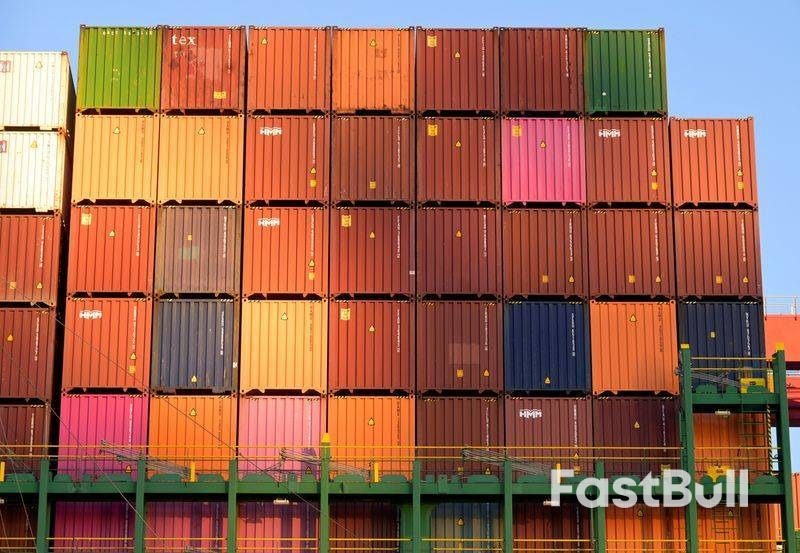
          German exporters do not want a deal at any price in the trade conflict with the United States, said Dirk Jandura, head of the BGA trade lobby.

          "Our interests must be reflected in an agreement with the U.S.," Jandura said on Thursday in Berlin. "We need a fair deal for the whole of Europe. It must not be concluded at any price."

          The European Commission aims to reach a trade agreement outline with the U.S. in the coming days, ahead of the August 1 deadline set by President Donald Trump for broad tariff increases.

          Jandura, President of the Federation of German Wholesale, Foreign Trade and Services (BGA), called for a stronger European single market to improve the EU's negotiating position and to cushion the economic impact of tariffs, alongside new trade agreements or the revision of existing ones.

          The U.S. was Germany's biggest trading partner in 2024 with two-way goods trade totalling 253 billion euros ($296.77 billion).

          Exports to the United States dropped 7.7% in May month on month, following a 10.5% decline in April, data showed on Tuesday.

          "The situation in foreign trade is dramatic and threatens to get worse," said Jandura. "The consequences of Trump's tariff policy are thus becoming ever clearer."

          Source: Yahoo Finance

          To stay updated on all economic events of today, please check out our Economic calendar
          Risk Warnings and Disclaimers
          You understand and acknowledge that there is a high degree of risk involved in trading. Following any strategies or investment methods may lead to potential losses. The content on the site is provided by our contributors and analysts for information purposes only. You are solely responsible for determining whether any trading assets, securities, strategy, or any other product is suitable for investing based on your own investment objectives and financial situation.
          Add to Favorites
          Share

          Vietnam Moves to Tighten Trade Rules After US Tariff Deal Amid Transshipment Concerns

          Gerik

          Economic

          Vietnam Responds to US Pressure with Regulatory Overhaul

          In the wake of a preliminary tariff agreement with the United States, Vietnam is preparing to enforce stricter trade compliance measures aimed at curbing illegal transshipment practices. A draft decree seen by Reuters outlines plans for increased penalties and inspection protocols, primarily targeting Chinese-origin goods suspected of bypassing US tariffs by re-entering global supply chains through Vietnam.
          This initiative is a direct outcome of recent negotiations between President Donald Trump and Vietnamese leader To Lam, resulting in a deal that reduces the threatened 46% US tariff on Vietnamese imports to 20%. However, goods found to be illegally transshipped through Vietnam will still face a punitive 40% levy, signaling that enforcement not just diplomacy will determine the agreement’s long-term success.

          Causal Relationship Between Trade Surges and Transshipment Concerns

          The US has repeatedly accused Vietnam of being a transshipment hub for Chinese goods attempting to avoid high US tariffs. These accusations are supported by trade data showing a near-synchronous surge in both Vietnamese exports to the US and Vietnamese imports from China since the start of the US-China trade war in 2018. By 2024, Vietnam’s exports and imports in this bilateral triangle both stood at approximately $140 billion.
          The correlation suggests that a significant share of Vietnam’s rising export volume may be composed of goods that underwent minimal transformation, raising questions about their compliance with rules of origin standards. Washington’s demand for clearer thresholds on value-added requirements reflects a push for Vietnam to decrease its reliance on Chinese components, especially in sectors such as electronics and machinery.

          Focus of Enforcement: Origin Fraud and Counterfeit Goods

          Vietnam’s new measures aim to address widespread concerns surrounding fraudulent certificates of origin and counterfeit imports. The July 3 trade ministry document lists key product categories under heightened scrutiny, including plywood, wooden furniture, steel parts, headphones, batteries, and bicycles. These goods have been flagged as high-risk due to their prior involvement in trade defense cases by the US and EU.
          Vietnamese authorities have already intensified inspections on US-bound exports and are preparing to regulate self-certification practices more strictly. Future updates to the draft decree are expected to include financial penalties and legal sanctions. The draft also outlines plans for more frequent on-site inspections and a revision of the certificate-of-origin issuing process to deter fraud.

          Legal Ambiguities and the Path to a Final Deal

          Despite the outlined enforcement intentions, significant legal ambiguities remain. The US has yet to define how it will determine illegal transshipment and how much domestic value addition is required to classify goods as legitimately Vietnamese. These details are crucial, as they will shape compliance expectations and enforcement frameworks on both sides of the deal.
          Sources familiar with the ongoing discussions indicate that Washington is pushing for Vietnam to localize more production processes and reduce dependency on upstream Chinese inputs. However, without clear value thresholds or finalized timelines, both businesses and regulators are navigating uncertain terrain.

          Vietnam’s Strategic Trade Balancing Act

          Vietnam’s actions illustrate a strategic attempt to preserve trade ties with the US, its largest export market, while carefully managing its industrial dependence on China. This balancing act reflects a broader regional challenge: how to navigate great power rivalries while maintaining export-led economic growth.
          By committing to stronger enforcement, Vietnam seeks to demonstrate alignment with US trade priorities without severing its deeply integrated supply chains with China. Whether these measures will satisfy US regulators or disrupt trade flows remains to be seen, but they mark a clear shift in Vietnam’s trade governance in the face of mounting geopolitical and economic pressure.
          Vietnam’s pending crackdown on trade fraud is not merely regulatory housekeeping it is a political and economic response to the evolving demands of its largest trading partner. As the final terms of the tariff deal remain under negotiation, the success of these reforms will depend on both legal clarity and Vietnam’s capacity to enforce new standards without destabilizing its export-driven economy.

          Source: Reuters

          To stay updated on all economic events of today, please check out our Economic calendar
          Risk Warnings and Disclaimers
          You understand and acknowledge that there is a high degree of risk involved in trading. Following any strategies or investment methods may lead to potential losses. The content on the site is provided by our contributors and analysts for information purposes only. You are solely responsible for determining whether any trading assets, securities, strategy, or any other product is suitable for investing based on your own investment objectives and financial situation.
          Add to Favorites
          Share

          S&P 500 Technical Analysis – Awaiting The US CPI for The Next Major Move

          Blue River

          Stocks

          Technical Analysis

          FundamentalOverview

          The S&P 500 continuesto be supported given the lack of bearish drivers. We haven’t got anymeaningful catalyst since the NFP report other than Trump’s tariff letters thatwere largely ignored by the market given that everyone expects them to be justthe usual negotiating tactic.

          Next week, we have the USCPI report and that could trigger some big moves in the market. To keep thetrend going, we would likely need soft inflation figures as a hot report mighttrigger a deeper pullback given the positioning.

          In the bigger picturethough, given that the Fed's reaction function remains to either wait more orcut, the market should eventually get back to its upward trend.

          S&P 500Technical Analysis – Daily Timeframe
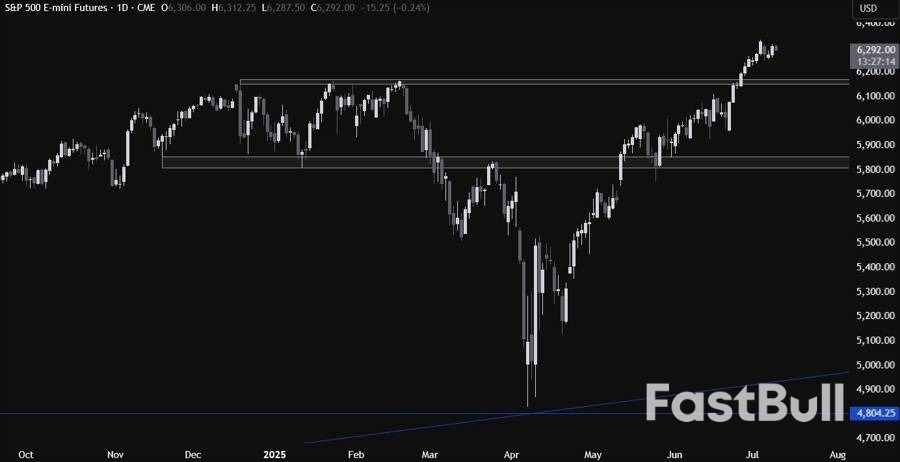
          S&P 500 Daily

          On the daily chart, we cansee that the S&P 500 is consolidating around the all-time highs after avery strong rally. From a risk management perspective, the buyers will have abetter risk to reward setup around the previous all-time high at 6,160-ishlevel to position for the continuation of the uptrend. The sellers, on theother hand, will want to see the price breaking lower to pile in for a dropinto the 6,000 level next.

          S&P 500 TechnicalAnalysis – 4 hour Timeframe
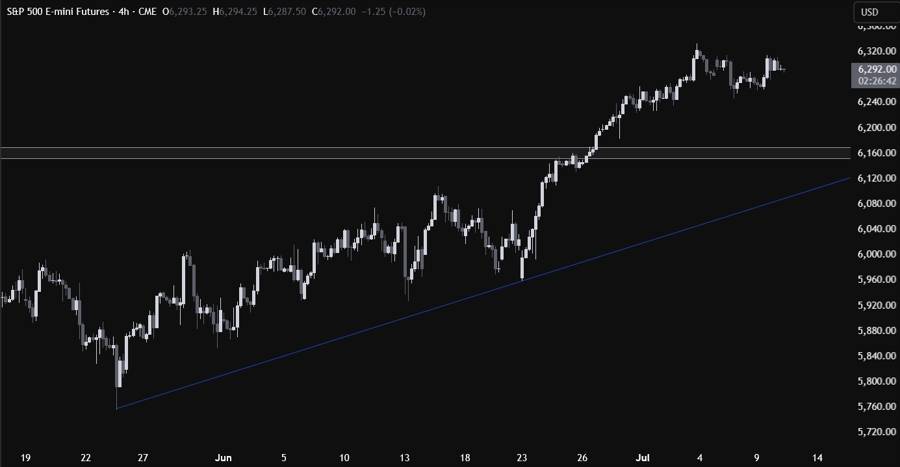
          S&P 500 4 hour

          On the 4 hour chart, we cansee that we have an upward trendline defining the uptrend. If we were toget a pullback all the way into the trendline, we can expect the dip-buyers tolean on it to position for a rally into new all-time highs with a better riskto reward setup. The sellers, on the other hand, will look for a break lower toincrease the bearish bets into the 5,800 level next.

          S&P 500 TechnicalAnalysis – 1 hour Timeframe
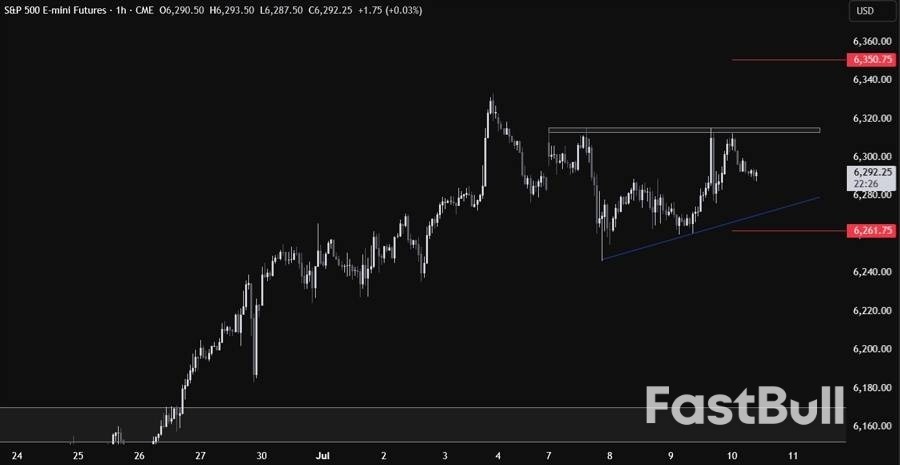
          S&P 500 1 hour

          On the 1 hour chart, we cansee that we have a minor resistance around the 6,315 level. The sellers willlikely continue to step in around the resistance with a defined risk above itto keep targeting a pullback into the 6,160 level. The buyers, on the otherhand, will look for a break higher to increase the bullish bets into newall-time highs.

          There’s also a minor upwardtrendline that can offer support for the dip-buyers, while the sellers willlikely increase the bearish bets into new lows on a breakout. The red linesdefine the average daily range for today.

          Source: ForexLive

          Risk Warnings and Disclaimers
          You understand and acknowledge that there is a high degree of risk involved in trading. Following any strategies or investment methods may lead to potential losses. The content on the site is provided by our contributors and analysts for information purposes only. You are solely responsible for determining whether any trading assets, securities, strategy, or any other product is suitable for investing based on your own investment objectives and financial situation.
          Add to Favorites
          Share

          European Telecom Firms Warn Against Deregulation Threatening Market Competition

          Gerik

          Economic

          Industry Opposition to Deregulatory Shift

          A coalition of European telecom operators has formally expressed concern over the European Commission’s recent proposal to ease regulation on fixed network infrastructure. In an open letter released on July 10, 2025, firms including Vodafone, Iliad, and 1&1 argued that the plan risks re-establishing monopolies by giving dominant national operators such as Deutsche Telekom in Germany unfair advantages. The proposal, they claim, undermines the EU’s longstanding competition principles and could severely constrain the growth of Europe’s fiber optic infrastructure.
          This resistance is rooted in the historical context of telecommunications in Europe, where former state-owned monopolies still control much of the essential network infrastructure. Under the current regulatory framework, these incumbents are obligated to provide access to competitors under regulated terms. The new plan would loosen these obligations, potentially eroding the competitive environment that smaller players depend on.

          Causal Risks to Fiber Optic Rollout and Market Balance

          The operators' criticism highlights a causal link between deregulation and reduced infrastructure access. If market leaders are no longer required to open their networks under fixed, transparent conditions, smaller telecom companies could find themselves locked out or forced to pay prohibitive access fees. This would not only reduce their competitiveness but also lead to underinvestment in rural or less profitable regions, where larger firms may not prioritize expansion.
          The letter frames this proposed policy change as a “step backwards,” suggesting that the relaxation of rules could lead to a form of structural re-monopolization. Rather than accelerating broadband rollout, as the EU may have intended, the policy could paradoxically stifle it by reducing competitive incentives for innovation and territorial expansion.

          Germany’s Policy Context and Broader Implications

          The timing of the letter is particularly significant, as it follows Germany's Bundestag decision earlier this month to pass legislation aimed at accelerating both fiber optic and mobile network growth. While the German law emphasizes speed and efficiency, the broader EU regulatory shift seems to threaten the competitive checks that made such expansion possible in the first place.
          The operators’ pushback underscores that regulatory flexibility should not come at the expense of equitable access. Without safeguards to prevent dominant firms from using their infrastructure advantages to block competitors, the overall quality, reach, and affordability of internet services across Europe could decline.
          As the EU considers loosening fixed network regulations, strong opposition from firms like Vodafone and Iliad signals deep industry concern over the potential re-emergence of monopolistic control. The current regulatory framework has fostered diversity and innovation by ensuring infrastructure access, particularly in the competitive broadband space. Weakening this model may offer short-term administrative relief but poses long-term threats to competition, consumer choice, and infrastructure development across the continent. The European Commission now faces a pivotal decision: whether to prioritize liberalization or uphold the regulatory foundations that have shaped Europe’s digital landscape.

          Source: Reuters

          To stay updated on all economic events of today, please check out our Economic calendar
          Risk Warnings and Disclaimers
          You understand and acknowledge that there is a high degree of risk involved in trading. Following any strategies or investment methods may lead to potential losses. The content on the site is provided by our contributors and analysts for information purposes only. You are solely responsible for determining whether any trading assets, securities, strategy, or any other product is suitable for investing based on your own investment objectives and financial situation.
          Add to Favorites
          Share

          Russian Attack On Kyiv Kills Two As US Resumes Arms Deliveries To Ukraine

          Daniel Carter

          Political

          Russia-Ukraine Conflict

          Escalating Russian attacks have strained Ukrainian air defences at a perilous moment in the war and forced thousands of people to seek bomb shelters overnight.
          "Residential buildings, vehicles, warehouse facilities, office and non-residential buildings are on fire," head of Kyiv's military administration, Tymur Tkachenko, said on the Telegram messaging app.
          Russia launched 18 missiles and around 400 drones in an attack which primarily targeted the capital Kyiv, according to Ukrainian President Volodymyr Zelenskiy.
          There was no comment from Moscow about the attack, which came a day after Russia launched a single-night record number of drones targeting its smaller neighbour in what Ukrainians describe as terror tactics.
          "Approaches to warfare changed a long time ago, and in its quest to break our society through terror, Russia has opted for combined strikes," the head of Ukrainian presidential office Andriy Yermak said.
          Russia says its attacks aim to degrade Ukraine's military. The Russian defence ministry said its own air defence units had destroyed 14 Ukrainian drones overnight, RIA state news agency reported.
          After U.S. President Donald Trump pledged earlier this week to send more defensive weapons to Kyiv, Washington was already delivering artillery shells and mobile rocket artillery missiles to Ukraine, two U.S. officials told Reuters on Wednesday.
          Zelenskiy held a "substantive" meeting on Wednesday with Trump's Ukraine envoy, Keith Kellogg, in Rome ahead of a Ukrainian recovery conference.
          On Thursday, he will hold more meetings with American officials to discuss the adoption of the next package of U.S. sanctions against Russia in the near future, according to the Ukrainian foreign minister.
          Trump has been growing increasingly frustrated with President Vladimir Putin, saying that the Russian leader was throwing a lot of "bullshit" at the U.S. efforts to end the war that Moscow launched against Ukraine in February 2022.
          U.S. Secretary of State Marco Rubio will meet with Russian Foreign Minister Sergei Lavrov on the sidelines of the ASEAN foreign ministers' meeting in Kuala Lumpur on Thursday, the U.S. State Department and Russia's foreign ministry said.
          The Russian attack on Kyiv on Thursday rattled the city with explosions, Reuters' witnesses said. Videos showed windows blown out, devastated facades and cars burned down. Ukrainian officials said that damage was reported in eight of the city's 10 districts.
          "I turned around and saw that the apartment was gone, and a fire had also broken out," said Karyna Volf, a 25-year-old Kyiv resident who rushed out of her place moments before shards of glass went flying.
          "This is terror, because it happens every night when people are asleep."
          Thick smoke covered parts of Kyiv, darkening the red hues of a sunrise over the city of three million, Reuters' witnesses reported. Air raids in the capital lasted more than four hours, according to Ukraine's air force data.
          Closer to the battle zone, a Russian air strike killed three people and injured one late on Wednesday in the front-line town of Kostiantynivka in Ukraine's east, the national emergency services said.

          Source: Reuters

          Risk Warnings and Disclaimers
          You understand and acknowledge that there is a high degree of risk involved in trading. Following any strategies or investment methods may lead to potential losses. The content on the site is provided by our contributors and analysts for information purposes only. You are solely responsible for determining whether any trading assets, securities, strategy, or any other product is suitable for investing based on your own investment objectives and financial situation.
          Add to Favorites
          Share

          Fresh Tariff Games Are Leaving Small Businesses Dazed

          Glendon

          Economic

          President Donald Trump’s latest extension of tariff negotiations once again stretches out the policy limbo that US businesses are being forced to endure. In a flurry of letters this week, Trump effectively kicked the can on his much-hyped July 9 “reciprocal tariff” deadline until Aug. 1. In other words, Trump wants nations to come forward with concessions by that date. Meanwhile, American businesses and consumers are already juggling current levies that are up some 11 percentage points to around 13% on average.

          Who will pay the price for Trump’s destructive policy and this persistent uncertainty? Odds are decent that the titans of the US stock market will adapt, but the nation’s small businesses could suffer lasting damage.

          Small businesses, which collectively employ about half of America’s private workforce, account for about a third of the value of goods imported into the US. They include many wholesalers, some manufacturers and companies operating in a variety of other industries. (Here I define small businesses as those with fewer than 500 workers, but this group includes very small companies too, such as the 94,000 importers with just 1-19 employees.)

          Unlike the publicly traded giants who can often secure a private audience at Mar-a-Lago or at least have officials lobby on their behalf, small businesses have neither the policy influence, the negotiating leverage with suppliers, nor the fat profit margins to weather large cost increases and haphazard policy implementation. So while tariffs and trade uncertainty haven’t held back the S&P 500 Index or had an obvious impact (yet) on the consumer price index, one plausible thesis is that small businesses will take the brunt of the blow.

          Some of the more sobering evidence comes from surveys. Around 44% of small and medium-sized businesses say their revenues are taking a hit, according to the latest wave of a study from Alignable and researchers at the Massachusetts Institute of Technology and Harvard Business School. The National Federation of Independent Business’ monthly survey, whose small-business respondents always seem to perk up when a Republican is in office, has seen optimism swoon in 2025 (though it’s still up a lot from before Trump’s election win). Just a net 7% expect higher real sales volumes, versus 22% in December, while a net 32% plan to increase prices, the most since March 2024.

          Admittedly, survey interpretation can be tricky in our age of partisan politics and social media silos, and other data seem to paint a picture of a small business ecosystem that’s hanging in there for now, but clearly not firing on all cylinders.

          The Paychex Small Business Employment Watch jobs index — which focuses on businesses with under 50 workers — slipped slightly to 99.65 in June, the lowest since 2021, with values under 100 signaling that jobs are being shed. That index was consistent with similar data from the ADP National Employment Report, which showed that those under-50-employee businesses shed 47,000 jobs in June, the most since March 2022, even as larger firms continued to grow. Small business employment has mostly been treading water for a few years now, and the risk is that the tariff upheaval will turn a tenuous yet stable situation into a downright bad one with layoffs and business closures.

          For now, earnings are still in decent shape. Using proprietary internal bank data, Bank of America Institute researchers use the account inflow-to-outflow ratio as a proxy for small-business profitability, and they found that the ratio has been above 1 for most of 2025. However, the study also noted that in the subset of companies that themselves pay tariffs directly to Customs and Border Protection, those payments have soared.

          Like it or not, Trump appears to view all the uncertainty — the rolling deadlines, constantly changing tariff rates and blustery social media posts — as part of his negotiating strategy. Investors on Wall Street seem to be assuming, at this point, that the ultimate tariffs probably won’t be quite as bad as his threats (i.e., on the final accounting, they may “only” be as bad as the 1930s, rather than the 1890s). In the near-term, levies will probably go up as product-level investigations are completed and deadlines pass, but no one should be taking the bluster at face value, appears to be the calculus. And many of the levies are so intrinsically temporary that — worst comes to worst — they’ll never outlast the Trump administration itself, if they even make it past the 2026 midterm election.

          But that’s cold comfort to small business owners, who oftentimes find themselves operating with no more than one month’s cash buffer held in reserve. To them, the existing tariffs and the months of uncertainty are a near-and-present danger, and Trump is playing with fire each time he draws it all out for another month.

          Source: Bloomberg Europe

          To stay updated on all economic events of today, please check out our Economic calendar
          Risk Warnings and Disclaimers
          You understand and acknowledge that there is a high degree of risk involved in trading. Following any strategies or investment methods may lead to potential losses. The content on the site is provided by our contributors and analysts for information purposes only. You are solely responsible for determining whether any trading assets, securities, strategy, or any other product is suitable for investing based on your own investment objectives and financial situation.
          Add to Favorites
          Share

          Japan’s 20-Year Bond Auction Steadies Amid Pre-Election Fiscal Anxiety

          Gerik

          Economic

          Auction Metrics Suggest Stability, But Caution Persists

          The 20-year Japanese government bond (JGB) auction held on July 10, 2025, delivered a muted but stable result. The bid-to-cover ratio stood at 3.15 below the annual average, yet the highest since March while the auction’s tail narrowed to 0.18, marking its tightest level since January. These figures suggest that demand, while not robust, showed signs of resilience. Yields remained steady at 2.51%, following a 2.5 basis point decline prior to the auction, and bond futures ticked higher, reflecting modest confidence.
          The Ministry of Finance has subtly reduced the issuance of long-duration bonds in recent months, aiming to temper volatility in the super-long end of the curve. This reduction in supply, coupled with more attractive yield levels and temporary yield curve stabilization, made conditions more palatable for buyers. However, investors remain on alert, especially with Japan's Upper House election scheduled for July 20, where pledges for fiscal stimulus or tax cuts could significantly alter debt dynamics.

          Investor Sentiment Anchored by Election Risks and Policy Direction

          Though the auction's outcome did not raise immediate alarm, underlying unease among bond investors remains rooted in the nation’s ballooning debt and shifting political landscape. The causal concern lies in the prospect of post-election fiscal expansion, which could prompt higher bond issuance and upward pressure on yields. This sentiment was echoed by Meiji Yasuda Life Insurance Co., which publicly stated its intention to refrain from increasing exposure to super-long JGBs over the next two years due to the risk of rising interest rates and supply increases.
          This apprehension comes at a moment when the Bank of Japan historically the largest JGB holder is gradually stepping back from aggressive bond purchases. The anticipated reduction in central bank support introduces a structural shift in the bond market’s demand side, leaving longer-dated maturities more vulnerable to external sentiment and political developments.

          Foreign Influences and Comparative Pressure from Global Markets

          Japan’s bond market tension is not occurring in isolation. Sovereign yields globally have been trending higher, with the US 30-year Treasury yield approaching the 5% mark earlier this week. Fiscal sustainability fears mirrored in the US after a 10-year auction revealed strong demand are increasingly defining yield curve movements. While Japanese yields remain low by comparison, the international context reinforces domestic caution. Any perception that Japan may follow a path of expansive fiscal policy could push investors to reprice long-term risk more aggressively.
          Moreover, the upcoming election coincides with fresh 25% US tariffs set for August 1, imposed by President Donald Trump. The dual impact of trade uncertainty and fiscal stimulus risks places added strain on investor outlooks. US Treasury Secretary Scott Bessent’s remarks about “domestic constraints” tied to the Japanese vote underscore the broader geopolitical implications of the current fiscal stance.

          Auction Participants Indicate Support, But Not Full Conviction

          A partial breakdown of winning bidders reveals Nomura Securities Co. securing over 16% of the bonds, followed by Mitsubishi UFJ Morgan Stanley Securities Co. with just above 11%. These large allocations suggest that domestic institutions, particularly those aligned with long-term liability structures, continue to provide foundational support for JGBs. However, the absence of broader participation from foreign investors and cautious tones from major insurers temper the overall optimism.
          Market strategist Ken Matsumoto from Crédit Agricole assessed the situation as contained for now, suggesting that 30-year yields around 3% remain within a justifiable range, though a move toward 4% appears unlikely in the near term. Still, this assessment hinges on the assumption that post-election policies will not introduce unexpected fiscal shocks a condition far from guaranteed.
          Japan’s latest 20-year bond auction delivered a surface-level stability that belies deeper structural and political uncertainties. With a pivotal election just days away, and fiscal promises likely to define future debt trajectories, investors remain in a holding pattern. While auction metrics signal momentary calm, the market’s longer-term stability depends on both the evolution of Japan’s political leadership and the government’s ability to manage its debt without overburdening an already fragile demand base for super-long securities.

          Source: Reuters

          To stay updated on all economic events of today, please check out our Economic calendar
          Risk Warnings and Disclaimers
          You understand and acknowledge that there is a high degree of risk involved in trading. Following any strategies or investment methods may lead to potential losses. The content on the site is provided by our contributors and analysts for information purposes only. You are solely responsible for determining whether any trading assets, securities, strategy, or any other product is suitable for investing based on your own investment objectives and financial situation.
          Add to Favorites
          Share
          FastBull
          Copyright © 2025 FastBull Ltd

          728 RM B 7/F GEE LOK IND BLDG NO 34 HUNG TO RD KWUN TONG KLN HONG KONG

          TelegramInstagramTwitterfacebooklinkedin
          App Store Google Play Google Play
          Products
          Charts

          Chats

          Q&A with Experts
          Screeners
          Economic Calendar
          Data
          Tools
          Membership
          Features
          Function
          Markets
          Copy Trading
          Latest Signals
          Contests
          News
          Analysis
          24/7
          Columns
          Education
          Company
          Careers
          About Us
          Contact Us
          Advertising
          Help Center
          Feedback
          User Agreement
          Privacy Policy
          Business

          White Label

          Data API

          Web Plug-ins

          Poster Maker

          Affiliate Program

          Risk Disclosure

          The risk of loss in trading financial instruments such as stocks, FX, commodities, futures, bonds, ETFs and crypto can be substantial. You may sustain a total loss of the funds that you deposit with your broker. Therefore, you should carefully consider whether such trading is suitable for you in light of your circumstances and financial resources.

          No decision to invest should be made without thoroughly conducting due diligence by yourself or consulting with your financial advisors. Our web content might not suit you since we don't know your financial conditions and investment needs. Our financial information might have latency or contain inaccuracy, so you should be fully responsible for any of your trading and investment decisions. The company will not be responsible for your capital loss.

          Without getting permission from the website, you are not allowed to copy the website's graphics, texts, or trademarks. Intellectual property rights in the content or data incorporated into this website belong to its providers and exchange merchants.

          Not Logged In

          Log in to access more features

          FastBull Membership

          Not yet

          Purchase

          Become a signal provider
          Help Center
          Customer Service
          Dark Mode
          Price Up/Down Colors

          Log In

          Sign Up

          Position
          Layout
          Fullscreen
          Default to Chart
          The chart page opens by default when you visit fastbull.com
