• Trade
  • Markets
  • Copy
  • Contests
  • News
  • 24/7
  • Calendar
  • Q&A
  • Chats
Trending
Screeners
SYMBOL
LAST
BID
ASK
HIGH
LOW
NET CHG.
%CHG.
SPREAD
SPX
S&P 500 Index
6827.42
6827.42
6827.42
6899.86
6801.80
-73.58
-1.07%
--
DJI
Dow Jones Industrial Average
48458.04
48458.04
48458.04
48886.86
48334.10
-245.98
-0.51%
--
IXIC
NASDAQ Composite Index
23195.16
23195.16
23195.16
23554.89
23094.51
-398.69
-1.69%
--
USDX
US Dollar Index
97.950
98.030
97.950
98.500
97.950
-0.370
-0.38%
--
EURUSD
Euro / US Dollar
1.17394
1.17409
1.17394
1.17496
1.17192
+0.00011
+ 0.01%
--
GBPUSD
Pound Sterling / US Dollar
1.33707
1.33732
1.33707
1.33997
1.33419
-0.00148
-0.11%
--
XAUUSD
Gold / US Dollar
4299.39
4299.39
4299.39
4353.41
4257.10
+20.10
+ 0.47%
--
WTI
Light Sweet Crude Oil
57.233
57.485
57.233
58.011
56.969
-0.408
-0.71%
--

Community Accounts

Signal Accounts
--
Profit Accounts
--
Loss Accounts
--
View More

Become a signal provider

Sell trading signals to earn additional income

View More

Guide to Copy Trading

Get started with ease and confidence

View More

Signal Accounts for Members

All Signal Accounts

Best Return
  • Best Return
  • Best P/L
  • Best MDD
Past 1W
  • Past 1W
  • Past 1M
  • Past 1Y

All Contests

  • All
  • Trump Updates
  • Recommend
  • Stocks
  • Cryptocurrencies
  • Central Banks
  • Featured News
Top News Only
Share

Thai Leader Anutin: Landmine Blast That Killed Thai Soldiers 'Not A Roadside Accident'

Share

Thai Leader Anutin: Thailand To Continue Military Action Until 'We Feel No More Harm'

Share

Cambodian Prime Minister Hun Manet Says He Had Phone Calls With Trump And Malaysian Leader Anwar About Ceasefire

Share

Cambodia's Hun Manet Says USA, Malaysia Should Verify 'Which Side Fired First' In Latest Conflict

Share

Cambodia's Hun Manet: Cambodia Maintains Its Stance In Seeking Peaceful Resolution Of Disputes

Share

Nasdaq Companies: Allergan, Ferrovia, Insmed, Monolithic Power Systems, Seagate Technology, And Western Digital Will Be Added To The NASDAQ 100 Index. Biogen, CdW, GlobalFoundries, Lululemon, ON Semiconductor, And Tradedesk Will Be Removed From The NASDAQ 100 Index

Share

Witkoff Headed To Berlin This Weekend To Meet With Zelenskiy, European Leaders -Wsj Reporter On X

Share

Russia Attacks Two Ukrainian Ports, Damaging Three Turkish-Owned Vessels

Share

[Historic Flooding Occurs In At Least Four Rivers In Washington State Due To Days Of Torrential Rains] Multiple Areas In Washington State Have Been Hit By Severe Flooding Due To Days Of Torrential Rains, With At Least Four Rivers Experiencing Historic Flooding. Reporters Learned On The 12th That The Floods Caused By The Torrential Rains In Washington State Have Destroyed Homes And Closed Several Highways. Experts Warn That Even More Severe Flooding May Occur In The Future. A State Of Emergency Has Been Declared In Washington State

Share

Trump Says Proposed Free Economic Zone In Donbas Would Work

Share

Trump: I Think My Voice Should Be Heard

Share

Trump Says Will Be Choosing New Fed Chair In Near Future

Share

Trump Says Proposed Free Economic Zone In Donbas Complex But Would Work

Share

Trump Says Land Strikes In Venezuela Will Start Happening

Share

US President Trump: Thailand And Cambodia Are In A Good Situation

Share

State Media: North Korean Leader Kim Hails Troops Returning From Russia Mission

Share

The 10-year Treasury Yield Rose About 5 Basis Points During The "Fed Rate Cut Week," And The 2/10-year Yield Spread Widened By About 9 Basis Points. On Friday (December 12), In Late New York Trading, The Yield On The Benchmark 10-year US Treasury Note Rose 2.75 Basis Points To 4.1841%, A Cumulative Increase Of 4.90 Basis Points For The Week, Trading Within A Range Of 4.1002%-4.2074%. It Rose Steadily From Monday To Wednesday (before The Fed Announced Its Rate Cut And Treasury Bill Purchase Program), Subsequently Exhibiting A V-shaped Recovery. The 2-year Treasury Yield Fell 1.82 Basis Points To 3.5222%, A Cumulative Decrease Of 3.81 Basis Points For The Week, Trading Within A Range Of 3.6253%-3.4989%

Share

Trump: Lots Of Progress Being Made On Russia-Ukraine

Share

NOPA November US Soybean Crush Estimated At 220.285 Million Bushels

Share

SPDR Gold Trust Reports Holdings Up 0.22%, Or 2.28 Tonnes, To 1053.11 Tonnes By Dec 12

TIME
ACT
FCST
PREV
U.K. Trade Balance Non-EU (SA) (Oct)

A:--

F: --

P: --

U.K. Trade Balance (Oct)

A:--

F: --

P: --

U.K. Services Index MoM

A:--

F: --

P: --

U.K. Construction Output MoM (SA) (Oct)

A:--

F: --

P: --

U.K. Industrial Output YoY (Oct)

A:--

F: --

P: --

U.K. Trade Balance (SA) (Oct)

A:--

F: --

P: --

U.K. Trade Balance EU (SA) (Oct)

A:--

F: --

P: --

U.K. Manufacturing Output YoY (Oct)

A:--

F: --

P: --

U.K. GDP MoM (Oct)

A:--

F: --

P: --

U.K. GDP YoY (SA) (Oct)

A:--

F: --

P: --

U.K. Industrial Output MoM (Oct)

A:--

F: --

P: --

U.K. Construction Output YoY (Oct)

A:--

F: --

P: --

France HICP Final MoM (Nov)

A:--

F: --

P: --

China, Mainland Outstanding Loans Growth YoY (Nov)

A:--

F: --

P: --

China, Mainland M2 Money Supply YoY (Nov)

A:--

F: --

P: --

China, Mainland M0 Money Supply YoY (Nov)

A:--

F: --

P: --

China, Mainland M1 Money Supply YoY (Nov)

A:--

F: --

P: --

India CPI YoY (Nov)

A:--

F: --

P: --

India Deposit Gowth YoY

A:--

F: --

P: --

Brazil Services Growth YoY (Oct)

A:--

F: --

P: --

Mexico Industrial Output YoY (Oct)

A:--

F: --

P: --

Russia Trade Balance (Oct)

A:--

F: --

P: --

Philadelphia Fed President Henry Paulson delivers a speech
Canada Building Permits MoM (SA) (Oct)

A:--

F: --

P: --

Canada Wholesale Sales YoY (Oct)

A:--

F: --

P: --

Canada Wholesale Inventory MoM (Oct)

A:--

F: --

P: --

Canada Wholesale Inventory YoY (Oct)

A:--

F: --

P: --

Canada Wholesale Sales MoM (SA) (Oct)

A:--

F: --

P: --

Germany Current Account (Not SA) (Oct)

A:--

F: --

P: --

U.S. Weekly Total Rig Count

A:--

F: --

P: --

U.S. Weekly Total Oil Rig Count

A:--

F: --

P: --

Japan Tankan Large Non-Manufacturing Diffusion Index (Q4)

--

F: --

P: --

Japan Tankan Small Manufacturing Outlook Index (Q4)

--

F: --

P: --

Japan Tankan Large Non-Manufacturing Outlook Index (Q4)

--

F: --

P: --

Japan Tankan Large Manufacturing Outlook Index (Q4)

--

F: --

P: --

Japan Tankan Small Manufacturing Diffusion Index (Q4)

--

F: --

P: --

Japan Tankan Large Manufacturing Diffusion Index (Q4)

--

F: --

P: --

Japan Tankan Large-Enterprise Capital Expenditure YoY (Q4)

--

F: --

P: --

U.K. Rightmove House Price Index YoY (Dec)

--

F: --

P: --

China, Mainland Industrial Output YoY (YTD) (Nov)

--

F: --

P: --

China, Mainland Urban Area Unemployment Rate (Nov)

--

F: --

P: --

Saudi Arabia CPI YoY (Nov)

--

F: --

P: --

Euro Zone Industrial Output YoY (Oct)

--

F: --

P: --

Euro Zone Industrial Output MoM (Oct)

--

F: --

P: --

Canada Existing Home Sales MoM (Nov)

--

F: --

P: --

Euro Zone Total Reserve Assets (Nov)

--

F: --

P: --

U.K. Inflation Rate Expectations

--

F: --

P: --

Canada National Economic Confidence Index

--

F: --

P: --

Canada New Housing Starts (Nov)

--

F: --

P: --

U.S. NY Fed Manufacturing Employment Index (Dec)

--

F: --

P: --

U.S. NY Fed Manufacturing Index (Dec)

--

F: --

P: --

Canada Core CPI YoY (Nov)

--

F: --

P: --

Canada Manufacturing Unfilled Orders MoM (Oct)

--

F: --

P: --

Canada Manufacturing New Orders MoM (Oct)

--

F: --

P: --

Canada Core CPI MoM (Nov)

--

F: --

P: --

Canada Manufacturing Inventory MoM (Oct)

--

F: --

P: --

Canada CPI YoY (Nov)

--

F: --

P: --

Canada CPI MoM (Nov)

--

F: --

P: --

Canada CPI YoY (SA) (Nov)

--

F: --

P: --

Canada Core CPI MoM (SA) (Nov)

--

F: --

P: --

Q&A with Experts
    • All
    • Chatrooms
    • Groups
    • Friends
    Connecting
    .
    .
    .
    Type here...
    Add Symbol or Code

      No matching data

      All
      Trump Updates
      Recommend
      Stocks
      Cryptocurrencies
      Central Banks
      Featured News
      • All
      • Russia-Ukraine Conflict
      • Middle East Flashpoint
      • All
      • Russia-Ukraine Conflict
      • Middle East Flashpoint
      Search
      Products

      Charts Free Forever

      Chats Q&A with Experts
      Screeners Economic Calendar Data Tools
      Membership Features
      Data Warehouse Market Trends Institutional Data Policy Rates Macro

      Market Trends

      Market Sentiment Order Book Forex Correlations

      Top Indicators

      Charts Free Forever
      Markets

      News

      News Analysis 24/7 Columns Education
      From Institutions From Analysts
      Topics Columnists

      Latest Views

      Latest Views

      Trending Topics

      Top Columnists

      Latest Update

      Signals

      Copy Rankings Latest Signals Become a signal provider AI Rating
      Contests
      Brokers

      Overview Brokers Assessment Rankings Regulators News Claims
      Broker listing Forex Brokers Comparison Tool Live Spread Comparison Scam
      Q&A Complaint Scam Alert Videos Tips to Detect Scam
      More

      Business
      Events
      Careers About Us Advertising Help Center

      White Label

      Data API

      Web Plug-ins

      Affiliate Program

      Awards Institution Evaluation IB Seminar Salon Event Exhibition
      Vietnam Thailand Singapore Dubai
      Fans Party Investment Sharing Session
      FastBull Summit BrokersView Expo
      Recent Searches
        Top Searches
          Markets
          News
          Analysis
          User
          24/7
          Economic Calendar
          Education
          Data
          • Names
          • Latest
          • Prev

          View All

          No data

          Scan to Download

          Faster Charts, Chat Faster!

          Download App
          English
          • English
          • Español
          • العربية
          • Bahasa Indonesia
          • Bahasa Melayu
          • Tiếng Việt
          • ภาษาไทย
          • Français
          • Italiano
          • Türkçe
          • Русский язык
          • 简中
          • 繁中
          Open Account
          Search
          Products
          Charts Free Forever
          Markets
          News
          Signals

          Copy Rankings Latest Signals Become a signal provider AI Rating
          Contests
          Brokers

          Overview Brokers Assessment Rankings Regulators News Claims
          Broker listing Forex Brokers Comparison Tool Live Spread Comparison Scam
          Q&A Complaint Scam Alert Videos Tips to Detect Scam
          More

          Business
          Events
          Careers About Us Advertising Help Center

          White Label

          Data API

          Web Plug-ins

          Affiliate Program

          Awards Institution Evaluation IB Seminar Salon Event Exhibition
          Vietnam Thailand Singapore Dubai
          Fans Party Investment Sharing Session
          FastBull Summit BrokersView Expo

          German CPI confirmed at 2.0%, euro drifting, FOMC split over cuts

          Adam

          Economic

          Summary:

          German inflation slowed to 2.0% in June, aligning with ECB’s target as energy and food prices fell, while services inflation stayed high. The euro drifted slightly higher, as markets eyed Fed rate cut uncertainty and split FOMC views.
          The euro continues to have a quiet week and is drifting for a third consecutive day. In the European session, EUR/USD is trading at 1.1730, up 0.09% on the day.

          German inflation dips to 2% as food, energy prices fall

          German inflation rose 2.0% y/y in June, in line with the consensus and a drop lower than the 2.1% gain recorded in the past two months. The drop in CPI was driven by declines in energy and food prices. However, service prices remain high and continue to fuel inflation. Monthly, inflation was flat, in line with the consensus and a touch lower than the 0.1% gain in May.
          The annual inflation rate of 2.0% is the lowest level since October 2024. The inflation rate is right at the ECB's target but Bank policymakers know that the tough battle against inflation isn't over.
          Services inflation has been persistently above the 2% target and the newest headache for the ECB is the rapid appreciation of the euro, which has skyrocketed some 14% against the US dollar this year. The euro's rise has kept a lid on import prices and dampened inflation, but if the euro continues to rise, it will hurt the struggling export sector.
          The ECB lowered the deposit rate in June by a quarter-point to 2.0%, its lowest level since October 2022. If next week's eurozone inflation report indicates that inflation is heading lower, expectations will rise for a rate cut at the July 24 meeting.

          FOMC minutes: members split over much to cut

          The FOMC minutes from the June meeting were dovish in the sense that there is a broad consensus that the Fed will deliver additional rate cuts this year. The pace of those cuts, however, is up for debate. The minutes noted that some members favored cutting as soon as the July meeting, while others were more cautious and wanted to see where inflation and employment were headed. President Trump's tariffs have not boosted inflation so far, but the tariff effect on inflation could be felt in the following months.

          EURUSD Technical

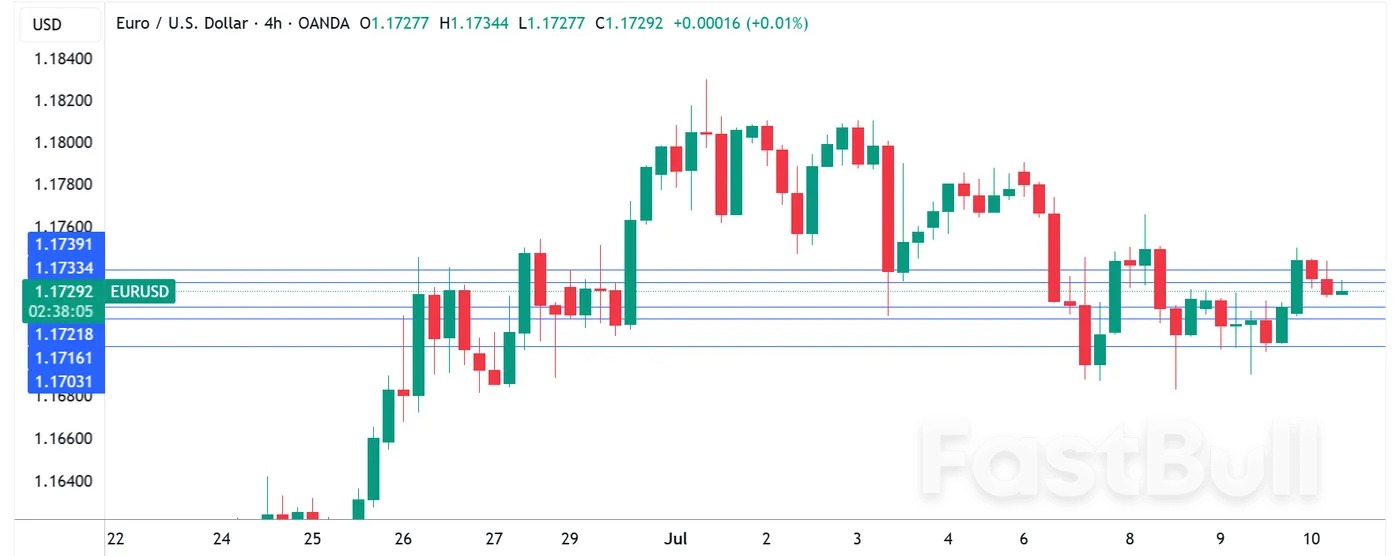
          EUR/USD has pushed above resistance at 1.1721 and is testing resistance at 1.1733. Above, there is resistance at 1.1739
          1.1715 and 1.1703 are the next support levels
          German CPI confirmed at 2.0%, euro drifting, FOMC split over cuts_1

          EURUSD 4-Hour Chart, July 9, 2025

          Source: marketpulse

          To stay updated on all economic events of today, please check out our Economic calendar
          Risk Warnings and Disclaimers
          You understand and acknowledge that there is a high degree of risk involved in trading. Following any strategies or investment methods may lead to potential losses. The content on the site is provided by our contributors and analysts for information purposes only. You are solely responsible for determining whether any trading assets, securities, strategy, or any other product is suitable for investing based on your own investment objectives and financial situation.
          Add to Favorites
          Share

          Looming UK Debt Crisis Will Make Truss Fallout a "Tea Party"

          Warren Takunda

          Economic

          Bond markets are prodding and testing the UK's debt markets, similar to the tremors that arrive before a major volcanic eruption.
          "Bond Vigilantes are losing patience with populist politicians who can't seem to do basic fiscal arithmetic. They are casting around for a scapegoat and it is increasingly clear that the UK may well be first to be hit full on," says Albert Edwards, an economist at Société Générale.
          Last Wednesday the UK suffered a bond selloff as investors questioned the sustainability of the UK's debt trajectory. We saw a similar episode in January, when it became clear UK growth was going to disappoint, despit the huge boost to public spending announced by the new Chancellor, Rachel Reeves, in October of 2024.
          The episodes were mini versions of the market fallout that followed Liz Truss's famed 2022 'mini budget'.
          "In retrospect, the Liz Truss budget debacle back in September 2022 might seem like a tea-party compared to what is coming down the line," he adds.
          Looming UK Debt Crisis Will Make Truss Fallout a "Tea Party"_1

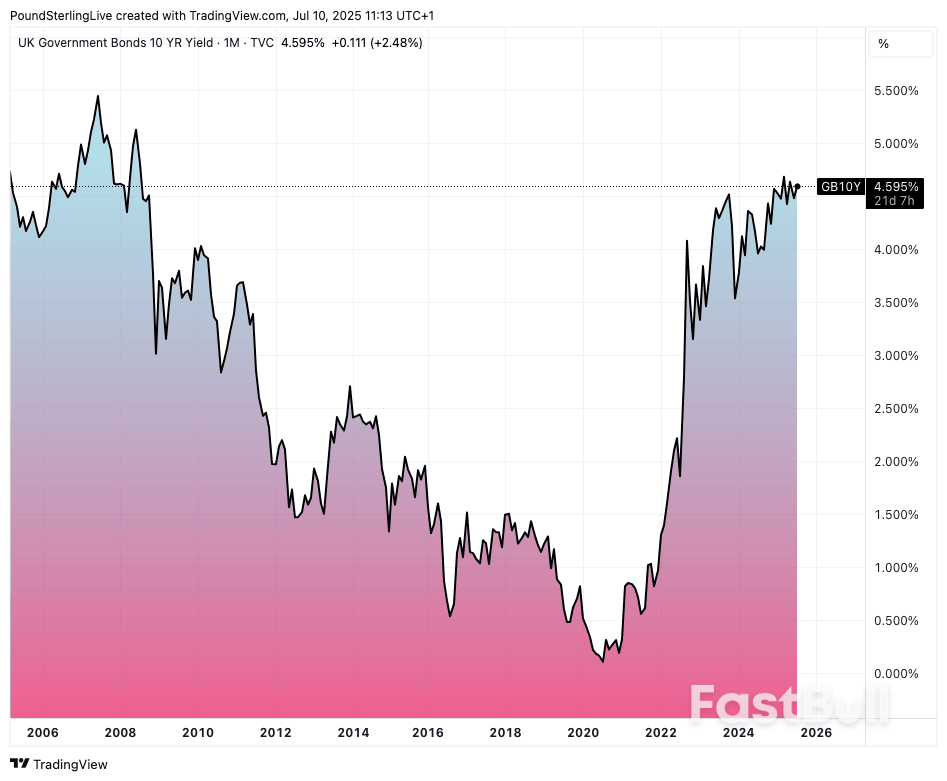
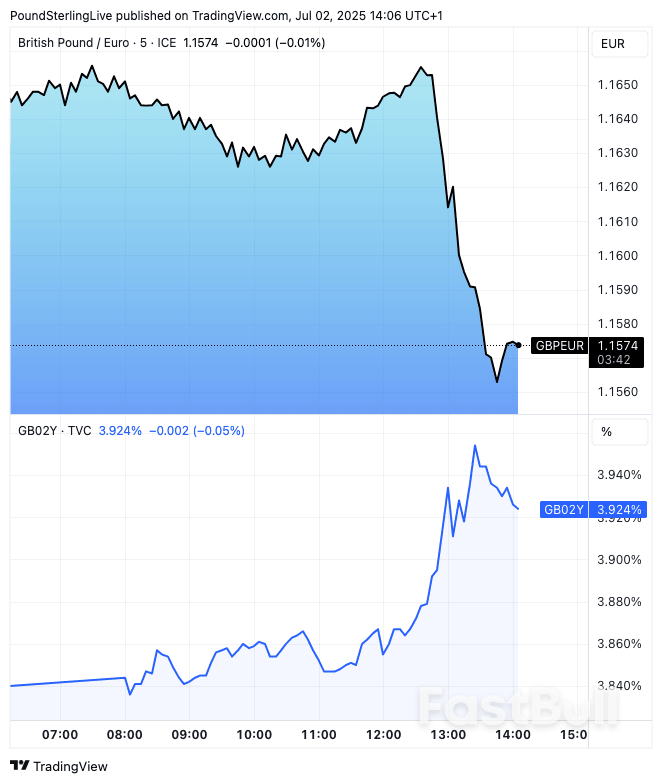
          Above: Price action from Wednesday July 02. Bond yields up (lower panel) and GBP down. Usually GBP would rise when gilts rise. When this breakdown in correlation happens it signals an unease over UK debt sustainability.

          An eruption is getting closer, and the warnings are becoming louder and more frequent. The Office for Budget Responsibility this week focused minds when it stated "the risks to the fiscal outlook are mounting."
          UK debt yields are rising, particularly on long-dated debt issuance, such as the ten-year and 30-year. This is being driven by rising term premium, which in financial speak is simply the premium investors demand to account for rising fears that the government won't be able to honour that debt at some point in future years.
          Edwards, who is a chief global strategist at Soc Gen, has been an economist in the City of London for over 40 years, which means he knows that the decade of ultra-low interest rates that followed the 2008 financial crisis was an anomaly.
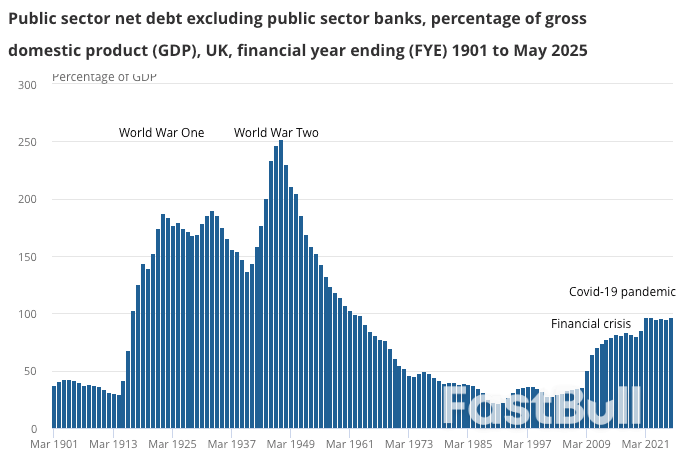
          That decade allowed governments to become spendthrift and pay lip service to debt sustainability. But the return of inflation means interest rates are resetting close to historical levels, putting significant pressure on governments that haven't adjusted to the new reality.Looming UK Debt Crisis Will Make Truss Fallout a "Tea Party"_2

          Above: The cost of debt is rising.

          The current left-wing Labour Government is particularly unsuited to meet the needs of the new reality.
          "Successive humiliating U-turns by the UK government as it struggles to get welfare cuts through parliament despite its massive majority really has placed the UK Gilt market dead centre in the crosshairs," says Edwards.
          Prime Minister Keir Starmer last week had to abandon an effort to trim the growth in the UK's runaway benefits bill.
          More and more working-age people in the UK are signing up for out-of-work benefits, with the Personal Independence Payment (PIP) being the main gateway. This allows those with a wide ranging set of ailments, including acne, anxiety and ADHD, to 'sign on'.
          As a result of the government's generosity, the Centre for Social Justice, a think tank, says jobless Universal Credit claimants who also receive PIP will receive £25,000 next year, while a worker on minimum pay will, after tax and NI, only receive £22,500.
          Looming UK Debt Crisis Will Make Truss Fallout a "Tea Party"_3
          But the biggest component of the welfare bill is the state pension, which continues to grow in real terms thanks to the Triple Lock guarantee that was designed to ensure pensioners are left better off year after year. It is something the OBR is particularly concerned about.
          "Having witnessed the debacle of the UK budget arithmetic, the Bond Vigilantes are now voting with their feet. Who can blame them? This week’s report from the Office of Budget Responsibility (the UK’s fiscal overlord) makes for disturbing reading," says Edwards.
          Yet, the UK's debt dynamics are not as bad as those of the U.S., France and Japan. So why the focus on Britain?
          Each of those three examples has some sort of special dispensation, which the UK doesn't:
          The U.S. has the exorbitant privilege of issuing the U.S. Dollar, the world's global currency.France is wrapped tightly in the Eurozone, which is dominated by Germany, a fiscally more austere country. The ECB also provides a formidable backstop, similar to that the U.S.Federal Reserve offers the Dollar.Japan has the highest debt-to-GDP ratio of the developed world, yet it runs current account surpluses, meaning it is a net saver.
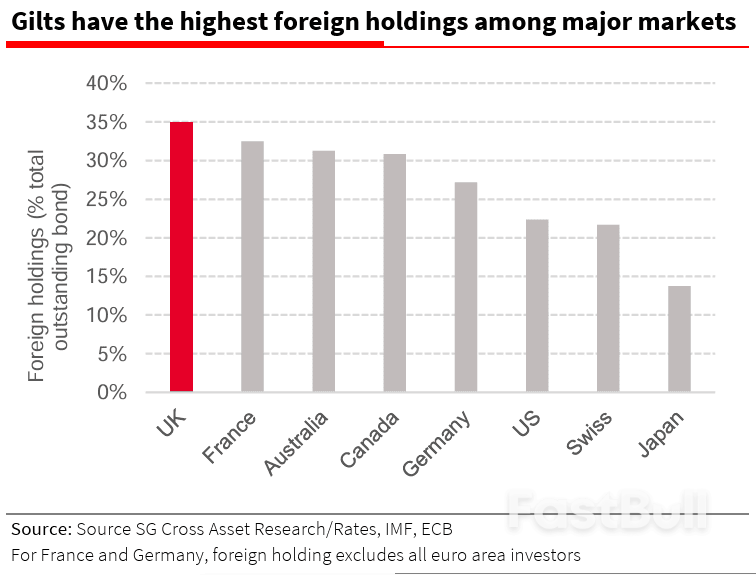
          The UK is none of the above. Bond specialists say the UK Gilt market is noticeably more vulnerable to the fickleness of foreign investors than most other government bond markets because foreigners make up a decent chunk of the UK debt customer base.
          Looming UK Debt Crisis Will Make Truss Fallout a "Tea Party"_4

          Image courtesy of Societe Generale.

          Are there any routes available to the UK other than massively cutting spending? No, says Edwards:
          "All the UK has left in its armoury is the ability to either:back away from QT (but it was the BoE announcement of aggressive QT the day before Liz Truss’s Sept 2022 budget that likely triggered the Gilt market rout as much as the expansionary budget itself), ordo more of what the US Treasury and BoJ have been doing - twisting issuance away from the long end (see right chart above). But for me, that would be symptomatic of an overindebted EM country shuffling the fiscal deckchairs on a sinking Titanic. Delay is not a solution."
          "I don’t want to be melodramatic here," he adds, "but I think Bill Gross may have been right about the UK Gilt market sitting on a bed of nitroglycerine, some 15 years on from his original pronouncement. The Bond Vigilantes are angry, and having identified the UK Gilt market as 'the weakest link' have started voting with their feet – in other words giving the extremely exposed UK Gilt market a good kicking."

          Source: Poundsterlinglive

          To stay updated on all economic events of today, please check out our Economic calendar
          Risk Warnings and Disclaimers
          You understand and acknowledge that there is a high degree of risk involved in trading. Following any strategies or investment methods may lead to potential losses. The content on the site is provided by our contributors and analysts for information purposes only. You are solely responsible for determining whether any trading assets, securities, strategy, or any other product is suitable for investing based on your own investment objectives and financial situation.
          Add to Favorites
          Share

          FTSE 100 hits a record

          Adam

          Stocks

          Risk sentiment is buoyant on Thursday, with the exception of Brazilian markets, Europe’s main stocks indices are higher, the dollar is lower, and bond markets are clam, with UK Gilts outperforming. The FTSE 100 reached a fresh record high and is now up more than 16% since April’s low. US stock index futures are down slightly on Thursday but have picked up from their lows as risk sentiment gathers momentum.

          FTSE 100 surges to record highs, as tariff threats ignored

          The FTSE 100 is being led higher by miners, and the materials sector is higher by more than 3% on Thursday. Healthcare stocks are also strong across Europe. This may sound counterintuitive, President Trump has just announced tariffs on copper, and is threatening a 200% levy on pharma imports, so why are these sectors rallying? The reason is that there has been very little concrete details about how tariffs will be applied, which is why we are seeing these sectors steal the spotlight: investors expect Trump to back-track. Thus, after heavy declines for Brazilian stocks on Wednesday they may also recover later today.

          FX market: dollar fades as tariff threat recedes

          A similar theme can be see in the FX space. The south African rand and the Korean won are the best performers across the EM FX space on Thursday, clawing back losses from earlier this week after President Trump announced tariffs on South Africa and South Korea. Thus, we could see the Brazilian real also claw back some of Wednesday’s losses later today.
          President Trump’s reciprocal tariff deadline came and went, now the focus has shifted back to AI and tech stocks. Nvidia surged to a fresh record high on Wednesday, and its market cap surged to $4 trillion at one stage, the first company in the world to do so. Of course, AI is a massive theme, but is Nvidia, a chip maker really worth more than the entire market capitalization of the FTSE 100 and the German Dax?

          Nvidia: the good news keeps coming

          Nvidia does not report earnings until late August, but the market has upgraded its earnings estimates for the company for the second quarter. Analysts now expect revenues of $45.5bn for last quarter, up from $44.06bn in the first three months of the year. There were a couple of drivers for Nvidia’s push back into record high territory on Wednesday: Meta is continuing to spend big on its AI infrastructure build out, which means more sales for Nvidia from one of its biggest customers. Also, Nvidia’s CEO is heading to China this week to launch a new AI chip that is designed especially for the Chinese market. This chip would have to get around US export controls for tech, however, it could be a major new revenue stream for Nvidia if the launch is successful. Reports in the UK press suggest that the chip could come into effect in September, which could lead to a raft of earnings upgrades for later this year and into 2026, which is also good news for the share price.
          Growth stocks like Nvidia and other tech stocks are the biggest factor driving US indices this week. Earnings revisions as we lead up to Q2 earnings season and momentum are also powerful drivers. This is helping to keep the main US stock indices buoyant and close to record highs, which is why we expect any weakness in US indices on Thursday to be mild.

          FOMC minutes fail to move the dial for rate cut expectations

          Last night’s Fed minutes have weighed slightly on sentiment towards US stocks as we move through to Thursday, and US stock index futures are pointing to a mildly lower open. We will be watching to see if Nvidia can continue to extend gains after rising more than 13% in the past month. The Fed minutes suggest that there is a split at the Federal Reserve, with some members concerned about the impact of tariffs on inflation, and others less worried about potential upside risks for CPI. The Fed Fund Futures market is still expecting 2 rate cuts by year end, and expectations for interest rates at the end of this year are little changed at 3.79%.
          Ahead today, the focus will be on initial jobless claims in the US, and whether they will trend lower like they did last week, and any news on an EU/US trade agreement.

          source : xtb

          Risk Warnings and Disclaimers
          You understand and acknowledge that there is a high degree of risk involved in trading. Following any strategies or investment methods may lead to potential losses. The content on the site is provided by our contributors and analysts for information purposes only. You are solely responsible for determining whether any trading assets, securities, strategy, or any other product is suitable for investing based on your own investment objectives and financial situation.
          Add to Favorites
          Share

          Opec Raises 2050 Energy Demand Outlook Amid Expansion of Global Economies

          Glendon

          Economic

          Commodity

          Opec has raised its forecast for world energy demand for the medium and long term as global economies expand and population growth boosts requirements for oil.

          Overall energy demand in the long term is expected to increase by 23 per cent to reach 378 million barrels of oil equivalent per day by 2050, the supergroup of oil producers said on Thursday in its World Oil Outlook 2050 report.

          In the medium term, global oil demand is projected to increase by 9 per cent to reach 113.3 million barrels per day by 2030, from 103.7 million bpd in 2024, while in the long term, it is forecast to surge by 18.5 per cent to reach 123 million bpd by 2050, Opec said.

          This will be driven by “expanding economic growth, rising populations, increasing urbanisation, new energy-intensive industries like artificial intelligence, and the need to bring energy to the billions without it”, Haitham Al Ghais, secretary general of Opec, said.

          The global population is expected to reach 9.7 billion by 2050, from 8.2 billion in 2024, with the working age population set to increase by 800 million over the same period to reach about 6.1 billion.

          The global urbanisation rate is also expected to rise to 68 per cent from 58 per cent during the period, resulting in about 1.9 billion people moving to cities by 2050, Opec said.

          The world economy, meanwhile, is set to more than double in size to $358 trillion by 2050, with global average income expected to rise during the period, according to Opec.

          India, Africa and Middle East to lead demand growth

          Countries outside the Organisation for Economic Co-operation and Development (OECD), including India, Africa and Middle East states, are projected to lead the oil demand growth for both medium and long-term forecast periods.

          The non-OECD oil demand during the long term is projected to increase by almost 28 million bpd, while OECD oil demand is set to witness a decline of 8.5 million bpd.

          Combined demand in India, other Asia, the Middle East and Africa is set to increase by 22.4 million bpd between 2024 and 2050, with India alone adding 8.2 million bpd, the report said. China’s oil demand is projected to increase by less than 2 million bpd over the same period.

          Road transport and petrochemicals to play key role

          Road transport, petrochemicals and aviation are expected to play a key role in boosting demand for oil. The transportation sector accounted for more than 57 per cent of global oil demand in 2024 and is projected to retain this share over the entire forecast period. A significant demand increase of 4.7 million bpd is also projected in the petrochemicals sector.

          “Oil underpins the global economy and is central to our daily lives,” Mr Al Ghais said. “There is no peak oil demand on the horizon.”

          Opec+ countries have been boosting production since April in anticipation of higher demand after curtaining production for several years.

          The group will boost production by 548,000 bpd for August, it said last week, after increasing output by 411,000 bpd for each of May, June and July. The group also approved an increase of 138,000 bpd in April.

          "You can see that even with the increases for several months, we haven’t seen a major build-up in inventories, which means the market needed those barrels," Suhail Al Mazrouei, the UAE’s Minister of Energy and Infrastructure, said in Vienna on Wednesday.

          "What we want is stability and you cannot be short-sighted just by looking at the price. We need the price to be right for investments to happen," he said, adding that countries with big oil reserves were still not investing enough.

          Boosting investments in oil sector

          Mr Al Ghais also underscored the importance of boosting investments in the oil sector, with investment requirements of $18.2 trillion until 2050.

          “It is vital that these investments are made for consumers and producers everywhere, as well as for the effective functioning of the global economy at large,” Mr Al Ghais said.

          Oil markets remained volatile this year amid US President Donald Trump’s tariff plans and the Israel-Iran conflict.

          Crude prices started the year strongly. The closing price of Brent, the benchmark for two-thirds of the world's oil, peaked at more than $82 a barrel on January 15, while West Texas Intermediate, the gauge that tracks US crude, hit almost $79 per barrel on that day.

          However, demand concerns, a slowing global economy and less-than-stellar growth in China, the world's biggest crude importer, have weighed on crude prices this year.

          Mr Trump’s push to impose hefty tariffs on trade partners has been the biggest driver of declining oil prices.
          Source: THENATIONALNEWS

          To stay updated on all economic events of today, please check out our Economic calendar
          Risk Warnings and Disclaimers
          You understand and acknowledge that there is a high degree of risk involved in trading. Following any strategies or investment methods may lead to potential losses. The content on the site is provided by our contributors and analysts for information purposes only. You are solely responsible for determining whether any trading assets, securities, strategy, or any other product is suitable for investing based on your own investment objectives and financial situation.
          Add to Favorites
          Share

          The Day Ahead: Markets Today Eye Jobless Claims, Delta Earnings, Fed Remarks, AI Momentum

          Adam

          Economic

          Market Overview

          U.S. equity futures are modestly lower early Thursday after the S&P 500 recouped part of its tariff-driven slide.
          As of 08:30 GMT, S&P 500 futures are down 0.25%, Nasdaq 100 futures off 0.29%, and Dow futures lower by 0.24% (107 points). The market remains focused on President Trump’s announced 50% tariff on Brazil starting August 1, citing “unfair trade relationships.” Brazil has confirmed it will respond under its economic reciprocity law.
          Wednesday saw the S&P 500 and Dow close higher by 0.6% and 0.5%, respectively, with the Nasdaq gaining 0.9% to close at a record high, driven by strong AI momentum.
          Nvidia rose nearly 2%, briefly touching a $4 trillion market cap, while Palantir added 2.5%. Boeing (+3.7%) and Caterpillar (+2%) led industrial gains, lifting the sector to a record close alongside tech.
          Investors remain focused on the inflationary impact of tariffs after the Fed’s June minutes showed officials split on the scale and timing of rate cuts.

          Key Economic Releases

          At 12:30 GMT, Weekly Jobless Claims for the week ending July 5 are due, with forecasts expecting an increase of 2,000 to 235,000 from 233,000 prior. A higher reading could support Fed easing expectations if labor market cooling aligns with inflation moderation, while a lower print may challenge near-term dovish bias and support yields.

          Notable Earnings

          Delta Air Lines (DAL) reports pre-market, with the Street expecting Q2 EPS of $2.02 on revenue of $15.4 billion. Focus will be on management’s view of tariff-related business travel impacts.
          Additional pre-market reports:
          Conagra (CAG): $0.59 EPS est.
          Helen of Troy (HELE): $0.90 EPS est.
          Simply Good Foods (SMPL): $0.50 EPS est.
          Post-close reports:
          Levi Strauss (LEVI): $0.13 EPS est.
          PriceSmart (PSMT): $1.12 EPS est.
          WD-40 (WDFC): $1.44 EPS est.

          Central Bank Activity

          The Fed’s June minutes highlighted a split on the timing and scope of potential rate cuts, with discussion around tariff-driven inflation risks and potential downside pressures on consumption and investment.
          Today, FOMC members Musalem, Waller, and Daly are scheduled to speak. Markets will monitor remarks on tariff impacts, the labor market, and the policy path, with traders watching for any recalibration of near-term Fed guidance.

          Commodities, Crypto, and Bonds

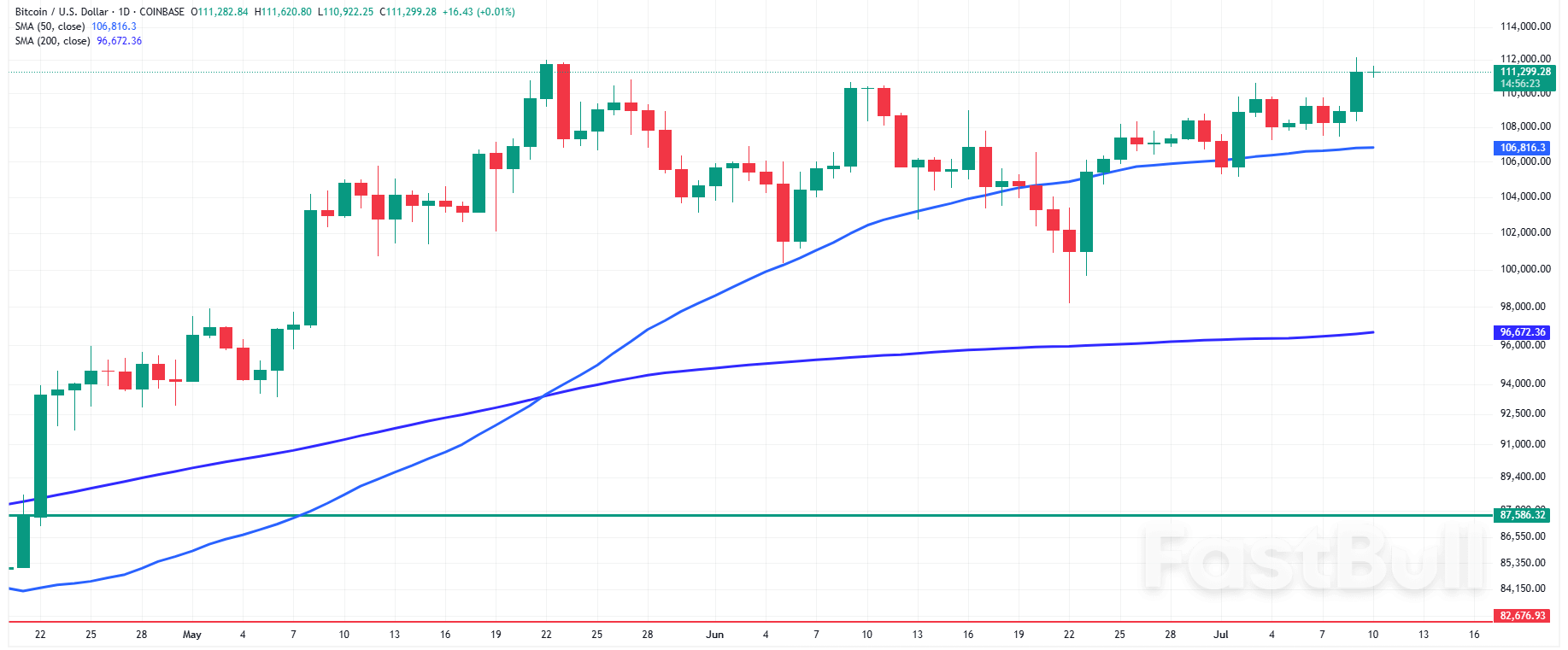
          The Day Ahead: Markets Today Eye Jobless Claims, Delta Earnings, Fed Remarks, AI Momentum_1Daily Bitcoin (BTCUSD)

          Bitcoin surged to a fresh record above $112,000, supported by institutional flows, dovish Fed speculation, and broader risk-on sentiment tied to AI sector momentum.

          Technical Outlook

          The Day Ahead: Markets Today Eye Jobless Claims, Delta Earnings, Fed Remarks, AI Momentum_2
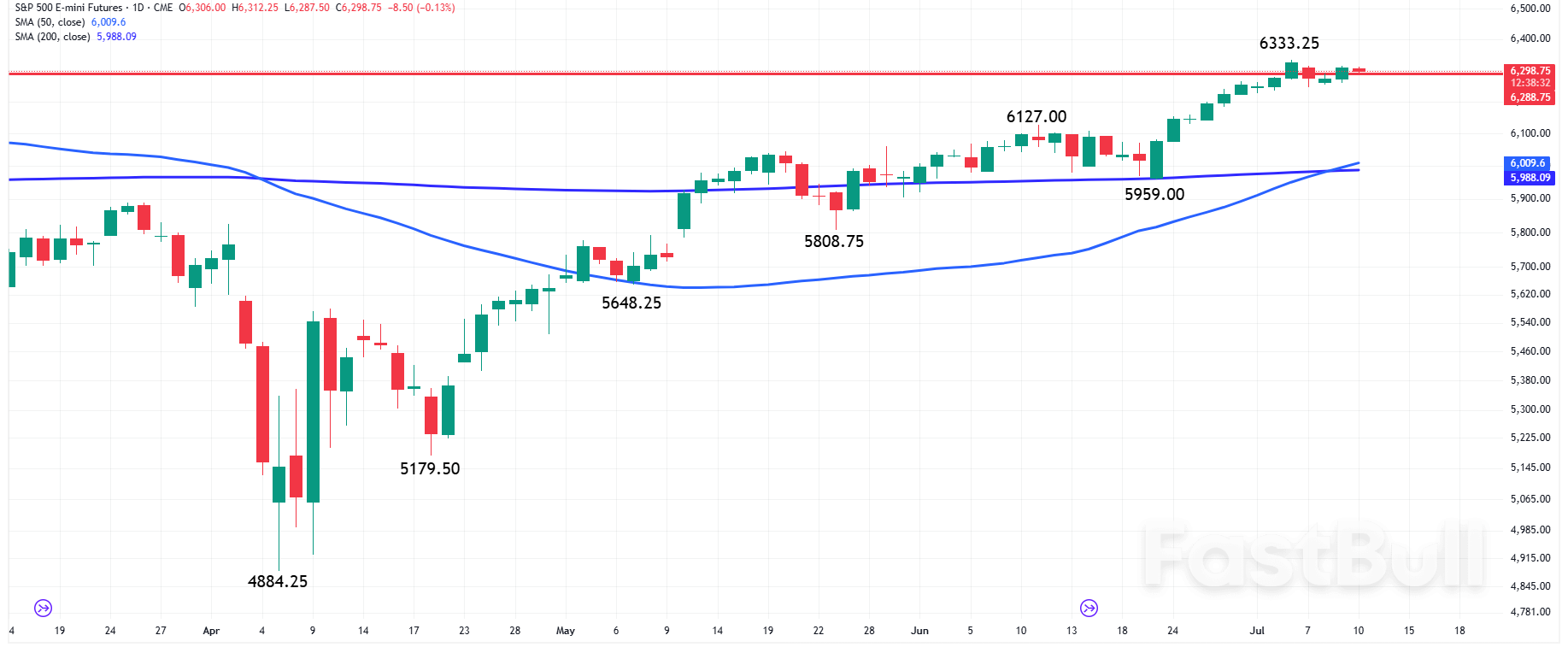
          S&P 500 E-mini Futures trade near 6,298 with resistance at 6,333.25. Support is layered at the 50-day moving average at 6,009.50, the 200-day moving average at 5,988.10, and the swing bottoms at 5,959.00 and 5,808.75.
          The Day Ahead: Markets Today Eye Jobless Claims, Delta Earnings, Fed Remarks, AI Momentum_3
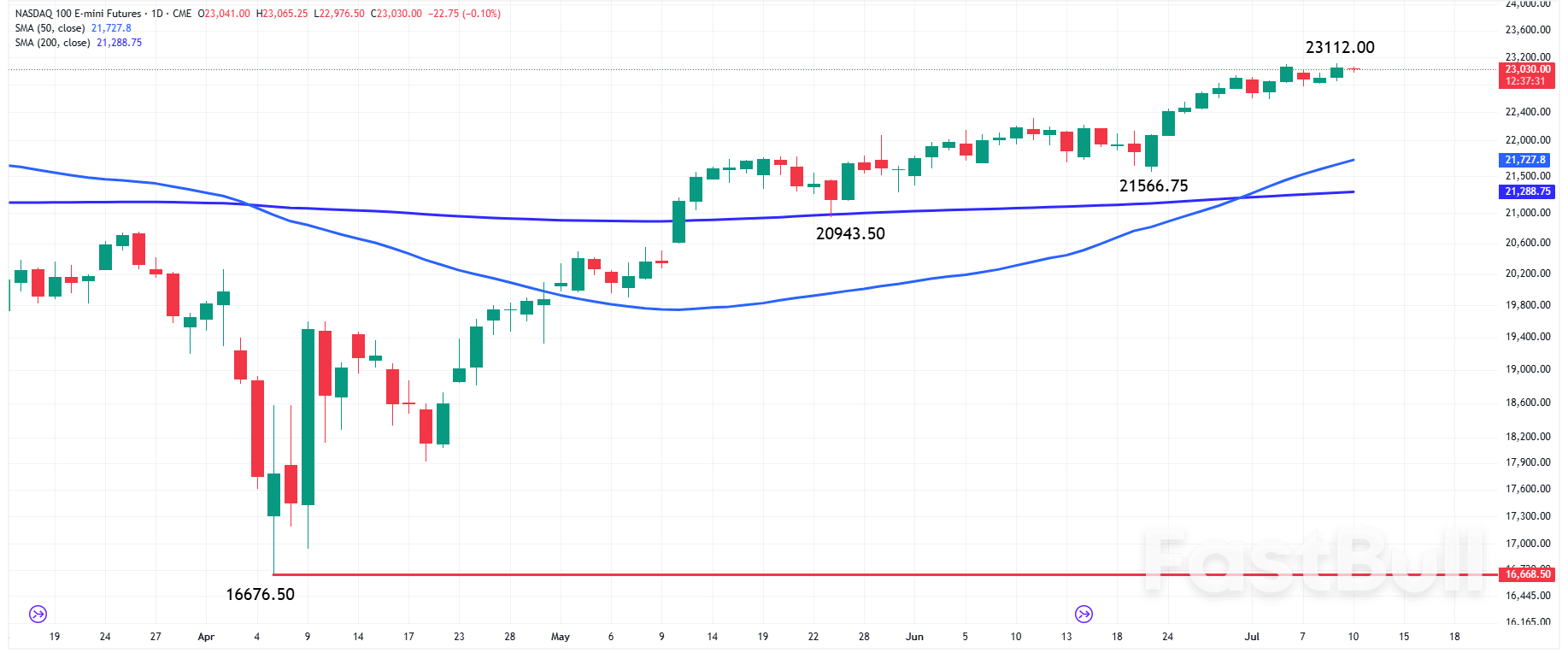
          Nasdaq 100 E-mini Futures trade near 23,030 with resistance at 23,112. Support is layered at the 50-day moving average at 21,727.80, the 200-day moving average at 21,288.80, and the prior lows at 21,566.75 and 20,943.50.
          The Day Ahead: Markets Today Eye Jobless Claims, Delta Earnings, Fed Remarks, AI Momentum_4
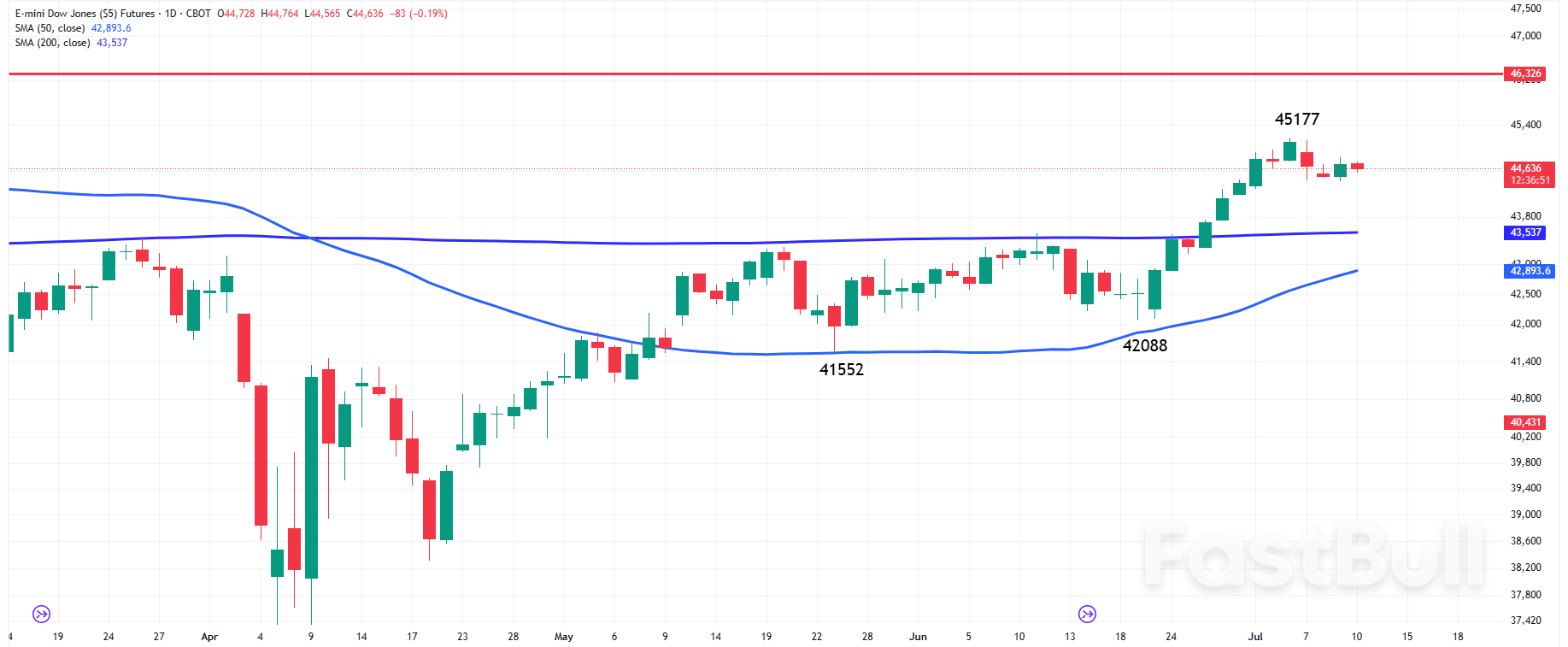
          Dow E-mini Futures trade near 44,636 with resistance at 45,177 and secondary resistance at 46,326. Support is layered at the 200-day moving average at 43,537, the 50-day moving average at 42,893.60, and the prior low at 42,088.00.

          Outlook

          Focus remains on AI-led momentum despite tariff concerns. Weekly claims data will provide near-term clarity for Fed expectations, while speeches from Musalem, Waller, and Daly may deliver additional directional cues. Traders should monitor Delta’s earnings for confidence signals while watching for retests or breaks of resistance across indices into Friday’s positioning flows.

          Source: fxempire

          To stay updated on all economic events of today, please check out our Economic calendar
          Risk Warnings and Disclaimers
          You understand and acknowledge that there is a high degree of risk involved in trading. Following any strategies or investment methods may lead to potential losses. The content on the site is provided by our contributors and analysts for information purposes only. You are solely responsible for determining whether any trading assets, securities, strategy, or any other product is suitable for investing based on your own investment objectives and financial situation.
          Add to Favorites
          Share

          Trump Tariffs Goods from Brazil at 50%, Citing ‘Witch Hunt’ Trial Against Country’s Former President

          Warren Takunda

          Economic

          China–U.S. Trade War

          President Donald Trump singled out Brazil for import taxes of 50% on Wednesday for its treatment of its former president, Jair Bolsonaro, showing that personal grudges rather than simple economics are a driving force in the U.S. leader’s use of tariffs.
          Trump avoided his standard form letter with Brazil, specifically tying his tariffs to the trial of Bolsonaro, who is charged with trying to overturn his 2022 election loss. Trump has described Bolsonaro as a friend and hosted the former Brazilian president at his Mar-a-Lago resort when both were in power in 2020.
          “This Trial should not be taking place,” Trump wrote in the letter posted on Truth Social. “It is a Witch Hunt that should end IMMEDIATELY!”
          There is a sense of kinship as Trump was indicted in 2023 for his efforts to overturn the results of the 2020 U.S. presidential election. The U.S. president addressed his tariff letter to Brazilian President Luiz Inacio Lula da Silva, who bested Bolsonaro in 2022.
          Lula responded in a forceful statement that said Trump’s tariffs would trigger the country’s economic reciprocity law, which allows trade, investment and intellectual property agreements to be suspended against countries that harm Brazil’s competitiveness.
          He noted that the U.S. has had a trade surplus of more than $410 billion with Brazil over the past 15 years.
          “Brazil is a sovereign country with independent institutions that will not accept being taken for granted by anyone,” Lula said.
          Bolsonaro testified before the country’s Supreme Court in June over the alleged plot to remain in power after his 2022 election loss. Judges will hear from 26 other defendants in the coming months, and legal analysts say a decision could come as early as September. The country’s electoral authorities have already barred Bolsonaro from running for office until 2030.
          The former president did not comment about Trump’s tariff decision on his social media channels, but wrote that he is being politically persecuted.
          In his statement, Lula defended the country’s legal system, saying the “proceedings against those who planned the coup d’etat is a competence of the Brazilian judiciary and is not subject to interference or threats that harm the independence of national institutions.”

          For Trump, the tariffs are personal

          Trump also objected to Brazil’s Supreme Court fining of social media companies, saying the temporary blocking last year amounted to “SECRET and UNLAWFUL Censorship Orders.” Trump said he is launching an investigation as a result under Section 301 of the Trade Act of 1974, which applies to countries with trade practices that are deemed unfair to U.S. companies.
          Among the companies the Supreme Court fined was X, which was not mentioned specifically in Trump’s letter. X is owned by Elon Musk, Trump’s multibillionaire backer in the 2024 election whose time leading Trump’s Department of Government Efficiency recently ended and led to a public feud over the U.S. president’s deficit-increasing budget plan. Trump also owns a social media company, Truth Social.
          “In Brazil, freedom of speech is not mistaken by aggression or violent behavior,” Lula said in his statement. “To operate in our country, every company, local or foreign, must be subjected to Brazilian legislation.”
          Brazilian lawmakers allied with Lula blamed Bolsonaro and two of his sons, congressman Eduardo Bolsonaro and Sen. Flávio Bolsonaro, for Trump’s tariff action. Sen. Lindbergh Farias, the whip of Lula’s Workers’ Party in the Senate, said on social media that the Bolsonaros “must be very happy to harm Brazil, our economy and our jobs.”
          The Brazil letter was a reminder that politics and personal relations with Trump matter just as much as any economic fundamentals. And while Trump has said the high tariff rates he’s setting are based on trade imbalances, it was unclear by his Wednesday actions how the countries being targeted would help to reindustrialize America.
          The tariffs starting Aug. 1 would be a dramatic increase from the 10% rate that Trump levied on Brazil as part of his April 2 “Liberation Day” announcement. In addition to oil, Brazil sells orange juice, coffee, iron and steel to the U.S., among other products. The U.S. ran a $6.8 billion trade surplus with Brazil last year, according to the Census Bureau.
          Trump initially announced his broad tariffs by declaring an economic emergency, arguing under a 1977 law that the U.S. was at risk because of persistent trade imbalances. But that rationale becomes problematic in this particular case, as Trump is linking his tariffs to the Bolsonaro trial and the U.S. exports more to Brazil than it imports.

          Trump also targeted smaller trade partners

          Trump also sent letters Wednesday to the leaders of seven other nations. None of them — the Philippines, Brunei, Moldova, Algeria, Libya, Iraq and Sri Lanka — is a major industrial rival to the United States.
          Most economic analyses say the tariffs will worsen inflationary pressures and subtract from economic growth, but Trump has used the taxes as a way to assert the diplomatic and financial power of the U.S. on both rivals and allies. His administration is promising that the taxes on imports will lower trade imbalances, offset some of the cost of the tax cuts he signed into law on Friday and cause factory jobs to return to the United States.
          Trump, during a White House meeting with African leaders, talked up trade as a diplomatic tool. Trade, he said, “seems to be a foundation” for him to settle disputes between India and Pakistan, as well as Kosovo and Serbia.
          “You guys are going to fight, we’re not going to trade,” Trump said. “And we seem to be quite successful in doing that.”
          Trump said the tariff rates in his letters were based on “common sense” and trade imbalances, even though the Brazil letter indicated otherwise. Trump suggested he had not thought of penalizing the countries whose leaders were meeting with him in the Oval Office — Liberia, Senegal, Gabon, Mauritania and Guinea-Bissau — as “these are friends of mine now.”
          Countries are not complaining about the rates outlined in his letters, he said, even though those tariffs have been generally close to the ones announced April 2 that rattled financial markets. The S&P 500 stock index rose Wednesday.
          “We really haven’t had too many complaints because I’m keeping them at a very low number, very conservative as you would say,” Trump said.

          Tariff uncertainty returns with Trump’s letters

          Officials for the European Union, a major trade partner and source of Trump’s ire on trade, said Tuesday that they are not expecting to receive a letter from Trump listing tariff rates. The Republican president started the process of announcing tariff rates on Monday by hitting two major U.S. trading partners, Japan and South Korea, with import taxes of 25%.
          According to Trump’s Wednesday letters, imports from Libya, Iraq, Algeria and Sri Lanka would be taxed at 30%, those from Moldova and Brunei at 25% and those from the Philippines at 20%. The tariffs would start Aug. 1.
          The Philippine government’s reaction has been relatively tame. Its ambassador in Washington, Jose Manuel Romualdez, said the country will seek new negotiations with the U.S. to lower the 20% tariff.
          The Census Bureau reported that last year the U.S. ran a trade imbalance on goods of $1.4 billion with Algeria, $5.9 billion with Iraq, $900 million with Libya, $4.9 billion with the Philippines, $2.6 billion with Sri Lanka, $111 million with Brunei and $85 million with Moldova. The imbalance represents the difference between what the U.S. exported to those countries and what it imported.
          Taken together, the trade imbalances with those seven countries are essentially a rounding error in a U.S. economy with a gross domestic product of $30 trillion.
          The letters were posted on Truth Social after the expiration of a 90-day negotiating period with a baseline levy of 10%. Trump is giving countries more time to negotiate with his Aug. 1 deadline, but he has insisted there will be no extensions for the countries that receive letters.
          The president threatened additional tariffs on any country that attempts to retaliate.
          Savarese reported from Rio de Janeiro. Associated Press writers Jim Gomez in Manila, David McHugh in Frankfurt, Germany, and Eileen Ng in Kuala Lumpur, Malaysia, contributed to this report.

          Source: AP

          To stay updated on all economic events of today, please check out our Economic calendar
          Risk Warnings and Disclaimers
          You understand and acknowledge that there is a high degree of risk involved in trading. Following any strategies or investment methods may lead to potential losses. The content on the site is provided by our contributors and analysts for information purposes only. You are solely responsible for determining whether any trading assets, securities, strategy, or any other product is suitable for investing based on your own investment objectives and financial situation.
          Add to Favorites
          Share

          US Weekly Jobless Claims Fall Unexpectedly in Latest Week

          Michelle

          Economic

          Forex

          The number of Americans filing new applications for jobless benefits unexpectedly fell last week, suggesting employers may be holding on to workers despite other indications of a cooling labor market.

          Initial claims for state unemployment benefits dropped 5,000 to a seasonally adjusted 227,000 for the week ended July 4, the Labor Department said on Thursday. Economists polled by Reuters had forecast 235,000 claims for the latest week. The data included last week's July Fourth holiday and claims tend to be volatile around public holidays.

          Economists and U.S. central bankers have generally viewed the labor market as solid, if weakening somewhat. This is a view reinforced by last week's monthly jobs report that showed the unemployment rate ticking down to 4.1%, though largely because the workforce shrank, and a bigger-than-expected gain of 147,000 jobs, though highly concentrated in just a few sectors.

          Fed Chair Jerome Powell has noted that in the current low-hiring and low-firing environment, any increase in layoffs could rapidly push up the unemployment rate.

          So far that has not happened, though nearly 100 U.S. companies have announced layoffs this month, including Microsoft and Intel. Economists say President DonaldTrump'sstill unsettled tariff policy is making it difficult for businesses to plan ahead.

          Hiring has been lackluster, making it harder for people out of work to find jobs. Last month's jobs report showed the median duration of unemployment rose in June to 10.1 weeks from 9.5 weeks in May.

          The number of people receiving unemployment benefits after an initial week of aid, a proxy for hiring, increased 10,000 to a seasonally adjusted 1.965 million during the week ending June 28, Thursday's claims report showed.

          The so-called continuing claims are at their highest level since November 2021, suggesting those who lose a job are taking longer to find a new position.

          The Federal Reserve last week left its policy rate in the 4.25%-4.50% range where it has been since December as central bankers wait to see if tariffs push up inflation before moving to lower rates.

          Source: TradingView

          To stay updated on all economic events of today, please check out our Economic calendar
          Risk Warnings and Disclaimers
          You understand and acknowledge that there is a high degree of risk involved in trading. Following any strategies or investment methods may lead to potential losses. The content on the site is provided by our contributors and analysts for information purposes only. You are solely responsible for determining whether any trading assets, securities, strategy, or any other product is suitable for investing based on your own investment objectives and financial situation.
          Add to Favorites
          Share
          FastBull
          Copyright © 2025 FastBull Ltd

          728 RM B 7/F GEE LOK IND BLDG NO 34 HUNG TO RD KWUN TONG KLN HONG KONG

          TelegramInstagramTwitterfacebooklinkedin
          App Store Google Play Google Play
          Products
          Charts

          Chats

          Q&A with Experts
          Screeners
          Economic Calendar
          Data
          Tools
          Membership
          Features
          Function
          Markets
          Copy Trading
          Latest Signals
          Contests
          News
          Analysis
          24/7
          Columns
          Education
          Company
          Careers
          About Us
          Contact Us
          Advertising
          Help Center
          Feedback
          User Agreement
          Privacy Policy
          Business

          White Label

          Data API

          Web Plug-ins

          Poster Maker

          Affiliate Program

          Risk Disclosure

          The risk of loss in trading financial instruments such as stocks, FX, commodities, futures, bonds, ETFs and crypto can be substantial. You may sustain a total loss of the funds that you deposit with your broker. Therefore, you should carefully consider whether such trading is suitable for you in light of your circumstances and financial resources.

          No decision to invest should be made without thoroughly conducting due diligence by yourself or consulting with your financial advisors. Our web content might not suit you since we don't know your financial conditions and investment needs. Our financial information might have latency or contain inaccuracy, so you should be fully responsible for any of your trading and investment decisions. The company will not be responsible for your capital loss.

          Without getting permission from the website, you are not allowed to copy the website's graphics, texts, or trademarks. Intellectual property rights in the content or data incorporated into this website belong to its providers and exchange merchants.

          Not Logged In

          Log in to access more features

          FastBull Membership

          Not yet

          Purchase

          Become a signal provider
          Help Center
          Customer Service
          Dark Mode
          Price Up/Down Colors

          Log In

          Sign Up

          Position
          Layout
          Fullscreen
          Default to Chart
          The chart page opens by default when you visit fastbull.com