

Markets
News
Analysis
User
24/7
Economic Calendar
Education
Data
- Names
- Latest
- Prev



Signal Accounts for Members
All Signal Accounts
All Contests
 U.K. Trade Balance Non-EU (SA) (Oct)
A:--
F: --
P: --
U.K. Trade Balance (Oct)A:--
F: --
P: --
U.K. Services Index MoMA:--
F: --
P: --
U.K. Construction Output MoM (SA) (Oct)A:--
F: --
P: --
U.K. Industrial Output YoY (Oct)A:--
F: --
P: --
U.K. Trade Balance (SA) (Oct)A:--
F: --
P: --
U.K. Trade Balance EU (SA) (Oct)A:--
F: --
P: --
U.K. Manufacturing Output YoY (Oct)A:--
F: --
P: --
U.K. GDP MoM (Oct)A:--
F: --
P: --
U.K. GDP YoY (SA) (Oct)A:--
F: --
P: --
U.K. Industrial Output MoM (Oct)A:--
F: --
P: --
U.K. Construction Output YoY (Oct)A:--
F: --
P: --
 France HICP Final MoM (Nov)
A:--
F: --
P: --
 China, Mainland Outstanding Loans Growth YoY (Nov)
A:--
F: --
P: --
China, Mainland M2 Money Supply YoY (Nov)A:--
F: --
P: --
China, Mainland M0 Money Supply YoY (Nov)A:--
F: --
P: --
China, Mainland M1 Money Supply YoY (Nov)A:--
F: --
P: --
 India CPI YoY (Nov)
A:--
F: --
P: --
India Deposit Gowth YoYA:--
F: --
P: --
 Brazil Services Growth YoY (Oct)
A:--
F: --
P: --
 Mexico Industrial Output YoY (Oct)
A:--
F: --
P: --
 Russia Trade Balance (Oct)
A:--
F: --
P: --
 Philadelphia Fed President Henry Paulson delivers a speech
 Canada Building Permits MoM (SA) (Oct)
A:--
F: --
P: --
Canada Wholesale Sales YoY (Oct)A:--
F: --
P: --
Canada Wholesale Inventory MoM (Oct)A:--
F: --
P: --
Canada Wholesale Inventory YoY (Oct)A:--
F: --
P: --
Canada Wholesale Sales MoM (SA) (Oct)A:--
F: --
P: --
 Germany Current Account (Not SA) (Oct)
A:--
F: --
P: --
U.S. Weekly Total Rig CountA:--
F: --
P: --
U.S. Weekly Total Oil Rig CountA:--
F: --
P: --
 Japan Tankan Large Non-Manufacturing Diffusion Index (Q4)
--
F: --
P: --
Japan Tankan Small Manufacturing Outlook Index (Q4)--
F: --
P: --
Japan Tankan Large Non-Manufacturing Outlook Index (Q4)--
F: --
P: --
Japan Tankan Large Manufacturing Outlook Index (Q4)--
F: --
P: --
Japan Tankan Small Manufacturing Diffusion Index (Q4)--
F: --
P: --
Japan Tankan Large Manufacturing Diffusion Index (Q4)--
F: --
P: --
Japan Tankan Large-Enterprise Capital Expenditure YoY (Q4)--
F: --
P: --
U.K. Rightmove House Price Index YoY (Dec)--
F: --
P: --
China, Mainland Industrial Output YoY (YTD) (Nov)--
F: --
P: --
China, Mainland Urban Area Unemployment Rate (Nov)--
F: --
P: --
 Saudi Arabia CPI YoY (Nov)
--
F: --
P: --
 Euro Zone Industrial Output YoY (Oct)
--
F: --
P: --
Euro Zone Industrial Output MoM (Oct)--
F: --
P: --
Canada Existing Home Sales MoM (Nov)--
F: --
P: --
Euro Zone Total Reserve Assets (Nov)--
F: --
P: --
U.K. Inflation Rate Expectations--
F: --
P: --
Canada National Economic Confidence Index--
F: --
P: --
Canada New Housing Starts (Nov)--
F: --
P: --
U.S. NY Fed Manufacturing Employment Index (Dec)--
F: --
P: --
U.S. NY Fed Manufacturing Index (Dec)--
F: --
P: --
Canada Core CPI YoY (Nov)--
F: --
P: --
Canada Manufacturing Unfilled Orders MoM (Oct)--
F: --
P: --
Canada Manufacturing New Orders MoM (Oct)--
F: --
P: --
Canada Core CPI MoM (Nov)--
F: --
P: --
Canada Manufacturing Inventory MoM (Oct)--
F: --
P: --
Canada CPI YoY (Nov)--
F: --
P: --
Canada CPI MoM (Nov)--
F: --
P: --
Canada CPI YoY (SA) (Nov)--
F: --
P: --
Canada Core CPI MoM (SA) (Nov)--
F: --
P: --


No matching data

Latest Views
Latest Views
Trending Topics
Top Columnists
Latest Update
White Label
Data API
Web Plug-ins
Affiliate Program
View All
No data
Despite Flatline Growth, Pound Recovers from Weeklong Decline.
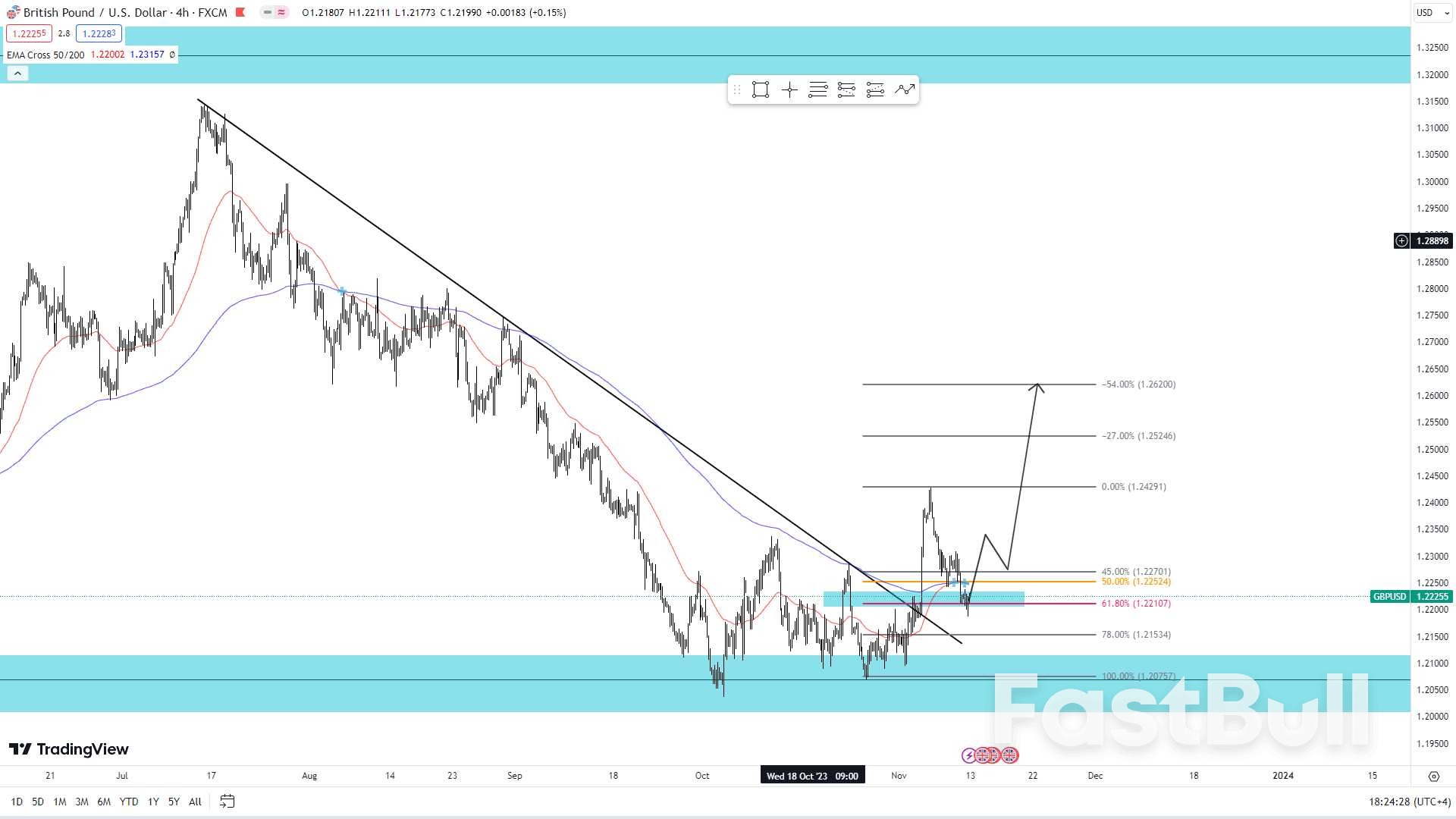 From a technical standpoint, GBP/USD faces resistance levels at 1.2287 and 1.2344, while support is found at 1.2183 and 1.2091. On the hourly chart, GBP/USD displays a noteworthy pattern of Lower Highs and Lower Lows, indicating significant selling pressure. Traders may consider a selling entry point at 1.22254, with a prudent Take Profit set at 1.21859 and a risk mitigated by a Stop Loss at 1.22394.
The Pound to US Dollar (GBP/USD) exchange rate fluctuated last week amid mixed commentary from central bank policymakers, ahead of disappointing UK GDP data.
The pairing closed Friday’s session at around $1.2211.
The Pound (GBP) was volatile last week in anticipation of Friday’s GDP reports, left vulnerable to external factors and investor reluctancy in the interim.
The Pound initially rallied amid a lack of data last week, as hawkish Bank of England (BoE) commentary appeared to drive GBP movement.
While the central bank primarily adopted a ‘higher for longer’ narrative regarding interest rates, Sterling edged higher amid speculation that the BoE remained open to further interest rate hikes.
However, the Pound quickly retreated as ongoing concerns about the health of the UK economy undermined the possibility of further rate hikes. Furthermore, the BoE’s Chief Economist, Huw Pill, argued for an accommodative approach towards monetary policy, in order to bear down on UK inflation, negating the previously bullish rhetoric.
GBP was also pressured on Thursday by a mixed market mood, which prevented the increasingly risk-sensitive currency from edging higher against its safer peers.
Friday’s GDP data for the third quarter came in higher than forecast at 0%, though still declined from the second quarter’s 0.2%. A dip in UK economic growth served to reinforce UK recession anxieties, leaving the Pound to end the week on a bleak note.
The US Dollar (USD) fluctuated this week, with notable US data running thin on the ground.
Early in the week an unexpected narrowing in China’s trade surplus sparked a spell of cautious trade, causing a safe-haven dash to USD amid global economic uncertainties.
Though the ‘Greenback’ initially rallied, tepid commentary from Federal Reserve policymakers later dented Fed interest rate hike bets, causing USD to stumble.
On Thursday, weaker-than-expected employment data saw the ‘Greenback’ face headwinds, as signs of gradual loosening in the US labour market undermined speculations of restrictive monetary policy.
However, a widely anticipated speech from Federal Chair, Jerome Powell, on Thursday evening capped USD’s losses. Powell’s comments seemed to boost the ‘Greenback’ overnight as he conveyed a significantly more restrictive stance towards monetary policy, boosting USD investor confidence as the week draws to a close.
Looking ahead, the latest core inflation data for both the UK and the US is due out next week and is likely to be the core catalyst of movement for the currency pairing.
On Tuesday, October’s annual core inflation reading for the US is forecast to hold at 4.1%. Sticky inflation could see Fed rate hike bets lifted, boosting USD.
In the UK core inflation is forecast to cool from 6.1% to 5.8% in October’s annual report, due out on Wednesday. Falling inflation may lead to pared BoE rate hike bets amid the central bank’s increasingly dovish tone surrounding monetary policy, leaving Sterling to face heavy selling pressure.
The UK’s latest employment data may also drive GBP volatility. UK unemployment is forecast to edge slightly higher, to 4.4%, nearing a two-year-high. Signs of a loosening employment sector may reinforce economic slowdown concerns in the UK, denting GBP.
UK average earnings (including bonuses) are due to increase, from 8.1% to 8.3%. While wage growth could indicate a robust labour market, inflation adjustments may undermine suggestions of a tight labour market, as recession concerns within the UK dampen Sterling sentiment.
On Wednesday, a forecast contraction in US retail sales could dent the ‘Greenback’, with signs of decreased consumer activity potentially undermining Fed rate hike bets. In contrast, an uptick in the UK’s October retail sales, due on Friday, may bolster GBP by quelling concerns of domestic recession.
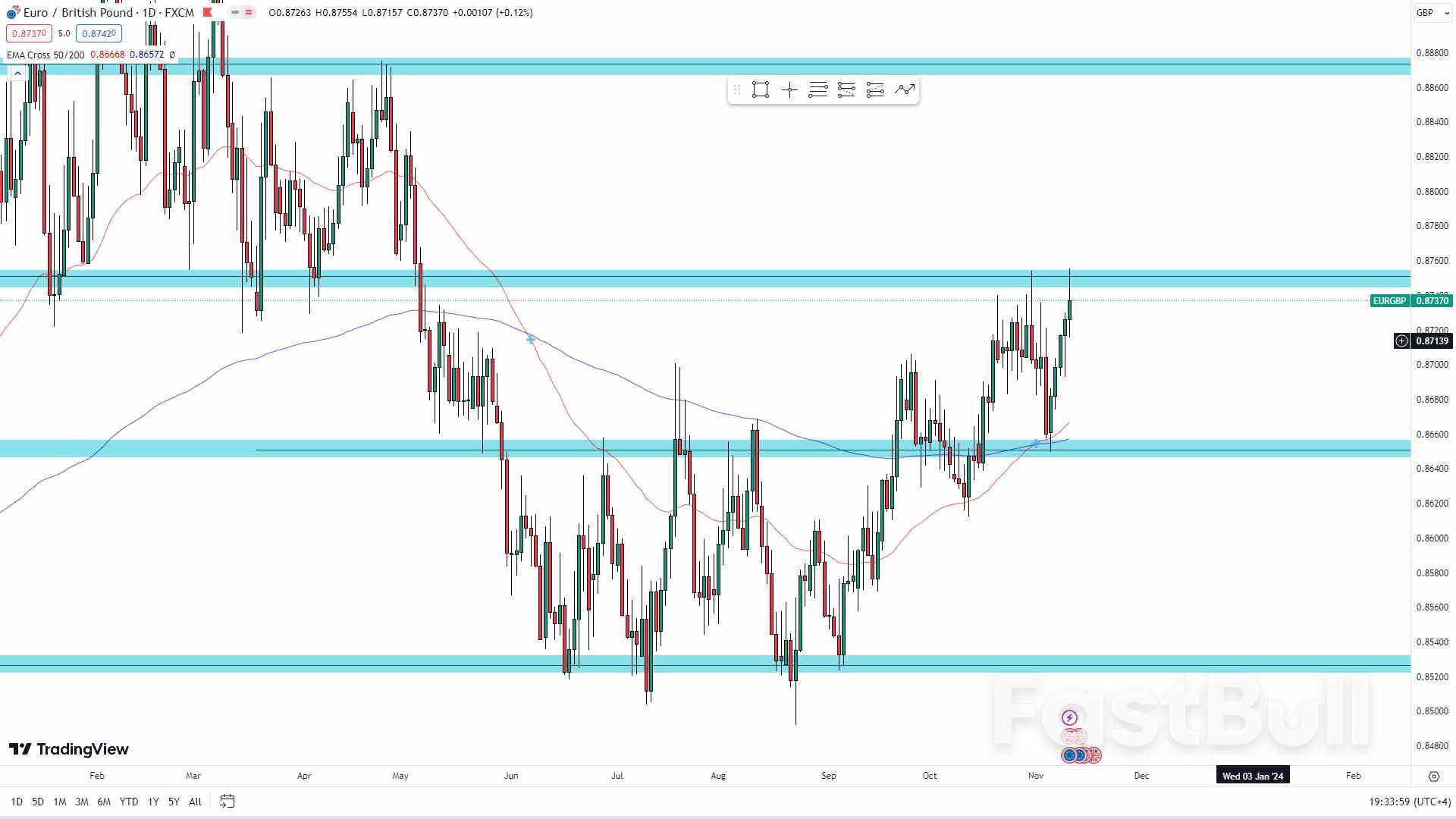 In a notable shift from prevailing market sentiment, Credit Agricole provides a technical analysis of EURGBP, identifying a compelling long opportunity. Despite widespread speculation about a significant decline, the analysis anticipates higher highs in the near future. However, it emphasises that EURGBP is presently trading in the premium price range.
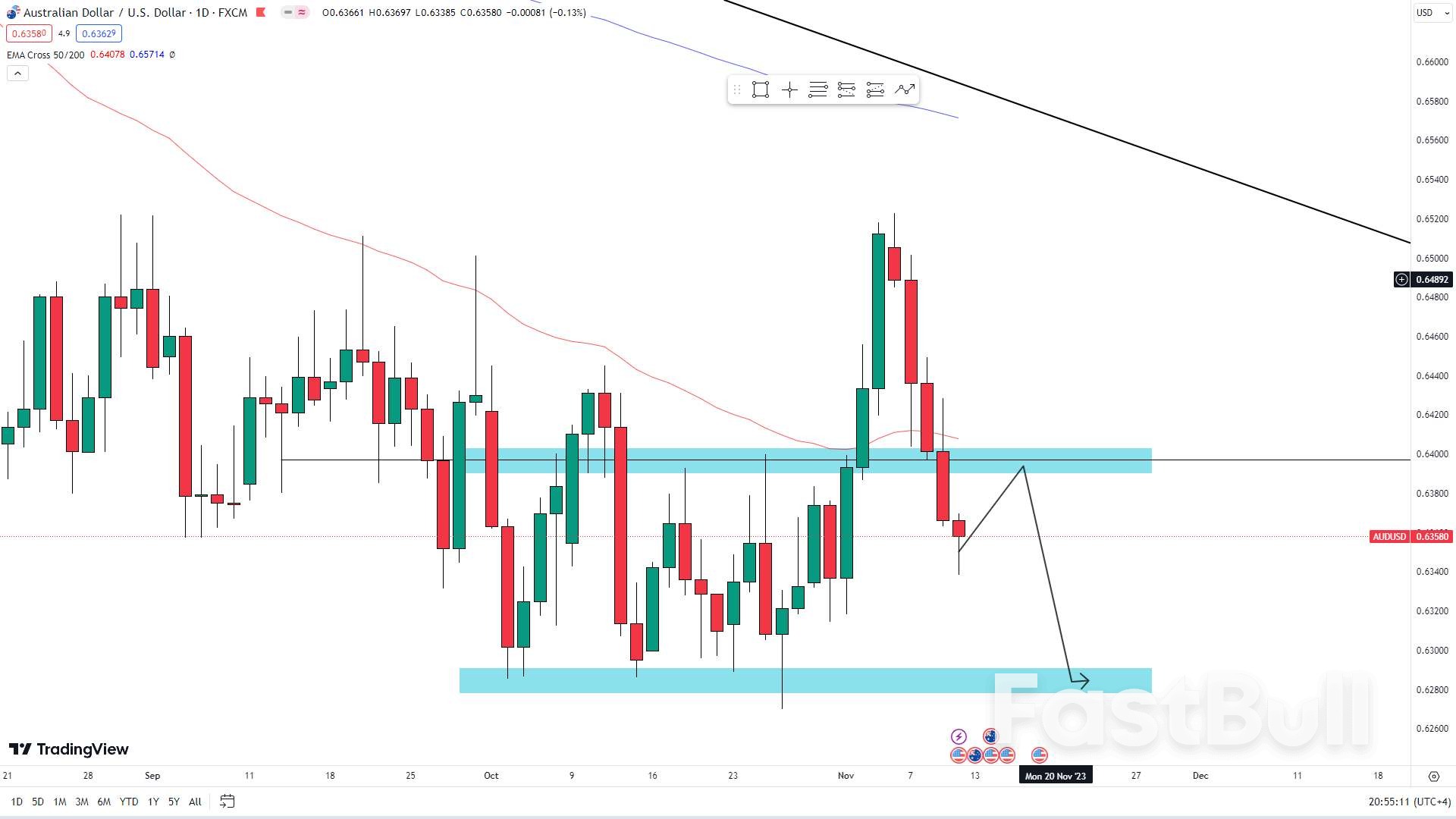 Looking at the technical aspect of AUD/USD, the price has breached a robust horizontal support zone, aligning with the 50% Fibonacci level and the rising trendline support. The oversold territory on the RSI indicator suggests a potential pullback to the support-turned-resistance zone, with the possibility of further downside movement.
Japanese Yen continues to weaken, accelerating its decline in today’s Asian session and edging closer to a multi-decade low against Dollar. The market appears to be gaining confidence that Japan will not intervene at this stage, despite the steep and extended depreciation. But the country’s approach to currency intervention remains shrouded in typical discretion. So, it’s “never say never” regarding the timing of intervention.
Still, it should be noted that top Japanese officials have previously attributed part of Yen’s weakness to the divergent monetary policies between Japan and other major economies. BoJ remains cautious, with even the most optimistic officials suggesting a wait until early next year’s wage negotiations to gauge the sustainability of the 2% inflation target. That’s a clear prerequisite to loose policy exit. Hence, Yen’s bearish trend is unlikely to change before that.
In the broader currency market, Canadian Dollar trails Yen as the second weakest, followed by Swiss Franc. On the other hand, New Zealand Dollar leads as the strongest, with Sterling and Australian Dollar also showing robustness. Euro and Dollar are showing mixed performance.
As the week progresses, the focus will shift back to key economic data, particularly CPI figures from US the UK, which are expected to influence market sentiment and central bank policies significantly.
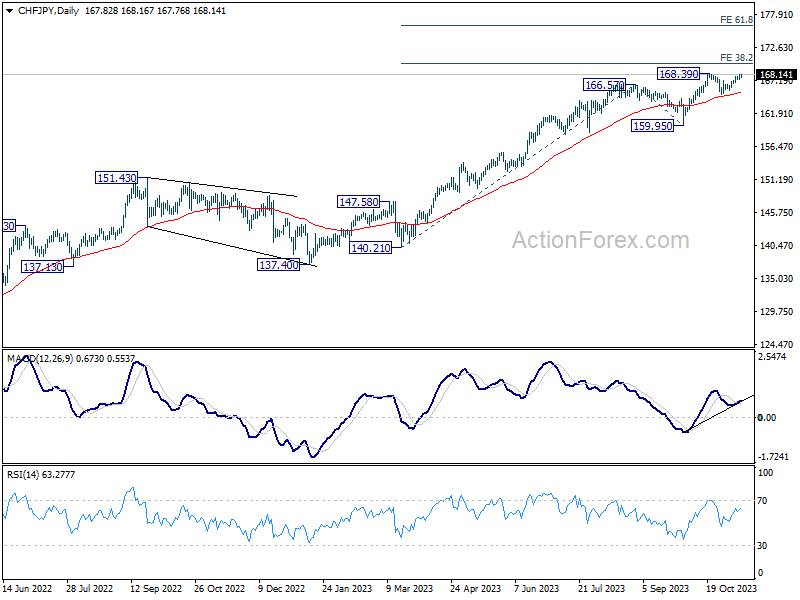
Technically, CHF/JPY’s pull back from 168.39 appears to be finished already, ahead of 55 EMA. The shallow fall is likely just a correction to the rise from 159.95 to 168.39 only. Immediate focus is now on 168.39. Decisive break there will resume larger up trend. Next target is 38.2% projection of 140.21 to 166.57 from 159.95 at 170.01. Firm break there could prompt upside acceleration to 61.8% projection at 176.24 next.
In Asia, at the time of writing, Nikkei is down -0.05%. Hong Kong HSI is up 0.01%. China Shanghai SSE is down -0.07%. Singapore Strait Times is down -0.91%. Japan 10-year JGB yield is up 0.026 at 0.884.
Japan’s corporate goods price index, a key indicator of wholesale inflation, exhibited a significant slowdown in October, underscoring a continued trend of easing price pressures.
The index increased by just 0.8% yoy, falling short of the anticipated 0.9% yoy and marking its first dip below 1% since February 2021. This latest figure also represents the 10th consecutive month of slowing wholesale inflation.
The deceleration in the CGPI can be largely attributed to decreases in the prices of specific commodities. Notably, costs for wood, chemical, and steel products experienced declines, reflecting the broader impact of reduced global commodity prices.
Export price index saw an uptick from 0.5% yoy to 1.0% yoy. Import price index showed a lesser decline, moving from -15.5% yoy to -12.5% yoy.
In a speech, Marion Kohler, Acting Assistant Governor of RBA, remarked that decline in inflation is expected to be a “more gradual process than previously thought.”
This outlook stems from the current economic environment characterized by “still-high level of domestic demand” and “strong labour” alongside other cost pressures. These factors contribute to the prediction that inflation will hover just below 3% by the end of 2025.
The Assistant Governor pointed out that the recent trend of declining inflation has primarily been “driven by lower goods price inflation.” In stark contrast, “domestically sourced inflation” – especially in the services sector – has shown resilience, being “widespread and slow to decline.”
Kohler also underscored the nuanced challenges in the next phase of controlling inflation, which she anticipates to be “more drawn out than the first.” This outlook aligns with experiences in other advanced economies that have faced similar inflationary patterns.
Furthermore, she cautioned about the potential for unforeseen challenges, citing the recent increase in fuel prices as an example of supply shocks that could unpredictably influence headline inflation.
Kohler emphasized the uncertain nature of the journey ahead in managing inflation, stating, “the road ahead could be bumpy.”
A slew of significant economic data releases are scheduled for the week. A major focal point will be US CPI. Market expectations are set for deceleration in headline CPI from 3.7% yoy to 3.3%, while core CPI is anticipated to hold steady at 4.1% yoy.
This data comes under the microscope following remarks from Fed Chair Jerome Powell last week. Powell expressed that Fed is “not confident” about whether the current monetary policy is “sufficiently restrictive” to bring inflation down to the 2% target. His concerns echo the global sentiment that the final leg of the disinflation journey is often the most challenging.
Adding to the intrigue, University of Michigan’s report last Friday revealed an uptick in year-ahead inflation expectations to a seven-month high of 4.4%, a significant jump from the previous readings of 4.2% in October and 3.2% in September. Notably, long-term inflation expectations have also escalated to 3.2%, marking the highest point since 2011.
Should the upcoming US CPI report deliver any unexpected upside surprise, it could heavily tilt the scales towards at least one more rate hike by Fed before the end of the tightening cycle.
Alongside CPI, US retail sales data will also be under scrutiny, offering insights into consumer behavior amidst the dual challenges of high inflation and elevated interest rates.
Across the Atlantic, UK CPI is another critical data point, with expectations pointing to a significant slowdown in headline reading from 6.7% yoy to 4.7% yoy, and core CPI anticipated to decrease from 6.1% yoy to 5.7%.
UK’s disinflation process is clearly lagging other major economies. BoE Chief Economist Huw Pill recently suggested a strategy of maintaining current interest rates for an extended period to effectively combat inflation. This approach is likely to persist, barring any dramatic spikes in inflation figures. More intensify debate would start when disinflation finally approaches the “last mile”.
Additional data releases such as UK job data, retail sales, German ZEW economic sentiment, and Japan’s GDP will also be closely monitored. For Australia, employment report is due, but its impact might be overshadowed by crucial data from China, including industrial production and retail sales, which hold significant implications for the Australian economy.
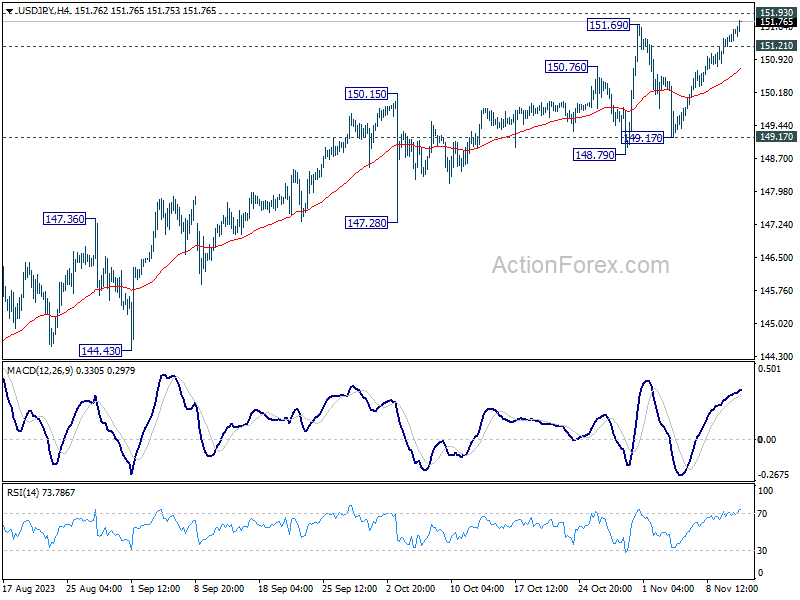
Daily Pivots: (S1) 150.94; (P) 151.17; (R1) 151.56;
As USD/JPY’s rise from 149.17 extends, immediate focus is now on 151.93 key resistance. Decisive break there will confirm resumption of long term up trend. Next target will be 157.69 projection level. On the downside, below 151.21 minor support will turn intraday bias neutral first. But near term outlook will stay bullish as long as 149.17 support holds, even in case of deep retreat.
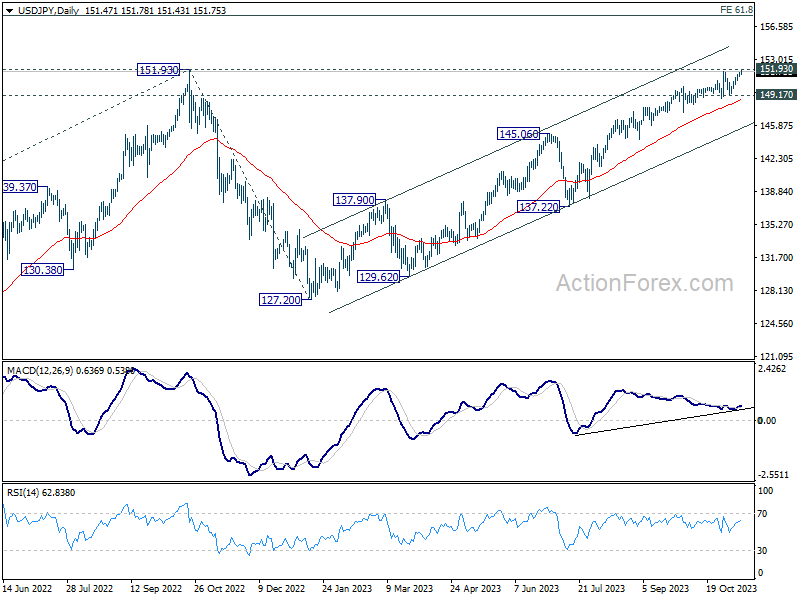
In the bigger picture, immediate focus is now on 151.93 resistance (2022 high). Rejection by 151.93, followed by sustained break of 145.06 resistance turned support will argue that rise from 127.20 has completed, and turn outlook bearish for 137.22 support and below. However, sustained break of 151.93 will confirm resumption of long term up trend. Next target will be 61.8% projection of 102.58 (2021 low) to 151.93 from 127.20 at 157.69.
The Aussie dollar fell every day last week, losing about 1.5 cents despite the RBA rate hike. A resilient US dollar kept a lid on A$, adding to the focus on US CPI data this week. There will also be key Australian data, including Q3 wages and October employment.
The RBA raised its cash rate 25bp to 4.35%, a decision expected by almost all forecasters (including Westpac) and about 80% priced into money markets. Governor Bullock’s statement summarised the information received since the previous official forecasts in August as showing that “the risk of inflation remaining higher for longer has increased.” Both economic growth and inflation were higher than expected, inflation uncomfortably so.
This reasoning was widely expected but markets reacted to a surprise change in the wording of the closely watched final paragraph, from “some further tightening of monetary policy may be required” (used for the past 6 meetings) to “whether further tightening of monetary policy is required.” This change obviously doesn’t close the door on another hike but it was enough to leave AUD/USD down about half a cent on the day, at 0.6435.
The Aussie’s underperformance on many cross rates is surprising given that money markets continue to price considerable risk of further RBA tightening, in contrast to major central banks. A 5 December hike is widely viewed as a low probability given the limited data before then. But a further 20bp (80% chance of a hike) is priced by May 2024. So on short-end yield spreads, the Aussie’s support is still much improved over the past few weeks.
The Aussie extended its decline on Wednesday and especially Thursday when the US dollar posted sharp gains. The main catalyst was a speech by Fed chair Jerome Powell. He said that “we are not confident that we have achieved” a sufficiently restrictive monetary policy setting to return inflation to the 2% target. Powell’s remarks prompted a bounce in US yields, part of a sizeable gain for the week – the 2-year Treasury note yield rose from 4.84% to 5.06%.
We will hear plenty more from Fed officials this week, but not from Powell. The US focus will be on key October data – the consumer price index and retail sales. CPI is most market-sensitive, with consensus 3.3%yr versus 3.7%yr in September but CPI ex-food and energy unchanged at 4.1%yr.
Australia’s data calendar is very crowded. Westpac-MI November consumer sentiment will show the public response to the RBA’s Melbourne Cup Day rate rise. The Q3 wages survey will capture the July jump in the minimum wage. Westpac looks for 1.3%qtr, 3.9%yr, up from 3.6%yr in Q2. The report will be perused for indicators of wage pressures outside the award wages jump.
In its November statement, the RBA said that “Conditions in the labour market have eased but they remain tight.” In October, Westpac expects a 25k rebound in employment after the soft 7k gain in September. We look for the unemployment rate to remain at 3.6%, while softness in hours worked will also be monitored. As always, there is plenty of room for surprise in this report so AUD will be on edge.
The Aussie’s commodity price support remains mixed. The LME base metals index slipped -1.3% over the week, to be just 1% above year-to-date lows. Crude oil prices hit lows since July, some analysts blaming worries over China’s growth prospects. But iron ore rallied another 3.9% to $127/tonne, reaching highs since March and a long way above Australia’s federal budget assumptions.
The slide in US equities last Thursday coincided with a sharp fall in the Aussie, though equity weakness is often also correlated with a rise in US yields so it can be hard to assess which is impacting the A$ more. It may be in the week ahead that the US equity/rates nexus determines whether AUD/USD tests the bounds of its November range of 0.6318-0.6523.
Singapore holiday (Mon), Aust Nov Westpac consumer sentiment, Oct NAB business confidence, Germany Nov ZEW investor sentiment, UK Sep average earnings, US Oct CPI (Tue), Aust Q3 wage price index, Japan Q3 GDP, China Oct retail sales, industrial production, UK Oct CPI, US Oct retail sales (Wed), Aust Oct employment (Thu), UK Oct retail sales (Fri)


 Someone called us and suggested sending 200 liters of solar power, we thought he was from the Israeli army, which would be enough for less than an hour since we need 8000 to 10000 liters per day. We believe this proposal makes a mockery of the catastrophic situation in which we live.


728 RM B 7/F GEE LOK IND BLDG NO 34 HUNG TO RD KWUN TONG KLN HONG KONG


White Label
Data API
Web Plug-ins
Poster Maker
Affiliate Program
The risk of loss in trading financial instruments such as stocks, FX, commodities, futures, bonds, ETFs and crypto can be substantial. You may sustain a total loss of the funds that you deposit with your broker. Therefore, you should carefully consider whether such trading is suitable for you in light of your circumstances and financial resources.
No decision to invest should be made without thoroughly conducting due diligence by yourself or consulting with your financial advisors. Our web content might not suit you since we don't know your financial conditions and investment needs. Our financial information might have latency or contain inaccuracy, so you should be fully responsible for any of your trading and investment decisions. The company will not be responsible for your capital loss.
Without getting permission from the website, you are not allowed to copy the website's graphics, texts, or trademarks. Intellectual property rights in the content or data incorporated into this website belong to its providers and exchange merchants.
Not Logged In
Log in to access more features

FastBull Membership
Not yet
Purchase


Log In
Sign Up


