• Trade
  • Markets
  • Copy
  • Contests
  • News
  • 24/7
  • Calendar
  • Q&A
  • Chats
Trending
Screeners
SYMBOL
LAST
BID
ASK
HIGH
LOW
NET CHG.
%CHG.
SPREAD
SPX
S&P 500 Index
6810.75
6810.75
6810.75
6861.30
6801.50
-16.66
-0.24%
--
DJI
Dow Jones Industrial Average
48334.29
48334.29
48334.29
48679.14
48285.67
-123.75
-0.26%
--
IXIC
NASDAQ Composite Index
23075.49
23075.49
23075.49
23345.56
23012.00
-119.67
-0.52%
--
USDX
US Dollar Index
97.980
98.060
97.980
98.070
97.740
+0.030
+ 0.03%
--
EURUSD
Euro / US Dollar
1.17420
1.17428
1.17420
1.17686
1.17262
+0.00026
+ 0.02%
--
GBPUSD
Pound Sterling / US Dollar
1.33643
1.33653
1.33643
1.34014
1.33546
-0.00064
-0.05%
--
XAUUSD
Gold / US Dollar
4301.99
4302.33
4301.99
4350.16
4285.08
+2.60
+ 0.06%
--
WTI
Light Sweet Crude Oil
56.348
56.378
56.348
57.601
56.233
-0.885
-1.55%
--

Community Accounts

Signal Accounts
--
Profit Accounts
--
Loss Accounts
--
View More

Become a signal provider

Sell trading signals to earn additional income

View More

Guide to Copy Trading

Get started with ease and confidence

View More

Signal Accounts for Members

All Signal Accounts

Best Return
  • Best Return
  • Best P/L
  • Best MDD
Past 1W
  • Past 1W
  • Past 1M
  • Past 1Y

All Contests

  • All
  • Trump Updates
  • Recommend
  • Stocks
  • Cryptocurrencies
  • Central Banks
  • Featured News
Top News Only
Share

USA State Department: Rubio Signs Status Of Forces Agreement With Paraguayan Foreign Minister

Share

New York Fed Accepts $2.601 Billion Of $2.601 Billion Submitted To Reverse Repo Facility On Dec 15

Share

Turkey: Shoots Down A Drone In The Black Sea Using F-16 Fighter Jets

Share

Goldman Sachs Says They Believe That The Copper Price Is Vulnerable To An Ai-Linked Price Correction

Share

Goldman Sachs Upgrades 2026 Copper Price Forecast To $11400 From $10,650

Share

Attempts By Ukrainian Troops To Advance From The South-West To Outskirts Of Kupiansk Are Being Thwarted

Share

Russian Troops Control All Of Kupiansk - IFX Cites Russian Military

Share

On Monday (December 15), The South Korean Won Ultimately Rose 0.60% Against The US Dollar, Closing At 1468.91 Won. The Won Was On An Upward Trend Throughout The Day, Rising Significantly At 17:00 Beijing Time And Reaching A Daily High Of 1463.04 Won At 17:36

Share

Health Ministry: Israeli Forces Kill Palestinian Teen In West Bank

Share

New York Federal Reserve President Williams: Over Time, The Size Of Reserves Could Grow From $2.9 Trillion

Share

New York Fed President Williams: AI Valuations Are High, But There Is A Real Driving Factor

Share

New York Federal Reserve President Williams: The Job Market Is In Very Good Shape

Share

New York Fed President Williams: 'Very Supportive' Of USA Central Bank's Decision To Cut Interest Rates Last Week

Share

New York Fed President Williams: 'Too Early To Say' What Central Bank Should Do At January Meeting

Share

New York Fed President Williams: Strong Markets Part Of Reason Why Economy Will Grow Robustly In 2026

Share

New York Fed President Williams: What Constitutes Ample Reserves Will Change Over Time

Share

New York Fed President Williams: Market Valuations 'Elevated,' But There Are Reasons For Pricing

Share

New York Fed President Williams: Ample Reserves System Working Very Well

Share

New York Fed President Williams: Some Signs That Parts Of Underlying Economy Not As Strong As GDP Data Suggests

Share

New York Fed President Williams: Expects Coming Job Data Will Show Gradual Cooling

TIME
ACT
FCST
PREV
Japan Tankan Small Manufacturing Outlook Index (Q4)

A:--

F: --

P: --

Japan Tankan Large Non-Manufacturing Outlook Index (Q4)

A:--

F: --

P: --

Japan Tankan Large Manufacturing Outlook Index (Q4)

A:--

F: --

P: --

Japan Tankan Small Manufacturing Diffusion Index (Q4)

A:--

F: --

P: --

Japan Tankan Large-Enterprise Capital Expenditure YoY (Q4)

A:--

F: --

P: --

U.K. Rightmove House Price Index YoY (Dec)

A:--

F: --

P: --

China, Mainland Industrial Output YoY (YTD) (Nov)

A:--

F: --

P: --

China, Mainland Urban Area Unemployment Rate (Nov)

A:--

F: --

P: --

Saudi Arabia CPI YoY (Nov)

A:--

F: --

P: --

Euro Zone Industrial Output YoY (Oct)

A:--

F: --

P: --

Euro Zone Industrial Output MoM (Oct)

A:--

F: --

P: --

Canada Existing Home Sales MoM (Nov)

A:--

F: --

P: --

Canada National Economic Confidence Index

A:--

F: --

P: --

Canada New Housing Starts (Nov)

A:--

F: --

P: --
U.S. NY Fed Manufacturing Employment Index (Dec)

A:--

F: --

P: --

U.S. NY Fed Manufacturing Index (Dec)

A:--

F: --

P: --

Canada Core CPI YoY (Nov)

A:--

F: --

P: --

Canada Manufacturing Unfilled Orders MoM (Oct)

A:--

F: --

P: --

U.S. NY Fed Manufacturing Prices Received Index (Dec)

A:--

F: --

P: --

U.S. NY Fed Manufacturing New Orders Index (Dec)

A:--

F: --

P: --

Canada Manufacturing New Orders MoM (Oct)

A:--

F: --

P: --

Canada Core CPI MoM (Nov)

A:--

F: --

P: --

Canada Trimmed CPI YoY (SA) (Nov)

A:--

F: --

P: --

Canada Manufacturing Inventory MoM (Oct)

A:--

F: --

P: --

Canada CPI YoY (Nov)

A:--

F: --

P: --

Canada CPI MoM (Nov)

A:--

F: --

P: --

Canada CPI YoY (SA) (Nov)

A:--

F: --

P: --

Canada Core CPI MoM (SA) (Nov)

A:--

F: --

P: --

Canada CPI MoM (SA) (Nov)

A:--

F: --

P: --

Federal Reserve Board Governor Milan delivered a speech
U.S. NAHB Housing Market Index (Dec)

A:--

F: --

P: --

Australia Composite PMI Prelim (Dec)

--

F: --

P: --

Australia Services PMI Prelim (Dec)

--

F: --

P: --

Australia Manufacturing PMI Prelim (Dec)

--

F: --

P: --

Japan Manufacturing PMI Prelim (SA) (Dec)

--

F: --

P: --

U.K. 3-Month ILO Employment Change (Oct)

--

F: --

P: --

U.K. Unemployment Claimant Count (Nov)

--

F: --

P: --

U.K. Unemployment Rate (Nov)

--

F: --

P: --

U.K. 3-Month ILO Unemployment Rate (Oct)

--

F: --

P: --

U.K. Average Weekly Earnings (3-Month Average, Including Bonuses) YoY (Oct)

--

F: --

P: --

U.K. Average Weekly Earnings (3-Month Average, Excluding Bonuses) YoY (Oct)

--

F: --

P: --

France Services PMI Prelim (Dec)

--

F: --

P: --

France Composite PMI Prelim (SA) (Dec)

--

F: --

P: --

France Manufacturing PMI Prelim (Dec)

--

F: --

P: --

Germany Services PMI Prelim (SA) (Dec)

--

F: --

P: --

Germany Manufacturing PMI Prelim (SA) (Dec)

--

F: --

P: --

Germany Composite PMI Prelim (SA) (Dec)

--

F: --

P: --

Euro Zone Composite PMI Prelim (SA) (Dec)

--

F: --

P: --

Euro Zone Services PMI Prelim (SA) (Dec)

--

F: --

P: --

Euro Zone Manufacturing PMI Prelim (SA) (Dec)

--

F: --

P: --

U.K. Services PMI Prelim (Dec)

--

F: --

P: --

U.K. Manufacturing PMI Prelim (Dec)

--

F: --

P: --

U.K. Composite PMI Prelim (Dec)

--

F: --

P: --

Euro Zone ZEW Economic Sentiment Index (Dec)

--

F: --

P: --

Germany ZEW Current Conditions Index (Dec)

--

F: --

P: --

Germany ZEW Economic Sentiment Index (Dec)

--

F: --

P: --

Euro Zone Trade Balance (Not SA) (Oct)

--

F: --

P: --

Euro Zone ZEW Current Conditions Index (Dec)

--

F: --

P: --

Euro Zone Trade Balance (SA) (Oct)

--

F: --

P: --

Euro Zone Total Reserve Assets (Nov)

--

F: --

P: --

U.K. Inflation Rate Expectations

--

F: --

P: --

Q&A with Experts
    • All
    • Chatrooms
    • Groups
    • Friends
    Connecting
    .
    .
    .
    Type here...
    Add Symbol or Code

      No matching data

      All
      Trump Updates
      Recommend
      Stocks
      Cryptocurrencies
      Central Banks
      Featured News
      • All
      • Russia-Ukraine Conflict
      • Middle East Flashpoint
      • All
      • Russia-Ukraine Conflict
      • Middle East Flashpoint
      Search
      Products

      Charts Free Forever

      Chats Q&A with Experts
      Screeners Economic Calendar Data Tools
      Membership Features
      Data Warehouse Market Trends Institutional Data Policy Rates Macro

      Market Trends

      Market Sentiment Order Book Forex Correlations

      Top Indicators

      Charts Free Forever
      Markets

      News

      News Analysis 24/7 Columns Education
      From Institutions From Analysts
      Topics Columnists

      Latest Views

      Latest Views

      Trending Topics

      Top Columnists

      Latest Update

      Signals

      Copy Rankings Latest Signals Become a signal provider AI Rating
      Contests
      Brokers

      Overview Brokers Assessment Rankings Regulators News Claims
      Broker listing Forex Brokers Comparison Tool Live Spread Comparison Scam
      Q&A Complaint Scam Alert Videos Tips to Detect Scam
      More

      Business
      Events
      Careers About Us Advertising Help Center

      White Label

      Data API

      Web Plug-ins

      Affiliate Program

      Awards Institution Evaluation IB Seminar Salon Event Exhibition
      Vietnam Thailand Singapore Dubai
      Fans Party Investment Sharing Session
      FastBull Summit BrokersView Expo
      Recent Searches
        Top Searches
          Markets
          News
          Analysis
          User
          24/7
          Economic Calendar
          Education
          Data
          • Names
          • Latest
          • Prev

          View All

          No data

          Scan to Download

          Faster Charts, Chat Faster!

          Download App
          English
          • English
          • Español
          • العربية
          • Bahasa Indonesia
          • Bahasa Melayu
          • Tiếng Việt
          • ภาษาไทย
          • Français
          • Italiano
          • Türkçe
          • Русский язык
          • 简中
          • 繁中
          Open Account
          Search
          Products
          Charts Free Forever
          Markets
          News
          Signals

          Copy Rankings Latest Signals Become a signal provider AI Rating
          Contests
          Brokers

          Overview Brokers Assessment Rankings Regulators News Claims
          Broker listing Forex Brokers Comparison Tool Live Spread Comparison Scam
          Q&A Complaint Scam Alert Videos Tips to Detect Scam
          More

          Business
          Events
          Careers About Us Advertising Help Center

          White Label

          Data API

          Web Plug-ins

          Affiliate Program

          Awards Institution Evaluation IB Seminar Salon Event Exhibition
          Vietnam Thailand Singapore Dubai
          Fans Party Investment Sharing Session
          FastBull Summit BrokersView Expo

          FTSE 100 retreats amid US trade uncertainty

          Adam

          Stocks

          Summary:

          The FTSE 100 slipped after briefly surpassing 9,000, amid US trade uncertainty. UK consumer sentiment held steady, mining stocks rose, while Mony and Empyrean shares fell on mixed company updates.

          London stocks were mixed at midday on Monday, as the FTSE 100 retreated after passing the 9,000 mark at the market open, as new data shows consumer sentiment has remained broadly unchanged during July.
          The FTSE 100 index was down 7.99 points, 0.1%, at 8,984.13. The FTSE 250 was up 33.34 points, 0.2%, at 21,931.60, and the AIM All-Share was down 0.32 of a point at 772.46.
          The Cboe UK 100 was down 0.1% at 896.21, the Cboe UK 250 was up 0.2% at 19,311.02, and the Cboe Small Companies was up 0.1% at 17,607.44.
          "Markets were muted at the start of the new trading week as investors awaited updates on US trade negotiations," commented AJ Bell analyst Russ Mould.
          "There is now less than a fortnight before the 1 August deadline for the new tariff regime to kick in, and we still don’t have framework deals between the US and many regions including the EU.
          "It's now been six months since Donald Trump returned to the White House and it is fair to say he's ruffled a few feathers during that period. Financial markets have been all over the place, geopolitical tensions have intensified, and uncertainty has prevailed."
          Stocks in New York were called higher. The Dow Jones Industrial Average was called up 0.2%, the S&P 500 index 0.3% higher, and the Nasdaq Composite also 0.3% higher.
          The yield on the US 10-year Treasury was quoted at 4.38%, narrowing from 4.42%. The yield on the US 30-year Treasury was quoted at 4.95%, narrowing from 4.99%.
          In European equities on Monday, the CAC 40 in Paris lost 0.5%, while the DAX 40 in Frankfurt shed 0.2%.
          Consumer sentiment in the UK was little changed in July, data published by S&P Global showed Monday.
          The S&P Global UK consumer sentiment index edged up to 45.1 points in July from 45.0 in June. Getting closer to the neutral 50-point mark separating growth from contraction, it indicates the deterioration in consumer sentiment slowed in July.
          S&P Global highlighted that UK households expected their financial situation to worsen, although the extent to which financial wellbeing is anticipated to deteriorate was the least pronounced in seven months.
          Further, UK households have recorded positive labour market sentiment every month over the last two years, with July indicating a "solid" and stronger improvement, it added.
          Meanwhile, Ofwat will be abolished as part of an overhaul of a "broken" water regulation system that failed customers and the environment, the UK government has confirmed.
          Environment Secretary Steve Reed made the announcement in response to an independent review by Jon Cunliffe commissioned by the government to answer public fury over pollution in rivers, lakes and seas, soaring bills, shareholder pay outs and bosses' bonuses.
          Reed said the move to create a single "powerful" regulator taking in the functions of four existing bodies with overlapping functions would curb pollution and "prevent the abuses of the past for customers".
          The pound was quoted slightly up at USD1.3447 at midday on Monday in London, compared to USD1.3444 at the equities close on Friday. The euro stood lower at USD1.1638, against USD1.1656. Against the yen, the dollar was trading down at JPY147.88 compared to JPY148.48.
          Miners continued to dominate the top spots in the FTSE 100, with Glencore up 3.4%, Anglo American rising 3.3%, Antofagasta gaining 2.9% and Rio Tinto advancing 2.6%.
          On the FTSE 250, Hunting was among the biggest winners, 3.7% higher.
          The London-based supplier to the oil and gas industry has received an order for its titanium stress joints, as part of a phase three deepwater gas development in the Turkish area of the Black Sea.
          The order is worth USD31 million, with the contract expected to be completed over 24 months, with first delivery expected in the first quarter of 2027. Hunting did not name the customer.
          Hunting added it now has a sales order book of around USD125 million, up 72% from USD72.5 million at the end of 2024.
          At the other end, Mony Group slumped 8.3%.
          The Ewloe, Wales-based tech-led savings platform reported GBP59.8 million in pretax profit for the six months that ended June 30, up 2.9% from GBP58.1 million a year prior.
          Revenue edged up 0.8% to GBP225.3 million from GBP223.5 million, while administrative expenses reduced by 6.9% to GBP67.9 million from GBP72.9 million. Mony declared an interim dividend of 3.3 pence per share, unchanged from a year prior.
          Mony is "confident" in delivering adjusted earnings before interest, tax, depreciation and amortisation within the company-cited market consensus for GBP137 million to GBP150 million. This would be up 5.8% at best from GBP141.8 million a year earlier. Adjusted Ebitda in the first half rose 1.5% to GBP75.1 million from GBP74.0 million.
          Empyrean Resources fell 14%.
          The oil and gas development firm focused on the Duyung production sharing contract offshore Indonesia has raised GBP1 million before costs through a placing of 1.25 billion new shares at 0.08 pence per share.
          Funds will be used for development costs for the company's 8.5% interest in the Mako gas field and for general working capital.
          "We have taken the prudent step in bolstering our cash position now that the major milestone of a gas sales agreement with PLN Pesero, the Indonesian government owned utility company, has been signed following the earlier directive for Mako gas to be used for domestic supply. Indonesian demand for energy is experiencing strong growth and natural gas is replacing coal for this transition," said Chief Executive Officer Tom Kelly.
          Brent oil was quoted lower at USD68.92 a barrel at midday in London on Monday from USD69.41 late Friday.
          Gold was quoted higher at USD3,363.42 an ounce against USD3,352.48.
          Still to come on Monday's economic calendar, the US Conference Board leading index at 1500 BST.

          Source : Alliance News

          Risk Warnings and Disclaimers
          You understand and acknowledge that there is a high degree of risk involved in trading. Following any strategies or investment methods may lead to potential losses. The content on the site is provided by our contributors and analysts for information purposes only. You are solely responsible for determining whether any trading assets, securities, strategy, or any other product is suitable for investing based on your own investment objectives and financial situation.
          Add to Favorites
          Share

          Gaming Out How The World Might React to Trump’s Tariffs

          Glendon

          Economic

          Forex

          The world is watching and waiting to see just how President Donald Trump chooses to deliver on his threats to increase tariffs Aug. 1. That implies a certain helplessness outside the US. And yet how the rest of the world reacts to what is already the biggest turn in American protectionism since 1930 may end up defining the consequences for the global economy as much as Trump’s salvos.

          That’s why the debates now happening in Europe over how to respond to Trump’s impending escalation matter so much.

          The world’s largest economy raising tariffs is, most economists will tell you, going to cause damage on the US economy and others. But if the European Union and the US’s other trading partners respond with their own duties, that’s only going to make things worse. Especially if the US, as Trump has signaled in his letters delineating his tariff threats, responds by hiking import taxes further. Then you’ve unleashed a tit-for-tat trade war that’s bad for everyone.

          Forbearance is hard in the best of circumstances. When commerce, egos, jobs and geopolitics are involved it’s even trickier. But level heads and economic self control may be the best hope for the global economy in the months to come.

          The 1930 Smoot-Hawley tariffs are so widely deemed to be an act of economic vandalism that even avowed protectionists will tell you that they made the prospect of the US Congress ever voting again to raise import taxes politically improbable. Which is why Trump’s tariffs are being rolled out as executive actions. The votes don’t exist in Congress.

          The consensus among economists and historians is that the Smoot-Hawley tariffs extended and deepened the Great Depression. But the retaliation they triggered from other countries also did a lot of the damage and led to a historic collapse of global trade.

          Which means that the big lesson from the 1930s is that the world may be better off if other economies can take the high road when America acts out.

          Tallying Tit-For-Tat

          In a recent working paper two economists at the International Monetary Fund quantify that.

          A world in which other economies respond to US tariffs with their own would lead to a 49% reduction in US exports but also weaken the economies of trading partners, they find.

          A second scenario in which the response to US tariffs is a surge in industrial policy and domestic subsidies in other countries leads to increased production and exports, “but the distortions and fiscal costs they generate lead to real income losses globally and for subsidizing countries, especially China,” economists Lorenzo Rotunno and Michele Ruta also find.

          The only scenario that the model they used showed helping the world economy is one in which the rest of the world responds to US tariffs by opening up trade with everyone other than the US. In that case, they find, the US suffers from its trade barriers. But the rest of the world thrives with real global GDP growing by 0.3%, “more than offsetting the welfare loss from the US tariff increases.”

          “Importantly, the simulations suggest that only policy mixes that include economic integration emerge as increasing world welfare even in the presence of US tariffs,” Rotunno and Ruta write.

          Economic models often struggle to replicate the real world. There are no elections or Burgundy winemakers baying for retaliation against Oregon Pinot Noir in the world of the academic economist.

          Smaller Deals

          As Trump’s skeleton agreement with the UK and ceasefire with China illustrate there is also a scenario in which other economies cut deals with Trump to cement in new US tariffs with minor accommodations to avoid retaliation.

          The good news for the global economy is that a version of the integrating world the IMF economists foresee may be materializing. Canada, the EU, the UK and other big economies are pursuing new trade deals that exclude the US even as they try to reason with Trump.

          But it’s still not clear whether the EU and others will marry those efforts with the political self-control needed to avoid retaliation. That means the most consequential impending economic question for the world right now may just be: What’s more important? Standing up to Trump? Or turning the other cheek?

          Source: Bloomberg Europe

          To stay updated on all economic events of today, please check out our Economic calendar
          Risk Warnings and Disclaimers
          You understand and acknowledge that there is a high degree of risk involved in trading. Following any strategies or investment methods may lead to potential losses. The content on the site is provided by our contributors and analysts for information purposes only. You are solely responsible for determining whether any trading assets, securities, strategy, or any other product is suitable for investing based on your own investment objectives and financial situation.
          Add to Favorites
          Share

          EU Weighs Aggressive Trade Retaliation as US Tariff Threats Escalate

          Gerik

          Economic

          Fracturing Dialogue Spurs Retaliation Planning

          The European Union is preparing a broader retaliation strategy as transatlantic trade negotiations stall under growing uncertainty. Despite earlier signs of progress, EU officials now report that hopes for a manageable agreement with the United States have largely evaporated following President Donald Trump’s threat to impose a 30% tariff on EU exports starting August 1. Internal briefings from Trade Commissioner Maros Sefcovic delivered to EU envoys last week painted a bleak picture, revealing fragmented responses from U.S. negotiators and no clear proposal with the potential to secure Trump’s approval.
          According to EU diplomats, American counterparts offered a range of ideas during talks in Washington, with baseline tariff proposals exceeding the previously floated 10% rate. This lack of coherence, paired with Trump’s rejection of a "standstill" clause to freeze further tariffs, has reinforced the view that Europe may be left without any dependable agreement framework.

          Section 232 and Legal Justifications for Tariff Power

          At the core of the impasse lies Washington’s invocation of national security under Section 232 trade rules. The Trump administration has broadened this rationale beyond traditional sectors like steel and aluminum to include pharmaceuticals, semiconductors, and timber substantially increasing the scope for unilateral tariff actions. This legal strategy not only strengthens the administration’s domestic authority but also undermines the EU’s ability to negotiate firm limits on future tariff use.
          The result is a growing belief within Brussels that negotiation alone will not suffice to protect European industry. With little clarity on what the US administration might eventually accept, the EU is now actively considering broader retaliatory options that had previously been set aside in favor of diplomacy.

          Escalating Momentum Behind the Anti-Coercion Instrument

          One of the most powerful tools now under review is the EU’s anti-coercion instrument (ACI), originally designed to counter economic pressure from nations such as China. This mechanism enables the EU to take targeted action against countries deemed to be exerting undue economic influence on member states. The ACI could authorize retaliatory steps including the restriction of U.S. firms’ access to European public procurement markets, curbs on financial services, and even investment limitations.
          Until recently, the ACI was considered an extreme or “nuclear” option especially by member states wary of provoking a tit-for-tat escalation with Washington. France has long championed its use, while others, including Germany, had urged caution. However, EU diplomats now say that Germany is warming to the idea, and a qualified majority 15 member states representing 65% of the EU population may soon be within reach.

          Existing Tariff Measures and Broader Counterattack Plans

          Beyond the ACI, the EU already has a suspended tariff package targeting €21 billion ($24.5 billion) of U.S. exports, which could be reactivated by August 6. Additionally, officials are weighing an expanded response aimed at a further €72 billion in American goods. These measures would be in line with WTO-compliant retaliation but also serve as an immediate economic signal to Washington should the proposed U.S. tariffs go forward.
          Despite the growing support for more assertive action, EU leaders continue to stress that negotiation remains their preferred route. European Commission President Ursula von der Leyen reiterated that while the ACI was designed for extraordinary scenarios, the bloc had not yet formally decided to invoke it. However, the shift in tone from strategic patience to active deterrence reflects the depth of concern about unchecked U.S. protectionism.
          The failure to find common ground in trade talks and the looming threat of sweeping U.S. tariffs have catalyzed a fundamental shift in EU policy thinking. The bloc is no longer solely relying on negotiation but is actively preparing to defend its economic interests through strong countermeasures, including the unprecedented use of the anti-coercion instrument. While the formal deployment of these tools is not guaranteed, their rising political support marks a turning point in Europe’s posture toward U.S. economic pressure. The coming weeks will test whether diplomacy can still prevail or if a cycle of mutual escalation will redefine the future of transatlantic trade.

          Source: Reuters

          To stay updated on all economic events of today, please check out our Economic calendar
          Risk Warnings and Disclaimers
          You understand and acknowledge that there is a high degree of risk involved in trading. Following any strategies or investment methods may lead to potential losses. The content on the site is provided by our contributors and analysts for information purposes only. You are solely responsible for determining whether any trading assets, securities, strategy, or any other product is suitable for investing based on your own investment objectives and financial situation.
          Add to Favorites
          Share

          US Tariff Threats Loom Over Italy’s Economy, With GDP Losses Projected Up to 0.8% by 2027

          Gerik

          Economic

          Rising Trade Tensions Threaten Italy’s Economic Outlook

          The specter of sweeping US tariffs on European Union imports is casting a long shadow over Italy’s economic recovery. According to new projections released by Confindustria, the country’s leading business federation, the imposition of a 30% tariff on EU goods by the United States could result in a cumulative GDP contraction of 0.82% by 2027. The phased impact is estimated at 0.25% in 2025 and 0.59% in 2026, suggesting a compounding effect on national output over time if no mitigating policies are enacted.
          These forecasts align with escalating trade tensions following statements by President Donald Trump, who has threatened to enact tariffs starting August 1. Though US Trade Chief Howard Lutnick expressed openness to dialogue, the risk of a full implementation remains. The analysis assumes a scenario with no EU retaliation, isolating the potential direct consequences of the US policy shift.

          Key Export Sectors at Risk Under Tariff Scenario

          Italy’s exposure to US tariffs is significant due to the composition of its export portfolio. Core sectors include industrial machinery, automotive components, pharmaceuticals, and high-value food products such as olive oil, pasta, cheese, and wine. These categories not only represent large volumes but also occupy premium price segments in the US market, making them highly sensitive to tariff-induced price hikes.
          This vulnerability is further intensified by the relative strength of the euro. Since the beginning of 2025, the dollar has depreciated over 12% against the euro, eroding the price competitiveness of EU exports even before any tariff effects are factored in. Confindustria argues that this currency movement already acts as a de facto barrier to trade, reinforcing the urgency of tariff avoidance.

          Bleaker Forecasts from Private Sector Analysts

          In a parallel report, professional services firm EY presented an even more severe economic outlook. Their model estimates that the proposed tariffs would cut 1.4% from Italy’s GDP over 2025 and 2026, eliminating nearly all expected growth for the period. If realized, this would push Italy’s economy into stagnation or even mild contraction.
          This scenario contradicts the more optimistic projections of Italy’s national statistics agency, Istat, which anticipated GDP growth of 0.6% for 2025 and 0.8% for 2026. The divergence underscores the uncertainty surrounding macroeconomic forecasting amid unpredictable trade policy outcomes. EY’s model appears to incorporate broader secondary effects such as lost investment, reduced business confidence, and potential retaliatory pressures on other sectors of the Italian economy.

          Trade Diplomacy as the Only Path to Stability

          Italy’s business leaders have firmly stated that the only acceptable level for US tariffs is zero. They argue that current market conditions, including an unfavorable exchange rate and subdued domestic demand in the EU, already constrain growth. Additional barriers risk distorting longstanding transatlantic trade relationships and damaging competitiveness in critical export markets.
          The outcome of ongoing negotiations will determine whether Italy can preserve access to the US market or face mounting structural headwinds. While the US administration has left the door open for a diplomatic resolution, the precedent of unilateral tariff hikes during earlier trade disputes has heightened anxiety among European exporters.
          The potential implementation of US tariffs represents a substantial downside risk to Italy’s economic trajectory through 2027. The projected GDP losses from both Confindustria and EY point to a fragile economic environment vulnerable to external policy shifts. With major export sectors exposed and currency movements already eroding competitiveness, the next phase of trade negotiations will play a decisive role in determining whether Italy enters a period of prolonged economic stagnation or manages to avoid deeper structural damage.

          Source: Reuters

          To stay updated on all economic events of today, please check out our Economic calendar
          Risk Warnings and Disclaimers
          You understand and acknowledge that there is a high degree of risk involved in trading. Following any strategies or investment methods may lead to potential losses. The content on the site is provided by our contributors and analysts for information purposes only. You are solely responsible for determining whether any trading assets, securities, strategy, or any other product is suitable for investing based on your own investment objectives and financial situation.
          Add to Favorites
          Share

          Nasdaq 100: Market Optimism Builds Ahead of Big Tech Earnings

          Blue River

          Technical Analysis

          The earnings season is gaining momentum. This week, major technology companies such as Alphabet (GOOGL) and Tesla (TSLA) are scheduled to release their quarterly results.

          Given that 85% of the 53 S&P 500 companies that have already reported have exceeded analysts’ expectations, it is reasonable to assume that market participants are also anticipating strong results from the big tech names. The Nasdaq 100 index (US Tech 100 mini on FXOpen) set an all-time high last week — a level that may be surpassed (potentially more than once) before the end of August.

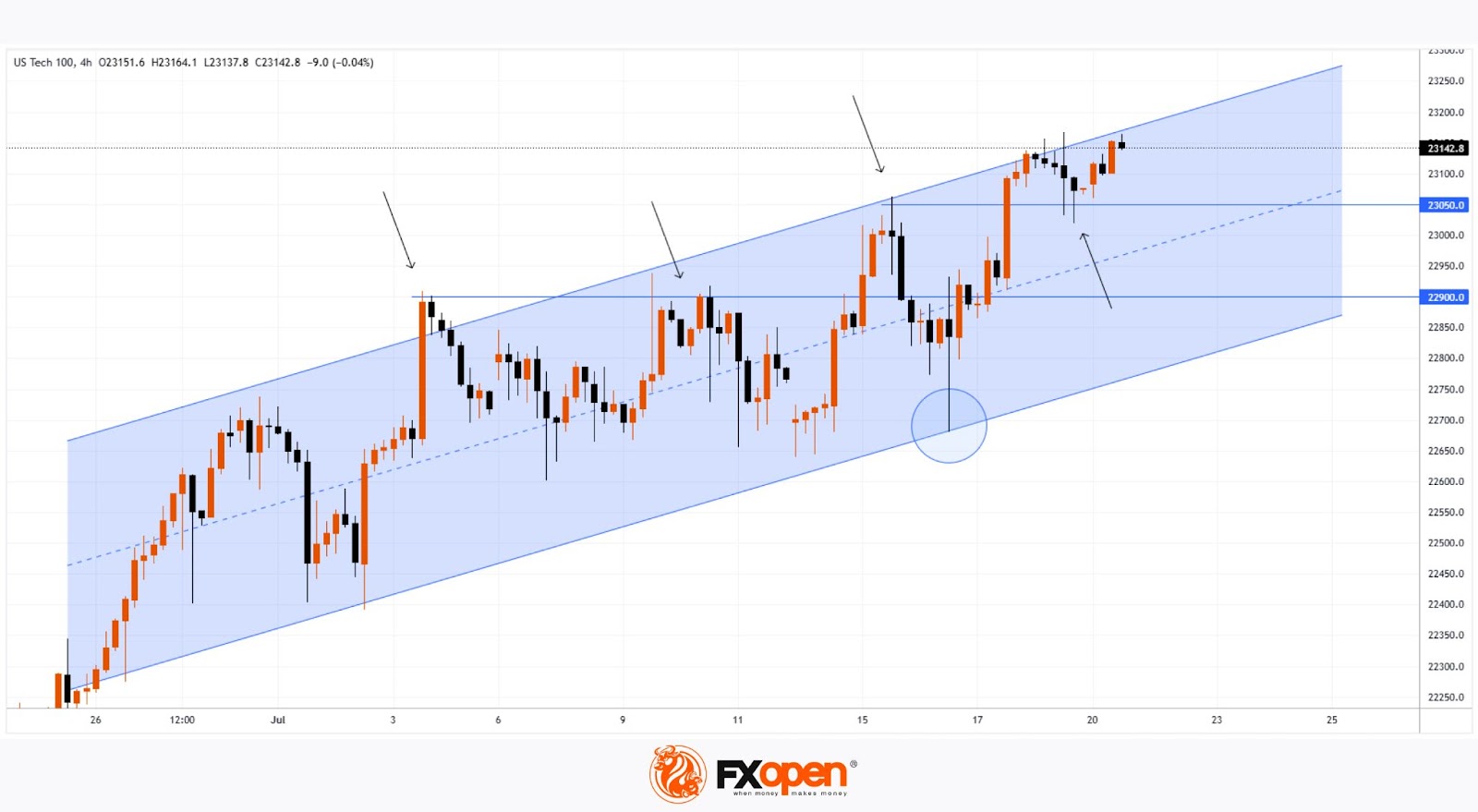
          Technical Analysis of the Nasdaq 100 Chart (US Tech 100 mini on FXOpen)

          Price movements have formed an upward channel (marked in blue), with the following dynamics observed:

          → The bearish signals we highlighted on 7 July did not result in any significant correction. This may be interpreted as a sign of a strong market, as bearish momentum failed to materialise despite favourable technical conditions.

          → Buyers have shown initiative by gaining control at higher price levels (as indicated by the arrows): the resistance at 22,900 has been invalidated, while the 23,050 level has flipped to become support.

          → A long lower shadow near the bottom boundary of the channel (circled on the chart) underscores aggressive buying activity.

          Should the earnings and forward guidance from major tech firms also come in strong, this could further reinforce the sustainable bullish trend in the US equity market.

          Source: ACTIONFOREX

          Risk Warnings and Disclaimers
          You understand and acknowledge that there is a high degree of risk involved in trading. Following any strategies or investment methods may lead to potential losses. The content on the site is provided by our contributors and analysts for information purposes only. You are solely responsible for determining whether any trading assets, securities, strategy, or any other product is suitable for investing based on your own investment objectives and financial situation.
          Add to Favorites
          Share

          The Pound's Complicated, Don't Sell It - Yet

          Glendon

          Economic

          Forex

          THE POUND'S COMPLICATED, DON'T SELL IT - YET

          Analysts' views on Britain's pound are more varied than for other top currencies, both in terms of direction of travel, and the reasons behind it.

          This is anecdotal, but if you ask a number of analysts about the euro, yen, broad dollar, Swiss franc etc, they will all touch on pretty much the same themes for each currency.

          But there's a greater variety of views over the outlook for the pound, as reflected in a Goldman note from late Friday, in which they say they expect sterling weakness against European currencies, but not yet, and see less downside for the pound against the dollar.

          Why?

          First of all, at least for euro/sterling they say there are two factors in the mix, rate differentials, as usual, but also concerns about Britain's fiscal position.

          And these two point in different directions, higher British rates boost the pound, but at the same time, they hurt it, because higher long-term gilt yields mean a worsening in government finances.

          And Goldman reckons the second is more important for now, and will lead to higher euro/sterling, which last week reached its highest since April's tariff volatility and before that, late 2023.

          However, they think these fiscal worries will fade, as the summer should be quieter for news on UK government finances. They see more benign market for gilt issuance, and so now isn't the time to position for further sterling weakness.

          That changes later in the year though, partly because they think a sterling rebound would give better levels at which to sell, and partly because rate differentials will start to matter again, and they expect more BoE rate cuts than the market.

          As for cable - sterling/dollar - they think it's harder to target falls there, because of all U.S. volatility, and their expectations for a broadly weaker dollar.

          Source: TradingView

          To stay updated on all economic events of today, please check out our Economic calendar
          Risk Warnings and Disclaimers
          You understand and acknowledge that there is a high degree of risk involved in trading. Following any strategies or investment methods may lead to potential losses. The content on the site is provided by our contributors and analysts for information purposes only. You are solely responsible for determining whether any trading assets, securities, strategy, or any other product is suitable for investing based on your own investment objectives and financial situation.
          Add to Favorites
          Share

          Russia’s Metals Exports to China Hit $1 Billion in 2025

          Michelle

          Economic

          Commodity

          Russia’s got one trading partner left that still writes big checks:- China. And those checks just got a hell of a lot bigger.

          Russia’s precious metals exports to China nearly doubled in the first half of 2025, pulling in $1 billion, with gold leading the charge as prices rip through the roof. That figure came straight from Trade Data Monitor, which tracks Chinese customs filings.

          Shipments of Russian gold, silver, and other ores sent to China shot up by 80% compared to the same period last year. The jump lines up with a sharp rally in bullion prices, which have gained around 28% so far this year.

          The rally is getting help from central banks stacking reserves, trade friction between the U.S. and its partners, and investors pouring into exchange-traded funds trying to shield themselves from market chaos.

          Russia leans on China after being locked out of Western gold trade

          Ever since Russia’s 2022 invasion of Ukraine, the Kremlin’s been cut out of the world’s top trading venues like London and New York. That shut the door on Western demand, but China’s stayed open.

          With the Bank of Russia, once the biggest central bank buyer of gold, not returning to the market in any major way, Russian miners are now banking hard on Asian demand.

          Russia still pumps out over 300 tons of gold annually, making it the second-largest gold producer in the world. That supply needs a home. For now, it’s getting one in China. And not just gold, Russia’s also moving more palladium and platinum, thanks to demand coming out of China’s manufacturing sectors.

          MMC Norilsk Nickel PJSC, the country’s major producer of both metals, has turned its focus entirely eastward. That play seems to be working. Prices for palladium are up 38%, and platinum has jumped 59% so far this year. China’s taking that in stride, expanding imports as the West keeps its sanctions tight.

          Inside Russia, miners are getting an extra push from locals. As trust in the ruble drops, Russian retail demand for gold has hit record highs in 2024, with people buying coins, bars, and any physical metal they can stash. Precious metals have basically become the savings account for Russian households trying to survive inflation and a volatile currency.

          Global drama and weak dollar push gold to new highs

          Gold prices didn’t just spike because of mining. They’re also reacting to global politics. On Monday morning, spot gold rose to $3,369.02 per ounce, while U.S. gold futures hit $3,376.40. The jump was helped by a weakening U.S. dollar, which slipped 0.2% against other major currencies. That drop made it easier for non-dollar holders to jump in and buy gold.

          Tim Waterer, Chief Market Analyst at KCM Trade, explained the rally clearly: “Dollar has made a subdued start to the week, which has left the door open for gold to post gains early doors with tariff deadlines looming large.” He added:

          “The closer we move towards the key August 1 deadline without any new trade deals emerging, the more likely gold is to start fancying another run towards the $3,400 level and perhaps beyond.”

          Tensions are running high with U.S. President Donald Trump’s tariff deadline just days away. His Commerce Secretary, Howard Lutnick, is still hopeful about locking in a deal with the European Union, but so far, no handshake.

          Trump is also rumored to be considering a visit to China ahead of the APEC summit, which takes place from October 30 to November 1. Another option would be to meet Chinese President Xi Jinping at the APEC gathering in South Korea.

          Over in Europe, the European Central Bank is expected to hold its interest rate steady at 2.0% after a series of recent cuts. In the U.S., Federal Reserve Governor Christopher Waller said last week that the Fed should move ahead with a rate cut at its next meeting. Both of those moves make gold more attractive, especially with traditional yields falling and uncertainty mounting.

          In Japan, the ruling coalition lost its majority in the upper house during Sunday’s vote, dealing another political shock just as global trade talks stall out. That instability only adds more fuel to the metals market.

          And it’s not just gold on fire. Other metals are following suit. Spot silver gained 0.4% to hit $38.33 per ounce, platinum added 1.1% to reach $1,437.53, and palladium climbed 1.3% to $1,256.98.

          Source: CryptoSlate

          To stay updated on all economic events of today, please check out our Economic calendar
          Risk Warnings and Disclaimers
          You understand and acknowledge that there is a high degree of risk involved in trading. Following any strategies or investment methods may lead to potential losses. The content on the site is provided by our contributors and analysts for information purposes only. You are solely responsible for determining whether any trading assets, securities, strategy, or any other product is suitable for investing based on your own investment objectives and financial situation.
          Add to Favorites
          Share
          FastBull
          Copyright © 2025 FastBull Ltd

          728 RM B 7/F GEE LOK IND BLDG NO 34 HUNG TO RD KWUN TONG KLN HONG KONG

          TelegramInstagramTwitterfacebooklinkedin
          App Store Google Play Google Play
          Products
          Charts

          Chats

          Q&A with Experts
          Screeners
          Economic Calendar
          Data
          Tools
          Membership
          Features
          Function
          Markets
          Copy Trading
          Latest Signals
          Contests
          News
          Analysis
          24/7
          Columns
          Education
          Company
          Careers
          About Us
          Contact Us
          Advertising
          Help Center
          Feedback
          User Agreement
          Privacy Policy
          Business

          White Label

          Data API

          Web Plug-ins

          Poster Maker

          Affiliate Program

          Risk Disclosure

          The risk of loss in trading financial instruments such as stocks, FX, commodities, futures, bonds, ETFs and crypto can be substantial. You may sustain a total loss of the funds that you deposit with your broker. Therefore, you should carefully consider whether such trading is suitable for you in light of your circumstances and financial resources.

          No decision to invest should be made without thoroughly conducting due diligence by yourself or consulting with your financial advisors. Our web content might not suit you since we don't know your financial conditions and investment needs. Our financial information might have latency or contain inaccuracy, so you should be fully responsible for any of your trading and investment decisions. The company will not be responsible for your capital loss.

          Without getting permission from the website, you are not allowed to copy the website's graphics, texts, or trademarks. Intellectual property rights in the content or data incorporated into this website belong to its providers and exchange merchants.

          Not Logged In

          Log in to access more features

          FastBull Membership

          Not yet

          Purchase

          Become a signal provider
          Help Center
          Customer Service
          Dark Mode
          Price Up/Down Colors

          Log In

          Sign Up

          Position
          Layout
          Fullscreen
          Default to Chart
          The chart page opens by default when you visit fastbull.com