Markets
News
Analysis
User
24/7
Economic Calendar
Education
Data
- Names
- Latest
- Prev


Signal Accounts for Members
All Signal Accounts
All Contests


France Trade Balance (SA) (Oct)A:--
F: --
Euro Zone Employment YoY (SA) (Q3)A:--
F: --
Canada Part-Time Employment (SA) (Nov)A:--
F: --
P: --
Canada Unemployment Rate (SA) (Nov)A:--
F: --
P: --
Canada Full-time Employment (SA) (Nov)A:--
F: --
P: --
Canada Labor Force Participation Rate (SA) (Nov)A:--
F: --
P: --
Canada Employment (SA) (Nov)A:--
F: --
P: --
U.S. PCE Price Index MoM (Sept)A:--
F: --
P: --
U.S. Personal Income MoM (Sept)A:--
F: --
P: --
U.S. Core PCE Price Index MoM (Sept)A:--
F: --
P: --
U.S. PCE Price Index YoY (SA) (Sept)A:--
F: --
P: --
U.S. Core PCE Price Index YoY (Sept)A:--
F: --
P: --
U.S. Personal Outlays MoM (SA) (Sept)A:--
F: --
U.S. 5-10 Year-Ahead Inflation Expectations (Dec)A:--
F: --
P: --
U.S. Real Personal Consumption Expenditures MoM (Sept)A:--
F: --
U.S. Weekly Total Rig CountA:--
F: --
P: --
U.S. Weekly Total Oil Rig CountA:--
F: --
P: --
U.S. Consumer Credit (SA) (Oct)A:--
F: --
China, Mainland Foreign Exchange Reserves (Nov)A:--
F: --
P: --
Japan Trade Balance (Oct)A:--
F: --
P: --
Japan Nominal GDP Revised QoQ (Q3)A:--
F: --
P: --
China, Mainland Imports YoY (CNH) (Nov)A:--
F: --
P: --
China, Mainland Exports (Nov)A:--
F: --
P: --
China, Mainland Imports (CNH) (Nov)A:--
F: --
P: --
China, Mainland Trade Balance (CNH) (Nov)A:--
F: --
P: --
China, Mainland Exports YoY (USD) (Nov)A:--
F: --
P: --
China, Mainland Imports YoY (USD) (Nov)A:--
F: --
P: --
Germany Industrial Output MoM (SA) (Oct)A:--
F: --
Euro Zone Sentix Investor Confidence Index (Dec)A:--
F: --
P: --
Canada National Economic Confidence IndexA:--
F: --
P: --
U.K. BRC Like-For-Like Retail Sales YoY (Nov)--
F: --
P: --
U.K. BRC Overall Retail Sales YoY (Nov)--
F: --
P: --
Australia Overnight (Borrowing) Key Rate--
F: --
P: --
RBA Rate Statement
RBA Press Conference
Germany Exports MoM (SA) (Oct)--
F: --
P: --
U.S. NFIB Small Business Optimism Index (SA) (Nov)--
F: --
P: --
Mexico 12-Month Inflation (CPI) (Nov)--
F: --
P: --
Mexico Core CPI YoY (Nov)--
F: --
P: --
Mexico PPI YoY (Nov)--
F: --
P: --
U.S. Weekly Redbook Index YoY--
F: --
P: --
U.S. JOLTS Job Openings (SA) (Oct)--
F: --
P: --
China, Mainland M1 Money Supply YoY (Nov)--
F: --
P: --
China, Mainland M0 Money Supply YoY (Nov)--
F: --
P: --
China, Mainland M2 Money Supply YoY (Nov)--
F: --
P: --
U.S. EIA Short-Term Crude Production Forecast For The Year (Dec)--
F: --
P: --
U.S. EIA Natural Gas Production Forecast For The Next Year (Dec)--
F: --
P: --
U.S. EIA Short-Term Crude Production Forecast For The Next Year (Dec)--
F: --
P: --
EIA Monthly Short-Term Energy Outlook
U.S. API Weekly Gasoline Stocks--
F: --
P: --
U.S. API Weekly Cushing Crude Oil Stocks--
F: --
P: --
U.S. API Weekly Crude Oil Stocks--
F: --
P: --
U.S. API Weekly Refined Oil Stocks--
F: --
P: --
South Korea Unemployment Rate (SA) (Nov)--
F: --
P: --
Japan Reuters Tankan Non-Manufacturers Index (Dec)--
F: --
P: --
Japan Reuters Tankan Manufacturers Index (Dec)--
F: --
P: --
Japan Domestic Enterprise Commodity Price Index MoM (Nov)--
F: --
P: --
Japan Domestic Enterprise Commodity Price Index YoY (Nov)--
F: --
P: --
China, Mainland PPI YoY (Nov)--
F: --
P: --
China, Mainland CPI MoM (Nov)--
F: --
P: --


No matching data
Latest Views
Latest Views
Trending Topics
Top Columnists
Latest Update
White Label
Data API
Web Plug-ins
Affiliate Program
View All

No data
The FTSE 100 hit a record high, driven by miners and healthcare stocks, as markets shrug off Trump's tariff threats. AI momentum and Nvidia’s surge fuel optimism, while the dollar weakens.
Opec has raised its forecast for world energy demand for the medium and long term as global economies expand and population growth boosts requirements for oil.
Overall energy demand in the long term is expected to increase by 23 per cent to reach 378 million barrels of oil equivalent per day by 2050, the supergroup of oil producers said on Thursday in its World Oil Outlook 2050 report.
In the medium term, global oil demand is projected to increase by 9 per cent to reach 113.3 million barrels per day by 2030, from 103.7 million bpd in 2024, while in the long term, it is forecast to surge by 18.5 per cent to reach 123 million bpd by 2050, Opec said.
This will be driven by “expanding economic growth, rising populations, increasing urbanisation, new energy-intensive industries like artificial intelligence, and the need to bring energy to the billions without it”, Haitham Al Ghais, secretary general of Opec, said.
The global population is expected to reach 9.7 billion by 2050, from 8.2 billion in 2024, with the working age population set to increase by 800 million over the same period to reach about 6.1 billion.
The global urbanisation rate is also expected to rise to 68 per cent from 58 per cent during the period, resulting in about 1.9 billion people moving to cities by 2050, Opec said.
The world economy, meanwhile, is set to more than double in size to $358 trillion by 2050, with global average income expected to rise during the period, according to Opec.
Countries outside the Organisation for Economic Co-operation and Development (OECD), including India, Africa and Middle East states, are projected to lead the oil demand growth for both medium and long-term forecast periods.
The non-OECD oil demand during the long term is projected to increase by almost 28 million bpd, while OECD oil demand is set to witness a decline of 8.5 million bpd.
Combined demand in India, other Asia, the Middle East and Africa is set to increase by 22.4 million bpd between 2024 and 2050, with India alone adding 8.2 million bpd, the report said. China’s oil demand is projected to increase by less than 2 million bpd over the same period.
Road transport, petrochemicals and aviation are expected to play a key role in boosting demand for oil. The transportation sector accounted for more than 57 per cent of global oil demand in 2024 and is projected to retain this share over the entire forecast period. A significant demand increase of 4.7 million bpd is also projected in the petrochemicals sector.
“Oil underpins the global economy and is central to our daily lives,” Mr Al Ghais said. “There is no peak oil demand on the horizon.”
Opec+ countries have been boosting production since April in anticipation of higher demand after curtaining production for several years.
The group will boost production by 548,000 bpd for August, it said last week, after increasing output by 411,000 bpd for each of May, June and July. The group also approved an increase of 138,000 bpd in April.
"You can see that even with the increases for several months, we haven’t seen a major build-up in inventories, which means the market needed those barrels," Suhail Al Mazrouei, the UAE’s Minister of Energy and Infrastructure, said in Vienna on Wednesday.
"What we want is stability and you cannot be short-sighted just by looking at the price. We need the price to be right for investments to happen," he said, adding that countries with big oil reserves were still not investing enough.
Mr Al Ghais also underscored the importance of boosting investments in the oil sector, with investment requirements of $18.2 trillion until 2050.
“It is vital that these investments are made for consumers and producers everywhere, as well as for the effective functioning of the global economy at large,” Mr Al Ghais said.
Oil markets remained volatile this year amid US President Donald Trump’s tariff plans and the Israel-Iran conflict.
Crude prices started the year strongly. The closing price of Brent, the benchmark for two-thirds of the world's oil, peaked at more than $82 a barrel on January 15, while West Texas Intermediate, the gauge that tracks US crude, hit almost $79 per barrel on that day.
However, demand concerns, a slowing global economy and less-than-stellar growth in China, the world's biggest crude importer, have weighed on crude prices this year.
Mr Trump’s push to impose hefty tariffs on trade partners has been the biggest driver of declining oil prices.
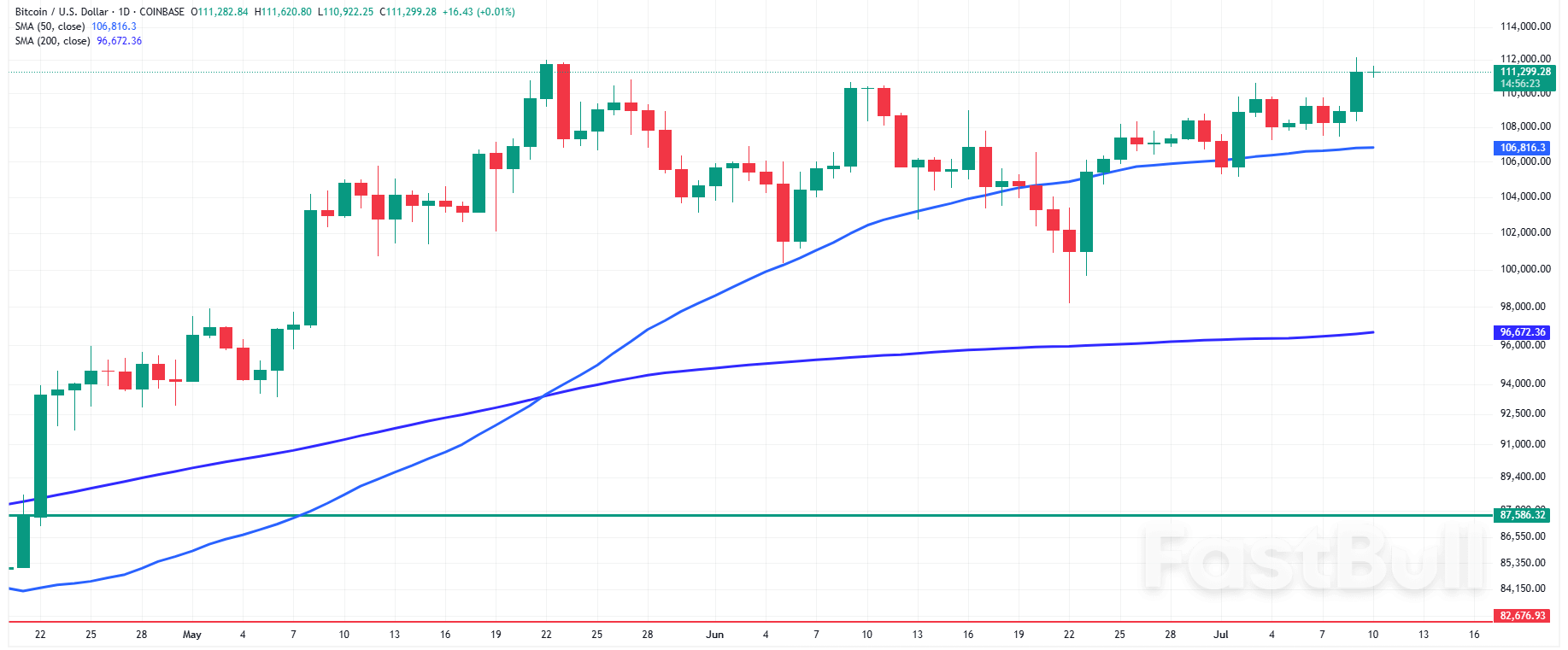
Daily Bitcoin (BTCUSD)


The number of Americans filing new applications for jobless benefits unexpectedly fell last week, suggesting employers may be holding on to workers despite other indications of a cooling labor market.
Initial claims for state unemployment benefits dropped 5,000 to a seasonally adjusted 227,000 for the week ended July 4, the Labor Department said on Thursday. Economists polled by Reuters had forecast 235,000 claims for the latest week. The data included last week's July Fourth holiday and claims tend to be volatile around public holidays.
Economists and U.S. central bankers have generally viewed the labor market as solid, if weakening somewhat. This is a view reinforced by last week's monthly jobs report that showed the unemployment rate ticking down to 4.1%, though largely because the workforce shrank, and a bigger-than-expected gain of 147,000 jobs, though highly concentrated in just a few sectors.
Fed Chair Jerome Powell has noted that in the current low-hiring and low-firing environment, any increase in layoffs could rapidly push up the unemployment rate.
So far that has not happened, though nearly 100 U.S. companies have announced layoffs this month, including Microsoft and Intel. Economists say President DonaldTrump'sstill unsettled tariff policy is making it difficult for businesses to plan ahead.
Hiring has been lackluster, making it harder for people out of work to find jobs. Last month's jobs report showed the median duration of unemployment rose in June to 10.1 weeks from 9.5 weeks in May.
The number of people receiving unemployment benefits after an initial week of aid, a proxy for hiring, increased 10,000 to a seasonally adjusted 1.965 million during the week ending June 28, Thursday's claims report showed.
The so-called continuing claims are at their highest level since November 2021, suggesting those who lose a job are taking longer to find a new position.
The Federal Reserve last week left its policy rate in the 4.25%-4.50% range where it has been since December as central bankers wait to see if tariffs push up inflation before moving to lower rates.
White Label
Data API
Web Plug-ins
Poster Maker
Affiliate Program
The risk of loss in trading financial instruments such as stocks, FX, commodities, futures, bonds, ETFs and crypto can be substantial. You may sustain a total loss of the funds that you deposit with your broker. Therefore, you should carefully consider whether such trading is suitable for you in light of your circumstances and financial resources.
No decision to invest should be made without thoroughly conducting due diligence by yourself or consulting with your financial advisors. Our web content might not suit you since we don't know your financial conditions and investment needs. Our financial information might have latency or contain inaccuracy, so you should be fully responsible for any of your trading and investment decisions. The company will not be responsible for your capital loss.
Without getting permission from the website, you are not allowed to copy the website's graphics, texts, or trademarks. Intellectual property rights in the content or data incorporated into this website belong to its providers and exchange merchants.
Not Logged In
Log in to access more features

FastBull Membership
Not yet
Purchase
Log In
Sign Up