• Trade
  • Markets
  • Copy
  • Contests
  • News
  • 24/7
  • Calendar
  • Q&A
  • Chats
Trending
Screeners
SYMBOL
LAST
BID
ASK
HIGH
LOW
NET CHG.
%CHG.
SPREAD
SPX
S&P 500 Index
6848.42
6848.42
6848.42
6861.30
6843.84
+21.01
+ 0.31%
--
DJI
Dow Jones Industrial Average
48628.25
48628.25
48628.25
48679.14
48557.21
+170.21
+ 0.35%
--
IXIC
NASDAQ Composite Index
23242.41
23242.41
23242.41
23345.56
23239.56
+47.25
+ 0.20%
--
USDX
US Dollar Index
97.820
97.900
97.820
98.070
97.810
-0.130
-0.13%
--
EURUSD
Euro / US Dollar
1.17575
1.17582
1.17575
1.17596
1.17262
+0.00181
+ 0.15%
--
GBPUSD
Pound Sterling / US Dollar
1.33951
1.33960
1.33951
1.33970
1.33546
+0.00244
+ 0.18%
--
XAUUSD
Gold / US Dollar
4330.55
4330.96
4330.55
4350.16
4294.68
+31.16
+ 0.72%
--
WTI
Light Sweet Crude Oil
56.858
56.888
56.858
57.601
56.789
-0.375
-0.66%
--

Community Accounts

Signal Accounts
--
Profit Accounts
--
Loss Accounts
--
View More

Become a signal provider

Sell trading signals to earn additional income

View More

Guide to Copy Trading

Get started with ease and confidence

View More

Signal Accounts for Members

All Signal Accounts

Best Return
  • Best Return
  • Best P/L
  • Best MDD
Past 1W
  • Past 1W
  • Past 1M
  • Past 1Y

All Contests

  • All
  • Trump Updates
  • Recommend
  • Stocks
  • Cryptocurrencies
  • Central Banks
  • Featured News
Top News Only
Share

The Nasdaq Golden Dragon China Index Fell 0.9% In Early Trading

Share

The S&P 500 Opened 32.78 Points Higher, Or 0.48%, At 6860.19; The Dow Jones Industrial Average Opened 136.31 Points Higher, Or 0.28%, At 48594.36; And The Nasdaq Composite Opened 134.87 Points Higher, Or 0.58%, At 23330.04

Share

Miran: Goods Inflation Could Be Settling In At A Higher Level Than Was Normal Before The Pandemic, But That Will Be More Than Offset By Housing Disinflation

Share

Miran, Who Dissented In Favor Of A Larger Cut At Last Fed Meeting, Repeats Keeping Policy Too Tight Will Lead To Job Losses

Share

Miran: Does Not Think Higher Goods Inflation Is Mostly From Tariffs, But Acknowledges Does Not Have A Full Explanation For It

Share

Toronto Stock Index .GSPTSE Rises 67.16 Points, Or 0.21 Percent, To 31594.55 At Open

Share

Miran: Excluding Housing And Non-Market Based Items, Core Pce Inflation May Be Below 2.3%, “Within Noise” Of The Fed's 2% Target

Share

Polish State Assets Minister Balczun Says Jsw Needs Over USD 830 Million Financing To Keep Liquidity For A Year

Share

Miran: Prices Are “Once Again Stable” And Monetary Policy Should Reflect That

Share

Fed's Miran: Current Excess Inflation Is Not Reflective Of Underlying Supply And Demand In The Economy

Share

Portugal Treasury Puts 2026 Net Financing Needs At 13 Billion Euros, Up From 10.8 Billion In 2025

Share

Portugal Treasury Expects 2026 Net Financing Needs At 29.4 Billion Euros, Up From 25.8 Billion In 2025

Share

Bank Of America Says With Indonesia's Smelter Now Ramping Up, It Expects Aluminium Supply Growth To Accelerate To 2.6% Year On Year In 2026

Share

Bank Of America Expects A Deficit In Aluminium Next Year And Sees Prices Pushing Above $3000/T

Share

Fed Data - USA Effective Federal Funds Rate At 3.64 Percent On 12 December On $102 Billion In Trades Versus 3.64 Percent On $99 Billion On 11 December

Share

Brazil's Petrobras Says No Impact Seen On Oil, Petroleum Products Output As Workers Start Planned Strike

Share

Statement: US Travel Group Warns New Proposed Trump Administration Requirements For Foreign Tourists To Provide Social Media Histories Could Mean Millions Of People Opting Not To Visit

Share

Blackrock: Kerry White Will Become Head Of Citi Investment Management At Citi Wealth

Share

Blackrock: Rob Jasminski, Head Of Citi Investment Management, Has Joined With Team

Share

Blackrock: Effective Dec 15, Citi Investment Management Employees Will Join Blackrock

TIME
ACT
FCST
PREV
Japan Tankan Small Manufacturing Outlook Index (Q4)

A:--

F: --

P: --

Japan Tankan Large Non-Manufacturing Outlook Index (Q4)

A:--

F: --

P: --

Japan Tankan Large Manufacturing Outlook Index (Q4)

A:--

F: --

P: --

Japan Tankan Small Manufacturing Diffusion Index (Q4)

A:--

F: --

P: --

Japan Tankan Large Manufacturing Diffusion Index (Q4)

A:--

F: --

P: --

Japan Tankan Large-Enterprise Capital Expenditure YoY (Q4)

A:--

F: --

P: --

U.K. Rightmove House Price Index YoY (Dec)

A:--

F: --

P: --

China, Mainland Industrial Output YoY (YTD) (Nov)

A:--

F: --

P: --

China, Mainland Urban Area Unemployment Rate (Nov)

A:--

F: --

P: --

Saudi Arabia CPI YoY (Nov)

A:--

F: --

P: --

Euro Zone Industrial Output YoY (Oct)

A:--

F: --

P: --

Euro Zone Industrial Output MoM (Oct)

A:--

F: --

P: --

Canada Existing Home Sales MoM (Nov)

A:--

F: --

P: --

Canada National Economic Confidence Index

A:--

F: --

P: --

Canada New Housing Starts (Nov)

A:--

F: --

P: --
U.S. NY Fed Manufacturing Employment Index (Dec)

A:--

F: --

P: --

U.S. NY Fed Manufacturing Index (Dec)

A:--

F: --

P: --

Canada Core CPI YoY (Nov)

A:--

F: --

P: --

Canada Manufacturing Unfilled Orders MoM (Oct)

A:--

F: --

P: --

U.S. NY Fed Manufacturing Prices Received Index (Dec)

A:--

F: --

P: --

U.S. NY Fed Manufacturing New Orders Index (Dec)

A:--

F: --

P: --

Canada Manufacturing New Orders MoM (Oct)

A:--

F: --

P: --

Canada Core CPI MoM (Nov)

A:--

F: --

P: --

Canada Trimmed CPI YoY (SA) (Nov)

A:--

F: --

P: --

Canada Manufacturing Inventory MoM (Oct)

A:--

F: --

P: --

Canada CPI YoY (Nov)

A:--

F: --

P: --

Canada CPI MoM (Nov)

A:--

F: --

P: --

Canada CPI YoY (SA) (Nov)

A:--

F: --

P: --

Canada Core CPI MoM (SA) (Nov)

A:--

F: --

P: --

Canada CPI MoM (SA) (Nov)

A:--

F: --

P: --

Federal Reserve Board Governor Milan delivered a speech
U.S. NAHB Housing Market Index (Dec)

--

F: --

P: --

Australia Composite PMI Prelim (Dec)

--

F: --

P: --

Australia Services PMI Prelim (Dec)

--

F: --

P: --

Australia Manufacturing PMI Prelim (Dec)

--

F: --

P: --

Japan Manufacturing PMI Prelim (SA) (Dec)

--

F: --

P: --

U.K. 3-Month ILO Employment Change (Oct)

--

F: --

P: --

U.K. Unemployment Claimant Count (Nov)

--

F: --

P: --

U.K. Unemployment Rate (Nov)

--

F: --

P: --

U.K. 3-Month ILO Unemployment Rate (Oct)

--

F: --

P: --

U.K. Average Weekly Earnings (3-Month Average, Including Bonuses) YoY (Oct)

--

F: --

P: --

U.K. Average Weekly Earnings (3-Month Average, Excluding Bonuses) YoY (Oct)

--

F: --

P: --

France Services PMI Prelim (Dec)

--

F: --

P: --

France Composite PMI Prelim (SA) (Dec)

--

F: --

P: --

France Manufacturing PMI Prelim (Dec)

--

F: --

P: --

Germany Services PMI Prelim (SA) (Dec)

--

F: --

P: --

Germany Manufacturing PMI Prelim (SA) (Dec)

--

F: --

P: --

Germany Composite PMI Prelim (SA) (Dec)

--

F: --

P: --

Euro Zone Composite PMI Prelim (SA) (Dec)

--

F: --

P: --

Euro Zone Services PMI Prelim (SA) (Dec)

--

F: --

P: --

Euro Zone Manufacturing PMI Prelim (SA) (Dec)

--

F: --

P: --

U.K. Services PMI Prelim (Dec)

--

F: --

P: --

U.K. Manufacturing PMI Prelim (Dec)

--

F: --

P: --

U.K. Composite PMI Prelim (Dec)

--

F: --

P: --

Euro Zone ZEW Economic Sentiment Index (Dec)

--

F: --

P: --

Germany ZEW Current Conditions Index (Dec)

--

F: --

P: --

Germany ZEW Economic Sentiment Index (Dec)

--

F: --

P: --

Euro Zone Trade Balance (Not SA) (Oct)

--

F: --

P: --

Euro Zone ZEW Current Conditions Index (Dec)

--

F: --

P: --

Euro Zone Trade Balance (SA) (Oct)

--

F: --

P: --

U.S. Retail Sales MoM (Excl. Automobile) (SA) (Oct)

--

F: --

P: --

Q&A with Experts
    • All
    • Chatrooms
    • Groups
    • Friends
    Connecting
    .
    .
    .
    Type here...
    Add Symbol or Code

      No matching data

      All
      Trump Updates
      Recommend
      Stocks
      Cryptocurrencies
      Central Banks
      Featured News
      • All
      • Russia-Ukraine Conflict
      • Middle East Flashpoint
      • All
      • Russia-Ukraine Conflict
      • Middle East Flashpoint
      Search
      Products

      Charts Free Forever

      Chats Q&A with Experts
      Screeners Economic Calendar Data Tools
      Membership Features
      Data Warehouse Market Trends Institutional Data Policy Rates Macro

      Market Trends

      Market Sentiment Order Book Forex Correlations

      Top Indicators

      Charts Free Forever
      Markets

      News

      News Analysis 24/7 Columns Education
      From Institutions From Analysts
      Topics Columnists

      Latest Views

      Latest Views

      Trending Topics

      Top Columnists

      Latest Update

      Signals

      Copy Rankings Latest Signals Become a signal provider AI Rating
      Contests
      Brokers

      Overview Brokers Assessment Rankings Regulators News Claims
      Broker listing Forex Brokers Comparison Tool Live Spread Comparison Scam
      Q&A Complaint Scam Alert Videos Tips to Detect Scam
      More

      Business
      Events
      Careers About Us Advertising Help Center

      White Label

      Data API

      Web Plug-ins

      Affiliate Program

      Awards Institution Evaluation IB Seminar Salon Event Exhibition
      Vietnam Thailand Singapore Dubai
      Fans Party Investment Sharing Session
      FastBull Summit BrokersView Expo
      Recent Searches
        Top Searches
          Markets
          News
          Analysis
          User
          24/7
          Economic Calendar
          Education
          Data
          • Names
          • Latest
          • Prev

          View All

          No data

          Scan to Download

          Faster Charts, Chat Faster!

          Download App
          English
          • English
          • Español
          • العربية
          • Bahasa Indonesia
          • Bahasa Melayu
          • Tiếng Việt
          • ภาษาไทย
          • Français
          • Italiano
          • Türkçe
          • Русский язык
          • 简中
          • 繁中
          Open Account
          Search
          Products
          Charts Free Forever
          Markets
          News
          Signals

          Copy Rankings Latest Signals Become a signal provider AI Rating
          Contests
          Brokers

          Overview Brokers Assessment Rankings Regulators News Claims
          Broker listing Forex Brokers Comparison Tool Live Spread Comparison Scam
          Q&A Complaint Scam Alert Videos Tips to Detect Scam
          More

          Business
          Events
          Careers About Us Advertising Help Center

          White Label

          Data API

          Web Plug-ins

          Affiliate Program

          Awards Institution Evaluation IB Seminar Salon Event Exhibition
          Vietnam Thailand Singapore Dubai
          Fans Party Investment Sharing Session
          FastBull Summit BrokersView Expo

          Freight Freefall: Asia–US Sea Cargo Rates Plunge Amid Overcapacity and Tariff Turbulence

          Gerik

          Economic

          Summary:

          Asia-to-US sea freight rates are projected to continue their steep decline in 2025, driven by global overcapacity and trade disruptions from tariffs...

          Freight Rates Collapse as Supply Outpaces Demand

          Spot freight rates for container shipments from Asia to the U.S. West and East Coasts have dropped sharply 58% and 46% respectively since June 1 according to Xeneta. This sharp decline reflects a global oversupply of shipping capacity amid sluggish demand, as well as shifting trade flows due to escalating tariff battles and geopolitical risks.
          The temporary spike in sea freight demand seen in late May and early June coinciding with a 90-day U.S.-China tariff truce was short-lived. Carriers had increased capacity to capitalize on the temporary surge, but rates quickly fell once the demand momentum faded. This scenario is particularly troubling as the Asia–U.S. trade lane remains one of the most profitable routes for global shipping lines.

          Capacity Glut and Trade Policy Drag Down Rates

          As global shipping firms scrambled to reposition vessels during the early summer optimism, overcapacity quickly became evident, a trend DHL and Xeneta both warned would worsen in the second half of 2025. The return of blank sailings cancelled trips to manage excess supply is becoming a routine tactic by carriers trying to avoid a price war.
          The shipping market is further strained by ongoing uncertainty in U.S.-China trade talks, which have yet to resolve key structural issues despite temporary tariff pauses. China's outbound shipments to the U.S. are falling, while EU demand remains weak, putting pressure on multiple major shipping corridors.
          According to DHL’s Niki Frank and Veson Nautical's Jarl Milford, these pressures will likely intensify as additional vessels enter the market in the coming months, creating a supply-demand imbalance that could lead to more prolonged price weakness.

          Rerouting as a Shock Absorber: The Red Sea and Tariff Detours

          Despite these bearish fundamentals, vessel rerouting is acting as a buffer. In particular, diversions from the Red Sea caused by security threats from Yemeni Houthi attacks and strategic avoidance of U.S. ports due to tariff concerns are lengthening voyage times. This effectively absorbs more vessels and prevents an even sharper rate drop.
          Jefferies Research noted that such detours have soaked up more than 10% of global containership supply, keeping capacity utilization relatively healthy at around 86–87%. These constraints have helped slow the rate decline somewhat, even as the transpacific route faces mounting pressure.
          Meanwhile, China’s export redirection toward Europe and Latin America has kept freight rates to those regions elevated, further mitigating global oversupply.

          Fragile Rate Floor, Persistent Uncertainty

          Looking ahead, analysts expect further rate declines on Asia–U.S. routes as more shipping capacity enters service and demand remains soft due to inflation, geopolitical uncertainty, and tepid global trade flows. The temporary buffer from rerouting and port avoidance may not be enough to offset the broader market imbalance unless trade conditions stabilize.
          While the tariff truce extension talks between the U.S. and China offer some hope, carriers and shippers alike are bracing for a volatile second half of the year. With Asia-to-U.S. volumes expected to fall further, the freight market may face a prolonged adjustment period, reshaping how cargo flows across global maritime corridors.
          In summary, the sea freight sector is navigating a perfect storm oversupply, shifting geopolitical currents, and fragile trade agreements. Unless policy clarity and demand recovery materialize, carriers may continue facing the challenge of sustaining profitability in a deeply uncertain landscape.

          Source: Reuters

          To stay updated on all economic events of today, please check out our Economic calendar
          Risk Warnings and Disclaimers
          You understand and acknowledge that there is a high degree of risk involved in trading. Following any strategies or investment methods may lead to potential losses. The content on the site is provided by our contributors and analysts for information purposes only. You are solely responsible for determining whether any trading assets, securities, strategy, or any other product is suitable for investing based on your own investment objectives and financial situation.
          Add to Favorites
          Share

          Euro Zone Business Growth Inched Up in July But Remained Subdued, PMI Shows

          Glendon

          Economic

          Forex

          Business activity in the euro zone grew at a slightly faster pace in July than in June but remained sluggish as demand dipped, a survey showed on Tuesday.

          The HCOB Eurozone Composite Purchasing Managers' Index, compiled by S&P Global, edged up to 50.9 in July from 50.6 in June, just below a preliminary estimate of 51.0.

          PMI readings above 50.0 indicate growth in activity while those below point to a contraction.

          July's reading marked a four-month high but was still below the survey's long-term average of 52.4, reflecting persistent weakness in the 20-country currency bloc.

          Services activity expanded at a slightly faster rate with the sector's PMI climbing to 51.0 from 50.5 in June.

          "This could turn out to be a good summer for service providers. In Italy and Spain, business activity rose more sharply in July than in the previous month, while Germany, after several challenging months, has clawed its way back into growth territory," said Cyrus de la Rubia, chief economist at Hamburg Commercial Bank.

          Overall new orders remained virtually unchanged, continuing a trend seen in June, while export sales contracted for the 41st consecutive month, acting as a persistent drag on growth. The composite new business index nudged up to 49.8 from 49.7.

          Among the bloc's largest economies, Spain led the way with the strongest expansion, followed by Italy. Germany, the region's biggest economy, recorded only modest growth, however.

          France was the only major euro zone economy to contract, with its PMI falling from the previous month, marking the 11th straight month of decline.

          Despite sluggish demand, the bloc's firms added jobs for a fifth consecutive month in July. The pace of job creation, while still modest, reached its fastest rate in over a year.

          Business confidence dipped for the first time since April, falling further below its long-term average as sentiment weakened across both manufacturing and services sectors.

          Cost pressures eased to their lowest level since October last year, primarily driven by the services sector, while output price inflation increased marginally to a three-month high. The services input prices index fell to 56.5 from 58.1.

          "Inflation is easing in the euro zone's services sector, increasing the likelihood of one further interest rate cut by the European Central Bank in the second half of the year," de la Rubia added.

          The ECB left interest rates unchanged in July but is expected to make one further cut this year, according to a July Reuters poll.

          Source: TradingView

          To stay updated on all economic events of today, please check out our Economic calendar
          Risk Warnings and Disclaimers
          You understand and acknowledge that there is a high degree of risk involved in trading. Following any strategies or investment methods may lead to potential losses. The content on the site is provided by our contributors and analysts for information purposes only. You are solely responsible for determining whether any trading assets, securities, strategy, or any other product is suitable for investing based on your own investment objectives and financial situation.
          Add to Favorites
          Share

          Chinese Firms Rush to U.S. Listings Despite Geopolitical Tensions and Domestic Barriers

          Gerik

          Economic

          U.S. IPO Surge Reflects Shifting Priorities Amid Domestic Constraints

          Chinese companies are accelerating their push into the U.S. equity market at a record pace in 2025, defying persistent geopolitical tensions and heightened regulatory oversight from both Beijing and Washington. According to law firm K&L Gates, 36 Chinese firms went public in the U.S. during the first half of 2025, on track to surpass the 2024 full-year record of 64 listings.
          This surge underscores a pragmatic shift: facing stricter listing rules and state-guided industrial priorities at home, Chinese startups and midsize firms increasingly prefer U.S. markets for their depth, liquidity, and valuation premiums especially through SPACs (special purpose acquisition companies), which offer a faster and less stringent path to becoming publicly traded.

          SPACs Offer a Lifeline for Pre-Profit Startups

          Among the wave of IPOs, a growing portion consists of pre-profit or even pre-revenue firms, mostly in tech and emerging industries, that cannot meet the profitability or industrial alignment criteria required by Chinese stock exchanges. SPACs have become an especially attractive vehicle. 76 companies have listed via SPACs in the U.S. so far this year, nearly doubling the tally from last year, according to SPACInsider.
          One notable example is Xinghui Car Technology, a Chinese racing car maker that signed a preliminary agreement with Nasdaq-listed SPAC UY Scuti. Its chairman emphasized the appeal of funding accessibility and regulatory transparency in the U.S.

          Regulatory Headwinds at Home and Abroad

          Beijing’s tightened listing requirements such as profitability thresholds and industrial alignment mandates tied to national goals like self-sufficiency have made domestic listings increasingly elusive for startups. For instance, main-board IPO hopefuls must meet size and profitability benchmarks, while tech-board listings require strategic sector alignment.
          In contrast, the U.S. regulatory framework offers clear, objective criteria, making it a more attractive destination despite political risks. Approval timelines further underscore the disparity: 9–12 months in China versus 4–6 months in New York, according to Merits & Tree Law Offices.
          However, the growing presence of Chinese companies in U.S. markets has triggered bipartisan political pushback in Washington. U.S. lawmakers continue to cite national security concerns, and the SEC is tightening disclosure rules, singling out China for particular scrutiny. Nonetheless, regulators like the Nasdaq and NYSE have remained silent on the influx, signaling a continued openness to new listings despite geopolitical sensitivities.

          Capital Market Decoupling: A Fragile Truce?

          Despite ongoing U.S.-China tensions, recent signs of trade détente including extended tariff truces have bolstered investor sentiment and pushed U.S. markets to fresh highs. Many Chinese firms appear to be betting on economic rationality prevailing over political hostility, at least in the short term.
          High-profile listings like Chagee’s $411 million Nasdaq debut further support the thesis that Chinese firms can still raise substantial capital in U.S. markets if they move swiftly and structure listings carefully.
          Yet, long-term uncertainties remain. U.S. policy shifts, including potential forced delistings or data transparency crackdowns, could still derail the momentum. On the other hand, China’s own reluctance to liberalize its domestic capital markets may continue to fuel outbound listing pressure.

          A Delicate Balancing Act

          If all pending applications materialize, 2025 could set a new record for Chinese IPOs in the U.S. even as political risks and regulatory barriers mount. This reflects a strategic calculation by Chinese firms: capital access today outweighs future regulatory risk, especially for startups racing to grow in competitive sectors.
          For investors, the trend presents both opportunity and risk. While the influx of new listings expands access to dynamic Chinese innovation stories, the looming threat of regulatory decoupling and national security-driven finance policy could complicate long-term exposure to these firms.
          In essence, this listing boom illustrates not just a financial trend, but a fragmented globalization where capital seeks efficiency, even as politics resists interdependence.

          Source: Reuters

          To stay updated on all economic events of today, please check out our Economic calendar
          Risk Warnings and Disclaimers
          You understand and acknowledge that there is a high degree of risk involved in trading. Following any strategies or investment methods may lead to potential losses. The content on the site is provided by our contributors and analysts for information purposes only. You are solely responsible for determining whether any trading assets, securities, strategy, or any other product is suitable for investing based on your own investment objectives and financial situation.
          Add to Favorites
          Share

          South Korea Scrambles to Cushion Tariff Blow as U.S. Deal Falls Short of Expectations

          Gerik

          Economic

          Trade Uncertainty Lingers Despite Partial Deal with U.S.

          South Korea’s Finance Ministry announced on Tuesday that it will implement support measures for domestic companies facing higher U.S. tariffs, as part of a broader effort to stabilize the economy amid rising global trade friction. The move follows a last-minute trade agreement that set tariffs on Korean exports to the U.S. at 15%, avoiding Trump’s previously threatened 25% levy but still significantly above the near-zero rate under the existing Korea-U.S. Free Trade Agreement (KORUS FTA).
          Despite averting the worst-case scenario, the new tariff regime still burdens exporters and raises questions about trade predictability, particularly for key industries such as automobiles, steel, and semiconductors. Several unresolved issues, including defense spending, corporate investments, and non-tariff barriers, are expected to dominate the upcoming summit between President Donald Trump and South Korea’s newly elected President Lee Jae Myung.

          Government Support: Demand Stimulus and Tech Investment

          Domestically, Seoul plans to stimulate short-term demand and boost long-term competitiveness by investing in technology development, especially in AI, semiconductors, and K-contents (Korean cultural exports). These industries are central to South Korea's strategic vision for sustainable growth and global influence.
          In tandem, the Finance Ministry is initiating regulatory reforms and enhancing support for businesses through policy incentives. Meetings with top business groups are underway to align public-private efforts in navigating the new trade landscape.

          Market Diversification and Resilience

          One of the ministry’s core strategies involves supporting firms to explore alternative export markets, a clear signal that South Korea is hedging against growing U.S. protectionism. The $350 billion investment clause included in the trade agreement is seen as a potential silver lining, offering opportunities in joint ventures, supply chain collaboration, and cross-border R&D, even if tariff rates remain elevated.
          However, with Asia’s fourth-largest economy still heavily reliant on trade, especially technology exports, the ministry acknowledged continued headwinds, including sluggish global demand and mounting geopolitical risks.

          IMF Outlook Revision Reflects Ongoing Fragility

          While the International Monetary Fund has upgraded forecasts for several global economies following recent trade policy developments, South Korea was an exception. Its 2025 GDP growth forecast was revised downward to 0.8%, from a previously expected 1.0%. This downgrade underscores the disproportionate exposure of Korea’s export-led economy to trade shocks.
          The road ahead will likely be shaped by the tone and outcome of the Trump-Lee summit, ongoing negotiations around non-tariff issues, and how swiftly Korea can reorient its industrial policy to adapt to the shifting global order.
          In the meantime, the South Korean government is walking a fine line: balancing diplomacy with Washington while safeguarding national economic interests at home.

          Source: Reuters

          To stay updated on all economic events of today, please check out our Economic calendar
          Risk Warnings and Disclaimers
          You understand and acknowledge that there is a high degree of risk involved in trading. Following any strategies or investment methods may lead to potential losses. The content on the site is provided by our contributors and analysts for information purposes only. You are solely responsible for determining whether any trading assets, securities, strategy, or any other product is suitable for investing based on your own investment objectives and financial situation.
          Add to Favorites
          Share

          Yen Extends Gains On Soft US Yields, ISM Services To Test Fed Cut Pricing

          Samantha Luan

          Forex

          Economic

          Yen continues to outperform in the FX market this week so far, drawing strong support from the ongoing slide in US Treasury yields. The benchmark 10-year yield slipped to close at 4.2% overnight, as Fed rate cut bets gaining traction. Market consensus is solidifying around the idea that Fed will deliver at least two rate cuts this year, with some pricing in the possibility of a third. While that sounds aggressive, it still aligns broadly with the Fed’s latest dot plot, which showed a median year-end rate of 3.9% — roughly 50bps below the current target range of 4.25–4.50%. The dovish shift is not much inconsistent with official guidance. For now, much depends on the strength of upcoming US data, with ISM Services PMI due later today offering the next key signal.

          Sterling is currently the second strongest major this week, benefiting from broad Euro and Swiss Franc weakness. However, GBP strength is relative, and the currency still faces a key test later this week with BoE’s policy decision. The BoE is expected to deliver another 25bps cut, but the focus will be on the vote split and inflation forecasts amid last month’s upside CPI surprise. Swiss Franc is languishing near the bottom of the performance table, alongside Euro and Kiwi. Commodity currencies and Dollar are mixed in the middle in this early part of the week

          On the trade front, tensions remain despite some diplomatic progress. The EU has postponed a package of countermeasures for six months, as it is working with the US to finalize a joint statement on tariffs . However, key disagreements remain — particularly around US tariffs on EU automotive and strategic sectors, which were left untouched in Washington’s July 31 executive order.

          In Asia, Japan’s lead negotiator Ryosei Akazawa is heading to Washington today to push for the implementation of the agreed tariff reduction on Japanese autos. The US had pledged to lower duties to 15% from 27.5%, but formalization via executive order is still pending.India is also in the spotlight after US President Donald Trump threatened new tariffs in response to its Russian oil purchases. New Delhi defended its position, noting that Russian imports only began after Europe diverted traditional suppliers during the war. India accused the US and EU of hypocrisy, stating their own trade with Russia is not similarly constrained by strategic necessity — a sign that political heat may remain in focus even as markets try to look past it.

          In Asia, at the time of writing, Nikkei is up 0.62%. Hong Kong HSI is up 0.27%. China Shanghai SSE is up 0.53%. Singapore Strait Times is up 0.46%. Japan 10-year JGB yield is down -0.034 at 1.477. Overnight, DOW rose 1.34%. S&P 500 rose 1.47%. NASDAQ rose 1.95%. 10-year yield fell -0.020 to 4.200.

          BoJ minutes hint at hikes post-tariff deal, AUD/JPY extends decline

          BoJ’s June meeting minutes, released today, confirmed that several policymakers were open to resuming rate hikes once trade uncertainty subsides. While the minutes are somewhat dated — the meeting took place before the announcement of the US–Japan trade agreement — they reveal a growing consensus that the central bank may return to a normalization path sooner than previously expected. Markets are now turning to Friday’s Summary of Opinions from the more recent July meeting, which should reflect a more upbeat outlook following the tariff deal.

          Some BoJ members noted that as wages remain firm and inflation slightly exceeds expectations, the Bank would likely “shift away from the current wait-and-see approach and consider resuming rate hikes, if trade friction de-escalates” Others emphasized that while the BoJ should pause rate hikes for now due to uncertainty, it must stay “flexible and nimble,” ready to resume hikes depending on US policy and global developments.

          Yen continues to strengthen this week, underpinned by falling US Treasury yields and a pickup in BoJ tightening expectations. In contrast, the Australian Dollar is under pressure as markets increasingly price in another RBA rate cut next week. The shift follows last week’s soft Q2 CPI data, which undercut arguments for extended policy pauses and revived dovish speculation.

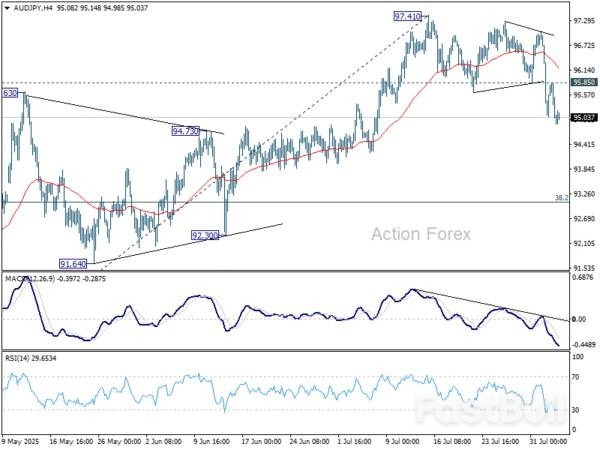
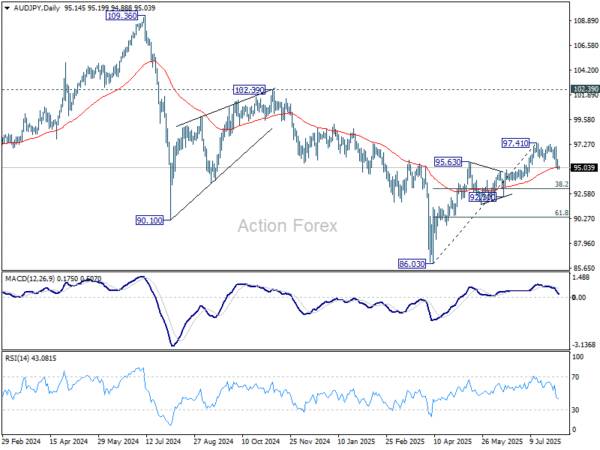
          Technically, a short term top should be in place at 97.41 in AUD/JPY with breach of 55 D EMA (now at 95.08). Sustained trading below the EMA will bring AUD/JPY further lower to 38.2% retracement of 86.03 to 97.41 at 93.06, as a correction to the rise from 86.03. Nevertheless, break of 95.85 minor resistance will dampen this bearish view and turn intraday bias neutral first.

          China’s Caixin Services PMI surges to 52.6, on stronger demand and renewed optimism

          China’s Caixin Services PMI jumped sharply from 50.6 to 52.6 in July, well ahead of expectations at 50.4, marking the fastest pace of expansion since May 2024. PMI Composite, owever, fell from 51.3 to 50.8 as dragged down by weak manufacturing.

          According to S&P Global’s Jingyi Pan, the rise was driven by better domestic demand and a notable improvement in external demand, with new export business expanding for the first time in three months. Business sentiment also improved, reaching the highest level since March.Firms also began hiring again, albeit mostly part-time. Importantly, companies felt confident enough to raise output charges for the first time in six months — a sign that inflation pressures are being more easily passed on to clients.

          GBP/JPY Daily Outlook

          Daily Pivots: (S1) 194.79; (P) 195.67; (R1) 196.29;

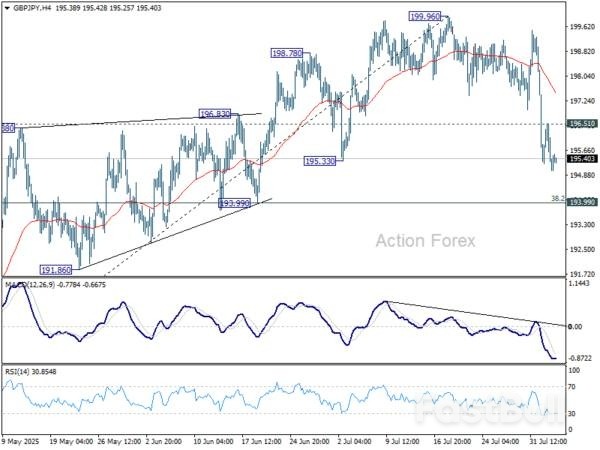
          GBP/JPY’s fall from 199.96 short term top continues today and intraday bias stays on the downside. Deeper fall should be seen to 193.99 cluster support (38.2% retracement of 184.35 to 199.96 at 193.99). Strong support should be seen there to bring rebound, at least on first attempt. On the upside, above 196.51 resistance will turn intraday bias neutral again first. However, sustained break of 193.99 will raise the chance of near term bearish reversal.

          In the bigger picture, price actions from 208.09 (2024 high) are seen as a correction to rally from 123.94 (2020 low). The pattern might still extend with another falling leg. But in that case, strong support should be seen from 38.2% retracement of 123.94 to 208.09 at 175.94 to contain downside. Meanwhile, decisive break of 208.09 will confirm long term up trend resumption.

          Economic Indicators Update

          GMTCCYEVENTSACTF/CPPREV
          23:50JPYBoJ Minutes


          00:30JPYServices PMI Jul F53.653.553.5
          01:45CNYCaixin Services PMI Jul52.650.450.6
          06:45EURFrance Industrial Output M/M Jun
          0.80%-0.50%
          07:50EURFrance Services PMI Jul F
          49.749.7
          07:55EURGermany Services PMI Jul F
          50.150.1
          08:00EUREurozone Services PMI Jul F
          51.251.2
          08:30GBPServices PMI Jul F
          51.251.2
          09:00EUREurozone PPI M/M Jun
          0.90%-0.60%
          09:00EUREurozone PPI Y/Y Jun
          0.50%0.30%
          12:30CADTrade Balance (CAD) Jun
          -5.8B-5.9B
          12:30USDTrade Balance (USD) Jun
          -62.6B-71.5B
          13:45USDServices PMI Jul F
          55.255.2
          14:00USDISM Services PMI Jul
          51.550.8

          Source: ACTIONFOREX

          To stay updated on all economic events of today, please check out our Economic calendar
          Risk Warnings and Disclaimers
          You understand and acknowledge that there is a high degree of risk involved in trading. Following any strategies or investment methods may lead to potential losses. The content on the site is provided by our contributors and analysts for information purposes only. You are solely responsible for determining whether any trading assets, securities, strategy, or any other product is suitable for investing based on your own investment objectives and financial situation.
          Add to Favorites
          Share

          Trump Turns Up Heat on China and India Over Russian Oil as Global Tensions Escalate

          Gerik

          Commodity

          China–U.S. Trade War

          Trump Targets Asia’s Russian Oil Dependence in Ceasefire Push

          U.S. President Donald Trump is applying heightened diplomatic and trade pressure on China and India as part of a broader campaign to force Russia into a ceasefire in Ukraine. The move underscores Washington’s frustration over Russia’s continued ability to finance its war effort through energy exports, despite Western sanctions.
          Both China and India, key energy-importing nations, have ramped up their Russian oil intake significantly since the European Union banned most seaborne Russian oil imports in early 2023. These alternative trade routes have cushioned Moscow from the full blow of Western sanctions and allowed its wartime economy to function with surprising resilience.

          Cheap Russian Crude Drives Profits in Asia

          A core reason for China and India’s defiance is price advantage. Russian oil continues to trade at a substantial discount to global benchmarks like Brent, enabling refiners to boost profit margins. This economic incentive has proven more compelling than geopolitical pressure, particularly as both countries strive to control inflation and maintain energy affordability.
          Since the EU boycott, China has imported $219.5 billion worth of Russian fossil fuels, followed by India at $133.4 billion and Turkey at $90.3 billion, according to estimates. Notably, India was a minor buyer before the Ukraine invasion, signaling how quickly economic opportunities reshaped trade flows.
          Even as G7 nations imposed a price cap on Russian crude to limit revenue, Moscow has largely evaded enforcement through the use of a shadow fleet of aging tankers and intermediaries in sanction-neutral countries. As a result, Russia earned $12.6 billion from oil sales in June alone, and is projected to earn $153 billion in oil revenue this year, funding its war machine and stabilizing the ruble.

          Energy Security vs. Sanctions Unity

          India’s stance remains defiant. Prime Minister Narendra Modi dismissed the U.S. threats as “unjustified”, defending India's right to pursue its national interest in energy procurement. China, too, has shown no sign of scaling back, especially as it balances relations with both Moscow and Washington.
          The continued reliance on Russian crude by these nations poses a significant challenge to the effectiveness of U.S.-led sanctions. It also highlights a broader geopolitical rift where energy security, inflation control, and regional alliances override Western pressure for sanctions alignment.
          While Trump threatens secondary sanctions or higher tariffs on Indian exports, the likelihood of achieving a strategic pivot without economic concessions or broader diplomatic engagement appears limited. For now, discounted Russian oil remains a powerful geopolitical lever one that both China and India are unwilling to relinquish.

          Source: AP

          Risk Warnings and Disclaimers
          You understand and acknowledge that there is a high degree of risk involved in trading. Following any strategies or investment methods may lead to potential losses. The content on the site is provided by our contributors and analysts for information purposes only. You are solely responsible for determining whether any trading assets, securities, strategy, or any other product is suitable for investing based on your own investment objectives and financial situation.
          Add to Favorites
          Share

          Australia Eyes Price Floor to Secure Critical Minerals Supply Chain

          Gerik

          Economic

          Commodity

          Strategic Shift to Support Rare Earths Amid Global Supply Realignment

          Australia is preparing to implement a price floor mechanism to stabilize and support its critical minerals industry, as confirmed by Resources Minister Madeleine King. The policy is part of Australia’s broader goal to become a strategic alternative to China in supplying rare earths and other key inputs for electric vehicles, defense, and high-tech manufacturing.
          Rare earth prices have been too low and too volatile to attract sufficient investment into domestic processing infrastructure, leaving global supply chains highly dependent on China. By introducing a price floor, the Australian government aims to reduce market risk and improve capital certainty for miners and investors.
          Minister King stated that the plan is intended to provide pricing certainty in markets that are "opaque and prone to manipulation," referencing concerns over China's influence on pricing dynamics.

          Strong Market Reaction: Miners Surge

          Investors responded swiftly to the policy signal. Shares in Lynas Rare Earths surged over 6%, while Iluka Resources and Arafura Rare Earths each rose by more than 8%, reflecting growing confidence in Australia’s role in reshaping global critical minerals supply.
          These gains parallel moves in the U.S., where MP Materials recently secured a multibillion-dollar agreement with the U.S. government to supply rare earth magnets under a guaranteed pricing framework. Analysts noted that the U.S. deal set a global precedent for how government intervention can de-risk mineral development projects, potentially increasing production but also raising end-user costs for automakers and electronics firms.

          Balancing Investment and Cost

          While the move is likely to stimulate upstream investment, it could also raise input costs for downstream users, such as EV makers and electronics firms, unless carefully calibrated. This reflects a broader trend among Western allies to trade higher short-term costs for long-term supply chain resilience, particularly in the face of geopolitical risks involving China.
          Australia’s push also aligns with its strategic reserve policy for heavy rare earths and other critical minerals, further institutionalizing government support across the sector.

          A New Model for Resource Sovereignty?

          If implemented, Australia’s price floor could become a model for other resource-rich nations seeking to localize value chains and reduce exposure to commodity shocks. However, the policy's effectiveness will depend on its design, transparency, and coordination with key trade partners such as the United States, Japan, and the EU.
          As global powers continue to decouple from China's mineral dominance, Australia’s leadership on critical minerals policy will be closely watched for its economic and geopolitical ripple effects.

          Source: Reuters

          To stay updated on all economic events of today, please check out our Economic calendar
          Risk Warnings and Disclaimers
          You understand and acknowledge that there is a high degree of risk involved in trading. Following any strategies or investment methods may lead to potential losses. The content on the site is provided by our contributors and analysts for information purposes only. You are solely responsible for determining whether any trading assets, securities, strategy, or any other product is suitable for investing based on your own investment objectives and financial situation.
          Add to Favorites
          Share
          FastBull
          Copyright © 2025 FastBull Ltd

          728 RM B 7/F GEE LOK IND BLDG NO 34 HUNG TO RD KWUN TONG KLN HONG KONG

          TelegramInstagramTwitterfacebooklinkedin
          App Store Google Play Google Play
          Products
          Charts

          Chats

          Q&A with Experts
          Screeners
          Economic Calendar
          Data
          Tools
          Membership
          Features
          Function
          Markets
          Copy Trading
          Latest Signals
          Contests
          News
          Analysis
          24/7
          Columns
          Education
          Company
          Careers
          About Us
          Contact Us
          Advertising
          Help Center
          Feedback
          User Agreement
          Privacy Policy
          Business

          White Label

          Data API

          Web Plug-ins

          Poster Maker

          Affiliate Program

          Risk Disclosure

          The risk of loss in trading financial instruments such as stocks, FX, commodities, futures, bonds, ETFs and crypto can be substantial. You may sustain a total loss of the funds that you deposit with your broker. Therefore, you should carefully consider whether such trading is suitable for you in light of your circumstances and financial resources.

          No decision to invest should be made without thoroughly conducting due diligence by yourself or consulting with your financial advisors. Our web content might not suit you since we don't know your financial conditions and investment needs. Our financial information might have latency or contain inaccuracy, so you should be fully responsible for any of your trading and investment decisions. The company will not be responsible for your capital loss.

          Without getting permission from the website, you are not allowed to copy the website's graphics, texts, or trademarks. Intellectual property rights in the content or data incorporated into this website belong to its providers and exchange merchants.

          Not Logged In

          Log in to access more features

          FastBull Membership

          Not yet

          Purchase

          Become a signal provider
          Help Center
          Customer Service
          Dark Mode
          Price Up/Down Colors

          Log In

          Sign Up

          Position
          Layout
          Fullscreen
          Default to Chart
          The chart page opens by default when you visit fastbull.com