• Trade
  • Markets
  • Copy
  • Contests
  • News
  • 24/7
  • Calendar
  • Q&A
  • Chats
Trending
Screeners
SYMBOL
LAST
BID
ASK
HIGH
LOW
NET CHG.
%CHG.
SPREAD
SPX
S&P 500 Index
6827.42
6827.42
6827.42
6899.86
6801.80
-73.58
-1.07%
--
DJI
Dow Jones Industrial Average
48458.04
48458.04
48458.04
48886.86
48334.10
-245.98
-0.51%
--
IXIC
NASDAQ Composite Index
23195.16
23195.16
23195.16
23554.89
23094.51
-398.69
-1.69%
--
USDX
US Dollar Index
97.950
98.030
97.950
98.500
97.950
-0.370
-0.38%
--
EURUSD
Euro / US Dollar
1.17394
1.17409
1.17394
1.17496
1.17192
+0.00011
+ 0.01%
--
GBPUSD
Pound Sterling / US Dollar
1.33707
1.33732
1.33707
1.33997
1.33419
-0.00148
-0.11%
--
XAUUSD
Gold / US Dollar
4299.39
4299.39
4299.39
4353.41
4257.10
+20.10
+ 0.47%
--
WTI
Light Sweet Crude Oil
57.233
57.485
57.233
58.011
56.969
-0.408
-0.71%
--

Community Accounts

Signal Accounts
--
Profit Accounts
--
Loss Accounts
--
View More

Become a signal provider

Sell trading signals to earn additional income

View More

Guide to Copy Trading

Get started with ease and confidence

View More

Signal Accounts for Members

All Signal Accounts

Best Return
  • Best Return
  • Best P/L
  • Best MDD
Past 1W
  • Past 1W
  • Past 1M
  • Past 1Y

All Contests

  • All
  • Trump Updates
  • Recommend
  • Stocks
  • Cryptocurrencies
  • Central Banks
  • Featured News
Top News Only
Share

USA Embassy In Lithuania: Maria Kalesnikava Is Not Going To Vilnius

Share

USA Embassy In Lithuania: Other Prisoners Are Being Sent From Belarus To Ukraine

Share

Ukraine President Zelenskiy: Five Ukrainians Released By Belarus In US-Brokered Deal

Share

USA Vilnius Embassy: USA Stands Ready For "Additional Engagement With Belarus That Advances USA Interests"

Share

USA Vilnius Embassy: Belarus, USA, Other Citizens Among The Prisoners Released Into Lithuania

Share

USA Vilnius Embassy: USA Will Continue Diplomatic Efforts To Free The Remaining Political Prisoners In Belarus

Share

USA Vilnius Embassy: Belarus Releases 123 Prisoners Following Meeting Of President Trump's Envoy Coale And Belarus President Lukashenko

Share

USA Vilnius Embassy: Masatoshi Nakanishi, Aliaksandr Syrytsa Are Among The Prisoners Released By Belarus

Share

USA Vilnius Embassy: Maria Kalesnikava And Viktor Babaryka Are Among The Prisoners Released By Belarus

Share

USA Vilnius Embassy: Nobel Peace Prize Laureate Ales Bialiatski Is Among The Prisoners Released By Belarus

Share

Belarusian Presidential Administration Telegram Channel: Lukashenko Has Pardoned 123 Prisoners As Part Of Deal With US

Share

Two Local Syrian Officials: Joint US-Syrian Military Patrol In Central Syria Came Under Fire From Unknown Assailants

Share

Israeli Military Says It Targeted 'Key Hamas Terrorist' In Gaza City

Share

Rwanda's Actions In Eastern Drc Are A Clear Violation Of Washington Accords Signed By President Trump - Secretary Of State Rubio

Share

Israeli Military Issues Evacuation Warning In Southern Lebanon Village Ahead Of Strike - Spokesperson On X

Share

Belarusian State Media Cites US Envoy Coale As Saying He Discussed Ukraine And Venezuela With Lukashenko

Share

Belarusian State Media Cites US Envoy Coale As Saying That US Removes Sanctions On Belarusian Potassium

Share

Thai Prime Minister: No Ceasefire Agreement With Cambodia

Share

US, Ukraine To Discuss Ceasefire In Berlin Ahead Of European Summit

Share

Incoming Czech Prime Minister Babis: Czech Republic Will Not Take On Guarantees For Ukraine Financing, European Commission Must Find Alternatives

TIME
ACT
FCST
PREV
U.K. Trade Balance Non-EU (SA) (Oct)

A:--

F: --

P: --

U.K. Trade Balance (Oct)

A:--

F: --

P: --

U.K. Services Index MoM

A:--

F: --

P: --

U.K. Construction Output MoM (SA) (Oct)

A:--

F: --

P: --

U.K. Industrial Output YoY (Oct)

A:--

F: --

P: --

U.K. Trade Balance (SA) (Oct)

A:--

F: --

P: --

U.K. Trade Balance EU (SA) (Oct)

A:--

F: --

P: --

U.K. Manufacturing Output YoY (Oct)

A:--

F: --

P: --

U.K. GDP MoM (Oct)

A:--

F: --

P: --

U.K. GDP YoY (SA) (Oct)

A:--

F: --

P: --

U.K. Industrial Output MoM (Oct)

A:--

F: --

P: --

U.K. Construction Output YoY (Oct)

A:--

F: --

P: --

France HICP Final MoM (Nov)

A:--

F: --

P: --

China, Mainland Outstanding Loans Growth YoY (Nov)

A:--

F: --

P: --

China, Mainland M2 Money Supply YoY (Nov)

A:--

F: --

P: --

China, Mainland M0 Money Supply YoY (Nov)

A:--

F: --

P: --

China, Mainland M1 Money Supply YoY (Nov)

A:--

F: --

P: --

India CPI YoY (Nov)

A:--

F: --

P: --

India Deposit Gowth YoY

A:--

F: --

P: --

Brazil Services Growth YoY (Oct)

A:--

F: --

P: --

Mexico Industrial Output YoY (Oct)

A:--

F: --

P: --

Russia Trade Balance (Oct)

A:--

F: --

P: --

Philadelphia Fed President Henry Paulson delivers a speech
Canada Building Permits MoM (SA) (Oct)

A:--

F: --

P: --

Canada Wholesale Sales YoY (Oct)

A:--

F: --

P: --

Canada Wholesale Inventory MoM (Oct)

A:--

F: --

P: --

Canada Wholesale Inventory YoY (Oct)

A:--

F: --

P: --

Canada Wholesale Sales MoM (SA) (Oct)

A:--

F: --

P: --

Germany Current Account (Not SA) (Oct)

A:--

F: --

P: --

U.S. Weekly Total Rig Count

A:--

F: --

P: --

U.S. Weekly Total Oil Rig Count

A:--

F: --

P: --

Japan Tankan Large Non-Manufacturing Diffusion Index (Q4)

--

F: --

P: --

Japan Tankan Small Manufacturing Outlook Index (Q4)

--

F: --

P: --

Japan Tankan Large Non-Manufacturing Outlook Index (Q4)

--

F: --

P: --

Japan Tankan Large Manufacturing Outlook Index (Q4)

--

F: --

P: --

Japan Tankan Small Manufacturing Diffusion Index (Q4)

--

F: --

P: --

Japan Tankan Large Manufacturing Diffusion Index (Q4)

--

F: --

P: --

Japan Tankan Large-Enterprise Capital Expenditure YoY (Q4)

--

F: --

P: --

U.K. Rightmove House Price Index YoY (Dec)

--

F: --

P: --

China, Mainland Industrial Output YoY (YTD) (Nov)

--

F: --

P: --

China, Mainland Urban Area Unemployment Rate (Nov)

--

F: --

P: --

Saudi Arabia CPI YoY (Nov)

--

F: --

P: --

Euro Zone Industrial Output YoY (Oct)

--

F: --

P: --

Euro Zone Industrial Output MoM (Oct)

--

F: --

P: --

Canada Existing Home Sales MoM (Nov)

--

F: --

P: --

Euro Zone Total Reserve Assets (Nov)

--

F: --

P: --

U.K. Inflation Rate Expectations

--

F: --

P: --

Canada National Economic Confidence Index

--

F: --

P: --

Canada New Housing Starts (Nov)

--

F: --

P: --

U.S. NY Fed Manufacturing Employment Index (Dec)

--

F: --

P: --

U.S. NY Fed Manufacturing Index (Dec)

--

F: --

P: --

Canada Core CPI YoY (Nov)

--

F: --

P: --

Canada Manufacturing Unfilled Orders MoM (Oct)

--

F: --

P: --

Canada Manufacturing New Orders MoM (Oct)

--

F: --

P: --

Canada Core CPI MoM (Nov)

--

F: --

P: --

Canada Manufacturing Inventory MoM (Oct)

--

F: --

P: --

Canada CPI YoY (Nov)

--

F: --

P: --

Canada CPI MoM (Nov)

--

F: --

P: --

Canada CPI YoY (SA) (Nov)

--

F: --

P: --

Canada Core CPI MoM (SA) (Nov)

--

F: --

P: --

Q&A with Experts
    • All
    • Chatrooms
    • Groups
    • Friends
    Connecting
    .
    .
    .
    Type here...
    Add Symbol or Code

      No matching data

      All
      Trump Updates
      Recommend
      Stocks
      Cryptocurrencies
      Central Banks
      Featured News
      • All
      • Russia-Ukraine Conflict
      • Middle East Flashpoint
      • All
      • Russia-Ukraine Conflict
      • Middle East Flashpoint
      Search
      Products

      Charts Free Forever

      Chats Q&A with Experts
      Screeners Economic Calendar Data Tools
      Membership Features
      Data Warehouse Market Trends Institutional Data Policy Rates Macro

      Market Trends

      Market Sentiment Order Book Forex Correlations

      Top Indicators

      Charts Free Forever
      Markets

      News

      News Analysis 24/7 Columns Education
      From Institutions From Analysts
      Topics Columnists

      Latest Views

      Latest Views

      Trending Topics

      Top Columnists

      Latest Update

      Signals

      Copy Rankings Latest Signals Become a signal provider AI Rating
      Contests
      Brokers

      Overview Brokers Assessment Rankings Regulators News Claims
      Broker listing Forex Brokers Comparison Tool Live Spread Comparison Scam
      Q&A Complaint Scam Alert Videos Tips to Detect Scam
      More

      Business
      Events
      Careers About Us Advertising Help Center

      White Label

      Data API

      Web Plug-ins

      Affiliate Program

      Awards Institution Evaluation IB Seminar Salon Event Exhibition
      Vietnam Thailand Singapore Dubai
      Fans Party Investment Sharing Session
      FastBull Summit BrokersView Expo
      Recent Searches
        Top Searches
          Markets
          News
          Analysis
          User
          24/7
          Economic Calendar
          Education
          Data
          • Names
          • Latest
          • Prev

          View All

          No data

          Scan to Download

          Faster Charts, Chat Faster!

          Download App
          English
          • English
          • Español
          • العربية
          • Bahasa Indonesia
          • Bahasa Melayu
          • Tiếng Việt
          • ภาษาไทย
          • Français
          • Italiano
          • Türkçe
          • Русский язык
          • 简中
          • 繁中
          Open Account
          Search
          Products
          Charts Free Forever
          Markets
          News
          Signals

          Copy Rankings Latest Signals Become a signal provider AI Rating
          Contests
          Brokers

          Overview Brokers Assessment Rankings Regulators News Claims
          Broker listing Forex Brokers Comparison Tool Live Spread Comparison Scam
          Q&A Complaint Scam Alert Videos Tips to Detect Scam
          More

          Business
          Events
          Careers About Us Advertising Help Center

          White Label

          Data API

          Web Plug-ins

          Affiliate Program

          Awards Institution Evaluation IB Seminar Salon Event Exhibition
          Vietnam Thailand Singapore Dubai
          Fans Party Investment Sharing Session
          FastBull Summit BrokersView Expo

          Federal Reserve Likely to Defy Trump, Keep Rates Unchanged This Week

          Warren Takunda

          Economic

          Summary:

          The Fed is likely to hold rates steady this week despite Trump’s pressure for cuts. Tariffs and inflation risks are keeping officials cautious.

          The Federal Reserve will likely keep its key short-term interest rate unchanged on Wednesday, despite weeks of harsh criticism and demands from President Donald Trump that the Fed reduce borrowing costs.
          After causing a sharp drop in financial markets two weeks ago by saying he could fire Fed Chair Jerome Powell, Trump subsequently backed off and said he had no intention of doing so. Still, he and Treasury Secretary Scott Bessent have said the Fed should cut rates.
          They argue that inflation has steadily cooled and high borrowing costs are no longer needed to restrain price increases. The Fed sharply ramped up its short-term rate in 2022 and 2023 as pandemic-era inflation spiked.
          Separately, Elon Musk, the head of Trump’s Department of Government Efficiency, last Wednesday suggested that DOGE should look more closely at the Fed’s spending on its facilities.
          The heightened scrutiny shows that even as the Trump administration backs off its threats to fire Powell, the Fed is still subject to unusually sharp political pressures, despite its status as an independent agency.
          Even so, the Fed will almost certainly leave its key rate unchanged at about 4.3% when it meets Tuesday and Wednesday. Powell and many of the other 18 officials that sit on the Fed’s rate-setting committee have said they want to see how Trump’s tariffs affect the economy before making any moves.
          Trump, however, on Friday said on the social media platform Truth Social that there is “NO INFLATION” and claimed that grocery and egg prices have fallen, and that gas has dropped to $1.98 a gallon.
          That’s not entirely true: Grocery prices have jumped 0.5% in two of the past three months and are up 2.4% from a year ago. Gas and oil prices have declined — gas costs are down 10% from a year ago — continuing a longer-running trend that has continued in part because of fears the economy will weaken. Still, AAA says gas prices nationwide average $3.18 a gallon.
          Inflation did drop noticeably in March, an encouraging sign, though in the first three months of the year it was 3.6%, according to the Fed’s preferred gauge, well above its 2% target.
          Without tariffs, economists say it’s possible the Fed would soon reduce its benchmark rate, because it is currently at a level intended to slow borrowing and spending and cool inflation. Yet the Fed can’t now cut rates with Trump’s broad tariffs likely to raise prices in the coming months.
          Vincent Reinhart, chief economist at BNY, said that the Fed is “scarred” by what happened in 2021, when prices rose amid supply snarls and Powell and other Fed officials said the increase would likely be “transitory.” Instead, inflation soared to a peak of 9.1% in June 2022.
          This time they will be more cautious, he said.
          “That’s a Fed that is going to have to wait for evidence and be slow to adjust on that evidence,” Reinhart said.
          Plus, Trump’s badgering of Powell makes it harder for the Fed chair to cut rates because doing so anytime soon would be seen as knuckling under to the White House, said Preston Mui, an economist at Employ America.
          “You could imagine a world where there isn’t pressure from the Trump administration and they cut rates ... sooner, because they feel comfortable making the argument that they’re doing so because of the data,” he said.
          For his part, Powell said last month that tariffs would likely push up inflation and slow the economy, a tricky combination for the Fed. The central bank would typically raise rates — or at least keep them elevated — to fight inflation, while it would cut them to spur the economy if unemployment rose.
          Powell has said that the impact of the tariffs on inflation could be temporary — a one-time price increase — but most recently said it “could also be more persistent.” That suggests that Powell will want to wait, potentially for months, to ensure tariffs don’t sustainably raise inflation before considering a rate cut.
          Some economists forecast the Fed won’t cut rates until its September meeting, or even later.
          Yet Fed officials could move sooner if the tariffs hit the economy hard enough to cause layoffs and push up unemployment. Wall Street investors appear to expect such an outcome — they project that the first cut will occur in July, according to futures pricing.
          Separately, Musk criticized the Fed Wednesday for spending $2.5 billion on an extensive renovation of two of its buildings in Washington, D.C.
          “Since at the end of the day, this is all taxpayer money, we should certainly look to see if indeed the Federal Reserve is spending $2.5 billion on their interior designer,” Musk said. “That’s an eyebrow raiser.”
          Fed officials acknowledge that the cost of the renovations have risen as prices for building materials and labor have spiked amid the post-pandemic inflation. And former Fed officials, speaking on background, say that local regulations forced the Fed to do more of the expansion underground, rather than making the buildings taller, which added to the cost.
          Meanwhile, Kevin Warsh, a former Fed governor and a potential candidate to replace Powell as chair when Powell’s term expires next year, said recently that the Fed has attracted greater scrutiny because of its failure to keep prices in check.
          “The Fed’s current wounds are largely self-inflicted,” he said in a speech during an International Monetary Fund conference in late April, in which he also slammed the Fed for participating in a global forum on climate change. “A strategic reset is necessary to mitigate losses of credibility, changes in standing, and most important, worse economic outcomes for our fellow citizens.”
          Powell, for his part, said last month that “Fed independence is very widely understood and supported in Washington, in Congress, where it really matters.”

          Source: AP

          To stay updated on all economic events of today, please check out our Economic calendar
          Risk Warnings and Disclaimers
          You understand and acknowledge that there is a high degree of risk involved in trading. Following any strategies or investment methods may lead to potential losses. The content on the site is provided by our contributors and analysts for information purposes only. You are solely responsible for determining whether any trading assets, securities, strategy, or any other product is suitable for investing based on your own investment objectives and financial situation.
          Add to Favorites
          Share

          U.S. Non-manufacturing Sector Shows Unexpected Strength, ISM PMI Rises to 51.6

          Natalie Gordon

          Economic

          Forex

          The Institute of Supply Management (ISM) Non-Manufacturing Purchasing Managers’ Index (PMI) reported an unexpected rise in the non-manufacturing sector, indicating an expansion in the economy. The actual index value was reported at 51.6, surpassing forecasted and previous values.

          The actual PMI figure of 51.6 outperformed the forecasted figure of 50.2. This indicates a more robust expansion in the non-manufacturing sector than analysts had predicted. The index, a composite measure of business activity, new orders, employment, and supplier deliveries, reflects the overall health of the non-manufacturing sector. A reading above 50 suggests expansion, while a figure below 50 indicates contraction.

          In comparison to the previous month, the current ISM Non-Manufacturing PMI also shows an improvement. The previous month’s index was reported at 50.8, meaning that the non-manufacturing sector has seen a stronger expansion this month. This improvement is a positive sign for the U.S. economy, as the non-manufacturing sector represents a significant portion of the country’s GDP.

          The data for the ISM Non-Manufacturing PMI is compiled from monthly responses to questions asked of more than 370 purchasing and supply executives in over 62 different industries. These industries span nine divisions from the Standard Industrial Classification (SIC) categories, providing a comprehensive view of the non-manufacturing sector’s performance.

          The unexpected rise in the ISM Non-Manufacturing PMI is a positive sign for the USD. Higher than expected readings are generally taken as bullish for the USD, as they suggest a stronger economy. Conversely, lower than expected readings are seen as bearish for the USD, indicating a weaker economy. This month’s higher than expected PMI figure suggests that the non-manufacturing sector, and by extension the U.S. economy, is in a stronger position than previously thought.

          Source: Investing

          To stay updated on all economic events of today, please check out our Economic calendar
          Risk Warnings and Disclaimers
          You understand and acknowledge that there is a high degree of risk involved in trading. Following any strategies or investment methods may lead to potential losses. The content on the site is provided by our contributors and analysts for information purposes only. You are solely responsible for determining whether any trading assets, securities, strategy, or any other product is suitable for investing based on your own investment objectives and financial situation.
          Add to Favorites
          Share

          Services PMI Slips to 50.8, Underperforming Market Expectations

          Glendon

          Economic

          Forex

          The latest data on the Services PMI (Purchasing Managers’ Index) reveals a decline in the sector’s performance. The index, which is released monthly by Markit Economics, registered an actual figure of 50.8. This number indicates a slight improvement in the sector, but it falls short of the forecasted 51.4.

          The Services PMI is a key economic indicator, gauging the health of the service sector by surveying over 400 executives in private sector service companies. The survey encompasses a wide range of industries, including transport and communication, financial intermediaries, business and personal services, computing & IT, hotels, and restaurants. An index level of 50 denotes no change since the previous month, whereas a level above 50 signals an improvement and below 50 indicates a deterioration.

          The actual PMI number of 50.8 not only missed the forecasted figure of 51.4 but also showed a decline from the previous month’s reading of 54.4. This indicates a slowdown in the growth of the service sector, which could potentially be a cause for concern for the US economy.

          A stronger-than-forecast PMI reading is generally supportive (bullish) for the USD, indicating a robust service sector. Conversely, a weaker-than-forecast reading is generally negative (bearish) for the USD. In this case, the lower-than-expected PMI of 50.8 may exert some downward pressure on the USD.

          Despite the decline, the PMI remains above the 50-mark threshold, suggesting the service sector is still in expansion mode, albeit at a slower pace. This slowdown could be attributed to a variety of factors, and it will be important to monitor future PMI releases to identify whether this is a temporary blip or the start of a longer-term trend.

          In light of the recent data, investors and market watchers will likely keep a close eye on the upcoming economic indicators for any signs of sustained weakness in the service sector.

          Source: Investing

          To stay updated on all economic events of today, please check out our Economic calendar
          Risk Warnings and Disclaimers
          You understand and acknowledge that there is a high degree of risk involved in trading. Following any strategies or investment methods may lead to potential losses. The content on the site is provided by our contributors and analysts for information purposes only. You are solely responsible for determining whether any trading assets, securities, strategy, or any other product is suitable for investing based on your own investment objectives and financial situation.
          Add to Favorites
          Share

          Shifting Currents in Global Maritime Shipping: Overcapacity Meets Policy Headwinds

          Gerik

          Economic

          Commodity

          Impact of US Tariff Measures

          Recent US surcharges targeting vessels built in Chinese shipyards have exerted a direct relationship on port-calling patterns and operating costs. By imposing additional millions of dollars in port fees for China-built ships, US policy aims to resuscitate domestic shipbuilding but, in turn, prompts major lines such as MSC, Maersk and Hapag-Lloyd to consolidate cargo and reduce calls at American ports. As these higher fees are passed on to shippers, demand for direct sailings to the United States is likely to diminish, triggering route adjustments and raising per-container costs by several hundred dollars.
          Under the International Maritime Organization’s new emissions pricing and trading framework—expected to generate up to $40 billion by 2030—shipping lines face a direct relationship between compliance and fleet renewal. With heavy fuel oil vessels responsible for roughly 3 percent of global CO₂ output, carriers are now compelled to order zero-emission ships powered by green methanol or other clean propulsion systems. Hapag-Lloyd’s €4 billion order for 24 such vessels exemplifies how regulatory pressure translates into capital expenditure. Meanwhile, leading cargo owners like Ikea and Adidas are correlating their own sustainability goals with demand for greener shipping services, intensifying the investment imperative.

          Rerouted Voyages Around the Suez Canal

          Heightened tensions in the Red Sea have prompted a shift in voyage planning that shows a direct relationship between security concerns and sailing distances. Major operators including Maersk and MSC now bypass the Suez Canal via the Cape of Good Hope, adding approximately 6,000 kilometers and increasing fuel consumption. According to BIMCO data, weekly container transits through Suez fell from pre-conflict daily levels to about 100,000 per week in 2024, less than half the prior throughput. This extended routing not only ties up more vessels but also drives up operating expenses, further exacerbating capacity mismatches.
          After pandemic-era profits—Maersk reported $20 billion in pre-tax earnings in 2021, Hapag-Lloyd $13 billion—carriers placed record orders that expanded container fleet capacity by 12 percent in 2024 and an anticipated additional 6 percent this year. Yet BIMCO forecasts a 2 percent decline in trade volumes for 2025, indicating a correlational link between fleet growth and underutilization. Should trans-Pacific volumes fall by 7.5 percent, as Flexport’s Sanne Manders warns, the shock to shipping companies would be severe, with empty container slots and idled tonnage dragging on revenues.
          The confluence of policy-induced cost increases, environmental compliance outlays, security-driven reroutings and a looming demand downturn leaves executives weighing complex trade-offs. To navigate this shifting environment, carriers must pursue capacity management measures, diversify trade lanes, and accelerate fleet decarbonization. Only by aligning vessel deployment with evolving trade patterns—and by forging stronger partnerships with shippers on sustainability—can the industry adjust to these new headwinds without sacrificing financial resilience.
          To stay updated on all economic events of today, please check out our Economic calendar
          Risk Warnings and Disclaimers
          You understand and acknowledge that there is a high degree of risk involved in trading. Following any strategies or investment methods may lead to potential losses. The content on the site is provided by our contributors and analysts for information purposes only. You are solely responsible for determining whether any trading assets, securities, strategy, or any other product is suitable for investing based on your own investment objectives and financial situation.
          Add to Favorites
          Share

          Oil News: OPEC+ Output Hike Sparks Bearish Crude Outlook and Supply Fears

          Adam

          Commodity

          OPEC+ Supply Surge Pressures Oil Prices as Market Eyes Demand Outlook

          Crude oil futures opened sharply lower on Monday, as traders reacted to OPEC+’s decision to accelerate output hikes, stoking concerns of a growing supply surplus in an already fragile demand environment. West Texas Intermediate (WTI) briefly dipped to $55.30 before finding support just above the long-term level at $55.55, narrowly avoiding a retest of the April 9 low at $54.48.

          OPEC+ Output Acceleration Weighs on Market Sentiment

          OPEC+ announced over the weekend it would increase crude production by 411,000 barrels per day (bpd) in June, marking the second consecutive monthly hike. This move lifts total production additions to 960,000 bpd for April through June—roughly 44% of the 2.2 million bpd in voluntary cuts made since 2022. Saudi Arabia, the group’s de facto leader, is reportedly pushing for faster unwinding of cuts to pressure non-compliant members like Iraq and Kazakhstan.
          The decision added immediate downside pressure to oil markets, with both Brent and WTI falling over $1 per barrel in early trading. As the session progressed, oil futures began clawing back some losses. However, the bearish tone remains dominant given heightened supply concerns.

          Demand Uncertainty Compounds Bearish Tone

          Traders remain wary of the demand side of the equation. ING cited ongoing demand uncertainty driven by tariff risks and weak refined fuel consumption, particularly in Asia. Vortexa data shows a 150 million barrel build in global onshore and floating crude inventories since mid-February, reinforcing the surplus narrative.
          Adding barrels into a demand-constrained market has compressed the Brent futures curve. The prompt spread narrowed to just 10 cents per barrel, down from 47 cents the previous session, and briefly dipped into contango—a bearish market structure where future prices exceed spot levels.

          Forecasts Cut as Market Reassesses Fundamentals

          Investment banks have revised their oil prices projections in response to OPEC+’s move. Barclays cut its 2025 Brent forecast by $4 to $66, while ING now expects Brent to average $65 this year, down from $70. Analysts at Saxo Bank noted that Saudi Arabia’s push appears tactical—meant to both punish quota violations and put pressure on U.S. shale producers.

          Bearish Oil Price Outlook Persists

          Technically, WTI’s failure to break below $55.30 suggests some support, but bearish momentum persists unless prices reclaim resistance at $59.67. With OPEC+ bringing more barrels online and inventories swelling, traders are bracing for further downside unless demand signals improve. The oil prices forecast remains bearish in the near term, with supply concerns outweighing any tentative signs of a rebound.

          source : fxempire

          Risk Warnings and Disclaimers
          You understand and acknowledge that there is a high degree of risk involved in trading. Following any strategies or investment methods may lead to potential losses. The content on the site is provided by our contributors and analysts for information purposes only. You are solely responsible for determining whether any trading assets, securities, strategy, or any other product is suitable for investing based on your own investment objectives and financial situation.
          Add to Favorites
          Share

          Vietnam Prioritized for U.S. Tariff Talks: First Negotiation Round Begins May 7

          Gerik

          Economic

          Vietnam Among Priority Countries in U.S. Trade Negotiations

          Speaking at the opening of the 9th session of the 15th National Assembly on May 5, Prime Minister Pham Minh Chinh confirmed that Vietnam is one of six countries selected by the United States for expedited tariff negotiations. The first negotiation round will commence on May 7, following the technical delegation’s arrival in Washington on May 1.
          The move comes as the global economy faces heightened volatility, with President Donald Trump’s high reciprocal tariffs creating ripple effects across global supply chains. These tariffs were recently suspended for 90 days—except for China—and temporarily adjusted to a 10% rate to allow for bilateral talks.
          The Vietnamese government has responded promptly and strategically, aiming to protect legitimate national interests and foster balanced and sustainable trade. In preparation for the talks, Vietnam is implementing a new decree on strategic trade controls, enhancing export-origin monitoring, and expanding access to alternative markets.

          U.S. Tariff Negotiation Landscape: Vietnam in Strong Position

          According to Vietnam's Trade Counselor in the U.S., Do Ngoc Hung, Vietnam shares the negotiation table with India, the UK, Japan, South Korea, and Indonesia. Among these, India, Japan, and South Korea have reportedly made progress, but President Trump remains cautious, indicating he may impose separate terms if outcomes fall short of U.S. expectations.
          Despite acknowledging these developments, Trump emphasized that the current tariff framework benefits the U.S., placing it in a strong bargaining position. This underscores Vietnam’s need to move swiftly and strategically during the upcoming negotiation sessions.

          Strategic Economic Measures and Growth Goals

          Despite external challenges, Vietnam remains committed to its 2025 targets: over 8% GDP growth, an economic scale of over $500 billion, and per capita income exceeding $5,000.
          To achieve this, the government has outlined an aggressive fiscal and monetary policy plan. It aims to increase state budget revenue by over 15%, and is prepared to raise the budget deficit to 4–4.5% of GDP if needed, to create space for development investments. Operating expenditures will be minimized to prioritize disbursement for national infrastructure and public investment projects.
          Additionally, restructuring the banking system and resolving bad debts remain central to financial reform. Banks under special supervision will receive targeted solutions to restore normal operations.

          Crackdown on Trade Violations and Regulatory Overhaul

          The government has emphasized tough enforcement against smuggling, counterfeit goods, and deceptive advertising, especially for pharmaceuticals and nutritional supplements. Prime Minister Chinh called for the elimination of unnecessary investment conditions and committed to cutting administrative processing times by at least 30%.
          In a broader strategic shift, the government is pushing for a new resolution from the Politburo and National Assembly to position private enterprise as a central driver of the economy. Local firms are being encouraged to participate more deeply in global supply and production chains.
          With Vietnam now in the priority group for U.S. trade negotiations, the outcome of the talks could play a decisive role in mitigating tariff risks, stabilizing exports, and preserving growth momentum. The coordinated domestic reforms and proactive diplomacy signal that Vietnam is not only ready for negotiation but also positioning itself to turn challenges into opportunity.
          To stay updated on all economic events of today, please check out our Economic calendar
          Risk Warnings and Disclaimers
          You understand and acknowledge that there is a high degree of risk involved in trading. Following any strategies or investment methods may lead to potential losses. The content on the site is provided by our contributors and analysts for information purposes only. You are solely responsible for determining whether any trading assets, securities, strategy, or any other product is suitable for investing based on your own investment objectives and financial situation.
          Add to Favorites
          Share

          Wall Street rallies on robust jobs data and US‑China trade thaw

          Adam

          Stocks

          Economic

          How Wall Street's rally extends as strong jobs data fuels market optimism

          US stock markets locked in a second week of gains as robust economic data and potential easing of US-China trade tensions boosted investor confidence, with all eyes now on the upcoming Fed decision.

          US markets extend winning streak

          US stock markets rallied on Friday, locking in a second consecutive week of gains, fuelled by strong economic data and the potential easing of trade tensions between the US and China.
          For the week, the US Tech 100 surged by 3.45%, while the Wall Street gained 1,207 points or 3%. The US 500 increased by 2.11% for the week, achieving its longest winning streak—nine consecutive days—since 2004.

          Jobs report exceeds expectations

          Friday's Non-Farm Payrolls report was robust as headline nonfarm payrolls increased by 177,000 in April, compared to the 135,000 expected. The unemployment rate held steady at 4.2% and would have dropped to 4.0% if not for the rise in the participation rate to 62.6% from 62.5%.
          The resilient labour market data alleviates worries about an economic slowdown for now and bolsters confidence in the Federal Reserve's ability to remain patient with policy adjustments. It remains to be seen if there will be meaningful deterioration in the hard data, or if the recent de-escalation and the potential of "framework deals" prevent the hard data from following the soft data lower.

          Key events in focus this week

          Attention this week will focus on potential tariff negotiations between the US and China, and the Federal Reserve's interest rate decision, previewed below. Investors will also closely watch Q1 earnings reports from companies including Ford, AMD, Walt Disney and Uber. Finally, the ISM Services PMI is expected to fall to 50.2 from 50.8 to narrowly remain in expansion territory.

          FOMC interest rate decision

          Thursday, 8 May at 4.00am AEST
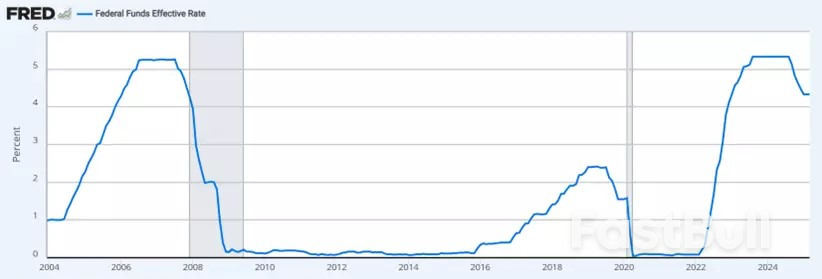
          At the last FOMC meeting in mid-March, the Fed kept the Fed Funds rate on hold at 4.25%–4.50%, citing solid economic growth, low unemployment, and slightly elevated inflation.
          The Fed's projections (Dots) showed that members still expected to deliver two 25 basis point (bp) rate cuts in 2025. The Fed's updated forecasts, as expected, showed an increase in inflation and unemployment forecasts while lowering its GDP forecasts, reflecting the overall impact of increased tariffs.
          The significant reciprocal tariffs announced on "Liberation Day" have raised fears of higher inflation and a slowdown in the labour market, testing both elements of the Fed's dual mandate.
          As such, the Fed is expected to keep the Fed's Funds rate unchanged this week at 4.25%-4.50%. It is expected to emphasise ongoing economic uncertainty, particularly due to potential tariff effects and the need to remain patient as it waits for more data. No Summary of Economic Projections or "dot plot" update is due for this meeting.
          Following Friday's firm Non-Farm Payrolls report, the likelihood of a Fed rate cut in June eased to about 35% from around 55%. The July meeting is fully priced for a 25bp rate cut with a cumulative 78 basis points of Fed rate cuts priced by year-end.
          Fed funds rate chart
          Wall Street rallies on robust jobs data and US‑China trade thaw_1

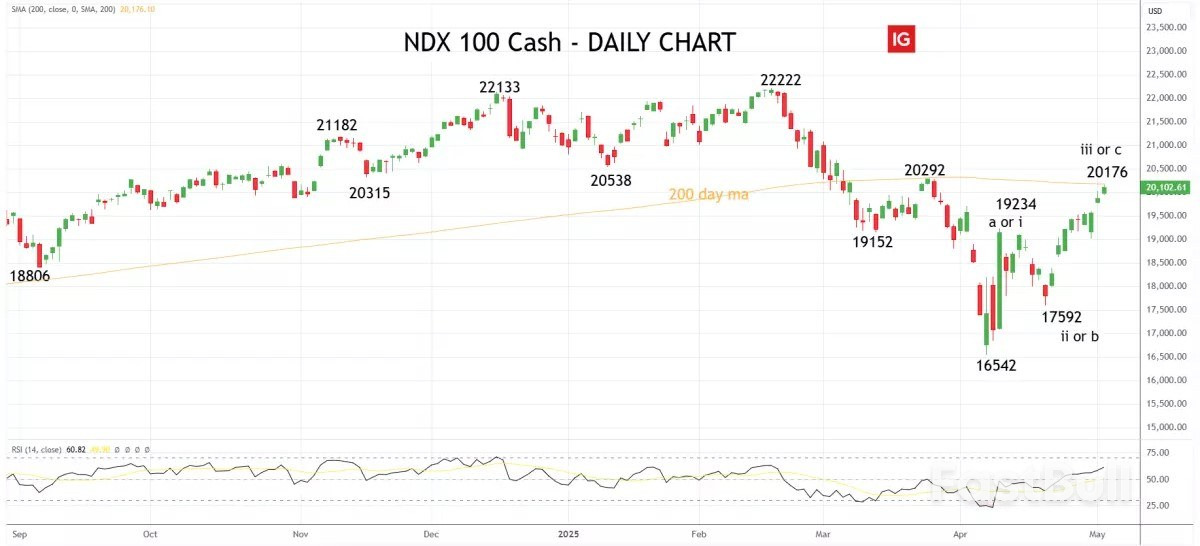
          US Tech 100 technical analysis

          The rally from the 16,542 low of April 7 to Friday night's 20,176 high has at this stage unfolded in three waves (ABC). This follows a three-wave decline from the 22,222 record high to the 16,542 low, which leaves the picture somewhat messy when viewed through an Elliott Wave (EW) lens.
          With the jury out from an EW perspective, we will continue to lean against the 200-day moving average at 21,777, which the US Tech 100 tested on Friday night. Specifically, while the US Tech 100 remains below the 200-day moving average, currently at 21,177, medium-term downside risks remain, including a retest of the April 16,542 low. If the US Tech 100 sees a sustained break above the 200-day MA, it would indicate that the decline from the 22,222 record high to the 16,542 low is complete and that the uptrend has resumed.
          US Tech 100 daily chart
          Wall Street rallies on robust jobs data and US‑China trade thaw_2

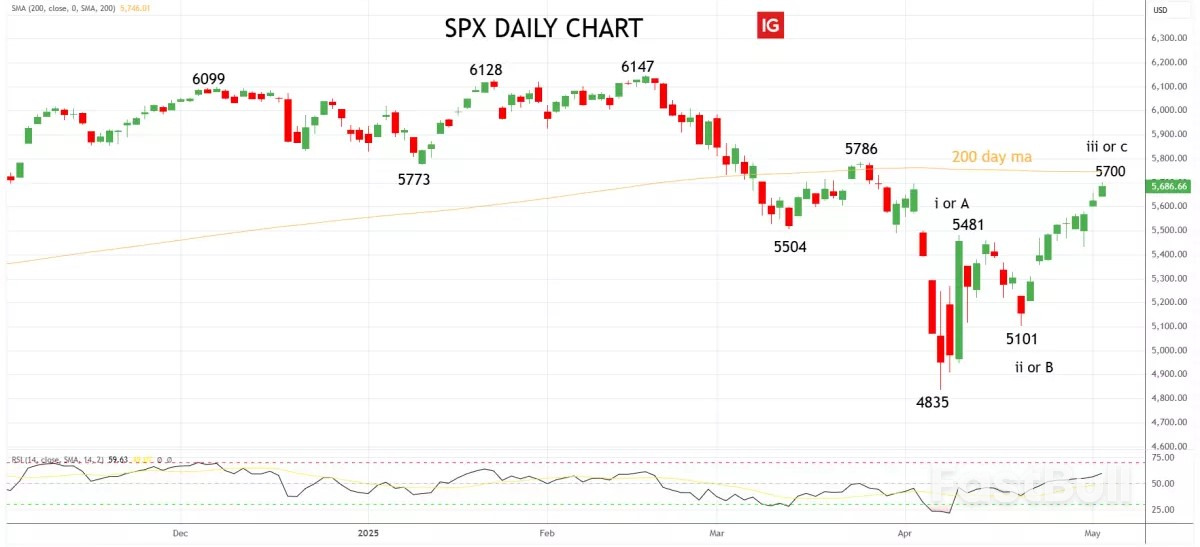
          US 500 technical analysis

          The rally from the 4835 low of April 7 to Friday night's 5700 high has at this stage unfolded in three waves (ABC). This follows a three-wave decline from the 6147 record high to the 4835 low, which leaves the picture somewhat messy when viewed through an Elliott Wave lens.
          With the jury out from an EW perspective, we will continue to lean against the 200-day moving average at 5746, which the US 500 fell narrowly short of on Friday night.
          Specifically, while the US 500 remains below the 200-day moving average, currently at 5746, medium-term downside risks remain, including a retest of the April 4835 low. If the US 500 sees a sustained break above the 200-day MA, it would indicate that the decline from the 6147 record high to the 4835 low is complete and that the uptrend has resumed.
          US 500 daily chart
          Wall Street rallies on robust jobs data and US‑China trade thaw_3

          Source : ig

          To stay updated on all economic events of today, please check out our Economic calendar
          Risk Warnings and Disclaimers
          You understand and acknowledge that there is a high degree of risk involved in trading. Following any strategies or investment methods may lead to potential losses. The content on the site is provided by our contributors and analysts for information purposes only. You are solely responsible for determining whether any trading assets, securities, strategy, or any other product is suitable for investing based on your own investment objectives and financial situation.
          Add to Favorites
          Share
          FastBull
          Copyright © 2025 FastBull Ltd

          728 RM B 7/F GEE LOK IND BLDG NO 34 HUNG TO RD KWUN TONG KLN HONG KONG

          TelegramInstagramTwitterfacebooklinkedin
          App Store Google Play Google Play
          Products
          Charts

          Chats

          Q&A with Experts
          Screeners
          Economic Calendar
          Data
          Tools
          Membership
          Features
          Function
          Markets
          Copy Trading
          Latest Signals
          Contests
          News
          Analysis
          24/7
          Columns
          Education
          Company
          Careers
          About Us
          Contact Us
          Advertising
          Help Center
          Feedback
          User Agreement
          Privacy Policy
          Business

          White Label

          Data API

          Web Plug-ins

          Poster Maker

          Affiliate Program

          Risk Disclosure

          The risk of loss in trading financial instruments such as stocks, FX, commodities, futures, bonds, ETFs and crypto can be substantial. You may sustain a total loss of the funds that you deposit with your broker. Therefore, you should carefully consider whether such trading is suitable for you in light of your circumstances and financial resources.

          No decision to invest should be made without thoroughly conducting due diligence by yourself or consulting with your financial advisors. Our web content might not suit you since we don't know your financial conditions and investment needs. Our financial information might have latency or contain inaccuracy, so you should be fully responsible for any of your trading and investment decisions. The company will not be responsible for your capital loss.

          Without getting permission from the website, you are not allowed to copy the website's graphics, texts, or trademarks. Intellectual property rights in the content or data incorporated into this website belong to its providers and exchange merchants.

          Not Logged In

          Log in to access more features

          FastBull Membership

          Not yet

          Purchase

          Become a signal provider
          Help Center
          Customer Service
          Dark Mode
          Price Up/Down Colors

          Log In

          Sign Up

          Position
          Layout
          Fullscreen
          Default to Chart
          The chart page opens by default when you visit fastbull.com