• Trade
  • Markets
  • Copy
  • Contests
  • News
  • 24/7
  • Calendar
  • Q&A
  • Chats
Trending
Screeners
SYMBOL
LAST
BID
ASK
HIGH
LOW
NET CHG.
%CHG.
SPREAD
SPX
S&P 500 Index
6827.42
6827.42
6827.42
6899.86
6801.80
-73.58
-1.07%
--
DJI
Dow Jones Industrial Average
48458.04
48458.04
48458.04
48886.86
48334.10
-245.98
-0.51%
--
IXIC
NASDAQ Composite Index
23195.16
23195.16
23195.16
23554.89
23094.51
-398.69
-1.69%
--
USDX
US Dollar Index
97.950
98.030
97.950
98.500
97.950
-0.370
-0.38%
--
EURUSD
Euro / US Dollar
1.17394
1.17409
1.17394
1.17496
1.17192
+0.00011
+ 0.01%
--
GBPUSD
Pound Sterling / US Dollar
1.33707
1.33732
1.33707
1.33997
1.33419
-0.00148
-0.11%
--
XAUUSD
Gold / US Dollar
4299.39
4299.39
4299.39
4353.41
4257.10
+20.10
+ 0.47%
--
WTI
Light Sweet Crude Oil
57.233
57.485
57.233
58.011
56.969
-0.408
-0.71%
--

Community Accounts

Signal Accounts
--
Profit Accounts
--
Loss Accounts
--
View More

Become a signal provider

Sell trading signals to earn additional income

View More

Guide to Copy Trading

Get started with ease and confidence

View More

Signal Accounts for Members

All Signal Accounts

Best Return
  • Best Return
  • Best P/L
  • Best MDD
Past 1W
  • Past 1W
  • Past 1M
  • Past 1Y

All Contests

  • All
  • Trump Updates
  • Recommend
  • Stocks
  • Cryptocurrencies
  • Central Banks
  • Featured News
Top News Only
Share

Iranian Media Says 18 Crew Members Of Foreign Tanker Seized In Gulf Of Oman Over Carrying 'Smuggled Fuel' Detained

Share

Regional Governor: Two Killed In Ukrainian Drone Strike On Russia's Saratov

Share

Chinese Foreign Ministry - China Foreign Minister Met With United Arab Emirates Counterpart On Dec 12

Share

China's Central Financial And Economic Affairs Commission Deputy Director: Will Expand Export And Increase Import In 2026

Share

Thai Leader Anutin: Landmine Blast That Killed Thai Soldiers 'Not A Roadside Accident'

Share

Thai Leader Anutin: Thailand To Continue Military Action Until 'We Feel No More Harm'

Share

Cambodian Prime Minister Hun Manet Says He Had Phone Calls With Trump And Malaysian Leader Anwar About Ceasefire

Share

Cambodia's Hun Manet Says USA, Malaysia Should Verify 'Which Side Fired First' In Latest Conflict

Share

Cambodia's Hun Manet: Cambodia Maintains Its Stance In Seeking Peaceful Resolution Of Disputes

Share

Nasdaq Companies: Allergan, Ferrovia, Insmed, Monolithic Power Systems, Seagate Technology, And Western Digital Will Be Added To The NASDAQ 100 Index. Biogen, CdW, GlobalFoundries, Lululemon, ON Semiconductor, And Tradedesk Will Be Removed From The NASDAQ 100 Index

Share

Witkoff Headed To Berlin This Weekend To Meet With Zelenskiy, European Leaders -Wsj Reporter On X

Share

Russia Attacks Two Ukrainian Ports, Damaging Three Turkish-Owned Vessels

Share

[Historic Flooding Occurs In At Least Four Rivers In Washington State Due To Days Of Torrential Rains] Multiple Areas In Washington State Have Been Hit By Severe Flooding Due To Days Of Torrential Rains, With At Least Four Rivers Experiencing Historic Flooding. Reporters Learned On The 12th That The Floods Caused By The Torrential Rains In Washington State Have Destroyed Homes And Closed Several Highways. Experts Warn That Even More Severe Flooding May Occur In The Future. A State Of Emergency Has Been Declared In Washington State

Share

Trump Says Proposed Free Economic Zone In Donbas Would Work

Share

Trump: I Think My Voice Should Be Heard

Share

Trump Says Will Be Choosing New Fed Chair In Near Future

Share

Trump Says Proposed Free Economic Zone In Donbas Complex But Would Work

Share

Trump Says Land Strikes In Venezuela Will Start Happening

Share

US President Trump: Thailand And Cambodia Are In A Good Situation

Share

State Media: North Korean Leader Kim Hails Troops Returning From Russia Mission

TIME
ACT
FCST
PREV
U.K. Trade Balance Non-EU (SA) (Oct)

A:--

F: --

P: --

U.K. Trade Balance (Oct)

A:--

F: --

P: --

U.K. Services Index MoM

A:--

F: --

P: --

U.K. Construction Output MoM (SA) (Oct)

A:--

F: --

P: --

U.K. Industrial Output YoY (Oct)

A:--

F: --

P: --

U.K. Trade Balance (SA) (Oct)

A:--

F: --

P: --

U.K. Trade Balance EU (SA) (Oct)

A:--

F: --

P: --

U.K. Manufacturing Output YoY (Oct)

A:--

F: --

P: --

U.K. GDP MoM (Oct)

A:--

F: --

P: --

U.K. GDP YoY (SA) (Oct)

A:--

F: --

P: --

U.K. Industrial Output MoM (Oct)

A:--

F: --

P: --

U.K. Construction Output YoY (Oct)

A:--

F: --

P: --

France HICP Final MoM (Nov)

A:--

F: --

P: --

China, Mainland Outstanding Loans Growth YoY (Nov)

A:--

F: --

P: --

China, Mainland M2 Money Supply YoY (Nov)

A:--

F: --

P: --

China, Mainland M0 Money Supply YoY (Nov)

A:--

F: --

P: --

China, Mainland M1 Money Supply YoY (Nov)

A:--

F: --

P: --

India CPI YoY (Nov)

A:--

F: --

P: --

India Deposit Gowth YoY

A:--

F: --

P: --

Brazil Services Growth YoY (Oct)

A:--

F: --

P: --

Mexico Industrial Output YoY (Oct)

A:--

F: --

P: --

Russia Trade Balance (Oct)

A:--

F: --

P: --

Philadelphia Fed President Henry Paulson delivers a speech
Canada Building Permits MoM (SA) (Oct)

A:--

F: --

P: --

Canada Wholesale Sales YoY (Oct)

A:--

F: --

P: --

Canada Wholesale Inventory MoM (Oct)

A:--

F: --

P: --

Canada Wholesale Inventory YoY (Oct)

A:--

F: --

P: --

Canada Wholesale Sales MoM (SA) (Oct)

A:--

F: --

P: --

Germany Current Account (Not SA) (Oct)

A:--

F: --

P: --

U.S. Weekly Total Rig Count

A:--

F: --

P: --

U.S. Weekly Total Oil Rig Count

A:--

F: --

P: --

Japan Tankan Large Non-Manufacturing Diffusion Index (Q4)

--

F: --

P: --

Japan Tankan Small Manufacturing Outlook Index (Q4)

--

F: --

P: --

Japan Tankan Large Non-Manufacturing Outlook Index (Q4)

--

F: --

P: --

Japan Tankan Large Manufacturing Outlook Index (Q4)

--

F: --

P: --

Japan Tankan Small Manufacturing Diffusion Index (Q4)

--

F: --

P: --

Japan Tankan Large Manufacturing Diffusion Index (Q4)

--

F: --

P: --

Japan Tankan Large-Enterprise Capital Expenditure YoY (Q4)

--

F: --

P: --

U.K. Rightmove House Price Index YoY (Dec)

--

F: --

P: --

China, Mainland Industrial Output YoY (YTD) (Nov)

--

F: --

P: --

China, Mainland Urban Area Unemployment Rate (Nov)

--

F: --

P: --

Saudi Arabia CPI YoY (Nov)

--

F: --

P: --

Euro Zone Industrial Output YoY (Oct)

--

F: --

P: --

Euro Zone Industrial Output MoM (Oct)

--

F: --

P: --

Canada Existing Home Sales MoM (Nov)

--

F: --

P: --

Euro Zone Total Reserve Assets (Nov)

--

F: --

P: --

U.K. Inflation Rate Expectations

--

F: --

P: --

Canada National Economic Confidence Index

--

F: --

P: --

Canada New Housing Starts (Nov)

--

F: --

P: --

U.S. NY Fed Manufacturing Employment Index (Dec)

--

F: --

P: --

U.S. NY Fed Manufacturing Index (Dec)

--

F: --

P: --

Canada Core CPI YoY (Nov)

--

F: --

P: --

Canada Manufacturing Unfilled Orders MoM (Oct)

--

F: --

P: --

Canada Manufacturing New Orders MoM (Oct)

--

F: --

P: --

Canada Core CPI MoM (Nov)

--

F: --

P: --

Canada Manufacturing Inventory MoM (Oct)

--

F: --

P: --

Canada CPI YoY (Nov)

--

F: --

P: --

Canada CPI MoM (Nov)

--

F: --

P: --

Canada CPI YoY (SA) (Nov)

--

F: --

P: --

Canada Core CPI MoM (SA) (Nov)

--

F: --

P: --

Q&A with Experts
    • All
    • Chatrooms
    • Groups
    • Friends
    Connecting
    .
    .
    .
    Type here...
    Add Symbol or Code

      No matching data

      All
      Trump Updates
      Recommend
      Stocks
      Cryptocurrencies
      Central Banks
      Featured News
      • All
      • Russia-Ukraine Conflict
      • Middle East Flashpoint
      • All
      • Russia-Ukraine Conflict
      • Middle East Flashpoint
      Search
      Products

      Charts Free Forever

      Chats Q&A with Experts
      Screeners Economic Calendar Data Tools
      Membership Features
      Data Warehouse Market Trends Institutional Data Policy Rates Macro

      Market Trends

      Market Sentiment Order Book Forex Correlations

      Top Indicators

      Charts Free Forever
      Markets

      News

      News Analysis 24/7 Columns Education
      From Institutions From Analysts
      Topics Columnists

      Latest Views

      Latest Views

      Trending Topics

      Top Columnists

      Latest Update

      Signals

      Copy Rankings Latest Signals Become a signal provider AI Rating
      Contests
      Brokers

      Overview Brokers Assessment Rankings Regulators News Claims
      Broker listing Forex Brokers Comparison Tool Live Spread Comparison Scam
      Q&A Complaint Scam Alert Videos Tips to Detect Scam
      More

      Business
      Events
      Careers About Us Advertising Help Center

      White Label

      Data API

      Web Plug-ins

      Affiliate Program

      Awards Institution Evaluation IB Seminar Salon Event Exhibition
      Vietnam Thailand Singapore Dubai
      Fans Party Investment Sharing Session
      FastBull Summit BrokersView Expo
      Recent Searches
        Top Searches
          Markets
          News
          Analysis
          User
          24/7
          Economic Calendar
          Education
          Data
          • Names
          • Latest
          • Prev

          View All

          No data

          Scan to Download

          Faster Charts, Chat Faster!

          Download App
          English
          • English
          • Español
          • العربية
          • Bahasa Indonesia
          • Bahasa Melayu
          • Tiếng Việt
          • ภาษาไทย
          • Français
          • Italiano
          • Türkçe
          • Русский язык
          • 简中
          • 繁中
          Open Account
          Search
          Products
          Charts Free Forever
          Markets
          News
          Signals

          Copy Rankings Latest Signals Become a signal provider AI Rating
          Contests
          Brokers

          Overview Brokers Assessment Rankings Regulators News Claims
          Broker listing Forex Brokers Comparison Tool Live Spread Comparison Scam
          Q&A Complaint Scam Alert Videos Tips to Detect Scam
          More

          Business
          Events
          Careers About Us Advertising Help Center

          White Label

          Data API

          Web Plug-ins

          Affiliate Program

          Awards Institution Evaluation IB Seminar Salon Event Exhibition
          Vietnam Thailand Singapore Dubai
          Fans Party Investment Sharing Session
          FastBull Summit BrokersView Expo

          Fed Holds Rates Amid Rising Dual Risks, Navigates Uncertainty from Trump’s Tariffs

          Gerik

          Economic

          Summary:

          The Federal Reserve kept its policy rate unchanged at 4.25%–4.50% on May 7 but warned of increasing risks to both inflation and employment, citing mounting uncertainty from President Trump’s unpredictable tariff agenda....

          Fed Caught Between Conflicting Signals and Political Headwinds

          At its latest policy meeting, the Federal Reserve opted to hold interest rates steady while issuing one of its most cautious statements in recent memory. Chair Jerome Powell emphasized that while the U.S. economy remains resilient on the surface—with continued job gains and solid GDP figures—deepening uncertainty, particularly surrounding trade policy, is clouding the outlook and making the appropriate monetary response less clear.
          The central bank’s policy stance remains officially data-dependent. However, Powell’s language during the press conference revealed the limits of that approach when market signals are being distorted by rapid and unpredictable policy shifts from the White House. Trump’s “Liberation Day” tariff measures, subsequent exemptions, and delayed implementations have created a fluid environment that complicates economic forecasting and decision-making.

          Tariff Volatility Clouds Economic Outlook

          A core challenge now facing the Fed is how to interpret data that has been skewed by anticipatory behavior. For example, the Q1 GDP slowdown appeared more severe due to a front-loading of imports as businesses sought to avoid pending tariffs. Powell noted that domestic demand remains firm, but acknowledged that consumer and business confidence has become fragile, with anecdotal evidence from the Fed’s Beige Book reporting paused investment decisions, rising costs, and waning orders.
          With inflation pressures building and unemployment potentially rising—two opposing forces within the Fed’s dual mandate—the institution finds itself in a strategic holding pattern. Powell underscored that the Fed is “well-positioned to respond in a timely way,” but refrained from signaling any definitive path forward until data better reveals which direction the economy is headed.

          Markets React Calmly to Wait-and-See Stance

          Despite the cautious tone, markets responded positively to the Fed’s noncommittal position. The Dow Jones rose 0.7% to 41,113.97, the S&P 500 gained 0.4% to 5,631.28, and the Nasdaq climbed 0.3% to 17,738.16. Treasury yields fell modestly, reflecting a decline in near-term rate hike expectations, while the dollar rebounded slightly against a basket of global currencies.
          The market's muted reaction reflects an understanding that while risks are growing, the Fed remains a source of relative stability. Ashish Shah of Goldman Sachs Asset Management noted that recent strong labor market data supports the Fed’s current stance, but cautioned that a deterioration in employment would be the key trigger for renewed easing.

          Outlook Hinges on Trade and Policy Clarity

          The Fed’s reluctance to act prematurely is rooted in its legal and institutional mandate: it cannot respond to speculative threats, only realized ones. Yet the scale and unpredictability of President Trump’s trade strategy, including threats of retaliatory tariffs, abrupt changes in trade timelines, and the absence of a clear long-term framework, are making it difficult to distinguish between temporary volatility and structural shifts.
          Economist Thomas Simons from Jefferies noted that the Fed’s statement likely underplays how destabilizing recent developments have been. He argued that Powell’s “noncommittal” tone is appropriate given that any firm projection could be rendered obsolete by a single tweet or executive order.
          Meanwhile, when the Fed last published its economic projections in March, it anticipated two 25 basis point cuts by year-end. As of early May, that scenario appears increasingly remote unless a sharp downturn emerges.

          Fed Stands Ready but Stays Cautious Amid External Chaos

          As of now, the Fed is effectively sidelined by the political economy. While domestic fundamentals such as employment and consumption have remained stable, the external policy environment—particularly tariff escalation and legal-political unpredictability—has frozen the central bank’s ability to act decisively. The path forward depends not just on inflation or job data, but also on whether a coherent policy direction emerges from the executive branch.
          Unless the trade and political fog lifts, the Fed is likely to remain in “wait-and-react” mode, using flexibility rather than forward guidance as its main tool. This may calm markets for now, but the underlying tension between political disruption and economic stewardship continues to grow.

          Source: Reuters

          To stay updated on all economic events of today, please check out our Economic calendar
          Risk Warnings and Disclaimers
          You understand and acknowledge that there is a high degree of risk involved in trading. Following any strategies or investment methods may lead to potential losses. The content on the site is provided by our contributors and analysts for information purposes only. You are solely responsible for determining whether any trading assets, securities, strategy, or any other product is suitable for investing based on your own investment objectives and financial situation.
          Add to Favorites
          Share

          Ukraine's Cities Quiet As Kremlin-sponsored Ceasefire Kicks In

          Grace Montgomery

          Russia-Ukraine Conflict

          A three-day ceasefire declared by Russia came into effect on Thursday morning with skies over Ukraine's major cities quiet, in a change from successive nights of heavy attacks by Russian drones and ballistic missiles.

          Ukraine's air force reported that after the start of the Kremlin-sponsored ceasefire Russian aircraft twice launched guided bombs on the Sumy region of northern Ukraine. There was no word on damage and Reuters could not independently verify the attacks.

          The Russian ceasefire, coinciding with the 80th anniversary of the World War Two defeat of Nazi Germany, went into effect at midnight Moscow time (2100 GMT).

          As part of the anniversary events, Russian President Vladimir Putin is hosting Chinese President Xi Jinping and other leaders in Moscow, and will review a military parade on Moscow's Red Square on May 9.

          Ukraine has not committed to abide by the Kremlin's ceasefire, calling it a ruse by Putin to create the impression he wants to end the war, which began when Russia launched a full-scale invasion of Ukraine in February 2022. Putin says he is committed to achieving peace.

          Ukraine launched successive drone attacks on Moscow this week, which had forced the closure of airports in the Russian capital and the grounding of airliners.

          Apart from the Ukrainian air force reports about the two launches of guided bombs, there were no reports in Ukraine of any Russian long-range drones or missiles being launched on Ukrainian cities early on Thursday.

          As of 3:45 am (00:45 GMT), the capital Kyiv was quiet, in contrast to 24 hours earlier when the city had reverberated with the sound of explosions from waves of Russian airborne attacks, and outgoing Ukrainian anti-aircraft fire.

          It was not immediately clear if there was a pause in fighting on the frontlines between Russian and Ukrainian forces. A Reuters witness near the front in eastern Ukraine said early on Thursday he could hear no sounds of fighting.

          Ukraine's President Volodymyr Zelenskiy said on Wednesday that his country stood by its offer to observe a 30-day ceasefire in the war with Russia.

          "We are not withdrawing this proposal, which could give diplomacy a chance," Zelenskiy said in his nightly video address.

          Russia, he said, had made no response to the 30-day offer except for new strikes.

          "This clearly and obviously demonstrates to everyone who the source of the war is," the Ukrainian president added.

          Zelenskiy also appeared to acknowledge the numerous drone attacks that have been targeting Russian sites, including the city of Moscow, as the World War Two commemorations approached.

          "It is absolutely fair that Russian skies, the skies of the aggressor, are also not calm today, in a mirror-like way," he said on Wednesday.

          Moscow Mayor Sergei Sobyanin, in a series of posts on the Telegram messaging app over a five-hour period, said 14 drones headed for the capital had been repelled or destroyed. This happened before the Kremlin-sponsored three-day ceasefire took effect.

          The U.S. proposed the 30-day ceasefire in March and Ukraine agreed. Russia has said such a measure could only be introduced after mechanisms to enforce and uphold it are put in place.

          Both countries are under pressure from U.S. President Donald Trump to bring a swift end to the war, the biggest conflict in Europe since World War Two.

          Russian Foreign Ministry spokeswoman Maria Zakharova expressed surprise at remarks from U.S. envoy Keith Kellogg that Putin may be obstructing a comprehensive ceasefire.

          "The only obstacle to the ceasefire is Kyiv, which violates agreements and is unwilling to seriously discuss the terms of a long-term ceasefire," Zakharova said.

          Source: Reuters

          Risk Warnings and Disclaimers
          You understand and acknowledge that there is a high degree of risk involved in trading. Following any strategies or investment methods may lead to potential losses. The content on the site is provided by our contributors and analysts for information purposes only. You are solely responsible for determining whether any trading assets, securities, strategy, or any other product is suitable for investing based on your own investment objectives and financial situation.
          Add to Favorites
          Share

          Fed Stays Cautious as U.S. Stocks Edge Up; Market Eyes Trade Talks and Growth Signals

          Gerik

          Economic

          Fed Maintains Rates Amid Rising Policy Dilemmas

          Following a two-day policy meeting, the U.S. Federal Reserve opted to keep its benchmark interest rate unchanged at the 4.25%–4.50% range, a level it has maintained since December 2024. While the decision aligned with market expectations, the Fed’s accompanying statement carried a more cautious tone, highlighting increasing risks to both its inflation and employment mandates. This acknowledgment of uncertainty has reinforced the narrative that the central bank is navigating a narrow corridor between maintaining economic momentum and containing inflationary pressures.
          Fed officials noted that signs of persistent inflation and potential labor market weakening are becoming more pronounced, complicating any imminent shift in monetary stance. The lack of a clear pivot toward rate cuts suggests policymakers are waiting for more definitive economic data before adjusting their approach.

          Markets React with Modest Gains and Sector Divergence

          Despite the Fed’s guarded outlook, equity markets responded with moderate optimism. The Dow Jones Industrial Average rose 0.7% to 41,113.97 points, the S&P 500 added 0.4% to 5,631.28 points, and the Nasdaq Composite edged up 0.3% to close at 17,738.16. Analysts attributed the muted yet positive response to the absence of hawkish surprises and investor anticipation of upcoming catalysts, including global trade developments and corporate earnings.
          However, sector performance was uneven. Alphabet shares dropped 7.5% after reports surfaced of declining traffic to Google search via Apple devices, raising concerns over its core advertising ecosystem. In contrast, Disney saw its stock surge 10.7% after reporting strong quarterly revenue growth, driven by a rise in Disney+ subscriptions and its announcement of a new theme park project in the UAE.

          Commentary from Analysts Highlights Policy Trade-offs

          Investment strategists offered varied interpretations of the Fed’s stance. Adam Sarhan of 50 Park Investments described the market as waiting for its “next growth catalyst,” pointing to potential trade agreements and economic indicators. Julia Hermann from New York Life Investments emphasized the policy dilemma faced by the Fed, where cutting rates risks stoking inflation, while tightening could stall the recovery. She argued that only a clear economic downturn would justify more accommodative policy. Adam Reinert from Marshall Financial echoed the need for policy consistency, stressing that the Fed must endure short-term difficulty to protect long-term credibility.
          These assessments reflect broader concerns that monetary tools are reaching their limits without synchronized fiscal or global policy support, particularly as geopolitical volatility remains high.

          Global and Domestic Focus Shifts to Trade Talks

          Looking ahead, investor sentiment is expected to hinge on progress in U.S.-China trade relations. A high-level meeting between American and Chinese officials is scheduled to take place in Switzerland this weekend. Market participants view the talks as a critical opportunity for de-escalation following the tariff increases initiated by President Trump.
          Meanwhile, Vietnam's equity markets also closed in positive territory, mirroring global resilience. The VN-Index gained 8.42 points to finish at 1,250.37, and the HNX-Index advanced 0.52 points to 213.41, signaling continued confidence in domestic fundamentals despite external uncertainties.
          The Federal Reserve’s decision to maintain its current rate policy reinforces a wait-and-see approach amid rising risks. While markets welcomed the lack of aggressive tightening, the broader environment remains sensitive to both economic data and political developments. With trade negotiations looming and corporate performance under scrutiny, investor sentiment is likely to remain cautious and reactive in the short term.

          Source: CNBC

          To stay updated on all economic events of today, please check out our Economic calendar
          Risk Warnings and Disclaimers
          You understand and acknowledge that there is a high degree of risk involved in trading. Following any strategies or investment methods may lead to potential losses. The content on the site is provided by our contributors and analysts for information purposes only. You are solely responsible for determining whether any trading assets, securities, strategy, or any other product is suitable for investing based on your own investment objectives and financial situation.
          Add to Favorites
          Share

          EU To Set Out Next Countermeasures Against U.S. Tariffs On Thursday

          Liam Peterson

          China–U.S. Trade War

          Maros Sefcovic, European Commissioner for Trade and Economic Security; Interinstitutional Relations and Transparency, speaks to reporters in Singapore on May 7, 2025, after signing of the EU-Singapore Digital Trade Agreement (DTA), a landmark initiative enhancing digital economic cooperation between the European Union and Singapore.

          The European Commission will announce on Thursday details of its next countermeasures against U.S. tariffs should negotiations with Washington fail, European Trade Commissioner Maros Sefcovic said on Wednesday.

          "Tomorrow we will announce next preparatory steps, both in the area of possible rebalancing measures, and also in the areas important for the further discussions," Sefcovic told a news conference in Singapore after the signing of a digital trade agreement with the Southeast Asian country.

          He added that he will work closely with member states and industries to prepare for every scenario.

          "I would like to make it very clear that negotiations clearly come first, but not at any cost," he said.

          The new measures would represent the EU's response to U.S. import tariffs on cars and so-called reciprocal tariffs on most other goods.

          The 27-nation bloc had in April approved duties mostly of 25% on U.S. imports amounting to 21 billion euros ($23 billion), including maize, wheat, motorcycles and clothing. The duties have been paused until July, after U.S. President Donald Trump announced a 90-day suspension of reciprocal tariffs.

          The EU faces 25% U.S. import tariffs on its steel, aluminum and cars. It also faces reciprocal tariffs of 10% for almost all other goods, a levy that could rise to 20% after the 90-day pause expires on July 8.

          Sefcovic previously said U.S. tariffs now covered 70% of EU goods trade to the United States and could rise to 97% after further U.S. investigations into pharmaceuticals, semiconductors and other products.

          Source: CNBC

          Risk Warnings and Disclaimers
          You understand and acknowledge that there is a high degree of risk involved in trading. Following any strategies or investment methods may lead to potential losses. The content on the site is provided by our contributors and analysts for information purposes only. You are solely responsible for determining whether any trading assets, securities, strategy, or any other product is suitable for investing based on your own investment objectives and financial situation.
          Add to Favorites
          Share

          Powell Says Fed Won’t Be Rushed, Outlook Depends On White House

          Hannah Ellis

          Federal Reserve Chair Jerome Powell made clear he won’t be rushed into lowering borrowing costs until there’s more certainty on the direction of trade policy, which will have to come from the White House.

          Powell and his colleagues held interest rates steady on Wednesday and, in their first meeting since President Donald Trump’s sweeping tariff announcements last month, said the risks of seeing higher inflation and unemployment had risen.

          That scenario would force a tough choice, Powell said, between lowering borrowing costs to support the job market or keeping them elevated to contain price pressures. And in the meantime, he suggested uncertainty over the scope and scale of the tariffs — and the outcome of looming trade talks — will keep policymakers on hold for now.

          “Absent a decisive turn in the US economic data, the FOMC seems comfortable remaining on hold indefinitely,” said James Egelhof, chief US economist for BNP Paribas, referring to the Federal Open Market Committee. “The FOMC is waiting for conviction of whether the next move is a cut based on the economy moving towards a recession or whether it’s a move towards more restrictive policy due to high inflation becoming entrenched into the economy.”

          The rate-setting panel voted unanimously to keep the benchmark federal funds rate in a range of 4.25% to 4.5%, where it’s been since December.

          Trump announced a series of larger-than-expected tariffs on April 2 but then paused some of them for 90 days. Levies on imports from China now total 145%. The on-again-off-again nature of the tariffs, paired with the lack of clarity on where trade policy will ultimately settle, has unleashed a wave of uncertainty across the economy.

          While the levies are still being negotiated, economists widely expect the expansive tariffs to boost prices and weigh on growth.

          Powell has been on the receiving end of severe criticism from Trump for not cutting rates. In his back-and-forth with reporters, the Fed chair emphasized the White House was in a better position to resolve the mounting risks and uncertainty, and indeed appeared to be moving in that direction. US and Chinese officials are set to meet later this week in Switzerland to discuss the tariffs.

          “Ultimately this is for the administration to do. This is their mandate, not ours,” Powell said. “It seems we’re entering a new phase where the administration is beginning talks with a number of our important trading partners and that has the potential to change the picture materially.”

          Recession concerns have grown in the US, and some businesses have reported pausing investment decisions given the uncertainty. Still, the labor market remains resilient, with employers adding 177,000 jobs in April. Fed officials described labor market conditions as “solid,” according to the statement.

          Powell — acknowledging that consumer and business sentiment had darkened amid the erratic tariff announcements — said the hard data still paint a picture of a healthy economy.

          “I think generally when we watch the Fed, they have much less of the ‘masters of the universe’ vibe going right now,” said Claudia Sahm, chief economist at New Century Advisors. “The Fed is very much at the whim of policies coming out of the White House. They’re reactive.”

          Economists say it will take time for the full effect of the new tariffs to work through the economy. So far, the impact has mainly included a sharp decline in sentiment and a surge in imports. The US economy contracted at the start of the year for the first time since 2022, but a gauge of underlying demand stayed firm.

          Futures markets show investors still expect about three interest-rate cuts this year, with odds of a cut as early as July at about 85%. Most economists and investors don’t expect the Fed to lower rates at its next meeting in June.

          “You’re not going to have data by June that really give you enough information,” said Ellen Meade, a research professor of economics at Duke University and former special adviser to the Fed Board. “The earliest you’d really be thinking about is July, but frankly I think it’s September, and I’m not even convinced they’re going to cut.”

          Source: Bloomberg Europe

          Risk Warnings and Disclaimers
          You understand and acknowledge that there is a high degree of risk involved in trading. Following any strategies or investment methods may lead to potential losses. The content on the site is provided by our contributors and analysts for information purposes only. You are solely responsible for determining whether any trading assets, securities, strategy, or any other product is suitable for investing based on your own investment objectives and financial situation.
          Add to Favorites
          Share

          UBS Forecast: USD/ZAR Could Plummet On Rising Risk Appetite

          Michelle Reid

          Forex

          Economic

          For those tracking global markets, including the dynamic world of cryptocurrency, shifts in major currency pairs like the USD/ZAR can offer valuable insights into broader economic sentiment. Recent analysis from UBS suggests a notable potential movement for this pair, indicating that conditions are aligning for the US Dollar to weaken against the South African Rand. This outlook is significantly tied to increasing trade deal optimism and a corresponding rise in global investor risk appetite.

          What is Driving the UBS Forecast on USD/ZAR?

          UBS analysts point to specific factors underpinning their view that the USD/ZAR exchange rate may decline. A lower USD/ZAR rate means it takes fewer US Dollars to buy one South African Rand, effectively indicating a strengthening ZAR relative to the USD. The primary drivers identified are:

          ● Trade Deal Progress: Positive developments or the anticipation of favorable outcomes in major international trade negotiations tend to reduce global economic uncertainty. This encourages investors to move away from traditional safe-haven assets, like the US Dollar, towards currencies associated with emerging markets, such as the South African Rand.
          ● Increased Risk Appetite: When investor confidence is high and global economic prospects appear brighter, there is a greater willingness to take on more risk. Emerging market currencies and assets often benefit disproportionately from this shift, as they typically offer higher yields but also carry greater perceived risk. A surge in risk appetite directly supports the ZAR.

          These two factors are often intertwined. Successful trade talks signal improved global economic health, which in turn boosts confidence and encourages risk-taking in the Forex market and beyond.

          How Does Trade Deal Optimism Impact Emerging Markets?

          Emerging markets, like South Africa, are often highly sensitive to global trade flows and investor sentiment. Here’s why trade deal optimism is particularly impactful:

          ● Export Potential: Better trade relations can open up or expand export markets for South African goods, boosting economic activity and potentially improving the country’s trade balance.
          ● Foreign Investment: Reduced trade tensions create a more stable and predictable global environment, making emerging markets more attractive destinations for foreign direct investment and portfolio flows. This inflow of capital increases demand for the local currency (ZAR).
          ● Commodity Prices: Many emerging economies are significant commodity exporters. Improved global trade often correlates with stronger demand for commodities, pushing prices up. As a major exporter of minerals and other commodities, South Africa’s economy benefits from higher prices, which supports the Rand.

          This positive feedback loop reinforces the case for a stronger ZAR when trade prospects improve, influencing the USD/ZAR pair.

          Understanding the Role of Risk Appetite in Forex

          Risk appetite is a key metric for understanding capital flows in the Forex market. It describes the level of risk that investors are willing to take on. When risk appetite is high, investors seek higher returns, often found in assets perceived as riskier, such as:

          ● Emerging market currencies (like ZAR)
          ● Stocks in developing economies
          ● Certain commodities

          Conversely, when risk appetite is low (during periods of uncertainty or fear), investors flock to safe havens like:

          ● The US Dollar (often considered a primary safe haven)
          ● Japanese Yen
          ● Swiss Franc
          ● Government bonds from stable economies
          ● Gold

          The current environment, characterized by increasing trade deal optimism, is fostering higher risk appetite. This dynamic directly impacts the USD/ZAR pair, as capital flows move out of the safe-haven USD and into the higher-yielding, risk-sensitive ZAR.

          What Does a Weakening USD/ZAR Mean for the Market?

          A weakening USD/ZAR rate has several implications for different market participants:

          For South Africa:

          ● Makes imports cheaper (potentially reducing inflation).
          ● Makes exports more expensive for international buyers (could impact competitiveness unless commodity prices are rising).
          ● Attracts foreign investment seeking exposure to a strengthening currency and potentially higher local returns.
          ● Can improve the country’s external debt profile if denominated in USD.

          For USD Holders/Investors:

          ● Investments in ZAR-denominated assets become more valuable when converted back to USD.
          ● Travel to South Africa becomes less expensive.

          For the Forex Market:

          ● Increased trading activity around the USD/ZAR pair.
          ● Potential for volatility as sentiment shifts.
          ● May signal broader trends for other emerging market currencies against the USD.

          Are There Challenges or Risks to This Outlook?

          While the UBS forecast highlights the potential for USD/ZAR to weaken, it’s crucial to remember that Forex markets are influenced by numerous factors. Potential challenges or risks include:

          ● Reversal in Trade Optimism: Any breakdown or negative turn in trade negotiations could quickly reverse sentiment and strengthen the USD.
          ● Domestic Issues in South Africa: Local political instability, economic challenges (like power shortages or high unemployment), or changes in monetary policy by the South African Reserve Bank could negatively impact the ZAR regardless of global sentiment.
          ● Unexpected Global Events: Geopolitical shocks, new economic data from major economies (US inflation, Federal Reserve policy), or other unforeseen events can rapidly shift risk appetite and currency valuations.
          ● Commodity Price Volatility: While often linked to trade, commodity prices have their own dynamics and significant declines could hurt the ZAR.

          Therefore, while the current environment supports the UBS forecast, continuous monitoring of global and local developments is essential.

          Actionable Insights for Traders and Investors

          Given the UBS forecast and the factors at play, what should market participants consider?

          ● Monitor Trade Headlines: Keep a close eye on news related to major international trade negotiations. Positive headlines reinforce the trend; negative ones pose a risk.
          ● Track Risk Appetite Indicators: Observe broader market movements. Are stock markets rising globally? Are traditional safe havens like gold or the Yen weakening? These can be signs of increasing risk appetite.
          ● Analyze South African Fundamentals: Pay attention to South Africa’s economic data releases (inflation, growth, unemployment) and political developments. These domestic factors play a significant role in the ZAR’s strength.
          ● Consider Volatility: Emerging market currencies can be volatile. Risk management is crucial if trading the USD/ZAR pair.
          ● Look for Confirmation: While UBS has a view, look for analysis from other major banks and research institutions to see if there is a consensus forming in the Forex market.

          This environment driven by trade deal optimism and rising risk appetite presents potential opportunities but also requires careful analysis and awareness of potential pitfalls.

          In conclusion, UBS’s outlook for a potentially weaker USD/ZAR pair is strongly linked to the positive momentum generated by trade deal optimism and the resulting increase in global investor risk appetite. These factors create a favorable environment for emerging market currencies like the South African Rand. However, market participants must remain vigilant, as the complex interplay of global events, domestic conditions, and shifts in sentiment can quickly alter the trajectory of currency pairs in the volatile Forex market.

          Source: CryptoSlate

          To stay updated on all economic events of today, please check out our Economic calendar
          Risk Warnings and Disclaimers
          You understand and acknowledge that there is a high degree of risk involved in trading. Following any strategies or investment methods may lead to potential losses. The content on the site is provided by our contributors and analysts for information purposes only. You are solely responsible for determining whether any trading assets, securities, strategy, or any other product is suitable for investing based on your own investment objectives and financial situation.
          Add to Favorites
          Share

          Fed Keeps Rates Steady Amid Economic Uncertainty

          Patricia Franklin

          Central Bank

          Economic

          Cryptocurrency

          Key Points:

          ● The Federal Reserve holds rates steady amid economic concerns.
          ● Market expects a cautious Fed stance.
          ● Bitcoin and Ethereum prices remain sensitive to Fed actions.

          The Federal Reserve held interest rates steady at 4.25%-4.50% on May 8, 2025, amid growing economic uncertainties linked to tariffs.

          The pause in rate changes reflects the Fed's focus on economic stability, with investors and markets responding cautiously to economic implications.

          Fed Holds Rates With Inflation and Tariffs in Focus

          The Federal Reserve, led by Jerome Powell, kept interest rates stable within the 4.25%-4.50% range. This marks the third consecutive rate hold, consistent with market predictions amid economic uncertainties related to tariffs. Powell acknowledged the Fed's dual concerns: inflation and unemployment, highlighting the potential impact of tariffs.

          The ongoing tariff issues could affect inflation and economic growth. Maintaining stable rates signals a cautious approach as the Fed navigates rising risks. Markets reacted by stabilizing interest rates on loans and mortgages, although sentiment remains tentative given potential inflation. Jerome Powell noted, "If the large increases in tariffs that have been announced are sustained, they're likely to generate a rise in inflation, a slowdown in economic growth and an increase in unemployment."

          Market reactions highlighted the Fed's warning of simultaneous inflation and unemployment threats. Bitcoin and Ethereum, sensitive to such policy stances, exhibited minor fluctuations. Powell's emphasis on tariff impacts likely influences future decisions, leaving investors alert to potential actions.

          Crypto Markets Adjust to Federal Rate Strategies

          Did you know? Current Federal Reserve policies contrast with 2020-2021's low rate period, which significantly boosted crypto markets.

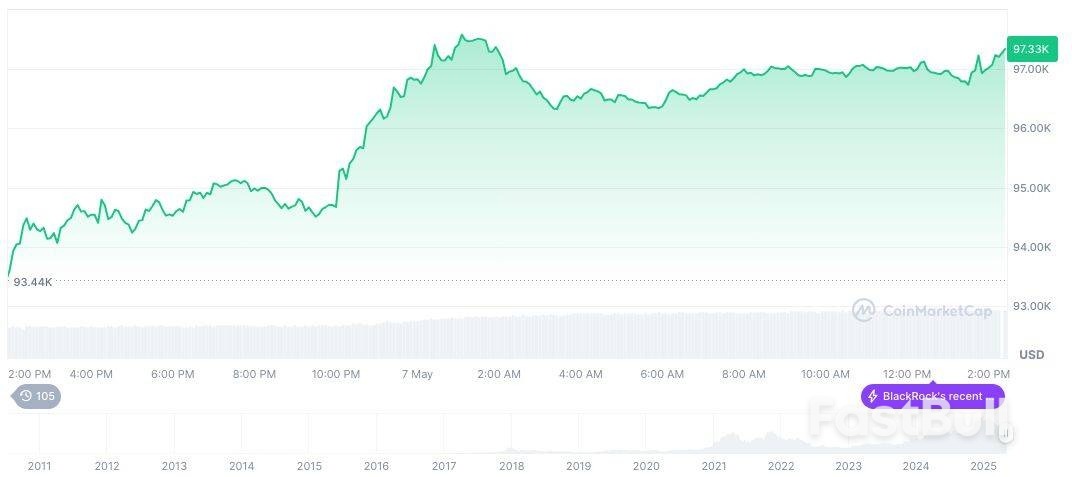
          Bitcoin's price stands at $97,217.35 with a market cap of $1.93 trillion. Its 24-hour trading volume increased by 214.83% to $77.91 billion. Bitcoin's price rose 1.16% over 24 hours, 3.30% in a week, and 21.74% over 30 days, signaling fluctuating investor interest despite economic uncertainties.

          Bitcoin(BTC), daily chart, screenshot on CoinMarketCap at 22:49 UTC on May 7, 2025.

          Coincu research suggests potential growth in crypto as investors seek alternatives amidst uncertain monetary policy. Speculative assets like Bitcoin and Ethereum might gain appeal, with market sentiment closely tied to future Fed actions. Historical data indicates shifts in crypto activity following similar economic events.

          Source: CryptoSlate

          To stay updated on all economic events of today, please check out our Economic calendar
          Risk Warnings and Disclaimers
          You understand and acknowledge that there is a high degree of risk involved in trading. Following any strategies or investment methods may lead to potential losses. The content on the site is provided by our contributors and analysts for information purposes only. You are solely responsible for determining whether any trading assets, securities, strategy, or any other product is suitable for investing based on your own investment objectives and financial situation.
          Add to Favorites
          Share
          FastBull
          Copyright © 2025 FastBull Ltd

          728 RM B 7/F GEE LOK IND BLDG NO 34 HUNG TO RD KWUN TONG KLN HONG KONG

          TelegramInstagramTwitterfacebooklinkedin
          App Store Google Play Google Play
          Products
          Charts

          Chats

          Q&A with Experts
          Screeners
          Economic Calendar
          Data
          Tools
          Membership
          Features
          Function
          Markets
          Copy Trading
          Latest Signals
          Contests
          News
          Analysis
          24/7
          Columns
          Education
          Company
          Careers
          About Us
          Contact Us
          Advertising
          Help Center
          Feedback
          User Agreement
          Privacy Policy
          Business

          White Label

          Data API

          Web Plug-ins

          Poster Maker

          Affiliate Program

          Risk Disclosure

          The risk of loss in trading financial instruments such as stocks, FX, commodities, futures, bonds, ETFs and crypto can be substantial. You may sustain a total loss of the funds that you deposit with your broker. Therefore, you should carefully consider whether such trading is suitable for you in light of your circumstances and financial resources.

          No decision to invest should be made without thoroughly conducting due diligence by yourself or consulting with your financial advisors. Our web content might not suit you since we don't know your financial conditions and investment needs. Our financial information might have latency or contain inaccuracy, so you should be fully responsible for any of your trading and investment decisions. The company will not be responsible for your capital loss.

          Without getting permission from the website, you are not allowed to copy the website's graphics, texts, or trademarks. Intellectual property rights in the content or data incorporated into this website belong to its providers and exchange merchants.

          Not Logged In

          Log in to access more features

          FastBull Membership

          Not yet

          Purchase

          Become a signal provider
          Help Center
          Customer Service
          Dark Mode
          Price Up/Down Colors

          Log In

          Sign Up

          Position
          Layout
          Fullscreen
          Default to Chart
          The chart page opens by default when you visit fastbull.com