• Trade
  • Markets
  • Copy
  • Contests
  • News
  • 24/7
  • Calendar
  • Q&A
  • Chats
Trending
Screeners
SYMBOL
LAST
BID
ASK
HIGH
LOW
NET CHG.
%CHG.
SPREAD
SPX
S&P 500 Index
6870.39
6870.39
6870.39
6895.79
6858.28
+13.27
+ 0.19%
--
DJI
Dow Jones Industrial Average
47954.98
47954.98
47954.98
48133.54
47871.51
+104.05
+ 0.22%
--
IXIC
NASDAQ Composite Index
23578.12
23578.12
23578.12
23680.03
23506.00
+72.99
+ 0.31%
--
USDX
US Dollar Index
98.910
98.990
98.910
98.960
98.730
-0.040
-0.04%
--
EURUSD
Euro / US Dollar
1.16505
1.16512
1.16505
1.16717
1.16341
+0.00079
+ 0.07%
--
GBPUSD
Pound Sterling / US Dollar
1.33194
1.33203
1.33194
1.33462
1.33136
-0.00118
-0.09%
--
XAUUSD
Gold / US Dollar
4211.57
4211.91
4211.57
4218.85
4190.61
+13.66
+ 0.33%
--
WTI
Light Sweet Crude Oil
59.165
59.195
59.165
60.084
59.124
-0.644
-1.08%
--

Community Accounts

Signal Accounts
--
Profit Accounts
--
Loss Accounts
--
View More

Become a signal provider

Sell trading signals to earn additional income

View More

Guide to Copy Trading

Get started with ease and confidence

View More

Signal Accounts for Members

All Signal Accounts

Best Return
  • Best Return
  • Best P/L
  • Best MDD
Past 1W
  • Past 1W
  • Past 1M
  • Past 1Y

All Contests

  • All
  • Trump Updates
  • Recommend
  • Stocks
  • Cryptocurrencies
  • Central Banks
  • Featured News
Top News Only
Share

Congolese President Felix Tshisekedi: Rwanda Is Already Violating Its Peace Deal Commitments

Share

German Foreign Minister Wadephul: Chinese Partners Say They Want To Give Priority To Resolving Bottlenecks In Germany, Europe

Share

India Foreign Ministry: New Deputy USA Trade Representative Will Visit India On Dec 10-11

Share

India Foreign Ministry: Advise Indian Nationals To Exercise Caution While Travelling To Or Transiting Through China

Share

Agrural - Brazil's 2025/26 Total Corn Output Seen At 135.3 Million Tonnes Versus 141.1 Million Tonnes In Previous Season

Share

Agrural - Brazil's 2025/26 Soybean Planting Hits 94% Of Expected Area As Of Last Thursday

Share

SEBI: Modalities For Migration To Ai Only Schemes And Relaxations To Large Value Funds For Accredited Investors

Share

All 6 Bank Of Israel Monetary Policy Committee Members Voted To Lower Benchmark Interest Rate 25 Bps To 4.25% On Nov 24

Share

India Government: Cancellations Are On Account Of Developer Delays And Not Due To Transmission Side Delays

Share

Fitch: We See Moderation Of Export Performance In China In 2026

Share

India Government: Revokes Grid Access Permissions For Renewable Energy Projects

Share

Stats Office - Tanzania Inflation At 3.4% Year-On-Year In November

Share

Temasek CEO Dilhan Pillay: We Are Taking A Conservative Stance On Allocating Capital

Share

Brazil Economists See Brazilian Real At 5.40 Per Dollar By Year-End 2025 Versus 5.40 In Previous Estimate - Central Bank Poll

Share

Brazil Economists See Year-End 2026 Interest Rate Selic At 12.25% Versus 12.00% In Previous Estimate - Central Bank Poll

Share

Brazil Economists See Year-End 2025 Interest Rate Selic At 15.00% Versus 15.00% In Previous Estimate - Central Bank Poll

Share

EU Commission Says Meta Has Committed To Give EU Users Choice On Personalised Ads

Share

Sources Revealed That The Bank Of England Has Invited Employees To Voluntarily Apply For Layoffs

Share

The Bank Of England Plans To Cut Staff Due To Budget Pressures

Share

Traders Believe There Is Less Than A 10% Chance That The European Central Bank Will Cut Interest Rates By 25 Basis Points In 2026

TIME
ACT
FCST
PREV
France Industrial Output MoM (SA) (Oct)

A:--

F: --

P: --
France Trade Balance (SA) (Oct)

A:--

F: --

P: --
Euro Zone Employment YoY (SA) (Q3)

A:--

F: --

P: --
Canada Part-Time Employment (SA) (Nov)

A:--

F: --

P: --

Canada Unemployment Rate (SA) (Nov)

A:--

F: --

P: --

Canada Full-time Employment (SA) (Nov)

A:--

F: --

P: --

Canada Labor Force Participation Rate (SA) (Nov)

A:--

F: --

P: --

Canada Employment (SA) (Nov)

A:--

F: --

P: --

U.S. PCE Price Index MoM (Sept)

A:--

F: --

P: --

U.S. Personal Income MoM (Sept)

A:--

F: --

P: --

U.S. Core PCE Price Index MoM (Sept)

A:--

F: --

P: --

U.S. PCE Price Index YoY (SA) (Sept)

A:--

F: --

P: --

U.S. Core PCE Price Index YoY (Sept)

A:--

F: --

P: --

U.S. Personal Outlays MoM (SA) (Sept)

A:--

F: --

P: --
U.S. 5-10 Year-Ahead Inflation Expectations (Dec)

A:--

F: --

P: --

U.S. Real Personal Consumption Expenditures MoM (Sept)

A:--

F: --

P: --
U.S. Weekly Total Rig Count

A:--

F: --

P: --

U.S. Weekly Total Oil Rig Count

A:--

F: --

P: --

U.S. Consumer Credit (SA) (Oct)

A:--

F: --

P: --
China, Mainland Foreign Exchange Reserves (Nov)

A:--

F: --

P: --

Japan Trade Balance (Oct)

A:--

F: --

P: --

Japan Nominal GDP Revised QoQ (Q3)

A:--

F: --

P: --

China, Mainland Imports YoY (CNH) (Nov)

A:--

F: --

P: --

China, Mainland Exports (Nov)

A:--

F: --

P: --

China, Mainland Imports (CNH) (Nov)

A:--

F: --

P: --

China, Mainland Trade Balance (CNH) (Nov)

A:--

F: --

P: --

China, Mainland Exports YoY (USD) (Nov)

A:--

F: --

P: --

China, Mainland Imports YoY (USD) (Nov)

A:--

F: --

P: --

Germany Industrial Output MoM (SA) (Oct)

A:--

F: --

P: --
Euro Zone Sentix Investor Confidence Index (Dec)

A:--

F: --

P: --

Canada National Economic Confidence Index

--

F: --

P: --

U.K. BRC Like-For-Like Retail Sales YoY (Nov)

--

F: --

P: --

U.K. BRC Overall Retail Sales YoY (Nov)

--

F: --

P: --

Australia Overnight (Borrowing) Key Rate

--

F: --

P: --

RBA Rate Statement
RBA Press Conference
Germany Exports MoM (SA) (Oct)

--

F: --

P: --

U.S. NFIB Small Business Optimism Index (SA) (Nov)

--

F: --

P: --

Mexico 12-Month Inflation (CPI) (Nov)

--

F: --

P: --

Mexico Core CPI YoY (Nov)

--

F: --

P: --

Mexico PPI YoY (Nov)

--

F: --

P: --

U.S. Weekly Redbook Index YoY

--

F: --

P: --

U.S. JOLTS Job Openings (SA) (Oct)

--

F: --

P: --

China, Mainland M1 Money Supply YoY (Nov)

--

F: --

P: --

China, Mainland M0 Money Supply YoY (Nov)

--

F: --

P: --

China, Mainland M2 Money Supply YoY (Nov)

--

F: --

P: --

U.S. EIA Short-Term Crude Production Forecast For The Year (Dec)

--

F: --

P: --

U.S. EIA Natural Gas Production Forecast For The Next Year (Dec)

--

F: --

P: --

U.S. EIA Short-Term Crude Production Forecast For The Next Year (Dec)

--

F: --

P: --

EIA Monthly Short-Term Energy Outlook
U.S. API Weekly Gasoline Stocks

--

F: --

P: --

U.S. API Weekly Cushing Crude Oil Stocks

--

F: --

P: --

U.S. API Weekly Crude Oil Stocks

--

F: --

P: --

U.S. API Weekly Refined Oil Stocks

--

F: --

P: --

South Korea Unemployment Rate (SA) (Nov)

--

F: --

P: --

Japan Reuters Tankan Non-Manufacturers Index (Dec)

--

F: --

P: --

Japan Reuters Tankan Manufacturers Index (Dec)

--

F: --

P: --

Japan Domestic Enterprise Commodity Price Index MoM (Nov)

--

F: --

P: --

Japan Domestic Enterprise Commodity Price Index YoY (Nov)

--

F: --

P: --

China, Mainland PPI YoY (Nov)

--

F: --

P: --

China, Mainland CPI MoM (Nov)

--

F: --

P: --

Q&A with Experts
    • All
    • Chatrooms
    • Groups
    • Friends
    Connecting
    .
    .
    .
    Type here...
    Add Symbol or Code

      No matching data

      All
      Trump Updates
      Recommend
      Stocks
      Cryptocurrencies
      Central Banks
      Featured News
      • All
      • Russia-Ukraine Conflict
      • Middle East Flashpoint
      • All
      • Russia-Ukraine Conflict
      • Middle East Flashpoint
      Search
      Products

      Charts Free Forever

      Chats Q&A with Experts
      Screeners Economic Calendar Data Tools
      Membership Features
      Data Warehouse Market Trends Institutional Data Policy Rates Macro

      Market Trends

      Market Sentiment Order Book Forex Correlations

      Top Indicators

      Charts Free Forever
      Markets

      News

      News Analysis 24/7 Columns Education
      From Institutions From Analysts
      Topics Columnists

      Latest Views

      Latest Views

      Trending Topics

      Top Columnists

      Latest Update

      Signals

      Copy Rankings Latest Signals Become a signal provider AI Rating
      Contests
      Brokers

      Overview Brokers Assessment Rankings Regulators News Claims
      Broker listing Forex Brokers Comparison Tool Live Spread Comparison Scam
      Q&A Complaint Scam Alert Videos Tips to Detect Scam
      More

      Business
      Events
      Careers About Us Advertising Help Center

      White Label

      Data API

      Web Plug-ins

      Affiliate Program

      Awards Institution Evaluation IB Seminar Salon Event Exhibition
      Vietnam Thailand Singapore Dubai
      Fans Party Investment Sharing Session
      FastBull Summit BrokersView Expo
      Recent Searches
        Top Searches
          Markets
          News
          Analysis
          User
          24/7
          Economic Calendar
          Education
          Data
          • Names
          • Latest
          • Prev

          View All

          No data

          Scan to Download

          Faster Charts, Chat Faster!

          Download App
          English
          • English
          • Español
          • العربية
          • Bahasa Indonesia
          • Bahasa Melayu
          • Tiếng Việt
          • ภาษาไทย
          • Français
          • Italiano
          • Türkçe
          • Русский язык
          • 简中
          • 繁中
          Open Account
          Search
          Products
          Charts Free Forever
          Markets
          News
          Signals

          Copy Rankings Latest Signals Become a signal provider AI Rating
          Contests
          Brokers

          Overview Brokers Assessment Rankings Regulators News Claims
          Broker listing Forex Brokers Comparison Tool Live Spread Comparison Scam
          Q&A Complaint Scam Alert Videos Tips to Detect Scam
          More

          Business
          Events
          Careers About Us Advertising Help Center

          White Label

          Data API

          Web Plug-ins

          Affiliate Program

          Awards Institution Evaluation IB Seminar Salon Event Exhibition
          Vietnam Thailand Singapore Dubai
          Fans Party Investment Sharing Session
          FastBull Summit BrokersView Expo

          Fed Division Deepens as Trump-Backed Voices Push for July Rate Cut

          Gerik

          Economic

          Summary:

          Internal division is growing within the Federal Reserve as more officials publicly back President Trump’s call for a rate cut, potentially as early as July...

          Emerging Consensus for Rate Cuts as Trump Gains Unlikely Allies Inside the Fed

          The Federal Reserve is facing an unusual degree of internal disagreement over the direction of monetary policy, as senior officials increasingly align with President Donald Trump’s call for lower interest rates. In recent days, Vice Chair for Supervision Michelle Bowman and Governor Christopher Waller, both Trump appointees, have publicly stated their support for policy easing if inflation remains under control.
          Bowman’s remarks on Monday marked a clear shift in tone. She emphasized that with limited inflationary pressure and relatively muted price impacts from Trump’s new tariffs, it may be time to recalibrate policy toward neutrality. Her support for a rate cut in the next meeting comes despite earlier Fed consensus to hold steady.

          Fed’s Tactical Shift: From Patience to Conditional Readiness

          While not all officials have taken as clear a stance, several are now signaling a readiness to act. Chicago Fed President Austan Goolsbee said in a Milwaukee event that if tariffs don’t result in significant inflation, monetary easing should be considered a viable option. He hinted that the post-April tariff landscape might not be as disruptive as anticipated.
          Chair Jerome Powell, despite Trump's increasingly aggressive personal attacks—including calling him “dumb” and “stubborn”—remains cautious. He reiterated that the Fed prefers to see more summer data before committing to any rate adjustment. Yet even Powell has acknowledged that energy shocks from geopolitical tensions, like the recent Israel-Iran conflict, have so far been short-lived in the past, unlike the structural shocks of the 1970s.

          Geopolitical Risks and Energy Prices: Limited Reaction from Fed So Far

          The recent U.S. airstrikes on Iran’s nuclear facilities and a shaky ceasefire agreement with Israel have raised global energy price concerns. Still, Fed officials remain calm. Bowman noted that while commodity prices may rise, weak consumer demand—especially from low-income groups—and stable supply chains are keeping retailers cautious about price hikes.
          Powell reinforced this view, stating that U.S. dependence on foreign oil is far lower than in previous decades, reducing the pass-through effects of oil shocks. The Fed sees current events as manageable unless full-scale regional conflict breaks out, which would pose greater risks.

          Political Pressure Meets Institutional Independence

          Trump’s direct criticism of Powell has escalated, yet Fed officials insist that political interference does not impact policy decisions. Powell, in particular, has repeatedly stated that the central bank will continue to operate independently and base its decisions strictly on economic data.
          Nonetheless, market sentiment is tilting toward the expectation of a rate cut. CME Group’s FedWatch tool reflects a rising probability of a policy shift at the July 29–30 meeting. Analysts warn that while current inflation trends are subdued, the Fed must also weigh potential second-round effects of tariffs, wage growth, and geopolitical instability.
          As inflation remains modest and the labor market shows resilience, calls for monetary easing—particularly from Trump-aligned officials—are growing louder. The Fed's internal divergence reflects broader tensions between maintaining long-term credibility and responding swiftly to evolving risks. Whether July becomes the turning point for U.S. monetary policy will depend not just on inflation data but also on how much pressure the Fed can resist from both markets and politics.

          Source: CNN

          To stay updated on all economic events of today, please check out our Economic calendar
          Risk Warnings and Disclaimers
          You understand and acknowledge that there is a high degree of risk involved in trading. Following any strategies or investment methods may lead to potential losses. The content on the site is provided by our contributors and analysts for information purposes only. You are solely responsible for determining whether any trading assets, securities, strategy, or any other product is suitable for investing based on your own investment objectives and financial situation.
          Add to Favorites
          Share

          Bento Businesses Buckle as Japan's Soaring Rice Prices Threaten Small Eateries

          Gerik

          Economic

          Commodity

          Japan’s Fourth-Largest Economy Wavers as Bento Shops Fall Victim to Soaring Rice Prices

          Japan’s bento economy—once a reliable staple for busy office workers and students—is faltering under the weight of stagflation. With core input costs, especially rice, rising at an unprecedented pace, many small businesses are now closing down or facing mounting losses.
          According to Teikoku Databank, 22 bento shops declared bankruptcy between January and May 2025—already surpassing last year’s same-period figure. In 2024, a record 52 shops folded, and experts predict that 2025 could set a new high.
          Daisuke Iijima, an analyst at Teikoku, commented that “many small bento vendors are barely hanging on,” with most opting to operate at a loss or raise prices despite customer resistance.

          From Affordable Meals to Margin Killers: Rice Costs Spark Crisis

          Once celebrated for affordability and convenience, bento meals are becoming harder to sustain. Rice—making up the bulk of ingredient costs—has more than doubled in price year-on-year as of May 2025. This steep rise is compressing margins across the board.
          Bento consumption had already weakened during the pandemic as remote work reduced foot traffic and customer frequency. Now, a brutal combination of lower demand and spiraling costs is devastating a sector reliant on volume and affordability.
          Data shows that in fiscal 2024, 45% of bento shops reported increased profits, but 30% suffered losses, and 22% saw profit declines. Larger chains are weathering the storm thanks to supply chain leverage, but mom-and-pop vendors lack the same financial cushion.

          Raising Prices, Losing Customers: A No-Win Dilemma

          Many bento sellers have had no choice but to raise prices. However, the speed and scale of price increases still lag behind input inflation. Worse, the bento market is hypersensitive to pricing—customers view it as the cheapest meal option, meaning even slight hikes can reduce demand.
          This puts small businesses in a bind: raise prices and risk losing loyal customers, or absorb the costs and risk financial ruin. Iijima warns that “without greater resilience, more small bento shops will inevitably close.”

          Uncertainty Over Rice and Consumer Prices

          Japan’s inflation rate is expected to hover around 3% in 2025, a moderate figure by global standards but high enough to challenge a deflation-habituated economy. Industry insiders remain split on whether rice prices will normalize or remain elevated in the longer term.
          While larger chains are adapting through scale, digital ordering, and diversified menus, many traditional bento shops lack both capital and innovation capability. Unless government or industry-level interventions ease the cost burden—or inflation retreats—the outlook remains bleak for this once-thriving segment of Japan’s food service economy.

          Source: JPT

          To stay updated on all economic events of today, please check out our Economic calendar
          Risk Warnings and Disclaimers
          You understand and acknowledge that there is a high degree of risk involved in trading. Following any strategies or investment methods may lead to potential losses. The content on the site is provided by our contributors and analysts for information purposes only. You are solely responsible for determining whether any trading assets, securities, strategy, or any other product is suitable for investing based on your own investment objectives and financial situation.
          Add to Favorites
          Share

          Addressing FDI Distortions: Vietnam Seeks Quality Over Quantity in Investment Strategy

          Gerik

          Economic

          Chronic Profit Loss and Transfer Pricing: A Structural Weakness in Vietnam’s FDI Sector

          According to Report No. 229/BC-BTC released by the Ministry of Finance, many foreign-invested companies in Vietnam register billions of dollars in capital but contribute minimal equity. Instead, they primarily use debt financing, which inflates financial expenses and depreciation costs, leading to years of reported losses. Experts argue this creates significant space for transfer pricing tactics, allowing firms to shift profits abroad, evade taxes, and erode state revenues.
          These manipulative practices are not only a fiscal concern but also distort Vietnam’s investment climate. As capital outflows and tax avoidance persist, the credibility of Vietnam’s FDI environment and its equitable regulatory framework is increasingly at stake.

          Regional and Sectoral Imbalances Continue to Undermine Investment Potential

          Despite boasting over 43,000 active FDI projects as of May 2025—with over $517 billion in registered capital—the geographical distribution remains lopsided. Most projects are concentrated in industrial hubs like Ho Chi Minh City, Hanoi, and Binh Duong, while rural and mountainous regions such as the Mekong Delta and Central Highlands attract little attention.
          Sectorally, the dominance of manufacturing, real estate, and electricity production continues. Manufacturing alone accounts for over $316 billion in registered capital, or 61.2% of all FDI. This concentration risks unsustainable development, overburdens urban infrastructure, and overlooks the diverse growth potential across sectors like high-tech, renewable energy, and digital services.

          Weak Linkages Between FDI and Domestic Firms: Missed Opportunities in Value Creation

          The report also highlights the limited integration between FDI firms and local enterprises. While a few foreign firms have helped transfer technology and build human capital, many still rely on importing raw materials and executing only low-value-added stages of production. This restricts knowledge spillovers and local value creation. Localization rates remain modest despite years of policy support for Vietnam’s supporting industries.
          Such dynamics trap Vietnam in the low-value end of global supply chains and prevent the domestic private sector from upgrading capabilities. The potential for productivity gains, innovation, and export competitiveness is thus curtailed.

          Structural Challenges Behind Inefficient FDI Utilization

          Several systemic barriers compound the problem. These include a shortage of industrial land with adequate infrastructure, high logistics costs, uneven labor quality, and weak adaptive capacity among domestic firms. The lack of targeted investment promotion further contributes to misallocation of FDI capital, where large volumes of investment do not translate into commensurate socio-economic gains.

          Toward a New FDI Strategy: From Volume to Value

          Acknowledging these inefficiencies, Vietnam’s Ministry of Finance has committed to recalibrating its FDI attraction policies. Future FDI strategies will prioritize quality, efficiency, and sustainability over mere project count or capital volume. New criteria will focus on technological spillovers, domestic supply chain integration, environmental responsibility, and long-term economic contributions.
          Infrastructure upgrades, labor upskilling, and institutional reforms will form the backbone of Vietnam’s “new-generation FDI” policy. Investment promotion will be more selective, targeting large corporations capable of driving innovation and management excellence into the domestic economy.
          Priority sectors identified include high-tech manufacturing, renewable energy, semiconductor production, artificial intelligence, and digital finance. Instead of mass promotion, Vietnam aims for strategic alignment with global supply chain realignment, particularly in light of rising U.S.-China tensions and emerging Indo-Pacific economic dynamics.
          While foreign capital continues to play a critical role in Vietnam’s development, the country now faces a turning point. The shift from quantity to quality is not only a policy imperative but also a strategic necessity in a more competitive and uncertain global landscape. To truly capitalize on FDI, Vietnam must close regulatory loopholes, boost domestic enterprise readiness, and build an ecosystem that values long-term, inclusive growth over short-term capital inflows.
          To stay updated on all economic events of today, please check out our Economic calendar
          Risk Warnings and Disclaimers
          You understand and acknowledge that there is a high degree of risk involved in trading. Following any strategies or investment methods may lead to potential losses. The content on the site is provided by our contributors and analysts for information purposes only. You are solely responsible for determining whether any trading assets, securities, strategy, or any other product is suitable for investing based on your own investment objectives and financial situation.
          Add to Favorites
          Share

          Bitcoin Sentiment Turns Greedy Again—Time to Be Cautious?

          Glendon

          Cryptocurrency

          As Bitcoin and other digital assets recover, data shows the sentiment among cryptocurrency investors has returned to a state of greed.

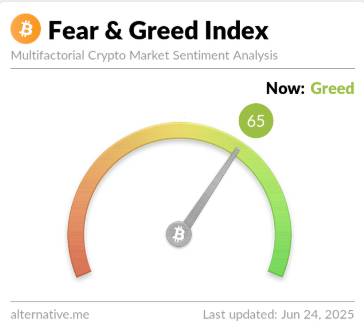
          Bitcoin Fear & Greed Index Is Pointing At Greed Again

          The “Fear & Greed Index” refers to an indicator made by Alternative that measures the net sentiment held by the average trader in the Bitcoin and wider cryptocurrency spaces.

          The index uses the data of the following five factors to determine the market sentiment: trading volume, volatility, market cap dominance, social media sentiment, and Google Trends.

          The metric represents the calculated mentality as a score lying between 0 and 100. The former end point corresponds to a state of maximum fear, while the latter one to that of maximum greed.

          Here’s what the index says regarding the current sentiment among the investors:

          Looks like the value of the metric is 65 at the moment | Source: Alternative

          As displayed above, the Bitcoin Fear & Greed Index has a value of 65, which suggests the traders currently share a majority sentiment of greed. This is a notable change compared to yesterday, when the indicator was sitting at 47, meaning that the investor mentality was overall neutral.

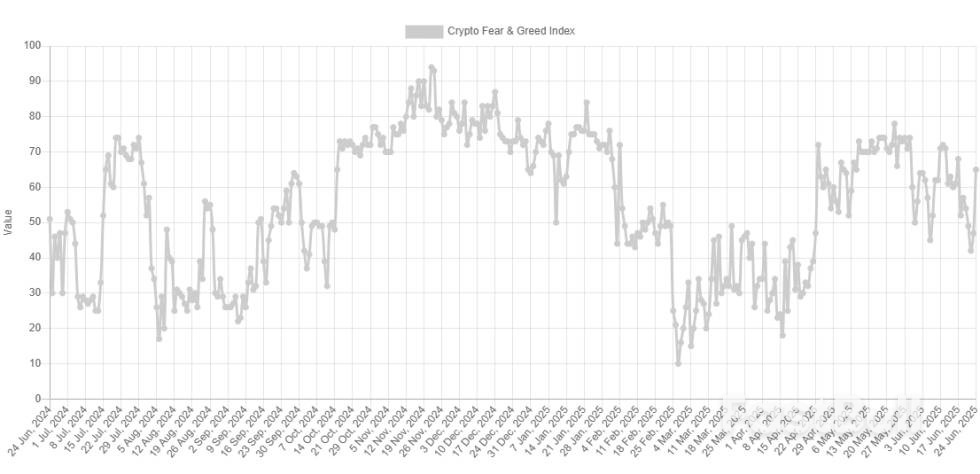
          The trend in the Fear & Greed Index over the past twelve months | Source: Alternative

          The holder sentiment earlier declined as a result of the geopolitical situation surrounding the Israel-Iran conflict. Following the announcement of a ceasefire between the nations, prices bounced back and it would appear that with them, so did the investor mood.

          The ceasefire has since been violated, so it’s possible that tomorrow’s Fear & Greed Index would be less bullish. That said, Bitcoin has held surprisingly well despite the news, which could imply that the sentiment may also remain the same.

          Historically, BTC and digital assets in general have tended to move in the direction that goes against the expectations of the investors. This means that an overly greedy market makes tops likely, while an extremely fearful one bottoms.

          At present, the level of greed in the market isn’t too strong, but the fact that it has seen a notable jump alongside the recovery run could still be to take note off. In the scenario that hype keeps increasing in the coming days, another reversal could turn more probable for Bitcoin and company.

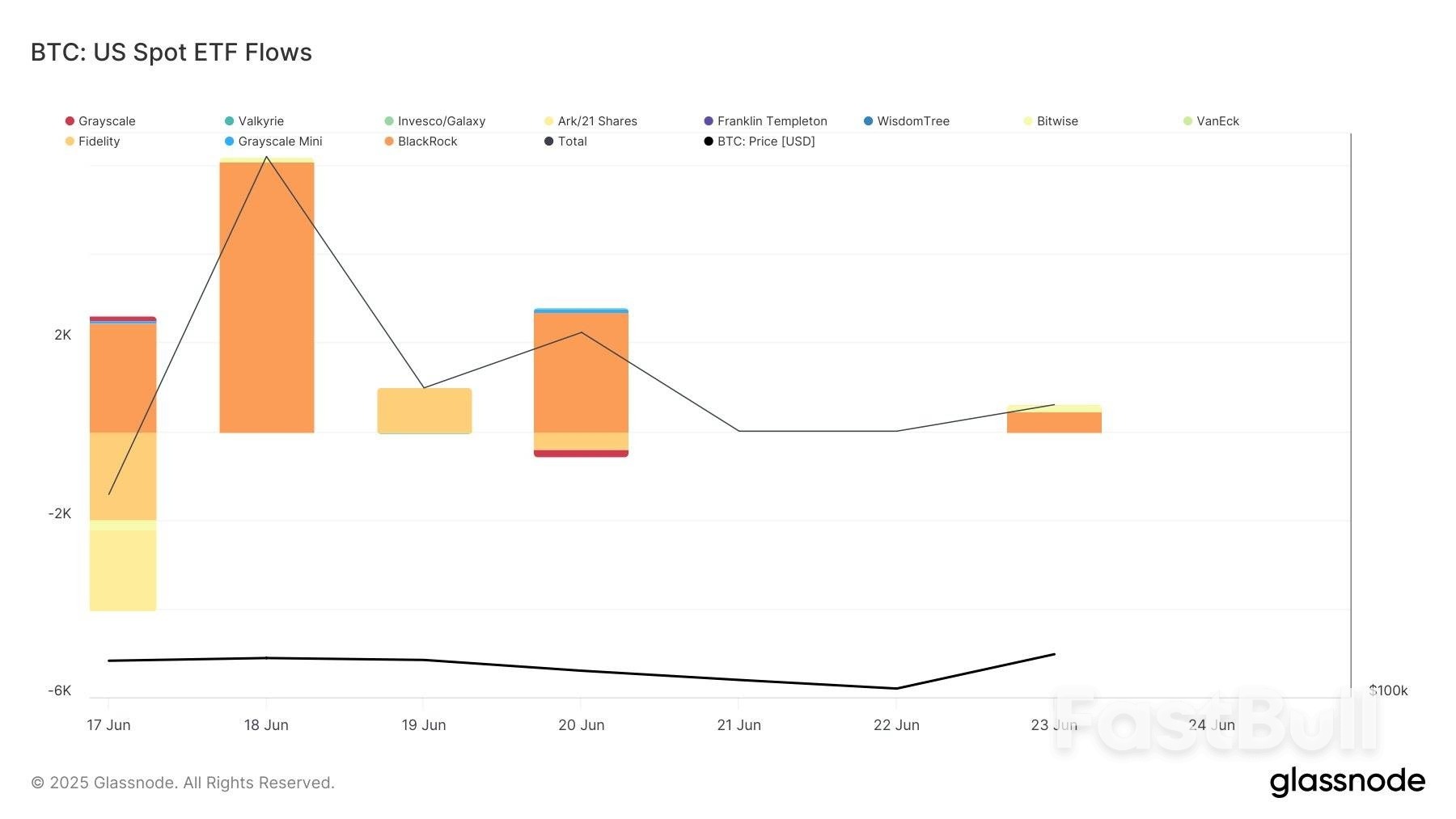
          In some other news, the US-based Bitcoin spot exchange-traded funds (ETFs) saw net inflows yesterday, 23rd June, as pointed out by the analytics firm Glassnode in an X post.

          The data for the netflows associated with the US spot ETFs | Source: Glassnode on X

          As displayed in the above graph, the US Bitcoin spot ETFs saw net inflows of around 598 BTC on this date, despite the geopolitical tensions. “Although the inflows were modest, no major outflows were recorded either, which is notable signal of investor confidence,” notes Glassnode.

          BTC Price

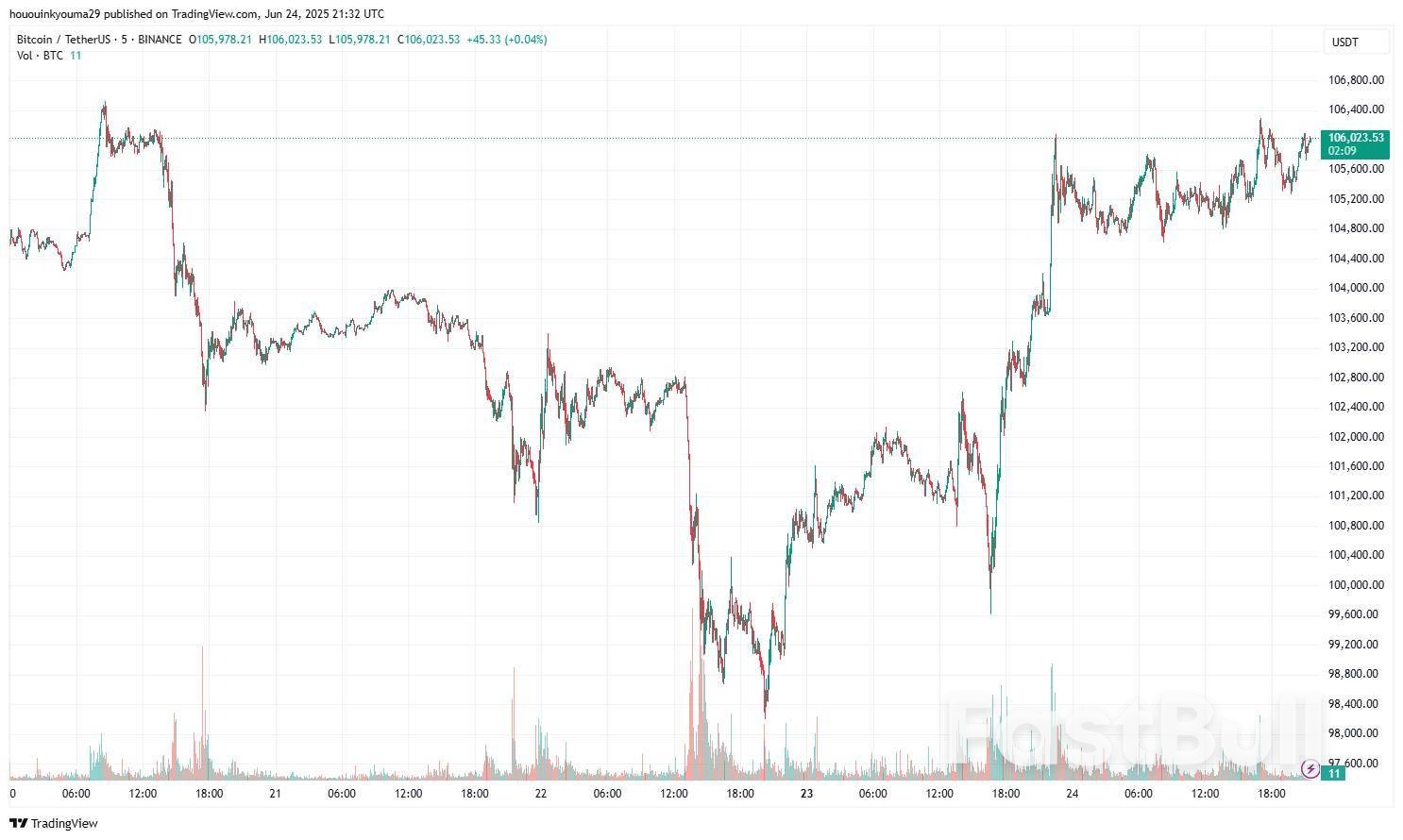
          Bitcoin has already made recovery beyond the level it was trading at before the plunge, as its price is now back at $106,000.

          The asset seems to have shot up during the past day | Source: BTCUSDT on TradingView

          Source: CoinGecko

          Risk Warnings and Disclaimers
          You understand and acknowledge that there is a high degree of risk involved in trading. Following any strategies or investment methods may lead to potential losses. The content on the site is provided by our contributors and analysts for information purposes only. You are solely responsible for determining whether any trading assets, securities, strategy, or any other product is suitable for investing based on your own investment objectives and financial situation.
          Add to Favorites
          Share

          Trump’s Mixed Signals on Iranian Oil Baffle Markets and Allies

          Gerik

          Economic

          Middle East Situation

          Trump’s Surprise Reversal Undermines Sanctions Doctrine

          In a surprising move that sent ripples through diplomatic and financial circles, President Donald Trump declared that China could resume purchasing Iranian oil, marking a sharp deviation from Washington’s years-long policy of maximum pressure on Tehran. His statement, made via Truth Social, came just hours after he announced a fragile ceasefire between Israel and Iran following recent U.S. airstrikes on Iranian nuclear sites.
          The announcement appeared to be made unilaterally, without coordination with the U.S. Treasury or State Department, both of which seemed caught off guard. The Treasury confirmed that sanctions enforcement remains active, signaling confusion within the administration. This lack of internal alignment suggests that the president’s comments may be more rhetorical than a formal policy change.

          A Diplomatic Gambit Tied to Trade and Peace

          Trump’s apparent olive branch to China — Iran’s top oil customer — seems part of a larger effort to reduce tensions in both the Middle East and U.S.-China trade relations. Analysts suggest the statement might have been aimed at encouraging further cooperation from Beijing amid delicate negotiations over reciprocal tariffs and regional diplomacy.
          This possible “carve-out” for China could be interpreted as a goodwill gesture, albeit one that risks undermining U.S. leverage. China has already built covert supply chains for Iranian crude, often disguising its imports as Malaysian or Emirati shipments. Officially, it hasn’t reported Iranian oil purchases since June 2022, yet third-party trackers estimate flows exceed 1 million barrels per day.

          Markets React Cautiously as Confusion Reigns

          Oil markets saw a modest uptick, with Brent crude rising above $68 per barrel. The increase was muted, likely due to uncertainty about the actual policy implications. Many traders are skeptical, interpreting the president’s post as a one-off political maneuver rather than a green light for unrestrained imports.
          Former Treasury officials and geopolitical analysts warned that the inconsistent messaging could reduce the credibility of U.S. sanctions enforcement. If buyers believe the White House is wavering, compliance may erode even without formal changes to the law.

          Strategic Risks: Eroding Sanctions Without Security Gains

          Trump’s post contradicts his administration’s own policy as recently as last month, when he vowed that any purchase of Iranian oil would trigger secondary sanctions. The U.S. has blacklisted hundreds of tankers and Chinese entities over illicit Iranian oil trading. As of now, none of those measures have been lifted.
          This sudden reversal could weaken the U.S. bargaining position in nuclear talks with Tehran and embolden sanctions evasion. It also complicates coordination with allies, particularly in Europe, who have long been urged by Washington to isolate Iran’s energy sector.
          Moreover, the White House’s inability to clarify whether the president’s words reflect actual policy exposes a larger issue: inconsistent foreign policy execution at a time of elevated geopolitical risk.
          Trump’s abrupt shift on Chinese imports of Iranian oil has confused markets, surprised diplomats, and put U.S. sanctions credibility in question. Whether this is part of a larger strategy to ease tensions or simply political improvisation remains unclear. Without formal clarification or legal revisions, the U.S. sanctions regime remains in place — but its deterrent power may have just taken a serious hit.

          Source: Bloomberg

          To stay updated on all economic events of today, please check out our Economic calendar
          Risk Warnings and Disclaimers
          You understand and acknowledge that there is a high degree of risk involved in trading. Following any strategies or investment methods may lead to potential losses. The content on the site is provided by our contributors and analysts for information purposes only. You are solely responsible for determining whether any trading assets, securities, strategy, or any other product is suitable for investing based on your own investment objectives and financial situation.
          Add to Favorites
          Share

          Powell Reaffirms Fed’s Caution on Rate Cuts Amid Political Heat and Tariff Uncertainty

          Gerik

          Economic

          Fed Holds Firm Against Political Pressure, Focuses on Data-Driven Policy

          In testimony before the House Financial Services Committee on Tuesday, Federal Reserve Chair Jerome Powell delivered a measured but resolute message: the Fed is committed to maintaining price stability and will remain cautious before altering its policy stance. Despite rising political pressure, especially from President Trump, Powell reiterated that the central bank’s decisions are independent and will be guided solely by data.
          Trump has escalated his public attacks on Powell, accusing him of being "dumb" and "hardheaded" for refusing to cut rates amid rising trade tensions. However, Powell made clear that “politics has no role” in Fed policy, emphasizing, “We’re doing our jobs.”

          Tariffs: The Core Uncertainty Behind the Fed’s Policy Delay

          The key issue restraining the Fed from acting is uncertainty around the inflationary impact of Trump’s tariff policies. Powell explained that the “ultimate level” and persistence of price increases due to tariffs remain unclear. While short-term effects typically include one-off price hikes, the Fed is watching for signs of sustained inflation acceleration that could justify a policy shift.
          Powell warned that the Federal Open Market Committee (FOMC) has a duty to “prevent a one-time increase in the price level from becoming an ongoing inflation problem.” He highlighted that inflation is projected to rise modestly in May to 2.3%, with core inflation expected to reach 2.6% — both slightly above the Fed’s 2% target but still not alarming enough to prompt immediate action.

          Labor Market Solid, Inflation Risks Balanced — No Rush to Cut

          Powell characterized the U.S. economy as “solid,” with employment near full capacity. While inflation remains slightly elevated, he emphasized the Fed’s responsibility to balance the dual mandate of price stability and full employment. “Without price stability, we cannot achieve the long periods of strong labor market conditions that benefit all Americans,” he told lawmakers.
          Some Fed officials — including Governors Michelle Bowman and Christopher Waller — have suggested that if inflation stays in check, they may support a July rate cut. However, Powell signaled the broader committee’s reluctance, noting that it will take more than one month of data to justify easing.

          Market Implications: July Cut Unlikely, September More Probable

          The futures market is currently pricing in only a 23% chance of a July rate cut, with stronger odds for a move in September. This aligns with Powell’s assertion that more time is needed to observe the economic fallout from tariffs and ensure inflation doesn’t spiral.
          The Fed’s dot plot revealed a divided board: nine officials anticipate zero or one cut in 2025, while the remaining ten foresee two or more cuts. This internal divergence reflects how finely balanced the inflation-growth tradeoff is in the current environment.
          Despite rising political heat, Powell’s testimony makes it clear the Fed is focused on its long-term credibility and macroeconomic stability rather than short-term pressure. With inflation data still within a manageable range and uncertainty over tariffs unresolved, the central bank is in no rush to cut rates. Investors and markets should expect the Fed to remain data-dependent, resisting premature action until inflation expectations and global risks become more predictable.

          Source: CNBC

          To stay updated on all economic events of today, please check out our Economic calendar
          Risk Warnings and Disclaimers
          You understand and acknowledge that there is a high degree of risk involved in trading. Following any strategies or investment methods may lead to potential losses. The content on the site is provided by our contributors and analysts for information purposes only. You are solely responsible for determining whether any trading assets, securities, strategy, or any other product is suitable for investing based on your own investment objectives and financial situation.
          Add to Favorites
          Share

          China Steps Up Global Yuan Push Amid Dollar Weakness and Policy Uncertainty

          Gerik

          Economic

          Forex

          Beijing Moves to Elevate the Yuan’s Global Profile

          As the U.S. dollar suffers from heightened policy uncertainty and declining global confidence, China is intensifying efforts to promote the yuan as a viable alternative for international trade and finance. The People's Bank of China (PBOC), under Governor Pan Gongsheng, is leading initiatives to reduce reliance on what he calls a "single sovereign currency," a clear reference to the dollar. At the core of this strategy is the internationalization of the digital yuan, expanded access to Chinese financial markets, and greater use of the renminbi in cross-border payments and commodity pricing.
          These efforts come at a moment of relative strength for China’s currency. The offshore yuan has appreciated over 2% against the U.S. dollar in 2025, while the dollar index has fallen over 9% amid investor unease with U.S. policy under President Trump, especially regarding tariffs and sanctions.

          Strategic Access for Foreign Institutions and Commodities Pricing Power

          China is targeting the futures and commodities markets as key channels for yuan internationalization. In recent weeks, three major Chinese exchanges—Shanghai, Dalian, and Zhengzhou—have opened up 16 additional futures and options contracts to qualified foreign institutional investors, including contracts in natural rubber, lead, and tin. These additions are part of a broader campaign to expand foreign investor access to China’s hedging tools and integrate the yuan into global commodity pricing systems.
          The Shanghai Futures Exchange also announced plans to allow foreign currency collateral for yuan-settled trades—further smoothing access for global players.
          Financial firms are slowly responding. Morgan Stanley’s Chinese subsidiary now offers brokerage services for commodity futures and plans to expand to equity and bond futures trading, after years of gradual regulatory approvals.
          Despite these openings, structural barriers remain. China's capital controls and lack of legal transparency continue to deter deep foreign investment, limiting the yuan’s broader appeal compared to the dollar's unmatched liquidity and regulatory clarity.

          Digital Yuan, Cross-Border Lending, and Bilateral Settlements

          Beyond investment markets, Beijing is building out a parallel financial infrastructure to challenge dollar supremacy. The central bank has laid the groundwork for a digital yuan hub in Shanghai to support international transactions, while Chinese banks are increasingly using yuan in lending to emerging markets, especially as lower interest rates make it cost-effective.
          The Cross-Border Interbank Payment System (CIPS) is also playing a growing role, providing an alternative to the SWIFT network and supporting bilateral trade in yuan with partners in Asia, Africa, and the Middle East. In February 2025, China allocated $100 billion in financing through Hong Kong to support yuan-denominated deals—further incentivizing global businesses to adopt the currency.
          While China's push is strategic and steady, results remain mixed. According to SWIFT’s May data, the yuan accounted for just 2.89% of global payments, down from 5th to 6th place globally. In contrast, the U.S. dollar still dominated with 48.46% of all cross-border transactions, followed by the euro at 23.56%.

          Dollar Weakness and Global Shifts Bolster China’s Timing

          China’s de-dollarization drive coincides with broader shifts in Asia and the Global South. Geopolitical tensions, dollar volatility, and the rising cost of U.S. borrowing have prompted many countries to hedge against dollar exposure. President Trump’s tariff escalation and abrupt foreign policy decisions have only intensified the appetite for diversification, pushing more institutional money toward yuan-based assets.
          State Street Markets’ proprietary data points to a sharp increase in institutional CNY inflows. According to senior EM strategist Ning Sun, institutional investors—still underweight in yuan—are now positioning more aggressively in CNY-denominated assets.

          Progress, but Long Road Ahead

          While China’s multi-pronged strategy is yielding incremental gains, experts remain cautious. As Matt Gertken of BCA Research notes, the yuan lacks the deep, open, and rule-of-law-based financial system that underpins the dollar’s dominance. Unless China can offer credible reforms to improve transparency, legal reliability, and capital mobility, the yuan's global role will remain significant but limited.
          Still, with the global monetary order in flux and confidence in the dollar shaken, China’s window to reshape financial geopolitics is as wide as it has ever been. The challenge now is execution and trust.

          Source: CNBC

          To stay updated on all economic events of today, please check out our Economic calendar
          Risk Warnings and Disclaimers
          You understand and acknowledge that there is a high degree of risk involved in trading. Following any strategies or investment methods may lead to potential losses. The content on the site is provided by our contributors and analysts for information purposes only. You are solely responsible for determining whether any trading assets, securities, strategy, or any other product is suitable for investing based on your own investment objectives and financial situation.
          Add to Favorites
          Share
          FastBull
          Copyright © 2025 FastBull Ltd

          728 RM B 7/F GEE LOK IND BLDG NO 34 HUNG TO RD KWUN TONG KLN HONG KONG

          TelegramInstagramTwitterfacebooklinkedin
          App Store Google Play Google Play
          Products
          Charts

          Chats

          Q&A with Experts
          Screeners
          Economic Calendar
          Data
          Tools
          Membership
          Features
          Function
          Markets
          Copy Trading
          Latest Signals
          Contests
          News
          Analysis
          24/7
          Columns
          Education
          Company
          Careers
          About Us
          Contact Us
          Advertising
          Help Center
          Feedback
          User Agreement
          Privacy Policy
          Business

          White Label

          Data API

          Web Plug-ins

          Poster Maker

          Affiliate Program

          Risk Disclosure

          The risk of loss in trading financial instruments such as stocks, FX, commodities, futures, bonds, ETFs and crypto can be substantial. You may sustain a total loss of the funds that you deposit with your broker. Therefore, you should carefully consider whether such trading is suitable for you in light of your circumstances and financial resources.

          No decision to invest should be made without thoroughly conducting due diligence by yourself or consulting with your financial advisors. Our web content might not suit you since we don't know your financial conditions and investment needs. Our financial information might have latency or contain inaccuracy, so you should be fully responsible for any of your trading and investment decisions. The company will not be responsible for your capital loss.

          Without getting permission from the website, you are not allowed to copy the website's graphics, texts, or trademarks. Intellectual property rights in the content or data incorporated into this website belong to its providers and exchange merchants.

          Not Logged In

          Log in to access more features

          FastBull Membership

          Not yet

          Purchase

          Become a signal provider
          Help Center
          Customer Service
          Dark Mode
          Price Up/Down Colors

          Log In

          Sign Up

          Position
          Layout
          Fullscreen
          Default to Chart
          The chart page opens by default when you visit fastbull.com