• Trade
  • Markets
  • Copy
  • Contests
  • News
  • 24/7
  • Calendar
  • Q&A
  • Chats
Trending
Screeners
SYMBOL
LAST
BID
ASK
HIGH
LOW
NET CHG.
%CHG.
SPREAD
SPX
S&P 500 Index
6846.50
6846.50
6846.50
6878.28
6827.18
-23.90
-0.35%
--
DJI
Dow Jones Industrial Average
47739.31
47739.31
47739.31
47971.51
47611.93
-215.67
-0.45%
--
IXIC
NASDAQ Composite Index
23545.89
23545.89
23545.89
23698.93
23455.05
-32.22
-0.14%
--
USDX
US Dollar Index
99.040
99.120
99.040
99.160
98.730
+0.090
+ 0.09%
--
EURUSD
Euro / US Dollar
1.16370
1.16377
1.16370
1.16717
1.16162
-0.00056
-0.05%
--
GBPUSD
Pound Sterling / US Dollar
1.33235
1.33245
1.33235
1.33462
1.33053
-0.00077
-0.06%
--
XAUUSD
Gold / US Dollar
4188.83
4189.27
4188.83
4218.85
4175.92
-9.08
-0.22%
--
WTI
Light Sweet Crude Oil
58.612
58.739
58.612
60.084
58.495
-1.197
-2.00%
--

Community Accounts

Signal Accounts
--
Profit Accounts
--
Loss Accounts
--
View More

Become a signal provider

Sell trading signals to earn additional income

View More

Guide to Copy Trading

Get started with ease and confidence

View More

Signal Accounts for Members

All Signal Accounts

Best Return
  • Best Return
  • Best P/L
  • Best MDD
Past 1W
  • Past 1W
  • Past 1M
  • Past 1Y

All Contests

  • All
  • Trump Updates
  • Recommend
  • Stocks
  • Cryptocurrencies
  • Central Banks
  • Featured News
Top News Only
Share

(US Stocks) The Philadelphia Gold And Silver Index Closed Down 2.34% At 311.01 Points. (Global Session) The NYSE Arca Gold Miners Index Closed Down 2.17%, Hitting A Daily Low Of 2235.45 Points; US Stocks Remained Slightly Down Before The Opening Bell—holding Steady Around 2280 Points—before Briefly Rising Slightly

Share

IMF: IMF Executive Board Approves Extension Of The Extended Credit Facility Arrangement With Nepal

Share

Trump: Same Approach Will Apply To Amd, Intel, And Other Great American Companies

Share

Trump: Department Of Commerce Is Finalizing Details

Share

Trump: $25% Will Be Paid To United States Of America

Share

Trump: President Xi Responded Positively

Share

[Consumer Discretionary ETFs Fell Over 1.4%, Leading The Decline Among US Sector ETFs; Semiconductor ETFs Rose Over 1.1%] On Monday (December 8), The Consumer Discretionary ETF Fell 1.45%, The Energy ETF Fell 1.09%, The Internet ETF Fell 0.18%, The Regional Banks ETF Rose 0.34%, The Technology ETF Rose 0.70%, The Global Technology ETF Rose 0.93%, And The Semiconductor ETF Rose 1.13%

Share

Trump: I Have Informed President Xi, Of China, That United States Will Allow Nvidia To Ship Its H200 Products To Approved Customers In China

Share

Argentina's Merval Index Closed Up 0.02% At 3.047 Million Points. It Rose To A New Daily High Of 3.165 Million Points In Early Trading In Buenos Aires Before Gradually Giving Back Its Gains

Share

US Stock Market Closing Report | On Monday (December 8), The Magnificent 7 Index Fell 0.20% To 208.33 Points. The "mega-cap" Tech Stock Index Fell 0.33% To 405.00 Points

Share

Pentagon - USA State Dept Approves Potential Sale Of Hellfire Missiles To Belgium For An Estimated $79 Million

Share

Toronto Stock Index .GSPTSE Unofficially Closes Down 141.44 Points, Or 0.45 Percent, At 31169.97

Share

The Nasdaq Golden Dragon China Index Closed Up Less Than 0.1%. Nxtt Rose 21%, Microalgo Rose 7%, Daqo New Energy Rose 4.3%, And 21Vianet, Baidu, And Miniso All Rose More Than 3%

Share

The S&P 500 Initially Closed Down More Than 0.4%, With The Telecom Sector Down 1.9%, And Materials, Consumer Discretionary, Utilities, Healthcare, And Energy Sectors Down By As Much As 1.6%, While The Technology Sector Rose 0.7%. The NASDAQ 100 Initially Closed Down 0.3%, With Marvell Technology Down 7%, Fortinet Down 4%, And Netflix And Tesla Down 3.4%

Share

IMF: Review Pakistan Authorities To Draw The Equivalent Of About US$1 Billion

Share

President Trump Is Committed To The Continued Cessation Of Violence And Expects The Governments Of Cambodia And Thailand To Fully Honor Their Commitments To End This Conflict - Senior White House Official

Share

[Water Overflows From Spent Fuel Pool At Japanese Nuclear Facility] According To Japan's Nuclear Waste Management Company, Following A Strong Earthquake Off The Coast Of Aomori Prefecture Late On December 8th, Workers At The Nuclear Waste Treatment Plant In Rokkasho Village, Aomori Prefecture, Discovered "at Least 100 Liters Of Water" On The Ground Around The Spent Fuel Pool During An Inspection. Analysis Suggests This Water "may Have Overflowed Due To The Earthquake's Shaking." However, It Is Reported That The Overflowed Water "remains Inside The Building And Has Not Affected The External Environment."

Share

Trump Says Netflix, Paramount Are Not His Friends As Warner Bros Fight Heats Up

Share

On Monday (December 8), The ICE Dollar Index Rose 0.11% To 99.102 In Late New York Trading, Trading Between 98.794 And 99.227, Following A Significant Rally After The US Stock Market Opened. The Bloomberg Dollar Index Rose 0.12% To 1213.90, Trading Between 1210.34 And 1214.88

Share

Trump: Has Not Spoken To Kushner About Paramount Bid

TIME
ACT
FCST
PREV
France Trade Balance (SA) (Oct)

A:--

F: --

P: --
Euro Zone Employment YoY (SA) (Q3)

A:--

F: --

P: --
Canada Part-Time Employment (SA) (Nov)

A:--

F: --

P: --

Canada Unemployment Rate (SA) (Nov)

A:--

F: --

P: --

Canada Full-time Employment (SA) (Nov)

A:--

F: --

P: --

Canada Labor Force Participation Rate (SA) (Nov)

A:--

F: --

P: --

Canada Employment (SA) (Nov)

A:--

F: --

P: --

U.S. PCE Price Index MoM (Sept)

A:--

F: --

P: --

U.S. Personal Income MoM (Sept)

A:--

F: --

P: --

U.S. Core PCE Price Index MoM (Sept)

A:--

F: --

P: --

U.S. PCE Price Index YoY (SA) (Sept)

A:--

F: --

P: --

U.S. Core PCE Price Index YoY (Sept)

A:--

F: --

P: --

U.S. Personal Outlays MoM (SA) (Sept)

A:--

F: --

P: --
U.S. 5-10 Year-Ahead Inflation Expectations (Dec)

A:--

F: --

P: --

U.S. Real Personal Consumption Expenditures MoM (Sept)

A:--

F: --

P: --
U.S. Weekly Total Rig Count

A:--

F: --

P: --

U.S. Weekly Total Oil Rig Count

A:--

F: --

P: --

U.S. Consumer Credit (SA) (Oct)

A:--

F: --

P: --
China, Mainland Foreign Exchange Reserves (Nov)

A:--

F: --

P: --

Japan Trade Balance (Oct)

A:--

F: --

P: --

Japan Nominal GDP Revised QoQ (Q3)

A:--

F: --

P: --

China, Mainland Imports YoY (CNH) (Nov)

A:--

F: --

P: --

China, Mainland Exports (Nov)

A:--

F: --

P: --

China, Mainland Imports (CNH) (Nov)

A:--

F: --

P: --

China, Mainland Trade Balance (CNH) (Nov)

A:--

F: --

P: --

China, Mainland Exports YoY (USD) (Nov)

A:--

F: --

P: --

China, Mainland Imports YoY (USD) (Nov)

A:--

F: --

P: --

Germany Industrial Output MoM (SA) (Oct)

A:--

F: --

P: --
Euro Zone Sentix Investor Confidence Index (Dec)

A:--

F: --

P: --

Canada National Economic Confidence Index

A:--

F: --

P: --

U.K. BRC Like-For-Like Retail Sales YoY (Nov)

--

F: --

P: --

U.K. BRC Overall Retail Sales YoY (Nov)

--

F: --

P: --

Australia Overnight (Borrowing) Key Rate

--

F: --

P: --

RBA Rate Statement
RBA Press Conference
Germany Exports MoM (SA) (Oct)

--

F: --

P: --

U.S. NFIB Small Business Optimism Index (SA) (Nov)

--

F: --

P: --

Mexico 12-Month Inflation (CPI) (Nov)

--

F: --

P: --

Mexico Core CPI YoY (Nov)

--

F: --

P: --

Mexico PPI YoY (Nov)

--

F: --

P: --

U.S. Weekly Redbook Index YoY

--

F: --

P: --

U.S. JOLTS Job Openings (SA) (Oct)

--

F: --

P: --

China, Mainland M1 Money Supply YoY (Nov)

--

F: --

P: --

China, Mainland M0 Money Supply YoY (Nov)

--

F: --

P: --

China, Mainland M2 Money Supply YoY (Nov)

--

F: --

P: --

U.S. EIA Short-Term Crude Production Forecast For The Year (Dec)

--

F: --

P: --

U.S. EIA Natural Gas Production Forecast For The Next Year (Dec)

--

F: --

P: --

U.S. EIA Short-Term Crude Production Forecast For The Next Year (Dec)

--

F: --

P: --

EIA Monthly Short-Term Energy Outlook
U.S. API Weekly Gasoline Stocks

--

F: --

P: --

U.S. API Weekly Cushing Crude Oil Stocks

--

F: --

P: --

U.S. API Weekly Crude Oil Stocks

--

F: --

P: --

U.S. API Weekly Refined Oil Stocks

--

F: --

P: --

South Korea Unemployment Rate (SA) (Nov)

--

F: --

P: --

Japan Reuters Tankan Non-Manufacturers Index (Dec)

--

F: --

P: --

Japan Reuters Tankan Manufacturers Index (Dec)

--

F: --

P: --

Japan Domestic Enterprise Commodity Price Index MoM (Nov)

--

F: --

P: --

Japan Domestic Enterprise Commodity Price Index YoY (Nov)

--

F: --

P: --

China, Mainland PPI YoY (Nov)

--

F: --

P: --

China, Mainland CPI MoM (Nov)

--

F: --

P: --

Italy Industrial Output YoY (SA) (Oct)

--

F: --

P: --

Q&A with Experts
    • All
    • Chatrooms
    • Groups
    • Friends
    Connecting
    .
    .
    .
    Type here...
    Add Symbol or Code

      No matching data

      All
      Trump Updates
      Recommend
      Stocks
      Cryptocurrencies
      Central Banks
      Featured News
      • All
      • Russia-Ukraine Conflict
      • Middle East Flashpoint
      • All
      • Russia-Ukraine Conflict
      • Middle East Flashpoint
      Search
      Products

      Charts Free Forever

      Chats Q&A with Experts
      Screeners Economic Calendar Data Tools
      Membership Features
      Data Warehouse Market Trends Institutional Data Policy Rates Macro

      Market Trends

      Market Sentiment Order Book Forex Correlations

      Top Indicators

      Charts Free Forever
      Markets

      News

      News Analysis 24/7 Columns Education
      From Institutions From Analysts
      Topics Columnists

      Latest Views

      Latest Views

      Trending Topics

      Top Columnists

      Latest Update

      Signals

      Copy Rankings Latest Signals Become a signal provider AI Rating
      Contests
      Brokers

      Overview Brokers Assessment Rankings Regulators News Claims
      Broker listing Forex Brokers Comparison Tool Live Spread Comparison Scam
      Q&A Complaint Scam Alert Videos Tips to Detect Scam
      More

      Business
      Events
      Careers About Us Advertising Help Center

      White Label

      Data API

      Web Plug-ins

      Affiliate Program

      Awards Institution Evaluation IB Seminar Salon Event Exhibition
      Vietnam Thailand Singapore Dubai
      Fans Party Investment Sharing Session
      FastBull Summit BrokersView Expo
      Recent Searches
        Top Searches
          Markets
          News
          Analysis
          User
          24/7
          Economic Calendar
          Education
          Data
          • Names
          • Latest
          • Prev

          View All

          No data

          Scan to Download

          Faster Charts, Chat Faster!

          Download App
          English
          • English
          • Español
          • العربية
          • Bahasa Indonesia
          • Bahasa Melayu
          • Tiếng Việt
          • ภาษาไทย
          • Français
          • Italiano
          • Türkçe
          • Русский язык
          • 简中
          • 繁中
          Open Account
          Search
          Products
          Charts Free Forever
          Markets
          News
          Signals

          Copy Rankings Latest Signals Become a signal provider AI Rating
          Contests
          Brokers

          Overview Brokers Assessment Rankings Regulators News Claims
          Broker listing Forex Brokers Comparison Tool Live Spread Comparison Scam
          Q&A Complaint Scam Alert Videos Tips to Detect Scam
          More

          Business
          Events
          Careers About Us Advertising Help Center

          White Label

          Data API

          Web Plug-ins

          Affiliate Program

          Awards Institution Evaluation IB Seminar Salon Event Exhibition
          Vietnam Thailand Singapore Dubai
          Fans Party Investment Sharing Session
          FastBull Summit BrokersView Expo

          EURUSD Technical Analysis – Sellers Lean At Resistance, Bias Bearish Below Support Zone

          James Whitman

          Forex

          Technical Analysis

          Summary:

          EURUSD breaks below key swing support; sellers eye 1.1145 and 1.10648 next
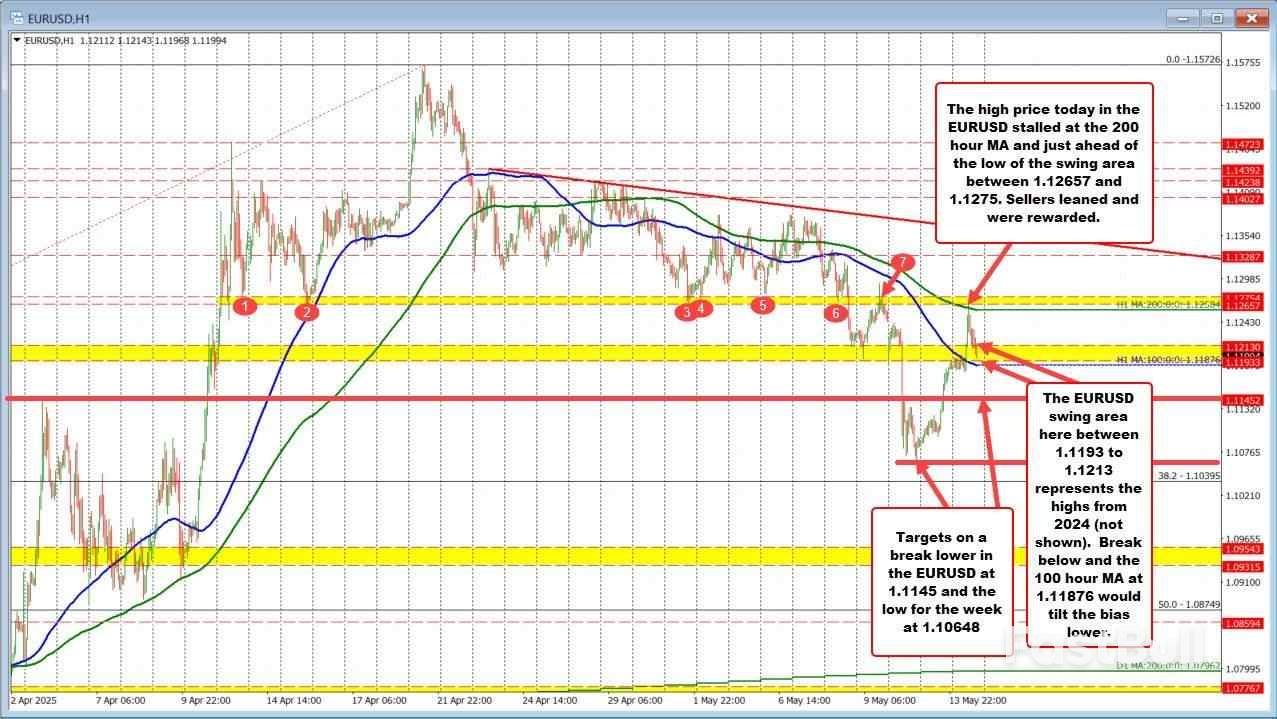
          EURUSD technicals

          EURUSD failed to sustain earlier gains as price action today stalled just ahead of the 200-hour moving average (green line on the chart above) and the lower boundary of a key swing zone between 1.12657 and 1.1275. Sellers leaned into the level and have since pushed the pair back toward the 100-hour moving averages.

          The current focus is on the swing area between 1.1193 and 1.1213, which previously marked key highs from 2024 (not shown). A confirmed break below this zone - and the 100 hour MA at 1.11876 - would be technically significant and likely accelerate selling momentum.

          On the downside, immediate targets include the 1.1145 support area followed by the weekly low near 1.10648. These levels could attract additional sellers if the current pressure persists. To shift momentum back to the upside, EURUSD would need to reclaim 1.1213 and the 200 hour MA (and stay above) at 1.12578.

          Key technical levels:

          ● Resistance: 1.1213, 200-hour MA at 1.12578, 1.12657–1.1275 (swing area)

          ● Support: 1.1193–1.1213 (swing zone), 1.11876 (100-hour MA), 1.1145, 1.10648

          ● Bias: Bearish below 1.1213; intensifies under 1.11876

          The sellers remain in control as long as price stays capped below 1.1213. Watch for follow-through below key supports to confirm bearish continuation.

          Source: ForexLive

          Risk Warnings and Disclaimers
          You understand and acknowledge that there is a high degree of risk involved in trading. Following any strategies or investment methods may lead to potential losses. The content on the site is provided by our contributors and analysts for information purposes only. You are solely responsible for determining whether any trading assets, securities, strategy, or any other product is suitable for investing based on your own investment objectives and financial situation.
          Add to Favorites
          Share

          EIA Crude Oil Inventories Show Unexpected Increase, Indicating Weaker Demand

          Thomas

          Economic

          Commodity

          The Energy Information Administration (EIA) has reported a significant increase in its Crude Oil Inventories, pointing towards weaker demand for crude oil. The weekly change in the number of barrels of commercial crude oil held by US firms was recorded at 3.454 million barrels, an unexpected swing from the forecasted decrease of 2 million barrels.

          This recent data release reveals a stark contrast to the projected estimates. Analysts had predicted a decrease of 2 million barrels, based on various market factors and trends. However, the actual inventory numbers have defied these forecasts, indicating a potential shift in the market dynamics.

          When compared to the previous week’s data, the numbers also show a notable increase. The previous week saw a decrease of 2.032 million barrels, reflecting a stronger demand for crude oil. The sudden rise in the inventory this week, therefore, suggests a weakening demand, which could potentially impact crude prices in the bearish direction.

          The level of inventories significantly influences the price of petroleum products, which, in turn, can have an impact on inflation. An increase in crude inventories is generally considered bearish for crude prices as it implies weaker demand.

          Given the importance of the EIA Crude Oil Inventories data, this unexpected increase will likely be closely monitored by investors and market analysts. The implications of this shift could be wide-ranging, influencing not only crude prices but also impacting broader market trends and the inflation outlook.

          As the market continues to digest this unexpected data, the focus will now be on how this might influence the Federal Reserve’s approach to monetary policy, especially in the context of inflation concerns. The EIA’s next report will be eagerly awaited for further insights into the demand and supply dynamics of the crude oil market.

          Source: Investing

          To stay updated on all economic events of today, please check out our Economic calendar
          Risk Warnings and Disclaimers
          You understand and acknowledge that there is a high degree of risk involved in trading. Following any strategies or investment methods may lead to potential losses. The content on the site is provided by our contributors and analysts for information purposes only. You are solely responsible for determining whether any trading assets, securities, strategy, or any other product is suitable for investing based on your own investment objectives and financial situation.
          Add to Favorites
          Share

          Trump's Gulf Tour Sparks AI, Finance And Energy Deals

          Thomas

          Economic

          U.S. President Donald Trump secured a $600 billion commitment from Saudi Arabia to invest in the United States on the first day of a four-day tour of the Gulf, opening the way for a series of business deals.

          Here is an overview of major deals and announcements made on the sidelines of Trump's Gulf visit:

          * Saudi Aramco (2222.SE), opens new tab has signed 34 agreements with major U.S. companies, potentially worth as much as $90 billion, the oil giant said.

          * Qatar Airways signed a deal to purchase jets from U.S. manufacturer Boeing (BA.N), opens new tab.

          * Nvidia (NVDA.O), opens new tab said it will sell hundreds of thousands of AI chips in Saudi Arabia, with a first tranche of 18,000 of its newest "Blackwell" chips going to Humain, an AI startup the kingdom's sovereign wealth fund launched this week.

          * Qualcomm Inc (QCOM.O), opens new tab said it signed a memo of understanding to develop and build a data centre central processor.

          * Franklin Templeton (BEN.N), opens new tab said it has signed a non-binding memorandum of understanding with Saudi Arabia's Public Investment Fund to partner in investing up to $5 billion in the kingdom's financial markets.

          * Neuberger Berman signed an agreement with PIF to invest up to $6 billion in the kingdom, and to launch a Riyadh-based multi-asset investment management platform.

          * BlackRock Saudi Arabia (BLK.N), opens new tab and PIF signed a non-binding letter of intent at the Saudi-U.S. Investment Forum to formalise their strategic collaboration through potential new allocations to the BlackRock Riyadh Investment Management platform.

          * Cisco (CSCO.O), opens new tab said it will collaborate with the AI Infrastructure Partnership, which is led by BlackRock (BLK.N), opens new tab, Global Infrastructure Partners, MGX, Microsoft (MSFT.O), opens new tab, Nvidia and xAI.

          The company also said it will join Saudi Arabia's Humain and extend its strategic partnership with Abu Dhabi's G42 to advance AI innovation and infrastructure development.

          * Infrastructure investment manager I Squared Capital said it has signed a memorandum of understanding with PIF to establish a dedicated infrastructure investment strategy focused on the Middle East.

          * Amazon Web Services (AMZN.O), opens new tab and Saudi Arabia's AI startup Humain said they planned to invest $5 billion-plus in a strategic partnership to build an "AI Zone" in the kingdom.

          * U.S. chip firm AMD (AMD.O), opens new tab and Humain said they would build AI infrastructure that will lead them to invest up to $10 billion to deploy 500 megawatts of AI computing capacity over the next five years.

          * Saudi Arabian DataVolt plans to invest $20 billion in AI data centres and energy infrastructure in the United States.

          * Google (GOOGL.O), opens new tab , DataVolt, Oracle (ORCL.N), opens new tab, Salesforce (CRM.N), opens new tab, AMD (AMD.O), opens new tab, and Uber (UBER.N), opens new tab say they will invest $80 billion in technologies in both countries.

          * Construction consulting firms Hill International, Jacobs, Parsons, and AECOM are building infrastructure projects such as King Salman International Airport, King Salman Park, The Vault, Qiddiya City, and more, totalling $2 billion in U.S. services exports.

          * Additional major exports include GE Vernova's (GEV.N), opens new tab gas turbines and energy solutions totalling $14.2 billion and Boeing 737-8 passenger aircraft for AviLease totalling $4.8 billion.

          * Healthcare firm Shamekh IV Solutions will be investing $5.8 billion, including a plant in Michigan to launch a high-capacity IV fluid facility.

          * Hassana Investment Company and Franklin Templeton signed a memorandum of understanding valued at $150 million to explore a strategic partnership related to investments in Saudi private credit opportunities.

          * Saudi Aramco (2222.SE), opens new tab said it would sign memorandums of understanding with U.S. liquefied natural gas producer NextDecade (NEXT.O), opens new tab and utility Sempra (SRE.N), opens new tab.

          * U.S.-based investment platform Burkhan World Investments said it signed memorandums of understanding with Saudi partners, totalling $15 billion in investment commitments.

          Source: Reuters

          To stay updated on all economic events of today, please check out our Economic calendar
          Risk Warnings and Disclaimers
          You understand and acknowledge that there is a high degree of risk involved in trading. Following any strategies or investment methods may lead to potential losses. The content on the site is provided by our contributors and analysts for information purposes only. You are solely responsible for determining whether any trading assets, securities, strategy, or any other product is suitable for investing based on your own investment objectives and financial situation.
          Add to Favorites
          Share

          Fed Warns of Economic Shock Risk Despite US-China Trade Truce

          Gerik

          Economic

          China–U.S. Trade War

          Fed's Cautious Stance Amid Trade Uncertainty

          Federal Reserve (Fed) President for the Chicago branch, Austan D. Goolsbee, expressed cautious optimism regarding the recent reduction in trade tensions between the US and China. While the 90-day tariff reduction deal between the two nations offers temporary relief, Goolsbee warned that the risk of stagflation—where inflation rises alongside slow economic growth—remains a concern. Despite the easing of tensions, the overall tariff levels remain high, continuing to exert pressure on the economy.
          Goolsbee highlighted that the trade deal, which includes a reduction of US tariffs on Chinese imports from 145% to 30% and Chinese tariffs on US goods from 125% to 10%, only addresses part of the issue. While the temporary tariff reductions offer some respite, the high tariffs that remain could still lead to increased costs for consumers and slow growth.

          Tariffs and Uncertainty Impeding Economic Growth

          The ongoing tariff situation, coupled with the uncertainty surrounding President Trump’s broader trade policies, continues to hinder economic forecasts. With tariffs on goods from almost all of the US's trading partners still in place, economists estimate that American consumers are facing an effective tariff rate of around 15%. This uncertainty has already started to affect consumer sentiment, with surveys showing growing pessimism about the economic outlook and businesses pausing investments and hiring until there is greater clarity.
          Despite these challenges, Goolsbee emphasized that the labor market remains relatively stable, and the Fed is taking a cautious approach in its policy decisions. The central bank paused its interest rate cuts after January, following a series of reductions in 2024, and remains in wait-and-see mode to assess the impact of these policies.

          Fed's Focus on Inflation Risks

          The biggest concern for the Fed remains inflation. Goolsbee warned that if inflation expectations increase significantly or if the labor market worsens, the Fed may be forced to take action. He stressed that stagflation is a particularly difficult scenario for central banks to manage, as rising prices without corresponding growth can dampen both consumer spending and investment.
          With ongoing economic uncertainty, the Fed’s next steps will depend on the evolving impact of tariffs and trade policies. While there is room for optimism regarding the temporary relief from trade tensions, the lingering effects of high tariffs and market volatility mean the central bank must remain vigilant.

          Source: The Business Times

          To stay updated on all economic events of today, please check out our Economic calendar
          Risk Warnings and Disclaimers
          You understand and acknowledge that there is a high degree of risk involved in trading. Following any strategies or investment methods may lead to potential losses. The content on the site is provided by our contributors and analysts for information purposes only. You are solely responsible for determining whether any trading assets, securities, strategy, or any other product is suitable for investing based on your own investment objectives and financial situation.
          Add to Favorites
          Share

          Inflation Cools, Trump Heats Up

          Adam

          Economic

          The mood on Wall Street brightened this morning, if only slightly, as futures inched upward on a gentle tailwind of geopolitical détente and tamer-than-expected inflation figures. The S&P 500 futures edged up by 0.2 percent, the Dow Jones Industrial Average futures crept ahead by 0.1 percent, and Nasdaq futures matched the S&P’s modest advance.
          The latest reading from the Bureau of Labor Statistics offered a small but significant surprise: the Consumer Price Index rose by just 0.2 percent in April, following a rare 0.1 percent dip the previous month. Economists polled by Bloomberg had penciled in a slightly brisker 0.3 percent rise. In a market hypersensitive to the scent of inflation, even the subtlest cooling is perceived as good news.
          For markets, Mr Trump’s second presidency is beginning to look less like a disruption and more like a restoration. The financial tumult that followed his early executive orders has, for now, been absorbed. Wall Street is once again responding to a familiar Trumpian mix: bluster, chaos, and ultimately, pragmatism.
          Investors are learning to appreciate a version of Mr Trump who is still combative, but quicker to retreat when faced with economic realities. He may lack finesse, but his approach - direct, divisive, unapologetic - is effective. In an era where political consensus has withered, such a bulldozer style of governance is oddly reassuring. It gives the impression, however illusory, that someone is at the wheel - regardless of how many red lights are run or toes (and allies) are crushed in the process.
          This embrace is not without reservation. Bond markets remain uneasy. Treasury yields edged higher yesterday, despite April inflation data coming in slightly lower than expected. High interest rates continue to weigh on the economy. And America's yawning fiscal deficit remains unaddressed.
          Concerns about recession linger. In Bank of America’s latest survey of large fund managers, 26% still expect a US downturn - down from 42% in April, but hardly comforting. On Polymarket, a predictive platform that has at times outperformed traditional financial houses, the probability of a recession stands at 39%. That figure may not dominate headlines, but it reflects a persistent undercurrent of doubt.
          Meanwhile, Europe's markets have outpaced their American counterparts. The Stoxx Europe 600 is up 7% in 2025, still comfortably ahead of the S&P 500. German and Spanish indices, in particular, have performed well, each gaining 18% this year. But markets heavy in pharmaceuticals - such as Denmark, Belgium and Switzerland - have underperformed amid escalating White House rhetoric against high drug prices.
          Investors are also tilting back toward American tech giants and large-cap stocks, a shift that should benefit the big US indices in the months ahead.
          On the geopolitical front, Mr Trump is touring the Middle East, touting hundreds of billions of dollars in promised financial commitments from Gulf nations to the United States. Eyes are also on Turkey, where talks are scheduled Thursday to broker a ceasefire between Russia and Ukraine. Washington’s trade diplomacy is hitting friction elsewhere: China has voiced displeasure with the terms of the UK-US trade agreement, a reminder that America’s commercial assertiveness extends well beyond tariffs.
          Monetary policy remains in the spotlight. Several Federal Reserve officials are scheduled to speak today, including Christopher Waller, Philip Jefferson and Mary Daly later in the day. Their remarks will be parsed for clues on the path of interest rates.
          In Asia-Pacific, markets were mixed. European markets are relatively flat.

          source : marketscreener

          To stay updated on all economic events of today, please check out our Economic calendar
          Risk Warnings and Disclaimers
          You understand and acknowledge that there is a high degree of risk involved in trading. Following any strategies or investment methods may lead to potential losses. The content on the site is provided by our contributors and analysts for information purposes only. You are solely responsible for determining whether any trading assets, securities, strategy, or any other product is suitable for investing based on your own investment objectives and financial situation.
          Add to Favorites
          Share

          Russia's Financial Reserves Depleting, Military Plans at Risk

          Gerik

          Economic

          Russia-Ukraine Conflict

          Russia's Depleting Financial Reserves

          Russia is grappling with a severe financial crisis, as its liquidity reserves in the National Wealth Fund (NWF) have plummeted from $117 billion in 2021 to just $31 billion by November 2024. According to Swedish economist Anders Åslund, Russia could run out of these reserves by the fall of 2025. This situation poses a serious risk to Russia's military ambitions, as the country has heavily relied on its national wealth fund for defense spending in recent years.
          The Russian government’s defense budget for 2025 is set to reach a record high of $130.5 billion, an amount that could put immense pressure on the country’s financial resources. Åslund warns that when the reserves run out, it will be inevitable to cut the defense budget, potentially leading to economic controls reminiscent of the Soviet era.

          The Impact of Western Sanctions

          The rapid depletion of Russia’s reserves can be partially attributed to the sanctions imposed by the West, which have made it difficult for Russia to borrow from foreign nations. The country’s total foreign debt has significantly decreased over the last decade, dropping from $729 billion in 2023 to about $293 billion by September 2024.
          This limited capacity to fund its military efforts not only threatens Russia’s ability to maintain its war in Ukraine but also undermines its overall economy, which is already facing serious challenges. These challenges include rising inflation, a depreciating currency, and a severe labor shortage, which many economists warn could stunt Russia's long-term growth prospects.

          Economic Struggles Amid War Efforts

          Despite President Vladimir Putin’s assertions that Russia’s economy is strong and even "tempered" by Western sanctions, Åslund argues that the reality is different. Russia is edging closer to a state of "stagflation," where inflation is high but economic growth remains nearly stagnant.
          The economy’s deteriorating state is compounded by the difficulty in financing its military efforts. Many experts, including European economist Renaud Foucart, suggest that Russia may not have the financial means to win the war or even to sustain it in the long run.

          A Crisis Point for Russia’s Military and Economy

          With the war in Ukraine continuing into its fourth year, Russia's economy is at a breaking point. As its financial reserves dwindle, the country faces the risk of a severe economic crisis, compounded by a shrinking workforce and a weakening economy. The Kremlin's ability to continue its military campaign will largely depend on its financial resources, which are increasingly stretched thin. Some analysts predict that economic pressures may force Russia to end its conflict with Ukraine by 2025, as it struggles to maintain both its military and domestic economy.

          Source: Yahoo Finance

          To stay updated on all economic events of today, please check out our Economic calendar
          Risk Warnings and Disclaimers
          You understand and acknowledge that there is a high degree of risk involved in trading. Following any strategies or investment methods may lead to potential losses. The content on the site is provided by our contributors and analysts for information purposes only. You are solely responsible for determining whether any trading assets, securities, strategy, or any other product is suitable for investing based on your own investment objectives and financial situation.
          Add to Favorites
          Share

          Economic Crisis Looms in South Korea as Business Failures Surge and People Struggle with Debt

          Gerik

          Economic

          Rising Business Failures and Economic Slowdown in South Korea

          South Korea is facing alarming economic signals, with a growing number of business failures and a sharp decline in domestic demand. According to the Korea Development Institute (KDI), the country's economy is showing clear signs of recession, a stark contrast to previous years of growth. For the first time since February 2023, the term "economic recession" was included in KDI’s economic report.
          The construction industry, a key sector for foreign direct investment (FDI), has especially been hit hard, with many small and medium-sized construction companies unable to cope with the increasing economic challenges. Exports, particularly to the United States, have also seen significant reductions, reflecting the broader trade impacts and the downturn in global demand.
          KDI predicts that the economic slowdown will intensify, driven by global risks and the decline in FDI, which fell by 24% in the first four months of 2025. The country’s GDP growth for Q1 2025 was -0.246%, the lowest among 19 countries that have reported their growth rates.

          Record High Debt and Increasing Financial Strain

          South Korea’s total debt—across the government, businesses, and households—has reached a record high of 6,222 trillion won (approximately $4.27 trillion). This massive debt, equivalent to 247.2% of GDP, continues to weigh heavily on the economy. Household debt, in particular, has been growing rapidly, with the debt-to-GDP ratio for households standing at 91%, significantly higher than the average of 68.9% in other developed economies.
          The central bank has lowered interest rates twice to 3%, but the relief has not been felt by households, as banks have not yet reduced lending rates for consumers. This ongoing financial strain is reducing household purchasing power and driving up the cost of living, with many households turning to more extreme measures to manage their finances.

          Consumer Behavior Shifts Amid Rising Costs

          As inflation and debt continue to mount, South Korean consumers are adjusting their spending habits. Traditional celebrations such as Family Day have seen people opting for cheaper alternatives, such as buying second-hand flowers or discounted food items nearing expiration. Platforms like Danggeun Market and Lucky Meal are gaining popularity, as consumers seek to save on everyday expenses by purchasing second-hand goods or discounted meals.
          These shifts are reflective of the broader trend of consumers tightening their belts amid economic uncertainty. Retailers are reporting increased demand for second-hand items, especially toys and gifts, as people look for ways to make ends meet without compromising on social traditions.

          The Strain on Businesses and Rising Prices

          As consumer spending falters, businesses, particularly small and medium enterprises (SMEs), are struggling to keep up with rising costs. The price of food and basic goods continues to rise, adding to the financial burden of the population. Convenience store chains like CU are raising the prices of everyday items such as lunch boxes, with prices now exceeding expectations for the average consumer.
          The Consumer Protection Agency of South Korea has reported that food prices at retail stores and restaurants have been rising consistently. Suppliers are struggling to absorb the increasing costs of raw materials, forcing them to pass the burden onto consumers.

          A Struggling Economy and the Need for Reform

          South Korea's economic situation paints a grim picture, with rising debts, business closures, and an overall contraction in economic activity. While some sectors like housing, automobiles, and renewable energy are seeing growth, the broader economic landscape remains uncertain.
          With household debt and inflation reaching unsustainable levels, South Korea faces the daunting challenge of stabilizing its economy. Experts suggest that the government must focus on structural reforms, particularly in the real estate and construction sectors, to address the deepening crisis. As businesses and households adjust to new economic realities, the nation’s ability to rebound will depend on effective policy interventions and international cooperation to navigate the global economic challenges ahead.
          To stay updated on all economic events of today, please check out our Economic calendar
          Risk Warnings and Disclaimers
          You understand and acknowledge that there is a high degree of risk involved in trading. Following any strategies or investment methods may lead to potential losses. The content on the site is provided by our contributors and analysts for information purposes only. You are solely responsible for determining whether any trading assets, securities, strategy, or any other product is suitable for investing based on your own investment objectives and financial situation.
          Add to Favorites
          Share
          FastBull
          Copyright © 2025 FastBull Ltd

          728 RM B 7/F GEE LOK IND BLDG NO 34 HUNG TO RD KWUN TONG KLN HONG KONG

          TelegramInstagramTwitterfacebooklinkedin
          App Store Google Play Google Play
          Products
          Charts

          Chats

          Q&A with Experts
          Screeners
          Economic Calendar
          Data
          Tools
          Membership
          Features
          Function
          Markets
          Copy Trading
          Latest Signals
          Contests
          News
          Analysis
          24/7
          Columns
          Education
          Company
          Careers
          About Us
          Contact Us
          Advertising
          Help Center
          Feedback
          User Agreement
          Privacy Policy
          Business

          White Label

          Data API

          Web Plug-ins

          Poster Maker

          Affiliate Program

          Risk Disclosure

          The risk of loss in trading financial instruments such as stocks, FX, commodities, futures, bonds, ETFs and crypto can be substantial. You may sustain a total loss of the funds that you deposit with your broker. Therefore, you should carefully consider whether such trading is suitable for you in light of your circumstances and financial resources.

          No decision to invest should be made without thoroughly conducting due diligence by yourself or consulting with your financial advisors. Our web content might not suit you since we don't know your financial conditions and investment needs. Our financial information might have latency or contain inaccuracy, so you should be fully responsible for any of your trading and investment decisions. The company will not be responsible for your capital loss.

          Without getting permission from the website, you are not allowed to copy the website's graphics, texts, or trademarks. Intellectual property rights in the content or data incorporated into this website belong to its providers and exchange merchants.

          Not Logged In

          Log in to access more features

          FastBull Membership

          Not yet

          Purchase

          Become a signal provider
          Help Center
          Customer Service
          Dark Mode
          Price Up/Down Colors

          Log In

          Sign Up

          Position
          Layout
          Fullscreen
          Default to Chart
          The chart page opens by default when you visit fastbull.com
