• Trade
  • Markets
  • Copy
  • Contests
  • News
  • 24/7
  • Calendar
  • Q&A
  • Chats
Trending
Screeners
SYMBOL
LAST
BID
ASK
HIGH
LOW
NET CHG.
%CHG.
SPREAD
SPX
S&P 500 Index
6870.39
6870.39
6870.39
6895.79
6858.28
+13.27
+ 0.19%
--
DJI
Dow Jones Industrial Average
47954.98
47954.98
47954.98
48133.54
47871.51
+104.05
+ 0.22%
--
IXIC
NASDAQ Composite Index
23578.12
23578.12
23578.12
23680.03
23506.00
+72.99
+ 0.31%
--
USDX
US Dollar Index
98.880
98.960
98.880
98.960
98.730
-0.070
-0.07%
--
EURUSD
Euro / US Dollar
1.16519
1.16526
1.16519
1.16717
1.16341
+0.00093
+ 0.08%
--
GBPUSD
Pound Sterling / US Dollar
1.33277
1.33285
1.33277
1.33462
1.33136
-0.00035
-0.03%
--
XAUUSD
Gold / US Dollar
4207.63
4208.06
4207.63
4218.85
4190.61
+9.72
+ 0.23%
--
WTI
Light Sweet Crude Oil
59.378
59.408
59.378
60.084
59.291
-0.431
-0.72%
--

Community Accounts

Signal Accounts
--
Profit Accounts
--
Loss Accounts
--
View More

Become a signal provider

Sell trading signals to earn additional income

View More

Guide to Copy Trading

Get started with ease and confidence

View More

Signal Accounts for Members

All Signal Accounts

Best Return
  • Best Return
  • Best P/L
  • Best MDD
Past 1W
  • Past 1W
  • Past 1M
  • Past 1Y

All Contests

  • All
  • Trump Updates
  • Recommend
  • Stocks
  • Cryptocurrencies
  • Central Banks
  • Featured News
Top News Only
Share

Kremlin: India Buys Energy Where It Is Profitable To And As Far As We Understand They Will Continue To Do That

Share

Turkey's Main Banking Index Up 2.5%

Share

Turkey's Main BIST-100 Index Up 1.9%

Share

Hungary's Preliminary November Budget Balance Huf -403 Billion

Share

Indian Rupee Down 0.1% At 90.07 Per USA Dollar As Of 3:30 P.M. Ist, Previous Close 89.98

Share

India's Nifty 50 Index Provisionally Ends 0.96% Lower

Share

[JPMorgan: US Stock Rally May Stagnate Following Fed Rate Cut] JPMorgan Strategists Say The Recent Rally In US Stocks May Stall As Investors Take Profits Following The Anticipated Fed Rate Cut. The Market Currently Predicts A 92% Probability Of The Fed Lowering Borrowing Costs On Wednesday. Expectations Of A Rate Cut Have Continued To Rise, Fueled By Positive Signals From Policymakers In Recent Weeks. "Investors May Be More Inclined To Lock In Gains At The End Of The Year Rather Than Increase Directional Exposure," Mislav Matejka's Team Wrote In A Report

Share

Russian Defence Ministry: Russian Forces Take Control Of Novodanylivka In Ukraine's Zaporizhzhia Region

Share

Russian Defence Ministry: Russian Forces Take Control Of Chervone In Ukraine's Donetsk Region

Share

French Finance Ministry: Government Started Process To Block Temporarily Shein Platform

Share

Finance Minister: Indonesia To Impose Coal Export Tax Of Up To 5% Next Year

Share

[Trump Considering Fired Homeland Security Secretary Noem? White House Denies] According To Reports From US Media Outlets Such As The Daily Beast And The UK's Independent, The White House Has Denied Reports That US President Trump Is Considering Firing Homeland Security Secretary Noem. White House Spokesperson Abigail Jackson Posted On Social Media On The 7th Local Time, Calling The Claims "fake News" And Stating That "Secretary Noem Has Done An Excellent Job Implementing The President's Agenda And 'making America Safe Again'."

Share

HKEX: Standard Chartered Bought Back 571604 Total Shares On Other Exchanges For Gbp9.5 Million On Dec 5

Share

Morgan Stanley Reiterates Bullish Outlook On US Stocks Due To Fed Rate Cut Expectations. Morgan Stanley Strategists Believe That The US Stock Market Faces A "bullish Outlook" Given Improved Earnings Expectations And Anticipated Fed Rate Cuts. They Expect Strong Corporate Earnings By 2026, And Anticipate The Fed Will Cut Rates Based On Lagging Or Mildly Weak Labor Markets. They Expect The US Consumer Discretionary Sector And Small-cap Stocks To Continue To Outperform

Share

China's National Development And Reform Commission Announced That Starting From 24:00 On December 8, The Retail Price Limit For Gasoline And Diesel In China Will Be Reduced By 55 Yuan Per Ton, Which Translates To A Reduction Of 0.04 Yuan Per Liter For 92-octane Gasoline, 0.05 Yuan Per Liter For 95-octane Gasoline, And 0.05 Yuan Per Liter For 0# Diesel

Share

Tkms CEO: US Security Strategy Highlights Need For Europe To Take Care Of Its Own Defences

Share

USA S&P 500 E-Mini Futures Up 0.1%, NASDAQ 100 Futures Up 0.18%, Dow Futures Down 0.02%

Share

London Metal Exchange (LME): Copper Inventories Increased By 2,000 Tons, Aluminum Inventories Decreased By 2,500 Tons, Nickel Inventories Increased By 228 Tons, Zinc Inventories Increased By 2,375 Tons, Lead Inventories Decreased By 3,725 Tons, And Tin Inventories Decreased By 10 Tons

Share

Swiss Sight Deposits Of Domestic Banks At 440.519 Billion Sfr In Week Ending December 5 Versus 437.298 Billion Sfr A Week Earlier

Share

Czech November Jobless Rate 4.6% Versus Mkt Fcast 4.7%

TIME
ACT
FCST
PREV
France Industrial Output MoM (SA) (Oct)

A:--

F: --

P: --
France Trade Balance (SA) (Oct)

A:--

F: --

P: --
Euro Zone Employment YoY (SA) (Q3)

A:--

F: --

P: --
Canada Part-Time Employment (SA) (Nov)

A:--

F: --

P: --

Canada Unemployment Rate (SA) (Nov)

A:--

F: --

P: --

Canada Full-time Employment (SA) (Nov)

A:--

F: --

P: --

Canada Labor Force Participation Rate (SA) (Nov)

A:--

F: --

P: --

Canada Employment (SA) (Nov)

A:--

F: --

P: --

U.S. PCE Price Index MoM (Sept)

A:--

F: --

P: --

U.S. Personal Income MoM (Sept)

A:--

F: --

P: --

U.S. Core PCE Price Index MoM (Sept)

A:--

F: --

P: --

U.S. PCE Price Index YoY (SA) (Sept)

A:--

F: --

P: --

U.S. Core PCE Price Index YoY (Sept)

A:--

F: --

P: --

U.S. Personal Outlays MoM (SA) (Sept)

A:--

F: --

P: --
U.S. 5-10 Year-Ahead Inflation Expectations (Dec)

A:--

F: --

P: --

U.S. Real Personal Consumption Expenditures MoM (Sept)

A:--

F: --

P: --
U.S. Weekly Total Rig Count

A:--

F: --

P: --

U.S. Weekly Total Oil Rig Count

A:--

F: --

P: --

U.S. Consumer Credit (SA) (Oct)

A:--

F: --

P: --
China, Mainland Foreign Exchange Reserves (Nov)

A:--

F: --

P: --

Japan Trade Balance (Oct)

A:--

F: --

P: --

Japan Nominal GDP Revised QoQ (Q3)

A:--

F: --

P: --

China, Mainland Imports YoY (CNH) (Nov)

A:--

F: --

P: --

China, Mainland Exports (Nov)

A:--

F: --

P: --

China, Mainland Imports (CNH) (Nov)

A:--

F: --

P: --

China, Mainland Trade Balance (CNH) (Nov)

A:--

F: --

P: --

China, Mainland Exports YoY (USD) (Nov)

A:--

F: --

P: --

China, Mainland Imports YoY (USD) (Nov)

A:--

F: --

P: --

Germany Industrial Output MoM (SA) (Oct)

A:--

F: --

P: --
Euro Zone Sentix Investor Confidence Index (Dec)

A:--

F: --

P: --

Canada National Economic Confidence Index

--

F: --

P: --

U.K. BRC Like-For-Like Retail Sales YoY (Nov)

--

F: --

P: --

U.K. BRC Overall Retail Sales YoY (Nov)

--

F: --

P: --

Australia Overnight (Borrowing) Key Rate

--

F: --

P: --

RBA Rate Statement
RBA Press Conference
Germany Exports MoM (SA) (Oct)

--

F: --

P: --

U.S. NFIB Small Business Optimism Index (SA) (Nov)

--

F: --

P: --

Mexico 12-Month Inflation (CPI) (Nov)

--

F: --

P: --

Mexico Core CPI YoY (Nov)

--

F: --

P: --

Mexico PPI YoY (Nov)

--

F: --

P: --

U.S. Weekly Redbook Index YoY

--

F: --

P: --

U.S. JOLTS Job Openings (SA) (Oct)

--

F: --

P: --

China, Mainland M1 Money Supply YoY (Nov)

--

F: --

P: --

China, Mainland M0 Money Supply YoY (Nov)

--

F: --

P: --

China, Mainland M2 Money Supply YoY (Nov)

--

F: --

P: --

U.S. EIA Short-Term Crude Production Forecast For The Year (Dec)

--

F: --

P: --

U.S. EIA Natural Gas Production Forecast For The Next Year (Dec)

--

F: --

P: --

U.S. EIA Short-Term Crude Production Forecast For The Next Year (Dec)

--

F: --

P: --

EIA Monthly Short-Term Energy Outlook
U.S. API Weekly Gasoline Stocks

--

F: --

P: --

U.S. API Weekly Cushing Crude Oil Stocks

--

F: --

P: --

U.S. API Weekly Crude Oil Stocks

--

F: --

P: --

U.S. API Weekly Refined Oil Stocks

--

F: --

P: --

South Korea Unemployment Rate (SA) (Nov)

--

F: --

P: --

Japan Reuters Tankan Non-Manufacturers Index (Dec)

--

F: --

P: --

Japan Reuters Tankan Manufacturers Index (Dec)

--

F: --

P: --

Japan Domestic Enterprise Commodity Price Index MoM (Nov)

--

F: --

P: --

Japan Domestic Enterprise Commodity Price Index YoY (Nov)

--

F: --

P: --

China, Mainland PPI YoY (Nov)

--

F: --

P: --

Q&A with Experts
    • All
    • Chatrooms
    • Groups
    • Friends
    Connecting
    .
    .
    .
    Type here...
    Add Symbol or Code

      No matching data

      All
      Trump Updates
      Recommend
      Stocks
      Cryptocurrencies
      Central Banks
      Featured News
      • All
      • Russia-Ukraine Conflict
      • Middle East Flashpoint
      • All
      • Russia-Ukraine Conflict
      • Middle East Flashpoint
      Search
      Products

      Charts Free Forever

      Chats Q&A with Experts
      Screeners Economic Calendar Data Tools
      Membership Features
      Data Warehouse Market Trends Institutional Data Policy Rates Macro

      Market Trends

      Market Sentiment Order Book Forex Correlations

      Top Indicators

      Charts Free Forever
      Markets

      News

      News Analysis 24/7 Columns Education
      From Institutions From Analysts
      Topics Columnists

      Latest Views

      Latest Views

      Trending Topics

      Top Columnists

      Latest Update

      Signals

      Copy Rankings Latest Signals Become a signal provider AI Rating
      Contests
      Brokers

      Overview Brokers Assessment Rankings Regulators News Claims
      Broker listing Forex Brokers Comparison Tool Live Spread Comparison Scam
      Q&A Complaint Scam Alert Videos Tips to Detect Scam
      More

      Business
      Events
      Careers About Us Advertising Help Center

      White Label

      Data API

      Web Plug-ins

      Affiliate Program

      Awards Institution Evaluation IB Seminar Salon Event Exhibition
      Vietnam Thailand Singapore Dubai
      Fans Party Investment Sharing Session
      FastBull Summit BrokersView Expo
      Recent Searches
        Top Searches
          Markets
          News
          Analysis
          User
          24/7
          Economic Calendar
          Education
          Data
          • Names
          • Latest
          • Prev

          View All

          No data

          Scan to Download

          Faster Charts, Chat Faster!

          Download App
          English
          • English
          • Español
          • العربية
          • Bahasa Indonesia
          • Bahasa Melayu
          • Tiếng Việt
          • ภาษาไทย
          • Français
          • Italiano
          • Türkçe
          • Русский язык
          • 简中
          • 繁中
          Open Account
          Search
          Products
          Charts Free Forever
          Markets
          News
          Signals

          Copy Rankings Latest Signals Become a signal provider AI Rating
          Contests
          Brokers

          Overview Brokers Assessment Rankings Regulators News Claims
          Broker listing Forex Brokers Comparison Tool Live Spread Comparison Scam
          Q&A Complaint Scam Alert Videos Tips to Detect Scam
          More

          Business
          Events
          Careers About Us Advertising Help Center

          White Label

          Data API

          Web Plug-ins

          Affiliate Program

          Awards Institution Evaluation IB Seminar Salon Event Exhibition
          Vietnam Thailand Singapore Dubai
          Fans Party Investment Sharing Session
          FastBull Summit BrokersView Expo

          Europe’s Thoughtful AI Infrastructure Strategy Turns Constraints into Competitive Strength

          Gerik

          Economic

          Summary:

          Europe’s fragmented energy markets, regulatory complexity, and infrastructure delays may seem like obstacles in the AI race but analysts argue these very constraints could position the continent as a sustainable...

          Deliberate Design: Europe Turns Obstacles into Opportunity

          Often seen as trailing the U.S. and China in the AI race, Europe is carving out a different kind of edge one rooted in caution, scarcity, and sustainability. While the U.S. dominates hyperscale AI data center construction and foundational model training, European markets are drawing investor interest for a slower, more strategic build-out of data centers focused on AI inference and cloud computing.
          According to McKinsey, global data center capacity could double or triple by 2030, requiring up to $7 trillion in investment. While the U.S. will lead this expansion, Europe is expected to double its capacity at a “meaningful pace,” provided it can resolve key infrastructure bottlenecks.

          Power Access Defines Winners and Losers

          The biggest chokepoint for Europe is electricity. Grid congestion and high energy costs have created stark regional differences. Northern and Southern European countries with abundant renewable energy such as Sweden, Norway, and Spain are becoming attractive locations for data center development. Italy, with relatively short connection times, is also gaining momentum.
          In contrast, Germany, the U.K., Ireland, and the Netherlands are constrained by limited grid capacity or moratoriums on new connections, making them less viable for near-term investments. The discrepancy in power availability has reshaped the flow of capital away from the traditional FLAP-D markets (Frankfurt, London, Amsterdam, Paris, Dublin), toward less saturated locations with greater energy resilience.

          A Tightly Regulated Ecosystem Spurs Innovation

          Unlike the U.S., where deregulation has enabled rapid build-outs, Europe’s strict approval processes and transparency requirements around energy, water usage, and community impact are forcing a more thoughtful approach. In countries like Spain, developers must now also quantify the socio-economic impact of proposed data centers an unheard-of requirement in the U.S. This creates higher upfront friction, but could ultimately foster better integration with local communities and sustainable infrastructure use.
          Moreover, reforms are being introduced to improve the process. The U.K., for example, is shifting from a first-come-first-served grid connection policy to a “first ready, first connected” model, which prioritizes shovel-ready projects over speculative applications. These changes aim to discourage queue-hogging and accelerate critical developments.

          Inference, Not Training, Is Europe’s AI Sweet Spot

          Europe is unlikely to catch up with the U.S. in training foundational AI models, as the continent has relatively few such companies France’s Mistral being a rare example. Instead, it is positioning itself as a leader in AI inference the phase of AI deployment where trained models perform real-time processing.
          Inference demands high-density compute infrastructure, upgraded cooling systems, and fast connectivity all of which align well with existing cloud facilities. McKinsey forecasts that 70% of future AI workloads will be inference-based. European developers and fund managers see this as a compelling niche. Inference infrastructure is also more likely to be kept within national borders due to regulatory pushes for sovereign AI, especially with GDPR and other data localization policies gaining traction.

          Sovereign AI and Capital Discipline Shape Long-Term Outlook

          Investment strategies in Europe are shifting accordingly. Data center operators are now locking in 10–15-year contracts before construction begins, minimizing speculative builds and reducing the risk of stranded assets should AI growth moderate or change direction. The exception lies with newer “neo-cloud” providers, whose shorter contracts and unproven models carry higher risk but even here, debt financiers are becoming more comfortable, suggesting growing confidence in AI-related infrastructure.
          Europe’s energy-conscious and capital-disciplined ecosystem may provide more resilient long-term returns. Sites repurposed from deindustrialized zones where infrastructure is already in place offer another path forward, reducing both development costs and environmental impact.

          Scarcity Becomes Strategy in Europe’s AI Future

          Europe’s AI infrastructure trajectory is shaped not by speed but by sustainability, precision, and resilience. By embracing its constraints energy bottlenecks, tight regulation, and market fragmentation the region is developing high-quality, future-proofed data centers optimized for inference rather than training.
          This considered pace may insulate European markets from the risk of overbuilds and speculative bubbles now looming over faster-growing regions. And as sovereign AI policies gain momentum, Europe’s localized, modular data infrastructure could become not only viable but vital in a world where digital independence is becoming just as critical as innovation.
          To stay updated on all economic events of today, please check out our Economic calendar
          Risk Warnings and Disclaimers
          You understand and acknowledge that there is a high degree of risk involved in trading. Following any strategies or investment methods may lead to potential losses. The content on the site is provided by our contributors and analysts for information purposes only. You are solely responsible for determining whether any trading assets, securities, strategy, or any other product is suitable for investing based on your own investment objectives and financial situation.
          Add to Favorites
          Share

          China’s Cheap Auto Parts Flood Europe’s Biggest Car Market

          Alice Winters

          Stocks

          Economic

          Chinese automotive suppliers are inundating Germany with low-cost components, piling pressure on local manufacturers already grappling with muted demand and elevated costs, according to labor officials.

          The influx of electrical systems and forged metal parts is hitting companies including Robert Bosch GmbH, Mahle GmbH and PWO AG. The imbalance threatens local production, with China's industrial upgrades narrowing quality gaps that used to protect German firms.

          Chinese car parts are "pouring into the German market at incredible speed," said Andreas Bohnert, who chairs the works council at PWO, which makes steering columns and other precision-metal parts. "The pace at which these products are arriving — and, one has to admit, at a relatively good level of quality — shows that the Chinese have really done their homework."

          The squeeze on Germany's supplier base is part of a Chinese expansion that's rattling the country's industrial core. China, once a driver of sales and profit for German automakers, is increasingly becoming an equally capable rival. Imports of Chinese vehicles and components to Germany have surged since the pandemic, and the likes of BYD Co. and Contemporary Amperex Technology Co. Ltd. are dominating on EVs and the batteries needed to run them.

          The shift is reverberating through the supplier landscape. Company officials said the accelerating flow of low-cost Chinese inputs is squeezing margins, eroding order volumes and testing the resilience of a supply chain already strained by the transition to EVs and a protracted downturn in European car production. Several companies have started to cut output and jobs.

          Fresh data has reinforced the concerns. An analysis from the Cologne-based German Economic Institute last week identified sharp increases in Chinese imports across several component categories, including a near tripling of gearbox parts for combustion-engine vehicles.

          A survey released Thursday by European supplier association CLEPA found that nearly 70% of European parts makers now face direct competition from Chinese imports — a 12-percentage-point jump over the previous study from late March. The pressure is taking a toll, the group said, with a majority of suppliers expecting profitability to fall below the 5% minimum needed to sustain investment.

          "Without decisive measures, parts manufacturing in Europe risks disappearing, as companies are forced to relocate or shut down, jeopardizing employment and expertise," said Benjamin Krieger, CLEPA's secretary general.

          Some firms are already feeling the squeeze. At Mahle, general works council chairman Boris Schwürz said Chinese rivals are moving into product areas long dominated by German manufacturers. Some offers reaching automakers arrive at "prices that in certain cases are clearly below manufacturing cost," he said, adding that Volkswagen AG, BMW AG and Mercedes-Benz Group AG are buying the Chinese parts.

          Suppliers from the Asian country are now offering equivalent products "20% to 30% cheaper," according to Bosch labor representative Frank Sell. Europe may need to reconsider whether foreign manufacturers should be required to carry out part of their production within the region, he said.

          Source: Bloomberg Europe

          To stay updated on all economic events of today, please check out our Economic calendar
          Risk Warnings and Disclaimers
          You understand and acknowledge that there is a high degree of risk involved in trading. Following any strategies or investment methods may lead to potential losses. The content on the site is provided by our contributors and analysts for information purposes only. You are solely responsible for determining whether any trading assets, securities, strategy, or any other product is suitable for investing based on your own investment objectives and financial situation.
          Add to Favorites
          Share

          World Bank Economist Urges Malaysia to Cut Tariffs for All Trading Partners, Not Just US

          Michelle Reid

          Forex

          Economic

          A World Bank economist said on Thursday that Malaysia should reduce tariffs for all trading partners, not just major ones like the US, because selective cuts can distort trade and reduce overall welfare.

          Chief economist for East Asia and the Pacific Apurva Sanghi said non-discriminatory tariff cuts would make Malaysia's economy more open and efficient.

          "Tariff cuts are good, but if you are going to cut them, you need to cut them in a non-discriminatory fashion," he said at the National Economic Outlook Conference 2025 organised by Malaysian Institute of Economic Research (MIER). He added that preferential tariffs often benefit less efficient foreign producers, while hurting the country's overall welfare.

          Sanghi made the remarks during a presentation on global economic challenges, warning that slowing growth, weak investment, and rising debt make trade openness especially important for middle-income countries.

          He noted that Malaysia signed a Reciprocal Trade Agreement (ART) with the US in October, its third-largest trading partner, creating a delicate balance with its biggest trading partner, China. The deal has raised concerns that Malaysia might be forced to align with US sanctions, potentially affecting its neutral stance in the US-China rivalry.

          To illustrate the economic impact of selective tariffs, Sanghi presented a simple model: Malaysia imports only BYD from China and Tesla from the US, with no domestic cars. Prices before tariffs are US$20,000 for BYD and US$30,000 for Tesla, with a 100% tariff.

          With tariffs, BYD costs US$40,000, and Malaysia imports 50 units, generating US$1 million in government revenue.

          If tariffs are removed only for Tesla, it drops to US$30,000, and consumers switch to Tesla, saving money, but the government loses US$1 million, creating a net welfare loss.

          If tariffs are removed for all cars, BYD drops to US$20,000, generating US$1 million in consumer savings, offsetting the loss of revenue.

          "The net outcome is zero, which is better than the negative outcome under unilateral preferential treatment," Sanghi said. He emphasised that the example was about economic logic, not fairness or geopolitics. "Preferential treatment leads to both trade creation and trade diversion," he noted. "But when it is extended to a less efficient country, the negative impact of diversion outweighs the positive effect of trade creation."

          Earlier, Sanghi warned that the world economy faces slowing growth, stalling investment, and rising debt, with investment in low- and middle-income countries at its slowest in 30 years, and global policy uncertainty at record highs.

          Source: Theedgemarkets

          To stay updated on all economic events of today, please check out our Economic calendar
          Risk Warnings and Disclaimers
          You understand and acknowledge that there is a high degree of risk involved in trading. Following any strategies or investment methods may lead to potential losses. The content on the site is provided by our contributors and analysts for information purposes only. You are solely responsible for determining whether any trading assets, securities, strategy, or any other product is suitable for investing based on your own investment objectives and financial situation.
          Add to Favorites
          Share

          Hong Kong’s Deadliest Fire in Decades Sparks Corporate Solidarity and National Outcry

          Gerik

          Economic

          Corporate Giants Mobilize Rapidly in Response to Deadly Blaze

          In the aftermath of the devastating high-rise fire in Hong Kong’s Tai Po district, a wave of donations has poured in from China’s most powerful private-sector players. Alibaba Group and Ant Group jointly committed HK$30 million, with Alibaba founder Jack Ma separately pledging the same amount through his foundation. Other major contributors included Anta Group (HK$30 million), Tencent, Xiaomi, ByteDance, and NetEase, each pledging HK$10 million. The China Red Cross, along with automakers like BYD, Xpeng, and Geely, also offered support.
          This surge in corporate giving reflects both public pressure and the broader political climate. President Xi Jinping swiftly called for "all-out efforts" to reduce casualties and emphasized the importance of coordinated relief. In a political context increasingly focused on social accountability, these donations not only aid victims but signal alignment with Beijing’s expectations for socially responsible capitalism.

          Human Toll and Accountability in Focus

          The blaze, which erupted in Wang Fuk Court a dense eight-tower public housing estate sheltering over 4,600 residents has left at least 55 confirmed dead, with hundreds still missing. The scale and intensity of the disaster mark it as Hong Kong’s worst since the 1948 Shek Kip Mei fire. Firefighters struggled for nearly 24 hours to contain the blaze across seven blocks, ultimately stabilizing four towers while others continued to burn into Thursday morning.
          Preliminary investigations suggest the fire began on bamboo scaffolding, commonly used in Hong Kong construction, before spreading rapidly through wooden poles and protective netting. Authorities have arrested three individuals from the construction company responsible for the site, citing "gross negligence" and the use of flammable foam and plastic materials that likely failed to meet fire safety codes. They are now being investigated for manslaughter.
          This tragedy has brought Hong Kong’s construction and safety practices into sharp relief, particularly regarding outdated materials and oversight lapses in densely populated areas.

          Scrutiny Over Housing Safety and Regulatory Oversight

          The fire has ignited public criticism over building safety, particularly in public housing, where cost-saving practices often intersect with vulnerable populations. Officials face growing pressure to reevaluate not only the materials used in scaffolding and protective construction but also the regulatory framework overseeing such developments.
          The alleged use of substandard materials raises the question of whether current enforcement is adequate or if systemic weaknesses in inspection and compliance played a role. The public housing sector, already burdened by aging infrastructure and rising occupancy pressures, may now face a broader reckoning.

          Philanthropy Amid Political Realignment

          The scale of private-sector pledges reflects a deeper trend within China: the realignment of elite entrepreneurs with national policy directives. Figures like Lei Jun (Xiaomi), Zhang Yiming (ByteDance), and Wang Xing (Meituan) have in recent years launched philanthropic foundations or contributed billions to social causes, particularly in education, science, and welfare.
          While these acts are humanitarian in nature, they also serve a strategic function in China’s tightening regulatory environment. By echoing Xi Jinping’s vision of “common prosperity,” these firms are reinforcing their social license to operate and potentially shielding themselves from further scrutiny.

          A National Tragedy and Turning Point

          As the death toll rises and investigations continue, Hong Kong's fire disaster has exposed systemic gaps in urban construction practices and forced renewed focus on regulatory integrity. Meanwhile, the private sector’s rapid philanthropic response demonstrates a complex interplay between corporate citizenship, political alignment, and public expectation.
          This tragedy may serve as a turning point in both Hong Kong’s urban safety strategy and the broader redefinition of corporate responsibility across Greater China, as national leaders demand that profit be increasingly paired with purpose.

          Source: CNBC

          To stay updated on all economic events of today, please check out our Economic calendar
          Risk Warnings and Disclaimers
          You understand and acknowledge that there is a high degree of risk involved in trading. Following any strategies or investment methods may lead to potential losses. The content on the site is provided by our contributors and analysts for information purposes only. You are solely responsible for determining whether any trading assets, securities, strategy, or any other product is suitable for investing based on your own investment objectives and financial situation.
          Add to Favorites
          Share

          European Markets Open Cautiously as Investors Digest Global Optimism

          George Anderson

          Economic

          Stocks

          European Stocks Stall After Global Rally

          Following a strong pan-European performance the previous day where the Stoxx 600 gained nearly 1.1% Thursday’s early trading signals revealed a more hesitant tone. Germany’s DAX was projected to edge up 0.2%, France’s CAC 40 to rise by 0.1%, and Italy’s FTSE MIB to open slightly higher. In contrast, the UK’s FTSE index hovered marginally below the flatline, suggesting regional divergence in investor expectations.
          This pause follows a broader global upswing driven by increasing market confidence that the U.S. Federal Reserve will implement a rate cut in December. According to CME’s FedWatch tool, traders now price in an 84.9% chance of a quarter-point cut at the December 9–10 meeting. While this has supported Wall Street and buoyed Asia-Pacific markets, European traders appear to be taking a breather after pricing in much of the optimism.

          Lack of Domestic Catalysts Shifts Focus to U.S. and China

          The subdued open reflects a combination of cautious sentiment and limited domestic drivers. There were no major earnings reports scheduled for Thursday in Europe. Economic data releases such as Germany’s GfK consumer confidence and broader EU sentiment indicators are unlikely to shift market direction significantly unless they diverge meaningfully from forecasts.
          The absence of major local headlines pushes investor attention outward toward U.S. monetary policy and geopolitical developments like China’s industrial slowdown and ongoing trade uncertainties. These external conditions influence European equities both directly, through multinational corporate exposure, and indirectly, through currency and commodity markets.

          Speculation Around Puma Sparks Corporate Activity Interest

          Despite the broader market's quiet tone, individual names are attracting attention. Bloomberg reported that Chinese sportswear giant Anta Sports may be preparing a bid for Germany’s Puma, one of Europe’s key athletic brands. While Puma has declined to comment, this potential acquisition could rekindle interest in the consumer discretionary and retail sector, especially given the growing wave of outbound Chinese investment despite capital controls.
          Mergers and acquisitions often have a strong signaling effect in Europe’s fragmented corporate landscape, and any confirmation of interest from Anta may prompt revaluations across the sector.

          Wall Street and Asia Set the Tone, But Europe Decelerates

          Wall Street’s Wednesday rally marking its fourth consecutive day of gains has been a primary sentiment driver globally. The S&P 500, Dow, and Nasdaq each gained 0.7% to 0.8%, with technology and financial stocks leading the surge. Asian markets followed suit, with Japan’s Nikkei up 1% and South Korea’s Kospi rising 0.7%. India’s indices reached record highs, reflecting strong domestic investor appetite.
          However, Europe’s slower Thursday opening suggests the region is entering a phase of tactical recalibration. Investors may be awaiting clearer signals from both central banks and corporate earnings, particularly in the absence of concrete fiscal stimulus from European governments.
          While the global rally, fueled by Fed dovishness and improved earnings sentiment, continues to shape equity markets, Europe’s hesitant open reflects a more measured approach. Traders appear to be digesting gains and awaiting fresh catalysts, particularly data that might validate or challenge the current rate-cut narrative. Until then, European markets may remain range-bound, supported by global optimism but restrained by domestic uncertainties and structural inertia.

          Source: CNBC

          To stay updated on all economic events of today, please check out our Economic calendar
          Risk Warnings and Disclaimers
          You understand and acknowledge that there is a high degree of risk involved in trading. Following any strategies or investment methods may lead to potential losses. The content on the site is provided by our contributors and analysts for information purposes only. You are solely responsible for determining whether any trading assets, securities, strategy, or any other product is suitable for investing based on your own investment objectives and financial situation.
          Add to Favorites
          Share

          Is The Silver Price Preparing to Challenge Its Record High?

          FXOpen

          Commodity

          The United States is celebrating Thanksgiving, meaning trading activity across financial markets will be lower than usual today (and to some extent tomorrow). Yesterday, we noted a decline in volatility in the gold market.

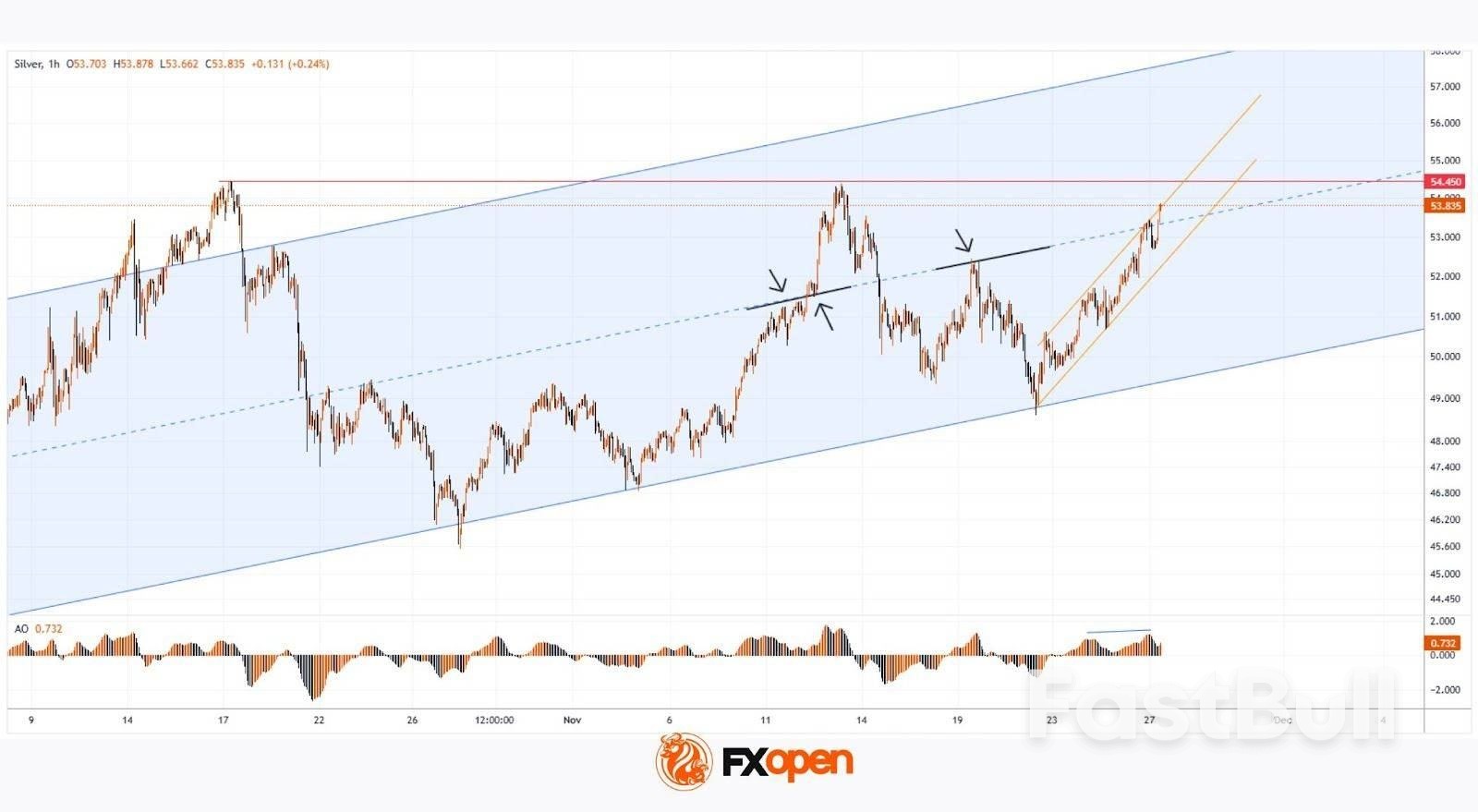
          Against this backdrop, the silver market is drawing attention – and may not allow traders to relax. As the XAG/USD chart shows, silver has risen by more than 7% since the start of the week.

          It is reasonable to assume that the holiday-induced drop in liquidity has opened the door to broader price movements. It is not impossible that we may soon see an attempt to break the all-time high (around $54.45 per ounce), which as of this morning lies roughly 1% away.

          Technical Analysis of XAG/USD

          Examining the XAG/USD chart, we can identify key swing points that allow us to outline an ascending channel. This week's strong advance has pushed silver into the upper half of that channel.

          The bulls' strength is reflected in:
          → the steep slope of the orange channel, within which we see impulsive bullish candles followed by brief corrections – a classic pattern of a strong market;
          → a higher peak on the Awesome Oscillator.

          Given this context, it is plausible that the median line could switch from resistance to support (as it has previously – shown by arrows), potentially helping the bulls gather the confidence needed to challenge the record high.

          Source: FXOpen

          Risk Warnings and Disclaimers
          You understand and acknowledge that there is a high degree of risk involved in trading. Following any strategies or investment methods may lead to potential losses. The content on the site is provided by our contributors and analysts for information purposes only. You are solely responsible for determining whether any trading assets, securities, strategy, or any other product is suitable for investing based on your own investment objectives and financial situation.
          Add to Favorites
          Share

          Chinese Tech Firms Shift AI Model Training Abroad to Circumvent U.S. Chip Restrictions

          Gerik

          Economic

          Chinese Tech Giants Turn to Southeast Asia for AI Advancement

          Facing increasingly stringent U.S. export restrictions on cutting-edge semiconductor technology, leading Chinese technology firms are reportedly shifting their AI model training operations overseas. According to a Financial Times report, companies like Alibaba and ByteDance have begun utilizing data centers in Southeast Asia to train their most recent large language models (LLMs) using Nvidia hardware specifically chips now restricted in sales to China.
          The move reflects an escalating workaround strategy by Chinese firms to maintain momentum in the highly competitive AI race, particularly in generative AI development. The Biden administration has introduced successive rounds of export controls targeting high-performance AI chips like Nvidia’s A100 and H100, widely considered critical to training sophisticated models. These restrictions, aimed at preventing China’s military and surveillance sectors from acquiring advanced computing capabilities, have unintentionally disrupted the commercial R&D pipelines of major private-sector firms as well.

          Strategic Implications for China’s AI Industry

          By outsourcing AI training tasks to offshore data centers outside U.S. jurisdiction especially in countries like Singapore, Malaysia, and Thailand Chinese companies are leveraging legal and logistical gray zones to circumvent domestic limitations. This strategy allows continued access to Nvidia’s high-powered GPUs, which remain indispensable for the computational requirements of training large-scale models, including those that rival OpenAI’s GPT or Google’s Gemini.
          This approach is not without risks. Outsourcing data-intensive operations to foreign infrastructure introduces concerns over data security, regulatory compliance, and strategic exposure. However, the shift also reflects the adaptability of Chinese tech firms as they face tightening access to core technology, especially from American and allied suppliers.

          Global AI Supply Chain Fragmentation Accelerates

          This development signals a further fragmentation of the global AI supply chain, with national security policies increasingly intersecting with commercial innovation. As Chinese firms deepen their reliance on offshore facilities for chip access, the traditional model of domestic end-to-end development becomes less viable. Meanwhile, it also underscores Southeast Asia’s emerging role as a regional AI infrastructure hub, potentially attracting increased investment from both Chinese and Western technology players seeking jurisdictional neutrality.
          The reported offshore training by Alibaba and ByteDance represents a tactical response to geopolitical technology constraints. While it allows continuity in AI development, it may also invite closer scrutiny from both U.S. and host-country regulators. More broadly, it reflects how technology firms are now compelled to recalibrate operations in response to the reshaping of global semiconductor and AI trade dynamics. As U.S.–China tech decoupling deepens, such maneuvers are likely to become more common, pushing the boundaries of innovation beyond conventional geopolitical borders.

          Source: Reuters

          To stay updated on all economic events of today, please check out our Economic calendar
          Risk Warnings and Disclaimers
          You understand and acknowledge that there is a high degree of risk involved in trading. Following any strategies or investment methods may lead to potential losses. The content on the site is provided by our contributors and analysts for information purposes only. You are solely responsible for determining whether any trading assets, securities, strategy, or any other product is suitable for investing based on your own investment objectives and financial situation.
          Add to Favorites
          Share
          FastBull
          Copyright © 2025 FastBull Ltd

          728 RM B 7/F GEE LOK IND BLDG NO 34 HUNG TO RD KWUN TONG KLN HONG KONG

          TelegramInstagramTwitterfacebooklinkedin
          App Store Google Play Google Play
          Products
          Charts

          Chats

          Q&A with Experts
          Screeners
          Economic Calendar
          Data
          Tools
          Membership
          Features
          Function
          Markets
          Copy Trading
          Latest Signals
          Contests
          News
          Analysis
          24/7
          Columns
          Education
          Company
          Careers
          About Us
          Contact Us
          Advertising
          Help Center
          Feedback
          User Agreement
          Privacy Policy
          Business

          White Label

          Data API

          Web Plug-ins

          Poster Maker

          Affiliate Program

          Risk Disclosure

          The risk of loss in trading financial instruments such as stocks, FX, commodities, futures, bonds, ETFs and crypto can be substantial. You may sustain a total loss of the funds that you deposit with your broker. Therefore, you should carefully consider whether such trading is suitable for you in light of your circumstances and financial resources.

          No decision to invest should be made without thoroughly conducting due diligence by yourself or consulting with your financial advisors. Our web content might not suit you since we don't know your financial conditions and investment needs. Our financial information might have latency or contain inaccuracy, so you should be fully responsible for any of your trading and investment decisions. The company will not be responsible for your capital loss.

          Without getting permission from the website, you are not allowed to copy the website's graphics, texts, or trademarks. Intellectual property rights in the content or data incorporated into this website belong to its providers and exchange merchants.

          Not Logged In

          Log in to access more features

          FastBull Membership

          Not yet

          Purchase

          Become a signal provider
          Help Center
          Customer Service
          Dark Mode
          Price Up/Down Colors

          Log In

          Sign Up

          Position
          Layout
          Fullscreen
          Default to Chart
          The chart page opens by default when you visit fastbull.com