• Trade
  • Markets
  • Copy
  • Contests
  • News
  • 24/7
  • Calendar
  • Q&A
  • Chats
Trending
Screeners
SYMBOL
LAST
BID
ASK
HIGH
LOW
NET CHG.
%CHG.
SPREAD
SPX
S&P 500 Index
6827.42
6827.42
6827.42
6899.86
6801.80
-73.58
-1.07%
--
DJI
Dow Jones Industrial Average
48458.04
48458.04
48458.04
48886.86
48334.10
-245.98
-0.51%
--
IXIC
NASDAQ Composite Index
23195.16
23195.16
23195.16
23554.89
23094.51
-398.69
-1.69%
--
USDX
US Dollar Index
97.910
97.990
97.910
98.070
97.890
-0.040
-0.04%
--
EURUSD
Euro / US Dollar
1.17404
1.17411
1.17404
1.17447
1.17262
+0.00010
+ 0.01%
--
GBPUSD
Pound Sterling / US Dollar
1.33799
1.33809
1.33799
1.33856
1.33546
+0.00092
+ 0.07%
--
XAUUSD
Gold / US Dollar
4345.66
4346.09
4345.66
4350.16
4294.68
+46.27
+ 1.08%
--
WTI
Light Sweet Crude Oil
57.342
57.372
57.342
57.601
57.194
+0.109
+ 0.19%
--

Community Accounts

Signal Accounts
--
Profit Accounts
--
Loss Accounts
--
View More

Become a signal provider

Sell trading signals to earn additional income

View More

Guide to Copy Trading

Get started with ease and confidence

View More

Signal Accounts for Members

All Signal Accounts

Best Return
  • Best Return
  • Best P/L
  • Best MDD
Past 1W
  • Past 1W
  • Past 1M
  • Past 1Y

All Contests

  • All
  • Trump Updates
  • Recommend
  • Stocks
  • Cryptocurrencies
  • Central Banks
  • Featured News
Top News Only
Share

Cronos Group Up 4%, Sndl Up 1.4%

Share

London Metal Exchange: Intends To Publish A Consultation On The Proposed Changes To Our Rules In Response To The Regime Early In2026

Share

London Metal Exchange: Announces Publication Of Update Describing How The London Metal Exchange Plans To Implement The Fca Policy Statement 25/1 On Commodity Reform

Share

USA - Listed Shares Of Gold Miners Rise Premarket After Gold Rises About 1%

Share

The Council Of The European Union: In Light Of The Situation In Venezuela, The Council Decided Today To Extend The Existing Restrictions For Another Year, Until 10 January 2027

Share

Ivory Coast 2025/26 Cocoa Arrivals Reached 894000 T By December 14 Versus 895000 T Year Ago - Exporters' Estimate

Share

Ishares MSCI Chile ETF Up 3.9% Premarket After Jose Antonio Kast Wins Chile's Presidential Election On Sunday

Share

Spain's Debt-To-GDP Ratio Falls To 103.2% In Third Quarter 2025

Share

China's Central Bank: Authorises DBS Bank As Yuan Clearing Bank In Singapore

Share

Bank Of Korea - South Korea Central Bank, Nps Agree To Extend Currency Swap Agreement For Another Year

Share

Poland's CPI At 0.1% Month-On-Month In November Versus 0.1% Released Earlier

Share

London Metal Exchange (LME): Copper Inventories Decreased By 25 Tons, Aluminum Inventories Decreased By 50 Tons, Nickel Inventories Increased By 360 Tons, Zinc Inventories Increased By 2,550 Tons, Lead Inventories Increased By 17,725 Tons, And Tin Inventories Increased By 125 Tons

Share

Polish Inflation At 2.5% Year-On-Year In November

Share

Poland's January-October Import Up 5.4% To 309.3 Billion Euros

Share

Poland's January-October Trade Balance At -5.1 Billion Euros

Share

Poland's January-October Export Up 2.8% To 304.3 Billion Euros

Share

Ceasefire Negotiations Between Ukraine And US Representatives In Berlin To Continue Monday Morning - German Source Familiar With The Schedule

Share

Spain's IBEX Hits Fresh Record High, Up Over 1%

Share

Spot Silver Rises Nearly 3% To $63.82/Oz

Share

France's Foreign Minister Says He Suggesd To EU's Kallas That US Representatives Brief EU Foreign Ministers On Gaza Peace Plan During Their Meeting

TIME
ACT
FCST
PREV
France HICP Final MoM (Nov)

A:--

F: --

P: --

China, Mainland Outstanding Loans Growth YoY (Nov)

A:--

F: --

P: --

China, Mainland M2 Money Supply YoY (Nov)

A:--

F: --

P: --

China, Mainland M0 Money Supply YoY (Nov)

A:--

F: --

P: --

China, Mainland M1 Money Supply YoY (Nov)

A:--

F: --

P: --

India CPI YoY (Nov)

A:--

F: --

P: --

India Deposit Gowth YoY

A:--

F: --

P: --

Brazil Services Growth YoY (Oct)

A:--

F: --

P: --

Mexico Industrial Output YoY (Oct)

A:--

F: --

P: --

Russia Trade Balance (Oct)

A:--

F: --

P: --

Philadelphia Fed President Henry Paulson delivers a speech
Canada Building Permits MoM (SA) (Oct)

A:--

F: --

P: --

Canada Wholesale Sales YoY (Oct)

A:--

F: --

P: --

Canada Wholesale Inventory MoM (Oct)

A:--

F: --

P: --

Canada Wholesale Inventory YoY (Oct)

A:--

F: --

P: --

Canada Wholesale Sales MoM (SA) (Oct)

A:--

F: --

P: --

Germany Current Account (Not SA) (Oct)

A:--

F: --

P: --

U.S. Weekly Total Rig Count

A:--

F: --

P: --

U.S. Weekly Total Oil Rig Count

A:--

F: --

P: --

Japan Tankan Small Manufacturing Outlook Index (Q4)

A:--

F: --

P: --

Japan Tankan Large Non-Manufacturing Diffusion Index (Q4)

A:--

F: --

P: --

Japan Tankan Large Non-Manufacturing Outlook Index (Q4)

A:--

F: --

P: --

Japan Tankan Large Manufacturing Outlook Index (Q4)

A:--

F: --

P: --

Japan Tankan Small Manufacturing Diffusion Index (Q4)

A:--

F: --

P: --

Japan Tankan Large Manufacturing Diffusion Index (Q4)

A:--

F: --

P: --

Japan Tankan Large-Enterprise Capital Expenditure YoY (Q4)

A:--

F: --

P: --

U.K. Rightmove House Price Index YoY (Dec)

A:--

F: --

P: --

China, Mainland Industrial Output YoY (YTD) (Nov)

A:--

F: --

P: --

China, Mainland Urban Area Unemployment Rate (Nov)

A:--

F: --

P: --

Saudi Arabia CPI YoY (Nov)

A:--

F: --

P: --

Euro Zone Industrial Output YoY (Oct)

--

F: --

P: --

Euro Zone Industrial Output MoM (Oct)

--

F: --

P: --

Canada Existing Home Sales MoM (Nov)

--

F: --

P: --

Euro Zone Total Reserve Assets (Nov)

--

F: --

P: --

U.K. Inflation Rate Expectations

--

F: --

P: --

Canada National Economic Confidence Index

--

F: --

P: --

Canada New Housing Starts (Nov)

--

F: --

P: --

U.S. NY Fed Manufacturing Employment Index (Dec)

--

F: --

P: --

U.S. NY Fed Manufacturing Index (Dec)

--

F: --

P: --

Canada Core CPI YoY (Nov)

--

F: --

P: --

Canada Manufacturing Unfilled Orders MoM (Oct)

--

F: --

P: --

U.S. NY Fed Manufacturing Prices Received Index (Dec)

--

F: --

P: --

U.S. NY Fed Manufacturing New Orders Index (Dec)

--

F: --

P: --

Canada Manufacturing New Orders MoM (Oct)

--

F: --

P: --

Canada Core CPI MoM (Nov)

--

F: --

P: --

Canada Trimmed CPI YoY (SA) (Nov)

--

F: --

P: --

Canada Manufacturing Inventory MoM (Oct)

--

F: --

P: --

Canada CPI YoY (Nov)

--

F: --

P: --

Canada CPI MoM (Nov)

--

F: --

P: --

Canada CPI YoY (SA) (Nov)

--

F: --

P: --

Canada Core CPI MoM (SA) (Nov)

--

F: --

P: --

Canada CPI MoM (SA) (Nov)

--

F: --

P: --

Federal Reserve Board Governor Milan delivered a speech
U.S. NAHB Housing Market Index (Dec)

--

F: --

P: --

Australia Composite PMI Prelim (Dec)

--

F: --

P: --

Australia Services PMI Prelim (Dec)

--

F: --

P: --

Australia Manufacturing PMI Prelim (Dec)

--

F: --

P: --

Japan Manufacturing PMI Prelim (SA) (Dec)

--

F: --

P: --

U.K. Unemployment Claimant Count (Nov)

--

F: --

P: --

U.K. Unemployment Rate (Nov)

--

F: --

P: --

U.K. 3-Month ILO Unemployment Rate (Oct)

--

F: --

P: --

Q&A with Experts
    • All
    • Chatrooms
    • Groups
    • Friends
    Connecting
    .
    .
    .
    Type here...
    Add Symbol or Code

      No matching data

      All
      Trump Updates
      Recommend
      Stocks
      Cryptocurrencies
      Central Banks
      Featured News
      • All
      • Russia-Ukraine Conflict
      • Middle East Flashpoint
      • All
      • Russia-Ukraine Conflict
      • Middle East Flashpoint
      Search
      Products

      Charts Free Forever

      Chats Q&A with Experts
      Screeners Economic Calendar Data Tools
      Membership Features
      Data Warehouse Market Trends Institutional Data Policy Rates Macro

      Market Trends

      Market Sentiment Order Book Forex Correlations

      Top Indicators

      Charts Free Forever
      Markets

      News

      News Analysis 24/7 Columns Education
      From Institutions From Analysts
      Topics Columnists

      Latest Views

      Latest Views

      Trending Topics

      Top Columnists

      Latest Update

      Signals

      Copy Rankings Latest Signals Become a signal provider AI Rating
      Contests
      Brokers

      Overview Brokers Assessment Rankings Regulators News Claims
      Broker listing Forex Brokers Comparison Tool Live Spread Comparison Scam
      Q&A Complaint Scam Alert Videos Tips to Detect Scam
      More

      Business
      Events
      Careers About Us Advertising Help Center

      White Label

      Data API

      Web Plug-ins

      Affiliate Program

      Awards Institution Evaluation IB Seminar Salon Event Exhibition
      Vietnam Thailand Singapore Dubai
      Fans Party Investment Sharing Session
      FastBull Summit BrokersView Expo
      Recent Searches
        Top Searches
          Markets
          News
          Analysis
          User
          24/7
          Economic Calendar
          Education
          Data
          • Names
          • Latest
          • Prev

          View All

          No data

          Scan to Download

          Faster Charts, Chat Faster!

          Download App
          English
          • English
          • Español
          • العربية
          • Bahasa Indonesia
          • Bahasa Melayu
          • Tiếng Việt
          • ภาษาไทย
          • Français
          • Italiano
          • Türkçe
          • Русский язык
          • 简中
          • 繁中
          Open Account
          Search
          Products
          Charts Free Forever
          Markets
          News
          Signals

          Copy Rankings Latest Signals Become a signal provider AI Rating
          Contests
          Brokers

          Overview Brokers Assessment Rankings Regulators News Claims
          Broker listing Forex Brokers Comparison Tool Live Spread Comparison Scam
          Q&A Complaint Scam Alert Videos Tips to Detect Scam
          More

          Business
          Events
          Careers About Us Advertising Help Center

          White Label

          Data API

          Web Plug-ins

          Affiliate Program

          Awards Institution Evaluation IB Seminar Salon Event Exhibition
          Vietnam Thailand Singapore Dubai
          Fans Party Investment Sharing Session
          FastBull Summit BrokersView Expo

          European Stocks Edge Higher After Tumultuous Week for Global Markets

          Warren Takunda

          Economic

          Stocks

          Summary:

          Concerns about an escalating trade war between the US and China still remain after US president Donald Trump imposed a 125% tariff on China, on top of existing 20% duties.
          European markets opened slightly higher on Friday morning as stocks attempted to claw back some gains at the end of a very volatile week rocked by changing tariff announcements.
          The UK's FTSE 100 index was 0.5% higher at around 9:45 CEST, whereas Germany’s DAX index was up 0.6%. France’s CAC 40 index advanced 0.8% too, with the STOXX 600 index rising 0.4%.
          British American Tobacco, HSBC and Barclays saw gains early Friday, while Getinge B and Zurich Insurance Group were some of the top losers.
          However, market anxieties remained, despite US president Donald Trump’s recent announcement of a 90-day pause in so-called ‘reciprocal’ tariffs. Investors remain nervous about the US’ outsized tariffs on China.

          Asia-Pacific markets overnight

          Asia-Pacific stocks lagged on Thursday, as investor concerns about further tariff retaliations from both the US and China remained.
          Japan’s benchmark Nikkei 225 closed almost 3% lower on Friday, at 33,585.58.
          China’s Shanghai Composite Index was trading 0.5% higher at market close on Friday at 3,238.23.
          Hong Kong’s Hang Seng index, meanwhile, showed gains of 1.6% at around 9:45am CEST on Friday.
          Australia’s S&P/ASX 200 dropped 0.8% to 7,646,50, while South Korea’s Kospi was down 0.5% on Friday.

          US markets-closing prices on Thursday

          US stocks closed in the red on Thursday, as investors worried about whether the escalating trade war between China and the US could potentially lead to an economic downturn.
          The S&P 500 closed 3.5% lower on Thursday, with the Nasdaq 100 index also losing 4.2%. The Dow Jones Industrial Average Index closed 2.5% lower on Thursday as well.
          Companies such as CarMax, United Airlines, Microchip and Monolithic saw the biggest falls, whereas Boeing, General Motors and Chevron experienced smaller losses.

          Commodities and currencies

          In commodities, US crude oil rose around 1% to $60.9 per barrel on Friday morning, with Brent crude oil also advanced 1.1% to $64.1 per barrel.
          On the other hand, gold was up over 1% on Friday morning, pulling back slightly from record highs. The precious metal also recorded a 5.5% gain on a weekly basis.
          The EUR/USD pair increased 1.4% on Friday morning, with the EUR/GBP pair rising 0.8% as well.

          Source: Euronews

          To stay updated on all economic events of today, please check out our Economic calendar
          Risk Warnings and Disclaimers
          You understand and acknowledge that there is a high degree of risk involved in trading. Following any strategies or investment methods may lead to potential losses. The content on the site is provided by our contributors and analysts for information purposes only. You are solely responsible for determining whether any trading assets, securities, strategy, or any other product is suitable for investing based on your own investment objectives and financial situation.
          Add to Favorites
          Share

          Euroviews: The Euro as a Safe Haven — Is It Here to Stay?

          Warren Takunda

          Economic

          Recent market trends indicate an increasing perception of the euro as a safe-haven currency, meaning it attracts capital in times of financial uncertainty or panic.
          While not always positive, being a safe haven currency has the potential to strengthen the role of the euro in the world economy.
          However, with the US dollar still dominating official foreign exchange reserves at 58% compared to the euro's 20%, the question is whether this trend can persist and become the status quo.
          In our view, it can – but not unconditionally, especially without a true Hamiltonian moment on European public debt.

          Europe should expand its domestic economy

          From a purely foreign exchange perspective, we expect the euro to appreciate to its fair value of approximately $1.15 per euro. Sustaining this level will depend on the European economy's ability to rebalance its growth model towards domestic demand and reduce its trade surplus.
          The European economy is heavily reliant on global trade, a trait deeply ingrained in its DNA as a project rooted in the principles of the Washington Consensus. If the US market were to close to imports, Europe would face intensified competition from China on its domestic market.
          Compared to Europe, China has competitive advantages in terms of production scale, energy costs, business regulation and technology. The risk of being overwhelmed by Chinese products unable to enter the US market is significant.
          To rebalance without abandoning its free trade ethos, Europe must significantly expand its domestic economy.
          This process is under way, driven partly by Germany's stimulus package, which is expected to have a substantial impact on other European economies. Additionally, increased defence spending across EU countries could further bolster economic growth.
          We estimate that the combined effects of Germany's stimulus and higher defence spending could add a quarter point to the European GDP in 2026 and even half a point in both 2027 and 2028. In a region where the long-term growth trend hovers around 1.2%, this is not to be sniffed at.
          These gradual changes are positive, especially since they are being implemented through a rules-based framework, which could enhance the euro's safe haven status. However, relying solely on fiscal stimulus may be insufficient due to the limited fiscal space provided by European budget rules and the small size of the EU budget, which we assume is likely to persist.
          To successfully rebalance its economy by boosting domestic demand without overburdening public debt, Europe should leverage its strengths in skills and savings, alongside its rules-based order. This calls for comprehensive reforms, starting with lowering internal trade barriers.

          Sustaining euro's rise requires more than just fiscal stimulus

          A recent IMF paper suggests that reducing internal trade barriers to levels similar to those between US states could increase Europe's GDP per capita by 7 points.
          This gain is twice the value of Europe's exports to the US and would help Europe regain scale within the single market.
          It will also be vital to deliver on the Savings and Investment Union (SIU). A recent OECD study indicates that higher market capitalisation can significantly lift GDP per capita, by about 2.5 points if market capitalisation increases by one standard deviation, equivalent to roughly 6% of GDP.
          This improvement in savings allocation could finance more innovation and help Europe regain its technological edge.
          While the euro's rise as a safe haven is promising, sustaining this trend requires more than just fiscal stimulus. It demands long-term structural reforms that enhance the efficiency of the single market and rebalance global capital attraction.
          By focusing on these areas, Europe can strengthen its economic model and solidify the international role of the euro.
          What is at stake is significant: an improved ability to absorb external shocks and enhanced independence from US monetary policy.

          Source: Euronews

          To stay updated on all economic events of today, please check out our Economic calendar
          Risk Warnings and Disclaimers
          You understand and acknowledge that there is a high degree of risk involved in trading. Following any strategies or investment methods may lead to potential losses. The content on the site is provided by our contributors and analysts for information purposes only. You are solely responsible for determining whether any trading assets, securities, strategy, or any other product is suitable for investing based on your own investment objectives and financial situation.
          Add to Favorites
          Share

          Pound to Euro Rate Headed for Largest Weekly Loss Since September 2022

          Warren Takunda

          Economic

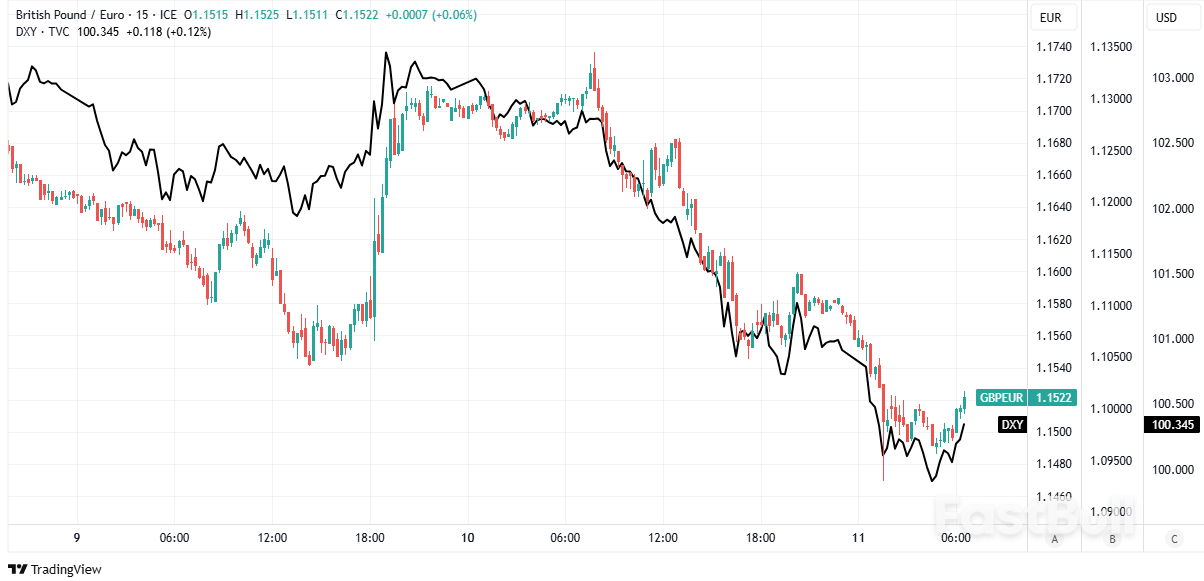
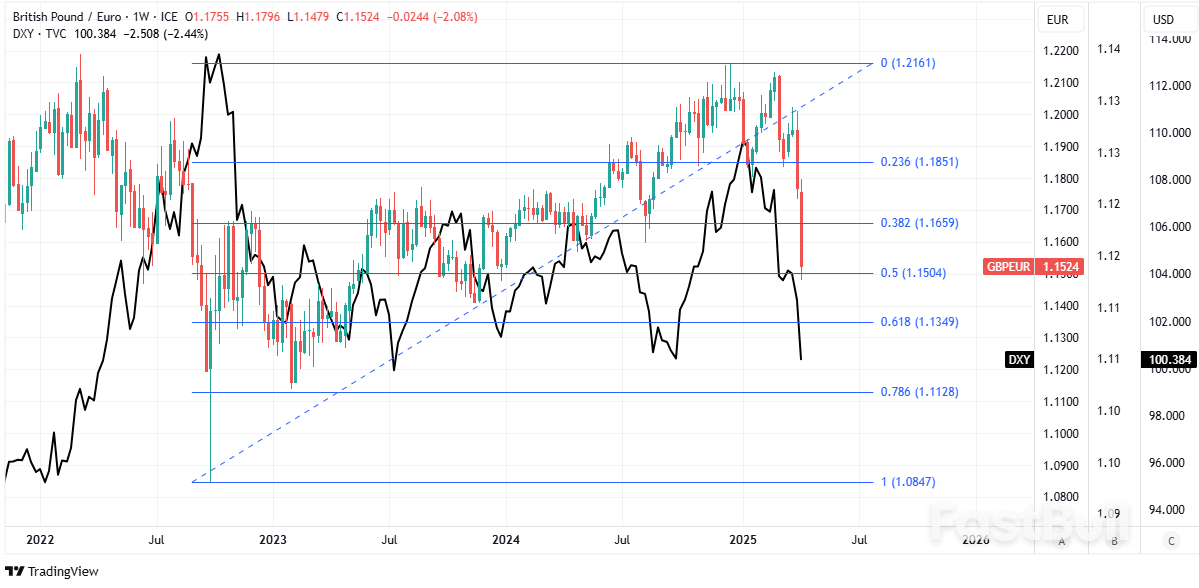
          The Pound to Euro exchange rate was on course for its largest weekly loss since September 2022 on Friday following a rout in US Dollar rates and a parabolic rally by the single currency, with GBP/EUR now appearing set to trade in a narrow 1.1489 to 1.1543 range through the session ahead.
          GBP/EUR fell as much as 0.83% in the Asia session overnight to reach lows at 1.1489 ahead of the London open, despite further intervening gains for GBP/EUR, with the slump resulting from a parabolic rally in a EUR/USD pair that rose as much as 1.5% to its highest since February 2022.
          “[The Dollar Index] fell by a further 0.9% during the Asian trading session and is currently just above 100pts,” says Kristina Clifton, an economist and strategist at Commonwealth Bank of Australia. “EUR and JPY have risen the most against the USD since President Trump announced the Liberation Day tariffs on 2 April.”
          The Pound to Euro rate's decline comes amid a rout in US Dollar rates, and in US stock markets, that has seen the currencies of current account surplus jurisdictions like the Euro Area, Switzerland and Japan surge by 2% or more against the greenback so far this week.

          Pound to Euro Rate Headed for Largest Weekly Loss Since September 2022_1Above: GBP/EUR at 15-minute intervals alongside US Dollar Index. Click for closer inspection.
          The unravelling is an apparent response to White House trade policy, which aims to reshore production of domestically-consumed goods.
          That can be expected to erode the profits and margins of corporate America in at least the short-to-medium term, which renders indefensible the stratospheric, if not outrageous valuations that have prevailed across the pond since at least the beginning of the first administration helmed by Donald Trump, if not even longer.
          The equity rout has acted as rocket fuel for the Euro, Swiss Franc and Japanese Yen, which has in turn exacerbated the ongoing declines in both the trade-weighted US Dollar and trade-weighted Renminbi, which fell far below Beijing’s floor for the currency in CHF/CNY, JPY/CNY and EUR/CNY previously on Thursday.
          “In his first term President Trump was understood to view rising equity markets as a sign of his success. However, this time around President Trump seems unconcerned about the sharp fall in equities that has occurred because of his tariff announcements,” CBA’s Clifton says.

          Pound to Euro Rate Headed for Largest Weekly Loss Since September 2022_2Above: GBP/EUR at weekly intervals with Fibonacci retracements of recovery from 2022 lows highlighting possible areas of support for Sterling, with US Dollar Index. Click for closer inspection.

          “Prime Minister Georgia Meloni will meet with President Trump next week to negotiate lower tariffs for the EU. If it looks like countries are able to negotiate substantially lower tariffs then the downside risks to the US economy will lessen, supporting USD and weighing on EUR/USD,” Clifton adds.
          The simultaneous sell-offs in US Dollar pairs and equity markets are mutually reinforcing and, together, they risk becoming self-perpetuating because as a rule of thumb, international equity investors rarely maintain anything more than partial hedges of their foreign exchange exposure.
          This means that when the Dollar declines, the value of US stock investments also declines, which magnifies the overall portfolio losses when markets fall and becomes a reason for some investors to sell stocks if the Dollar declines, and vice versa.
          However, there may also be mutual reinforcement between the declines of the trade-weighted Dollar and trade-weighted Renminbi because Beijing’s basket-based approach to its managed-float creates a correlation or quasi peg between the two.

          Source: Poundsterlinglive

          To stay updated on all economic events of today, please check out our Economic calendar
          Risk Warnings and Disclaimers
          You understand and acknowledge that there is a high degree of risk involved in trading. Following any strategies or investment methods may lead to potential losses. The content on the site is provided by our contributors and analysts for information purposes only. You are solely responsible for determining whether any trading assets, securities, strategy, or any other product is suitable for investing based on your own investment objectives and financial situation.
          Add to Favorites
          Share

          Dollar Extends Slump As China Hits Back On Tariffs: Markets Wrap

          Michelle

          Economic

          Forex

          The dollar extended losses after its biggest plunge in three years as China raised tariffs on all US goods, the latest salvo in the trade war that’s whipsawed markets this week.

          US stock futures and Europe’s Stoxx 600 equity benchmark turned lower. Havens such as the yen, Swiss franc and gold gained while the euro rose to its strongest in three years. The 10-year Treasury yield held above 4.4% after rising 50 basis points this week.

          China’s latest move came after President Donald Trump hiked US levies on the Asian nation even as he paused additional duties on some other trading partners. The greenback has become the latest victim of market turmoil as the trade war risks pushing the US into a recession, amid a broader exodus from US assets that’s raised questions about the haven status of Treasuries.

          “The main player of global trade just tore down the play-book and we don’t know what his endgame is,” said Olivier Baduel, head of European equities at OFI Invest AM in Paris. “We’re witnessing a loss of visibility and we are still in a phase of uncertainty.”

          Investors will look for guidance later Friday from executives at some of the biggest US banks which are due to report first-quarter earnings, including Wells Fargo & Co., JPMorgan Chase & Co. and Morgan Stanley. BlackRock Inc. is also reporting before the US open.

          The $7.5 trillion-a-day currency market has been on edge since Trump’s return to the White House and his on-again, off-again announcements on tariffs. The dollar gauge has lost more than 6% since its February peak and was down about 0.9% on Friday, on track for its biggest weekly decline since November 2022.

          An index of Asia-Pacific stocks was set for a third week of declines as market relief turned to angst after the White House clarified US tariffs on China rose to 145%. Shares in China and Hong Kong, however, rose on Friday on expectations the government will come out with more economic stimulus.

          The worsening tariffs spat is already affecting corporations. Audi has suspended deliveries to the US and the bigger-than-expected import tax has also prompted Japan’s Nintendo Co. to delay pre-orders for its long-awaited Switch 2 gaming console. From Ray-Bans to wigs, US buyers may see unexpected price rises.

          JPMorgan’s corporate clients are holding off on investment decisions because of uncertainty around tariff policies, according to Max Neukirchen, the bank’s co-head of global payments.
          “The main player of global trade just tore down the play-book and we don’t know what his endgame is,” said Olivier Baduel, head of European equities at OFI Invest AM in Paris. “We’re witnessing a loss of visibility and we are still in a phase of uncertainty.”
          An index of Asia-Pacific stocks was set for a third week of declines as market relief turned to angst after the White House clarified US tariffs on China rose to 145%. Shares in China and Hong Kong, however, rose on Friday on expectations the government will come out with more economic stimulus.
          In commodities, oil is on track for a second weekly loss. Copper extended a rebound from its lowest close in 11 months. Aluminum, zinc and nickel all rose, while iron ore futures were little changed in Singapore.

          Source: Yahoo Finance

          To stay updated on all economic events of today, please check out our Economic calendar
          Risk Warnings and Disclaimers
          You understand and acknowledge that there is a high degree of risk involved in trading. Following any strategies or investment methods may lead to potential losses. The content on the site is provided by our contributors and analysts for information purposes only. You are solely responsible for determining whether any trading assets, securities, strategy, or any other product is suitable for investing based on your own investment objectives and financial situation.
          Add to Favorites
          Share

          Bitcoin Price at Risk As Cooling CPI Data Fails to Offset Trump Tariff Concerns

          Glendon

          Cryptocurrency

          Bitcoin could keep sliding as cooler-than-expected U.S. inflation data has sparked fears that President Trump might go harder on tariffs, a move that could actually bring inflation back up in the long run.

          On Friday, Bitcoin (BTC) dropped below $80,000 and was still down about 1.6% over the last 24 hours at press time. This came even as the U.S. Consumer Price Index (CPI) for March showed inflation falling to 2.4%, down from 2.8% in February and slightly better than the 2.5% forecasted by analysts.

          The CPI, released monthly by the U.S. Bureau of Labor Statistics, is a key inflation gauge and influences the Federal Reserve’s monetary policy decisions. Normally, lower inflation reduces the need for rate hikes, which tends to benefit risk assets like crypto and stocks.

          However, despite the positive CPI reading, markets didn’t rally. The S&P 500 and Nasdaq both opened sharply lower and closed the day down 3.4% and 4.3%, respectively.

          The total crypto market cap has also dropped 2.8% in the past 24 hours, suggesting that broader concerns are overshadowing any relief from cooling inflation.

          Trump’s trade policies remain the key concern. On April 9, President Trump announced a 90-day pause on planned tariff hikes and introduced a 10% reciprocal tariff on most countries — but notably excluded China, where it raised tariffs on Chinese imports to a steep 125%, accusing Beijing of failing to respect global trade norms.

          The move briefly calmed markets, sending Bitcoin up over 7% to $82,000 as investors welcomed the temporary easing of trade tensions.

          However, that optimism quickly faded after China responded with 84% tariffs on U.S. goods starting April 10. This retaliation renewed fears of a prolonged U.S.-China trade war, which could weigh heavily on investor confidence, especially after the 90-day window ends.

          According to pundits at The Kobeissi Letter, the combination of a strong jobs report and cooling inflation may actually give Trump more political room to escalate tariffs further, potentially undoing the progress made on inflation.

          At the same time, the likelihood of the Federal Reserve cutting interest rates in the near term appears slim. CME Group’s FedWatch Tool points to an 81.5% chance the Fed will hold rates steady at its May 7 meeting. With no rate cuts expected until at least June, the macro backdrop remains uncertain for Bitcoin.

          Capital inflows into Bitcoin have also significantly slowed this year. Analytics platform Glassnode recently flagged that inflows have plunged over 90% from a peak of $100 billion to just around $6 billion. Typically, this is a sign that investor interest may be cooling due to the current uncertainty.
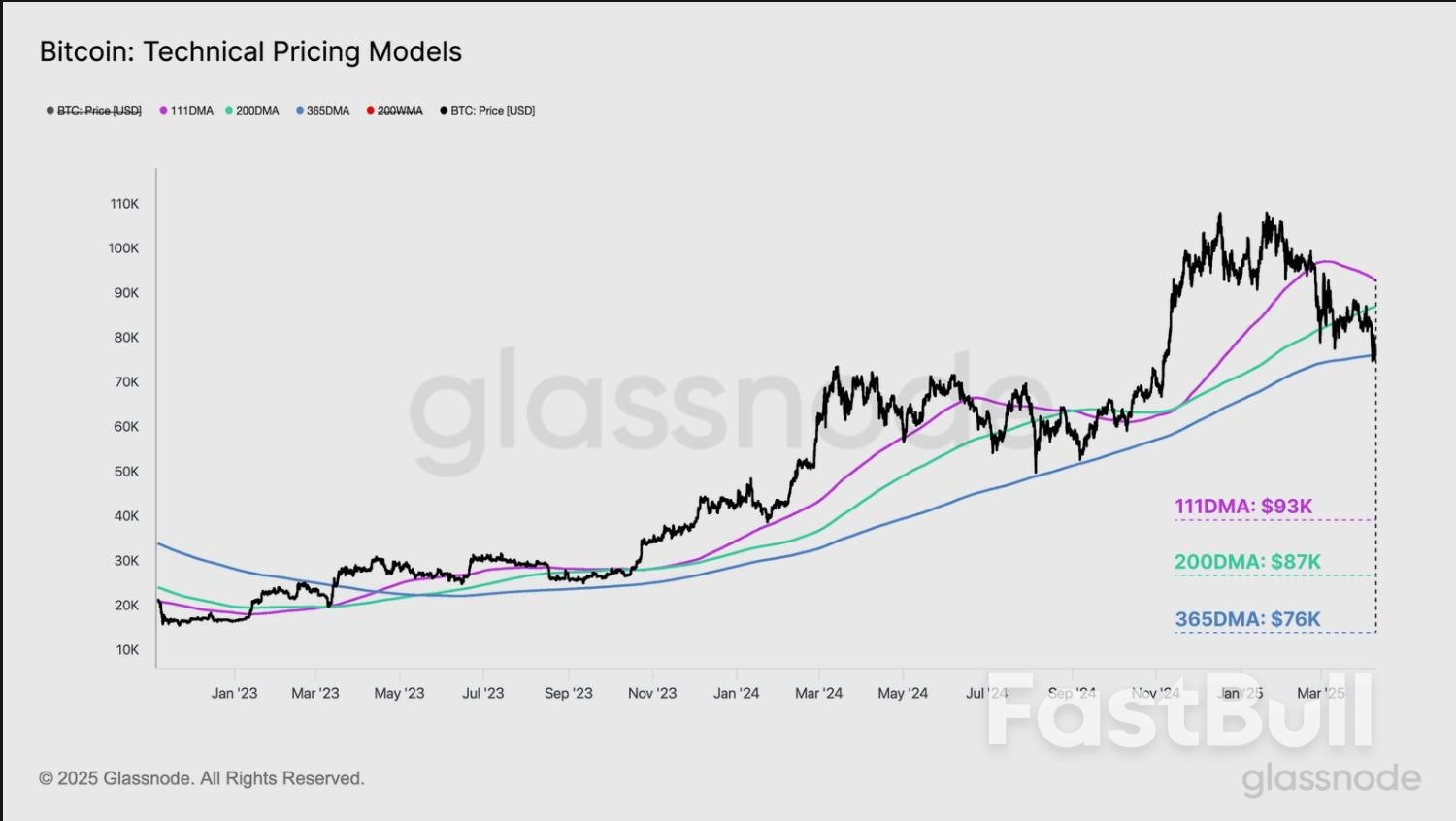
          Key Bitcoin Support and Resistance Levels | Source: Glassnode

          Technical indicators also point to a potential downside. If Bitcoin fails to hold the $80,000 level, Glassnode analysts warn it could revisit lower support zones, possibly the 356-day exponential moving average at $76k.

          The next key levels to watch below this price point are the active realized price at $71,000, and if things worsen, the true market mean near $65,000. These are major support zones where long-term holders usually step in. But if BTC loses this range, it could mean more downside ahead.

          Analysts remain hopeful

          Still, not everyone views Bitcoin’s recent pullback as a sign of weakness. Some analysts argue that Bitcoin is, in fact, holding up remarkably well in comparison to traditional markets.

          While Bitcoin’s seven-day realized volatility has doubled to 83%, it still remains significantly lower than the S&P 500’s, a development that hints at the asset’s potential evolution into a low-beta hedge against traditional equities. On a 30-day basis, Bitcoin appears notably less volatile than the S&P 500.

          Adding to that, some on-chain data suggests that bigger players are buying the dip.

          According to Santiment, 132 new “shark” wallets, those holding more than 10 BTC, have popped up in the last 24 hours.

          Data from CryptoQuant also shows that around 48,575 BTC, worth roughly $3.6 billion, has moved into accumulation wallets. It’s the biggest whale activity seen since 2022, which could mean that major holders are positioning themselves for a longer-term play, even as short-term uncertainty lingers.

          That said, while many are still on edge, others are starting to see signs of a potential recovery on the charts.

          According to Merlijn The Trader, Bitcoin just finished a double bottom pattern, which is a classic sign of a trend reversal. Now that it’s trading above $81k and has already bounced off the $79,900 level, a potential breakout could be on the horizon with upside targets around $86K..

          If BTC manages to post a weekly close above $86k, some analysts believe it could pave the way for bulls to target $94k.

          However, unless some form of resolution is reached between the U.S. and China, this tug-of-war over tariffs will likely keep dragging on markets.

          Source: CryptoSlate

          Risk Warnings and Disclaimers
          You understand and acknowledge that there is a high degree of risk involved in trading. Following any strategies or investment methods may lead to potential losses. The content on the site is provided by our contributors and analysts for information purposes only. You are solely responsible for determining whether any trading assets, securities, strategy, or any other product is suitable for investing based on your own investment objectives and financial situation.
          Add to Favorites
          Share

          China Raises Tariffs on US Goods to 125% as Xi Urges EU to Resist Trump ‘Bullying’

          Warren Takunda

          Economic

          China has raised its tariffs on US products to 125% in the latest salvo of the trade dispute with Washington, just hours after Xi Jinping said there were “no winners in a tariff war”.
          Xi made the comments during a meeting with the Spanish prime minister in which he invited the EU to work with China to resist “bullying”, part of an apparent campaign to shore up other trading partners.
          The Chinese commerce ministry announced on Friday that it was raising the 84% tariffs on all US imports to 125%, again saying that China was ready to “fight to the end”. The statement also suggested it may be Beijing’s last move in the tit-for-tat tariff raises as “at the current tariff level, there is no market acceptance for US goods exported to China”.
          “If the US continues to impose tariffs on Chinese goods exported to the US, China will ignore it,” it said, flagging that there were other countermeasures to come.
          Some markets continued to tumble on Friday, as the French president, Emmanuel Macron, described the US president’s 90-day tariff pause – which sets most tariffs at 10% until July – as “fragile”.
          Asian indices followed Wall Street lower on Friday, with Japan’s Nikkei down nearly 5% and Hong Kong stocks heading towards the biggest weekly decline since 2008. Oil prices were also expected to drop for a second consecutive week.
          Chinese officials have been canvassing other trading partners about how to deal with the US tariffs, after the country was excluded from Trump’s 90-day pause of the steepest global tariffs. Instead the US president made consecutive increases to duties on Chinese imports, which are now 145%.
          On Friday, Xi welcomed Spain’s Pedro Sánchez, after also talking to counterparts in Saudi Arabia and South Africa. According to the official Chinese summary of the talks, Xi said “there will be no winners in a tariff war, and going against the world will isolate oneself”, in an apparent reference to the US.
          “China and the EU should fulfil their international responsibilities, jointly maintain the trend of economic globalisation and the international trade environment, and jointly resist unilateral bullying, not only to safeguard their own legitimate rights and interests, but also to safeguard international fairness and justice, and to safeguard international rules and order,” the summary said Xi told Sánchez.
          Spain said Sánchez told Xi his country favoured a more balanced relationship between the EU and China based on negotiations to resolve differences and cooperation in areas of common interest.
          Xi plans to travel to south-east Asia, including Vietnam and Cambodia, next week.
          Macron wrote on X early on Friday that Trump’s partial tariff suspension, pausing new rates on various countries that would have risen as high as 50%, “sends out a signal and leaves the door open for talks. But this pause is a fragile one.”
          He added: “This 90-day pause means 90 days of uncertainty for all our businesses, on both sides of the Atlantic and beyond.”
          Battered financial markets were given a brief reprieve on Wednesday when Trump decided to pause duties on dozens of countries. However, his escalating trade dispute with China, the world’s second-largest economy, has continued to fuel fears of recession and further retaliation.
          The US treasury secretary, Scott Bessent, tried to assuage the fears of sceptics by telling a cabinet meeting on Thursday that more than 75 countries wanted to start trade negotiations, and Trump had expressed hope of a deal with China.
          But the uncertainty in the meantime extended some of the most volatile trading since the early days of the Covid-19 pandemic.
          The US’s S&P 500 index ended 3.5% lower on Thursday and was now down about 15% from its all-time peak in February. Some analysts believe stocks have further to fall owing to the uncertainty surrounding the US tariff policy.
          Bessent shrugged off the renewed market sell-off on Thursday and predicted that striking deals with other countries would bring more certainty.
          The US and Vietnam agreed to begin formal trade talks after Bessent spoke to the Vietnamese deputy prime minister, Ho Duc Phoc, the White House said.
          The south-east Asian manufacturing hub is prepared to crack down on Chinese goods being shipped to the US via its territory in the hope of avoiding tariffs, Reuters reported on Friday.
          Taiwan’s president said his government would also be among the first batch of trading partners to enter negotiations. Taiwan, listed for a 32% tariff, has offered zero tariffs as a basis for talks.
          Japan’s prime minister, Shigeru Ishiba, meanwhile, has set up a taskforce led by his close aide that hopes to visit Washington next week, according to local media.
          A man looks at digital boards at the Taiwan stock exchange in Tapei after Trump’s surprise decision to pause global tariffs. Photograph: Anadolu/Getty Images
          While Trump suddenly paused his “reciprocal” tariffs on other countries hours after they came into effect this week, he did not include China, instead increasing duties on Chinese imports as punishment for Beijing’s initial move to retaliate.
          Trump had imposed tariffs on Chinese goods of 145% since taking office, a White House official said.
          Meanwhile, Trump told reporters at the White House he thought the US could make a deal with China, but he reiterated his argument that Beijing had “really taken advantage” of the US for a long time.
          “I’m sure that we’ll be able to get along very well,” the US president said, referring to Xi. “In a true sense, he’s been a friend of mine for a long period of time, and I think that we’ll end up working out something that’s very good for both countries.”
          Xi and Trump are not known to have spoken since before Trump’s inauguration. Beijing has said it has no intention of backing down to what it terms as Trump’s “bullying” with the tariffs.
          “We will never sit idly by and watch while the legitimate rights and interests of the Chinese people are infringed, nor will we sit idly by as international economic and trade rules and the multilateral trading system are undermined,” the Chinese foreign ministry spokesperson, Lin Jian, said on Thursday.
          As well as retaliatory tariffs, Beijing has also restricted imports of Hollywood films, and put 18 US companies on trade restriction lists.
          The commerce ministry said China’s door was open to dialogue but this must be based on mutual respect.
          The US tariff pause also does not apply to duties paid by Canada and Mexico, whose goods are still subject to 25% fentanyl-related tariffs unless they comply with the US-Mexico-Canada trade agreement’s rules of origin.
          With trade hostilities persisting among the top three US trade partners, Goldman Sachs estimates the probability of a recession at 45%.
          Even with the rollback, the overall average import duty rate imposed by the US is the highest in more than a century, according to Yale University researchers.
          It also did little to soothe business leaders’ worries about the fallout from Trump’s trade dispute and its chaotic implementation: soaring costs, falling orders and snarled supply chains.
          One reprieve came, however, when the EU said it would pause its first counter-tariffs.

          Source: Theguardian

          To stay updated on all economic events of today, please check out our Economic calendar
          Risk Warnings and Disclaimers
          You understand and acknowledge that there is a high degree of risk involved in trading. Following any strategies or investment methods may lead to potential losses. The content on the site is provided by our contributors and analysts for information purposes only. You are solely responsible for determining whether any trading assets, securities, strategy, or any other product is suitable for investing based on your own investment objectives and financial situation.
          Add to Favorites
          Share

          Asian Shares Sink, With Japan’s Nikkei Down 5.6% as China-US Trade War Escalates

          Warren Takunda

          Economic

          Stocks

          Asian shares sank Friday after U.S. stocks gave up much of their historic gains from the day before.
          The deepening worries over President Donald Trump’s trade war initially helped pull Japan’s Nikkei 225 share index down 5.6%.
          By mid-morning in Tokyo, it was down 4.2% at 33,148.45.
          The yen surged against the U.S. dollar, which also lost value against the euro.
          One dollar bought 143.64 Japanese yen, down from about 146 yen a day earlier. The euro rose to $1.1306 from $1.1195.
          South Korea’s Kospi fell 1.3% to 2,413.16, while in Australia, the S&P/ASX 200 shed 1.2% to 7,619.70.
          In China markets, Hong Kong’s Hang Seng edged down 0.4% to 20,606.04 and Shanghai’s lost 0.2% to 3,218.94.
          Taiwan’s Taiex gained 1.5% as investors expect more orders would transfer to Taiwan under the worsening China-US trade war.
          China announced more countermeasures against the United States and losses for U.S. stocks accelerated after the White House clarified that the United States will tax Chinese imports at 145%, not the 125% rate that Trump had written about in his posting on Truth Social Wednesday, once other previously announced tariffs were included. The drop for the S&P 500 exceeded 6% at one point.
          China, meanwhile, has been seeking to join forces with other countries in apparent hopes of forming a united front against Trump. The world’s second-largest economy is also ramping up its own countermeasures to Trump’s tariffs.
          Investors are viewing Trump’s decision to delay higher tariffs for most countries for 90 days as a ploy, not a pivot, Stephen Innes of SPI Asset Management said in a commentary.
          “That’s the market hitting the brakes, hard. The sugar high from Trump’s tariff pause is fading fast, and Asia’s about to feel the comedown. The champagne’s flat, the party’s over and the tape is twitching,” he wrote.
          On Thursday, the S&P 500 tumbled 3.5% to 5,268.05, slicing into Wednesday’s surge of 9.5% following Trump’s decision to pause many of his tariffs worldwide. The Dow Jones Industrial Average dropped 2.5% to 39,593.66, and the Nasdaq composite tumbled 4.3% to 16,387.31.
          “Trump blinks,” UBS strategist Bhanu Baweja wrote in a report about the president’s decision on tariffs, “but the damage isn’t all undone.”
          The stock price of Warner Bros. Discovery, the company behind “A Minecraft Movie,” dropped 12.5% for one of Wall Street’s sharpest losses after China said Thursday it will “appropriately reduce the number of imported U.S. films.” The Walt Disney Co.’s stock sank 6.8%
          A spokesperson for the China Film Administration said it is “inevitable” that Chinese audiences would find American films less palatable given the “wrong move by the U.S. to wantonly implement tariffs on China.”
          That was after Trump and his Treasury secretary, Scott Bessent, sent a clear message to other countries Wednesday after announcing their pause on tariffs for most countries: “Do not retaliate, and you will be rewarded.”
          The European Union said Thursday it will put its trade retaliation measures on hold for 90 days and leave room for a negotiated solution.
          Thursday’s swings also hit the bond market, which has historically played the role of enforcer against politicians and economic policies it deemed imprudent. It helped topple the United Kingdom’s Liz Truss in 2022, for example, whose 49 days made her Britain’s shortest-serving prime minister.
          Earlier this week, big jumps for U.S. Treasury yields had rattled the market, so much that Trump said Wednesday he had been watching how investors were “getting a little queasy.”
          Several reasons could have been behind the sharp, sudden rise in yields. Hedge funds may have sold Treasurys in order to raise cash, and investors outside the United States may be dumping their U.S. government bonds because of the trade war. Regardless of the reasons behind it, higher Treasury yields crank up pressure on the stock market and push rates higher for mortgages and other loans for U.S. households and businesses.
          The 10-year Treasury yield had calmed following Trump’s U-turn on tariffs, dropping all the way back to 4.30% shortly after the release of a better-than-expected report on inflation Thursday morning. That’s after it had shot up to nearly 4.50% Wednesday morning from just 4.01% at the end of last week.
          As Thursday progressed, though, the 10-year Treasury yield climbed once again and reached 4.40%. It was trading at 4.39% early Friday.
          In other dealings early Friday, U.S. benchmark crude oil lost 37 cents to $59.70 per barrel in electronic trading on the New York Stock Exchange.
          Brent crude, the international standard, fell 30 cents to $63.03 per barrel.

          Source: AP

          To stay updated on all economic events of today, please check out our Economic calendar
          Risk Warnings and Disclaimers
          You understand and acknowledge that there is a high degree of risk involved in trading. Following any strategies or investment methods may lead to potential losses. The content on the site is provided by our contributors and analysts for information purposes only. You are solely responsible for determining whether any trading assets, securities, strategy, or any other product is suitable for investing based on your own investment objectives and financial situation.
          Add to Favorites
          Share
          FastBull
          Copyright © 2025 FastBull Ltd

          728 RM B 7/F GEE LOK IND BLDG NO 34 HUNG TO RD KWUN TONG KLN HONG KONG

          TelegramInstagramTwitterfacebooklinkedin
          App Store Google Play Google Play
          Products
          Charts

          Chats

          Q&A with Experts
          Screeners
          Economic Calendar
          Data
          Tools
          Membership
          Features
          Function
          Markets
          Copy Trading
          Latest Signals
          Contests
          News
          Analysis
          24/7
          Columns
          Education
          Company
          Careers
          About Us
          Contact Us
          Advertising
          Help Center
          Feedback
          User Agreement
          Privacy Policy
          Business

          White Label

          Data API

          Web Plug-ins

          Poster Maker

          Affiliate Program

          Risk Disclosure

          The risk of loss in trading financial instruments such as stocks, FX, commodities, futures, bonds, ETFs and crypto can be substantial. You may sustain a total loss of the funds that you deposit with your broker. Therefore, you should carefully consider whether such trading is suitable for you in light of your circumstances and financial resources.

          No decision to invest should be made without thoroughly conducting due diligence by yourself or consulting with your financial advisors. Our web content might not suit you since we don't know your financial conditions and investment needs. Our financial information might have latency or contain inaccuracy, so you should be fully responsible for any of your trading and investment decisions. The company will not be responsible for your capital loss.

          Without getting permission from the website, you are not allowed to copy the website's graphics, texts, or trademarks. Intellectual property rights in the content or data incorporated into this website belong to its providers and exchange merchants.

          Not Logged In

          Log in to access more features

          FastBull Membership

          Not yet

          Purchase

          Become a signal provider
          Help Center
          Customer Service
          Dark Mode
          Price Up/Down Colors

          Log In

          Sign Up

          Position
          Layout
          Fullscreen
          Default to Chart
          The chart page opens by default when you visit fastbull.com
