• Trade
  • Markets
  • Copy
  • Contests
  • News
  • 24/7
  • Calendar
  • Q&A
  • Chats
Trending
Screeners
SYMBOL
LAST
BID
ASK
HIGH
LOW
NET CHG.
%CHG.
SPREAD
SPX
S&P 500 Index
6835.74
6835.74
6835.74
6878.28
6827.18
-34.66
-0.50%
--
DJI
Dow Jones Industrial Average
47678.85
47678.85
47678.85
47971.51
47611.93
-276.13
-0.58%
--
IXIC
NASDAQ Composite Index
23505.01
23505.01
23505.01
23698.93
23455.05
-73.10
-0.31%
--
USDX
US Dollar Index
99.020
99.100
99.020
99.160
98.730
+0.070
+ 0.07%
--
EURUSD
Euro / US Dollar
1.16387
1.16394
1.16387
1.16717
1.16162
-0.00039
-0.03%
--
GBPUSD
Pound Sterling / US Dollar
1.33255
1.33266
1.33255
1.33462
1.33053
-0.00057
-0.04%
--
XAUUSD
Gold / US Dollar
4191.98
4192.42
4191.98
4218.85
4175.92
-5.93
-0.14%
--
WTI
Light Sweet Crude Oil
58.633
58.663
58.633
60.084
58.495
-1.176
-1.97%
--

Community Accounts

Signal Accounts
--
Profit Accounts
--
Loss Accounts
--
View More

Become a signal provider

Sell trading signals to earn additional income

View More

Guide to Copy Trading

Get started with ease and confidence

View More

Signal Accounts for Members

All Signal Accounts

Best Return
  • Best Return
  • Best P/L
  • Best MDD
Past 1W
  • Past 1W
  • Past 1M
  • Past 1Y

All Contests

  • All
  • Trump Updates
  • Recommend
  • Stocks
  • Cryptocurrencies
  • Central Banks
  • Featured News
Top News Only
Share

IMF: Review Pakistan Authorities To Draw The Equivalent Of About US$1 Billion

Share

President Trump Is Committed To The Continued Cessation Of Violence And Expects The Governments Of Cambodia And Thailand To Fully Honor Their Commitments To End This Conflict - Senior White House Official

Share

[Water Overflows From Spent Fuel Pool At Japanese Nuclear Facility] According To Japan's Nuclear Waste Management Company, Following A Strong Earthquake Off The Coast Of Aomori Prefecture Late On December 8th, Workers At The Nuclear Waste Treatment Plant In Rokkasho Village, Aomori Prefecture, Discovered "at Least 100 Liters Of Water" On The Ground Around The Spent Fuel Pool During An Inspection. Analysis Suggests This Water "may Have Overflowed Due To The Earthquake's Shaking." However, It Is Reported That The Overflowed Water "remains Inside The Building And Has Not Affected The External Environment."

Share

Trump Says Netflix, Paramount Are Not His Friends As Warner Bros Fight Heats Up

Share

On Monday (December 8), The ICE Dollar Index Rose 0.11% To 99.102 In Late New York Trading, Trading Between 98.794 And 99.227, Following A Significant Rally After The US Stock Market Opened. The Bloomberg Dollar Index Rose 0.12% To 1213.90, Trading Between 1210.34 And 1214.88

Share

Trump: Has Not Spoken To Kushner About Paramount Bid

Share

US President Trump: I Don’t Know Much About Paramount’s Hostile Takeover Bid For Warner Bros. Discovery

Share

Trump: I Want To Do What's Right

Share

Trump On Bids For Warner Bros: I'd Have To See Netflix, Paramount Percentages Of Market

Share

Trump On Vaccines: We Are Looking At A Lot Of Things

Share

Trump: EU Fine On X A “Nasty One”

Share

Trump: I Don't Want To Pay Insurance Companies, They Are Owned By Democrats

Share

Trump: On Healthcare, I Want The Money To Be Paid To The People

Share

US Treasury Secretary Bessenter: We Are Still Working Towards A Trade Agreement With India

Share

US Natural Gas Futures Drop 7% On Less Cold Forecasts, Near-Record Output

Share

[Trump: The US Will Not Experience Deflation] US President Trump Believes That US Inflation Will Decline Slightly Further, But There Will Be No Deflation

Share

Trump: We Will End Up Putting Severe Tariffs On Fertilizer From Canada If We Have To

Share

Bessent: We Are Still Working On India Trade Deal

Share

Brent Crude Futures Settle At $62.49/Bbl, Down $1.26, 1.98 Percent

Share

Trump: Farming Equipment Has Gotten Too Expensive

TIME
ACT
FCST
PREV
France Trade Balance (SA) (Oct)

A:--

F: --

P: --
Euro Zone Employment YoY (SA) (Q3)

A:--

F: --

P: --
Canada Part-Time Employment (SA) (Nov)

A:--

F: --

P: --

Canada Unemployment Rate (SA) (Nov)

A:--

F: --

P: --

Canada Full-time Employment (SA) (Nov)

A:--

F: --

P: --

Canada Labor Force Participation Rate (SA) (Nov)

A:--

F: --

P: --

Canada Employment (SA) (Nov)

A:--

F: --

P: --

U.S. PCE Price Index MoM (Sept)

A:--

F: --

P: --

U.S. Personal Income MoM (Sept)

A:--

F: --

P: --

U.S. Core PCE Price Index MoM (Sept)

A:--

F: --

P: --

U.S. PCE Price Index YoY (SA) (Sept)

A:--

F: --

P: --

U.S. Core PCE Price Index YoY (Sept)

A:--

F: --

P: --

U.S. Personal Outlays MoM (SA) (Sept)

A:--

F: --

P: --
U.S. 5-10 Year-Ahead Inflation Expectations (Dec)

A:--

F: --

P: --

U.S. Real Personal Consumption Expenditures MoM (Sept)

A:--

F: --

P: --
U.S. Weekly Total Rig Count

A:--

F: --

P: --

U.S. Weekly Total Oil Rig Count

A:--

F: --

P: --

U.S. Consumer Credit (SA) (Oct)

A:--

F: --

P: --
China, Mainland Foreign Exchange Reserves (Nov)

A:--

F: --

P: --

Japan Trade Balance (Oct)

A:--

F: --

P: --

Japan Nominal GDP Revised QoQ (Q3)

A:--

F: --

P: --

China, Mainland Imports YoY (CNH) (Nov)

A:--

F: --

P: --

China, Mainland Exports (Nov)

A:--

F: --

P: --

China, Mainland Imports (CNH) (Nov)

A:--

F: --

P: --

China, Mainland Trade Balance (CNH) (Nov)

A:--

F: --

P: --

China, Mainland Exports YoY (USD) (Nov)

A:--

F: --

P: --

China, Mainland Imports YoY (USD) (Nov)

A:--

F: --

P: --

Germany Industrial Output MoM (SA) (Oct)

A:--

F: --

P: --
Euro Zone Sentix Investor Confidence Index (Dec)

A:--

F: --

P: --

Canada National Economic Confidence Index

A:--

F: --

P: --

U.K. BRC Like-For-Like Retail Sales YoY (Nov)

--

F: --

P: --

U.K. BRC Overall Retail Sales YoY (Nov)

--

F: --

P: --

Australia Overnight (Borrowing) Key Rate

--

F: --

P: --

RBA Rate Statement
RBA Press Conference
Germany Exports MoM (SA) (Oct)

--

F: --

P: --

U.S. NFIB Small Business Optimism Index (SA) (Nov)

--

F: --

P: --

Mexico 12-Month Inflation (CPI) (Nov)

--

F: --

P: --

Mexico Core CPI YoY (Nov)

--

F: --

P: --

Mexico PPI YoY (Nov)

--

F: --

P: --

U.S. Weekly Redbook Index YoY

--

F: --

P: --

U.S. JOLTS Job Openings (SA) (Oct)

--

F: --

P: --

China, Mainland M1 Money Supply YoY (Nov)

--

F: --

P: --

China, Mainland M0 Money Supply YoY (Nov)

--

F: --

P: --

China, Mainland M2 Money Supply YoY (Nov)

--

F: --

P: --

U.S. EIA Short-Term Crude Production Forecast For The Year (Dec)

--

F: --

P: --

U.S. EIA Natural Gas Production Forecast For The Next Year (Dec)

--

F: --

P: --

U.S. EIA Short-Term Crude Production Forecast For The Next Year (Dec)

--

F: --

P: --

EIA Monthly Short-Term Energy Outlook
U.S. API Weekly Gasoline Stocks

--

F: --

P: --

U.S. API Weekly Cushing Crude Oil Stocks

--

F: --

P: --

U.S. API Weekly Crude Oil Stocks

--

F: --

P: --

U.S. API Weekly Refined Oil Stocks

--

F: --

P: --

South Korea Unemployment Rate (SA) (Nov)

--

F: --

P: --

Japan Reuters Tankan Non-Manufacturers Index (Dec)

--

F: --

P: --

Japan Reuters Tankan Manufacturers Index (Dec)

--

F: --

P: --

Japan Domestic Enterprise Commodity Price Index MoM (Nov)

--

F: --

P: --

Japan Domestic Enterprise Commodity Price Index YoY (Nov)

--

F: --

P: --

China, Mainland PPI YoY (Nov)

--

F: --

P: --

China, Mainland CPI MoM (Nov)

--

F: --

P: --

Italy Industrial Output YoY (SA) (Oct)

--

F: --

P: --

Q&A with Experts
    • All
    • Chatrooms
    • Groups
    • Friends
    Connecting
    .
    .
    .
    Type here...
    Add Symbol or Code

      No matching data

      All
      Trump Updates
      Recommend
      Stocks
      Cryptocurrencies
      Central Banks
      Featured News
      • All
      • Russia-Ukraine Conflict
      • Middle East Flashpoint
      • All
      • Russia-Ukraine Conflict
      • Middle East Flashpoint
      Search
      Products

      Charts Free Forever

      Chats Q&A with Experts
      Screeners Economic Calendar Data Tools
      Membership Features
      Data Warehouse Market Trends Institutional Data Policy Rates Macro

      Market Trends

      Market Sentiment Order Book Forex Correlations

      Top Indicators

      Charts Free Forever
      Markets

      News

      News Analysis 24/7 Columns Education
      From Institutions From Analysts
      Topics Columnists

      Latest Views

      Latest Views

      Trending Topics

      Top Columnists

      Latest Update

      Signals

      Copy Rankings Latest Signals Become a signal provider AI Rating
      Contests
      Brokers

      Overview Brokers Assessment Rankings Regulators News Claims
      Broker listing Forex Brokers Comparison Tool Live Spread Comparison Scam
      Q&A Complaint Scam Alert Videos Tips to Detect Scam
      More

      Business
      Events
      Careers About Us Advertising Help Center

      White Label

      Data API

      Web Plug-ins

      Affiliate Program

      Awards Institution Evaluation IB Seminar Salon Event Exhibition
      Vietnam Thailand Singapore Dubai
      Fans Party Investment Sharing Session
      FastBull Summit BrokersView Expo
      Recent Searches
        Top Searches
          Markets
          News
          Analysis
          User
          24/7
          Economic Calendar
          Education
          Data
          • Names
          • Latest
          • Prev

          View All

          No data

          Scan to Download

          Faster Charts, Chat Faster!

          Download App
          English
          • English
          • Español
          • العربية
          • Bahasa Indonesia
          • Bahasa Melayu
          • Tiếng Việt
          • ภาษาไทย
          • Français
          • Italiano
          • Türkçe
          • Русский язык
          • 简中
          • 繁中
          Open Account
          Search
          Products
          Charts Free Forever
          Markets
          News
          Signals

          Copy Rankings Latest Signals Become a signal provider AI Rating
          Contests
          Brokers

          Overview Brokers Assessment Rankings Regulators News Claims
          Broker listing Forex Brokers Comparison Tool Live Spread Comparison Scam
          Q&A Complaint Scam Alert Videos Tips to Detect Scam
          More

          Business
          Events
          Careers About Us Advertising Help Center

          White Label

          Data API

          Web Plug-ins

          Affiliate Program

          Awards Institution Evaluation IB Seminar Salon Event Exhibition
          Vietnam Thailand Singapore Dubai
          Fans Party Investment Sharing Session
          FastBull Summit BrokersView Expo

          Euro Zone Manufacturing Edges Toward Stability Despite Persistent Demand Weakness

          Gerik

          Economic

          Summary:

          Euro zone manufacturing continued its gradual recovery in April, with output rising at the fastest pace in over three years, though the sector overall remains in contraction due to sluggish new orders and export declines..

          Manufacturing Activity Nears Stabilization After Prolonged Weakness

          The latest PMI data for April reveals a cautiously improving picture for the euro zone’s manufacturing sector. While the headline HCOB euro zone manufacturing Purchasing Managers' Index (PMI) rose to 49.0—its highest level in nearly three years—it remains just below the critical 50 threshold that separates expansion from contraction. This marks the fourth consecutive month of improvement, signaling a tentative recovery in one of the bloc’s most important industrial segments.
          Economists were particularly surprised by the resilience of the sector, given persistent global uncertainties such as U.S. tariff volatility and weak global trade conditions. “This comes as a surprise given the many uncertainties and shocks of recent months,” commented Cyrus de la Rubia, Chief Economist at Hamburg Commercial Bank.

          Production Rebounds Despite Demand Headwinds

          The most notable recovery signal came from the output sub-index, which rose to 51.5—marking the second straight month of production growth and its highest level since March 2022. This uptick implies that, despite a continued contraction in demand, firms have ramped up output, possibly in anticipation of a broader rebound or due to modest restocking activity.
          New orders, while still in decline, showed the slowest rate of contraction in three years, reaching 49.5. This suggests that although demand remains weak, it may be bottoming out. Export demand, however, continued to lag, falling more steeply than overall orders and underscoring structural challenges in overseas markets.

          Performance Across Major Euro Area Economies

          Among the euro zone’s largest economies, Germany, France, and Italy all posted improving PMI readings, although none crossed into growth territory. Germany and France in particular recorded positive production growth, while Italy edged closer to expansion. At the same time, smaller economies like Greece (PMI 53.2) and Ireland (53.0) led the region in manufacturing strength, whereas Austria lagged with a score of just 46.6.
          The disparity among member states reflects uneven industrial performance, possibly influenced by differences in sectoral composition, energy cost exposure, and domestic policy support.

          Labor Market and Price Trends Offer Mixed Signals

          Employment in manufacturing continued to decline for the 23rd straight month, though at the slowest pace since June of the previous year. This suggests that job shedding may be tapering, consistent with tentative signs of sector stabilization. Still, manufacturers remain cautious about rehiring, reflecting subdued business sentiment.
          On the cost side, the data shows input prices declined for the first time since November. This, combined with the fastest output price increase in two years, allowed some firms to improve profit margins. Such a divergence—falling input costs and rising output prices—may indicate selective pricing power and better cost control amid still-fragile demand conditions.

          Signs of Hope Tempered by Caution

          Despite signs of stabilization, overall confidence among manufacturers remains subdued. Business optimism dropped to its lowest level of 2025 so far, highlighting ongoing concerns about geopolitical risk, consumer sentiment, and export uncertainty.
          The release of the composite PMI next week, which includes the services sector, will provide a broader view of the euro zone economy’s health. For now, April’s data suggests the industrial side of the economy may have weathered the worst of its downturn—but sustained recovery will likely require a firmer rebound in both domestic and global demand.

          Source: Reuters

          To stay updated on all economic events of today, please check out our Economic calendar
          Risk Warnings and Disclaimers
          You understand and acknowledge that there is a high degree of risk involved in trading. Following any strategies or investment methods may lead to potential losses. The content on the site is provided by our contributors and analysts for information purposes only. You are solely responsible for determining whether any trading assets, securities, strategy, or any other product is suitable for investing based on your own investment objectives and financial situation.
          Add to Favorites
          Share

          AUD/USD In A Range: Is A Bullish Breakout Next?

          Blue River

          Forex

          Technical Analysis

          ● AUD/USD extends sideways move within 0.6340-0.6448 area.
          ● Key resistance levels in focus as bullish breakout still likely.

          AUDUSD has been in a tight range for almost two weeks, consolidating its rapid rally from a five-year low below its 200-day simple moving average (SMA) and within the 0.6340-0.6448 area.

          The 50% Fibonacci retracement of the September-April downtrend at 0.6427, along with the support-turned-resistance trendline from October 2023, has also posed a challenge for the bulls. However, with the RSI and the MACD fluctuating in the bullish area despite their sideways trajectory, hopes for an upward breakout remain alive ahead of the all-important US nonfarm payrolls. Additionally, the short-term sideways movement could be a bullish rectangle pattern, which typically resolves to the upside.

          A move above the 200-day SMA at 0.6457 could initially stall somewhere between the 0.6500 psychological level and the 61.8% Fibonacci mark of 0.6548. A decisive break above the latter could trigger significant momentum toward the 0.6638 barrier, and potentially further to the 78.6% Fibonacci level at 0.6720.

          In the bearish scenario, where the pair closes below 0.6367, the 20- and 50-day SMAs may help limit downside pressures near the 38.2% Fibonacci of 0.6300. Further congestion could occur around the 0.6260 area before a sharper decline toward the 23.6% Fibonacci level at 0.6155.

          In a nutshell, although AUDUSD is maintaining a neutral short-term outlook, the technical indicators suggest that buyers remain active, likely awaiting a close above 0.6427 to regain control.

          Source: ACTIONFOREX

          Risk Warnings and Disclaimers
          You understand and acknowledge that there is a high degree of risk involved in trading. Following any strategies or investment methods may lead to potential losses. The content on the site is provided by our contributors and analysts for information purposes only. You are solely responsible for determining whether any trading assets, securities, strategy, or any other product is suitable for investing based on your own investment objectives and financial situation.
          Add to Favorites
          Share

          Australian Dollar Leads Currency Rebound Amid Easing US-China Trade Tensions

          Gerik

          China–U.S. Trade War

          Forex

          Market Optimism Grows as Beijing Signals Openness to Trade Talks

          On Friday, the Australian dollar surged to its highest level in over two weeks, driven by growing optimism surrounding a potential easing in trade tensions between the United States and China. The move followed a statement from China’s Commerce Ministry, which confirmed it is “evaluating” a proposal from Washington to reopen trade negotiations. The offshore Chinese yuan also strengthened to its highest point since early April, reinforcing the positive shift in sentiment across Asia-Pacific markets.
          This tentative thaw in the geopolitical climate led to a broader rally in risk-sensitive currencies, with the New Zealand dollar also gaining ground. The Aussie rose by 0.5% to $0.6412, while the kiwi appreciated 0.4% to $0.5932. These currencies, often used as proxies for the Chinese yuan due to the close trade relationships between the Antipodean economies and China, reflect global investors’ reassessment of risk as fears of an uncontained trade war momentarily ease.

          Dollar Pulls Back but Remains Firm Amid Mixed US Signals

          Despite the recent bounce in risk assets, the U.S. dollar maintained its strength and is still on track to log its third consecutive weekly gain. However, it dipped 0.2% on Friday amid slightly improved market risk appetite and weaker demand for safe-haven currencies.
          Investor behavior appears to be shifting as the dollar regains some ground lost in the immediate aftermath of President Trump’s aggressive tariff announcements. Analysts suggest this recovery stems from the market’s attempt to recalibrate expectations based on short-term optimism and long-term uncertainty.
          Currency expert Alvin Tan noted the dual nature of the current environment: “The market is keeping one eye on the economic situation, but the other eye is looking for positive developments in China.” The dollar-yen exchange rate hit a three-week high of 145.91 before pulling back slightly to 145.17, as the Bank of Japan maintained rates and reduced growth forecasts due to tariff-related risks.

          Investor Focus Turns to US Labor Data and Federal Reserve Trajectory

          With immediate trade tensions appearing to cool, attention now turns to economic fundamentals, particularly in the United States. Friday’s upcoming nonfarm payroll report is expected to provide crucial insight into labor market resilience and its implications for Federal Reserve policy. The market consensus anticipates 130,000 new jobs added in April, following March’s robust figure of 228,000.
          Should job growth remain stable, the Federal Open Market Committee (FOMC) may delay interest rate cuts, choosing instead to monitor the inflationary effects of tariffs over time. In a client note, ANZ analysts wrote, “As long as the labor market holds up, the FOMC will focus on inflation.”
          This reflects a nuanced interpretation of causality: while tariffs may stoke inflationary pressures by increasing import costs, their broader economic impact—if accompanied by consumer demand deterioration—could instead suppress price growth and necessitate easing.

          Euro Rebounds Slightly, But Yen Remains Weak

          Elsewhere, the euro edged up 0.2% to $1.1317 after hitting a near three-week low. The yen, in contrast, remained under pressure following the Bank of Japan’s dovish stance. The central bank’s decision to hold interest rates and downgrade growth expectations underlines the vulnerability of Japan’s economy to external shocks—particularly from the U.S.-China tariff dispute. Although the BOJ is technically leaving the door open for future hikes, analysts view this as unlikely in the near term unless global conditions stabilize.

          Currency Markets Reflect Cautious Optimism

          The broad rebound in Asia-Pacific currencies highlights a shift in investor sentiment as hopes for renewed diplomacy between Washington and Beijing emerge. Yet, the underlying volatility remains tied to unpredictable trade policies and macroeconomic data releases.
          If progress in U.S.-China talks materializes and labor market data supports a resilient economy, risk-on sentiment could strengthen further. However, any stall in negotiations or surprising weakness in U.S. employment could quickly reverse the recent gains, underscoring the fragile equilibrium in today’s currency markets.

          Source: Reuters

          Risk Warnings and Disclaimers
          You understand and acknowledge that there is a high degree of risk involved in trading. Following any strategies or investment methods may lead to potential losses. The content on the site is provided by our contributors and analysts for information purposes only. You are solely responsible for determining whether any trading assets, securities, strategy, or any other product is suitable for investing based on your own investment objectives and financial situation.
          Add to Favorites
          Share

          Oil Prices Rise as China Signals Willingness for Trade Talks and U.S. Threatens Iran Sanctions

          Gerik

          Economic

          Commodity

          Oil Climbs on Renewed Hopes for U.S.–China Trade De-escalation

          Global oil benchmarks gained ground Friday following a statement from China’s Commerce Ministry confirming that Beijing is “evaluating” a U.S. proposal for talks on tariffs. Brent crude rose 0.8% to $62.62 per barrel, while West Texas Intermediate (WTI) also gained 0.8%, settling at $59.74. The development marked a rare moment of optimism in markets recently clouded by geopolitical risk and trade-driven economic anxieties.
          This potential thaw in U.S.–China tensions injected renewed bullish sentiment into commodities, especially oil, which has been weighed down by recession fears triggered by protracted tariff escalations. Oil demand forecasts have recently been revised downward as trade disputes dampen global economic activity, pressuring prices even as supply dynamics fluctuate.

          Strategic Signaling from China Opens Market Breathing Room

          Market reaction to China's openness reflects more than just a technical bounce. According to Vandana Hari of Vanda Insights, the move “could be a game-changer” in reversing the gloom that has characterized oil markets for weeks. While no resolution is imminent, traders see Beijing’s statement as a possible pivot away from confrontation—an important psychological shift that may recalibrate pricing expectations, particularly for demand-linked commodities like oil.
          In parallel, President Donald Trump’s renewed hardline stance on Iran also lent support to oil. His threat of imposing secondary sanctions on buyers of Iranian oil came amid a broader breakdown in nuclear negotiations and follows earlier moves to reinstate a “maximum pressure” campaign. These developments signal the possibility of tighter supply from the Middle East, which has historically elevated price volatility.
          Oil had already risen nearly 2% late Thursday on similar news, offsetting earlier weekly losses driven by expectations that OPEC+ may accelerate production increases in June.

          OPEC+ Eyes Supply Increase Despite Fragile Market Recovery

          The rebound in oil markets is occurring just as the OPEC+ coalition prepares for a critical meeting on May 5. Saudi Arabia, the group’s de facto leader, has reportedly indicated a reluctance to maintain price floors via continued production cuts. Several member states are expected to push for a second consecutive monthly output hike in June, reflecting growing concern about losing market share amid rising non-OPEC+ supply.
          However, this strategy comes at a time when global oil demand is facing long-term structural headwinds. Analysts remain divided over the market’s ability to absorb increased supply, especially if macroeconomic conditions remain weak.

          Geopolitics and Macro Demand Collide

          The convergence of geopolitical risks—from U.S.–China trade dynamics to Iranian oil sanctions—continues to dominate oil market sentiment. Unlike in previous cycles, where either demand strength or supply curbs could drive prices higher, current conditions are uniquely complex. Sluggish demand due to trade war-induced slowdowns collides with rising non-OPEC production, creating a fragile equilibrium vulnerable to policy shifts.
          Trump’s repeated use of tariffs and sanctions as both economic weapons and negotiation tools adds another layer of unpredictability. Any perceived easing in U.S.–China tensions may be offset swiftly by escalating pressure on Iran or fluctuating OPEC+ decisions, leaving markets susceptible to sharp swings.
          Friday’s price recovery reflects a cautious repricing of risk amid slightly improved trade rhetoric and heightened geopolitical pressure. Yet, the durability of this bounce remains uncertain. With OPEC+ expected to decide on output increases soon, and the potential for renewed sanctions to tighten supply, the oil market remains a high-stakes balancing act.

          Source: Reuters

          To stay updated on all economic events of today, please check out our Economic calendar
          Risk Warnings and Disclaimers
          You understand and acknowledge that there is a high degree of risk involved in trading. Following any strategies or investment methods may lead to potential losses. The content on the site is provided by our contributors and analysts for information purposes only. You are solely responsible for determining whether any trading assets, securities, strategy, or any other product is suitable for investing based on your own investment objectives and financial situation.
          Add to Favorites
          Share

          Dogecoin, XRP ETF Hopes Are Fuelling Bullish Sentiment, Social Data Shows

          Grace Montgomery

          Cryptocurrency

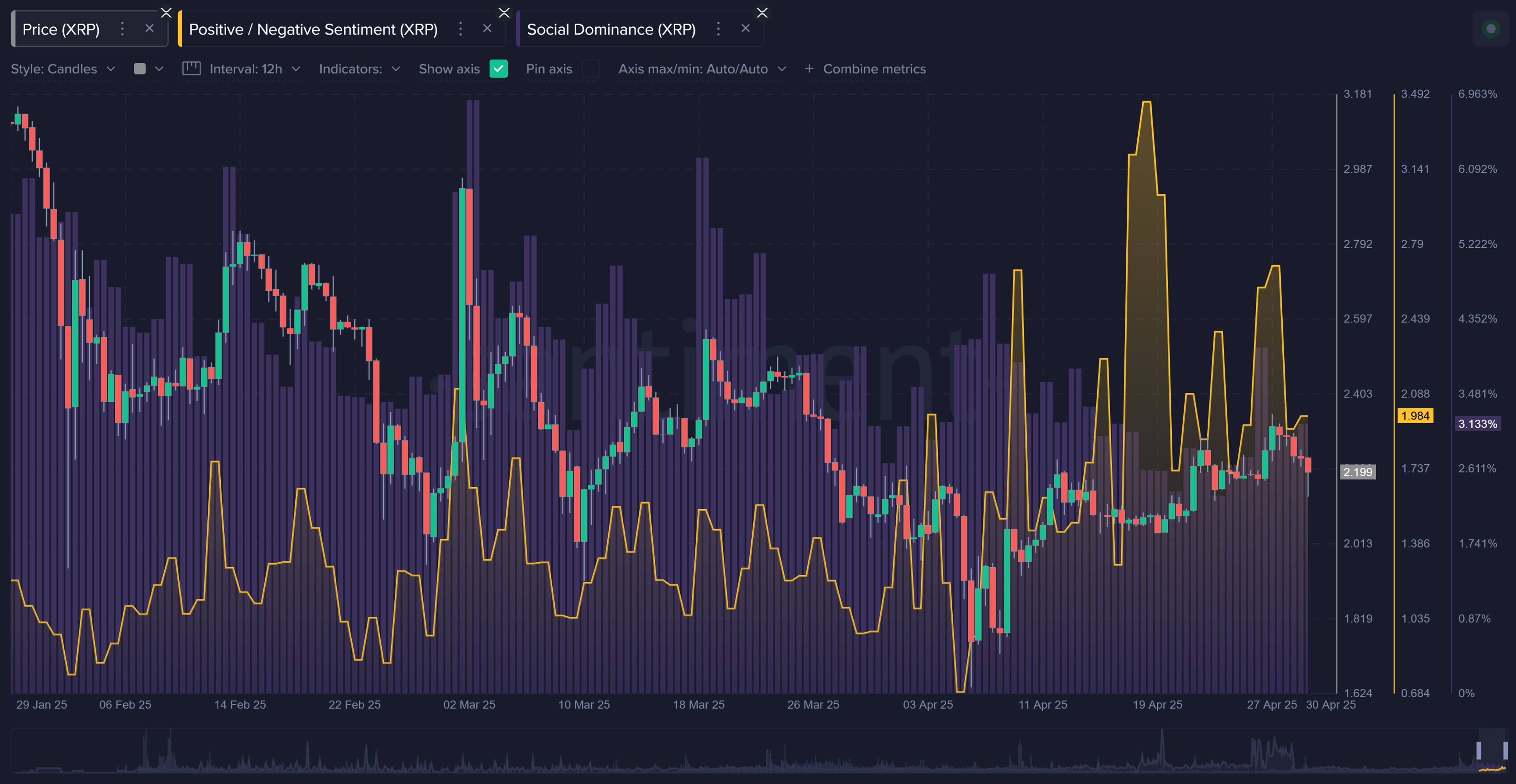
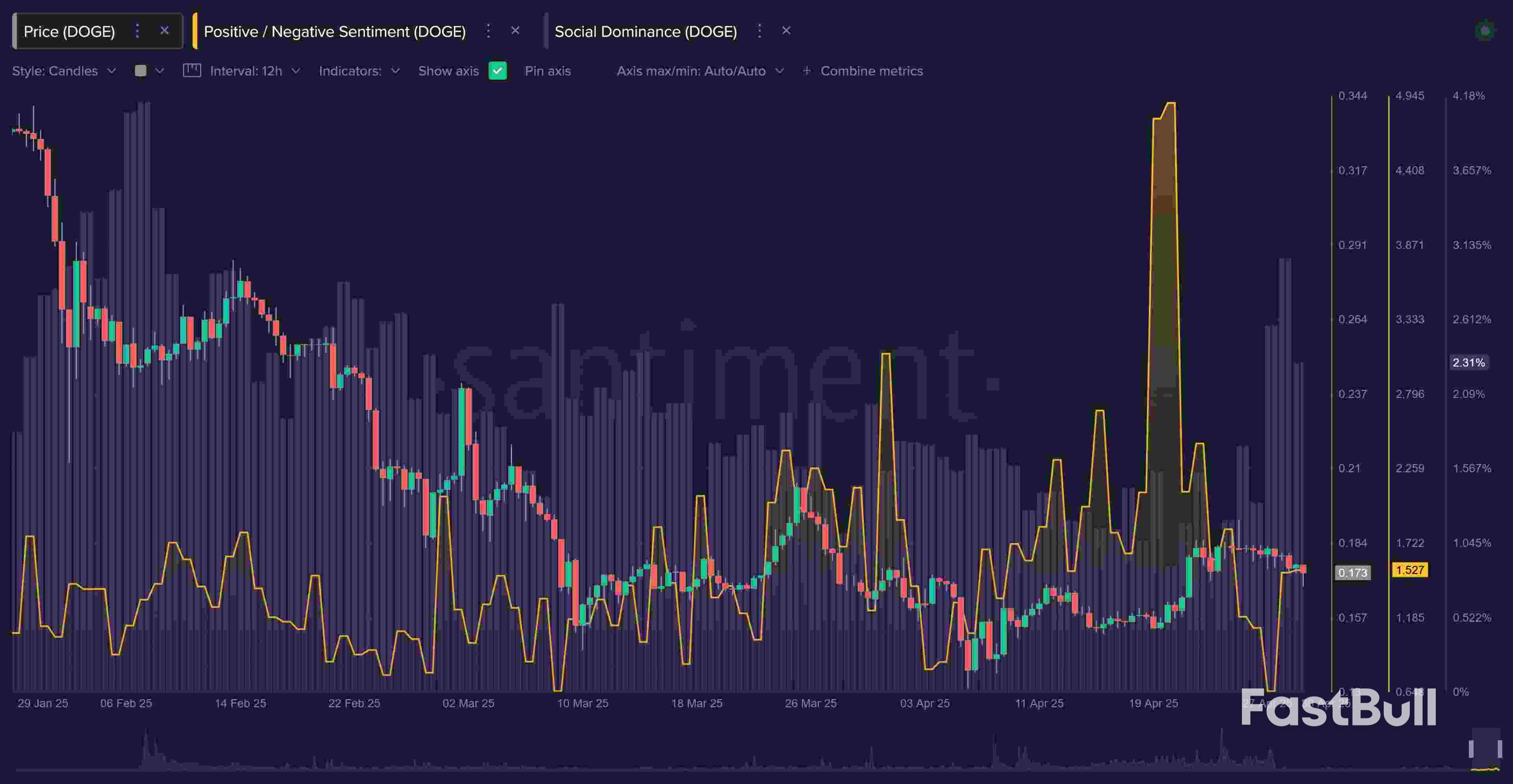
          Optimism for dogecoin (DOGE) and XRP based exchange-traded funds (ETFs) is rising sharply with crowd sentiment shifting in favor of both tokens, social data from Santiment in a Thursday update shows.

          Monitoring social commentary can be used alongside technical tools in a trading strategy, as positive chatter tends to support price rises, while negative chatter can fuel bearish trades.

          Online discussions around XRP are skewed toward bulls with few bearish outlooks, despite an overall drop in social discussions for XRP compared to other majors. The perceived likelihood of a spot XRP ETF approval by the end of 2025 has risen to 85%, up from 65% just two months ago, per Polymarket.

          Such a boost in confidence comes despite the SEC’s recent decision to delay rulings on spot DOGE and XRP ETF proposals until June 17. Technical analysis remains bullish, showing strong accumulation patterns in the current market lull.

          Online tone for Dogecoin has shifted dramatically following the April filings by 21Shares and Bitwise for DOGE spot ETFs. Until late April, DOGE was in a prolonged lull in social attention, but its social dominance has now surged to a three-month high, Santiment noted.

          The House of Doge and Dogecoin Foundation’s support for 21Shares’ application has added further credibility to the effort, helping DOGE shed some of its "memecoin" baggage.

          “After being seen mainly as a meme or joke coin, DOGE is now viewed as a more serious investment option with potential for wider adoption,” Santiment said.

          “Analysts and traders have noticed heavy accumulation by whales, with bullish patterns forming in the charts, which has added to the sense that Dogecoin may be entering a new growth phase," it added.

          Meanwhile, tokens like ether (ETH), Solana’s SOL and BNB show mixed social signals even as bitcoin staged a recovery above $97,000 early Friday.

          Source: CoinDesk

          Risk Warnings and Disclaimers
          You understand and acknowledge that there is a high degree of risk involved in trading. Following any strategies or investment methods may lead to potential losses. The content on the site is provided by our contributors and analysts for information purposes only. You are solely responsible for determining whether any trading assets, securities, strategy, or any other product is suitable for investing based on your own investment objectives and financial situation.
          Add to Favorites
          Share

          Trump to Unveil 2026 Budget Proposal Amid Tax Push, Tariff Strain, and Agency Cuts

          Gerik

          Economic

          Trump's Fiscal Blueprint to Prioritize Defense, Tax Cuts, and Deregulation

          President Donald Trump is set to release his administration’s fiscal year 2026 budget proposal, a political and economic document that not only outlines executive branch priorities but also attempts to shape ongoing negotiations in Congress over federal spending and tax reform.
          The proposed budget reportedly includes a military expenditure exceeding $1 trillion and introduces over $160 billion in cuts across environmental protection, renewable energy, education, and foreign aid programs. These reductions align with Trump’s campaign pledge to reduce the size of the federal government and redirect spending toward defense and national security.
          While the White House budget has no binding authority over Congress—which must pass its own appropriations bills—it often serves as a statement of presidential intent and a negotiating anchor, especially during partisan fiscal standoffs.

          A Tax Cut Bill and Internal GOP Tensions Loom

          The timing of the budget release is strategic. Republicans in Congress are working under tight deadlines to pass a landmark tax-cut bill by July 4. Trump has repeatedly emphasized the bill as a centerpiece of his second-term agenda, calling it “a big beautiful bill” aimed at stimulating business investment and reducing the tax burden on individuals and corporations.
          However, to finance this tax reform, internal GOP factions are clashing over the scale and focus of proposed spending cuts. Trump's budget may deepen these divides, particularly as it calls for severe reductions in traditionally bipartisan programs such as education and foreign development assistance.

          Tariffs as a Revenue Source and Economic Risk

          Trump is banking on tariff revenues to help balance the budget while simultaneously slashing taxes. His administration argues that tariffs on “nearly every country” will generate significant income to offset fiscal deficits. Yet this logic is contentious. In Q1 2025, the U.S. economy contracted by 0.3%, in part due to uncertainty surrounding the administration’s trade policy. Businesses have cited the unpredictability of Trump’s tariffs as a constraint on investment and hiring decisions.
          The budget’s assumptions may be further complicated by the international response to U.S. tariffs, including retaliatory trade measures and shifting supply chains that could dampen expected revenue flows.

          Federal Workforce and Agency Closures Reflect Broader Shrinking of Government

          Trump has aggressively pursued a policy of downsizing the federal government. With the support of high-profile figures like Elon Musk, his administration has shut down several federal agencies and laid off tens of thousands of civil servants. Some of these cuts are currently subject to ongoing legal challenges, especially where statutory mandates conflict with executive actions.
          The proposed budget is expected to institutionalize these rollbacks and frame them as permanent structural reforms. It also reflects a broader ideological commitment to decentralization and a reduction in federal regulatory reach.

          Symbolic Timing and Political Theater

          Interestingly, Trump will not be in Washington when the budget is made public. Instead, he concluded his first 100 days in office with a speech at the University of Alabama and departed for West Palm Beach for the weekend. This departure underscores the theatrical nature of the announcement, where symbolic gestures often carry as much weight as policy details.
          Trump’s 2026 budget plan blends aggressive defense spending, tax reduction, and deregulation with the assumption that tariff-driven revenues can replace traditional fiscal foundations. Yet its reliance on controversial cuts and optimistic economic projections sets up a contentious battle in Congress—especially as economic indicators signal slowing growth and political fault lines within the Republican Party widen.

          Source: Reuters

          To stay updated on all economic events of today, please check out our Economic calendar
          Risk Warnings and Disclaimers
          You understand and acknowledge that there is a high degree of risk involved in trading. Following any strategies or investment methods may lead to potential losses. The content on the site is provided by our contributors and analysts for information purposes only. You are solely responsible for determining whether any trading assets, securities, strategy, or any other product is suitable for investing based on your own investment objectives and financial situation.
          Add to Favorites
          Share

          Japan Signals U.S. Treasury Holdings as Negotiating Leverage in Tariff Talks with Washington

          Gerik

          Economic

          Tokyo Puts Financial Leverage on the Table in Trade Strategy Shift

          In a significant shift of tone, Japan’s Finance Minister Katsunobu Kato suggested that the country's vast holdings of U.S. Treasury securities—exceeding $1 trillion—could be considered a bargaining chip in ongoing trade talks with Washington. While he stopped short of threatening a sell-off, Kato’s remarks mark the first time Tokyo has openly acknowledged its potential to wield its creditor status as strategic leverage.
          His comments come amid deepening trade friction driven by President Donald Trump’s sweeping tariff measures, which have rattled markets and strained relations with major allies, including Japan. Speaking in a televised interview, Kato said that "all cards must be on the table," though he clarified that whether Japan actually uses this card is "a different question."

          Treasury Sell-off Fears Resurface as U.S. Bonds Face Volatility

          Global investors remain highly sensitive to any indication that major foreign holders of U.S. debt—especially Japan and China—might adjust their positions. The mere suggestion that Japan might use its Treasury stockpile as a strategic tool comes after an April bond market rout, triggered in part by Trump's tariff declarations. That sell-off, according to insiders, contributed to the White House’s decision to pause its reciprocal tariff plan for 90 days.
          Kato’s remarks contrast with statements he made just weeks ago dismissing any link between Treasury holdings and trade policy. Analysts now view Japan’s public pivot as a tactical move aimed at leveraging recent volatility in U.S. debt markets to its advantage in negotiations.

          Playing the Card Without Using It: A Subtle Form of Pressure

          Though no concrete threat was issued, the timing of Kato's statement is critical. The U.S. Treasury market is still digesting April’s sharp sell-off, making the prospect of instability more politically potent in Washington. Analysts like Martin Whetton of Westpac note that Japan’s message is calculated: “They don’t have to do anything. Just raising the possibility sends a signal. It is, after all, the art of the deal.”
          With Japanese negotiators meeting U.S. Treasury Secretary Scott Bessent for the second time in recent weeks, Tokyo is seeking to strengthen its hand not just on tariffs but on broader issues like economic security and non-tariff measures.

          Risks and Limits of the 'Treasury Card' Strategy

          While the Treasury card carries symbolic weight, its practical use is limited. A major sell-off would likely harm Japan as much as the U.S., depressing bond prices and causing substantial losses on its remaining holdings. It could also trigger instability in global financial markets—an outcome Tokyo has long sought to avoid.
          Nathan Sheets, former U.S. Undersecretary for International Affairs, emphasized this dilemma: “The idea was an absolute non-issue in the past. But the fact we now even have to consider it shows the world we’re in.” Japan’s economy, deeply tied to the U.S. auto market and reliant on currency stability, has traditionally avoided weaponizing its financial assets.
          Still, as Naka Matsuzawa of Nomura Securities points out, Japan’s holdings are a credible counterweight in disputes over foreign exchange. Trump has accused Tokyo of artificially weakening the yen—a claim Japan firmly denies—and the Treasury portfolio could be used to temper any future demands related to currency appreciation.

          Geopolitical Finance Enters the Spotlight

          Japan’s subtle invocation of its U.S. Treasury holdings as leverage in trade talks signals a new era in economic diplomacy, where creditor relationships may no longer be politically passive. Even if Tokyo never acts on the threat, the signal itself reinforces a growing theme: financial power is increasingly inseparable from geopolitical positioning.
          As the next round of negotiations approaches in mid-May, Japan’s strategy suggests it intends to navigate the Trump administration’s aggressive trade agenda with a mix of economic logic and subtle, strategic pressure.

          Source: Reuters

          To stay updated on all economic events of today, please check out our Economic calendar
          Risk Warnings and Disclaimers
          You understand and acknowledge that there is a high degree of risk involved in trading. Following any strategies or investment methods may lead to potential losses. The content on the site is provided by our contributors and analysts for information purposes only. You are solely responsible for determining whether any trading assets, securities, strategy, or any other product is suitable for investing based on your own investment objectives and financial situation.
          Add to Favorites
          Share
          FastBull
          Copyright © 2025 FastBull Ltd

          728 RM B 7/F GEE LOK IND BLDG NO 34 HUNG TO RD KWUN TONG KLN HONG KONG

          TelegramInstagramTwitterfacebooklinkedin
          App Store Google Play Google Play
          Products
          Charts

          Chats

          Q&A with Experts
          Screeners
          Economic Calendar
          Data
          Tools
          Membership
          Features
          Function
          Markets
          Copy Trading
          Latest Signals
          Contests
          News
          Analysis
          24/7
          Columns
          Education
          Company
          Careers
          About Us
          Contact Us
          Advertising
          Help Center
          Feedback
          User Agreement
          Privacy Policy
          Business

          White Label

          Data API

          Web Plug-ins

          Poster Maker

          Affiliate Program

          Risk Disclosure

          The risk of loss in trading financial instruments such as stocks, FX, commodities, futures, bonds, ETFs and crypto can be substantial. You may sustain a total loss of the funds that you deposit with your broker. Therefore, you should carefully consider whether such trading is suitable for you in light of your circumstances and financial resources.

          No decision to invest should be made without thoroughly conducting due diligence by yourself or consulting with your financial advisors. Our web content might not suit you since we don't know your financial conditions and investment needs. Our financial information might have latency or contain inaccuracy, so you should be fully responsible for any of your trading and investment decisions. The company will not be responsible for your capital loss.

          Without getting permission from the website, you are not allowed to copy the website's graphics, texts, or trademarks. Intellectual property rights in the content or data incorporated into this website belong to its providers and exchange merchants.

          Not Logged In

          Log in to access more features

          FastBull Membership

          Not yet

          Purchase

          Become a signal provider
          Help Center
          Customer Service
          Dark Mode
          Price Up/Down Colors

          Log In

          Sign Up

          Position
          Layout
          Fullscreen
          Default to Chart
          The chart page opens by default when you visit fastbull.com