• Trade
  • Markets
  • Copy
  • Contests
  • News
  • 24/7
  • Calendar
  • Q&A
  • Chats
Trending
Screeners
SYMBOL
LAST
BID
ASK
HIGH
LOW
NET CHG.
%CHG.
SPREAD
SPX
S&P 500 Index
6827.42
6827.42
6827.42
6899.86
6801.80
-73.58
-1.07%
--
DJI
Dow Jones Industrial Average
48458.04
48458.04
48458.04
48886.86
48334.10
-245.98
-0.51%
--
IXIC
NASDAQ Composite Index
23195.16
23195.16
23195.16
23554.89
23094.51
-398.69
-1.69%
--
USDX
US Dollar Index
97.950
98.030
97.950
98.500
97.950
-0.370
-0.38%
--
EURUSD
Euro / US Dollar
1.17394
1.17409
1.17394
1.17496
1.17192
+0.00011
+ 0.01%
--
GBPUSD
Pound Sterling / US Dollar
1.33707
1.33732
1.33707
1.33997
1.33419
-0.00148
-0.11%
--
XAUUSD
Gold / US Dollar
4299.39
4299.39
4299.39
4353.41
4257.10
+20.10
+ 0.47%
--
WTI
Light Sweet Crude Oil
57.233
57.485
57.233
58.011
56.969
-0.408
-0.71%
--

Community Accounts

Signal Accounts
--
Profit Accounts
--
Loss Accounts
--
View More

Become a signal provider

Sell trading signals to earn additional income

View More

Guide to Copy Trading

Get started with ease and confidence

View More

Signal Accounts for Members

All Signal Accounts

Best Return
  • Best Return
  • Best P/L
  • Best MDD
Past 1W
  • Past 1W
  • Past 1M
  • Past 1Y

All Contests

  • All
  • Trump Updates
  • Recommend
  • Stocks
  • Cryptocurrencies
  • Central Banks
  • Featured News
Top News Only
Share

Iranian Media Says 18 Crew Members Of Foreign Tanker Seized In Gulf Of Oman Over Carrying 'Smuggled Fuel' Detained

Share

Regional Governor: Two Killed In Ukrainian Drone Strike On Russia's Saratov

Share

Chinese Foreign Ministry - China Foreign Minister Met With United Arab Emirates Counterpart On Dec 12

Share

China's Central Financial And Economic Affairs Commission Deputy Director: Will Expand Export And Increase Import In 2026

Share

Thai Leader Anutin: Landmine Blast That Killed Thai Soldiers 'Not A Roadside Accident'

Share

Thai Leader Anutin: Thailand To Continue Military Action Until 'We Feel No More Harm'

Share

Cambodian Prime Minister Hun Manet Says He Had Phone Calls With Trump And Malaysian Leader Anwar About Ceasefire

Share

Cambodia's Hun Manet Says USA, Malaysia Should Verify 'Which Side Fired First' In Latest Conflict

Share

Cambodia's Hun Manet: Cambodia Maintains Its Stance In Seeking Peaceful Resolution Of Disputes

Share

Nasdaq Companies: Allergan, Ferrovia, Insmed, Monolithic Power Systems, Seagate Technology, And Western Digital Will Be Added To The NASDAQ 100 Index. Biogen, CdW, GlobalFoundries, Lululemon, ON Semiconductor, And Tradedesk Will Be Removed From The NASDAQ 100 Index

Share

Witkoff Headed To Berlin This Weekend To Meet With Zelenskiy, European Leaders -Wsj Reporter On X

Share

Russia Attacks Two Ukrainian Ports, Damaging Three Turkish-Owned Vessels

Share

[Historic Flooding Occurs In At Least Four Rivers In Washington State Due To Days Of Torrential Rains] Multiple Areas In Washington State Have Been Hit By Severe Flooding Due To Days Of Torrential Rains, With At Least Four Rivers Experiencing Historic Flooding. Reporters Learned On The 12th That The Floods Caused By The Torrential Rains In Washington State Have Destroyed Homes And Closed Several Highways. Experts Warn That Even More Severe Flooding May Occur In The Future. A State Of Emergency Has Been Declared In Washington State

Share

Trump Says Proposed Free Economic Zone In Donbas Would Work

Share

Trump: I Think My Voice Should Be Heard

Share

Trump Says Will Be Choosing New Fed Chair In Near Future

Share

Trump Says Proposed Free Economic Zone In Donbas Complex But Would Work

Share

Trump Says Land Strikes In Venezuela Will Start Happening

Share

US President Trump: Thailand And Cambodia Are In A Good Situation

Share

State Media: North Korean Leader Kim Hails Troops Returning From Russia Mission

TIME
ACT
FCST
PREV
U.K. Trade Balance Non-EU (SA) (Oct)

A:--

F: --

P: --

U.K. Trade Balance (Oct)

A:--

F: --

P: --

U.K. Services Index MoM

A:--

F: --

P: --

U.K. Construction Output MoM (SA) (Oct)

A:--

F: --

P: --

U.K. Industrial Output YoY (Oct)

A:--

F: --

P: --

U.K. Trade Balance (SA) (Oct)

A:--

F: --

P: --

U.K. Trade Balance EU (SA) (Oct)

A:--

F: --

P: --

U.K. Manufacturing Output YoY (Oct)

A:--

F: --

P: --

U.K. GDP MoM (Oct)

A:--

F: --

P: --

U.K. GDP YoY (SA) (Oct)

A:--

F: --

P: --

U.K. Industrial Output MoM (Oct)

A:--

F: --

P: --

U.K. Construction Output YoY (Oct)

A:--

F: --

P: --

France HICP Final MoM (Nov)

A:--

F: --

P: --

China, Mainland Outstanding Loans Growth YoY (Nov)

A:--

F: --

P: --

China, Mainland M2 Money Supply YoY (Nov)

A:--

F: --

P: --

China, Mainland M0 Money Supply YoY (Nov)

A:--

F: --

P: --

China, Mainland M1 Money Supply YoY (Nov)

A:--

F: --

P: --

India CPI YoY (Nov)

A:--

F: --

P: --

India Deposit Gowth YoY

A:--

F: --

P: --

Brazil Services Growth YoY (Oct)

A:--

F: --

P: --

Mexico Industrial Output YoY (Oct)

A:--

F: --

P: --

Russia Trade Balance (Oct)

A:--

F: --

P: --

Philadelphia Fed President Henry Paulson delivers a speech
Canada Building Permits MoM (SA) (Oct)

A:--

F: --

P: --

Canada Wholesale Sales YoY (Oct)

A:--

F: --

P: --

Canada Wholesale Inventory MoM (Oct)

A:--

F: --

P: --

Canada Wholesale Inventory YoY (Oct)

A:--

F: --

P: --

Canada Wholesale Sales MoM (SA) (Oct)

A:--

F: --

P: --

Germany Current Account (Not SA) (Oct)

A:--

F: --

P: --

U.S. Weekly Total Rig Count

A:--

F: --

P: --

U.S. Weekly Total Oil Rig Count

A:--

F: --

P: --

Japan Tankan Large Non-Manufacturing Diffusion Index (Q4)

--

F: --

P: --

Japan Tankan Small Manufacturing Outlook Index (Q4)

--

F: --

P: --

Japan Tankan Large Non-Manufacturing Outlook Index (Q4)

--

F: --

P: --

Japan Tankan Large Manufacturing Outlook Index (Q4)

--

F: --

P: --

Japan Tankan Small Manufacturing Diffusion Index (Q4)

--

F: --

P: --

Japan Tankan Large Manufacturing Diffusion Index (Q4)

--

F: --

P: --

Japan Tankan Large-Enterprise Capital Expenditure YoY (Q4)

--

F: --

P: --

U.K. Rightmove House Price Index YoY (Dec)

--

F: --

P: --

China, Mainland Industrial Output YoY (YTD) (Nov)

--

F: --

P: --

China, Mainland Urban Area Unemployment Rate (Nov)

--

F: --

P: --

Saudi Arabia CPI YoY (Nov)

--

F: --

P: --

Euro Zone Industrial Output YoY (Oct)

--

F: --

P: --

Euro Zone Industrial Output MoM (Oct)

--

F: --

P: --

Canada Existing Home Sales MoM (Nov)

--

F: --

P: --

Euro Zone Total Reserve Assets (Nov)

--

F: --

P: --

U.K. Inflation Rate Expectations

--

F: --

P: --

Canada National Economic Confidence Index

--

F: --

P: --

Canada New Housing Starts (Nov)

--

F: --

P: --

U.S. NY Fed Manufacturing Employment Index (Dec)

--

F: --

P: --

U.S. NY Fed Manufacturing Index (Dec)

--

F: --

P: --

Canada Core CPI YoY (Nov)

--

F: --

P: --

Canada Manufacturing Unfilled Orders MoM (Oct)

--

F: --

P: --

Canada Manufacturing New Orders MoM (Oct)

--

F: --

P: --

Canada Core CPI MoM (Nov)

--

F: --

P: --

Canada Manufacturing Inventory MoM (Oct)

--

F: --

P: --

Canada CPI YoY (Nov)

--

F: --

P: --

Canada CPI MoM (Nov)

--

F: --

P: --

Canada CPI YoY (SA) (Nov)

--

F: --

P: --

Canada Core CPI MoM (SA) (Nov)

--

F: --

P: --

Q&A with Experts
    • All
    • Chatrooms
    • Groups
    • Friends
    Connecting
    .
    .
    .
    Type here...
    Add Symbol or Code

      No matching data

      All
      Trump Updates
      Recommend
      Stocks
      Cryptocurrencies
      Central Banks
      Featured News
      • All
      • Russia-Ukraine Conflict
      • Middle East Flashpoint
      • All
      • Russia-Ukraine Conflict
      • Middle East Flashpoint
      Search
      Products

      Charts Free Forever

      Chats Q&A with Experts
      Screeners Economic Calendar Data Tools
      Membership Features
      Data Warehouse Market Trends Institutional Data Policy Rates Macro

      Market Trends

      Market Sentiment Order Book Forex Correlations

      Top Indicators

      Charts Free Forever
      Markets

      News

      News Analysis 24/7 Columns Education
      From Institutions From Analysts
      Topics Columnists

      Latest Views

      Latest Views

      Trending Topics

      Top Columnists

      Latest Update

      Signals

      Copy Rankings Latest Signals Become a signal provider AI Rating
      Contests
      Brokers

      Overview Brokers Assessment Rankings Regulators News Claims
      Broker listing Forex Brokers Comparison Tool Live Spread Comparison Scam
      Q&A Complaint Scam Alert Videos Tips to Detect Scam
      More

      Business
      Events
      Careers About Us Advertising Help Center

      White Label

      Data API

      Web Plug-ins

      Affiliate Program

      Awards Institution Evaluation IB Seminar Salon Event Exhibition
      Vietnam Thailand Singapore Dubai
      Fans Party Investment Sharing Session
      FastBull Summit BrokersView Expo
      Recent Searches
        Top Searches
          Markets
          News
          Analysis
          User
          24/7
          Economic Calendar
          Education
          Data
          • Names
          • Latest
          • Prev

          View All

          No data

          Scan to Download

          Faster Charts, Chat Faster!

          Download App
          English
          • English
          • Español
          • العربية
          • Bahasa Indonesia
          • Bahasa Melayu
          • Tiếng Việt
          • ภาษาไทย
          • Français
          • Italiano
          • Türkçe
          • Русский язык
          • 简中
          • 繁中
          Open Account
          Search
          Products
          Charts Free Forever
          Markets
          News
          Signals

          Copy Rankings Latest Signals Become a signal provider AI Rating
          Contests
          Brokers

          Overview Brokers Assessment Rankings Regulators News Claims
          Broker listing Forex Brokers Comparison Tool Live Spread Comparison Scam
          Q&A Complaint Scam Alert Videos Tips to Detect Scam
          More

          Business
          Events
          Careers About Us Advertising Help Center

          White Label

          Data API

          Web Plug-ins

          Affiliate Program

          Awards Institution Evaluation IB Seminar Salon Event Exhibition
          Vietnam Thailand Singapore Dubai
          Fans Party Investment Sharing Session
          FastBull Summit BrokersView Expo

          Emerging Markets See Surge in Local Currency Debt as Dollar Weakens

          Gerik

          Economic

          Forex

          Summary:

          A weakening U.S. dollar is helping lift emerging market local currency debt from a decade-long drought, with record inflows into bond funds. This shift reflects changing investor preferences, as a weakening dollar...

          Emerging Markets Local Currency Debt: A Potential Turning Point

          Emerging market local currency bonds are experiencing a revival after years of stagnation, with inflows into bond funds reaching record levels. For the first time in years, these markets are witnessing a resurgence of interest, with the JPMorgan GBI Emerging Market local currency index at its lowest yields since 2022. As a result, emerging market local currency government bonds have seen returns exceeding 10% this year, outpacing the 4% return from hard-currency bonds.
          The key drivers behind this resurgence are global shifts in economic conditions. The U.S. dollar, which had been a dominant global reserve currency, recently fell to its lowest point in over three years, prompting investors to seek higher returns in other markets. In particular, the weakening dollar and lower global interest rates are fueling demand for local currency bonds in markets like Brazil, Mexico, Indonesia, and India.

          Reversal of Dollar Bull Market Trend

          For over a decade, the global market has favored U.S. assets, driven by the "U.S. exceptionalism" trade. This trend saw foreign investors flocking to U.S. equities and bonds, bolstered by a strong dollar. However, as the dollar weakens, emerging market bonds are becoming more attractive. Investors are seeking better yields, especially as slower global growth and the likelihood of lower rates in developed markets reduce the returns available in traditional markets like the U.S. and Europe.
          This shift has been described by market analysts as the end of a 14-year period during which emerging market local currency bonds were largely neglected. With the asset class now valued at approximately $13 trillion—double its size from 14 years ago—investors are beginning to revisit emerging markets in search of diversification and better returns.

          Factors Supporting the Shift: Central Banks and Market Conditions

          The current favorable environment for local currency bonds in emerging markets is driven by a combination of factors. Many emerging market central banks are cutting rates, which contrasts with the mixed outlook for rate cuts from the U.S. Federal Reserve. This divergence, along with the drop in the U.S. dollar, has created a "Goldilocks" moment for emerging markets, making local bonds increasingly attractive.
          Countries like the Philippines, Czech Republic, Hungary, South Africa, and Brazil are highlighted as offering compelling value for investors looking for opportunities in emerging markets. Even small flows into these markets are expected to have a significant impact, given the smaller size of emerging market assets compared to U.S. assets.
          While the flows into emerging market local currency bonds remain small, they represent a significant shift in investor sentiment. According to analysts, this shift could lead to steady, long-term growth for emerging market debt, with many expecting double-digit returns by the end of the year. Despite the gradual nature of this trend, the impact of these flows in the context of global capital markets could be meaningful, providing a boost to the asset class and signaling the end of a long period of neglect.

          Source: Reuters

          To stay updated on all economic events of today, please check out our Economic calendar
          Risk Warnings and Disclaimers
          You understand and acknowledge that there is a high degree of risk involved in trading. Following any strategies or investment methods may lead to potential losses. The content on the site is provided by our contributors and analysts for information purposes only. You are solely responsible for determining whether any trading assets, securities, strategy, or any other product is suitable for investing based on your own investment objectives and financial situation.
          Add to Favorites
          Share

          Israeli Airstrike Kills Iranian Military Leader In Tehran

          Daniel Carter

          Political

          Middle East Situation

          Key Points:
          ● Israeli airstrike kills Iran's military chief, Ali Shadmani, in Tehran.
          ● Linked to broader tactics disrupting Iran's command structure.
          ● No direct cryptocurrency impact observed relating to the strike.
          Ali Shadmani, Chief of Staff of Iran's Armed Forces, was killed by an Israeli airstrike in Tehran on June 17, as confirmed by the Israel Defense Forces (IDF).
          This assassination is part of Israel's ongoing strategy targeting Iran's military leadership, potentially affecting Middle East stability but not directly impacting crypto markets. According to a statement by the Israel Defense Forces, "The targeted killing of Shadmani marks another critical blow to Iran's military command structure amid ongoing hostilities and follows a series of recent assassinations aimed at dismantling the upper echelons of the Iranian armed forces. Israeli officials have described the operation as part of a broader strategy to disrupt Iran's ability to wage coordinated attacks in the region."

          Israeli Tactics: Disruption of Iranian Military Leadership

          The Israeli airstrike on June 17 resulted in the death of Ali Shadmani, Iran's Chief of Staff, in a rare precision attack in central Tehran. Israeli officials emphasized the operation as disrupting Iran's military capabilities.
          These targeted killings continue a pattern over recent days, with Israel aiming to weaken Iran's leadership. Such operations are part of a broader regional security strategy amid escalating tensions.
          Did you know? The targeted killing of military chiefs often marks shifts in regional power dynamics. Historically, similar actions have occasionally sparked transient volatility in global markets, yet current assessments suggest crypto markets remain stable.

          Cryptocurrency Market Stability Amid Escalating Geopolitical Tension

          Did you know? The targeted killing of military chiefs often marks shifts in regional power dynamics. Historically, similar actions have occasionally sparked transient volatility in global markets, yet current assessments suggest crypto markets remain stable.
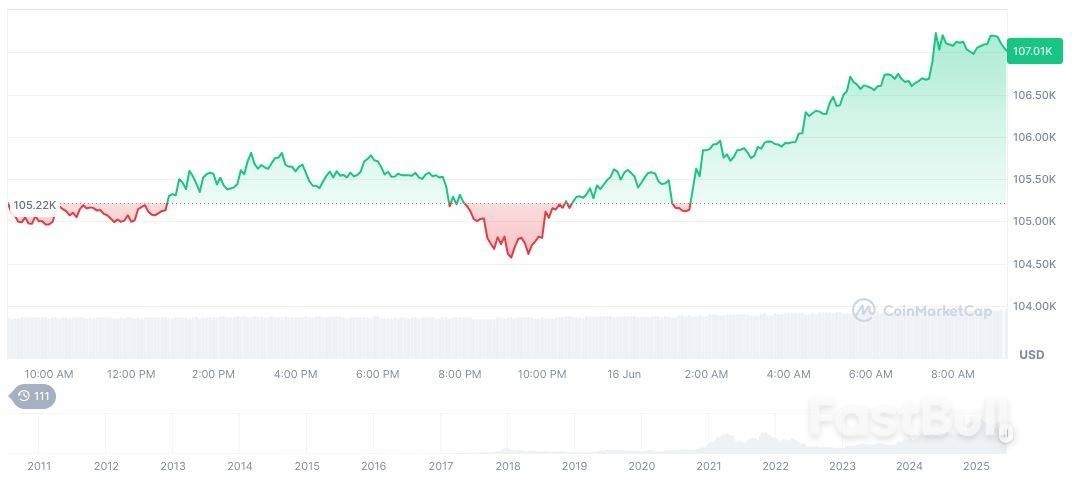
          Bitcoin currently prices at $106,979.35, with its market cap reaching $2.13 trillion and market dominance holding at 63.95%. Despite geopolitical events, Bitcoin's 24-hour trading volume soared to $53.80 billion with a moderate 0.26% increase over the same period. Price changes over 60 and 90 days indicate notable rises of 26.40% and 28.61%, respectively.

          Bitcoin(BTC), daily chart, screenshot on CoinMarketCap at 06:44 UTC on June 17, 2025.

          Experts suggest that while geopolitical tensions might spark sporadic volatility, the broader crypto ecosystem remains largely insulated from such military escalations, focusing instead on regulatory shifts and technological advancements in blockchain.

          Source: CryptoSlate

          Risk Warnings and Disclaimers
          You understand and acknowledge that there is a high degree of risk involved in trading. Following any strategies or investment methods may lead to potential losses. The content on the site is provided by our contributors and analysts for information purposes only. You are solely responsible for determining whether any trading assets, securities, strategy, or any other product is suitable for investing based on your own investment objectives and financial situation.
          Add to Favorites
          Share

          Central Banks Favour Gold Over Dollar for Reserves, WGC Survey Reveals

          Gerik

          Economic

          Commodity

          Growing Demand for Gold Among Central Banks

          According to the WGC's survey, central banks around the world are planning to increase their gold holdings over the next five years. This marks a significant shift, as 76% of the 73 central banks surveyed indicated that they expect to hold more gold, a rise from 69% the previous year. The survey, which was conducted between February 25 and May 20, also showed that nearly three-quarters of central banks believe their dollar reserves will decrease over the same period, a notable increase from 62% in 2024.
          Central banks have consistently bought over 1,000 metric tons of gold annually in the last three years, a sharp rise from the 400-500 ton range in the previous decade. This trend reflects growing geopolitical and economic uncertainty, with central banks turning to gold as a more stable and reliable asset during volatile periods.

          Gold's Performance Amid Crisis and Geopolitical Uncertainty

          Gold's appeal has been strengthened by its performance during times of crisis, such as the geopolitical tensions following Russia's invasion of Ukraine. Since February 2022, gold prices have surged, hitting an all-time high of $3,500 per ounce in April 2025, marking a 95% increase since the war began.
          For central banks, gold is not only seen as a hedge against inflation but also as an essential tool for portfolio diversification. These factors are prompting many central banks, particularly those in emerging markets, to prioritize gold accumulation.

          Geopolitical Risks and Trade Conflicts Impacting Reserve Management

          The WGC survey also revealed that 59% of central banks are concerned with potential trade conflicts and tariffs, which are influencing their reserve management strategies. Emerging markets, in particular, have been more vocal about these risks, with 69% of central banks in developing economies citing them as significant factors, compared to only 40% in advanced economies.
          The survey confirmed that the Bank of England remains the preferred location for central banks' gold reserves. This further underscores the growing global trend of accumulating gold while reducing dependence on the U.S. dollar.
          In conclusion, central banks are shifting towards gold as a safer, more stable asset amid rising global uncertainties. The WGC's findings suggest this trend is set to continue, with gold playing an increasingly pivotal role in global reserve management.

          Source: Reuters

          To stay updated on all economic events of today, please check out our Economic calendar
          Risk Warnings and Disclaimers
          You understand and acknowledge that there is a high degree of risk involved in trading. Following any strategies or investment methods may lead to potential losses. The content on the site is provided by our contributors and analysts for information purposes only. You are solely responsible for determining whether any trading assets, securities, strategy, or any other product is suitable for investing based on your own investment objectives and financial situation.
          Add to Favorites
          Share

          Why the BOJ Is Slowing Its Bond Taper Amid Soaring Yields and Fiscal Strains

          Gerik

          Economic

          Japan’s Debt Burden Meets Market Volatility

          Japan’s debt-to-GDP ratio—currently around 250%, the highest among developed economies—has long been a structural vulnerability. While much of the debt is domestically held, recent developments have reignited concern. A combination of weak bond auction results, fading demand from traditional buyers like life insurers, and global investor apprehension about sovereign debt have sent yields on super-long JGBs surging. In particular, the 40-year yield jumped to a record 3.675%, with 30-year and 20-year bonds also hitting multi-decade highs.
          This pressure is further magnified by the government's proposed fiscal stimulus ahead of July’s upper house elections, including potential cash handouts. These promises contribute to fears of worsening fiscal discipline.

          BOJ's Cautious Retreat from Ultra-Loose Policy

          The BOJ had been steadily reducing its monthly bond purchases—known as quantitative tightening—by 400 billion yen each quarter under a plan announced in July 2024. That pace will now be halved to 200 billion yen reductions per quarter starting in April 2026. For the current quarter, bond buying stands at 4.1 trillion yen per month.
          This recalibration suggests a more gradual exit from monetary stimulus, aiming to avoid destabilizing markets. Governor Kazuo Ueda signaled that the bank is concerned about how super-long yield spikes could spill into shorter maturities, which have more direct effects on borrowing costs for households and businesses.

          Shifting Investor Landscape and Fiscal Tools

          The structural shift in demand is partly driven by regulatory-driven behavior. Life insurers, who were once major buyers of super-long JGBs to meet solvency needs, are now pivoting toward higher-yield assets. This transition has removed a major source of steady demand for long-dated bonds, leaving auctions vulnerable.
          Moreover, the Japanese finance ministry is now taking a more active role. It plans to reduce the issuance of 20-, 30-, and 40-year bonds while increasing supply of shorter maturities. There are also discussions of introducing floating-rate debt and expanding bond access to unlisted companies and retail investors, aiming to deepen domestic demand and reduce dependency on volatile foreign inflows.

          Geopolitical and Global Policy Backdrop

          Japan’s bond market volatility does not exist in a vacuum. Global markets have turned cautious in the face of rising debt burdens across the U.S. and Europe. Moody’s recent downgrade of U.S. debt sent ripples through bond markets, amplifying scrutiny on countries like Japan with towering public liabilities.
          Additionally, BOJ policy decisions are taking place amid escalating geopolitical uncertainty, particularly in the Middle East and with U.S. trade tariffs. These risks reinforce the bank’s preference for stability over aggressive policy tightening.

          Market Confidence and Key Test Ahead

          The next major milestone will be the 20-year JGB auction on June 24, which will test whether recent measures to calm markets are working. The BOJ’s message is clear: while it aims to unwind stimulus and control inflation, it must do so without jeopardizing market confidence or fiscal credibility.
          Ultimately, the BOJ’s recalibrated taper reflects a delicate balancing act. It must juggle inflation control, market stability, and the government’s mounting fiscal obligations—all while navigating a shifting global investment landscape and fragile investor confidence in long-term Japanese debt.

          Source: Reuters

          To stay updated on all economic events of today, please check out our Economic calendar
          Risk Warnings and Disclaimers
          You understand and acknowledge that there is a high degree of risk involved in trading. Following any strategies or investment methods may lead to potential losses. The content on the site is provided by our contributors and analysts for information purposes only. You are solely responsible for determining whether any trading assets, securities, strategy, or any other product is suitable for investing based on your own investment objectives and financial situation.
          Add to Favorites
          Share

          Hedge Funds Flock to Asia, Triggering Highest Regional Exposure in Five Years

          Gerik

          Economic

          Bullish Momentum Returns to Asia

          From June 6 to June 12, hedge funds rapidly ramped up their activity in Asia, marking the largest volume surge in over five years, as revealed in a Goldman Sachs report published Friday and reviewed Tuesday by Reuters. During this period, net long positions surged, with bullish trades decisively outweighing bearish bets. The increase in buying suggests renewed conviction in Asia's growth potential.
          Notably, funds increased exposure to equities in Japan, Hong Kong, Taiwan, and India, while taking short positions in onshore Chinese stocks — suggesting selective confidence tied to geopolitical and macroeconomic undercurrents.

          Trade Talks and Elections Boost Sentiment

          This renewed investor enthusiasm coincides with high-level trade talks between the U.S. and China in London, which have sparked optimism of a thaw in tensions that have weighed on global supply chains and capital flows. Furthermore, South Korea’s recent election of a market-friendly president has injected fresh confidence, catalyzing foreign inflows into Korean equities.
          The MSCI Asia-Pacific Index has reflected this enthusiasm, climbing 2.5% in June alone, led by Korea and Taiwan. Since April 7, the index has risen 24%, buoyed by a 90-day tariff moratorium from the U.S. and stronger-than-expected corporate earnings across the region.

          Rotation From Dollar Assets to Asia

          Goldman Sachs also noted that the share of developed Asia markets in total hedge fund exposure hit 9%, placing it in the 94th percentile historically. This rotation is partly explained by the global trend of de-dollarization, as weakening expectations for the U.S. dollar lead funds to seek alternative regional opportunities. According to Kier Boley, CIO at UBP Alternative Investment Solutions, international investors are re-evaluating previously overlooked markets like Asia in light of shifting macroeconomic dynamics.
          While risks remain, especially in China where structural challenges persist, the momentum in Asia’s equity markets underscores a broad shift in hedge fund sentiment. If trade negotiations continue progressing and political stability strengthens across key Asian economies, this could mark the beginning of a more sustained capital rotation into the region, positioning Asia as a new center of post-tariff investment optimism.

          Source: Reuters

          To stay updated on all economic events of today, please check out our Economic calendar
          Risk Warnings and Disclaimers
          You understand and acknowledge that there is a high degree of risk involved in trading. Following any strategies or investment methods may lead to potential losses. The content on the site is provided by our contributors and analysts for information purposes only. You are solely responsible for determining whether any trading assets, securities, strategy, or any other product is suitable for investing based on your own investment objectives and financial situation.
          Add to Favorites
          Share

          Bank of Japan Signals Caution, Slows Bond Taper While Holding Rates

          Gerik

          Economic

          BOJ Holds Steady, Prioritizes Stability Over Aggression

          At the conclusion of its two-day policy meeting, the BOJ confirmed expectations by maintaining its short-term interest rate at 0.5%, reaffirming its gradual approach to tightening monetary policy. The central bank also announced that it will slow its bond tapering process from April 2026 onward, aiming to reduce monthly bond purchases by 200 billion yen per quarter. By March 2027, total monthly purchases are projected to decline to approximately 2 trillion yen.
          This decision leaves the current tapering plan in place through March 2026, suggesting that any aggressive rollback of stimulus is off the table for now.

          Gradual Normalization Amid Global and Domestic Pressure

          The BOJ's cautious approach highlights its concerns over both external risks—such as Middle East tensions and U.S. tariff actions—and domestic uncertainties like wage growth and inflation trends. While Japan has seen inflation hover just above the 2% target, Governor Kazuo Ueda has signaled the need for stability before initiating any substantial tightening.
          The Japanese bond market has experienced volatility, particularly in ultra-long government bonds (JGBs), prompting the central bank to ease the pace of normalization to avoid destabilizing the market. By carefully phasing its taper over multiple fiscal years, the BOJ appears focused on protecting bond yields from sudden spikes, which could impair fiscal sustainability and investor confidence.

          Market Reaction and Outlook

          Markets reacted moderately to the announcement. The 10-year JGB yield inched up to 1.465%, while the yen remained flat at 144.80 per dollar, indicating limited surprise. Investors now await Governor Ueda's 3:30 p.m. (0630 GMT) press conference, where further guidance may be offered on future rate hikes or taper adjustments.
          Overall, the BOJ continues to strike a delicate balance: acknowledging inflationary pressure without undermining financial market stability or derailing Japan’s still-fragile economic recovery. Further moves, particularly any interest rate increases, are likely to hinge on geopolitical developments, wage trajectories, and global central bank trends.

          Source: Reuters

          To stay updated on all economic events of today, please check out our Economic calendar
          Risk Warnings and Disclaimers
          You understand and acknowledge that there is a high degree of risk involved in trading. Following any strategies or investment methods may lead to potential losses. The content on the site is provided by our contributors and analysts for information purposes only. You are solely responsible for determining whether any trading assets, securities, strategy, or any other product is suitable for investing based on your own investment objectives and financial situation.
          Add to Favorites
          Share

          Thailand to Submit Formal Trade Proposal to U.S. Amid Tariff Threat

          Gerik

          Economic

          Bangkok Races Against Time as Tariff Moratorium Nears Expiry

          In a move to prevent a potentially damaging tariff increase, Thailand announced it will submit a formal trade proposal to the United States within the week. The country faces the risk of a 36% tariff on its exports if the current moratorium, which shields Thai products from punitive duties, is not successfully renegotiated before its July expiration.
          Finance Minister Pichai Chunhavajira stated on Tuesday that technical-level discussions will begin online this week, with the formal proposal aligned with pre-announced trade criteria. These include addressing trade imbalances, enhancing U.S. market access, and preventing transshipment violations, while also encouraging Thai investment projects that generate employment in the U.S..

          Digital Diplomacy to Lead the Way

          According to Pichai, the first phase of negotiation will be conducted virtually, and any face-to-face meetings will be considered based on progress in the preliminary rounds. This approach underlines the urgency of maintaining diplomatic momentum while navigating logistical challenges.
          Thailand’s earlier informal proposal, submitted in May, emphasized collaborative economic measures that benefit both sides. The formal version, to be submitted after this week’s talks, is expected to provide more concrete commitments to rebalance bilateral trade and support U.S. economic interests.

          Strategic Context: U.S. Trade Pressure and Thai Economic Priorities

          This development comes amid broader U.S. efforts to tighten trade rules and enforcement, particularly in Southeast Asia, to combat transshipment and protect domestic industries. Thailand, a significant exporter of electronics, automotive parts, and apparel, could suffer substantial economic setbacks if subjected to steep tariffs.
          For Bangkok, avoiding the tariff is not only an economic imperative but a geopolitical one, as it seeks to remain a stable U.S. trade partner while balancing its ties with regional giants like China. The Thai government is also under domestic pressure to maintain export competitiveness and economic stability amid global uncertainty.
          With the July deadline approaching fast, the success of these talks may depend on how convincingly Thailand can demonstrate compliance, reciprocity, and economic alignment with U.S. trade priorities.

          Source: Reuters

          To stay updated on all economic events of today, please check out our Economic calendar
          Risk Warnings and Disclaimers
          You understand and acknowledge that there is a high degree of risk involved in trading. Following any strategies or investment methods may lead to potential losses. The content on the site is provided by our contributors and analysts for information purposes only. You are solely responsible for determining whether any trading assets, securities, strategy, or any other product is suitable for investing based on your own investment objectives and financial situation.
          Add to Favorites
          Share
          FastBull
          Copyright © 2025 FastBull Ltd

          728 RM B 7/F GEE LOK IND BLDG NO 34 HUNG TO RD KWUN TONG KLN HONG KONG

          TelegramInstagramTwitterfacebooklinkedin
          App Store Google Play Google Play
          Products
          Charts

          Chats

          Q&A with Experts
          Screeners
          Economic Calendar
          Data
          Tools
          Membership
          Features
          Function
          Markets
          Copy Trading
          Latest Signals
          Contests
          News
          Analysis
          24/7
          Columns
          Education
          Company
          Careers
          About Us
          Contact Us
          Advertising
          Help Center
          Feedback
          User Agreement
          Privacy Policy
          Business

          White Label

          Data API

          Web Plug-ins

          Poster Maker

          Affiliate Program

          Risk Disclosure

          The risk of loss in trading financial instruments such as stocks, FX, commodities, futures, bonds, ETFs and crypto can be substantial. You may sustain a total loss of the funds that you deposit with your broker. Therefore, you should carefully consider whether such trading is suitable for you in light of your circumstances and financial resources.

          No decision to invest should be made without thoroughly conducting due diligence by yourself or consulting with your financial advisors. Our web content might not suit you since we don't know your financial conditions and investment needs. Our financial information might have latency or contain inaccuracy, so you should be fully responsible for any of your trading and investment decisions. The company will not be responsible for your capital loss.

          Without getting permission from the website, you are not allowed to copy the website's graphics, texts, or trademarks. Intellectual property rights in the content or data incorporated into this website belong to its providers and exchange merchants.

          Not Logged In

          Log in to access more features

          FastBull Membership

          Not yet

          Purchase

          Become a signal provider
          Help Center
          Customer Service
          Dark Mode
          Price Up/Down Colors

          Log In

          Sign Up

          Position
          Layout
          Fullscreen
          Default to Chart
          The chart page opens by default when you visit fastbull.com