• Trade
  • Markets
  • Copy
  • Contests
  • News
  • 24/7
  • Calendar
  • Q&A
  • Chats
Trending
Screeners
SYMBOL
LAST
BID
ASK
HIGH
LOW
NET CHG.
%CHG.
SPREAD
SPX
S&P 500 Index
6827.42
6827.42
6827.42
6899.86
6801.80
-73.58
-1.07%
--
DJI
Dow Jones Industrial Average
48458.04
48458.04
48458.04
48886.86
48334.10
-245.98
-0.51%
--
IXIC
NASDAQ Composite Index
23195.16
23195.16
23195.16
23554.89
23094.51
-398.69
-1.69%
--
USDX
US Dollar Index
97.950
98.030
97.950
98.500
97.950
-0.370
-0.38%
--
EURUSD
Euro / US Dollar
1.17394
1.17409
1.17394
1.17496
1.17192
+0.00011
+ 0.01%
--
GBPUSD
Pound Sterling / US Dollar
1.33707
1.33732
1.33707
1.33997
1.33419
-0.00148
-0.11%
--
XAUUSD
Gold / US Dollar
4299.39
4299.39
4299.39
4353.41
4257.10
+20.10
+ 0.47%
--
WTI
Light Sweet Crude Oil
57.233
57.485
57.233
58.011
56.969
-0.408
-0.71%
--

Community Accounts

Signal Accounts
--
Profit Accounts
--
Loss Accounts
--
View More

Become a signal provider

Sell trading signals to earn additional income

View More

Guide to Copy Trading

Get started with ease and confidence

View More

Signal Accounts for Members

All Signal Accounts

Best Return
  • Best Return
  • Best P/L
  • Best MDD
Past 1W
  • Past 1W
  • Past 1M
  • Past 1Y

All Contests

  • All
  • Trump Updates
  • Recommend
  • Stocks
  • Cryptocurrencies
  • Central Banks
  • Featured News
Top News Only
Share

USA Embassy In Lithuania: Maria Kalesnikava Is Not Going To Vilnius

Share

USA Embassy In Lithuania: Other Prisoners Are Being Sent From Belarus To Ukraine

Share

Ukraine President Zelenskiy: Five Ukrainians Released By Belarus In US-Brokered Deal

Share

USA Vilnius Embassy: USA Stands Ready For "Additional Engagement With Belarus That Advances USA Interests"

Share

USA Vilnius Embassy: Belarus, USA, Other Citizens Among The Prisoners Released Into Lithuania

Share

USA Vilnius Embassy: USA Will Continue Diplomatic Efforts To Free The Remaining Political Prisoners In Belarus

Share

USA Vilnius Embassy: Belarus Releases 123 Prisoners Following Meeting Of President Trump's Envoy Coale And Belarus President Lukashenko

Share

USA Vilnius Embassy: Masatoshi Nakanishi, Aliaksandr Syrytsa Are Among The Prisoners Released By Belarus

Share

USA Vilnius Embassy: Maria Kalesnikava And Viktor Babaryka Are Among The Prisoners Released By Belarus

Share

USA Vilnius Embassy: Nobel Peace Prize Laureate Ales Bialiatski Is Among The Prisoners Released By Belarus

Share

Belarusian Presidential Administration Telegram Channel: Lukashenko Has Pardoned 123 Prisoners As Part Of Deal With US

Share

Two Local Syrian Officials: Joint US-Syrian Military Patrol In Central Syria Came Under Fire From Unknown Assailants

Share

Israeli Military Says It Targeted 'Key Hamas Terrorist' In Gaza City

Share

Rwanda's Actions In Eastern Drc Are A Clear Violation Of Washington Accords Signed By President Trump - Secretary Of State Rubio

Share

Israeli Military Issues Evacuation Warning In Southern Lebanon Village Ahead Of Strike - Spokesperson On X

Share

Belarusian State Media Cites US Envoy Coale As Saying He Discussed Ukraine And Venezuela With Lukashenko

Share

Belarusian State Media Cites US Envoy Coale As Saying That US Removes Sanctions On Belarusian Potassium

Share

Thai Prime Minister: No Ceasefire Agreement With Cambodia

Share

US, Ukraine To Discuss Ceasefire In Berlin Ahead Of European Summit

Share

Incoming Czech Prime Minister Babis: Czech Republic Will Not Take On Guarantees For Ukraine Financing, European Commission Must Find Alternatives

TIME
ACT
FCST
PREV
U.K. Trade Balance Non-EU (SA) (Oct)

A:--

F: --

P: --

U.K. Trade Balance (Oct)

A:--

F: --

P: --

U.K. Services Index MoM

A:--

F: --

P: --

U.K. Construction Output MoM (SA) (Oct)

A:--

F: --

P: --

U.K. Industrial Output YoY (Oct)

A:--

F: --

P: --

U.K. Trade Balance (SA) (Oct)

A:--

F: --

P: --

U.K. Trade Balance EU (SA) (Oct)

A:--

F: --

P: --

U.K. Manufacturing Output YoY (Oct)

A:--

F: --

P: --

U.K. GDP MoM (Oct)

A:--

F: --

P: --

U.K. GDP YoY (SA) (Oct)

A:--

F: --

P: --

U.K. Industrial Output MoM (Oct)

A:--

F: --

P: --

U.K. Construction Output YoY (Oct)

A:--

F: --

P: --

France HICP Final MoM (Nov)

A:--

F: --

P: --

China, Mainland Outstanding Loans Growth YoY (Nov)

A:--

F: --

P: --

China, Mainland M2 Money Supply YoY (Nov)

A:--

F: --

P: --

China, Mainland M0 Money Supply YoY (Nov)

A:--

F: --

P: --

China, Mainland M1 Money Supply YoY (Nov)

A:--

F: --

P: --

India CPI YoY (Nov)

A:--

F: --

P: --

India Deposit Gowth YoY

A:--

F: --

P: --

Brazil Services Growth YoY (Oct)

A:--

F: --

P: --

Mexico Industrial Output YoY (Oct)

A:--

F: --

P: --

Russia Trade Balance (Oct)

A:--

F: --

P: --

Philadelphia Fed President Henry Paulson delivers a speech
Canada Building Permits MoM (SA) (Oct)

A:--

F: --

P: --

Canada Wholesale Sales YoY (Oct)

A:--

F: --

P: --

Canada Wholesale Inventory MoM (Oct)

A:--

F: --

P: --

Canada Wholesale Inventory YoY (Oct)

A:--

F: --

P: --

Canada Wholesale Sales MoM (SA) (Oct)

A:--

F: --

P: --

Germany Current Account (Not SA) (Oct)

A:--

F: --

P: --

U.S. Weekly Total Rig Count

A:--

F: --

P: --

U.S. Weekly Total Oil Rig Count

A:--

F: --

P: --

Japan Tankan Large Non-Manufacturing Diffusion Index (Q4)

--

F: --

P: --

Japan Tankan Small Manufacturing Outlook Index (Q4)

--

F: --

P: --

Japan Tankan Large Non-Manufacturing Outlook Index (Q4)

--

F: --

P: --

Japan Tankan Large Manufacturing Outlook Index (Q4)

--

F: --

P: --

Japan Tankan Small Manufacturing Diffusion Index (Q4)

--

F: --

P: --

Japan Tankan Large Manufacturing Diffusion Index (Q4)

--

F: --

P: --

Japan Tankan Large-Enterprise Capital Expenditure YoY (Q4)

--

F: --

P: --

U.K. Rightmove House Price Index YoY (Dec)

--

F: --

P: --

China, Mainland Industrial Output YoY (YTD) (Nov)

--

F: --

P: --

China, Mainland Urban Area Unemployment Rate (Nov)

--

F: --

P: --

Saudi Arabia CPI YoY (Nov)

--

F: --

P: --

Euro Zone Industrial Output YoY (Oct)

--

F: --

P: --

Euro Zone Industrial Output MoM (Oct)

--

F: --

P: --

Canada Existing Home Sales MoM (Nov)

--

F: --

P: --

Euro Zone Total Reserve Assets (Nov)

--

F: --

P: --

U.K. Inflation Rate Expectations

--

F: --

P: --

Canada National Economic Confidence Index

--

F: --

P: --

Canada New Housing Starts (Nov)

--

F: --

P: --

U.S. NY Fed Manufacturing Employment Index (Dec)

--

F: --

P: --

U.S. NY Fed Manufacturing Index (Dec)

--

F: --

P: --

Canada Core CPI YoY (Nov)

--

F: --

P: --

Canada Manufacturing Unfilled Orders MoM (Oct)

--

F: --

P: --

Canada Manufacturing New Orders MoM (Oct)

--

F: --

P: --

Canada Core CPI MoM (Nov)

--

F: --

P: --

Canada Manufacturing Inventory MoM (Oct)

--

F: --

P: --

Canada CPI YoY (Nov)

--

F: --

P: --

Canada CPI MoM (Nov)

--

F: --

P: --

Canada CPI YoY (SA) (Nov)

--

F: --

P: --

Canada Core CPI MoM (SA) (Nov)

--

F: --

P: --

Q&A with Experts
    • All
    • Chatrooms
    • Groups
    • Friends
    Connecting
    .
    .
    .
    Type here...
    Add Symbol or Code

      No matching data

      All
      Trump Updates
      Recommend
      Stocks
      Cryptocurrencies
      Central Banks
      Featured News
      • All
      • Russia-Ukraine Conflict
      • Middle East Flashpoint
      • All
      • Russia-Ukraine Conflict
      • Middle East Flashpoint
      Search
      Products

      Charts Free Forever

      Chats Q&A with Experts
      Screeners Economic Calendar Data Tools
      Membership Features
      Data Warehouse Market Trends Institutional Data Policy Rates Macro

      Market Trends

      Market Sentiment Order Book Forex Correlations

      Top Indicators

      Charts Free Forever
      Markets

      News

      News Analysis 24/7 Columns Education
      From Institutions From Analysts
      Topics Columnists

      Latest Views

      Latest Views

      Trending Topics

      Top Columnists

      Latest Update

      Signals

      Copy Rankings Latest Signals Become a signal provider AI Rating
      Contests
      Brokers

      Overview Brokers Assessment Rankings Regulators News Claims
      Broker listing Forex Brokers Comparison Tool Live Spread Comparison Scam
      Q&A Complaint Scam Alert Videos Tips to Detect Scam
      More

      Business
      Events
      Careers About Us Advertising Help Center

      White Label

      Data API

      Web Plug-ins

      Affiliate Program

      Awards Institution Evaluation IB Seminar Salon Event Exhibition
      Vietnam Thailand Singapore Dubai
      Fans Party Investment Sharing Session
      FastBull Summit BrokersView Expo
      Recent Searches
        Top Searches
          Markets
          News
          Analysis
          User
          24/7
          Economic Calendar
          Education
          Data
          • Names
          • Latest
          • Prev

          View All

          No data

          Scan to Download

          Faster Charts, Chat Faster!

          Download App
          English
          • English
          • Español
          • العربية
          • Bahasa Indonesia
          • Bahasa Melayu
          • Tiếng Việt
          • ภาษาไทย
          • Français
          • Italiano
          • Türkçe
          • Русский язык
          • 简中
          • 繁中
          Open Account
          Search
          Products
          Charts Free Forever
          Markets
          News
          Signals

          Copy Rankings Latest Signals Become a signal provider AI Rating
          Contests
          Brokers

          Overview Brokers Assessment Rankings Regulators News Claims
          Broker listing Forex Brokers Comparison Tool Live Spread Comparison Scam
          Q&A Complaint Scam Alert Videos Tips to Detect Scam
          More

          Business
          Events
          Careers About Us Advertising Help Center

          White Label

          Data API

          Web Plug-ins

          Affiliate Program

          Awards Institution Evaluation IB Seminar Salon Event Exhibition
          Vietnam Thailand Singapore Dubai
          Fans Party Investment Sharing Session
          FastBull Summit BrokersView Expo

          Opposite Effect: Could Trump's Tariffs End Up Cooling Inflation in Europe?

          Warren Takunda

          Economic

          China–U.S. Trade War

          Summary:

          A day after the meeting between the President of the European Commission, Ursula von der Leyen, and UK Prime Minister Keir Starmer, the UK finance minister said that trade relations with the EU may take precedence over those with the US.

          When US President Donald Trump announced sweeping new tariffs on 2 April, the world braced for a fresh surge in inflation, but three weeks later, a growing number of economists and policymakers see the opposite happening.
          Far from stoking inflation, tariffs could end up being the trigger that pushes European interest rates even lower.
          European Central Bank (ECB) officials have already begun adjusting their tone. Earlier this month, the Governing Council unanimously cut the deposit facility rate by 25 basis points to 2.25%, with ECB President Christine Lagarde hinting that a 50-point move was also discussed.
          The US tariff announcement appears to have tilted the stance in Frankfurt, with policymakers now prioritising downside growth risks.
          "We're seeing the tariff impact in PMI numbers, in intentions to purchase, intentions to hire," Lagarde said in an interview with The Washington Post this week, adding that "tariffs are probably more disinflationary than inflationary."
          Lagarde also indicated that the ECB is likely to downwardly revise its growth outlook in its upcoming June meeting.
          President Donald Trump arrives on the South Lawn of the White House, 24 April, 2025AP Photo

          Lower commodity prices, stronger euro, weaker demand

          Oil prices have fallen more than 15% since early April, while the European Dutch TTF natural gas benchmark has dropped over 22%.
          This cooling in energy markets reflects expectations of slower global growth, particularly if US tariffs restrict trade flows and reduce business confidence.
          At the same time, the euro has strengthened against the dollar, thus limiting imported inflation.
          Another force fuelling disinflation, especially in Europe, is the expected redirection of global goods.
          Goldman Sachs economist Giovanni Pierdomenico said that US tariffs will create around $300 billion (€280 billion) in excess global supply. With US demand falling, some of that surplus, especially from China, is likely to find its way to Europe.
          Past episodes suggest about 15% of excess supply ends up in the euro area, equivalent to a 1.5–2% increase in goods supply. "We estimate this should translate into around -1.5% of downside to the price level of core goods, corresponding to -0.5% downside to core HICP," Pierdomenico said.
          "China will have overcapacity, will want to reroute its exports somewhere, possibly to Europe. That would have a dampening impact on prices," Lagarde said.
          A view of the European currency Euro sculpture at Germany's main financial district in Frankfurt, 9 April, 2025AP Photo

          ECB eyes deeper rate cuts

          With inflationary pressures easing, markets are increasingly betting that the ECB will deliver additional rate cuts before year-end. Bank of America now expects the deposit rate to fall to 1.25% by December, citing "lower growth, even lower inflation, and policy rates to drop" further.
          The bank recently revised down its euro area GDP forecasts to 0.8% for 2025 and 1.0% for 2026, highlighting tariff-related uncertainty, a stronger euro, and subdued global demand.
          Germany, given its export-heavy economy and vulnerability to auto sector tariffs, is projected to shrink by 0.1% in 2025. France and Italy are forecast to grow just 0.4% and 0.7%, respectively.
          Falling wage pressures are adding to the disinflationary tilt. Bill Diviney, head of macro research at ABN Amro, said the Indeed wage tracker declined to 2.7% in the first quarter- the lowest since the pandemic. "Disinflationary forces mean the ECB is likely to cut rates further to 1.5% by September," he said.
          New German cars are stored at a logistic centre in Essen, 27 March, 2025AP Photo
          Diviney added that the euro's recent appreciation, tighter financial conditions, and lower energy prices had all reinforced the case for further easing. "Our conviction in inflation leading to an undershoot of the ECB’s 2% target by the turn of the year has increased."
          While the ECB is reacting to European conditions, the risk of a US downturn looms large. Goldman Sachs economist Alexandre Stott noted that in past cycles, most European economies entered recession within three quarters of a US contraction. "We already forecast small contractions for Germany, Italy, and Switzerland in Q3 this year," he said.
          Although the full effects of President Trump's trade tariffs have yet to materialise, the early market and policy response suggests that inflation fears may have been overdone.
          Instead, falling commodity prices, weaker demand, and a redirection of global supply are creating a disinflationary environment that may compel the ECB to accelerate its easing cycle in the months ahead.

          Source: Euronews

          To stay updated on all economic events of today, please check out our Economic calendar
          Risk Warnings and Disclaimers
          You understand and acknowledge that there is a high degree of risk involved in trading. Following any strategies or investment methods may lead to potential losses. The content on the site is provided by our contributors and analysts for information purposes only. You are solely responsible for determining whether any trading assets, securities, strategy, or any other product is suitable for investing based on your own investment objectives and financial situation.
          Add to Favorites
          Share

          BoE’s Greene Predicts Lower UK Inflation Due To US Tariffs

          Patricia Franklin

          Economic

          Bank of England policymaker, Megan Greene, expressed her concerns about weak growth and the potential impact of U.S. tariffs on the UK’s inflation during a discussion with the Atlantic Council think tank. The discussion took place on the sidelines of the International Monetary Fund’s spring meeting on Friday.

          Greene said that the U.S. President Donald Trump’s tariffs are more likely to lead to lower inflation in Britain rather than higher. She expressed uncertainty about the final impact of these tariffs, stating, "We have tariffs, and none of us have any idea what they’ll look like when the dust finally settles."

          She further added that the risk space has shifted slightly. She believes that the risk is now leaning towards the disinflationary side. In her view, the tariffs on the UK would, on balance, be more disinflationary than inflationary.

          Source: Investing

          To stay updated on all economic events of today, please check out our Economic calendar
          Risk Warnings and Disclaimers
          You understand and acknowledge that there is a high degree of risk involved in trading. Following any strategies or investment methods may lead to potential losses. The content on the site is provided by our contributors and analysts for information purposes only. You are solely responsible for determining whether any trading assets, securities, strategy, or any other product is suitable for investing based on your own investment objectives and financial situation.
          Add to Favorites
          Share

          Week Ahead: US GDP, Inflation And Jobs In Focus Amid Tariff Mess – BoJ Meets

          XM

          Central Bank

          Economic

          China–U.S. Trade War

          Trump continues to sow tariff confusion

          There was finally some relief for financial markets in the past week when US President Trump offered investors a rare glimmer of hope that there is light at the end of the trade war tunnel. However, it didn’t take long for the light to start dimming again as the trade conflict took another complicated turn after it became apparent that the Trump administration’s climbdown in the standoff against China isn’t as big as previously anticipated.

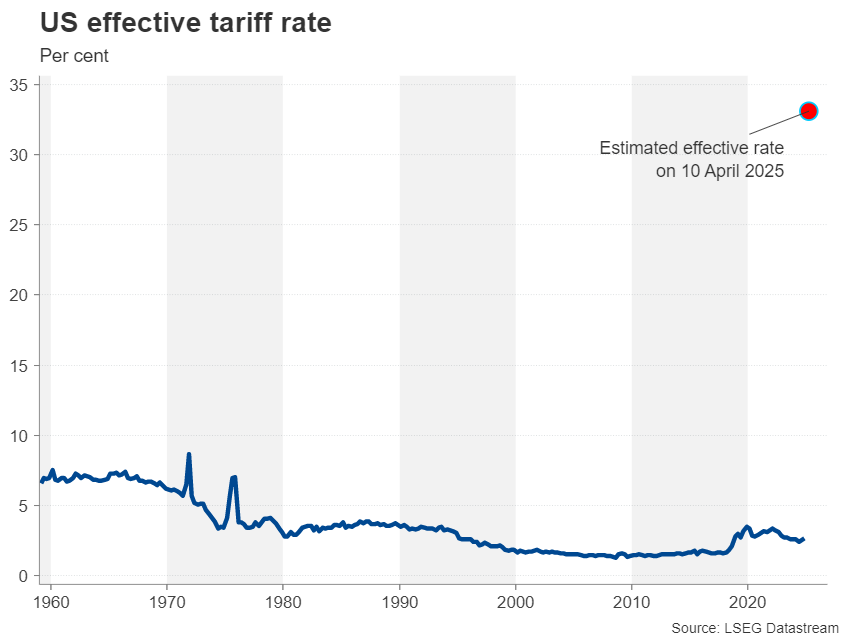
          Trump’s carrot-and-stick approach in his bid to get China onto the negotiating table isn’t proving very effective, particularly when the carrot is much smaller than the stick. For Beijing, the trade war has escalated to a level where national pride is at stake, hence, it is not blinking as easily as Trump assumed it would. This is already posing a problem for the White House, which has signalled that the Trump administration is willing to lower the exorbitant 145% tariff rate within two-three weeks if there is a deal.

          Week Ahead: US GDP, Inflation And Jobs In Focus Amid Tariff Mess – BoJ Meets_1

          But according to Chinese officials, the two sides have not even started talks, casting doubt on Trump’s negotiating tactic. Furthermore, other concessions, for example on auto tariffs for US car manufacturers, are far from a done deal, with Trump even threatening to raise them for auto imports from Canada.

          All this is only worsening the uncertainty for US businesses rather than offering some clarity. So, although the acknowledgement by the White House that it is keeping an eye on the market turbulence and Trump is keen to reach trade agreements with America’s main trading partners is a positive sign, it does little in terms of easing the immediate fears about the country’s economic prospects.

          Dollar and Wall Street on recession watch

          Those concerns will either be fuelled or reduced in the coming week, as there’s a flurry of top-tier economic releases on the way. Kicking things off on Tuesday are the consumer confidence index for April and JOLTS job openings for March. On Wednesday, the advance estimate for GDP growth will be monitored very closely amid some predictions that the US economy contracted in the first quarter.

          The Atlanta Fed’s GDPNow model is estimating an annualized drop of 2.2% in GDP, but analysts according to a Reuters poll are forecasting growth of 0.4%, down sharply from the Q4 pace of 2.4%.

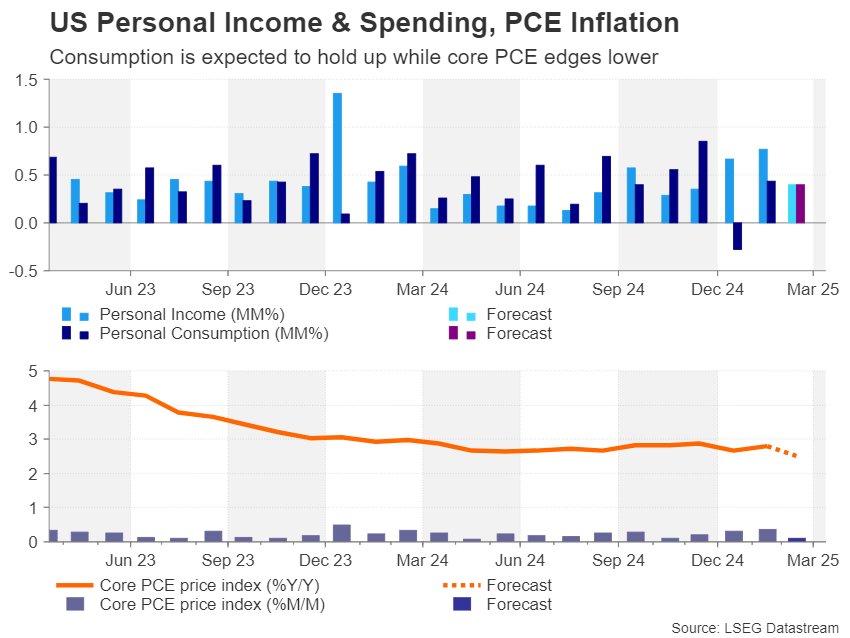
          The ADP employment survey is also out on Wednesday, along with the latest PCE inflation and consumption numbers. The all-important core PCE price index is expected to have risen by 0.1% month-on-month in March to give an annual figure of 2.5%, which would be a decrease from the prior 2.8%.

          Week Ahead: US GDP, Inflation And Jobs In Focus Amid Tariff Mess – BoJ Meets_2

          Personal consumption is forecast to have maintained month-on-month growth of 0.4%, suggesting that US households continue to spend at a healthy clip.

          Other data on Wednesday will include the Chicago PMI as well as pending home sales. On Thursday, the Challenger Layoffs for April might attract some attention but the bigger focus that day will be the ISM manufacturing PMI. The index is expected to have declined in April from 49.0 to 47.9, with investors also likely to track the direction of the employment and prices sub-indices.

          The real highlight, however, will be Friday’s nonfarm payrolls report, amid the intense speculation about how soon the Fed will cut rates. Jobs growth is projected to have slowed from 228k in March to 130k in April, with the unemployment rate staying unchanged at 4.2%. Average earnings probably grew by 0.3% in April.

          A disappointing NFP print, combined with a soft core PCE reading could bolster expectations of a 25-basis-point rate cut in June as opposed to July, though bets for the May meeting would likely remain very low. For the US dollar, a worrying set of data would almost certainly be negative, but on Wall Street, stocks could rise if increased rate cut hopes are not overshadowed by recession fears.

          BoJ to keep rates steady as outlook deteriorates

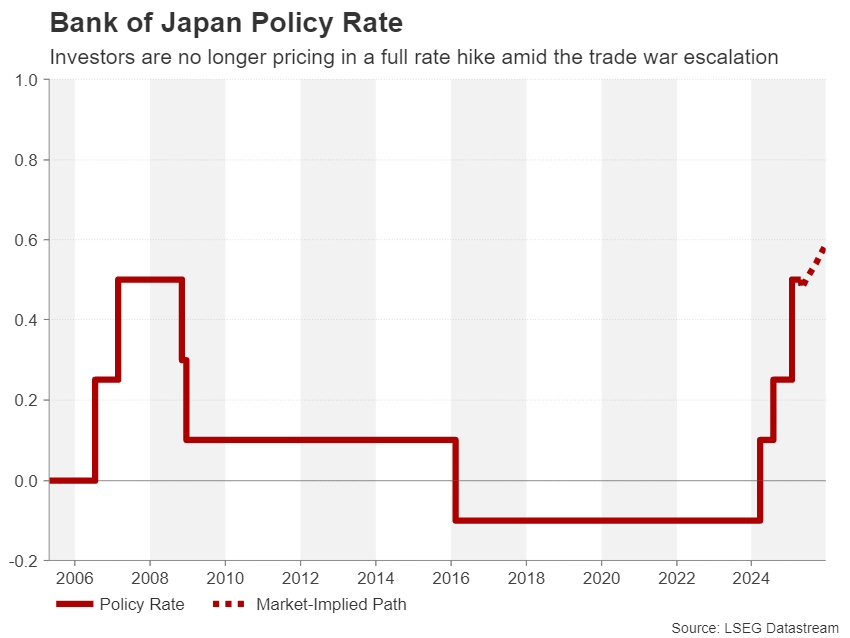
          The Bank of Japan is not anticipated to announce any changes to its monetary policy settings when it meets on Thursday, as policymakers take time to assess the impact of Donald Trump’s tariffs on the Japanese economy before deciding whether to hike interest rates again.

          Inflation in Japan edged up to 3.2% y/y in March as per the core CPI measure and the BoJ remains confident that the recent wage growth momentum is now becoming more sustainable. However, the downside risks to growth have increased markedly since February when Trump unleashed the first of many waves of tariffs, with Japan not being spared from the universal 10% levies, nor the sectoral tariffs on steel and autos.

          The BoJ is therefore expected to lower its growth forecasts in its latest quarterly Outlook Report. The question is whether the Bank will also cut its inflation projections or keep them more or less unchanged. Policymakers don’t think at this stage that tariffs pose a significant danger to their inflation goal so they will probably keep the door to future rate hikes wide open.

          Week Ahead: US GDP, Inflation And Jobs In Focus Amid Tariff Mess – BoJ Meets_3

          If Governor Ueda goes a step further and explicitly signals that further rate hikes are likely in the coming months, this could boost the yen, which is enjoying strong safe-haven demand lately.

          In terms of data, the preliminary industrial output for March is due on Wednesday, to be followed by some jobs stats on Friday.

          Euro looks to flash GDP and CPI as uptrend stalls

          The flash PMI numbers for April painted a grim picture for the Eurozone economy as businesses were hit by a new round of duties. With the impact of the US tariffs on global trade only now being felt, investors will probably ignore the preliminary GDP figures for the first quarter that are out on Wednesday.

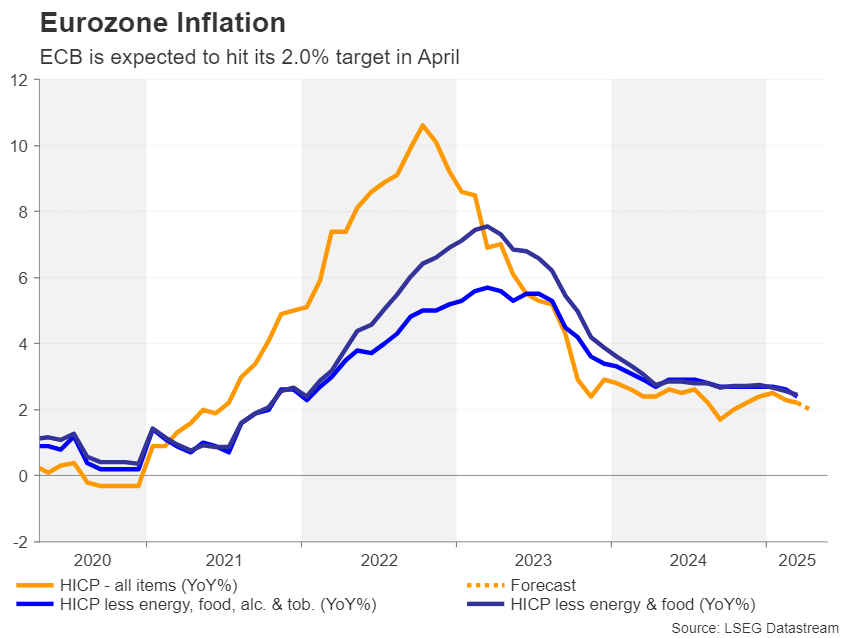
          Even if the euro area notched up impressive growth in the first three months of the year, this is unlikely to dampen rate cut expectations for the European Central Bank as inflation is falling and growth forecasts are being downgraded. ECB policymakers have already slashed rates by a total of 175 bps and have strongly hinted that they’re not done yet.

          If Friday’s flash CPI data shows that inflationary pressures continue to subside, the ECB will have little reason to pause. The headline rate of CPI moderated to 2.2% y/y in March and is forecast to ease further to 2.0% in April.

          Week Ahead: US GDP, Inflation And Jobs In Focus Amid Tariff Mess – BoJ Meets_4

          The euro could come under some pressure if the CPI prints are on the soft side, but the primary driver in the FX domain will be the US dollar, and specifically, sentiment towards Trump’s trade policies. Fresh efforts by the White House to defuse tensions could spur another bounce in the US dollar, setting back the euro’s uptrend.

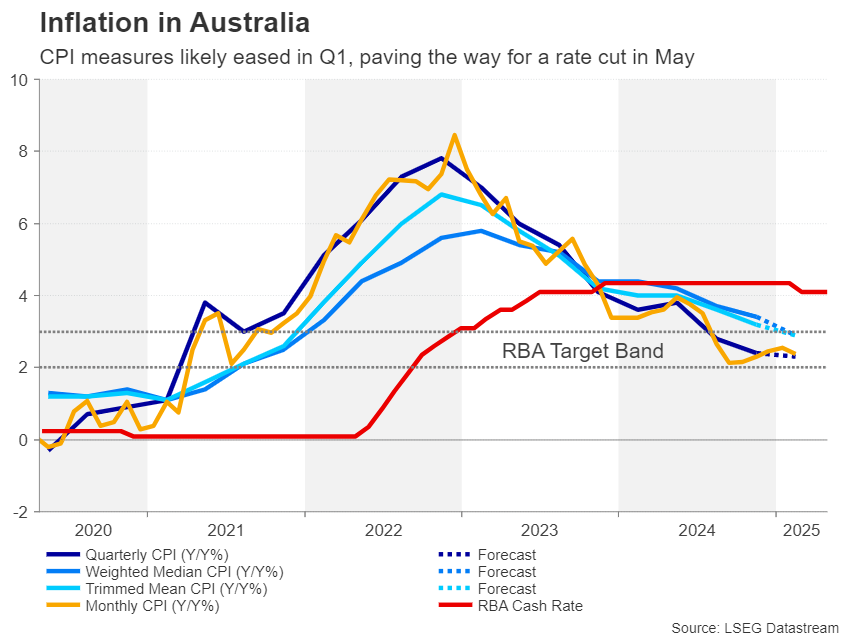
          Australian CPI may not alter RBA bets

          Inflation will also be in the spotlight in Australia where the quarterly CPI readings will be published on Wednesday. The Reserve Bank of Australia has only cut rates once during this cycle amid slow progress in getting inflation under control.

          The monthly measure dipped from 2.5% to 2.4% y/y in February in a huge relief after rising for three consecutive months. The quarterly figure covering the first three months of 2025 is expected to inch lower too. But for the RBA, the underlying gauges of CPI might be more important. If they extend their decline in Q1 and the monthly rate also falls, there would be nothing stopping the RBA from cutting rates in May.

          Week Ahead: US GDP, Inflation And Jobs In Focus Amid Tariff Mess – BoJ Meets_5

          However, this may not necessarily trigger much reaction in the Australian dollar, as a 25-bps rate cut is already fully priced in for May and for almost every other meeting in the remainder of the year.

          Aussie traders will also be watching the manufacturing PMIs out of China for any signs that the steep US levies are hurting the world’s second largest economy. Both the official and Caixin manufacturing PMIs are due on Wednesday.

          Canadians to likely pick Carney as next PM

          Canadians will be voting in a general election on Monday after former Bank of England and Bank of Canada governor Mark Carney called a snap vote following Justin Trudeau’s resignation. Carney’s Liberal party was all set to lose the election until Trump’s trade tirade reinvigorated the party among voters.

          Trudeau’s and Carney’s handling of Trump’s threats to Canada’s economy as well as its sovereignty appear to have earned them plaudits, pushing the Liberals ahead of the Conservatives, who were poised for victory before the trade war escalation.

          There’s still room for surprises, however, as the Liberals may fail to win a majority, and with their current coalition partners, the New Democratic Party, expected to lose most of its seats, a hung parliament may not go down well with Canada’s stock market and the local dollar.

          Week Ahead: US GDP, Inflation And Jobs In Focus Amid Tariff Mess – BoJ Meets_6

          But should the Liberals secure a majority, the Canadian dollar could gain slightly, although it’s likely to benefit more from a shock Conservative win, as they’ve pledged bigger tax cuts.

          Source: XM

          To stay updated on all economic events of today, please check out our Economic calendar
          Risk Warnings and Disclaimers
          You understand and acknowledge that there is a high degree of risk involved in trading. Following any strategies or investment methods may lead to potential losses. The content on the site is provided by our contributors and analysts for information purposes only. You are solely responsible for determining whether any trading assets, securities, strategy, or any other product is suitable for investing based on your own investment objectives and financial situation.
          Add to Favorites
          Share

          Markets Steady as US Yields Dip Amid Continuous Tariff Rumors

          Adam

          Stocks

          Economic

          China–U.S. Trade War

          Global financial markets are relatively stable heading into the end of the week, with risk appetite showing further signs of improvement. European equities are trading modestly higher, following rebounds seen earlier in Japan and Hong Kong. However, US futures are slightly in the red despite strong earnings reports from tech heavyweights Alphabet and Intel. Still, one supportive development is the continued pullback in US Treasury yields, with the 10-year dipping below 4.3% mark—viewed as a positive sign for US assets.
          Meanwhile, the trade war front is seeing renewed speculation, especially regarding US-China tariff relations. According to multiple media reports, China has quietly granted tariff exemptions on some US goods—including integrated circuits—previously subject to its 125% retaliatory duties. While no formal statement has been issued by Chinese authorities, there are reports of internal government consultations with foreign businesses. A list of 131 product categories is circulating on social media is believed to outline those under consideration for exemption. These steps signal a possible softening of Beijing’s stance and a willingness to preserve critical supply chains.
          Meanwhile, US President Donald Trump told Time magazine that China is actively engaging in talks with Washington to strike a tariff deal, and claimed that President Xi Jinping had recently called him. However, China’s Foreign Ministry declined to comment on Trump’s statement and previously warned the US to stop “misleading the public” about the status of bilateral negotiations. The conflicting narratives underscore the fog of uncertainty surrounding trade diplomacy, though market participants appear cautiously hopeful that both sides are seeking a path to de-escalation.
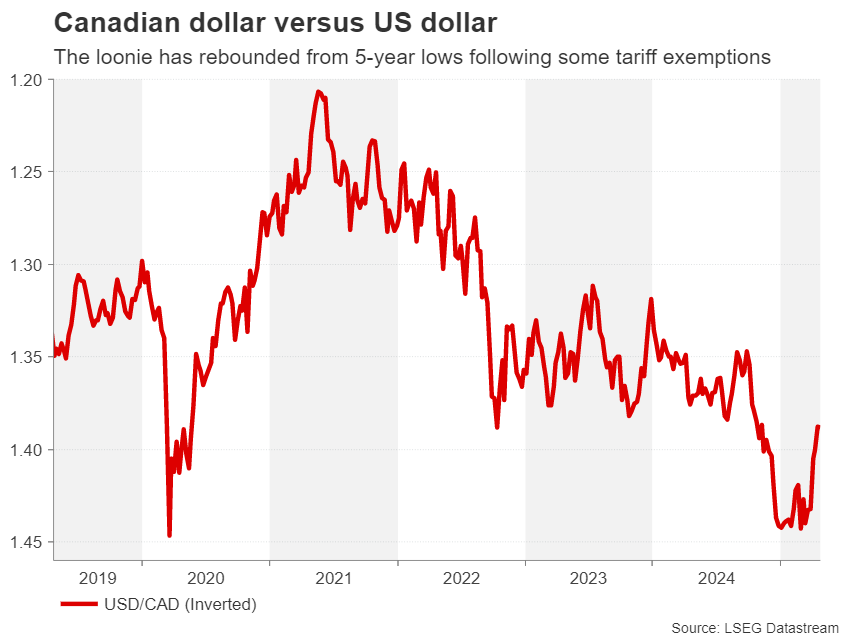
          In the currency markets, the week’s performance leaderboard remains largely unchanged. Kiwi is holding firmly at the top. Sterling and Aussie are also among the week’s better performers. On the other end of the spectrum, Swiss franc, Japanese Yen, and Euro are lagging—reflecting fading safe-haven demand. Dollar and Loonie sit in the middle.
          In Europe, at the time of writing, FTSE is up 0.28%. DAX is up 0.87%. CAC is up 0.65%. UK 10-year yield is down -0.021 at 4.482. Germany 10-year yield is up 0.018 at 2.471. Earlier in Asia, Nikkei rose 1.90%. Hong Kong HSI rose 0.32%. China Shanghai SSE fell -0.07%. Singapore Strait Times fell -0.21%. Japan 10-year JGB yield rose 0.03 to 1.34.

          Canada retail sales fall -0.4% mom in Feb, but core spending offers rebound hopes

          Canadian retail sales declined by -0.4% mom to CAD 69.3B in February, in line with market expectations. The overall weakness was driven primarily by a -2.6%mom drop in motor vehicle and parts dealers, with all four store categories in the subsector posting declines.
          However, beneath the surface, the data showed encouraging signs. Core retail sales—which exclude fuel and vehicle-related sales—rose by 0.5% mom.
          Looking ahead, Statistics Canada’s advance estimate points to a 0.7% mom increase in total sales for March.

          SNB’s Schlegel: Growth may miss forecasts due to trade uncertainty

          Swiss National Bank Chairman Martin Schlegel warned at the central bank’s annual general meeting that high levels of trade policy uncertainty continue to cloud the economic outlook.
          “It remains very uncertain how inflation and the economy in Switzerland will develop,” Schlegel said, adding that “an economic slowdown cannot be ruled out.”
          Growth forecasts are already under pressure, with SNB’s March projection of 1% to 1.5% GDP growth this year falling below Switzerland’s long-term average of 1.8%.
          Schlegel reiterated that SNB stands ready to adjust policy if needed, including interest rate changes and foreign exchange interventions. However, he acknowledged the limits of monetary policy in addressing deeper structural uncertainty.
          “Price stability cannot prevent trade policy uncertainty,” he cautioned, but emphasized that maintaining stable prices provides an essential foundation for the broader economy.

          UK retail sales rise 0.4% mom in March, 1.6% qoq in Q1

          UK retail sales surprised to the upside in March, rising by 0.4% mom, defying market expectations for a -0.3% mom decline.
          The unexpected strength was attributed largely to favorable weather conditions, which lifted sales at clothing and outdoor retailers. However, this gain was partially offset by weaker performance at supermarkets.
          Looking beyond the monthly figure, the broader quarterly performance painted an encouraging picture of consumer resilience. Retail sales volumes grew by 1.6% qoq 1.7% yoy in Q1. These results indicate that UK consumers remain relatively active despite broader economic uncertainties.

          Tokyo CPI core surges to 3.4% in April, strengthening case for BoJ June hike

          Inflation in Japan’s capital city surged in April, with Tokyo core CPI (excluding food) accelerating from 2.4% yoy to 3.4% yoy, above the 3.2% yoy forecast. The more domestically focused core-core measure (excluding food and energy) also rose sharply, from 2.2% yoy to 3.1% yoy. Headline CPI jumped from 2.9% yoy to 3.5% yoy.
          Despite the upside surprise, BoJ is still expected to hold rates steady at its May 1 policy meeting as it gauges the broader impact of recent US tariffs and awaits progress in ongoing trade negotiations. However, with inflation gathering pace across key categories, market expectations are shifting toward a rate hike as soon as June.

          USD/CHF Mid-Day Outlook

          USD/CHF’s corrective recovery from 0.8038 is still in progress and intraday bias stays on the upside. Further rise would be seen but upside should be limited by 38.2% retracement of 0.9200 to 0.8038 at 0.8482. On the downside, below 0.8196 minor support will bring retest of 0.8038. Firm break there will resume larger down trend.
          Markets Steady as US Yields Dip Amid Continuous Tariff Rumors_1
          In the bigger picture, long term down trend from 1.0342 (2017 high) is still in progress and met 61.8% projection of 1.0146 (2022 high) to 0.8332 from 0.9200 at 0.8079 already. In any case, outlook will stay bearish as long as 55 W EMA (now at 0.8794) holds. Sustained break of 0.8079 will target 100% projection at 0.7382.
          Markets Steady as US Yields Dip Amid Continuous Tariff Rumors_2

          source : actionforex

          To stay updated on all economic events of today, please check out our Economic calendar
          Risk Warnings and Disclaimers
          You understand and acknowledge that there is a high degree of risk involved in trading. Following any strategies or investment methods may lead to potential losses. The content on the site is provided by our contributors and analysts for information purposes only. You are solely responsible for determining whether any trading assets, securities, strategy, or any other product is suitable for investing based on your own investment objectives and financial situation.
          Add to Favorites
          Share

          Inflation job nearly done but tariff risks loom — What European Central Bank members said this week

          Adam

          Central Bank

          Economic

          China–U.S. Trade War

          After years dominated by the pandemic, supply chains, energy and inflation, there was a new topic topping the agenda at the World Bank and International Monetary Fund’s Spring Meetings this year: tariffs.
          The IMF set the tone by kicking off the week with the release of its latest economic forecasts, which cut growth outlooks for the U.S., U.K. and many Asian countries. While economists, central bankers and politicians have been engaged in panels and behind-the-scenes talks, many are attempting to work out whether trade tensions between China and the U.S. are — or perhaps are not — cooling.
          Policymakers from the European Central Bank that CNBC spoke to this week broadly stuck a dovish-leaning tone, indicating they saw interest rates continuing to fall and few upside risks to euro zone inflation. However, all stressed the current high levels of uncertainty, the need to keep monitoring data, and the high risks to the growth outlook — sentiments also echoed by Bank of England Governor Andrew Bailey in his interview with CNBC on Thursday.
          These were some of the main messages from ECB members this week.

          Christine Lagarde, European Central Bank president

          On inflation and monetary policy:

          “We’re heading towards our [inflation] target in the course of 2025, so that disinflationary process is so much on track that we are nearing completion. But we have the shocks, you know, and the shocks will be a dampen on GDP. It’s a negative shock to demand.”
          “The net impact on inflation will depend on what countermeasures are eventually taken by Europe. Then we have to take into account the [German] fiscal push by the defense investments, by the infrastructure fund.”
          “We have seen successive movements, you know, announcement [of U.S. tariffs], and then a pause, and then some exemptions. So we have to be very attentive... Either we cut, either we pause, but we will be data dependent to the extreme.”

          On market moves:

          “When we had done our projections, we anticipated that... the dollar would appreciate, the euro would depreciate. It’s not what we saw. And there have been some counter-intuitive movements in various categories.”
          “The German market has obviously been shocked in a positive way by the program soon to be put in place by the German government, with a commitment to defense, with a commitment to a big fund for infrastructure development.”

          Klaas Knot, The Netherlands Bank president

          On tariff uncertainty:

          “If I look back over the last 14 years, in the initial days of the pandemic I think that was comparable uncertainty to what we have now.”
          “In the short run, it’s crystal clear that the uncertainty that is created by the unpredictability of the tariff actions by the U.S. government works as a strong negative factor for growth. Basically, uncertainty is like a tax without revenue.”

          On the inflation impact:

          “In the short run, we will have lower growth. We will probably also have lower inflation. As we also see, the euro is appreciating as energy prices have also come down. So together with the sort of negative factor uncertainty in the short run, it’s crystal clear that it will accelerate the disinflation.”
          “But in the medium term, the inflation outlook is not all that clear. I think there are still these negative factors. But in the medium term, you might get retaliation. You might get the disruption of global value chains, which might also be inflationary in other parts of the world than the U.S. only. And then, of course, we have the fiscal policy coming in in Europe. So this is actually a time in which you need projections.”

          On a June rate cut and market pricing for two more ECB rate cuts in 2025:

          “I’m fully open minded. I think it’s way too early to already take a position on June, whether it would be another cut. It will fully depend on these projections.”
          “I would need to see a more structured analysis of the impact on the inflation profile ahead of us, and only then can I say whether the market is pricing fair or whether I don’t.”

          Robert Holzmann, Austrian National Bank governor

          On the need to wait for more data and news on tariffs:

          “We have not seen this uncertainty now for years... unless the uncertainty subsides, by the right decisions, we will have to hold back a number of our decisions, and hence, we don’t know yet in what direction monetary policy should be best moved.”
          “Before looking at data in detail, the question is, what kind of political decisions will be taken? Is it that we will have some tariff increases? Is it that we will have strong tariff increases? Is it that we will have retribution by high counter tariffs?”

          On the ECB’s April rate cut:

          “I think there’s a broad consensus [on rates]. But of course, at the margin, people differ.”
          “My assessment is that at this time, it wasn’t clear yet to what extent [tariff] countermeasures were being taken. Because with countermeasures in Europe, prices may have increased. Without countermeasures, quite likely the price pressure is downward. And for the time being, we don’t know yet the direction.”

          On the direction of interest rates:

          “I think if the recent noises about an arrangement [on trade] were to be true, in this case, quite likely it is more towards the downside than the upside with regard to prices. But this can be changed with different decisions and the result of which, we may even imagine in [the] other direction. For the time being, no, it will be down.”
          “There may be further cuts this year, but the number is still outstanding.”

          Mārtiņš Kazāks, Bank of Latvia governor

          On opportunity from tariffs:

          “With all this uncertainty and vulnerability, this is also the time of opportunities for Europe.”
          “It’s a time for Europe to grasp all the aspects of being an economic superpower and becoming a really fully-fledged political and geopolitical superpower, and this requires doing all the decisions that in the past, were not carried out fully.”
          “This requires political will, political guts to make those decisions, and to strengthen the European economy and assert its place in a global world.”

          On market reaction to tariffs:

          “So far it seems to be relatively orderly ... but if one looks at the spillovers to Europe, the financial markets are working more or less fine, we haven’t seen spreads exploding or anything like that.”
          “But in terms, however, of the macro scenarios, this uncertainty is extremely elevated in the sense that, given the possible outcomes, the multiple scenarios and their probabilities are very similar with the baseline [tariff] scenario.”

          Source: cnbc

          To stay updated on all economic events of today, please check out our Economic calendar
          Risk Warnings and Disclaimers
          You understand and acknowledge that there is a high degree of risk involved in trading. Following any strategies or investment methods may lead to potential losses. The content on the site is provided by our contributors and analysts for information purposes only. You are solely responsible for determining whether any trading assets, securities, strategy, or any other product is suitable for investing based on your own investment objectives and financial situation.
          Add to Favorites
          Share

          Michigan Consumer Sentiment Drops to 52.2, Beating Analyst Expectations

          Michelle

          Economic

          Forex

          Stocks

          On April 25, 2025, the University of Michigan released the final reading of Michigan Consumer Sentiment report for April. The report indicated that Consumer Sentiment decreased from 57.0 in March to 52.2 in April, compared to analyst forecast of 50.8.

          Current Economic Conditions declined from 63.8 in March to 59.8 in April, while Index of Consumer Expectations pulled back from 52.6 to 47.3.

          Year-ahead inflation expectations increased from 5.0% in March to 6.5% in April, reaching the highest level since 1981. Long-run inflation expectations grew from 4.1% to 4.4%.

          The University of Michigan commented: “Consumers perceived risks to multiple aspects of the economy, in large part due to ongoing uncertainty around trade policy and the potential for a resurgence of inflation looming ahead.”

          U.S. Dollar Index settled near the 99.60 level as traders reacted to Consumer Sentiment data. The Index remains stuck below the psychologically important 100.00 level amid tariff uncertainty.

          Gold settled near session lows at $3285 after the release of the report. Gold traders continue to take profits after the strong rally.

          SP500 gained some ground after the release of the better-than-expected Michigan Consumer Sentiment report. Currently, SP500 is trying to settle above the 5500 level. Traders stay bullish amid hopes for a trade deal between the U.S. and China.

          Source: FX Empire

          To stay updated on all economic events of today, please check out our Economic calendar
          Risk Warnings and Disclaimers
          You understand and acknowledge that there is a high degree of risk involved in trading. Following any strategies or investment methods may lead to potential losses. The content on the site is provided by our contributors and analysts for information purposes only. You are solely responsible for determining whether any trading assets, securities, strategy, or any other product is suitable for investing based on your own investment objectives and financial situation.
          Add to Favorites
          Share

          Asia-Pacific Growth Outlook Cut as Trade Tensions and Global Uncertainty Mount

          Gerik

          Economic

          World Bank and IMF align on downward revision

          On April 24, the World Bank (WB) and the International Monetary Fund (IMF) jointly revised their growth forecasts for the Asia–Pacific region, citing mounting global trade frictions, weakening demand, and structural vulnerabilities. According to the WB’s latest East Asia and Pacific economic update, regional growth is now projected at 4.0% for 2025, down from 5.0% in 2024. The IMF’s revision is even sharper, cutting its outlook for 2025 to 3.9%—a 0.5 percentage point drop from its previous forecast and the steepest revision since the COVID-19 pandemic.
          These parallel downgrades reflect a clear correlation between rising global protectionism and weakening regional investment, consumption, and export performance. The synchronized nature of the revisions signals a structural shift rather than a temporary cyclical dip.

          Trade-based growth model under pressure

          At the heart of the slowdown is Asia’s heavy reliance on open trade and global supply chain integration. According to the IMF, Asia contributed nearly 60% of global growth in 2024, making its current deceleration particularly concerning. However, the traditional model—built on export-driven momentum and liberalized trade regimes—is showing signs of fatigue amid tighter financial conditions and growing geopolitical uncertainty.
          Both institutions underscore that declining global demand, rising trade barriers, and financial tightening have significantly constrained the region’s external growth engines. This suggests a causal relationship: as external trade shrinks, Asia’s high-growth economies face constrained fiscal space and productivity pressures, especially in aging societies and economies with limited domestic consumption bases.

          Divergent outlooks between emerging and advanced economies

          The IMF’s breakdown reveals a more granular picture: growth in advanced economies in the region is forecast to slow to just 1.2% in 2025, a significant 0.7 percentage point downgrade. Meanwhile, emerging and developing economies are expected to grow at a more robust 4.5%, but this too marks a 0.5 percentage point decrease. The broad-based nature of these revisions—across income levels and country profiles—suggests that no segment of the region is fully insulated from the global downturn.
          The divergence between advanced and emerging Asia illustrates both a correlation and contrast in economic resilience. Advanced economies, more exposed to global capital markets and trade volatility, are suffering sharper slowdowns. In contrast, developing economies retain more momentum but remain vulnerable to structural constraints such as aging demographics and underdeveloped consumer markets.
          Policy response: From export dependency to balanced growth
          To counter these headwinds, both the WB and IMF are urging governments to pivot toward more balanced growth models. Key recommendations include investing in productivity-enhancing technologies, promoting domestic demand, and diversifying export markets. The WB highlights reform progress in Malaysia and Thailand, where new technologies are being integrated into labor markets, and in Vietnam, where service-sector competition is being liberalized.
          The IMF, meanwhile, emphasizes regional integration and resilience through agreements like RCEP, which could enhance intra-Asian trade in goods, services, and digital economy sectors. Such frameworks could also help harmonize regulatory standards, creating buffers against future global shocks.
          This reflects a strategic shift: rather than waiting for global demand to recover, Asia is being advised to build internally driven and more shock-resilient economies.

          Navigating fragility with reform and regional cooperation

          The 2025 growth downgrades by both the World Bank and IMF mark a sobering moment for Asia–Pacific policymakers. While not yet signaling a regional recession, the downward momentum reveals that structural shifts—both global and internal—are weakening Asia’s traditional growth foundations.
          To preserve long-term growth, governments must rethink dependence on export-led development, strengthen domestic demand engines, and invest in cross-border frameworks that support economic integration and stability. In a post-globalization world of rising uncertainty, the region’s future resilience will depend not just on reactive policy, but on proactive structural transformation.

          Source: IMF

          To stay updated on all economic events of today, please check out our Economic calendar
          Risk Warnings and Disclaimers
          You understand and acknowledge that there is a high degree of risk involved in trading. Following any strategies or investment methods may lead to potential losses. The content on the site is provided by our contributors and analysts for information purposes only. You are solely responsible for determining whether any trading assets, securities, strategy, or any other product is suitable for investing based on your own investment objectives and financial situation.
          Add to Favorites
          Share
          FastBull
          Copyright © 2025 FastBull Ltd

          728 RM B 7/F GEE LOK IND BLDG NO 34 HUNG TO RD KWUN TONG KLN HONG KONG

          TelegramInstagramTwitterfacebooklinkedin
          App Store Google Play Google Play
          Products
          Charts

          Chats

          Q&A with Experts
          Screeners
          Economic Calendar
          Data
          Tools
          Membership
          Features
          Function
          Markets
          Copy Trading
          Latest Signals
          Contests
          News
          Analysis
          24/7
          Columns
          Education
          Company
          Careers
          About Us
          Contact Us
          Advertising
          Help Center
          Feedback
          User Agreement
          Privacy Policy
          Business

          White Label

          Data API

          Web Plug-ins

          Poster Maker

          Affiliate Program

          Risk Disclosure

          The risk of loss in trading financial instruments such as stocks, FX, commodities, futures, bonds, ETFs and crypto can be substantial. You may sustain a total loss of the funds that you deposit with your broker. Therefore, you should carefully consider whether such trading is suitable for you in light of your circumstances and financial resources.

          No decision to invest should be made without thoroughly conducting due diligence by yourself or consulting with your financial advisors. Our web content might not suit you since we don't know your financial conditions and investment needs. Our financial information might have latency or contain inaccuracy, so you should be fully responsible for any of your trading and investment decisions. The company will not be responsible for your capital loss.

          Without getting permission from the website, you are not allowed to copy the website's graphics, texts, or trademarks. Intellectual property rights in the content or data incorporated into this website belong to its providers and exchange merchants.

          Not Logged In

          Log in to access more features

          FastBull Membership

          Not yet

          Purchase

          Become a signal provider
          Help Center
          Customer Service
          Dark Mode
          Price Up/Down Colors

          Log In

          Sign Up

          Position
          Layout
          Fullscreen
          Default to Chart
          The chart page opens by default when you visit fastbull.com