• Trade
  • Markets
  • Copy
  • Contests
  • News
  • 24/7
  • Calendar
  • Q&A
  • Chats
Trending
Screeners
SYMBOL
LAST
BID
ASK
HIGH
LOW
NET CHG.
%CHG.
SPREAD
SPX
S&P 500 Index
6827.42
6827.42
6827.42
6899.86
6801.80
-73.58
-1.07%
--
DJI
Dow Jones Industrial Average
48458.04
48458.04
48458.04
48886.86
48334.10
-245.98
-0.51%
--
IXIC
NASDAQ Composite Index
23195.16
23195.16
23195.16
23554.89
23094.51
-398.69
-1.69%
--
USDX
US Dollar Index
97.950
98.030
97.950
98.500
97.950
-0.370
-0.38%
--
EURUSD
Euro / US Dollar
1.17394
1.17409
1.17394
1.17496
1.17192
+0.00011
+ 0.01%
--
GBPUSD
Pound Sterling / US Dollar
1.33707
1.33732
1.33707
1.33997
1.33419
-0.00148
-0.11%
--
XAUUSD
Gold / US Dollar
4299.39
4299.39
4299.39
4353.41
4257.10
+20.10
+ 0.47%
--
WTI
Light Sweet Crude Oil
57.233
57.485
57.233
58.011
56.969
-0.408
-0.71%
--

Community Accounts

Signal Accounts
--
Profit Accounts
--
Loss Accounts
--
View More

Become a signal provider

Sell trading signals to earn additional income

View More

Guide to Copy Trading

Get started with ease and confidence

View More

Signal Accounts for Members

All Signal Accounts

Best Return
  • Best Return
  • Best P/L
  • Best MDD
Past 1W
  • Past 1W
  • Past 1M
  • Past 1Y

All Contests

  • All
  • Trump Updates
  • Recommend
  • Stocks
  • Cryptocurrencies
  • Central Banks
  • Featured News
Top News Only
Share

Ukraine's Navy Says Russian Drone Attack Hit Civilian Turkish Vessel Carrying Sunflower Oil To Egypt On Saturday

Share

Israeli Military Says It Put Planned Strike On South Lebanon Site On Hold After Lebanese Army Requested Access

Share

Norwegian Nobel Committee: Calls On The Belarusian Authorities To Release All Political Prisoners

Share

Norwegian Nobel Committee: His Freedom Is A Deeply Welcome And Long-Awaited Moment

Share

Ukraine Says It Received 114 Prisoners From Belarus

Share

USA Embassy In Lithuania: Maria Kalesnikava Is Not Going To Vilnius

Share

USA Embassy In Lithuania: Other Prisoners Are Being Sent From Belarus To Ukraine

Share

Ukraine President Zelenskiy: Five Ukrainians Released By Belarus In US-Brokered Deal

Share

USA Vilnius Embassy: USA Stands Ready For "Additional Engagement With Belarus That Advances USA Interests"

Share

USA Vilnius Embassy: Belarus, USA, Other Citizens Among The Prisoners Released Into Lithuania

Share

USA Vilnius Embassy: USA Will Continue Diplomatic Efforts To Free The Remaining Political Prisoners In Belarus

Share

USA Vilnius Embassy: Belarus Releases 123 Prisoners Following Meeting Of President Trump's Envoy Coale And Belarus President Lukashenko

Share

USA Vilnius Embassy: Masatoshi Nakanishi, Aliaksandr Syrytsa Are Among The Prisoners Released By Belarus

Share

USA Vilnius Embassy: Maria Kalesnikava And Viktor Babaryka Are Among The Prisoners Released By Belarus

Share

USA Vilnius Embassy: Nobel Peace Prize Laureate Ales Bialiatski Is Among The Prisoners Released By Belarus

Share

Belarusian Presidential Administration Telegram Channel: Lukashenko Has Pardoned 123 Prisoners As Part Of Deal With US

Share

Two Local Syrian Officials: Joint US-Syrian Military Patrol In Central Syria Came Under Fire From Unknown Assailants

Share

Israeli Military Says It Targeted 'Key Hamas Terrorist' In Gaza City

Share

Rwanda's Actions In Eastern Drc Are A Clear Violation Of Washington Accords Signed By President Trump - Secretary Of State Rubio

Share

Israeli Military Issues Evacuation Warning In Southern Lebanon Village Ahead Of Strike - Spokesperson On X

TIME
ACT
FCST
PREV
U.K. Trade Balance Non-EU (SA) (Oct)

A:--

F: --

P: --

U.K. Trade Balance (Oct)

A:--

F: --

P: --

U.K. Services Index MoM

A:--

F: --

P: --

U.K. Construction Output MoM (SA) (Oct)

A:--

F: --

P: --

U.K. Industrial Output YoY (Oct)

A:--

F: --

P: --

U.K. Trade Balance (SA) (Oct)

A:--

F: --

P: --

U.K. Trade Balance EU (SA) (Oct)

A:--

F: --

P: --

U.K. Manufacturing Output YoY (Oct)

A:--

F: --

P: --

U.K. GDP MoM (Oct)

A:--

F: --

P: --

U.K. GDP YoY (SA) (Oct)

A:--

F: --

P: --

U.K. Industrial Output MoM (Oct)

A:--

F: --

P: --

U.K. Construction Output YoY (Oct)

A:--

F: --

P: --

France HICP Final MoM (Nov)

A:--

F: --

P: --

China, Mainland Outstanding Loans Growth YoY (Nov)

A:--

F: --

P: --

China, Mainland M2 Money Supply YoY (Nov)

A:--

F: --

P: --

China, Mainland M0 Money Supply YoY (Nov)

A:--

F: --

P: --

China, Mainland M1 Money Supply YoY (Nov)

A:--

F: --

P: --

India CPI YoY (Nov)

A:--

F: --

P: --

India Deposit Gowth YoY

A:--

F: --

P: --

Brazil Services Growth YoY (Oct)

A:--

F: --

P: --

Mexico Industrial Output YoY (Oct)

A:--

F: --

P: --

Russia Trade Balance (Oct)

A:--

F: --

P: --

Philadelphia Fed President Henry Paulson delivers a speech
Canada Building Permits MoM (SA) (Oct)

A:--

F: --

P: --

Canada Wholesale Sales YoY (Oct)

A:--

F: --

P: --

Canada Wholesale Inventory MoM (Oct)

A:--

F: --

P: --

Canada Wholesale Inventory YoY (Oct)

A:--

F: --

P: --

Canada Wholesale Sales MoM (SA) (Oct)

A:--

F: --

P: --

Germany Current Account (Not SA) (Oct)

A:--

F: --

P: --

U.S. Weekly Total Rig Count

A:--

F: --

P: --

U.S. Weekly Total Oil Rig Count

A:--

F: --

P: --

Japan Tankan Large Non-Manufacturing Diffusion Index (Q4)

--

F: --

P: --

Japan Tankan Small Manufacturing Outlook Index (Q4)

--

F: --

P: --

Japan Tankan Large Non-Manufacturing Outlook Index (Q4)

--

F: --

P: --

Japan Tankan Large Manufacturing Outlook Index (Q4)

--

F: --

P: --

Japan Tankan Small Manufacturing Diffusion Index (Q4)

--

F: --

P: --

Japan Tankan Large Manufacturing Diffusion Index (Q4)

--

F: --

P: --

Japan Tankan Large-Enterprise Capital Expenditure YoY (Q4)

--

F: --

P: --

U.K. Rightmove House Price Index YoY (Dec)

--

F: --

P: --

China, Mainland Industrial Output YoY (YTD) (Nov)

--

F: --

P: --

China, Mainland Urban Area Unemployment Rate (Nov)

--

F: --

P: --

Saudi Arabia CPI YoY (Nov)

--

F: --

P: --

Euro Zone Industrial Output YoY (Oct)

--

F: --

P: --

Euro Zone Industrial Output MoM (Oct)

--

F: --

P: --

Canada Existing Home Sales MoM (Nov)

--

F: --

P: --

Euro Zone Total Reserve Assets (Nov)

--

F: --

P: --

U.K. Inflation Rate Expectations

--

F: --

P: --

Canada National Economic Confidence Index

--

F: --

P: --

Canada New Housing Starts (Nov)

--

F: --

P: --

U.S. NY Fed Manufacturing Employment Index (Dec)

--

F: --

P: --

U.S. NY Fed Manufacturing Index (Dec)

--

F: --

P: --

Canada Core CPI YoY (Nov)

--

F: --

P: --

Canada Manufacturing Unfilled Orders MoM (Oct)

--

F: --

P: --

Canada Manufacturing New Orders MoM (Oct)

--

F: --

P: --

Canada Core CPI MoM (Nov)

--

F: --

P: --

Canada Manufacturing Inventory MoM (Oct)

--

F: --

P: --

Canada CPI YoY (Nov)

--

F: --

P: --

Canada CPI MoM (Nov)

--

F: --

P: --

Canada CPI YoY (SA) (Nov)

--

F: --

P: --

Canada Core CPI MoM (SA) (Nov)

--

F: --

P: --

Q&A with Experts
    • All
    • Chatrooms
    • Groups
    • Friends
    Connecting
    .
    .
    .
    Type here...
    Add Symbol or Code

      No matching data

      All
      Trump Updates
      Recommend
      Stocks
      Cryptocurrencies
      Central Banks
      Featured News
      • All
      • Russia-Ukraine Conflict
      • Middle East Flashpoint
      • All
      • Russia-Ukraine Conflict
      • Middle East Flashpoint
      Search
      Products

      Charts Free Forever

      Chats Q&A with Experts
      Screeners Economic Calendar Data Tools
      Membership Features
      Data Warehouse Market Trends Institutional Data Policy Rates Macro

      Market Trends

      Market Sentiment Order Book Forex Correlations

      Top Indicators

      Charts Free Forever
      Markets

      News

      News Analysis 24/7 Columns Education
      From Institutions From Analysts
      Topics Columnists

      Latest Views

      Latest Views

      Trending Topics

      Top Columnists

      Latest Update

      Signals

      Copy Rankings Latest Signals Become a signal provider AI Rating
      Contests
      Brokers

      Overview Brokers Assessment Rankings Regulators News Claims
      Broker listing Forex Brokers Comparison Tool Live Spread Comparison Scam
      Q&A Complaint Scam Alert Videos Tips to Detect Scam
      More

      Business
      Events
      Careers About Us Advertising Help Center

      White Label

      Data API

      Web Plug-ins

      Affiliate Program

      Awards Institution Evaluation IB Seminar Salon Event Exhibition
      Vietnam Thailand Singapore Dubai
      Fans Party Investment Sharing Session
      FastBull Summit BrokersView Expo
      Recent Searches
        Top Searches
          Markets
          News
          Analysis
          User
          24/7
          Economic Calendar
          Education
          Data
          • Names
          • Latest
          • Prev

          View All

          No data

          Scan to Download

          Faster Charts, Chat Faster!

          Download App
          English
          • English
          • Español
          • العربية
          • Bahasa Indonesia
          • Bahasa Melayu
          • Tiếng Việt
          • ภาษาไทย
          • Français
          • Italiano
          • Türkçe
          • Русский язык
          • 简中
          • 繁中
          Open Account
          Search
          Products
          Charts Free Forever
          Markets
          News
          Signals

          Copy Rankings Latest Signals Become a signal provider AI Rating
          Contests
          Brokers

          Overview Brokers Assessment Rankings Regulators News Claims
          Broker listing Forex Brokers Comparison Tool Live Spread Comparison Scam
          Q&A Complaint Scam Alert Videos Tips to Detect Scam
          More

          Business
          Events
          Careers About Us Advertising Help Center

          White Label

          Data API

          Web Plug-ins

          Affiliate Program

          Awards Institution Evaluation IB Seminar Salon Event Exhibition
          Vietnam Thailand Singapore Dubai
          Fans Party Investment Sharing Session
          FastBull Summit BrokersView Expo

          Drug Price Cuts: What Is Trump Planning and What Will It Mean for Big Pharma?

          Warren Takunda

          Economic

          Summary:

          President has directed Robert Kennedy to send price targets to industry, with slimming drugs thought to be included

          Donald Trump has used his executive powers to order sweeping cuts to the price of prescription drugs in the US, in an effort to bring them in line with other developed countries.
          The plans, first announced in a social media post on Sunday, triggered a sharp fall in drugmakers’ share prices on Monday. However, these later reversed amid growing scepticism that the shake-up would be as severe as promised.

          What is Trump proposing?

          His order directs the US health secretary, Robert Kennedy, to send price targets to the pharmaceutical industry and kick off a round of negotiations within 30 days to reduce prices from their current levels. The US currently pays by far the most for its medications.
          If talks hit an impasse, Kennedy is instructed to enforce the “most favoured nation” pricing model and limit US prices to the lowest rates paid by other wealthy countries. At a press conference, the US president said this would amount to price cuts of between 59% and 90%.
          Health officials said that, unlike a similar push in Trump’s first term, the new policy would target not just Medicare, the US government-funded programme that covers people aged 65 and older, but also Medicaid, for people on low incomes, and treatments covered by private health insurance.
          Officials also said it was fair to assume that slimming drugs known as GLP-1s, such as Wegovy, Ozempic and Zepbound, would be included. Trump mentioned the “fat shot drug” and said he had become aware of the huge price differences when a businessman told him he had bought Ozempic for $88 (£67) in London, but was paying $1,300 for it in New York.

          Haven’t we been here before?

          Trump’s attempts during the final months of his first term to bring down drug prices were struck down in federal court. That “most favoured nation” plan would have tied reimbursements for 50 drugs by Medicare to the lowest prices paid by certain other countries.
          A federal judge blocked the move after ruling that the administration had failed to give the public a chance to comment. The Biden administration dropped the proposal under pressure from hospitals and drug companies, but last year Medicare started negotiating some prices for the first time, under the Inflation Reduction Act.

          How would the scheme work in practice?

          There is not a lot of detail in the executive order and it is unclear what impact, if any, it would have on millions of Americans with private health insurance. The federal government has the most power to influence the prices of drugs covered by Medicare and Medicaid.
          Experts said the new policy kept pressure on pharmacy benefits managers (PMBs), the “middlemen” such as Cigna, CVS and UnitedHealth that negotiate drug prices with pharma companies in the US. The White House wants drugmakers to sell more products directly to patients.
          The main US lobby group, the Pharmaceutical Research and Manufacturers of America (PhMRA), said the US was the only country in the world that let PMBs, insurers and hospitals take 50% of every dollar spent on medicines, and that the amount going to middlemen often exceeded the price in Europe. “Giving this money directly to patients will lower their medicine costs and significantly reduce the gap with European prices,” it said.
          The pharmaceutical industry is likely to push back hard against the proposed shake-up. The US health policy research group KFF told NBC News it “would expect the drug industry to throw every legal argument at this proposal”. However, AstraZeneca and the Wegovy and Ozempic maker, Novo Nordisk, struck a conciliatory note, saying they would engage with policymakers.

          What impact could it have?

          The Medicare and Medicaid programmes together account for two-fifths of US drug sales. Analysts at UBS have calculated that European drugmakers could see an average hit of 6% to profits if “most favoured nation” prices are introduced on the top 50 drugs in the US, while US companies would face a 10% drop.
          Bristol Myers Squibb and Pfizer would be worst-hit among the US pharma companies and Eli Lilly least-affected, while in Europe AstraZeneca and Novo Nordisk would take the brunt and GSK and Sanofi would suffer the least.
          PhRMA has warned that the planned price cuts would “jeopardise the hundreds of billions [of dollars that] our member companies are planning to invest in America”. Profits from US drugs prices have long helped fund the development of new treatments used around the world.
          In recent weeks big pharma companies have announced a spate of big investments, adding up to close to $200bn, as they sought to head off a threatened sector-specific tariff. As the US remains the biggest market for most international drugmakers, it is unlikely that Trump’s order will derail those investment plans.

          How does drug pricing work around the world?

          Governments determine the price of medications in the UK, the EU and other countries by negotiating directly with pharma companies, and often pay less. Drugmakers offer tiered pricing, with rates varying depending on the destination country and bigger discounts for poorer nations.
          Wegovy has a list price of $1,349 for a month’s supply in the US, while in the UK a starting dose costs from £130 a month, and in Germany the drug costs between €170 (£143) and €300 a month. The Democratic senator Bernie Sanders, a presidential candidate in 2020, has called the US “Novo Nordisk’s cash cow”.
          A 2021 study found that drug prices in the US were “substantially higher” than those in each of 32 other countries. Compared with all those countries combined, US prices were 256% higher.

          What does all this mean for threatened pharma tariffs?

          It seems that a sector-specific levy is off the table, and products have been spared the 25% tariffs that other sectors such as steel, aluminium and cars have endured. Trump hinted at a reprieve earlier this month, saying the US administration would give companies “a lot of time” to move their operations to the country before facing a “tariff wall”.

          Source: Theguardian

          To stay updated on all economic events of today, please check out our Economic calendar
          Risk Warnings and Disclaimers
          You understand and acknowledge that there is a high degree of risk involved in trading. Following any strategies or investment methods may lead to potential losses. The content on the site is provided by our contributors and analysts for information purposes only. You are solely responsible for determining whether any trading assets, securities, strategy, or any other product is suitable for investing based on your own investment objectives and financial situation.
          Add to Favorites
          Share

          USDCAD Retests The 200 Day MA/swing Area And Finds Willing Sellers.

          Blue River

          Economic

          Forex

          Technical Analysis

          USDCAD technicals

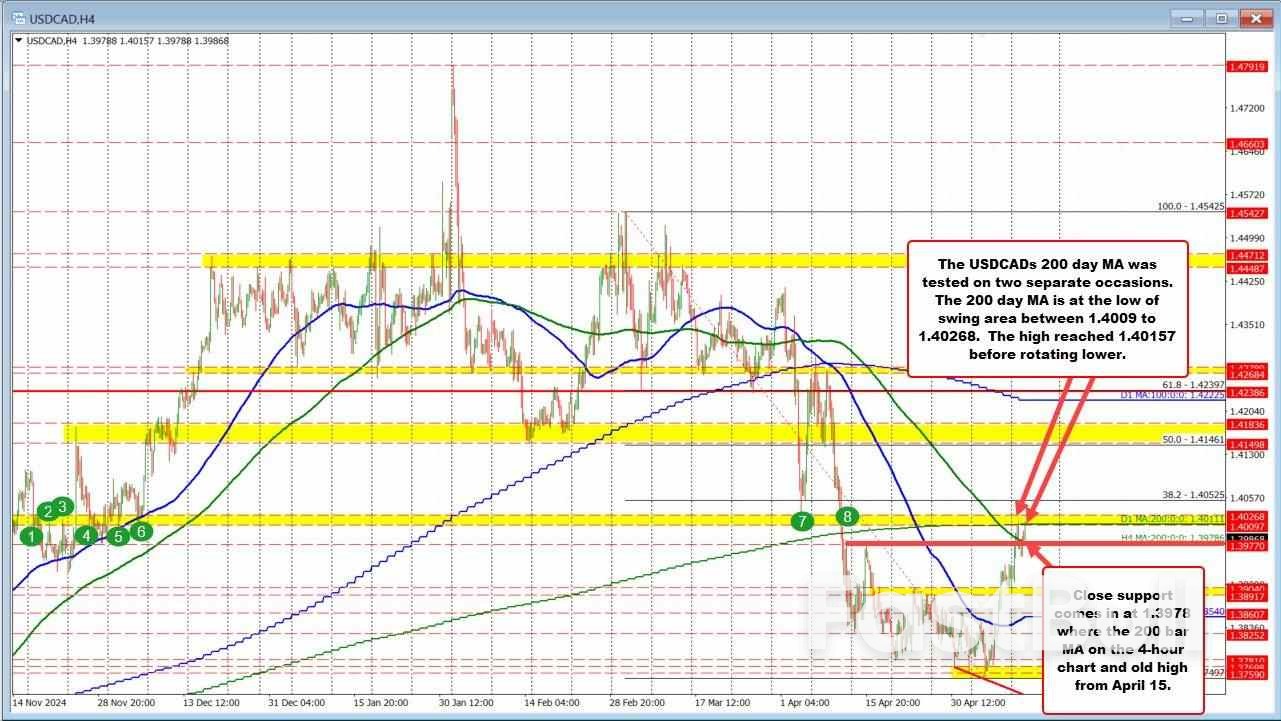
          The USDCAD extended higher yesterday and again earlier today, but both rallies have stalled just ahead of a key resistance confluence. The area of interest includes:

          ● The 200-day moving average, currently near 1.40111

          ● The swing area resistance between 1.4009 and 1.4027

          ● Today’s high stopped at 1.40157 before rotating back lower

          This zone has now rejected buyers on two separate occasions, reinforcing its role as a critical barrier that bulls must break to extend the upside bias. A clean move above 1.4027 would open the door toward the 38.2% retracement of the move down from the March high at 1.40525, with other key resistance around the 50% and swing area between 1.4146–1.41836.

          On the downside, the initial support now comes in near 1.3978, where the 200-bar moving average on the 4-hour chart lines up with the old swing high from April 15. Holding above that level keeps the rebound and short term bullish bias intact. A move below it, however, could trigger a deeper correction down to 1.389172 1.3904 swing area.

          Key technical levels:

          ● Resistance: 1.4009–1.4027 (200-day MA + swing), 1.40525 (38.2% retracement), 1.4146 to 1.41836 (50% and swing area)

          ● Support: 1.3978 (4H 200-bar MA/old high from April 15), 1.38917 – 1.3904 (swing area)

          ● Bias: Neutral to bullish above 1.3978; stronger bullish bias only above 1.4027 and then the 38.2% retracement at 1.40525

          Source: ForexLive

          To stay updated on all economic events of today, please check out our Economic calendar
          Risk Warnings and Disclaimers
          You understand and acknowledge that there is a high degree of risk involved in trading. Following any strategies or investment methods may lead to potential losses. The content on the site is provided by our contributors and analysts for information purposes only. You are solely responsible for determining whether any trading assets, securities, strategy, or any other product is suitable for investing based on your own investment objectives and financial situation.
          Add to Favorites
          Share

          UBS cuts U.S. stocks view after 11% rally on fading trade fears

          Adam

          Stocks

          Central Bank

          UBS downgraded U.S. equities to Neutral from Attractive following an 11% rally in the S&P 500 since early April.
          The bank pointed to reduced upside after progress on U.S.-China trade talks drove market gains.
          “We downgrade U.S. equities to Neutral from Attractive,” UBS said, noting that “risk-reward in equities is now more balanced.”
          The firm had upgraded U.S. stocks on April 10, arguing that excessive trade-related pessimism was priced in. But with tariffs temporarily paused and markets rebounding, UBS believes the easy gains are behind.
          On Monday, the S&P 500 rose 3.3% and the Nasdaq jumped 4.4% after the U.S. and China agreed to reduce tariffs for 90 days while negotiations continue.
          U.S. levies on Chinese imports will fall to 30% from 145%, while China will cut tariffs on U.S. goods to 10% from 125%.
          “The pace and scale of tariff reductions agreed in this initial round have exceeded market expectations,” UBS said.
          Despite the downgrade, UBS emphasized it is “not a bearish view, nor a call to sell equities.”
          “Uncertainty is still high,” UBS cautioned, “and investors will soon begin to focus on whether this temporary fix can evolve into a lasting agreement.”
          The bank continues to advise a full strategic allocation to U.S. stocks and expects equities to be higher 12 months from now.
          UBS’s sector preferences remain unchanged, with Attractive ratings on communication services, tech, health care, and utilities.
          Looking ahead, UBS said the “durability of this rally will depend on two key factors: whether U.S.-China negotiators can turn this into a lasting trade agreement, and how Beijing proceeds with anticipated stimulus.”

          Source: Investing

          Risk Warnings and Disclaimers
          You understand and acknowledge that there is a high degree of risk involved in trading. Following any strategies or investment methods may lead to potential losses. The content on the site is provided by our contributors and analysts for information purposes only. You are solely responsible for determining whether any trading assets, securities, strategy, or any other product is suitable for investing based on your own investment objectives and financial situation.
          Add to Favorites
          Share

          China Reduces Tariffs on US Imports Amidst Trade Talks

          Michelle

          Economic

          Forex

          China's State Council Tariff Commission announced on May 13, 2025, that tariffs on US imports will drop from 34% to 10%, effective the following day. The move could affect economic relations. This tariff reduction, part of a reciprocal agreement, may influence market sentiment across various sectors. Cryptocurrencies could see indirect effects due to shifts in macroeconomic confidence.

          China's State Council Tariff Commission declared a significant tariff reduction on American goods. Effective May 14, 2025, the tariff rate drops from 34% to 10%, while the 24% surcharge will be suspended for 90 days. This decision aligns with a US-China trade agreement.

          China's Tariff Decision Sparks Market Watch

          These tariff changes are anticipated to enhance US-China economic relations temporarily. The immediate implications include potential stabilization of trade ties and a reduction in trade-related uncertainties. Markets sensitive to US-China interactions may respond accordingly.

          This adjustment may influence the broader economic environment and market sentiment, particularly for assets sensitive to US-China trade relations.

          This adjustment may influence the broader economic environment and market sentiment, particularly for assets sensitive to US-China trade relations. - China News Online

          Market Reactions and Future Outlook

          Did you know? The US and China have had a long history of trade negotiations, often impacting global markets significantly.

          Market reactions have been mixed, with stakeholders monitoring potential effects. While no prominent cryptocurrency industry figures have commented publicly, the broader market sentiment might shift, impacting digital assets tethered to economic conditions between these major economies.

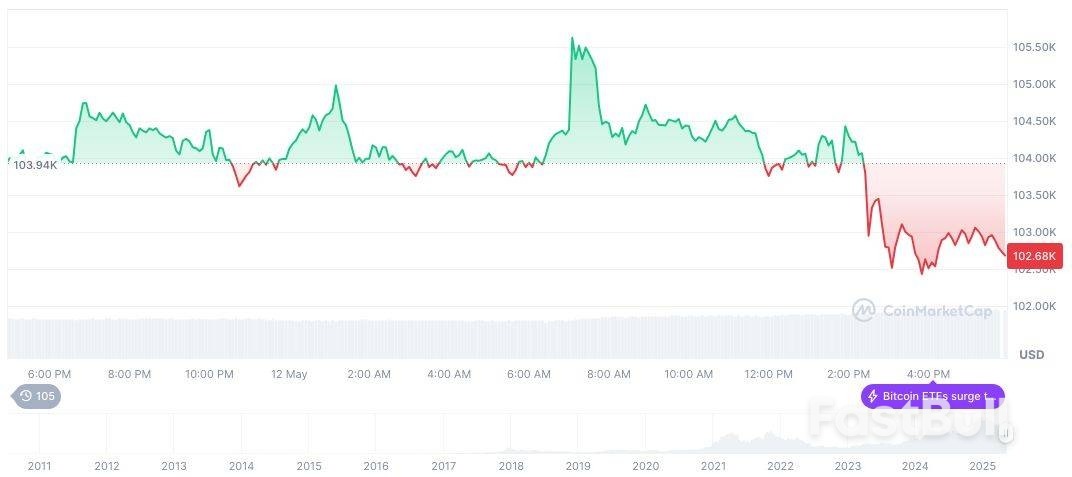
          Bitcoin(BTC), daily chart, screenshot on CoinMarketCap at 14:19 UTC on May 13, 2025. Source: CoinMarketCap

          Recent developments in multiple cryptocurrency policies, such as Binance's significant new investments, could add more layers of complexity to market reactions.

          Source: CryptoSlate

          To stay updated on all economic events of today, please check out our Economic calendar
          Risk Warnings and Disclaimers
          You understand and acknowledge that there is a high degree of risk involved in trading. Following any strategies or investment methods may lead to potential losses. The content on the site is provided by our contributors and analysts for information purposes only. You are solely responsible for determining whether any trading assets, securities, strategy, or any other product is suitable for investing based on your own investment objectives and financial situation.
          Add to Favorites
          Share

          U.S.-China trade war pushed global supply chain near breaking point, new data shows

          Adam

          Economic

          China–U.S. Trade War

          The trade truce reached between the U.S. and China arrived just as President Donald Trump’s tariffs took a big bite out of North American & Asian manufacturing, with a steep retreat in April purchasing activity after the rush to hoard supply, according to the GEP Global Supply Chain Volatility Index.
          “The pause on tariffs is a major relief for manufacturers in both the U.S. and China,” said John Piatek, vice president of consulting for GEP. “Our Supply Chain Volatility Index shows manufacturing demand in China is dropping steeply, and U.S. manufacturers are aggressively stockpiling key inputs to buffer against tariffs.”
          But according to Piatek, the trade deal won’t quickly quiet U.S. manufacturers’ anxiety about how to reduce risks related to China for the long-term. “As they maneuver to de-risk and limit exposure to China, the rapidly changing landscape and uncertainty is clouding manufacturers’ outlook and dampening their capital investment and supply chain,” he said.
          The GEP Global Supply Chain Volatility Index tracks demand conditions, shortages, transportation costs, inventories, and backlogs based on a monthly survey of 27,000 businesses.
          “The first blows of the tariff war have landed on global manufacturers,” Piatek said. The supply chain volatility data should serve as a warning about what would come next if the temporary pause in tariffs by the U.S. and China aren’t extended permanently after the 90-day pause and the trade war re-escalates.
          The data showed a “hockey stick”-like upturn in April, according to Piatek, with North American companies aggressively stockpiling inventory at what he described as a “concerning rate.” At the same time, “the first signs of manufacturers anticipating slower demand and supply shortages have emerged,” he said.
          Purchasing activity by manufacturers in Asia was at its weakest since December 2023.
          One bright spot to offset pull back in manufacturing is Europe, where an industrial recession is coming to an end. The U.K., the first nation to sign a preliminary trade deal with the U.S., recorded significant manufacturing weakness, with supplier activity down to a rate near a record low based on the past two decades of data. But supply chain capacity in Germany and France, which was underutilized over the past year, is reflecting growth. Piatek cautioned that this could reverse if global trade conditions worsen.
          The GEP data also shows an increase in spare capacity across Asian supply chains in April, led by China, Taiwan and South Korea.
          Stephen Edwards, CEO of the Port of Virginia, told CNBC in an interview published this week that if the supply chain future is less China and more Southeast Asia, South Asia and Europe, the U.S. port is positioned for that growth.
          “Our fastest growth over the last four years has been the Indian subcontinent, then Vietnam, then Europe,” said Edwards.
          Trade from China has been flat for the last four years at Port of Virginia.
          “It is our second-largest trading bloc after the European Union. So it’s still a big block,” he said. “But if that is going to migrate over time, whatever the new trade environment is, there’s an opportunity. We have not yet seen the trade agreements, but we believe that it’s going to be less China and more from Southeast Asia and Europe. I think we’re in a pretty good spot,” Edwards said.

          Source: cnbc

          To stay updated on all economic events of today, please check out our Economic calendar
          Risk Warnings and Disclaimers
          You understand and acknowledge that there is a high degree of risk involved in trading. Following any strategies or investment methods may lead to potential losses. The content on the site is provided by our contributors and analysts for information purposes only. You are solely responsible for determining whether any trading assets, securities, strategy, or any other product is suitable for investing based on your own investment objectives and financial situation.
          Add to Favorites
          Share

          What next for Nvidia? AI innovation, tariff challenges, and market outlook

          Adam

          Economic

          Nvidia's latest AI hardware innovations

          ​Nvidia continues to lead in artificial intelligence (AI) and graphics processing unit (GPU) advancements, navigating complex geopolitical landscapes and evolving market dynamics. The company's relentless focus on pushing the boundaries of computing power has maintained its position at the forefront of the artificial intelligence revolution.
          ​At GTC 2025, Nvidia unveiled its Blackwell Ultra GPUs, marking a significant leap in AI and graphics processing capabilities. These new chips represent a substantial improvement over the previous generation, with performance gains of up to 30% and enhanced power efficiency that addresses one of the key challenges facing data centres today.
          ​The RTX 50-Series Launch has brought next-generation technology to consumer graphics cards. The RTX 5060, priced at $299.00, is set to release on May 19, 2025, offering advanced features like DLSS 4 and GDDR7 memory. This continues Nvidia's strategy of making AI-enhanced graphics accessible to mainstream users.
          ​These innovations come at a critical time as competition in the GPU space intensifies. While Nvidia maintains its leadership position, rivals are making significant investments to challenge its dominance in both consumer and enterprise markets.

          ​Strategic partnerships and expansion plans

          ​Nvidia's growth strategy extends beyond product development to include key partnerships and strategic acquisitions that strengthen its ecosystem and market position. These moves demonstrate a long-term vision that goes well beyond selling chips.
          ​The Cadence Collaboration represents a significant enhancement of Nvidia's presence in the simulation and design space. Nvidia's GPUs power Cadence's new Millennium M2000 supercomputer, enhancing simulation speeds for industries like aerospace and biotech. This partnership highlights how Nvidia's technology is becoming increasingly embedded in critical industrial design processes.
          ​Silicon Valley Expansion reinforces Nvidia's commitment to its home market. The company acquired a 13-acre office complex in Santa Clara for $123 million, expanding its headquarters and reinforcing its commitment to US-based operations. This investment comes at a time when many tech firms are pursuing remote work models or looking to expand in lower-cost regions, although some have backtracked following President Trump’s re-election.
          ​These strategic moves align with Nvidia's broader vision of creating an AI ecosystem where its hardware, software, and partnerships create a competitive moat that extends beyond raw computing power. This approach has been central to the company's ability to maintain premium pricing and profit margins.

          ​Nvidia's massive AI infrastructure investment

          ​In a bold response to geopolitical pressures and growing demand for AI capabilities, Nvidia has announced an unprecedented investment plan focused on building out domestic infrastructure. This represents one of the largest corporate investments in US manufacturing in recent memory.
          ​Nvidia's $500 Billion Commitment to invest in US AI infrastructure over the next four years aims to bolster domestic manufacturing and reduce reliance on foreign supply chains. This massive investment demonstrates both the scale of AI's growth potential and Nvidia's determination to maintain its leadership position regardless of trade tensions.
          ​The investment plan includes the construction of new data centres specifically designed for AI training and inference, as well as research facilities dedicated to advancing semiconductor design and manufacturing techniques. These facilities will create thousands of high-skilled jobs across multiple states.
          ​Beyond the direct benefits to Nvidia's business, this investment signals a potential reshaping of the global semiconductor supply chain, with more critical components and technologies being developed and manufactured within the United States. The move has received bipartisan political support, highlighting the strategic importance of AI infrastructure.

          ​Navigating US tariffs and trade policies

          ​Nvidia faces significant challenges due to evolving US trade policies, particularly concerning exports to China. The company's response to these challenges demonstrates its strategic flexibility and determination to maintain access to key markets despite geopolitical headwinds.
          ​Export controls have limited Nvidia's ability to sell high-performance AI chips to China, prompting the company to develop a downgraded H20 chip variant to comply with regulations. This represents a delicate balancing act – maintaining access to the Chinese market while adhering to US government restrictions.
          ​The Market Impact of these restrictions is substantial. China accounts for approximately 13% of Nvidia's revenue and represents a significant growth opportunity. CEO Jensen Huang has emphasised the potential $50 billion loss if access to the Chinese AI market diminishes, highlighting the material impact of geopolitical tensions on the company's prospects.
          ​This weekend’s US-China trade negotiations have led to a 90-day reduction in tariffs, providing temporary relief and positively influencing Nvidia's share price. However, this reprieve may be short-lived, and the company continues to develop contingency plans for various trade policy scenarios.
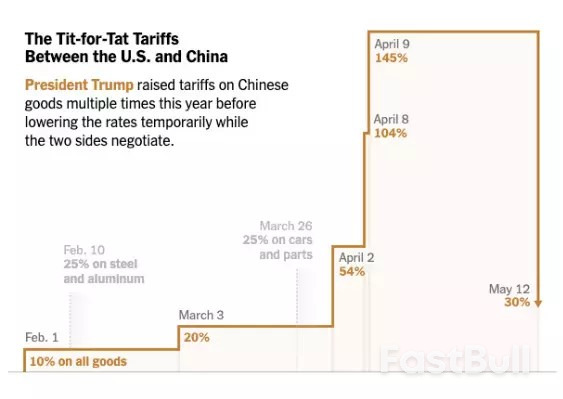
          US tariffs on China imports
          What next for Nvidia? AI innovation, tariff challenges, and market outlook_1

          Market performance and analyst expectations

          ​Despite the tariff challenges, Nvidia's market performance has remained strong, reflecting investor confidence in the company's strategic positioning and growth prospects in the AI market. The stock continues to be a bellwether for technology sector sentiment.
          ​Analyst Forecasts project a positive trajectory for Nvidia's stock, with expectations of reaching $134.00 by the end of May 2025, indicating a potential 9% increase from current levels (as of 13/05/2025). This optimism is driven by the company's continued revenue growth and expanding profit margins.
          ​The valuation metrics for Nvidia remain elevated compared to broader market averages, with a forward P/E ratio significantly above the S&P 500 average. However, analysts justify this premium based on the company's growth rate and dominant position in AI, which is viewed as a multi-decade growth opportunity.
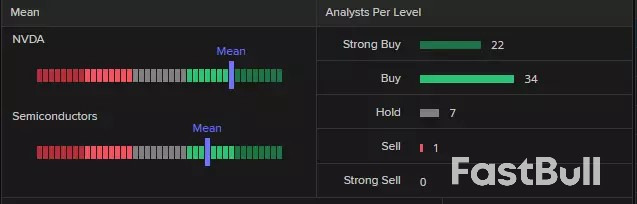
          ​According to LSEG Data & Analytics, 22 analysts have a ‘strong buy’ recommendation for Nvidia, 34 a ‘buy’, 7 a ‘hold’ and 1 a ‘sell’ (as of 13/05/2025).
          Nvidia LSEG Data & Analytics chart
          What next for Nvidia? AI innovation, tariff challenges, and market outlook_2
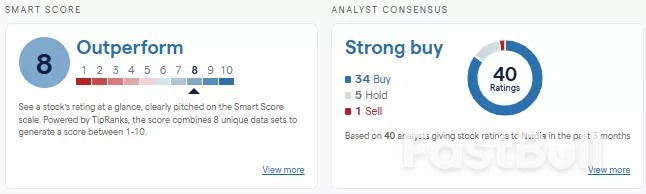
          Nvidia has a TipRanks Smart Score of ‘8 Outperform’ and is rated as a ‘strong buy’ with 34 ’buy’, 5 ‘hold’ and 1 ‘sell’ recommendation (as of 13/05/2025).
          Nvidia TipRanks Smart Score chart
          What next for Nvidia? AI innovation, tariff challenges, and market outlook_3

          Technical analysis of the Nvidia share price

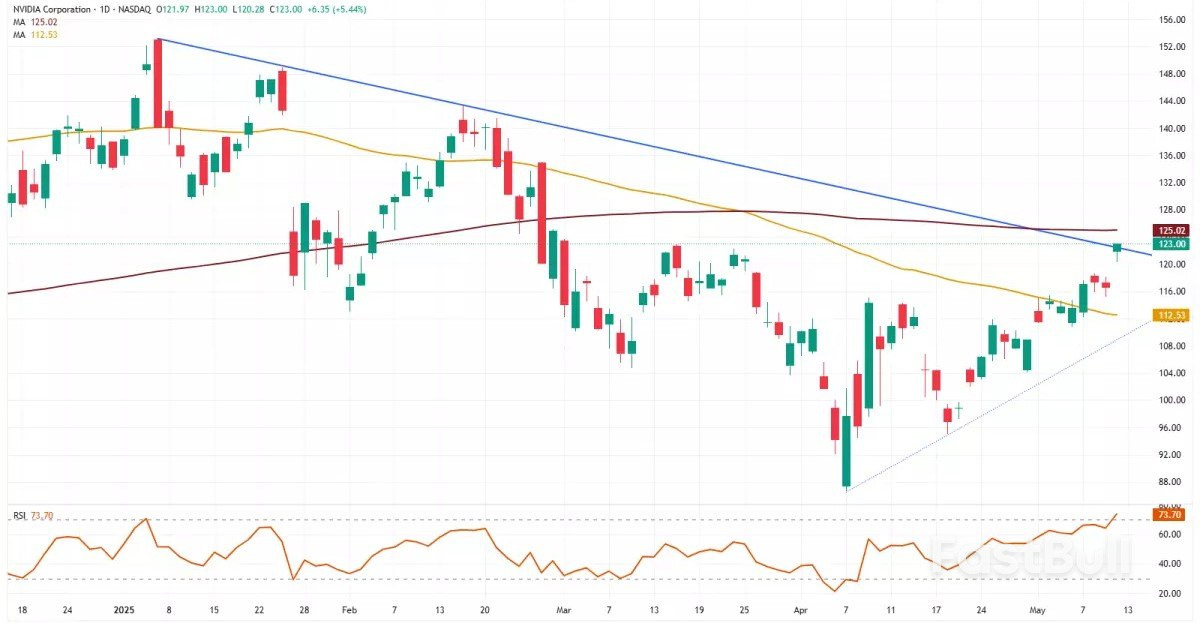
          ​The Nvidia share price, which dropped by around 42% from its $153.13 early January high to its $86.62 7 April low, has risen around 30% since then, to its 2025 downtrend line at $122.88. Together with the 200-day simple moving average (SMA) at $125.02 it may act as resistance, though.
          Nvidia daily candlestick chart
          What next for Nvidia? AI innovation, tariff challenges, and market outlook_4
          Despite the Nvidia’s recent share price rally, it still trades around 8% lower year-to-date. While the 30 April low at $104.08 underpins, the April-to-May uptrend is deemed to be intact.
          ​Minor support above this low can be seen between the early February low, 9 and 14 April and 2 May highs at $115.40-to-$113.01.

          ​Long-term outlook and competitive landscape

          ​The long-term prospects for Nvidia appear promising despite short-term challenges. The company's strategic investments and product innovations position it for sustained growth in the AI and semiconductor sectors, with several key factors supporting its continued leadership.
          ​The broader AI market continues to expand rapidly, with enterprise adoption accelerating across sectors from healthcare to financial services. Nvidia's first-mover advantage and comprehensive software ecosystem have created significant switching costs for customers, helping to insulate the company from competitive threats.
          ​Nevertheless, competition is intensifying from both traditional rivals and new entrants. AMD has made significant strides with its MI300 AI accelerators, while Intel is investing heavily to regain technological leadership. Additionally, cloud service providers like Google and Amazon are increasingly developing their own custom silicon.
          ​Perhaps the most significant long-term question for Nvidia is whether AI chip design will eventually commoditise, as has happened with other semiconductor categories. The company's strategy of continuously pushing performance boundaries while building a comprehensive software and services ecosystem aims to prevent this outcome.

          How to trade Nvidia shares

          ​For investors and traders looking to gain exposure to Nvidia's growth story or capitalise on its price movements, several approaches are available through IG's trading and investment platforms.
          ​Research Nvidia's market position, financial performance, and growth prospects to inform your trading decision.
          ​Decide whether you want to trade or invest in Nvidia shares based on your outlook for the company and the broader technology sector.
          ​Open an account with IG by visiting our website and completing the application process.​
          Search for 'Nvidia' or its ticker 'NVDA' on our trading platform or app.​
          Place your trade, ensuring you have appropriate risk management measures in place given the stock's volatility.
          ​Spread betting and CFD trading offer ways to potentially profit from both rising and falling Nvidia share prices, while also providing leverage for amplified exposure. However, it's important to remember that leverage increases both potential returns and risks.
          ​For those with a longer-term perspective who believe in Nvidia's continued AI dominance, share dealing provides direct ownership of Nvidia stock. This approach allows investors to benefit from both capital appreciation and any future dividend increases as the company matures.
          ​Nvidia stands at the intersection of multiple transformative technologies, from AI to advanced gaming and autonomous vehicles. While tariff challenges and geopolitical tensions create near-term uncertainty, the company's technological leadership and strategic investments position it to remain at the forefront of the AI revolution that continues to reshape global industries and create new market opportunities.​​

          Source:ig

          To stay updated on all economic events of today, please check out our Economic calendar
          Risk Warnings and Disclaimers
          You understand and acknowledge that there is a high degree of risk involved in trading. Following any strategies or investment methods may lead to potential losses. The content on the site is provided by our contributors and analysts for information purposes only. You are solely responsible for determining whether any trading assets, securities, strategy, or any other product is suitable for investing based on your own investment objectives and financial situation.
          Add to Favorites
          Share

          Reeves’s Tax Rises on Employers Start to Bite as Unemployment Jumps

          Warren Takunda

          Economic

          For the past few months, the true impact of Labour’s increases in labour costs has been clouded by a fog of contradictory data, but the latest jobs figures suggest that murkiness could be beginning to clear.
          Those who feared the rise in employers’ national insurance contributions (NICs) would lead to job losses are being proved right. The unemployment rate climbed by 0.2 percentage points to 4.5% between January and March – the highest level for nearly four years.
          Concerns that the number of vacancies would drop have also come true. Employers are refusing to take on new staff, pushing the vacancy rate back towards its pre-pandemic level.
          However, that’s not the whole picture, with data showing employers have begun to ease back on above-inflation pay growth. Average weekly earnings that exclude bonuses rose by 5.6% in the first three months of the year compared with the same quarter in 2024. That annual growth rate was down from 5.9% in the three months ending with February and below the consensus among City economists of a milder drop to 5.7%.
          There are other ways employers could adjust to the higher NICs and national living wage increase. They could reduce profits and increase prices.
          The Bank of England said last week that it expected private-sector employers to take a hit to their profits, sharing the pain with their shareholders. Unfortunately, the evidence for this is absent simply because the Office for National Statistics has not produced any data since last summer on the profitability of UK companies. So the Bank is guessing.
          Forecasts for inflation are also guesswork, though there is a growing suspicion that companies that exercised their monopoly pricing power during the pandemic will again try to convince consumers they need to pay much higher prices for their goods this year. Data out on Wednesday next week on the inflation rate in April will give the first signs as to whether that theory is correct.
          If lower average profits and slightly higher prices become part of the response, then you might say everyone is sharing the pain from higher employment taxes.
          The problem for Labour is that the biggest hit is felt most acutely by employers in very visible areas of the economy, such as retailers, hospitality businesses and the charity sector.
          Ministers must be concerned that the lower number of vacancies is colliding with a rising number of people wanting employment, making for a very large and discontented group of people who want to break into the labour market but cannot.
          It all suggests the hangover from the pandemic is still causing pain in the form of huge mismatches between what employers want and what workers can offer.
          The cure for this ill can only be investment in skills. Yet that is in short supply at the moment. And while Rachel Reeves blames the uncertainty caused by Donald Trump for depressing investment, and the economy more broadly, she must shoulder some of the blame.
          The tightrope she must walk to stick to her self-imposed fiscal rules is clearly another factor. To balance the books in the next budget, which the chancellor says she must, is going to be tough and might mean the government needs to impose even more tax rises on employers.
          If this worry persists among employers, it is sure to combine with Trump-induced uncertainty to delay any jobs recovery.

          Source: Theguardian

          To stay updated on all economic events of today, please check out our Economic calendar
          Risk Warnings and Disclaimers
          You understand and acknowledge that there is a high degree of risk involved in trading. Following any strategies or investment methods may lead to potential losses. The content on the site is provided by our contributors and analysts for information purposes only. You are solely responsible for determining whether any trading assets, securities, strategy, or any other product is suitable for investing based on your own investment objectives and financial situation.
          Add to Favorites
          Share
          FastBull
          Copyright © 2025 FastBull Ltd

          728 RM B 7/F GEE LOK IND BLDG NO 34 HUNG TO RD KWUN TONG KLN HONG KONG

          TelegramInstagramTwitterfacebooklinkedin
          App Store Google Play Google Play
          Products
          Charts

          Chats

          Q&A with Experts
          Screeners
          Economic Calendar
          Data
          Tools
          Membership
          Features
          Function
          Markets
          Copy Trading
          Latest Signals
          Contests
          News
          Analysis
          24/7
          Columns
          Education
          Company
          Careers
          About Us
          Contact Us
          Advertising
          Help Center
          Feedback
          User Agreement
          Privacy Policy
          Business

          White Label

          Data API

          Web Plug-ins

          Poster Maker

          Affiliate Program

          Risk Disclosure

          The risk of loss in trading financial instruments such as stocks, FX, commodities, futures, bonds, ETFs and crypto can be substantial. You may sustain a total loss of the funds that you deposit with your broker. Therefore, you should carefully consider whether such trading is suitable for you in light of your circumstances and financial resources.

          No decision to invest should be made without thoroughly conducting due diligence by yourself or consulting with your financial advisors. Our web content might not suit you since we don't know your financial conditions and investment needs. Our financial information might have latency or contain inaccuracy, so you should be fully responsible for any of your trading and investment decisions. The company will not be responsible for your capital loss.

          Without getting permission from the website, you are not allowed to copy the website's graphics, texts, or trademarks. Intellectual property rights in the content or data incorporated into this website belong to its providers and exchange merchants.

          Not Logged In

          Log in to access more features

          FastBull Membership

          Not yet

          Purchase

          Become a signal provider
          Help Center
          Customer Service
          Dark Mode
          Price Up/Down Colors

          Log In

          Sign Up
          Position
          Layout
          Fullscreen
          Default to Chart
          The chart page opens by default when you visit fastbull.com