• Trade
  • Markets
  • Copy
  • Contests
  • News
  • 24/7
  • Calendar
  • Q&A
  • Chats
Trending
Screeners
SYMBOL
LAST
BID
ASK
HIGH
LOW
NET CHG.
%CHG.
SPREAD
SPX
S&P 500 Index
6901.01
6901.01
6901.01
6903.47
6833.46
+14.33
+ 0.21%
--
DJI
Dow Jones Industrial Average
48704.00
48704.00
48704.00
48756.34
48099.46
+646.26
+ 1.34%
--
IXIC
NASDAQ Composite Index
23593.85
23593.85
23593.85
23606.70
23308.95
-60.30
-0.25%
--
USDX
US Dollar Index
98.430
98.510
98.430
98.500
98.260
+0.110
+ 0.11%
--
EURUSD
Euro / US Dollar
1.17280
1.17289
1.17280
1.17459
1.17192
-0.00103
-0.09%
--
GBPUSD
Pound Sterling / US Dollar
1.33684
1.33693
1.33684
1.33997
1.33644
-0.00171
-0.13%
--
XAUUSD
Gold / US Dollar
4344.06
4344.47
4344.06
4345.97
4264.56
+64.77
+ 1.51%
--
WTI
Light Sweet Crude Oil
57.238
57.268
57.238
58.011
57.186
-0.403
-0.70%
--

Community Accounts

Signal Accounts
--
Profit Accounts
--
Loss Accounts
--
View More

Become a signal provider

Sell trading signals to earn additional income

View More

Guide to Copy Trading

Get started with ease and confidence

View More

Signal Accounts for Members

All Signal Accounts

Best Return
  • Best Return
  • Best P/L
  • Best MDD
Past 1W
  • Past 1W
  • Past 1M
  • Past 1Y

All Contests

  • All
  • Trump Updates
  • Recommend
  • Stocks
  • Cryptocurrencies
  • Central Banks
  • Featured News
Top News Only
Share

FAA Says It Will Review Flight Crew Alerting System For Forthcoming Boeing 737 Max 10, Which Includes Synthetic Enhanced Angle Of Attack System

Share

Homeland Security Terminating Temporary Protected Status For Ethiopia -Federal Register

Share

Cleveland Fed President Hammack: Will Be Watching Carefully To See If Inflation Moderates And Jobs Stabilize

Share

Cleveland Fed President Hammack: Would Prefer For Fed Policy To Be A Little More Restrictive Than Current Level

Share

Cleveland Fed President Hammack: Right Now Fed Policy Is Right Around Neutral

Share

Cleveland Fed President Hammack: Fed's Decision This Week Was Complicated

Share

Federal Reserve's Hammack: The Federal Reserve Spends A Lot Of Time Studying AI

Share

Russian Government Has Extended Deferral Of Tax And Contribution Payments For Coal Companies Until March 2026

Share

Cleveland Fed President Hammack: Local Contacts Describe Low Hire, Low Fire Job Sector

Share

Fed Data - USA Effective Federal Funds Rate At 3.64 Percent On 11 December On $99 Billion In Trades Versus 3.89 Percent On $98 Billion On 10 December

Share

Cleveland Fed President Hammack: Has Every Confidence Next Fed Chair Will Be Focused On 2% Inflation Target

Share

Cleveland Fed President Hammack: Seeing Some Softening On Labor Side Of Economy

Share

Cleveland Fed President Hammack: Is Committed To Achieving Fed's 2% Inflation Target, Price Pressures Have Been Too High

Share

Cleveland Fed President Hammack: Weaker Dollar This Year Was Not About Moving Away From Currency

Share

Cleveland Fed President Hammack: Novel That A Fed Governor Retained A Connection To White House

Share

Cleveland Fed President Hammack: Independent Central Banks Deliver Better Outcomes

Share

Cleveland Fed President Hammack: 'Very Grateful' Government Data Is Returning

Share

Chicago Fed President Goolsbee: Take Some Comfort In Market-Based Measures Of Inflation, A Source Of Optimism About The Path Of Price Increases

Share

Cleveland Fed President Hammack: There Is A Wide Range Of Alternative Data On Job Market

Share

Cleveland Fed President Hammack: Not Having Government Data Has Created A Bit Of A Fog For The Fed

TIME
ACT
FCST
PREV
U.K. Trade Balance Non-EU (SA) (Oct)

A:--

F: --

P: --

U.K. Trade Balance (Oct)

A:--

F: --

P: --

U.K. Services Index MoM

A:--

F: --

P: --

U.K. Construction Output MoM (SA) (Oct)

A:--

F: --

P: --

U.K. Industrial Output YoY (Oct)

A:--

F: --

P: --

U.K. Trade Balance (SA) (Oct)

A:--

F: --

P: --

U.K. Trade Balance EU (SA) (Oct)

A:--

F: --

P: --

U.K. Manufacturing Output YoY (Oct)

A:--

F: --

P: --

U.K. GDP MoM (Oct)

A:--

F: --

P: --

U.K. GDP YoY (SA) (Oct)

A:--

F: --

P: --

U.K. Industrial Output MoM (Oct)

A:--

F: --

P: --

U.K. Manufacturing Output MoM (Oct)

A:--

F: --

P: --

U.K. Monthly GDP 3M/3M Change (Oct)

A:--

F: --

P: --

U.K. Construction Output YoY (Oct)

A:--

F: --

P: --

France HICP Final MoM (Nov)

A:--

F: --

P: --

China, Mainland Outstanding Loans Growth YoY (Nov)

A:--

F: --

P: --

China, Mainland M2 Money Supply YoY (Nov)

A:--

F: --

P: --

China, Mainland M0 Money Supply YoY (Nov)

A:--

F: --

P: --

China, Mainland M1 Money Supply YoY (Nov)

A:--

F: --

P: --

India CPI YoY (Nov)

A:--

F: --

P: --

India Deposit Gowth YoY

A:--

F: --

P: --

Brazil Services Growth YoY (Oct)

A:--

F: --

P: --

Mexico Industrial Output YoY (Oct)

A:--

F: --

P: --

Russia Trade Balance (Oct)

A:--

F: --

P: --

Philadelphia Fed President Henry Paulson delivers a speech
Canada Building Permits MoM (SA) (Oct)

A:--

F: --

P: --

Canada Wholesale Sales YoY (Oct)

A:--

F: --

P: --

Canada Wholesale Inventory MoM (Oct)

A:--

F: --

P: --

Canada Wholesale Inventory YoY (Oct)

A:--

F: --

P: --

Canada Wholesale Sales MoM (SA) (Oct)

A:--

F: --

P: --

Germany Current Account (Not SA) (Oct)

A:--

F: --

P: --

U.S. Weekly Total Rig Count

--

F: --

P: --

U.S. Weekly Total Oil Rig Count

--

F: --

P: --

Japan Tankan Large Non-Manufacturing Diffusion Index (Q4)

--

F: --

P: --

Japan Tankan Small Manufacturing Outlook Index (Q4)

--

F: --

P: --

Japan Tankan Large Non-Manufacturing Outlook Index (Q4)

--

F: --

P: --

Japan Tankan Large Manufacturing Outlook Index (Q4)

--

F: --

P: --

Japan Tankan Small Manufacturing Diffusion Index (Q4)

--

F: --

P: --

Japan Tankan Large Manufacturing Diffusion Index (Q4)

--

F: --

P: --

Japan Tankan Large-Enterprise Capital Expenditure YoY (Q4)

--

F: --

P: --

China, Mainland Industrial Output YoY (YTD) (Nov)

--

F: --

P: --

China, Mainland Urban Area Unemployment Rate (Nov)

--

F: --

P: --

Saudi Arabia CPI YoY (Nov)

--

F: --

P: --

Euro Zone Industrial Output YoY (Oct)

--

F: --

P: --

Euro Zone Industrial Output MoM (Oct)

--

F: --

P: --

Canada Existing Home Sales MoM (Nov)

--

F: --

P: --

Euro Zone Total Reserve Assets (Nov)

--

F: --

P: --

Canada National Economic Confidence Index

--

F: --

P: --

Canada New Housing Starts (Nov)

--

F: --

P: --

U.S. NY Fed Manufacturing Employment Index (Dec)

--

F: --

P: --

U.S. NY Fed Manufacturing Index (Dec)

--

F: --

P: --

Canada Core CPI YoY (Nov)

--

F: --

P: --

Canada Manufacturing Unfilled Orders MoM (Oct)

--

F: --

P: --

Canada Manufacturing New Orders MoM (Oct)

--

F: --

P: --

Canada Core CPI MoM (Nov)

--

F: --

P: --

Canada Manufacturing Inventory MoM (Oct)

--

F: --

P: --

Canada CPI YoY (Nov)

--

F: --

P: --

Canada CPI MoM (Nov)

--

F: --

P: --

Canada CPI YoY (SA) (Nov)

--

F: --

P: --

Canada Core CPI MoM (SA) (Nov)

--

F: --

P: --

Canada CPI MoM (SA) (Nov)

--

F: --

P: --

Q&A with Experts
    • All
    • Chatrooms
    • Groups
    • Friends
    Connecting
    .
    .
    .
    Type here...
    Add Symbol or Code

      No matching data

      All
      Trump Updates
      Recommend
      Stocks
      Cryptocurrencies
      Central Banks
      Featured News
      • All
      • Russia-Ukraine Conflict
      • Middle East Flashpoint
      • All
      • Russia-Ukraine Conflict
      • Middle East Flashpoint
      Search
      Products

      Charts Free Forever

      Chats Q&A with Experts
      Screeners Economic Calendar Data Tools
      Membership Features
      Data Warehouse Market Trends Institutional Data Policy Rates Macro

      Market Trends

      Market Sentiment Order Book Forex Correlations

      Top Indicators

      Charts Free Forever
      Markets

      News

      News Analysis 24/7 Columns Education
      From Institutions From Analysts
      Topics Columnists

      Latest Views

      Latest Views

      Trending Topics

      Top Columnists

      Latest Update

      Signals

      Copy Rankings Latest Signals Become a signal provider AI Rating
      Contests
      Brokers

      Overview Brokers Assessment Rankings Regulators News Claims
      Broker listing Forex Brokers Comparison Tool Live Spread Comparison Scam
      Q&A Complaint Scam Alert Videos Tips to Detect Scam
      More

      Business
      Events
      Careers About Us Advertising Help Center

      White Label

      Data API

      Web Plug-ins

      Affiliate Program

      Awards Institution Evaluation IB Seminar Salon Event Exhibition
      Vietnam Thailand Singapore Dubai
      Fans Party Investment Sharing Session
      FastBull Summit BrokersView Expo
      Recent Searches
        Top Searches
          Markets
          News
          Analysis
          User
          24/7
          Economic Calendar
          Education
          Data
          • Names
          • Latest
          • Prev

          View All

          No data

          Scan to Download

          Faster Charts, Chat Faster!

          Download App
          English
          • English
          • Español
          • العربية
          • Bahasa Indonesia
          • Bahasa Melayu
          • Tiếng Việt
          • ภาษาไทย
          • Français
          • Italiano
          • Türkçe
          • Русский язык
          • 简中
          • 繁中
          Open Account
          Search
          Products
          Charts Free Forever
          Markets
          News
          Signals

          Copy Rankings Latest Signals Become a signal provider AI Rating
          Contests
          Brokers

          Overview Brokers Assessment Rankings Regulators News Claims
          Broker listing Forex Brokers Comparison Tool Live Spread Comparison Scam
          Q&A Complaint Scam Alert Videos Tips to Detect Scam
          More

          Business
          Events
          Careers About Us Advertising Help Center

          White Label

          Data API

          Web Plug-ins

          Affiliate Program

          Awards Institution Evaluation IB Seminar Salon Event Exhibition
          Vietnam Thailand Singapore Dubai
          Fans Party Investment Sharing Session
          FastBull Summit BrokersView Expo

          Dollar Set for Weekly Loss; Sterling Weakens After GDP Drop

          Michelle

          Forex

          Economic

          Summary:

          The U.S. dollar steadied Friday, but was on course for a third consecutive weekly fall after the Federal Reserve cut interest rates earlier this week, bringing borrowing costs to a nea...

          The U.S. dollar steadied Friday, but was on course for a third consecutive weekly fall after the Federal Reserve cut interest rates earlier this week, bringing borrowing costs to a near three-year low.

          At 04:00 ET (09:00 GMT), the Dollar Index, which tracks the greenback against a basket of six other currencies, traded largely unchanged at 97.995, but was set for a weekly drop of 0.7%.

          The index is down more than 9% this year, on pace for its steepest annual drop since 2017.

          Dollar slips after Fed meeting

          The U.S. central bank lowered rates by 25 basis points this week, as expected, but remarks from Chair Jerome Powell at his post-meeting press conference were more balanced and less hawkish than many had anticipated.

          The Fed policymakers also forecast another rate cut next year, even with members of the central bank showing divisions over December's move.

          "The bearish wind is coming not only from interest rates but also from end-of-year seasonality," said analysts at ING, in a note. "Dollar rates saw another calibration of Fed expectations lower, with the 2y falling to 3.50% and the market pricing in 3.05% as the Fed terminal rate at the end of next year, keeping pressure on the U.S. dollar."

          The focus going forward will hinge on economic data that is still lagging from the impact of the 43-day federal government shutdown in October and November, as well as the identity of the next Fed chair.

          Euro undervalued versus dollar - ING

          In Europe, GBP/USD dropped 0.1% to 1.3383, falling back from its highest level since October after data showed that the U.K. economy unexpectedly contracted in October, with uncertainty ahead of the Autumn budget by Chancellor Rachel Reeves likely curtailing growth.

          Data released earlier Friday by the Office for National Statistics showed that U.K. gross domestic product fell by 0.1% on a monthly basis in October, matching the drop seen during the prior month and below the 0.1% growth expected.

          The Bank of England holds its final policy-setting meeting of the year next week, and is widely expected to cut interest rates by a quarter point to 3.75% as recent data has shown inflation drifting lower.

          EUR/USD edged lower to 1.1736, but the single currency was poised to register weekly gains of 0.8%, on course for a third weekly gain.

          German inflation rose to 2.6% in November, confirming preliminary data, while consumer prices harmonised to compare with other European Union countries, stood at 2.3% year-on-year in October.

          "Following the Fed meeting this week, the market's attention will shift to the ECB meeting next Thursday. President Christine Lagarde will present a new forecast, which should be the first test of the current pricing of no further rate cuts, in line with our view," ING added.

          BOJ looms large

          In Asia, USD/JPY gained 0.1% to 155.73, with the yen slightly lower ahead of next week's Bank of Japan meeting where the broad expectation is for a rate hike.

          The market focus is on comments from the policymakers on how the Japanese rate path will look in 2026.

          USD/CNY traded 0.1% lower to 7.0556, while AUD/USD gained 0.1% to 0.6673, set for a weekly gain of 0.5% as persistent inflationary pressures suggests the Reserve Bank of Australia could hike rates in the near-term.

          Source: Investing

          To stay updated on all economic events of today, please check out our Economic calendar
          Risk Warnings and Disclaimers
          You understand and acknowledge that there is a high degree of risk involved in trading. Following any strategies or investment methods may lead to potential losses. The content on the site is provided by our contributors and analysts for information purposes only. You are solely responsible for determining whether any trading assets, securities, strategy, or any other product is suitable for investing based on your own investment objectives and financial situation.
          Add to Favorites
          Share

          U.S. Stocks Hit New Highs as Investors Rotate Out of Tech Amid AI Uncertainty

          Gerik

          Economic

          Stocks

          Stock Market Soars While Tech Sector Shows Cracks

          U.S. equities rallied on Thursday, with the S&P 500 and Dow Jones Industrial Average reaching fresh record highs. The Russell 2000 also climbed to a new peak, signaling renewed optimism across small-cap stocks following the Federal Reserve’s decision to cut interest rates by 25 basis points on Wednesday. This rate adjustment is expected to support broader economic activity into year-end.
          Yet, the Nasdaq Composite failed to join the rally, declining 0.26% due to weakness in high-profile tech names. Oracle led the losses, with shares tumbling nearly 11% after the company posted weak quarterly revenue and disclosed rising capital expenditures and lease obligations. This triggered broader skepticism around the AI growth narrative, dragging down other key players like Nvidia and Micron.

          Broadcom Beats But Market Reacts to Strategic Uncertainty

          Chipmaker Broadcom also reported fourth-quarter earnings and revenue that surpassed analyst estimates, along with confirmation that AI firm Anthropic is now a $10 billion customer. Despite strong financials and a doubling in net income from a year ago, Broadcom's stock dropped 4.5% in extended trading. Investors were unsettled by comments from CEO Hock Tan, who failed to ease concerns over Google’s potential pivot to in-house chip design and the uncertain terms of Broadcom’s AI-related contract with OpenAI.
          Rising memory prices also surfaced as a margin threat for the company, compounding worries about profitability in the next fiscal year. These developments underline a growing trend where top-line growth in the AI space is being met with skepticism about sustainability and earnings leverage.

          Sector Rotation Signals Broader Market Strength

          While the tech sector faltered, investors poured into other industries. The S&P 500 financials sector, for instance, reached a new high, driven by strong performance in Visa and Mastercard. This reflects a healthy rotation into value and cyclical stocks, supported by the perception that the U.S. economy remains resilient under a lower rate regime.
          The Fed’s dovish move has helped boost investor sentiment, providing momentum for risk-on positioning across various asset classes. Despite concerns about the AI sector, the broader market appears poised for a bullish end to the year assuming no major economic or geopolitical shocks intervene.

          Corporate Headlines: Disney, Reddit, and Oracle

          Disney announced a $1 billion investment in OpenAI and will license its iconic characters to Sora, OpenAI’s video generation platform. CEO Bob Iger framed the deal as a forward-looking play on content innovation, marking a major convergence between entertainment and generative AI.
          Meanwhile, Reddit has launched a legal challenge against Australia’s recent social media ban for users under 16, arguing that the law infringes on freedom of political communication. The challenge could set a precedent for how digital rights are interpreted in age-restricted internet access laws.
          Finally, Oracle’s future remains in question after its latest earnings report sparked a sell-off. Analysts are re-evaluating their price targets, citing concerns about its long-term AI strategy and high operational costs. The company’s recent investments have yet to translate into the kind of growth or clarity seen from AI peers like Microsoft or Nvidia.

          Diverging Paths Define Year-End Market Narrative

          The contrasting performances of traditional and tech stocks highlight an important inflection point. While AI and big tech have led markets for most of 2025, recent earnings disappointments are prompting a reassessment. Investors are increasingly seeking value in sectors with clearer profitability profiles as economic data stabilizes and monetary policy shifts to support.
          With the Fed’s support now firmly in place and economic indicators showing resilience, market rotation rather than retreat appears to be the prevailing strategy heading into the holiday season. However, the future of AI-linked valuations and the ability of tech firms to meet elevated expectations will remain key themes into early 2026.

          Source: CNBC

          To stay updated on all economic events of today, please check out our Economic calendar
          Risk Warnings and Disclaimers
          You understand and acknowledge that there is a high degree of risk involved in trading. Following any strategies or investment methods may lead to potential losses. The content on the site is provided by our contributors and analysts for information purposes only. You are solely responsible for determining whether any trading assets, securities, strategy, or any other product is suitable for investing based on your own investment objectives and financial situation.
          Add to Favorites
          Share

          UK Economy Contracts Ahead of Budget, Raising Pressure on Bank of England

          Gerik

          Economic

          Economic Contraction Undermines Growth Optimism Before Budget

          New data from the UK’s Office for National Statistics revealed that GDP contracted by 0.1% between August and October 2025, reversing the modest 0.1% growth recorded in the previous quarter. Economists had forecast flat growth, but the contraction suggests deeper underlying weaknesses in the UK economy as it entered the critical budget season.
          The drop was driven by stagnating services output normally a core driver of the UK economy along with declines in construction and production. Output in construction fell 0.3%, while production shrank 0.5%, largely due to a steep drop in vehicle manufacturing. These figures reinforce the challenges facing the Chancellor as she introduced her budget last month, seeking to boost growth while addressing fiscal pressures.

          Reeves’ Budget Amid Economic Slump and Structural Pressures

          Chancellor Rachel Reeves’ Budget, unveiled in November, included a series of tax hikes aimed at addressing a looming fiscal shortfall. The government is attempting to rein in public debt while stimulating growth a policy balancing act made more difficult by the latest GDP figures.
          Lindsay James, investment strategist at Quilter, described the GDP contraction as evidence of the “difficulty the UK economy is going through as the government searches for some sort of growth.” She warned that October’s figures fall short of already modest expectations, casting doubt on near-term economic momentum.
          This contraction also comes amid continued uncertainty over policy direction and questions over the economy’s resilience in the face of global supply chain pressures, high interest rates, and weak consumer confidence.

          Monetary Policy Outlook: Pressure Mounts for Rate Cut

          The data adds urgency to the Bank of England’s upcoming monetary policy decision. The central bank’s Monetary Policy Committee is set to meet on December 18, and financial markets now widely anticipate a quarter-point rate cut to 3.75%, following months of elevated rates to combat inflation.
          While inflation has been cooling, the persistence of price pressures may constrain the Bank’s ability to lower rates aggressively. As Quilter’s James notes, “The pace at which subsequent cuts can be delivered remains questionable.” The contraction may tip the scales toward a more dovish stance, but policymakers must tread carefully to avoid rekindling inflation.
          Yael Selfin, chief economist at KPMG UK, echoed these sentiments, predicting weak growth through the end of 2025. She warned that continued uncertainty over government policy and lingering Budget aftershocks could suppress business and consumer activity into the final quarter. As a result, flat GDP growth is expected for Q4, reinforcing the view that the UK economy is stagnating rather than recovering.

          Weak Growth, Policy Dilemmas, and Rising Risks

          The UK's unexpected GDP contraction highlights the fragility of its recovery and the complexity of the government’s fiscal and monetary balancing act. As Chancellor Reeves rolls out a Budget focused on stability and long-term investment, the immediate data underscores just how little momentum the economy has to build upon.
          With structural challenges ranging from industrial output weakness to services stagnation still unresolved, and with political and fiscal credibility on the line, the coming months will be pivotal. The Bank of England’s rate decision will be closely watched for signs of flexibility in response to a deteriorating outlook. Yet any policy support will need to be weighed carefully against the risk of derailing inflation progress, leaving the UK economy in a precarious position as 2025 draws to a close.

          Source: CNBC

          To stay updated on all economic events of today, please check out our Economic calendar
          Risk Warnings and Disclaimers
          You understand and acknowledge that there is a high degree of risk involved in trading. Following any strategies or investment methods may lead to potential losses. The content on the site is provided by our contributors and analysts for information purposes only. You are solely responsible for determining whether any trading assets, securities, strategy, or any other product is suitable for investing based on your own investment objectives and financial situation.
          Add to Favorites
          Share

          Thailand’s Parliament Dissolution Deepens Crisis Amid Ceasefire Breakdown with Cambodia

          Gerik

          Economic

          Dissolution of Parliament Marks Escalation in Political and Regional Tensions

          Thailand’s King Maha Vajiralongkorn has approved Prime Minister Anutin Charnvirakul’s request to dissolve parliament, triggering snap elections within 45 to 60 days. The move follows a failed negotiation between Anutin’s minority government and the opposition People’s Party over constitutional reforms. In a statement, Anutin said the government would “return power to the people,” though critics suggest the move is as much a strategic reset for his Bhumjaithai Party as it is a concession to political gridlock.
          The dissolution comes at a critical moment as border hostilities with Cambodia have intensified. Clashes have reportedly killed at least 20 people and injured many more, collapsing a ceasefire initially brokered by the Trump administration in July. While Anutin has insisted the military's operations at the border will continue unaffected, the timing of the election and deteriorating diplomatic ties may complicate both military and political strategies going forward.

          U.S. Diplomacy at Risk Amid Strategic Ceasefire Collapse

          The breakdown of the Thailand-Cambodia ceasefire carries reputational risks for President Donald Trump, who has taken personal credit for brokering the truce. A scheduled call between Trump and the leaders of both countries aims to defuse tensions and salvage the agreement, with Trump expected to pressure both sides to restore dialogue or risk trade consequences.
          Senior economists warn that any perception of Thai non-compliance could result in U.S. retaliation. Gareth Leather of Capital Economics emphasized that Washington may reintroduce punitive tariffs if Thailand is seen as undermining a truce that Trump has touted as a foreign policy success. Given the U.S.’s leverage over regional trade and investment talks, Thailand’s diplomatic stance could directly impact its economic outlook.

          Economic Fallout: Weak Growth and Trade Disruption Loom

          Thailand’s political turbulence comes as the economy grapples with stagnation. The nation recorded just 1.2% GDP growth in Q3 2025, with economists already revising 2026 forecasts downward to as low as 1.6%, citing political instability, border disruptions, and uncertainty around U.S. trade policy.
          A key concern is the economic fallout from severed trade ties with Cambodia. Cambodia was Thailand’s 11th-largest export market in 2024, contributing approximately 3% of total exports, largely in petroleum products. In October 2025, Thai exports to Cambodia fell a staggering 67% year-over-year due to border closures. While some exports, like oil, can be redirected to other markets, the broader collapse of bilateral trade poses medium-term risks.
          Oxford Economics’ Alexandra Hermann warned that the economic hit could be compounded by a mass exodus of Cambodian migrant workers estimated between 500,000 and 1.5 million who are critical to sectors such as construction, agriculture, and services in Thailand. With a domestic labor force of around 40 million, such a loss could cause notable productivity declines in 2026.

          Anutin’s Strategy: Nationalism and Military Posturing Ahead of Elections

          Anutin, who came to power in September after former PM Paetongtarn Shinawatra was removed for ethical violations tied to the Cambodian dispute, has adopted a more confrontational approach at the border. Analysts suggest this may be aimed at bolstering nationalist sentiment ahead of early elections. His tougher stance could rally conservative voters, but also risks prolonging the conflict with Cambodia and further straining regional diplomacy.
          While Anutin has positioned the dissolution as democratic, critics argue it reflects a calculated effort to shift blame for legislative stagnation and consolidate power under the guise of electoral legitimacy. Nonetheless, it may also expose his administration to new opposition attacks, especially if the economic and security situation continues to deteriorate.

          Rising Political and Geopolitical Volatility Threatens Thailand’s Near-Term Outlook

          The convergence of internal political fragmentation and external military tensions is placing Thailand in a precarious position. With parliament dissolved and border fighting reignited, the country faces the dual burden of governance paralysis and regional conflict. For President Trump, the situation poses both a diplomatic challenge and a test of his administration’s influence in Southeast Asia. For Thailand, the risks are more immediate: eroding investor confidence, deteriorating trade, labor disruptions, and a weakened macroeconomic trajectory heading into 2026.
          Unless both domestic and regional conflicts are de-escalated quickly, Thailand’s economic and political outlook may face worsening instability well into the next year.

          Source: CNBC

          To stay updated on all economic events of today, please check out our Economic calendar
          Risk Warnings and Disclaimers
          You understand and acknowledge that there is a high degree of risk involved in trading. Following any strategies or investment methods may lead to potential losses. The content on the site is provided by our contributors and analysts for information purposes only. You are solely responsible for determining whether any trading assets, securities, strategy, or any other product is suitable for investing based on your own investment objectives and financial situation.
          Add to Favorites
          Share

          EUR/USD Surges on Dovish Fed Signals And Shifting Expectations

          Blue River

          Forex

          Economic

          The EUR/USD pair rallied sharply to 1.1735 on Friday, propelled by a sustained sell-off in the US dollar. The move followed a widely anticipated Federal Reserve rate cut, which was accompanied by guidance that proved more accommodative than markets had expected.

          Chair Jerome Powell explicitly ruled out further rate hikes, and the Fed's updated "dot plot" projections now indicate only one additional cut for 2026 – a more measured path of easing than previously anticipated.

          Adding to dollar weakness, the Fed announced it would begin purchasing short-term Treasury bills to bolster banking system liquidity – a measure that pushed Treasury yields lower. This was compounded by economic data showing initial jobless claims rose last week at their fastest pace in nearly four and a half years, reinforcing the case for a more supportive policy stance.

          The broader external environment is turning increasingly unfavourable for the greenback. While the Fed signals a slower pace of easing, markets are concurrently pricing in a relatively tighter policy trajectory for central banks in Australia, Canada, and the Eurozone. This divergence has driven the dollar lower against most major currencies this week, with its most pronounced decline coming against the euro.

          Technical Analysis: EUR/USD

          H4 Chart:

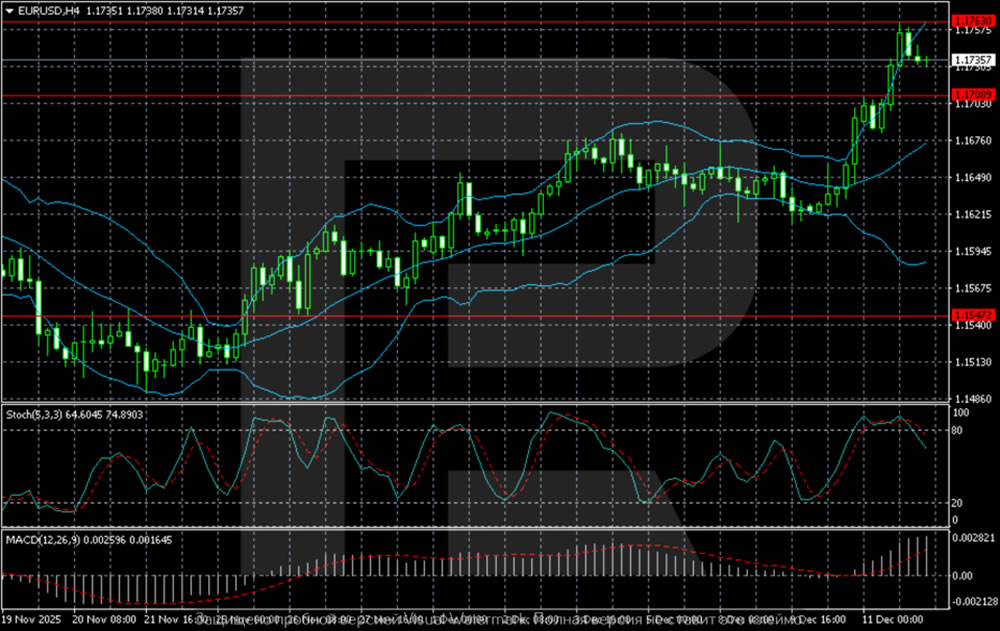
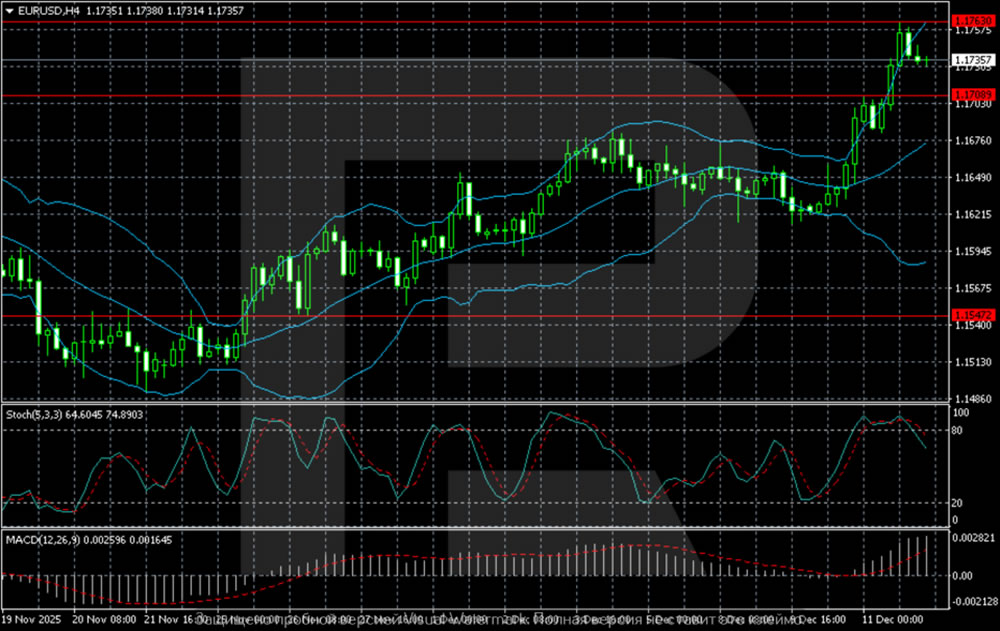
          On the H4 chart, EUR/USD exhibits a robust bullish trend, trading near a key resistance zone at 1.1760–1.1780. The pair is holding firmly above the middle Bollinger Band, confirming buyer dominance. The upward slope and gradual widening of the upper band signal rising volatility and sustained momentum following a breakout to new highs.

          Provided the price remains above the 1.1709 support, the market retains strong potential to challenge the 1.1780 ceiling. A decisive breakout and close above this zone would open a clear path towards 1.1850. Should a pullback materialise, the nearest significant support lies at 1.1650, the previous breakout point. A break below 1.1547 would be required to signal a deeper correction towards the lower Bollinger Band.

          H1 Chart:

          On the H1 chart, the pair is consolidating after a powerful impulse wave that targeted the 1.1760–1.1780 resistance area. The current correction is finding initial support at 1.1709, a level from which the latest acceleration originated.

          The Stochastic oscillator is declining from overbought territory, increasing the probability of a near-term pause or shallow pullback. Nevertheless, the underlying structure remains bullish, with the price trading above the middle Bollinger Band, which now serves as dynamic support.

          A confirmed breakout above 1.1780 would signal a continuation of the uptrend, with subsequent targets at 1.1820 and 1.1850. Conversely, a sustained move below 1.1709 would provide the first technical indication of fading bullish momentum, potentially triggering a correction towards the next demand zone in the 1.1650–1.1620 range.

          Conclusion

          EUR/USD has broken out decisively on the back of a dovish Fed pivot and a shifting global rate differential. The technical picture is firmly bullish, with the pair now testing a major resistance cluster near 1.1780. A successful breakout above this level would likely accelerate gains towards 1.1850. In the near term, the 1.1709 support is critical; holding above it keeps the immediate upward bias intact, while a break below would suggest a period of consolidation is needed before the next directional move.

          Source: ACTIONFOREX

          To stay updated on all economic events of today, please check out our Economic calendar
          Risk Warnings and Disclaimers
          You understand and acknowledge that there is a high degree of risk involved in trading. Following any strategies or investment methods may lead to potential losses. The content on the site is provided by our contributors and analysts for information purposes only. You are solely responsible for determining whether any trading assets, securities, strategy, or any other product is suitable for investing based on your own investment objectives and financial situation.
          Add to Favorites
          Share

          China’s Bank Consolidation Campaign Struggles as Profits Sink and Capital Buffers Thin

          Gerik

          Economic

          Record Consolidation Push Meets Mounting Financial Stress

          In 2025, China accelerated its unprecedented drive to consolidate its fragmented small banking sector, with over 350 banking licenses revoked by November up sharply from 198 the year prior. This wave of mergers primarily targets the country’s 3,600-plus rural banks and credit cooperatives, which account for about 14% of China’s $58 trillion banking industry. Despite these aggressive moves, newly formed entities appear financially strained, as a Reuters review of 20 regional banks involved in 2024 mergers revealed that 13 saw declining profits or outright losses by mid-2025. Additionally, 14 of these lenders reported deterioration in their capital adequacy ratios.
          The results signal that consolidation, while aimed at reducing systemic risk, may be exposing deeper structural issues within China’s small-bank landscape particularly in regions burdened by overleveraged local governments and lingering fallout from the country’s property sector crisis.

          Asset Quality Concerns Persist Despite Mergers

          At the heart of Beijing’s financial stability concerns lies the vulnerability of rural and city commercial banks, which are disproportionately reliant on short-term interbank borrowing and often lack robust governance or diversified revenue streams. In many cases, regional governments pressured relatively healthier city lenders to absorb “high-risk” rural banks, hoping that scale and integration would stabilize the system. However, data shows the opposite has often occurred: banks that acquired distressed peers are now seeing their own balance sheets weaken.
          For instance, Shanxi Bank, backed by the Shanxi provincial government, reported a dramatic 90% profit plunge in 2024 after absorbing four rural banks, alongside a spike in its non-performing loan (NPL) ratio from 1.74% to 2.5%. Similarly, Bank of Dongguan’s profit fell 8.2% after its own acquisitions, and its NPL ratio rose from 0.93% to 1.01%. These figures suggest that the integration process not only failed to restore profitability but may have transferred risk from smaller institutions to mid-sized regional banks.

          Structural Fragility and Moral Hazard Undermine Reform Goals

          Financial analysts warn that unless underlying bad debts are properly recognized and written off, mergers merely spread risk rather than eliminate it. Xiaoxi Zhang of Gavekal Dragonomics emphasizes that bad loans must be resolved transparently, as bundling troubled assets without restructuring does not strengthen the system’s foundations.
          Moreover, local governments who often control or support these banks may be forced to intervene repeatedly, leading to a vicious cycle of public bailouts. Such interventions risk creating moral hazard, with weak institutions relying on state rescues while stronger banks are dragged into distressed asset pools. As one state-owned bank executive noted, many smaller lenders are “just lying down waiting to be rescued.”
          The risk is compounded by the fact that rural and city commercial banks remain far more fragile than their national peers. By September 2025, rural banks reported an average NPL ratio of 2.82%, city commercial banks at 1.84%, both substantially higher than the 1.22% reported by national state-owned banks and joint-stock banks.

          Policy Ambiguity and Political Tension Cloud Long-Term Impact

          While China’s top financial regulator, NFRA chief Li Yunze, has reaffirmed Beijing’s intent to continue systematic restructuring of small and medium-sized financial institutions, clear success metrics remain absent. Despite large-scale consolidations in 2024, including the merger of 290 rural lenders into regional banks, asset quality issues persist. Political pressure for rapid stabilization may have led to premature integrations without adequate risk pricing or restructuring mechanisms.
          Additionally, anecdotal evidence suggests that acquiring banks were often given limited discretion, being “guided” to acquire specific troubled banks from local government-approved lists. A loan officer from Jiangsu confirmed that many acquirers discovered significantly worse asset conditions than originally disclosed, undermining the credibility of regulatory risk assessments.

          A Costly Band-Aid for a Systemic Wound

          China’s sweeping bank consolidation campaign was designed to eliminate fragmentation and mitigate systemic risk. Yet, early evidence indicates that while the quantity of banks has decreased, the quality of financial health has not proportionally improved. The mergers, rather than curing the sector’s ailments, may have merely delayed them pushing distressed assets further up the institutional ladder without resolving their root causes.
          The correlation between forced consolidations and worsening balance sheets points to a structural mismatch: cosmetic changes in the number of institutions cannot substitute for deeper capital reform, debt resolution, and governance overhaul. Until Beijing confronts these core vulnerabilities particularly in rural and underdeveloped regions the threat of financial instability will remain, regardless of how many banking licenses are revoked.

          Source: Reuters

          To stay updated on all economic events of today, please check out our Economic calendar
          Risk Warnings and Disclaimers
          You understand and acknowledge that there is a high degree of risk involved in trading. Following any strategies or investment methods may lead to potential losses. The content on the site is provided by our contributors and analysts for information purposes only. You are solely responsible for determining whether any trading assets, securities, strategy, or any other product is suitable for investing based on your own investment objectives and financial situation.
          Add to Favorites
          Share

          Romanian Inflation Holds Firm In November

          ING

          Forex

          Economic

          Some price pressures begin to moderate

          Food inflation was marginally below what we had expected, non-food inflation was roughly in line with expectations, while services inflation was slightly higher than we had expected. That said, on the latter in particular, pressures appear to be less broad-based across the category, likely a sign that slower demand and diminishing wage pressures are starting to act on arguably the stickiest part of the consumer basket.

          Today's data also offered a fresh look at wage growth evolution, which has shown some minor improvements (4.3% year-on-year in October versus 4.1% in September) but remained visibly below inflation, continuing to be a drag on consumption.

          The outlook: marginal upward shift amid mixed risks

          The small upside divergences from the past two months led to an upward adjustment in our year-end 2025 forecast from 9.6% to 9.8%. This also means minor upward changes in next year's inflation path. At this stage, our average inflation forecast for 2026 has inched up from 7.1% to 7.2%, with a year-end value of 4.5%, above the National Bank of Romania's 3.7% projection.

          Risks to this outlook remain two-sided. On the upside, renewed energy price pressures, particularly gas bills from April 2026, could push inflation higher. On the downside, soft demand and moderating wages are likely to dominate the near-term picture, reducing the risk of second-round effects from the current inflationary upswing. Our commodities team also expects oil and natural gas prices to ease in 2026.

          Overall, this inflation episode looks far less intense than the surge that followed the Covid pandemic, as key drivers such as fiscal stimulus, commodity shocks and strong wage growth are absent. This should, in principle, allow the National Bank of Romania to begin reducing interest rates even before inflation starts to print meaningfully lower in 2026, shifting its attention more towards the downside pressures in economic activity. Our base case remains for a first rate cut in May 2026, with a total of 100bp in cuts next year.

          Source: ING

          To stay updated on all economic events of today, please check out our Economic calendar
          Risk Warnings and Disclaimers
          You understand and acknowledge that there is a high degree of risk involved in trading. Following any strategies or investment methods may lead to potential losses. The content on the site is provided by our contributors and analysts for information purposes only. You are solely responsible for determining whether any trading assets, securities, strategy, or any other product is suitable for investing based on your own investment objectives and financial situation.
          Add to Favorites
          Share
          FastBull
          Copyright © 2025 FastBull Ltd

          728 RM B 7/F GEE LOK IND BLDG NO 34 HUNG TO RD KWUN TONG KLN HONG KONG

          TelegramInstagramTwitterfacebooklinkedin
          App Store Google Play Google Play
          Products
          Charts

          Chats

          Q&A with Experts
          Screeners
          Economic Calendar
          Data
          Tools
          Membership
          Features
          Function
          Markets
          Copy Trading
          Latest Signals
          Contests
          News
          Analysis
          24/7
          Columns
          Education
          Company
          Careers
          About Us
          Contact Us
          Advertising
          Help Center
          Feedback
          User Agreement
          Privacy Policy
          Business

          White Label

          Data API

          Web Plug-ins

          Poster Maker

          Affiliate Program

          Risk Disclosure

          The risk of loss in trading financial instruments such as stocks, FX, commodities, futures, bonds, ETFs and crypto can be substantial. You may sustain a total loss of the funds that you deposit with your broker. Therefore, you should carefully consider whether such trading is suitable for you in light of your circumstances and financial resources.

          No decision to invest should be made without thoroughly conducting due diligence by yourself or consulting with your financial advisors. Our web content might not suit you since we don't know your financial conditions and investment needs. Our financial information might have latency or contain inaccuracy, so you should be fully responsible for any of your trading and investment decisions. The company will not be responsible for your capital loss.

          Without getting permission from the website, you are not allowed to copy the website's graphics, texts, or trademarks. Intellectual property rights in the content or data incorporated into this website belong to its providers and exchange merchants.

          Not Logged In

          Log in to access more features

          FastBull Membership

          Not yet

          Purchase

          Become a signal provider
          Help Center
          Customer Service
          Dark Mode
          Price Up/Down Colors

          Log In

          Sign Up

          Position
          Layout
          Fullscreen
          Default to Chart
          The chart page opens by default when you visit fastbull.com