• Trade
  • Markets
  • Copy
  • Contests
  • News
  • 24/7
  • Calendar
  • Q&A
  • Chats
Trending
Screeners
SYMBOL
LAST
BID
ASK
HIGH
LOW
NET CHG.
%CHG.
SPREAD
SPX
S&P 500 Index
6827.42
6827.42
6827.42
6899.86
6801.80
-73.58
-1.07%
--
DJI
Dow Jones Industrial Average
48458.04
48458.04
48458.04
48886.86
48334.10
-245.98
-0.51%
--
IXIC
NASDAQ Composite Index
23195.16
23195.16
23195.16
23554.89
23094.51
-398.69
-1.69%
--
USDX
US Dollar Index
97.950
98.030
97.950
98.500
97.950
-0.370
-0.38%
--
EURUSD
Euro / US Dollar
1.17394
1.17409
1.17394
1.17496
1.17192
+0.00011
+ 0.01%
--
GBPUSD
Pound Sterling / US Dollar
1.33707
1.33732
1.33707
1.33997
1.33419
-0.00148
-0.11%
--
XAUUSD
Gold / US Dollar
4299.39
4299.39
4299.39
4353.41
4257.10
+20.10
+ 0.47%
--
WTI
Light Sweet Crude Oil
57.233
57.485
57.233
58.011
56.969
-0.408
-0.71%
--

Community Accounts

Signal Accounts
--
Profit Accounts
--
Loss Accounts
--
View More

Become a signal provider

Sell trading signals to earn additional income

View More

Guide to Copy Trading

Get started with ease and confidence

View More

Signal Accounts for Members

All Signal Accounts

Best Return
  • Best Return
  • Best P/L
  • Best MDD
Past 1W
  • Past 1W
  • Past 1M
  • Past 1Y

All Contests

  • All
  • Trump Updates
  • Recommend
  • Stocks
  • Cryptocurrencies
  • Central Banks
  • Featured News
Top News Only
Share

USA Embassy In Lithuania: Maria Kalesnikava Is Not Going To Vilnius

Share

USA Embassy In Lithuania: Other Prisoners Are Being Sent From Belarus To Ukraine

Share

Ukraine President Zelenskiy: Five Ukrainians Released By Belarus In US-Brokered Deal

Share

USA Vilnius Embassy: USA Stands Ready For "Additional Engagement With Belarus That Advances USA Interests"

Share

USA Vilnius Embassy: Belarus, USA, Other Citizens Among The Prisoners Released Into Lithuania

Share

USA Vilnius Embassy: USA Will Continue Diplomatic Efforts To Free The Remaining Political Prisoners In Belarus

Share

USA Vilnius Embassy: Belarus Releases 123 Prisoners Following Meeting Of President Trump's Envoy Coale And Belarus President Lukashenko

Share

USA Vilnius Embassy: Masatoshi Nakanishi, Aliaksandr Syrytsa Are Among The Prisoners Released By Belarus

Share

USA Vilnius Embassy: Maria Kalesnikava And Viktor Babaryka Are Among The Prisoners Released By Belarus

Share

USA Vilnius Embassy: Nobel Peace Prize Laureate Ales Bialiatski Is Among The Prisoners Released By Belarus

Share

Belarusian Presidential Administration Telegram Channel: Lukashenko Has Pardoned 123 Prisoners As Part Of Deal With US

Share

Two Local Syrian Officials: Joint US-Syrian Military Patrol In Central Syria Came Under Fire From Unknown Assailants

Share

Israeli Military Says It Targeted 'Key Hamas Terrorist' In Gaza City

Share

Rwanda's Actions In Eastern Drc Are A Clear Violation Of Washington Accords Signed By President Trump - Secretary Of State Rubio

Share

Israeli Military Issues Evacuation Warning In Southern Lebanon Village Ahead Of Strike - Spokesperson On X

Share

Belarusian State Media Cites US Envoy Coale As Saying He Discussed Ukraine And Venezuela With Lukashenko

Share

Belarusian State Media Cites US Envoy Coale As Saying That US Removes Sanctions On Belarusian Potassium

Share

Thai Prime Minister: No Ceasefire Agreement With Cambodia

Share

US, Ukraine To Discuss Ceasefire In Berlin Ahead Of European Summit

Share

Incoming Czech Prime Minister Babis: Czech Republic Will Not Take On Guarantees For Ukraine Financing, European Commission Must Find Alternatives

TIME
ACT
FCST
PREV
U.K. Trade Balance Non-EU (SA) (Oct)

A:--

F: --

P: --

U.K. Trade Balance (Oct)

A:--

F: --

P: --

U.K. Services Index MoM

A:--

F: --

P: --

U.K. Construction Output MoM (SA) (Oct)

A:--

F: --

P: --

U.K. Industrial Output YoY (Oct)

A:--

F: --

P: --

U.K. Trade Balance (SA) (Oct)

A:--

F: --

P: --

U.K. Trade Balance EU (SA) (Oct)

A:--

F: --

P: --

U.K. Manufacturing Output YoY (Oct)

A:--

F: --

P: --

U.K. GDP MoM (Oct)

A:--

F: --

P: --

U.K. GDP YoY (SA) (Oct)

A:--

F: --

P: --

U.K. Industrial Output MoM (Oct)

A:--

F: --

P: --

U.K. Construction Output YoY (Oct)

A:--

F: --

P: --

France HICP Final MoM (Nov)

A:--

F: --

P: --

China, Mainland Outstanding Loans Growth YoY (Nov)

A:--

F: --

P: --

China, Mainland M2 Money Supply YoY (Nov)

A:--

F: --

P: --

China, Mainland M0 Money Supply YoY (Nov)

A:--

F: --

P: --

China, Mainland M1 Money Supply YoY (Nov)

A:--

F: --

P: --

India CPI YoY (Nov)

A:--

F: --

P: --

India Deposit Gowth YoY

A:--

F: --

P: --

Brazil Services Growth YoY (Oct)

A:--

F: --

P: --

Mexico Industrial Output YoY (Oct)

A:--

F: --

P: --

Russia Trade Balance (Oct)

A:--

F: --

P: --

Philadelphia Fed President Henry Paulson delivers a speech
Canada Building Permits MoM (SA) (Oct)

A:--

F: --

P: --

Canada Wholesale Sales YoY (Oct)

A:--

F: --

P: --

Canada Wholesale Inventory MoM (Oct)

A:--

F: --

P: --

Canada Wholesale Inventory YoY (Oct)

A:--

F: --

P: --

Canada Wholesale Sales MoM (SA) (Oct)

A:--

F: --

P: --

Germany Current Account (Not SA) (Oct)

A:--

F: --

P: --

U.S. Weekly Total Rig Count

A:--

F: --

P: --

U.S. Weekly Total Oil Rig Count

A:--

F: --

P: --

Japan Tankan Large Non-Manufacturing Diffusion Index (Q4)

--

F: --

P: --

Japan Tankan Small Manufacturing Outlook Index (Q4)

--

F: --

P: --

Japan Tankan Large Non-Manufacturing Outlook Index (Q4)

--

F: --

P: --

Japan Tankan Large Manufacturing Outlook Index (Q4)

--

F: --

P: --

Japan Tankan Small Manufacturing Diffusion Index (Q4)

--

F: --

P: --

Japan Tankan Large Manufacturing Diffusion Index (Q4)

--

F: --

P: --

Japan Tankan Large-Enterprise Capital Expenditure YoY (Q4)

--

F: --

P: --

U.K. Rightmove House Price Index YoY (Dec)

--

F: --

P: --

China, Mainland Industrial Output YoY (YTD) (Nov)

--

F: --

P: --

China, Mainland Urban Area Unemployment Rate (Nov)

--

F: --

P: --

Saudi Arabia CPI YoY (Nov)

--

F: --

P: --

Euro Zone Industrial Output YoY (Oct)

--

F: --

P: --

Euro Zone Industrial Output MoM (Oct)

--

F: --

P: --

Canada Existing Home Sales MoM (Nov)

--

F: --

P: --

Euro Zone Total Reserve Assets (Nov)

--

F: --

P: --

U.K. Inflation Rate Expectations

--

F: --

P: --

Canada National Economic Confidence Index

--

F: --

P: --

Canada New Housing Starts (Nov)

--

F: --

P: --

U.S. NY Fed Manufacturing Employment Index (Dec)

--

F: --

P: --

U.S. NY Fed Manufacturing Index (Dec)

--

F: --

P: --

Canada Core CPI YoY (Nov)

--

F: --

P: --

Canada Manufacturing Unfilled Orders MoM (Oct)

--

F: --

P: --

Canada Manufacturing New Orders MoM (Oct)

--

F: --

P: --

Canada Core CPI MoM (Nov)

--

F: --

P: --

Canada Manufacturing Inventory MoM (Oct)

--

F: --

P: --

Canada CPI YoY (Nov)

--

F: --

P: --

Canada CPI MoM (Nov)

--

F: --

P: --

Canada CPI YoY (SA) (Nov)

--

F: --

P: --

Canada Core CPI MoM (SA) (Nov)

--

F: --

P: --

Q&A with Experts
    • All
    • Chatrooms
    • Groups
    • Friends
    Connecting
    .
    .
    .
    Type here...
    Add Symbol or Code

      No matching data

      All
      Trump Updates
      Recommend
      Stocks
      Cryptocurrencies
      Central Banks
      Featured News
      • All
      • Russia-Ukraine Conflict
      • Middle East Flashpoint
      • All
      • Russia-Ukraine Conflict
      • Middle East Flashpoint
      Search
      Products

      Charts Free Forever

      Chats Q&A with Experts
      Screeners Economic Calendar Data Tools
      Membership Features
      Data Warehouse Market Trends Institutional Data Policy Rates Macro

      Market Trends

      Market Sentiment Order Book Forex Correlations

      Top Indicators

      Charts Free Forever
      Markets

      News

      News Analysis 24/7 Columns Education
      From Institutions From Analysts
      Topics Columnists

      Latest Views

      Latest Views

      Trending Topics

      Top Columnists

      Latest Update

      Signals

      Copy Rankings Latest Signals Become a signal provider AI Rating
      Contests
      Brokers

      Overview Brokers Assessment Rankings Regulators News Claims
      Broker listing Forex Brokers Comparison Tool Live Spread Comparison Scam
      Q&A Complaint Scam Alert Videos Tips to Detect Scam
      More

      Business
      Events
      Careers About Us Advertising Help Center

      White Label

      Data API

      Web Plug-ins

      Affiliate Program

      Awards Institution Evaluation IB Seminar Salon Event Exhibition
      Vietnam Thailand Singapore Dubai
      Fans Party Investment Sharing Session
      FastBull Summit BrokersView Expo
      Recent Searches
        Top Searches
          Markets
          News
          Analysis
          User
          24/7
          Economic Calendar
          Education
          Data
          • Names
          • Latest
          • Prev

          View All

          No data

          Scan to Download

          Faster Charts, Chat Faster!

          Download App
          English
          • English
          • Español
          • العربية
          • Bahasa Indonesia
          • Bahasa Melayu
          • Tiếng Việt
          • ภาษาไทย
          • Français
          • Italiano
          • Türkçe
          • Русский язык
          • 简中
          • 繁中
          Open Account
          Search
          Products
          Charts Free Forever
          Markets
          News
          Signals

          Copy Rankings Latest Signals Become a signal provider AI Rating
          Contests
          Brokers

          Overview Brokers Assessment Rankings Regulators News Claims
          Broker listing Forex Brokers Comparison Tool Live Spread Comparison Scam
          Q&A Complaint Scam Alert Videos Tips to Detect Scam
          More

          Business
          Events
          Careers About Us Advertising Help Center

          White Label

          Data API

          Web Plug-ins

          Affiliate Program

          Awards Institution Evaluation IB Seminar Salon Event Exhibition
          Vietnam Thailand Singapore Dubai
          Fans Party Investment Sharing Session
          FastBull Summit BrokersView Expo

          Dollar Hits Fresh 2025 Low As US Tariff Concerns Pick Up Again

          Michelle

          Economic

          Forex

          Summary:

          The dollar extended its decline as worries over US tariffs increased after President Donald Trump said he would notify trading partners soon of unilateral levies.
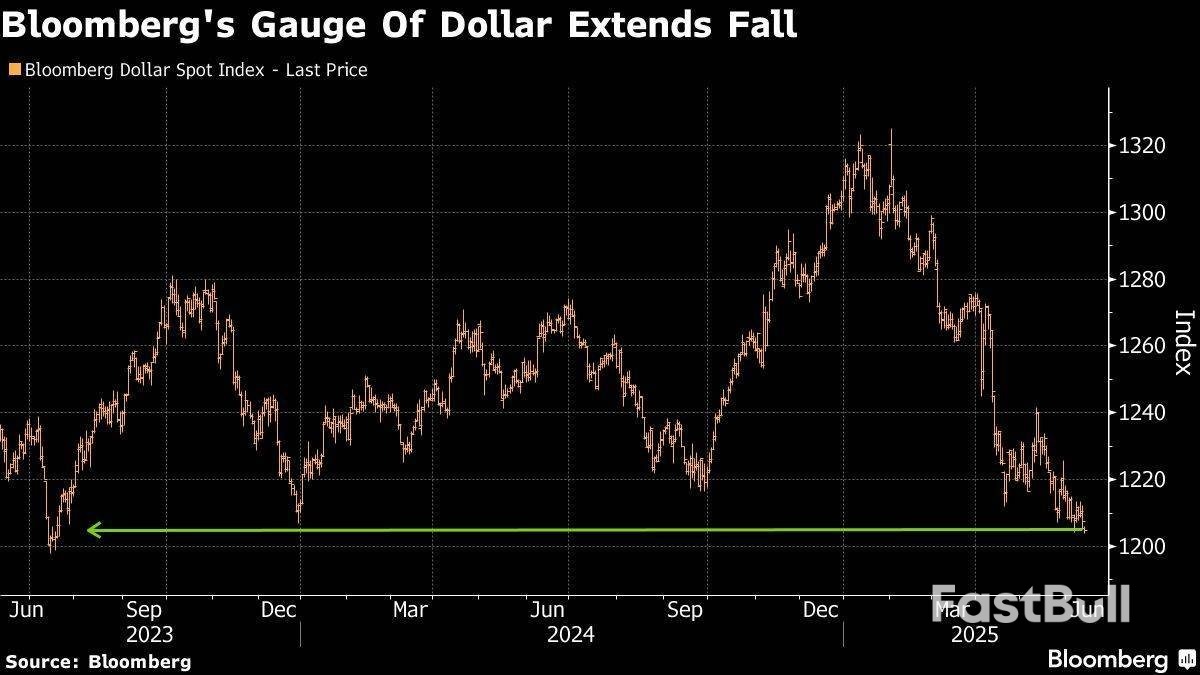
          The dollar extended its decline as worries over US tariffs increased after President Donald Trump said he would notify trading partners soon of unilateral levies.

          The Bloomberg Dollar Spot Index slid as much as 0.6% to the lowest level since July 2023 on Thursday, extending the previous day’s drop spurred by softer US inflation data. The euro rose to its strongest since November 2021.

          Traders will be monitoring US producer-price data due later Thursday for confirmation of subdued pressures. Some of its components feed into core personal consumption expenditure, the Federal Reserve’s preferred measure of inflation. They will also watch an auction of 30-year Treasuries after yields surged last month on fiscal concerns.

          “Dollar weakness has much more room to run,” said Vasileios Gkionakis, senior economist and strategist at Aviva Investors. He added the greenback’s weakness despite rising yields show eroding investor confidence in US assets.

          The dollar’s decline spilled into the currency volatility market, reinforcing the inverse correlation between the greenback and hedging costs recently. Demand was particularly pronounced in the one-week tenor, which captures the Fed’s June 18 policy meeting.

          What Bloomberg’s Strategists Say...

          “Trader pricing still favors more Federal Reserve interest rate cuts, although the precise timing flips around depending on the prevailing investor mood. But what is consistent is the US dollar ploughing a path to the downside as FX trader convictions firm.”

          — Mark Cranfield, Markets Live Strategist, Singapore

          Currency traders will also be watching the upcoming Group-of-Seven summit for any trade negotiation developments.

          “We are watching the G-7 summit closely for pending trade deals between the US and its key trading partners (e.g., Mexico and Canada),” said Alex Loo, macro strategist at TD Securities in Singapore. “Leaks this week may boost sentiment, especially the likes of Canadian dollar and Mexican peso.”

          Source: Yahoo Finance

          To stay updated on all economic events of today, please check out our Economic calendar
          Risk Warnings and Disclaimers
          You understand and acknowledge that there is a high degree of risk involved in trading. Following any strategies or investment methods may lead to potential losses. The content on the site is provided by our contributors and analysts for information purposes only. You are solely responsible for determining whether any trading assets, securities, strategy, or any other product is suitable for investing based on your own investment objectives and financial situation.
          Add to Favorites
          Share

          Stock market today: Dow, S&P 500, Nasdaq futures slide amid murky signals on Trump's trade policy

          Adam

          Stocks

          China–U.S. Trade War

          US stock futures pulled back on Thursday ahead of a fresh batch of inflation data, as investors continued to puzzle over President Trump's ever-evolving trade policy.
          Dow Jones Industrial Average futures (YM=F) fell roughly 0.6%, or over 200 points, while S&P 500 futures (ES=F) dropped about 0.4%. Contracts on the tech-heavy Nasdaq 100 (NQ=F) moved 0.3% lower.
          Stocks are staying downbeat after the S&P 500 (^GSPC) snapped this week's run of wins, as investors add growing tensions in the Middle East to worries over the fragility of the US-China trade detente.
          But the spotlight is on the May reading on wholesale inflation due later, after its consumer counterpart showed an easing in price pressures in the wake of Trump's "reciprocal" tariff hikes in April.
          Further hints that tariffs are sparing inflation could put the Federal Reserve in a tight spot ahead of its policy meeting next week. Bets on interest-rate cuts this year have mounted, but analysts expect officials to maintain their wait-and-see approach to economic data and policy decisions.
          While investor focus is shifting back to the Fed and away from trade war, Wall Street is following the latest twists and turns in the hunt for clarity around Trump's tariff policy.
          US trading partners will get letters within a week or two to set their tariff rates, Trump reiterated on Wednesday, saying they "can take it or leave it." Meanwhile, Treasury Secretary Scott Bessent told Congress it's "highly likely" that countries in trade negotiations with the US will see an extension of the 90-day tariff pause, currently set to expire July 9.

          source : finance.yahoo

          Risk Warnings and Disclaimers
          You understand and acknowledge that there is a high degree of risk involved in trading. Following any strategies or investment methods may lead to potential losses. The content on the site is provided by our contributors and analysts for information purposes only. You are solely responsible for determining whether any trading assets, securities, strategy, or any other product is suitable for investing based on your own investment objectives and financial situation.
          Add to Favorites
          Share

          Futures edge lower, Trump on trade talks, PPI ahead - what’s moving markets

          Adam

          Stocks

          China–U.S. Trade War

          U.S. stock futures suggest a lackluster start to trading on Wall Street on Thursday, as investors eye recent U.S.-China trade talks and a bevy of fresh inflation data. President Donald Trump has suggested that he is open to possibly extending a 90-day delay to his punishing "reciprocal" tariffs beyond a deadline early next month. Elsewhere, markets are awaiting May producer price figures, while Oracle (NYSE:ORCL) raises its full-year revenue target, sending shares in the cloud-computing group spiking in extended hours trading.

          Futures drop

          U.S. stock futures pointed lower, with traders gauging a relatively benign consumer price reading and signs of détente in recent trade tensions between the United States and China.
          By 03:37 ET (07:37 GMT), the Dow futures contract had slipped by 106 points, or 0.3%, S&P 500 futures had fallen by 13 points, or 0.2%, and Nasdaq 100 futures had declined by 48 points, or 0.2%.
          The benchmark S&P 500 and tech-heavy Nasdaq Composite both retreated on Wednesday, while the blue-chip Dow Jones Industrial Average was unchanged. Investors seemed to greet a slower-than-anticipated measure of consumer price growth in May in muted fashion, as worries persisted over the potential impact of Trump’s tariff agenda.
          Markets seemed to also be cautiously assessing a framework agreement between Washington and Beijing to resume their fragile trade truce. Trump called the deal "great," although analysts flagged that the announcement was short of many concrete details and possibly left the door open for a future flare-up in the spat between the world’s two largest economies.
          Sentiment was dented as well after media reports suggested that the U.S. is preparing for a partial evacuation of its embassy in Iran. An official from Tehran previously said that strikes on U.S. bases in the region would be carried out if ongoing nuclear talks collapse and a conflict emerges with the U.S.

          Trump on trade talks

          Meanwhile, Trump has hinted at a willingness to possibly extend a delay to his elevated "reciprocal" levies on most countries, saying that negotiations on bespoke trade deals were ongoing with 15 countries.
          Speaking to reporters on Wednesday, Trump claimed that the White House was "rocking in terms of deals," adding that "quite a few countries [...] want to make a deal with us."
          But he stressed that an extension to a postponement of his heightened duties beyond the current deadline in early July is likely not a "necessity."
          Trump added that the U.S. plans to send out letters to dozens of nations in the coming weeks that will set out the terms of trade deals, flagging that these countries will then have to choose whether to "take it, or [...] leave it."
          The president paused the implementation of his broadest tariffs in April, in a bid to give negotiators time to hammer out a series of agreements. However, with the 90-day halt set to end on July 8, the U.S. has just one trade deal agreed with Britain and 17 others are being discussed.

          PPI ahead

          The focus is now turning to a data point due out later today which tracks growth in U.S. producer prices, as markets remain wary of any indications that Trump’s tariffs could be re-fueling inflationary pressures.
          Economists anticipated that the producer price index for final demand edged up by 0.2% month-over-month in May, after it fell by 0.5% in the prior month. In the twelve months to May, the measure is seen speeding up to 2.6% from 2.4%.
          In April, wholesale services prices slipped by 0.7% -- the biggest fall since the government first began to monitor the numbers in December 2009. Prices for hotel and motel rooms decreased in particular, reflecting a retreat in tourist travel which analysts noted was potentially sparked by a backlash to Trump’s policies since returning to office.
          Crucially, accommodations, airline fares, and portfolio management fees make up some of the components that factor into an inflation gauge preferred by Federal Reserve interest-rate setters.
          On Wednesday, a separate Labor Department data set showed that consumer prices increased at a cooler-than-projected pace in May, thanks in large part to cheaper gasoline prices counterbalancing an uptick in rent costs.

          Oracle earnings

          Shares in Oracle surged in extended hours trading after the cloud-computing group lifted its annual revenue growth target and highlighted solid demand from clients aiming to harness artificial intelligence.
          Oracle CEO Safra Catz told investors in a post-earnings call on Wednesday that total revenue in its 2026 fiscal year is expected to be at least $67 billion, implying yearly growth of roughly 16.7%.
          The company had previously guided for an increase of 15%.
          Catz noted that its annual total cloud growth rate, which includes "applications plus infrastructure," will also rise to over 40% from 24% in the 2025 fiscal year, bolstered mostly by solid returns from its Oracle Cloud Infrastructure solution business and clients’ need to support AI workloads.
          Analysts at Vital Knowledge called the prospects for Oracle’s growth "amazing," but flagged that "meeting that demand is eating up a lot of cash" and contributing to an elevated projection for annual capital expenditures.

          Oil dips

          Oil prices slipped, handing back some of the previous session’s sharp gains as the U.S. authorised voluntary departures for military dependents in the Middle East amid rising tensions with Iran.
          At 03:42 ET, Brent futures dropped 1.3% to $68.89 a barrel and U.S. West Texas Intermediate crude futures fell 1.2% to $67.33 a barrel.
          Both contracts surged over 4% on Wednesday during a turbulent trading session, supported by the progress in U.S.-China trade talks, which has helped reduce demand concerns, with free-flowing trade expected to boost global economic activity and thus crude demand.
          Wednesday’s spike reflects heightened geopolitical risk, as investors feared any conflict could disrupt shipping routes or oil infrastructure across the Gulf.

          Source: Investing

          Risk Warnings and Disclaimers
          You understand and acknowledge that there is a high degree of risk involved in trading. Following any strategies or investment methods may lead to potential losses. The content on the site is provided by our contributors and analysts for information purposes only. You are solely responsible for determining whether any trading assets, securities, strategy, or any other product is suitable for investing based on your own investment objectives and financial situation.
          Add to Favorites
          Share

          Euro Hits Highest Since Late 2021, Safe-haven Swiss Franc And Yen Jump

          Glendon

          Economic

          Forex

          The euro hit its highest level in almost four years against the U.S. dollar as investors rushed into safe-haven assets on Thursday while remaining cautious about the impact of the U.S.-China trade deal.

          Geopolitical risks were in focus after U.S. President Donald Trump said some U.S. personnel were being moved out of the Middle East because “it could be a dangerous place,” adding that Washington would not allow Iran to develop a nuclear weapon.

          A cocktail of rising Middle East tensions and concern over the fragility of the trade truce between the U.S. and China drew investors into safe-haven assets.

          Analysts noted that the U.S. dollar serves as a key barometer of trade talks sentiment, while geopolitical instability prompted investors to buy safe-haven Swiss francs and yen.

          The franc rose 0.8% to 0.8138 versus the greenback, its highest level since April 22, and the yen climbed 0.6% to 143.70.

          The euro reached its highest since late 2021 at $1.1589 and was last up 0.70% at $1.1568.

          Some analysts said the euro has also drawn support from a hawkish European Central Bank, which hinted at a pause in its year-long easing cycle after inflation finally returned to its 2% target.

          However, ECB policymaker Isabel Schnabel said on Thursday the strong euro exchange rate is driven by a positive confidence shock in Europe - investors being drawn to the euro as a safe haven - and not by interest rate differentials.

          Trade deal deadline

          On the trade front, Trump said he would be willing to extend a July 8 deadline for completing trade talks with countries. But he added that the U.S. would send out letters in coming weeks specifying the terms for trade deals to dozens of other countries, which they could then embrace or reject.

          Investors argued that such a move keeps the risk of a July 9 jump in U.S. import tariffs on the table, which is regarded as negative for the dollar. The greenback and U.S. Treasuries dropped sharply after Trump announced a blitz of reciprocal tariffs - which he dubbed “Liberation Day” - in early April.

          Against a basket of currencies, the U.S. dollar fell to its weakest since April 22 at 98.072 and was last down 0.35% at 98.108. It hit 97.861, its lowest since April 2022.

          U.S. Treasury yields dropped on Wednesday as the closely watched “core” consumer price index eased some pressure on the Federal Reserve to maintain higher interest rates for longer.

          However, analysts remain cautious about the inflation outlook ahead of Thursday’s release of the producer price index.

          “We suspect the core Personal Consumption Expenditures Price Index (PCE) reading will prove modestly firmer, although the result will also hinge on the inputs from core PPI,” said David Doyle, head of economics at Macquarie.

          “Despite the subdued figures, through year-end, we expect year-on-year core inflation to remain elevated and potentially (to) rise as price pressures flow from recent tariff implementation.”

          Markets priced two Fed rate cuts of 25 basis points by year-end, with an 80% chance of the first move in September and 100 bps by September 2026.

          The onshore yuan rose 0.1% to 7.1818 per U.S. dollar, though gains were capped by the still-fragile truce in the U.S.-China trade war and the uncertainty surrounding the next moves of the two countries.

          Barclays sees plenty of headwinds over the medium term that could push the currency back onto a depreciation path, even if it might gain a little further from below 7.20.

          Source: BNN BIoomberg

          To stay updated on all economic events of today, please check out our Economic calendar
          Risk Warnings and Disclaimers
          You understand and acknowledge that there is a high degree of risk involved in trading. Following any strategies or investment methods may lead to potential losses. The content on the site is provided by our contributors and analysts for information purposes only. You are solely responsible for determining whether any trading assets, securities, strategy, or any other product is suitable for investing based on your own investment objectives and financial situation.
          Add to Favorites
          Share

          Goldman Sachs Bets on Rupee Rally to 83 With Binary Options Amid Strengthening Fundamentals

          Gerik

          Economic

          Strategic Trade Setup Reflects Confidence in India's Macroeconomic Stability

          Goldman Sachs’ trading desk has proposed a nine-month binary put option on the USD/INR pair, struck at 83 — a level that implies a nearly 3% appreciation of the rupee from its current level of around 85.50. Binary options are unique in that they offer an all-or-nothing payout if the rupee reaches or strengthens beyond that level by the contract’s expiry, in this case by March 2026. This timing aligns with seasonal rupee strength commonly observed toward India’s fiscal year-end.
          The choice of a binary put signals Goldman’s conviction in a decisive break below the strike price rather than a gradual strengthening. It also minimizes exposure to volatility during the life of the trade, focusing only on the final settlement value, making it a cost-efficient expression of a directional view.

          Improved Growth and Capital Flows Reinforce Bullish Sentiment

          India's GDP growth of 7.4% in the March quarter — up from 6.4% in the previous period — suggests broad-based economic momentum. This uptick is supported by Goldman's internal activity tracker showing robust consumer spending into April. Such momentum is a key signal for foreign investors, who have already poured over $4 billion into Indian equities in the last two months. If this trend continues, the rupee will benefit from increased demand in the foreign exchange market.
          Moreover, earnings growth among Indian corporates and rising investor confidence are aligning to create a pro-risk appetite that favors currency appreciation.

          Geopolitics and Commodities Offer Additional Tailwinds

          Another important factor in the trade setup is the expectation of easing trade tensions between India and the U.S. Goldman sees the prospect of a U.S.-India trade agreement as a possible catalyst for rupee strength. A de-escalation of reciprocal tariffs, particularly the paused 26% levy on Indian shipments, would boost both capital sentiment and trade flows, strengthening the rupee.
          Lower oil prices are another pillar supporting this thesis. Brent crude is projected by Goldman to average $60 in H2 2025 and drop further to $56 in 2026. This would ease India’s import bill, improve the current account balance, and reduce the need for dollar purchases by oil companies, all of which point toward INR appreciation.

          Currency Lag and Catch-Up Potential

          Despite these improving fundamentals, the rupee has underperformed relative to other Asian currencies, even as the U.S. dollar index fell by over 9% in recent months. This divergence suggests potential catch-up gains for the INR, should market expectations realign with macroeconomic reality.
          However, the binary nature of the option also implies that the trade could expire worthless if USD/INR fails to drop below 83, even marginally. Key risks include renewed global risk aversion, domestic political instability, or a surprise spike in oil prices — any of which could limit rupee gains or push the currency back into depreciation territory.
          Goldman Sachs’ options bet on the rupee reflects a calculated optimism about India's economic trajectory and its currency’s underperformance in 2025. By targeting the 83 level with a binary put, the strategy expresses a high-conviction view with a defined risk-reward profile. Investors considering similar exposure must weigh macro tailwinds against potential shocks, but the broader case for rupee appreciation appears supported by solid fundamentals and improving capital market dynamics.

          Source: Reuters

          To stay updated on all economic events of today, please check out our Economic calendar
          Risk Warnings and Disclaimers
          You understand and acknowledge that there is a high degree of risk involved in trading. Following any strategies or investment methods may lead to potential losses. The content on the site is provided by our contributors and analysts for information purposes only. You are solely responsible for determining whether any trading assets, securities, strategy, or any other product is suitable for investing based on your own investment objectives and financial situation.
          Add to Favorites
          Share

          What’s At Stake If Trump Scraps Security Pact With UK, Australia

          Michelle

          Economic

          Political

          The Trump administration has launched a review into the Aukus defense pact that the US signed with Australia and the UK in 2021 to counter China’s military expansion in the Indo-Pacific region.

          Central to the agreement is a controversial project — expected to cost hundreds of billions of dollars — to help Australia develop a fleet of nuclear-powered submarines over a 30-year period.

          If the US ends up abandoning the pact, it would deal a major blow to Australia and its defense capabilities. It would also raise questions for other Asia-Pacific allies about the US commitment to their security interests in the face of a rising China.

          Aukus is the nickname given to the wide-reaching security partnership signed between the US, the UK and Australia in September 2021. The most eye-catching part of the pact was the agreement to help Australia acquire a fleet of eight nuclear-powered submarines.

          At the moment, only six nations — the US, the UK, France, China, Russia and India — have the technology to deploy and operate nuclear-powered subs, which are faster than their diesel-electric counterparts, can stay submerged for several months and have space for more weapons, equipment and supplies.

          The plan is for the US to sell Australia as many as five of its nuclear-powered Virginia-class submarines by the early 2030s. Then Australia and the UK would together design and build a next-generation submarine partly using American technology, due to be completed in the 2040s.

          Under the deal, the UK would also expand its own nuclear-powered submarine fleet, from seven to as many as 12. The Aukus deal represented the first time that the US agreed to share its highly sensitive sub technology since 1965. The agreement was important enough to the US that it was willing to risk a diplomatic crisis with France, which saw a $66 billion contract to provide conventional submarines to Australia abruptly canceled because of Aukus.

          But the partnership isn’t limited to submarines: The second pillar of the deal, for instance, revolves around strategic technology sharing in areas such as quantum computing, artificial intelligence and advanced weaponry.

          The possibilities of the Aukus agreement have already led Japan, South Korea and New Zealand to all publicly express interest in joining the second pillar of the pact.

          The Trump administration has been looking to shift the burden of collective defense to its allies and to make sure the US has enough naval vessels of its own in case of a military clash over the coming decades.

          The review will study whether the deal, signed while Joe Biden was president, is “aligned with the President’s America First agenda,” the Pentagon said in a statement.

          More generally, the Trump administration has been ramping up pressure on allies around the world — including NATO countries and regional partners in Asia — to increase their military budgets. And the US wants to narrow its own gap in total ships with China’s Navy, the world’s largest.

          In a face-to-face meeting with Australia’s Deputy Prime Minister Richard Marles, US Secretary of Defense Pete Hegseth specifically asked for Canberra to raise its defense spending to 3.5% of GDP. Currently, Australia is on track to boost its military spending to about 2.4% of GDP by the mid 2030s.

          US shipbuilding and submarine production has been plagued by delays and cost overruns. Last year, a top US lawmaker revealed that the Navy’s Virginia-class submarine program is at least two years behind schedule and is projected to run $17 billion over its planned budget through 2030.

          Skeptics of Aukus include US Undersecretary of Defense for Policy Elbridge Colby. Last year, he posted to social media that “it would be crazy to have fewer SSNs in the right place and time,” using the shorthand for nuclear-powered attack submarine.

          The pact has also attracted criticism in Australia. Former Australian Prime Ministers Paul Keating and Malcolm Turnbull have disapproved of the agreement, saying it undermines the nation’s defense sovereignty at a time of growing strategic uncertainty in the Indo-Pacific.

          Following the announcement of the review, Keating described the Aukus program as the “most poorly conceived defense procurement program ever adopted by an Australian government.” Critics of the pact said the review would present Australia with an opportunity to leave the deal.

          Any major revisions or even scrapping of the Aukus pact would deal a major blow to Australia’s defense sector, which had begun to reshape itself to accommodate the anticipated submarines. Marles, who is also Australia’s deputy prime minister, earlier this year delivered a A$500 million ($325 million) downpayment to the US as part of Aukus.

          The Australian government has also been moving away from conventional military forces and toward longer-range capabilities, including missiles and drones, to support the nuclear fleet.

          A failure to acquire the submarines would blow a hole through the center of Australia’s defense capabilities at a crucial moment in regional geopolitics, with tensions high over China’s ambitions in the Indo-Pacific and South China Sea.

          Any move by the US or Australia to end Aukus would be viewed as a major win for China, which has been highly critical of the security pact since it was signed.

          At a Ministry of Foreign Affairs briefing in Beijing on June 12, spokesman Lin Jian said China opposed “anything that amplifies the risk of nuclear proliferation and exacerbates an arms race.”

          China has repeatedly petitioned the International Atomic Energy Agency to consider the Aukus pact a breach of non-proliferation treaties. China’s state-run media has also repeatedly accused Australia of trying to become a nuclear threat.

          The initial announcement in 2021 was greeted with some concern from Southeast Asian nations including Indonesia and Malaysia, which worried about a regional arms race. Others, including Japan and the Philippines, fellow US treaty allies, were positive about the partnership.

          Source: Bloomberg Europe

          To stay updated on all economic events of today, please check out our Economic calendar
          Risk Warnings and Disclaimers
          You understand and acknowledge that there is a high degree of risk involved in trading. Following any strategies or investment methods may lead to potential losses. The content on the site is provided by our contributors and analysts for information purposes only. You are solely responsible for determining whether any trading assets, securities, strategy, or any other product is suitable for investing based on your own investment objectives and financial situation.
          Add to Favorites
          Share

          UK Economy Contracts Sharply in April, Challenging Government’s Growth Ambitions

          Gerik

          Economic

          A Surprise Contraction Signals Fragility Beneath Quarterly Growth

          The Office for National Statistics (ONS) reported that UK GDP fell by 0.3% in April, a sharper decline than the 0.1% contraction expected by economists. This comes after a modest 0.2% growth in March. While the three-month rolling GDP figure shows a 0.7% expansion — buoyed by services sector performance earlier in the year — the sudden monthly drop suggests that recent growth may have been front-loaded and is not firmly rooted.
          ONS director Liz McKeown noted that activity in sectors like legal and real estate services slumped after a March spike in house purchases ahead of stamp duty changes. Similarly, car manufacturing, which had contributed to Q1 momentum, underperformed. These reversals underscore how temporary policy incentives or one-off factors distorted the true trajectory of economic output.

          Sectoral Imbalances Complicate Recovery Outlook

          While construction, retail, and R&D posted gains in April, they were insufficient to offset declines elsewhere. The imbalance highlights an ongoing lack of broad-based economic strength. For instance, the contraction in manufacturing — especially automotive production — is worrying given its multiplier effect on supply chains and employment. It also reflects persistent structural weaknesses, such as stagnant investment and weak export competitiveness.
          The service sector, traditionally the UK’s economic engine, remains volatile. April's drop, driven by reduced activity in professional and property-related services, suggests consumer and business confidence is still fragile. This dynamic could persist amid ongoing cost-of-living pressures and global macroeconomic headwinds, including uncertainty from U.S. tariffs and geopolitical instability.

          Government Growth Agenda Faces Early Test

          In response to the data, Chancellor Rachel Reeves acknowledged the disappointing figures but reaffirmed her commitment to “delivering growth” via the government’s Plan for Change. Her recently announced spending review outlined ambitious public investment: £29 billion annually for the NHS, a defence budget increase to 2.6% of GDP by 2027, £39 billion for affordable housing, and £15.6 billion for city-region transport upgrades.
          However, these capital allocations — while promising in the long term — are unlikely to produce immediate GDP uplift. Moreover, with tax revenues constrained and debt levels elevated, the government may face pressure to introduce tax rises or borrowing to finance these initiatives, potentially dampening household spending or business investment in the short run.

          Market and Policy Implications

          The pound remained relatively steady after the data release, suggesting markets may be taking a wait-and-see approach. However, continued weak monthly data could trigger volatility, especially if inflation stays sticky or external shocks intensify. Policymakers at the Bank of England may also reassess the timing of future rate decisions, especially if growth and inflation begin to diverge.
          The UK’s economic contraction in April serves as a cautionary reminder that recovery remains uneven and vulnerable. While headline quarterly growth remains intact, the April figures question its durability. Chancellor Reeves' growth agenda is comprehensive in scope but will need careful execution, fiscal discipline, and sustained confidence to translate into real economic momentum.
          Unless private sector activity picks up and structural productivity issues are addressed, government investment alone may not be enough to anchor long-term growth — especially in the face of rising geopolitical and trade uncertainties across global markets.

          Source: Yahoo Finance

          To stay updated on all economic events of today, please check out our Economic calendar
          Risk Warnings and Disclaimers
          You understand and acknowledge that there is a high degree of risk involved in trading. Following any strategies or investment methods may lead to potential losses. The content on the site is provided by our contributors and analysts for information purposes only. You are solely responsible for determining whether any trading assets, securities, strategy, or any other product is suitable for investing based on your own investment objectives and financial situation.
          Add to Favorites
          Share
          FastBull
          Copyright © 2025 FastBull Ltd

          728 RM B 7/F GEE LOK IND BLDG NO 34 HUNG TO RD KWUN TONG KLN HONG KONG

          TelegramInstagramTwitterfacebooklinkedin
          App Store Google Play Google Play
          Products
          Charts

          Chats

          Q&A with Experts
          Screeners
          Economic Calendar
          Data
          Tools
          Membership
          Features
          Function
          Markets
          Copy Trading
          Latest Signals
          Contests
          News
          Analysis
          24/7
          Columns
          Education
          Company
          Careers
          About Us
          Contact Us
          Advertising
          Help Center
          Feedback
          User Agreement
          Privacy Policy
          Business

          White Label

          Data API

          Web Plug-ins

          Poster Maker

          Affiliate Program

          Risk Disclosure

          The risk of loss in trading financial instruments such as stocks, FX, commodities, futures, bonds, ETFs and crypto can be substantial. You may sustain a total loss of the funds that you deposit with your broker. Therefore, you should carefully consider whether such trading is suitable for you in light of your circumstances and financial resources.

          No decision to invest should be made without thoroughly conducting due diligence by yourself or consulting with your financial advisors. Our web content might not suit you since we don't know your financial conditions and investment needs. Our financial information might have latency or contain inaccuracy, so you should be fully responsible for any of your trading and investment decisions. The company will not be responsible for your capital loss.

          Without getting permission from the website, you are not allowed to copy the website's graphics, texts, or trademarks. Intellectual property rights in the content or data incorporated into this website belong to its providers and exchange merchants.

          Not Logged In

          Log in to access more features

          FastBull Membership

          Not yet

          Purchase

          Become a signal provider
          Help Center
          Customer Service
          Dark Mode
          Price Up/Down Colors

          Log In

          Sign Up

          Position
          Layout
          Fullscreen
          Default to Chart
          The chart page opens by default when you visit fastbull.com
