

Markets
News
Analysis
User
24/7
Economic Calendar
Education
Data
- Names
- Latest
- Prev



Signal Accounts for Members
All Signal Accounts
All Contests
 Japan Tankan Small Manufacturing Outlook Index (Q4)
A:--
F: --
P: --
Japan Tankan Large Non-Manufacturing Outlook Index (Q4)A:--
F: --
P: --
Japan Tankan Large Manufacturing Outlook Index (Q4)A:--
F: --
P: --
Japan Tankan Small Manufacturing Diffusion Index (Q4)A:--
F: --
P: --
Japan Tankan Large Manufacturing Diffusion Index (Q4)A:--
F: --
P: --
Japan Tankan Large-Enterprise Capital Expenditure YoY (Q4)A:--
F: --
P: --
 U.K. Rightmove House Price Index YoY (Dec)
A:--
F: --
P: --
 China, Mainland Industrial Output YoY (YTD) (Nov)
A:--
F: --
P: --
China, Mainland Urban Area Unemployment Rate (Nov)A:--
F: --
P: --
 Saudi Arabia CPI YoY (Nov)
A:--
F: --
P: --
 Euro Zone Industrial Output YoY (Oct)
A:--
F: --
P: --
Euro Zone Industrial Output MoM (Oct)A:--
F: --
P: --
 Canada Existing Home Sales MoM (Nov)
A:--
F: --
P: --
Canada National Economic Confidence IndexA:--
F: --
P: --
Canada New Housing Starts (Nov)A:--
F: --
 U.S. NY Fed Manufacturing Employment Index (Dec)
A:--
F: --
P: --
U.S. NY Fed Manufacturing Index (Dec)A:--
F: --
P: --
Canada Core CPI YoY (Nov)A:--
F: --
P: --
Canada Manufacturing Unfilled Orders MoM (Oct)A:--
F: --
P: --
U.S. NY Fed Manufacturing Prices Received Index (Dec)A:--
F: --
P: --
U.S. NY Fed Manufacturing New Orders Index (Dec)A:--
F: --
P: --
Canada Manufacturing New Orders MoM (Oct)A:--
F: --
P: --
Canada Core CPI MoM (Nov)A:--
F: --
P: --
Canada Trimmed CPI YoY (SA) (Nov)A:--
F: --
P: --
Canada Manufacturing Inventory MoM (Oct)A:--
F: --
P: --
Canada CPI YoY (Nov)A:--
F: --
P: --
Canada CPI MoM (Nov)A:--
F: --
P: --
Canada CPI YoY (SA) (Nov)A:--
F: --
P: --
Canada Core CPI MoM (SA) (Nov)A:--
F: --
P: --
Canada CPI MoM (SA) (Nov)A:--
F: --
P: --
Federal Reserve Board Governor Milan delivered a speech U.S. NAHB Housing Market Index (Dec)--
F: --
P: --
 Australia Composite PMI Prelim (Dec)
--
F: --
P: --
Australia Services PMI Prelim (Dec)--
F: --
P: --
Australia Manufacturing PMI Prelim (Dec)--
F: --
P: --
Japan Manufacturing PMI Prelim (SA) (Dec)--
F: --
P: --
U.K. 3-Month ILO Employment Change (Oct)--
F: --
P: --
U.K. Unemployment Claimant Count (Nov)--
F: --
P: --
U.K. Unemployment Rate (Nov)--
F: --
P: --
U.K. 3-Month ILO Unemployment Rate (Oct)--
F: --
P: --
U.K. Average Weekly Earnings (3-Month Average, Including Bonuses) YoY (Oct)--
F: --
P: --
U.K. Average Weekly Earnings (3-Month Average, Excluding Bonuses) YoY (Oct)--
F: --
P: --
 France Services PMI Prelim (Dec)
--
F: --
P: --
France Composite PMI Prelim (SA) (Dec)--
F: --
P: --
France Manufacturing PMI Prelim (Dec)--
F: --
P: --
 Germany Services PMI Prelim (SA) (Dec)
--
F: --
P: --
Germany Manufacturing PMI Prelim (SA) (Dec)--
F: --
P: --
Germany Composite PMI Prelim (SA) (Dec)--
F: --
P: --
Euro Zone Composite PMI Prelim (SA) (Dec)--
F: --
P: --
Euro Zone Services PMI Prelim (SA) (Dec)--
F: --
P: --
Euro Zone Manufacturing PMI Prelim (SA) (Dec)--
F: --
P: --
U.K. Services PMI Prelim (Dec)--
F: --
P: --
U.K. Manufacturing PMI Prelim (Dec)--
F: --
P: --
U.K. Composite PMI Prelim (Dec)--
F: --
P: --
Euro Zone ZEW Economic Sentiment Index (Dec)--
F: --
P: --
Germany ZEW Current Conditions Index (Dec)--
F: --
P: --
Germany ZEW Economic Sentiment Index (Dec)--
F: --
P: --
Euro Zone Trade Balance (Not SA) (Oct)--
F: --
P: --
Euro Zone ZEW Current Conditions Index (Dec)--
F: --
P: --
Euro Zone Trade Balance (SA) (Oct)--
F: --
P: --
U.S. Retail Sales MoM (Excl. Automobile) (SA) (Oct)--
F: --
P: --


No matching data

Latest Views
Latest Views
Trending Topics
Top Columnists
Latest Update
White Label
Data API
Web Plug-ins
Affiliate Program
View All
No data
A key driver of U.S. Dollar weakness remains intact: hedging against USD weakness.
US retail sales rose in August for a third month in a broad advance, rounding out a resilient summer of spending.
The value of retail purchases, not adjusted for inflation, increased 0.6% after a similar gain in July, Commerce Department data showed Tuesday. That beat all estimates in a Bloomberg survey of economists. Excluding cars, sales climbed 0.7%.
Nine out of 13 categories posted increases, led by online retailers, clothing stores and sporting goods, likely reflecting back-to-school shopping. Motor vehicle sales rose at a slower pace.
Tuesday’s report adds to evidence that consumers are still spending even as tariffs boost the cost of some goods, sentiment remains subdued and the labor market shows signs of faltering. Though wage growth has cooled, many workers’ pay gains continue to outpace inflation, and others, particularly the wealthy, are benefiting from a stock market rally.
Federal Reserve officials are closely tracking consumer spending — which supports two-thirds of US economic activity — as they decide the trajectory of interest rates. While they’re still assessing the impact President Donald Trump’s tariffs will ultimately have on prices, they’re widely expected to cut rates at the end of their two-day meeting Wednesday in an effort to shield the labor market from further deterioration.
Stock futures remained higher and Treasury yields rose after the report.
The retail sales report showed so-called control-group sales — which feed into the government’s calculation of goods spending for gross domestic product — climbed 0.7% in August, so far indicating a healthy third quarter. The measure excludes food services, auto dealers, building materials stores and gasoline stations.
The retail sales figures largely reflect purchases of goods, which comprise roughly a third of overall consumer outlays. Because the data are not adjusted for inflation, an advance could also reflect the impact of higher prices. A report on real spending on goods and services for August will be released later this month.
Spending at restaurants and bars, the only service-sector category in the retail report, advanced 0.7% after declining in the prior month.
Inflation data out last week suggested companies largely refrained from price hikes last month, as many firms have been wary that steep markups could push customers away.
Canada's annual inflation rate rose 1.9% in August as petrol prices on a yearly basis fell at a slower pace than the previous month and food prices were up slightly, data showed on Tuesday.
The annual inflation rate has been largely distorted by the cancellation of the carbon levy on petrol sale which has helped bring down the cost of the fuel on a yearly basis, and economists have focused on core inflation measures to gauge the trend of prices.
On a monthly basis, the consumer price index was down 0.1% in August, Statistics Canada said.
Analysts polled by Reuters had forecast the annual inflation rate at 2% in August from 1.7% in July, and on a month-on-month basis to increase by 0.1% from 0.3% in the prior month.
The lower than expected rise in inflation is likely to bolster chances of a rate cut on Wednesday by the Bank of Canada, even though there are still concerns that underlying inflation was still high.
Money markets are expecting almost 87% chances of a 25 basis point rate cut on Sept. 17. (0#CADIRPR)
The BoC has kept its benchmark policy rate on hold since March at 2.75% but a slew of data in the last few weeks have propped up the case for restarting the rate reduction cycle.
Petrol prices were the biggest contributor to the rise in inflation in August and rose 1.4% on a monthly basis. However on a yearly basis, the price of fuel dropped 12.7% in August from 16.1% decline in July, the statistics agency noted. This helped in bringing down transportation costs by 0.5% in August.
Excluding gasoline, the CPI rose 2.4% in August, after increasing 2.5% in each of the previous three months, StatsCan said.
One of the core measures of inflation, the CPI-median, or the centermost component of the CPI basket, mirrored the prior month's 3.1% rise in August. The other core measure CPI-trim, which excludes the most extreme price changes, fell to 3% from 3.1% in July.
The share of the CPI basket which is above 3% rose to 39.1% in August from 37.3% in July, indicating resilient underling inflation.
Prices for shelter, which accounts for almost 30% of the CPI basket, rose by 2.6% in August from 3% in July as costs for both mortgage costs and rents eased.
Food prices rose by 3.4% in August as prices for meat rose 7.2% year over year, following a 4.7% increase in July, StatsCan said.
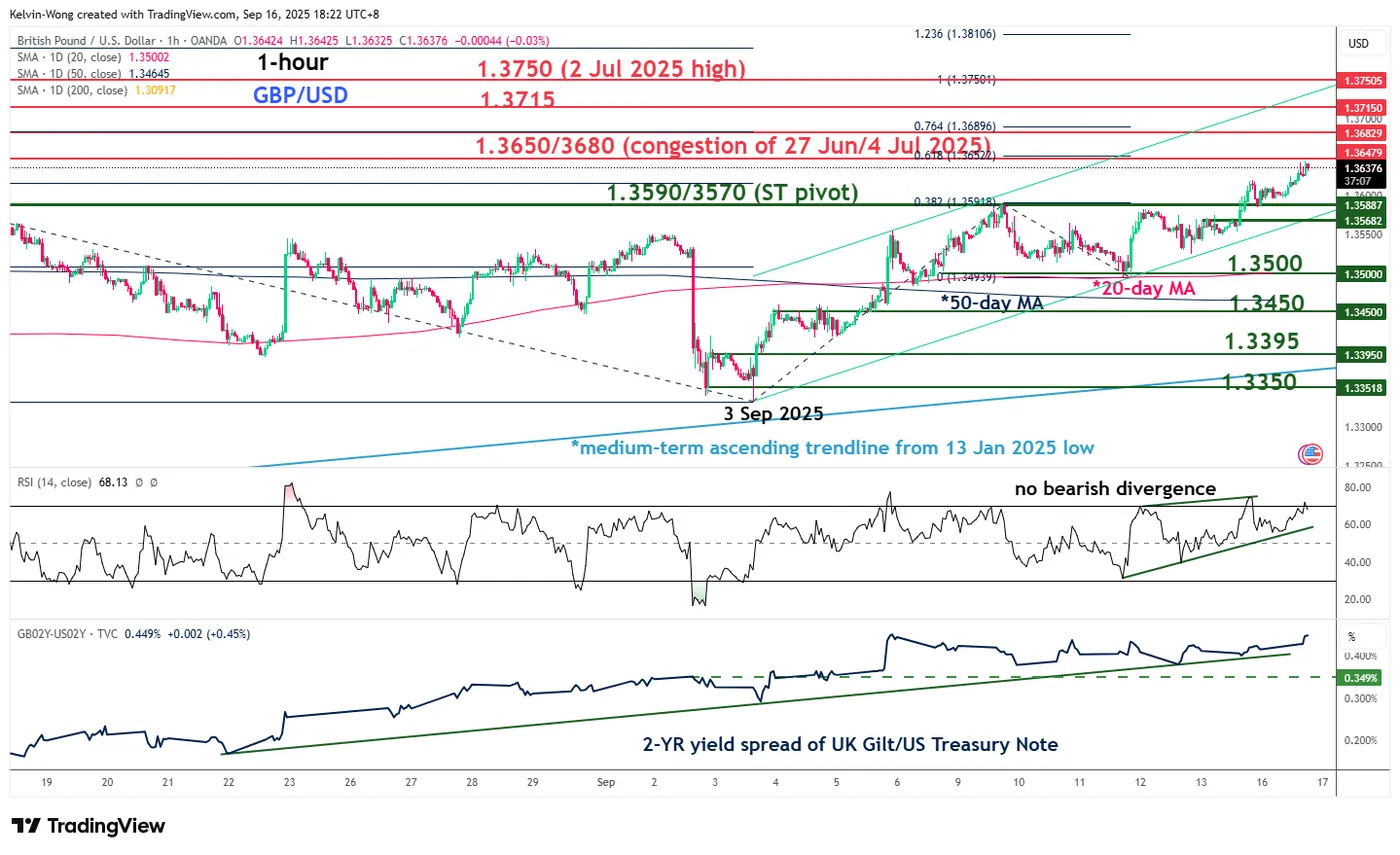
The price actions of the sterling have staged the expected recovery against the US dollar, as the GBP/USD has rallied by 1.2% and almost hit the lower limit of our highlighted resistance zone of 1.3650/1.3680 (printed an intraday high of 1.3645 on Tuesday, 16 September 2025, at the time of writing).
Today’s stellar performance of the GBP/USD (+0.3% has also been reinforced by better-than-expected July’s employment change data for the UK, which came in at 232,000, above the consensus of 222,000, while the unemployment rate remained steady for the third consecutive month at 4.7%, in line with expectations.
Let’s now update the short-term (1 to 3 days) trajectory and key technical elements of the GBP/USD ahead of tomorrow’s FOMC monetary policy decision outcome and the release of the latest Fed economic projections (dot plot).
Preferred trend bias (1-3 days)
A new minor bullish impulsive up move sequence is likely to have kicked off for the GBP/USD from its 3 September 2025 minor bullish reversal low of 1.3333 on the onset of the intraday spike up of the 30-year UK gilt yield over fiscal policy fears.
Maintain bullish bias above a tightened short-term pivotal support of 1.3590/1.3570 on the GBP/USD, with the next intermediate resistances to come in at 1.3715 and 1.3750 (also a Fibonacci extension).
Key elements
Alternative trend bias (1 to 3 days)
A break below 1.3570 key short-term support in GBP/USD will negate the bullish tone for a deeper minor corrective decline to expose the next intermediate supports at 1.3500 (also the 20-day moving average) and 1.3450 (also the 50-day moving average)
Key points:
The Fed looks set to cut rates this week after a string of softer data. Job growth has slowed, unemployment has edged up, producer prices turned negative in August, and consumer inflation was broadly in line. This marks the start of an easing cycle.For long-term investors, the key is not the size of the cut, but how different asset classes and segments might respond.
Equities often benefit from easier monetary policy because lower rates reduce financing costs and improve valuations. The opportunity set is also expanding beyond mega-cap technology.
In summary, any sector where large upfront capital spending meets long-dated cash flows — such as miners, utilities, renewables, infrastructure, pipelines, and REITs — stands to gain more than average when financing costs ease. Pairing these capital-heavy sectors with structural demand themes like AI power, electrification, and the energy transition makes the case even stronger.
Quality fixed income offers attractive risk-reward and diversification benefits. Lower policy rates are likely to push Treasury yields down, creating space for government and investment-grade bonds to deliver mid-single-digit returns over the next year. If U.S. growth slows further, yields could fall quickly, giving bonds added capital gains.
Cash was a comfortable trade when deposits and money-market funds yielded 4–5%. With rate cuts on the way, those returns will fade quickly, making idle cash less attractive.
Risks still loom
Rate cuts mark a turning point in the policy cycle. Equities could broaden beyond mega-cap tech into small caps, utilities, and EM. Bonds regain their role as a true diversifier, while gold and infrastructure look more attractive as funding costs ease.Most importantly, idle cash is set to underperform and it can be redeployed across bonds for yield, equities for growth, or real assets for diversification.The Fed is shifting gears, but inflation, growth, and politics will shape the road ahead.
Governments in the UK and France this year have been punished by bond investors over failures to shrink fiscal deficits, while in the US the Trump administration has been — for what it’s worth — making the case its policies will be reining in federal borrowing needs soon.
Not all the Group of Seven advanced economies are focused on fiscal discipline, however. Germany’s infrastructure-cum-defense buildout initiative is well known. Another case that may get less attention: Canada.
Prime Minister Mark Carney on Sunday confirmed he plans to run a “substantial” deficit — higher than last year’s shortfall of approximately C$48 billion ($35 billion). That reflects a broad plan to invest in the domestic economy and put growth on a trajectory in coming years that relies less on its southern neighbor, the US.
President Donald Trump’s tariffs have hit Canada’s economy hard, triggering the first contraction in GDP in nearly two years last quarter. That’s eroding revenues and requiring spending to support industry and workers.
Since his successful election campaign in April, Carney has outlined billions in additional federal expenditures to boost defense and increase construction of affordable housing.
“There’s going to be implications for the deficit, but it’ll build a much stronger Canada moving forward,” Carney told reporters. For now, a (slight) majority of Canadians agree, with a recent poll offering the prime minister backing for his approach.
Canada’s starting point is solid, with the lowest net debt to gross domestic product ratio in the G-7 — at little more than 40% last year, compared with roughly 100% for the US — and the top sovereign ratings from Moody’s and S&P.
The latest survey of economists by Bloomberg reflects expectations for a deficit of over 2% of GDP this year, still well below the 3% that France is struggling to reach or the north-of-6% the US has been running.
Also, Carney says his government will be looking for savings in other areas as it compiles the budget to be unveiled next month. The plan will feature both “austerity and investment,” he’s said, pushing for major reviews of operational spending in the public sector. A review of procurement practices is also in train.
In something reminiscent of former UK Chancellor Gordon Brown’s “golden rule” (only borrow to fund investment over the economic cycle) Ottawa will be looking to separate the budget into operating expenses and capital investments, something economists are divided on.
“Splitting the budget is just marketing — the ‘investment’ items are still outlays that will require financing,” says Stuart Paul of Bloomberg Economics.
728 RM B 7/F GEE LOK IND BLDG NO 34 HUNG TO RD KWUN TONG KLN HONG KONG


White Label
Data API
Web Plug-ins
Poster Maker
Affiliate Program
The risk of loss in trading financial instruments such as stocks, FX, commodities, futures, bonds, ETFs and crypto can be substantial. You may sustain a total loss of the funds that you deposit with your broker. Therefore, you should carefully consider whether such trading is suitable for you in light of your circumstances and financial resources.
No decision to invest should be made without thoroughly conducting due diligence by yourself or consulting with your financial advisors. Our web content might not suit you since we don't know your financial conditions and investment needs. Our financial information might have latency or contain inaccuracy, so you should be fully responsible for any of your trading and investment decisions. The company will not be responsible for your capital loss.
Without getting permission from the website, you are not allowed to copy the website's graphics, texts, or trademarks. Intellectual property rights in the content or data incorporated into this website belong to its providers and exchange merchants.
Not Logged In
Log in to access more features

FastBull Membership
Not yet
Purchase


Log In
Sign Up


