• Trade
  • Markets
  • Copy
  • Contests
  • News
  • 24/7
  • Calendar
  • Q&A
  • Chats
Trending
Screeners
SYMBOL
LAST
BID
ASK
HIGH
LOW
NET CHG.
%CHG.
SPREAD
SPX
S&P 500 Index
6827.42
6827.42
6827.42
6899.86
6801.80
-73.58
-1.07%
--
DJI
Dow Jones Industrial Average
48458.04
48458.04
48458.04
48886.86
48334.10
-245.98
-0.51%
--
IXIC
NASDAQ Composite Index
23195.16
23195.16
23195.16
23554.89
23094.51
-398.69
-1.69%
--
USDX
US Dollar Index
97.950
98.030
97.950
98.500
97.950
-0.370
-0.38%
--
EURUSD
Euro / US Dollar
1.17394
1.17409
1.17394
1.17496
1.17192
+0.00011
+ 0.01%
--
GBPUSD
Pound Sterling / US Dollar
1.33707
1.33732
1.33707
1.33997
1.33419
-0.00148
-0.11%
--
XAUUSD
Gold / US Dollar
4299.39
4299.39
4299.39
4353.41
4257.10
+20.10
+ 0.47%
--
WTI
Light Sweet Crude Oil
57.233
57.485
57.233
58.011
56.969
-0.408
-0.71%
--

Community Accounts

Signal Accounts
--
Profit Accounts
--
Loss Accounts
--
View More

Become a signal provider

Sell trading signals to earn additional income

View More

Guide to Copy Trading

Get started with ease and confidence

View More

Signal Accounts for Members

All Signal Accounts

Best Return
  • Best Return
  • Best P/L
  • Best MDD
Past 1W
  • Past 1W
  • Past 1M
  • Past 1Y

All Contests

  • All
  • Trump Updates
  • Recommend
  • Stocks
  • Cryptocurrencies
  • Central Banks
  • Featured News
Top News Only
Share

Iranian Media Says 18 Crew Members Of Foreign Tanker Seized In Gulf Of Oman Over Carrying 'Smuggled Fuel' Detained

Share

Regional Governor: Two Killed In Ukrainian Drone Strike On Russia's Saratov

Share

Chinese Foreign Ministry - China Foreign Minister Met With United Arab Emirates Counterpart On Dec 12

Share

China's Central Financial And Economic Affairs Commission Deputy Director: Will Expand Export And Increase Import In 2026

Share

Thai Leader Anutin: Landmine Blast That Killed Thai Soldiers 'Not A Roadside Accident'

Share

Thai Leader Anutin: Thailand To Continue Military Action Until 'We Feel No More Harm'

Share

Cambodian Prime Minister Hun Manet Says He Had Phone Calls With Trump And Malaysian Leader Anwar About Ceasefire

Share

Cambodia's Hun Manet Says USA, Malaysia Should Verify 'Which Side Fired First' In Latest Conflict

Share

Cambodia's Hun Manet: Cambodia Maintains Its Stance In Seeking Peaceful Resolution Of Disputes

Share

Nasdaq Companies: Allergan, Ferrovia, Insmed, Monolithic Power Systems, Seagate Technology, And Western Digital Will Be Added To The NASDAQ 100 Index. Biogen, CdW, GlobalFoundries, Lululemon, ON Semiconductor, And Tradedesk Will Be Removed From The NASDAQ 100 Index

Share

Witkoff Headed To Berlin This Weekend To Meet With Zelenskiy, European Leaders -Wsj Reporter On X

Share

Russia Attacks Two Ukrainian Ports, Damaging Three Turkish-Owned Vessels

Share

[Historic Flooding Occurs In At Least Four Rivers In Washington State Due To Days Of Torrential Rains] Multiple Areas In Washington State Have Been Hit By Severe Flooding Due To Days Of Torrential Rains, With At Least Four Rivers Experiencing Historic Flooding. Reporters Learned On The 12th That The Floods Caused By The Torrential Rains In Washington State Have Destroyed Homes And Closed Several Highways. Experts Warn That Even More Severe Flooding May Occur In The Future. A State Of Emergency Has Been Declared In Washington State

Share

Trump Says Proposed Free Economic Zone In Donbas Would Work

Share

Trump: I Think My Voice Should Be Heard

Share

Trump Says Will Be Choosing New Fed Chair In Near Future

Share

Trump Says Proposed Free Economic Zone In Donbas Complex But Would Work

Share

Trump Says Land Strikes In Venezuela Will Start Happening

Share

US President Trump: Thailand And Cambodia Are In A Good Situation

Share

State Media: North Korean Leader Kim Hails Troops Returning From Russia Mission

TIME
ACT
FCST
PREV
U.K. Trade Balance Non-EU (SA) (Oct)

A:--

F: --

P: --

U.K. Trade Balance (Oct)

A:--

F: --

P: --

U.K. Services Index MoM

A:--

F: --

P: --

U.K. Construction Output MoM (SA) (Oct)

A:--

F: --

P: --

U.K. Industrial Output YoY (Oct)

A:--

F: --

P: --

U.K. Trade Balance (SA) (Oct)

A:--

F: --

P: --

U.K. Trade Balance EU (SA) (Oct)

A:--

F: --

P: --

U.K. Manufacturing Output YoY (Oct)

A:--

F: --

P: --

U.K. GDP MoM (Oct)

A:--

F: --

P: --

U.K. GDP YoY (SA) (Oct)

A:--

F: --

P: --

U.K. Industrial Output MoM (Oct)

A:--

F: --

P: --

U.K. Construction Output YoY (Oct)

A:--

F: --

P: --

France HICP Final MoM (Nov)

A:--

F: --

P: --

China, Mainland Outstanding Loans Growth YoY (Nov)

A:--

F: --

P: --

China, Mainland M2 Money Supply YoY (Nov)

A:--

F: --

P: --

China, Mainland M0 Money Supply YoY (Nov)

A:--

F: --

P: --

China, Mainland M1 Money Supply YoY (Nov)

A:--

F: --

P: --

India CPI YoY (Nov)

A:--

F: --

P: --

India Deposit Gowth YoY

A:--

F: --

P: --

Brazil Services Growth YoY (Oct)

A:--

F: --

P: --

Mexico Industrial Output YoY (Oct)

A:--

F: --

P: --

Russia Trade Balance (Oct)

A:--

F: --

P: --

Philadelphia Fed President Henry Paulson delivers a speech
Canada Building Permits MoM (SA) (Oct)

A:--

F: --

P: --

Canada Wholesale Sales YoY (Oct)

A:--

F: --

P: --

Canada Wholesale Inventory MoM (Oct)

A:--

F: --

P: --

Canada Wholesale Inventory YoY (Oct)

A:--

F: --

P: --

Canada Wholesale Sales MoM (SA) (Oct)

A:--

F: --

P: --

Germany Current Account (Not SA) (Oct)

A:--

F: --

P: --

U.S. Weekly Total Rig Count

A:--

F: --

P: --

U.S. Weekly Total Oil Rig Count

A:--

F: --

P: --

Japan Tankan Large Non-Manufacturing Diffusion Index (Q4)

--

F: --

P: --

Japan Tankan Small Manufacturing Outlook Index (Q4)

--

F: --

P: --

Japan Tankan Large Non-Manufacturing Outlook Index (Q4)

--

F: --

P: --

Japan Tankan Large Manufacturing Outlook Index (Q4)

--

F: --

P: --

Japan Tankan Small Manufacturing Diffusion Index (Q4)

--

F: --

P: --

Japan Tankan Large Manufacturing Diffusion Index (Q4)

--

F: --

P: --

Japan Tankan Large-Enterprise Capital Expenditure YoY (Q4)

--

F: --

P: --

U.K. Rightmove House Price Index YoY (Dec)

--

F: --

P: --

China, Mainland Industrial Output YoY (YTD) (Nov)

--

F: --

P: --

China, Mainland Urban Area Unemployment Rate (Nov)

--

F: --

P: --

Saudi Arabia CPI YoY (Nov)

--

F: --

P: --

Euro Zone Industrial Output YoY (Oct)

--

F: --

P: --

Euro Zone Industrial Output MoM (Oct)

--

F: --

P: --

Canada Existing Home Sales MoM (Nov)

--

F: --

P: --

Euro Zone Total Reserve Assets (Nov)

--

F: --

P: --

U.K. Inflation Rate Expectations

--

F: --

P: --

Canada National Economic Confidence Index

--

F: --

P: --

Canada New Housing Starts (Nov)

--

F: --

P: --

U.S. NY Fed Manufacturing Employment Index (Dec)

--

F: --

P: --

U.S. NY Fed Manufacturing Index (Dec)

--

F: --

P: --

Canada Core CPI YoY (Nov)

--

F: --

P: --

Canada Manufacturing Unfilled Orders MoM (Oct)

--

F: --

P: --

Canada Manufacturing New Orders MoM (Oct)

--

F: --

P: --

Canada Core CPI MoM (Nov)

--

F: --

P: --

Canada Manufacturing Inventory MoM (Oct)

--

F: --

P: --

Canada CPI YoY (Nov)

--

F: --

P: --

Canada CPI MoM (Nov)

--

F: --

P: --

Canada CPI YoY (SA) (Nov)

--

F: --

P: --

Canada Core CPI MoM (SA) (Nov)

--

F: --

P: --

Q&A with Experts
    • All
    • Chatrooms
    • Groups
    • Friends
    Connecting
    .
    .
    .
    Type here...
    Add Symbol or Code

      No matching data

      All
      Trump Updates
      Recommend
      Stocks
      Cryptocurrencies
      Central Banks
      Featured News
      • All
      • Russia-Ukraine Conflict
      • Middle East Flashpoint
      • All
      • Russia-Ukraine Conflict
      • Middle East Flashpoint
      Search
      Products

      Charts Free Forever

      Chats Q&A with Experts
      Screeners Economic Calendar Data Tools
      Membership Features
      Data Warehouse Market Trends Institutional Data Policy Rates Macro

      Market Trends

      Market Sentiment Order Book Forex Correlations

      Top Indicators

      Charts Free Forever
      Markets

      News

      News Analysis 24/7 Columns Education
      From Institutions From Analysts
      Topics Columnists

      Latest Views

      Latest Views

      Trending Topics

      Top Columnists

      Latest Update

      Signals

      Copy Rankings Latest Signals Become a signal provider AI Rating
      Contests
      Brokers

      Overview Brokers Assessment Rankings Regulators News Claims
      Broker listing Forex Brokers Comparison Tool Live Spread Comparison Scam
      Q&A Complaint Scam Alert Videos Tips to Detect Scam
      More

      Business
      Events
      Careers About Us Advertising Help Center

      White Label

      Data API

      Web Plug-ins

      Affiliate Program

      Awards Institution Evaluation IB Seminar Salon Event Exhibition
      Vietnam Thailand Singapore Dubai
      Fans Party Investment Sharing Session
      FastBull Summit BrokersView Expo
      Recent Searches
        Top Searches
          Markets
          News
          Analysis
          User
          24/7
          Economic Calendar
          Education
          Data
          • Names
          • Latest
          • Prev

          View All

          No data

          Scan to Download

          Faster Charts, Chat Faster!

          Download App
          English
          • English
          • Español
          • العربية
          • Bahasa Indonesia
          • Bahasa Melayu
          • Tiếng Việt
          • ภาษาไทย
          • Français
          • Italiano
          • Türkçe
          • Русский язык
          • 简中
          • 繁中
          Open Account
          Search
          Products
          Charts Free Forever
          Markets
          News
          Signals

          Copy Rankings Latest Signals Become a signal provider AI Rating
          Contests
          Brokers

          Overview Brokers Assessment Rankings Regulators News Claims
          Broker listing Forex Brokers Comparison Tool Live Spread Comparison Scam
          Q&A Complaint Scam Alert Videos Tips to Detect Scam
          More

          Business
          Events
          Careers About Us Advertising Help Center

          White Label

          Data API

          Web Plug-ins

          Affiliate Program

          Awards Institution Evaluation IB Seminar Salon Event Exhibition
          Vietnam Thailand Singapore Dubai
          Fans Party Investment Sharing Session
          FastBull Summit BrokersView Expo

          CNBC Daily Open: Stocks rise and fall when Trump gives the word

          Adam

          Stocks

          Economic

          Summary:

          Trump’s 100% tariffs on China erased $800 billion from tech stocks, halting the AI-driven rally. Despite strong Chinese export data and Gaza ceasefire progress, renewed trade tensions rattled global markets.
          Artificial intelligence (in other words, “OpenAI and the companies in its ecosystem”) has been turbocharging stock markets since ChatGPT was released in 2022.
          The clearest example of the sustained rally we’ve been enjoying: In recent weeks, the S&P 500
          basically hit a record close each time the index rises — even if it’s a miniscule 0.05% tick upwards.
          That’s not to say investors aren’t worried about a possible AI bubble forming. If you squint a bit, Nvidia’s
          huge investment deal with OpenAI can look like one hand passing a wad of cash to another, while OpenAI’s ambitious Stargate project, despite only having one “star” in its name, might need something like the energy of five to power it.
          None of that, however, has halted stocks’ long-run march upward. Until one man said a few words.
          On Friday, U.S. President Donald Trump, in response to China tightening exports of rare earths, introduced new 100% tariffs on the Asian giant, on top of existing rates. “Also on November 1st, we will impose Export Controls on any and all critical software,” Trump added.
          That single measure wiped out almost $800 billion from major tech firms, with the S&P 500 and Nasdaq Composite
          falling the most since April, when, well, we all know what happened then.
          One of the few people that, with a single utterance, could move billions is Taylor Swift. Trump is another. And “the rest is History,” as Trump wrote.

          What you need to know today

          Trump slaps new tariffs on China. The president announced tariffs of 100% on imports from China starting Nov. 1, in response to Beijing tightening its exports of rare earth metals. However, Trump said Sunday that “all will be fine” with China.
          Chinese exports growth beats expectations. Shipments out of the country grew 8.3% in September from a year earlier, higher than the Reuters poll’s estimate for a 7.1% increase and rebounding from August’s six-month low. Imports also surpassed expectations.
          Israeli hostages released. Palestinian militant group Hamas on Monday released the first seven surviving Israeli hostages on Monday, marking the first stage of a ceasefire deal brokered with Trump’s help.
          Stocks hit by trade war reigniting. Major U.S. indexes slumped Friday, with tech behemoths losing $770 billion in market capitalization. On Sunday night stateside, U.S. futures rebound. Asia-Pacific markets, however, fell Monday, with Chinese stocks declining the most.
          [PRO] China will remain leader in robotics. That’s according to Morgan Stanley, which wrote in a Sept. 30 report — shared with the media last week — that there’s “potential in Chinese manufacturing” to grow rapidly in the next few years.

          And finally...

          Chinese shares had recently rallied to a multi-year high on expectations of government stimulus and a recent inflow of foreign capital into Chinese equities.
          However, the possibility of that rally continuing was predicated on stability in geopolitical risk, especially on trade. With tariff rhetoric back at the forefront, analysts warned sentiment could quickly unravel.

          Source: cnbc

          To stay updated on all economic events of today, please check out our Economic calendar
          Risk Warnings and Disclaimers
          You understand and acknowledge that there is a high degree of risk involved in trading. Following any strategies or investment methods may lead to potential losses. The content on the site is provided by our contributors and analysts for information purposes only. You are solely responsible for determining whether any trading assets, securities, strategy, or any other product is suitable for investing based on your own investment objectives and financial situation.
          Add to Favorites
          Share

          Market navigator: week of 13 October 2025

          Adam

          Economic

          What happened last week

          Ceasefire in Gaza: Israel and Hamas approved a peace plan proposed by the US and overseen by Turkey, Egypt and Qatar to establish a ceasefire in Gaza. The initial phase encompasses hostage exchange and humanitarian assistance. WTI crude oil plunged over 5% to $58.9.
          Intensifying trade tensions: The US plans to escalate tariffs from 30% to 100% commencing 1 November, responding to China's enhanced rare earth controls and Qualcomm investigation. China imposed reciprocal port fees on US vessels. Uncertainty remains whether Presidents Trump and Xi's potential Asia-Pacific Economic Cooperation meeting could de-escalate tensions. Nasdaq 100 plunged 3.5% on Friday, the largest single-day decline since April.
          Fed faces data uncertainty: September's Federal Open Market Committee (FOMC) minutes revealed majority support for additional rate reductions in 2025, though disagreement exists regarding magnitude. The government shutdown, now in its second week, has prevented release of critical employment and inflation data, potentially complicating the Federal Reserve's (Fed) justification for October rate cuts.
          RBNZ's jumbo cut: The Reserve Bank of New Zealand surprised markets by implementing a substantial 50 basis point reduction. The central bank projects inflation returning to 2% by mid-2026, citing significant spare domestic capacity. The committee signalled openness to further reductions. NZD/USD weakened 1.9%.

          Markets in focus

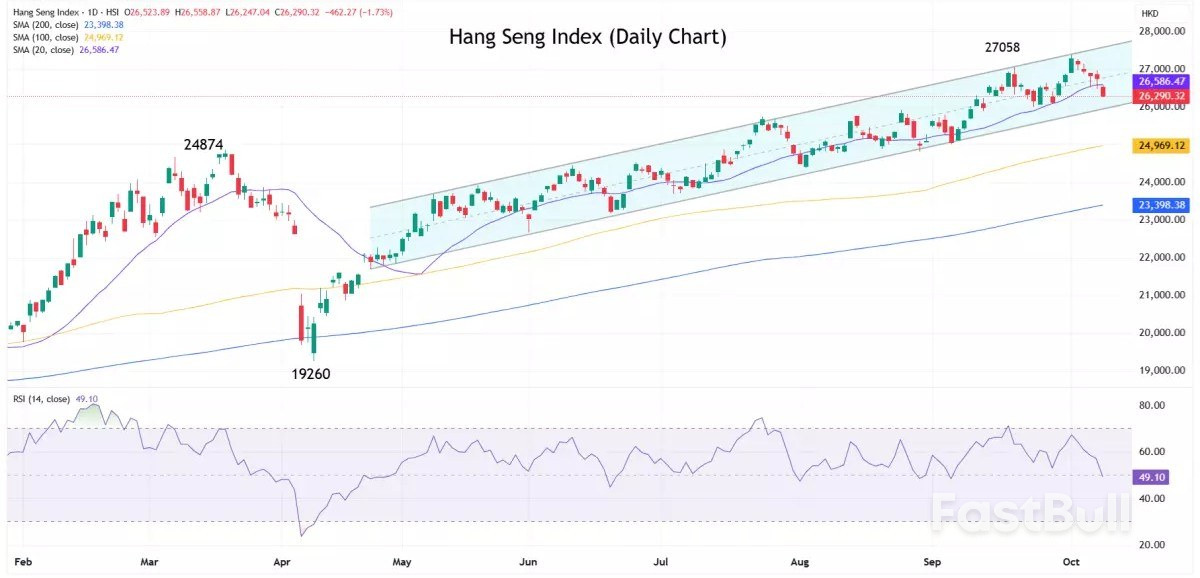
          Southbound flow failed to sustain Hang Seng Index momentum
          The Hang Seng Index (HSI) declined 3.1% last week, representing its steepest weekly contraction since July. Nearly all gains from the previous week have been eliminated. Profit-taking activity intensified as the prior week's top performers became last week's primary laggards, with SMIC plummeting 15% and Alibaba declining 11%.
          Hang Seng Bank emerged as the index's top performer, surging 26% following HSBC's announcement to acquire the company through a privatisation transaction. HSBC is offering HK$155 per share, representing a 30% premium to Hang Seng's closing price on 8 October. The $14 billion transaction will impact HSBC's capital ratio by 125 basis points negatively. HSBC's share price declined 6% last week. The proposal demonstrates HSBC's confidence in Hong Kong's business opportunities. Additionally, the deal is expected to enhance the group's operational efficiency in the territory over the long term.
          Hong Kong stocks trading volumes contracted significantly during the National Day Golden Week holiday. Market turnover reached only HK$121.2 billion on 6 October, compared with the daily average turnover of HK$316.5 billion recorded in September. With Southbound flows resuming on 9 October, trading activities are expected to gradually recover.
          From a technical perspective, the ascending channel established since mid-April continues to govern HSI's price movement. Following last week's correction, the relative strength index (RSI) has declined below the neutral threshold at 50, suggesting a potential rebound may be imminent. Upside potential extends towards 27,650, represented by the channel's upper boundary. Retracements would likely encounter support at the 50-day moving average near 25,000.
          Figure 1: Hang Seng Index (daily) price chart

          Market navigator: week of 13 October 2025_1as of 11 Oct 2025. Past performance is not a reliable indicator of future performance.
          Political uncertainty drives volatility in Yen
          Sanae Takaichi prevailed over prominent contenders Koizumi and Hayashi at the Liberal Democratic Party (LDP) presidential election on 4 October, yet her path to becoming Japan's first female prime minister faces substantial obstacles. The LDP's coalition partner Komeito terminated the 26-year partnership citing failure to strengthen political funding regulations. Takaichi appointed Koichi Hagiuda, who was previously suspended for involvement in a funding scandal, as LDP's acting secretary-general.
          With Komeito declining to support Takaichi in the upcoming parliamentary vote, she must secure alliances with alternative parties as the LDP remains 37 seats short of a lower house majority required to assume the prime ministership.
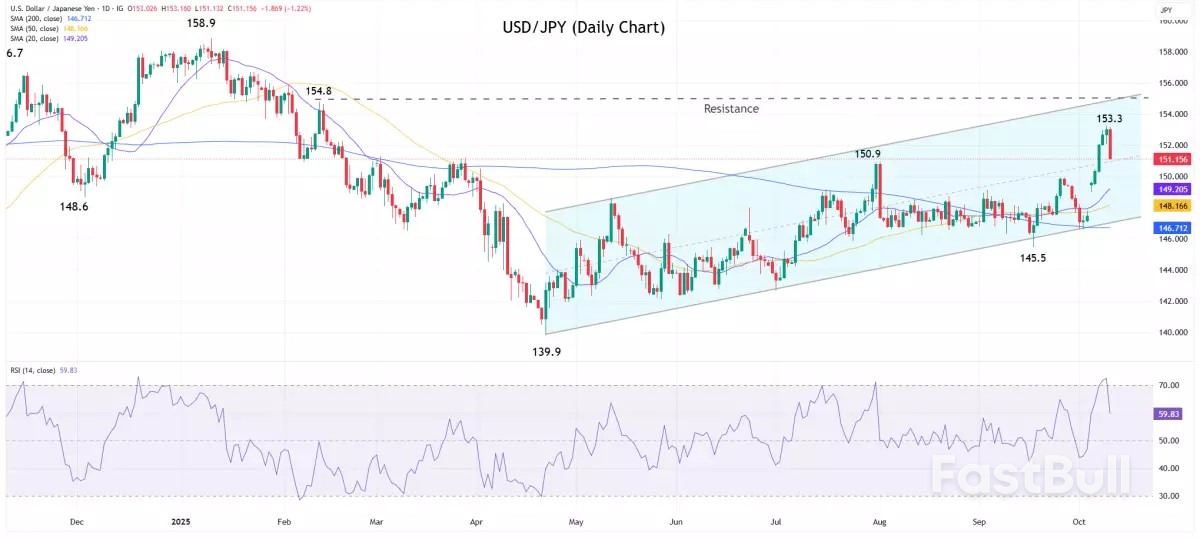
          Regarded as a hardline conservative and protégé of former Prime Minister Shinzo Abe, Takaichi is anticipated to support fiscal expansion and accommodative monetary policy. USD/JPY strengthened above 153, reaching the highest level since February, before retracing gains following the coalition's dissolution. 20-year government bond yields surged to 2.75%, the highest level since 1999.
          Given the political uncertainties and USD/JPY's decisive breakout above 150, the yen's strengthening trend from earlier this year appears to have reversed, with USD/JPY potentially targeting February's high at 154.8. Technical support is located near the 20-day moving average (MA) at 149.2. Should the yen continue trading within the current range or weaken further, yen carry trades will likely regain popularity. Investors should remain vigilant as an unwinding of carry trades could precipitate extremely volatile conditions in Japanese equity and currency markets, similar to the events of July 2024.
          Figure 2: USD/JPY (daily) price chart

          Market navigator: week of 13 October 2025_2as of 11 Oct 2025. Past performance is not a reliable indicator of future performance.
          Gold and silver achieve historic levels
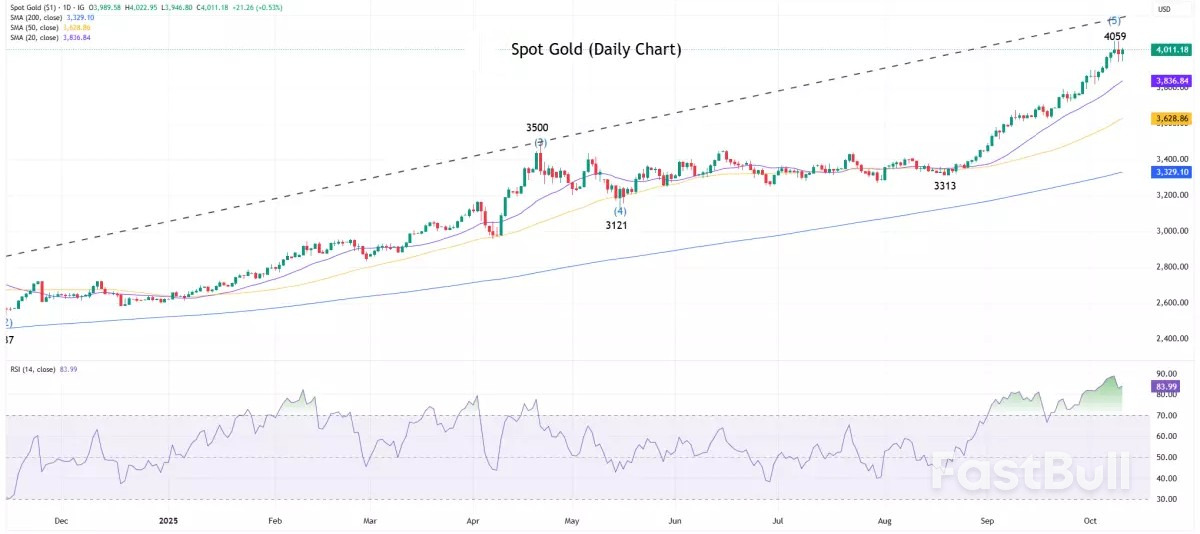
          The gold rally extended to its eighth consecutive week, accumulating an impressive 20% performance during this period. Gold prices established another record high, reaching $4059 per ounce on 8 October.
          Concurrently, silver prices surged to $51.20 per ounce, the highest level since the Hunt brothers' squeeze event in 1980. This represents staggering year-to-date gains exceeding 70%, substantially outperforming gold.
          Beyond safe-haven demand, diversification from the US dollar and rate cut expectations, silver prices benefit from industrial demand including solar panels and wind turbines. Supply has lagged demand over the past four years and is projected to continue this deficit through 2025.
          Technical analysis indicates gold has achieved the target from our previous assessment based on a 100% Fibonacci extension of Elliott Wave 1 from November 2024. The pullback following the $4059 peak reveals profit-taking activity as the RSI reached 88, indicating extreme overbought conditions. The consolidation phase should receive support from the 20-day MA around $3840, with the subsequent rebound possessing potential to challenge resistance at $4200. Should this support level fail to hold, it may signal the commencement of corrective Wave A towards $3700.
          Figure 3: Spot gold (daily) price chart

          Market navigator: week of 13 October 2025_3 as of 11 Oct 2025. Past performance is not a reliable indicator of future performance.
          The week ahead

          This week presents critical inflection points for global markets, though considerable uncertainty surrounds US data releases following the federal government shutdown that delayed September's employment report and trade figures. Markets anticipate China's trade statistics and the commencement of third-quarter (Q3) earnings season featuring major financial institutions.
          China's September trade data assumes heightened importance as investors scrutinise export momentum with the tariff truce with the US scheduled to conclude on 10 November. August demonstrated resilience with exports advancing 4.4% year-on-year (YoY) and the trade surplus reaching $102.33 billion. However, import growth of merely 1.3% YoY signals continued weakness in domestic demand. Wednesday's consumer price index (CPI) data will provide additional insight into domestic economic recovery progress. Deflationary pressure is expected to persist due to intense pricing competition amongst businesses.
          The US consumer price index report, originally scheduled for Wednesday, has been postponed to 24 October due to the government shutdown, though will arrive in time for the Fed's assessment before its 28-29 October policy meeting. Thursday's producer price index (PPI) data, forecast to rebound 0.3% month-on-month (MoM) following August's contraction, will also likely face delays until further notice. Should inflation exceed expectations, markets may recalibrate rate cut probabilities for the remainder of 2025. Currently, the market is pricing in a 98% probability of a rate cut in October.
          Third-quarter earnings season officially commences with results from major US banking institutions including JPMorgan Chase, Goldman Sachs and Citigroup. Financial sector performance will illuminate the health of consumer lending and investment banking activity. Technology sector attention centres on results from ASML and Taiwan Semiconductor Manufacturing Company (TSMC), whose guidance will prove critical for assessing AI infrastructure demand. Strong earnings accompanied by optimistic forward guidance could catalyse renewed equity market momentum, while disappointments may trigger sector rotation or broader risk aversion.
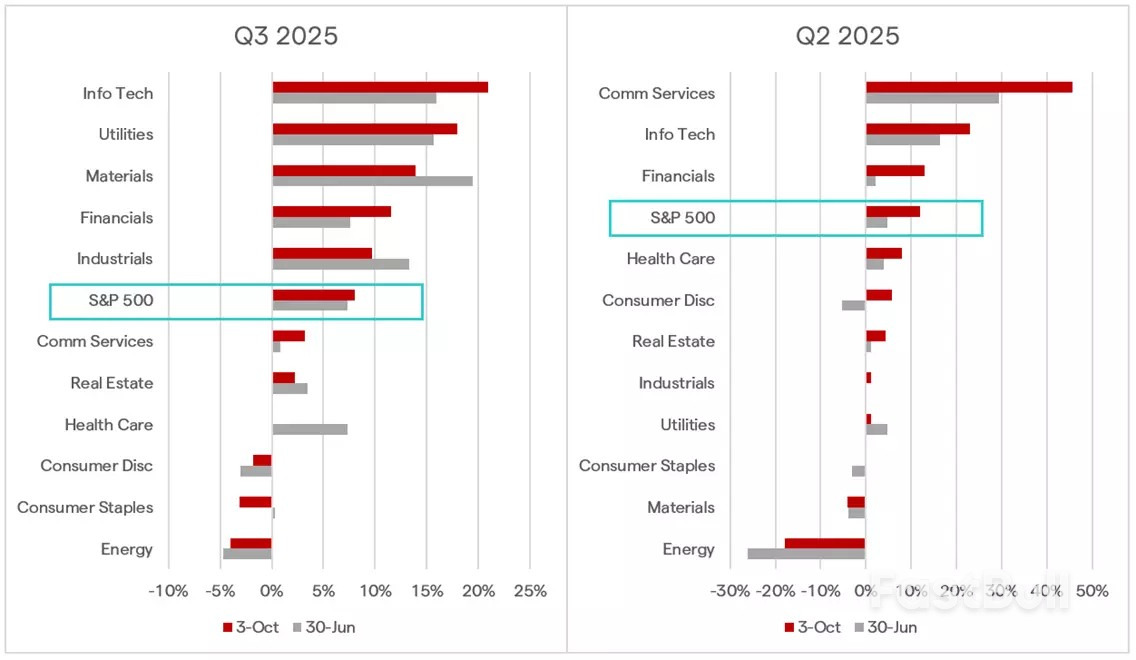
          According to Factset's Earnings Insight report, analysts are estimating an earnings growth rate of 8% for the S&P 500 in Q3 following upward revisions during the period. The number of companies issuing positive earnings guidance (56) substantially exceeds the five-year average (43), driven by optimistic outlooks from technology companies. This forecast presents a stark contrast with sentiment prior to Q2's earnings season, when analysts expected earnings growth below 5%. With substantial optimism priced in and valuations significantly above long-term averages, questions emerge regarding whether elevated expectations for Q3 will face disappointment.
          Figure 4: S&P 500 earnings growth expectations by sector (3 October vs. 30 June)

          Market navigator: week of 13 October 2025_4as of 3 October 2025

          Source: ig

          To stay updated on all economic events of today, please check out our Economic calendar
          Risk Warnings and Disclaimers
          You understand and acknowledge that there is a high degree of risk involved in trading. Following any strategies or investment methods may lead to potential losses. The content on the site is provided by our contributors and analysts for information purposes only. You are solely responsible for determining whether any trading assets, securities, strategy, or any other product is suitable for investing based on your own investment objectives and financial situation.
          Add to Favorites
          Share

          Gold (XAUUSD) Price Forecast: Fed Cut Hopes and Geopolitics Lift Gold, But Reversal Risk Grows

          Adam

          Commodity

          Gold Price Hits $4079.92 as Record Rally Extends — But Is a Reversal Near?

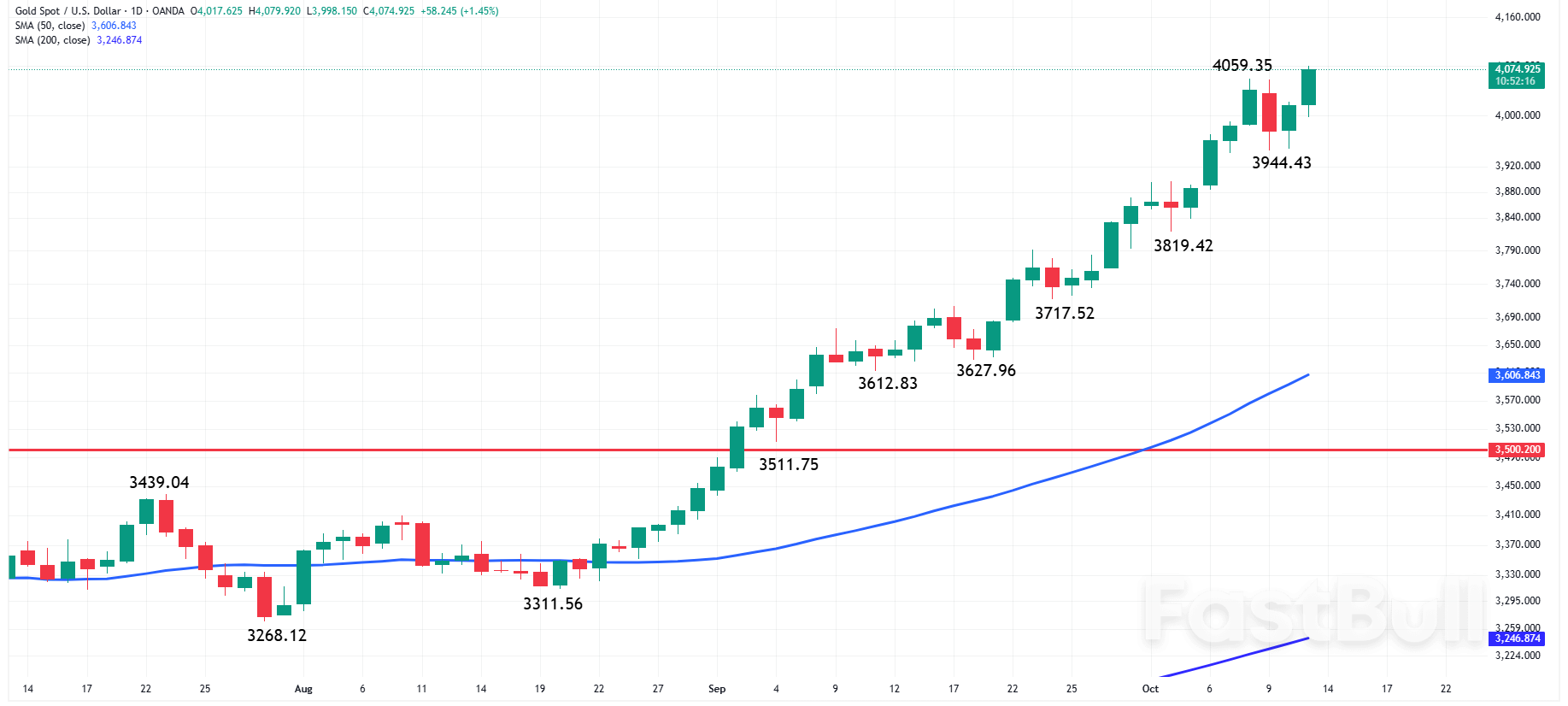
          Gold (XAUUSD) Price Forecast: Fed Cut Hopes and Geopolitics Lift Gold, But Reversal Risk Grows_1Daily Gold (XAU/USD)

          Spot gold (XAU/USD) surged to another record high on Monday, briefly touching $4079.92 after clearing last week’s top at $4059.35. While there’s no defined resistance at all-time highs, the chart is starting to raise red flags for short-term traders. The rally is technically overbought, and price action now shifts focus to reversal signals rather than upside targets.
          At 10:26 GMT, XAU/USD is trading $4074.10, up $57.42 or +1.43%.
          With Relative Strength Index readings around 80 and no clear resistance overhead, bulls remain in control — for now. But a higher-high, lower-close or closing price reversal top would suggest a short-term top is forming. A clean downside break through the newly formed minor bottom at $3944.43 would flip short-term momentum negative and could spark a deeper correction toward the 50-day moving average at $3606.80.

          Trump’s Tariff Threats Send Safe-Haven Bids Into Gold and Silver

          Gold’s latest breakout was fueled by renewed trade war fears after former President Trump announced 100% tariffs on Chinese imports and threatened fresh export controls starting November 1. The safe-haven bid extended into silver, which also hit a record high, while Bitcoin and equities faced pressure.
          Trump later softened his tone, saying, “Don’t worry about China, it will all be fine!” on Truth Social. But the tariff threat hasn’t been retracted, keeping geopolitical risk firmly in play. UBS noted “ongoing strong investment and central bank demand” as tailwinds and sees upside to $4200. Meanwhile, Goldman Sachs warned that silver may face more volatility and downside risk than gold due to its industrial linkages.

          Fed Rate Cuts in Play as Traders Eye October and December

          Fed expectations are providing another layer of support. Markets are pricing in a 95% chance of a 25bps cut in October, and 79.8% for a second cut in December, according to FedWatch. Non-yielding gold has gained 53% year-to-date, supported by declining real yields and an aggressive central bank gold-buying trend.
          Traders will be watching closely for fresh guidance from Fed Chair Jerome Powell, who is scheduled to speak Tuesday at the NABE annual meeting. Several other Fed officials are also due to comment this week, potentially impacting short-term rate expectations and dollar flows.

          Gold Price Forecast: Bullish Bias Holds, But Watch for a Reversal Setup

          The gold market remains in a strong bullish trend with momentum intact above $3944.43. However, technical signals suggest caution is warranted. If sellers step in with a reversal pattern near current highs, a correction toward $3606.80 becomes a real risk. For now, the bias is bullish — but traders should be watching the close closely for signs the rally may be running out of steam.

          Source: fxempire

          Risk Warnings and Disclaimers
          You understand and acknowledge that there is a high degree of risk involved in trading. Following any strategies or investment methods may lead to potential losses. The content on the site is provided by our contributors and analysts for information purposes only. You are solely responsible for determining whether any trading assets, securities, strategy, or any other product is suitable for investing based on your own investment objectives and financial situation.
          Add to Favorites
          Share

          China's Exports Top Forecast But Fresh US Trade Spat Raises Risks to Outlook

          Michelle

          Economic

          Forex

          China's export growth bounced back in September, but renewed trade threats from Beijing and Washington have rekindled worries about jobs and further deflation in an economy heavily reliant on selling its manufactured goods overseas.
          The world's second-largest economy has greatly diversified its export markets this year to insulate itself from U.S. President Donald Trump's 35-percentage-point tariff hikes, helping to keep GDP growth on track towards a roughly 5% target for the year.
          However, this strategy could get a reality check should Trump carry out his threat of re-imposing triple-digit tariffs on China in retaliation for Beijing announcing sweeping rare earth export controls last week.
          "While China's economy has proven more resilient in the face of U.S. tariffs than many had feared, there is still significant potential downside from a deeper rift with the U.S.," said Capital Economics analyst Julian Evans-Pritchard.
          China's exports rose an annual 8.3% last month, customs data showed on Monday, beating a 6% increase in a Reuters poll and registering the fastest growth since March. They compared with a 4.4% increase in August.
          While the faster export growth is welcome news for a still-fragile economy, Trump's latest threat to raise U.S. tariffs above 100% would deal a deflationary shock to China and put smaller exporters and jobs of factory workers at risk.
          China's choke on rare earths and magnets, where its near-monopoly position gives it great leverage in the trade war, could also paralyse global supply chains in industries from autos to green energy and aircraft.
          These global risks have most analysts predicting that Beijing and Washington will work towards de-escalation in the coming weeks, and potentially preserve some chances that Trump and Chinese President Xi Jinping may still meet at an APEC summit in South Korea at the end of the month, as previously expected.
          But the range of outcomes is now much larger than it was only a few days ago - a level of uncertainty investors may have to get used to as the U.S.-China rivalry intensifies.
          "We believe both sides, after testing the other's boundaries, will likely make concessions again, and we still see a decent chance of a Xi-Trump in-person meeting during the upcoming APEC summit in South Korea at end October," Nomura analysts said.
          "We view this cycle of tension, escalation and truce as the new normal for U.S.-China relations."
          Monday's trade data was overshadowed by the fresh salvos in the U.S.-China trade war, denting Asian markets and sending Chinese stocks sinking sharply in volatile trade.

          EXPORTS UP IN NON-U.S. MARKETS

          Exports to the U.S. fell by 27% year-on-year, the data showed, while shipments bound for the European Union, Southeast Asia and Africa grew by 14%, 15.6% and 56.4%, respectively.
          "Chinese firms are actively tapping into new markets with the relative cost advantage of their goods, that's for sure," said Xu Tianchen, senior economist at the Economist Intelligence Unit in Beijing.
          "The United States now only accounts for less than 10% of China's direct exports," he added. "100% tariffs would no doubt add to the pressure China's export sector is under, but I don't think the impact will be as large as before."
          But Chinese exporters have described the scramble to grow market share elsewhere as a "mad rat race," squeezing their profit margins and prompting cost-cutting measures at home, such as reducing staff and wages.

          DEPRESSED DOMESTIC DEMAND

          Factory owners face little choice but to slash prices in pursuit of overseas buyers as domestic consumers are keeping their wallets shut.
          This puts pressure on Beijing to introduce more stimulus measures to boost household incomes and domestic demand.
          Indeed, while China's imports grew 7.4%, their fastest pace since April 2024, against a 1.3% gain a month prior, and a forecast rise of 1.5%, analysts attributed the uptick to stockpiling by the world's biggest buyer of commodities.
          China's steel imports rose again last month, keeping the country on track for an all-time record this year, while coal purchases rose to a nine-month high, as rising prices spurred buying.
          Soybean imports reached the second-highest level on record, driven by strong purchases from South America, with Chinese buyers still spurning U.S. soybean cargoes.
          Earlier this month, Trump said he hoped to discuss soybeans with Xi during their planned meeting in South Korea.
          China's trade surplus fell to $90.45 billion in September, from $102.33 billion a month prior, and missed a forecast of $98.96 billion.
          China hoped to get back to the negotiating table with its U.S. counterparts, Wang Jun, vice customs minister, told a press conference ahead of the data release.
          The trade outlook greatly depends on how the high-stakes game of threats between Beijing and Washington unfolds in coming weeks.
          Lynn Song, chief Greater China economist at ING, expects that neither would want to return to "mutually damaging tit-for-tat escalations and retaliations."
          "However, the past few weeks show that the possibility of miscalculation is always present," Song said.

          Source: Reuters

          To stay updated on all economic events of today, please check out our Economic calendar
          Risk Warnings and Disclaimers
          You understand and acknowledge that there is a high degree of risk involved in trading. Following any strategies or investment methods may lead to potential losses. The content on the site is provided by our contributors and analysts for information purposes only. You are solely responsible for determining whether any trading assets, securities, strategy, or any other product is suitable for investing based on your own investment objectives and financial situation.
          Add to Favorites
          Share

          China’s Global Exports Are Booming Amid Renewed Trade Disputes With US

          Warren Takunda

          Economic

          China's exports globally hit a six-month high in September; however, exports to the United States fell 27% in the same month, compared to the year before.
          Customs figures released Monday showed that China's worldwide exports were 8.3% higher than a year earlier, at $328.5 billion (€283bn), surpassing economists' estimates.
          That was markedly better than the 4.4% year-on-year increase in August.
          Imports grew 7.4% last month, significantly better than a 1.3% increase by year in August, although a weaker domestic economy and a real estate sector downturn continue to weigh on demand and consumption.
          The outlook is cloudy as a truce between Beijing and Washington unravels and both sides hit out with new tariffs and other retaliatory measures.

          Renewed trade tensions

          Tensions with the US reignited Friday after the US President Donald Trump threatened an additional 100% tariff on Chinese goods and export controls on "critical" software.
          That came after China announced it would hit American ships with new port fees in response to a US plan to impose port fees on Chinese vessels docking in the country.
          Beijing also extended export controls on lithium-ion batteries and on exports of rare earths and related technologies.
          The friction could jeopardise plans for a meeting between Trump and Chinese President Xi Jinping in late October. It also suggests a lack of progress in efforts to forge a broad trade agreement between the world's two biggest economies.
          China signalled on Sunday that it would not back down in the face of a 100% tariff threat from President Trump and urged the United States to resolve differences through negotiations instead of threats.
          Trump responded by taking a less confrontational approach without retreating from his demands, while his vice president seemed to warn Beijing not to react aggressively.
          “China’s stance is consistent,” the Commerce Ministry said in a statement posted online. “We do not want a tariff war, but we are not afraid of one.”
          Hours later, Trump used his Truth Social platform to send a message to Chinese leader Xi Jinping. “Don't worry about China, it will all be fine!” the Republican president wrote. “Highly respected President Xi just had a bad moment. He doesn’t want Depression for his country, and neither do I. The U.S.A. wants to help China, not hurt it!!!”

          Chinese exports are climbing across the globe

          As exports to the United States have come under pressure from Trump's policies aimed at trying to get manufacturers to shift factories to America, China has expanded markets for its products in other regions.
          Shipments to Southeast Asia grew 15.6% year-on-year in September. Exports to Latin America and Africa were up 15% and 56%, respectively.
          "Currently, the external environment is still severe and complicated. Trade is facing increasing uncertainty and difficulties," Wang Jun, vice minister of China's customs agency, said at a press conference Monday. "We still need to put in more efforts to stabilise trade in the fourth quarter."
          China's exports "continue to show resilience given the low costs and limited choices for replacement globally despite the higher tariffs", said Gary Ng, a senior economist at Natixis.
          "What is more worrisome is not only tariffs but export controls," Ng added. "If we begin to see an escalation in export controls halting supply chains, this may have a more prolonged impact."

          Source: Euronews

          To stay updated on all economic events of today, please check out our Economic calendar
          Risk Warnings and Disclaimers
          You understand and acknowledge that there is a high degree of risk involved in trading. Following any strategies or investment methods may lead to potential losses. The content on the site is provided by our contributors and analysts for information purposes only. You are solely responsible for determining whether any trading assets, securities, strategy, or any other product is suitable for investing based on your own investment objectives and financial situation.
          Add to Favorites
          Share

          Oil News: Crude Oil Stuck Below Death Cross—Is $55.74 the Next Target?

          Adam

          Commodity

          Crude Oil Rebounds but Faces Technical Hurdles Near $60

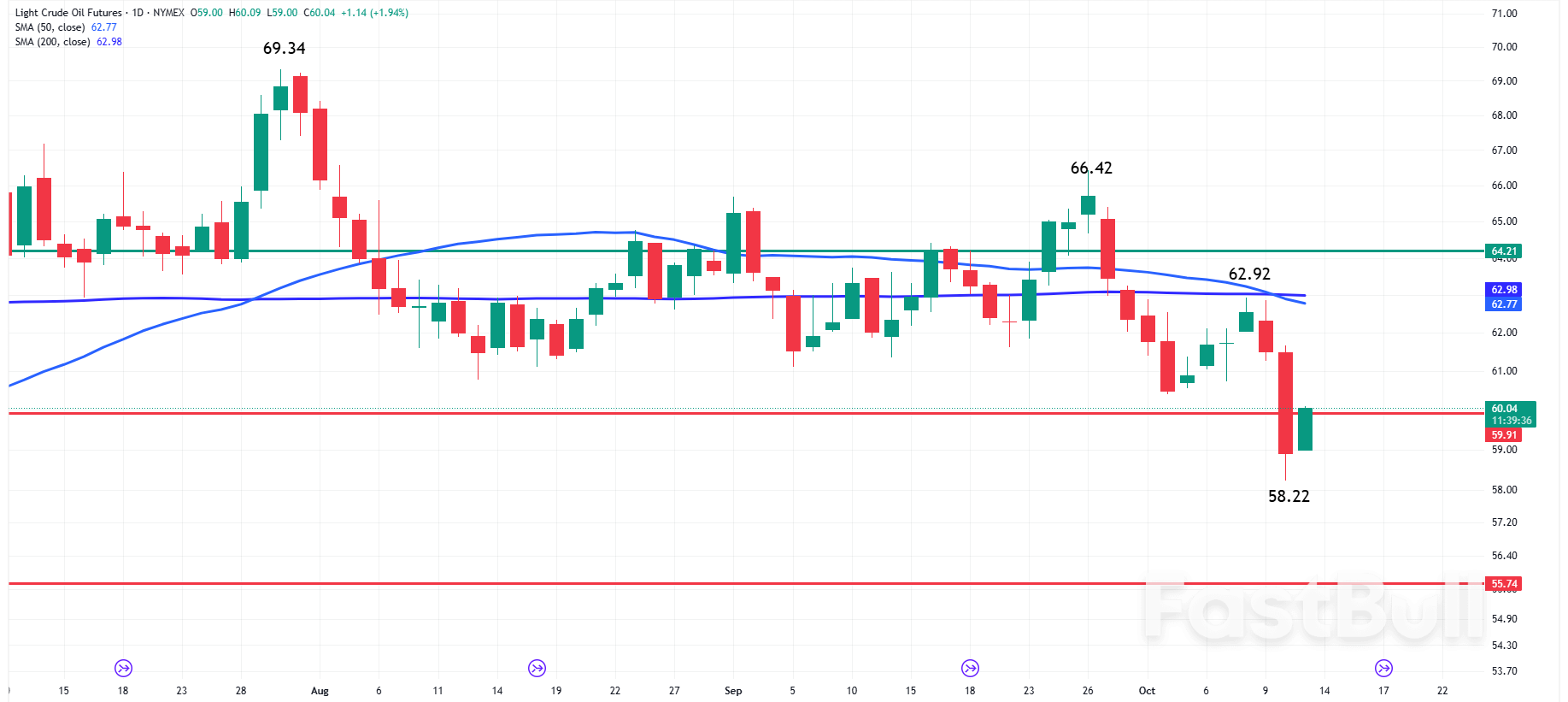
          Light crude oil futures are attempting a rebound early Monday after plunging to $58.22 on Friday, the lowest level since June 4. The bounce follows a heavy sell-off triggered by bearish technical breakdowns and heightened geopolitical and trade-related tensions.
          Price action is now testing 61.8% Fibonacci resistance at $59.91—the same level that triggered Friday’s sharp drop. A sustained move above this level could open the door for a short-covering rally toward a minor pivot at $60.57. However, with the prevailing trend still bearish, sellers are likely to reassert control near that area.
          At 09:46 GMT, Light Crude Oil Futures are trading $60.01, up $1.11 or +1.88%.

          Key Resistance Clusters: Moving Averages Align Bearishly

          Oil News: Crude Oil Stuck Below Death Cross—Is $55.74 the Next Target?_1Daily Light Crude Oil Futures

          Any upside continuation faces stiff resistance, with the 50-day moving average at $62.77, a swing top at $62.92, and the 200-day moving average at $62.98. Of note, the 50-day has crossed below the 200-day, forming a bearish “death cross” that signals long-term weakness. Unless bulls can overcome this cluster decisively, rallies are likely to be viewed as selling opportunities.
          On the downside, a failure to hold $58.22 would signal renewed selling pressure, potentially exposing the next major support at $55.74.

          U.S.-China Trade Tensions Keep Traders on Edge

          Oil’s rebound is partially driven by renewed investor focus on a potential meeting between U.S. President Donald Trump and China’s Xi Jinping. The meeting, tentatively slated for later this month on the sidelines of the APEC summit in South Korea, could determine whether the current tariff standoff escalates or finds relief.
          Last week’s oil selloff followed an expansion of Chinese rare earth export controls and Trump’s announcement of 100% tariffs on certain Chinese goods. Market participants remain highly sensitive to any signs of resolution or further deterioration in trade talks, which significantly impact global demand sentiment for crude.

          China’s Crude Imports Provide Limited Demand Support

          On the demand front, China’s crude oil imports rose 3.9% year-over-year in September to 11.5 million barrels per day, according to customs data. While the increase is notable, it has done little to offset broader demand concerns tied to trade uncertainty and regional conflict resolution in the Middle East.

          Market Forecast: Bearish Bias Holds Below Key Technical Levels

          Despite Monday’s modest rebound, the broader technical and fundamental outlook for crude oil remains bearish.
          As long as prices remain capped below the 50-day and 200-day moving averages, rallies are likely to be sold. A break below $58.22 would confirm renewed downside pressure, targeting $55.74.
          Until a firm resolution in U.S.-China trade tensions materializes, downside risks continue to dominate the oil prices forecast.

          Source: fxempire

          Risk Warnings and Disclaimers
          You understand and acknowledge that there is a high degree of risk involved in trading. Following any strategies or investment methods may lead to potential losses. The content on the site is provided by our contributors and analysts for information purposes only. You are solely responsible for determining whether any trading assets, securities, strategy, or any other product is suitable for investing based on your own investment objectives and financial situation.
          Add to Favorites
          Share

          Stock Bubble Dread Grips Central Bankers in Washington

          Adam

          Stocks

          Central bankers, already uneasy about trade tensions and swelling public debt, will collectively confront a new worry in the coming week: the danger of a market crash.
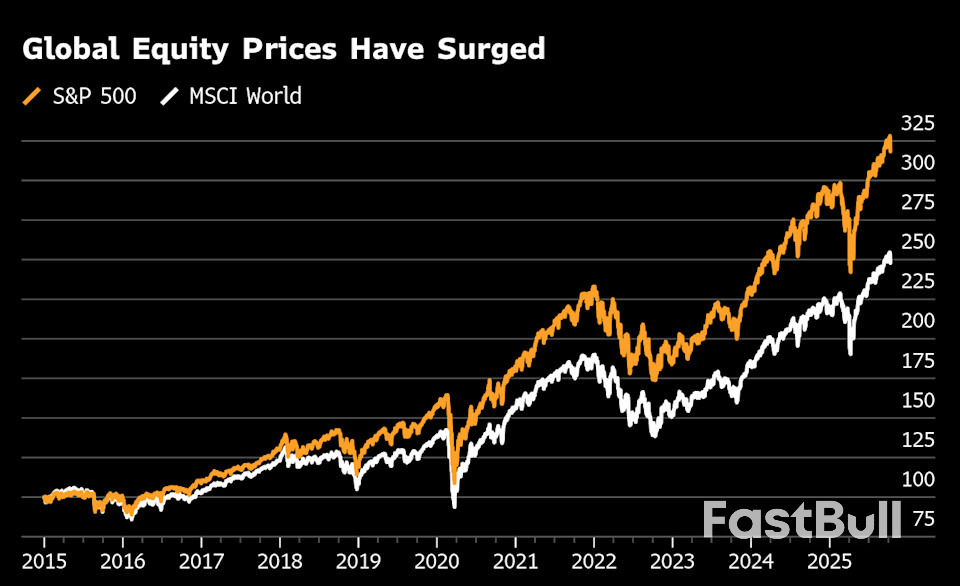
          Global policymakers and finance ministers will gather in Washington for the International Monetary Fund/World Bank fall meetings after a chorus of warnings that a stock bubble focused on artificial intelligence companies might burst before long.
          Kristalina Georgieva, the fund’s managing director, acknowledged the financial stability risk in a speech on Wednesday that previewed topics for discussion in the coming days.
          “Valuations are heading toward levels we saw during the bullishness about the internet 25 years ago,” she said. “If a sharp correction were to occur, tighter financial conditions could drag down world growth, expose vulnerabilities, and make life especially tough for developing countries.”
          Her warning was arguably more forthright than the IMF’s commentary from the October 2000 meeting, when its World Economic Outlook described “still high” equity valuations and the potential for imbalances to unwind “in a disorderly fashion.” Within months, the selloff momentum was such that the Federal Reserve was forced to deliver an emergency half-point interest-rate cut.
          Even before US President Donald Trump’s renewed China tariff threat tanked stocks on Friday, officials saw alarming parallels. The Bank of England just warned of the risk of a “sharp market correction,” European Central Bank policymakers worried aloud, and the Reserve Bank of Australia this month also noted vulnerabilities.
          Stock Bubble Dread Grips Central Bankers in Washington_1
          Such concerns have been mounting for a while. ECB officials were presented with the warning of “sudden and sharp price corrections” at their last policy meeting more than a month ago, while Fed Chair Jerome Powell observed in September that markets are “highly valued.”
          Fast forward to the coming week, and the IMF’s Global Financial Stability Report — a publication that didn’t even exist back in 2000 — may draw more attention than usual on Tuesday. The latest WEO, with economic forecasts for the world, will also be released.
          Statements from Group of Seven or Group of 20 ministers attending the IMF gathering will also be scrutinized, as will the cacophony of policymakers likely to share their views.
          What Bloomberg Economics Says:
          “Artificial intelligence might be a bubble. It is also a juggernaut. The IMF is doubtless correct to warn that valuations are stretched. More doubtful — whether those warnings register with investors gripped by fear of missing out.”
          —Tom Orlik, global chief economist.
          Elsewhere, trade and consumer price data in China and India, UK wage and growth numbers, and Monday’s announcement in Stockholm of the Nobel Prize for Economics will be among the week’s highlights.
          Meanwhile, the prospect of a revived trade war between Beijing and Washington will focus investors and policymakers.
          Trump on Friday announced an additional 100% tariff on China as well as export controls on “any and all critical software” beginning Nov. 1, hours after threatening to cancel an upcoming meeting with President Xi Jinping. That came after China added new port fees on US ships, started an antitrust investigation into Qualcomm Inc., and unveiled sweeping new curbs on its exports of rare earths and other critical materials.
          China’s Ministry of Commerce said the US should stop threatening it and urged more negotiations on outstanding issues to agree on a trade deal.
          Speaking on Fox News, Vice President JD Vance said the US has more leverage in the escalating dispute, saying the Trump administration is ready to be reasonable if Beijing is. Trump later posted a statement that hinted at a possible off-ramp for Chinese President Xi Jinping while issuing a veiled threat that a full trade war would wound China.

          US and Canada

          In the US, where official economic data releases remain delayed by a government shutdown, investors will focus on Powell’s assessment of the labor market and inflation. He’ll offer an outlook for the economy and monetary policy at the National Association for Business Economics on Tuesday.
          Powell’s speech highlights a week full of appearances by central bankers, including Fed governors Christopher Waller, Michael Barr and Stephen Miran, as well as regional Fed bank presidents Anna Paulson, Susan Collins and Alberto Musalem.
          Economic data releases include the September small-business optimism index and October manufacturing surveys from the Fed banks of New York and Philadelphia. On Wednesday, the Fed issues its Beige Book — anecdotal information about economic conditions around the country.
          Canada’s Finance Minister Francois-Philippe Champagne and central bank Governor Tiff Macklem attend the meetings in Washington, with Macklem also scheduled to appear at the Peterson Institute for International Economics. Senior Deputy Governor Carolyn Rogers is set to speak in Vancouver about Canada’s urgent need to boost productivity.
          Home sales and housing start data for September will offer a look at Canada’s slow real-estate recovery, which may have gotten a mid-month boost from the Bank of Canada’s rate cut.

          Asia

          Asia’s week will be dominated by a mix of trade, inflation and policy signals that should help clarify how the region is coping with heightened global uncertainty and widening policy divergence.
          China sets the tone at the start of the week with trade figures likely to show exports picking up in September. The same day, India is expected to report a further cooling in consumer price gains.
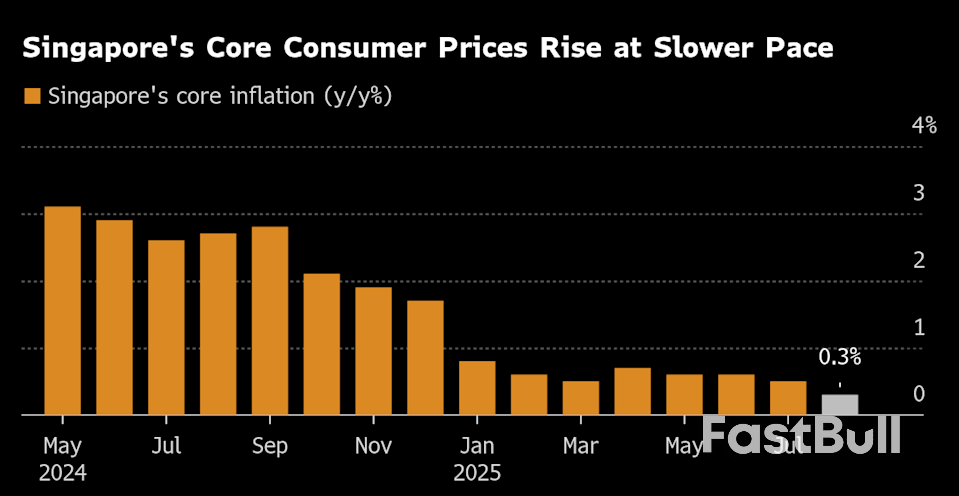
          On Tuesday, Singapore’s central bank is likely to keep monetary settings unchanged after two rounds of easing earlier this year. The city-state also publishes advance third-quarter GDP data, which should confirm that growth cooled after a strong June quarter.
          Stock Bubble Dread Grips Central Bankers in Washington_2
          Singapore’s review follows a flurry of policy moves across the region, with Indonesia and New Zealand extending their easing cycles to support growth amid rising trade protectionism, while Thailand, Malaysia and Australia opted to hold steady as they monitor the impact of earlier cuts.
          Minutes from the Reserve Bank’s September meeting on Tuesday will offer a window into how officials are weighing the risks of cutting further against a still-firm labor market. National Australia Bank’s business survey is released the same day.
          China on Wednesday reports September prices data that are likely to show deflation persisting in Asia’s largest economy, underscoring how domestic demand remains fragile despite recent policy support.
          India’s trade figures the same day will show the impact of hefty US tariffs, while import trends will offer a read on domestic consumption and investment appetite. The country also releases its unemployment rate that day.
          Bank of Japan board member Naoki Tamura, a hawk who called for a rate hike last month, speaks on Thursday, followed by Deputy Governor Shinichi Uchida on Friday. Given the collapse in the nation’s governing coalition after Sanae Takaichi’s victory in the ruling party leadership race, investors will be on watch for any change in tone.
          Australian jobs data will show whether hiring remains strong enough to keep policy on hold into year-end. On Friday, South Korea and Malaysia report trade figures while Singapore publishes export data.

          Europe, Middle East, Africa

          Appearances in Washington by ECB President Christine Lagarde and BOE Governor Andrew Bailey will be among the highlights.
          Back in the euro region, the saga over France’s public finances will focus investors in a relatively quiet week for data. Sébastien Lecornu returned as prime minister on Friday and needs to form a government before he can then file a budget.
          Among the statistics on the calendar, Germany’s ZEW investor confidence index on Tuesday and euro-zone industrial production on Wednesday may draw the most attention.
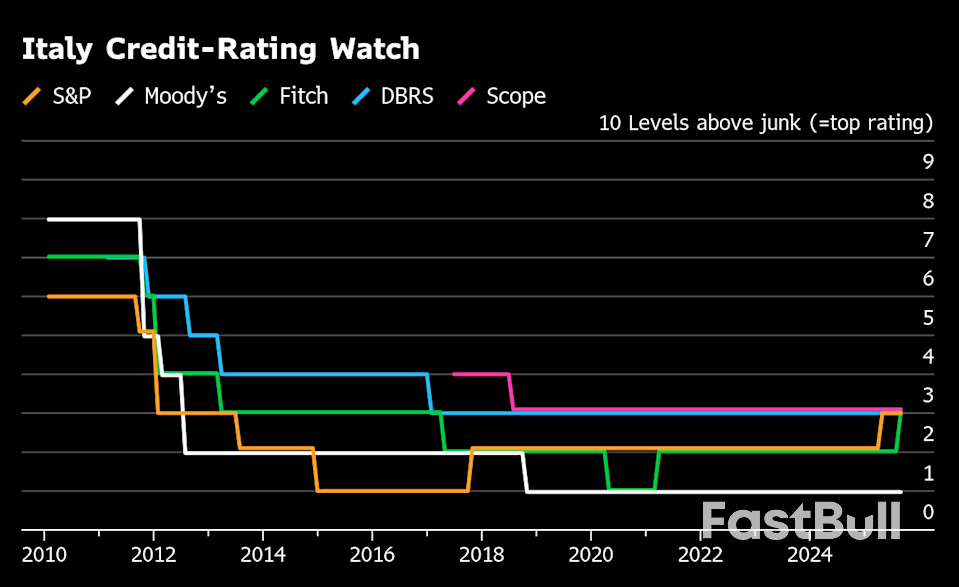
          On Friday, a potential ratings update on Italy from Morningstar DBRS could be significant. With the country on a positive outlook, an upgrade would give it the highest rating since 2018 from any one of the five companies used by the ECB to assess collateral.
          Stock Bubble Dread Grips Central Bankers in Washington_3
          In the UK, wage data on Tuesday are expected to show some weakening in the measure that excludes bonuses, a result that might reassure BOE officials gauging the strength of inflation. Growth numbers two days later are predicted to show a slight increase in gross domestic product in August after no change the prior month.
          In Israel, inflation data on Wednesday may show an acceleration to 3.1% in September from 2.9% in August. The central bank held rates steady last month, anticipating price growth to hover around 3% — the upper end of its range — before easing in early 2026.
          Turning to Africa, Nigerian numbers the same day will probably reveal inflation slowing below 20% last month for the first time since 2022, helped by softer food prices during the main harvest and a stronger naira. Such cooling could give the central bank scope for another 50-basis-point cut in November.
          With most central bankers at the IMF meeting, only a couple of rate decisions are on the calendar. In Namibia, policymakers are expected to keep their rate unchanged at 6.75% on Wednesday, with inflation edging higher. Seychelles is likely to leave borrowing costs on hold the same day.

          Latin America

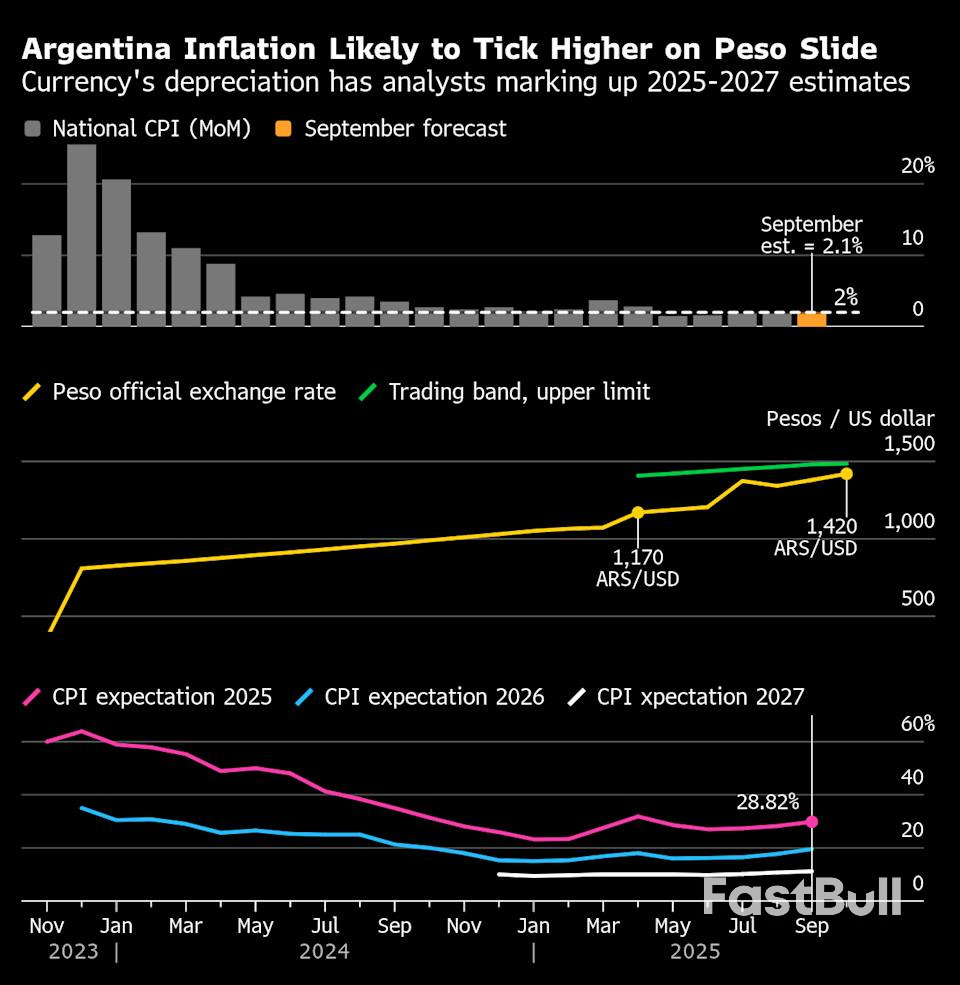
          A $20 billion swap line with the US Treasury, along with currency market intervention on Thursday, for now likely heads off a full-blown economic crisis for Argentina, but the peso’s selloff preceding the rescue left a mark on inflation and expectations alike.
          Stock Bubble Dread Grips Central Bankers in Washington_4
          September data reported Tuesday will likely show that consumer prices rose more than 2% on the month for the first time since April.
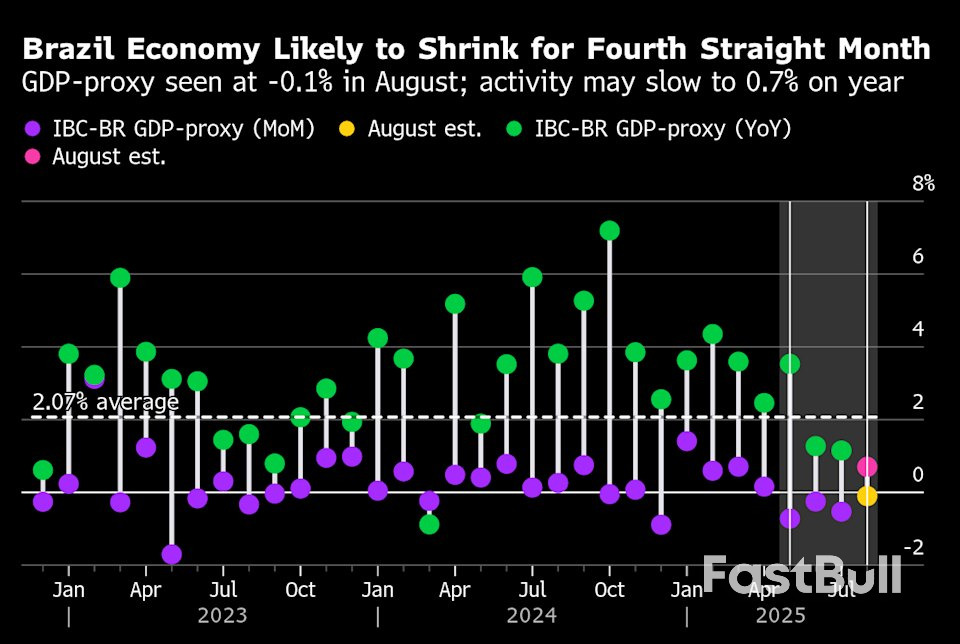
          Brazil and Peru — Latin America’s largest- and sixth-largest economies, respectively — will post August GDP-proxy figures in the coming week. Brazilian economic activity fell for a third month in July, the longest month-on-month slump since 2019.
          Stock Bubble Dread Grips Central Bankers in Washington_5
          The 50% tariffs on exports to the US that went into effect in August, coupled with tight monetary conditions, stand a good chance of dragging activity down to a fourth straight negative print.
          Peruvian activity bounced back in July, and yet another private pension fund withdrawal should provide support into year-end.
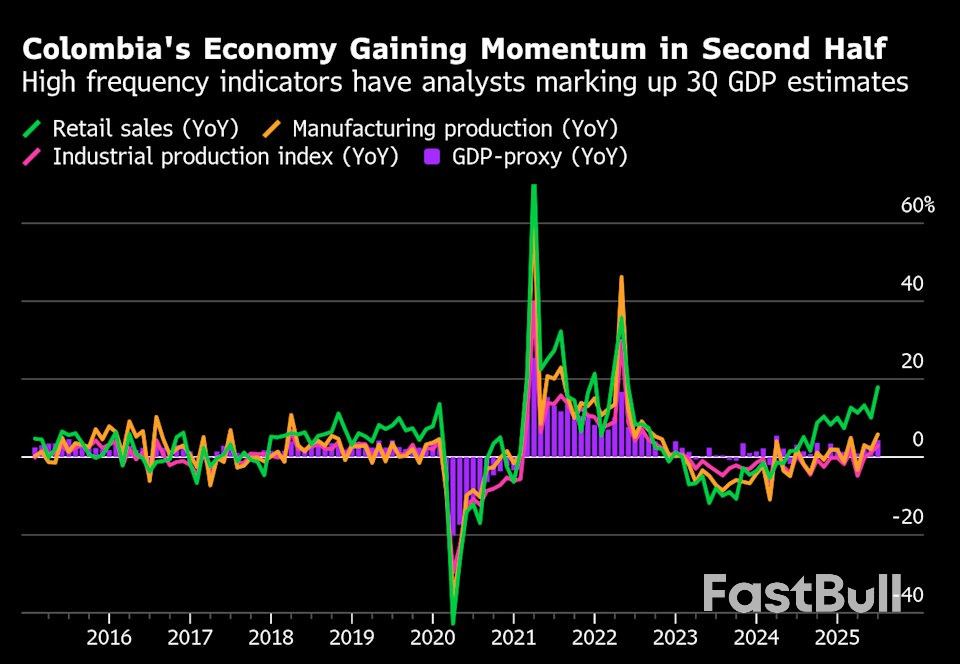
          Meanwhile, Colombia’s economy is riding a jump in demand that saw monthly activity rebound in July from a tumble in June.
          Stock Bubble Dread Grips Central Bankers in Washington_6
          GDP-proxy data, retail sales, manufacturing and industrial output — on the schedule for the coming week — all posted positive readings for a second straight month in July for the first time since late 2022.
          Analysts, who’ve marked up third-quarter GDP estimates while trimming their forecasts for the next six months, see Colombia’s economic growth picking up for a second year, followed by a third year in 2026.

          Source: Bloomberg

          Risk Warnings and Disclaimers
          You understand and acknowledge that there is a high degree of risk involved in trading. Following any strategies or investment methods may lead to potential losses. The content on the site is provided by our contributors and analysts for information purposes only. You are solely responsible for determining whether any trading assets, securities, strategy, or any other product is suitable for investing based on your own investment objectives and financial situation.
          Add to Favorites
          Share
          FastBull
          Copyright © 2025 FastBull Ltd

          728 RM B 7/F GEE LOK IND BLDG NO 34 HUNG TO RD KWUN TONG KLN HONG KONG

          TelegramInstagramTwitterfacebooklinkedin
          App Store Google Play Google Play
          Products
          Charts

          Chats

          Q&A with Experts
          Screeners
          Economic Calendar
          Data
          Tools
          Membership
          Features
          Function
          Markets
          Copy Trading
          Latest Signals
          Contests
          News
          Analysis
          24/7
          Columns
          Education
          Company
          Careers
          About Us
          Contact Us
          Advertising
          Help Center
          Feedback
          User Agreement
          Privacy Policy
          Business

          White Label

          Data API

          Web Plug-ins

          Poster Maker

          Affiliate Program

          Risk Disclosure

          The risk of loss in trading financial instruments such as stocks, FX, commodities, futures, bonds, ETFs and crypto can be substantial. You may sustain a total loss of the funds that you deposit with your broker. Therefore, you should carefully consider whether such trading is suitable for you in light of your circumstances and financial resources.

          No decision to invest should be made without thoroughly conducting due diligence by yourself or consulting with your financial advisors. Our web content might not suit you since we don't know your financial conditions and investment needs. Our financial information might have latency or contain inaccuracy, so you should be fully responsible for any of your trading and investment decisions. The company will not be responsible for your capital loss.

          Without getting permission from the website, you are not allowed to copy the website's graphics, texts, or trademarks. Intellectual property rights in the content or data incorporated into this website belong to its providers and exchange merchants.

          Not Logged In

          Log in to access more features

          FastBull Membership

          Not yet

          Purchase

          Become a signal provider
          Help Center
          Customer Service
          Dark Mode
          Price Up/Down Colors

          Log In

          Sign Up

          Position
          Layout
          Fullscreen
          Default to Chart
          The chart page opens by default when you visit fastbull.com