• Trade
  • Markets
  • Copy
  • Contests
  • News
  • 24/7
  • Calendar
  • Q&A
  • Chats
Trending
Screeners
SYMBOL
LAST
BID
ASK
HIGH
LOW
NET CHG.
%CHG.
SPREAD
SPX
S&P 500 Index
6827.42
6827.42
6827.42
6899.86
6801.80
-73.58
-1.07%
--
DJI
Dow Jones Industrial Average
48458.04
48458.04
48458.04
48886.86
48334.10
-245.98
-0.51%
--
IXIC
NASDAQ Composite Index
23195.16
23195.16
23195.16
23554.89
23094.51
-398.69
-1.69%
--
USDX
US Dollar Index
97.950
98.030
97.950
98.500
97.950
-0.370
-0.38%
--
EURUSD
Euro / US Dollar
1.17394
1.17409
1.17394
1.17496
1.17192
+0.00011
+ 0.01%
--
GBPUSD
Pound Sterling / US Dollar
1.33707
1.33732
1.33707
1.33997
1.33419
-0.00148
-0.11%
--
XAUUSD
Gold / US Dollar
4299.39
4299.39
4299.39
4353.41
4257.10
+20.10
+ 0.47%
--
WTI
Light Sweet Crude Oil
57.233
57.485
57.233
58.011
56.969
-0.408
-0.71%
--

Community Accounts

Signal Accounts
--
Profit Accounts
--
Loss Accounts
--
View More

Become a signal provider

Sell trading signals to earn additional income

View More

Guide to Copy Trading

Get started with ease and confidence

View More

Signal Accounts for Members

All Signal Accounts

Best Return
  • Best Return
  • Best P/L
  • Best MDD
Past 1W
  • Past 1W
  • Past 1M
  • Past 1Y

All Contests

  • All
  • Trump Updates
  • Recommend
  • Stocks
  • Cryptocurrencies
  • Central Banks
  • Featured News
Top News Only
Share

USA Embassy In Lithuania: Maria Kalesnikava Is Not Going To Vilnius

Share

USA Embassy In Lithuania: Other Prisoners Are Being Sent From Belarus To Ukraine

Share

Ukraine President Zelenskiy: Five Ukrainians Released By Belarus In US-Brokered Deal

Share

USA Vilnius Embassy: USA Stands Ready For "Additional Engagement With Belarus That Advances USA Interests"

Share

USA Vilnius Embassy: Belarus, USA, Other Citizens Among The Prisoners Released Into Lithuania

Share

USA Vilnius Embassy: USA Will Continue Diplomatic Efforts To Free The Remaining Political Prisoners In Belarus

Share

USA Vilnius Embassy: Belarus Releases 123 Prisoners Following Meeting Of President Trump's Envoy Coale And Belarus President Lukashenko

Share

USA Vilnius Embassy: Masatoshi Nakanishi, Aliaksandr Syrytsa Are Among The Prisoners Released By Belarus

Share

USA Vilnius Embassy: Maria Kalesnikava And Viktor Babaryka Are Among The Prisoners Released By Belarus

Share

USA Vilnius Embassy: Nobel Peace Prize Laureate Ales Bialiatski Is Among The Prisoners Released By Belarus

Share

Belarusian Presidential Administration Telegram Channel: Lukashenko Has Pardoned 123 Prisoners As Part Of Deal With US

Share

Two Local Syrian Officials: Joint US-Syrian Military Patrol In Central Syria Came Under Fire From Unknown Assailants

Share

Israeli Military Says It Targeted 'Key Hamas Terrorist' In Gaza City

Share

Rwanda's Actions In Eastern Drc Are A Clear Violation Of Washington Accords Signed By President Trump - Secretary Of State Rubio

Share

Israeli Military Issues Evacuation Warning In Southern Lebanon Village Ahead Of Strike - Spokesperson On X

Share

Belarusian State Media Cites US Envoy Coale As Saying He Discussed Ukraine And Venezuela With Lukashenko

Share

Belarusian State Media Cites US Envoy Coale As Saying That US Removes Sanctions On Belarusian Potassium

Share

Thai Prime Minister: No Ceasefire Agreement With Cambodia

Share

US, Ukraine To Discuss Ceasefire In Berlin Ahead Of European Summit

Share

Incoming Czech Prime Minister Babis: Czech Republic Will Not Take On Guarantees For Ukraine Financing, European Commission Must Find Alternatives

TIME
ACT
FCST
PREV
U.K. Trade Balance Non-EU (SA) (Oct)

A:--

F: --

P: --

U.K. Trade Balance (Oct)

A:--

F: --

P: --

U.K. Services Index MoM

A:--

F: --

P: --

U.K. Construction Output MoM (SA) (Oct)

A:--

F: --

P: --

U.K. Industrial Output YoY (Oct)

A:--

F: --

P: --

U.K. Trade Balance (SA) (Oct)

A:--

F: --

P: --

U.K. Trade Balance EU (SA) (Oct)

A:--

F: --

P: --

U.K. Manufacturing Output YoY (Oct)

A:--

F: --

P: --

U.K. GDP MoM (Oct)

A:--

F: --

P: --

U.K. GDP YoY (SA) (Oct)

A:--

F: --

P: --

U.K. Industrial Output MoM (Oct)

A:--

F: --

P: --

U.K. Construction Output YoY (Oct)

A:--

F: --

P: --

France HICP Final MoM (Nov)

A:--

F: --

P: --

China, Mainland Outstanding Loans Growth YoY (Nov)

A:--

F: --

P: --

China, Mainland M2 Money Supply YoY (Nov)

A:--

F: --

P: --

China, Mainland M0 Money Supply YoY (Nov)

A:--

F: --

P: --

China, Mainland M1 Money Supply YoY (Nov)

A:--

F: --

P: --

India CPI YoY (Nov)

A:--

F: --

P: --

India Deposit Gowth YoY

A:--

F: --

P: --

Brazil Services Growth YoY (Oct)

A:--

F: --

P: --

Mexico Industrial Output YoY (Oct)

A:--

F: --

P: --

Russia Trade Balance (Oct)

A:--

F: --

P: --

Philadelphia Fed President Henry Paulson delivers a speech
Canada Building Permits MoM (SA) (Oct)

A:--

F: --

P: --

Canada Wholesale Sales YoY (Oct)

A:--

F: --

P: --

Canada Wholesale Inventory MoM (Oct)

A:--

F: --

P: --

Canada Wholesale Inventory YoY (Oct)

A:--

F: --

P: --

Canada Wholesale Sales MoM (SA) (Oct)

A:--

F: --

P: --

Germany Current Account (Not SA) (Oct)

A:--

F: --

P: --

U.S. Weekly Total Rig Count

A:--

F: --

P: --

U.S. Weekly Total Oil Rig Count

A:--

F: --

P: --

Japan Tankan Large Non-Manufacturing Diffusion Index (Q4)

--

F: --

P: --

Japan Tankan Small Manufacturing Outlook Index (Q4)

--

F: --

P: --

Japan Tankan Large Non-Manufacturing Outlook Index (Q4)

--

F: --

P: --

Japan Tankan Large Manufacturing Outlook Index (Q4)

--

F: --

P: --

Japan Tankan Small Manufacturing Diffusion Index (Q4)

--

F: --

P: --

Japan Tankan Large Manufacturing Diffusion Index (Q4)

--

F: --

P: --

Japan Tankan Large-Enterprise Capital Expenditure YoY (Q4)

--

F: --

P: --

U.K. Rightmove House Price Index YoY (Dec)

--

F: --

P: --

China, Mainland Industrial Output YoY (YTD) (Nov)

--

F: --

P: --

China, Mainland Urban Area Unemployment Rate (Nov)

--

F: --

P: --

Saudi Arabia CPI YoY (Nov)

--

F: --

P: --

Euro Zone Industrial Output YoY (Oct)

--

F: --

P: --

Euro Zone Industrial Output MoM (Oct)

--

F: --

P: --

Canada Existing Home Sales MoM (Nov)

--

F: --

P: --

Euro Zone Total Reserve Assets (Nov)

--

F: --

P: --

U.K. Inflation Rate Expectations

--

F: --

P: --

Canada National Economic Confidence Index

--

F: --

P: --

Canada New Housing Starts (Nov)

--

F: --

P: --

U.S. NY Fed Manufacturing Employment Index (Dec)

--

F: --

P: --

U.S. NY Fed Manufacturing Index (Dec)

--

F: --

P: --

Canada Core CPI YoY (Nov)

--

F: --

P: --

Canada Manufacturing Unfilled Orders MoM (Oct)

--

F: --

P: --

Canada Manufacturing New Orders MoM (Oct)

--

F: --

P: --

Canada Core CPI MoM (Nov)

--

F: --

P: --

Canada Manufacturing Inventory MoM (Oct)

--

F: --

P: --

Canada CPI YoY (Nov)

--

F: --

P: --

Canada CPI MoM (Nov)

--

F: --

P: --

Canada CPI YoY (SA) (Nov)

--

F: --

P: --

Canada Core CPI MoM (SA) (Nov)

--

F: --

P: --

Q&A with Experts
    • All
    • Chatrooms
    • Groups
    • Friends
    Connecting
    .
    .
    .
    Type here...
    Add Symbol or Code

      No matching data

      All
      Trump Updates
      Recommend
      Stocks
      Cryptocurrencies
      Central Banks
      Featured News
      • All
      • Russia-Ukraine Conflict
      • Middle East Flashpoint
      • All
      • Russia-Ukraine Conflict
      • Middle East Flashpoint
      Search
      Products

      Charts Free Forever

      Chats Q&A with Experts
      Screeners Economic Calendar Data Tools
      Membership Features
      Data Warehouse Market Trends Institutional Data Policy Rates Macro

      Market Trends

      Market Sentiment Order Book Forex Correlations

      Top Indicators

      Charts Free Forever
      Markets

      News

      News Analysis 24/7 Columns Education
      From Institutions From Analysts
      Topics Columnists

      Latest Views

      Latest Views

      Trending Topics

      Top Columnists

      Latest Update

      Signals

      Copy Rankings Latest Signals Become a signal provider AI Rating
      Contests
      Brokers

      Overview Brokers Assessment Rankings Regulators News Claims
      Broker listing Forex Brokers Comparison Tool Live Spread Comparison Scam
      Q&A Complaint Scam Alert Videos Tips to Detect Scam
      More

      Business
      Events
      Careers About Us Advertising Help Center

      White Label

      Data API

      Web Plug-ins

      Affiliate Program

      Awards Institution Evaluation IB Seminar Salon Event Exhibition
      Vietnam Thailand Singapore Dubai
      Fans Party Investment Sharing Session
      FastBull Summit BrokersView Expo
      Recent Searches
        Top Searches
          Markets
          News
          Analysis
          User
          24/7
          Economic Calendar
          Education
          Data
          • Names
          • Latest
          • Prev

          View All

          No data

          Scan to Download

          Faster Charts, Chat Faster!

          Download App
          English
          • English
          • Español
          • العربية
          • Bahasa Indonesia
          • Bahasa Melayu
          • Tiếng Việt
          • ภาษาไทย
          • Français
          • Italiano
          • Türkçe
          • Русский язык
          • 简中
          • 繁中
          Open Account
          Search
          Products
          Charts Free Forever
          Markets
          News
          Signals

          Copy Rankings Latest Signals Become a signal provider AI Rating
          Contests
          Brokers

          Overview Brokers Assessment Rankings Regulators News Claims
          Broker listing Forex Brokers Comparison Tool Live Spread Comparison Scam
          Q&A Complaint Scam Alert Videos Tips to Detect Scam
          More

          Business
          Events
          Careers About Us Advertising Help Center

          White Label

          Data API

          Web Plug-ins

          Affiliate Program

          Awards Institution Evaluation IB Seminar Salon Event Exhibition
          Vietnam Thailand Singapore Dubai
          Fans Party Investment Sharing Session
          FastBull Summit BrokersView Expo

          China’s Gold ETF Boom Signals Strategic Shift Amid Geopolitical Tensions and Yuan Pressure

          Gerik

          China–U.S. Trade War

          Commodity

          Summary:

          Amid mounting geopolitical risks and depreciation pressure on the yuan, Chinese investors—both retail and institutional—are flooding into gold ETFs...

          Gold Demand Surges as China Seeks Shelter from Global Instability

          Faced with escalating global tensions and currency depreciation, China is witnessing a historic surge in gold-backed exchange-traded fund (ETF) inflows. In Q1 2025, Chinese investors poured a record 16.7 billion yuan (approx. $2.3 billion) into domestic gold ETFs, adding 23 tonnes of physical gold to ETF holdings—the largest quarterly net inflow since these products were introduced in China.
          According to the World Gold Council (WGC), this inflow pushed total assets under management for gold ETFs in China to a record 101 billion yuan, with total holdings reaching 138 tonnes. This trend not only highlights a tactical response to immediate market uncertainty, but also reflects a deeper structural shift in how China approaches capital preservation and monetary sovereignty.

          Investor Sentiment Reflects Broader Strategic Anxiety

          The motivation behind this rush into gold is multifaceted. First, it reflects investor anxiety over the weakening Chinese yuan, which in early April 2025 fell to an all-time low of 7.4290 CNY/USD in offshore markets. This sharp depreciation was triggered by President Donald Trump’s announcement of sweeping tariffs on Chinese exports—some exceeding 100%—reigniting U.S.–China trade tensions.
          Second, the broader investment environment in China has been underwhelming. With domestic equity markets struggling and traditional assets underperforming, gold has reemerged as the most credible store of value. The WGC reports that China accounted for 38% of global gold bar and coin demand in Q1, totaling 124 tonnes, while its ETF investment represented roughly 10% of global ETF demand.
          This demonstrates that gold has moved from a speculative asset to a financial mainstay in Chinese portfolios—serving not only individuals, but also as a macro-level hedge against dollar volatility and policy unpredictability.

          Official Policy Aligns with Market Behavior: China Expands National Gold Reserves

          Beyond the retail surge, China’s central bank has been steadily expanding its official gold holdings. As of March 2025, the People’s Bank of China (PBoC) held 2,292 tonnes of gold—its highest ever—representing 6.5% of total foreign reserves. This aligns with Beijing’s long-term strategy of reducing dependence on U.S. Treasury bonds and dollar-denominated assets.
          Analysts, including Jasper Lo of Hong Kong, believe this reflects genuine policy concern that the yuan may face long-term devaluation. Anderson Cheung, head of commodities at Best Profit Capital, adds that Beijing may further reduce U.S. bond holdings and increase gold reserves as a credible alternative store of wealth in a destabilized global monetary system.

          Shanghai Gold Exchange Goes Global

          Complementing this reserve shift is China’s effort to internationalize gold trading. The expansion of the Shanghai Gold Exchange’s overseas operations is part of a broader plan to promote the yuan in global trade and reduce reliance on the Western-dominated financial system. This “goldification” of reserves is not simply economic—it is a geopolitical maneuver to fortify China’s financial autonomy.
          Despite a 20-fold surge in gold prices during Q1 2025, Chinese demand has remained resilient. This indicates that investors are prioritizing safety and long-term value over short-term valuation concerns. According to WGC, even April alone saw ETF inflows in Asia exceed the entire Q1 total, signaling that risk aversion continues to intensify.

          China’s Gold Strategy Is No Longer Tactical—It’s Structural

          The unprecedented inflows into gold ETFs and physical gold purchases in China are not mere market reactions. They represent a coordinated shift in both investor and policy-level strategies aimed at safeguarding financial stability in an era of geopolitical realignment, inflationary uncertainty, and monetary friction with the West.
          China’s move toward gold is reshaping global capital flows, strengthening its currency defenses, and asserting greater independence in monetary policy. In a world where fiat credibility and geopolitical clarity are weakening, gold has become not just a safe haven—but a pillar of China’s emerging financial architecture.

          Source: The Rio Times

          Risk Warnings and Disclaimers
          You understand and acknowledge that there is a high degree of risk involved in trading. Following any strategies or investment methods may lead to potential losses. The content on the site is provided by our contributors and analysts for information purposes only. You are solely responsible for determining whether any trading assets, securities, strategy, or any other product is suitable for investing based on your own investment objectives and financial situation.
          Add to Favorites
          Share

          EU to Unveil Trade Negotiation Proposal with U.S. Amid Steel Surplus and Global Policy Shifts

          Gerik

          Economic

          EU Revives Transatlantic Trade Talks with Strategic Agenda

          The European Union is poised to announce a package of trade proposals to the United States in the coming week, signaling a strategic effort to reboot economic relations and confront shared global challenges. According to Bloomberg News, which cites sources familiar with the matter, the proposals are designed to lower both trade and non-trade barriers, while simultaneously bolstering European investment into the American market.
          This initiative comes at a critical juncture. Global trade volatility, particularly in the wake of U.S. tariff policies under President Donald Trump, has strained traditional alliances. However, with rising concerns over Chinese industrial overcapacity—especially in the steel sector—the EU sees an opportunity to re-engage Washington under a shared framework of cooperation.

          Targeting Tariff Reduction and Industrial Imbalance

          The EU’s agenda reportedly includes specific measures to ease regulatory burdens and increase the flow of goods and capital between the two economies. The move reflects Brussels’ broader intent to shield its industries from distorted global competition, most notably from China, whose steel surplus continues to disrupt global pricing and fair trade practices.
          By working closely with the U.S. to counter China’s industrial strategy, the EU hopes to avoid unilateral American actions—like tariffs—that previously impacted European exports. Instead, Brussels seeks a coordinated, rules-based response to these structural trade imbalances.

          Energy and Technology as Pillars of Transatlantic Investment

          Another key pillar of the EU’s proposal is a call for increased U.S. exports of liquefied natural gas (LNG) and advanced technologies to Europe. This aligns with the EU’s ongoing efforts to diversify its energy sources—particularly following the disruption of Russian supplies—and accelerate its digital and green transition. Encouraging U.S. energy and tech firms to deepen their European footprint is seen as a win-win strategy that strengthens both economic resilience and strategic autonomy.

          Recalibrating Global Trade Alignment

          This fresh diplomatic push marks a shift from confrontation to collaboration in the transatlantic relationship. By jointly addressing structural issues like state subsidies, overcapacity, and critical supply chains, the EU and U.S. aim to re-establish themselves as standard-setters in the evolving global trade system.
          Furthermore, the proposals serve as a counterbalance to growing protectionism and provide a platform for future trade liberalization that avoids past missteps—such as the stalled Transatlantic Trade and Investment Partnership (TTIP).
          The EU’s upcoming trade proposal underscores a renewed commitment to partnership with the United States amid mounting global economic uncertainties. With shared interests in countering China’s overcapacity and enhancing bilateral investment flows, this initiative could lay the foundation for a more stable and forward-looking transatlantic trade relationship.

          Source: Bloomberg

          To stay updated on all economic events of today, please check out our Economic calendar
          Risk Warnings and Disclaimers
          You understand and acknowledge that there is a high degree of risk involved in trading. Following any strategies or investment methods may lead to potential losses. The content on the site is provided by our contributors and analysts for information purposes only. You are solely responsible for determining whether any trading assets, securities, strategy, or any other product is suitable for investing based on your own investment objectives and financial situation.
          Add to Favorites
          Share

          Bitcoin Surges to $97,000 — Highest in Over Two Months as ETF Inflows and Spot Demand Drive Recovery

          Gerik

          Cryptocurrency

          Bitcoin Approaches $100,000 Once Again

          Bitcoin has surged past $96,900 in early May, narrowing the gap to the psychologically significant $100,000 threshold. According to Bloomberg, this marks Bitcoin's highest price since late February and represents a sharp recovery from the steep declines seen earlier in 2025. With a market capitalization of approximately $1.92 trillion, Bitcoin is now just 11% below its all-time high of around $109,000 recorded on January 20, coinciding with the inauguration of President Donald Trump’s second term.
          The rebound has caught market attention for its resilience amid geopolitical and macroeconomic headwinds, particularly those driven by aggressive U.S. tariff policies that previously triggered sell-offs in both equity and crypto markets.

          From Derivatives to Spot: A Shift in Market Dynamics

          Unlike previous rallies fueled by leverage and speculative trading in derivatives markets, the current upswing in Bitcoin appears to be led by spot demand. While open interest in futures remains relatively muted, ETF activity has spiked. Over the past week alone, Bitcoin and Ethereum-focused exchange-traded funds attracted more than $3.2 billion in inflows. Notably, the iShares Bitcoin Trust saw nearly $1.5 billion in fresh capital—its largest weekly inflow this year.
          This suggests a shift in investor behavior, with institutions and long-term holders increasingly favoring direct exposure to digital assets rather than leveraged products. Analysts interpret this pattern as a vote of confidence in crypto’s structural resilience, particularly amid policy uncertainty and global economic reconfiguration.

          Macro Volatility Fades, Market Correlations Evolve

          Previously, Bitcoin’s price was tightly correlated with broader macroeconomic themes such as inflation, central bank policy, and tariff-related uncertainty. In early 2025, Trump’s tariff escalation contributed to a nearly 30% correction in Bitcoin’s value. However, recent data indicates that digital asset volatility has decoupled from other markets—at least temporarily.
          Chris Newhouse, Head of Research at Ergonia, observed that “Bitcoin continues to oscillate between behaving like digital gold and a risk-on tech stock,” underscoring its fluid relationship with macroeconomic variables. The muted response in leveraged liquidation and the parallel rise in options activity suggest that current price action is being driven by organic accumulation rather than short-term speculation.

          ETF Demand Reinforces Institutional Confidence

          ETF inflows are playing an increasingly central role in Bitcoin’s price dynamics. The surge in demand for regulated crypto products reflects rising interest from traditional financial institutions, many of which had been previously hesitant due to regulatory uncertainty and asset volatility. Now, with more clarity in the ETF framework and increasing retail comfort, these funds serve as a bridge between traditional capital and decentralized finance.
          Moreover, the comparative stability in options and futures markets implies that volatility expectations remain well-anchored—another indicator of maturing investor behavior.
          Bitcoin’s resurgence to $97,000 reveals a deepening transformation in the crypto market’s structure. With macro volatility easing and demand shifting toward spot and ETF-based exposure, the current rally appears more sustainable than past surges. While external risks—especially tariff-induced shocks—still loom, the market is demonstrating a greater capacity to absorb and adapt to uncertainty.
          Risk Warnings and Disclaimers
          You understand and acknowledge that there is a high degree of risk involved in trading. Following any strategies or investment methods may lead to potential losses. The content on the site is provided by our contributors and analysts for information purposes only. You are solely responsible for determining whether any trading assets, securities, strategy, or any other product is suitable for investing based on your own investment objectives and financial situation.
          Add to Favorites
          Share

          India Emerges as Strategic Winner Amid U.S. Tariff War, Eyes Expanded Trade Role

          Gerik

          Economic

          China–U.S. Trade War

          India Turns Global Trade Turmoil into Strategic Leverage

          The ongoing trade war initiated by President Donald Trump has created disruptions in global supply chains—but also opened rare opportunities. Among the beneficiaries, India is emerging as a standout, leveraging its geopolitical rivalry with China and Prime Minister Narendra Modi’s active diplomacy to position itself as a more reliable partner for the United States.
          India’s pivot is not accidental. As tensions between Washington and Beijing escalate, India’s historical skepticism toward China, combined with its economic ambitions, has become a strategic asset. By aligning more closely with the U.S. and other democratic allies through platforms like the Quadrilateral Security Dialogue (Quad), India has turned geopolitical headwinds into trade momentum.

          Apple’s Major Supply Chain Shift Boosts India’s Industrial Footprint

          One of the most concrete signals of India’s rising importance in global trade is Apple’s decision to relocate part of its iPhone production from China to India. Facing U.S. tariffs of up to 145% on Chinese goods, Apple announced plans to shift the production of up to 60 million iPhones annually—destined for the U.S. market—from Chinese factories to Indian facilities. While the transition is expected to stretch through 2026, this move marks a landmark reconfiguration in the global tech supply chain.
          This shift also aligns with India’s “Make in India” campaign and offers significant economic upside. It not only increases manufacturing jobs and investment but also strengthens India’s case as a long-term alternative to China in high-value electronics production. Even if the transition is slower than anticipated, the direction is clear: India is becoming central to corporate strategies seeking tariff insulation and geopolitical hedging.

          Diplomacy Backed by Trade Reforms: Modi's Calculated Gamble

          Prime Minister Modi’s diplomatic agility has played a vital role in this transformation. Unlike other global leaders who have adopted confrontational rhetoric, Modi has approached the Trump administration with a conciliatory and pragmatic stance. His administration has actively engaged with U.S. officials, including a recent visit to Washington by India’s lead trade negotiator Rajesh Agrawal. These efforts are paving the way for what U.S. Treasury Secretary Scott Bessent described as “one of the first new bilateral trade deals” expected later this year.
          Despite India’s traditionally protectionist trade posture, Modi has initiated negotiations with the EU, the UK, and others, signaling a broader rethinking of economic strategy. This shift suggests that India is not only reacting to short-term tariff concerns but is also preparing to reposition itself within a more fragmented and competitive global trading system.

          Balancing Opportunity and Constraint

          While the outlook is promising, challenges remain. Opening India’s market to U.S. exports could face domestic resistance, given its long-standing protective policies aimed at shielding local industries. Yet the Modi administration’s willingness to rethink these boundaries reflects a broader strategic calculus: economic liberalization, when paired with geopolitical alignment, may offer India a greater voice in global trade governance.
          Additionally, India’s logistics and infrastructure must keep pace with growing demand. Large-scale relocations like Apple’s require improvements in ports, skilled labor availability, and policy consistency. Success will hinge not just on diplomatic charm but on execution at scale.
          India’s rise amid the U.S.-China tariff war is a product of both global realignment and deliberate national strategy. As protectionist policies reconfigure old alliances and manufacturing hubs, New Delhi is navigating the uncertainty with a rare combination of flexibility and foresight. With major corporations like Apple shifting supply chains and a bilateral trade deal with the U.S. on the horizon, India is poised to assert itself not only as a production base but as a political and economic power shaping the next era of global trade.

          Source: FT

          To stay updated on all economic events of today, please check out our Economic calendar
          Risk Warnings and Disclaimers
          You understand and acknowledge that there is a high degree of risk involved in trading. Following any strategies or investment methods may lead to potential losses. The content on the site is provided by our contributors and analysts for information purposes only. You are solely responsible for determining whether any trading assets, securities, strategy, or any other product is suitable for investing based on your own investment objectives and financial situation.
          Add to Favorites
          Share

          Tariffs Strain U.S. Manufacturing as Input Costs Rise and Job Market Shows Early Cracks

          Gerik

          Economic

          Manufacturing Slips Again Under Tariff Pressure

          The U.S. manufacturing sector continued to decline in April, marking the second straight month of contraction as tariffs imposed under President Donald Trump’s “Liberation Day” policy disrupted supply chains and inflated production costs. According to the Institute for Supply Management (ISM), the Manufacturing Purchasing Managers' Index (PMI) dropped to a five-month low of 48.7—below the neutral 50 mark that separates expansion from contraction. This trend reinforces growing concerns that trade protectionism is undermining industrial momentum.
          Every industry surveyed by ISM cited tariffs as a negative factor, not only for cost inflation but also due to the disorderly implementation and lack of clarity around import duties. Manufacturers reported longer supplier delivery times, rising inventories, and frozen shipments from China, all of which indicate distorted operations and weakened demand clarity.

          Input Costs Surge, Orders Distorted by Tariff Deadlines

          The survey's forward-looking components painted a mixed picture. New orders rose slightly to 47.2 from 45.2 in March, largely due to businesses rushing to place orders before tariffs took effect. Supplier delivery times lengthened to 55.2, and inventories continued to grow—but analysts warn that these are artificial bulges driven by short-term tariff-avoidance behavior rather than healthy demand expansion.
          Most notably, input costs climbed again, with the prices-paid index reaching 69.8—the highest since June 2022. Manufacturers of nonmetallic minerals said procurement had been “paralyzed,” and machinery producers described the current climate as “tariff whiplash.” Some domestic suppliers were also raising prices, taking advantage of the constrained trade landscape.

          Job Losses Begin to Appear as Caution Spreads

          The labor market is showing early signs of stress. While most manufacturers have so far resisted large-scale layoffs, many are pausing hiring, and some are beginning to shed jobs to adjust to uncertain demand. ISM’s April report confirmed this, noting that layoffs were chosen over natural attrition due to speed and efficiency.
          Supporting this, the Labor Department reported a sharp increase in unemployment claims, which jumped by 18,000 to 241,000 in the week ending April 26. Continuing claims surged by 83,000 to nearly 1.92 million—the highest since November 2021—indicating weaker hiring activity. While some of the rise was seasonal (due to school spring breaks in New York), the broader upward trend is now unmistakable.
          Major employers have begun cutting back. UPS, for example, announced 20,000 job cuts and the closure of 73 facilities as it scales back deliveries for Amazon. Analysts warn that if more companies follow suit, the labor market could shift quickly from resilience to contraction.

          Trump’s Trade Policy Raises Broader Economic Risks

          The 145% tariffs on Chinese goods announced in April, along with sweeping duties on other imports, have sparked what some economists are calling “tariff-driven recessionary pressure.” The U.S. economy already contracted in Q1—largely due to a surge in front-loaded imports ahead of tariffs—and further weakening in manufacturing and labor indicators may signal deeper trouble ahead.
          While markets rallied on Thursday, with the Dow, S&P 500, and Nasdaq all posting gains, economists caution that investor optimism may not align with real economic trends. The full effects of protectionist policies are still unfolding, and the delayed impact on consumer spending, hiring, and investment could become more evident in Q2.

          Looking Ahead: All Eyes on Friday’s Jobs Report

          The next key data point is April’s nonfarm payroll report, due Friday. Analysts expect job growth to slow to 130,000 from 228,000 in March, with the unemployment rate holding at 4.2%. If confirmed, this would suggest the labor market is beginning to cool—a trend that, if reinforced by further tariff escalation, could pose a significant drag on domestic demand.
          The April data offer a sobering view of how quickly tariffs can disrupt industrial activity and inflate business costs. The ISM PMI’s second straight decline, rising inventories, elevated input prices, and growing unemployment claims collectively signal an economy facing mounting internal friction. While tariffs aim to protect domestic industry, their uneven implementation and global ripple effects are starting to generate instability across both the production floor and the job market.

          Source: Reuters

          To stay updated on all economic events of today, please check out our Economic calendar
          Risk Warnings and Disclaimers
          You understand and acknowledge that there is a high degree of risk involved in trading. Following any strategies or investment methods may lead to potential losses. The content on the site is provided by our contributors and analysts for information purposes only. You are solely responsible for determining whether any trading assets, securities, strategy, or any other product is suitable for investing based on your own investment objectives and financial situation.
          Add to Favorites
          Share

          U.S. Toughens Stance On Iranian Oil Trade, Threatens Secondary Sanctions

          Catherine Richards

          Economic

          In a recent development, U.S. President Donald Trump announced that all purchases of Iranian oil or petrochemical products must cease immediately. He warned that any country or individual that continues to buy from Iran would face secondary sanctions.

          The President stated that those who violate this directive would be barred from doing business with the United States in any capacity. The announcement was made on Truth Social on Thursday.

          This move comes after the U.S. postponed its latest round of talks with Iran regarding its nuclear program. The discussions were initially scheduled to take place in Rome on Saturday. A senior Iranian official revealed that the new date for the talks would be determined by the U.S. approach.

          The Trump administration has been actively targeting Tehran with sanctions. These include measures against a China-based crude oil storage terminal and an independent refiner accused of participating in illegal oil and petrochemical trade.

          In February, Trump reinstated a "maximum pressure" campaign against Iran. This initiative aims to reduce Iran’s oil exports to zero and prevent the development of a nuclear weapon by Tehran.

          Secondary sanctions are a method by which one country punishes another for trading with a third country by denying access to its own market. This is a powerful tool for the U.S., given the size of its economy.

          Analysts suggest that if the U.S. is serious about curbing Iran’s oil exports, it would need to impose secondary sanctions on entities facilitating the purchase of Iranian oil, such as Chinese banks. China is currently the largest buyer of Iranian crude oil.

          This article was generated with the support of AI and reviewed by an editor. For more information see our T&C.

          Source: Investing

          To stay updated on all economic events of today, please check out our Economic calendar
          Risk Warnings and Disclaimers
          You understand and acknowledge that there is a high degree of risk involved in trading. Following any strategies or investment methods may lead to potential losses. The content on the site is provided by our contributors and analysts for information purposes only. You are solely responsible for determining whether any trading assets, securities, strategy, or any other product is suitable for investing based on your own investment objectives and financial situation.
          Add to Favorites
          Share

          Gold Price Forecast: Bearish Momentum Accelerates, Weekly Bearish Signal

          Golden Gleam

          Commodity

          Economic

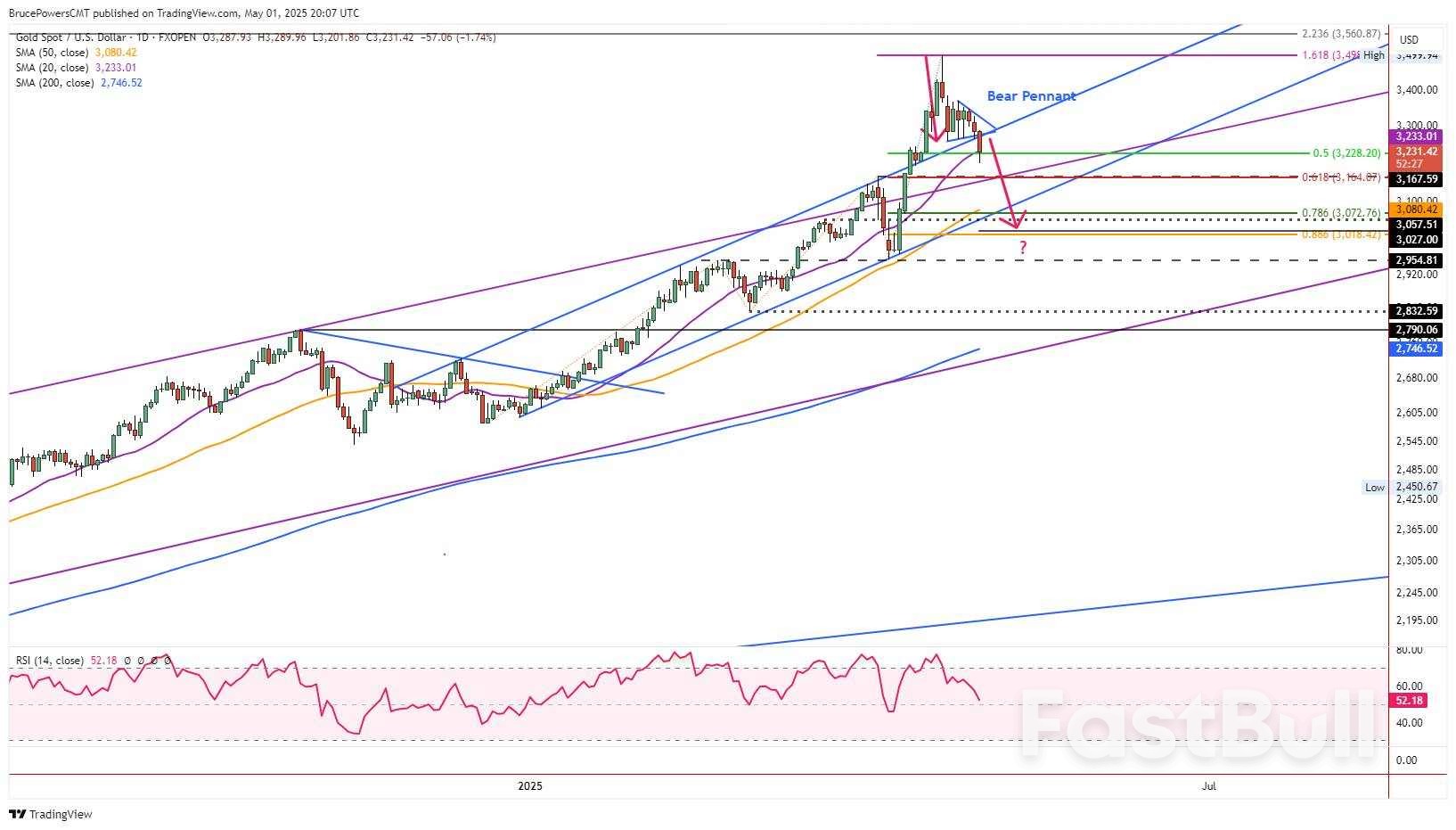
          Gold triggered a bearish pennant pattern on Thursday, subsequently falling below potential support at the 20-Day MA before reaching an 11-day low of $3,201. It looks like gold will end the day below the 20-Day line as well, further confirming bearish sentiment. Sellers remain in control at the time of this writing as trading continues in the lower third of the day’s trading range and gold looks likely to close the session in a similar bearish position.

          61.8% Fibonacci Retracement Completes at $3,104

          Although the next potential support zone is around the 61.8% Fibonacci retracement of a short upswing at $3,104, the measuring objective from the pennant is somewhat lower – below a couple key potential support zones. That could be a sign that selling behavior may surprise to the downside. Nonetheless, it increases the chance that the higher support zone may be reached before the bearish correction is complete.

          50-Day Moving Average at $3,080

          Given the evidence of bearish momentum that returned today, it looks like the next potential support zone around the 61.8% retracement could be tested soon. If it fails to hold as support the next lower price zone identified on the chart is around $3,080 to $3,073, consisting of the 50-Day MA and the 78.6% Fibonacci retracement level at $3,073. Note that the 50-Day line is starting to rise above the 78.6% level.

          Weekly Bearish Reversal Triggers

          Not only was there a bearish signal on the daily chart, but also the weekly chart. A weekly bearish shooting star candle triggered today on a drop below last week’s low of $3,260. That is another bearish sign for crude oil. When both the daily and weekly charts line up as they did with the drop today, it indicates the potential for aggressive selling behavior as underlying demand falls off.

          Pennant Pattern Points to $3,027

          As noted above, the measuring objective for the bear pennant points to a potential lower target. It shows a target around $3,027. Although targets are one of the least reliable indications, the lower target points to increased downside risk for gold. Whether it is eventually reached or not, it is a bearish sign. Indications that gold was getting closer to unsustainable overbought conditions occurred with a bull breakout of a rising trend channel during the first half of April, that failed today. Gold fell back into the channel today on a drop below the top blue channel line.

          Source: Kitco

          To stay updated on all economic events of today, please check out our Economic calendar
          Risk Warnings and Disclaimers
          You understand and acknowledge that there is a high degree of risk involved in trading. Following any strategies or investment methods may lead to potential losses. The content on the site is provided by our contributors and analysts for information purposes only. You are solely responsible for determining whether any trading assets, securities, strategy, or any other product is suitable for investing based on your own investment objectives and financial situation.
          Add to Favorites
          Share
          FastBull
          Copyright © 2025 FastBull Ltd

          728 RM B 7/F GEE LOK IND BLDG NO 34 HUNG TO RD KWUN TONG KLN HONG KONG

          TelegramInstagramTwitterfacebooklinkedin
          App Store Google Play Google Play
          Products
          Charts

          Chats

          Q&A with Experts
          Screeners
          Economic Calendar
          Data
          Tools
          Membership
          Features
          Function
          Markets
          Copy Trading
          Latest Signals
          Contests
          News
          Analysis
          24/7
          Columns
          Education
          Company
          Careers
          About Us
          Contact Us
          Advertising
          Help Center
          Feedback
          User Agreement
          Privacy Policy
          Business

          White Label

          Data API

          Web Plug-ins

          Poster Maker

          Affiliate Program

          Risk Disclosure

          The risk of loss in trading financial instruments such as stocks, FX, commodities, futures, bonds, ETFs and crypto can be substantial. You may sustain a total loss of the funds that you deposit with your broker. Therefore, you should carefully consider whether such trading is suitable for you in light of your circumstances and financial resources.

          No decision to invest should be made without thoroughly conducting due diligence by yourself or consulting with your financial advisors. Our web content might not suit you since we don't know your financial conditions and investment needs. Our financial information might have latency or contain inaccuracy, so you should be fully responsible for any of your trading and investment decisions. The company will not be responsible for your capital loss.

          Without getting permission from the website, you are not allowed to copy the website's graphics, texts, or trademarks. Intellectual property rights in the content or data incorporated into this website belong to its providers and exchange merchants.

          Not Logged In

          Log in to access more features

          FastBull Membership

          Not yet

          Purchase

          Become a signal provider
          Help Center
          Customer Service
          Dark Mode
          Price Up/Down Colors

          Log In

          Sign Up

          Position
          Layout
          Fullscreen
          Default to Chart
          The chart page opens by default when you visit fastbull.com