Markets
News
Analysis
User
24/7
Economic Calendar
Education
Data
- Names
- Latest
- Prev


Signal Accounts for Members
All Signal Accounts
All Contests


France Industrial Output MoM (SA) (Oct)A:--
F: --
France Trade Balance (SA) (Oct)A:--
F: --
Euro Zone Employment YoY (SA) (Q3)A:--
F: --
Canada Part-Time Employment (SA) (Nov)A:--
F: --
P: --
Canada Unemployment Rate (SA) (Nov)A:--
F: --
P: --
Canada Full-time Employment (SA) (Nov)A:--
F: --
P: --
Canada Labor Force Participation Rate (SA) (Nov)A:--
F: --
P: --
Canada Employment (SA) (Nov)A:--
F: --
P: --
U.S. PCE Price Index MoM (Sept)A:--
F: --
P: --
U.S. Personal Income MoM (Sept)A:--
F: --
P: --
U.S. Core PCE Price Index MoM (Sept)A:--
F: --
P: --
U.S. PCE Price Index YoY (SA) (Sept)A:--
F: --
P: --
U.S. Core PCE Price Index YoY (Sept)A:--
F: --
P: --
U.S. Personal Outlays MoM (SA) (Sept)A:--
F: --
U.S. 5-10 Year-Ahead Inflation Expectations (Dec)A:--
F: --
P: --
U.S. Real Personal Consumption Expenditures MoM (Sept)A:--
F: --
U.S. Weekly Total Rig CountA:--
F: --
P: --
U.S. Weekly Total Oil Rig CountA:--
F: --
P: --
U.S. Consumer Credit (SA) (Oct)A:--
F: --
China, Mainland Foreign Exchange Reserves (Nov)A:--
F: --
P: --
Japan Trade Balance (Oct)A:--
F: --
P: --
Japan Nominal GDP Revised QoQ (Q3)A:--
F: --
P: --
China, Mainland Imports YoY (CNH) (Nov)A:--
F: --
P: --
China, Mainland Exports (Nov)A:--
F: --
P: --
China, Mainland Imports (CNH) (Nov)A:--
F: --
P: --
China, Mainland Trade Balance (CNH) (Nov)A:--
F: --
P: --
China, Mainland Exports YoY (USD) (Nov)A:--
F: --
P: --
China, Mainland Imports YoY (USD) (Nov)A:--
F: --
P: --
Germany Industrial Output MoM (SA) (Oct)A:--
F: --
Euro Zone Sentix Investor Confidence Index (Dec)A:--
F: --
P: --
Canada National Economic Confidence Index--
F: --
P: --
U.K. BRC Like-For-Like Retail Sales YoY (Nov)--
F: --
P: --
U.K. BRC Overall Retail Sales YoY (Nov)--
F: --
P: --
Australia Overnight (Borrowing) Key Rate--
F: --
P: --
RBA Rate Statement
RBA Press Conference
Germany Exports MoM (SA) (Oct)--
F: --
P: --
U.S. NFIB Small Business Optimism Index (SA) (Nov)--
F: --
P: --
Mexico 12-Month Inflation (CPI) (Nov)--
F: --
P: --
Mexico Core CPI YoY (Nov)--
F: --
P: --
Mexico PPI YoY (Nov)--
F: --
P: --
U.S. Weekly Redbook Index YoY--
F: --
P: --
U.S. JOLTS Job Openings (SA) (Oct)--
F: --
P: --
China, Mainland M1 Money Supply YoY (Nov)--
F: --
P: --
China, Mainland M0 Money Supply YoY (Nov)--
F: --
P: --
China, Mainland M2 Money Supply YoY (Nov)--
F: --
P: --
U.S. EIA Short-Term Crude Production Forecast For The Year (Dec)--
F: --
P: --
U.S. EIA Natural Gas Production Forecast For The Next Year (Dec)--
F: --
P: --
U.S. EIA Short-Term Crude Production Forecast For The Next Year (Dec)--
F: --
P: --
EIA Monthly Short-Term Energy Outlook
U.S. API Weekly Gasoline Stocks--
F: --
P: --
U.S. API Weekly Cushing Crude Oil Stocks--
F: --
P: --
U.S. API Weekly Crude Oil Stocks--
F: --
P: --
U.S. API Weekly Refined Oil Stocks--
F: --
P: --
South Korea Unemployment Rate (SA) (Nov)--
F: --
P: --
Japan Reuters Tankan Non-Manufacturers Index (Dec)--
F: --
P: --
Japan Reuters Tankan Manufacturers Index (Dec)--
F: --
P: --
Japan Domestic Enterprise Commodity Price Index MoM (Nov)--
F: --
P: --
Japan Domestic Enterprise Commodity Price Index YoY (Nov)--
F: --
P: --
China, Mainland PPI YoY (Nov)--
F: --
P: --


No matching data
Latest Views
Latest Views
Trending Topics
Top Columnists
Latest Update
White Label
Data API
Web Plug-ins
Affiliate Program
View All

No data
China’s export growth is projected to decelerate in August to 5% year-on-year, down from July’s 7.2%, as the temporary lift from a tariff truce with the US fades and trade tensions resurface....
Japan risks having to pay higher tariffs if it doesn’t fund US President Donald Trump’s investment recommendations, according to a document fleshing out a $550 billion funding initiative agreed by the two nations in July.
Trump will pick investment projects based on recommendations from an investment committee led by US Commerce Secretary Howard Lutnick, according to an Understanding of Memorandum of the investment mechanism signed by Lutnick and his Japanese counterpart Ryosei Akazawa in Washington on Thursday.
The investment committee will incorporate input from Japan via a separate panel, with investments to be made up to Jan. 19, 2029, the memorandum said, a time frame that coincides with Trump’s presidential term.
“The idea is to build supply chains within the United States,” Akazawa said in Washington on Thursday evening. “Therefore, it is only natural that the US side’s intentions, and more specifically, President Trump’s intentions, are strongly reflected.”
The memorandum provides more details of how Japan will be obligated to supply funds for Trump’s investment choices than has so far been indicated by Japanese officials. Akazawa said there was no change from July in the details agreed.
The investment fund forms part of a trade deal agreed with the US that limits universal duties on Japanese goods and sectoral tariffs on the auto sector to 15%. The Trump administration has included similar funding arrangements in other trade deals too, including the US agreement with South Korea.
While the US-Japan deal was struck on July 22, the auto tariffs had remained at 27.5% while existing duties were still being charged on top of the new tariffs imposed this year. Trump signed an executive order Thursday to lower the duties to 15% and stop the stacking up of tariffs, a move that delivers embattled Japanese Prime Minister Shigeru Ishiba a limited success as he tries to hold on to power in Tokyo amid calls for him to resign.
The memorandum states that the US does not intend to raise tariffs provided Japan faithfully implements it and doesn’t fail to provide funding. The US president would determine the tariff rate should that option be taken in the case of Japan choosing not to fund a project.
Japan will need to make funds denominated in dollars available within 45 days of an investment project being presented for review, the memorandum states. Separate Special Purpose Vehicles will be set up for each investment.
“Each Investment SPV will be managed and governed by the United States or its designees in the capacity of a general partner,” the memorandum stated.
Akazawa reiterated Thursday that Japan will contribute to the funding initiative partly using loan guarantees. A senior Japanese government official who briefed the press in Washington also said Akazawa’s previous explanation of how the investment fund would work remains the same.
“In short, we will provide investments, loans and loan guarantees for up to $550 billion. That remains the same,” he said.
Akazawa has largely played down the size of actual investments that Japan is likely to make via the new setup, which will involve the government-backed Japan Bank For International Cooperation and Nippon Export and Investment Insurance.
Of the total, investment will comprise 1% or 2% and the US and Japan will split the profits of that investment at a ratio of 90-10, he said in July following the deal’s announcement. The Japan side has cited JBIC and NEXI as the government-backed organizations that will be leading financing for the projects.
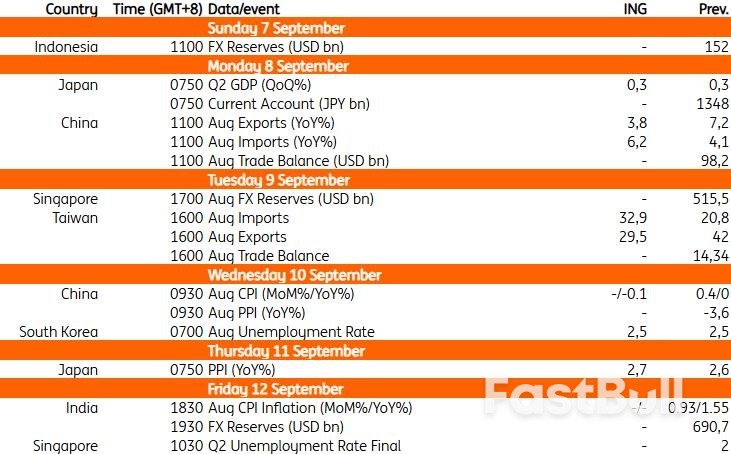
On Monday, we don’t expect major surprises from China’s August trade data in light of the extension of the US-China trade war truce, which kept tariffs at the status quo. Export growth could slow to around 3.8% year on year, while imports could continue to pick up to around 6.2% YoY, thanks to base effects from 2024.August inflation data, to be released on Wednesday, could show price pressures dipped back into negative territory at around -0.1% YoY after coming in at zero in July.
When Taiwan releases its August trade data on Tuesday, we will be on the lookout for any early signs of a pullback after the tariff hikes from 10% to 20% during the month. After Taiwan's government characterized the 20% rate as temporary, it’s possible that prospective importers held off in hopes that the tariff could soon be lowered. This may be more evident in subsequent months than in August. We look for export growth to slow to 29.5% YoY, while import growth continues to accelerate to 32.9% YoY.
South Korea’s unemployment rate is expected to stay at 2.5% for a second consecutive month. Unusually severe weather conditions may have reduced employment in agriculture and construction, while leisure-related services may see an increase in jobs. Aided by government support for small businesses, the unemployment rate may stay at the current low level for a considerable time.
Japan’s second-quarter GDP likely remained near the flash estimate of 0.3% quarter-on-quarter growth. Meanwhile, the August producer price index is projected to rise to 2.7% YoY, indicating continued pipeline price pressures.
Key events in Asia next week

Lawmakers of Japan's ruling party will vote on Monday whether to hold an extraordinary leadership election that could oust embattled premier Shigeru Ishiba and have a significant impact on the world's fourth largest economy.
Concern over political uncertainty has led to a sell-off in the yen and Japanese government bonds (JGB) this week with the yield on the 30-year yield hitting a record high on Wednesday.
While the policy paralysis around such a vote could add pain for an economy hit by U.S. tariffs, markets are focusing more on the chance of Ishiba's replacement by an advocate of looser fiscal and monetary policy such as Sanae Takaichi, who has criticised the Bank of Japan's interest rate hikes.
"The dominant market bet is for the LDP to hold a leadership race and for Ishiba, known as a fiscal hawk, to lose his job," said Katsutoshi Inadome, senior strategist at Sumitomo Mitsui Trust Asset Management.
"We'll likely see further selling in Japanese government bonds as whoever succeeds Ishiba probably will be more open to loosening fiscal policy than him."
Ishiba has refused calls from within his Liberal Democratic Party (LDP) to step down and take responsibility for its July loss in an upper house election.
Staying in power, however, has become increasingly hard for him. Having lost a majority in both houses of parliament, his ruling coalition needs opposition support to pass legislation.
Wary of being attached to the unpopular premier, opposition parties have refused to cooperate. Even some of Ishiba's cabinet members are now calling for the choice of a new party leader.
Party rules require at least half the LDP members to request holding the race, which could follow this month or in October.
Such a leadership race could delay parliament's passage of an expected supplementary budget aimed at cushioning the blow to households from rising living costs.
Eurasia Group gave odds of 60% that Ishiba would not survive.
"Ishiba's poor performance as party leader in lower and upper house elections and events in recent days, including former prime minister Aso Taro announcing his support for the special election, have turned the tide against Ishiba," said David Boling, director of Japan and Asian Trade at Eurasia.
That puts the focus his potential successor.
While the LDP lacks a majority in parliament, its leader would still be the favourite to become next prime minister, due to a fragmented opposition.
The choice could affect not just the scale of fiscal stimulus, but the timing of the BOJ's next interest rate hike, analysts say.
Front-runners include 44-year-old Shinjiro Koizumi, a charismatic agriculture minister popular with the public, but whose views on economic policy are unknown.
Takaichi, who represents the party's right wing, is also seen by some analysts as a strong candidate to become Japan's first female prime minister. She lost the September leadership race to Ishiba in a run-off vote.
While several other candidates are seen in the fray, Takaichi stands out for her vocal opposition to BOJ rate hikes and calls to ramp up spending to underpin a fragile economy.
After ending a decade-long, massive stimulus programme last year, the BOJ raised interest rates to 0.5% in January on the view that Japan was on the cusp of sustainably meeting its inflation target of 2%.
Most economists polled by Reuters expect the central bank to raise rates again this year, with some betting on a hike in October.
"Under Takaichi, fiscal discipline will be out the window," Inadome said. "Markets still remember the time she made it to the run-up in September, and triggered huge selling in JGBs."
White Label
Data API
Web Plug-ins
Poster Maker
Affiliate Program
The risk of loss in trading financial instruments such as stocks, FX, commodities, futures, bonds, ETFs and crypto can be substantial. You may sustain a total loss of the funds that you deposit with your broker. Therefore, you should carefully consider whether such trading is suitable for you in light of your circumstances and financial resources.
No decision to invest should be made without thoroughly conducting due diligence by yourself or consulting with your financial advisors. Our web content might not suit you since we don't know your financial conditions and investment needs. Our financial information might have latency or contain inaccuracy, so you should be fully responsible for any of your trading and investment decisions. The company will not be responsible for your capital loss.
Without getting permission from the website, you are not allowed to copy the website's graphics, texts, or trademarks. Intellectual property rights in the content or data incorporated into this website belong to its providers and exchange merchants.
Not Logged In
Log in to access more features

FastBull Membership
Not yet
Purchase
Log In
Sign Up