Markets
News
Analysis
User
24/7
Economic Calendar
Education
Data
- Names
- Latest
- Prev


Signal Accounts for Members
All Signal Accounts
All Contests


France Trade Balance (SA) (Oct)A:--
F: --
Euro Zone Employment YoY (SA) (Q3)A:--
F: --
Canada Part-Time Employment (SA) (Nov)A:--
F: --
P: --
Canada Unemployment Rate (SA) (Nov)A:--
F: --
P: --
Canada Full-time Employment (SA) (Nov)A:--
F: --
P: --
Canada Labor Force Participation Rate (SA) (Nov)A:--
F: --
P: --
Canada Employment (SA) (Nov)A:--
F: --
P: --
U.S. PCE Price Index MoM (Sept)A:--
F: --
P: --
U.S. Personal Income MoM (Sept)A:--
F: --
P: --
U.S. Core PCE Price Index MoM (Sept)A:--
F: --
P: --
U.S. PCE Price Index YoY (SA) (Sept)A:--
F: --
P: --
U.S. Core PCE Price Index YoY (Sept)A:--
F: --
P: --
U.S. Personal Outlays MoM (SA) (Sept)A:--
F: --
U.S. 5-10 Year-Ahead Inflation Expectations (Dec)A:--
F: --
P: --
U.S. Real Personal Consumption Expenditures MoM (Sept)A:--
F: --
U.S. Weekly Total Rig CountA:--
F: --
P: --
U.S. Weekly Total Oil Rig CountA:--
F: --
P: --
U.S. Consumer Credit (SA) (Oct)A:--
F: --
China, Mainland Foreign Exchange Reserves (Nov)A:--
F: --
P: --
Japan Trade Balance (Oct)A:--
F: --
P: --
Japan Nominal GDP Revised QoQ (Q3)A:--
F: --
P: --
China, Mainland Imports YoY (CNH) (Nov)A:--
F: --
P: --
China, Mainland Exports (Nov)A:--
F: --
P: --
China, Mainland Imports (CNH) (Nov)A:--
F: --
P: --
China, Mainland Trade Balance (CNH) (Nov)A:--
F: --
P: --
China, Mainland Exports YoY (USD) (Nov)A:--
F: --
P: --
China, Mainland Imports YoY (USD) (Nov)A:--
F: --
P: --
Germany Industrial Output MoM (SA) (Oct)A:--
F: --
Euro Zone Sentix Investor Confidence Index (Dec)A:--
F: --
P: --
Canada National Economic Confidence IndexA:--
F: --
P: --
U.K. BRC Like-For-Like Retail Sales YoY (Nov)--
F: --
P: --
U.K. BRC Overall Retail Sales YoY (Nov)--
F: --
P: --
Australia Overnight (Borrowing) Key Rate--
F: --
P: --
RBA Rate Statement
RBA Press Conference
Germany Exports MoM (SA) (Oct)--
F: --
P: --
U.S. NFIB Small Business Optimism Index (SA) (Nov)--
F: --
P: --
Mexico 12-Month Inflation (CPI) (Nov)--
F: --
P: --
Mexico Core CPI YoY (Nov)--
F: --
P: --
Mexico PPI YoY (Nov)--
F: --
P: --
U.S. Weekly Redbook Index YoY--
F: --
P: --
U.S. JOLTS Job Openings (SA) (Oct)--
F: --
P: --
China, Mainland M1 Money Supply YoY (Nov)--
F: --
P: --
China, Mainland M0 Money Supply YoY (Nov)--
F: --
P: --
China, Mainland M2 Money Supply YoY (Nov)--
F: --
P: --
U.S. EIA Short-Term Crude Production Forecast For The Year (Dec)--
F: --
P: --
U.S. EIA Natural Gas Production Forecast For The Next Year (Dec)--
F: --
P: --
U.S. EIA Short-Term Crude Production Forecast For The Next Year (Dec)--
F: --
P: --
EIA Monthly Short-Term Energy Outlook
U.S. API Weekly Gasoline Stocks--
F: --
P: --
U.S. API Weekly Cushing Crude Oil Stocks--
F: --
P: --
U.S. API Weekly Crude Oil Stocks--
F: --
P: --
U.S. API Weekly Refined Oil Stocks--
F: --
P: --
South Korea Unemployment Rate (SA) (Nov)--
F: --
P: --
Japan Reuters Tankan Non-Manufacturers Index (Dec)--
F: --
P: --
Japan Reuters Tankan Manufacturers Index (Dec)--
F: --
P: --
Japan Domestic Enterprise Commodity Price Index MoM (Nov)--
F: --
P: --
Japan Domestic Enterprise Commodity Price Index YoY (Nov)--
F: --
P: --
China, Mainland PPI YoY (Nov)--
F: --
P: --
China, Mainland CPI MoM (Nov)--
F: --
P: --
Italy Industrial Output YoY (SA) (Oct)--
F: --
P: --


No matching data
Latest Views
Latest Views
Trending Topics
Top Columnists
Latest Update
White Label
Data API
Web Plug-ins
Affiliate Program
View All

No data
Q1 GDP growth led by exports, business investments; Final domestic demand, household spending slowed; Gross domestic product in March grows by 0.1%; Estimate shows economy to expand by 0.1% in April.
Canada's economy in the first quarter grew faster than expected, data showed on Friday, primarily driven by exports as companies in the United States rushed to stockpile before tariffs by President Donald Trump.
But an increase in imports that led to inventory build-up, lower household spending and weaker final domestic demand indicate that the economy was battling on the domestic front. Economists have warned that as tariffs continue on Canada, this trend will persist.
The gross domestic product in the first quarter grew by 2.2% on an annualized basis as compared with the downwardly revised 2.1% growth posted in the previous quarter, Statistics Canada said.
This is the final economic indicator before the Bank of Canada's rates decision on Wednesday and will help determine whether the central bank will cut or stay pat on rates.
Currency swap markets were expecting around 75% chance the bank would hold its rates at the current level of 2.75%, before the GDP data was released. (0#CADIRPR)
Trump's repeated threats and flip-flops on tariffs since the beginning of the year led to an increase in exports and imports to and from the U.S.
Trump imposed tariffs on Canada in March, first on a slew of products and later specifically on steel and aluminum.
The GDP grew by 0.1% in March after a contraction of 0.2% in February. The economy is likely expected to expand by 0.1% in April, the statistics agency said referring to a flash estimate.
The March growth was primarily driven by a rebound in the mining, quarrying, and oil and gas extraction and construction sectors.
Analysts polled by Reuters had expected the first quarter GDP to expand by 1.7% and by 0.1% in March.
The quarterly GDP figure is calculated based on income and expenditure while the monthly GDP is derived from industrial output.
The tariffs and the uncertainty around them started showing early signs of impact as the final domestic demand, which represents total final consumption expenditures and investment in fixed capital, did not increase for the first time since the end of 2023, Statscan said.
Growth in household spending also slowed to 0.3% in the first quarter, after rising 1.2% in the prior quarter.
The first quarter growth was led by a rise in exports, which jumped by 1.6% after increasing by 1.7% in the fourth quarter of 2024. Business investment in machinery and equipments also increased by 5.3% which pushed the quarterly GDP higher.

US consumers hit the brakes in April after the strongest month of spending since early 2023 while inflation remained tame, consistent with a slowing economy.
Inflation-adjusted personal spending rose 0.1% after rising 0.7% a month earlier, Bureau of Economic Analysis data showed Friday.
The personal consumption expenditures price index, excluding food and energy, increased 0.1% from a month earlier. Compared with a year earlier, the so-called core inflation gauge rose 2.5% from April 2024 — the smallest annual advance in more than four years.
The figures illustrate an undercurrent of anxiety among many American consumers about the economy after the weakest quarter for spending in nearly two years. While higher duties on imports have yet to show up more broadly in higher goods prices, sentiment has slumped and the outlook for personal finances stands at a record low.
The modest rise in spending reflected an increase in services that more than offset a decline in durable goods outlays.
At the same time, the Trump administration has walked back or paused some tariffs as negotiators work toward trade deals with key partners including China and the European Union. On Wednesday, a US court issued a ruling that blocks many of the import taxes.
Separate data out Friday showed a massive narrowing of the US merchandise-trade deficit in April on the largest-ever decrease in imports.
The constant state of flux in trade policy has nonetheless fueled uncertainty, with consumers’ spending attitudes hanging in the balance. Meanwhile, Federal Reserve policymakers will likely keep interest rates unchanged for the foreseeable future until they get more clarity on the impact of tariffs not only on prices but also on other pillars of the economy like the labor market and consumer spending.
Economists are paying close attention to the degree to which companies are passing through higher import duties to consumers. A measure of goods inflation that excludes food and energy climbed 0.3%.
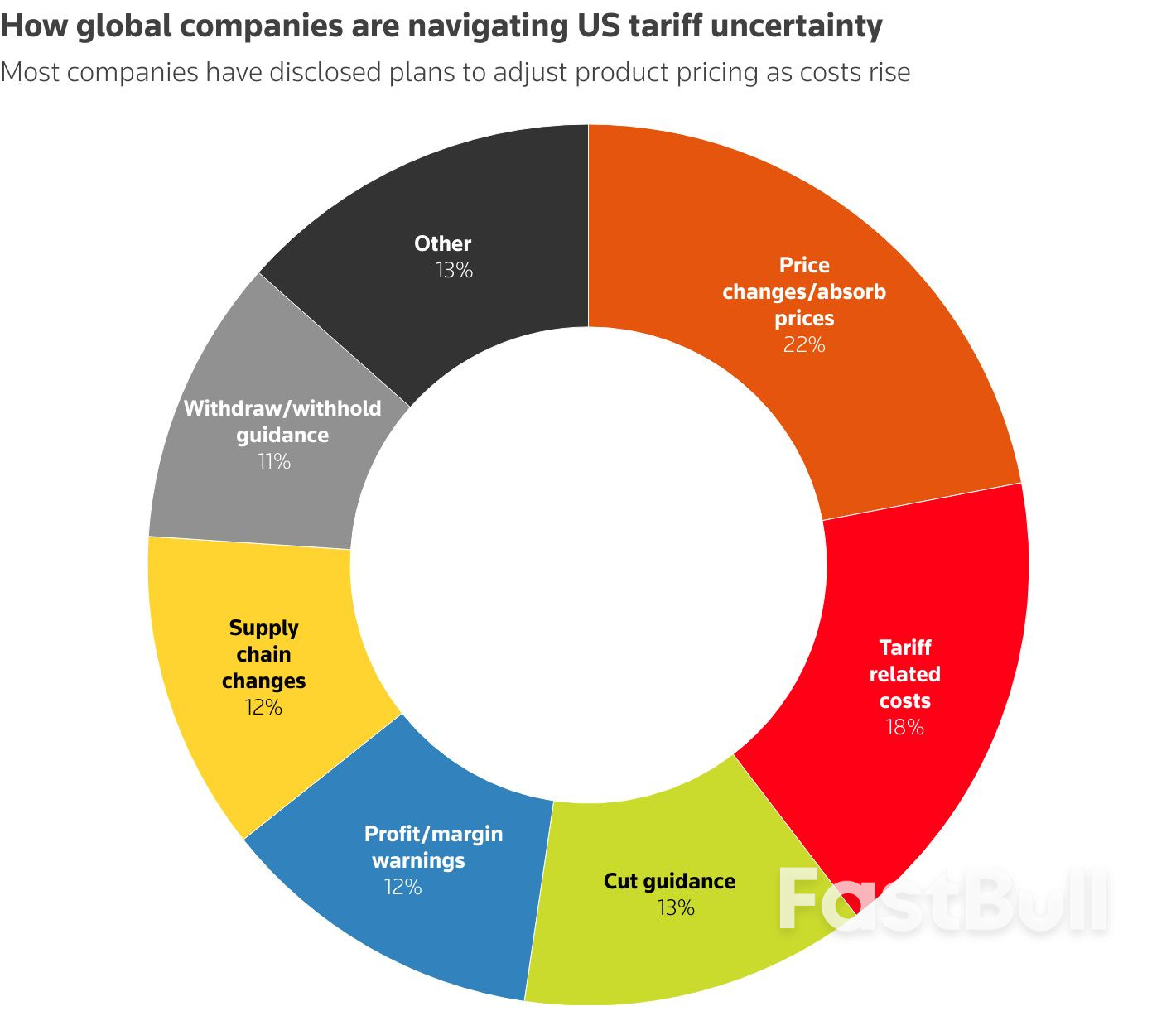
While many companies have so far been absorbing or offsetting much of the hit from tariffs, retailers including Walmart Inc. and Macy’s Inc. have indicated Americans will start seeing price hikes soon.
Analysts have revised down their oil price forecasts for the third consecutive month as swelling OPEC+ supply and lingering uncertainty around the impact of trade disputes on fuel demand weigh on prices, a Reuters poll showed.
A survey of 40 economists and analysts in May forecasts Brent crude will average US$66.98 per barrel in 2025, down from April’s $68.98 forecast, while U.S. crude is seen at $63.35, below last month’s $65.08 estimate. Prices have averaged roughly $71.08 and $67.56 so far this year respectively, as per LSEG data.
While tensions have somewhat eased between the U.S. and other trade partners, trade conflicts still loom as a key factor that could weaken oil demand, said Tobias Keller, analyst at UniCredit.
“On the supply side, oil prices will be heavily influenced by OPEC+ production decisions, while geopolitical tensions... pose ongoing risks of disruption and price volatility,” Keller added.
Eight OPEC+ members began unwinding output cuts earlier this year, agreeing to larger-than-expected increases of 411,000 bpd for May and June. The members may decide on a similar output hike for July at a meeting on Saturday, sources have told Reuters.
The move “seems driven by a desire to punish non-compliant members rather than support oil prices at any specific level. Compliance will be hard to enforce, especially in Kazakhstan,” said Suvro Sarkar, lead energy analyst at DBS Bank.
Meanwhile, analysts polled by Reuters expect global oil demand to grow by an average of 775,000 barrels per day in 2025, with many pointing to elevated trade uncertainty and the risk of economic slowdown as key concerns. This compares to the 740,000 bpd 2025 average demand growth forecast from the International Energy Agency earlier this month.
With U.S. consumption and China oil demand constrained by fuel efficiency gains, economic uncertainty and the shift to electric mobility, “demand growth is largely coming from the resource nations themselves,” said Norbert Ruecker, head of economics & next generation research at Julius Baer.
Meanwhile, Russia’s war in Ukraine continues to pose a geopolitical risk premium for oil. Analysts say markets have largely priced in the uncertainty.
“Potential de-escalation efforts and the possibility of lifting sanctions on Russian oil could further lower prices,” said Sarkar.
A legal fight over US tariffs adds another layer of uncertainty for global commerce, as the Trump administration continues to pursue its protectionist trade policy.
If a ruling by the Court of International Trade blocking President Donald Trump’s “Liberation Day” tariffs succeeds, it would bring the average US tariff rate down to 6%, according to Bloomberg Economics. That’s higher than the roughly 2% when Trump took office, but far below the near 27% reached last month. That would certainly be a smaller shock to the economies of the US and its trading partners, Bloomberg Economics’ chief economist Tom Orlik wrote in a note.
The problem is that there’s no way of knowing what happens next. A federal appeals court offered a temporary reprieve on Thursday, setting up for a long legal fight that could wind up at the Supreme Court. Despite the ruling, countries continue to negotiate with the US for bilateral deals including Taiwan and Japan. And even if current tariffs eventually get blocked, the administration is already looking at other options that would keep levies high.
One such tool is Section 122 of the Trade Act of 1974, which would enable the president to impose sweeping tariffs of as much as 15% on imports from countries with which the US runs a “large and serious” balance-of-payments deficit. Economists said that would be the fastest workaround, even though it would require congressional approval after 150 days.
Markets reflected that uncertainty as US and Asian shares fell, with an initial burst of optimism about the ruling meeting a growing sense that tariffs would find their way in somehow.
After digesting the major surprise from the Court of International Trade’s ruling, several economists said they won’t change their baseline assumption on tariffs rates — meaning they’re not going to change their economic forecasts in a meaningful way.
Bloomberg Economics and Deutsche Bank both have a baseline assumption that tariffs will end up around 15%. The administration is counting on revenue from elevated import levies to offset some of the costs of the fiscal package currently in front of Congress. “Abandoning tariffs altogether is therefore not an option,” Deutsche Bank economists wrote.
There could still be some nuanced economic implications, including the risk of fueling inflation, according to Bloomberg Economics’ Anna Wong. Optimism about lower tariffs could prompt consumers to spend more on recreation services, she wrote in a note, and businesses to boost import orders.
Paying workers to move actually pays dividends. Tulsa, Oklahoma, wanted to attract more people to live and work in the city so it started giving Americans $10,000 to relocate. A new study shows that the initiative — replicated by about 100 other places across the US — was worth it, providing $4 for every $1 spent.
The European Union has gained leverage in trade talks with the United States after a U.S. court cast doubt on the legality of Washington's "reciprocal"tariffs, EU officials said on Friday.
A U.S. federal appeals court temporarily reinstated President Donald Trump's tariffs on Thursday, a day after a U.S. trade court ruled that Trump had exceeded his authority in imposing the duties and ordered an immediate block on them.
"The uncertainty as to the legality of the 'reciprocal' tariffs certainly gives us extra leverage," one EU official close to the talks said. "The talks will continue, as formally we still look for zero-for-zero tariffs."
The EU was willing to discuss some non-trade barriers with the U.S., EU officials said, but would not touch the EU's taxation system — such as the value added tax or digital tax — or food safety standards.
The EU officials said the uncertainty created by the court rulings and the Trump administration's tariff policy had a positive aspect for Europe, which was seen by markets as an oasis of stability in comparison.
"This is the watchword: uncertainty. It is impossible to know what the status of the tariffs will be next week, not to mention next month," one of the EU officials said.
"If you want sane, stable, even boring, rules-based order and predictable business environment, Europe is the place for you."
Meanwhile, some European companies, worried over the uncertainty and possible major hits to their business, are holding their own talks with U.S. authorities.
VolkswagenCEO Oliver Blume said his company was holding "fair" and "constructive" talks with the U.S. government on tariffs and wanted to make further investments in the country.
Blume, speaking to German newspaper Sueddeutsche Zeitung, said that Volkswagen's main contact in Washington was U.S. Commerce Secretary Howard Lutnick.
Earlier this week, sources told Reuters that Germany's carmakers were in talks with Washington over a possible tariff deal.
The European Commission conducts all trade negotiations on behalf of the 27-nation bloc and companies, or even individual EU countries, cannot legally get a deal outside that framework.
The European Commission would not comment on the U.S. court rulings because they were internal U.S. procedures.
But it said trade talks between Brussels and Washington would continue, with Europe sticking to its offer of mutual zero tariffs on industrial goods.
"There's no change in our approach, we proceed as planned with both technical and political meetings next week," a Commission spokesperson said.
EU Trade Commissioner Maros Sefcovic in a post on the X social media platform said he held a phone call with Lutnick on Friday.
"Our time and effort fully invested, as delivering forward-looking solutions remains a top EU priority. Staying in permanent contact," Sefcovic said on X.
More trade talks between the U.S. and the EU are scheduled for next week, on the sidelines of the OECD Ministerial Council Meeting in Paris on June 3-4.
The EU officials said the U.S. courts' rulings validated the EU view that the sweeping "reciprocal" tariffs, imposed on all goods from the EU and many other countries around the world on April 2, were unjustified.
They also said that while U.S. courts did not question Washington's 25% tariffs imposed on European steel, aluminium and cars, the rulings could also play a role in the EU's efforts to get those tariffs lowered or removed.
White Label
Data API
Web Plug-ins
Poster Maker
Affiliate Program
The risk of loss in trading financial instruments such as stocks, FX, commodities, futures, bonds, ETFs and crypto can be substantial. You may sustain a total loss of the funds that you deposit with your broker. Therefore, you should carefully consider whether such trading is suitable for you in light of your circumstances and financial resources.
No decision to invest should be made without thoroughly conducting due diligence by yourself or consulting with your financial advisors. Our web content might not suit you since we don't know your financial conditions and investment needs. Our financial information might have latency or contain inaccuracy, so you should be fully responsible for any of your trading and investment decisions. The company will not be responsible for your capital loss.
Without getting permission from the website, you are not allowed to copy the website's graphics, texts, or trademarks. Intellectual property rights in the content or data incorporated into this website belong to its providers and exchange merchants.
Not Logged In
Log in to access more features

FastBull Membership
Not yet
Purchase
Log In
Sign Up