• Trade
  • Markets
  • Copy
  • Contests
  • News
  • 24/7
  • Calendar
  • Q&A
  • Chats
Trending
Screeners
SYMBOL
LAST
BID
ASK
HIGH
LOW
NET CHG.
%CHG.
SPREAD
SPX
S&P 500 Index
6850.12
6850.12
6850.12
6861.30
6843.84
+22.71
+ 0.33%
--
DJI
Dow Jones Industrial Average
48616.18
48616.18
48616.18
48679.14
48557.21
+158.14
+ 0.33%
--
IXIC
NASDAQ Composite Index
23260.40
23260.40
23260.40
23345.56
23240.37
+65.25
+ 0.28%
--
USDX
US Dollar Index
97.820
97.900
97.820
98.070
97.810
-0.130
-0.13%
--
EURUSD
Euro / US Dollar
1.17565
1.17573
1.17565
1.17596
1.17262
+0.00171
+ 0.15%
--
GBPUSD
Pound Sterling / US Dollar
1.33946
1.33953
1.33946
1.33970
1.33546
+0.00239
+ 0.18%
--
XAUUSD
Gold / US Dollar
4331.95
4332.36
4331.95
4350.16
4294.68
+32.56
+ 0.76%
--
WTI
Light Sweet Crude Oil
56.872
56.902
56.872
57.601
56.789
-0.361
-0.63%
--

Community Accounts

Signal Accounts
--
Profit Accounts
--
Loss Accounts
--
View More

Become a signal provider

Sell trading signals to earn additional income

View More

Guide to Copy Trading

Get started with ease and confidence

View More

Signal Accounts for Members

All Signal Accounts

Best Return
  • Best Return
  • Best P/L
  • Best MDD
Past 1W
  • Past 1W
  • Past 1M
  • Past 1Y

All Contests

  • All
  • Trump Updates
  • Recommend
  • Stocks
  • Cryptocurrencies
  • Central Banks
  • Featured News
Top News Only
Share

The Nasdaq Golden Dragon China Index Fell 0.9% In Early Trading

Share

The S&P 500 Opened 32.78 Points Higher, Or 0.48%, At 6860.19; The Dow Jones Industrial Average Opened 136.31 Points Higher, Or 0.28%, At 48594.36; And The Nasdaq Composite Opened 134.87 Points Higher, Or 0.58%, At 23330.04

Share

Miran: Goods Inflation Could Be Settling In At A Higher Level Than Was Normal Before The Pandemic, But That Will Be More Than Offset By Housing Disinflation

Share

Miran, Who Dissented In Favor Of A Larger Cut At Last Fed Meeting, Repeats Keeping Policy Too Tight Will Lead To Job Losses

Share

Miran: Does Not Think Higher Goods Inflation Is Mostly From Tariffs, But Acknowledges Does Not Have A Full Explanation For It

Share

Toronto Stock Index .GSPTSE Rises 67.16 Points, Or 0.21 Percent, To 31594.55 At Open

Share

Miran: Excluding Housing And Non-Market Based Items, Core Pce Inflation May Be Below 2.3%, “Within Noise” Of The Fed's 2% Target

Share

Polish State Assets Minister Balczun Says Jsw Needs Over USD 830 Million Financing To Keep Liquidity For A Year

Share

Miran: Prices Are “Once Again Stable” And Monetary Policy Should Reflect That

Share

Fed's Miran: Current Excess Inflation Is Not Reflective Of Underlying Supply And Demand In The Economy

Share

Portugal Treasury Puts 2026 Net Financing Needs At 13 Billion Euros, Up From 10.8 Billion In 2025

Share

Portugal Treasury Expects 2026 Net Financing Needs At 29.4 Billion Euros, Up From 25.8 Billion In 2025

Share

Bank Of America Says With Indonesia's Smelter Now Ramping Up, It Expects Aluminium Supply Growth To Accelerate To 2.6% Year On Year In 2026

Share

Bank Of America Expects A Deficit In Aluminium Next Year And Sees Prices Pushing Above $3000/T

Share

Fed Data - USA Effective Federal Funds Rate At 3.64 Percent On 12 December On $102 Billion In Trades Versus 3.64 Percent On $99 Billion On 11 December

Share

Brazil's Petrobras Says No Impact Seen On Oil, Petroleum Products Output As Workers Start Planned Strike

Share

Statement: US Travel Group Warns New Proposed Trump Administration Requirements For Foreign Tourists To Provide Social Media Histories Could Mean Millions Of People Opting Not To Visit

Share

Blackrock: Kerry White Will Become Head Of Citi Investment Management At Citi Wealth

Share

Blackrock: Rob Jasminski, Head Of Citi Investment Management, Has Joined With Team

Share

Blackrock: Effective Dec 15, Citi Investment Management Employees Will Join Blackrock

TIME
ACT
FCST
PREV
Japan Tankan Small Manufacturing Outlook Index (Q4)

A:--

F: --

P: --

Japan Tankan Large Non-Manufacturing Outlook Index (Q4)

A:--

F: --

P: --

Japan Tankan Large Manufacturing Outlook Index (Q4)

A:--

F: --

P: --

Japan Tankan Small Manufacturing Diffusion Index (Q4)

A:--

F: --

P: --

Japan Tankan Large Manufacturing Diffusion Index (Q4)

A:--

F: --

P: --

Japan Tankan Large-Enterprise Capital Expenditure YoY (Q4)

A:--

F: --

P: --

U.K. Rightmove House Price Index YoY (Dec)

A:--

F: --

P: --

China, Mainland Industrial Output YoY (YTD) (Nov)

A:--

F: --

P: --

China, Mainland Urban Area Unemployment Rate (Nov)

A:--

F: --

P: --

Saudi Arabia CPI YoY (Nov)

A:--

F: --

P: --

Euro Zone Industrial Output YoY (Oct)

A:--

F: --

P: --

Euro Zone Industrial Output MoM (Oct)

A:--

F: --

P: --

Canada Existing Home Sales MoM (Nov)

A:--

F: --

P: --

Canada National Economic Confidence Index

A:--

F: --

P: --

Canada New Housing Starts (Nov)

A:--

F: --

P: --
U.S. NY Fed Manufacturing Employment Index (Dec)

A:--

F: --

P: --

U.S. NY Fed Manufacturing Index (Dec)

A:--

F: --

P: --

Canada Core CPI YoY (Nov)

A:--

F: --

P: --

Canada Manufacturing Unfilled Orders MoM (Oct)

A:--

F: --

P: --

U.S. NY Fed Manufacturing Prices Received Index (Dec)

A:--

F: --

P: --

U.S. NY Fed Manufacturing New Orders Index (Dec)

A:--

F: --

P: --

Canada Manufacturing New Orders MoM (Oct)

A:--

F: --

P: --

Canada Core CPI MoM (Nov)

A:--

F: --

P: --

Canada Trimmed CPI YoY (SA) (Nov)

A:--

F: --

P: --

Canada Manufacturing Inventory MoM (Oct)

A:--

F: --

P: --

Canada CPI YoY (Nov)

A:--

F: --

P: --

Canada CPI MoM (Nov)

A:--

F: --

P: --

Canada CPI YoY (SA) (Nov)

A:--

F: --

P: --

Canada Core CPI MoM (SA) (Nov)

A:--

F: --

P: --

Canada CPI MoM (SA) (Nov)

A:--

F: --

P: --

Federal Reserve Board Governor Milan delivered a speech
U.S. NAHB Housing Market Index (Dec)

--

F: --

P: --

Australia Composite PMI Prelim (Dec)

--

F: --

P: --

Australia Services PMI Prelim (Dec)

--

F: --

P: --

Australia Manufacturing PMI Prelim (Dec)

--

F: --

P: --

Japan Manufacturing PMI Prelim (SA) (Dec)

--

F: --

P: --

U.K. 3-Month ILO Employment Change (Oct)

--

F: --

P: --

U.K. Unemployment Claimant Count (Nov)

--

F: --

P: --

U.K. Unemployment Rate (Nov)

--

F: --

P: --

U.K. 3-Month ILO Unemployment Rate (Oct)

--

F: --

P: --

U.K. Average Weekly Earnings (3-Month Average, Including Bonuses) YoY (Oct)

--

F: --

P: --

U.K. Average Weekly Earnings (3-Month Average, Excluding Bonuses) YoY (Oct)

--

F: --

P: --

France Services PMI Prelim (Dec)

--

F: --

P: --

France Composite PMI Prelim (SA) (Dec)

--

F: --

P: --

France Manufacturing PMI Prelim (Dec)

--

F: --

P: --

Germany Services PMI Prelim (SA) (Dec)

--

F: --

P: --

Germany Manufacturing PMI Prelim (SA) (Dec)

--

F: --

P: --

Germany Composite PMI Prelim (SA) (Dec)

--

F: --

P: --

Euro Zone Composite PMI Prelim (SA) (Dec)

--

F: --

P: --

Euro Zone Services PMI Prelim (SA) (Dec)

--

F: --

P: --

Euro Zone Manufacturing PMI Prelim (SA) (Dec)

--

F: --

P: --

U.K. Services PMI Prelim (Dec)

--

F: --

P: --

U.K. Manufacturing PMI Prelim (Dec)

--

F: --

P: --

U.K. Composite PMI Prelim (Dec)

--

F: --

P: --

Euro Zone ZEW Economic Sentiment Index (Dec)

--

F: --

P: --

Germany ZEW Current Conditions Index (Dec)

--

F: --

P: --

Germany ZEW Economic Sentiment Index (Dec)

--

F: --

P: --

Euro Zone Trade Balance (Not SA) (Oct)

--

F: --

P: --

Euro Zone ZEW Current Conditions Index (Dec)

--

F: --

P: --

Euro Zone Trade Balance (SA) (Oct)

--

F: --

P: --

U.S. Retail Sales MoM (Excl. Automobile) (SA) (Oct)

--

F: --

P: --

Q&A with Experts
    • All
    • Chatrooms
    • Groups
    • Friends
    Connecting
    .
    .
    .
    Type here...
    Add Symbol or Code

      No matching data

      All
      Trump Updates
      Recommend
      Stocks
      Cryptocurrencies
      Central Banks
      Featured News
      • All
      • Russia-Ukraine Conflict
      • Middle East Flashpoint
      • All
      • Russia-Ukraine Conflict
      • Middle East Flashpoint
      Search
      Products

      Charts Free Forever

      Chats Q&A with Experts
      Screeners Economic Calendar Data Tools
      Membership Features
      Data Warehouse Market Trends Institutional Data Policy Rates Macro

      Market Trends

      Market Sentiment Order Book Forex Correlations

      Top Indicators

      Charts Free Forever
      Markets

      News

      News Analysis 24/7 Columns Education
      From Institutions From Analysts
      Topics Columnists

      Latest Views

      Latest Views

      Trending Topics

      Top Columnists

      Latest Update

      Signals

      Copy Rankings Latest Signals Become a signal provider AI Rating
      Contests
      Brokers

      Overview Brokers Assessment Rankings Regulators News Claims
      Broker listing Forex Brokers Comparison Tool Live Spread Comparison Scam
      Q&A Complaint Scam Alert Videos Tips to Detect Scam
      More

      Business
      Events
      Careers About Us Advertising Help Center

      White Label

      Data API

      Web Plug-ins

      Affiliate Program

      Awards Institution Evaluation IB Seminar Salon Event Exhibition
      Vietnam Thailand Singapore Dubai
      Fans Party Investment Sharing Session
      FastBull Summit BrokersView Expo
      Recent Searches
        Top Searches
          Markets
          News
          Analysis
          User
          24/7
          Economic Calendar
          Education
          Data
          • Names
          • Latest
          • Prev

          View All

          No data

          Scan to Download

          Faster Charts, Chat Faster!

          Download App
          English
          • English
          • Español
          • العربية
          • Bahasa Indonesia
          • Bahasa Melayu
          • Tiếng Việt
          • ภาษาไทย
          • Français
          • Italiano
          • Türkçe
          • Русский язык
          • 简中
          • 繁中
          Open Account
          Search
          Products
          Charts Free Forever
          Markets
          News
          Signals

          Copy Rankings Latest Signals Become a signal provider AI Rating
          Contests
          Brokers

          Overview Brokers Assessment Rankings Regulators News Claims
          Broker listing Forex Brokers Comparison Tool Live Spread Comparison Scam
          Q&A Complaint Scam Alert Videos Tips to Detect Scam
          More

          Business
          Events
          Careers About Us Advertising Help Center

          White Label

          Data API

          Web Plug-ins

          Affiliate Program

          Awards Institution Evaluation IB Seminar Salon Event Exhibition
          Vietnam Thailand Singapore Dubai
          Fans Party Investment Sharing Session
          FastBull Summit BrokersView Expo

          Brazil Seizes China Soybean Market Share as U.S. Exports Stall Amid Trade Tensions

          Gerik

          Economic

          Commodity

          Summary:

          U.S. soybean exporters risk losing billions in sales to China this year as prolonged trade disputes and high tariffs push Chinese buyers to secure key seasonal supplies from Brazil, even during the U.S.’s prime export window....

          Brazil Captures the U.S. Seasonal Advantage

          Chinese importers have already booked around 8 million metric tons of soybeans for September shipment entirely from South America and about 4 million tons for October, half their monthly requirement, traders told Reuters. This purchasing pattern is significant because September–January is traditionally the U.S.’s peak shipment season before Brazil’s harvest comes online. Last year, China sourced roughly 7 million tons from the U.S. over the same two-month period, but this year’s advance bookings suggest that Brazil is absorbing much of that market share.
          Analysts, including Wang Wenshen of Sublime China Information, see China’s heavy third-quarter buying as a deliberate move to build inventory ahead of potential fourth-quarter supply disruptions. With Chinese soybean imports hitting record highs in recent months, this stockpiling strategy reduces Beijing’s immediate reliance on U.S. shipments and minimizes exposure to ongoing trade uncertainty.
          Impact on U.S. Prices and Export OutlookThe absence of Chinese demand at the start of the U.S. crop year in September could weigh further on Chicago Board of Trade soybean futures, which are already trading near five-year lows. Traders say that without Chinese participation, U.S. exporters will face a narrower sales window, adding pressure to find alternative markets before Brazilian supplies dominate early 2026.

          Trade Policy as the Key Bottleneck

          While U.S. soybeans for October shipment are about $40 per ton cheaper than Brazilian cargoes before tariffs, China’s 23% duty keeps them uncompetitive. President Donald Trump recently urged China to quadruple its soybean purchases ahead of a tariff truce deadline a target analysts call unrealistic without a duty cut, as it would require China to source almost exclusively from the U.S. Although the two sides extended their truce by 90 days, traders see little incentive for Chinese buying until tariff relief is agreed.
          If Washington and Beijing reach a tariff-reduction deal by November, analysts such as Johnny Xiang of AgRadar Consulting say China could return to the U.S. market, potentially extending the U.S. export window and pressuring Brazil’s forward sales. Until then, Brazil’s position as China’s primary supplier even in months that traditionally favor U.S. exports underscores how trade policy, rather than price competitiveness, is driving global soybean flows in 2025.

          Source: Reuters

          To stay updated on all economic events of today, please check out our Economic calendar
          Risk Warnings and Disclaimers
          You understand and acknowledge that there is a high degree of risk involved in trading. Following any strategies or investment methods may lead to potential losses. The content on the site is provided by our contributors and analysts for information purposes only. You are solely responsible for determining whether any trading assets, securities, strategy, or any other product is suitable for investing based on your own investment objectives and financial situation.
          Add to Favorites
          Share

          BOJ Faces Growing Calls to Drop “Underlying Inflation” Metric and Signal Path to Rate Hikes

          Gerik

          Economic

          Doubts Over “Underlying Inflation” as Policy Anchor

          BOJ Governor Kazuo Ueda has used “underlying inflation” a loosely defined measure focusing on domestic demand and wage-driven price growth to justify a cautious stance on rate hikes. However, there is no single standardized indicator for this concept, making it vulnerable to criticism. This ambiguity has drawn fire from both outside observers and members of the BOJ’s own policy board, who argue that with headline and core inflation already above the 2% target for more than three years, the bank’s messaging should pivot toward actual price trends, the output gap, and inflation expectations.
          At the July policy meeting, some board members expressed concern that second-round price effects where cost increases become embedded in corporate pricing behavior and public expectations are taking hold. With headline consumer inflation at 3.3% in June, driven by an 8.2% surge in food prices, these members urged a shift toward highlighting upside risks to prices and framing communication around the likelihood of sustaining 2% inflation. Government economic council members have echoed these concerns, warning that prolonged price pressures are eroding household purchasing power and raising inflation expectations, suggesting monetary policy could be falling behind the curve.

          Policy Context and Trade-Related Shifts

          The BOJ ended its ultra-loose monetary policy last year, raising short-term rates to 0.5% in January. Its next move has been complicated by the economic impact of higher U.S. tariffs, which led to a downgrade in growth forecasts in May. However, a July trade agreement with the U.S. has improved the BOJ’s economic outlook. Several board members Naoki Tamura, Hajime Takata, and Junko Koeda have warned that sustained food price increases could broaden inflation further, making the case for tighter policy.
          While some members still see “underlying inflation” as a valuable guiding concept, the fact that others are openly questioning it signals a gradual policy recalibration. Analysts, including Naomi Muguruma, suggest the BOJ may begin phasing out references to the metric as it prepares for its next rate hike possibly as early as October. This change would mark a shift toward communication aligned more closely with observable inflation data, potentially clearing the way for a series of gradual hikes into 2026.

          Source: Reuters

          To stay updated on all economic events of today, please check out our Economic calendar
          Risk Warnings and Disclaimers
          You understand and acknowledge that there is a high degree of risk involved in trading. Following any strategies or investment methods may lead to potential losses. The content on the site is provided by our contributors and analysts for information purposes only. You are solely responsible for determining whether any trading assets, securities, strategy, or any other product is suitable for investing based on your own investment objectives and financial situation.
          Add to Favorites
          Share

          EURUSD Rises As Market Bets On Fed Rate Cut

          Blue River

          Economic

          Forex

          Technical Analysis

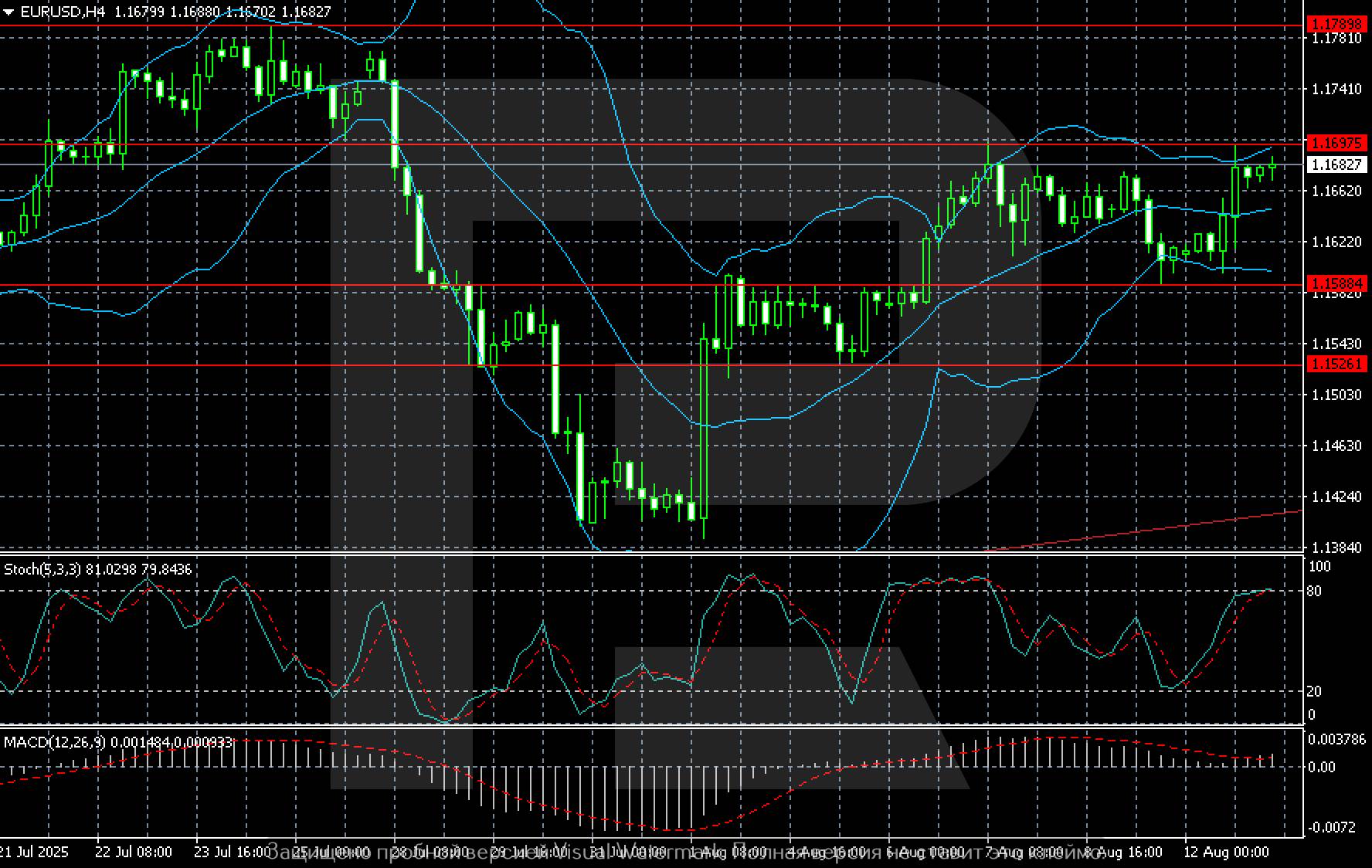
          The EURUSD pair strengthened to 1.1682. Statistics and concerns over the Federal Reserve’s independence weigh on the USD. Find out more in our analysis for 13 August 2025.

          EURUSD forecast: key trading points

          ● The EURUSD pair is moving upwards while signals for the US dollar remain weak
          ● Investors expect the Fed to cut rates by 25 basis points in September
          ● EURUSD forecast for 13 August 2025: 1.1697

          Fundamental analysis

          The EURUSD rate rose to 1.1682 in the middle of the week. Fresh US inflation data strengthened expectations for a Fed rate cut next month.

          July consumer inflation remained flat at 2.7%, below the forecast of a rise to 2.8% due to tariffs, while the core figure climbed to 3.1%, the highest in six months.

          Fed funds futures now price in a 94% probability of a 25-basis-point rate cut in September. The market does not rule out another similar move before the end of the year.

          Additional pressure on the US dollar came after White House Press Secretary Karoline Leavitt stated that President Donald Trump is considering suing Federal Reserve Chairman Jerome Powell over his actions during the renovation of the Fed’s headquarters. This sparked concerns about the Fed’s independence.

          The EURUSD forecast is positive.

          EURUSD technical analysis

          On the H4 chart, the EURUSD pair remains in an upward phase and is hovering within the 1.1620-1.1690 range after recovering from late-July lows near 1.1500. The nearest resistance level stands at 1.1697, and a breakout above it would open the way towards 1.1789. Support levels are at 1.1588 and 1.1526.

          The price is near the upper Bollinger Band, indicating elevated volatility and overbought conditions. The Stochastic above 80 confirms the risk of a short-term correction. The MACD indicator remains in positive territory, with its lines pointing upwards, indicating sustained bullish momentum.

          Summary

          The EURUSD pair continues to rise, holding within an upward trading channel. The EURUSD forecast for today, 13 August 2025, suggests an extension of the buying wave towards 1.1697.

          Source: RoboForex

          To stay updated on all economic events of today, please check out our Economic calendar
          Risk Warnings and Disclaimers
          You understand and acknowledge that there is a high degree of risk involved in trading. Following any strategies or investment methods may lead to potential losses. The content on the site is provided by our contributors and analysts for information purposes only. You are solely responsible for determining whether any trading assets, securities, strategy, or any other product is suitable for investing based on your own investment objectives and financial situation.
          Add to Favorites
          Share

          Hang Seng Index Technical: End Of Minor Corrective Decline, Start Of New Bullish Impulsive Up Move

          MarketPulse by OANDA Group

          Economic

          Stocks

          Technical Analysis

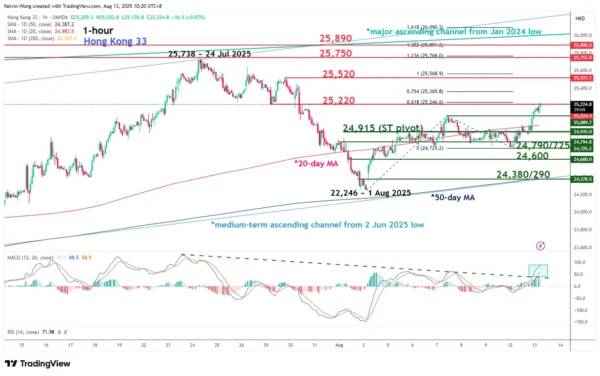
          Since the recent one-week slide of -5.8% seen on the Hong Kong 33 CFD Index (a proxy of the Hang Seng Index futures) from 24 July 2025 high to 1 August 2025 low, its price actions have been choppy as markets grappled with US tariffs news flow and the possibility of an imminent US Federal Reserve dovish pivot in September.Amid this chaotic news flow environment, several technical elements are advocating the potential start of a new short-term bullish trend for the Hong Kong 33 CFD Index.

          Fig. 1: Hong Kong 33 CFD Index minor trend as of 13 Aug 2025 (Source: TradingView)

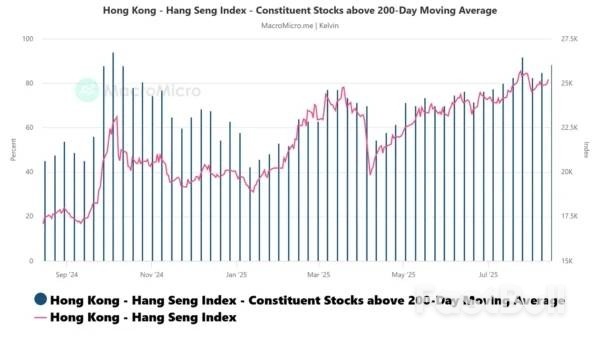
          Fig. 2: Percentage of Hang Seng Index component stocks above 200-day MA as of 12 Aug 2025 (Source: MacroMicro)

          Preferred trend bias (1-3 days)

          Bullish bias above 24,915 short-term pivotal support, with the next intermediate resistances coming in at 25,520, 25,750, and 25,890 (see Fig. 1).

          Key elements

          ● The price action of the Hong Kong 33 CFD Index staged a bullish breakout above its 20-day moving average on Tuesday, 12 August, which suggests the potential start of a new short-term bullish impulsive uptrend phase.
          ● The medium-term and major uptrend phases remain intact for the Hong Kong 33 CFD Index as price actions continued to oscillate within a major ascending channel from the January 2024 low and a medium-term ascending channel from the 2 June 2025 low.
          ● The hourly MACD trend indicator of the Hong Kong 33 CFD has continued to trend steadily upwards above its centerline since Tuesday, 12 August, which supports the emergence of a new short-term bullish impulsive uptrend phase.
          ● Market breadth of the Hang Seng Index has also improved as the percentage of its component stocks trading above their respective key 200-day moving averages has increased from 1 August print of 82% to 88% as of Tuesday, 12 August (see Fig. 2).

          Alternative trend bias (1 to 3 days)

          Failure to hold at the 24,915 key short-term support negates the bullish tone to reinstate another round of minor choppy corrective decline sequence to retest the next intermediate supports at 24,790/24,725 and 24,600.

          Source: OANDA

          To stay updated on all economic events of today, please check out our Economic calendar
          Risk Warnings and Disclaimers
          You understand and acknowledge that there is a high degree of risk involved in trading. Following any strategies or investment methods may lead to potential losses. The content on the site is provided by our contributors and analysts for information purposes only. You are solely responsible for determining whether any trading assets, securities, strategy, or any other product is suitable for investing based on your own investment objectives and financial situation.
          Add to Favorites
          Share

          Global Investors Pivot to ex-U.S. Markets Amid Valuation Gaps and Dollar Weakness

          Gerik

          Economic

          Record Inflows to ex-U.S. Equity Funds

          July marked a decisive month for international diversification, with global ex-U.S. equity funds attracting their largest monthly inflow since December 2021. The $13.6 billion inflow contrasted sharply with $6.3 billion in outflows from U.S.-focused equity funds, the third consecutive month of redemptions. The shift began earlier in 2025, but July’s data reflects an acceleration as investors weigh relative performance, valuation gaps, and policy divergence between the U.S. and other markets.
          President Donald Trump’s economic policies particularly on trade have dampened the appeal of U.S. assets. While tariff de-escalation provided short-term relief in the second quarter, upcoming trade deadlines and unresolved negotiations in early Q3 are sustaining uncertainty. Derek Izuel of Shelton Capital Management notes that narrowing growth differentials and the prospect of continued Fed policy restraint could further encourage reallocations away from U.S. equities.

          Performance and Valuation Disparities

          Performance gaps are reinforcing the flow trend. Year-to-date, the MSCI Asia Pacific ex-Japan index has gained around 14%, and MSCI Europe has surged more than 19%, both outpacing the S&P 500’s 7.2% rise. A roughly 10% decline in the U.S. dollar has further boosted foreign-market returns for U.S.-based investors. Valuation metrics strengthen the case: the forward 12-month P/E ratio for the MSCI U.S. index stands at 22.6, significantly above MSCI Asia’s 14.4, MSCI Europe’s 14.2, and the MSCI World’s 19.7.
          While some see the moves as potentially marking a longer-term allocation change, others caution against overinterpreting the flows. Jim Smigiel of SEI frames the shift as a rebalancing toward neutral geographic exposure rather than a deliberate underweight to U.S. equities. Nonetheless, if U.S. growth underperforms relative to expectations or monetary policy remains tight, the combination of higher valuations and stronger performance abroad could sustain momentum toward non-U.S. markets.
          This reallocation trend underscores that, in the current macro environment, relative valuations, currency moves, and regional growth prospects are playing a more influential role in shaping global equity capital flows than they have in years.

          Source: Reuters

          To stay updated on all economic events of today, please check out our Economic calendar
          Risk Warnings and Disclaimers
          You understand and acknowledge that there is a high degree of risk involved in trading. Following any strategies or investment methods may lead to potential losses. The content on the site is provided by our contributors and analysts for information purposes only. You are solely responsible for determining whether any trading assets, securities, strategy, or any other product is suitable for investing based on your own investment objectives and financial situation.
          Add to Favorites
          Share

          Vietnam Targets “Tiger Economy” Status with Sweeping Economic and Institutional Reforms

          Gerik

          Economic

          From Export-Led Growth to a Multi-Engine Strategy

          Vietnam’s rise from a low-income nation in 1990 to a global manufacturing hub has been driven by low-cost, export-oriented industries. Its GDP per capita (adjusted for local prices) has surged more than thirteen-fold to $16,385. Yet the government recognizes that this model powered by cheap labor, foreign direct investment, and assembly-based exports faces diminishing returns as wages rise and global trade tensions intensify.
          U.S.–Vietnam trade relations underscore both opportunity and vulnerability: a record $123.5 billion trade surplus with the U.S. in 2024 triggered tariff threats from the Trump administration, resulting in a 20% levy on most Vietnamese goods and double that on suspected transshipments. While Hanoi managed to negotiate terms comparable to regional peers, the episode reinforced the need to upgrade its economic base beyond low-margin manufacturing.

          High-Tech, Green Energy, and Infrastructure as Growth Pillars

          Following the path of earlier Asian tigers but avoiding reliance on a single flagship industry, Vietnam is placing “multiple big bets” across high-tech manufacturing, AI, renewable energy, and advanced infrastructure. Planned investments include a $67 billion North–South high-speed rail, nuclear power plants, and new logistics corridors. The country also aims to establish financial hubs in Ho Chi Minh City and Danang, offering streamlined regulations, fintech incentives, and expedited dispute resolution to attract global capital.
          A significant break from past economic doctrine came in May with Resolution 68, naming private enterprises as the “most important force” in the economy. The state is merging ministries, eliminating lower-tier bureaucracies, and consolidating 63 provinces into 34 to create stronger regional talent pools. Private firms will now be eligible for mega-project bids, priority in government contracts tied to innovation, and improved access to financing steps designed to nurture “national champions” capable of competing globally. By 2030, Vietnam intends to elevate at least 20 domestic firms to world-class scale, though resistance from state enterprise stakeholders could slow momentum.

          Demographic Headwinds and Climate Imperatives

          Vietnam’s demographic dividend will close by 2039, with its labor force peaking shortly after. Without policy adjustments, productivity could decline while care burdens increase, particularly for women. The government is expanding preventive healthcare, raising the retirement age, and promoting female labor force participation to offset workforce shrinkage.
          Climate change poses an equally pressing threat: typhoon damage, rising sea levels, and flooding could cost the economy up to 14.5% of GDP annually by 2050. Industrial parks are beginning to adopt flood resilience measures, recognizing that climate adaptation is not only environmental policy but also a prerequisite for sustaining investment and export competitiveness.
          Vietnam’s transformation strategy hinges on balancing reform speed with political consensus, securing foreign investment while reducing vulnerability to external shocks, and managing the twin pressures of demographic aging and environmental risk. If it can execute across these fronts, Vietnam could emerge as the next diversified, innovation-driven Asian growth engine one whose success rests on agility, institutional modernization, and the ability to turn structural challenges into competitive advantages.

          Source: Reuters

          To stay updated on all economic events of today, please check out our Economic calendar
          Risk Warnings and Disclaimers
          You understand and acknowledge that there is a high degree of risk involved in trading. Following any strategies or investment methods may lead to potential losses. The content on the site is provided by our contributors and analysts for information purposes only. You are solely responsible for determining whether any trading assets, securities, strategy, or any other product is suitable for investing based on your own investment objectives and financial situation.
          Add to Favorites
          Share

          Tariff-Driven Trade Realignment Creates New Openings for Vietnam’s Export Position

          Gerik

          Economic

          Tariffs as a Structural Trade Force

          Global merchandise exports totaled USD 23.8 trillion in 2023, with the top 30 exporting nations and territories accounting for USD 19.7 trillion. Beneath these headline figures, the composition of trade is undergoing a strategic reconfiguration as tariffs evolve from a defensive economic measure into a geopolitical instrument. The latest large-scale U.S. tariff announcement delayed in implementation until early August underscores how policy uncertainty is becoming embedded in the global trade environment, influencing not only corporate supply chain decisions but also capital allocation strategies.
          China remains the dominant global exporter, shipping USD 3.38 trillion in goods last year, outpacing the U.S. by 67%. Yet, its leadership is increasingly contested as U.S. tariffs target critical Chinese export sectors such as electronics, machinery, and consumer goods. This pressure is accelerating the diversification of manufacturing and export capacity toward other markets, where geopolitical alignment with major economies is stronger and operational risks are perceived to be lower.

          Vietnam’s Strategic Positioning

          Vietnam, along with India and Mexico, has become a prominent destination for trade diversion and “friend-shoring” strategies. Its integration into regional supply chains, competitive labor costs, improving infrastructure, and network of free trade agreements give it leverage to capture market share vacated by China in certain categories. This shift is reinforced by foreign direct investment flows seeking both production efficiency and geopolitical safety.
          Japan, South Korea, Taiwan, and ASEAN economies remain critical to the global manufacturing ecosystem, with aggregate Asian export strength expanding even as trade lanes fragment. This resilience is supported by industrial policy, cross-border infrastructure projects, and deep regional trade agreements. In contrast, the U.S. export mix focuses on high-value sectors semiconductors, aerospace, pharmaceuticals, and energy leaving it more exposed to potential retaliation when tariffs disrupt global supply linkages.

          European and Resource-Driven Trade Models

          Europe retains significant export capacity, with Germany, the Netherlands, France, Italy, and the UK leading the bloc. However, Germany’s manufacturing model faces headwinds from high input costs, demographic shifts, and a shrinking trade surplus. In the Middle East, the UAE and Saudi Arabia are climbing the rankings on sustained energy exports, while Brazil and Australia continue to anchor their trade profiles in commodity shipments.
          The emerging trade order is defined less by seamless globalization and more by politically aligned “reglobalization.” Export resilience now depends not only on scale and efficiency but also on the reliability of trade partners and the security of supply routes. For investors, this means focusing on trade share dynamics, strategic positioning in global value chains, and the physical and political infrastructure that underpins export growth.
          In this environment, Vietnam’s role is not just a statistical rise in export rankings it represents a structural repositioning in the global trade system, where economic performance is increasingly measured against criteria of durability, security, and geopolitical compatibility rather than pure cost efficiency.
          To stay updated on all economic events of today, please check out our Economic calendar
          Risk Warnings and Disclaimers
          You understand and acknowledge that there is a high degree of risk involved in trading. Following any strategies or investment methods may lead to potential losses. The content on the site is provided by our contributors and analysts for information purposes only. You are solely responsible for determining whether any trading assets, securities, strategy, or any other product is suitable for investing based on your own investment objectives and financial situation.
          Add to Favorites
          Share
          FastBull
          Copyright © 2025 FastBull Ltd

          728 RM B 7/F GEE LOK IND BLDG NO 34 HUNG TO RD KWUN TONG KLN HONG KONG

          TelegramInstagramTwitterfacebooklinkedin
          App Store Google Play Google Play
          Products
          Charts

          Chats

          Q&A with Experts
          Screeners
          Economic Calendar
          Data
          Tools
          Membership
          Features
          Function
          Markets
          Copy Trading
          Latest Signals
          Contests
          News
          Analysis
          24/7
          Columns
          Education
          Company
          Careers
          About Us
          Contact Us
          Advertising
          Help Center
          Feedback
          User Agreement
          Privacy Policy
          Business

          White Label

          Data API

          Web Plug-ins

          Poster Maker

          Affiliate Program

          Risk Disclosure

          The risk of loss in trading financial instruments such as stocks, FX, commodities, futures, bonds, ETFs and crypto can be substantial. You may sustain a total loss of the funds that you deposit with your broker. Therefore, you should carefully consider whether such trading is suitable for you in light of your circumstances and financial resources.

          No decision to invest should be made without thoroughly conducting due diligence by yourself or consulting with your financial advisors. Our web content might not suit you since we don't know your financial conditions and investment needs. Our financial information might have latency or contain inaccuracy, so you should be fully responsible for any of your trading and investment decisions. The company will not be responsible for your capital loss.

          Without getting permission from the website, you are not allowed to copy the website's graphics, texts, or trademarks. Intellectual property rights in the content or data incorporated into this website belong to its providers and exchange merchants.

          Not Logged In

          Log in to access more features

          FastBull Membership

          Not yet

          Purchase

          Become a signal provider
          Help Center
          Customer Service
          Dark Mode
          Price Up/Down Colors

          Log In

          Sign Up

          Position
          Layout
          Fullscreen
          Default to Chart
          The chart page opens by default when you visit fastbull.com