• Trade
  • Markets
  • Copy
  • Contests
  • News
  • 24/7
  • Calendar
  • Q&A
  • Chats
Trending
Screeners
SYMBOL
LAST
BID
ASK
HIGH
LOW
NET CHG.
%CHG.
SPREAD
SPX
S&P 500 Index
6809.01
6809.01
6809.01
6861.30
6801.50
-18.40
-0.27%
--
DJI
Dow Jones Industrial Average
48314.42
48314.42
48314.42
48679.14
48285.67
-143.62
-0.30%
--
IXIC
NASDAQ Composite Index
23070.82
23070.82
23070.82
23345.56
23012.00
-124.34
-0.54%
--
USDX
US Dollar Index
97.950
98.030
97.950
98.070
97.740
0.000
0.00%
--
EURUSD
Euro / US Dollar
1.17450
1.17458
1.17450
1.17686
1.17262
+0.00056
+ 0.05%
--
GBPUSD
Pound Sterling / US Dollar
1.33655
1.33665
1.33655
1.34014
1.33546
-0.00052
-0.04%
--
XAUUSD
Gold / US Dollar
4303.43
4303.84
4303.43
4350.16
4285.08
+4.04
+ 0.09%
--
WTI
Light Sweet Crude Oil
56.433
56.463
56.433
57.601
56.233
-0.800
-1.40%
--

Community Accounts

Signal Accounts
--
Profit Accounts
--
Loss Accounts
--
View More

Become a signal provider

Sell trading signals to earn additional income

View More

Guide to Copy Trading

Get started with ease and confidence

View More

Signal Accounts for Members

All Signal Accounts

Best Return
  • Best Return
  • Best P/L
  • Best MDD
Past 1W
  • Past 1W
  • Past 1M
  • Past 1Y

All Contests

  • All
  • Trump Updates
  • Recommend
  • Stocks
  • Cryptocurrencies
  • Central Banks
  • Featured News
Top News Only
Share

Attempts By Ukrainian Troops To Advance From The South-West To Outskirts Of Kupiansk Are Being Thwarted

Share

Russian Troops Control All Of Kupiansk - IFX Cites Russian Military

Share

On Monday (December 15), The South Korean Won Ultimately Rose 0.60% Against The US Dollar, Closing At 1468.91 Won. The Won Was On An Upward Trend Throughout The Day, Rising Significantly At 17:00 Beijing Time And Reaching A Daily High Of 1463.04 Won At 17:36

Share

Health Ministry: Israeli Forces Kill Palestinian Teen In West Bank

Share

New York Federal Reserve President Williams: Over Time, The Size Of Reserves Could Grow From $2.9 Trillion

Share

New York Fed President Williams: AI Valuations Are High, But There Is A Real Driving Factor

Share

New York Federal Reserve President Williams: The Job Market Is In Very Good Shape

Share

New York Fed President Williams: 'Very Supportive' Of USA Central Bank's Decision To Cut Interest Rates Last Week

Share

New York Fed President Williams: 'Too Early To Say' What Central Bank Should Do At January Meeting

Share

New York Fed President Williams: Strong Markets Part Of Reason Why Economy Will Grow Robustly In 2026

Share

New York Fed President Williams: What Constitutes Ample Reserves Will Change Over Time

Share

New York Fed President Williams: Market Valuations 'Elevated,' But There Are Reasons For Pricing

Share

New York Fed President Williams: Ample Reserves System Working Very Well

Share

New York Fed President Williams: Some Signs That Parts Of Underlying Economy Not As Strong As GDP Data Suggests

Share

New York Fed President Williams: Expects Coming Job Data Will Show Gradual Cooling

Share

Ukraine President Zelenskiy: Monitoring Of Ceasefire Should Be Part Of Security Guarantees

Share

Ukraine President Zelenskiy: Ukraine Needs Clear Understanding On Security Guarantees Before Taking Any Decisions Regarding Frontlines

Share

U.S. Commerce Secretary Rutnick Praised Korea Zinc Co. Ltd., Stating That The United States Will Have Priority Access To The Company's Products In 2026

Share

Ukraine President Zelenskiy: USA Passed On Russian Demands

Share

Zelenskiy Says: Don't Think USA Was Demanding Anything On Territories

TIME
ACT
FCST
PREV
Japan Tankan Small Manufacturing Outlook Index (Q4)

A:--

F: --

P: --

Japan Tankan Large Non-Manufacturing Outlook Index (Q4)

A:--

F: --

P: --

Japan Tankan Large Manufacturing Outlook Index (Q4)

A:--

F: --

P: --

Japan Tankan Small Manufacturing Diffusion Index (Q4)

A:--

F: --

P: --

Japan Tankan Large-Enterprise Capital Expenditure YoY (Q4)

A:--

F: --

P: --

U.K. Rightmove House Price Index YoY (Dec)

A:--

F: --

P: --

China, Mainland Industrial Output YoY (YTD) (Nov)

A:--

F: --

P: --

China, Mainland Urban Area Unemployment Rate (Nov)

A:--

F: --

P: --

Saudi Arabia CPI YoY (Nov)

A:--

F: --

P: --

Euro Zone Industrial Output YoY (Oct)

A:--

F: --

P: --

Euro Zone Industrial Output MoM (Oct)

A:--

F: --

P: --

Canada Existing Home Sales MoM (Nov)

A:--

F: --

P: --

Canada National Economic Confidence Index

A:--

F: --

P: --

Canada New Housing Starts (Nov)

A:--

F: --

P: --
U.S. NY Fed Manufacturing Employment Index (Dec)

A:--

F: --

P: --

U.S. NY Fed Manufacturing Index (Dec)

A:--

F: --

P: --

Canada Core CPI YoY (Nov)

A:--

F: --

P: --

Canada Manufacturing Unfilled Orders MoM (Oct)

A:--

F: --

P: --

U.S. NY Fed Manufacturing Prices Received Index (Dec)

A:--

F: --

P: --

U.S. NY Fed Manufacturing New Orders Index (Dec)

A:--

F: --

P: --

Canada Manufacturing New Orders MoM (Oct)

A:--

F: --

P: --

Canada Core CPI MoM (Nov)

A:--

F: --

P: --

Canada Trimmed CPI YoY (SA) (Nov)

A:--

F: --

P: --

Canada Manufacturing Inventory MoM (Oct)

A:--

F: --

P: --

Canada CPI YoY (Nov)

A:--

F: --

P: --

Canada CPI MoM (Nov)

A:--

F: --

P: --

Canada CPI YoY (SA) (Nov)

A:--

F: --

P: --

Canada Core CPI MoM (SA) (Nov)

A:--

F: --

P: --

Canada CPI MoM (SA) (Nov)

A:--

F: --

P: --

Federal Reserve Board Governor Milan delivered a speech
U.S. NAHB Housing Market Index (Dec)

A:--

F: --

P: --

Australia Composite PMI Prelim (Dec)

--

F: --

P: --

Australia Services PMI Prelim (Dec)

--

F: --

P: --

Australia Manufacturing PMI Prelim (Dec)

--

F: --

P: --

Japan Manufacturing PMI Prelim (SA) (Dec)

--

F: --

P: --

U.K. 3-Month ILO Employment Change (Oct)

--

F: --

P: --

U.K. Unemployment Claimant Count (Nov)

--

F: --

P: --

U.K. Unemployment Rate (Nov)

--

F: --

P: --

U.K. 3-Month ILO Unemployment Rate (Oct)

--

F: --

P: --

U.K. Average Weekly Earnings (3-Month Average, Including Bonuses) YoY (Oct)

--

F: --

P: --

U.K. Average Weekly Earnings (3-Month Average, Excluding Bonuses) YoY (Oct)

--

F: --

P: --

France Services PMI Prelim (Dec)

--

F: --

P: --

France Composite PMI Prelim (SA) (Dec)

--

F: --

P: --

France Manufacturing PMI Prelim (Dec)

--

F: --

P: --

Germany Services PMI Prelim (SA) (Dec)

--

F: --

P: --

Germany Manufacturing PMI Prelim (SA) (Dec)

--

F: --

P: --

Germany Composite PMI Prelim (SA) (Dec)

--

F: --

P: --

Euro Zone Composite PMI Prelim (SA) (Dec)

--

F: --

P: --

Euro Zone Services PMI Prelim (SA) (Dec)

--

F: --

P: --

Euro Zone Manufacturing PMI Prelim (SA) (Dec)

--

F: --

P: --

U.K. Services PMI Prelim (Dec)

--

F: --

P: --

U.K. Manufacturing PMI Prelim (Dec)

--

F: --

P: --

U.K. Composite PMI Prelim (Dec)

--

F: --

P: --

Euro Zone ZEW Economic Sentiment Index (Dec)

--

F: --

P: --

Germany ZEW Current Conditions Index (Dec)

--

F: --

P: --

Germany ZEW Economic Sentiment Index (Dec)

--

F: --

P: --

Euro Zone Trade Balance (Not SA) (Oct)

--

F: --

P: --

Euro Zone ZEW Current Conditions Index (Dec)

--

F: --

P: --

Euro Zone Trade Balance (SA) (Oct)

--

F: --

P: --

Euro Zone Total Reserve Assets (Nov)

--

F: --

P: --

U.K. Inflation Rate Expectations

--

F: --

P: --

Q&A with Experts
    • All
    • Chatrooms
    • Groups
    • Friends
    Connecting
    .
    .
    .
    Type here...
    Add Symbol or Code

      No matching data

      All
      Trump Updates
      Recommend
      Stocks
      Cryptocurrencies
      Central Banks
      Featured News
      • All
      • Russia-Ukraine Conflict
      • Middle East Flashpoint
      • All
      • Russia-Ukraine Conflict
      • Middle East Flashpoint
      Search
      Products

      Charts Free Forever

      Chats Q&A with Experts
      Screeners Economic Calendar Data Tools
      Membership Features
      Data Warehouse Market Trends Institutional Data Policy Rates Macro

      Market Trends

      Market Sentiment Order Book Forex Correlations

      Top Indicators

      Charts Free Forever
      Markets

      News

      News Analysis 24/7 Columns Education
      From Institutions From Analysts
      Topics Columnists

      Latest Views

      Latest Views

      Trending Topics

      Top Columnists

      Latest Update

      Signals

      Copy Rankings Latest Signals Become a signal provider AI Rating
      Contests
      Brokers

      Overview Brokers Assessment Rankings Regulators News Claims
      Broker listing Forex Brokers Comparison Tool Live Spread Comparison Scam
      Q&A Complaint Scam Alert Videos Tips to Detect Scam
      More

      Business
      Events
      Careers About Us Advertising Help Center

      White Label

      Data API

      Web Plug-ins

      Affiliate Program

      Awards Institution Evaluation IB Seminar Salon Event Exhibition
      Vietnam Thailand Singapore Dubai
      Fans Party Investment Sharing Session
      FastBull Summit BrokersView Expo
      Recent Searches
        Top Searches
          Markets
          News
          Analysis
          User
          24/7
          Economic Calendar
          Education
          Data
          • Names
          • Latest
          • Prev

          View All

          No data

          Scan to Download

          Faster Charts, Chat Faster!

          Download App
          English
          • English
          • Español
          • العربية
          • Bahasa Indonesia
          • Bahasa Melayu
          • Tiếng Việt
          • ภาษาไทย
          • Français
          • Italiano
          • Türkçe
          • Русский язык
          • 简中
          • 繁中
          Open Account
          Search
          Products
          Charts Free Forever
          Markets
          News
          Signals

          Copy Rankings Latest Signals Become a signal provider AI Rating
          Contests
          Brokers

          Overview Brokers Assessment Rankings Regulators News Claims
          Broker listing Forex Brokers Comparison Tool Live Spread Comparison Scam
          Q&A Complaint Scam Alert Videos Tips to Detect Scam
          More

          Business
          Events
          Careers About Us Advertising Help Center

          White Label

          Data API

          Web Plug-ins

          Affiliate Program

          Awards Institution Evaluation IB Seminar Salon Event Exhibition
          Vietnam Thailand Singapore Dubai
          Fans Party Investment Sharing Session
          FastBull Summit BrokersView Expo

          Brazil Asserts Sovereignty as US Imposes 50% Tariffs

          Gerik

          Economic

          Summary:

          President Lula of Brazil firmly rejected any humiliating concessions to the US after Washington imposed a 50% tariff on Brazilian goods, signaling a strong national stance while weighing collective BRICS action and domestic resilience...

          US Tariffs Escalate Tensions in Brazil-US Relations

          The recent 50% tariff hike by the United States on Brazilian exports, effective from August 7, has intensified an already strained diplomatic relationship. President Luiz Inacio Lula da Silva responded with a calculated mixture of defiance and restraint, making clear that Brazil will not tolerate pressure or public embarrassment in international affairs. In an exclusive interview with Reuters, Lula emphasized that he sees no space for direct negotiation with President Donald Trump, refusing to initiate dialogue unless confident of a productive outcome.
          Despite the tariff representing one of the highest rates currently imposed on any American trading partner, Brazil has refrained from announcing retaliatory measures. Lula made it clear that his administration is not abandoning diplomacy but will not act hastily. His reluctance to contact the White House stems from the belief that Trump is not yet receptive to talks. By anchoring his decision on a personal reading of intent rather than political necessity, Lula reinforces a strategy of assertive patience.

          Causal Link Between US Tariffs and Political Pressure

          The increase in tariffs does not appear isolated from broader political motives. Lula linked the trade pressure to US disapproval of Brazil’s prosecution of former president Jair Bolsonaro, who is currently facing legal consequences for alleged electoral interference in 2022. Lula accused Trump of attempting to influence Brazil’s judicial process, a move he equated to a serious violation of national sovereignty. The statement reveals a deeper cause-and-effect dynamic, where trade barriers serve as instruments of political leverage.
          The Brazilian economy, the largest in Latin America, may act as a buffer against the immediate fallout of the US tariffs. This resilience provides President Lula with more room to maintain his stance without urgent compromise. Rather than capitulating under economic pressure, Lula has directed his ministers to concentrate on domestic strategies that soften the impact of US policy while preserving fiscal discipline. Although he declined to disclose specifics, the approach implies a long-term plan focused on internal stability rather than reactive trade warfare.

          Respect as a Diplomatic Prerequisite

          While denying any personal animosity toward Trump, Lula cited past incidents in which foreign leaders were publicly undermined at the White House. Recalling the cases of South Africa’s President Cyril Ramaphosa and Ukraine’s Volodymyr Zelensky, Lula asserted that respect must underpin all high-level diplomatic engagement. He categorically stated that humiliation has no place in presidential discourse and refused to accept anything less than mutual recognition between sovereign nations.
          Looking beyond bilateral confrontation, Lula is exploring a multilateral path to counterbalance US measures. He intends to initiate dialogue with fellow BRICS members, particularly China and India, with the goal of establishing a unified response to Washington’s protectionist policy. Although no coordination has yet taken place, Lula confirmed that discussions are forthcoming. He also floated the possibility of filing a joint complaint to the World Trade Organization, highlighting a preference for rule-based international resolution.

          Correlational Analysis of Multilateral Strategy and Deterrence

          Although no direct retaliation has been announced, the potential for collective legal or economic actions could function as a deterrent against further escalation. The correlation between Brazil’s outreach to BRICS and WTO forums and its intent to uphold sovereignty suggests a calculated move to elevate the dispute from bilateral discord to global scrutiny. By signaling possible alignment with other major economies, Brazil leverages the symbolic power of coalition-building even before concrete action unfolds.
          President Lula’s remarks reflect a broader tension between defending national pride and engaging in pragmatic diplomacy. His decision not to confront Trump directly, while preparing coordinated multilateral steps, illustrates a dual-track approach. The emphasis on respect and sovereignty signals a cultural and political boundary, while measured institutional responses such as WTO appeals reveal an attempt to resolve disputes without escalating into an uncontrolled trade war.
          Brazil’s reaction to the US tariffs demonstrates a nuanced strategy combining national dignity, economic pragmatism, and diplomatic foresight. Rather than resorting to immediate retaliation, President Lula is choosing to reinforce Brazil’s internal economic position while building international alliances to mount a broader, rule-based response. In doing so, he sends a clear message: Brazil will not bow to coercive tactics but will navigate global friction with deliberation and strength.
          To stay updated on all economic events of today, please check out our Economic calendar
          Risk Warnings and Disclaimers
          You understand and acknowledge that there is a high degree of risk involved in trading. Following any strategies or investment methods may lead to potential losses. The content on the site is provided by our contributors and analysts for information purposes only. You are solely responsible for determining whether any trading assets, securities, strategy, or any other product is suitable for investing based on your own investment objectives and financial situation.
          Add to Favorites
          Share

          Trump’s Tariff Expansion Marks Most Aggressive U.S. Trade Shift in Decades

          Gerik

          Economic

          A New Era of ‘Reciprocal’ Tariffs Begins

          President Trump’s executive order, now implemented, sets out new country-specific tariff rates, with major economies like the European Union, South Korea, and Japan hit with a 15% base tariff. Others have been singled out with what the administration calls “bespoke” rates, ranging from 20% to a peak of 50%. For example, Brazil now faces 50%, India 25% (with threats of doubling), and Switzerland a surprising 39% despite diplomatic attempts to avoid the hike.
          According to the Yale Budget Lab, the overall U.S. average effective tariff rate has climbed to 18.3%, the highest in modern history. While some nations remain at the baseline 10% rate, analysts expect further changes in the coming weeks.

          Strategic Targets and Trade Retaliation Risks

          The tariff rollout reflects Trump’s broader vision of restoring trade “fairness” via reciprocal pressure, but it also escalates tensions with key allies. Nations such as Bangladesh, South Africa, Vietnam, and Laos now face 20% or higher tariffs, many of them previously considered strategic partners or emerging market collaborators.
          In particular, India has become a flashpoint. Beyond its 25% base rate, it now faces a potential additional 25% penalty due to its ongoing purchases of Russian oil, raising questions about how trade and geopolitical loyalty are being intertwined in U.S. policy.

          Semiconductors and Pharma: The Next Frontiers

          President Trump has also threatened sector-specific tariffs, most notably on semiconductors and pharmaceuticals. A proposed 100% tariff on chips and semiconductors could soon take effect unless companies commit to domestic U.S. manufacturing.
          Such a policy, while aimed at reshoring supply chains, could exacerbate current price pressures, disrupt global tech production, and add to inflation. Pharmaceutical products may also be targeted in the coming months, although Trump has hinted at possible exemptions as part of bilateral talks.

          Inflation Worries Meet Political Strategy

          The tariffs come amid growing concerns from Federal Reserve Chair Jerome Powell, who recently noted that higher tariffs are starting to show in consumer prices. Despite this, the Fed has held interest rates steady against Trump’s preferences highlighting a growing disconnect between fiscal and monetary policy.
          While critics argue the tariffs risk fueling inflation and slowing growth, Trump continues to tout them as revenue wins, celebrating record-high tariff revenues. According to Trump, the strategy is “just in its infancy,” suggesting more rounds are on the way.

          Winners, Losers, and Global Repercussions

          Countries with free trade agreements like Canada, Mexico, and China have not seen immediate rate changes in this round, though their current duties already exceed 25%. However, their negotiating schedules differ, leaving the door open to future revisions.
          For now, over 100 mostly smaller nations are exempt from further changes, remaining at 10%. Yet, with the threat of transshipment penalties a new 40% tariff for evading duties Trump’s administration is also cracking down on indirect trade routes, though enforcement definitions remain vague.

          Tariffs as a Pillar of Trump's Second-Term Strategy

          What began as a talking point in 2018 has now evolved into a full-scale restructuring of U.S. trade policy. Trump’s claim of being a “tariff man” is no longer rhetorical it’s now economic doctrine. With these new tariffs, the U.S. signals not only a return to protectionist policies but an aggressive new playbook centered on leverage, retaliation, and industrial realignment.
          Whether this results in stronger domestic production or global retaliation remains to be seen. But what is clear is this: global supply chains, multinational agreements, and U.S. consumer prices are entering a volatile new chapter.

          Source: Yahoo Finance

          To stay updated on all economic events of today, please check out our Economic calendar
          Risk Warnings and Disclaimers
          You understand and acknowledge that there is a high degree of risk involved in trading. Following any strategies or investment methods may lead to potential losses. The content on the site is provided by our contributors and analysts for information purposes only. You are solely responsible for determining whether any trading assets, securities, strategy, or any other product is suitable for investing based on your own investment objectives and financial situation.
          Add to Favorites
          Share

          Oil Market Stays Tight Despite OPEC+ Output Increases: Capacity Limits and Summer Demand Tell the Real Story

          Gerik

          Economic

          Commodity

          Production Hikes on Paper, Shortfalls in Reality

          OPEC+ had announced a 2.5 million barrels per day (bpd) increase in oil production from March to September 2025. However, actual production data tells a different story. Only about 540,000 bpd of that target has been realized, largely due to infrastructure constraints, compensatory cuts, and capacity limits in key countries such as Iraq, Kazakhstan, and Russia.
          Iraq and Russia are still making amends for previously exceeding their quotas. Kazakhstan was already producing at capacity, limiting its ability to raise output. The lion’s share of the actual increase over 70% has come from Saudi Arabia, which raised exports by 631,000 bpd between March and June, although much of that oil was redirected to storage rather than flowing into the market.

          Rising Demand Absorbs the Extra Barrels

          Instead of easing the market, the modest increase in supply has been absorbed by surging summer energy demand, particularly in the Middle East, where air conditioning use spikes during hotter months.
          At the same time, China’s strategic stockpiling of 82 million barrels in Q2 almost 900,000 bpd has drawn more oil out of circulation. This stockpiling comes amid stronger-than-expected Chinese consumption, further contributing to price resilience.
          With refineries ramping up processing and regional energy needs rising, the market remains structurally tight. This has resulted in a backwardated futures curve, where near-term contracts are trading at a premium to future delivery prices a classic indicator of prompt supply shortages. As of early August, the first-month Brent contract was trading $2.74 above the six-month contract, reversing May’s discount.

          Low Global Stockpiles Support Prices

          Oil inventories in OECD countries remain low, reinforcing market tightness. U.S. commercial crude stocks stood at 419 million barrels in June, below the five-year average. In Europe, May stocks were 9% lower than average, at 394 million barrels.
          These low stock levels stem from years of aggressive OPEC+ cuts during the pandemic and have not yet been replenished despite the announced production increases.

          Export Data Reveals the Real Supply Picture

          While quotas have increased, exports have lagged behind. According to Vortexa, total exports from OPEC+ rose by just 460,000 bpd from March to June, even as global demand rose by an estimated 1 million bpd. Saudi Arabia accounted for all of the net export increase, with exports from Iraq, Russia, Kuwait, Kazakhstan, and Oman declining during the same period.
          This means that announcements of production hikes are not being matched by real-world deliveries, leaving global buyers scrambling in a tight market.

          The OPEC+ Eight and Future Quota Games

          Only eight countries Saudi Arabia, Russia, Iraq, UAE, Kazakhstan, Kuwait, Oman, and Algeria are involved in the current phase of OPEC+ quota adjustments. Despite their ambitious plans to raise collective output to 32.36 million bpd by September, structural limitations mean actual delivery is likely to fall short again.
          While producers may continue to push for higher quotas, they do so not necessarily to pump more immediately, but to secure flexibility for future production and negotiations. Russia, for instance, faces logistical challenges due to ongoing attacks on its energy infrastructure.
          Contrary to initial expectations, OPEC+ output hikes have not flooded the market with oil. Structural constraints, regional demand surges, and inventory shortfalls have kept the supply-demand balance tight, propping up prices. Until exports significantly rise and more producers gain the capacity to meet quotas, the oil market is likely to remain in a state of supply tension despite what the official output plans suggest.

          Source: Reuters

          To stay updated on all economic events of today, please check out our Economic calendar
          Risk Warnings and Disclaimers
          You understand and acknowledge that there is a high degree of risk involved in trading. Following any strategies or investment methods may lead to potential losses. The content on the site is provided by our contributors and analysts for information purposes only. You are solely responsible for determining whether any trading assets, securities, strategy, or any other product is suitable for investing based on your own investment objectives and financial situation.
          Add to Favorites
          Share

          Trump’s Aggressive New Tariffs Signal Radical Shift in U.S. Trade Policy

          Gerik

          Economic

          A Historic Escalation in Global Trade Tensions

          As of August 7, 2025, the United States has begun enforcing a sweeping new tariff regime under President Trump’s “reciprocal” trade policy. The new rates ranging from 10% to as high as 50% mark one of the most significant overhauls to U.S. trade in nearly a century. The move follows months of uncertainty, halted negotiations, and escalating rhetoric aimed at shrinking America’s trade deficits.
          Trump’s administration has hailed the tariffs as a victory for American industry, citing over $100 billion in increased tax revenue without triggering the feared inflation or recession. However, economists now warn that the intensification of tariffs could fuel rising prices and slow job growth two issues already surfacing in recent economic data.

          Tariff Breakdown: Who’s Paying What

          Previously, most imported goods were subject to a 10% baseline tariff. Under the new policy, the rates now differ dramatically by country. Among the highest:
          Brazil: 50%
          Laos & Myanmar: 40%
          Switzerland: 39%
          Iraq & Serbia: 35%
          India: 25%, with an additional 25% surcharge set for August 27 due to oil purchases from Russia
          In total, 21 countries including key U.S. suppliers like Vietnam, Taiwan, and Thailand face tariffs above 15%. Another 39 countries, plus the European Union, are subject to 15% tariffs. While Mexico and Canada can enjoy exemptions under the USMCA agreement, non-compliant goods from Canada are now subject to a steep 35% tariff, up from 25%.

          Deals in Name Only? The Status of Trump’s Trade Agreements

          Despite Trump’s announcement of eight trade “agreements,” only two those with China and the United Kingdom have been formalized. The rest remain vague and largely aspirational, involving non-binding commitments to purchase American goods and invest in U.S. industries.
          A critical turning point looms on August 12 when the U.S.-China tariff truce expires. If no action is taken, both sides could see a sharp increase in trade barriers once again, undermining fragile progress.
          Meanwhile, Japanese leaders have publicly contradicted Trump’s claims about trade terms such as purchasing Ford F-150s suggesting a gap between U.S. announcements and actual policy agreements.

          Exemptions and Loopholes

          Certain goods remain exempt from the new tariffs. For instance:
          Smartphones are not subject to the new rates.
          Pharmaceuticals currently avoid tariffs unless targeted by future sectoral actions.
          Products manufactured abroad but composed of at least 20% U.S. labor or materials may also receive partial exemptions.
          Several sectors, such as semiconductors and lumber, are expected to face new targeted tariffs soon. Trump has specifically warned of a 100% tariff on chips, though no timeline has been announced.

          Effective Dates and Temporary Grace Periods

          Although the tariffs are now officially in effect, there is a grace period for goods already in transit. Products shipped before 12:01 AM on August 7 can still enter under previous tariff rates until October 5. This measure provides limited breathing room for global exporters and American importers to adjust.
          While Trump's sweeping order is being challenged in U.S. courts, legal resolution may take months or longer. In the meantime, Trump retains wide authority under national security and trade laws to continue imposing duties.
          Analysts expect more sectoral tariffs in the coming weeks, particularly targeting technology and raw materials. The administration is also considering a broader 100% duty on semiconductors, a move that could disrupt already fragile electronics supply chains.

          A New Global Trade Paradigm or an Economic Gamble?

          Trump’s tariff strategy represents a decisive shift toward protectionism not seen since the early 20th century. While supporters argue it’s a necessary correction to decades of trade imbalance, critics warn of unintended consequences: rising consumer prices, retaliatory tariffs from allies, and global economic fragmentation.
          The next few months will be critical. With a volatile economic outlook, pending trade talks with China, and growing legal opposition, the future of U.S. trade policy under Trump’s second term remains uncertain but undoubtedly transformative.

          Source: Reuters

          To stay updated on all economic events of today, please check out our Economic calendar
          Risk Warnings and Disclaimers
          You understand and acknowledge that there is a high degree of risk involved in trading. Following any strategies or investment methods may lead to potential losses. The content on the site is provided by our contributors and analysts for information purposes only. You are solely responsible for determining whether any trading assets, securities, strategy, or any other product is suitable for investing based on your own investment objectives and financial situation.
          Add to Favorites
          Share

          China’s Rare Earth Exports Fall Sharply in July Amid Global Scrutiny and Policy Shifts

          Gerik

          Economic

          Commodity

          Exports Decline After June’s Peak Amid Volatile Trade Trends

          China, the world’s dominant producer of rare earth elements, exported 5,994.3 metric tons in July 2025, marking a steep 23% decline from June’s record high, according to preliminary customs data released Thursday. The June figure had been the highest monthly export level since at least 2014, suggesting July’s drop could be part of a broader pattern of erratic month-to-month fluctuations rather than a definitive shift in trade policy.
          The latest decline comes as global attention intensifies on China's role in the critical materials supply chain, especially after it agreed to a series of deals with the United States and the European Union to increase rare earth shipments and relax its export licensing regime initially tightened in April in response to U.S. tariff escalations.

          Data Limitations and Lack of Transparency Complicate Interpretation

          Analysts caution that the July figures are too preliminary and ambiguous to draw definitive conclusions about China's policy intentions. The customs data fails to differentiate among various types of rare earths and related products, some of which remain unrestricted under China's evolving regulatory framework. Moreover, the monthly data is known to be highly volatile, with double-digit swings frequently observed in either direction.
          A more detailed dataset, which includes specific figures for exports of rare earth magnets a high-value segment essential to industries such as electric vehicles, electronics, and defense will be released on August 20. Preliminary information indicates that magnet exports to both the U.S. and Germany surged in June, aligning with their ongoing efforts to secure strategic supply chains amid geopolitical tensions.

          China Tightens Control Quietly Despite Diplomatic Agreements

          While Beijing has engaged diplomatically with Western powers to ease concerns over rare earth availability, domestic policy developments suggest a contrasting internal strategy. In July, Chinese authorities issued the first set of 2025 rare earth mining and smelting quotas without the usual accompanying public announcement, signaling a more opaque approach to industry oversight.
          This quiet imposition of output controls aligns with China's broader strategy of maintaining a dominant position in the global rare earth supply chain while minimizing external leverage. The lack of transparency may also be aimed at limiting speculative activity or external pressure during sensitive negotiations.

          Supply Chain Security and Strategic Shifts

          Western governments, including the U.S., EU, and Australia, have increasingly sought to diversify their rare earth supply sources. Financial incentives, such as subsidies and investment guarantees, are being introduced or proposed to support non-Chinese producers in countries like Canada, Australia, and Vietnam.
          Nevertheless, China continues to control more than 60% of global rare earth production and an even higher share of downstream processing capacity. This makes its export patterns and licensing policies critical barometers for industries that rely on these materials for green technologies, semiconductors, and advanced manufacturing.

          Strategic Uncertainty Remains as Policy Diverges from Trade Volumes

          Despite the sharp decline in July, China’s year-to-date rare earth exports rose 13% compared to the same period in 2024, indicating that broader output and demand trends remain strong. However, the juxtaposition of increased diplomatic engagement with Western nations and silent tightening of production controls introduces ambiguity around Beijing’s long-term intentions.
          As the full data for July including rare earth magnets is released later this month, market watchers and policymakers alike will be looking for clearer signals. Until then, China's rare earth strategy remains a high-stakes balancing act between domestic control and international pressure.

          Source: Reuters

          To stay updated on all economic events of today, please check out our Economic calendar
          Risk Warnings and Disclaimers
          You understand and acknowledge that there is a high degree of risk involved in trading. Following any strategies or investment methods may lead to potential losses. The content on the site is provided by our contributors and analysts for information purposes only. You are solely responsible for determining whether any trading assets, securities, strategy, or any other product is suitable for investing based on your own investment objectives and financial situation.
          Add to Favorites
          Share

          Trump’s Tariffs Go Live, Testing U.S. Trade Strategy as Economic Costs Mount

          Gerik

          Economic

          Tariffs Begin as Trump Targets Trade Realignment

          At 12:01 a.m. EDT on August 7, the United States began collecting higher tariffs on goods from 67 countries, marking the most aggressive escalation in Trump’s protectionist trade policy to date. The new rates ranging from 10% to 50% are part of a multilayered strategy aimed at forcing investment concessions from foreign governments, reorienting supply chains, and reviving U.S. manufacturing competitiveness.
          Notably, goods from Brazil now face a 50% tariff, those from Switzerland 39%, Canada 35%, and India 25%. Additionally, a further 25% tariff on Indian goods will take effect in three weeks due to its continued imports of Russian oil. Imports from countries like the EU, Japan, and South Korea were negotiated down to 15%, while others like Vietnam, Indonesia, and Pakistan received reduced rates between 19% and 20%.
          Although shipments in transit before the deadline can enter under the previous 10% rate until October 5, most trading partners are now recalibrating export strategies in response to the changed tariff landscape.

          Domestic Price Increases and Business Losses Emerge

          While the Trump administration argues that the tariff revenue estimated to reach over $300 billion annually represents a victory for U.S. taxpayers, the actual costs are being borne by domestic importers and consumers. The Atlantic Institute estimates that the average U.S. tariff rate now stands near 20%, the highest in over a century, up from just 2.5% in early 2017.
          Commerce Department data already reflect price inflation in key consumer categories such as home furnishings, vehicles, and recreational goods, starting in June. As these costs filter through the economy, real wages may decline, and consumption could soften, particularly in lower-income households.
          Moreover, early earnings reports from multinational firms signal the toll. Caterpillar, Yum Brands, Molson Coors, and Marriott are among the companies reporting tariff-related profit hits. According to Reuters’ global tariff tracker, the collective drag on corporate earnings is projected to exceed $15 billion in 2025, indicating a broad correlation between trade barriers and weakened margins.

          Markets Respond Cautiously as Legal and Political Risks Persist

          Despite the policy shift, financial markets have remained relatively stable. Asian equities hovered near record highs, and the U.S. dollar dipped only slightly. Analysts interpret this calm as a temporary decoupling between policy noise and investor sentiment, with many waiting to assess longer-term impacts before repositioning.
          However, political uncertainty continues to surround the policy’s durability. Trump’s legal authority, based on a 1977 economic emergency statute, is under judicial review. If courts strike down the justification, the White House may need to identify new legal grounds to maintain the measures. Additionally, enforcement remains opaque, particularly regarding the 40% surcharge on goods deemed to be transshipped to evade tariffs.
          Paul Ryan and other former allies have questioned the rationale and stability of Trump’s trade moves, suggesting legal and legislative backlash could grow if inflation accelerates or consumer sentiment weakens.

          Geopolitical Friction and Global Retaliation Risks Build

          Beyond the U.S. domestic economy, the tariffs risk reigniting trade conflicts with key partners. India and Canada, facing some of the steepest increases, are expected to explore retaliatory options or seek renegotiated terms. Meanwhile, China on a separate tariff schedule is approaching its own deadline. Trump has threatened to escalate duties unless progress is made in ending the war in Ukraine, citing China’s continued purchase of Russian oil.
          In parallel, the U.S. has expanded national security-based tariffs targeting strategic sectors like semiconductors, pharmaceuticals, autos, and base metals. Trump stated that tariffs on microchips could rise to 100%, which, if enacted, could further strain technology supply chains and raise costs for domestic manufacturers.

          Tariffs Introduce Structural Shifts, But At a Price

          Trump’s sweeping tariff regime marks a pivotal moment in U.S. trade policy, intended to restore industrial primacy and reduce dependence on foreign supply chains. However, early evidence points to inflationary spillovers, diminished corporate earnings, and limited clarity about enforcement and legal sustainability.
          While the administration views tariff revenue and investment pledges as long-term gains, the near-term impact is more ambiguous. Higher import costs and mounting business uncertainty suggest a growing divergence between political strategy and economic stability. Whether this trade realignment results in lasting competitive advantages or enduring inefficiencies remains an open question.

          Source: Reuters

          To stay updated on all economic events of today, please check out our Economic calendar
          Risk Warnings and Disclaimers
          You understand and acknowledge that there is a high degree of risk involved in trading. Following any strategies or investment methods may lead to potential losses. The content on the site is provided by our contributors and analysts for information purposes only. You are solely responsible for determining whether any trading assets, securities, strategy, or any other product is suitable for investing based on your own investment objectives and financial situation.
          Add to Favorites
          Share

          Bitcoin Nears 50-Day Average Amid Market Hesitation

          Olivia Brooks

          Cryptocurrency

          Key Points:

          ●Bitcoin approaches 50-day moving average amid market correction.
          ●Expert analysis indicates accumulation fatigue.
          ●Traders shift focus to smaller projects.

          Bitcoin's approach to its 50-day moving average signals a market correction exacerbated by summer trading patterns and diminishing bullish sentiment, according to analysts' reports from August 7, 2025.

          This correction underscores the cryptocurrency market's vulnerability to seasonal factors, highlighting traders' cautious stance amidst macroeconomic uncertainties and shifting sentiment in options markets.

          Bitcoin Faces Summer Market Challenges and Shifts

          The recent market correction, particularly impacting Bitcoin, aligns with summer seasonal weakness and macroeconomic factors. Analysts noted Bitcoin's frequent testing of the 50-day moving average, signaling "accumulation fatigue," as described by FxPro's Chief Market Analyst, Alex Kuptsikevich. The market has paused to lock in profits, while traders shift focus to smaller projects.

          Market sentiment for Bitcoin’s long-term performance has shifted from a previously bullish outlook to neutrality. This change reflects the broader market's reassessment of future trends amid continued uncertainty. As Griffin Ardern of BloFin stated, "The bullish sentiment for Bitcoin's long-term options has dissipated, now firmly holding a neutral stance."

          Analysts such as James Check describe the sell-off as "a traditional benign event," with active discussions on platforms like BlockBeats reflecting a cautious attitude toward potential future market weakness.

          Current Market Sentiment and Historical Price Patterns

          Did you know? Bitcoin has frequently tested its 50-day moving average, indicating market sentiment shifts over time.

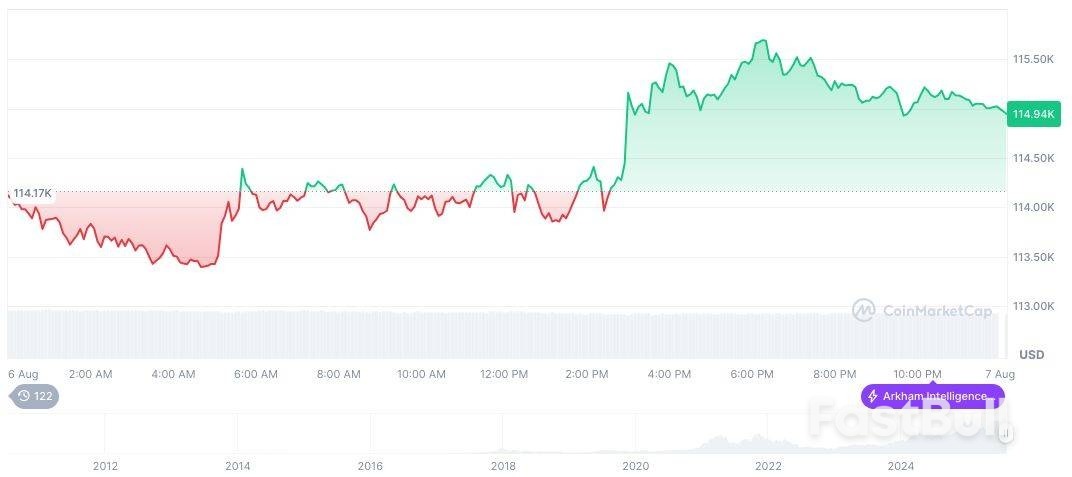
          Bitcoin (BTC) is priced at $114,333, with a market cap of $2.28 trillion, commanding a 60.84% dominance in the crypto landscape. Over the past 90 days, BTC has demonstrated an 11.23% increase in price, as reported by CoinMarketCap.

          Source: CoinMarketCap

          According to the Coincu research team, the observed neutral market sentiment and past trends suggest Bitcoin’s price could stabilize or decline further if broader economic uncertainties persist. Predictions rely on past performance and current on-chain indicators.

          Source: CryptoSlate

          Risk Warnings and Disclaimers
          You understand and acknowledge that there is a high degree of risk involved in trading. Following any strategies or investment methods may lead to potential losses. The content on the site is provided by our contributors and analysts for information purposes only. You are solely responsible for determining whether any trading assets, securities, strategy, or any other product is suitable for investing based on your own investment objectives and financial situation.
          Add to Favorites
          Share
          FastBull
          Copyright © 2025 FastBull Ltd

          728 RM B 7/F GEE LOK IND BLDG NO 34 HUNG TO RD KWUN TONG KLN HONG KONG

          TelegramInstagramTwitterfacebooklinkedin
          App Store Google Play Google Play
          Products
          Charts

          Chats

          Q&A with Experts
          Screeners
          Economic Calendar
          Data
          Tools
          Membership
          Features
          Function
          Markets
          Copy Trading
          Latest Signals
          Contests
          News
          Analysis
          24/7
          Columns
          Education
          Company
          Careers
          About Us
          Contact Us
          Advertising
          Help Center
          Feedback
          User Agreement
          Privacy Policy
          Business

          White Label

          Data API

          Web Plug-ins

          Poster Maker

          Affiliate Program

          Risk Disclosure

          The risk of loss in trading financial instruments such as stocks, FX, commodities, futures, bonds, ETFs and crypto can be substantial. You may sustain a total loss of the funds that you deposit with your broker. Therefore, you should carefully consider whether such trading is suitable for you in light of your circumstances and financial resources.

          No decision to invest should be made without thoroughly conducting due diligence by yourself or consulting with your financial advisors. Our web content might not suit you since we don't know your financial conditions and investment needs. Our financial information might have latency or contain inaccuracy, so you should be fully responsible for any of your trading and investment decisions. The company will not be responsible for your capital loss.

          Without getting permission from the website, you are not allowed to copy the website's graphics, texts, or trademarks. Intellectual property rights in the content or data incorporated into this website belong to its providers and exchange merchants.

          Not Logged In

          Log in to access more features

          FastBull Membership

          Not yet

          Purchase

          Become a signal provider
          Help Center
          Customer Service
          Dark Mode
          Price Up/Down Colors

          Log In

          Sign Up

          Position
          Layout
          Fullscreen
          Default to Chart
          The chart page opens by default when you visit fastbull.com