• Trade
  • Markets
  • Copy
  • Contests
  • News
  • 24/7
  • Calendar
  • Q&A
  • Chats
Trending
Screeners
SYMBOL
LAST
BID
ASK
HIGH
LOW
NET CHG.
%CHG.
SPREAD
SPX
S&P 500 Index
6870.39
6870.39
6870.39
6895.79
6858.28
+13.27
+ 0.19%
--
DJI
Dow Jones Industrial Average
47954.98
47954.98
47954.98
48133.54
47871.51
+104.05
+ 0.22%
--
IXIC
NASDAQ Composite Index
23578.12
23578.12
23578.12
23680.03
23506.00
+72.99
+ 0.31%
--
USDX
US Dollar Index
98.810
98.890
98.810
98.960
98.730
-0.140
-0.14%
--
EURUSD
Euro / US Dollar
1.16604
1.16611
1.16604
1.16717
1.16341
+0.00178
+ 0.15%
--
GBPUSD
Pound Sterling / US Dollar
1.33325
1.33334
1.33325
1.33462
1.33151
+0.00013
+ 0.01%
--
XAUUSD
Gold / US Dollar
4210.54
4210.95
4210.54
4218.85
4190.61
+12.63
+ 0.30%
--
WTI
Light Sweet Crude Oil
59.973
60.003
59.973
60.063
59.752
+0.164
+ 0.27%
--

Community Accounts

Signal Accounts
--
Profit Accounts
--
Loss Accounts
--
View More

Become a signal provider

Sell trading signals to earn additional income

View More

Guide to Copy Trading

Get started with ease and confidence

View More

Signal Accounts for Members

All Signal Accounts

Best Return
  • Best Return
  • Best P/L
  • Best MDD
Past 1W
  • Past 1W
  • Past 1M
  • Past 1Y

All Contests

  • All
  • Trump Updates
  • Recommend
  • Stocks
  • Cryptocurrencies
  • Central Banks
  • Featured News
Top News Only
Share

United Arab Emirates Energy Minister: We Are Working To Open Opportunities For Ai Firms To Improve Efficiency Of Electricity Andwater Grids, We Already Saved 30% Of Energy Consumption By Using Ai

Share

Switzerland's Consumer Confidence Index Fell To 34 In November, Compared With A Previous Reading Of -36.9

Share

Shares In Italy's Fincantieri Up 3.2% In Early Trade

Share

India's Nifty Smallcap 100 Index Falls 2.75%

Share

Britain's FTSE 100 Up 0.17%, France's CAC 40 Down 0.07%

Share

Europe's STOXX Index Up 0.04%, Euro Zone Blue Chips Index Up 0.02%

Share

United Arab Emirates Energy Minister: Natural Gas Is Important And We Intend To Not Only Satisfy Our Local Demand, But Also Grow Our Export Of LNG

Share

Yomiuri: Mitsubishi Ufj Bank Chief Hanzawa Likely To Become MUFG President

Share

Benin's International Bonds Slip After Attempted Coup, 2052 Maturity Down By 1.5 Euro Cents, Tradeweb Data

Share

China Vice Commerce Minister, On Nexperia: Root Cause Of Chaos In The Global Semiconductor Supply Chain Lies In The Netherlands

Share

United Arab Emirates Energy Minister: We Should Not Be Worrying About When Demand For Fossil Fuels Will Peak

Share

China Vice Commerce Minister: Urges Germany And EU Auto Association To Push EU Commission To Resolve EV Anti-Subsidy Case

Share

China Vice Commerce Minister Held Video Conferences With The President Of The German Association Of The Automotive Industry And The President Of The European Automobile Manufacturers Association, Respectively, To Exchange Views On Cooperation In The Automotive Industry And Supply Chain Between China And Germany And Between China And Europe

Share

China Vice Commerce Minister: Welcomes Eu Automakers To Continue To Invest In China

Share

China Says It Is Ready To Improve US Ties While Safeguarding Sovereignty

Share

The Chinese Foreign Ministry Stated That Japanese Prime Minister Takaichi And The Right-wing Forces Behind Him Continue To Misjudge The Situation, Refuse To Repent, Turn A Deaf Ear To Criticism Both Domestically And Internationally, Downplay Their Interference In Other Countries' Internal Affairs And Threats Of Force, Distort The Truth, Disregard Right And Wrong, And Show No Basic Respect For International Law And The Fundamental Norms Of International Relations. They Attempt To Revive Japanese Militarism By Instigating Conflict And Confrontation, Thus Breaking Through The Post-war International Order. Neighboring Asian Countries And The International Community Should Remain Highly Vigilant

Share

Indonesia Government Proposes Additional 11.5 Trillion Rupiah State Injection In 2025 For Housing, Transportation Sectors

Share

Sweden Prime Minister, In Letter Sent To European Commission And European Council President: Russia's Aggression Against Ukraine Is An Existential Threat To Europe

Share

Sweden Prime Minister, In Letter Sent To European Commission And European Council President: Must Move Ahead Quickly On Proposals To Use The Cash Balances From Russia's Immobilized Assets For A Reparations Loan To Ukraine

Share

China's Foreign Ministry Strongly Urges Japan To Immediately Cease Its Dangerous Actions That Disrupt China's Normal Military Exercises

TIME
ACT
FCST
PREV
U.S. Personal Income MoM (Sept)

A:--

F: --

P: --

U.S. PCE Price Index YoY (SA) (Sept)

A:--

F: --

P: --

U.S. PCE Price Index MoM (Sept)

A:--

F: --

P: --

U.S. Personal Outlays MoM (SA) (Sept)

A:--

F: --

P: --

U.S. Core PCE Price Index MoM (Sept)

A:--

F: --

P: --

U.S. Core PCE Price Index YoY (Sept)

A:--

F: --

P: --

U.S. UMich 5-Year-Ahead Inflation Expectations Prelim YoY (Dec)

A:--

F: --

P: --

U.S. Real Personal Consumption Expenditures MoM (Sept)

A:--

F: --

P: --

U.S. UMich Current Economic Conditions Index Prelim (Dec)

A:--

F: --

P: --

U.S. UMich 1-Year-Ahead Inflation Expectations Prelim (Dec)

A:--

F: --

P: --

U.S. UMich Consumer Expectations Index Prelim (Dec)

A:--

F: --

P: --

U.S. Weekly Total Rig Count

A:--

F: --

P: --

U.S. Weekly Total Oil Rig Count

A:--

F: --

P: --

U.S. Unit Labor Cost Prelim (SA) (Q3)

--

F: --

P: --

U.S. Consumer Credit (SA) (Oct)

A:--

F: --

P: --

China, Mainland Foreign Exchange Reserves (Nov)

A:--

F: --

P: --

Japan Wages MoM (Oct)

A:--

F: --

P: --

Japan Trade Balance (Oct)

A:--

F: --

P: --

Japan Nominal GDP Revised QoQ (Q3)

A:--

F: --

P: --

Japan Trade Balance (Customs Data) (SA) (Oct)

A:--

F: --

P: --

Japan GDP Annualized QoQ Revised (Q3)

A:--

F: --

P: --
China, Mainland Exports YoY (CNH) (Nov)

A:--

F: --

P: --

China, Mainland Trade Balance (USD) (Nov)

A:--

F: --

P: --

China, Mainland Imports YoY (CNH) (Nov)

A:--

F: --

P: --

China, Mainland Exports (Nov)

A:--

F: --

P: --

China, Mainland Imports (CNH) (Nov)

A:--

F: --

P: --

China, Mainland Trade Balance (CNH) (Nov)

A:--

F: --

P: --

China, Mainland Imports YoY (USD) (Nov)

A:--

F: --

P: --

China, Mainland Exports YoY (USD) (Nov)

A:--

F: --

P: --

Germany Industrial Output MoM (SA) (Oct)

A:--

F: --

P: --

Euro Zone Sentix Investor Confidence Index (Dec)

--

F: --

P: --

Canada Leading Index MoM (Nov)

--

F: --

P: --

Canada National Economic Confidence Index

--

F: --

P: --

China, Mainland Trade Balance (USD) (Nov)

--

F: --

P: --

U.S. 3-Year Note Auction Yield

--

F: --

P: --

U.K. BRC Overall Retail Sales YoY (Nov)

--

F: --

P: --

U.K. BRC Like-For-Like Retail Sales YoY (Nov)

--

F: --

P: --

Australia Overnight (Borrowing) Key Rate

--

F: --

P: --

RBA Rate Statement
RBA Press Conference
Germany Exports MoM (SA) (Oct)

--

F: --

P: --

U.S. NFIB Small Business Optimism Index (SA) (Nov)

--

F: --

P: --

Mexico Core CPI YoY (Nov)

--

F: --

P: --

Mexico 12-Month Inflation (CPI) (Nov)

--

F: --

P: --

Mexico PPI YoY (Nov)

--

F: --

P: --

Mexico CPI YoY (Nov)

--

F: --

P: --

U.S. Weekly Redbook Index YoY

--

F: --

P: --

U.S. JOLTS Job Openings (SA) (Oct)

--

F: --

P: --

China, Mainland M2 Money Supply YoY (Nov)

--

F: --

P: --

China, Mainland M0 Money Supply YoY (Nov)

--

F: --

P: --

China, Mainland M1 Money Supply YoY (Nov)

--

F: --

P: --

U.S. EIA Short-Term Crude Production Forecast For The Next Year (Dec)

--

F: --

P: --

U.S. EIA Short-Term Crude Production Forecast For The Year (Dec)

--

F: --

P: --

U.S. EIA Natural Gas Production Forecast For The Next Year (Dec)

--

F: --

P: --

EIA Monthly Short-Term Energy Outlook
U.S. 10-Year Note Auction Avg. Yield

--

F: --

P: --

U.S. API Weekly Cushing Crude Oil Stocks

--

F: --

P: --

U.S. API Weekly Crude Oil Stocks

--

F: --

P: --

U.S. API Weekly Refined Oil Stocks

--

F: --

P: --

U.S. API Weekly Gasoline Stocks

--

F: --

P: --

Q&A with Experts
    • All
    • Chatrooms
    • Groups
    • Friends
    Connecting
    .
    .
    .
    Type here...
    Add Symbol or Code

      No matching data

      All
      Trump Updates
      Recommend
      Stocks
      Cryptocurrencies
      Central Banks
      Featured News
      • All
      • Russia-Ukraine Conflict
      • Middle East Flashpoint
      • All
      • Russia-Ukraine Conflict
      • Middle East Flashpoint
      Search
      Products

      Charts Free Forever

      Chats Q&A with Experts
      Screeners Economic Calendar Data Tools
      Membership Features
      Data Warehouse Market Trends Institutional Data Policy Rates Macro

      Market Trends

      Market Sentiment Order Book Forex Correlations

      Top Indicators

      Charts Free Forever
      Markets

      News

      News Analysis 24/7 Columns Education
      From Institutions From Analysts
      Topics Columnists

      Latest Views

      Latest Views

      Trending Topics

      Top Columnists

      Latest Update

      Signals

      Copy Rankings Latest Signals Become a signal provider AI Rating
      Contests
      Brokers

      Overview Brokers Assessment Rankings Regulators News Claims
      Broker listing Forex Brokers Comparison Tool Live Spread Comparison Scam
      Q&A Complaint Scam Alert Videos Tips to Detect Scam
      More

      Business
      Events
      Careers About Us Advertising Help Center

      White Label

      Data API

      Web Plug-ins

      Affiliate Program

      Awards Institution Evaluation IB Seminar Salon Event Exhibition
      Vietnam Thailand Singapore Dubai
      Fans Party Investment Sharing Session
      FastBull Summit BrokersView Expo
      Recent Searches
        Top Searches
          Markets
          News
          Analysis
          User
          24/7
          Economic Calendar
          Education
          Data
          • Names
          • Latest
          • Prev

          View All

          No data

          Scan to Download

          Faster Charts, Chat Faster!

          Download App
          English
          • English
          • Español
          • العربية
          • Bahasa Indonesia
          • Bahasa Melayu
          • Tiếng Việt
          • ภาษาไทย
          • Français
          • Italiano
          • Türkçe
          • Русский язык
          • 简中
          • 繁中
          Open Account
          Search
          Products
          Charts Free Forever
          Markets
          News
          Signals

          Copy Rankings Latest Signals Become a signal provider AI Rating
          Contests
          Brokers

          Overview Brokers Assessment Rankings Regulators News Claims
          Broker listing Forex Brokers Comparison Tool Live Spread Comparison Scam
          Q&A Complaint Scam Alert Videos Tips to Detect Scam
          More

          Business
          Events
          Careers About Us Advertising Help Center

          White Label

          Data API

          Web Plug-ins

          Affiliate Program

          Awards Institution Evaluation IB Seminar Salon Event Exhibition
          Vietnam Thailand Singapore Dubai
          Fans Party Investment Sharing Session
          FastBull Summit BrokersView Expo

          Bitcoin Sentiment Turns Greedy Again—Time to Be Cautious?

          Glendon

          Cryptocurrency

          Summary:

          As Bitcoin and other digital assets recover, data shows the sentiment among cryptocurrency investors has returned to a state of greed.

          As Bitcoin and other digital assets recover, data shows the sentiment among cryptocurrency investors has returned to a state of greed.

          Bitcoin Fear & Greed Index Is Pointing At Greed Again

          The “Fear & Greed Index” refers to an indicator made by Alternative that measures the net sentiment held by the average trader in the Bitcoin and wider cryptocurrency spaces.

          The index uses the data of the following five factors to determine the market sentiment: trading volume, volatility, market cap dominance, social media sentiment, and Google Trends.

          The metric represents the calculated mentality as a score lying between 0 and 100. The former end point corresponds to a state of maximum fear, while the latter one to that of maximum greed.

          Here’s what the index says regarding the current sentiment among the investors:
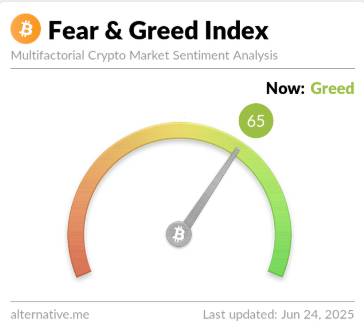
          Looks like the value of the metric is 65 at the moment | Source: Alternative

          As displayed above, the Bitcoin Fear & Greed Index has a value of 65, which suggests the traders currently share a majority sentiment of greed. This is a notable change compared to yesterday, when the indicator was sitting at 47, meaning that the investor mentality was overall neutral.
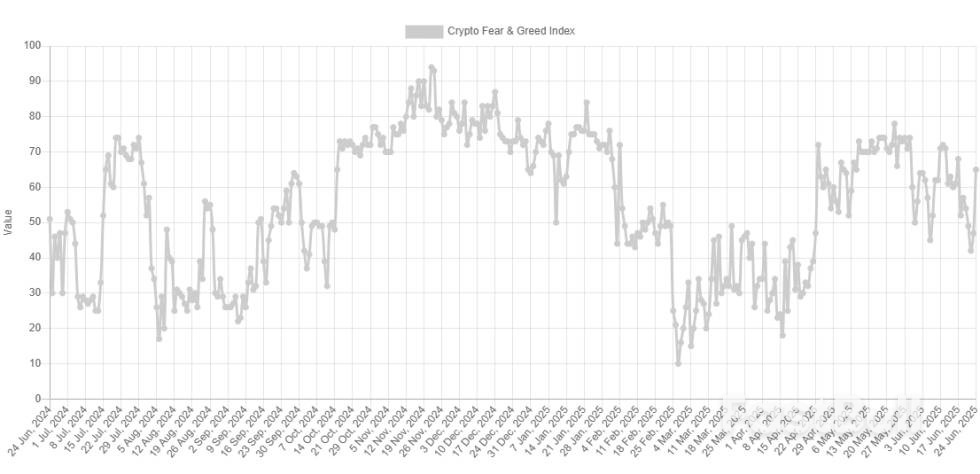
          The trend in the Fear & Greed Index over the past twelve months | Source: Alternative

          The holder sentiment earlier declined as a result of the geopolitical situation surrounding the Israel-Iran conflict. Following the announcement of a ceasefire between the nations, prices bounced back and it would appear that with them, so did the investor mood.

          The ceasefire has since been violated, so it’s possible that tomorrow’s Fear & Greed Index would be less bullish. That said, Bitcoin has held surprisingly well despite the news, which could imply that the sentiment may also remain the same.

          Historically, BTC and digital assets in general have tended to move in the direction that goes against the expectations of the investors. This means that an overly greedy market makes tops likely, while an extremely fearful one bottoms.

          At present, the level of greed in the market isn’t too strong, but the fact that it has seen a notable jump alongside the recovery run could still be to take note off. In the scenario that hype keeps increasing in the coming days, another reversal could turn more probable for Bitcoin and company.

          In some other news, the US-based Bitcoin spot exchange-traded funds (ETFs) saw net inflows yesterday, 23rd June, as pointed out by the analytics firm Glassnode in an X post.
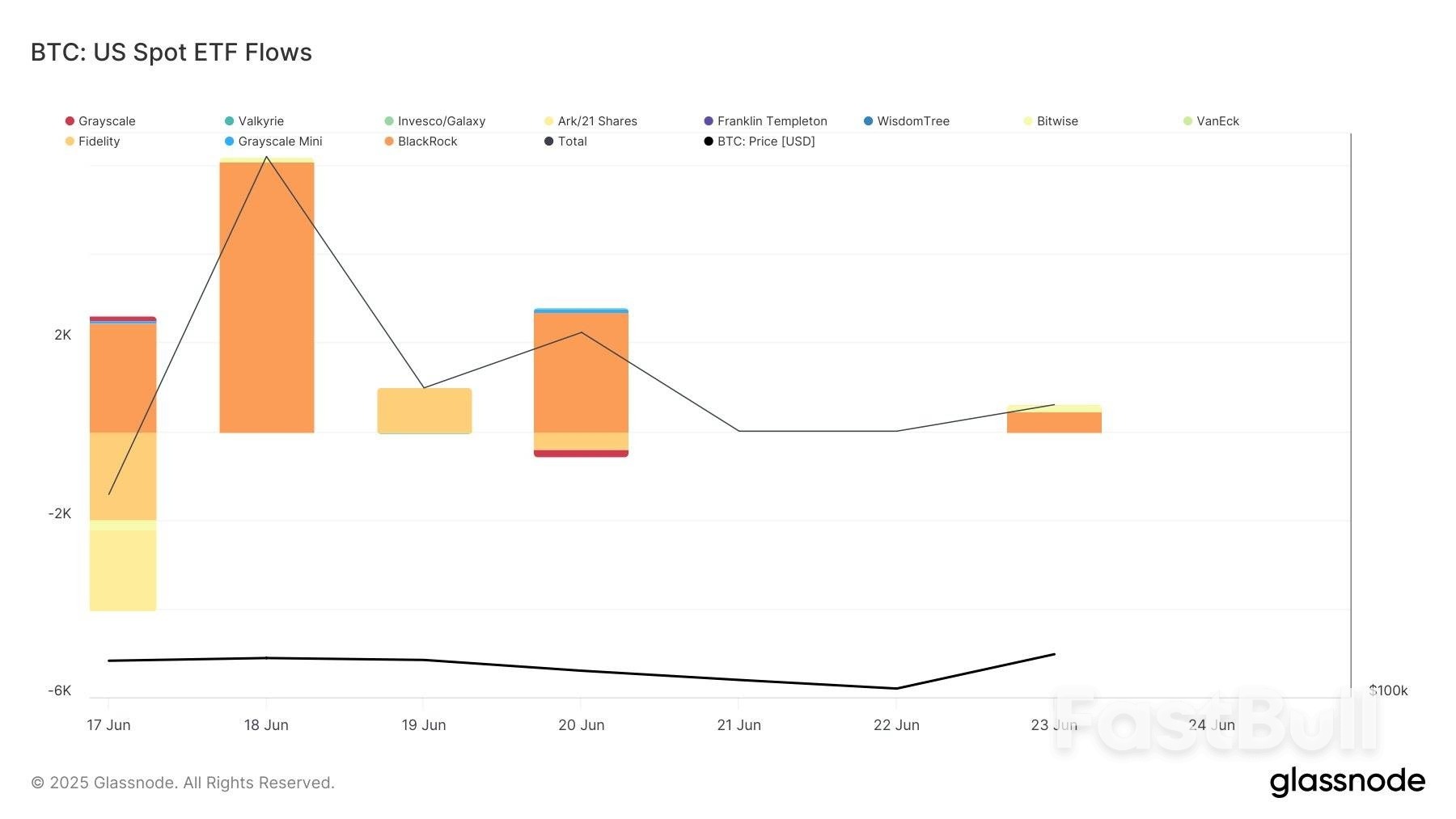
          The data for the netflows associated with the US spot ETFs | Source: Glassnode on X

          As displayed in the above graph, the US Bitcoin spot ETFs saw net inflows of around 598 BTC on this date, despite the geopolitical tensions. “Although the inflows were modest, no major outflows were recorded either, which is notable signal of investor confidence,” notes Glassnode.

          BTC Price

          Bitcoin has already made recovery beyond the level it was trading at before the plunge, as its price is now back at $106,000.
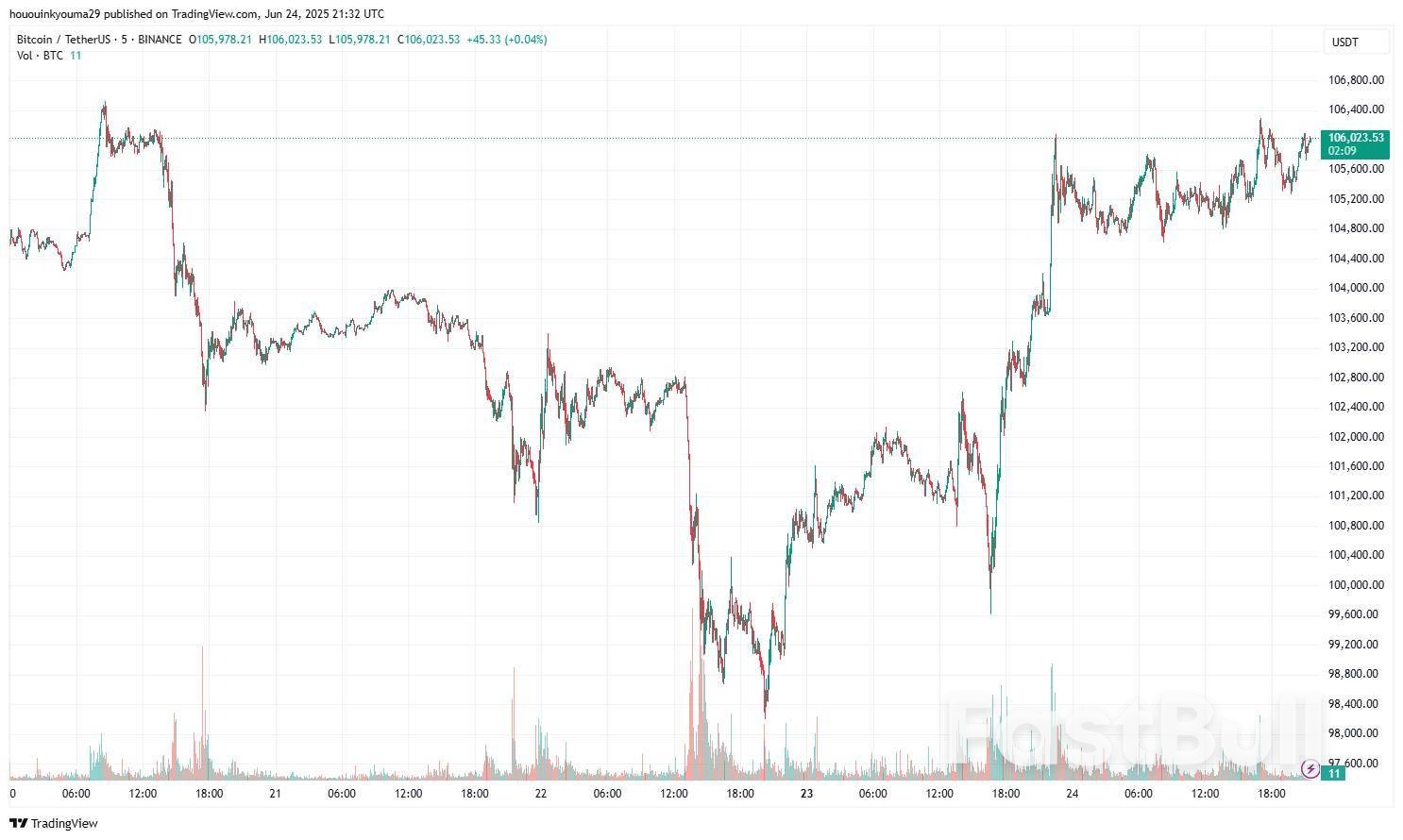
          The asset seems to have shot up during the past day | Source: BTCUSDT on TradingView

          Source: CoinGecko

          Risk Warnings and Disclaimers
          You understand and acknowledge that there is a high degree of risk involved in trading. Following any strategies or investment methods may lead to potential losses. The content on the site is provided by our contributors and analysts for information purposes only. You are solely responsible for determining whether any trading assets, securities, strategy, or any other product is suitable for investing based on your own investment objectives and financial situation.
          Add to Favorites
          Share

          Trump’s Mixed Signals on Iranian Oil Baffle Markets and Allies

          Gerik

          Economic

          Middle East Situation

          Trump’s Surprise Reversal Undermines Sanctions Doctrine

          In a surprising move that sent ripples through diplomatic and financial circles, President Donald Trump declared that China could resume purchasing Iranian oil, marking a sharp deviation from Washington’s years-long policy of maximum pressure on Tehran. His statement, made via Truth Social, came just hours after he announced a fragile ceasefire between Israel and Iran following recent U.S. airstrikes on Iranian nuclear sites.
          The announcement appeared to be made unilaterally, without coordination with the U.S. Treasury or State Department, both of which seemed caught off guard. The Treasury confirmed that sanctions enforcement remains active, signaling confusion within the administration. This lack of internal alignment suggests that the president’s comments may be more rhetorical than a formal policy change.

          A Diplomatic Gambit Tied to Trade and Peace

          Trump’s apparent olive branch to China — Iran’s top oil customer — seems part of a larger effort to reduce tensions in both the Middle East and U.S.-China trade relations. Analysts suggest the statement might have been aimed at encouraging further cooperation from Beijing amid delicate negotiations over reciprocal tariffs and regional diplomacy.
          This possible “carve-out” for China could be interpreted as a goodwill gesture, albeit one that risks undermining U.S. leverage. China has already built covert supply chains for Iranian crude, often disguising its imports as Malaysian or Emirati shipments. Officially, it hasn’t reported Iranian oil purchases since June 2022, yet third-party trackers estimate flows exceed 1 million barrels per day.

          Markets React Cautiously as Confusion Reigns

          Oil markets saw a modest uptick, with Brent crude rising above $68 per barrel. The increase was muted, likely due to uncertainty about the actual policy implications. Many traders are skeptical, interpreting the president’s post as a one-off political maneuver rather than a green light for unrestrained imports.
          Former Treasury officials and geopolitical analysts warned that the inconsistent messaging could reduce the credibility of U.S. sanctions enforcement. If buyers believe the White House is wavering, compliance may erode even without formal changes to the law.

          Strategic Risks: Eroding Sanctions Without Security Gains

          Trump’s post contradicts his administration’s own policy as recently as last month, when he vowed that any purchase of Iranian oil would trigger secondary sanctions. The U.S. has blacklisted hundreds of tankers and Chinese entities over illicit Iranian oil trading. As of now, none of those measures have been lifted.
          This sudden reversal could weaken the U.S. bargaining position in nuclear talks with Tehran and embolden sanctions evasion. It also complicates coordination with allies, particularly in Europe, who have long been urged by Washington to isolate Iran’s energy sector.
          Moreover, the White House’s inability to clarify whether the president’s words reflect actual policy exposes a larger issue: inconsistent foreign policy execution at a time of elevated geopolitical risk.
          Trump’s abrupt shift on Chinese imports of Iranian oil has confused markets, surprised diplomats, and put U.S. sanctions credibility in question. Whether this is part of a larger strategy to ease tensions or simply political improvisation remains unclear. Without formal clarification or legal revisions, the U.S. sanctions regime remains in place — but its deterrent power may have just taken a serious hit.

          Source: Bloomberg

          To stay updated on all economic events of today, please check out our Economic calendar
          Risk Warnings and Disclaimers
          You understand and acknowledge that there is a high degree of risk involved in trading. Following any strategies or investment methods may lead to potential losses. The content on the site is provided by our contributors and analysts for information purposes only. You are solely responsible for determining whether any trading assets, securities, strategy, or any other product is suitable for investing based on your own investment objectives and financial situation.
          Add to Favorites
          Share

          Powell Reaffirms Fed’s Caution on Rate Cuts Amid Political Heat and Tariff Uncertainty

          Gerik

          Economic

          Fed Holds Firm Against Political Pressure, Focuses on Data-Driven Policy

          In testimony before the House Financial Services Committee on Tuesday, Federal Reserve Chair Jerome Powell delivered a measured but resolute message: the Fed is committed to maintaining price stability and will remain cautious before altering its policy stance. Despite rising political pressure, especially from President Trump, Powell reiterated that the central bank’s decisions are independent and will be guided solely by data.
          Trump has escalated his public attacks on Powell, accusing him of being "dumb" and "hardheaded" for refusing to cut rates amid rising trade tensions. However, Powell made clear that “politics has no role” in Fed policy, emphasizing, “We’re doing our jobs.”

          Tariffs: The Core Uncertainty Behind the Fed’s Policy Delay

          The key issue restraining the Fed from acting is uncertainty around the inflationary impact of Trump’s tariff policies. Powell explained that the “ultimate level” and persistence of price increases due to tariffs remain unclear. While short-term effects typically include one-off price hikes, the Fed is watching for signs of sustained inflation acceleration that could justify a policy shift.
          Powell warned that the Federal Open Market Committee (FOMC) has a duty to “prevent a one-time increase in the price level from becoming an ongoing inflation problem.” He highlighted that inflation is projected to rise modestly in May to 2.3%, with core inflation expected to reach 2.6% — both slightly above the Fed’s 2% target but still not alarming enough to prompt immediate action.

          Labor Market Solid, Inflation Risks Balanced — No Rush to Cut

          Powell characterized the U.S. economy as “solid,” with employment near full capacity. While inflation remains slightly elevated, he emphasized the Fed’s responsibility to balance the dual mandate of price stability and full employment. “Without price stability, we cannot achieve the long periods of strong labor market conditions that benefit all Americans,” he told lawmakers.
          Some Fed officials — including Governors Michelle Bowman and Christopher Waller — have suggested that if inflation stays in check, they may support a July rate cut. However, Powell signaled the broader committee’s reluctance, noting that it will take more than one month of data to justify easing.

          Market Implications: July Cut Unlikely, September More Probable

          The futures market is currently pricing in only a 23% chance of a July rate cut, with stronger odds for a move in September. This aligns with Powell’s assertion that more time is needed to observe the economic fallout from tariffs and ensure inflation doesn’t spiral.
          The Fed’s dot plot revealed a divided board: nine officials anticipate zero or one cut in 2025, while the remaining ten foresee two or more cuts. This internal divergence reflects how finely balanced the inflation-growth tradeoff is in the current environment.
          Despite rising political heat, Powell’s testimony makes it clear the Fed is focused on its long-term credibility and macroeconomic stability rather than short-term pressure. With inflation data still within a manageable range and uncertainty over tariffs unresolved, the central bank is in no rush to cut rates. Investors and markets should expect the Fed to remain data-dependent, resisting premature action until inflation expectations and global risks become more predictable.

          Source: CNBC

          To stay updated on all economic events of today, please check out our Economic calendar
          Risk Warnings and Disclaimers
          You understand and acknowledge that there is a high degree of risk involved in trading. Following any strategies or investment methods may lead to potential losses. The content on the site is provided by our contributors and analysts for information purposes only. You are solely responsible for determining whether any trading assets, securities, strategy, or any other product is suitable for investing based on your own investment objectives and financial situation.
          Add to Favorites
          Share

          China Steps Up Global Yuan Push Amid Dollar Weakness and Policy Uncertainty

          Gerik

          Economic

          Forex

          Beijing Moves to Elevate the Yuan’s Global Profile

          As the U.S. dollar suffers from heightened policy uncertainty and declining global confidence, China is intensifying efforts to promote the yuan as a viable alternative for international trade and finance. The People's Bank of China (PBOC), under Governor Pan Gongsheng, is leading initiatives to reduce reliance on what he calls a "single sovereign currency," a clear reference to the dollar. At the core of this strategy is the internationalization of the digital yuan, expanded access to Chinese financial markets, and greater use of the renminbi in cross-border payments and commodity pricing.
          These efforts come at a moment of relative strength for China’s currency. The offshore yuan has appreciated over 2% against the U.S. dollar in 2025, while the dollar index has fallen over 9% amid investor unease with U.S. policy under President Trump, especially regarding tariffs and sanctions.

          Strategic Access for Foreign Institutions and Commodities Pricing Power

          China is targeting the futures and commodities markets as key channels for yuan internationalization. In recent weeks, three major Chinese exchanges—Shanghai, Dalian, and Zhengzhou—have opened up 16 additional futures and options contracts to qualified foreign institutional investors, including contracts in natural rubber, lead, and tin. These additions are part of a broader campaign to expand foreign investor access to China’s hedging tools and integrate the yuan into global commodity pricing systems.
          The Shanghai Futures Exchange also announced plans to allow foreign currency collateral for yuan-settled trades—further smoothing access for global players.
          Financial firms are slowly responding. Morgan Stanley’s Chinese subsidiary now offers brokerage services for commodity futures and plans to expand to equity and bond futures trading, after years of gradual regulatory approvals.
          Despite these openings, structural barriers remain. China's capital controls and lack of legal transparency continue to deter deep foreign investment, limiting the yuan’s broader appeal compared to the dollar's unmatched liquidity and regulatory clarity.

          Digital Yuan, Cross-Border Lending, and Bilateral Settlements

          Beyond investment markets, Beijing is building out a parallel financial infrastructure to challenge dollar supremacy. The central bank has laid the groundwork for a digital yuan hub in Shanghai to support international transactions, while Chinese banks are increasingly using yuan in lending to emerging markets, especially as lower interest rates make it cost-effective.
          The Cross-Border Interbank Payment System (CIPS) is also playing a growing role, providing an alternative to the SWIFT network and supporting bilateral trade in yuan with partners in Asia, Africa, and the Middle East. In February 2025, China allocated $100 billion in financing through Hong Kong to support yuan-denominated deals—further incentivizing global businesses to adopt the currency.
          While China's push is strategic and steady, results remain mixed. According to SWIFT’s May data, the yuan accounted for just 2.89% of global payments, down from 5th to 6th place globally. In contrast, the U.S. dollar still dominated with 48.46% of all cross-border transactions, followed by the euro at 23.56%.

          Dollar Weakness and Global Shifts Bolster China’s Timing

          China’s de-dollarization drive coincides with broader shifts in Asia and the Global South. Geopolitical tensions, dollar volatility, and the rising cost of U.S. borrowing have prompted many countries to hedge against dollar exposure. President Trump’s tariff escalation and abrupt foreign policy decisions have only intensified the appetite for diversification, pushing more institutional money toward yuan-based assets.
          State Street Markets’ proprietary data points to a sharp increase in institutional CNY inflows. According to senior EM strategist Ning Sun, institutional investors—still underweight in yuan—are now positioning more aggressively in CNY-denominated assets.

          Progress, but Long Road Ahead

          While China’s multi-pronged strategy is yielding incremental gains, experts remain cautious. As Matt Gertken of BCA Research notes, the yuan lacks the deep, open, and rule-of-law-based financial system that underpins the dollar’s dominance. Unless China can offer credible reforms to improve transparency, legal reliability, and capital mobility, the yuan's global role will remain significant but limited.
          Still, with the global monetary order in flux and confidence in the dollar shaken, China’s window to reshape financial geopolitics is as wide as it has ever been. The challenge now is execution and trust.

          Source: CNBC

          To stay updated on all economic events of today, please check out our Economic calendar
          Risk Warnings and Disclaimers
          You understand and acknowledge that there is a high degree of risk involved in trading. Following any strategies or investment methods may lead to potential losses. The content on the site is provided by our contributors and analysts for information purposes only. You are solely responsible for determining whether any trading assets, securities, strategy, or any other product is suitable for investing based on your own investment objectives and financial situation.
          Add to Favorites
          Share

          Australian Sheep Exports Surge Amid Record Prices and Global Demand

          Gerik

          Commodity

          Australian Farmers Reap Benefits from Historic Lamb and Mutton Prices

          Australian sheep farmers are witnessing a historic boom as the price of heavy lambs soared to nearly A$11 ($7.14) per kilogram last week—a 50% jump from the same period in 2024. This marks a significant moment for the nation’s agricultural sector, especially as Australia cements its role as the world’s top sheep meat exporter.
          According to Matt Dalgleish, analyst at Episode 3, the surge is driven by increasing export demand, limited global supply, and Australia’s expanding market share. “Until the underlying pressure of limited supply and strong growth in demand changes, there should be more good times ahead for Australian producers,” he noted.

          Export Volumes and Values Hit Record Levels

          Australian export volumes reached 702,000 metric tons in 2024, worth $3.6 billion, representing a near 40% increase from the previous peak in 2019. In the first four months of 2025 alone, shipments rose 10% year-over-year, showing strong momentum as international buyers continue sourcing from Australia.
          China remains the largest importer of Australian sheep meat, followed by the United States, the European Union, Britain, and Middle Eastern countries. Demand is being bolstered not just by population growth but also by substitution effects: consumers, especially in the U.S., are turning to lamb and mutton as beef prices remain elevated.

          New Zealand’s Declining Output Creates a Strategic Window

          Australia’s boom coincides with structural stagnation in New Zealand’s sheep industry. As Rabobank’s Angus Gidley-Baird explains, “Its production is stagnating or retracting. So any growth in global demand is Australia’s opportunity for the taking.” The number of sheep in New Zealand has steadily declined since 2012, largely due to the conversion of pastureland into pine plantations to generate carbon credits.
          This structural shift means that while Australia’s sheep numbers have increased—enabling producers to meet processor demand—New Zealand’s global market share has been gradually eroded, consolidating Australia’s export dominance.

          Continued Growth with Caution on Supply Constraints

          Looking forward, analysts expect sheep meat prices to remain strong, albeit with seasonal fluctuations. The main tailwinds include high global demand, constrained rival supply, and favorable trade conditions. However, to sustain growth, Australia must manage challenges such as processor capacity, climate risk, and maintaining animal health standards amid scaling operations.
          For now, though, the combination of favorable market dynamics and declining competition places Australia in a rare and enviable position within global agriculture: leading a high-value export market with strong forward momentum.

          Source: Reuters

          Risk Warnings and Disclaimers
          You understand and acknowledge that there is a high degree of risk involved in trading. Following any strategies or investment methods may lead to potential losses. The content on the site is provided by our contributors and analysts for information purposes only. You are solely responsible for determining whether any trading assets, securities, strategy, or any other product is suitable for investing based on your own investment objectives and financial situation.
          Add to Favorites
          Share

          German Exporters Lose Confidence as U.S. Tariff Threats Persist

          Gerik

          Economic

          German Export Outlook Weakens Under Tariff Cloud

          The Ifo Institute reported on Wednesday that its export expectations index for Germany fell to -3.9 in June from -3.0 in May. This decline reflects a growing sense of unease among exporters, who remain wary of U.S. President Donald Trump’s push for reciprocal tariffs and ongoing trade tensions with the European Union. Klaus Wohlrabe, head of Ifo surveys, emphasized that the lack of a clear resolution is weighing on sentiment: “The tariff threats from the U.S. are still on the table. An agreement between the EU and the U.S. has yet to be reached.”
          Germany’s export-dependent economy is particularly sensitive to changes in global trade policy, and the auto industry—which accounts for a significant portion of German exports—is especially exposed. Many German manufacturers have built production models around stable transatlantic trade, making them vulnerable to tariff shocks.

          Negotiations with U.S. Yield Limited Progress

          Though negotiations are ongoing, European officials have expressed growing skepticism that a comprehensive deal can be reached in the near term. According to sources familiar with the discussions, both sides may have to settle for a 10% reciprocal tariff baseline—significantly higher than current levels and a departure from long-standing low-tariff norms under previous trade frameworks.
          President Trump’s strategy appears focused on shrinking the U.S. trade deficit with the EU, particularly targeting industries like automobiles and machinery where German firms hold large surpluses. The EU has so far resisted unilateral concessions, aiming instead for a broader resolution, though the clock is ticking as the July 9 expiration of the current tariff pause approaches.

          Short-Term Caution, Long-Term Structural Concern

          With no imminent resolution in sight, German exporters are bracing for a more difficult second half of 2025. The continued slide in Ifo’s export expectations signals caution about new orders and investment in trade-reliant sectors. If talks break down entirely or if the U.S. unilaterally enforces higher tariffs, Germany could face sharper slowdowns in manufacturing, particularly in autos, chemicals, and industrial machinery.
          In the broader context, this development adds to Europe’s economic challenges as growth remains sluggish, inflationary pressures diverge across the eurozone, and global demand remains fragile. Germany’s export pessimism could ripple across the EU if the tariff standoff becomes prolonged or escalates into broader retaliatory measures.

          Source: Reuters

          To stay updated on all economic events of today, please check out our Economic calendar
          Risk Warnings and Disclaimers
          You understand and acknowledge that there is a high degree of risk involved in trading. Following any strategies or investment methods may lead to potential losses. The content on the site is provided by our contributors and analysts for information purposes only. You are solely responsible for determining whether any trading assets, securities, strategy, or any other product is suitable for investing based on your own investment objectives and financial situation.
          Add to Favorites
          Share

          Gold (XAUUSD) Rises, But Outlook Remains Uncertain

          Golden Gleam

          Economic

          Commodity

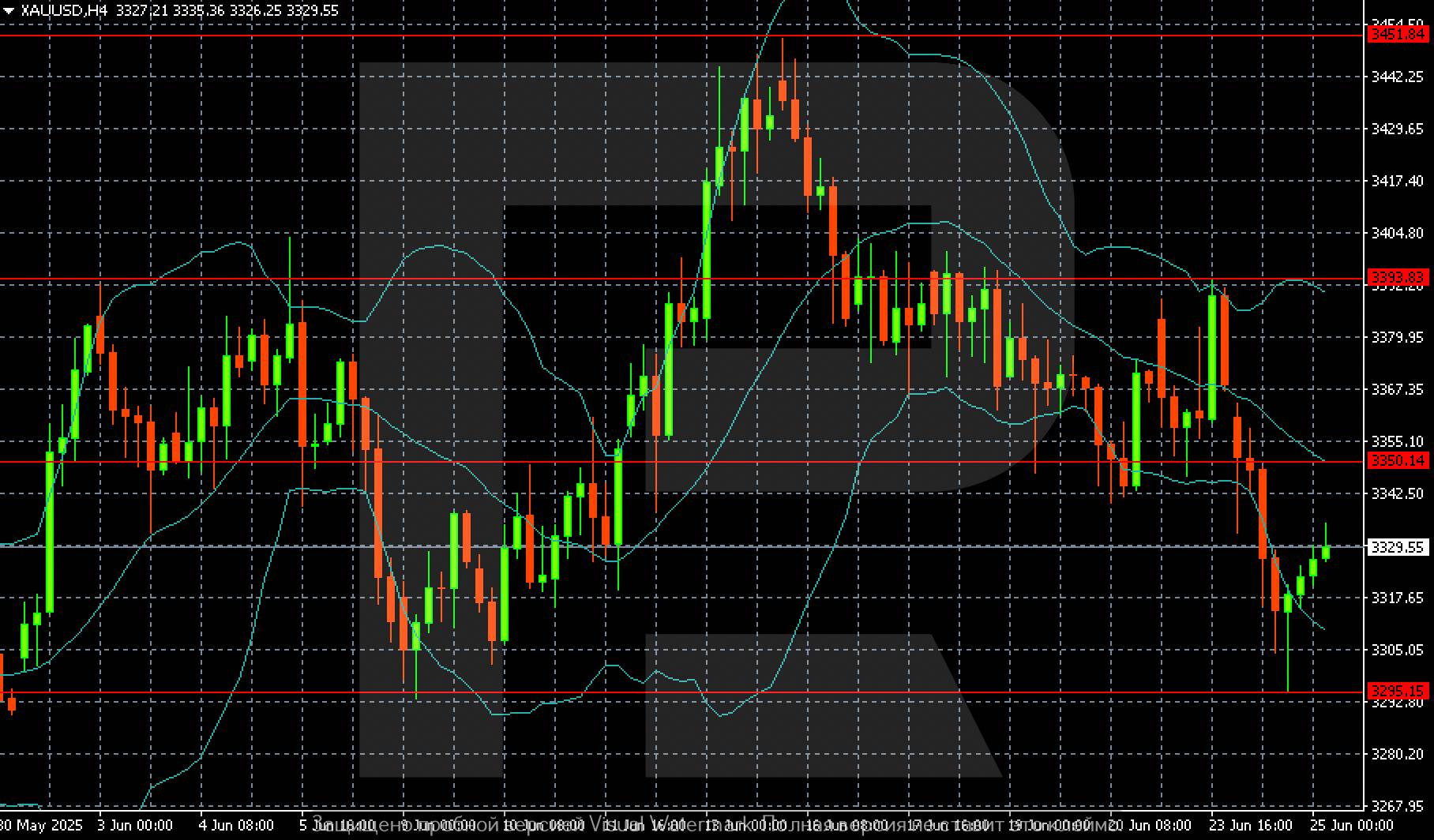
          Gold (XAUUSD) quotes are forming grounds for a rebound, although the outlook remains mixed. The gold (XAUUSD) forecast for today, 25 June 2025, suggests a potential recovery with growth towards 3,350 USD.

          Gold (XAUUSD) prices strengthened to 3,300 USD, rebounding from a two-week low. Discover more in our analysis for 25 June 2025.

          XAUUSD forecast: key trading points

          ●Gold (XAUUSD) prices are recovering after hitting a two-week low
          ●The Fed interest rate outlook could be a growth point
          ●XAUUSD forecast for 25 June 2025: 3,350

          Fundamental analysis

          Gold (XAUUSD) quotes recovered to 3,300 USD per troy ounce on Wednesday, moving away from their lowest level in two weeks. Market participants are evaluating the durability of the ceasefire between Iran and Israel.

          Today, preliminary US intelligence assessments revealed that the recent strikes on three Iranian nuclear sites only temporarily stalled Tehran's nuclear programme, which fuels concerns over possible escalation.

          The ceasefire brokered by the US appears fragile, with both parties accusing each other of attacks shortly after the truce began.

          On the monetary policy front, US Federal Reserve Chairman Jerome Powell said that interest rates will likely remain unchanged until the impact of new tariffs becomes clearer. However, he did not rule out a possible rate cut in July.

          These comments contrast with statements from other Fed officials who earlier supported policy easing amid signs of slowing inflation and a weakening labour market.

          The gold (XAUUSD) forecast is mixed.

          XAUUSD technical analysis

          On the H4 chart, gold (XAUUSD) is recovering, although sellers still hold the initiative. XAUUSD rebounded from the lower boundary of the descending channel at 3,295, but to strengthen this momentum, prices must consolidate above 3,350. This would also confirm the emergence of bullish sentiment in the market. If so, the next upside target could be 3,393.

          If the rebound fails to gain traction, the market may retreat back to 3,295, increasing market pressure.

          Source: RoboForex

          To stay updated on all economic events of today, please check out our Economic calendar
          Risk Warnings and Disclaimers
          You understand and acknowledge that there is a high degree of risk involved in trading. Following any strategies or investment methods may lead to potential losses. The content on the site is provided by our contributors and analysts for information purposes only. You are solely responsible for determining whether any trading assets, securities, strategy, or any other product is suitable for investing based on your own investment objectives and financial situation.
          Add to Favorites
          Share
          FastBull
          Copyright © 2025 FastBull Ltd

          728 RM B 7/F GEE LOK IND BLDG NO 34 HUNG TO RD KWUN TONG KLN HONG KONG

          TelegramInstagramTwitterfacebooklinkedin
          App Store Google Play Google Play
          Products
          Charts

          Chats

          Q&A with Experts
          Screeners
          Economic Calendar
          Data
          Tools
          Membership
          Features
          Function
          Markets
          Copy Trading
          Latest Signals
          Contests
          News
          Analysis
          24/7
          Columns
          Education
          Company
          Careers
          About Us
          Contact Us
          Advertising
          Help Center
          Feedback
          User Agreement
          Privacy Policy
          Business

          White Label

          Data API

          Web Plug-ins

          Poster Maker

          Affiliate Program

          Risk Disclosure

          The risk of loss in trading financial instruments such as stocks, FX, commodities, futures, bonds, ETFs and crypto can be substantial. You may sustain a total loss of the funds that you deposit with your broker. Therefore, you should carefully consider whether such trading is suitable for you in light of your circumstances and financial resources.

          No decision to invest should be made without thoroughly conducting due diligence by yourself or consulting with your financial advisors. Our web content might not suit you since we don't know your financial conditions and investment needs. Our financial information might have latency or contain inaccuracy, so you should be fully responsible for any of your trading and investment decisions. The company will not be responsible for your capital loss.

          Without getting permission from the website, you are not allowed to copy the website's graphics, texts, or trademarks. Intellectual property rights in the content or data incorporated into this website belong to its providers and exchange merchants.

          Not Logged In

          Log in to access more features

          FastBull Membership

          Not yet

          Purchase

          Become a signal provider
          Help Center
          Customer Service
          Dark Mode
          Price Up/Down Colors

          Log In

          Sign Up

          Position
          Layout
          Fullscreen
          Default to Chart
          The chart page opens by default when you visit fastbull.com