- XAUUSD
- XAGUSD
- WTI
- USDX
Markets
Analysis
User
24/7
Economic Calendar
Education
Data
- Names
- Latest
- Prev


Signal Accounts for Members
All Signal Accounts
All Contests


The Yield On Japan's 10-year Government Bonds Rose 2 Basis Points To 2.54%, The Highest Level Since June 1997
U.S. Commerce Secretary Lutnick: We Are Bringing Semiconductor Manufacturing Back To The United States
Summary Of Comments From Bank Of Japan Board Members At April Meeting: One Member Stated That If Supply-side Constraints Materialize, They Will Exert Extremely Strong Upward Pressure On Prices
Summary Of Comments From Policymakers At The Bank Of Japan's April Meeting: One Member Stated That If Tensions In The Middle East Persist, It May Be Necessary To Raise The Policy Rate To A Neutral Level Sooner Than Expected
Summary Of Comments From Board Members At The Bank Of Japan's April Meeting: One Member Stated That If The Risk Of Rising Prices Increases, The Bank Of Japan Must Not Hesitate To Accelerate The Pace Of Interest Rate Hikes
Summary Of Comments From Bank Of Japan Policy Board Members At April Meeting: One Member Stated That The Policy Rate Is Still Some Distance From The Neutral Level, Therefore The Bank Of Japan Must Continue To Raise Interest Rates At Intervals Of Several Months
Summary Of Comments From Board Members At The Bank Of Japan’s April Meeting: One Member Stated That The Bank Of Japan Must Prevent A Significant Increase In Inflation Risks When Implementing Monetary Policy
Summary Of Comments From Bank Of Japan Board Members At Its April Meeting: One Member Stated That While There Is No Need For Urgent Action At Present, The Bank Of Japan Should Raise Interest Rates As Soon As Possible Unless There Are Clear Signs Of An Economic Slowdown
Summary Of Comments From Bank Of Japan Policy Board Members At Its April Meeting: One Member Stated That Japan's Real Policy Rate Is Among The Lowest Globally, And The Bank Of Japan Must Continue To Adjust The Negative Real Interest Rate To Address The Second-round Effects Of Rising Prices
Summary Of Comments From The Bank Of Japan's April Meeting Policy Board: One Member Stated That Even Though The Future Direction Of The Situation In The Middle East Remains Uncertain, The Bank Of Japan Is Highly Likely To Raise Interest Rates Starting From Its Next Meeting
Summary Of Comments From Board Members At The Bank Of Japan’s April Meeting: One Member Stated That Prioritizing Interest Rate Hikes To Curb Inflation At The Current Stage Is Highly Likely To Have A Negative Impact On Economic Development
Summary Of Comments From Board Members At The Bank Of Japan's April Meeting: One Member Stated That The Impact Of The Situation In The Middle East Is Difficult To Predict, And The Bank Of Japan Needs To Adopt A Wait-and-see Approach At This Meeting
Summary Of Comments From Board Members At The Bank Of Japan's April Meeting: One Member Stated That The Bank Of Japan May Need To Address The Risk Of Prices Deviating From Their Upward Trend
Summary Of Comments From Board Members At The Bank Of Japan’s April Meeting: One Member Stated That, Given The Significantly Low Real Interest Rates, It Would Be Appropriate For The Bank Of Japan To Continue Raising Policy Rates
U.S. Senate Minority Leader: Trump Has Dragged The United States Into War; Democrats Will Continue To Push For Withdrawal
In March, Japan's All-household Expenditure Fell 2.9% Year-on-Year, Compared With Expectations Of A 1.3% Decline And The Previous Reading Of A 1.8% Drop
Japan's Household Spending In March Fell By 1.3% Month-on-month, Against An Expected Increase Of 0.6%, Following A Previous Rise Of 1.5%
The United States Is Offering A $15 Million Reward To Disrupt The Islamic Revolutionary Guard Corps' Financial Networks

U.S. Private Nonfarm Payrolls (SA) (Apr)A:--
F: --
U.S. Average Weekly Working Hours (SA) (Apr)A:--
F: --
P: --
U.S. Government Employment (Apr)A:--
F: --
P: --
U.S. Wholesale Sales MoM (SA) (Mar)A:--
F: --
U.S. 5-10 Year-Ahead Inflation Expectations (May)A:--
F: --
P: --
U.S. Weekly Total Oil Rig CountA:--
F: --
P: --
U.S. Weekly Total Rig CountA:--
F: --
P: --
Chicago Fed President Goolsby and San Francisco Fed President Daly participated in a panel discussion at the Hoover Institution's 2026 Monetary Policy Conference.
China, Mainland Trade Balance (CNH) (Apr)A:--
F: --
P: --
China, Mainland Imports YoY (CNH) (Apr)A:--
F: --
P: --
China, Mainland Exports YoY (USD) (Apr)A:--
F: --
P: --
China, Mainland Imports YoY (USD) (Apr)A:--
F: --
P: --
China, Mainland Exports (Apr)A:--
F: --
P: --
China, Mainland Imports (CNH) (Apr)A:--
F: --
P: --
China, Mainland Trade Balance (USD) (Apr)A:--
F: --
P: --
China, Mainland CPI MoM (Apr)A:--
F: --
P: --
China, Mainland PPI YoY (Apr)A:--
F: --
P: --
China, Mainland CPI YoY (Apr)A:--
F: --
P: --
Turkey Retail Sales YoY (Mar)A:--
F: --
P: --
Canada National Economic Confidence IndexA:--
F: --
P: --
U.S. Existing Home Sales Annualized MoM (Apr)A:--
F: --
U.S. Existing Home Sales Annualized Total (Apr)A:--
F: --
U.S. Conference Board Employment Trends Index (SA) (Apr)A:--
F: --
China, Mainland M1 Money Supply YoY (Apr)--
F: --
P: --
China, Mainland M2 Money Supply YoY (Apr)--
F: --
P: --
China, Mainland M0 Money Supply YoY (Apr)--
F: --
P: --
U.S. 3-Year Note Auction YieldA:--
F: --
P: --
Saudi Arabia Crude Oil ProductionA:--
F: --
P: --
U.K. BRC Overall Retail Sales YoY (Apr)A:--
F: --
P: --
U.K. BRC Like-For-Like Retail Sales YoY (Apr)A:--
F: --
P: --
Japan Foreign Exchange Reserves (Apr)A:--
F: --
P: --
Indonesia Retail Sales YoY (Mar)--
F: --
P: --
Japan 10-Year Note Auction Yield--
F: --
P: --
Japan Leading Indicators Prelim (Mar)--
F: --
P: --
Italy Industrial Output YoY (SA) (Mar)--
F: --
P: --
Germany ZEW Economic Sentiment Index (May)--
F: --
P: --
Germany ZEW Current Conditions Index (May)--
F: --
P: --
Euro Zone ZEW Economic Sentiment Index (May)--
F: --
P: --
South Africa Unemployment Rate (Q1)--
F: --
P: --
Euro Zone ZEW Current Conditions Index (May)--
F: --
P: --
Italy 12-Month BOT Auction Avg. Yield--
F: --
P: --
Germany 2-Year Schatz Auction Avg. Yield--
F: --
P: --
U.S. NFIB Small Business Optimism Index (SA) (Apr)--
F: --
P: --
India CPI YoY (Apr)--
F: --
P: --
Brazil CPI YoY (Apr)--
F: --
P: --
Mexico Industrial Output YoY (Mar)--
F: --
P: --
U.S. CPI MoM (Not SA) (Apr)--
F: --
P: --
U.S. Core CPI (SA) (Apr)--
F: --
P: --
U.S. Real Income MoM (SA) (Apr)--
F: --
P: --
U.S. CPI MoM (SA) (Apr)--
F: --
P: --
U.S. Core CPI MoM (SA) (Apr)--
F: --
P: --
U.S. Core CPI YoY (Not SA) (Apr)--
F: --
P: --
U.S. CPI YoY (Not SA) (Apr)--
F: --
P: --
U.S. Weekly Redbook Index YoY--
F: --
P: --
U.S. Cleveland Fed CPI MoM (Apr)--
F: --
P: --
U.S. EIA Natural Gas Production Forecast For The Next Year (May)--
F: --
P: --
U.S. EIA Short-Term Crude Production Forecast For The Year (May)--
F: --
P: --
U.S. EIA Short-Term Crude Production Forecast For The Next Year (May)--
F: --
P: --
U.S. 10-Year Note Auction Avg. Yield--
F: --
P: --
U.S. Budget Balance (Apr)--
F: --
P: --
U.S. API Weekly Crude Oil Stocks--
F: --
P: --


No matching data
The Bitcoin mining difficulty hit an all-time high of 127.6 trillion this week, but is projected to drop during the next difficulty adjustment on August 9.
Mining difficulty is expected to fall by about 3% to 123.7 trillion in the next adjustment period, and the current average block time is about 10 minutes and 20 seconds, according to CoinWarz.
Data from CryptoQuant shows that the mining difficulty fell in June, with a sharp drop-off at the end of month and the first two weeks of July, when difficulty fell to 116.9 trillion. However, the difficulty level resumed its long-term uptrend in the latter half of July.
Bitcoin mining difficulty, and the network’s hashrate — the total computing power committed to securing the network — is central to miner profitability and maintaining Bitcoin’s high stock-to-flow ratio, which protects BTC’s price from overproduction.
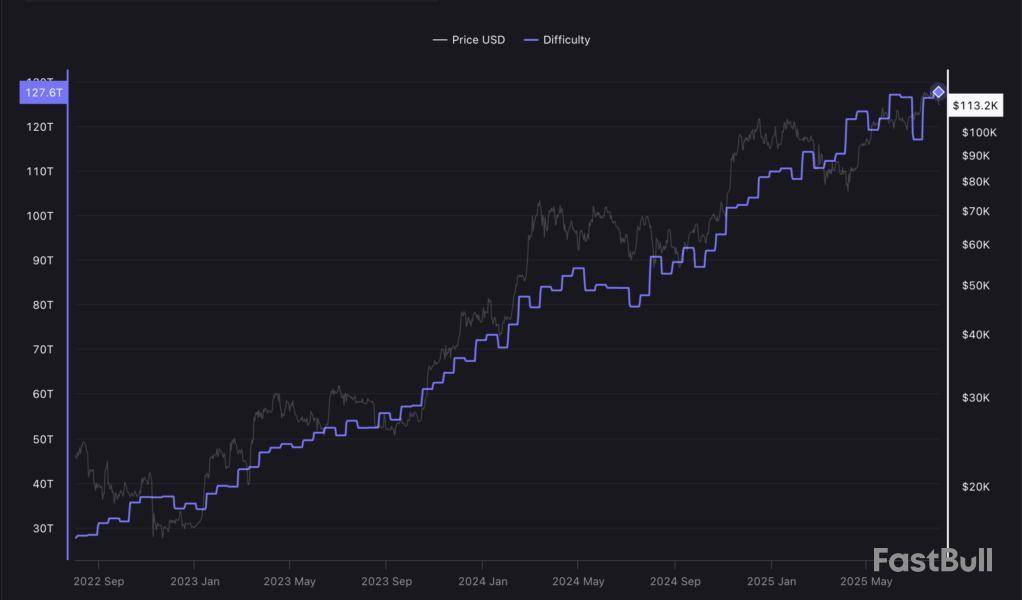
Bitcoin’s difficulty adjustment and the stock-to-flow ratio
Stock-to-flow ratio measures the total available supply of a financial asset or commodity against the newly created supply added by miners or commodity producers.
The higher the ratio, the more resilient the asset or commodity is to price changes caused by overproduction; the lower the ratio, the more the asset or commodity will be impacted by new supply.
This ratio is partially why silver was demonetized by gold. Silver has a lower stock-to-flow ratio than gold. Rising silver prices attract miners and producers to create more supply, which floods the market with new silver and depresses prices.
Bitcoin has a higher stock-to-flow ratio than gold, with about 94% of BTC’s 21 million supply already mined and circulating in the markets. Gold, in comparison, has no hard supply cap and an inflation rate of about 2% per year.
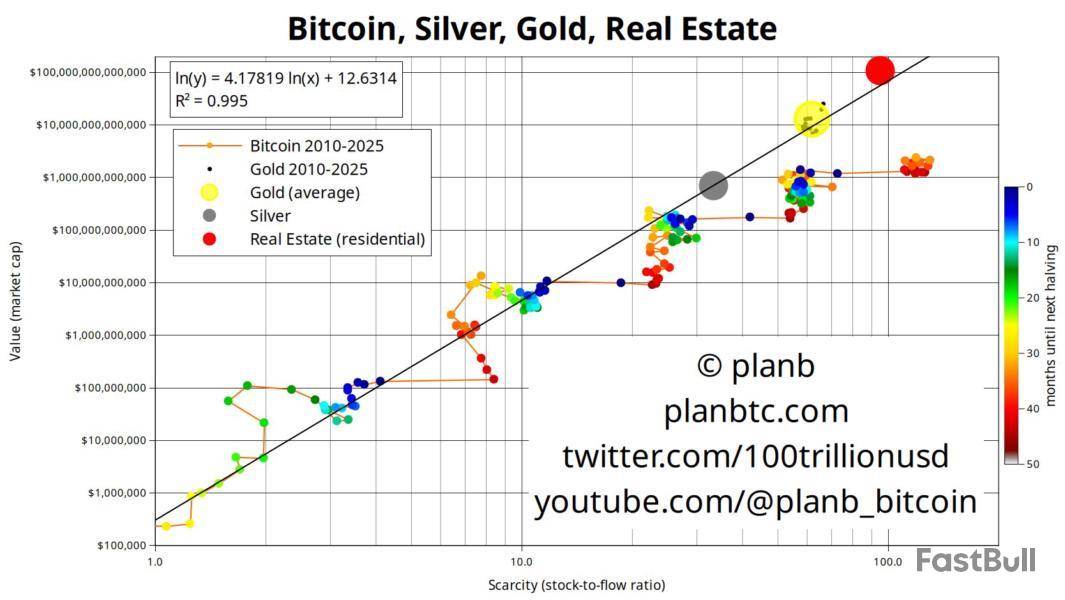
“Gold scarcity, the stock-to-flow ratio, is about 60. Bitcoin’s scarcity is about 120. So, bitcoin is 2x scarcer than gold,” according to PlanB, the creator of the Bitcoin stock-to-flow price analysis model.
The difficulty adjustment makes Bitcoin’s price inelastic to production, which is kept proportional to the total computing power deployed by miners.
Adjusting difficulty prevents overproduction and subsequent price collapses due to new supply being dumped on the market in large quantities over a short period of time.
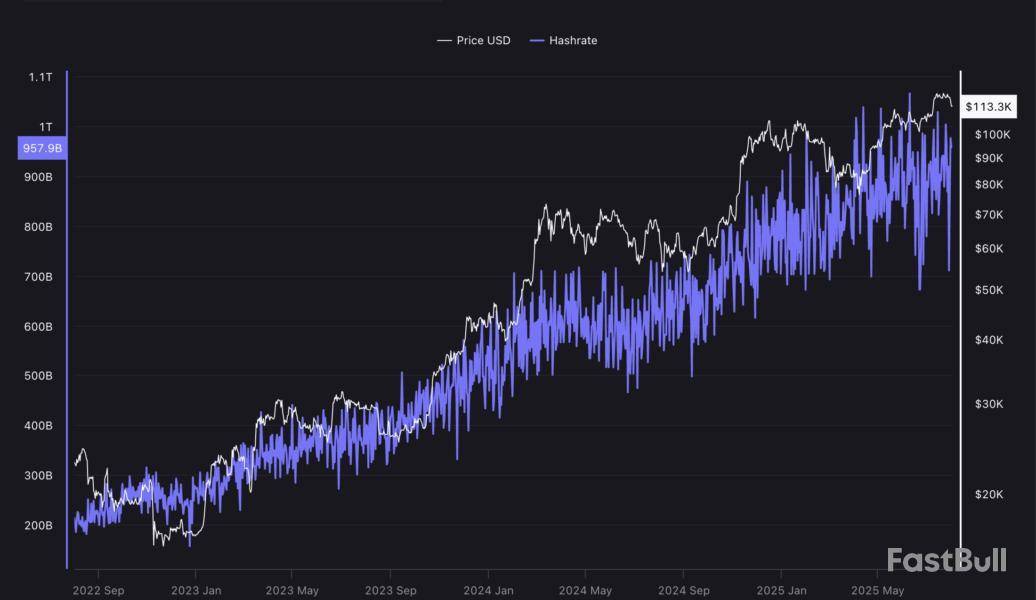
As more computing power is deployed to secure the Bitcoin network, the difficulty rises to match the new computing resources, keeping block production as close to the protocol’s 10-minute target as possible.
Conversely, if computing power drops, the network difficulty adjusts down to ensure new blocks are mined at a steady pace of about 10 minutes.
The risk of loss in trading financial instruments such as stocks, FX, commodities, futures, bonds, ETFs and crypto can be substantial. You may sustain a total loss of the funds that you deposit with your broker. Therefore, you should carefully consider whether such trading is suitable for you in light of your circumstances and financial resources.
No decision to invest should be made without thoroughly conducting due diligence by yourself or consulting with your financial advisors. Our web content might not suit you since we don't know your financial conditions and investment needs. Our financial information might have latency or contain inaccuracy, so you should be fully responsible for any of your trading and investment decisions. The company will not be responsible for your capital loss.
Without getting permission from the website, you are not allowed to copy the website's graphics, texts, or trademarks. Intellectual property rights in the content or data incorporated into this website belong to its providers and exchange merchants.
Not Logged In
Log in to access more features
Log In
Sign Up