
Markets
News
Analysis
User
24/7
Economic Calendar
Education
Data
- Names
- Latest
- Prev


Signal Accounts for Members
All Signal Accounts
All Contests


France Industrial Output MoM (SA) (Oct)A:--
F: --
France Trade Balance (SA) (Oct)A:--
F: --
Euro Zone Employment YoY (SA) (Q3)A:--
F: --
Canada Part-Time Employment (SA) (Nov)A:--
F: --
P: --
Canada Unemployment Rate (SA) (Nov)A:--
F: --
P: --
Canada Full-time Employment (SA) (Nov)A:--
F: --
P: --
Canada Labor Force Participation Rate (SA) (Nov)A:--
F: --
P: --
Canada Employment (SA) (Nov)A:--
F: --
P: --
U.S. PCE Price Index MoM (Sept)A:--
F: --
P: --
U.S. Personal Income MoM (Sept)A:--
F: --
P: --
U.S. Core PCE Price Index MoM (Sept)A:--
F: --
P: --
U.S. PCE Price Index YoY (SA) (Sept)A:--
F: --
P: --
U.S. Core PCE Price Index YoY (Sept)A:--
F: --
P: --
U.S. Personal Outlays MoM (SA) (Sept)A:--
F: --
U.S. 5-10 Year-Ahead Inflation Expectations (Dec)A:--
F: --
P: --
U.S. Real Personal Consumption Expenditures MoM (Sept)A:--
F: --
U.S. Weekly Total Rig CountA:--
F: --
P: --
U.S. Weekly Total Oil Rig CountA:--
F: --
P: --
U.S. Consumer Credit (SA) (Oct)A:--
F: --
China, Mainland Foreign Exchange Reserves (Nov)A:--
F: --
P: --
Japan Trade Balance (Oct)A:--
F: --
P: --
Japan Nominal GDP Revised QoQ (Q3)A:--
F: --
P: --
China, Mainland Imports YoY (CNH) (Nov)A:--
F: --
P: --
China, Mainland Exports (Nov)A:--
F: --
P: --
China, Mainland Imports (CNH) (Nov)A:--
F: --
P: --
China, Mainland Trade Balance (CNH) (Nov)A:--
F: --
P: --
China, Mainland Exports YoY (USD) (Nov)A:--
F: --
P: --
China, Mainland Imports YoY (USD) (Nov)A:--
F: --
P: --
Germany Industrial Output MoM (SA) (Oct)A:--
F: --
Euro Zone Sentix Investor Confidence Index (Dec)A:--
F: --
P: --
Canada National Economic Confidence Index--
F: --
P: --
U.K. BRC Like-For-Like Retail Sales YoY (Nov)--
F: --
P: --
U.K. BRC Overall Retail Sales YoY (Nov)--
F: --
P: --
Australia Overnight (Borrowing) Key Rate--
F: --
P: --
RBA Rate Statement
RBA Press Conference
Germany Exports MoM (SA) (Oct)--
F: --
P: --
U.S. NFIB Small Business Optimism Index (SA) (Nov)--
F: --
P: --
Mexico 12-Month Inflation (CPI) (Nov)--
F: --
P: --
Mexico Core CPI YoY (Nov)--
F: --
P: --
Mexico PPI YoY (Nov)--
F: --
P: --
U.S. Weekly Redbook Index YoY--
F: --
P: --
U.S. JOLTS Job Openings (SA) (Oct)--
F: --
P: --
China, Mainland M1 Money Supply YoY (Nov)--
F: --
P: --
China, Mainland M0 Money Supply YoY (Nov)--
F: --
P: --
China, Mainland M2 Money Supply YoY (Nov)--
F: --
P: --
U.S. EIA Short-Term Crude Production Forecast For The Year (Dec)--
F: --
P: --
U.S. EIA Natural Gas Production Forecast For The Next Year (Dec)--
F: --
P: --
U.S. EIA Short-Term Crude Production Forecast For The Next Year (Dec)--
F: --
P: --
EIA Monthly Short-Term Energy Outlook
U.S. API Weekly Gasoline Stocks--
F: --
P: --
U.S. API Weekly Cushing Crude Oil Stocks--
F: --
P: --
U.S. API Weekly Crude Oil Stocks--
F: --
P: --
U.S. API Weekly Refined Oil Stocks--
F: --
P: --
South Korea Unemployment Rate (SA) (Nov)--
F: --
P: --
Japan Reuters Tankan Non-Manufacturers Index (Dec)--
F: --
P: --
Japan Reuters Tankan Manufacturers Index (Dec)--
F: --
P: --
Japan Domestic Enterprise Commodity Price Index MoM (Nov)--
F: --
P: --
Japan Domestic Enterprise Commodity Price Index YoY (Nov)--
F: --
P: --
China, Mainland PPI YoY (Nov)--
F: --
P: --
China, Mainland CPI MoM (Nov)--
F: --
P: --


No matching data
Latest Views
Latest Views
Trending Topics
Top Columnists
Latest Update
White Label
Data API
Web Plug-ins
Affiliate Program
View All

No data
You can also read this news on COINTURK NEWS: Bitcoin Climbs Past $106,000: What’s Next in the Crypto World? Bitcoin , the largest cryptocurrency, saw its price slip below $100,000 over the w
Bitcoin , the largest cryptocurrency, saw its price slip below $100,000 over the weekend but quickly rebounded above $106,000. Analysts note that the latest drop stopping at $97,000 might trigger a response reaching up to $110,000. According to 10x Research, despite $63 billion entering the market in 2024, Bitcoin has only risen by 13% since the start of the year, indicating that it is no longer reacting as strongly as in previous cycles. Investors are adapting to lower volatility by shifting their capital into a smaller number of major cryptocurrencies. On the macroeconomic front, following the Federal Reserve’s surprise 50 basis point rate cut last September, inflation has remained stable at 2.4% for three months, with unemployment steady at 4.2%. As markets await the July 15 CPI data, the $97,000 support is closely watched as the potential last dip level.
The $97,000 level on the chart is defined as the “last entry zone” and is considered a strong response area for buyers. While the psychological support at $100,000 remains, it is now regarded as a “minor support”. If the price fails to hold above this threshold, the $97,000 level might be tested. The consolidation range between $100,000 and $106,000 suggests that large-scale breakouts may remain limited until mid-July.
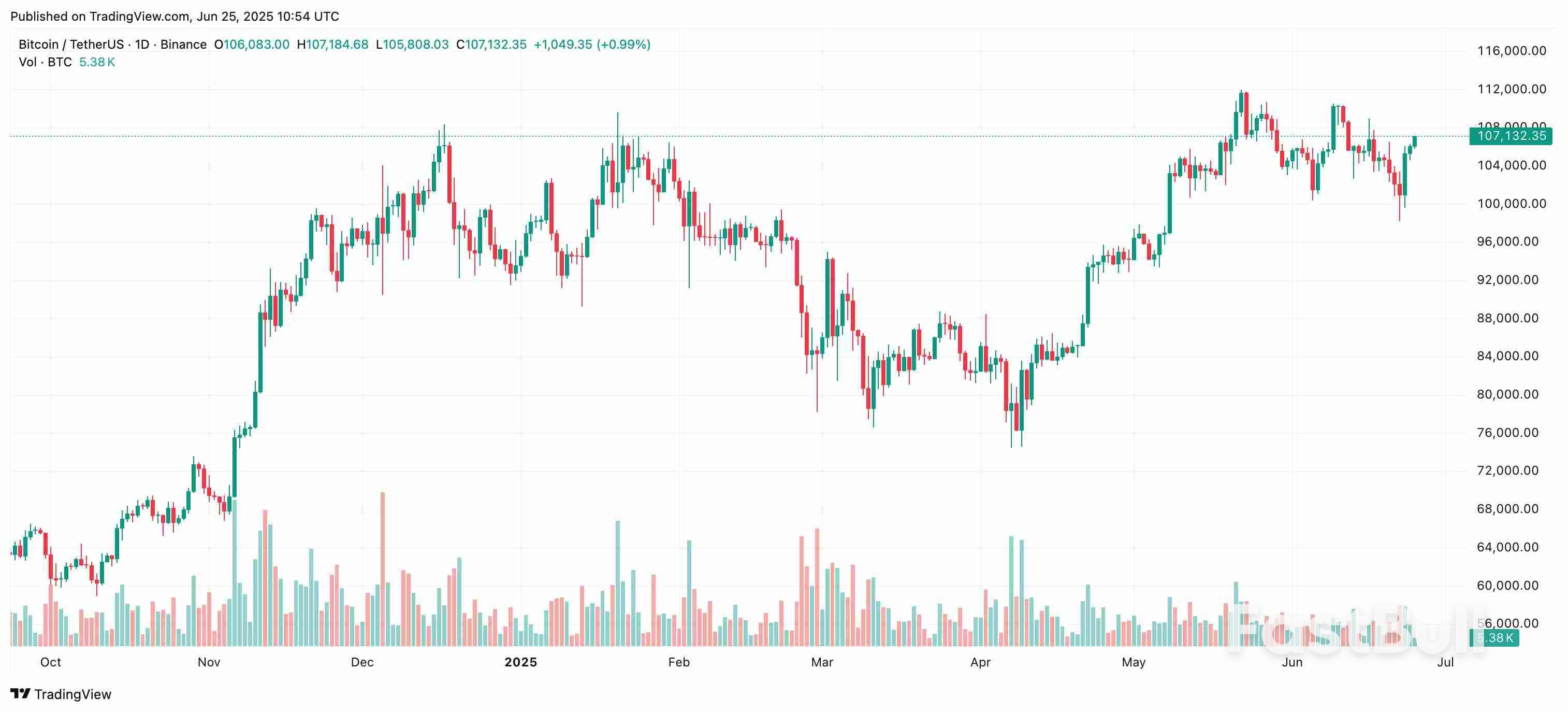
On the resistance side, the $106,000 level serves as the first recovery point after the weekend drop. Analyst Astronomer indicates that if the price sustains above this, the target would be $110,000. This level stands out as the initial major barrier for a price surge, provided the $97,000 support holds. It is often reminded that weekend lows tend to be retested, suggesting that despite short-term volatility, there is a cautious optimism in the broader trend.
Despite billions of dollars flowing into Bitcoin ETFs in 2024, the price remaining muted indicates that “positioning style over money” is coming to the forefront. According to 10x Research, as volatility decreases, investors are moving away from leverage and into major cryptocurrencies. This approach dampens the upward momentum in the short term.
Following last year’s surprise interest rate cut by the Fed, the increase in bond yields reflected the market’s questioning of this decision. However, the stabilization of inflation at 2.4% and unchanged unemployment rates bolster the “soft landing” scenario. In the geopolitical arena, the Israel-Iran ceasefire supports risk appetite and contributed to Bitcoin rising to $106,000 earlier in the week. Nonetheless, investors appear cautious until the arrival of the July CPI data.
As liquidity inflows continue, the true direction of the price will be determined by macro data as well as how market participants adapt to this low volatility environment. Stable ETF flows, the addition of cryptocurrencies to corporate balance sheets, and growth in the stablecoin market are being monitored as supportive factors for an upward trend.
The European Commission finally revealed how it’s planning to react to the likelihood of an additional 10% baseline tariff from the US on EU exports remaining in place.
“We will need to retaliate and rebalance in some key sectors if the US insists on an asymmetrical deal,” the EU’s industry chief, Stephane Sejourne, told Bloomberg this week.
For many in Brussels, the big question for weeks has been how to respond to what they see as US President Donald Trump’s push for an unbalanced deal.
That’s been the backdrop for the commission’s accelerated talks with American counterparts to reach a negotiated solution to the tariff dispute before the July 9 deadline. If not, most European goods face the prospect of a debilitating 50% levy.
But while EU trade chief Maros Sefcovic said that talks have progressed at pace, the Trump administration has continued to insist in closed-door discussions on an agreement that the Europeans view as one-sided favoring Washington.
Many European officials expect that some tariffs will remain, including the 10% baseline. Those sectoral tariffs are based on Trump’s so-called 232 authority, which is expected to be deployed against more industries such as pharmaceuticals and semiconductors.
One of the sectors hurt by US duties will be the civil aviation industry, and Toulouse-based Airbus can’t be subject to “unfair competition” from Boeing, the French commissioner said, because the European aircraft maker faces the 10% tariff. Airbus is arguably the primary example of the success of the bloc’s industrial cooperation.
“If we don’t rebalance, we would leave some leading sectors unprotected,” Sejourne said.
The EU’s executive arm is already preparing an arsenal featuring not “countermeasures” but “rebalancing” measures.
Sejourne, who’s been on the offensive to protect European interests versus Trump’s industrial charges, made clear that the EU will play smart and act in those sectors where there’s a clear economic interest.
But the commission will need to rally member states into a new reality of higher tariffs imposed by an unpredictable American president who sees Europe as more of an obstacle to his domestic goals than a partner.
Pakistan and the U.S. have resolved to conclude trade talks next week, the South Asian nation said on Wednesday after a meeting between its Finance Minister Muhammad Aurangzeb and U.S. Commerce Secretary Howard Lutnick.
The negotiations, focused on reciprocal tariffs, are part of a broader push to reset economic ties at a time of shifting geopolitical alignments and Pakistan’s efforts to avoid steep U.S. duties on exports.
“Both sides showed satisfaction on the ongoing negotiations and resolved to conclude the trade negotiations next week,” Pakistan's finance ministry said in a statement, adding that a longer-term strategic and investment partnership is also under discussion.
Pakistan faces a 29% tariff on exports to the U.S. under President Donald Trump’s measures to target countries with large trade surpluses with the U.S.
Pakistan’s surplus was around $3 billion in 2024.
To offset the imbalance and ease tariff pressures, Islamabad has offered to import more U.S. goods, including crude oil, and to open up investment opportunities through concessions for U.S. firms in Pakistan's mining sector.
Earlier this week, the two countries co-hosted a webinar promoting investment in Pakistan’s mineral sector, including the $7 billion Reko Diq copper-gold project.
Senior officials from both governments and U.S. investors discussed public-private partnerships and regulatory reforms.
The U.S. Export-Import Bank is reviewing financing proposals worth $500 million to $1 billion in Reko Diq.
Trump, who hosted Pakistan's army chief Field Marshal Asim Munir at the White House last week, has earlier said trade helped avert a deeper conflict between Pakistan and India.
Following Bitcoin’s drop below the $100,000 mark over the weekend, fresh narratives are surfacing about where the top crypto might be headed next. Despite more than $63 billion flowing into the crypto market in 2024, Bitcoin has only managed a modest 13% gain year-to-date, raising questions about what’s holding back the top cryptocurrency.
According to 10x Research, the usual catalysts such as ETF inflows, stablecoin activity, and corporate accumulation are in play, yet Bitcoin is no longer reacting the way it did during last year’s rally. Unlike the booming reaction in 2024, Bitcoin is now behaving differently, suggesting something deeper is shifting.
| Level | Price | Type | Description |
| Resistance | $110,000 | Bullish Target | Next key upside level if $97K support holds; seen as a potential rebound zone. |
| Resistance | $106,000 | Recovery Level | BTC has bounced to this level after the weekend dip; signals renewed interest. |
| Neutral | $100,000 – $106,000 | Consolidation Zone | BTC may range between these levels until CPI or macro catalysts emerge. |
| Support | $100,000 | Psychological Support | Former key level now acting as minor support after the recent drop. |
| Support | $97,000 | Key Entry Point | Closely watched as a final dip zone; considered a solid re-entry point. |
Instead of sparking a big rally, 10x Research says traders are showing their bullishness in quieter ways. They’re adapting to lower market volatility and putting their money into fewer top coins. This shift in strategy might be slowing down Bitcoin’s short-term gains, even though there’s still plenty of money flowing into the market.
The report also revisits the Fed’s surprise 50 bps rate cut in September 2024, which was met with skepticism. Bond yields surged, indicating investors weren’t convinced it was the right move. Meanwhile, inflation, which dropped from 3.5% in April 2024 to a stable 2.4%, has remained steady for three straight months. However, the expert’s warnings that tariffs would reignite inflation have so far proven inaccurate.
Meanwhile, unemployment has held steady at 4.2% for nearly a year, defying recession fears. With macro fundamentals stabilizing and the Fed’s tone becoming more dovish, many expected a stronger Bitcoin rally. Yet, the market seems to be waiting for clearer signals.
With inflation steady and liquidity still flowing, all eyes are now on the July 15 CPI report as the next big market catalyst. 10x Research hints that Bitcoin’s next move may depend less on money flowing in and more on how market participants continue to adapt to these changing geopolitical and financial scenarios.
Looking at the current sentiment, Analyst Astronomer suggests the decline may not be over yet, with a possible final dip before the price bounces back. The $97,000 zone is being watched closely as a key level for buyers to re-enter the market.
If support holds, Bitcoin could aim for a rebound toward $110,000. Weekend lows tend to be retested, and with sentiment shifting following a ceasefire deal between Israel and Iran, Bitcoin has already climbed back to $106,000.
This geopolitical development, along with improving market mood, has brought renewed buying interest. The overall outlook remains cautiously bullish, with investors eyeing $97,000 as a solid entry point if another dip happens.
The euro’s latest rally is approaching a pivotal level that could either stall its momentum or unlock the next leg toward $1.20, a target strategists and traders have circled for months.
After climbing as much as 1.6% in the past three days, the common currency is closing in on $1.17 — a zone that holds the heaviest notional volume in euro-bullish options so far this month, according to Depository Trust & Clearing Corporation data. That makes it a potential inflection point.
A break and hold above $1.17 could open the door for an accelerated push toward $1.20, a level last seen four years ago. If resistance holds, however, expect some profit-taking or flow-rebalancing first.
HSBC strategists increased their year-end forecast for the euro to $1.20 from $1.15 last week as they predict broad dollar weakness in the coming months. Danske Bank A/S analysts reiterated their 12-month euro forecast of $1.20 last month while Deutsche Bank AG strategists see a rally to that level by December.
The euro climbed as high as $1.1641 on Tuesday, its strongest intraday level since October 2021, as easing geopolitical tensions and softer US economic data fueled fresh demand for the common currency. The announcement of a ceasefire between Iran and Israel, along with cautious remarks from Federal Reserve Chair Jerome Powell, helped spark the latest push.
Money markets are pricing in a total of 59 basis points of Fed easing by year-end, compared with 25 basis points by the European Central Bank. The process of bringing inflation back to 2% is almost over, ECB Chief Economist Philip Lane said Tuesday, despite some remaining price pressures.
Options markets suggest investors retain conviction in a stronger euro. Risk reversals — which reflect the difference in pricing between bullish and bearish bets — jumped Tuesday by the fourth-largest margin in more than three years, signaling a decisive return of bullish sentiment. The shift followed a brief period in which the dollar found support from rising oil prices.
The broader picture remains constructive. DTCC data shows more than 60% of notional euro options volume this month has favored calls. The euro was trading little changed near $1.1610 on Wednesday.
White Label
Data API
Web Plug-ins
Poster Maker
Affiliate Program
The risk of loss in trading financial instruments such as stocks, FX, commodities, futures, bonds, ETFs and crypto can be substantial. You may sustain a total loss of the funds that you deposit with your broker. Therefore, you should carefully consider whether such trading is suitable for you in light of your circumstances and financial resources.
No decision to invest should be made without thoroughly conducting due diligence by yourself or consulting with your financial advisors. Our web content might not suit you since we don't know your financial conditions and investment needs. Our financial information might have latency or contain inaccuracy, so you should be fully responsible for any of your trading and investment decisions. The company will not be responsible for your capital loss.
Without getting permission from the website, you are not allowed to copy the website's graphics, texts, or trademarks. Intellectual property rights in the content or data incorporated into this website belong to its providers and exchange merchants.
Not Logged In
Log in to access more features

FastBull Membership
Not yet
Purchase
Log In
Sign Up