
Markets
News
Analysis
User
24/7
Economic Calendar
Education
Data
- Names
- Latest
- Prev


Signal Accounts for Members
All Signal Accounts
All Contests


U.K. Trade Balance Non-EU (SA) (Oct)A:--
F: --
P: --
U.K. Trade Balance (Oct)A:--
F: --
P: --
U.K. Services Index MoMA:--
F: --
P: --
U.K. Construction Output MoM (SA) (Oct)A:--
F: --
P: --
U.K. Industrial Output YoY (Oct)A:--
F: --
P: --
U.K. Trade Balance (SA) (Oct)A:--
F: --
P: --
U.K. Trade Balance EU (SA) (Oct)A:--
F: --
P: --
U.K. Manufacturing Output YoY (Oct)A:--
F: --
P: --
U.K. GDP MoM (Oct)A:--
F: --
P: --
U.K. GDP YoY (SA) (Oct)A:--
F: --
P: --
U.K. Industrial Output MoM (Oct)A:--
F: --
P: --
U.K. Construction Output YoY (Oct)A:--
F: --
P: --
France HICP Final MoM (Nov)A:--
F: --
P: --
China, Mainland Outstanding Loans Growth YoY (Nov)A:--
F: --
P: --
China, Mainland M2 Money Supply YoY (Nov)A:--
F: --
P: --
China, Mainland M0 Money Supply YoY (Nov)A:--
F: --
P: --
China, Mainland M1 Money Supply YoY (Nov)A:--
F: --
P: --
India CPI YoY (Nov)A:--
F: --
P: --
India Deposit Gowth YoYA:--
F: --
P: --
Brazil Services Growth YoY (Oct)A:--
F: --
P: --
Mexico Industrial Output YoY (Oct)A:--
F: --
P: --
Russia Trade Balance (Oct)A:--
F: --
P: --
Philadelphia Fed President Henry Paulson delivers a speech
Canada Building Permits MoM (SA) (Oct)A:--
F: --
P: --
Canada Wholesale Sales YoY (Oct)A:--
F: --
P: --
Canada Wholesale Inventory MoM (Oct)A:--
F: --
P: --
Canada Wholesale Inventory YoY (Oct)A:--
F: --
P: --
Canada Wholesale Sales MoM (SA) (Oct)A:--
F: --
P: --
Germany Current Account (Not SA) (Oct)A:--
F: --
P: --
U.S. Weekly Total Rig CountA:--
F: --
P: --
U.S. Weekly Total Oil Rig CountA:--
F: --
P: --
Japan Tankan Large Non-Manufacturing Diffusion Index (Q4)--
F: --
P: --
Japan Tankan Small Manufacturing Outlook Index (Q4)--
F: --
P: --
Japan Tankan Large Non-Manufacturing Outlook Index (Q4)--
F: --
P: --
Japan Tankan Large Manufacturing Outlook Index (Q4)--
F: --
P: --
Japan Tankan Small Manufacturing Diffusion Index (Q4)--
F: --
P: --
Japan Tankan Large Manufacturing Diffusion Index (Q4)--
F: --
P: --
Japan Tankan Large-Enterprise Capital Expenditure YoY (Q4)--
F: --
P: --
U.K. Rightmove House Price Index YoY (Dec)--
F: --
P: --
China, Mainland Industrial Output YoY (YTD) (Nov)--
F: --
P: --
China, Mainland Urban Area Unemployment Rate (Nov)--
F: --
P: --
Saudi Arabia CPI YoY (Nov)--
F: --
P: --
Euro Zone Industrial Output YoY (Oct)--
F: --
P: --
Euro Zone Industrial Output MoM (Oct)--
F: --
P: --
Canada Existing Home Sales MoM (Nov)--
F: --
P: --
Euro Zone Total Reserve Assets (Nov)--
F: --
P: --
U.K. Inflation Rate Expectations--
F: --
P: --
Canada National Economic Confidence Index--
F: --
P: --
Canada New Housing Starts (Nov)--
F: --
P: --
U.S. NY Fed Manufacturing Employment Index (Dec)--
F: --
P: --
U.S. NY Fed Manufacturing Index (Dec)--
F: --
P: --
Canada Core CPI YoY (Nov)--
F: --
P: --
Canada Manufacturing Unfilled Orders MoM (Oct)--
F: --
P: --
Canada Manufacturing New Orders MoM (Oct)--
F: --
P: --
Canada Core CPI MoM (Nov)--
F: --
P: --
Canada Manufacturing Inventory MoM (Oct)--
F: --
P: --
Canada CPI YoY (Nov)--
F: --
P: --
Canada CPI MoM (Nov)--
F: --
P: --
Canada CPI YoY (SA) (Nov)--
F: --
P: --
Canada Core CPI MoM (SA) (Nov)--
F: --
P: --


No matching data
Latest Views
Latest Views
Trending Topics
Top Columnists
Latest Update
White Label
Data API
Web Plug-ins
Affiliate Program
View All

No data
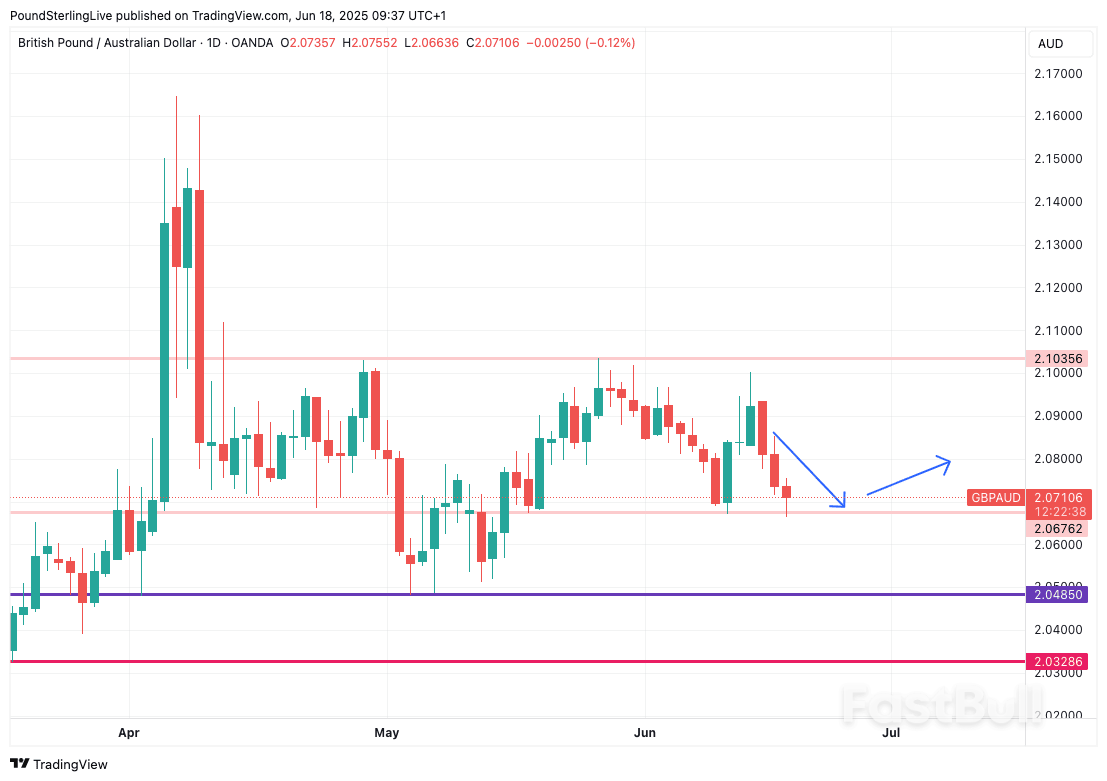
Trade-related risks for AUD are set to re-emerge as key deadlines approach.
It started with her neighbor frantically knocking on her front door panicking at the sound of explosions. Then she taped her windows to prevent them from shattering and packed an emergency backpack.
By Tuesday, Neda was on a gridlocked highway, joining thousands of other Tehranis trying to flee the Iranian capital. Their aim was to find somewhere more remote where they wouldn’t be near any of the hundreds of sites that Israel might target.
“My biggest fear is the uncertainty and the ambiguity of it all,” Neda, 35, said by social media chat from a suburb on the outskirts of northern Tehran. “Will this go on for a week or for eight years? Will we have to keep on improvising life one day at a time?”
For the past five days, Israel has subjected Iran to its worst military attack since the Islamic Republic was invaded by neighboring Iraq in 1980. What’s clear in the metropolis of 10 million people, is that people don’t expect things to be the same again in a country whose leadership is hobbled and its economy shattered.
A snapshot of the mood among people contacted in Tehran suggests they expect the regime will be weakened further, but it won’t be toppled. Neda, for one, said she’s no supporter of the Iranian leadership, but right now her ire is directed at Israeli Prime Minister Benjamin Netanyahu.
Whenever the conflict ends, though, major reforms will be inevitable, said Cyrus Razzaghi, president and chief executive of Tehran-based consultancy Ara Enterprise.
That firstly would mean an overhaul of a fragmented intelligence apparatus that’s repeatedly failed to intercept clandestine Israeli operations on Iranian soil that include successive, audacious strikes killing the country’s top military and security officials.
“The Islamic Republic won’t emerge from this conflict unchanged,” Razzaghi said. “Even if regime change is unlikely in the near term, significant internal shifts are expected once the dust settles.”
US President Donald Trump’s increasingly bellicose rhetoric — on Tuesday he told Iranians to evacuate Tehran and demanded surrender — is fanning concerns that the US will join Israel’s assault. Netanyahu has said he is targeting the establishment of the Islamic Republic, not just its nuclear facilities, which he’s threatened to strike for years.
He’s appealed directly to the Iranian public, encouraging them to see his attack as an opportunity for them to oust their oppressive rulers. His military offensive has so far killed 224 Iranians, most of them civilians, according to Iran’s government.
Supreme Leader Ali Khamenei and the Islamist system of rule that he’s fortified around himself have faced unprecedented levels of unpopularity in recent years. They’ve been challenged by some of the biggest protests since the 1979 Islamic Revolution. Their demands have been ignored and the authorities have mostly doubled down on their intolerance for any dissent.
But for now, it’s Netanyahu who is the target of the anger among Iranians.
“I can’t talk for most people but I can talk about most of the people I’m in contact with and I’m certain they share this feeling I have, that with every word he says I feel this boiling rage inside of me,” Neda said of Israel’s prime minister. “My deep hatred for him is increasing.”
Khamenei’s removal could make Iran more confrontational as younger, more ideological officials rise through the ranks of various institutions and try to project the country’s strength, according to Dina Esfandiary, a Middle East analyst at Bloomberg Economics. Targeting Khamenei would also bolster the surge of nationalistic feeling that has begun to emerge since Israel’s strikes, she wrote.
The question is whether that feeling is enough to offset the deep polarization that’s afflicted Iran for years and the anger with which many view the powerful clerical-military cadre that controls the country.
At the moment, there are some sure signs of stubborn resistance. A news anchor of Iranian state television, for example, was heralded by the government for continuing to broadcast during a bombing raid as smoke and dust filled the studio.
But with an economy battered by years of trade embargoes, sanctions and endemic mismanagement, any patience left could quickly run out. Nazanine, a 55-year-old finance officer at a marketing company, is appalled by Netanyahu, though has opposed the Iranian leadership for years. “My hatred for Netanyahu and the Islamic Republic is the same,” she said. “I’m sick of them both.”
An Israeli and Western intelligence assessment seen by Bloomberg suggested that the war could lead to an economic collapse and inflation of 80%, if not higher. That, according to the report, would likely social discontent and challenge the stability of the ruling regime.
Currently Iran’s inflation rate is around 43%, one of the highest in the world, according to the International Monetary Fund. Underscoring a reliance on petrodollars, the country needs an oil price of $163 a barrel — more than double’s today’s level of around $75 — to balance its budget, according to calculations by the Fund.
There are already signs of pain. Since Friday, the rial has weakened more than 10% against the dollar on the black market, according to bonbast.com, a site that tracks the currency’s street value.
For Nazanine, the first task is to confront the shock of having to flee her city. She lives in a wealthy northern Tehran neighborhood that’s been targeted several times by Israel. Her apartment overlooks the now bombed out multistory residence of top Khamenei aide, Ali Shamkhani.
Shamkhani survived the attack and is being treated in hospital, the state-run Nour News reported on Monday without giving details of his injuries.
“I was awake when it all happened,” she said from the relative safety of the countryside on the outskirts of Tehran. “It feels like a real war.”
The latest economic data reveals a slight decrease in the number of initial jobless claims filed in the United States. The actual number of individuals who filed for unemployment insurance for the first time during the past week was 245,000.
This figure is notably lower than the forecasted 246,000 jobless claims predicted by economic analysts. The dip in initial jobless claims, although marginal, is seen as a positive sign, indicating a stronger labor market and a potentially more robust economy.
Comparing the actual number of initial jobless claims to the previous week’s data, there is a noticeable decrease. The previous week saw 250,000 individuals filing for unemployment insurance for the first time. This week’s figure of 245,000 represents a decrease of 5,000 claims, or 2% from the previous week.
Initial Jobless Claims is one of the earliest U.S. economic data indicators, providing insights into the health of the labor market. While the market impact of this data varies from week to week, a lower than expected reading is generally taken as positive or bullish for the USD. Conversely, a higher than expected reading is considered negative or bearish for the USD.
The slight decrease in initial jobless claims suggests that fewer people are losing their jobs, which could indicate improving business conditions. However, economists will be keeping a close eye on these figures in the coming weeks to determine if this is a one-off occurrence or part of a broader trend towards a strengthening labor market.
In conclusion, the actual number of initial jobless claims for this week came in lower than both the forecasted and previous week’s figures. This data, while only a single indicator, offers a cautiously optimistic outlook for the U.S. labor market and, by extension, the overall economy.
Tuesday marked the 250th anniversary of the Battle of Bunker Hill, where an American officer ostensibly told the revolutionary forces not to fire against the British until the “whites of their eyes” were visible.
Something similar may be characterizing the Federal Reserve and its wait for confidence that tariff hikes won’t feed through to inflation. For the fourth straight policy meeting on Wednesday, Chair Jerome Powell and his colleagues are expected to hold fire on rate cuts.
While the hard data have, to the surprise of many, failed to show any broad upswing in prices from Trump’s jacked-up import duties, policymakers and private economists alike expect that to materialize at some point. The question then would be whether the impact would be transitory. After flubbing its call on transitory inflation in 2021, the Fed is naturally loath to make the same mistake twice.
“The wait-and-see approach has served them well up until this point,” said Brett Ryan, senior US economist at Deutsche Bank AG. “Why deviate from it now when there’s no pressing reason to do so and with still upside risk to the inflation outlook?”
Last week’s consumer price index report made, arguably, for a tough messaging assignment for Powell in his Wednesday press briefing. The core gauge, which excludes food and energy costs, rose by 0.1% — a figure entirely matching the Fed’s price-stability target. It was the fourth consecutive month that prices undershot forecasts and suggested policymakers had finally achieved the “soft landing.”
“At the moment, the key question is whether the lack of a powerful economic response so far to tariff increases means that the fallout will be less than expected or will simply hit a month or two later originally expected,” Stephen Stanley, chief economist at Santander US Capital Markets, wrote in a note. (He said he’s in the latter camp.)
The Fed’s key document to watch Wednesday will be the Summary of Economic Projections. That’ll contain the first update to Fed officials’ estimates for growth, inflation, unemployment and interest rates since Trump announced his “reciprocal” tariffs in April.
Last time, Fed policymakers penciled in two rate cuts by year-end, and investors will be on watch to see whether that median forecast gets pared back to just one.
With the conflict involving Iran putting about a fifth of global crude supply at risk, Bloomberg Economics has taken a look at the implications should the price of oil jump to $100 a barrel, after having crossed $70.
Crude prices have topped $100 for a sustained period once before, starting in 2011. Any such move now would prove less impactful than then, Jamie Rush, director of global economics, wrote Tuesday. There are at least two factors to consider. First, the oil intensity of GDP has dropped — taking the US as an example, it’s fallen by about about a quarter since 2011. Second, the relative cost of oil compared with everything else has gone down.
“The amount of oil burned to produce the goods and services we consume has fallen dramatically in recent decades,” Rush says. And on the second point, “what matters to businesses and consumers is not the dollar cost of oil, but what you have to give up to buy it,” he says. “If the general level of prices and energy usage had been the same in 2011 as they are now in the US, $100 oil would have felt more like $54 oil.”
The U.S. and European Union are running out of time to strike a deal on trade tariffs — and analysts say several key sticking points could make an agreement impossible.
Negotiations have been slow since both the U.S. and EU temporarily cut duties on each other until July 9. If a deal is not agreed by then, full reciprocal import tariffs of 50% on EU goods, and the bloc's wide-spanning countermeasures are set to come into effect.
"We're talking, but I don't feel that they're offering a fair deal yet," U.S. President Donald Trump told reporters Tuesday, further dashing hopes of an imminent agreement.
So what's holding things up between the two sides, which had a relationship worth 1.68 trillion euros ($1.93 trillion) in 2024?
One bone of contention flagged by experts was the EU's regulation of especially Big Tech companies. The bloc has faced regular criticism from the U.S. after imposing landmark rules on tech giants regarding transparency, competition and moderation.
"Trump's administration actively seeks to use trade negotiations to force the EU to capitulate and weaken the regulatory environment," Alberto Rizzi, policy fellow at the European Council on Foreign Relations, told CNBC.
"However, to Europeans any interference into its domestic regulation of digital platforms is not acceptable and would run counter to its commitment to fight disinformation and hate speech," he added.
Philip Luck, director of the economics program at the Center for Strategic and International Studies (CSIS), echoed the concerns, but said the EU could potentially surrender some ground without undermining their principles.
But the parties "haven't gotten down to that level of conversation yet," he said.
Taxes are another major area of disagreement between the U.S. and the EU, Rizzi said, noting that Trump sees tariffs as accounting for supposedly unfair taxes placed on U.S. companies and goods by European countries.
That includes so-called value-added taxes, or VAT, which are levied on each stage of the supply chain as a product's value changes. While very common globally, the U.S. doesn't operate VAT, and Trump has billed it as a trade barrier — and a justification for tariffs.
"However, the EU value-added tax treats domestic and foreign goods exactly in the same way and in Europeans' eyes, taxation is a purely domestic issue that should not be part of any trade discussion," Rizzi said. "Taxation is a red line for the EU in trade discussions."
A much broader issue between Washington and Brussels appears to be a fundamental lack of trust and alignment on negotiations and their goal.
Jacob Kirkegaard, non-resident senior fellow with the Peterson Institute for International Economics, went as far as saying that "there's only really one sticking point, which is that Trump wants tariffs on the EU, and the EU is not having it."
CSIS's Luck struck a similar tone, flagging that, philosophically, the U.S. and EU have starkly different views going into the talks.
"This [U.S.] administration views these negotiations through a lens of how partners can concede to concessions to help us. They do not view this as a traditional reciprocal trade conversation, where we give something and they give something," he explained.
The EU has a much more traditional view, he said, as demonstrated by its zero-for-zero tariffs suggestion — which faced pushback from the White House.
European politicians are "proud people who think of themselves as being on a equal footing to the United States" who can't make "constant" concessions, nor do they feel like they should have to, Luck said.
The U.S. appears unlikely to accept a zero-for-zero agreement or one where tariffs are lowered for both parties, Luck said.
It's also doubtful the EU can secure a deal like the U.K., which agreed to certain quotas and tariffs on some critical sectors.
That's because firstly, the bloc would likely not accept similar conditions to the U.K., Luck added, but also "because this [U.S.] administration has much bigger, sort of fundamental complaints about European policy."
He does, however, see a scenario where the EU may agree to a lower tariff, such as the 10% currently in place — but only because it has to.
Rizzi also suggested that perhaps a "limited deal that scales back or freezes tariffs on specific sectors" could happen. But, he noted, this does not mean a broad agreement is imminent.
"I'm very skeptical that a deal will happen," Kirkegaard, who is also a senior fellow at Bruegel, said.
"I think it is much more likely that there's no deal, the EU then retaliates, and then we'll have to see whether Trump does with what he did with China: that he retaliates again, and maybe the EU retaliates again."
He warned that de-escalation — and a deal — might only be possible when a certain, very high, threshold of economic pain is met.
White Label
Data API
Web Plug-ins
Poster Maker
Affiliate Program
The risk of loss in trading financial instruments such as stocks, FX, commodities, futures, bonds, ETFs and crypto can be substantial. You may sustain a total loss of the funds that you deposit with your broker. Therefore, you should carefully consider whether such trading is suitable for you in light of your circumstances and financial resources.
No decision to invest should be made without thoroughly conducting due diligence by yourself or consulting with your financial advisors. Our web content might not suit you since we don't know your financial conditions and investment needs. Our financial information might have latency or contain inaccuracy, so you should be fully responsible for any of your trading and investment decisions. The company will not be responsible for your capital loss.
Without getting permission from the website, you are not allowed to copy the website's graphics, texts, or trademarks. Intellectual property rights in the content or data incorporated into this website belong to its providers and exchange merchants.
Not Logged In
Log in to access more features

FastBull Membership
Not yet
Purchase
Log In
Sign Up