• Trade
  • Markets
  • Copy
  • Contests
  • News
  • 24/7
  • Calendar
  • Q&A
  • Chats
Trending
Screeners
SYMBOL
LAST
BID
ASK
HIGH
LOW
NET CHG.
%CHG.
SPREAD
SPX
S&P 500 Index
6855.86
6855.86
6855.86
6861.30
6847.07
+28.45
+ 0.42%
--
DJI
Dow Jones Industrial Average
48612.61
48612.61
48612.61
48679.14
48557.21
+154.57
+ 0.32%
--
IXIC
NASDAQ Composite Index
23304.58
23304.58
23304.58
23345.56
23265.18
+109.42
+ 0.47%
--
USDX
US Dollar Index
97.830
97.910
97.830
98.070
97.810
-0.120
-0.12%
--
EURUSD
Euro / US Dollar
1.17561
1.17568
1.17561
1.17596
1.17262
+0.00167
+ 0.14%
--
GBPUSD
Pound Sterling / US Dollar
1.33946
1.33954
1.33946
1.33961
1.33546
+0.00239
+ 0.18%
--
XAUUSD
Gold / US Dollar
4332.37
4332.78
4332.37
4350.16
4294.68
+32.98
+ 0.77%
--
WTI
Light Sweet Crude Oil
56.914
56.944
56.914
57.601
56.789
-0.319
-0.56%
--

Community Accounts

Signal Accounts
--
Profit Accounts
--
Loss Accounts
--
View More

Become a signal provider

Sell trading signals to earn additional income

View More

Guide to Copy Trading

Get started with ease and confidence

View More

Signal Accounts for Members

All Signal Accounts

Best Return
  • Best Return
  • Best P/L
  • Best MDD
Past 1W
  • Past 1W
  • Past 1M
  • Past 1Y

All Contests

  • All
  • Trump Updates
  • Recommend
  • Stocks
  • Cryptocurrencies
  • Central Banks
  • Featured News
Top News Only
Share

The Nasdaq Golden Dragon China Index Fell 0.9% In Early Trading

Share

The S&P 500 Opened 32.78 Points Higher, Or 0.48%, At 6860.19; The Dow Jones Industrial Average Opened 136.31 Points Higher, Or 0.28%, At 48594.36; And The Nasdaq Composite Opened 134.87 Points Higher, Or 0.58%, At 23330.04

Share

Miran: Goods Inflation Could Be Settling In At A Higher Level Than Was Normal Before The Pandemic, But That Will Be More Than Offset By Housing Disinflation

Share

Miran, Who Dissented In Favor Of A Larger Cut At Last Fed Meeting, Repeats Keeping Policy Too Tight Will Lead To Job Losses

Share

Miran: Does Not Think Higher Goods Inflation Is Mostly From Tariffs, But Acknowledges Does Not Have A Full Explanation For It

Share

Toronto Stock Index .GSPTSE Rises 67.16 Points, Or 0.21 Percent, To 31594.55 At Open

Share

Miran: Excluding Housing And Non-Market Based Items, Core Pce Inflation May Be Below 2.3%, “Within Noise” Of The Fed's 2% Target

Share

Polish State Assets Minister Balczun Says Jsw Needs Over USD 830 Million Financing To Keep Liquidity For A Year

Share

Miran: Prices Are “Once Again Stable” And Monetary Policy Should Reflect That

Share

Fed's Miran: Current Excess Inflation Is Not Reflective Of Underlying Supply And Demand In The Economy

Share

Portugal Treasury Puts 2026 Net Financing Needs At 13 Billion Euros, Up From 10.8 Billion In 2025

Share

Portugal Treasury Expects 2026 Net Financing Needs At 29.4 Billion Euros, Up From 25.8 Billion In 2025

Share

Bank Of America Says With Indonesia's Smelter Now Ramping Up, It Expects Aluminium Supply Growth To Accelerate To 2.6% Year On Year In 2026

Share

Bank Of America Expects A Deficit In Aluminium Next Year And Sees Prices Pushing Above $3000/T

Share

Fed Data - USA Effective Federal Funds Rate At 3.64 Percent On 12 December On $102 Billion In Trades Versus 3.64 Percent On $99 Billion On 11 December

Share

Brazil's Petrobras Says No Impact Seen On Oil, Petroleum Products Output As Workers Start Planned Strike

Share

Statement: US Travel Group Warns New Proposed Trump Administration Requirements For Foreign Tourists To Provide Social Media Histories Could Mean Millions Of People Opting Not To Visit

Share

Blackrock: Kerry White Will Become Head Of Citi Investment Management At Citi Wealth

Share

Blackrock: Rob Jasminski, Head Of Citi Investment Management, Has Joined With Team

Share

Blackrock: Effective Dec 15, Citi Investment Management Employees Will Join Blackrock

TIME
ACT
FCST
PREV
Japan Tankan Small Manufacturing Outlook Index (Q4)

A:--

F: --

P: --

Japan Tankan Large Non-Manufacturing Outlook Index (Q4)

A:--

F: --

P: --

Japan Tankan Large Manufacturing Outlook Index (Q4)

A:--

F: --

P: --

Japan Tankan Small Manufacturing Diffusion Index (Q4)

A:--

F: --

P: --

Japan Tankan Large Manufacturing Diffusion Index (Q4)

A:--

F: --

P: --

Japan Tankan Large-Enterprise Capital Expenditure YoY (Q4)

A:--

F: --

P: --

U.K. Rightmove House Price Index YoY (Dec)

A:--

F: --

P: --

China, Mainland Industrial Output YoY (YTD) (Nov)

A:--

F: --

P: --

China, Mainland Urban Area Unemployment Rate (Nov)

A:--

F: --

P: --

Saudi Arabia CPI YoY (Nov)

A:--

F: --

P: --

Euro Zone Industrial Output YoY (Oct)

A:--

F: --

P: --

Euro Zone Industrial Output MoM (Oct)

A:--

F: --

P: --

Canada Existing Home Sales MoM (Nov)

A:--

F: --

P: --

Canada National Economic Confidence Index

A:--

F: --

P: --

Canada New Housing Starts (Nov)

A:--

F: --

P: --
U.S. NY Fed Manufacturing Employment Index (Dec)

A:--

F: --

P: --

U.S. NY Fed Manufacturing Index (Dec)

A:--

F: --

P: --

Canada Core CPI YoY (Nov)

A:--

F: --

P: --

Canada Manufacturing Unfilled Orders MoM (Oct)

A:--

F: --

P: --

U.S. NY Fed Manufacturing Prices Received Index (Dec)

A:--

F: --

P: --

U.S. NY Fed Manufacturing New Orders Index (Dec)

A:--

F: --

P: --

Canada Manufacturing New Orders MoM (Oct)

A:--

F: --

P: --

Canada Core CPI MoM (Nov)

A:--

F: --

P: --

Canada Trimmed CPI YoY (SA) (Nov)

A:--

F: --

P: --

Canada Manufacturing Inventory MoM (Oct)

A:--

F: --

P: --

Canada CPI YoY (Nov)

A:--

F: --

P: --

Canada CPI MoM (Nov)

A:--

F: --

P: --

Canada CPI YoY (SA) (Nov)

A:--

F: --

P: --

Canada Core CPI MoM (SA) (Nov)

A:--

F: --

P: --

Canada CPI MoM (SA) (Nov)

A:--

F: --

P: --

Federal Reserve Board Governor Milan delivered a speech
U.S. NAHB Housing Market Index (Dec)

--

F: --

P: --

Australia Composite PMI Prelim (Dec)

--

F: --

P: --

Australia Services PMI Prelim (Dec)

--

F: --

P: --

Australia Manufacturing PMI Prelim (Dec)

--

F: --

P: --

Japan Manufacturing PMI Prelim (SA) (Dec)

--

F: --

P: --

U.K. 3-Month ILO Employment Change (Oct)

--

F: --

P: --

U.K. Unemployment Claimant Count (Nov)

--

F: --

P: --

U.K. Unemployment Rate (Nov)

--

F: --

P: --

U.K. 3-Month ILO Unemployment Rate (Oct)

--

F: --

P: --

U.K. Average Weekly Earnings (3-Month Average, Including Bonuses) YoY (Oct)

--

F: --

P: --

U.K. Average Weekly Earnings (3-Month Average, Excluding Bonuses) YoY (Oct)

--

F: --

P: --

France Services PMI Prelim (Dec)

--

F: --

P: --

France Composite PMI Prelim (SA) (Dec)

--

F: --

P: --

France Manufacturing PMI Prelim (Dec)

--

F: --

P: --

Germany Services PMI Prelim (SA) (Dec)

--

F: --

P: --

Germany Manufacturing PMI Prelim (SA) (Dec)

--

F: --

P: --

Germany Composite PMI Prelim (SA) (Dec)

--

F: --

P: --

Euro Zone Composite PMI Prelim (SA) (Dec)

--

F: --

P: --

Euro Zone Services PMI Prelim (SA) (Dec)

--

F: --

P: --

Euro Zone Manufacturing PMI Prelim (SA) (Dec)

--

F: --

P: --

U.K. Services PMI Prelim (Dec)

--

F: --

P: --

U.K. Manufacturing PMI Prelim (Dec)

--

F: --

P: --

U.K. Composite PMI Prelim (Dec)

--

F: --

P: --

Euro Zone ZEW Economic Sentiment Index (Dec)

--

F: --

P: --

Germany ZEW Current Conditions Index (Dec)

--

F: --

P: --

Germany ZEW Economic Sentiment Index (Dec)

--

F: --

P: --

Euro Zone Trade Balance (Not SA) (Oct)

--

F: --

P: --

Euro Zone ZEW Current Conditions Index (Dec)

--

F: --

P: --

Euro Zone Trade Balance (SA) (Oct)

--

F: --

P: --

U.S. Retail Sales MoM (Excl. Automobile) (SA) (Oct)

--

F: --

P: --

Q&A with Experts
    • All
    • Chatrooms
    • Groups
    • Friends
    Connecting
    .
    .
    .
    Type here...
    Add Symbol or Code

      No matching data

      All
      Trump Updates
      Recommend
      Stocks
      Cryptocurrencies
      Central Banks
      Featured News
      • All
      • Russia-Ukraine Conflict
      • Middle East Flashpoint
      • All
      • Russia-Ukraine Conflict
      • Middle East Flashpoint
      Search
      Products

      Charts Free Forever

      Chats Q&A with Experts
      Screeners Economic Calendar Data Tools
      Membership Features
      Data Warehouse Market Trends Institutional Data Policy Rates Macro

      Market Trends

      Market Sentiment Order Book Forex Correlations

      Top Indicators

      Charts Free Forever
      Markets

      News

      News Analysis 24/7 Columns Education
      From Institutions From Analysts
      Topics Columnists

      Latest Views

      Latest Views

      Trending Topics

      Top Columnists

      Latest Update

      Signals

      Copy Rankings Latest Signals Become a signal provider AI Rating
      Contests
      Brokers

      Overview Brokers Assessment Rankings Regulators News Claims
      Broker listing Forex Brokers Comparison Tool Live Spread Comparison Scam
      Q&A Complaint Scam Alert Videos Tips to Detect Scam
      More

      Business
      Events
      Careers About Us Advertising Help Center

      White Label

      Data API

      Web Plug-ins

      Affiliate Program

      Awards Institution Evaluation IB Seminar Salon Event Exhibition
      Vietnam Thailand Singapore Dubai
      Fans Party Investment Sharing Session
      FastBull Summit BrokersView Expo
      Recent Searches
        Top Searches
          Markets
          News
          Analysis
          User
          24/7
          Economic Calendar
          Education
          Data
          • Names
          • Latest
          • Prev

          View All

          No data

          Scan to Download

          Faster Charts, Chat Faster!

          Download App
          English
          • English
          • Español
          • العربية
          • Bahasa Indonesia
          • Bahasa Melayu
          • Tiếng Việt
          • ภาษาไทย
          • Français
          • Italiano
          • Türkçe
          • Русский язык
          • 简中
          • 繁中
          Open Account
          Search
          Products
          Charts Free Forever
          Markets
          News
          Signals

          Copy Rankings Latest Signals Become a signal provider AI Rating
          Contests
          Brokers

          Overview Brokers Assessment Rankings Regulators News Claims
          Broker listing Forex Brokers Comparison Tool Live Spread Comparison Scam
          Q&A Complaint Scam Alert Videos Tips to Detect Scam
          More

          Business
          Events
          Careers About Us Advertising Help Center

          White Label

          Data API

          Web Plug-ins

          Affiliate Program

          Awards Institution Evaluation IB Seminar Salon Event Exhibition
          Vietnam Thailand Singapore Dubai
          Fans Party Investment Sharing Session
          FastBull Summit BrokersView Expo

          A Divided Fed? Trump’s Influence Raises Fears of Supreme Court-Style Partisanship

          Gerik

          Economic

          Summary:

          Political tensions are reshaping the internal dynamics of the U.S. Federal Reserve. With President Trump pressuring for rate cuts and attempting to appoint loyalists, analysts warn the Fed may start resembling the ideologically split Supreme Court marked by dissent, politicization...

          Trump’s Second Term Reignites Political Friction with the Fed

          Since returning to the Oval Office, President Trump has resumed his combative stance toward the Federal Reserve, pushing for aggressive rate cuts and harshly criticizing Chair Jerome Powell. His threats to remove Governor Lisa Cook and her refusal to resign amid unproven accusations illustrate a deepening rift between the executive branch and the traditionally independent central bank.
          The latest catalyst: Trump’s appointment of Stephen Miran, a vocal critic of Fed independence, to replace outgoing Governor Adriana Kugler. Miran, known for co-authoring a 2024 paper advocating reforms to reduce the Fed’s autonomy, reflects Trump’s broader strategy to reshape the Fed from within.

          The Court Analogy: Governors Staying Longer to Block Opposing Agendas

          According to Ian Katz at Capital Alpha Partners, the Fed is starting to resemble the U.S. Supreme Court not just in ideological division but also in strategic tenure. Traditionally, Fed governors step down before their 14-year terms end. But now, some may remain until a president from their own party returns to power a tactic reminiscent of justices waiting for a sympathetic White House to name their replacement.
          Lisa Cook, for example, was appointed by President Biden and is entitled to serve until 2038. She now faces open hostility from Trump officials, including threats of termination. Yet her resolve to stay signals a new era where governors entrench themselves to protect institutional independence.
          Similarly, Jerome Powell’s future is uncertain. Though his chairmanship ends in May 2026, his governor role extends until January 2028. Treasury Secretary Scott Bessent has called on him to resign after his term as chair ends, citing tradition. Powell has declined to comment, maintaining strategic ambiguity.

          Why This Matters: Rate Decisions, Governance, and Regional Fed Control

          While three Trump-appointed governors won’t tilt policy decisions on the 12-member Federal Open Market Committee (FOMC) which includes regional Fed presidents a fourth appointment would give Trump a majority on the seven-member Board of Governors. That shift could influence key areas such as budget allocation, staffing, and the approval of regional Fed presidents.
          In February 2026, the five-year terms of all regional Fed presidents expire. A Trump-controlled board could reshape leadership at regional banks, which have voting roles on the FOMC allowing the White House to subtly tilt rate-setting decisions toward dovish, growth-favoring policies.

          Consensus at Risk: Unanimous Rate Decisions Could Become Rare

          Historically, Fed rate decisions are marked by near-unanimous votes. Even one dissent is rare. But that pattern may be changing. In July, two Trump-appointed governors broke ranks, voting for rate cuts despite the broader FOMC holding rates steady. A similar split is anticipated in the upcoming September meeting, as Powell cautiously signaled openness to easing, but hawkish voices remain notably Kansas City Fed President Jeffrey Schmid.
          This dissent mirrors the ideological fissures of the Supreme Court, where 5-4 decisions are the norm. If the Fed becomes similarly fractured, it could inject uncertainty into markets and weaken the perception of central bank neutrality.

          An Existential Risk to the Fed’s Independence?

          Analysts at JPMorgan warn that Miran’s appointment could pose an “existential threat” to the Federal Reserve. If Trump pursues legislative changes to the Federal Reserve Act, the very structure and autonomy of the institution could be altered transforming the Fed from an apolitical body into a partisan battlefield.
          Whoever succeeds Powell as Fed Chair in 2026 will face a more divided board and a politically charged environment. Like the Chief Justice of the Supreme Court, the Fed Chair is only one vote yet their leadership, persuasion skills, and ability to broker consensus will be tested like never before.
          As Trump continues his campaign to mold the Fed in his image, the central bank’s future independence, credibility, and cohesion may hang in the balance.

          Source: Fortune

          To stay updated on all economic events of today, please check out our Economic calendar
          Risk Warnings and Disclaimers
          You understand and acknowledge that there is a high degree of risk involved in trading. Following any strategies or investment methods may lead to potential losses. The content on the site is provided by our contributors and analysts for information purposes only. You are solely responsible for determining whether any trading assets, securities, strategy, or any other product is suitable for investing based on your own investment objectives and financial situation.
          Add to Favorites
          Share

          Fitch Maintains Its Rating on India, Citing Strong Growth

          Michelle

          Economic

          (Aug 25): Credit-rating firm Fitch on Monday maintained its long-term foreign-currency issuer default rating on India at 'BBB-', citing the country's strong economic growth and resilient external finances.

          "India's economic outlook remains strong relative to peers, even as momentum has moderated in the past two years," Fitch said in a statement.

          The agency forecast GDP growth of 6.5% for the fiscal year ending March 2026 (FY26), unchanged from FY25, and well above the 'BBB' median of 2.5%.

          Fitch's rating comes days after S&P Global Ratings lifted its sovereign credit rating on India, citing strong economic growth, marking its first upgrade in 18 years.

          Economic Affairs Secretary Anuradha Thakur had then said she expects other rating agencies to take note of the factors behind S&P's upgrade and follow suit.

          Domestic demand will remain "solid" helped by the government's ongoing capital spending drive and steady private consumption, Fitch said, but flagged that private investment will remain moderate due to risks from US tariffs.

          US President Donald Trump has threatened to double tariffs on Indian goods to 50% — among the highest rates imposed on Washington's trade partners — targeting India's oil purchases from Russia. The 50% tariffs are set to kick in from Aug 27.

          "US tariffs are a moderate downside risk to our forecast," Fitch said, adding that they will reduce India's ability to benefit from supply chain shifts out of China if tariff levels fail to be negotiated lower.

          "Proposed goods and services tax (GST) reforms, if adopted, would support consumption, offsetting some of these growth risks," Fitch added, referring to the tax restructuring promises made by Indian Prime Minister Narendra Modi earlier this month.

          Source: Theedgemarkets

          To stay updated on all economic events of today, please check out our Economic calendar
          Risk Warnings and Disclaimers
          You understand and acknowledge that there is a high degree of risk involved in trading. Following any strategies or investment methods may lead to potential losses. The content on the site is provided by our contributors and analysts for information purposes only. You are solely responsible for determining whether any trading assets, securities, strategy, or any other product is suitable for investing based on your own investment objectives and financial situation.
          Add to Favorites
          Share

          Can the U.S. Sustain Public Debt at 250% of GDP Without Raising Interest Rates?

          Gerik

          Economic

          Research Suggests Room for More U.S. Debt But with Caveats

          At the 2025 Jackson Hole economic symposium, a group of prominent economists Adrien Auclert (Stanford), Hannes Malmberg (University of Minnesota), Matthew Rognlie (Northwestern), and Ludwig Straub (Harvard) unveiled a provocative scenario: the United States could theoretically sustain public debt levels as high as 250% of GDP in the long run without driving up interest rates.
          This projection comes amid growing political tension over America’s fiscal path, especially following the July passage of the “One Big Beautiful Bill Act,” a sweeping Republican-backed law that expands government spending. As of late 2024, publicly held federal debt had already reached 97% of GDP.

          Demographics vs. Debt Supply

          The authors argue that the interplay between an aging population and government borrowing is at the heart of this dynamic. As people live longer and seek secure investment options like U.S. Treasurys, the demand for government debt rises. This rising appetite for safe assets particularly among retirees could offset the inflationary pressure of increasing debt issuance.
          In this “base case” scenario, interest rates could remain stable despite higher debt, so long as fiscal discipline remains intact and reforms are implemented gradually over time.

          Warning Signs for Delayed Action

          However, the research warns of a tipping point: if fiscal policy does not adjust in time, the supply of government debt could exceed market demand. That imbalance would force the Treasury to offer higher yields to attract investors, pushing interest rates up and raising debt-servicing costs for the government.
          To avoid such a scenario, the authors estimate the government would need to implement fiscal adjustments equivalent to at least 10% of GDP. If these reforms are delayed or absent, public debt could become unsustainable beyond the year 2100.

          Official Forecasts Reflect Growing Concerns

          The U.S. Congressional Budget Office (CBO), in its January report, projected that the debt-to-GDP ratio would rise to 117% by 2034. Following the enactment of the new law, the CBO revised its projections upward by an additional 9.5 percentage points.
          In presenting the findings at Jackson Hole, Professor Ludwig Straub emphasized that the model accounts for long-term trajectories, not just current political dynamics. The paper introduces a nuanced understanding of how structural demographic changes and financial behavior can influence fiscal sustainability, even under high-debt conditions.
          The study challenges traditional assumptions that skyrocketing debt must inevitably lead to higher interest rates. Instead, it suggests that investor behavior and demographic shifts can moderate these effects provided the government makes timely and substantial fiscal adjustments. In short, it's not just how much debt the U.S. holds, but how it manages that debt that will define future financial stability.
          To stay updated on all economic events of today, please check out our Economic calendar
          Risk Warnings and Disclaimers
          You understand and acknowledge that there is a high degree of risk involved in trading. Following any strategies or investment methods may lead to potential losses. The content on the site is provided by our contributors and analysts for information purposes only. You are solely responsible for determining whether any trading assets, securities, strategy, or any other product is suitable for investing based on your own investment objectives and financial situation.
          Add to Favorites
          Share

          Global Stock Exchanges Call for Regulatory Action on Tokenised Stocks

          Gerik

          Economic

          Stocks

          Tokenised Stocks Under Scrutiny

          Tokenised stocks digital tokens on blockchains that simulate ownership of traditional equities are drawing growing interest from crypto platforms and fintech innovators. While these tokens promise benefits such as lower trading costs, faster settlement, and 24/7 accessibility, they have sparked concern from traditional stock exchanges worldwide.
          In a formal letter to the U.S. Securities and Exchange Commission (SEC), the European Securities and Markets Authority (ESMA), and the International Organization of Securities Commissions (IOSCO), the World Federation of Exchanges (WFE) called for immediate regulatory intervention. The WFE argues that these tokens pose systemic risks by misleading investors and undermining the legal framework that governs traditional securities.

          Lack of Rights and Safeguards

          Unlike conventional shares, tokenised stocks do not confer legal ownership of the underlying asset. Investors buying these tokens do not gain voting rights, dividend entitlements, or shareholder protections. The WFE warned that the distinction is often blurred in marketing, potentially misleading retail investors into believing they hold actual equity.
          “These products are marketed as stock tokens or the equivalent to stocks when they are not,” the WFE wrote. The group expressed alarm at the growing number of brokers and crypto platforms including but not limited to Coinbase and Robinhood offering or planning to offer tokenised U.S. stocks.

          Reputational Risks for Issuers

          The exchanges also emphasized that companies whose stocks are mimicked could face reputational fallout if a platform offering their tokens collapses or engages in unethical conduct. According to WFE CEO Nandini Sukumar, several issuers have already raised such concerns directly with their exchanges.
          Beyond market reputation, the issue raises deeper concerns about regulatory arbitrage and the fragmentation of investor protection standards across jurisdictions. The WFE is pushing for a harmonized global approach to ensure tokenised stocks are subject to the same rules as conventional securities.

          Regulatory Momentum Building

          The SEC has already hinted at stronger oversight. In July, a commissioner reaffirmed that tokenised securities must comply with existing securities laws. Meanwhile, Robinhood has rolled out tokenised equity offerings in the European Union, and Coinbase is reportedly seeking SEC approval for similar products in the U.S.
          WFE’s letter strengthens the case for immediate regulatory clarity. The group insists regulators must establish legal frameworks governing token ownership, apply traditional securities rules, and prohibit marketing these tokens as stock equivalents unless they confer genuine shareholder rights.
          The emergence of tokenised equities highlights the tension between fintech innovation and established market infrastructure. While offering potential efficiency gains, these digital instruments risk undermining investor protections and destabilizing public trust in securities markets if left unchecked. The call from global exchanges marks a critical inflection point in the debate over what constitutes a security in the digital age and how best to regulate it.

          Source: Reuters

          To stay updated on all economic events of today, please check out our Economic calendar
          Risk Warnings and Disclaimers
          You understand and acknowledge that there is a high degree of risk involved in trading. Following any strategies or investment methods may lead to potential losses. The content on the site is provided by our contributors and analysts for information purposes only. You are solely responsible for determining whether any trading assets, securities, strategy, or any other product is suitable for investing based on your own investment objectives and financial situation.
          Add to Favorites
          Share

          Euro Rallies Against Dollar After Powell’s Cautious Jackson Hole Speech

          Blue River

          Technical Analysis

          The euro strengthened against the US dollar on Friday following a speech by Federal Reserve Chair Jerome Powell at the Jackson Hole Economic Symposium, closing the week on a positive note. While Powell acknowledged the potential for an interest rate cut as soon as September, he refrained from making any explicit commitments.

          The EUR/USD pair rose to 1.1728, reaching its highest level since 28 July.

          Market expectations for a rate cut at the Fed’s September meeting (16–17) now stand at 85%. For the remainder of the year, market pricing points to a more dovish outlook, with an average of 54 basis points of easing anticipated, up from 48 basis points previously.

          Investor attention is now shifting to labour market data. Powell noted that the market is in an unusual balance, with both demand for and supply of workers slowing. The trajectory of employment will be a key determinant for the Fed’s future policy decisions.

          An additional factor weighing on the dollar is the growing scrutiny surrounding the Fed’s independence. Last week, US President Donald Trump called for the resignation of Federal Reserve Governor Lisa Cook and suggested she could be dismissed. This has further fuelled concerns about political pressure being exerted on the central bank.

          Technical Analysis: EUR/USD

          H4 Chart:

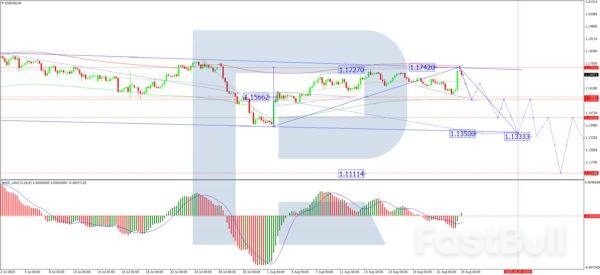
          On the H4 chart, the market has formed a consolidation range around the 1.1566 level. Following an upward breakout, the corrective wave appears to have completed at the 1.1742 high. The primary focus is now on the potential initiation of a new bearish wave targeting the 1.1550 level. This scenario is technically supported by the MACD indicator, whose signal line remains below zero and is pointing decisively lower.

          H1 Chart:

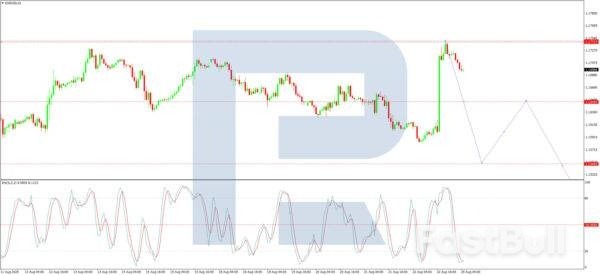
          On the H1 chart, the market completed an ascending wave to the 1.1742 level and subsequently formed a consolidation range below it. The price has now broken downwards out of this range. The immediate outlook suggests a high probability of a further decline towards the 1.1664 support level. Following this, a corrective bounce towards 1.1694 is possible. The broader structure is then expected to resume its downward trajectory, targeting 1.1590, with the ultimate bearish objective for the wave structure seen at 1.1550. This view is corroborated by the Stochastic oscillator, whose signal line is currently below the 50 midline and is trending sharply lower towards the 20 level.

          Conclusion

          While fundamental drivers from the Fed provided a lift, the technical picture suggests the euro’s rally may be limited in the near term.

          Source: ACTIONFOREX

          Risk Warnings and Disclaimers
          You understand and acknowledge that there is a high degree of risk involved in trading. Following any strategies or investment methods may lead to potential losses. The content on the site is provided by our contributors and analysts for information purposes only. You are solely responsible for determining whether any trading assets, securities, strategy, or any other product is suitable for investing based on your own investment objectives and financial situation.
          Add to Favorites
          Share

          Thailand’s Exports Beat July Forecasts but Tariff Risks Loom Large

          Gerik

          Economic

          Solid July Numbers Offer Temporary Boost

          Thailand’s export sector delivered an 11% increase in July compared to a year earlier, outperforming the Reuters poll forecast of 9.6%. This performance, however, marked a slowdown from June’s 15.5% surge, suggesting momentum was already beginning to taper off. The Ministry of Commerce attributed the strong July figures to accelerated shipping activity before new U.S. tariffs on Thai goods were enforced.
          For the January–July period, exports grew by a robust 14.4%, providing a buffer to the full-year forecast. Despite the upbeat seven-month tally, the ministry remains cautious, holding to its annual export growth projection of just 2% to 3%. Officials noted that while the strong early-year performance may boost the yearly outcome, double-digit export growth for 2025 is unlikely.

          Tariffs Disrupt Growth Outlook

          The core challenge facing Thailand’s trade outlook is the new 19% tariff imposed by the U.S. on a broad range of Thai exports. While lower than the initially announced 36%, the tariff still poses significant headwinds. Many importers rushed orders ahead of the new policy, inflating short-term figures but pulling demand forward at the expense of future months.
          Trade Policy and Strategy Office chief Poonpong Naiyanapakorn stressed that the export sector would likely lose steam in the final five months of the year as the artificial bump from front-loaded shipments fades.
          Adding complexity, uncertainties linger regarding U.S. enforcement on transshipments goods exported from third countries via Thailand which could further weigh on trade if restrictions tighten.

          Key Markets Still Active

          Despite looming barriers, Thailand’s exports to the U.S. in July soared by 31.4% year-on-year, reinforcing America’s role as Thailand’s top trade partner, accounting for 18.3% of exports last year. Shipments to China, another critical market, also jumped 23.1%, reflecting resilient regional demand even amid global trade tensions.
          Imports rose 5.1% in July, slightly above expectations, signaling that domestic demand and production-related purchases remain healthy. More notably, the trade balance showed a surplus of $320 million, a sharp contrast to the expected $500 million deficit. This suggests exporters’ pre-tariff activity outpaced import needs, temporarily boosting the trade account.
          Thailand’s stronger-than-expected July exports offer a short-term reprieve, but the broader outlook remains clouded by geopolitical trade shifts and tariff uncertainties. While the annual growth target remains within reach, the possibility of a sharper-than-expected downturn looms, especially if demand from major partners such as the U.S. weakens under the weight of trade restrictions. The second half of 2025 will test Thailand’s export resilience in a more protectionist global environment.

          Source: Reuters

          To stay updated on all economic events of today, please check out our Economic calendar
          Risk Warnings and Disclaimers
          You understand and acknowledge that there is a high degree of risk involved in trading. Following any strategies or investment methods may lead to potential losses. The content on the site is provided by our contributors and analysts for information purposes only. You are solely responsible for determining whether any trading assets, securities, strategy, or any other product is suitable for investing based on your own investment objectives and financial situation.
          Add to Favorites
          Share

          Oil Prices Edge Up As Traders Mull Supply Risks

          Dark Current

          Economic

          Commodity

          Oil prices climbed on Monday as traders weighed concerns that Russian supply could be disrupted by more U.S. sanctions and Ukrainian attacks targeting energy infrastructure in Russia.

          Brent crude futures rose 29 cents, or 0.4%, to $68.02 at 0839 GMT, and West Texas Intermediate (WTI) crude futures gained 36 cents, or 0.6%, to $64.02.

          "The market is somewhat concerned that these peace negotiations are going nowhere," said Ole Hansen, head of commodity strategy at Saxo Bank.

          "The market is looking for supply to exceed demand in the autumn months, but in the short term that's being challenged by a potential geopolitical disruption."

          U.S. President Donald Trump warned again on Friday that he would impose sanctions on Russia if there was no progress toward a peaceful settlement in Ukraine in two weeks. He has also said he may hit India with harsh tariffs over its Russian oil purchases.

          Speaking at the weekend, U.S. Vice President JD Vance said Russia had made "significant concessions" toward a negotiated settlement in the three-and-a-half year war.

          Ukraine has repeatedly targeted Russian energy infrastructure during the war, and on Sunday carried out a drone attack which sparked a huge blaze at the Ust-Luga fuel export terminal, Russian officials said.

          A fire at Russia's Novoshakhtinsk refinery, caused by a Ukrainian drone attack, was burning for the fourth day on Sunday, the region's acting governor said. The refinery sells fuel mainly for export and has an annual capacity of 5 million metric tons of oil, or about 100,000 barrels per day.

          Softening the worries about Russian supply disruptions are OPEC+'s reversal of a series of production cuts, which are adding millions of barrels to the market, Saxo Bank's Hansen said.

          Eight members of the oil exporters' group are scheduled to meet on September 7 where they are set to approve another boost.

          Investors' risk appetite improved following Federal Reserve Chair Jerome Powell's signal on Friday of a possible interest rate cut at the U.S. central bank's meeting in September.

          But despite that, both benchmark oil prices appear to lack momentum, said Priyanka Sachdeva, senior market analyst at brokerage Phillip Nova, adding that markets seem increasingly convinced that Trump's tariffs will hit economic growth.

          Source: Reuters

          To stay updated on all economic events of today, please check out our Economic calendar
          Risk Warnings and Disclaimers
          You understand and acknowledge that there is a high degree of risk involved in trading. Following any strategies or investment methods may lead to potential losses. The content on the site is provided by our contributors and analysts for information purposes only. You are solely responsible for determining whether any trading assets, securities, strategy, or any other product is suitable for investing based on your own investment objectives and financial situation.
          Add to Favorites
          Share
          FastBull
          Copyright © 2025 FastBull Ltd

          728 RM B 7/F GEE LOK IND BLDG NO 34 HUNG TO RD KWUN TONG KLN HONG KONG

          TelegramInstagramTwitterfacebooklinkedin
          App Store Google Play Google Play
          Products
          Charts

          Chats

          Q&A with Experts
          Screeners
          Economic Calendar
          Data
          Tools
          Membership
          Features
          Function
          Markets
          Copy Trading
          Latest Signals
          Contests
          News
          Analysis
          24/7
          Columns
          Education
          Company
          Careers
          About Us
          Contact Us
          Advertising
          Help Center
          Feedback
          User Agreement
          Privacy Policy
          Business

          White Label

          Data API

          Web Plug-ins

          Poster Maker

          Affiliate Program

          Risk Disclosure

          The risk of loss in trading financial instruments such as stocks, FX, commodities, futures, bonds, ETFs and crypto can be substantial. You may sustain a total loss of the funds that you deposit with your broker. Therefore, you should carefully consider whether such trading is suitable for you in light of your circumstances and financial resources.

          No decision to invest should be made without thoroughly conducting due diligence by yourself or consulting with your financial advisors. Our web content might not suit you since we don't know your financial conditions and investment needs. Our financial information might have latency or contain inaccuracy, so you should be fully responsible for any of your trading and investment decisions. The company will not be responsible for your capital loss.

          Without getting permission from the website, you are not allowed to copy the website's graphics, texts, or trademarks. Intellectual property rights in the content or data incorporated into this website belong to its providers and exchange merchants.

          Not Logged In

          Log in to access more features

          FastBull Membership

          Not yet

          Purchase

          Become a signal provider
          Help Center
          Customer Service
          Dark Mode
          Price Up/Down Colors

          Log In

          Sign Up

          Position
          Layout
          Fullscreen
          Default to Chart
          The chart page opens by default when you visit fastbull.com