Markets
News
Analysis
User
24/7
Economic Calendar
Education
Data
- Names
- Latest
- Prev


Signal Accounts for Members
All Signal Accounts
All Contests


Japan Tankan Small Manufacturing Outlook Index (Q4)A:--
F: --
P: --
Japan Tankan Large Non-Manufacturing Outlook Index (Q4)A:--
F: --
P: --
Japan Tankan Large Manufacturing Outlook Index (Q4)A:--
F: --
P: --
Japan Tankan Small Manufacturing Diffusion Index (Q4)A:--
F: --
P: --
Japan Tankan Large-Enterprise Capital Expenditure YoY (Q4)A:--
F: --
P: --
U.K. Rightmove House Price Index YoY (Dec)A:--
F: --
P: --
China, Mainland Industrial Output YoY (YTD) (Nov)A:--
F: --
P: --
China, Mainland Urban Area Unemployment Rate (Nov)A:--
F: --
P: --
Saudi Arabia CPI YoY (Nov)A:--
F: --
P: --
Euro Zone Industrial Output YoY (Oct)A:--
F: --
P: --
Euro Zone Industrial Output MoM (Oct)A:--
F: --
P: --
Canada Existing Home Sales MoM (Nov)A:--
F: --
P: --
Canada National Economic Confidence IndexA:--
F: --
P: --
Canada New Housing Starts (Nov)A:--
F: --
U.S. NY Fed Manufacturing Employment Index (Dec)A:--
F: --
P: --
U.S. NY Fed Manufacturing Index (Dec)A:--
F: --
P: --
Canada Core CPI YoY (Nov)A:--
F: --
P: --
Canada Manufacturing Unfilled Orders MoM (Oct)A:--
F: --
P: --
U.S. NY Fed Manufacturing Prices Received Index (Dec)A:--
F: --
P: --
U.S. NY Fed Manufacturing New Orders Index (Dec)A:--
F: --
P: --
Canada Manufacturing New Orders MoM (Oct)A:--
F: --
P: --
Canada Core CPI MoM (Nov)A:--
F: --
P: --
Canada Trimmed CPI YoY (SA) (Nov)A:--
F: --
P: --
Canada Manufacturing Inventory MoM (Oct)A:--
F: --
P: --
Canada CPI YoY (Nov)A:--
F: --
P: --
Canada CPI MoM (Nov)A:--
F: --
P: --
Canada CPI YoY (SA) (Nov)A:--
F: --
P: --
Canada Core CPI MoM (SA) (Nov)A:--
F: --
P: --
Canada CPI MoM (SA) (Nov)A:--
F: --
P: --
Federal Reserve Board Governor Milan delivered a speech
U.S. NAHB Housing Market Index (Dec)A:--
F: --
P: --
Australia Composite PMI Prelim (Dec)--
F: --
P: --
Australia Services PMI Prelim (Dec)--
F: --
P: --
Australia Manufacturing PMI Prelim (Dec)--
F: --
P: --
Japan Manufacturing PMI Prelim (SA) (Dec)--
F: --
P: --
U.K. 3-Month ILO Employment Change (Oct)--
F: --
P: --
U.K. Unemployment Claimant Count (Nov)--
F: --
P: --
U.K. Unemployment Rate (Nov)--
F: --
P: --
U.K. 3-Month ILO Unemployment Rate (Oct)--
F: --
P: --
U.K. Average Weekly Earnings (3-Month Average, Including Bonuses) YoY (Oct)--
F: --
P: --
U.K. Average Weekly Earnings (3-Month Average, Excluding Bonuses) YoY (Oct)--
F: --
P: --
France Services PMI Prelim (Dec)--
F: --
P: --
France Composite PMI Prelim (SA) (Dec)--
F: --
P: --
France Manufacturing PMI Prelim (Dec)--
F: --
P: --
Germany Services PMI Prelim (SA) (Dec)--
F: --
P: --
Germany Manufacturing PMI Prelim (SA) (Dec)--
F: --
P: --
Germany Composite PMI Prelim (SA) (Dec)--
F: --
P: --
Euro Zone Composite PMI Prelim (SA) (Dec)--
F: --
P: --
Euro Zone Services PMI Prelim (SA) (Dec)--
F: --
P: --
Euro Zone Manufacturing PMI Prelim (SA) (Dec)--
F: --
P: --
U.K. Services PMI Prelim (Dec)--
F: --
P: --
U.K. Manufacturing PMI Prelim (Dec)--
F: --
P: --
U.K. Composite PMI Prelim (Dec)--
F: --
P: --
Euro Zone ZEW Economic Sentiment Index (Dec)--
F: --
P: --
Germany ZEW Current Conditions Index (Dec)--
F: --
P: --
Germany ZEW Economic Sentiment Index (Dec)--
F: --
P: --
Euro Zone Trade Balance (Not SA) (Oct)--
F: --
P: --
Euro Zone ZEW Current Conditions Index (Dec)--
F: --
P: --
Euro Zone Trade Balance (SA) (Oct)--
F: --
P: --
Euro Zone Total Reserve Assets (Nov)--
F: --
P: --
U.K. Inflation Rate Expectations--
F: --
P: --


No matching data
Latest Views
Latest Views
Trending Topics
Top Columnists
Latest Update
White Label
Data API
Web Plug-ins
Affiliate Program
View All

No data
The United States and the European Union agreed on aframework trade deal, ending months of uncertainty for industries and consumers on both sides of the Atlantic.
Here are the main elements of the deal:
* Almost all EU goods entering the U.S. will be subject to a 15% baseline tariff, including cars, which currently face 27.5%, as well as semiconductors and pharmaceuticals. The 15% tariff is the maximum tariff and is not added to any existing rates.
* The U.S. is to announce the result of its 232 trade investigations in a few weeks and decide on tariff rates for the sectors under investigation. But the EU-U.S. deal already secures a 15% tariff for European chips and pharmaceuticals, so the results of the investigations will not change that, U.S. officials said. It is not yet clear, however, if the same 15% rate has been set for timber and copper, which are also under U.S. 232 investigation.
* The U.S. and EU will have zero-for-zero tariffs on all aircraft and their components, certain chemicals, certain generic drugs, semiconductor equipment, some agricultural products, natural resources and critical raw materials. More products would be added.
* The situation for wine and spirits - a point of friction on both sides of the Atlantic - is still to be established.
* Tariffs on European steel and aluminium will stay at 50%, but European Commission President Ursula von der Leyen said these would later be cut and replaced by a quota system.
* The EU pledged to make $750 billion in strategic purchases, covering oil, gas, nuclear, fuel and chips during U.S. President Donald Trump's term in office.
* The EU pledged to buy U.S. military equipment.
* European companies are to invest $600 billion in the U.S. over the course of Trump's second term. Unlike Japan’s package - which Tokyo says will consist of equity, loans and guarantees from state-run agencies of up to $550 billion to be invested at Trump's discretion - EU officials said the Europe's $600 billion investment pledge is based on private sector projects already in the pipeline.
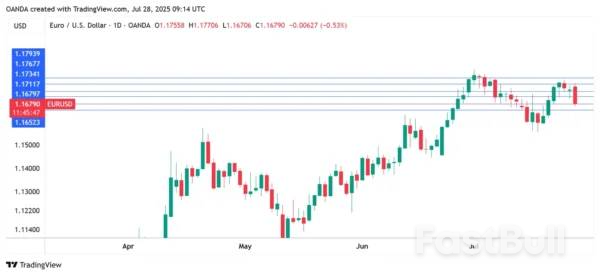
The euro is busy on Monday morning. EUR/USD started the week in positive territory and rose as much as 0.30%, but has reversed directions in the European session and is trading at 1.1677, down 0.54% on the day.
US President Trump can add another feather to his MAGA cap, with news that the European Union and the United States reached a trade agreement over the weekend. President Trump had threatened to hit the EU with 30% tariffs if a deal wasn’t reached by Aug. 1 and the specter of a nasty trade war between the largest two economies in the world has been averted.
A deal is of course good news but it’s important to keep in mind that the sides have agreed to a framework agreement, which is thin on details. Some contentious issues remain, such as the US tariff of 50% on steel and aluminum.
The deal mirrors the US-Japan agreement which was announced last week. The US will eliminate some tariffs, such as on aircraft parts and generic drugs, but most European products will face a tariff of 15%, which will make European imports more expensive for US consumers. The EU has also agreed to increase investment in the US by $600 billion and purchase $750 billion in US energy products.
The German auto industry is one of the deal’s big winners, as the 15% tariff will be easier to swallow than the current rate of 27.5%. The US-Japan deal puts a 15% tariff on Japanese motor vehicles, which would have put European automakers at a major disadvantage without a EU-US deal.
Trump is moving ahead and reaching deals with major trade partners, which is removing uncertainty and raising risk appetite. Investors are hoping that other key nations, such as Canada and South Korea, will follow soon with trade agreements with the US.

Dollar-Cost Averaging (DCA) is a popular investment strategy that involves consistently purchasing a fixed amount of an asset at regular intervals, regardless of its current market price. In the world of cryptocurrency — where volatility is the norm — DCA offers traders a way to reduce the emotional impact of price swings and potentially lower the average cost of their investment over time.
For crypto traders, DCA is especially useful in mitigating the risk of buying into the market at the wrong time. Instead of attempting to time the market, which even experienced traders struggle with, DCA encourages a steady and disciplined approach. By purchasing smaller amounts at different price points, traders can avoid the pitfalls of buying a large position during a price peak.
Let’s say a trader wants to invest $1,000 in Bitcoin. Rather than investing the entire amount in one go, they might choose to invest $100 every week for 10 weeks. If the price fluctuates during that time, the average purchase price could be lower than buying in a single lump sum at a high point. This approach helps smooth out the effects of volatility and can provide better long-term results for traders who are not trying to make quick profits.
One of the key psychological benefits of DCA is that it reduces anxiety and impulsiveness. Crypto markets are known for their dramatic price shifts, and new investors often panic during downturns or become overly enthusiastic during bull runs. With DCA, the focus shifts from short-term market movements to long-term accumulation, encouraging patience and discipline.
However, DCA is not a perfect strategy. It may lead to lower returns compared to investing a lump sum during a prolonged bull market. Also, in highly speculative altcoins with uncertain long-term prospects, DCA can magnify losses if the asset ultimately fails. Therefore, it’s important to combine DCA with solid research and sound asset selection.
In summary, Dollar-Cost Averaging is a simple yet powerful strategy for crypto traders looking to navigate market volatility. By spreading out purchases over time, traders can minimize risk, reduce emotional decision-making, and build positions with greater consistency. While not foolproof, DCA remains a valuable tool — especially for those new to crypto or looking to build wealth steadily over time.
In the end, Europe found it lacked the leverage to pull Donald Trump's America into a trade pact on its terms and so has signed up to a deal it can just about stomach - albeit one that is clearly skewed in the U.S.'s favour.
As such, Sunday's agreement on a blanket 15% tariff after a months-long stand-off is a reality check on the aspirations of the 27-country European Union to become an economic power able to stand up to the likes of the United States or China.
The cold shower is all the more bracing given that the EU has long portrayed itself as an export superpower and champion of rules-based commerce for the benefit both of its own soft power and the global economy as a whole.
For sure, the new tariff that will now be applied is a lot more digestible than the 30% "reciprocal" tariff which Trump threatened to invoke in a few days.
While it should ensure Europe avoids recession, it will likely keep its economy in the doldrums: it sits somewhere between two tariff scenarios the European Central Bank last month forecast would mean 0.5-0.9% economic growth this year compared to just over 1% in a trade tension-free environment.
But this is nonetheless a landing point that would have been scarcely imaginable only months ago in the pre-Trump 2.0 era, when the EU along with much of the world could count on U.S. tariffs averaging out at around 1.5%.
Even when Britain agreed a baseline tariff of 10% with the United States back in May, EU officials were adamant they could do better and - convinced the bloc had the economic heft to square up to Trump - pushed for a "zero-for-zero" tariff pact.
It took a few weeks of fruitless talks with their U.S. counterparts for the Europeans to accept that 10% was the best they could get and a few weeks more to take the same 15% baseline which the United States agreed with Japan last week.
"The EU does not have more leverage than the U.S., and the Trump administration is not rushing things," said one senior official in a European capital who was being briefed on last week's negotiations as they closed in around the 15% level.
That official and others pointed to the pressure from Europe's export-oriented businesses to clinch a deal and so ease the levels of uncertainty starting to hit businesses from Finland's Nokiato Swedish steelmaker SSAB.
"We were dealt a bad hand. This deal is the best possible play under the circumstances," said one EU diplomat. "Recent months have clearly shown how damaging uncertainty in global trade is for European businesses."
That imbalance - or what the trade negotiators have been calling "asymmetry" - is manifest in the final deal.
Not only is it expected the EU will call off retaliation and remain broadly open to U.S. goods on more favourable terms, but it has also pledged $600 billion of investment in the United States over the course of Trump's term in office.
As talks unfolded, it became clear that the EU came to the conclusion it had more to lose from all-out confrontation.
The retaliatory measures it threatened totalled some 93 billion euros - less than half its U.S. goods trade surplus of nearly 200 billion euros.
True, a growing number of EU capitals were also ready to envisage wide-ranging anti-coercion measures that would have allowed the bloc to target the services trade in which the United States had a surplus of some $75 billion last year.
But even then, there was no clear majority for targeting the U.S. digital services which European citizens enjoy and for which there are scant homegrown alternatives - from Netflixto Uberto Microsoftcloud services.
For now, the deal does not shift the dial significantly on the already modest near-term expectations for the European economy, which at least is seen buoyed by increased German spending on defence and infrastructure in the coming years.
"We therefore still expect a modest slowing in (euro area) growth in 2H25," said Greg Fuzesi, euro area economist at JP Morgan, who also expected the ECB to make one further rate cut on top of 200 basis points of easing over the past year.
It remains to be seen whether the lop-sided deal will prompt European leaders to push ahead with the economic reforms and diversification of trading allies to which they have long paid lip service but which have been held back by national divisions.
Describing the deal as a painful compromise that was an "existential threat" for many of its members, Germany's BGA wholesale and export association said it was time for Europe to reduce its reliance on its biggest trading partner.
"Let's look on the past months as a wake-up call," said BGA President Dirk Jandura. "Europe must now prepare itself strategically for the future - we need new trade deals with the biggest industrial powers of the world."
European companies were left wondering on Monday whether to cheer a hard-won US trade deal or lament a still sharp jump in tariffs versus those in place before President Donald Trump's second term.
A day earlier, European leaders heralded a framework trade deal with the United States that would impose a 15% import tariff on most EU goods, averting a spiralling battle between two allies which account for almost a third of global trade.
Although the deal is better than the 30% rate threatened by Trump and will bring clarity for European makers of cars, planes and chemicals, the 15% baseline tariff is well above initial hopes of a zero-for-zero agreement. It is also higher than the US import tariff rate last year of around 2.5%.
"Those who expect a hurricane are grateful for a storm," said Wolfgang Große Entrup, head of the German Chemical Industry Association VCI, calling for more talks to reduce tariffs that he said were "too high" for Europe's chemical industry.
"Further escalation has been avoided. Nevertheless, the price is high for both sides. European exports are losing competitiveness. US customers are paying the tariffs."
The deal, which also includes US$600 billion (RM2.5 trillion) of EU investments in the United States and US$750 billion of EU purchases of US energy over Trump's second term, includes some exemptions, even if details are still to be ironed out.
Carmakers Volkswagen and Stellantis, among others, will face the 15% tariff, down from 25% under the global levy imposed by Trump in April.
Stellantis shares rose 3.5% and car parts maker Valeo was up 4.7% in early trade. German pharma group Merck KGaA gained 2.9%.
Aircraft and aircraft parts will be exempt — good news for French planemaker Airbus — as will certain chemicals, some generic drugs, semiconductor equipment, some farm products, natural resources and critical raw materials.
Shares in the world's biggest chip maker ASML rose more than 4%, among the biggest gainers on the pan-European STOXX 600 index.
Dutch brewer Heineken cheered the deal, with CEO Dolf van den Brink welcoming the certainty it brought.
The world's number two brewer sends beer, especially its namesake lager, to the US from Europe and Mexico, and has also suffered from the indirect effect on consumer confidence in important markets like Brazil.
The rate on spirits that could impact firms such as Diageo, Pernod Ricard and LVMH, is still being negotiated though.
"It seems that in coming days there could be negotiations for certain agricultural products, zero for zero, which is what the European and US sectors have been calling for," said Jose Luis Benitez, director of the Spanish Wine Federation.
Benitez added that a 15% rate could put Europe at a disadvantage versus other wine exporting regions subject to 10% tariffs.
"If there are any exceptions, we hope that the (European) Commission understands that wine should be one of them."
Lamberto Frescobaldi, the president of Italian wine body UIV, said on Sunday that 15% tariffs on wine would result in a loss of €317 million over the next 12 months, though the group was waiting to see the final deal text.
Others said that the agreement — which followed on the heels of a similar one with Japan — helped bring greater clarity for company leaders, but still threatened to make European firms less competitive.
"While this agreement puts an end to uncertainty, it poses a significant threat to the competitiveness of the French cosmetics industry," said Emmanuel Guichard, secretary general of French cosmetics association Febea, which counts L'Oreal, LVMH and Clarins among its members.
White Label
Data API
Web Plug-ins
Poster Maker
Affiliate Program
The risk of loss in trading financial instruments such as stocks, FX, commodities, futures, bonds, ETFs and crypto can be substantial. You may sustain a total loss of the funds that you deposit with your broker. Therefore, you should carefully consider whether such trading is suitable for you in light of your circumstances and financial resources.
No decision to invest should be made without thoroughly conducting due diligence by yourself or consulting with your financial advisors. Our web content might not suit you since we don't know your financial conditions and investment needs. Our financial information might have latency or contain inaccuracy, so you should be fully responsible for any of your trading and investment decisions. The company will not be responsible for your capital loss.
Without getting permission from the website, you are not allowed to copy the website's graphics, texts, or trademarks. Intellectual property rights in the content or data incorporated into this website belong to its providers and exchange merchants.
Not Logged In
Log in to access more features

FastBull Membership
Not yet
Purchase
Log In
Sign Up