• Trade
  • Markets
  • Copy
  • Contests
  • News
  • 24/7
  • Calendar
  • Q&A
  • Chats
Trending
Screeners
SYMBOL
LAST
BID
ASK
HIGH
LOW
NET CHG.
%CHG.
SPREAD
SPX
S&P 500 Index
6857.13
6857.13
6857.13
6865.94
6827.13
+7.41
+ 0.11%
--
DJI
Dow Jones Industrial Average
47850.93
47850.93
47850.93
48049.72
47692.96
-31.96
-0.07%
--
IXIC
NASDAQ Composite Index
23505.13
23505.13
23505.13
23528.53
23372.33
+51.04
+ 0.22%
--
USDX
US Dollar Index
98.880
98.960
98.880
98.980
98.880
-0.100
-0.10%
--
EURUSD
Euro / US Dollar
1.16555
1.16562
1.16555
1.16557
1.16408
+0.00110
+ 0.09%
--
GBPUSD
Pound Sterling / US Dollar
1.33410
1.33417
1.33410
1.33411
1.33165
+0.00139
+ 0.10%
--
XAUUSD
Gold / US Dollar
4219.30
4219.75
4219.30
4219.77
4194.54
+12.13
+ 0.29%
--
WTI
Light Sweet Crude Oil
59.270
59.307
59.270
59.469
59.187
-0.113
-0.19%
--

Community Accounts

Signal Accounts
--
Profit Accounts
--
Loss Accounts
--
View More

Become a signal provider

Sell trading signals to earn additional income

View More

Guide to Copy Trading

Get started with ease and confidence

View More

Signal Accounts for Members

All Signal Accounts

Best Return
  • Best Return
  • Best P/L
  • Best MDD
Past 1W
  • Past 1W
  • Past 1M
  • Past 1Y

All Contests

  • All
  • Trump Updates
  • Recommend
  • Stocks
  • Cryptocurrencies
  • Central Banks
  • Featured News
Top News Only
Share

India's NIFTY IT Index Last Up 1.3%

Share

India's Nifty 50 Index Rises 0.35%

Share

Israel Sets 2026 Defence Budget At $34 Billion

Share

Russia Says Azov Sea's Port Of Temryuk Damaged In Ukrainian Attack

Share

Israel's Defense Budget For 2026 Will Be 112 Billion Israeli Shekels - Defense Minister Office

Share

One India Rate Panel Member Ram Singh Was Of View That Stance Should Be Changed To 'Accommodative' From 'Neutral' - Monetary Policy Committee Statement

Share

Reserve Bank Of India Chief: Will Continue To Meet Productive Needs Of Economy In Proactive Manner

Share

Reserve Bank Of India Chief: System Level Financial Parameters Of Nbfcs Sound

Share

Reserve Bank Of India Chief: Dollar Rupee Swap To Be For 3 Years, To Be Conducted This Month

Share

India's Nifty Realty Index Extend Gains, Last Up 1.4%

Share

India's Nifty Psu Bank Index Rises 1%

Share

Reserve Bank Of India Chief: Commited To Providing Sufficient Durable Liquidity

Share

Reserve Bank Of India Chief: Transmission Has Been Broad Based Across Sectors, Satisfactory

Share

Reserve Bank Of India Chief: As Of Nov 28, India's Forex Reserves Stood At $686 Billion

Share

Reserve Bank Of India Chief: Healthy Services Exports With Strong Remittances To Keep Cad Modest In This Year

Share

Reserve Bank Of India Chief: CPI Inflation Seen At 0.6% In Q3 Fy26

Share

Reserve Bank Of India Chief: Fy26 CPI Inflation Seen At 2% Versus 2.6% Previously

Share

India's Nifty Realty Index Up 1% After Reserve Bank Of India's Rate Cut

Share

India's Nifty Psu Bank Index Turns Positive, Up 0.43% After Reserve Bank Of India's Rate Cut

Share

Reserve Bank Of India Chief: Merchandise Exports Face Some Headwinds

TIME
ACT
FCST
PREV
Turkey Trade Balance

A:--

F: --

P: --

Germany Construction PMI (SA) (Nov)

A:--

F: --

P: --

Euro Zone IHS Markit Construction PMI (Nov)

A:--

F: --

P: --

Italy IHS Markit Construction PMI (Nov)

A:--

F: --

P: --

U.K. Markit/CIPS Construction PMI (Nov)

A:--

F: --

P: --

France 10-Year OAT Auction Avg. Yield

A:--

F: --

P: --

Euro Zone Retail Sales MoM (Oct)

A:--

F: --

P: --

Euro Zone Retail Sales YoY (Oct)

A:--

F: --

P: --

Brazil GDP YoY (Q3)

A:--

F: --

P: --

U.S. Challenger Job Cuts (Nov)

A:--

F: --

P: --

U.S. Challenger Job Cuts MoM (Nov)

A:--

F: --

P: --

U.S. Challenger Job Cuts YoY (Nov)

A:--

F: --

P: --

U.S. Initial Jobless Claims 4-Week Avg. (SA)

A:--

F: --

P: --

U.S. Weekly Initial Jobless Claims (SA)

A:--

F: --

P: --

U.S. Weekly Continued Jobless Claims (SA)

A:--

F: --

P: --

Canada Ivey PMI (SA) (Nov)

A:--

F: --

P: --

Canada Ivey PMI (Not SA) (Nov)

A:--

F: --

P: --

U.S. Non-Defense Capital Durable Goods Orders Revised MoM (Excl. Aircraft) (SA) (Sept)

A:--

F: --

P: --
U.S. Factory Orders MoM (Excl. Transport) (Sept)

A:--

F: --

P: --

U.S. Factory Orders MoM (Sept)

A:--

F: --

P: --

U.S. Factory Orders MoM (Excl. Defense) (Sept)

A:--

F: --

P: --

U.S. EIA Weekly Natural Gas Stocks Change

A:--

F: --

P: --

Saudi Arabia Crude Oil Production

A:--

F: --

P: --

U.S. Weekly Treasuries Held by Foreign Central Banks

A:--

F: --

P: --

Japan Foreign Exchange Reserves (Nov)

A:--

F: --

P: --

India Repo Rate

A:--

F: --

P: --

India Benchmark Interest Rate

A:--

F: --

P: --

India Reverse Repo Rate

A:--

F: --

P: --

India Cash Reserve Ratio

A:--

F: --

P: --

Japan Leading Indicators Prelim (Oct)

A:--

F: --

P: --

U.K. Halifax House Price Index YoY (SA) (Nov)

--

F: --

P: --

U.K. Halifax House Price Index MoM (SA) (Nov)

--

F: --

P: --

France Current Account (Not SA) (Oct)

--

F: --

P: --

France Trade Balance (SA) (Oct)

--

F: --

P: --

France Industrial Output MoM (SA) (Oct)

--

F: --

P: --

Italy Retail Sales MoM (SA) (Oct)

--

F: --

P: --

Euro Zone Employment YoY (SA) (Q3)

--

F: --

P: --

Euro Zone GDP Final YoY (Q3)

--

F: --

P: --

Euro Zone GDP Final QoQ (Q3)

--

F: --

P: --

Euro Zone Employment Final QoQ (SA) (Q3)

--

F: --

P: --

Euro Zone Employment Final (SA) (Q3)

--

F: --

P: --
Brazil PPI MoM (Oct)

--

F: --

P: --

Mexico Consumer Confidence Index (Nov)

--

F: --

P: --

Canada Unemployment Rate (SA) (Nov)

--

F: --

P: --

Canada Labor Force Participation Rate (SA) (Nov)

--

F: --

P: --

Canada Employment (SA) (Nov)

--

F: --

P: --

Canada Part-Time Employment (SA) (Nov)

--

F: --

P: --

Canada Full-time Employment (SA) (Nov)

--

F: --

P: --

U.S. Dallas Fed PCE Price Index YoY (Sept)

--

F: --

P: --

U.S. PCE Price Index YoY (SA) (Sept)

--

F: --

P: --

U.S. PCE Price Index MoM (Sept)

--

F: --

P: --

U.S. Personal Outlays MoM (SA) (Sept)

--

F: --

P: --

U.S. Core PCE Price Index MoM (Sept)

--

F: --

P: --

U.S. UMich 5-Year-Ahead Inflation Expectations Prelim YoY (Dec)

--

F: --

P: --

U.S. Core PCE Price Index YoY (Sept)

--

F: --

P: --

U.S. 5-10 Year-Ahead Inflation Expectations (Dec)

--

F: --

P: --

U.S. UMich Current Economic Conditions Index Prelim (Dec)

--

F: --

P: --

U.S. UMich Consumer Sentiment Index Prelim (Dec)

--

F: --

P: --

U.S. UMich 1-Year-Ahead Inflation Expectations Prelim (Dec)

--

F: --

P: --

U.S. UMich Consumer Expectations Index Prelim (Dec)

--

F: --

P: --

Q&A with Experts
    • All
    • Chatrooms
    • Groups
    • Friends
    Connecting
    .
    .
    .
    Type here...
    Add Symbol or Code

      No matching data

      All
      Trump Updates
      Recommend
      Stocks
      Cryptocurrencies
      Central Banks
      Featured News
      • All
      • Russia-Ukraine Conflict
      • Middle East Flashpoint
      • All
      • Russia-Ukraine Conflict
      • Middle East Flashpoint

      Search
      Products

      Charts Free Forever

      Chats Q&A with Experts
      Screeners Economic Calendar Data Tools
      Membership Features
      Data Warehouse Market Trends Institutional Data Policy Rates Macro

      Market Trends

      Market Sentiment Order Book Forex Correlations

      Top Indicators

      Charts Free Forever
      Markets

      News

      News Analysis 24/7 Columns Education
      From Institutions From Analysts
      Topics Columnists

      Latest Views

      Latest Views

      Trending Topics

      Top Columnists

      Latest Update

      Signals

      Copy Rankings Latest Signals Become a signal provider AI Rating
      Contests
      Brokers

      Overview Brokers Assessment Rankings Regulators News Claims
      Broker listing Forex Brokers Comparison Tool Live Spread Comparison Scam
      Q&A Complaint Scam Alert Videos Tips to Detect Scam
      More

      Business
      Events
      Careers About Us Advertising Help Center

      White Label

      Data API

      Web Plug-ins

      Affiliate Program

      Awards Institution Evaluation IB Seminar Salon Event Exhibition
      Vietnam Thailand Singapore Dubai
      Fans Party Investment Sharing Session
      FastBull Summit BrokersView Expo
      Recent Searches
        Top Searches
          Markets
          News
          Analysis
          User
          24/7
          Economic Calendar
          Education
          Data
          • Names
          • Latest
          • Prev

          View All

          No data

          Scan to Download

          Faster Charts, Chat Faster!

          Download App
          English
          • English
          • Español
          • العربية
          • Bahasa Indonesia
          • Bahasa Melayu
          • Tiếng Việt
          • ภาษาไทย
          • Français
          • Italiano
          • Türkçe
          • Русский язык
          • 简中
          • 繁中
          Open Account
          Search
          Products
          Charts Free Forever
          Markets
          News
          Signals

          Copy Rankings Latest Signals Become a signal provider AI Rating
          Contests
          Brokers

          Overview Brokers Assessment Rankings Regulators News Claims
          Broker listing Forex Brokers Comparison Tool Live Spread Comparison Scam
          Q&A Complaint Scam Alert Videos Tips to Detect Scam
          More

          Business
          Events
          Careers About Us Advertising Help Center

          White Label

          Data API

          Web Plug-ins

          Affiliate Program

          Awards Institution Evaluation IB Seminar Salon Event Exhibition
          Vietnam Thailand Singapore Dubai
          Fans Party Investment Sharing Session
          FastBull Summit BrokersView Expo

          First Impressions: Australian National Accounts, September Quarter 2025

          Westpac

          Forex

          Economic

          Summary:

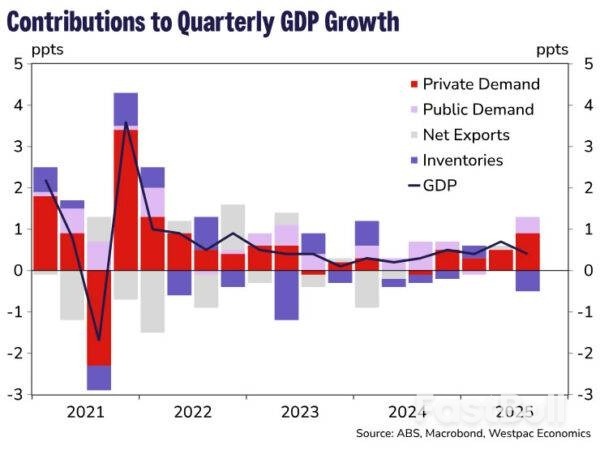
          The September quarter National Accounts show growth slowed to 0.4%qtr – this was softer than both the 0.8%qtr expected by Westpac Economics and the 0.7%qtr expected by the market.
          Meeting Demand Through Stockpiles Today, Productivity Tomorrow

          · The September quarter National Accounts show growth slowed to 0.4%qtr – this was softer than both the 0.8%qtr expected by Westpac Economics and the 0.7%qtr expected by the market. Despite this, upward revisions to previous activity saw the year-ended outcome accelerate to 2.1%yr – this year-ended growth rate was in line with Westpac Economics forecasts of 2.3%yr.
          · Domestic demand was strong, accelerating as Australia's economic upswing broadened to include business investment and the construction sector, while new public demand resumed its climb after going sideways over the past two quarters. However, the pickup in housing construction and business investment was a little softer than we expected.
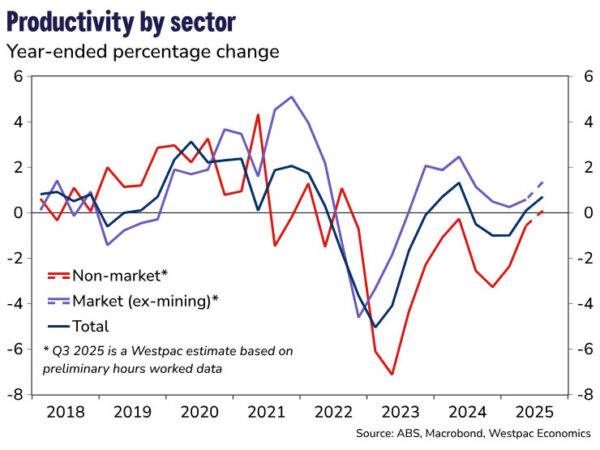
          · Inventory stockpiles were run down to meet this demand. Going forward increasing demand is likely to be met by more capacity with productivity growth accelerating to 0.8%yr. Looking at the market (ex-mining) sector, the productivity turnaround appears to be more impressive, accelerating to 1.4%yr.

          First Impressions: Australian National Accounts, September Quarter 2025_1

          The detail

          The September quarter National Accounts show growth slowed to 0.4% over the quarter while upward revisions to previous activity saw the year-ended outcome accelerate to 2.1%yr – a touch above the RBA's updated trend estimate of +2.0%yr but slightly below Westpac Economics' estimate of trend.

          Domestic demand (spending by consumers, businesses, and governments) grew a solid 1.2%qtr over the September quarter and 2.6% in year-ended terms – the strongest quarterly growth since the June quarter 2012 (outside the pandemic). There was no need for a 'handover' with both the private and public sectors contributing to the pickup in domestic demand.

          New private demand grew a strong 1.2%qtr and 3.1% in year-ended terms – also the fastest quarterly pace since the March quarter 2012 (outside the pandemic). While the consumer contributed, the standout was new business investment which grew 3.4%qtr and 3.8%yr. Despite this lift, the outcome was a touch softer than our 5.8%qtr forecast as engineering construction disappointed on the downside (-0.7%qtr v forecast of 2.0%qtr). Victoria recorded an outsized sharp 8.0% fall in engineering construction activity. Timing difference with the construction work done partial is one possible explanation of this discrepancy.

          The positive news was that we saw investment increases across most of the asset classes, including machinery (7.5%qtr and 6.2%yr); and new building (2.0%qtr and 2.1%yr). And while data centre fit outs and the purchase of civil aircrafts were the main contributors to the boost in machinery, capex data showed that the lift was broader to also include consumer facing industries (such as accommodation and food services) and some business facing industries (such as administrative and support services).

          Housing construction activity grew 1.8%qtr and 6.5%yr. Here too the quarterly outcome was softer than we expected based on the partial data (+1.8%qtr v +3.2%qtr). However, the year ended outcome was in line with our forecasts as activity in previous quarters was revised higher. The quarterly outcome was driven by both the construction of new dwellings (2.6%qtr) and renovation activity (0.5%qtr). There remains a healthy pipeline of projects to work through, which should support housing construction activity going forward.

          Firmer consumer spending extended into Q3, with household spending growing 0.5%qtr and 2.5%yr. This follows the bumper June quarter outcome of 0.9%qtr, which was partly driven by one-offs including the roll-off of state electricity rebates, larger than usual EOFY discounting, and holiday spend around Easter and ANZAC Day.

          With population growth projections running at 1.7%yr, this implies consumption per capita has started to post sizable increases. The Aussie consumer continues to be supported by rising real incomes which grew 0.9%qtr and 3.8%yr. A key uncertainty is whether this income boost will fade if interest rates were to remain on hold for longer and as the Stage 3 tax cuts are chewed away by bracket creep (we saw personal income tax increase as a share of household income this quarter). Without this boost, consumption could slow which would have implications for the labour market.

          On the flip side, the upswing is likely to gain greater momentum the longer it runs, which increases the likelihood it will become self-sustaining, boosting incomes and supporting consumption going forward. The Westpac–DataX Card Tracker Index shows spending picked up in October, suggesting momentum is extending to the December quarter.

          Net exports and inventories were broadly in line with expectations. A rundown in mining, public sector, and consumer goods inventories has detracted around 0.5ppts from Q3 growth, while net exports added a further 0.1ppt drag.

          Note, the statistical discrepancy detracted 0.1ppt from growth over the quarter, compared to a 0.2ppt contribution last quarter.

          It's not only demand, supply is also responding

          Labour productivity bounced to grow 0.8%yr. Digging a little deeper, we estimate that productivity in the market (ex-mining) sector grew at around 1.4%yr in Q3 (estimates will be finalised after Friday's Labour Accounts).
          First Impressions: Australian National Accounts, September Quarter 2025_2

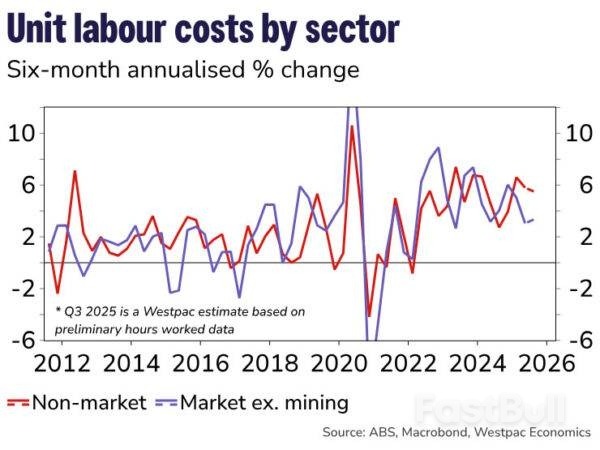
          As well as moderating growth in the sector's unit labour costs to around 3.3% in six-month annualised terms, this supports the view that whole-economy productivity growth will recover as the sector-specific factors in mining and the care economy wash out.
          First Impressions: Australian National Accounts, September Quarter 2025_3

          Source: Westpac Banking Corporation

          To stay updated on all economic events of today, please check out our Economic calendar
          Risk Warnings and Disclaimers
          You understand and acknowledge that there is a high degree of risk involved in trading. Following any strategies or investment methods may lead to potential losses. The content on the site is provided by our contributors and analysts for information purposes only. You are solely responsible for determining whether any trading assets, securities, strategy, or any other product is suitable for investing based on your own investment objectives and financial situation.
          Add to Favorites
          Share

          Hong Kong Fire Disaster Sparks Public Anger, Raises Accountability Questions Under National Security Shadow

          Gerik

          Economic

          Deadliest Fire in Decades Reignites Public Dissent

          The devastating blaze that swept through Wang Fuk Court in Hong Kong’s Tai Po district in late November 2025 has left more than 150 people dead, with many others injured, missing, or displaced. While the physical damage is immense, the fire has also reignited something unseen in Hong Kong in years: widespread public outrage, grief, and calls for government accountability.
          This emotional surge has emerged in a city tightly controlled since the imposition of China’s national security law in 2020. Mourning residents, volunteers, and observers gathered in thousands at the scene, lining up for over a mile to pay their respects. Makeshift memorials of chrysanthemums and handwritten tributes filled the streets, but so did unspoken questions how could such a tragedy occur in one of the world’s most advanced cities?

          Neglect and Systemic Failures Behind the Tragedy

          Initial investigations revealed that the Wang Fuk Court housing complex, a subsidized residential estate from the 1980s, was undergoing a $330 million HKD renovation project when the fire erupted. Styrofoam panels and plastic netting used during renovations are suspected of accelerating the blaze. Critically, these materials had already raised red flags among residents more than a year before the fire. Complaints were made to the construction company, the labor department, and even on public television. Yet no significant action was taken.
          Despite 16 government inspections, the hazardous materials remained in place. Bloomberg reporting confirmed that residents had even tested the panels themselves, discovering their flammability. Still, officials downplayed the concerns, arguing that styrofoam use was not technically illegal. The failure to respond, despite these warnings, is now seen as a direct causal factor that contributed to the scale and speed of the fire.

          Scaffolding, Regulations, and a Culture of Overlooked Risk

          Hong Kong’s longstanding use of bamboo scaffolding a rare practice globally also drew scrutiny. While structurally agile and cost-effective, bamboo is flammable. Experts believe that the fire may have spread rapidly due to the combined flammability of both the foam panels and the scaffolding’s protective netting.
          Though bamboo itself is harder to ignite than many assume, the government has since pledged to accelerate its replacement with metal scaffolding in public construction projects. This decision signals a partial admission of regulatory shortcomings, even as the deeper issue remains systemic: a culture of minimum compliance rather than proactive risk prevention.

          Swift Arrests But No Clear Closure

          Authorities acted quickly after public pressure mounted. Three people from the contractor company were arrested for manslaughter, while the Independent Commission Against Corruption (ICAC) detained eight others tied to potential misconduct in project bidding. The fact that the renovation contract went to the most expensive bidder has heightened suspicion of mismanagement or corruption, especially given the project's immense value.
          However, these arrests, while decisive, have not calmed the city. The public is demanding an independent inquiry, and although Chief Executive John Lee announced the formation of a committee, critics argue that its voluntary nature and lack of subpoena power fall short of true transparency. There is a growing recognition that accountability in this case may stop at mid-level operatives, not reach the top decision-makers or institutional frameworks that allowed the oversight to persist.

          Security Law Casts Long Shadow Over Mourning and Protest

          The fire has tapped into deep public resentment, evoking memories of the 2019 mass protests that swept the city. Small gatherings have already begun resembling pre-2020 civic mobilizations community-led support networks, volunteer supply chains, and public demands for reform. Authorities, wary of unrest, have responded swiftly under the national security framework.
          At least three people have been arrested for sedition, including a student handing out leaflets calling for an inquiry. Social media accounts advocating for justice have been taken down. The government’s fear is clear: that mourning could escalate into protest, and that any reawakening of mass dissent could undermine Beijing’s tightly managed vision for Hong Kong.
          This reaction reflects a causal concern on the part of authorities not just about the fire, but about how public sentiment, once ignited, can transform into a political challenge.

          Beijing Watches Closely as Hong Kong Balances Image and Control

          Chinese President Xi Jinping responded to the disaster within hours, expressing condolences and dispatching a task force to Hong Kong. While seen by some as a gesture of support, the immediacy also served as a signal to local leaders: this is not just a local issue it is a test of governance.
          Chief Executive John Lee, a former police officer appointed to maintain stability, is now caught between preserving order and responding with sufficient openness to restore public trust. His government’s actions in the coming weeks whether he proceeds with a transparent inquiry or maintains a defensive stance will shape perceptions of Hong Kong’s autonomy and Beijing’s influence.
          Jenni Marsh of Bloomberg framed the current moment as a "halfway house" for the city. Unlike mainland China, where grief is swiftly censored, Hong Kong still allows limited space for expression. But that space is shrinking. The city's leadership must now decide whether to confront uncomfortable truths or contain them and risk greater backlash.

          A Tragedy That May Reshape Hong Kong’s Civic Landscape

          The Wang Fuk Court fire is more than just a tragic accident. It is a flashpoint for Hong Kong’s identity under the national security regime. The scale of destruction, the visible regulatory failures, and the reawakening of collective grief have all converged into a moment of reckoning.
          Whether this becomes a catalyst for deeper change or is remembered as another moment suppressed under the weight of political control will depend not just on investigations or arrests, but on how much space Hong Kong’s leaders are willing or permitted to give to public accountability in the shadow of Beijing.

          Source: Bloomberg

          To stay updated on all economic events of today, please check out our Economic calendar
          Risk Warnings and Disclaimers
          You understand and acknowledge that there is a high degree of risk involved in trading. Following any strategies or investment methods may lead to potential losses. The content on the site is provided by our contributors and analysts for information purposes only. You are solely responsible for determining whether any trading assets, securities, strategy, or any other product is suitable for investing based on your own investment objectives and financial situation.
          Add to Favorites
          Share

          Australia’s Growth Reaches Two-Year High But Fails to Impress Markets Amid Inflation Risks

          Gerik

          Economic

          Growth Picks Up But Falls Short of Forecasts

          Australia’s economy posted its strongest expansion since late 2023, with GDP growing by 2.1% year-on-year in the third quarter of 2025. On a quarterly basis, growth reached 0.4%, below the Reuters forecast of 0.7%. Although the headline figure disappointed, economists argue it masks underlying strength within the domestic economy.
          Oxford Economics’ Harry Murphy Cruise noted that once trade and inventory distortions are removed, domestic economic activity actually surged by 1.2% quarter-on-quarter the fastest pace in over two years. This distinction is crucial, as it highlights that the soft GDP figure is not reflective of weak fundamentals but rather the result of external accounting factors such as inventory write-downs and net trade effects.

          Private Investment Surges On Infrastructure And Data Centers

          A core contributor to the quarter’s expansion was a revival in private investment. Business spending rose at its fastest rate since March 2021, largely focused on machinery, equipment, and digital infrastructure, especially in New South Wales and Victoria. This investment wave reflects a structural commitment to productivity and long-term capacity-building in the face of technological transformation.
          The increase in fixed capital formation appears to be causally linked to both private sector confidence and broader government incentives, particularly those tied to data center construction and green infrastructure.

          Consumer Spending Remains Resilient

          Household consumption, which accounts for over half of Australia’s GDP, also continued to rise. Growth was observed in essential categories such as rent, utilities, healthcare, insurance, and food a spending pattern that reflects both persistent cost-of-living pressures and continued labor market tightness.
          This spending tilt toward necessities rather than discretionary goods may be an indirect result of inflationary concerns and rate sensitivity. Still, it demonstrates consumer resilience in the face of policy tightening, implying a lagged and uneven transmission of higher rates to household behavior.

          Net Trade Becomes A Drag Amid Import Surge

          Despite strong domestic demand, net exports detracted 0.1 percentage point from GDP, as import growth outpaced export expansion. The causal link here is straightforward: a stronger domestic economy boosts import consumption, especially for capital and intermediate goods, while export volumes struggled to keep pace.
          This negative trade balance remains a recurring drag on overall growth, exacerbated by global demand volatility and commodity price fluctuations.

          Inflation Risks Limit Monetary Flexibility

          Before the GDP release, RBA Governor Michele Bullock had already signaled concern about the economy nearing its potential growth threshold. With October inflation accelerating to 3.8% year-on-year its fastest pace in seven months the central bank remains under pressure to maintain a tight policy stance. This inflation rate continues to sit well above the RBA’s 2–3% target range.
          Cruise of Oxford Economics remarked that the Q3 figures confirm the economy is still “too hot” for the RBA to consider easing. He further warned that while a rate hike in the upcoming meeting is not guaranteed, it cannot be ruled out, especially if inflation data continues to surprise on the upside.

          Policy Outlook Remains Restrictive

          At its last meeting, the RBA held interest rates steady at 3.6%, citing persistent inflation and a strong labor market. While rate cuts are not on the horizon, a potential hike remains a live option depending on price pressures. Bullock has already hinted that the cutting cycle may be nearing its end, but any shift toward dovish policy will depend heavily on future inflation prints.
          In response to the GDP data, Australia’s 10-year government bond yield rose by four basis points to 4.65%, bringing the total increase since mid-October to 55 basis points. This movement reflects mounting investor expectations that policy will remain tight for longer than initially anticipated.

          Strong Domestic Fundamentals Meet External Constraints

          Australia’s Q3 performance presents a mixed picture. While headline GDP growth missed expectations, the underlying data shows a robust domestic economy fueled by private investment and steady consumption. However, the enduring pressure from inflation, coupled with weak trade performance, limits the RBA’s policy flexibility.
          Looking forward, Australia’s challenge will be to maintain this growth momentum without further fueling inflation. With the RBA’s next meeting approaching, markets are watching closely for signs of whether rate stability will hold or whether a preemptive hike is required to re-anchor inflation expectations heading into 2026.

          Source: CNBC

          To stay updated on all economic events of today, please check out our Economic calendar
          Risk Warnings and Disclaimers
          You understand and acknowledge that there is a high degree of risk involved in trading. Following any strategies or investment methods may lead to potential losses. The content on the site is provided by our contributors and analysts for information purposes only. You are solely responsible for determining whether any trading assets, securities, strategy, or any other product is suitable for investing based on your own investment objectives and financial situation.
          Add to Favorites
          Share

          Markets Eye a Year-End Comeback Amid Tech Gains, Rate Cut Bets, and Cautious Optimism

          Gerik

          Economic

          A Fragile but Growing Hope for a Year-End Rally

          Following a tumultuous November, U.S. markets appear to be regaining momentum in early December, with tech stocks and digital assets helping reverse recent pullbacks. Tuesday’s rally broke a brief downturn and reinvigorated investor sentiment, showing that risk appetite remains intact, albeit more selective.
          Bitcoin, which recently experienced a sharp correction, recovered some losses, while equities across major U.S. indices posted gains. This rebound suggests that the sell-off was more of a temporary pause than a structural shift in investor positioning.
          According to Doug Beath, global equity strategist at Wells Fargo Investment Institute, the market narrative is shifting toward renewed optimism. He noted that traders are now looking beyond the current economic weakness toward improved earnings projections and potential growth acceleration in 2026. This change in outlook provides a psychological anchor for equity markets to stabilize in the final weeks of 2025.

          Rate Cut Bets Drive Risk Sentiment

          One of the most significant drivers of the recent market optimism is the growing belief that the U.S. Federal Reserve will ease monetary policy. According to the CME FedWatch Tool, the probability of a 25-basis-point rate cut at the upcoming December 10 meeting has surged to 89.2%, up dramatically from just a month ago when odds were near even.
          This expectation has created a supportive backdrop for both equities and crypto assets. Lower interest rates reduce the cost of capital and typically boost the valuation of growth-oriented sectors such as technology. The relationship here is causal: as borrowing costs fall, investment activity and asset valuations are incentivized, fueling momentum in interest-sensitive segments.

          Technology Leads Market Resilience

          Tech stocks have once again taken the lead in lifting U.S. markets. Tuesday’s gains across all three major benchmarks reflect renewed confidence in the sector, possibly supported by strong fourth-quarter earnings projections. European markets, in contrast, remained more muted, with the Stoxx 600 barely finishing above the flatline.
          A standout was Bayer, whose stock surged after the Trump administration moved to curb U.S. litigation risks linked to its weedkiller product. This development signals how regulatory actions continue to have material influence on corporate valuations, especially in sectors vulnerable to legal liabilities.

          Crypto Volatility Raises Structural Questions

          The crypto market, while partially rebounding, remains under pressure. Bitcoin’s recent 20% decline has led to renewed debate about whether the current downturn signals the onset of another crypto winter. Analysts remain divided. For digital asset-linked companies known as Digital Assets Treasury (DAT) entities falling token prices have caused their market valuations to diverge from the actual value of their holdings.
          This discrepancy creates both risks and speculative opportunities. On one hand, DATs trading below net asset value suggest potential value traps; on the other, it raises questions about investor confidence in the underlying crypto ecosystem. If sustained, such misalignments could distort funding conditions and undermine transparency in crypto-linked equity markets.

          Structural Headwinds: Tariffs and Housing Woes

          Beyond asset prices, structural risks continue to challenge investor outlooks. One such issue is the lagging impact of renewed U.S. tariffs under President Trump’s administration. The Institute for Supply Management’s November survey showed a drop in employment metrics, with its hiring gauge falling to 44% the weakest since August suggesting that businesses are beginning to adjust staffing levels in anticipation of higher input costs.
          Meanwhile, China’s real estate sector continues to deteriorate. Vanke, one of the country’s top property developers, is under scrutiny amid rumors of a potential state takeover, while November sales for the top 100 developers plunged 36% year-over-year. Morgan Stanley's estimate that average sales by 25 major firms dropped 42% paints a sobering picture of continued excess inventory and weak demand. These developments threaten to deepen the drag on China’s GDP and global construction-linked commodities.

          Innovation Spotlight: French AI Startup Mistral Breaks New Ground

          In a rare positive development out of Europe’s tech sector, French startup Mistral unveiled what it claims is the “world’s best” open-weight multimodal and multilingual AI model. Backed by €1.7 billion in funding from Nvidia and ASML, the launch positions Mistral as a serious competitor in the global AI race. It also signals continued investor appetite for frontier technologies, even in a climate of general economic caution.
          The release could bolster Europe’s position in the global AI supply chain and add momentum to transatlantic tech collaborations. However, it also raises further demand for high-performance chips and cloud infrastructure, placing additional stress on already tight semiconductor supply chains.

          Cautious Optimism with Caveats

          Despite recent headwinds, markets are exhibiting signs of cautious optimism. Strong tech performance, expectations for monetary easing, and selective bullishness in crypto suggest that a year-end rally is not out of reach. However, the landscape remains fraught with risks from unresolved trade tensions and housing instability in China to potential crypto volatility.
          Investors seeking a strong finish to 2025 may find a compelling story in recovering sentiment, but should brace for further turbulence and reassess risk exposure carefully as macro uncertainties persist.

          Source: CNBC

          To stay updated on all economic events of today, please check out our Economic calendar
          Risk Warnings and Disclaimers
          You understand and acknowledge that there is a high degree of risk involved in trading. Following any strategies or investment methods may lead to potential losses. The content on the site is provided by our contributors and analysts for information purposes only. You are solely responsible for determining whether any trading assets, securities, strategy, or any other product is suitable for investing based on your own investment objectives and financial situation.
          Add to Favorites
          Share

          Global Memory Chip Shortage Worsens as AI Demand Outpaces Supply, Raising Inflation and Tech Prices

          Gerik

          Economic

          AI Expansion Collides With Fragile Supply Chains

          The rapid global build-out of artificial intelligence infrastructure is intensifying a worldwide shortage of memory chips, turning what was once a sector-specific issue into a systemic economic disruption. With Microsoft, Google, ByteDance, and other tech giants accelerating data center expansion, demand for high-bandwidth memory (HBM) and traditional memory components has overwhelmed supply, leading to price surges and bottlenecks across industries.
          This mismatch stems from a direct causal relationship between AI’s explosive growth and memory demand. AI models such as those used in ChatGPT require immense memory bandwidth, redirecting production away from traditional DRAM and flash memory used in consumer electronics. As a result, device manufacturers, data center builders, and even component traders are all competing for scarce resources.

          Soaring Prices Across Memory Segments

          According to TrendForce, prices in some memory categories have more than doubled since February 2025. Inventory levels for DRAM suppliers fell dramatically to just two to four weeks by October, compared to 13–17 weeks in late 2024. This shortfall affects nearly all memory types, from USB flash to advanced HBM, underlining the severity of the constraint.
          South Korean firms Samsung and SK Hynix, which dominate over two-thirds of the DRAM market, have raised prices on server memory chips by up to 60%. Micron, another major supplier, has informed clients of upcoming discontinuations in legacy products such as DDR4 and LPDDR4. These strategic shifts, initially intended to favor high-margin AI memory, now risk disrupting broader technology supply chains.
          Retail and distributor quotes have become volatile, shifting hourly instead of monthly. In Akihabara, Tokyo’s tech district, stores are limiting memory purchases as prices for DDR5 kits surged from 17,000 yen to over 47,000 yen in just weeks. Traders like Polaris Mobility now issue day-long quotes due to pricing instability, a clear sign of market dislocation.

          Impact Beyond Tech: Delays, Inflation, And Consumer Costs

          The implications are far-reaching. Chip executives warn that the crisis could delay digital infrastructure projects and reduce productivity gains AI was expected to deliver. According to Citi, SK Hynix expects the shortage to persist through late 2027, reflecting long lead times to build new fabrication capacity. While the demand for AI-related chips continues rising, manufacturers hesitate to overinvest due to the cyclical nature of semiconductor markets.
          In the consumer space, smartphone makers like Xiaomi and Realme have started passing on the cost. Realme anticipates device price hikes of 20–30% by mid-2026, citing storage as a non-negotiable component. This inflationary trend is reinforced by ASUS and other electronics firms flagging potential pricing adjustments due to limited memory stockpiles.
          The cause-effect dynamic here is clear: AI-driven reallocation of manufacturing capacity toward HBM chips has directly constrained output of consumer-grade memory, creating shortages that ripple through the pricing of smartphones, laptops, and other devices.

          The Supply-Demand Tug-of-War Intensifies

          OpenAI’s October deal to source chips for its Stargate project requiring up to 900,000 wafers monthly by 2029 underscores the future imbalance. Current HBM production would need to double to meet this target, highlighting the disconnect between projected demand and existing output capacity.
          Google, Amazon, Microsoft, and Meta are placing open-ended orders with suppliers like Micron, committing to purchases regardless of price. This approach benefits well-capitalized firms but raises entry barriers for smaller players, accelerating consolidation within the AI and semiconductor ecosystem.
          In contrast, traditional memory buyers are “begging for supply,” as one executive put it. Companies like ASUS, Winbond, and numerous Chinese electronics firms are now forced to navigate an increasingly hostile procurement landscape, one in which availability, not cost-efficiency, determines survival.

          Secondhand Markets And Stockpiling Surge

          The crisis has also triggered a resurgence in secondary markets. In California, used memory chip seller Caramon saw monthly revenue jump from $500,000 to nearly $900,000, with demand largely driven by Chinese intermediaries. In Beijing, traders are stockpiling thousands of DDR4 units in anticipation of further increases.
          This speculative behavior signals a shift from normal supply dynamics to scarcity-driven arbitrage. As demand continues to exceed supply, especially in Asia, resale value appreciation becomes a new revenue strategy not just for suppliers, but also opportunistic middlemen.

          Industry Response: Capacity Expansions Are Too Late For Now

          While major players like SK Hynix and Samsung have committed to expanding production, factories tailored for conventional memory chips won’t come online until 2027 or later. Even smaller players like Winbond are increasing capital expenditure sharply, with $1.1 billion approved to expand capacity.
          Yet these investments cannot immediately resolve the supply crunch. The feedback loop between high demand, delayed supply response, and speculative hoarding is already well entrenched, reinforcing inflationary pressure globally.

          AI’s Promise Faces Real-World Constraints

          The AI revolution’s infrastructure needs have exposed fragile supply chains and long-overlooked bottlenecks in the semiconductor industry. What began as a rush for computational power has evolved into a structural challenge that affects both industrial strategy and consumer well-being.
          The current chip shortage exemplifies how rapid innovation can outpace physical supply chains, turning a technological leap into a macroeconomic vulnerability. With AI’s trajectory unlikely to slow, global supply chain resilience especially in memory manufacturing may prove to be one of the defining economic challenges of the next decade.

          Source: Reuters

          To stay updated on all economic events of today, please check out our Economic calendar
          Risk Warnings and Disclaimers
          You understand and acknowledge that there is a high degree of risk involved in trading. Following any strategies or investment methods may lead to potential losses. The content on the site is provided by our contributors and analysts for information purposes only. You are solely responsible for determining whether any trading assets, securities, strategy, or any other product is suitable for investing based on your own investment objectives and financial situation.
          Add to Favorites
          Share

          Silver Steadies After Record Highs Amid Supply Crunch and Fed Rate Cut Bets

          Gerik

          Economic

          Commodity

          Silver Holds Ground After Surging To Record Levels

          Silver prices paused in early Asian trading, stabilizing after reaching an all-time high of $58.84 per ounce on Monday. As of the latest trading session in Singapore, the white metal held firm, reflecting strong investor interest driven by expectations of easing monetary policy and intensifying supply constraints.
          Gold, in comparison, remained flat after two consecutive days of decline, while platinum and palladium showed minor losses. These mixed movements in the precious metals market reflect diverging investor strategies as macroeconomic uncertainty continues to shape risk appetite and safe-haven demand.

          Speculation And Supply Constraints Drive Silver Surge

          The recent spike in silver prices is largely attributed to a wave of speculative capital entering the market. A record volume of silver flowed into London last month, signaling heightened demand from institutional traders and hedge funds positioning for gains on the back of potential shortages.
          Concurrently, inventories in warehouses tied to the Shanghai Futures Exchange have declined to their lowest level in a decade. This notable depletion in available stock reinforces the perception of structural supply constraints, particularly as industrial demand for silver continues to grow in sectors such as electronics and green energy.
          The relationship between shrinking inventories and speculative interest is causal: tight supply conditions increase price volatility and attract short-term bets, which in turn amplify price movements. The self-reinforcing nature of these dynamics has pushed silver to historically unprecedented territory.

          Federal Reserve Rate Outlook Boosts Precious Metals

          Market participants are increasingly expecting a rate cut from the Federal Reserve during its upcoming meeting this month. Lower interest rates generally benefit non-yielding assets like gold and silver by reducing the opportunity cost of holding them. This relationship is well-established: when real yields decline, the relative attractiveness of precious metals typically improves.
          As such, silver and gold have found fundamental support in monetary policy expectations, even as gold’s recent retreat suggests that some investors may be taking profits or adjusting positions in anticipation of the Fed’s final decision.

          Volatility Ahead Amid Macro And Market Tensions

          While silver’s price appears to have stabilized for now, the combination of physical scarcity and speculative momentum suggests continued volatility. Any shifts in central bank policy, warehouse inventory data, or investor sentiment could rapidly alter the price trajectory.
          Meanwhile, the broader precious metals complex may remain under pressure or in consolidation mode, depending on the clarity and direction of monetary easing in the US and other major economies. For now, silver stands out as the most active and tightly supplied asset in this space, and its recent rally underscores the potent mix of structural scarcity and financial speculation.

          Source: Reuters

          To stay updated on all economic events of today, please check out our Economic calendar
          Risk Warnings and Disclaimers
          You understand and acknowledge that there is a high degree of risk involved in trading. Following any strategies or investment methods may lead to potential losses. The content on the site is provided by our contributors and analysts for information purposes only. You are solely responsible for determining whether any trading assets, securities, strategy, or any other product is suitable for investing based on your own investment objectives and financial situation.
          Add to Favorites
          Share

          Australia’s Economic Engine Loses Momentum As Rate Hike Bets Cool

          Gerik

          Economic

          Economic Expansion Falls Short Of Expectations

          Australia’s economy expanded by just 0.4% in the third quarter of 2025, a noticeable miss compared to the 0.7% anticipated by analysts. On an annual basis, GDP rose 2.1%, slightly under the forecasted 2.2%. While this annual growth rate aligns closely with the RBA’s projection, the weaker quarterly figure signals fragility beneath the surface of the broader economic outlook.
          The shortfall has already impacted financial markets. Australian government bond yields declined immediately following the data release, reversing earlier gains. Investors responded by scaling back expectations of another interest rate increase, with many interpreting the report as a sign the RBA will hold rates steady at 3.6% in its upcoming December meeting.

          Savings Rise As Households Turn Cautious

          The GDP report also revealed subtle shifts in household behavior. The savings rate increased to 6.4% from 6% in the previous quarter, supported by rising incomes. This behavioral change coincided with a 0.2% decrease in discretionary spending and a 1% increase in essential expenditures, suggesting households are becoming more cautious.
          The underlying causal factor appears to be growing economic uncertainty and a reallocation of budgets in response to rising living costs. The transition away from optional purchases implies a defensive stance by consumers, potentially dampening momentum in sectors reliant on non-essential goods and services.

          Mixed Interpretations Of The Private Sector’s Role

          Despite headline softness, some economists see encouraging signs beneath the data. Su-Lin Ong of the Royal Bank of Canada highlighted that the private sector continues to gain traction. With employment remaining strong and inflation exceeding the RBA’s target range, she argued there is no room for rate cuts, even if hikes may be paused.
          This argument rests on the assumption that labor cost pressures, particularly unit labor costs, are continuing to rise. While not conclusive evidence of overheating, this trend suggests an enduring inflationary undertone, especially in a low-productivity environment.

          Inflation Risks Remain In Focus Despite GDP Disappointment

          RBA Governor Michele Bullock reiterated that the central bank remains ready to act if price pressures intensify again. Traders initially brought forward expectations of a rate hike to August 2026 following her comments, only to quickly retract them after the GDP release. The market reaction reflects a tension between inflation concerns and apparent economic weakness.
          This response illustrates a correlation rather than a direct cause-effect pattern: stronger-than-expected inflation may pressure the RBA into tightening policy, but disappointing growth complicates such decisions.

          Productivity Constraints Limit Economic Capacity

          Australia’s potential growth rate has been downgraded to 2%, reflecting deteriorating productivity levels. Economic output per person remained stagnant in Q3, and GDP per capita has declined over seven consecutive quarters during 2023 and 2024. These numbers indicate that while the headline GDP is rising modestly, Australians are experiencing falling living standards.
          Chief economist Alex Joiner of IFM Investors stressed that public-sector-driven growth persists, with the hoped-for pivot to private sector expansion yet to fully materialize. He warned that the economy is growing close to its reduced capacity, raising the risk of renewed inflation if demand continues rising without matching productivity gains.
          This imbalance is a causal concern: weak productivity directly limits how much the economy can expand without generating inflation. Consequently, even moderate demand growth risks translating into price pressures.

          Key Contributions To GDP Growth And Drag

          A detailed breakdown of the components of GDP growth shows that household spending rose 0.5%, contributing 0.3 percentage points. Government spending increased 0.8%, adding another 0.2 percentage points. However, changes in inventories subtracted 0.5 percentage points, and net exports slightly reduced GDP by 0.1 percentage point.
          The shift in consumer behavior, increasing public spending, and weakening net trade reflect a complex interplay of domestic resilience and global headwinds. Inventory reductions likely stem from supply chain normalization or demand uncertainty, which may or may not persist into the next quarter.

          Limited Policy Room As Growth Slows

          Looking forward, the RBA forecasts economic growth of around 2% in 2026. The forecast rests on expectations of sustained population growth, stable household income, and lower borrowing costs. Yet questions remain about how much room the RBA has to lower rates in an environment with weak productivity and tight labor supply.
          Australia may no longer be able to rely on its historical growth patterns. The economy is not contracting, but per capita stagnation indicates that individuals are not materially better off. Policymakers now face the difficult task of balancing inflation risks with subdued growth, in an environment where structural constraints are tightening the country’s economic boundaries.

          Source: Reuters

          To stay updated on all economic events of today, please check out our Economic calendar
          Risk Warnings and Disclaimers
          You understand and acknowledge that there is a high degree of risk involved in trading. Following any strategies or investment methods may lead to potential losses. The content on the site is provided by our contributors and analysts for information purposes only. You are solely responsible for determining whether any trading assets, securities, strategy, or any other product is suitable for investing based on your own investment objectives and financial situation.
          Add to Favorites
          Share
          FastBull
          Copyright © 2025 FastBull Ltd

          728 RM B 7/F GEE LOK IND BLDG NO 34 HUNG TO RD KWUN TONG KLN HONG KONG

          TelegramInstagramTwitterfacebooklinkedin
          App Store Google Play Google Play
          Products
          Charts

          Chats

          Q&A with Experts
          Screeners
          Economic Calendar
          Data
          Tools
          Membership
          Features
          Function
          Markets
          Copy Trading
          Latest Signals
          Contests
          News
          Analysis
          24/7
          Columns
          Education
          Company
          Careers
          About Us
          Contact Us
          Advertising
          Help Center
          Feedback
          User Agreement
          Privacy Policy
          Business

          White Label

          Data API

          Web Plug-ins

          Poster Maker

          Affiliate Program

          Risk Disclosure

          The risk of loss in trading financial instruments such as stocks, FX, commodities, futures, bonds, ETFs and crypto can be substantial. You may sustain a total loss of the funds that you deposit with your broker. Therefore, you should carefully consider whether such trading is suitable for you in light of your circumstances and financial resources.

          No decision to invest should be made without thoroughly conducting due diligence by yourself or consulting with your financial advisors. Our web content might not suit you since we don't know your financial conditions and investment needs. Our financial information might have latency or contain inaccuracy, so you should be fully responsible for any of your trading and investment decisions. The company will not be responsible for your capital loss.

          Without getting permission from the website, you are not allowed to copy the website's graphics, texts, or trademarks. Intellectual property rights in the content or data incorporated into this website belong to its providers and exchange merchants.

          Not Logged In

          Log in to access more features

          FastBull Membership

          Not yet

          Purchase

          Become a signal provider
          Help Center
          Customer Service
          Dark Mode
          Price Up/Down Colors

          Log In

          Sign Up

          Position
          Layout
          Fullscreen
          Default to Chart
          The chart page opens by default when you visit fastbull.com