• Trade
  • Markets
  • Copy
  • Contests
  • News
  • 24/7
  • Calendar
  • Q&A
  • Chats
Trending
Screeners
SYMBOL
LAST
BID
ASK
HIGH
LOW
NET CHG.
%CHG.
SPREAD
SPX
S&P 500 Index
6857.13
6857.13
6857.13
6865.94
6827.13
+7.41
+ 0.11%
--
DJI
Dow Jones Industrial Average
47850.93
47850.93
47850.93
48049.72
47692.96
-31.96
-0.07%
--
IXIC
NASDAQ Composite Index
23505.13
23505.13
23505.13
23528.53
23372.33
+51.04
+ 0.22%
--
USDX
US Dollar Index
98.890
98.970
98.890
98.980
98.890
-0.090
-0.09%
--
EURUSD
Euro / US Dollar
1.16537
1.16544
1.16537
1.16555
1.16408
+0.00092
+ 0.08%
--
GBPUSD
Pound Sterling / US Dollar
1.33392
1.33403
1.33392
1.33396
1.33165
+0.00121
+ 0.09%
--
XAUUSD
Gold / US Dollar
4217.48
4217.86
4217.48
4218.25
4194.54
+10.31
+ 0.25%
--
WTI
Light Sweet Crude Oil
59.282
59.319
59.282
59.469
59.187
-0.101
-0.17%
--

Community Accounts

Signal Accounts
--
Profit Accounts
--
Loss Accounts
--
View More

Become a signal provider

Sell trading signals to earn additional income

View More

Guide to Copy Trading

Get started with ease and confidence

View More

Signal Accounts for Members

All Signal Accounts

Best Return
  • Best Return
  • Best P/L
  • Best MDD
Past 1W
  • Past 1W
  • Past 1M
  • Past 1Y

All Contests

  • All
  • Trump Updates
  • Recommend
  • Stocks
  • Cryptocurrencies
  • Central Banks
  • Featured News
Top News Only
Share

India's NIFTY IT Index Last Up 1.3%

Share

India's Nifty 50 Index Rises 0.35%

Share

Israel Sets 2026 Defence Budget At $34 Billion

Share

Russia Says Azov Sea's Port Of Temryuk Damaged In Ukrainian Attack

Share

Israel's Defense Budget For 2026 Will Be 112 Billion Israeli Shekels - Defense Minister Office

Share

One India Rate Panel Member Ram Singh Was Of View That Stance Should Be Changed To 'Accommodative' From 'Neutral' - Monetary Policy Committee Statement

Share

Reserve Bank Of India Chief: Will Continue To Meet Productive Needs Of Economy In Proactive Manner

Share

Reserve Bank Of India Chief: System Level Financial Parameters Of Nbfcs Sound

Share

Reserve Bank Of India Chief: Dollar Rupee Swap To Be For 3 Years, To Be Conducted This Month

Share

India's Nifty Realty Index Extend Gains, Last Up 1.4%

Share

India's Nifty Psu Bank Index Rises 1%

Share

Reserve Bank Of India Chief: Commited To Providing Sufficient Durable Liquidity

Share

Reserve Bank Of India Chief: Transmission Has Been Broad Based Across Sectors, Satisfactory

Share

Reserve Bank Of India Chief: As Of Nov 28, India's Forex Reserves Stood At $686 Billion

Share

Reserve Bank Of India Chief: Healthy Services Exports With Strong Remittances To Keep Cad Modest In This Year

Share

Reserve Bank Of India Chief: CPI Inflation Seen At 0.6% In Q3 Fy26

Share

Reserve Bank Of India Chief: Fy26 CPI Inflation Seen At 2% Versus 2.6% Previously

Share

India's Nifty Realty Index Up 1% After Reserve Bank Of India's Rate Cut

Share

India's Nifty Psu Bank Index Turns Positive, Up 0.43% After Reserve Bank Of India's Rate Cut

Share

Reserve Bank Of India Chief: Merchandise Exports Face Some Headwinds

TIME
ACT
FCST
PREV
Turkey Trade Balance

A:--

F: --

P: --

Germany Construction PMI (SA) (Nov)

A:--

F: --

P: --

Euro Zone IHS Markit Construction PMI (Nov)

A:--

F: --

P: --

Italy IHS Markit Construction PMI (Nov)

A:--

F: --

P: --

U.K. Markit/CIPS Construction PMI (Nov)

A:--

F: --

P: --

France 10-Year OAT Auction Avg. Yield

A:--

F: --

P: --

Euro Zone Retail Sales MoM (Oct)

A:--

F: --

P: --

Euro Zone Retail Sales YoY (Oct)

A:--

F: --

P: --

Brazil GDP YoY (Q3)

A:--

F: --

P: --

U.S. Challenger Job Cuts (Nov)

A:--

F: --

P: --

U.S. Challenger Job Cuts MoM (Nov)

A:--

F: --

P: --

U.S. Challenger Job Cuts YoY (Nov)

A:--

F: --

P: --

U.S. Initial Jobless Claims 4-Week Avg. (SA)

A:--

F: --

P: --

U.S. Weekly Initial Jobless Claims (SA)

A:--

F: --

P: --

U.S. Weekly Continued Jobless Claims (SA)

A:--

F: --

P: --

Canada Ivey PMI (SA) (Nov)

A:--

F: --

P: --

Canada Ivey PMI (Not SA) (Nov)

A:--

F: --

P: --

U.S. Non-Defense Capital Durable Goods Orders Revised MoM (Excl. Aircraft) (SA) (Sept)

A:--

F: --

P: --
U.S. Factory Orders MoM (Excl. Transport) (Sept)

A:--

F: --

P: --

U.S. Factory Orders MoM (Sept)

A:--

F: --

P: --

U.S. Factory Orders MoM (Excl. Defense) (Sept)

A:--

F: --

P: --

U.S. EIA Weekly Natural Gas Stocks Change

A:--

F: --

P: --

Saudi Arabia Crude Oil Production

A:--

F: --

P: --

U.S. Weekly Treasuries Held by Foreign Central Banks

A:--

F: --

P: --

Japan Foreign Exchange Reserves (Nov)

A:--

F: --

P: --

India Repo Rate

A:--

F: --

P: --

India Benchmark Interest Rate

A:--

F: --

P: --

India Reverse Repo Rate

A:--

F: --

P: --

India Cash Reserve Ratio

A:--

F: --

P: --

Japan Leading Indicators Prelim (Oct)

A:--

F: --

P: --

U.K. Halifax House Price Index YoY (SA) (Nov)

--

F: --

P: --

U.K. Halifax House Price Index MoM (SA) (Nov)

--

F: --

P: --

France Current Account (Not SA) (Oct)

--

F: --

P: --

France Trade Balance (SA) (Oct)

--

F: --

P: --

France Industrial Output MoM (SA) (Oct)

--

F: --

P: --

Italy Retail Sales MoM (SA) (Oct)

--

F: --

P: --

Euro Zone Employment YoY (SA) (Q3)

--

F: --

P: --

Euro Zone GDP Final YoY (Q3)

--

F: --

P: --

Euro Zone GDP Final QoQ (Q3)

--

F: --

P: --

Euro Zone Employment Final QoQ (SA) (Q3)

--

F: --

P: --

Euro Zone Employment Final (SA) (Q3)

--

F: --

P: --
Brazil PPI MoM (Oct)

--

F: --

P: --

Mexico Consumer Confidence Index (Nov)

--

F: --

P: --

Canada Unemployment Rate (SA) (Nov)

--

F: --

P: --

Canada Labor Force Participation Rate (SA) (Nov)

--

F: --

P: --

Canada Employment (SA) (Nov)

--

F: --

P: --

Canada Part-Time Employment (SA) (Nov)

--

F: --

P: --

Canada Full-time Employment (SA) (Nov)

--

F: --

P: --

U.S. Dallas Fed PCE Price Index YoY (Sept)

--

F: --

P: --

U.S. PCE Price Index YoY (SA) (Sept)

--

F: --

P: --

U.S. PCE Price Index MoM (Sept)

--

F: --

P: --

U.S. Personal Outlays MoM (SA) (Sept)

--

F: --

P: --

U.S. Core PCE Price Index MoM (Sept)

--

F: --

P: --

U.S. UMich 5-Year-Ahead Inflation Expectations Prelim YoY (Dec)

--

F: --

P: --

U.S. Core PCE Price Index YoY (Sept)

--

F: --

P: --

U.S. 5-10 Year-Ahead Inflation Expectations (Dec)

--

F: --

P: --

U.S. UMich Current Economic Conditions Index Prelim (Dec)

--

F: --

P: --

U.S. UMich Consumer Sentiment Index Prelim (Dec)

--

F: --

P: --

U.S. UMich 1-Year-Ahead Inflation Expectations Prelim (Dec)

--

F: --

P: --

U.S. UMich Consumer Expectations Index Prelim (Dec)

--

F: --

P: --

Q&A with Experts
    • All
    • Chatrooms
    • Groups
    • Friends
    Connecting
    .
    .
    .
    Type here...
    Add Symbol or Code

      No matching data

      All
      Trump Updates
      Recommend
      Stocks
      Cryptocurrencies
      Central Banks
      Featured News
      • All
      • Russia-Ukraine Conflict
      • Middle East Flashpoint
      • All
      • Russia-Ukraine Conflict
      • Middle East Flashpoint

      Search
      Products

      Charts Free Forever

      Chats Q&A with Experts
      Screeners Economic Calendar Data Tools
      Membership Features
      Data Warehouse Market Trends Institutional Data Policy Rates Macro

      Market Trends

      Market Sentiment Order Book Forex Correlations

      Top Indicators

      Charts Free Forever
      Markets

      News

      News Analysis 24/7 Columns Education
      From Institutions From Analysts
      Topics Columnists

      Latest Views

      Latest Views

      Trending Topics

      Top Columnists

      Latest Update

      Signals

      Copy Rankings Latest Signals Become a signal provider AI Rating
      Contests
      Brokers

      Overview Brokers Assessment Rankings Regulators News Claims
      Broker listing Forex Brokers Comparison Tool Live Spread Comparison Scam
      Q&A Complaint Scam Alert Videos Tips to Detect Scam
      More

      Business
      Events
      Careers About Us Advertising Help Center

      White Label

      Data API

      Web Plug-ins

      Affiliate Program

      Awards Institution Evaluation IB Seminar Salon Event Exhibition
      Vietnam Thailand Singapore Dubai
      Fans Party Investment Sharing Session
      FastBull Summit BrokersView Expo
      Recent Searches
        Top Searches
          Markets
          News
          Analysis
          User
          24/7
          Economic Calendar
          Education
          Data
          • Names
          • Latest
          • Prev

          View All

          No data

          Scan to Download

          Faster Charts, Chat Faster!

          Download App
          English
          • English
          • Español
          • العربية
          • Bahasa Indonesia
          • Bahasa Melayu
          • Tiếng Việt
          • ภาษาไทย
          • Français
          • Italiano
          • Türkçe
          • Русский язык
          • 简中
          • 繁中
          Open Account
          Search
          Products
          Charts Free Forever
          Markets
          News
          Signals

          Copy Rankings Latest Signals Become a signal provider AI Rating
          Contests
          Brokers

          Overview Brokers Assessment Rankings Regulators News Claims
          Broker listing Forex Brokers Comparison Tool Live Spread Comparison Scam
          Q&A Complaint Scam Alert Videos Tips to Detect Scam
          More

          Business
          Events
          Careers About Us Advertising Help Center

          White Label

          Data API

          Web Plug-ins

          Affiliate Program

          Awards Institution Evaluation IB Seminar Salon Event Exhibition
          Vietnam Thailand Singapore Dubai
          Fans Party Investment Sharing Session
          FastBull Summit BrokersView Expo

          EUR/USD Rebounds Cautiously, USD/CHF Coils For Next Move

          FXOpen

          Forex

          Economic

          Summary:

          EUR/USD is attempting a recovery wave from the 1.1500 zone. USD/CHF climbed higher above 0.8050 and might correct some gains.

          EUR/USD is attempting a recovery wave from the 1.1500 zone. USD/CHF climbed higher above 0.8050 and might correct some gains.

          Important Takeaways for EUR/USD and USD/CHF Analysis Today

          · The Euro declined toward 1.1500 before it started a recovery wave against the US Dollar.

          · There was a break above a major bearish trend line with resistance at 1.1530 on the hourly chart of EUR/USD at FXOpen.

          · USD/CHF climbed higher above 0.8050 and 0.8080 before it faced hurdles.

          · There was a break below a bullish trend line with support at 0.8085 on the hourly chart at FXOpen.

          EUR/USD Technical Analysis

          On the hourly chart of EUR/USD at FXOpen, the pair extended the decline below 1.1550. The Euro even declined below 1.1520 before the bulls appeared against the US Dollar.

          The pair tested 1.1490 and recently started a recovery wave. There was a move above 1.1520 and 1.1550. The pair climbed above the 50% Fib retracement level of the downward move from the 1.1653 swing high to the 1.1491 low.
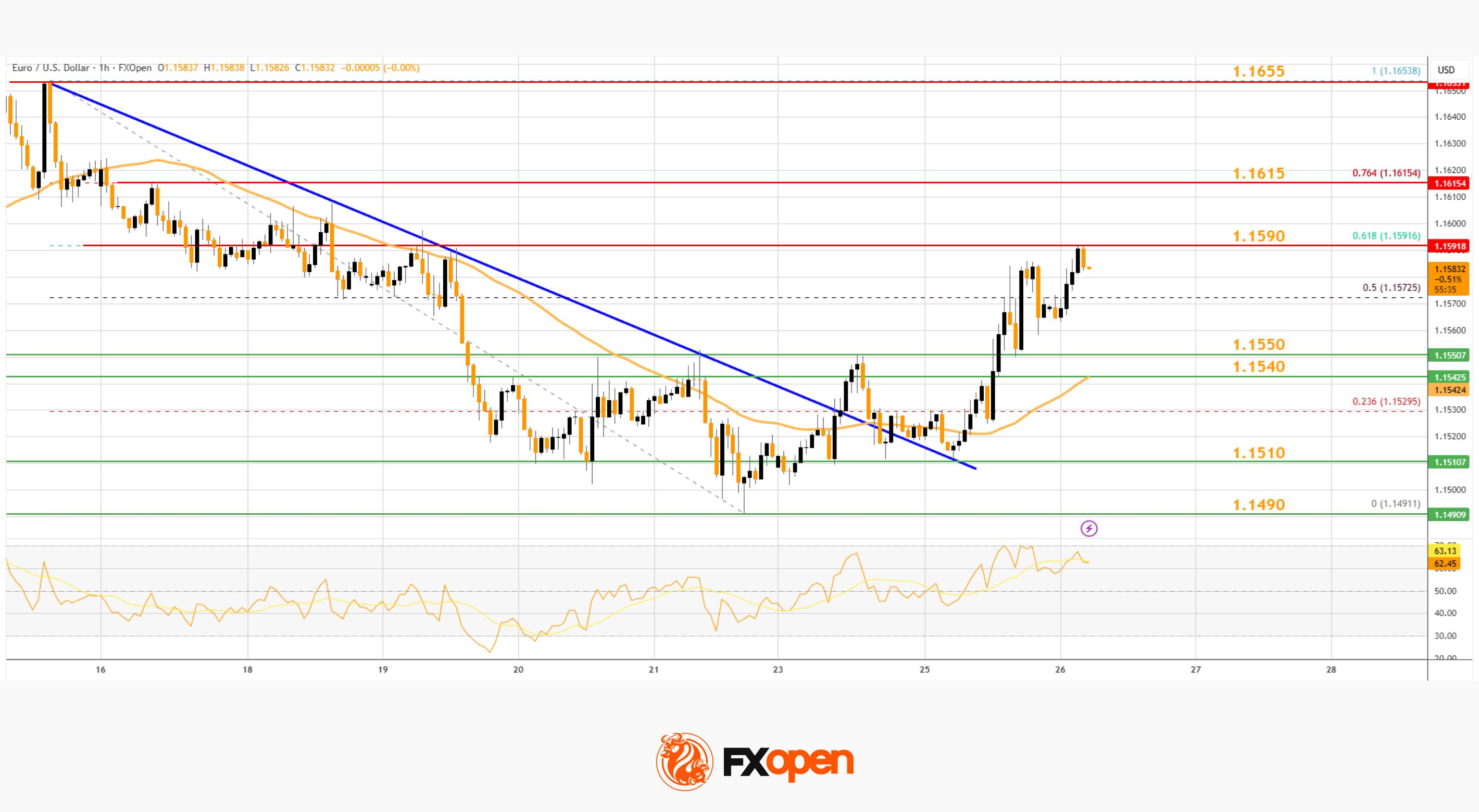
          More importantly, there was a break above a major bearish trend line with resistance at 1.1530. The pair is now trading above 1.1575 and the 50-hour simple moving average. Immediate hurdle on the EUR/USD chart is near the 61.8% Fib retracement at 1.1590.

          The first key breakout zone sits at 1.1615. An upside break above 1.1615 might send the pair toward 1.1655. Any more gains might open the doors for a move toward the 1.1700 zone. If there is a fresh decline, the pair might find bids near 1.1550.

          The next major support is 1.1540. A downside break below 1.1540 could send the pair toward 1.1510. Any more losses might send the pair to 1.1490.

          USD/CHF Technical Analysis

          On the hourly chart of USD/CHF at FXOpen, the pair started a decent increase from 0.7940. The US Dollar climbed above the 0.8000 handle against the Swiss Franc.

          The bulls were able to pump the pair above the 50-hour simple moving average and 0.8050. Finally, the pair tested 0.8100. A high was formed near 0.8101 and the pair is now consolidating gains. The pair dipped below the 23.6% Fib retracement level of the upward move from the 0.7937 swing low to the 0.8101 high.
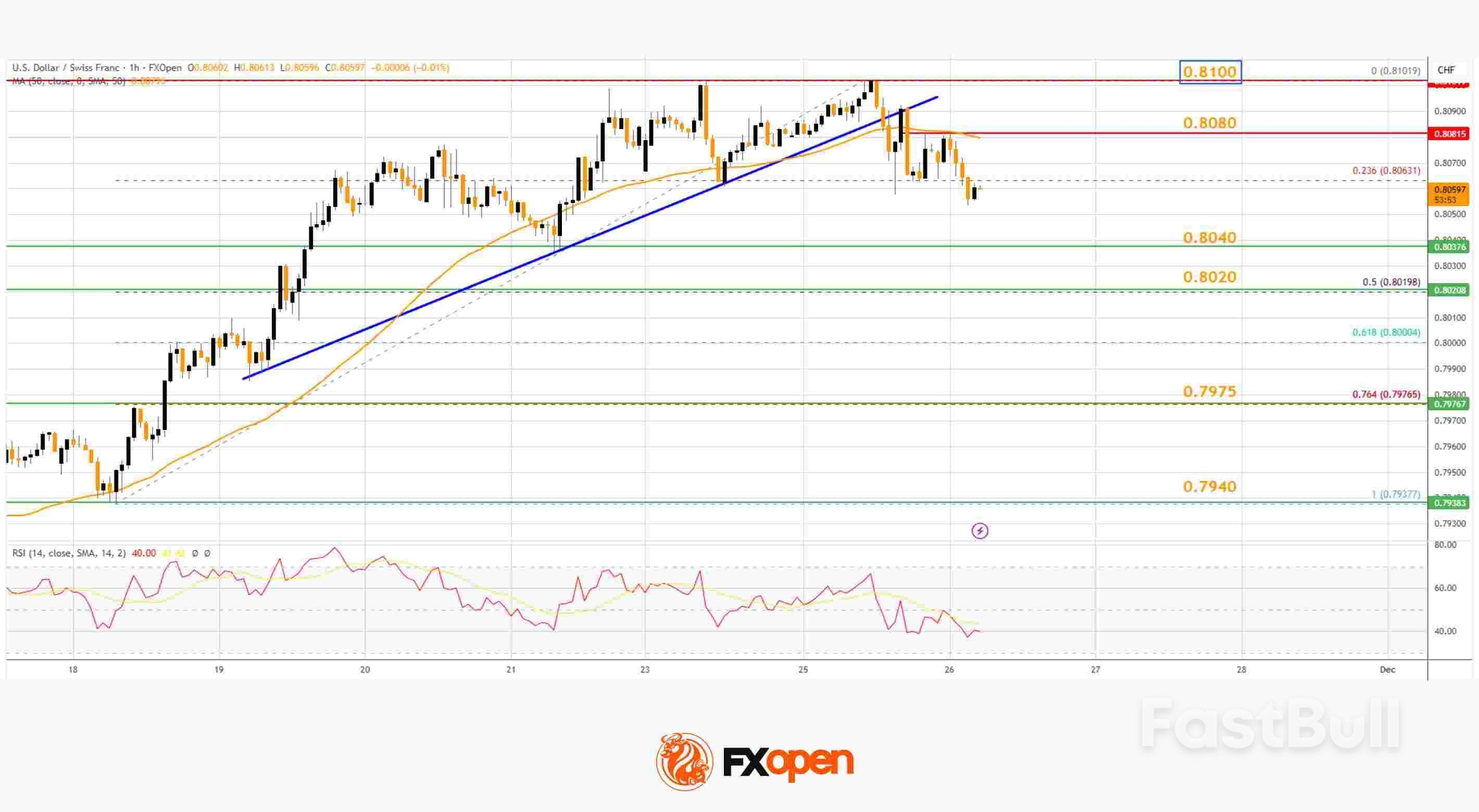
          Besides, there was a break below a bullish trend line at 0.8085. On the downside, immediate support on the USD/CHF chart is near 0.8040. The first key area of interest might be near the 50% Fib retracement at 0.8020.

          A downside break below 0.8020 might call for a drop to 0.7975. Any more losses may possibly open the doors for a move toward 0.7940.

          On the upside, the pair could struggle near 0.8080. The first major barrier for bulls is 0.8100. If there is a clear break above 0.8100 and the RSI climbs above 50, the pair could start another increase. In the stated case, it could test 0.8150.

          Source: FXOpen

          To stay updated on all economic events of today, please check out our Economic calendar
          Risk Warnings and Disclaimers
          You understand and acknowledge that there is a high degree of risk involved in trading. Following any strategies or investment methods may lead to potential losses. The content on the site is provided by our contributors and analysts for information purposes only. You are solely responsible for determining whether any trading assets, securities, strategy, or any other product is suitable for investing based on your own investment objectives and financial situation.
          Add to Favorites
          Share

          A Deepening Divide in the World’s Largest Economy: For Many Americans, Even Three Meals a Day Is a Struggle

          Gerik

          Economic

          Inflation May Be Slowing, But The Pain Is Accumulating

          While headline inflation in the U.S. has eased to 3% from the 9% peak in 2022, the cumulative effect of years of rapid price increases is devastating low- and middle-income Americans. In towns like Bethlehem, Pennsylvania, where the local economy once thrived, families are now making painful trade-offs just to survive. Many work multiple jobs, yet still cannot afford rent, food, or basic medical care.
          Victor, a veteran worker at Naftogaz’s now-damaged gas facility, symbolizes the emotional toll of watching both personal and national infrastructure crumble. His experience is echoed in communities across America, where what was once “difficult” is now “unsustainable.” According to Bethlehem resident Anissa Camacho, working two jobs alongside her partner, who also works two no longer guarantees enough for rent or food.

          Government Aid Cutbacks and Political Promises Fall Short

          President Donald Trump has repeatedly asserted that his administration has tamed inflation, particularly food prices. Yet data tells a different story: grocery bills continue climbing nationwide. Beef alone has surged 14% over the past year. At the same time, support programs such as SNAP and Medicaid are tightening eligibility requirements under new spending legislation. These changes disproportionately affect the most vulnerable people like Aidalis Martinez, a mother of two who relies on government aid to feed her children but now faces an uncertain future following program disruptions caused by last month’s government shutdown.
          Trump’s proposed 50-year mortgage plan, aimed at addressing the housing crisis, has drawn criticism even from within the MAGA base. Many accuse the administration of favoring Wall Street over working-class families, locking them into generational debt. The tension is exacerbated in regions like Lehigh Valley, where out-of-state investors have inflated property markets, pushing local residents out of the housing market entirely.

          Food Banks Overflow as Demand Surges

          Bethlehem’s New Bethany food pantry has seen a staggering surge in need, with daily visits rising from 3–5 families in 2019 to 20–30 today. Its once modest soup kitchen now feeds up to 200 people daily. “The stress people are under is extreme,” said Executive Director Marc Rittle. With homelessness rising and shelter beds filled, organizations are bracing for what Rittle calls “a new type of homelessness” working individuals and families who simply can’t afford housing anymore.
          Healthcare, another cornerstone of living costs, is expected to worsen if tax credits from the Affordable Care Act are not renewed by year-end. Without them, health insurance premiums could rise by over $1,000 annually. For self-employed or gig workers like Brian Buchanan, a musician from Lehigh Valley, even basic coverage is becoming unattainable. He’s now considering “catastrophic-only” plans a last resort for those priced out of comprehensive coverage.

          Housing Becomes the Ultimate Burden

          According to the Federal Reserve Bank of Atlanta, the median home price in the U.S. has climbed over one-third since 2021, reaching nearly $400,000. To afford housing under the commonly accepted 30% income threshold, a household would now need to earn over $120,000 annually well above the national median income of $85,000. The result is a widening affordability gap that threatens to displace more Americans, particularly in regions experiencing speculative real estate booms.
          The economic reality for millions of Americans is defined not by stock market highs but by skipped meals, unaffordable rents, and declining access to healthcare. While aggregate economic indicators may signal recovery, they mask an underlying affordability crisis that continues to deepen. President Trump’s promises to rein in costs and restore stability have yet to materialize for working families, many of whom now see daily survival as a luxury rather than a guarantee. In towns like Bethlehem and across the nation, the American Dream has become increasingly out of reach not due to a lack of effort, but because the system seems rigged against the very people it was meant to serve.

          Source: FT

          To stay updated on all economic events of today, please check out our Economic calendar
          Risk Warnings and Disclaimers
          You understand and acknowledge that there is a high degree of risk involved in trading. Following any strategies or investment methods may lead to potential losses. The content on the site is provided by our contributors and analysts for information purposes only. You are solely responsible for determining whether any trading assets, securities, strategy, or any other product is suitable for investing based on your own investment objectives and financial situation.
          Add to Favorites
          Share

          Asian Markets Rally on Fed Rate Cut Optimism as U.S. Stocks Lead Global Surge

          Gerik

          Stocks

          Economic

          Wall Street Gains Drive Global Optimism

          Asian stock markets followed Wall Street’s lead on Wednesday, climbing across the board on rising expectations that the U.S. Federal Reserve will lower interest rates in the coming weeks. Tokyo’s Nikkei 225 jumped 2% to close at 49,650.77, with notable gains among major exporters and tech shares. South Korea’s Kospi followed suit, rising 2.1% to 3,940.15, powered by a 2.3% gain in Samsung Electronics, the market’s most influential stock.
          The rally was a direct reaction to strong gains in U.S. markets the day prior. The Dow Jones Industrial Average advanced 1.4% to 47,112.45, the S&P 500 rose 0.9% to 6,765.88, and the Nasdaq Composite gained 0.7% to 23,025.59. Most notably, the Russell 2000 index, which tracks smaller-cap stocks more sensitive to borrowing conditions, surged 2.1% a move that underscored how strongly rate expectations are shaping equity valuations.

          Weak Consumer Data Reinforces Rate Cut Bets

          Investors are increasingly pricing in a Fed rate cut in December, with CME Group data indicating an 83% probability. This surge in optimism stems from a mix of weaker-than-expected U.S. consumer confidence and slowing retail sales in September. Together, these suggest economic momentum is softening, which bolsters the case for monetary easing.
          Although one inflation measure came in marginally worse than expected at the wholesale level, underlying trends pointed to some disinflation, giving the Fed greater flexibility. As lower interest rates reduce the cost of capital and boost investment valuations, the correlation between bond market expectations and equity performance remains clear.

          Asian Markets Respond Broadly, Though China Lags

          The rate-cut narrative found traction throughout Asia. Australia’s S&P/ASX 200 gained 0.9% to 8,615.30, while New Zealand’s S&P/NZX 50 added 0.7%, helped by a surprise rate cut from the Reserve Bank of New Zealand, which lowered its Official Cash Rate to 2.25% from 2.5%.
          In Greater China, however, gains were more muted. The Hang Seng Index in Hong Kong rose 0.5% to 26,013.33, while the Shanghai Composite inched up 0.1% to 3,875.48. Sentiment in Chinese markets was dampened by corporate-specific disappointments, most notably a 1.1% drop in Alibaba’s shares after the company reported earnings that missed profit expectations, despite stronger-than-forecast revenue. Its U.S.-listed stock had already fallen 2.3% the previous session.

          Retail Earnings Reassure Market on U.S. Consumption Trends

          U.S. retail sector earnings contributed to the positive mood, suggesting that consumer demand remains resilient in certain segments. Abercrombie & Fitch jumped 37.5% after posting better-than-expected profits, while Kohl’s soared 42.5% by defying loss expectations. Best Buy also rose 5.3%, citing strength in computing, gaming, and mobile sales. These earnings surprises helped counterbalance weak macroeconomic data and gave hope that retail activity could remain stable even if rates begin to fall.
          Oil prices saw modest increases, with U.S. crude up 24 cents to $58.19 per barrel and Brent crude rising 26 cents to $62.06. These moves reflect improving risk sentiment without major supply disruptions. In currency markets, the dollar slightly weakened to 156.03 yen, while the euro appreciated to $1.1587, mirroring the broader decline in U.S. yields and dovish expectations.
          The strong rally across global markets reflects renewed investor confidence that the Fed will ease policy to offset cooling demand. While this optimism hinges on future data and the Fed’s December decision, the current momentum highlights the outsized influence of monetary expectations on both developed and emerging markets. Should the Fed confirm this shift, the resulting risk-on sentiment could extend into early 2026, though any surprises on inflation or policy caution may trigger sharp corrections. For now, markets are banking on relief and the prospect of lower rates is driving a global rebound.

          Source: AP

          To stay updated on all economic events of today, please check out our Economic calendar
          Risk Warnings and Disclaimers
          You understand and acknowledge that there is a high degree of risk involved in trading. Following any strategies or investment methods may lead to potential losses. The content on the site is provided by our contributors and analysts for information purposes only. You are solely responsible for determining whether any trading assets, securities, strategy, or any other product is suitable for investing based on your own investment objectives and financial situation.
          Add to Favorites
          Share

          As Russian Strikes Cripple Gas Infrastructure, Ukraine Turns to U.S. LNG and Emergency Loans

          Gerik

          Economic

          Commodity

          Destruction of Gas Facilities Leaves Massive Supply Gap

          Ukraine is confronting a severe energy crisis after a series of Russian missile and drone strikes devastated its gas extraction infrastructure. The most recent assault on October 30, described as one of the most destructive yet, destroyed liquefied propane storage tanks and crippled extraction capacity at a key central Ukrainian facility. According to Naftogaz officials, the repeated bombardments particularly those in March and October have slashed domestic output, creating a shortfall of 4.4 billion cubic meters of gas for the coming winter.
          Without these attacks, Ukraine would have largely met its own demand, needing only modest annual imports of 2–3 billion cubic meters. Now, however, the country faces a pressing need to import nearly double that, at an estimated cost of $2 billion an unsustainable burden on an already war-battered economy.

          Urgent Search for U.S. Financial Support and LNG Supplies

          To fill the gap, Naftogaz has secured roughly 70% of the needed funds from European loans and grants. The remaining 30% hundreds of millions of dollars is now being pursued through emergency negotiations with U.S. government lenders, including the International Development Finance Corporation and EXIM Bank. However, the lack of a borrowing history with these institutions has slowed disbursement. As Naftogaz CEO Serhii Koretskyi stated, “This money was needed the day before yesterday.”
          Time is a critical factor. Transporting liquefied natural gas (LNG) across the Atlantic, converting it to usable form, and distributing it across Ukraine’s internal network takes weeks. Naftogaz is currently importing 25–30 million cubic meters daily, carefully timed to avoid price spikes in both Ukraine and the broader European market.

          Gas Infrastructure as a Military Target

          Naftogaz facilities have been under constant Russian attack since the full-scale invasion began in 2022, but the strategic targeting of gas infrastructure has intensified. In the most recent strike, shrapnel shredded transport pipes, fuel tanks exploded, and structural damage left pipes twisted and mangled. Ukrainian officials assert that these attacks are designed to weaponize winter, with Koretskyi calling them "manic terror attacks" aimed at depriving civilians of heating, hot water, and electricity in freezing conditions.
          Given Ukraine’s bitterly cold winters, with temperatures dropping to -20°C, gas is essential not only for residential heating but also for industrial operations and emergency power generation. The loss of domestic supply capacity significantly increases the country’s vulnerability and dependency on volatile external markets.

          Subsidies, Reform, and the Political Deadlock

          The energy crisis has reignited debate over long-delayed pricing reforms. Currently, Ukraine’s gas pricing for households is heavily subsidized state support covers roughly 50% of the real market price. This system, while politically popular, is financially unsustainable, especially under wartime conditions.
          IMF agreements have called for liberalization, but President Volodymyr Zelenskyy’s administration has so far resisted, fearing social backlash amid an ongoing war and a major corruption scandal in the energy sector. Koretskyi acknowledged that raising prices this winter is politically unviable. However, without reform, Naftogaz continues to incur operating losses, becoming increasingly reliant on foreign loans that compound national debt and delay long-term energy resilience.
          Energy expert and former lawmaker Victoria Voytsitska argues that the state’s unwillingness to adjust pricing structures makes Naftogaz a fiscal hostage. Meanwhile, former Naftogaz CEO Yurii Vitrenko estimates that 30% of households could pay market prices if subsidies were targeted more efficiently. He advocates a shift to direct cash transfers to consumers encouraging conservation while preserving social cohesion.

          Strategic Stakes Extend Beyond Winter Survival

          Ukraine’s scramble to import gas is not merely about surviving the winter it is central to its economic, social, and political resilience in the face of protracted war. With Russia aiming to weaponize energy deprivation, Ukraine’s reliance on LNG imports is a stopgap that underscores deeper vulnerabilities: insufficient energy reform, overdependence on foreign aid, and a political environment reluctant to adopt painful but necessary changes.
          The stakes are rising not just for Ukraine’s energy system but for its broader stability. Without reforms and greater self-reliance, each new winter may bring a familiar equation: Russian destruction, Western loans, and political hesitation. As Kyiv negotiates gas supply deals and peace frameworks in parallel, the battle over pipelines is proving as pivotal as the battlefields.

          Source: Bloomberg

          To stay updated on all economic events of today, please check out our Economic calendar
          Risk Warnings and Disclaimers
          You understand and acknowledge that there is a high degree of risk involved in trading. Following any strategies or investment methods may lead to potential losses. The content on the site is provided by our contributors and analysts for information purposes only. You are solely responsible for determining whether any trading assets, securities, strategy, or any other product is suitable for investing based on your own investment objectives and financial situation.
          Add to Favorites
          Share

          UK Treasury Chief Rachel Reeves Prepares Second Round of Tax Hikes Amid Fiscal Strain

          Gerik

          Economic

          Economic Slowdown Forces Reversal on Tax Promises

          UK Treasury chief Rachel Reeves is expected to announce a second consecutive tax-raising budget, despite earlier assurances that her initial budget would be the sole major fiscal adjustment during this parliamentary term. The decision reflects deepening structural pressures on the UK economy and growing gaps in public finances. According to economists, the fiscal shortfall has grown to an estimated £20–30 billion ($26–39 billion), forcing the Chancellor to act despite the political cost.
          While Reeves’ first budget, delivered in late 2024 after Labour’s landslide election victory, was positioned as a bold reset following years of austerity and stagnation, it also introduced higher levies on businesses a move that many now argue contributed to weakening economic performance in 2025. After a promising start as the fastest-growing economy among the G7 in early 2025, the UK has since lost momentum, further complicating the government’s fiscal outlook.

          Delicate Balance Between Stability and Stimulus

          The upcoming budget must achieve a dual aim: reinforce fiscal credibility and stimulate growth. As Peter Arnold of EY UK notes, Reeves is walking “a delicate balancing act,” trying to calm markets with stability while delivering on growth promises. The British economy remains 20–25% smaller than it would have been if the pre-2008 growth trajectory had continued a sobering reminder of long-term stagnation and missed tax revenue.
          This structural underperformance is compounded by a series of external shocks: the global financial crisis, the COVID-19 pandemic, Russia’s invasion of Ukraine, and U.S. President Donald Trump’s tariff regime. Additionally, Brexit continues to weigh on economic output and trade, resulting in lost revenues and diminished competitiveness relative to European peers.

          Spending Pressures Mount as Welfare Reforms Stall

          Adding to the fiscal dilemma is the cost of policy reversals. The Labour government has retreated from previous commitments to welfare cuts and is reportedly preparing to scrap the controversial cap on child benefits for larger families. Meanwhile, inflation remains stubborn, forcing ministers to consider measures such as freezing rail fares or reducing green levies on household energy bills policies that are politically popular but fiscally expensive.
          Reeves has shown no appetite for the most direct revenue-raising mechanism: increasing the base rate of income tax. Despite intense speculation, she appears set to avoid this highly visible move, which would breach Labour’s manifesto pledges and risk alienating voters. Instead, she is likely to pursue less visible and more technical options to raise revenue.

          Stealth Taxes Expected: Threshold Freezes and Wealth Surcharges

          The most probable measure is an extended freeze on income tax thresholds. In effect, this means that as wages rise, more individuals are pulled into higher tax brackets, boosting government revenue without changing headline rates. While politically subtler than overt tax increases, this method has been criticized as regressive, as it disproportionately affects middle-income earners over time.
          Other anticipated reforms include the introduction of a “mansion tax” targeting high-value properties, changes to capital gains taxation, and revisions to the tax relief framework for private pensions. These adjustments are expected to be incremental but cumulative, aimed at shifting the burden toward wealthier households without provoking widespread political backlash.
          Rachel Reeves’ second budget represents a critical test of the Labour government’s ability to maintain economic credibility while delivering on its social promises. Having ruled out broad-based income tax increases, Reeves is forced to rely on narrower, more intricate revenue measures to close the fiscal gap. However, the reintroduction of tax hikes despite prior pledges risks undermining public trust and reinforcing perceptions of economic mismanagement. As the UK grapples with stagnation, inflation, and high debt, the Chancellor’s ability to manage expectations may prove as important as the numbers in her red box.

          Source: AP

          To stay updated on all economic events of today, please check out our Economic calendar
          Risk Warnings and Disclaimers
          You understand and acknowledge that there is a high degree of risk involved in trading. Following any strategies or investment methods may lead to potential losses. The content on the site is provided by our contributors and analysts for information purposes only. You are solely responsible for determining whether any trading assets, securities, strategy, or any other product is suitable for investing based on your own investment objectives and financial situation.
          Add to Favorites
          Share

          Taiwan President Lai Unveils $40 Billion Defense Budget in Defiant Stance Against Beijing

          Gerik

          Economic

          Strategic Military Response to Beijing’s 2027 Ambition

          Taiwan’s President Lai Ching-te declared on Wednesday that the island will allocate an additional 1.25 trillion Taiwanese dollars (approximately $40 billion USD) to bolster its defense, marking a sharp escalation in Taiwan’s strategic posture amid rising Chinese military assertiveness. Lai stated that the budget increase comes in response to Beijing’s accelerated preparations to forcibly reunify Taiwan with the mainland by 2027 an assertion grounded in continued large-scale drills, aerial incursions, and naval maneuvers conducted by China in the Taiwan Strait.
          This major policy shift signals a direct response to what Lai characterized as an “unprecedented military buildup” and intensifying provocations not only in the Taiwan Strait but across wider strategic theaters such as the East and South China Seas and the Indo-Pacific. These provocations, he noted, are not random displays of power but components of a deliberate timetable toward forced reunification.

          Political Infiltration and Influence Campaigns Amplify Hybrid Threats

          Beyond the physical military threat, Lai emphasized that China’s approach includes an expanding campaign of infiltration into Taiwanese society and politics. According to Lai, Beijing is employing a multifaceted influence strategy to sway public opinion, undermine civil trust in Taiwan’s democratic institutions, and weaken the legitimacy of its government. This marks a clear effort to destabilize Taiwan from within, aligning conventional military pressure with information warfare and soft power coercion.
          Lai’s remarks underscored the dual-layered nature of the threat a combination of hard power in the form of armed drills and “gray-zone” operations, and soft influence via disinformation, cyber intrusions, and covert influence networks. These activities reinforce the causal relationship between Beijing’s geopolitical goals and its hybrid warfare tactics aimed at undermining Taiwan’s sovereignty without a formal declaration of war.

          Strategic Budget and Timeline for Readiness

          The defense package proposed by Lai is not merely symbolic. It reflects a targeted and time-sensitive push to achieve “high combat readiness” by 2027 the same year Beijing is alleged to be eyeing for a potential operation. This timeline underscores the government’s urgency and acknowledgment that strategic ambiguity may no longer suffice as a deterrence model. The supplementary budget aims to enhance deterrence through force modernization, civil defense expansion, and tighter integration of Taiwan’s military and industrial capabilities.
          While details of the allocations remain limited, defense analysts expect major investments in air defense systems, asymmetric warfare capabilities, cyber defense, and indigenous weapons development areas deemed critical for countering China’s numerical military superiority.

          Widening Regional Friction: Japan’s Involvement and U.S. Diplomacy

          Lai’s speech comes at a moment of increased regional tension following Japan’s assertive posture on Taiwan. Japanese Prime Minister Sanae Takaichi recently warned that any Chinese aggression toward Taiwan could constitute a “survival-threatening situation” for Tokyo, a stance that provoked Beijing’s condemnation and retaliatory measures, including travel advisories, cultural bans, and enhanced military readiness.
          This geopolitical friction has drawn Washington further into the cross-Strait dynamics. U.S. President Donald Trump spoke separately with both Xi Jinping and Prime Minister Takaichi earlier this week. Analysts suggest that China may be seeking Trump’s diplomatic assistance in toning down Japan’s rhetoric, though the U.S. continues to affirm its unofficial support for Taiwan’s self-defense through arms sales and strategic alignment.

          Beijing Reiterates Uncompromising Position

          Shortly before Lai’s speech, China’s Taiwan Affairs Office reiterated its staunch opposition to any form of Taiwanese independence. It accused Lai’s Democratic Progressive Party of sabotaging Taiwan’s economic and social development by stoking division and militarizing the island. Beijing’s continued framing of the Taiwan issue as an “internal matter” contrasts sharply with the internationalization of the conflict now drawing in regional and global powers.
          President Lai’s $40 billion defense initiative marks a decisive moment in Taiwan’s response to mounting Chinese aggression. The move reaffirms Taiwan’s strategic autonomy and readiness to invest heavily in its defense capabilities, even as political infiltration intensifies and regional tensions rise. With a clear 2027 horizon and escalating rhetoric from both sides, the Taiwan Strait is entering a period of heightened strategic risk, in which deterrence, diplomacy, and resilience will be central to avoiding conflict while preserving sovereignty.

          Source: CNBC

          To stay updated on all economic events of today, please check out our Economic calendar
          Risk Warnings and Disclaimers
          You understand and acknowledge that there is a high degree of risk involved in trading. Following any strategies or investment methods may lead to potential losses. The content on the site is provided by our contributors and analysts for information purposes only. You are solely responsible for determining whether any trading assets, securities, strategy, or any other product is suitable for investing based on your own investment objectives and financial situation.
          Add to Favorites
          Share

          South Korea Advances Strategic Investment Bill, Paving Way for U.S. Auto Tariff Cut

          Gerik

          Economic

          Investment Legislation Triggers Tariff Reduction

          South Korea’s ruling party has submitted a pivotal bill detailing the execution of its $350 billion investment commitments to the United States, a legislative move that triggers a key clause in the bilateral trade agreement. According to South Korea’s Finance Ministry, this bill meets the U.S. requirement for reducing tariffs on Korean automobiles and auto parts from 25% to 15%, with the cut retroactively applied from November 1, 2025.
          The bill’s passage is not only a legal mechanism but a symbolic culmination of extensive diplomatic negotiations, particularly since July when both nations first outlined a framework for tariff caps. While the broader deal had been struck earlier, the auto sector remained subject to a 25% levy, effectively used by Washington as leverage until South Korea finalized the structural plan for its strategic investment fund.

          Strategic Fund Tied to U.S. Industrial Policy Priorities

          At the heart of the agreement is a Korea-U.S. strategic investment fund that will channel Korean capital into critical American sectors such as shipbuilding, energy, and semiconductors. The bill outlines that the fund will be sustained through multiple streams including returns from South Korea’s foreign exchange reserves (managed by the government and Bank of Korea) and foreign bond issuances backed by Seoul.
          The fund will be operated by a dedicated entity with a planned 20-year horizon, signifying long-term integration between South Korean capital and U.S. industrial ambitions. This reflects a deeper economic alignment, and the structure of the fund responds to Seoul’s earlier concerns about potential currency volatility caused by large capital outflows.

          Tariff Relief Critical for Korean Auto Exporters

          The tariff reduction carries material implications for South Korean automakers. In 2024, the United States absorbed nearly half of Korea’s $70.8 billion in vehicle exports, making the U.S. market essential to the industry’s financial performance. By lowering tariffs from 25% to 15%, Korean manufacturers gain a competitive edge, especially after Japan secured a similar deal in September through a memorandum of understanding that temporarily disadvantaged Korean firms.
          The cost difference driven by tariffs was becoming a strategic concern for Korean carmakers, as it risked eroding market share in a vital export destination. The reinstated tariff parity with Japan helps preserve Korean competitiveness and ensures that auto and parts exports among Korea’s top outbound product categories retain pricing power in the U.S. market.

          Broader Trade Framework Anchored in Geopolitics and Industrial Policy

          This investment-for-tariff-exchange model represents a transactional yet strategic evolution in U.S.-Asia trade relationships. President Donald Trump’s October visit to South Korea finalized the terms of the investment initiative, and both sides issued a joint fact sheet outlining the security and economic elements of the accord. The confirmation of the auto tariff reduction by the U.S. Department of Commerce is still pending formal publication in the Federal Register, which will cement the legal framework.
          The move signals a calculated shift in U.S. trade policy: leveraging market access especially in high-tariff sectors as a tool to attract foreign capital into critical domestic supply chains. For Seoul, the investment serves dual purposes: securing trade concessions while aligning with U.S.-led industrial strategies to reduce dependence on China.
          South Korea’s submission of the special investment bill not only fulfills a key condition in its agreement with the United States but also unlocks a major economic concession for its automotive sector. While the 15% tariff remains elevated compared to pre-2017 levels, it represents meaningful relief and reestablishes competitive parity with Japanese rivals. The strategic investment framework, underpinned by long-term fund governance, marks a significant evolution in bilateral economic cooperation and reflects growing interdependence between capital deployment and trade access in global policy-making.

          Source: Reuters

          To stay updated on all economic events of today, please check out our Economic calendar
          Risk Warnings and Disclaimers
          You understand and acknowledge that there is a high degree of risk involved in trading. Following any strategies or investment methods may lead to potential losses. The content on the site is provided by our contributors and analysts for information purposes only. You are solely responsible for determining whether any trading assets, securities, strategy, or any other product is suitable for investing based on your own investment objectives and financial situation.
          Add to Favorites
          Share
          FastBull
          Copyright © 2025 FastBull Ltd

          728 RM B 7/F GEE LOK IND BLDG NO 34 HUNG TO RD KWUN TONG KLN HONG KONG

          TelegramInstagramTwitterfacebooklinkedin
          App Store Google Play Google Play
          Products
          Charts

          Chats

          Q&A with Experts
          Screeners
          Economic Calendar
          Data
          Tools
          Membership
          Features
          Function
          Markets
          Copy Trading
          Latest Signals
          Contests
          News
          Analysis
          24/7
          Columns
          Education
          Company
          Careers
          About Us
          Contact Us
          Advertising
          Help Center
          Feedback
          User Agreement
          Privacy Policy
          Business

          White Label

          Data API

          Web Plug-ins

          Poster Maker

          Affiliate Program

          Risk Disclosure

          The risk of loss in trading financial instruments such as stocks, FX, commodities, futures, bonds, ETFs and crypto can be substantial. You may sustain a total loss of the funds that you deposit with your broker. Therefore, you should carefully consider whether such trading is suitable for you in light of your circumstances and financial resources.

          No decision to invest should be made without thoroughly conducting due diligence by yourself or consulting with your financial advisors. Our web content might not suit you since we don't know your financial conditions and investment needs. Our financial information might have latency or contain inaccuracy, so you should be fully responsible for any of your trading and investment decisions. The company will not be responsible for your capital loss.

          Without getting permission from the website, you are not allowed to copy the website's graphics, texts, or trademarks. Intellectual property rights in the content or data incorporated into this website belong to its providers and exchange merchants.

          Not Logged In

          Log in to access more features

          FastBull Membership

          Not yet

          Purchase

          Become a signal provider
          Help Center
          Customer Service
          Dark Mode
          Price Up/Down Colors

          Log In

          Sign Up

          Position
          Layout
          Fullscreen
          Default to Chart
          The chart page opens by default when you visit fastbull.com
