• Trade
  • Markets
  • Copy
  • Contests
  • News
  • 24/7
  • Calendar
  • Q&A
  • Chats
Trending
Screeners
SYMBOL
LAST
BID
ASK
HIGH
LOW
NET CHG.
%CHG.
SPREAD
SPX
S&P 500 Index
6827.42
6827.42
6827.42
6899.86
6801.80
-73.58
-1.07%
--
DJI
Dow Jones Industrial Average
48458.04
48458.04
48458.04
48886.86
48334.10
-245.98
-0.51%
--
IXIC
NASDAQ Composite Index
23195.16
23195.16
23195.16
23554.89
23094.51
-398.69
-1.69%
--
USDX
US Dollar Index
97.900
97.980
97.900
98.070
97.810
-0.050
-0.05%
--
EURUSD
Euro / US Dollar
1.17483
1.17490
1.17483
1.17596
1.17262
+0.00089
+ 0.08%
--
GBPUSD
Pound Sterling / US Dollar
1.33877
1.33886
1.33877
1.33961
1.33546
+0.00170
+ 0.13%
--
XAUUSD
Gold / US Dollar
4332.87
4333.21
4332.87
4350.16
4294.68
+33.48
+ 0.78%
--
WTI
Light Sweet Crude Oil
56.878
56.908
56.878
57.601
56.789
-0.355
-0.62%
--

Community Accounts

Signal Accounts
--
Profit Accounts
--
Loss Accounts
--
View More

Become a signal provider

Sell trading signals to earn additional income

View More

Guide to Copy Trading

Get started with ease and confidence

View More

Signal Accounts for Members

All Signal Accounts

Best Return
  • Best Return
  • Best P/L
  • Best MDD
Past 1W
  • Past 1W
  • Past 1M
  • Past 1Y

All Contests

  • All
  • Trump Updates
  • Recommend
  • Stocks
  • Cryptocurrencies
  • Central Banks
  • Featured News
Top News Only
Share

Fed Data - USA Effective Federal Funds Rate At 3.64 Percent On 12 December On $102 Billion In Trades Versus 3.64 Percent On $99 Billion On 11 December

Share

Brazil's Petrobras Says No Impact Seen On Oil, Petroleum Products Output As Workers Start Planned Strike

Share

Statement: US Travel Group Warns New Proposed Trump Administration Requirements For Foreign Tourists To Provide Social Media Histories Could Mean Millions Of People Opting Not To Visit

Share

Blackrock: Kerry White Will Become Head Of Citi Investment Management At Citi Wealth

Share

Blackrock: Rob Jasminski, Head Of Citi Investment Management, Has Joined With Team

Share

Blackrock: Effective Dec 15, Citi Investment Management Employees Will Join Blackrock

Share

Blackrock: Formally Launch Citi Portfolio Solutions Powered By Blackrock

Share

According To Data From The Federal Reserve Bank Of New York, The Secured Overnight Funding Rate (Sofr) Was 3.67% On The Previous Trading Day (December 15), Compared To 3.66% The Day Before

Share

Peru Energy And Mines Ministry: Copper Production Up 4.8% Year-On-Year In October To 248192 Metric Tons

Share

Security Source: Ukrainian Drones Hits Russian Oil Infrastructure In Caspian Sea For Third Time

Share

Spot Palladium Extends Gains, Last Up 5% To $1562.7/Oz

Share

Mexico's Economy Ministry Announces Start Of Anti-Dumping Investigation And Anti-Subsidy Investigations Into USA Pork Imports

Share

Canada Nov CPI Common +2.8%, CPI Median +2.8%, CPI Trim +2.8% On Year

Share

NY Fed's Empire State Prices Paid Index +37.6 In December Versus+49.0 In November

Share

Canada Nov Consumer Prices +0.1% On Month, +2.2% On Year

Share

Canada Nov CPI Core -0.1% On Month, +2.9% On Year

Share

Canada Nov Core CPI, Seasonally Adjusted +0.2% On Month, Oct +0.3% (Unrevised)

Share

UK Health Minister Streeting On Doctors' Strike: Vote To Go Ahead Reveals The Bma's Shocking Disregard For Patient Safety

Share

Venezuelan State Oil Company Pdvsa Says Was Subject To Cyber Attack But Operations Unaffected

Share

Russia Central Bank Says January-October Current Account Surplus At $37.1 Billion

TIME
ACT
FCST
PREV
Japan Tankan Small Manufacturing Outlook Index (Q4)

A:--

F: --

P: --

Japan Tankan Large Non-Manufacturing Outlook Index (Q4)

A:--

F: --

P: --

Japan Tankan Large Manufacturing Outlook Index (Q4)

A:--

F: --

P: --

Japan Tankan Small Manufacturing Diffusion Index (Q4)

A:--

F: --

P: --

Japan Tankan Large Manufacturing Diffusion Index (Q4)

A:--

F: --

P: --

Japan Tankan Large-Enterprise Capital Expenditure YoY (Q4)

A:--

F: --

P: --

U.K. Rightmove House Price Index YoY (Dec)

A:--

F: --

P: --

China, Mainland Industrial Output YoY (YTD) (Nov)

A:--

F: --

P: --

China, Mainland Urban Area Unemployment Rate (Nov)

A:--

F: --

P: --

Saudi Arabia CPI YoY (Nov)

A:--

F: --

P: --

Euro Zone Industrial Output YoY (Oct)

A:--

F: --

P: --

Euro Zone Industrial Output MoM (Oct)

A:--

F: --

P: --

Canada Existing Home Sales MoM (Nov)

A:--

F: --

P: --

Canada National Economic Confidence Index

A:--

F: --

P: --

Canada New Housing Starts (Nov)

A:--

F: --

P: --
U.S. NY Fed Manufacturing Employment Index (Dec)

A:--

F: --

P: --

U.S. NY Fed Manufacturing Index (Dec)

A:--

F: --

P: --

Canada Core CPI YoY (Nov)

A:--

F: --

P: --

Canada Manufacturing Unfilled Orders MoM (Oct)

A:--

F: --

P: --

U.S. NY Fed Manufacturing Prices Received Index (Dec)

A:--

F: --

P: --

U.S. NY Fed Manufacturing New Orders Index (Dec)

A:--

F: --

P: --

Canada Manufacturing New Orders MoM (Oct)

A:--

F: --

P: --

Canada Core CPI MoM (Nov)

A:--

F: --

P: --

Canada Trimmed CPI YoY (SA) (Nov)

A:--

F: --

P: --

Canada Manufacturing Inventory MoM (Oct)

A:--

F: --

P: --

Canada CPI YoY (Nov)

A:--

F: --

P: --

Canada CPI MoM (Nov)

A:--

F: --

P: --

Canada CPI YoY (SA) (Nov)

A:--

F: --

P: --

Canada Core CPI MoM (SA) (Nov)

A:--

F: --

P: --

Canada CPI MoM (SA) (Nov)

A:--

F: --

P: --

Federal Reserve Board Governor Milan delivered a speech
U.S. NAHB Housing Market Index (Dec)

--

F: --

P: --

Australia Composite PMI Prelim (Dec)

--

F: --

P: --

Australia Services PMI Prelim (Dec)

--

F: --

P: --

Australia Manufacturing PMI Prelim (Dec)

--

F: --

P: --

Japan Manufacturing PMI Prelim (SA) (Dec)

--

F: --

P: --

U.K. 3-Month ILO Employment Change (Oct)

--

F: --

P: --

U.K. Unemployment Claimant Count (Nov)

--

F: --

P: --

U.K. Unemployment Rate (Nov)

--

F: --

P: --

U.K. 3-Month ILO Unemployment Rate (Oct)

--

F: --

P: --

U.K. Average Weekly Earnings (3-Month Average, Including Bonuses) YoY (Oct)

--

F: --

P: --

U.K. Average Weekly Earnings (3-Month Average, Excluding Bonuses) YoY (Oct)

--

F: --

P: --

France Services PMI Prelim (Dec)

--

F: --

P: --

France Composite PMI Prelim (SA) (Dec)

--

F: --

P: --

France Manufacturing PMI Prelim (Dec)

--

F: --

P: --

Germany Services PMI Prelim (SA) (Dec)

--

F: --

P: --

Q&A with Experts
    • All
    • Chatrooms
    • Groups
    • Friends
    Connecting
    .
    .
    .
    Type here...
    Add Symbol or Code

      No matching data

      All
      Trump Updates
      Recommend
      Stocks
      Cryptocurrencies
      Central Banks
      Featured News
      • All
      • Russia-Ukraine Conflict
      • Middle East Flashpoint
      • All
      • Russia-Ukraine Conflict
      • Middle East Flashpoint

      Search
      Products

      Charts Free Forever

      Chats Q&A with Experts
      Screeners Economic Calendar Data Tools
      Membership Features
      Data Warehouse Market Trends Institutional Data Policy Rates Macro

      Market Trends

      Market Sentiment Order Book Forex Correlations

      Top Indicators

      Charts Free Forever
      Markets

      News

      News Analysis 24/7 Columns Education
      From Institutions From Analysts
      Topics Columnists

      Latest Views

      Latest Views

      Trending Topics

      Top Columnists

      Latest Update

      Signals

      Copy Rankings Latest Signals Become a signal provider AI Rating
      Contests
      Brokers

      Overview Brokers Assessment Rankings Regulators News Claims
      Broker listing Forex Brokers Comparison Tool Live Spread Comparison Scam
      Q&A Complaint Scam Alert Videos Tips to Detect Scam
      More

      Business
      Events
      Careers About Us Advertising Help Center

      White Label

      Data API

      Web Plug-ins

      Affiliate Program

      Awards Institution Evaluation IB Seminar Salon Event Exhibition
      Vietnam Thailand Singapore Dubai
      Fans Party Investment Sharing Session
      FastBull Summit BrokersView Expo
      Recent Searches
        Top Searches
          Markets
          News
          Analysis
          User
          24/7
          Economic Calendar
          Education
          Data
          • Names
          • Latest
          • Prev

          View All

          No data

          Scan to Download

          Faster Charts, Chat Faster!

          Download App
          English
          • English
          • Español
          • العربية
          • Bahasa Indonesia
          • Bahasa Melayu
          • Tiếng Việt
          • ภาษาไทย
          • Français
          • Italiano
          • Türkçe
          • Русский язык
          • 简中
          • 繁中
          Open Account
          Search
          Products
          Charts Free Forever
          Markets
          News
          Signals

          Copy Rankings Latest Signals Become a signal provider AI Rating
          Contests
          Brokers

          Overview Brokers Assessment Rankings Regulators News Claims
          Broker listing Forex Brokers Comparison Tool Live Spread Comparison Scam
          Q&A Complaint Scam Alert Videos Tips to Detect Scam
          More

          Business
          Events
          Careers About Us Advertising Help Center

          White Label

          Data API

          Web Plug-ins

          Affiliate Program

          Awards Institution Evaluation IB Seminar Salon Event Exhibition
          Vietnam Thailand Singapore Dubai
          Fans Party Investment Sharing Session
          FastBull Summit BrokersView Expo

          Australian Dollar Retreats From August Highs

          FXOpen

          Technical Analysis

          Summary:

          Since last month, AUD/USD price movements have been forming a descending channel (highlighted in red), and this week’s reversal from the August high reinforces its relevance.

          This week, forex traders’ attention is firmly on the AUD/USD market following key news releases from Australia:

          → Tuesday: Interest rate decision. According to ForexFactory, analysts’ forecasts were confirmed as the Reserve Bank of Australia (RBA) cut the cash rate from 3.85% to 3.60%.

          → Today: Labour market statistics revealed that the unemployment rate fell from 4.3% to 4.2%.

          This dynamic fundamental backdrop has driven a rich technical setup on the AUD/USD chart, where bearish sentiment currently prevails.
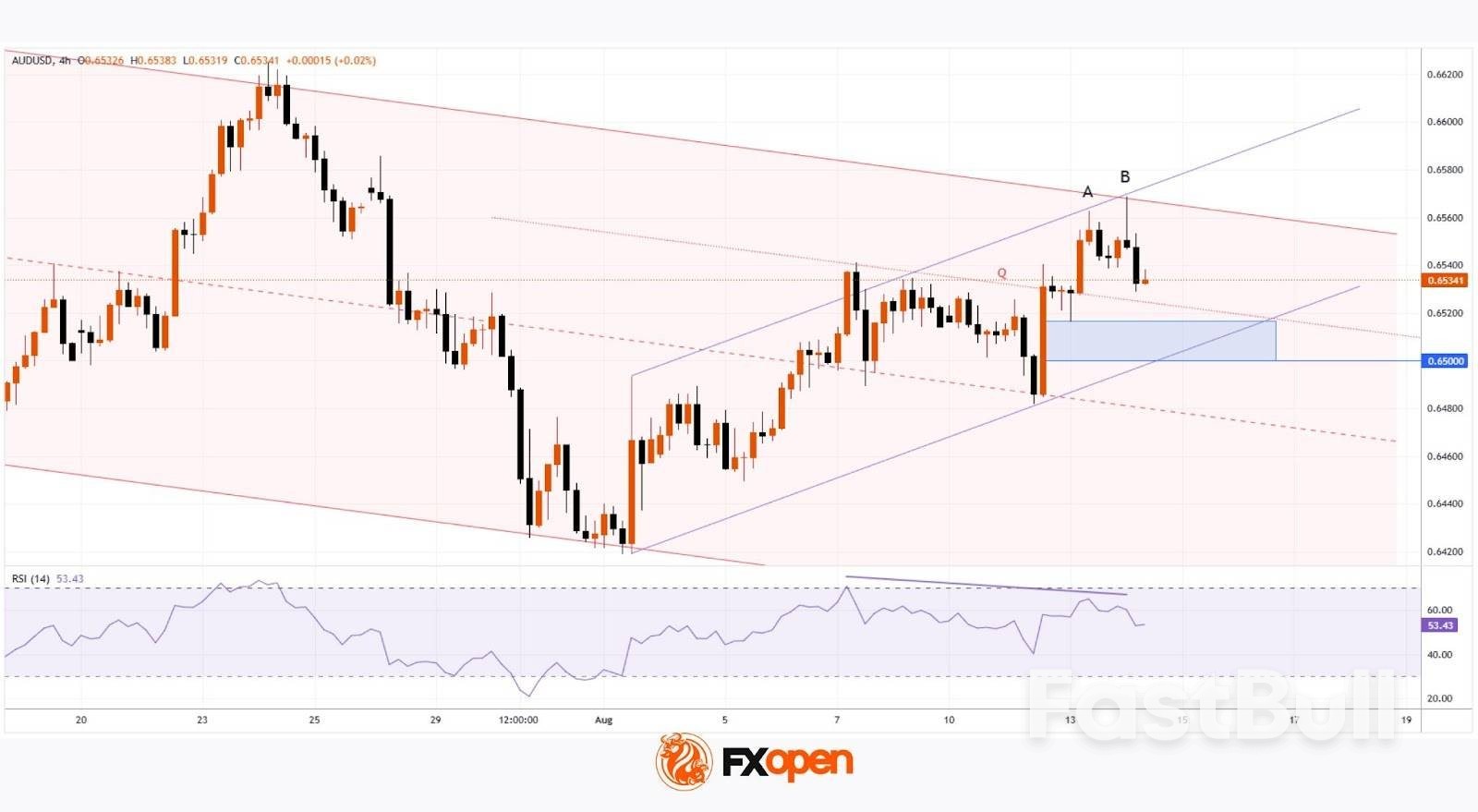
          Technical Analysis of the AUD/USD Chart

          Since last month, AUD/USD price movements have been forming a descending channel (highlighted in red), and this week’s reversal from the August high reinforces its relevance.

          Key factors emphasising the market’s bearish bias include:

          → Double top pattern formed by recent highs A and B. Notably, the long upper wicks of the candlesticks reflect increasing selling pressure.

          → The August upward move, marked by purple trendlines, may represent a corrective bear flag within the dominant downtrend.

          → Bearish RSI divergence – present not only between highs A and B, but also relative to the 7 July peak.

          Potential Support Levels:

          → Lower purple trendline;

          → Line Q, which divides the upper half of the channel into two quarters;

          → The 0.65 psychological level – previously defended strongly by bulls, as evidenced by the wide bullish candle on 12 August, when price surged easily (a sign of buying imbalance).

          These supports collectively form a key demand zone (shaded in purple). Bears will need significant momentum to break through this area and extend the prevailing downtrend in AUD/USD through August 2025.

          Source: FXOpen

          Risk Warnings and Disclaimers
          You understand and acknowledge that there is a high degree of risk involved in trading. Following any strategies or investment methods may lead to potential losses. The content on the site is provided by our contributors and analysts for information purposes only. You are solely responsible for determining whether any trading assets, securities, strategy, or any other product is suitable for investing based on your own investment objectives and financial situation.
          Add to Favorites
          Share

          S&P Upgrades India Rating on Economic Resilience, Sustained Fiscal Consolidation

          Glendon

          Economic

          Credit rating agency S&P Global upgraded India's long-term unsolicited sovereign credit ratings to "BBB" from "BBB-" on Thursday, citing economic resilience and sustained fiscal consolidation.

          The agency had revised the outlook on India's rating in May last year to positive from stable on robust growth and improved quality of government expenditure.

          "The upgrade of India reflects its buoyant economic growth, against the backdrop of an enhanced monetary policy environment that anchors inflationary expectations," the rating agency said in a statement.

          "Together with the government's commitment to fiscal consolidation and efforts to improve spending quality, we believe these factors have coalesced to benefit credit metrics," it added.

          The Indian rupee strengthened to 87.58 against the dollar from 87.66, while the benchmark 10-year bond yield fell 7 basis points to 6.38% soon after the announcement.

          The rating agency also revised its transfer and convertibility assessment to 'A-' from 'BBB+', it said.

          S&P may lower the country's ratings if it sees an erosion of political commitment to consolidate public finances, while downward pressure could also come from economic growth slowing materially on a structural basis such that it undermines fiscal sustainability, it said.

          Ratings could be further raised if fiscal deficits narrow meaningfully such that the net change in general government debt falls below 6% of GDP on a structural basis, it added.

          Source: Theedgemarkets

          To stay updated on all economic events of today, please check out our Economic calendar
          Risk Warnings and Disclaimers
          You understand and acknowledge that there is a high degree of risk involved in trading. Following any strategies or investment methods may lead to potential losses. The content on the site is provided by our contributors and analysts for information purposes only. You are solely responsible for determining whether any trading assets, securities, strategy, or any other product is suitable for investing based on your own investment objectives and financial situation.
          Add to Favorites
          Share

          Oil Price Premiums Narrow as Supply Expands and Summer Demand Cools

          Gerik

          Economic

          Commodity

          Market Structure Weakens as Supply Rises

          Global oil markets are entering a new phase of softening, with the price structure for key benchmarks like Brent, WTI, and Dubai narrowing markedly. The six-month time spreads in backwardation where near-term prices are higher than later deliveries have contracted by more than $1 per barrel since early August. This reflects a growing consensus among traders that supply conditions are loosening.
          In oil markets, backwardation typically signals tight supply and strong immediate demand. The recent flattening of this curve signals that prompt tightness is dissipating, primarily due to expectations of increasing output from OPEC+ members and steady flows from Russia via Baltic and Black Sea ports. This causal relationship between rising output and weaker time spreads is a clear indicator that the supply-demand balance is shifting toward surplus.

          OPEC+ Output and Non-OPEC Growth Drive Global Supply Surge

          Several supply-side developments are converging to ease global oil fundamentals. OPEC+, the extended cartel that includes key producers like Russia and Saudi Arabia, has agreed to lift production quotas starting in September. Simultaneously, non-OPEC exporters including Guyana, Brazil, and Norway are ramping up new production streams. These additions further reinforce market expectations that near-term supply growth will outpace demand recovery.
          According to Dubai-based trader Shohruh Zukhritdinov, this increase in supply, coupled with declining refinery utilization in the U.S. as the summer driving season ends, is weakening the market structure for both Brent and Dubai benchmarks. U.S. refinery runs typically decline entering the autumn “shoulder season,” a period of lower fuel demand, thus reducing prompt crude buying and exacerbating the pressure on front-month prices.

          Geopolitical Risk Premium Fades Amid Diplomatic Overtures

          Adding to the bearish sentiment is a marked reduction in geopolitical risk premiums. Recent fears of additional U.S. sanctions on Russian oil have diminished, thanks to steady Russian exports and a scheduled meeting between U.S. President Donald Trump and Russian President Vladimir Putin. The meeting, set for Friday in Alaska, aims to broker a ceasefire in Ukraine. Should it yield progress, Citi analysts estimate that Brent could drop into the low-$60s per barrel, underscoring the strong correlation between geopolitical developments and oil price expectations.
          The conclusion of summer has introduced a seasonal cooling effect on demand. In Europe, diesel margins have weakened, undermining refinery economics and reducing crude intake. In Saudi Arabia, demand for burning crude to meet peak electricity loads is set to drop. These cyclical factors are unraveling previously firm gasoil and diesel cracks, contributing to downward revisions in crude demand forecasts.
          Harry Tchilinguirian from Onyx Capital Group highlighted increased selling pressure in North Sea physical markets, a direct reaction to eroding demand fundamentals. He noted that even China previously a driver of seaborne crude demand due to aggressive stockpiling may reduce imports, raising concerns about absorption capacity for the extra barrels coming from Saudi Arabia.

          Spot Premiums Reflect Shifting Sentiment

          Middle Eastern crude benchmarks, particularly Dubai and Oman, are already reflecting this shift. Spot premiums for October-loading cargoes are now at their lowest levels in over a month. This drop in physical pricing confirms the broader weakening sentiment in the market and illustrates the direct link between anticipated oversupply and reduced willingness to pay for immediate delivery.
          The global oil market is entering a cooler phase after months of strength driven by tight supply and seasonal demand. With rising output from OPEC+ and new producers, fading fears of geopolitical disruption, and the natural decline in summer consumption, price structures are adjusting downward.
          As the market exits the summer peak, attention will shift toward autumn stock builds, geopolitical diplomacy, and China’s import behavior. Unless a new supply disruption or demand shock emerges, the current trend suggests that oil prices may continue to soften, with prompt premiums likely to remain under pressure in the months ahead.

          Source: Reuters

          To stay updated on all economic events of today, please check out our Economic calendar
          Risk Warnings and Disclaimers
          You understand and acknowledge that there is a high degree of risk involved in trading. Following any strategies or investment methods may lead to potential losses. The content on the site is provided by our contributors and analysts for information purposes only. You are solely responsible for determining whether any trading assets, securities, strategy, or any other product is suitable for investing based on your own investment objectives and financial situation.
          Add to Favorites
          Share

          China Moves to Mend Ties With India as US Tariffs Push New Strategic Alignments

          Gerik

          Economic

          A Diplomatic Reset Amid Geopolitical Realignment

          In a significant diplomatic overture, China will send Foreign Minister Wang Yi to New Delhi on August 18, marking his first visit in over three years. The trip signals a potential inflection point in Sino-Indian relations, which have been strained since the deadly 2020 Himalayan border clash. Sources familiar with the matter indicate that a key focus of Wang’s meetings with India’s National Security Adviser Ajit Doval and Foreign Minister Subrahmanyam Jaishankar will be on reducing military presence along their disputed border, a move aimed at de-escalating tensions and rebuilding trust.
          This visit is emblematic of a broader thaw that began quietly in late 2024. It comes as India reassesses its geopolitical posture in response to deteriorating trade ties with the United States. President Donald Trump’s recent 50% tariff hike on Indian exports significantly higher than on many of India’s regional peers has added new urgency to New Delhi’s search for alternative economic alignments.

          Bilateral Trade and Border Confidence-Building in Focus

          China and India are now considering the revival of border trade routes that were shuttered during the Covid-19 pandemic and have remained closed since the 2020 clashes. The proposed reactivation of three designated trading points along their 3,488-kilometer Himalayan border could restore long-standing local trade in goods such as spices, wool, carpets, and herbal products. While the absolute value of this trade was relatively minor estimated at $3.16 million in FY2017–18 it served as a confidence-building mechanism in border communities and contributed to grassroots economic cooperation.
          Reopening these channels would have symbolic and practical significance, particularly if paired with broader coordination on direct flights and visa liberalization. China has already signaled its willingness to coordinate closely with India on these measures, describing the need for “properly handling differences” in light of their shared identity as key developing economies and members of the Global South.

          Strategic Timing: Modi’s Visit to China and Trump’s Tariff Pressure

          The timing of Wang Yi’s visit is notable. Indian Prime Minister Narendra Modi is expected to travel to China later this month to attend the Shanghai Cooperation Organisation (SCO) summit in Tianjin. There, he may hold a bilateral meeting with Chinese President Xi Jinping his first since 2018. This potential face-to-face engagement could signal a dramatic shift in diplomatic tone following years of border tension and military buildup.
          Concurrently, Trump’s administration has increased pressure on India for its continued import of discounted Russian oil. The U.S. claims these purchases fund the Kremlin’s war effort in Ukraine, but India has defended its stance by arguing that such imports help stabilize global energy markets. Moreover, India’s deepening trade ties with Russia cemented by new bilateral agreements in July highlight New Delhi’s growing resistance to Washington’s foreign policy demands.
          Thus, China’s engagement with India comes at a time when New Delhi appears more willing to diversify its alliances and reduce its dependence on Western partners, especially the United States. There is a correlative relationship here: the more Trump’s tariffs alienate traditional partners, the more space opens for China to reassert influence regionally.

          Economic Concessions as Tools of Diplomacy

          China has also made tactical economic moves to support the diplomatic reset. It has recently relaxed restrictions on fertilizer shipments to India, providing short-term relief in a sector that affects both food security and inflation management. These incremental gestures align with China’s broader effort to rebuild bilateral goodwill through low-risk, high-visibility economic concessions.
          If both sides continue to prioritize cooperation over confrontation, it could mark a turning point in regional power dynamics. India and China remain the world’s most populous nations and fastest-growing major economies. Strengthened ties could reshape the trajectory of the Global South, not just in terms of trade but also in regional security frameworks and global governance.

          A Pragmatic Shift in a Fragmenting World Order

          As global alliances realign under the weight of U.S. protectionism and geopolitical competition, the warming relationship between India and China reflects a pragmatic recalibration of national interests. While tensions still linger particularly along the border the willingness of both governments to re-engage on multiple fronts suggests a growing understanding that strategic cooperation may serve their long-term goals more effectively than rivalry.
          China’s diplomatic outreach, paired with India’s growing disillusionment with Trump-era tariffs, introduces a new chapter in Asian diplomacy one that could gradually reshape the economic and political geometry of the region, especially as the multipolar world order becomes more defined.

          Source: Bloomberg

          To stay updated on all economic events of today, please check out our Economic calendar
          Risk Warnings and Disclaimers
          You understand and acknowledge that there is a high degree of risk involved in trading. Following any strategies or investment methods may lead to potential losses. The content on the site is provided by our contributors and analysts for information purposes only. You are solely responsible for determining whether any trading assets, securities, strategy, or any other product is suitable for investing based on your own investment objectives and financial situation.
          Add to Favorites
          Share

          Euro Zone Industry Shrinks More Than Feared In June But GDP Holds Up

          Winkelmann

          Forex

          Economic

          Euro zone industrial output dipped more than expected in June even as overall economic growth held up in the second quarter, challenging views that the 20 nation currency union remains resilient to the fallout from a global trade war.Industrial output fell 1.3% on the month in June, driven by a big dip in Germany and weak consumer goods production, underperforming expectations for a 1.0% fall, data from Eurostat showed on Thursday.

          Adding to the negative surprise, Eurostat also revised its output growth estimate for May to 1.1% from 1.7%, suggesting that the underlying trend is weaker than thought.Meanwhile GDP grew by 0.1% on the quarter, in line with a preliminary estimate, and employment rose just 0.1% on the quarter, in line with expectations in a Reuters poll, but below the 0.2% in the previous three months.A recent string of relatively upbeat indicators from purchasing managers (PMI) data to the European Commission's sentiment reading have fuelled a narrative that consumption is keeping the bloc resilient to trade tensions, but more recent numbers, like industrial orders and a key sentiment reading from Germany, have challenged this view.

          Still, investors continue to bet on a modest upturn on the premise that a recent EU trade deal with the U.S. provides much needed certainty and Germany's plans to sharply boost budget spending will support growth.This is why financial investors think the ECB may be done cutting interest rates and policymakers will sit out a temporary dip in inflation below the 2% target, as price pressures over the medium term are already building up.Growth is unlikely to take off, however, and the euro zone is facing modest expansion of only around 1% a year in the coming years, trailing other major economies, given structural inefficiencies.

          Compared to a year earlier, second quarter economic growth was 1.4%, a figure that is boosted by a one-off demand surge before U.S. tariffs took effect. This figure is now seen slowing steadily before picking up in 2026.The monthly industrial fall was driven by a 2.3% drop in Germany and an 11.3% fall in Ireland, a figure that is unlikely to concern many, since Irish data is exceptionally volatile due to activity among big multinational companies, mostly in pharmaceuticals, based there for tax purposes.Industry figures showed that besides energy production, every sector took a dip last month, led by a 4.7% fall in non-durable consumer goods and a 2.2% fall in capital goods production.

          Source: Reuters

          To stay updated on all economic events of today, please check out our Economic calendar
          Risk Warnings and Disclaimers
          You understand and acknowledge that there is a high degree of risk involved in trading. Following any strategies or investment methods may lead to potential losses. The content on the site is provided by our contributors and analysts for information purposes only. You are solely responsible for determining whether any trading assets, securities, strategy, or any other product is suitable for investing based on your own investment objectives and financial situation.
          Add to Favorites
          Share

          Gold Stabilizes Near Highs as Traders Bet on Fed Rate Cuts Amid Bessent’s Remarks

          Gerik

          Economic

          Commodity

          Gold Retains Strength Amid Shifting Rate Expectations

          Gold prices maintained recent gains on Thursday after US Treasury Secretary Scott Bessent publicly called on the Federal Reserve to cut its benchmark interest rate by at least 1.5 percentage points. This rare political intervention signaled intensifying pressure on the central bank and triggered a notable market response, increasing the probability of a September rate cut.
          Bullion rose as much as 0.6% before easing to trade around $3,365 per ounce. This price movement reflects a direct causal relationship: lower interest rates reduce the opportunity cost of holding non-yielding assets like gold, making the metal more attractive to investors. The drop in Treasury yields following Bessent’s comments added further support, as real returns on safe-haven bonds diminish when rate expectations fall.

          Market Sentiment Shifts Toward Monetary Easing

          In contrast to last month’s cautious outlook, when traders assigned less than a 50% chance of a rate cut in September, sentiment has now shifted decisively. The market consensus is building around a 25-basis-point cut next month, with a growing faction pricing in a larger adjustment. This pivot reflects how policymaker commentary, even when unofficial, can materially influence monetary expectations and asset pricing.
          Gold’s steady performance in this context illustrates the correlation between easing cycles and rising demand for safe-haven assets. The market’s reaction also suggests that investors are front-running a potential policy shift, reinforcing bullish momentum for precious metals.

          Geopolitical Tensions and Central Bank Buying Support Broader Rally

          Beyond interest rates, gold’s 28% year-to-date gain is also supported by sustained geopolitical and trade-related uncertainty, which continues to drive haven demand. Central bank gold purchases particularly from emerging markets seeking diversification from US dollar reserves have further underpinned the price rally. The majority of this surge occurred in the year’s first four months, but recent developments show that macroeconomic catalysts remain potent.
          Spot gold edged up 0.2% to $3,363.35 per ounce in early London trading, building on a similar gain in the prior session. Meanwhile, silver and platinum were largely unchanged, and palladium posted a minor increase, suggesting investor interest remains concentrated in gold due to its more direct sensitivity to interest rate trends and macro hedging functions.

          Tariff Uncertainty on Gold Imports Briefly Distorts Futures Market

          An additional factor influencing gold pricing is regulatory ambiguity. Confusion over whether US imports of gold bars would face new tariffs sparked temporary dislocations in the futures market earlier this week. The resulting premium for New York-traded gold futures over London spot prices was eventually narrowed after President Donald Trump stated there would be no levy. However, his lack of elaboration left some residual uncertainty in the market, revealing how regulatory clarity or lack thereof can introduce short-term price distortions even in highly liquid markets.
          This episode highlights the correlation between policy announcements and market efficiency: when clarity is absent, arbitrage mechanisms between spot and futures markets weaken, leading to pricing anomalies that may persist until official confirmation is delivered.

          Gold Outlook Anchored in Rate Speculation and Policy Ambiguity

          Gold’s current price trajectory remains closely tied to investor expectations surrounding US monetary policy. Bessent’s call for aggressive rate cuts amplified speculation of a shift in Fed policy, reinforcing gold’s appeal as both a hedge against declining real yields and a store of value in uncertain times.
          With additional support from central bank demand and lingering trade policy ambiguities, gold appears well-positioned to maintain its elevated levels in the near term. However, much will depend on how the Fed responds to both political pressure and incoming economic data ahead of its next meeting, with the metal’s future likely to be determined by a complex interplay between rates, risk sentiment, and global capital flows.

          Source: Bloomberg

          To stay updated on all economic events of today, please check out our Economic calendar
          Risk Warnings and Disclaimers
          You understand and acknowledge that there is a high degree of risk involved in trading. Following any strategies or investment methods may lead to potential losses. The content on the site is provided by our contributors and analysts for information purposes only. You are solely responsible for determining whether any trading assets, securities, strategy, or any other product is suitable for investing based on your own investment objectives and financial situation.
          Add to Favorites
          Share

          Canadian Canola Meal Caught in Tariff Standoff Faces Steep Discounts and Export Detours

          Gerik

          Economic

          Trade Standoff and Policy Escalation

          The current impasse stems from a rapid escalation in a year-long trade dispute. Beijing’s decision to impose a 100% duty on Canadian canola meal came without warning, catching both importers and feed producers off guard. This measure followed a preliminary anti-dumping levy of 75.8% on Canadian canola oilseed announced just two days earlier, itself a retaliatory move in response to Ottawa’s tariffs on Chinese electric vehicles imposed last August. The tariff expansion fits into a broader Chinese strategy of applying targeted pressure across multiple agricultural and industrial sectors, a pattern also seen in its March decision to impose identical 100% tariffs on Canadian rapeseed oil, oil cakes, and pea imports.
          Trade sources estimate that between 200,000 and 400,000 metric tons of canola meal are now sitting idle in secure warehouses near major Chinese ports, awaiting resolution. At the higher estimate, the cargo’s market value reaches roughly $120 million. Importers face an unpalatable choice: either absorb the full tariff hit, doubling the landed cost and making domestic resale unviable, or reroute the product to alternative markets willing to take the feed ingredient at a 30% discount.

          Market Ripple Effects

          The search for alternative buyers is focusing on Southeast Asia and South Korea, where demand for protein-rich feed ingredients remains robust. However, selling into these markets at discounted rates could depress regional feed prices and disrupt existing supply relationships. The heavy discounting also highlights a deeper structural problem for Canadian exporters: the sudden closure of China, historically a major buyer, compresses margins and forces them into more competitive, lower-value sales channels.
          From a geopolitical perspective, the canola meal impasse serves as a visible example of how agricultural commodities are weaponized in trade conflicts. For China, targeting canola a key Canadian export not only hits Canadian farm incomes but also signals to Ottawa that tariff retaliation will be felt across politically sensitive rural constituencies. For Canada, the challenge is compounded by the difficulty of quickly re-diverting such large volumes to markets with comparable absorption capacity.
          If the trade standoff persists, long-term supply chain adjustments may be necessary, including diversifying Canadian export destinations and negotiating alternative logistics routes. In the near term, the clearing of stranded stocks will likely depend on importers’ ability to negotiate sales into secondary markets, potentially at sustained discounts that could ripple back to farm-gate prices. The episode also raises a broader caution for agribusiness: in the current geopolitical climate, reliance on a single dominant buyer carries elevated risk, and market access can vanish overnight under the weight of political disputes.

          Source: Reuters

          To stay updated on all economic events of today, please check out our Economic calendar
          Risk Warnings and Disclaimers
          You understand and acknowledge that there is a high degree of risk involved in trading. Following any strategies or investment methods may lead to potential losses. The content on the site is provided by our contributors and analysts for information purposes only. You are solely responsible for determining whether any trading assets, securities, strategy, or any other product is suitable for investing based on your own investment objectives and financial situation.
          Add to Favorites
          Share
          FastBull
          Copyright © 2025 FastBull Ltd

          728 RM B 7/F GEE LOK IND BLDG NO 34 HUNG TO RD KWUN TONG KLN HONG KONG

          TelegramInstagramTwitterfacebooklinkedin
          App Store Google Play Google Play
          Products
          Charts

          Chats

          Q&A with Experts
          Screeners
          Economic Calendar
          Data
          Tools
          Membership
          Features
          Function
          Markets
          Copy Trading
          Latest Signals
          Contests
          News
          Analysis
          24/7
          Columns
          Education
          Company
          Careers
          About Us
          Contact Us
          Advertising
          Help Center
          Feedback
          User Agreement
          Privacy Policy
          Business

          White Label

          Data API

          Web Plug-ins

          Poster Maker

          Affiliate Program

          Risk Disclosure

          The risk of loss in trading financial instruments such as stocks, FX, commodities, futures, bonds, ETFs and crypto can be substantial. You may sustain a total loss of the funds that you deposit with your broker. Therefore, you should carefully consider whether such trading is suitable for you in light of your circumstances and financial resources.

          No decision to invest should be made without thoroughly conducting due diligence by yourself or consulting with your financial advisors. Our web content might not suit you since we don't know your financial conditions and investment needs. Our financial information might have latency or contain inaccuracy, so you should be fully responsible for any of your trading and investment decisions. The company will not be responsible for your capital loss.

          Without getting permission from the website, you are not allowed to copy the website's graphics, texts, or trademarks. Intellectual property rights in the content or data incorporated into this website belong to its providers and exchange merchants.

          Not Logged In

          Log in to access more features

          FastBull Membership

          Not yet

          Purchase

          Become a signal provider
          Help Center
          Customer Service
          Dark Mode
          Price Up/Down Colors

          Log In

          Sign Up

          Position
          Layout
          Fullscreen
          Default to Chart
          The chart page opens by default when you visit fastbull.com
