• Trade
  • Markets
  • Copy
  • Contests
  • News
  • 24/7
  • Calendar
  • Q&A
  • Chats
Trending
Screeners
SYMBOL
LAST
BID
ASK
HIGH
LOW
NET CHG.
%CHG.
SPREAD
SPX
S&P 500 Index
6857.13
6857.13
6857.13
6865.94
6827.13
+7.41
+ 0.11%
--
DJI
Dow Jones Industrial Average
47850.93
47850.93
47850.93
48049.72
47692.96
-31.96
-0.07%
--
IXIC
NASDAQ Composite Index
23505.13
23505.13
23505.13
23528.53
23372.33
+51.04
+ 0.22%
--
USDX
US Dollar Index
98.840
98.920
98.840
98.980
98.740
-0.140
-0.14%
--
EURUSD
Euro / US Dollar
1.16584
1.16593
1.16584
1.16715
1.16408
+0.00139
+ 0.12%
--
GBPUSD
Pound Sterling / US Dollar
1.33547
1.33555
1.33547
1.33622
1.33165
+0.00276
+ 0.21%
--
XAUUSD
Gold / US Dollar
4223.94
4224.35
4223.94
4230.62
4194.54
+16.77
+ 0.40%
--
WTI
Light Sweet Crude Oil
59.471
59.501
59.471
59.480
59.187
+0.088
+ 0.15%
--

Community Accounts

Signal Accounts
--
Profit Accounts
--
Loss Accounts
--
View More

Become a signal provider

Sell trading signals to earn additional income

View More

Guide to Copy Trading

Get started with ease and confidence

View More

Signal Accounts for Members

All Signal Accounts

Best Return
  • Best Return
  • Best P/L
  • Best MDD
Past 1W
  • Past 1W
  • Past 1M
  • Past 1Y

All Contests

  • All
  • Trump Updates
  • Recommend
  • Stocks
  • Cryptocurrencies
  • Central Banks
  • Featured News
Top News Only
Share

Kremlin Aide Ushakov Says USA Kushner Is Working Very Actively On Ukrainian Settlement

Share

Norway To Acquire 2 More Submarines, Long-Range Missiles, Daily Vg Reports

Share

Ucb Sa Shares Open Up 7.3% After 2025 Guidance Upgrade, Top Of Bel 20 Index

Share

Shares In Italy's Mediobanca Down 1.3% After Barclays Cuts To Underweight From Equal-Weight

Share

Stats Office - Austrian November Wholesale Prices +0.9% Year-On-Year

Share

Britain's FTSE 100 Up 0.15%

Share

Europe's STOXX 600 Up 0.1%

Share

Taiwan November PPI -2.8% Year-On-Year

Share

Stats Office - Austrian September Trade -230.8 Million EUR

Share

Swiss National Bank Forex Reserves Revised To Chf 724906 Million At End Of October - SNB

Share

Swiss National Bank Forex Reserves At Chf 727386 Million At End Of November - SNB

Share

Shanghai Warehouse Rubber Stocks Up 8.54% From Week Earlier

Share

Turkey's Main Banking Index Up 2%

Share

French October Trade Balance -3.92 Billion Euros Versus Revised -6.35 Billion Euros In September

Share

Kremlin Aide Says Russia Is Ready To Work Further With Current USA Team

Share

Kremlin Aide Says Russia And USA Are Moving Forward In Ukraine Talks

Share

Shanghai Rubber Warehouse Stocks Up 7336 Tons

Share

Shanghai Tin Warehouse Stocks Up 506 Tons

Share

Reserve Bank Of India Chief Malhotra: Goal Is To Have Inflation Be Around 4%

Share

Ukmto Says Master Has Confirmed That The Small Crafts Have Left The Scene, Vessel Is Proceeding To Its Next Port Of Call

TIME
ACT
FCST
PREV
France 10-Year OAT Auction Avg. Yield

A:--

F: --

P: --

Euro Zone Retail Sales MoM (Oct)

A:--

F: --

P: --

Euro Zone Retail Sales YoY (Oct)

A:--

F: --

P: --

Brazil GDP YoY (Q3)

A:--

F: --

P: --

U.S. Challenger Job Cuts (Nov)

A:--

F: --

P: --

U.S. Challenger Job Cuts MoM (Nov)

A:--

F: --

P: --

U.S. Challenger Job Cuts YoY (Nov)

A:--

F: --

P: --

U.S. Initial Jobless Claims 4-Week Avg. (SA)

A:--

F: --

P: --

U.S. Weekly Initial Jobless Claims (SA)

A:--

F: --

P: --

U.S. Weekly Continued Jobless Claims (SA)

A:--

F: --

P: --

Canada Ivey PMI (SA) (Nov)

A:--

F: --

P: --

Canada Ivey PMI (Not SA) (Nov)

A:--

F: --

P: --

U.S. Non-Defense Capital Durable Goods Orders Revised MoM (Excl. Aircraft) (SA) (Sept)

A:--

F: --

P: --
U.S. Factory Orders MoM (Excl. Transport) (Sept)

A:--

F: --

P: --

U.S. Factory Orders MoM (Sept)

A:--

F: --

P: --

U.S. Factory Orders MoM (Excl. Defense) (Sept)

A:--

F: --

P: --

U.S. EIA Weekly Natural Gas Stocks Change

A:--

F: --

P: --

Saudi Arabia Crude Oil Production

A:--

F: --

P: --

U.S. Weekly Treasuries Held by Foreign Central Banks

A:--

F: --

P: --

Japan Foreign Exchange Reserves (Nov)

A:--

F: --

P: --

India Repo Rate

A:--

F: --

P: --

India Benchmark Interest Rate

A:--

F: --

P: --

India Reverse Repo Rate

A:--

F: --

P: --

India Cash Reserve Ratio

A:--

F: --

P: --

Japan Leading Indicators Prelim (Oct)

A:--

F: --

P: --

U.K. Halifax House Price Index YoY (SA) (Nov)

A:--

F: --

P: --

U.K. Halifax House Price Index MoM (SA) (Nov)

A:--

F: --

P: --

France Current Account (Not SA) (Oct)

A:--

F: --

P: --

France Trade Balance (SA) (Oct)

A:--

F: --

P: --

France Industrial Output MoM (SA) (Oct)

A:--

F: --

P: --

Italy Retail Sales MoM (SA) (Oct)

--

F: --

P: --

Euro Zone Employment YoY (SA) (Q3)

--

F: --

P: --

Euro Zone GDP Final YoY (Q3)

--

F: --

P: --

Euro Zone GDP Final QoQ (Q3)

--

F: --

P: --

Euro Zone Employment Final QoQ (SA) (Q3)

--

F: --

P: --

Euro Zone Employment Final (SA) (Q3)

--

F: --

P: --
Brazil PPI MoM (Oct)

--

F: --

P: --

Mexico Consumer Confidence Index (Nov)

--

F: --

P: --

Canada Unemployment Rate (SA) (Nov)

--

F: --

P: --

Canada Labor Force Participation Rate (SA) (Nov)

--

F: --

P: --

Canada Employment (SA) (Nov)

--

F: --

P: --

Canada Part-Time Employment (SA) (Nov)

--

F: --

P: --

Canada Full-time Employment (SA) (Nov)

--

F: --

P: --

U.S. Personal Income MoM (Sept)

--

F: --

P: --

U.S. Dallas Fed PCE Price Index YoY (Sept)

--

F: --

P: --

U.S. PCE Price Index YoY (SA) (Sept)

--

F: --

P: --

U.S. PCE Price Index MoM (Sept)

--

F: --

P: --

U.S. Personal Outlays MoM (SA) (Sept)

--

F: --

P: --

U.S. Core PCE Price Index MoM (Sept)

--

F: --

P: --

U.S. UMich 5-Year-Ahead Inflation Expectations Prelim YoY (Dec)

--

F: --

P: --

U.S. Core PCE Price Index YoY (Sept)

--

F: --

P: --

U.S. Real Personal Consumption Expenditures MoM (Sept)

--

F: --

P: --

U.S. 5-10 Year-Ahead Inflation Expectations (Dec)

--

F: --

P: --

U.S. UMich Current Economic Conditions Index Prelim (Dec)

--

F: --

P: --

U.S. UMich Consumer Sentiment Index Prelim (Dec)

--

F: --

P: --

U.S. UMich 1-Year-Ahead Inflation Expectations Prelim (Dec)

--

F: --

P: --

U.S. UMich Consumer Expectations Index Prelim (Dec)

--

F: --

P: --

U.S. Weekly Total Rig Count

--

F: --

P: --

U.S. Weekly Total Oil Rig Count

--

F: --

P: --

U.S. Consumer Credit (SA) (Oct)

--

F: --

P: --

Q&A with Experts
    • All
    • Chatrooms
    • Groups
    • Friends
    Connecting
    .
    .
    .
    Type here...
    Add Symbol or Code

      No matching data

      All
      Trump Updates
      Recommend
      Stocks
      Cryptocurrencies
      Central Banks
      Featured News
      • All
      • Russia-Ukraine Conflict
      • Middle East Flashpoint
      • All
      • Russia-Ukraine Conflict
      • Middle East Flashpoint

      Search
      Products

      Charts Free Forever

      Chats Q&A with Experts
      Screeners Economic Calendar Data Tools
      Membership Features
      Data Warehouse Market Trends Institutional Data Policy Rates Macro

      Market Trends

      Market Sentiment Order Book Forex Correlations

      Top Indicators

      Charts Free Forever
      Markets

      News

      News Analysis 24/7 Columns Education
      From Institutions From Analysts
      Topics Columnists

      Latest Views

      Latest Views

      Trending Topics

      Top Columnists

      Latest Update

      Signals

      Copy Rankings Latest Signals Become a signal provider AI Rating
      Contests
      Brokers

      Overview Brokers Assessment Rankings Regulators News Claims
      Broker listing Forex Brokers Comparison Tool Live Spread Comparison Scam
      Q&A Complaint Scam Alert Videos Tips to Detect Scam
      More

      Business
      Events
      Careers About Us Advertising Help Center

      White Label

      Data API

      Web Plug-ins

      Affiliate Program

      Awards Institution Evaluation IB Seminar Salon Event Exhibition
      Vietnam Thailand Singapore Dubai
      Fans Party Investment Sharing Session
      FastBull Summit BrokersView Expo
      Recent Searches
        Top Searches
          Markets
          News
          Analysis
          User
          24/7
          Economic Calendar
          Education
          Data
          • Names
          • Latest
          • Prev

          View All

          No data

          Scan to Download

          Faster Charts, Chat Faster!

          Download App
          English
          • English
          • Español
          • العربية
          • Bahasa Indonesia
          • Bahasa Melayu
          • Tiếng Việt
          • ภาษาไทย
          • Français
          • Italiano
          • Türkçe
          • Русский язык
          • 简中
          • 繁中
          Open Account
          Search
          Products
          Charts Free Forever
          Markets
          News
          Signals

          Copy Rankings Latest Signals Become a signal provider AI Rating
          Contests
          Brokers

          Overview Brokers Assessment Rankings Regulators News Claims
          Broker listing Forex Brokers Comparison Tool Live Spread Comparison Scam
          Q&A Complaint Scam Alert Videos Tips to Detect Scam
          More

          Business
          Events
          Careers About Us Advertising Help Center

          White Label

          Data API

          Web Plug-ins

          Affiliate Program

          Awards Institution Evaluation IB Seminar Salon Event Exhibition
          Vietnam Thailand Singapore Dubai
          Fans Party Investment Sharing Session
          FastBull Summit BrokersView Expo

          Crude Oil Weekly Outlook: OPEC Meeting vs WTI Price Risks

          FOREX.com
          Summary:

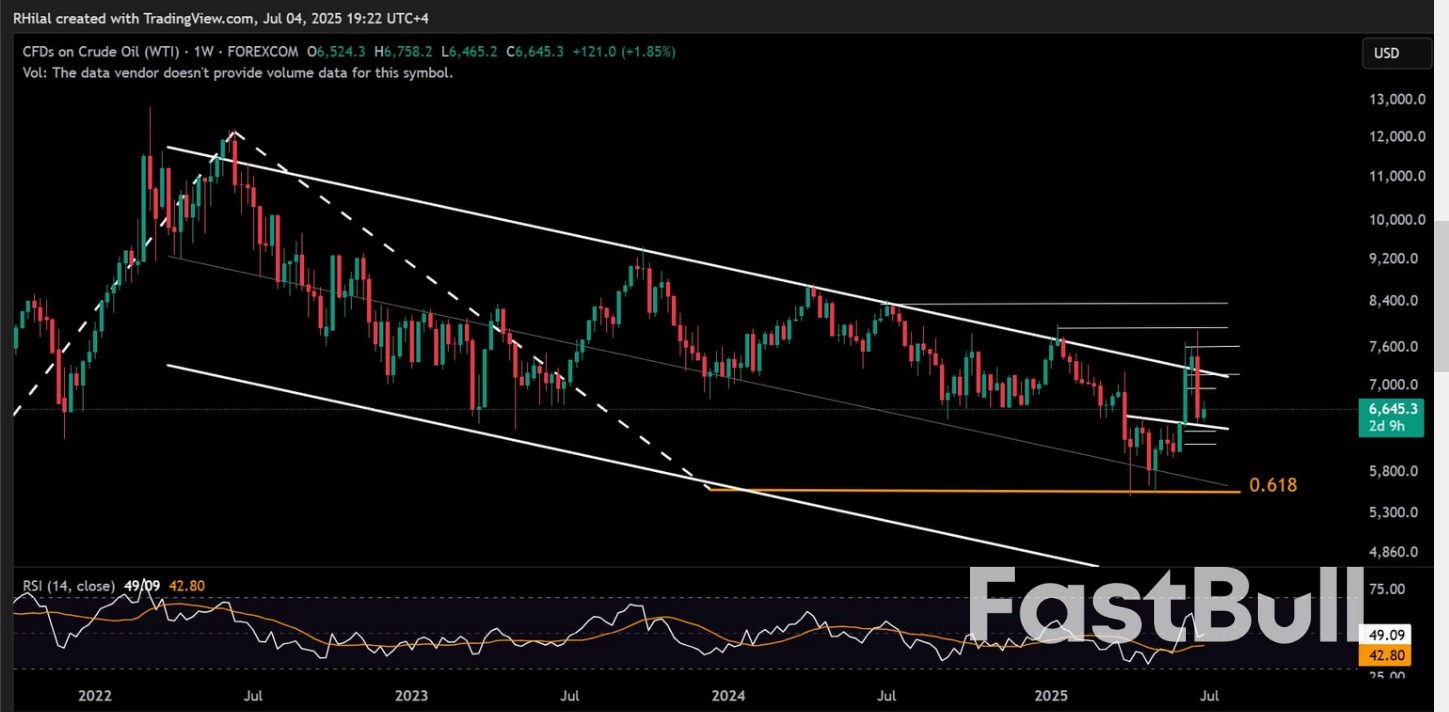
          As WTI trades back inside the 3-year downtrend channel established since the 2022 highs, the outlook has shifted to a neutral-to-bearish tone, with markets awaiting a decisive breakout.
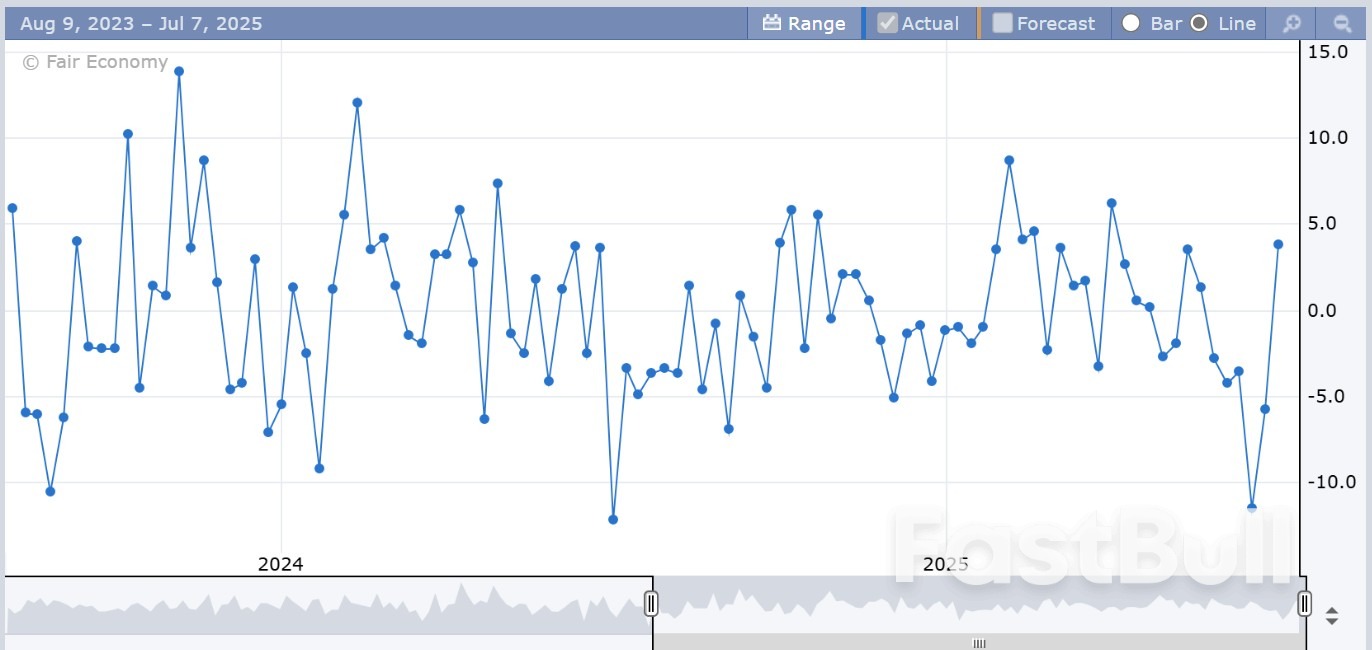
          Key Events to Watch

          ● Chinese CPI – Wednesday: Will deflationary pressures deepen?
          ● FOMC Minutes & USD Weakness: Possible policy clues and implications for oil demand
          ● U.S. Crude Inventories: Retesting 3-month highs, adding pressure to prices
          As WTI trades back inside the 3-year downtrend channel established since the 2022 highs, the outlook has shifted to a neutral-to-bearish tone, with markets awaiting a decisive breakout.
          Several macro and supply-side factors are reinforcing this stance, including OPEC’s planned unwind of voluntary supply cuts totaling more than 400,000 barrels per day starting in August, rising U.S. crude inventories nearing 3-month highs, and ongoing trade uncertainty tied to near-term tariff decisions.
          Crude Oil Weekly Outlook: OPEC Meeting vs WTI Price Risks_1
          Despite current downside pressure, several bullish factors are helping to hold prices and are worth monitoring:
          ● Continued U.S. dollar weakness could lend support to commodity prices.
          ● OPEC’s confidence in phasing out cuts suggests a more optimistic supply-demand outlook.
          ● Expectations for interest rate cuts and potential trade agreements may boost demand sentiment.

          So what are the key levels I’m watching?

          Crude Oil Weekly Outlook: Weekly Time Frame – Log Scale
          Crude Oil Weekly Outlook: OPEC Meeting vs WTI Price Risks_2
          As oil holds back within the 3-year down trending channel, a bearish-to-neutral stance persists in line with OPEC’s supply strategies. The latest oil drop found support above the 64-mark, aligning with the neckline of a previously formed inverted head and shoulders pattern that corresponded with the breakout above 70 during Middle East escalations. Now that we are back at that support and technical checkpoint, the scenarios are as follows:
          Bearish Scenario:Should oil close below the 63.40 level, downside risks may accelerate toward the midzone of the established 3-year channel, aligning with the 60, 58, and 56 levels, respectively, before confirming projections for new 2025 lows.
          Bullish Scenario: On the upside, if crude holds above the 64–66 support zone, it may recover toward the 69 and 72 resistance levels, where it is likely to challenge a fresh breakout attempt. Such a move could reshape the broader WTI outlook, either sustaining or overcoming the dominance of the long-standing down trending channel.

          Source: FOREX

          Risk Warnings and Disclaimers
          You understand and acknowledge that there is a high degree of risk involved in trading. Following any strategies or investment methods may lead to potential losses. The content on the site is provided by our contributors and analysts for information purposes only. You are solely responsible for determining whether any trading assets, securities, strategy, or any other product is suitable for investing based on your own investment objectives and financial situation.
          Add to Favorites
          Share

          China’s Rare Earth Export Controls Strengthen State Leverage But Strain Domestic Industry

          Gerik

          Economic

          Commodity

          Export Controls as Strategic Leverage in Geopolitics

          China’s decision in April to curb rare earth and magnet exports, primarily in retaliation to US-imposed tariffs, served its geopolitical intent by stalling parts of the global auto supply chain and drawing US officials back into negotiations. With China supplying 90% of the world’s rare earth magnets, the move underscored its dominance in a critical material segment used across electric vehicles, defense technologies, and clean energy systems.
          The export restrictions prompted a 75% drop in magnet exports within two months and forced several automakers globally to suspend production. These disruptions illustrated a direct causal relationship between Beijing’s policy intervention and the functional slowdown of the international manufacturing network. The United States subsequently reached a tentative deal with China on June 27 to resume rare earth trade, but industry insiders expect a slow implementation phase, as outlined by Baotou Rare Earth Products Exchange.

          Economic Repercussions for Domestic Producers

          While the move demonstrated China’s external bargaining power, the domestic cost has been severe. Magnet producers, already strained by a sluggish Chinese economy and weakening demand from the electric vehicle sector, found themselves facing an internal crisis. Export volumes had been crucial to many firms, contributing between 18% and 50% of total revenue among the top eleven listed magnet producers in 2024.
          The abrupt contraction in export markets, combined with tepid domestic demand, has placed pressure on both revenue and operational continuity. Several medium-sized firms cut production by approximately 15% during April and May, while inventories began to accumulate due to the customized nature of magnets, which hinders domestic resale.
          This squeeze has created a dual burden for manufacturers: they must manage rising storage and compliance costs, while simultaneously grappling with reduced revenue streams. The correlation here reveals that while the export curbs were politically intentional, their economic impact at home has been disproportionately negative and difficult to contain.

          Market Signals Diverge from Business Realities

          Stock prices of magnet-producing firms initially fell sharply in April following the export announcement but have since staged an unexpected rebound. Analysts such as Cory Combs at Trivium China warn that this recovery may be driven more by speculative sentiment than by any structural improvement in the sector’s prospects. Given the absence of a clear timeline for export license normalization, and the uncertain path forward in US-China trade relations, the current market optimism appears decoupled from operational fundamentals.
          Moreover, the presence of numerous private firms in the rare earth magnet industry obscures a full accounting of the sector’s financial condition. Share prices of listed entities only partially reflect broader industry stress, especially among small-to-mid-size producers that lack export licenses or political influence.

          Historical Parallels Suggest Prolonged Recovery Timelines

          The experience with other critical minerals namely germanium and antimony suggests that even when controls are aimed at civilian industries, recovery in export flows is not guaranteed. Customs data show that antimony shipments to Europe remain far below pre-control levels, even a year after restrictions were imposed. This precedent indicates a possible lag effect, where producers may continue facing delays and compliance hurdles long after diplomatic agreements are reached.
          Industry observers like Ellie Saklatvala from Argus emphasize that the burdens associated with documentation and licensing for exports have become a permanent feature of the trade process. These institutional changes reflect a structural shift in China’s export policy, with long-term implications for efficiency, trade friction, and inventory management.

          Pressure May Drive Consolidation, Not Reform

          The mounting operational strain could trigger a wave of industry consolidation. In a sector with hundreds of producers, particularly in regions like Inner Mongolia, financial pressure and logistical bottlenecks may force smaller players to exit or merge. Analysts like David Abraham view this as a potential outcome that Beijing may tacitly support, as it allows for tighter control and better tracking of rare earth flows.
          This dynamic introduces a complex causal relationship: export controls designed for external strategic leverage inadvertently become tools for domestic industry restructuring. While short-term business losses are severe, the central government may view long-term consolidation as a policy-aligned benefit.

          Strategic Gains at the Expense of Industrial Stability

          China’s rare earth export curbs have yielded political leverage but at a significant cost to its own magnet manufacturing base. The dual effects geopolitical positioning and economic self-harm reveal the trade-offs embedded in strategic resource nationalism. Even as negotiations with the US offer a potential easing of restrictions, the regulatory and logistical friction introduced by the controls appears here to stay.
          The episode underscores a broader transformation in how China uses its mineral dominance not merely as a passive supplier but as an active regulator of global supply chains, capable of enforcing compliance externally while reshaping industry structures at home. Whether this strategy will ultimately strengthen China’s position or undermine its industrial foundation remains contingent on how quickly and effectively domestic firms can adapt.

          Source: Reuters

          To stay updated on all economic events of today, please check out our Economic calendar
          Risk Warnings and Disclaimers
          You understand and acknowledge that there is a high degree of risk involved in trading. Following any strategies or investment methods may lead to potential losses. The content on the site is provided by our contributors and analysts for information purposes only. You are solely responsible for determining whether any trading assets, securities, strategy, or any other product is suitable for investing based on your own investment objectives and financial situation.
          Add to Favorites
          Share

          Market Analysis: GBP/USD Dips as EUR/GBP Accelerates Higher

          FXOpen
          Important Takeaways for GBP/USD and EUR/GBP Analysis Today
          ● The British Pound is showing bearish signs below the 1.3700 support against the US dollar.
          ● There is a key bearish trend line forming with resistance near 1.3650 on the hourly chart of GBP/USD at FXOpen.
          ● EUR/GBP is gaining pace and trading above the 0.8600 zone.
          ● There was a break above a contracting triangle with resistance at 0.8630 on the hourly chart at FXOpen.

          GBP/USD Technical Analysis

          Market Analysis: GBP/USD Dips as EUR/GBP Accelerates Higher _1
          On the hourly chart of GBP/USD at FXOpen, the pair failed to stay above the 1.3750 pivot level. As a result, the British Pound started a fresh decline below 1.3720 against the US Dollar.
          There was a clear move below 1.3700 and the 50-hour simple moving average. The bears pushed the pair below 1.3650. Finally, there was a spike below the 1.3600 support zone. A low was formed near 1.3562 and the pair is now consolidating losses.
          There was a minor move above the 1.3615 level. On the upside, the GBP/USD chart indicates that the pair is facing resistance near the 1.3650 level. There is also a key bearish trend line forming with resistance near 1.3650.
          The next major resistance is near the 50% Fib retracement level of the downward move from the 1.3788 swing high to the 1.3562 low at 1.3675. A close above the 1.3670 resistance zone could open the doors for a move toward the 1.3700 zone. The 61.8% Fib retracement level is at 1.3700. Any more gains might send GBP/USD toward 1.3790.
          On the downside, there is a key support forming near 1.3615. If there is a downside break below the 1.3615 support, the pair could accelerate lower. The next major support is near the 1.3560 zone, below which the pair could test 1.3500. Any more losses could lead the pair toward the 1.3440 support.

          EUR/GBP Technical Analysis

          Market Analysis: GBP/USD Dips as EUR/GBP Accelerates Higher _2
          On the hourly chart of EUR/GBP at FXOpen, the pair started a decent increase from the 0.8500 zone. The Euro traded above the 0.8580 resistance level to enter a positive zone against the British Pound.
          The pair settled above the 50-hour simple moving average and 0.8620. It traded as high as 0.8670 before a downside correction. There was a move below the 23.6% Fib retracement level of the upward move from the 0.8507 swing low to the 0.8670 high.
          However, the pair is stable above the 0.8600 support zone. The next major support is near the 50% Fib retracement level of the upward move from the 0.8507 swing low to the 0.8670 high at 0.8590.
          A downside break below 0.8590 might call for more downsides. In the stated case, the pair could drop toward the 0.8545 support level. Any more losses might call for an extended drop toward the 0.8505 pivot zone.
          The EUR/GBP chart suggests that the pair is facing resistance near the 0.8635 zone. A close above the 0.8635 level might accelerate gains. In the stated case, the bulls may perhaps aim for a test of 0.8670. Any more gains might send the pair toward the 0.8700 level.

          Source:FXOpen

          Risk Warnings and Disclaimers
          You understand and acknowledge that there is a high degree of risk involved in trading. Following any strategies or investment methods may lead to potential losses. The content on the site is provided by our contributors and analysts for information purposes only. You are solely responsible for determining whether any trading assets, securities, strategy, or any other product is suitable for investing based on your own investment objectives and financial situation.
          Add to Favorites
          Share

          Thailand Seeks to Avert 36% US Tariff with Strategic Trade Concessions

          Gerik

          Economic

          Thailand Offers Expedited Trade Deal to Deter Tariff Imposition

          Thailand has escalated its diplomatic and economic outreach to the United States in an attempt to prevent the implementation of a 36% export tariff threatened by the Trump administration. The revised trade proposal, submitted just before the expiration of a 90-day tariff suspension, reflects a calculated effort by Bangkok to preserve favorable trade ties with one of its largest partners.
          Finance Minister Pichai Chunhavajira confirmed that the new offer includes wider access for US agricultural and industrial products, as well as commitments to purchase more American energy and Boeing aircraft. These gestures are aimed at rebalancing trade flows and addressing US grievances about Thailand’s persistent trade surplus.

          Accelerated Timeline to Narrow Trade Surplus

          Under the updated proposal, Thailand pledges to reduce its $46 billion trade surplus with the US by 70% within five years, achieving a full trade balance within seven to eight years. This is a notable acceleration from the previous offer, which projected a ten-year timeline for correcting the imbalance. The new targets suggest that Thailand is prioritizing the preservation of market stability and avoiding a disruptive tariff shock over long-term negotiation leverage.
          This forward-leaning timeline is not merely symbolic. It reflects a causal response to external political pressure, as Thailand seeks to preempt tariff enforcement by aligning more closely with US economic interests. The immediacy of the commitment to eliminate import tariffs or non-tariff barriers for most goods upon deal acceptance, with slower adjustments for select items, supports this interpretation.

          Geopolitical and Economic Stakes at Play

          The proposal arrives at a sensitive juncture. With President Donald Trump signaling a more aggressive stance on trade, particularly toward countries with large bilateral surpluses, Thailand faces an urgent need to reposition itself as a cooperative partner. The Trump administration has framed such surpluses as indicators of unfair trade practices, and has wielded tariff threats as a mechanism for enforcing bilateral rebalancing.
          The focus on American energy imports and Boeing aircraft purchases further illustrates the strategic calculus behind Thailand’s offer. These sectors represent politically sensitive industries in the US and have historically been focal points in American trade diplomacy. By committing to purchases in these areas, Thailand is appealing directly to constituencies that influence US trade policy.

          Implications for Broader US-Asia Trade Dynamics

          Thailand’s move may also carry broader implications for other Southeast Asian economies that maintain trade surpluses with the US. If the proposal is accepted and tariffs are avoided, it could establish a framework for other nations facing similar pressure to follow suit. However, it also risks reinforcing a bilateral model of economic negotiation that prioritizes immediate trade balances over multilateral rules and market forces.
          The Thai offer reflects not just a willingness to make concessions but also an awareness of the shifting structure of global trade diplomacy. It underscores the growing importance of proactive engagement and targeted reciprocity in avoiding punitive outcomes in a less predictable global trade environment.
          Thailand’s revised trade proposal marks a significant diplomatic and economic overture intended to forestall a damaging trade rupture. By offering faster surplus reductions and immediate concessions, Bangkok is not only trying to preserve market access but also repositioning itself in a changing global trade order. Whether this strategy will be enough to satisfy Washington remains to be seen, but it highlights Thailand’s increasing readiness to adapt under mounting geopolitical and economic pressure.

          Source: Reuters

          To stay updated on all economic events of today, please check out our Economic calendar
          Risk Warnings and Disclaimers
          You understand and acknowledge that there is a high degree of risk involved in trading. Following any strategies or investment methods may lead to potential losses. The content on the site is provided by our contributors and analysts for information purposes only. You are solely responsible for determining whether any trading assets, securities, strategy, or any other product is suitable for investing based on your own investment objectives and financial situation.
          Add to Favorites
          Share

          Trump Threatens Extra 10% Tariffs On BRICS As Leaders Meet In Brazil

          Daniel Carter

          Economic

          Political

          Key points:
          ● Trump says countries aligning with 'Anti-American policies' of BRICS to face extra tariffs.
          ● Lula draws parallel with Cold War's Non-Aligned Movement.
          ● Group condemns rising tariffs, attacks on Iran and Gaza.
          ● Putin online, Modi and Ramaphosa present.
          President Donald Trumpsaid the U.S. will impose an additional 10% tariff on any countries aligning themselves with the "Anti-American policies" of the BRICS group of developing nations, whose leaders kicked off a summit in Brazil on Sunday.
          With forums such as the G7 and G20 groups of major economies hamstrung by divisions and the disruptive "America First" approach of the U.S. president, the BRICS is presenting itself as a haven for multilateral diplomacy amid violent conflicts and trade wars.
          In a joint statement from the opening of the BRICS summit in Rio de Janeiro released on Sunday afternoon, the group warned the rise in tariffs threatened global trade, continuing its veiled criticism of Trump'stariffpolicies.
          Hours later, Trump warned he would punish countries seeking to join with the grouping.
          "Any Country aligning themselves with the Anti-American policies of BRICS, will be charged an ADDITIONAL 10% Tariff. There will be no exceptions to this policy. Thank you for your attention to this matter!" Trump said in a post on Truth Social.
          Trump did not clarify or expand on the "Anti-American policies" reference in his post.
          Trump's administration is seeking to finalize dozens of trade deals with a wide range of countries before his July 9 deadline for the imposition of significant "retaliatory tariffs".
          The original BRICS group gathered leaders from Brazil, Russia, India and China at its first summit in 2009. The bloc later added South Africa and last year included Egypt, Ethiopia, Indonesia, Iran, and the United Arab Emirates as members. Saudi Arabia has held off formally joining, according to sources, while another 30 nations have expressed interest in participating in the BRICS, either as full members or partners.
          Indonesia's senior economic minister, Airlangga Hartarto, is in Brazil for the BRICS summit and is scheduled to go to the U.S. on Monday to oversee tariff talks, an official told Reuters. India's foreign ministry did not immediately respond to a request for comment.
          In opening remarks to the summit earlier, Brazil's President Luiz Inacio Lula da Silva drew a parallel with the Cold War's Non-Aligned Movement, a group of developing nations that resisted joining either side of a polarized global order.
          "BRICS is the heir to the Non-Aligned Movement," Lula told leaders. "With multilateralism under attack, our autonomy is in check once again."
          BRICS nations now represent more than half the world's population and 40% of its economic output, Lula noted in remarks on Saturday to business leaders, warning of rising protectionism.

          GROWING CLOUT, COMPLEXITY

          Expansion of the bloc has added diplomatic weight to the gathering, which aspires to speak for developing nations across the Global South, strengthening calls for reforming global institutions such as the United Nations Security Council and the International Monetary Fund.
          "If international governance does not reflect the new multipolar reality of the 21st century, it is up to BRICS to help bring it up to date," Lula said in his remarks, which highlighted the failure of U.S.-led wars in the Middle East.
          Russian PresidentVladimir Putinis attending online due to an arrest warrant from the International Criminal Court related to his war in Ukraine. Still, several heads of state were gathered for discussions at Rio's Museum of Modern Art on Sunday and Monday, including Indian Prime Minister Narendra Modi and South African President Cyril Ramaphosa.
          However, there are questions about the shared goals of an increasingly heterogeneous BRICS group, which has grown to include regional rivals along with major emerging economies.
          In the joint statement, the leaders called attacks against Iran's "civilian infrastructure and peaceful nuclear facilities" a "violation of international law."
          The group expressed "grave concern" for the Palestinian people over Israeli attacks on Gaza, and condemned what the joint statement called a "terrorist attack" in India-administered Kashmir.
          The group voiced its support for Ethiopia and Iran to join the World Trade Organization, while calling to urgently restore its ability to resolve trade disputes.
          The leaders' joint statement backed plans to pilot a BRICS Multilateral Guarantees initiative within the group's New Development Bank to lower financing costs and boost investment in member states, as first reported by Reuters last week.
          In a separate statement following a discussion of artificial intelligence, the leaders called for protections against unauthorized use of AI to avoid excessive data collection and allow mechanisms for fair payment.
          Brazil, which also hosts the United Nations climate summit in November, has seized on both gatherings to highlight how seriously developing nations are tackling climate change, while Trump has slammed the brakes on U.S. climate initiatives.

          Source: Reuters

          To stay updated on all economic events of today, please check out our Economic calendar
          Risk Warnings and Disclaimers
          You understand and acknowledge that there is a high degree of risk involved in trading. Following any strategies or investment methods may lead to potential losses. The content on the site is provided by our contributors and analysts for information purposes only. You are solely responsible for determining whether any trading assets, securities, strategy, or any other product is suitable for investing based on your own investment objectives and financial situation.
          Add to Favorites
          Share

          China’s Targeted Retaliation to EU Trade Curbs Heightens Diplomatic Complexity Before Key Summit

          Gerik

          Economic

          China Signals Retaliatory Resolve While Preserving Strategic Flexibility

          Beijing has formally retaliated against the European Union’s recent curbs on Chinese medical device access to public procurement contracts by announcing reciprocal restrictions. The Ministry of Finance stated that EU-based firms will be barred from participating in procurement for specific categories of medical devices in China. However, the Ministry of Commerce clarified that products manufactured within China by EU companies are exempt demonstrating that the measure is deliberately narrow and leaves room for continued cooperation with multinationals that have invested in local operations.
          This selective approach provides strategic ambiguity: while signaling discontent with the EU’s policies, it avoids full-scale escalation. Firms like Siemens Healthineers AG and Royal Philips NV, which have localized production inside China, appear insulated from the brunt of the policy shift. The distinction reinforces that China is balancing between defending its trade interests and maintaining economic openness for global partners with onshore commitments.

          Trade Frictions Escalate on Multiple Fronts

          This move arrives amid broader EU-China tensions involving Chinese electric vehicles and Beijing’s perceived support for Moscow following the invasion of Ukraine. In parallel to the medical device retaliation, China has initiated an anti-dumping investigation targeting European liquors and imposed five-year tariffs on European brandy. Yet here too, the Chinese government provided carve-outs excluding producers that agreed to maintain minimum pricing. This pattern of limited but symbolically potent trade responses suggests a calibrated strategy rather than indiscriminate escalation.
          Henry Gao, a legal scholar at Singapore Management University, described Beijing’s actions as measured, viewing them as proportional responses to EU actions in the same sector. The logic appears reciprocal rather than aggressively punitive, reflecting a correlational relationship between EU curbs and China’s actions. The effect is to apply political pressure ahead of the upcoming EU-China summit while signaling openness to future negotiation.

          Upcoming Summit Shaped by Trade Tensions and Political Calculations

          The timing of this trade retaliation adds uncertainty ahead of a highly anticipated summit between Chinese and EU leaders in Beijing. The summit, originally slated as a two-day event, may now be reduced to a single day, according to Bloomberg sources a move that signals growing diplomatic discomfort.
          Chinese officials appear to be preparing for a less conciliatory posture than in past summits. According to Cui Hongjian, a former diplomat, China’s approach is defensive, showing readiness to cooperate if tensions ease but also determination to respond if provoked. This shift reflects a maturing diplomatic stance where economic pressure is employed selectively to gain leverage without undermining broader ties.

          EV Dispute and Rare Earths Add Complexity to EU-China Relations

          Beyond medical devices and liquors, the EU’s imposition of steep tariffs on Chinese electric vehicles continues to loom over the relationship. The EU argues that state subsidies distort market competition. China has responded by pressing for negotiations on setting minimum prices for EV exports. State-affiliated sources claim that technical discussions are nearing completion, but final political agreement remains pending.
          At the same time, China’s increasing control over rare earth exports a sector vital to Europe’s green technology aspirations has drawn further concern from EU leaders. While not formally linked to retaliatory trade measures, the strategic tightening of rare earth supplies could indirectly influence trade negotiations and shape the EU’s willingness to compromise.

          Structural Grievances Resurface as Strategic Considerations Deepen

          The EU’s long-standing complaint is that its companies face unequal treatment in China, often being denied access to public contracts or burdened with regulatory obstacles. These structural concerns have persisted despite several rounds of dialogue. The current friction reflects deeper systemic misalignments between China’s state-influenced economic model and the EU’s calls for reciprocity and transparency.
          China’s current strategy of offering carve-outs for localized production reveals a preference for incentivizing investment and integration over confrontation. Yet, this strategy also risks deepening the bifurcation of global trade rules and standards, as companies may feel compelled to establish operations inside China to avoid punitive barriers.

          Delicate Balancing Act Ahead of Crucial Diplomatic Moment

          As the China-EU summit approaches, both sides face a narrowing path to constructive engagement. China’s retaliatory actions, while limited in scope, demonstrate it is prepared to challenge what it views as protectionist behavior, yet still aims to retain economic ties with key European stakeholders. The pattern of partial exemptions, strategic retaliations, and ongoing negotiations reveals a complex interplay of diplomatic signaling, domestic economic safeguarding, and geopolitical positioning.
          Whether the summit marks a step toward de-escalation or further divergence will likely depend on whether both sides can find common ground on the broader principles shaping their trade relationship not just sector-specific disputes.

          Source: Bloomberg

          To stay updated on all economic events of today, please check out our Economic calendar
          Risk Warnings and Disclaimers
          You understand and acknowledge that there is a high degree of risk involved in trading. Following any strategies or investment methods may lead to potential losses. The content on the site is provided by our contributors and analysts for information purposes only. You are solely responsible for determining whether any trading assets, securities, strategy, or any other product is suitable for investing based on your own investment objectives and financial situation.
          Add to Favorites
          Share

          Germany’s Industrial Output Surges Unexpectedly in May Despite Falling Orders

          Gerik

          Economic

          Surprise Upswing in German Industrial Production Defies Forecasts

          Germany’s industrial sector delivered a stronger-than-expected performance in May, with output rising by 1.2% compared to the previous month, according to the federal statistics office. Analysts surveyed by Reuters had anticipated stagnation, with no monthly change. This positive deviation points to resilience in key segments of the German economy, particularly in automotive manufacturing and energy production.
          The three-month rolling average, which smooths short-term volatility, further confirmed the trend. Industrial output from March through May increased by 1.4% compared to the previous three-month period, suggesting that the recent monthly gain was not an isolated spike but part of a broader rebound in productive activity.

          April Output Revised Down but Does Not Diminish Positive Momentum

          While the upward revision in May offers encouraging signs, the statistics office simultaneously revised April’s output drop downward from a provisional 1.4% decline to a more pronounced 1.6%. This adjustment underscores the sector’s recent volatility and the challenges it continues to face from fluctuating external demand and persistent structural pressures. However, May’s rebound more than offsets the revision, indicating a tentative shift toward recovery.
          Despite the surge in output, recent industrial order data raises concerns about the durability of this recovery. New orders fell by 1.4% in May, interrupting the momentum built in previous months. The drop was primarily driven by weaker demand from eurozone trading partners, which introduces a potential lagging effect on future production levels.
          The divergence between output and order volumes highlights a short-term mismatch: manufacturers may be fulfilling backlogs or ramping up supply in anticipation of delayed demand recovery. However, if the contraction in orders persists, it may eventually translate into lower production in the coming months. This dynamic points to a temporal correlation rather than a direct cause-effect chain, where current output gains reflect past demand, while new orders signal future challenges.
          Germany’s May industrial production data suggests a tentative rebound, driven by automotive and energy activity. However, the simultaneous fall in new orders, especially from within the eurozone, tempers enthusiasm and calls for a more measured outlook. For now, the production upswing serves as a positive signal for Europe’s largest economy, but sustained recovery will depend on restoring broader demand conditions across the region.

          Source: Bloomberg

          To stay updated on all economic events of today, please check out our Economic calendar
          Risk Warnings and Disclaimers
          You understand and acknowledge that there is a high degree of risk involved in trading. Following any strategies or investment methods may lead to potential losses. The content on the site is provided by our contributors and analysts for information purposes only. You are solely responsible for determining whether any trading assets, securities, strategy, or any other product is suitable for investing based on your own investment objectives and financial situation.
          Add to Favorites
          Share
          FastBull
          Copyright © 2025 FastBull Ltd

          728 RM B 7/F GEE LOK IND BLDG NO 34 HUNG TO RD KWUN TONG KLN HONG KONG

          TelegramInstagramTwitterfacebooklinkedin
          App Store Google Play Google Play
          Products
          Charts

          Chats

          Q&A with Experts
          Screeners
          Economic Calendar
          Data
          Tools
          Membership
          Features
          Function
          Markets
          Copy Trading
          Latest Signals
          Contests
          News
          Analysis
          24/7
          Columns
          Education
          Company
          Careers
          About Us
          Contact Us
          Advertising
          Help Center
          Feedback
          User Agreement
          Privacy Policy
          Business

          White Label

          Data API

          Web Plug-ins

          Poster Maker

          Affiliate Program

          Risk Disclosure

          The risk of loss in trading financial instruments such as stocks, FX, commodities, futures, bonds, ETFs and crypto can be substantial. You may sustain a total loss of the funds that you deposit with your broker. Therefore, you should carefully consider whether such trading is suitable for you in light of your circumstances and financial resources.

          No decision to invest should be made without thoroughly conducting due diligence by yourself or consulting with your financial advisors. Our web content might not suit you since we don't know your financial conditions and investment needs. Our financial information might have latency or contain inaccuracy, so you should be fully responsible for any of your trading and investment decisions. The company will not be responsible for your capital loss.

          Without getting permission from the website, you are not allowed to copy the website's graphics, texts, or trademarks. Intellectual property rights in the content or data incorporated into this website belong to its providers and exchange merchants.

          Not Logged In

          Log in to access more features

          FastBull Membership

          Not yet

          Purchase

          Become a signal provider
          Help Center
          Customer Service
          Dark Mode
          Price Up/Down Colors

          Log In

          Sign Up

          Position
          Layout
          Fullscreen
          Default to Chart
          The chart page opens by default when you visit fastbull.com