• Trade
  • Markets
  • Copy
  • Contests
  • News
  • 24/7
  • Calendar
  • Q&A
  • Chats
Trending
Screeners
SYMBOL
LAST
BID
ASK
HIGH
LOW
NET CHG.
%CHG.
SPREAD
SPX
S&P 500 Index
6870.39
6870.39
6870.39
6895.79
6858.28
+13.27
+ 0.19%
--
DJI
Dow Jones Industrial Average
47954.98
47954.98
47954.98
48133.54
47871.51
+104.05
+ 0.22%
--
IXIC
NASDAQ Composite Index
23578.12
23578.12
23578.12
23680.03
23506.00
+72.99
+ 0.31%
--
USDX
US Dollar Index
98.910
98.990
98.910
98.960
98.730
-0.040
-0.04%
--
EURUSD
Euro / US Dollar
1.16506
1.16513
1.16506
1.16717
1.16341
+0.00080
+ 0.07%
--
GBPUSD
Pound Sterling / US Dollar
1.33183
1.33192
1.33183
1.33462
1.33136
-0.00129
-0.10%
--
XAUUSD
Gold / US Dollar
4203.12
4203.55
4203.12
4218.85
4190.61
+5.21
+ 0.12%
--
WTI
Light Sweet Crude Oil
59.296
59.326
59.296
60.084
59.247
-0.513
-0.86%
--

Community Accounts

Signal Accounts
--
Profit Accounts
--
Loss Accounts
--
View More

Become a signal provider

Sell trading signals to earn additional income

View More

Guide to Copy Trading

Get started with ease and confidence

View More

Signal Accounts for Members

All Signal Accounts

Best Return
  • Best Return
  • Best P/L
  • Best MDD
Past 1W
  • Past 1W
  • Past 1M
  • Past 1Y

All Contests

  • All
  • Trump Updates
  • Recommend
  • Stocks
  • Cryptocurrencies
  • Central Banks
  • Featured News
Top News Only
Share

Document: EU Looking At Options For Boosting Lebanon's Internal Security Forces

Share

Thai Foreign Ministry: Military Action Will Continue Until Thai Sovereignty, Territorial Integrity Secure

Share

Ukraine President Zelenskiy: No Accord So Far On Eastern Ukraine In US Talks

Share

NATO: Ukrainian President Zelenskiy Will Meet NATO's Rutte And EU Commission Chief Von Der Leyen And Costa In Brussels On Monday

Share

China Finance Ministry: To Reopen 119 Billion Yuan 10-Year Bonds On Dec 12

Share

Sudan's Paramilitary RSF Say They Controlled Oil-Rich Area Of Heglig In Kordofan

Share

German Government Spokesperson: We See Russia As A Threat To Our Security

Share

Thai Army Chief Of Staff: Thailand Seeking To Cripple Cambodia's Military Capability

Share

German Government Spokesperson: We Reject Criticism Of Europe In New US National Security Strategy

Share

Ivory Coast 2025/26 Cocoa Arrivals Reached 803000 T By December 7 Versus 820000 T A Year Ago - Exporters' Estimate

Share

EU To Delay Proposals For Automotive Sector, Including Co2 Emissions, To Dec 16, Draft EU Commission Document Shows

Share

Kremlin: India Buys Energy Where It Is Profitable To And As Far As We Understand They Will Continue To Do That

Share

Turkey's Main Banking Index Up 2.5%

Share

Turkey's Main BIST-100 Index Up 1.9%

Share

Hungary's Preliminary November Budget Balance Huf -403 Billion

Share

Indian Rupee Down 0.1% At 90.07 Per USA Dollar As Of 3:30 P.M. Ist, Previous Close 89.98

Share

India's Nifty 50 Index Provisionally Ends 0.96% Lower

Share

[JPMorgan: US Stock Rally May Stagnate Following Fed Rate Cut] JPMorgan Strategists Say The Recent Rally In US Stocks May Stall As Investors Take Profits Following The Anticipated Fed Rate Cut. The Market Currently Predicts A 92% Probability Of The Fed Lowering Borrowing Costs On Wednesday. Expectations Of A Rate Cut Have Continued To Rise, Fueled By Positive Signals From Policymakers In Recent Weeks. "Investors May Be More Inclined To Lock In Gains At The End Of The Year Rather Than Increase Directional Exposure," Mislav Matejka's Team Wrote In A Report

Share

Russian Defence Ministry: Russian Forces Take Control Of Novodanylivka In Ukraine's Zaporizhzhia Region

Share

Russian Defence Ministry: Russian Forces Take Control Of Chervone In Ukraine's Donetsk Region

TIME
ACT
FCST
PREV
France Industrial Output MoM (SA) (Oct)

A:--

F: --

P: --
France Trade Balance (SA) (Oct)

A:--

F: --

P: --
Euro Zone Employment YoY (SA) (Q3)

A:--

F: --

P: --
Canada Part-Time Employment (SA) (Nov)

A:--

F: --

P: --

Canada Unemployment Rate (SA) (Nov)

A:--

F: --

P: --

Canada Full-time Employment (SA) (Nov)

A:--

F: --

P: --

Canada Labor Force Participation Rate (SA) (Nov)

A:--

F: --

P: --

Canada Employment (SA) (Nov)

A:--

F: --

P: --

U.S. PCE Price Index MoM (Sept)

A:--

F: --

P: --

U.S. Personal Income MoM (Sept)

A:--

F: --

P: --

U.S. Core PCE Price Index MoM (Sept)

A:--

F: --

P: --

U.S. PCE Price Index YoY (SA) (Sept)

A:--

F: --

P: --

U.S. Core PCE Price Index YoY (Sept)

A:--

F: --

P: --

U.S. Personal Outlays MoM (SA) (Sept)

A:--

F: --

P: --
U.S. 5-10 Year-Ahead Inflation Expectations (Dec)

A:--

F: --

P: --

U.S. Real Personal Consumption Expenditures MoM (Sept)

A:--

F: --

P: --
U.S. Weekly Total Rig Count

A:--

F: --

P: --

U.S. Weekly Total Oil Rig Count

A:--

F: --

P: --

U.S. Consumer Credit (SA) (Oct)

A:--

F: --

P: --
China, Mainland Foreign Exchange Reserves (Nov)

A:--

F: --

P: --

Japan Trade Balance (Oct)

A:--

F: --

P: --

Japan Nominal GDP Revised QoQ (Q3)

A:--

F: --

P: --

China, Mainland Imports YoY (CNH) (Nov)

A:--

F: --

P: --

China, Mainland Exports (Nov)

A:--

F: --

P: --

China, Mainland Imports (CNH) (Nov)

A:--

F: --

P: --

China, Mainland Trade Balance (CNH) (Nov)

A:--

F: --

P: --

China, Mainland Exports YoY (USD) (Nov)

A:--

F: --

P: --

China, Mainland Imports YoY (USD) (Nov)

A:--

F: --

P: --

Germany Industrial Output MoM (SA) (Oct)

A:--

F: --

P: --
Euro Zone Sentix Investor Confidence Index (Dec)

A:--

F: --

P: --

Canada National Economic Confidence Index

--

F: --

P: --

U.K. BRC Like-For-Like Retail Sales YoY (Nov)

--

F: --

P: --

U.K. BRC Overall Retail Sales YoY (Nov)

--

F: --

P: --

Australia Overnight (Borrowing) Key Rate

--

F: --

P: --

RBA Rate Statement
RBA Press Conference
Germany Exports MoM (SA) (Oct)

--

F: --

P: --

U.S. NFIB Small Business Optimism Index (SA) (Nov)

--

F: --

P: --

Mexico 12-Month Inflation (CPI) (Nov)

--

F: --

P: --

Mexico Core CPI YoY (Nov)

--

F: --

P: --

Mexico PPI YoY (Nov)

--

F: --

P: --

U.S. Weekly Redbook Index YoY

--

F: --

P: --

U.S. JOLTS Job Openings (SA) (Oct)

--

F: --

P: --

China, Mainland M1 Money Supply YoY (Nov)

--

F: --

P: --

China, Mainland M0 Money Supply YoY (Nov)

--

F: --

P: --

China, Mainland M2 Money Supply YoY (Nov)

--

F: --

P: --

U.S. EIA Short-Term Crude Production Forecast For The Year (Dec)

--

F: --

P: --

U.S. EIA Natural Gas Production Forecast For The Next Year (Dec)

--

F: --

P: --

U.S. EIA Short-Term Crude Production Forecast For The Next Year (Dec)

--

F: --

P: --

EIA Monthly Short-Term Energy Outlook
U.S. API Weekly Gasoline Stocks

--

F: --

P: --

U.S. API Weekly Cushing Crude Oil Stocks

--

F: --

P: --

U.S. API Weekly Crude Oil Stocks

--

F: --

P: --

U.S. API Weekly Refined Oil Stocks

--

F: --

P: --

South Korea Unemployment Rate (SA) (Nov)

--

F: --

P: --

Japan Reuters Tankan Non-Manufacturers Index (Dec)

--

F: --

P: --

Japan Reuters Tankan Manufacturers Index (Dec)

--

F: --

P: --

Japan Domestic Enterprise Commodity Price Index MoM (Nov)

--

F: --

P: --

Japan Domestic Enterprise Commodity Price Index YoY (Nov)

--

F: --

P: --

China, Mainland PPI YoY (Nov)

--

F: --

P: --

Q&A with Experts
    • All
    • Chatrooms
    • Groups
    • Friends
    Connecting
    .
    .
    .
    Type here...
    Add Symbol or Code

      No matching data

      All
      Trump Updates
      Recommend
      Stocks
      Cryptocurrencies
      Central Banks
      Featured News
      • All
      • Russia-Ukraine Conflict
      • Middle East Flashpoint
      • All
      • Russia-Ukraine Conflict
      • Middle East Flashpoint

      Search
      Products

      Charts Free Forever

      Chats Q&A with Experts
      Screeners Economic Calendar Data Tools
      Membership Features
      Data Warehouse Market Trends Institutional Data Policy Rates Macro

      Market Trends

      Market Sentiment Order Book Forex Correlations

      Top Indicators

      Charts Free Forever
      Markets

      News

      News Analysis 24/7 Columns Education
      From Institutions From Analysts
      Topics Columnists

      Latest Views

      Latest Views

      Trending Topics

      Top Columnists

      Latest Update

      Signals

      Copy Rankings Latest Signals Become a signal provider AI Rating
      Contests
      Brokers

      Overview Brokers Assessment Rankings Regulators News Claims
      Broker listing Forex Brokers Comparison Tool Live Spread Comparison Scam
      Q&A Complaint Scam Alert Videos Tips to Detect Scam
      More

      Business
      Events
      Careers About Us Advertising Help Center

      White Label

      Data API

      Web Plug-ins

      Affiliate Program

      Awards Institution Evaluation IB Seminar Salon Event Exhibition
      Vietnam Thailand Singapore Dubai
      Fans Party Investment Sharing Session
      FastBull Summit BrokersView Expo
      Recent Searches
        Top Searches
          Markets
          News
          Analysis
          User
          24/7
          Economic Calendar
          Education
          Data
          • Names
          • Latest
          • Prev

          View All

          No data

          Scan to Download

          Faster Charts, Chat Faster!

          Download App
          English
          • English
          • Español
          • العربية
          • Bahasa Indonesia
          • Bahasa Melayu
          • Tiếng Việt
          • ภาษาไทย
          • Français
          • Italiano
          • Türkçe
          • Русский язык
          • 简中
          • 繁中
          Open Account
          Search
          Products
          Charts Free Forever
          Markets
          News
          Signals

          Copy Rankings Latest Signals Become a signal provider AI Rating
          Contests
          Brokers

          Overview Brokers Assessment Rankings Regulators News Claims
          Broker listing Forex Brokers Comparison Tool Live Spread Comparison Scam
          Q&A Complaint Scam Alert Videos Tips to Detect Scam
          More

          Business
          Events
          Careers About Us Advertising Help Center

          White Label

          Data API

          Web Plug-ins

          Affiliate Program

          Awards Institution Evaluation IB Seminar Salon Event Exhibition
          Vietnam Thailand Singapore Dubai
          Fans Party Investment Sharing Session
          FastBull Summit BrokersView Expo

          The DAX Index Is Losing Its Bullish Momentum

          FXOpen

          Stocks

          Technical Analysis

          Summary:

          At the end of May, we noted that the German stock index DAX 40 (Germany 40 mini on FXOpen) was exhibiting significantly stronger performance compared to other global equity indices. However, we also highlighted the 24,100 level as a strong resistance zone.

          At the end of May, we noted that the German stock index DAX 40 (Germany 40 mini on FXOpen) was exhibiting significantly stronger performance compared to other global equity indices. However, we also highlighted the 24,100 level as a strong resistance zone.

          Two months have passed, and the chart now suggests that bearish signals are intensifying.
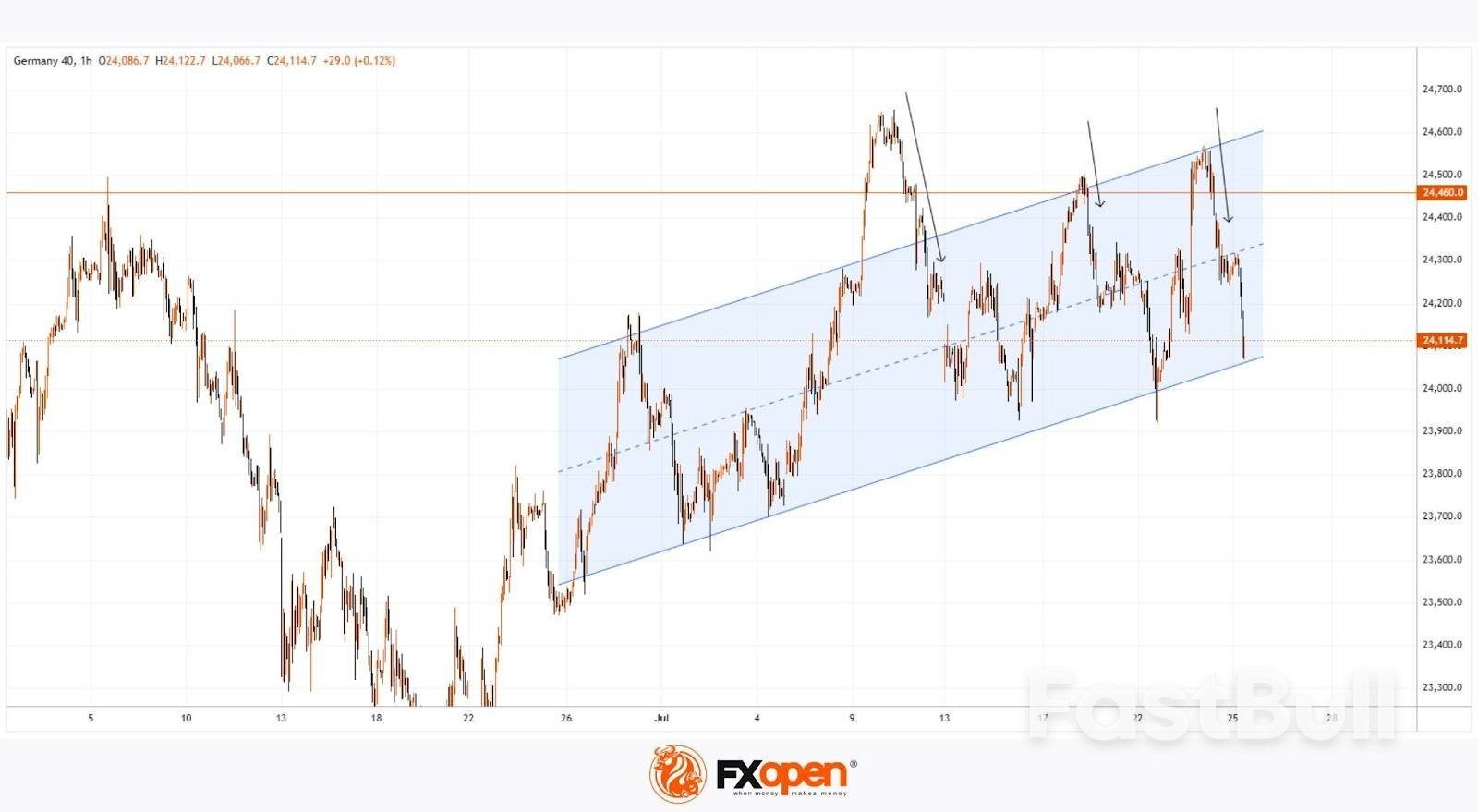
          From a technical analysis perspective, the DAX 40 (Germany 40 mini on FXOpen) formed an ascending channel in July (outlined in blue). However, each time the bulls attempted to push the price above the 24,460 level (which corresponds to the May high), they encountered resistance.

          It is worth noting the nature of the bearish reversals (indicated by arrows) – the price declined sharply, often without intermediate recoveries, signalling strong selling pressure. It is likely that major market participants used the proximity to the all-time high to reduce their long positions.

          From a fundamental standpoint, several factors are weighing on the DAX 40 (Germany 40 mini on FXOpen):→ Ongoing uncertainty surrounding the US–EU trade agreement, which has yet to be finalised (with the deadline approaching next week);→ Corporate news, including disappointing earnings reports from Puma, Volkswagen, and several other German companies.

          Given the above, it is reasonable to assume that bearish activity could result in an attempt to break below the lower boundary of the ascending blue channel.

          Source: FXOpen

          Risk Warnings and Disclaimers
          You understand and acknowledge that there is a high degree of risk involved in trading. Following any strategies or investment methods may lead to potential losses. The content on the site is provided by our contributors and analysts for information purposes only. You are solely responsible for determining whether any trading assets, securities, strategy, or any other product is suitable for investing based on your own investment objectives and financial situation.
          Add to Favorites
          Share

          Thai-Cambodia Clash Poses Limited Trade, Tourism Risks for Now

          Glendon

          Economic

          Forex

          The armed military conflict between Thailand and Cambodia presents limited risks to most business sectors for now while tourism industry experts are taking a wait-and-see stance to assess the impact.

          Thailand is warning of an all-out war with its neighbouring country as the US has called for a ceasefire. The clashes, though, are limited to border areas far removed from popular tourist destinations, such as Bangkok and Phuket.

          “We’ve been monitoring the situation and have yet to see significant changes in travel searches to these destinations,” booking site Expedia said in an emailed statement.

          The border clashes aren’t expected to affect Thailand’s tourism sector under the current circumstances, Chai Arunanondchai, president of the Tourism Council of Thailand, said at a Thursday briefing.

          Nonetheless, the conflict is already adversely affecting overall economic confidence and disrupting trade and investment between the two countries, the Thai Chamber of Commerce said in a Thursday statement.

          Exports from Thailand to Cambodia, including jewellery, oil and sugar, totalled US$5.1 billion (RM21.52 billion) in the first half of 2025, according to the Thai Commerce Ministry. Thailand imported US$732 million of Cambodian goods, mostly fruits and vegetables.

          The flareup, which included Thai airstrikes on Cambodian military bases, wasn’t initially expected to have a significant effect on food, media, cement and retail sectors in Thailand, UOB Kay Hian analysts said in a June 17 note to investors.

          Thai convenience store CP All and conglomerate Berli Jucker have limited exposure in Cambodia, they said in a research note.

          Thailand’s Carabao Group beverage maker, though, has relatively high sales in Cambodia, Citi Research said in a Friday note to investors. The clash could increase freight costs because of shifting trade routes due to the conflict, it said.

          “A prolonged dispute could weaken consumption sentiment in provinces close to border region,” according to Citi.

          Carabao is estimated to derive 28% of its energy drink revenue this year from Cambodia, CGS International said.

          Thailand’s Bumrungrad Hospital, as well as herbal supplement maker Mega Lifesciences, is estimated to receive about 6% of their fiscal-year revenue from Cambodia and could face limited risks, CGS added.

          Cambodia’s economic growth was already expected to slow, according to a July 17 report by Maybank Securities Pte.

          The country has more than half a million workers in Thailand, according to official estimates, though Maybank said undocumented migrants could push that number closer to 1.2 million people. Officials in Thailand’s Chanthaburi and Trat provinces said some 2,000 Cambodian migrant workers have gathered at a checkpoint to return home.

          Source: Theedgemarkets

          To stay updated on all economic events of today, please check out our Economic calendar
          Risk Warnings and Disclaimers
          You understand and acknowledge that there is a high degree of risk involved in trading. Following any strategies or investment methods may lead to potential losses. The content on the site is provided by our contributors and analysts for information purposes only. You are solely responsible for determining whether any trading assets, securities, strategy, or any other product is suitable for investing based on your own investment objectives and financial situation.
          Add to Favorites
          Share

          Ukraine Says Starlink's Global Outage Hit Its Military Communications

          Samantha Luan

          Russia-Ukraine Conflict

          Economic

          Starlink systems used by Ukrainian military units were down for two and a half hours overnight, a senior commander said, part of a global issue that disrupted the satellite internet provider.

          Ukraine's forces are heavily reliant on thousands of SpaceX's Starlink terminals for battlefield communications and some drone operations, as they have proved resistant to espionage and signal jamming throughout the three and a half years of fighting Russia's invasion.

          Starlink experienced one of its biggest international outages on Thursday when an internal software failure knocked tens of thousands of users offline."Starlink is down across the entire front," Robert Brovdi, the commander of Ukraine's drone forces, wrote on Telegram at 10:41 p.m. (1941 GMT) on Thursday.

          He updated his post later to say that by about 1:05 a.m. on Friday the issue had been resolved. He said the incident had highlighted the risk of reliance on the systems, and called for communication and connectivity methods to be diversified."Combat missions were performed without a (video) feed, battlefield reconnaissance was done with strike (drones)," Brovdi wrote.

          Oleksandr Dmitriev, the founder of OCHI, a Ukrainian system that centralises feeds from thousands of drone crews across the frontline, told Reuters the outage showed that relying on cloud services to command units and relay battlefield drone reconnaissance was a "huge risk"."If connection to the internet is lost ... the ability to conduct combat operations is practically gone," he said, calling for a move towards local communication systems that are not reliant on the internet.

          Although Starlink does not operate in Russia, Ukrainian officials have said that Moscow's troops are also widely using the systems on the frontlines in Ukraine.

          Source: Reuters

          To stay updated on all economic events of today, please check out our Economic calendar
          Risk Warnings and Disclaimers
          You understand and acknowledge that there is a high degree of risk involved in trading. Following any strategies or investment methods may lead to potential losses. The content on the site is provided by our contributors and analysts for information purposes only. You are solely responsible for determining whether any trading assets, securities, strategy, or any other product is suitable for investing based on your own investment objectives and financial situation.
          Add to Favorites
          Share

          China’s Budget Deficit Soars to Record High Amid Spending Surge to Offset U.S. Tariffs

          Gerik

          Economic

          A Record Deficit as Fiscal Stimulus Takes the Lead

          China’s widening fiscal gap reflects a deliberate and forceful shift toward stimulus-driven growth as exports to the U.S. falter under the weight of elevated tariffs, currently averaging about 30 percentage points higher than last year. The 5.25 trillion yuan budget gap marks a 45% increase from the same period in 2024, according to Bloomberg estimates derived from Finance Ministry data. This is the largest midyear deficit on record and highlights the scale of intervention required to stabilize the economy.
          The surge in the deficit stems from two key dynamics: a rapid increase in government expenditure and a parallel decline in fiscal income. Expenditure rose 9% year-on-year to 18.8 trillion yuan, fueled by both daily operational spending and long-term infrastructure investment through China’s dual budget framework. However, total income from taxation and land sales dropped, with tax revenue down 1.2% and land-related income traditionally a major fiscal support falling by 6.5%, reflecting deep-rooted weakness in the property sector.

          Policy Tools Shift as External Demand Weakens

          Despite a recent truce in tariff escalations, Chinese exports to the U.S. have continued to contract sharply, exposing the country’s vulnerability to external shocks. As a counterbalance, China has ramped up infrastructure spending and local government-led stimulus to sustain economic momentum. The Finance Ministry emphasized that this front-loaded fiscal action played a critical role in helping China post a stronger-than-expected 5.3% GDP growth rate in the first half, already exceeding the annual target of "around 5%."
          Notably, resilient exports to alternative markets beyond the U.S. have provided some cushion, but not enough to offset the broader trade friction. Consequently, Chinese authorities are doubling down on domestic drivers of growth, with additional rounds of stimulus likely under discussion when top policymakers meet at the end of July.

          Fiscal Strain Mounts Ahead of Key Trade Talks

          The ballooning deficit presents a delicate balancing act for Chinese authorities. On one hand, further stimulus may be essential to maintain growth amid deflationary risks and a chronically weak property market. On the other, fiscal sustainability concerns loom larger as tax collections stagnate and land sales fail to recover.
          Next week’s planned trade negotiations between China and the U.S. will be pivotal in determining whether China opts for an even more aggressive fiscal response. While a comprehensive trade resolution appears unlikely in the near term, any relaxation of tariffs would offer temporary relief and reduce the need for further stimulus.
          In the current context, Beijing’s strategy is clear: absorb the short-term fiscal pain to avoid a sharper economic deceleration. Whether this gamble pays off will depend not only on domestic reforms but also on the external trade environment especially the evolving stance of the U.S. ahead of its own presidential election cycle.
          China’s record-high budget deficit is both a reflection of economic vulnerability and a demonstration of Beijing’s determination to preserve growth through stimulus. With exports weakening, property markets stuck in correction, and trade tensions unresolved, fiscal policy is now the central engine of China's economic resilience but not without growing long-term costs.

          Source: Reuters

          To stay updated on all economic events of today, please check out our Economic calendar
          Risk Warnings and Disclaimers
          You understand and acknowledge that there is a high degree of risk involved in trading. Following any strategies or investment methods may lead to potential losses. The content on the site is provided by our contributors and analysts for information purposes only. You are solely responsible for determining whether any trading assets, securities, strategy, or any other product is suitable for investing based on your own investment objectives and financial situation.
          Add to Favorites
          Share

          Euro Zone Firms Sound Alarm on Economic Slowdown and China Competition

          Gerik

          Economic

          Mixed Signals from ECB vs. Corporate Reality

          While the ECB maintained its benchmark interest rate at 2% on Thursday and issued a cautiously optimistic message about euro area stability, its own survey of 72 large firms paints a more sobering picture. Conducted between June 23 and July 2, the report highlights early signs of an economic deceleration particularly in manufacturing and services due to trade friction and geopolitical instability.
          The central message from companies was one of caution. Although the ECB framed recent economic data as indicative of a “good place,” businesses cited real-world conditions such as weaker demand, trade policy uncertainty, and shifting supply chains that are dampening both production and investment.

          U.S. Tariffs and Chinese Trade Diversion Fuel Concerns

          The growing threat of broad-based U.S. tariffs, part of President Trump’s ongoing push to rebalance global trade flows, is already weighing on European business sentiment. Respondents said that these tariffs are forcing Asian, especially Chinese, exporters to redirect goods previously destined for the U.S. to the European market, intensifying competitive pressures in the region.
          So far, this diversion is concentrated in intermediate goods rather than final consumer products, but firms expect the impact to broaden over time, eventually spilling into retail sectors and affecting price dynamics. This supports broader fears about a “China shock 2.0” flooding European markets with low-cost exports amid deflationary conditions in China.

          Sector Divergence: Manufacturing vs. Retail

          The impact of these economic headwinds is not uniform across sectors. While manufacturing and business services are seeing a visible contraction in demand and pricing power, retail and consumer services report relatively minimal disruptions for now. These sectors have yet to feel the full impact of the trade redirection from Asia, although they remain exposed should conditions worsen in coming quarters.
          This divergence underscores a two-speed economy within the euro zone, where consumer-facing segments are holding steady for now, but industrial sectors already burdened by weak global demand are entering a more vulnerable phase.

          Slowing Wage Growth Signals Labour Market Cooling

          In addition to business activity and pricing concerns, the survey also showed softening wage expectations. After peaking at 4.5% in 2024, companies now forecast average wage increases to slow to 3.3% in 2025 and further to 2.8% in 2026. Although still elevated, this deceleration suggests that labor market tightness is easing and that inflationary wage pressures may be dissipating aligning with the ECB’s broader disinflation narrative.
          Despite the ECB’s attempt to project confidence in the euro area’s trajectory, its own corporate outreach reveals deeper concerns beneath the surface. The potential convergence of tighter U.S. trade policy and China’s surplus-driven export strategy is creating an environment of uncertainty and downward pressure on output and prices.
          Markets may be underestimating the fragility of this economic moment. With policy levers constrained and geopolitical volatility high, the euro zone economy could struggle to maintain momentum, especially if retaliatory trade measures or global demand shocks accelerate. The ECB’s balancing act between monetary patience and responsiveness to worsening data will define its credibility in the second half of 2025.

          Source: Reuters

          To stay updated on all economic events of today, please check out our Economic calendar
          Risk Warnings and Disclaimers
          You understand and acknowledge that there is a high degree of risk involved in trading. Following any strategies or investment methods may lead to potential losses. The content on the site is provided by our contributors and analysts for information purposes only. You are solely responsible for determining whether any trading assets, securities, strategy, or any other product is suitable for investing based on your own investment objectives and financial situation.
          Add to Favorites
          Share

          Should You Invest When Markets Are At Record Highs?

          SAXO

          Economic

          Forex

          Stocks

          Key points:

          ● Market highs often create hesitation for investors on the sidelines, but history shows that long-term investing at these levels can still deliver strong returns.
          ● With tools like limit orders, thematic diversification, and dollar cost averaging, there are still smart ways to put money to work—even at elevated levels.
          ● Instead of trying to time the top, focus on building a resilient, well-diversified portfolio that can navigate different economic scenarios.
          ● Long-term success comes from consistency and discipline, not perfect timing.

          The myth of waiting for the perfect entryIn theory, “buy low, sell high” sounds perfect. In practice, most investors struggle to do either.In fact, if you only invested on days when the S&P 500 hit an all-time high, your long-term returns would often be higher than if you invested on any random day.
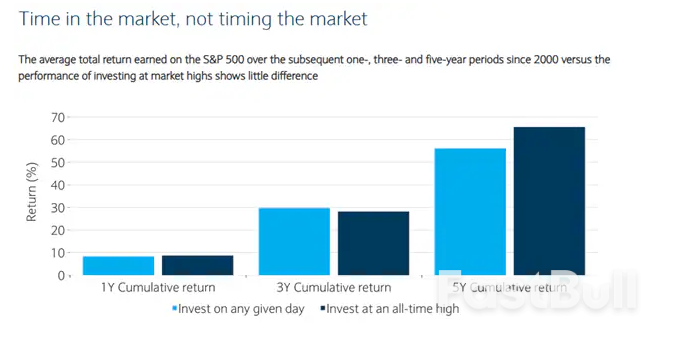
          Source: Bloomberg, Barclays Private Bank, March 2024

          That’s because record highs typically happen during bull markets, and bull markets tend to last longer than expected.The real challenge isn’t timing the market. It’s having a strategy that works when prices feel high, and sticking to it.

          What to do instead: smart moves at market highs

          1. Make pullbacks work for you

          Even when the overall market is rising, individual stocks and sectors often face short-term dips. Those can be opportunities.

          What you can do:

          ● If you’ve got cash on the sidelines, set price alerts for stocks or ETFs you want to own at better value.
          ● Use limit orders to automate discipline. These let you set a specific price you're willing to pay, and the order only executes if the market reaches that level. This helps avoid buying in a rush or at inflated prices.
          ● Keep a watchlist of high-conviction investments and gradually add to them during short-term weakness.
          ● Consider selling a put option(if you're familiar with options), which can let you earn income while waiting to buy at a lower price.

          2. Look for what hasn’t rallied yet

          While technology and AI stocks have led the charge, many parts of the market have lagged, and may offer better value and catch-up potential if the rally broadens out.

          What to consider:

          ● Small-cap stocks and value-oriented sectors (like banks, energy, or healthcare) have underperformed and may benefit from stronger economic growth or a shift in investor focus.
          ● Dividend stocks can provide a steady income stream and may become more appealing if interest rates begin to fall.
          ● Rather than trying to pick individual stocks, consider broad-based ETFs that offer exposure to these less-loved areas of the market, helping you diversify while keeping costs low.

          3. Diversify based on what drives markets

          Market leadership today is shaped less by geography or sector, and more by macro forces like interest rates, trade policies, and geopolitical risk. Traditional diversification alone may not be enough. It’s time to think about how different parts of your portfolio respond to shifting policy and economic drivers.

          How to position:

          ● Tariff-sensitive sectors like autos and semiconductors may benefit if global trade tensions ease, but could struggle in a more protectionist environment. On the other hand, utilities, healthcare, and defense tend to be more insulated from global supply chains and policy swings.
          ● Utilities and real estate often perform well when interest rates fall, as their steady income becomes more attractive relative to bonds and cash.
          ● Defense stocks, commodities, and gold can help cushion your portfolio during periods of geopolitical uncertainty or broad market volatility.
          ● Consider thematic funds that align with long-term structural trends such as clean energy, digital infrastructure, and healthcare innovation. These can offer growth potential across different macro cycles.

          Even if some of these areas have gained attention recently, their relevance over the long term means they may still be underrepresented in many portfolios.

          4. Stay consistent with a plan

          Waiting for the “perfect moment” to invest often leads to missed opportunities. Even when markets dip, fear and uncertainty can prevent action, leaving cash on the sidelines and long-term goals unmet.

          What works better:

          ● Adopt adollar-cost averaging (DCA) approach – invest a fixed amount at regular intervals (monthly or quarterly), regardless of market levels. This helps reduce the impact of short-term volatility and takes the emotion out of decision-making.
          ● Set calendar reminders to review and top up your investments, just like you would with other recurring commitments like bill payments or insurance.
          ● Stay focused on your long-term goals, not the day-to-day headlines. Markets will fluctuate, but a consistent, disciplined approach tends to win over time.
          Final thought

          Buying at market highs can feel uncomfortable, but history shows that long-term investors are often rewarded for staying the course.If you diversify smartly, lean into underappreciated areas, and stay consistent with your investing plan, you won’t need to worry about whether you’re “too late.”Because long-term wealth isn’t built by picking the perfect moment.It’s built by showing up, again and again.

          Source: SAXO

          To stay updated on all economic events of today, please check out our Economic calendar
          Risk Warnings and Disclaimers
          You understand and acknowledge that there is a high degree of risk involved in trading. Following any strategies or investment methods may lead to potential losses. The content on the site is provided by our contributors and analysts for information purposes only. You are solely responsible for determining whether any trading assets, securities, strategy, or any other product is suitable for investing based on your own investment objectives and financial situation.
          Add to Favorites
          Share

          ECB Rate Cuts in Doubt as Goldman and J.P. Morgan Pull Back Forecasts

          Gerik

          Economic

          Central Bank Caution Reflects Economic Stability

          Goldman Sachs and J.P. Morgan have recalibrated their outlooks on ECB monetary policy, signaling a more cautious stance after Thursday’s decision to maintain the main refinancing rate at 2%. The ECB has already implemented eight rate cuts since June 2024, yet the central bank now appears inclined to pause its easing cycle amid improving macroeconomic conditions. Christine Lagarde, the ECB President, emphasized a “wait-and-watch” approach, describing the current state of the economy as being in a “good place.”
          Goldman Sachs no longer anticipates any additional rate cuts in 2025. Meanwhile, J.P. Morgan has delayed its predicted rate move to October, instead of the earlier forecast of September. This change reflects confidence that the eurozone economy has shown greater resilience than expected, reducing the urgency for further monetary easing.

          Trade Tensions and Diplomacy Shape Rate Outlook

          Another key variable influencing the ECB's path is the ongoing negotiation of a trade agreement between the European Union and the United States. Earlier threats from U.S. President Donald Trump to impose 30% tariffs on EU goods by August 1 had heightened fears of trade-driven stagflation. However, diplomats now signal that a more moderate agreement centering on a 15% across-the-board tariff is emerging as the most probable outcome.
          This potential resolution has been factored into Goldman and J.P. Morgan’s updated forecasts. Analysts see a deal as removing one of the largest downside risks to European growth. If finalized, it would also reduce the need for the ECB to respond preemptively to external shocks with additional rate cuts.

          A Divided Wall Street and Uncertain Markets

          In contrast, other major institutions like Bank of America, Barclays, Citigroup, Deutsche Bank, and Morgan Stanley are holding onto their expectations for a September rate cut. However, even among these firms, caution is growing. Morgan Stanley analysts noted that stronger economic data or further easing of trade tensions could delay the next rate cut until December or beyond.
          Market sentiment reflects this divide. Eurozone money markets currently assign only a 30% probability to a rate cut by December. This hesitancy underscores how sensitive ECB projections now are to incoming economic data, especially inflation trends, labor market resilience, and manufacturing output.

          Markets Eye Data and Diplomacy

          The ECB's path forward has become increasingly data-dependent, shaped not only by inflation metrics and growth indicators but also by geopolitical developments like the pending EU-U.S. trade agreement. For now, monetary policy remains in a holding pattern, with financial institutions and traders cautiously rebalancing expectations.
          Unless the eurozone’s economic outlook deteriorates or diplomatic tensions escalate further, the ECB is likely to extend its pause. The next decisive shift may come only if incoming data clearly signal weakening demand or if negotiations with the U.S. collapse, reigniting trade risks.

          Source: Reuters

          To stay updated on all economic events of today, please check out our Economic calendar
          Risk Warnings and Disclaimers
          You understand and acknowledge that there is a high degree of risk involved in trading. Following any strategies or investment methods may lead to potential losses. The content on the site is provided by our contributors and analysts for information purposes only. You are solely responsible for determining whether any trading assets, securities, strategy, or any other product is suitable for investing based on your own investment objectives and financial situation.
          Add to Favorites
          Share
          FastBull
          Copyright © 2025 FastBull Ltd

          728 RM B 7/F GEE LOK IND BLDG NO 34 HUNG TO RD KWUN TONG KLN HONG KONG

          TelegramInstagramTwitterfacebooklinkedin
          App Store Google Play Google Play
          Products
          Charts

          Chats

          Q&A with Experts
          Screeners
          Economic Calendar
          Data
          Tools
          Membership
          Features
          Function
          Markets
          Copy Trading
          Latest Signals
          Contests
          News
          Analysis
          24/7
          Columns
          Education
          Company
          Careers
          About Us
          Contact Us
          Advertising
          Help Center
          Feedback
          User Agreement
          Privacy Policy
          Business

          White Label

          Data API

          Web Plug-ins

          Poster Maker

          Affiliate Program

          Risk Disclosure

          The risk of loss in trading financial instruments such as stocks, FX, commodities, futures, bonds, ETFs and crypto can be substantial. You may sustain a total loss of the funds that you deposit with your broker. Therefore, you should carefully consider whether such trading is suitable for you in light of your circumstances and financial resources.

          No decision to invest should be made without thoroughly conducting due diligence by yourself or consulting with your financial advisors. Our web content might not suit you since we don't know your financial conditions and investment needs. Our financial information might have latency or contain inaccuracy, so you should be fully responsible for any of your trading and investment decisions. The company will not be responsible for your capital loss.

          Without getting permission from the website, you are not allowed to copy the website's graphics, texts, or trademarks. Intellectual property rights in the content or data incorporated into this website belong to its providers and exchange merchants.

          Not Logged In

          Log in to access more features

          FastBull Membership

          Not yet

          Purchase

          Become a signal provider
          Help Center
          Customer Service
          Dark Mode
          Price Up/Down Colors

          Log In

          Sign Up

          Position
          Layout
          Fullscreen
          Default to Chart
          The chart page opens by default when you visit fastbull.com
