

Markets
News
Analysis
User
24/7
Economic Calendar
Education
Data
- Names
- Latest
- Prev



Signal Accounts for Members
All Signal Accounts
All Contests
 U.K. Trade Balance Non-EU (SA) (Oct)
A:--
F: --
P: --
U.K. Trade Balance (Oct)A:--
F: --
P: --
U.K. Services Index MoMA:--
F: --
P: --
U.K. Construction Output MoM (SA) (Oct)A:--
F: --
P: --
U.K. Industrial Output YoY (Oct)A:--
F: --
P: --
U.K. Trade Balance (SA) (Oct)A:--
F: --
P: --
U.K. Trade Balance EU (SA) (Oct)A:--
F: --
P: --
U.K. Manufacturing Output YoY (Oct)A:--
F: --
P: --
U.K. GDP MoM (Oct)A:--
F: --
P: --
U.K. GDP YoY (SA) (Oct)A:--
F: --
P: --
U.K. Industrial Output MoM (Oct)A:--
F: --
P: --
U.K. Construction Output YoY (Oct)A:--
F: --
P: --
 France HICP Final MoM (Nov)
A:--
F: --
P: --
 China, Mainland Outstanding Loans Growth YoY (Nov)
A:--
F: --
P: --
China, Mainland M2 Money Supply YoY (Nov)A:--
F: --
P: --
China, Mainland M0 Money Supply YoY (Nov)A:--
F: --
P: --
China, Mainland M1 Money Supply YoY (Nov)A:--
F: --
P: --
 India CPI YoY (Nov)
A:--
F: --
P: --
India Deposit Gowth YoYA:--
F: --
P: --
 Brazil Services Growth YoY (Oct)
A:--
F: --
P: --
 Mexico Industrial Output YoY (Oct)
A:--
F: --
P: --
 Russia Trade Balance (Oct)
A:--
F: --
P: --
 Philadelphia Fed President Henry Paulson delivers a speech
 Canada Building Permits MoM (SA) (Oct)
A:--
F: --
P: --
Canada Wholesale Sales YoY (Oct)A:--
F: --
P: --
Canada Wholesale Inventory MoM (Oct)A:--
F: --
P: --
Canada Wholesale Inventory YoY (Oct)A:--
F: --
P: --
Canada Wholesale Sales MoM (SA) (Oct)A:--
F: --
P: --
 Germany Current Account (Not SA) (Oct)
A:--
F: --
P: --
U.S. Weekly Total Rig CountA:--
F: --
P: --
U.S. Weekly Total Oil Rig CountA:--
F: --
P: --
 Japan Tankan Large Non-Manufacturing Diffusion Index (Q4)
--
F: --
P: --
Japan Tankan Small Manufacturing Outlook Index (Q4)--
F: --
P: --
Japan Tankan Large Non-Manufacturing Outlook Index (Q4)--
F: --
P: --
Japan Tankan Large Manufacturing Outlook Index (Q4)--
F: --
P: --
Japan Tankan Small Manufacturing Diffusion Index (Q4)--
F: --
P: --
Japan Tankan Large Manufacturing Diffusion Index (Q4)--
F: --
P: --
Japan Tankan Large-Enterprise Capital Expenditure YoY (Q4)--
F: --
P: --
U.K. Rightmove House Price Index YoY (Dec)--
F: --
P: --
China, Mainland Industrial Output YoY (YTD) (Nov)--
F: --
P: --
China, Mainland Urban Area Unemployment Rate (Nov)--
F: --
P: --
 Saudi Arabia CPI YoY (Nov)
--
F: --
P: --
 Euro Zone Industrial Output YoY (Oct)
--
F: --
P: --
Euro Zone Industrial Output MoM (Oct)--
F: --
P: --
Canada Existing Home Sales MoM (Nov)--
F: --
P: --
Euro Zone Total Reserve Assets (Nov)--
F: --
P: --
U.K. Inflation Rate Expectations--
F: --
P: --
Canada National Economic Confidence Index--
F: --
P: --
Canada New Housing Starts (Nov)--
F: --
P: --
U.S. NY Fed Manufacturing Employment Index (Dec)--
F: --
P: --
U.S. NY Fed Manufacturing Index (Dec)--
F: --
P: --
Canada Core CPI YoY (Nov)--
F: --
P: --
Canada Manufacturing Unfilled Orders MoM (Oct)--
F: --
P: --
Canada Manufacturing New Orders MoM (Oct)--
F: --
P: --
Canada Core CPI MoM (Nov)--
F: --
P: --
Canada Manufacturing Inventory MoM (Oct)--
F: --
P: --
Canada CPI YoY (Nov)--
F: --
P: --
Canada CPI MoM (Nov)--
F: --
P: --
Canada CPI YoY (SA) (Nov)--
F: --
P: --
Canada Core CPI MoM (SA) (Nov)--
F: --
P: --


No matching data

Latest Views
Latest Views
Trending Topics
Top Columnists
Latest Update
White Label
Data API
Web Plug-ins
Affiliate Program
View All
No data
The US Senate yesterday narrowly approved Trump’s so-called “big, beautiful budget bill.”Elon Musk, who had previously criticised the bill for potentially adding $3.3 trillion to the national debt, wa
The US Senate yesterday narrowly approved Trump’s so-called “big, beautiful budget bill.”
Elon Musk, who had previously criticised the bill for potentially adding $3.3 trillion to the national debt, warned that Republican lawmakers who supported it would face political consequences. In a post on X, Musk wrote:“Every member of Congress who campaigned on reducing government spending and then immediately voted for the biggest debt increase in history should hang their head in shame! And they will lose their primary next year if it is the last thing I do on this Earth.”
He also reiterated his intention to establish a third political force under the name “America Party.”
In response, President Trump issued sharp threats:
→ to apply federal pressure on Musk’s companies by revisiting existing subsidies and government contracts (estimated by The Washington Post at $38 billion);
→ to deport Musk back to South Africa.
The market responded immediately to this renewed escalation in the Trump–Musk conflict. Tesla (TSLA) shares fell by over 5% yesterday, forming a significant bearish gap.
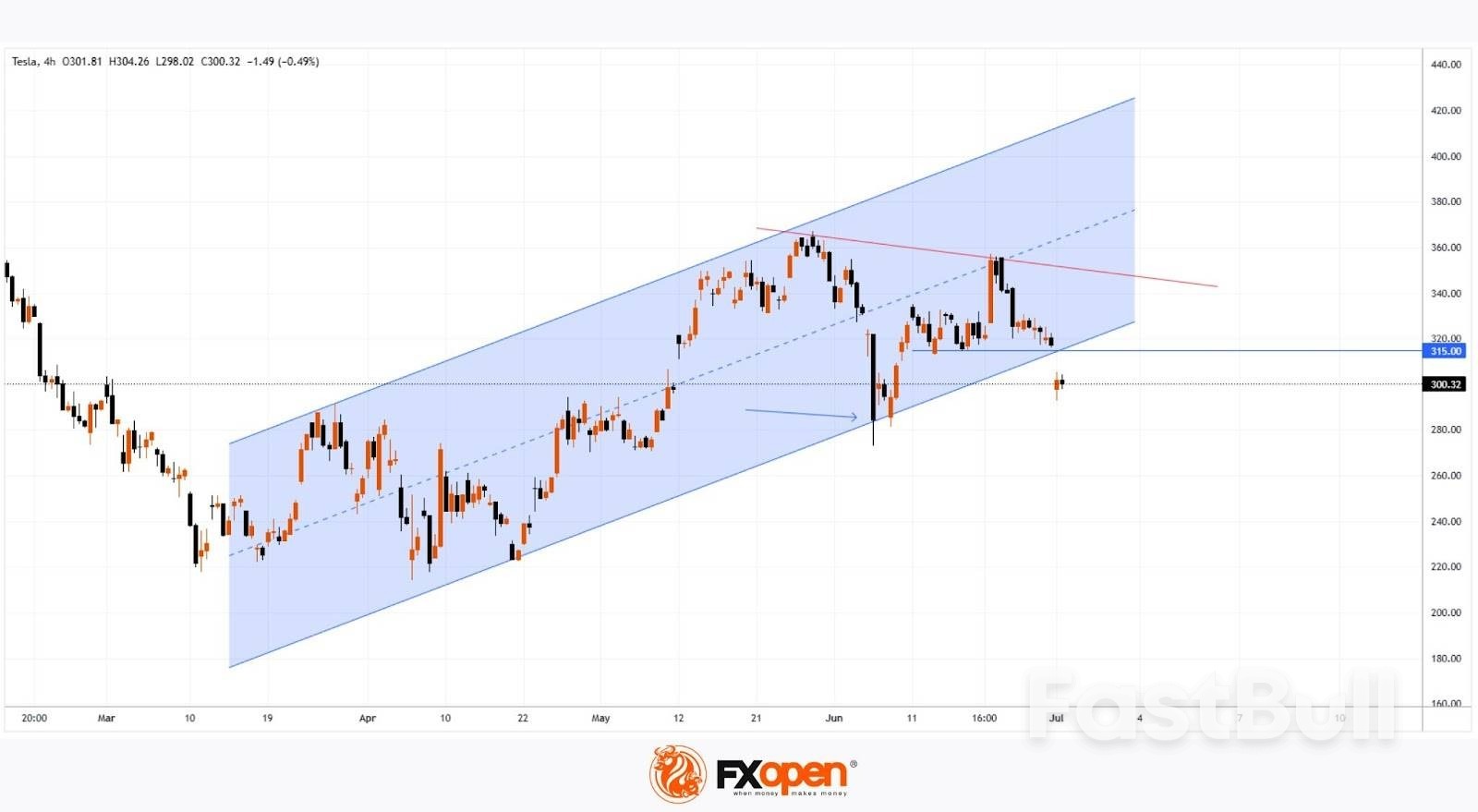
Eight days ago, we analysed the TSLA price chart, continuing to observe price action within the context of an ascending channel (indicated in blue). At that point:
→ In mid-June, when the initial Musk–Trump tensions surfaced, TSLA managed to hold within the channel. However, as of yesterday, the price broke below the lower boundary, casting doubt on the sustainability of the uptrend that had been in place since March–April;
→ The price breached the lower channel limit near the $315 level — a zone that previously acted as support. This suggests that $315 may now serve as a resistance level.
As a result, optimism related to the late-June launch of Tesla’s robotaxi initiative has been eclipsed by concerns that the Musk–Trump confrontation may have broader implications.
If the former allies refrain from further escalation, TSLA may consolidate into a broadening contracting triangle (its upper boundary marked in red) in the near term, ahead of Tesla’s Q2 earnings release scheduled for 29 July.
US President Donald Trump threatened Japan with tariffs of up to 35% as he ramped up tensions for a third straight day, fueling fears of a worst-case scenario among market players and raising doubts over Tokyo’s tactics in trade talks.
Japan should be forced to “pay 30%, 35% or whatever the number is that we determine, because we also have a very big trade deficit with Japan,” Trump said, again flagging the possibility that across-the-board tariffs could go much higher than the 24% initially penciled in for July 9. “I’m not sure we’re going to make a deal. I doubt it with Japan, they’re very tough. You have to understand, they’re very spoiled.”
Market participants and analysts warned against taking Trump’s comments at face value and suggested that some kind of deal will eventually get done. But they also warned that Prime Minister Shigeru Ishiba’s government may need to change tack from a friendly and firm stance that is now leading the two sides to brinkmanship.
“The ball is in Japan’s court now, and if Tokyo hesitates, it’s all over,” said Chihiro Ota, senior strategist at SMBC Nikko Securities. “If Japan doesn’t properly respond to Trump’s call to the table, he’ll only get more hostile. Ishiba should get on the phone with him right away.”
Trump’s latest threat fits in with a high-pressure deal-making strategy that sometimes results in big last-minute concessions on both sides, as seen with China, but market players still need to game out how to position themselves should talks founder.
While few analysts see Japan’s stocks collapsing on a no-deal scenario, some of them forecast the Nikkei 225 to fall into the 38,000 range, a decline of more than 4%, rather than rallying above 40,000 if there’s an agreement.
The Nikkei 225 was down 1% at 39,593 at the end of the morning session Wednesday while the yen was trading at 143.57 against the dollar, up around 0.1%.
Japan has so far stood firm in negotiations over across-the-board reciprocal tariffs, insisting that they be removed along with additional sectoral tariffs on autos, steel and aluminum. The car duties are particularly painful for Japan as the industry contributes the equivalent of almost 10% of gross domestic product and employs around 8% of the workforce.
Tokyo has insisted that a “win-win” deal must encompass all the tariffs in one go with Ishiba preferring no deal to a bad deal ahead of a July 20 upper house election. The prime minister on Wednesday reiterated his view that focusing on jobs and investment in the US was the way forward, just like it was for Nippon Steel as it patiently sought to change Trump’s view and take over US Steel.
But as July 9 gets closer, some observers say more needs to be done.
“We have to work on Trump himself, to first try to avoid the tariffs to be imposed from July 9,” said Ichiro Fujisaki, former Japanese ambassador to the US, adding that the president’s remarks show that Tokyo hasn’t brought enough to the table yet.
“We don’t have something like rare earths but the US is dependent on Japanese industry as well. About half of materials for making semiconductors come from Japanese industry,” Fujisaki said, pointing to a possible area of leverage, too.
In the meantime, market players are evaluating the potential scale of the fallout.
“There is a lot more risk of things falling apart than is being priced in by the market,” said Zuhair Khan, a fund manager at UBP Investments. “There is always the risk of a policy blunder by either side.”
He points to the 32,000 Nikkei level on the day Trump first announced the reciprocal tariffs. “If the probability of a no deal is 25% then the Nikkei should be at 38,000.”
The point of imposing a deadline in negotiations is to create an opportunity for leverage, so it’s not surprising to see Trump pushing high tariffs as a threat to push for better deals as the date approaches, said Phillip Wool, head of portfolio management at Rayliant Global Advisors Ltd.
“There’s also an element of political theater here, as Trump’s narrative to American voters is that the US has been bullied on trade for so long, and there’s clearly a desire to look ‘tough’ on trade,” Wool said. “But there has to be a face-saving deal at some point so that it looks like the negotiation was truly a success as opposed to the mutually assured destruction of impasse and perpetually high tariffs.”
Like some other market players, he is wary of an overly pessimistic knee-jerk response to each remark Trump makes. If there is a big selloff in a worst-case scenario, Wool sees it as a great buying opportunity for long-term, active investors.
Strategists are split on how a bad scenario might play out for the yen. While some such as SBI Liquidity Market Co.’s Marito Ueda see the possibility of risk aversion sparking a strengthening of Japan’s currency to the 138 range against the dollar, others see a weakening as more likely.
A stalemate in trade talks would likely delay the Bank of Japan’s next interest rate hike, especially if it led to tariffs of up to 35% in the meantime, said Akira Moroga, chief market strategist at Aozora Bank. Still, movement would slow after the 145 mark, making a push past 147 difficult, he said.
Still, the consensus is that a deal will be reached sooner or later, and that Japan will have to concede more ground to achieve it.
“If it’s concluded I don’t think it’s going to be a win-win situation,” said Fujisaki. “Maybe a capital-letter ‘WIN’ for US, but a small letter ‘win’ for Japan.”
Powell's statements suggest potential adjustments in monetary policy, impacting the U.S. economy and beyond.
Jerome Powell communicated expectations of higher inflation readings this summer due to economic conditions. He emphasized the continuous monitoring of inflation and reiterated the Federal Reserve's focus on a data-driven approach for future policy decisions.
Powell has led efforts since 2018 to steer U.S. economic policy during challenging periods. His remarks at the ECB panel highlighted anticipated inflation effects and interest rates remaining on hold amidst uncertainties caused by new trade tariffs.
Powell's outlook may influence BTC, ETH, and major digital assets, which have historically been sensitive to U.S. macro signals. Crypto markets and DeFi protocols could see shifts in trading volumes and price volatility depending on inflation and rate decisions.
Past episodes of delayed rate cuts after Fed signaling led to volatility in cryptocurrencies. Analysts predict possible capital flow rotations and temporary yield increases in DeFi following this news, potentially affecting tokens like AAVE and MKR.
The Fed continues to prioritize its dual mandate of maximum employment and stable prices. Powell's comments suggest no immediate new regulatory measures for the crypto sector but underscore the important data dependence in policy deliberations. Past instances have seen macro signals leading to shifts in crypto liquidity and asset reallocation, affecting various sectors within the ecosystem.
728 RM B 7/F GEE LOK IND BLDG NO 34 HUNG TO RD KWUN TONG KLN HONG KONG


White Label
Data API
Web Plug-ins
Poster Maker
Affiliate Program
The risk of loss in trading financial instruments such as stocks, FX, commodities, futures, bonds, ETFs and crypto can be substantial. You may sustain a total loss of the funds that you deposit with your broker. Therefore, you should carefully consider whether such trading is suitable for you in light of your circumstances and financial resources.
No decision to invest should be made without thoroughly conducting due diligence by yourself or consulting with your financial advisors. Our web content might not suit you since we don't know your financial conditions and investment needs. Our financial information might have latency or contain inaccuracy, so you should be fully responsible for any of your trading and investment decisions. The company will not be responsible for your capital loss.
Without getting permission from the website, you are not allowed to copy the website's graphics, texts, or trademarks. Intellectual property rights in the content or data incorporated into this website belong to its providers and exchange merchants.
Not Logged In
Log in to access more features

FastBull Membership
Not yet
Purchase


Log In
Sign Up


