• Trade
  • Markets
  • Copy
  • Contests
  • News
  • 24/7
  • Calendar
  • Q&A
  • Chats
Trending
Screeners
SYMBOL
LAST
BID
ASK
HIGH
LOW
NET CHG.
%CHG.
SPREAD
SPX
S&P 500 Index
6870.39
6870.39
6870.39
6895.79
6858.28
+13.27
+ 0.19%
--
DJI
Dow Jones Industrial Average
47954.98
47954.98
47954.98
48133.54
47871.51
+104.05
+ 0.22%
--
IXIC
NASDAQ Composite Index
23578.12
23578.12
23578.12
23680.03
23506.00
+72.99
+ 0.31%
--
USDX
US Dollar Index
98.830
98.910
98.830
98.960
98.810
-0.120
-0.12%
--
EURUSD
Euro / US Dollar
1.16542
1.16550
1.16542
1.16551
1.16341
+0.00116
+ 0.10%
--
GBPUSD
Pound Sterling / US Dollar
1.33404
1.33412
1.33404
1.33420
1.33151
+0.00092
+ 0.07%
--
XAUUSD
Gold / US Dollar
4211.59
4212.04
4211.59
4213.06
4190.61
+13.68
+ 0.33%
--
WTI
Light Sweet Crude Oil
59.979
60.016
59.979
60.063
59.752
+0.170
+ 0.28%
--

Community Accounts

Signal Accounts
--
Profit Accounts
--
Loss Accounts
--
View More

Become a signal provider

Sell trading signals to earn additional income

View More

Guide to Copy Trading

Get started with ease and confidence

View More

Signal Accounts for Members

All Signal Accounts

Best Return
  • Best Return
  • Best P/L
  • Best MDD
Past 1W
  • Past 1W
  • Past 1M
  • Past 1Y

All Contests

  • All
  • Trump Updates
  • Recommend
  • Stocks
  • Cryptocurrencies
  • Central Banks
  • Featured News
Top News Only
Share

Russia's Air Defences Destroy 67 Ukrainian Drones Overnight, RIA Agency Reports

Share

India's Nifty 50 Index Down 0.37%

Share

Hsi Down 287 Pts, Hsti Down 13 Pts, Pop Mart Down Over 8%, Ping An Hit New Highs

Share

China's November Coal Imports Down 20% Year-On-Year

Share

At Least One Thai Soldier Killed And 7 Wounded - Thai Army Spokesman

Share

India's Nifty Bank Futures Up 0.73% In Pre-Open Trade

Share

Cambodia Has Expanded Clashes To Several New Locations - Thai Army Spokesman

Share

Cambodian Military Has Increased Deployment Of Troops And Weapons - Thai Army Spokesman

Share

India's Nifty 50 Futures Up 0.53% In Pre-Open Trade

Share

India's Nifty 50 Index Down 0.1% In Pre-Open Trade

Share

Indian Rupee Opens Down 0.1% At 90.0625 Per USA Dollar, Versus 89.98 Previous Close

Share

China November Copper Imports At 427000 Tonnes

Share

China November Coal Imports At 44.05 Million Tonnes

Share

China November Iron Ore Imports At 110.54 Million Tonnes, Down 0.7 % From October

Share

China November Meat Imports At 393000 Tonnes

Share

China Imported 8.11 Million Tonnes Of Soy In November

Share

China November Crude Oil Imports Up 5.2 % From October

Share

China November Rare Earth Exports At 5493.9 Tonnes

Share

China Jan-Nov Iron Ore Imports Up 1.4% At 1.139 Billion Metric Tons

Share

China Jan-Nov Trade Balance 7708.1 Billion Yuan

TIME
ACT
FCST
PREV
U.S. Personal Income MoM (Sept)

A:--

F: --

P: --

U.S. PCE Price Index YoY (SA) (Sept)

A:--

F: --

P: --

U.S. PCE Price Index MoM (Sept)

A:--

F: --

P: --

U.S. Personal Outlays MoM (SA) (Sept)

A:--

F: --

P: --

U.S. Core PCE Price Index MoM (Sept)

A:--

F: --

P: --

U.S. Core PCE Price Index YoY (Sept)

A:--

F: --

P: --

U.S. UMich 5-Year-Ahead Inflation Expectations Prelim YoY (Dec)

A:--

F: --

P: --

U.S. Real Personal Consumption Expenditures MoM (Sept)

A:--

F: --

P: --

U.S. UMich Current Economic Conditions Index Prelim (Dec)

A:--

F: --

P: --

U.S. UMich Consumer Sentiment Index Prelim (Dec)

A:--

F: --

P: --

U.S. UMich 1-Year-Ahead Inflation Expectations Prelim (Dec)

A:--

F: --

P: --

U.S. UMich Consumer Expectations Index Prelim (Dec)

A:--

F: --

P: --

U.S. Weekly Total Rig Count

A:--

F: --

P: --

U.S. Weekly Total Oil Rig Count

A:--

F: --

P: --

U.S. Unit Labor Cost Prelim (SA) (Q3)

--

F: --

P: --

U.S. Consumer Credit (SA) (Oct)

A:--

F: --

P: --

China, Mainland Foreign Exchange Reserves (Nov)

A:--

F: --

P: --

Japan Wages MoM (Oct)

A:--

F: --

P: --

Japan Trade Balance (Oct)

A:--

F: --

P: --

Japan Nominal GDP Revised QoQ (Q3)

A:--

F: --

P: --

Japan Trade Balance (Customs Data) (SA) (Oct)

A:--

F: --

P: --

Japan GDP Annualized QoQ Revised (Q3)

A:--

F: --

P: --
China, Mainland Exports YoY (CNH) (Nov)

A:--

F: --

P: --

China, Mainland Imports YoY (CNH) (Nov)

A:--

F: --

P: --

China, Mainland Exports (Nov)

A:--

F: --

P: --

China, Mainland Imports (CNH) (Nov)

A:--

F: --

P: --

China, Mainland Trade Balance (CNH) (Nov)

A:--

F: --

P: --

China, Mainland Imports YoY (USD) (Nov)

A:--

F: --

P: --

China, Mainland Exports YoY (USD) (Nov)

A:--

F: --

P: --

China, Mainland Trade Balance (USD) (Nov)

A:--

F: --

P: --

Germany Industrial Output MoM (SA) (Oct)

--

F: --

P: --

Euro Zone Sentix Investor Confidence Index (Dec)

--

F: --

P: --

Canada Leading Index MoM (Nov)

--

F: --

P: --

Canada National Economic Confidence Index

--

F: --

P: --

U.S. Dallas Fed PCE Price Index YoY (Sept)

--

F: --

P: --

China, Mainland Trade Balance (USD) (Nov)

--

F: --

P: --

U.S. 3-Year Note Auction Yield

--

F: --

P: --

U.K. BRC Overall Retail Sales YoY (Nov)

--

F: --

P: --

U.K. BRC Like-For-Like Retail Sales YoY (Nov)

--

F: --

P: --

Australia Overnight (Borrowing) Key Rate

--

F: --

P: --

RBA Rate Statement
RBA Press Conference
Germany Exports MoM (SA) (Oct)

--

F: --

P: --

U.S. NFIB Small Business Optimism Index (SA) (Nov)

--

F: --

P: --

Mexico Core CPI YoY (Nov)

--

F: --

P: --

Mexico 12-Month Inflation (CPI) (Nov)

--

F: --

P: --

Mexico PPI YoY (Nov)

--

F: --

P: --

Mexico CPI YoY (Nov)

--

F: --

P: --

U.S. Weekly Redbook Index YoY

--

F: --

P: --

U.S. JOLTS Job Openings (SA) (Oct)

--

F: --

P: --

China, Mainland M2 Money Supply YoY (Nov)

--

F: --

P: --

China, Mainland M0 Money Supply YoY (Nov)

--

F: --

P: --

China, Mainland M1 Money Supply YoY (Nov)

--

F: --

P: --

U.S. EIA Short-Term Crude Production Forecast For The Next Year (Dec)

--

F: --

P: --

U.S. EIA Short-Term Crude Production Forecast For The Year (Dec)

--

F: --

P: --

U.S. EIA Natural Gas Production Forecast For The Next Year (Dec)

--

F: --

P: --

EIA Monthly Short-Term Energy Outlook
U.S. 10-Year Note Auction Avg. Yield

--

F: --

P: --

U.S. API Weekly Cushing Crude Oil Stocks

--

F: --

P: --

U.S. API Weekly Crude Oil Stocks

--

F: --

P: --

Q&A with Experts
    • All
    • Chatrooms
    • Groups
    • Friends
    Connecting
    .
    .
    .
    Type here...
    Add Symbol or Code

      No matching data

      All
      Trump Updates
      Recommend
      Stocks
      Cryptocurrencies
      Central Banks
      Featured News
      • All
      • Russia-Ukraine Conflict
      • Middle East Flashpoint
      • All
      • Russia-Ukraine Conflict
      • Middle East Flashpoint

      Search
      Products

      Charts Free Forever

      Chats Q&A with Experts
      Screeners Economic Calendar Data Tools
      Membership Features
      Data Warehouse Market Trends Institutional Data Policy Rates Macro

      Market Trends

      Market Sentiment Order Book Forex Correlations

      Top Indicators

      Charts Free Forever
      Markets

      News

      News Analysis 24/7 Columns Education
      From Institutions From Analysts
      Topics Columnists

      Latest Views

      Latest Views

      Trending Topics

      Top Columnists

      Latest Update

      Signals

      Copy Rankings Latest Signals Become a signal provider AI Rating
      Contests
      Brokers

      Overview Brokers Assessment Rankings Regulators News Claims
      Broker listing Forex Brokers Comparison Tool Live Spread Comparison Scam
      Q&A Complaint Scam Alert Videos Tips to Detect Scam
      More

      Business
      Events
      Careers About Us Advertising Help Center

      White Label

      Data API

      Web Plug-ins

      Affiliate Program

      Awards Institution Evaluation IB Seminar Salon Event Exhibition
      Vietnam Thailand Singapore Dubai
      Fans Party Investment Sharing Session
      FastBull Summit BrokersView Expo
      Recent Searches
        Top Searches
          Markets
          News
          Analysis
          User
          24/7
          Economic Calendar
          Education
          Data
          • Names
          • Latest
          • Prev

          View All

          No data

          Scan to Download

          Faster Charts, Chat Faster!

          Download App
          English
          • English
          • Español
          • العربية
          • Bahasa Indonesia
          • Bahasa Melayu
          • Tiếng Việt
          • ภาษาไทย
          • Français
          • Italiano
          • Türkçe
          • Русский язык
          • 简中
          • 繁中
          Open Account
          Search
          Products
          Charts Free Forever
          Markets
          News
          Signals

          Copy Rankings Latest Signals Become a signal provider AI Rating
          Contests
          Brokers

          Overview Brokers Assessment Rankings Regulators News Claims
          Broker listing Forex Brokers Comparison Tool Live Spread Comparison Scam
          Q&A Complaint Scam Alert Videos Tips to Detect Scam
          More

          Business
          Events
          Careers About Us Advertising Help Center

          White Label

          Data API

          Web Plug-ins

          Affiliate Program

          Awards Institution Evaluation IB Seminar Salon Event Exhibition
          Vietnam Thailand Singapore Dubai
          Fans Party Investment Sharing Session
          FastBull Summit BrokersView Expo

          Policy Divergence and Technical Breakthroughs Converge, Targeting the 1.93 Level

          Alan

          Forex

          Summary:

          The UK economy's marginal improvement, coupled with weakening growth momentum in Canada, may lead to further strengthening of the GBPCAD.

          BUY GBPCAD
          Close Time
          CLOSED

          1.87448

          Entry Price

          1.96900

          TP

          1.84300

          SL

          1.84387 +0.00189 +0.10%

          314.8

          Pips

          Loss

          1.84300

          SL

          1.84300

          Exit Price

          1.87448

          Entry Price

          1.96900

          TP

          Fundamentals

          UK:
          The preliminary UK Composite PMI for June rose to 50.7, with the Services PMI increasing to 51.3. Although the Manufacturing PMI declined to 47.7, it still exceeded expectations, indicating a stabilization in overall economic activity and providing fundamental support for the British pound. Despite recent dovish signals from Bank of England Governor Bailey, the market has partially priced in an August rate cut. Furthermore, the UK's May core inflation rate remained at 3.5%, and wage growth slowed only marginally, potentially limiting the scope for policy easing.
          Additionally, the UK's Q1 GDP grew by 0.7% quarter-on-quarter. The combination of service sector expansion and a slowdown in manufacturing contraction suggests signs of a soft landing, alleviating market concerns about a recession.
          Canada:
          In April, Canadian manufacturing sales experienced a 2.8% decline, marking the largest monthly decrease since October 2023, and representing the second consecutive month of contraction. This downturn was significantly impacted by U.S.-Canada tariffs, particularly affecting petroleum and automotive exports.
          Furthermore, Canada's May core CPI rose 2.5% year-on-year, exceeding the headline inflation rate of 1.7%. However, with weak economic growth momentum, market expectations for further interest rate cuts by the Bank of Canada (BOC) have increased. The BOC maintained its interest rate at 2.75%, but the economy may have entered a technical recession (with Q2 GDP expected to decline by 1%), and the pressure for policy easing continues to suppress the Canadian dollar.
          In summary, the marginal improvement in the UK economy, coupled with weak growth momentum in Canada, suggests that the GBPCAD may continue to strengthen.

          Technical Analysis

          Policy Divergence and Technical Breakthroughs Converge, Targeting the 1.93 Level_1
          In the 1D timeframe, the GBPCAD exhibits a clear upward trend, with the SMA system displaying a bullish alignment, thereby reinforcing the continuation of the overall uptrend.
          Currently, the GBPCAD has breached the critical resistance level of 1.8710, as well as the March high of 1.8777, which suggests further upside potential. The next target could be a test of the May 2016 high of 1.9301. A break above this level could see the GBPCAD potentially rise towards the 1.9800 range.
          It is recommended to go long at the lows.

          Trading Recommendations

          Trading Direction: Buy
          Entry Price: 1.8730
          Target Price: 1.9690
          Stop Loss: 1.8430
          Valid Until: July 14, 2025 23:00:00
          Support: 1.8669, 1.8551
          Resistance: 1.8831, 1.9301
          Risk Warnings and Disclaimers
          You understand and acknowledge that there is a high degree of risk involved in trading. Following any strategies or investment methods may lead to potential losses. The content on the site is provided by our contributors and analysts for information purposes only. You are solely responsible for determining whether any trading assets, securities, strategy, or any other product is suitable for investing based on your own investment objectives and financial situation.
          Add to Favorites
          Share

          An Upside Correction May Develop From Local Support

          Manuel

          Central Bank

          Economic

          Summary:

          The 200-period moving average is located near a key local resistance zone, which could trigger an acceleration in bullish momentum towards this area as part of a correction.

          BUY USDCAD
          Close Time
          CLOSED

          1.36455

          Entry Price

          1.36910

          TP

          1.36100

          SL

          1.38218 +0.00071 +0.05%

          45.5

          Pips

          Profit

          1.36100

          SL

          1.36911

          Exit Price

          1.36455

          Entry Price

          1.36910

          TP

          U.S. President Donald Trump recently stated that the United States will hold talks with Iran next week, although he expressed doubts about the need for a diplomatic solution regarding Iran’s nuclear program. According to Bloomberg, Trump cited the damage caused by U.S. bombings of key sites in Iran as a reason for questioning the necessity of a negotiated settlement.
          While Trump suggested that the conflict was essentially “over” following the U.S. bombing mission, he also warned that tensions could escalate once again. Traders will be closely monitoring developments surrounding the U.S.-Iran discussions and broader geopolitical tensions in the Middle East. Any sign of further escalation could lead to capital flows into safe-haven assets, particularly benefiting the U.S. Dollar (USD).
          Federal Reserve Chairman Jerome Powell commented on Wednesday that President Trump’s tariff policies could lead to a temporary increase in prices. However, he emphasized that the risk of causing more persistent inflation is significant enough to warrant caution when considering further interest rate cuts. While the Fed still expects to lower rates later this year, the timing remains uncertain, with policymakers awaiting clarity on the next trade deadlines and the full impact of the tariffs.
          On Thursday, mixed economic data from the U.S. added a cautious tone to the market, limiting any potential rally in the U.S. Dollar. Although durable goods orders surged in May, signaling resilience in the manufacturing sector, the U.S. economy contracted by 0.5% in Q1 2025, deeper than the previously estimated 0.2% decline, highlighting underlying economic weakness. In another sign of a cooling economy, initial jobless claims in the U.S. fell by 9,000 to 236,000 for the week ending June 21, falling below expectations.
          The CME’s FedWatch Tool currently prices in a 24% chance of a rate cut in July, with a 90% likelihood for September, up from 14% and 65% the week before.
          Meanwhile, economic data from Canada released on Tuesday showed that the country’s Consumer Price Index (CPI) rose by 1.7% year-on-year in May, matching the previous month’s 1.7% rise and in line with market expectations. On a monthly basis, the CPI increased by 0.6% in May, exceeding the market’s expectation of 0.5%, following a -0.1% decline in April.
          The ongoing slump in crude oil prices could weigh on the Canadian Dollar, which is closely tied to commodities. It’s important to note that Canada is the largest oil exporter to the U.S., and lower crude oil prices tend to negatively impact the CAD’s value.An Upside Correction May Develop From Local Support_1

          Technical Analysis

          USDCAD has recently experienced a sharp drop, reaching a local low of 1.3618 during the previous session. This level coincided with an RSI reading of 16.92 on the 1-hour chart, signaling an oversold condition. These extreme oversold levels often attract buyers, making it unlikely that the price will continue its decline before a corrective move occurs from this region. Additionally, the price shows significant support at the 1.3634 level, which was swiftly reclaimed after a brief dip below this level. If this support holds, an upward momentum could be on the horizon.
          On the flip side, the 100-period and 200-period moving averages are situated at 1.3718 and 1.3692, respectively. The 200-period moving average is located near a key local resistance zone, which could trigger an acceleration in bullish momentum towards this area as part of a correction. Furthermore, this zone coincides with a Fibonacci retracement level of the latest bearish impulse, adding further pressure for a correction towards this key resistance area.
          Trading Recommendations
          Trading direction: Buy
          Entry price: 1.3644
          Target price: 1.3691
          Stop loss: 1.3610
          Validity: Jul 04, 2025 15:00:00
          Risk Warnings and Disclaimers
          You understand and acknowledge that there is a high degree of risk involved in trading. Following any strategies or investment methods may lead to potential losses. The content on the site is provided by our contributors and analysts for information purposes only. You are solely responsible for determining whether any trading assets, securities, strategy, or any other product is suitable for investing based on your own investment objectives and financial situation.
          Add to Favorites
          Share

          Euro-Yen Bulls Eye 171.00 as Risk Sentiment Lifts Euro but Overbought Signals Flash Caution

          Warren Takunda

          Economic

          Summary:

          EUR/JPY holds steady near 169.00 as bullish sentiment in the Eurozone offsets the safe-haven appeal of the Japanese Yen.

          BUY EURJPY
          Close Time
          CLOSED

          168.999

          Entry Price

          171.000

          TP

          168.000

          SL

          180.734 -0.139 -0.08%

          73.9

          Pips

          Profit

          168.000

          SL

          169.738

          Exit Price

          168.999

          Entry Price

          171.000

          TP

          The Euro (EUR) remains well-supported against the Japanese Yen (JPY) on Thursday, hovering just below the psychologically significant 170.00 mark, as bullish momentum extends into the second half of June. Despite a modest pullback from recent highs, the Euro has posted a remarkable monthly gain of more than 3% against the Yen, propelled by a resurgence in global risk appetite and diverging monetary policy expectations between the European Central Bank (ECB) and the Bank of Japan (BoJ).
          At the time of writing, EUR/JPY is trading around 168.85, with earlier lows near 168.56 offering immediate support. Investors appear to be positioning cautiously, with the next upside milestone—the 170.00 barrier—now firmly in focus. However, technical indicators are beginning to flash warning signals that the bullish momentum could be reaching a temporary plateau.
          Euro Supported by Risk-On Flows and Interest Rate Differentials
          The Euro continues to benefit from a broadly positive global risk environment, which has favored high-yielding and growth-linked currencies at the expense of traditional safe havens like the Japanese Yen. This week’s announcement of a ceasefire between Iran and Israel—confirmed by U.S. officials on Tuesday—has significantly reduced geopolitical tensions, easing market fears of a wider regional conflict. The result has been a retreat in demand for the Yen, which historically rallies during times of global stress.
          Compounding the pressure on the JPY is Japan’s persistently low-interest rate regime, which remains one of the most dovish among G10 economies. Despite rising inflation and stronger-than-expected domestic PMIs, the Bank of Japan has shown reluctance to pivot decisively toward policy normalization. The central bank’s June meeting summary revealed that most members prefer a wait-and-see approach, citing uncertainty over U.S. trade policy and its potential impact on Japanese corporates.
          By contrast, the ECB—while leaning dovish—has already delivered a rate cut in June and remains open to further easing depending on inflation and growth dynamics. However, key policymakers have emphasized flexibility rather than urgency, suggesting that the Euro still enjoys a yield advantage over the Yen in the near term.
          As both Japan and the European Union race to finalize a trade agreement with the United States ahead of the July 9 deadline, the broader backdrop of improved diplomacy and economic cooperation adds to the constructive narrative for the Euro.
          Technical Analysis Euro-Yen Bulls Eye 171.00 as Risk Sentiment Lifts Euro but Overbought Signals Flash Caution_1
          From a technical standpoint, EUR/JPY has entered a period of sideways consolidation, trapped between firm support near 167.60 and resistance around 169.30—the top of its most recent bullish wave. This rangebound action reflects a tug-of-war between fading momentum and persistent demand for Euro exposure.
          The Relative Strength Index (RSI) on the daily chart remains above 68, signaling that the pair is trading near overbought territory. While this does not guarantee an immediate reversal, it suggests that upward progress may begin to slow unless fresh bullish catalysts emerge.
          So far, the price action has respected a well-defined ascending channel, with the upper boundary near 170.00 representing a critical resistance level. A clear breakout above this threshold could trigger a new leg higher, potentially opening the door for a run toward the 170.50–171.00 zone. Conversely, failure to overcome this barrier could encourage some profit-taking and test support back toward 167.60 or even the 50-day EMA around 164.57.
          Intraday, the pair is expected to trade between 168.30 and 170.00, with any dip into the lower end of this range likely to attract renewed buying interest. Should EUR/JPY successfully breach the 169.30 level and close above it, the bullish trend will regain strength, positioning the pair for a potential test of multi-year highs.
          TRADE RECOMMENDATION
          BUY EURJPY
          ENTRY PRICE: 169.00
          STOP LOSS: 168.00
          TAKE PROFIT: 171.00
          Risk Warnings and Disclaimers
          You understand and acknowledge that there is a high degree of risk involved in trading. Following any strategies or investment methods may lead to potential losses. The content on the site is provided by our contributors and analysts for information purposes only. You are solely responsible for determining whether any trading assets, securities, strategy, or any other product is suitable for investing based on your own investment objectives and financial situation.
          Add to Favorites
          Share

          EURAUD Faces Key Test as Bearish Pressure Builds

          Manuel

          Central Bank

          Economic

          Summary:

          This pullback may be the early stage of a more pronounced correction, with the lower boundary of the channel near 1.7805 acting as the first major support.

          SELL EURAUD
          Close Time
          CLOSED

          1.78672

          Entry Price

          1.77100

          TP

          1.80100

          SL

          1.75407 +0.00140 +0.08%

          142.8

          Pips

          Loss

          1.77100

          TP

          1.80210

          Exit Price

          1.78672

          Entry Price

          1.80100

          SL

          Germany, the largest economy in Europe, remains under intense economic pressure as markets closely watch the outlook for a potential trade agreement with the United States. This ongoing uncertainty continues to weigh heavily on German economic performance.
          On Thursday, Growth from Knowledge (GfK) released the latest Consumer Confidence Survey for July, an important leading indicator of economic sentiment in Germany. Expectations had pointed to a reading of -19.3, already indicative of a deteriorating outlook. However, the actual figure came in even lower, at -20.3, highlighting a further decline in consumer sentiment.
          One of the most significant challenges for both Germany and the broader European Union has been the impact of tariffs imposed by the United States on global trading partners. U.S. trade policy has introduced sweeping tariffs, with a base rate of 10% on all imports and additional duties on specific EU goods such as steel, aluminum, and auto parts. These measures, enacted symbolically on “Liberation Day,” have placed substantial pressure on export-reliant economies.
          In response, the European Union is actively seeking a mutually beneficial agreement with the United States. Any progress in easing tariffs, particularly on key industrial sectors, could provide some much-needed relief to the eurozone economy.
          Meanwhile, economic data releases this week have been relatively limited. Aside from the GfK consumer confidence numbers, which were broadly in line with expectations, communication from the European Central Bank has remained largely neutral. Remarks from ECB Chief Economist Philip Lane suggested that the central bank has "largely completed" its mission to bring inflation back to target, which aligns with the recent upward momentum seen in euro exchange rates.
          On the other side of the globe, the Australian dollar has found some support as geopolitical tensions ease. Following the confirmation of a ceasefire between Israel and Iran earlier in the week, risk appetite has returned to the markets, lifting the Aussie.
          Additionally, Australia’s monthly Consumer Price Index (CPI) data released on Wednesday showed a continued decline in price pressures. Analysts had forecast a 2.3% annual inflation rate for May, but the actual reading came in slightly lower at 2.1%. This softer inflation print has heightened expectations that the Reserve Bank of Australia (RBA) may move forward with another rate cut as early as July.EURAUD Faces Key Test as Bearish Pressure Builds_1

          Technical Analysis

          EURAUD is currently trading within a well-defined ascending channel. After recently approaching the upper boundary of the channel, the pair has begun to show signs of a bearish reaction. This pullback may be the early stage of a more pronounced correction, with the lower boundary of the channel near 1.7805 acting as the first major support.
          This zone is particularly significant, as it converges with the 100-period moving average on the 4-hour chart, which currently sits at 1.7712. Just below, the 200-period moving average lies at 1.7618, reinforcing the potential for further downside if momentum builds and the lower channel boundary is decisively breached.
          The Relative Strength Index (RSI) is currently hovering around 51, indicating a neutral stance. This suggests that bearish momentum has not fully taken control, but a firm break below the 1.7854 support level could serve as a catalyst for further downside movement. Should this occur, the next key support lies around 1.7706. This area could pose a greater challenge to sellers, and a period of consolidation near this region—along with the moving averages—could ultimately lay the groundwork for a renewed bullish move.
          Trading Recommendations
          Trading direction: Sell
          Entry price: 1.7870
          Target price: 1.7710
          Stop loss: 1.8010
          Validity: Jul 04, 2025 15:00:00
          Risk Warnings and Disclaimers
          You understand and acknowledge that there is a high degree of risk involved in trading. Following any strategies or investment methods may lead to potential losses. The content on the site is provided by our contributors and analysts for information purposes only. You are solely responsible for determining whether any trading assets, securities, strategy, or any other product is suitable for investing based on your own investment objectives and financial situation.
          Add to Favorites
          Share

          Inflation Permeates Rental Sector, BoJ Normalization Path Begins to Emerge

          Eva Chen

          Forex

          Central Bank

          Summary:

          Tokyo apartment rents are rising at the fastest pace in three decades, providing the Bank of Japan (BoJ) with the latest signal that the inflation trend in Japan is deepening across the economic domain.

          SELL USDJPY
          Close Time
          CLOSED

          145.180

          Entry Price

          142.400

          TP

          146.800

          SL

          155.075 -0.270 -0.17%

          29.9

          Pips

          Profit

          142.400

          TP

          144.881

          Exit Price

          145.180

          Entry Price

          146.800

          SL
          Fundamentals

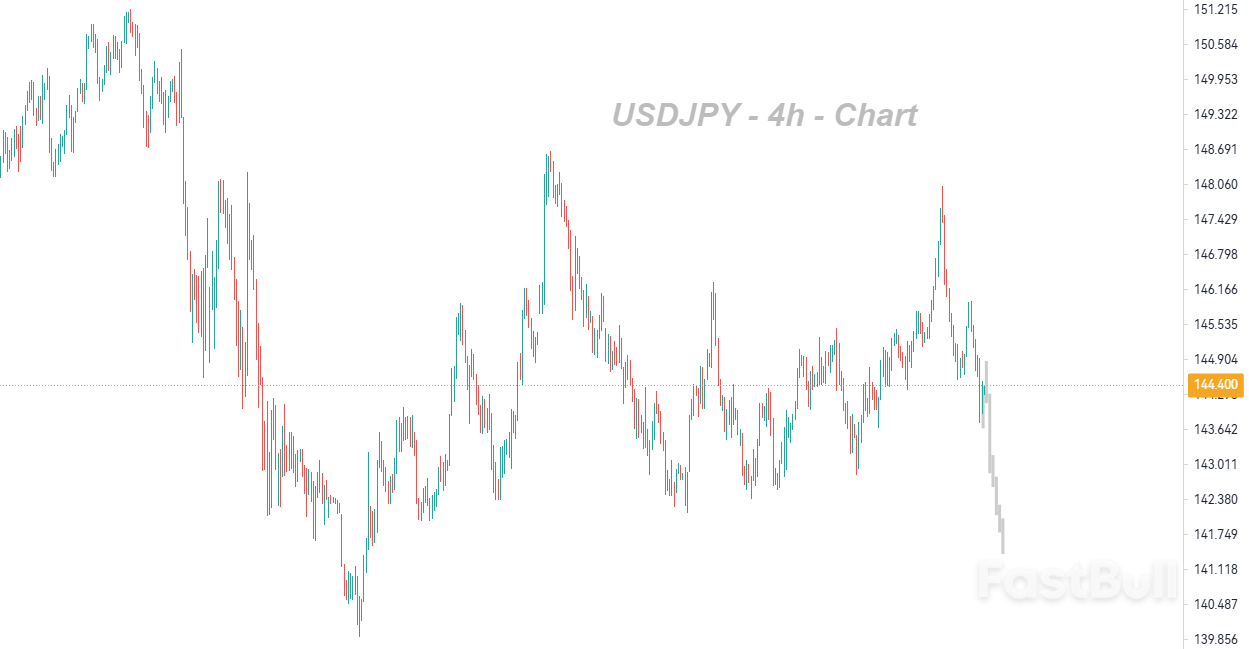
          During the Asian session on Thursday, USDJPY plunged significantly, breaking below the 144.00 level, due to the widespread selling of the US dollar and the upward pressure on the asset from rising inflation in Japan.
          Data from Japan's Ministry of Internal Affairs and Communications shows that rents in Japan's capital region rose by 1.3% year-on-year from April to May this year, the largest increase since 1994. Although this increase may seem modest compared to Tokyo's core inflation rate of 3.6% and the global surge in housing rents, it signifies that the inflationary cycle has finally penetrated Japan's rental market. The widespread increase in rents and prices provides the BoJ with grounds for further interest rate hikes.
          Market observers note that the rise in rents confirms the so-called normalization shift by the central bank, which is indeed one of the signs of a rise in underlying prices and may drive the normalization process of monetary policy. Previously, in its semiannual financial system report, the BoJ had listed the real estate market as a key issue requiring close monitoring.
          According to the summary of opinions from the BoJ's June meeting, the committee members discussed the issue of inflation rising faster than expected, while they continued to believe it was necessary to remain vigilant about the high uncertainty related to US tariffs.
          One of the nine committee members stated, "Although prices are slightly higher than expected, given the downside risks to economic activity brought by US tariff policies and the situation in the Middle East, it is appropriate for the central bank to maintain its current stance on monetary policy implementation." Others also mentioned that the inflation rate was higher than expected.
          Although the summary indicates that the urgency for interest rate hikes is not significant at present, the members' general view that inflation is higher than expected increases the likelihood of the BoJ raising the benchmark interest rate when the uncertainty of tariff impacts begins to dissipate.
          Data released last Friday showed that Japan's main price index hit a two-year high, and the BoJ's inflation outlook suggests that the bank may raise its inflation forecast in the quarterly economic report at its July meeting.
          Inflation Permeates Rental Sector, BoJ Normalization Path Begins to Emerge_1

          Technical Analysis

          USDJPY continued to be sold off on Thursday, but the intraday trend remained upward due to the oversold indicators. As long as the support level at 142.10 holds, USDJPY is expected to rise further, albeit modestly. On the upside, a break above 148.64 would restart the rally from 139.87.
          However, given the relatively favorable fundamentals for the yen and the head-and-shoulders top pattern still in place on the daily chart, we anticipate that after a brief rebound, the bears will continue to dominate.

          Trade Recommendations

          Trade Direction: Sell
          Entry Price: 145.18
          Target Price: 142.40
          Stop Loss: 146.80
          Valid Until: July 11, 2025 23:55:00
          Support: 143.75/143.36/142.79
          Resistance Levels: 144.51/144.90/145.46
          Risk Warnings and Disclaimers
          You understand and acknowledge that there is a high degree of risk involved in trading. Following any strategies or investment methods may lead to potential losses. The content on the site is provided by our contributors and analysts for information purposes only. You are solely responsible for determining whether any trading assets, securities, strategy, or any other product is suitable for investing based on your own investment objectives and financial situation.
          Add to Favorites
          Share

          Pound Sterling Soars to Multi-Month Highs as Dollar Slips on Powell Succession Rumors and Weak US GDP

          Warren Takunda

          Economic

          Summary:

          The British Pound surged to a nearly four-year high against the US Dollar as uncertainty swirled over Federal Reserve leadership.

          BUY GBPUSD
          Close Time
          CLOSED

          1.37500

          Entry Price

          1.40000

          TP

          1.35500

          SL

          1.33404 +0.00092 +0.07%

          8.6

          Pips

          Profit

          1.35500

          SL

          1.37586

          Exit Price

          1.37500

          Entry Price

          1.40000

          TP
          The British Pound rallied sharply against the US Dollar on Thursday, breaking toward multi-month highs, as growing uncertainty around U.S. Federal Reserve leadership, coupled with mixed economic data, sent the greenback tumbling. At the heart of the move was a Wall Street Journal report stating that President Donald Trump may announce a replacement for Fed Chair Jerome Powell by as early as September or October — a headline that caught markets off guard and injected a fresh layer of political risk into the Fed’s already delicate forward guidance.
          At the time of writing, the GBP/USD pair trades at 1.3746, marking a 0.61% daily gain and climbing to levels not seen since late 2021. Sterling’s strength has been aided by a combination of relative calm in UK macroeconomic news and renewed pressure on the Dollar as investors reassess the trajectory of U.S. monetary policy amid growing political noise.
          According to the WSJ article, the Trump administration is actively considering candidates to replace Jerome Powell, whose term ends in early 2026. Potential contenders reportedly include former Fed Governor Kevin Warsh, National Economic Council Director Kevin Hassett, and Treasury Secretary Scott Bessent. While no formal decisions have been made, the prospect of a leadership shakeup has unsettled investors, as it raises questions over future Fed independence, policy continuity, and how a new chair might approach inflation and employment mandates in a politically charged election year.
          The uncertainty surrounding Powell’s future has compounded pressure on the U.S. Dollar, which was already grappling with mixed data releases. Markets now face the confusing scenario of needing to monitor both Powell’s statements and possible early signals from a successor, should the nomination process move ahead sooner than expected.
          Adding fuel to the fire, Powell testified before Congress this week, reiterating that the central bank is in wait-and-see mode, monitoring the lingering impact of U.S. tariff policies on inflation. He hinted that should inflation prove transitory and decline sustainably, rate reductions could be considered — a dovish tilt that markets are increasingly interpreting as the groundwork for easing later in the year.
          Economic indicators released on Thursday painted a mixed picture of U.S. growth. While Durable Goods Orders surged by a stunning 16.4% in May — driven largely by a spike in commercial aircraft orders — the broader macro landscape looks less rosy. Revised data from the Bureau of Economic Analysis showed that Q1 2025 GDP contracted by -0.5% quarter-on-quarter, more than double the initial -0.2% print. This marks the weakest quarterly performance since early 2023 and raises concerns that the U.S. economy may be losing momentum faster than previously expected.
          Meanwhile, Initial Jobless Claims dropped to 236,000 for the week ending June 21, beating expectations and the prior week’s 245,000 reading. However, two of the last three weekly reports came in higher than forecast, suggesting that the labor market may be cooling — albeit gradually. Together, the GDP miss and Powell’s remarks reinforced market expectations that the Fed could begin cutting rates later this year, pressuring Treasury yields and the U.S. Dollar.
          On the UK front, the economic calendar was light, though Bank of England Governor Andrew Bailey delivered remarks that reaffirmed a slow and steady path toward easing. Bailey emphasized that while inflation is moving in the right direction, policy still needs to remain “restrictive for sufficiently long” to ensure inflation returns to the 2% target. He also underlined that rate cuts, when they come, would follow a “gradual and careful” trajectory.
          Markets are currently pricing in a 76% probability of a rate cut at the BoE’s August meeting, according to OIS futures — a dovish shift that would typically weigh on the Pound. Yet, GBP/USD surged regardless, driven more by Dollar fragility than domestic optimism.
          Some strategists warn that Sterling’s strength may be short-lived. Nick Rees, Head of Macro Research at Monex, told Bloomberg, “I think once things calm down and markets have a little bit more time to focus on the UK fiscal situation, I think big downside risk is building for the Pound that could start to play out in the weeks ahead.” Concerns over persistent deficits, soft productivity, and political uncertainty may eventually reassert downward pressure on Sterling.
          Technical Analysis Pound Sterling Soars to Multi-Month Highs as Dollar Slips on Powell Succession Rumors and Weak US GDP_1
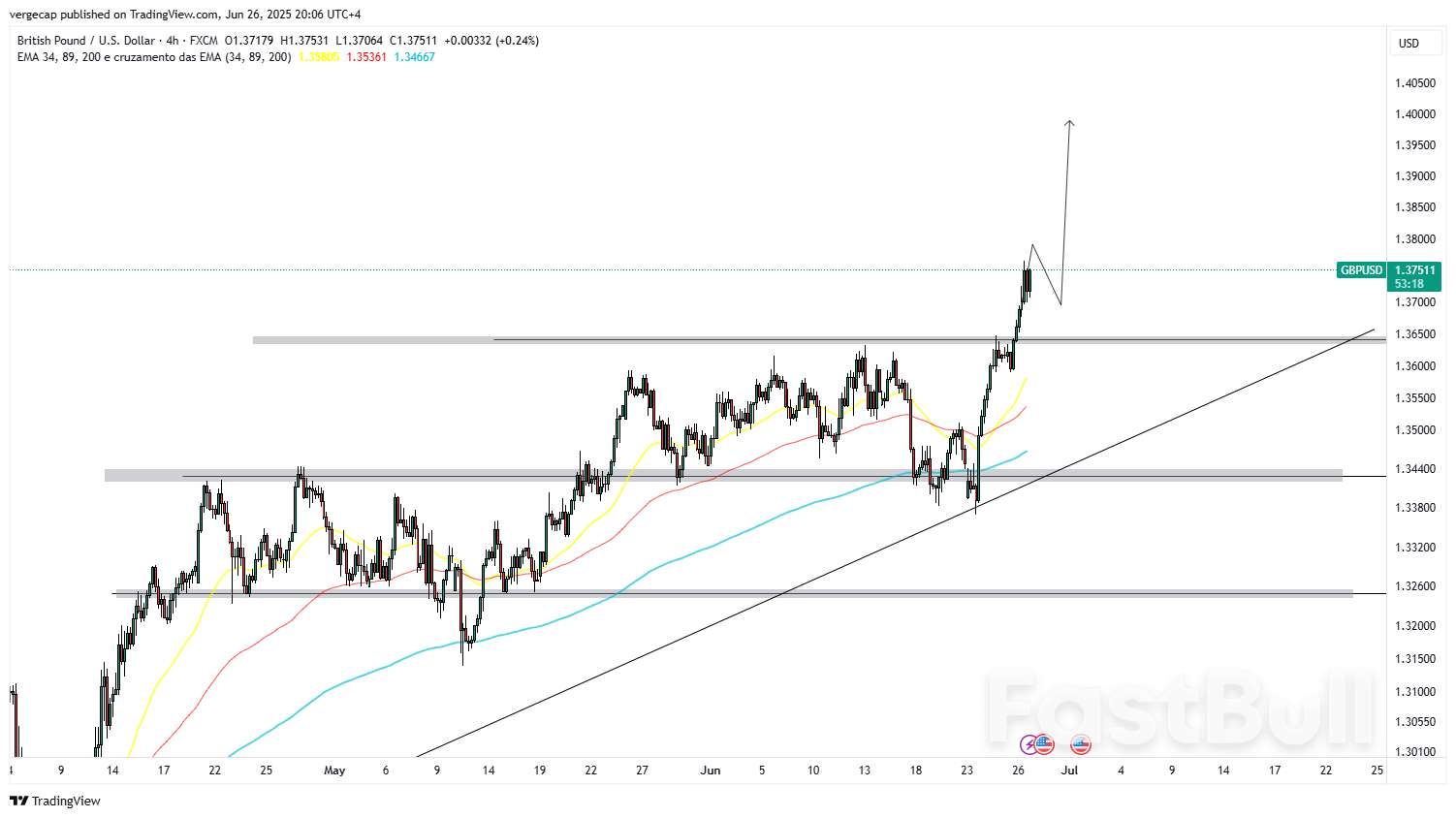
          From a technical standpoint, the GBP/USD pair continues to post higher highs, riding a strong uptrend bolstered by its position above the 50-day exponential moving average (EMA) and a rising bias line. Despite the RSI flashing overbought signals, bullish momentum appears intact, supported by positive divergence and growing investor appetite for risk assets amid Dollar weakness.
          The pair has cleared multiple resistance levels and appears poised to challenge the 1.3800 zone, a psychological barrier last tested in early 2021. Should price action extend above this level, further gains could open toward the 1.3865 region, followed by the 1.4000 handle.
          On the downside, initial support lies around the 1.3660 area — a prior breakout point and the location of the 9-day EMA. A break below this level could expose the pair to a corrective move toward the 1.3550 zone, which coincides with stronger structural support.
          TRADE RECOMMENDATION
          BUY GBPUSD
          ENTRY PRICE: 1.3750
          STOP LOSS: 1.3550
          TAKE PROFIT : 1.4000
          Risk Warnings and Disclaimers
          You understand and acknowledge that there is a high degree of risk involved in trading. Following any strategies or investment methods may lead to potential losses. The content on the site is provided by our contributors and analysts for information purposes only. You are solely responsible for determining whether any trading assets, securities, strategy, or any other product is suitable for investing based on your own investment objectives and financial situation.
          Add to Favorites
          Share

          USD/CAD Slides Toward 1.3450 as Trump Targets Fed, Stagflation Fears Rise

          Warren Takunda

          Economic

          Summary:

          The U.S. Dollar tumbled Thursday as political pressure on the Federal Reserve and rising fears of stagflation sparked broad selling.

          SELL USDCAD
          Close Time
          CLOSED

          1.36500

          Entry Price

          1.34000

          TP

          1.37800

          SL

          1.38218 +0.00071 +0.05%

          42.5

          Pips

          Profit

          1.34000

          TP

          1.36075

          Exit Price

          1.36500

          Entry Price

          1.37800

          SL
          The U.S. Dollar came under heavy pressure on Thursday, reversing its modest recovery from the previous session as a complex blend of political tensions, macroeconomic risks, and monetary policy uncertainty sparked a sharp deterioration in investor sentiment. The catalyst for the renewed selloff was a fresh round of attacks from President Donald Trump targeting the independence of the Federal Reserve, a move that significantly undermined confidence in the credibility of U.S. monetary policy at a time when economic fragility is becoming more apparent.
          According to reports from Washington insiders, Trump has recently escalated his rhetoric against Fed Chair Jerome Powell, allegedly using derogatory language and even entertaining the idea of replacing Powell before the end of his term. While the president has long been critical of the central bank's policy stance, the prospect of actively pursuing Powell’s dismissal represents a profound breach of the long-standing norms separating politics from monetary governance. Markets interpreted the remarks as an overt threat to institutional stability, prompting an immediate and sharp retreat in the dollar across the board.
          This political drama unfolded just as Powell reiterated the Fed’s cautious tone regarding interest rates. In his latest public appearance, the Fed Chair suggested that the central bank remains in a strong position to manage inflation, even as the effects of U.S. tariffs continue to ripple through the economy. He offered no firm signal that a rate cut was imminent, instead emphasizing the Fed’s commitment to a data-driven approach.
          Despite Powell's remarks, traders increasingly believe that policy easing is on the horizon. Expectations for a rate cut have surged in recent days. The CME FedWatch Tool shows that markets are now pricing in a 24% probability of a rate cut in July, up from just 14% a week ago. For September, the odds have soared to 90%, compared to 65% in the prior week. The spike in rate-cut bets is being driven not only by political pressure but also by fears that the administration’s escalating trade policy could push the U.S. economy into a period of stagflation—characterized by slowing growth and rising inflation.
          Those fears were echoed by a recent report from JP Morgan, which warned that the imposition of unilateral tariffs could erode consumer and business confidence, slow investment, and feed into inflation through higher import costs. The bank raised its probability of a U.S. recession in the second half of 2025 to 40%, citing growing stagflationary pressures as the key risk factor.
          Against this backdrop, the U.S. Dollar has lost favor even as global geopolitical tensions persist. The Dollar Index, which measures the greenback against a basket of major currencies, has broken below recent support levels. Demand has shifted toward currencies perceived to have more stable policy environments, despite broader market uncertainty.
          One notable outperformer has been the Canadian Dollar. Despite a more than 16% collapse in crude oil prices—Canada’s primary export—the Loonie has gained nearly 0.5% against the U.S. Dollar this week. This divergence from traditional correlations suggests growing investor confidence in the relative strength of Canada’s macroeconomic fundamentals and its central bank’s policy discipline.
          Technical AnalysisUSD/CAD Slides Toward 1.3450 as Trump Targets Fed, Stagflation Fears Rise_1
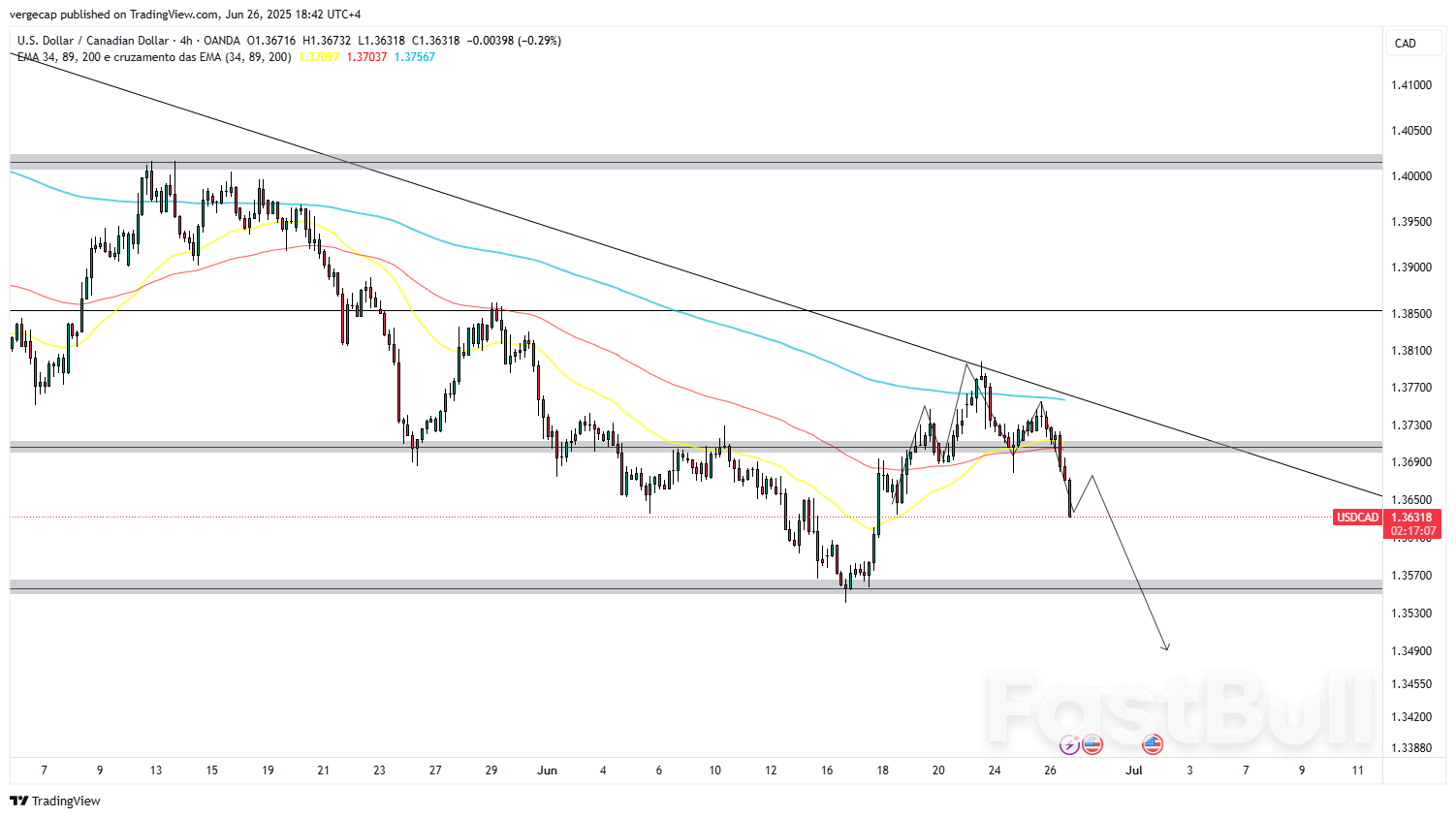
          USD/CAD has been trading on the back foot, slipping toward critical support near the 1.3450 level. Technical signals point to further weakness ahead. The pair recently formed a head and shoulders reversal pattern, a classic bearish setup that signals an end to upward momentum. Additionally, the 50-day exponential moving average has moved above current price levels, a bearish crossover that indicates downside pressure is increasing.
          Bearish engulfing candles have appeared on the daily chart, reinforcing the view that sentiment is turning against the greenback. Momentum indicators also show a shift in favor of sellers, and the price is now hovering near a potential break of market structure. A fair value gap has emerged just above the current level, suggesting that price may be seeking equilibrium at lower levels.
          A descending trendline has consistently rejected upside attempts, further confirming that bulls have lost control. If the pair decisively breaks below 1.3450, technical momentum could drive it toward the 1.3380–1.3400 range. Conversely, any bounce is likely to face stiff resistance around 1.3560, the neckline of the head and shoulders pattern and a former support zone now acting as a ceiling.
          TRADE RECOMMENDATION
          SELL USDCAD
          ENTRY PRICE: 1.3650
          STOP LOSS: 1.3780
          TAKE PROFIT: 1.3400
          Risk Warnings and Disclaimers
          You understand and acknowledge that there is a high degree of risk involved in trading. Following any strategies or investment methods may lead to potential losses. The content on the site is provided by our contributors and analysts for information purposes only. You are solely responsible for determining whether any trading assets, securities, strategy, or any other product is suitable for investing based on your own investment objectives and financial situation.
          Add to Favorites
          Share
          FastBull
          Copyright © 2025 FastBull Ltd

          728 RM B 7/F GEE LOK IND BLDG NO 34 HUNG TO RD KWUN TONG KLN HONG KONG

          TelegramInstagramTwitterfacebooklinkedin
          App Store Google Play Google Play
          Products
          Charts

          Chats

          Q&A with Experts
          Screeners
          Economic Calendar
          Data
          Tools
          Membership
          Features
          Function
          Markets
          Copy Trading
          Latest Signals
          Contests
          News
          Analysis
          24/7
          Columns
          Education
          Company
          Careers
          About Us
          Contact Us
          Advertising
          Help Center
          Feedback
          User Agreement
          Privacy Policy
          Business

          White Label

          Data API

          Web Plug-ins

          Poster Maker

          Affiliate Program

          Risk Disclosure

          The risk of loss in trading financial instruments such as stocks, FX, commodities, futures, bonds, ETFs and crypto can be substantial. You may sustain a total loss of the funds that you deposit with your broker. Therefore, you should carefully consider whether such trading is suitable for you in light of your circumstances and financial resources.

          No decision to invest should be made without thoroughly conducting due diligence by yourself or consulting with your financial advisors. Our web content might not suit you since we don't know your financial conditions and investment needs. Our financial information might have latency or contain inaccuracy, so you should be fully responsible for any of your trading and investment decisions. The company will not be responsible for your capital loss.

          Without getting permission from the website, you are not allowed to copy the website's graphics, texts, or trademarks. Intellectual property rights in the content or data incorporated into this website belong to its providers and exchange merchants.

          Not Logged In

          Log in to access more features

          FastBull Membership

          Not yet

          Purchase

          Become a signal provider
          Help Center
          Customer Service
          Dark Mode
          Price Up/Down Colors

          Log In

          Sign Up

          Position
          Layout
          Fullscreen
          Default to Chart
          The chart page opens by default when you visit fastbull.com
