• Trade
  • Markets
  • Copy
  • Contests
  • News
  • 24/7
  • Calendar
  • Q&A
  • Chats
Trending
Screeners
SYMBOL
LAST
BID
ASK
HIGH
LOW
NET CHG.
%CHG.
SPREAD
SPX
S&P 500 Index
6857.13
6857.13
6857.13
6865.94
6827.13
+7.41
+ 0.11%
--
DJI
Dow Jones Industrial Average
47850.93
47850.93
47850.93
48049.72
47692.96
-31.96
-0.07%
--
IXIC
NASDAQ Composite Index
23505.13
23505.13
23505.13
23528.53
23372.33
+51.04
+ 0.22%
--
USDX
US Dollar Index
98.750
98.830
98.750
98.980
98.750
-0.230
-0.23%
--
EURUSD
Euro / US Dollar
1.16706
1.16713
1.16706
1.16707
1.16408
+0.00261
+ 0.22%
--
GBPUSD
Pound Sterling / US Dollar
1.33614
1.33621
1.33614
1.33622
1.33165
+0.00343
+ 0.26%
--
XAUUSD
Gold / US Dollar
4227.04
4227.45
4227.04
4230.62
4194.54
+19.87
+ 0.47%
--
WTI
Light Sweet Crude Oil
59.338
59.375
59.338
59.469
59.187
-0.045
-0.08%
--

Community Accounts

Signal Accounts
--
Profit Accounts
--
Loss Accounts
--
View More

Become a signal provider

Sell trading signals to earn additional income

View More

Guide to Copy Trading

Get started with ease and confidence

View More

Signal Accounts for Members

All Signal Accounts

Best Return
  • Best Return
  • Best P/L
  • Best MDD
Past 1W
  • Past 1W
  • Past 1M
  • Past 1Y

All Contests

  • All
  • Trump Updates
  • Recommend
  • Stocks
  • Cryptocurrencies
  • Central Banks
  • Featured News
Top News Only
Share

Kremlin Aide Says Russia Is Ready To Work Further With Current USA Team

Share

Kremlin Aide Says Russia And USA Are Moving Forward In Ukraine Talks

Share

Shanghai Rubber Warehouse Stocks Up 7336 Tons

Share

Shanghai Tin Warehouse Stocks Up 506 Tons

Share

Reserve Bank Of India Chief Malhotra: Goal Is To Have Inflation Be Around 4%

Share

Ukmto Says Master Has Confirmed That The Small Crafts Have Left The Scene, Vessel Is Proceeding To Its Next Port Of Call

Share

Shanghai Nickel Warehouse Stocks Up 1726 Tons

Share

Shanghai Lead Warehouse Stocks Down 3064 Tons

Share

Shanghai Zinc Warehouse Stocks Down 4000 Tons

Share

Shanghai Aluminium Warehouse Stocks Up 8353 Tons

Share

Shanghai Copper Warehouse Stocks Down 9025 Tons

Share

Equinor: Preliminary Estimates Indicate Reservoirs May Contain Between 5 -18 Million Standard Cubic Meters Of Recoverable Oil Equivalents

Share

Japan Chief Cabinet Secretary Kihara: Government To Take Appropriate Steps On Excessive And Disorderly Moves In Foreign Exchange Market, If Necessary

Share

[Report: Amazon Pays €180 Million To Italy To End Tax And Labor Investigations] Amazon Has Paid A Settlement And Dismantled Its Monitoring System For Delivery Drivers In Italy, Ending An Investigation Into Alleged Tax Fraud And Illegal Labor Practices. In July 2024, The Group's Logistics Services Division Was Accused Of Circumventing Labor And Tax Laws By Relying On Cooperatives Or Limited Liability Companies To Supply Workers, Evading VAT, And Reducing Social Security Payments. Sources Say The Group Has Now Paid Approximately €180 Million To Italian Tax Authorities As Part Of A €1 Billion Settlement Involving 33 Companies

Share

Airbus - Booked 797 Gross Aircraft Orders In January-November

Share

[Market Update] Spot Gold Broke Through $4,230 Per Ounce, Up 0.51% On The Day

Share

Reserve Bank Of India Chief Malhotra: There Will Be Ample Liquidity As Long As We Are In An Easing Cycle

Share

Reserve Bank Of India Chief Malhotra: Quantum Of System Liquidity Will Be Managed To Ensure Monetary Transmission Is Happening

Share

China's Foreign Ministry: World Bank, IMF, WTO Top Officials To Join

Share

China's Foreign Ministry: China To Hold 1+1 Dialogue With International Economic Orgs On Dec 9

TIME
ACT
FCST
PREV
Euro Zone IHS Markit Construction PMI (Nov)

A:--

F: --

P: --

Italy IHS Markit Construction PMI (Nov)

A:--

F: --

P: --

U.K. Markit/CIPS Construction PMI (Nov)

A:--

F: --

P: --

France 10-Year OAT Auction Avg. Yield

A:--

F: --

P: --

Euro Zone Retail Sales MoM (Oct)

A:--

F: --

P: --

Euro Zone Retail Sales YoY (Oct)

A:--

F: --

P: --

Brazil GDP YoY (Q3)

A:--

F: --

P: --

U.S. Challenger Job Cuts (Nov)

A:--

F: --

P: --

U.S. Challenger Job Cuts MoM (Nov)

A:--

F: --

P: --

U.S. Challenger Job Cuts YoY (Nov)

A:--

F: --

P: --

U.S. Initial Jobless Claims 4-Week Avg. (SA)

A:--

F: --

P: --

U.S. Weekly Initial Jobless Claims (SA)

A:--

F: --

P: --

U.S. Weekly Continued Jobless Claims (SA)

A:--

F: --

P: --

Canada Ivey PMI (SA) (Nov)

A:--

F: --

P: --

Canada Ivey PMI (Not SA) (Nov)

A:--

F: --

P: --

U.S. Non-Defense Capital Durable Goods Orders Revised MoM (Excl. Aircraft) (SA) (Sept)

A:--

F: --

P: --
U.S. Factory Orders MoM (Excl. Transport) (Sept)

A:--

F: --

P: --

U.S. Factory Orders MoM (Sept)

A:--

F: --

P: --

U.S. Factory Orders MoM (Excl. Defense) (Sept)

A:--

F: --

P: --

U.S. EIA Weekly Natural Gas Stocks Change

A:--

F: --

P: --

Saudi Arabia Crude Oil Production

A:--

F: --

P: --

U.S. Weekly Treasuries Held by Foreign Central Banks

A:--

F: --

P: --

Japan Foreign Exchange Reserves (Nov)

A:--

F: --

P: --

India Repo Rate

A:--

F: --

P: --

India Benchmark Interest Rate

A:--

F: --

P: --

India Reverse Repo Rate

A:--

F: --

P: --

India Cash Reserve Ratio

A:--

F: --

P: --

Japan Leading Indicators Prelim (Oct)

A:--

F: --

P: --

U.K. Halifax House Price Index YoY (SA) (Nov)

A:--

F: --

P: --

U.K. Halifax House Price Index MoM (SA) (Nov)

A:--

F: --

P: --

France Current Account (Not SA) (Oct)

--

F: --

P: --

France Trade Balance (SA) (Oct)

--

F: --

P: --

France Industrial Output MoM (SA) (Oct)

--

F: --

P: --

Italy Retail Sales MoM (SA) (Oct)

--

F: --

P: --

Euro Zone Employment YoY (SA) (Q3)

--

F: --

P: --

Euro Zone GDP Final YoY (Q3)

--

F: --

P: --

Euro Zone GDP Final QoQ (Q3)

--

F: --

P: --

Euro Zone Employment Final QoQ (SA) (Q3)

--

F: --

P: --

Euro Zone Employment Final (SA) (Q3)

--

F: --

P: --
Brazil PPI MoM (Oct)

--

F: --

P: --

Mexico Consumer Confidence Index (Nov)

--

F: --

P: --

Canada Unemployment Rate (SA) (Nov)

--

F: --

P: --

Canada Labor Force Participation Rate (SA) (Nov)

--

F: --

P: --

Canada Employment (SA) (Nov)

--

F: --

P: --

Canada Part-Time Employment (SA) (Nov)

--

F: --

P: --

Canada Full-time Employment (SA) (Nov)

--

F: --

P: --

U.S. Personal Income MoM (Sept)

--

F: --

P: --

U.S. Dallas Fed PCE Price Index YoY (Sept)

--

F: --

P: --

U.S. PCE Price Index YoY (SA) (Sept)

--

F: --

P: --

U.S. PCE Price Index MoM (Sept)

--

F: --

P: --

U.S. Personal Outlays MoM (SA) (Sept)

--

F: --

P: --

U.S. Core PCE Price Index MoM (Sept)

--

F: --

P: --

U.S. UMich 5-Year-Ahead Inflation Expectations Prelim YoY (Dec)

--

F: --

P: --

U.S. Core PCE Price Index YoY (Sept)

--

F: --

P: --

U.S. Real Personal Consumption Expenditures MoM (Sept)

--

F: --

P: --

U.S. 5-10 Year-Ahead Inflation Expectations (Dec)

--

F: --

P: --

U.S. UMich Current Economic Conditions Index Prelim (Dec)

--

F: --

P: --

U.S. UMich Consumer Sentiment Index Prelim (Dec)

--

F: --

P: --

U.S. UMich 1-Year-Ahead Inflation Expectations Prelim (Dec)

--

F: --

P: --

U.S. UMich Consumer Expectations Index Prelim (Dec)

--

F: --

P: --

Q&A with Experts
    • All
    • Chatrooms
    • Groups
    • Friends
    Connecting
    .
    .
    .
    Type here...
    Add Symbol or Code

      No matching data

      All
      Trump Updates
      Recommend
      Stocks
      Cryptocurrencies
      Central Banks
      Featured News
      • All
      • Russia-Ukraine Conflict
      • Middle East Flashpoint
      • All
      • Russia-Ukraine Conflict
      • Middle East Flashpoint

      Search
      Products

      Charts Free Forever

      Chats Q&A with Experts
      Screeners Economic Calendar Data Tools
      Membership Features
      Data Warehouse Market Trends Institutional Data Policy Rates Macro

      Market Trends

      Market Sentiment Order Book Forex Correlations

      Top Indicators

      Charts Free Forever
      Markets

      News

      News Analysis 24/7 Columns Education
      From Institutions From Analysts
      Topics Columnists

      Latest Views

      Latest Views

      Trending Topics

      Top Columnists

      Latest Update

      Signals

      Copy Rankings Latest Signals Become a signal provider AI Rating
      Contests
      Brokers

      Overview Brokers Assessment Rankings Regulators News Claims
      Broker listing Forex Brokers Comparison Tool Live Spread Comparison Scam
      Q&A Complaint Scam Alert Videos Tips to Detect Scam
      More

      Business
      Events
      Careers About Us Advertising Help Center

      White Label

      Data API

      Web Plug-ins

      Affiliate Program

      Awards Institution Evaluation IB Seminar Salon Event Exhibition
      Vietnam Thailand Singapore Dubai
      Fans Party Investment Sharing Session
      FastBull Summit BrokersView Expo
      Recent Searches
        Top Searches
          Markets
          News
          Analysis
          User
          24/7
          Economic Calendar
          Education
          Data
          • Names
          • Latest
          • Prev

          View All

          No data

          Scan to Download

          Faster Charts, Chat Faster!

          Download App
          English
          • English
          • Español
          • العربية
          • Bahasa Indonesia
          • Bahasa Melayu
          • Tiếng Việt
          • ภาษาไทย
          • Français
          • Italiano
          • Türkçe
          • Русский язык
          • 简中
          • 繁中
          Open Account
          Search
          Products
          Charts Free Forever
          Markets
          News
          Signals

          Copy Rankings Latest Signals Become a signal provider AI Rating
          Contests
          Brokers

          Overview Brokers Assessment Rankings Regulators News Claims
          Broker listing Forex Brokers Comparison Tool Live Spread Comparison Scam
          Q&A Complaint Scam Alert Videos Tips to Detect Scam
          More

          Business
          Events
          Careers About Us Advertising Help Center

          White Label

          Data API

          Web Plug-ins

          Affiliate Program

          Awards Institution Evaluation IB Seminar Salon Event Exhibition
          Vietnam Thailand Singapore Dubai
          Fans Party Investment Sharing Session
          FastBull Summit BrokersView Expo

          Kiwi Holds Key Support, Can Bulls Extend the Rally?

          Manuel

          Economic

          Central Bank

          Summary:

          The pullback has also reached the Fibonacci retracement area between the 0.50 and 0.618 levels, a common region for trend corrections, adding further confluence to the bullish outlook.

          BUY NZDUSD
          Close Time
          CLOSED

          0.57273

          Entry Price

          0.58000

          TP

          0.56850

          SL

          0.57790 +0.00174 +0.30%

          42.3

          Pips

          Loss

          0.56850

          SL

          0.56850

          Exit Price

          0.57273

          Entry Price

          0.58000

          TP

          U.S. consumer confidence recorded its steepest decline since August 2021 this month, reflecting growing concerns about the broader economic outlook and uncertainty regarding the impact of Donald Trump's policy agenda.
          The Conference Board’s Consumer Confidence Index fell for the third consecutive month, dropping by seven points to 98.3 in February, according to data released on Tuesday. This reading came in below economists’ median forecast of 102.5, as surveyed by Bloomberg.
          The expectations index, which measures sentiment for the next six months, also fell to its lowest level in over three years, while the gauge of current economic conditions experienced a more moderate decline.
          Consumer and business sentiment, which initially surged following Trump’s election victory, now appears to be waning. Households and corporations are showing increased caution as inflationary pressures resurface, largely due to rising tariffs. Meanwhile, the labor market is gradually cooling, adding to economic uncertainty.
          At the time of writing, U.S. 10-year Treasury yields are down 1.7%, hovering around 4.32%. This decline reflects a surge in demand for U.S. bonds as market participants grow increasingly confident that the Federal Reserve (Fed) will resume its rate-cutting cycle at the June policy meeting.
          According to the CME FedWatch tool, the probability of a Fed rate cut in June has climbed to 76%, up from 56% just a week ago. The tool also indicates that the central bank is expected to keep rates unchanged in its March and May meetings, maintaining the current range of 4.25%-4.50%.
          Stronger-than-expected retail sales data in New Zealand could provide further support for the Kiwi. According to Statistics New Zealand, retail sales rose by 0.9% quarter-over-quarter in Q4, marking the largest gain in three years. This was a significant improvement from the previous reading of 0% (revised from -0.1%) and exceeded market expectations of a 0.6% increase.
          In addition, sentiment around the New Zealand dollar received a boost from China’s recent economic stimulus measures. Last week, Chinese authorities unveiled an action plan aimed at attracting foreign investment into the domestic telecommunications and biotechnology sectors. The Ministry of Commerce emphasized that the plan would be fully implemented by the end of 2025, with further support measures to be announced soon. Given New Zealand's strong trade ties with China, any positive developments in Chinese stimulus efforts tend to benefit the Kiwi.Kiwi Holds Key Support, Can Bulls Extend the Rally?_1

          Technical Analysis

          NZD/USD has pulled back to the 100-period moving average on the 2-hour chart, where it has found renewed support. Notably, the price has failed to form a lower low, suggesting that bullish momentum may soon regain strength. Additionally, this level, which previously acted as resistance, may now serve as a support zone. The pullback has also reached the Fibonacci retracement area between the 0.50 and 0.618 levels, a common region for trend corrections, adding further confluence to the bullish outlook.
          The Relative Strength Index (RSI) has dipped to 34, approaching oversold territory. However, in the context of an uptrend, oversold levels are less frequent, making this a potential area for price stabilization. Furthermore, the RSI has exhibited a bullish divergence—printing a lower reading even as price remains above previous lows—indicating that selling pressure may be losing momentum. This could pave the way for a continuation of the prevailing uptrend.
          If NZD/USD holds this support level, the pair could see an upside continuation toward the 0.5800 region, aligning with a Fibonacci expansion target. Conversely, a decisive breakdown below this level could expose the 200-period moving average, triggering renewed bearish pressure.
          Trading Recommendations
          Trading direction: Sell
          Entry price: 0.5725
          Target price: 0.5800
          Stop loss: 0.5685
          Validity: Mar 07, 2025 15:00:00
          Risk Warnings and Disclaimers
          You understand and acknowledge that there is a high degree of risk involved in trading. Following any strategies or investment methods may lead to potential losses. The content on the site is provided by our contributors and analysts for information purposes only. You are solely responsible for determining whether any trading assets, securities, strategy, or any other product is suitable for investing based on your own investment objectives and financial situation.
          Add to Favorites
          Share

          EURAUD Faces Selling Pressure at Resistance, Will Bears Prevail?

          Manuel

          Economic

          Forex

          Summary:

          The current price level is once again near the 200-period moving average, a dynamic resistance zone where selling pressure previously emerged, leading to a strong downside move.

          SELL EURAUD
          Close Time
          CLOSED

          1.65800

          Entry Price

          1.64250

          TP

          1.66400

          SL

          1.76076 -0.00074 -0.04%

          60.0

          Pips

          Loss

          1.64250

          TP

          1.66402

          Exit Price

          1.65800

          Entry Price

          1.66400

          SL

          The European Central Bank (ECB) policymaker Martins Kazaks recently commented on the bank’s outlook regarding interest rate cuts.
          "I believe we should continue cutting rates, but we will proceed step by step," Kazaks stated. He emphasized that the future trajectory of interest rates could be influenced by Trump’s policies, adding, "We must remain cautious as we approach the terminal rate."
          Meanwhile, ECB policymaker and Bundesbank President Joachim Nagel warned last week that the eurozone’s "strong export orientation" makes it "particularly vulnerable" to potential tariffs imposed by Trump.
          Additionally, ECB Executive Board member Isabel Schnabel argued on Tuesday that subdued economic growth should not necessarily be seen as proof that monetary policy is restrictive.
          "The natural interest rate in the eurozone has increased significantly over the past two years," Schnabel stated. "The nature of the inflationary process has likely changed in a lasting manner." She further noted that if quantitative tightening (QT) leads to a shortage of reserves, it could push up the general convenience yield and, as a result, lower equilibrium rates. She added, "It is increasingly unlikely that current financing conditions are materially constraining consumption and investment."
          On the economic front, fourth-quarter negotiated wage growth data for the eurozone came in at 4.12%, down from the previous quarter's 5.43%. The weaker wage growth data appears to contradict Schnabel's recent comments, where she suggested that the ECB might consider a "pause" in its easing cycle, citing persistent domestic inflation and still-elevated wage growth, particularly amid fresh energy price shocks. A slowdown in wage growth could reinforce expectations for further ECB rate cuts this year.
          Looking beyond the eurozone, Australia’s inflation data is expected to show a slight uptick to 2.6% in January from 2.5% in December. Such an outcome could strengthen the case for the Reserve Bank of Australia (RBA) to delay any rate cuts.
          Last week, the RBA lowered its Official Cash Rate (OCR) by 25 basis points (bps) to 4.10%, marking its first rate cut since November 2020. Despite the easing move, the central bank maintained a cautious stance, signaling that the battle against inflation is not yet over.EURAUD Faces Selling Pressure at Resistance, Will Bears Prevail?_1

          Technical Analysis

          EURAUD recently tested the 1.6615 level, an important resistance zone, but failed to establish a new local high. This could signal a potential correction ahead, as forming a lower high is typically considered a bearish signal. Additionally, the current price level is once again near the 200-period moving average, a dynamic resistance zone where selling pressure previously emerged, leading to a strong downside move. If sellers successfully defend this area, we could see another decline from this level.
          The Relative Strength Index (RSI) on the 4-hour chart has reached 67, nearing overbought territory. Moreover, the RSI has not surpassed its previous peak, maintaining the broader bearish structure. From this level, the price could continue a downward move toward the 1.6425 support zone, which has previously acted as a key demand area. On the other hand, a decisive breakout above 1.6636 could invalidate the bearish outlook and open the door for further gains.
          Trading Recommendations
          Trading direction: Sell
          Entry price: 1.6580
          Target price: 1.6425
          Stop loss: 1.6640
          Validity: Mar 07, 2025 15:00:00
          Risk Warnings and Disclaimers
          You understand and acknowledge that there is a high degree of risk involved in trading. Following any strategies or investment methods may lead to potential losses. The content on the site is provided by our contributors and analysts for information purposes only. You are solely responsible for determining whether any trading assets, securities, strategy, or any other product is suitable for investing based on your own investment objectives and financial situation.
          Add to Favorites
          Share

          Buyers May Step In as Bitcoin Pulls Back to Key Support

          Manuel

          Cryptocurrency

          Summary:

          Large corrections are a common feature of the crypto market, creating strategic opportunities to buy high quality assets at a discount.

          BUY BTC-USDT
          Close Time
          CLOSED

          88215.9

          Entry Price

          95000.0

          TP

          84000.0

          SL

          92434.9 -534.0 -0.57%

          4215.9

          Pips

          Loss

          84000.0

          SL

          83894.7

          Exit Price

          88215.9

          Entry Price

          95000.0

          TP

          Bitcoin, the world’s largest and oldest cryptocurrency, suffered a significant drop of over 8% within a 24-hour period on Tuesday morning (EDT), plunging to a low of $87,190—its lowest price of 2025—before staging a modest recovery.
          The broader cryptocurrency market mirrored Bitcoin’s decline, with major altcoins like Ethereum (ETH), XRP, and Solana (SOL) experiencing even steeper losses of up to 15%. ETH, the second-largest cryptocurrency, fell by more than 10%, dipping below $2,400, while XRP and SOL saw weekly losses extend to 19%.
          As a result, the total cryptocurrency market capitalization dipped below $3 trillion, declining 9% within 24 hours to approximately $2.86 trillion, according to data from CoinMarketCap.
          The downturn triggered significant liquidations across crypto derivatives, with a total of $1.5 billion wiped out during this period, affecting nearly 390,000 individual traders. Notably, the majority of these liquidations stemmed from long positions, accounting for the bulk of the losses, while only $121 million was attributed to short positions, according to data from Coinglass.
          This sharp correction marks a stark reversal from Bitcoin’s 50% rally following Donald Trump’s re-election victory, which had propelled BTC to a fresh all-time high of just over $109,000 in January as the Republican leader began his second term.
          Despite Trump’s pro-crypto stance, the market has faced headwinds from lingering political and economic uncertainty. On Monday, the U.S. President announced plans to move forward with tariffs on Canada and Mexico, a move that had an immediate negative impact on financial markets.
          "Trump's aggressive stance toward geopolitical allies and rivals alike is shaking investor confidence, while concerns about persistently high inflation remain," Bloomberg noted in a report on Tuesday. Additionally, the expectation of a longer-than-anticipated pause in Federal Reserve rate cuts has added to the risk-off sentiment.
          Traditional markets have also felt the impact, with the Nasdaq Composite and S&P 500 posting losses of 1.4% and 0.5%, respectively, earlier in the day. The tech-heavy Nasdaq 100 has extended its five-day decline to nearly 4%, according to Google Finance.
          In a separate development, the U.S. Securities and Exchange Commission (SEC) has formally closed its investigation into Uniswap, the leading decentralized finance (DeFi) platform, determining that it did not violate existing securities laws.
          Uniswap Labs confirmed the news via its official X (formerly Twitter) account, stating that the SEC ruled the platform was not operating as an unregistered broker or securities exchange, nor was it issuing unregistered securities.
          This marks a major regulatory victory for Uniswap, which had been under scrutiny since April 2023, when it received a Wells Notice, a warning often preceding enforcement action by the SEC. The decision to close the case without filing charges confirms that the regulator found insufficient grounds to proceed.Buyers May Step In as Bitcoin Pulls Back to Key Support_1

          Technical Analysis

          Bitcoin has retraced to $86,000 amid a wave of liquidations and multi-day declines driven by a mix of fundamental and technical factors. The breakdown below $90,000 triggered a cascade of liquidations, pushing the Relative Strength Index (RSI) on the 12-hour chart to 20, signaling extreme oversold conditions. Historically, such levels have often preceded strong rebounds as buyers step in.
          If the $86,000 support level holds, we could see a wave of fresh accumulation, as sharp corrections tend to offer some of the best buying opportunities in trending markets. The key upside target in this scenario would be the 0.50 Fibonacci retracement level at $97,000, which aligns with an important resistance zone.
          While retail traders remain bearish, institutional investors typically use these deep pullbacks to accumulate Bitcoin. Large corrections are a common feature of the crypto market, creating strategic opportunities to buy high-quality assets at a discount—a principle that many long-term investors follow.
          If bullish momentum returns, Bitcoin could reclaim $97,000 in the coming sessions, but a failure to hold $86,000 could expose it to further downside pressure. Market participants will be closely watching whether buyers step in at these key levels to determine the next directional move.
          Trading Recommendations
          Trading direction: Buy
          Entry price: 88200
          Target price: 95000
          Stop loss: 84000
          Validity: Mar 07, 2025 15:00:00
          Risk Warnings and Disclaimers
          You understand and acknowledge that there is a high degree of risk involved in trading. Following any strategies or investment methods may lead to potential losses. The content on the site is provided by our contributors and analysts for information purposes only. You are solely responsible for determining whether any trading assets, securities, strategy, or any other product is suitable for investing based on your own investment objectives and financial situation.
          Add to Favorites
          Share

          Ethereum Drops Below $2,400: Will Market Sentiment Pull ETH Lower in February 2025?

          Adam

          Cryptocurrency

          Summary:

          On February 25, 2025, the Ethereum market (ETH/USDT) recorded strong fluctuations, with the price falling to 2,427.67, down 0.2% from the high of 2,450.00 at the beginning of the week.

          SELL ETH-USDT
          Close Time
          CLOSED

          2425.89

          Entry Price

          2400.00

          TP

          2460.00

          SL

          3180.98 -27.02 -0.84%

          341.1

          Pips

          Loss

          2400.00

          TP

          2460.00

          Exit Price

          2425.89

          Entry Price

          2460.00

          SL

          Overview

          On February 25, 2025, the ETH/USDT price traded around 2,427.67, down slightly but within the strong volatility trend of the cryptocurrency market. This decline reflects pressure from the macroeconomic context and global market sentiment. The Fed continues to maintain interest rates at 5.25% - 5.50%, with the US CPI in January 2025 rising to 3.2%, higher than the forecast of 3.0%, increasing the opportunity cost of risky assets such as cryptocurrencies. The DXY index rose 0.8% to 106.50, strengthening the USD and putting pressure on selling digital assets.
          In addition, the cryptocurrency market was affected by concerns about legal regulations. The EU has just passed a new MiCA law, tightening regulations on stablecoins and cryptocurrency transactions, reducing confidence in ETH. On-chain data shows that ETH transaction volume decreased by 15% in the week, reaching $12 billion/day, the lowest in 2 months, while the number of active wallets decreased by 10%, down to 1.2 million/day. WTI oil prices are stable at $78.50/barrel, but rising gas prices in the US increase mining costs, indirectly affecting the operating costs of the Ethereum network. Market sentiment was also affected by the decline of Bitcoin (BTC) below $50,000, dragging altcoins like ETH down.

          Market psychology

          Market sentiment on February 25, 2025 in the crypto sector tilted to pessimism, with the Crypto Fear Greed Index (VIX) falling to 25, the “extreme fear” zone, reflecting concerns about regulation and the global economy. Large investors withdrew funds from ETH, with withdrawals from exchanges like Binance increasing 18% on the week to $500 million, while inflows into stablecoin USDT increased 12% to $15 billion. Data from Glassnode shows that hedge funds like Three Arrows Capital and Grayscale reduced their ETH positions and moved to USD and BTC, reinforcing the downward pressure on ETH/USDT.
          ETH/USDT trading volume in the market decreased by 20%, reaching $8 billion/day, the lowest in 3 months, while ETH's Volatility Index increased to 45%, the highest since November 2024, reflecting the instability. A report from CoinShares on February 24, 2025 predicted that ETH could fall another 5-7% if the Fed continues its hawkish signals, but if US inflation data weakens, ETH could recover to $2,600 by the end of March 2025. This sentiment shows that investors are positioning their portfolios to minimize risks, putting great pressure on ETH/USDT.

          Technical analysis

          Ethereum Falls Below $2,400: Will Market Sentiment Pull ETH Lower in February 2025?
          On the ETH/USDT chart on 25/02/2025, the price fell to 2,427.67, below the MA50 (2,450.00) and MA200 (2,480.00). Important support is at 2,400.00 (January 2025 low) and resistance is at 2,450.00 (MA50). RSI is at 35, in the oversold zone (below 40), but there is no sign of bullish divergence, indicating that the bearish pressure has not exhausted itself. Bollinger Bands are expanding with the price touching the lower band at 2,420.00, signaling high volatility. MACD is below zero, with the histogram at -0.0020, confirming the downtrend, but momentum could slow if the price meets strong support.
          If price breaks 2,400.00, next target is 2,350.00; if it breaks 2,450.00, a test of 2,480.00 is possible. The current downtrend is supported by increasing trading volume and bearish crossovers of moving averages.

          Trading Recommendations

          Short at 2,427.67, take profit at 2,400.00, stop loss at 2,460.00. Note the risk from US inflation data next week and the moves of large hedge funds, manage risk at 1-2% of the account to cope with volatility from the crypto market or legal regulations.
          ETH/USDT on 25/02/2025 fell sharply due to pressure from the Fed, regulations, and bearish market sentiment. Technical trends reinforce the bearish scenario, but investors need to be cautious with upcoming economic data and market movements, and manage risks closely amid high volatility.
          Risk Warnings and Disclaimers
          You understand and acknowledge that there is a high degree of risk involved in trading. Following any strategies or investment methods may lead to potential losses. The content on the site is provided by our contributors and analysts for information purposes only. You are solely responsible for determining whether any trading assets, securities, strategy, or any other product is suitable for investing based on your own investment objectives and financial situation.
          Add to Favorites
          Share

          Can the Euro Recover from Pressure from the ECB and BoC?

          Adam

          Forex

          Summary:

          On February 25, 2025, the EUR/CAD market witnessed a decline, trading around 1.4625, down 0.4% from the high of 1.4700 earlier in the week. Key factors include the potential easing of the European Central Bank (ECB) policy...

          BUY EURCAD
          EXP
          EXPIRED

          1.50000

          Entry Price

          1.50500

          TP

          1.49000

          SL

          1.62704 +0.00201 +0.12%

          --

          Pips

          EXPIRED

          1.49000

          SL

          1.50845

          Exit Price

          1.50000

          Entry Price

          1.50500

          TP

          Overview

          On February 25, 2025, EUR/CAD traded around 1.4625, falling sharply due to monetary policy pressure and weak Eurozone economic data. The ECB kept interest rates at 0.50%, but Eurozone inflation fell to 2.3%, close to the 2% target, raising expectations that the ECB would cut interest rates in Q2/2025. Eurozone GDP in Q4/2024 grew by just 0.3%, lower than the forecast of 0.5%, with the manufacturing PMI falling to 45.7, below the 50 threshold, putting downward pressure on the EUR.
          In contrast, the Bank of Canada (BoC) kept interest rates at 4.00%, but GDP in Q4/2024 increased by 0.8%, higher than the forecast of 0.6%, and inflation was stable at 2.8%, supporting CAD as a safe asset. Canada's manufacturing PMI in February 2025 reached 48.0, lower than the forecast of 49.0, but WTI oil prices were stable at $78.50/barrel, maintaining CAD's strength thanks to energy exports. Geopolitical tensions in Europe, especially the conflict in Ukraine, weakened the EUR, while CAD was strengthened by stable Canadian economic data and its role as a haven in the North American region.
          The interest rate differential between EUR and CAD, along with market sentiment, pushed EUR/CAD lower, with expectations of ECB easing in the short term.

          Market psychology

          Market sentiment on February 25, 2025 was skewed to anxiety, with the VIX at 22 and the Fear Greed Index falling to 27, reflecting concerns about the global economy. Investors turned to CAD as a safe-haven asset on solid Canadian economic data, while the EUR sold off on the weak economic outlook for the Eurozone. CME Group data showed that EUR/CAD futures short volume increased 23% for the week, with large funds such as TD Bank reducing their EUR positions and increasing CAD, reinforcing the downward pressure on the pair.
          CAD trading volumes in the forex market increased by 15%, especially in the EUR/CAD pair, with daily volumes reaching $110 billion, a two-month high. In contrast, the EUR lost strength, with the EUR's relative strength index against the G10 currency basket falling to its lowest level since December 2024. A report from Scotiabank on February 24, 2025 predicted that EUR/CAD could fall another 1-2% if the ECB signals easing, but if the BoC maintains a hawkish stance, CAD could recover slightly, easing the downward pressure.

          Technical analysis

          Can the Euro Recover from Pressure from the ECB and BoC?_1
          On the EUR/CAD chart on 25/02/2025, the price dropped sharply to 1.4625, below the MA50 (1.4670) and MA200 (1.4720). Important support is at 1.4600 (January 2025 low) and resistance is at 1.4670 (MA50). RSI is at 31, in the oversold zone (below 30), but has not shown any signs of recovery, indicating that the bearish pressure has not yet exhausted itself. Bollinger Bands are expanding with the price touching the lower band at 1.4610, signaling high volatility. MACD is below zero, with the histogram at -0.0012, confirming the downtrend, but momentum may slow if the price meets strong support.
          If price breaks 1.4600, next target is 1.4550; if it breaks 1.4670, a test of 1.4720 is possible. The current downtrend is supported by increasing volume and bearish crossovers of moving averages.

          Trading Recommendations

          Entry: 1.5000
          TP: 1,505
          SL: 1.4900
          Note risks from ECB decision 27/02/2025 and Canadian employment data, manage risk at 1-2% of account to deal with volatility from energy market or geopolitics.
          EUR/CAD fell sharply on 25/02/2025 due to weak Eurozone economy and CAD's increasing role as a safe haven. Technical trends reinforce the bearish scenario, but investors need to be cautious with the upcoming ECB decision and economic data, and manage risks closely in volatile markets.
          Risk Warnings and Disclaimers
          You understand and acknowledge that there is a high degree of risk involved in trading. Following any strategies or investment methods may lead to potential losses. The content on the site is provided by our contributors and analysts for information purposes only. You are solely responsible for determining whether any trading assets, securities, strategy, or any other product is suitable for investing based on your own investment objectives and financial situation.
          Add to Favorites
          Share

          CAD/CHF Drops Below 0.6250: Will the Swiss Franc Continue to Dominate the CAD Ahead of Economic Data?

          Adam

          Forex

          Summary:

          On February 25, 2025, the CAD/CHF market experienced significant volatility, falling to 0.6249, down 0.5% from a high of 0.6300 earlier in the week. Key factors included the neutral policy of the Swiss National Bank (SNB)..

          SELL USDCHF
          EXP
          EXPIRED

          0.62300

          Entry Price

          0.62000

          TP

          0.62900

          SL

          0.80206 -0.00154 -0.19%

          --

          Pips

          EXPIRED

          0.62000

          TP

          0.89442

          Exit Price

          0.62300

          Entry Price

          0.62900

          SL

          Overview

          On February 25, 2025, the CAD/CHF price traded around 0.6249, falling sharply due to pressure from monetary policy and weak Canadian economic data. The Bank of Canada (BoC) maintained interest rates at 4.00%, but GDP in the fourth quarter of 2024 increased by only 0.6%, lower than the forecast of 0.8%, while inflation fell to 2.8%, raising concerns that the BoC may ease policy early. The Canadian manufacturing PMI in February 2025 fell to 48.0, below the threshold of 50, indicating that the industry continued to shrink, putting downward pressure on the CAD.
          In contrast, the Swiss National Bank (SNB) kept its interest rate at 1.25%, neutral, but the CHF was reinforced as a safe asset by stable economic data. The Swiss manufacturing PMI in February 2025 reached 51.5, higher than the forecast of 50.8, and exports increased by 4.0% thanks to demand from the EU, supporting the CHF. Geopolitical tensions in Europe, especially the conflict in Ukraine, increased the CHF's safe-haven role, while WTI oil prices fell slightly to $78.00/barrel, negatively affecting the CAD, which depends on energy exports.
          The interest rate differential between CAD and CHF, along with market sentiment, pushed CAD/CHF lower, with expectations that the SNB could keep its policy neutral for at least the next 3 months.

          Market psychology

          Market sentiment on February 25, 2025 was skewed toward anxiety, with the VIX at 22 and the Fear Greed Index falling to 27, reflecting concerns about the global economy. Investors turned to CHF as a safe-haven asset on the back of solid Swiss economic data, while CAD was sold off on the weak Canadian economic outlook. CME Group data showed that CAD/CHF futures short volume rose 22% for the week, with major funds such as UBS reducing their CAD positions and increasing CHF, reinforcing the downward pressure on the pair.
          CHF trading volumes in the forex market increased by 18%, especially in the CAD/CHF pair, with volumes reaching $90 billion/day, a two-month high. In contrast, the CAD lost strength, with the CAD's relative strength index against the G10 currency basket falling to its lowest level since November 2024. A report from Credit Suisse on February 24, 2025 predicted that CAD/CHF could fall another 1-2% if the BoC signals easing, but if the SNB raises interest rates, the CHF could recover slightly, reducing the downward pressure.

          Technical analysis

          CAD/CHF Drops Below 0.6250: Will the Swiss Franc Continue to Dominate CAD Ahead of Economic Data?_1
          On the CAD/CHF chart on 25/02/2025, the price dropped sharply to 0.6249, below the MA50 (0.6280) and MA200 (0.6320). Important support is at 0.6200 (January 2025 low) and resistance is at 0.6280 (MA50). RSI is at 32, in the oversold zone (below 30), but has not shown any signs of recovery, indicating that the bearish pressure has not yet exhausted itself. Bollinger Bands are expanding with the price touching the lower band at 0.6230, signaling high volatility. MACD is below zero, with the histogram at -0.0010, confirming the downtrend, but momentum may slow if the price meets strong support.
          If price breaks 0.6200, next target is 0.6150; if it breaks 0.6280, test 0.6320 is possible. The current downtrend is supported by increasing trading volume and bearish crossover of moving averages.

          Trading Recommendations

          Entry: 0.6230
          TP: 0.6200
          SL: 0.6290
          Note risks from SNB decision 27/02/2025 and Canadian employment data, manage risk at 1-2% of account to deal with volatility from energy market or geopolitics.
          CAD/CHF on 25/02/2025 fell sharply due to weak Canadian economy and CHF increasing its safe-haven role. Technical trends reinforce the bearish scenario, but investors need to be cautious with the upcoming SNB decision and economic data, and manage risks closely in volatile markets.
          Risk Warnings and Disclaimers
          You understand and acknowledge that there is a high degree of risk involved in trading. Following any strategies or investment methods may lead to potential losses. The content on the site is provided by our contributors and analysts for information purposes only. You are solely responsible for determining whether any trading assets, securities, strategy, or any other product is suitable for investing based on your own investment objectives and financial situation.
          Add to Favorites
          Share

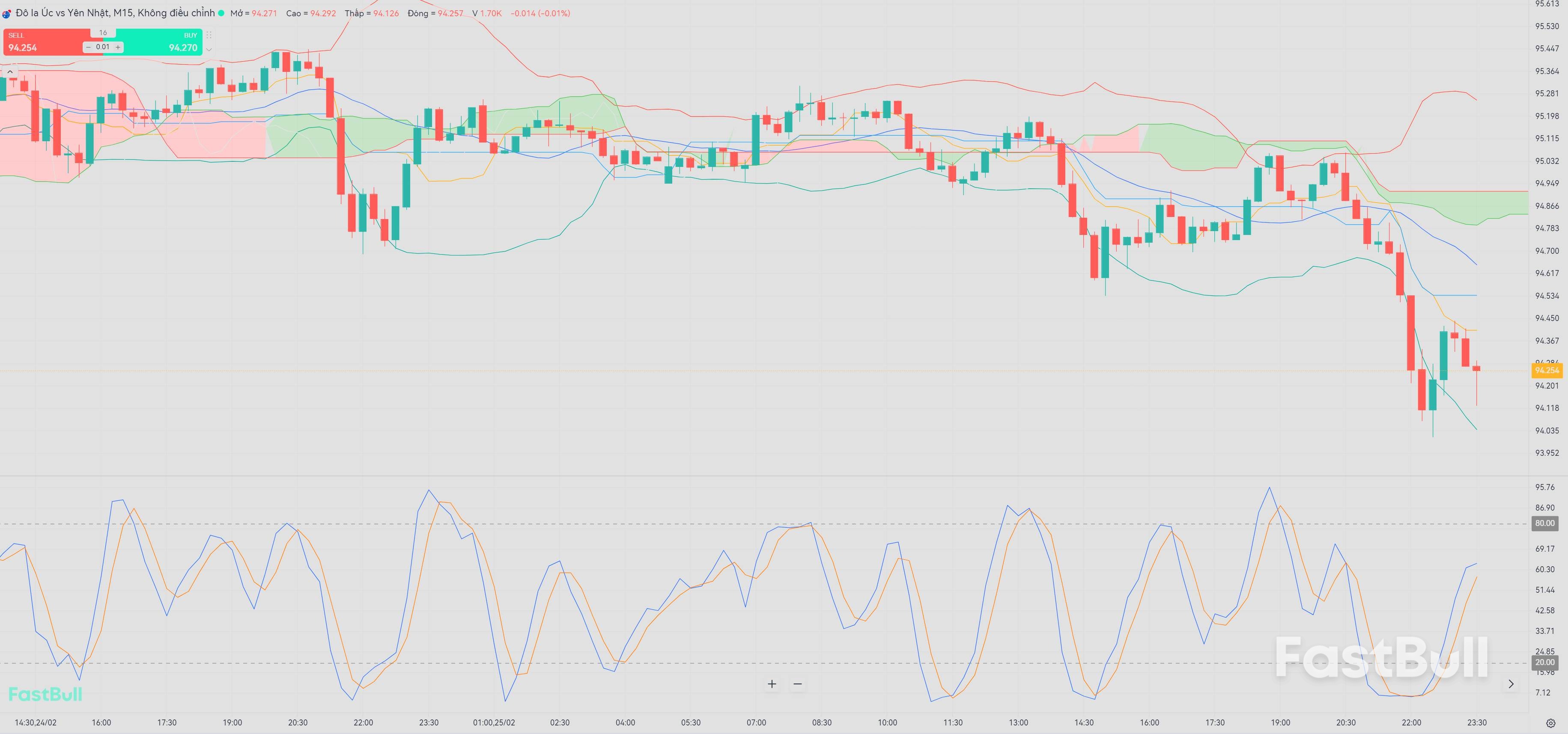
          AUD/JPY Freefall Below 95.00: Can the Yen Recover from RBA Pressure?

          Adam

          Forex

          Economic

          Summary:

          On February 25, 2025, the AUD/JPY market witnessed a sharp decline, trading around 94.254, down 0.7% from the high of 95.000 at the beginning of the week. Key factors included the tightening policy of the Bank of Japan (BoJ) and weak economic data in Australia...

          SELL AUDJPY
          Close Time
          CLOSED

          94.220

          Entry Price

          94.000

          TP

          94.700

          SL

          102.367 -0.150 -0.15%

          48.0

          Pips

          Loss

          94.000

          TP

          94.702

          Exit Price

          94.220

          Entry Price

          94.700

          SL

          Overview

          On February 25, 2025, the AUD/JPY price traded around 94.254, falling sharply due to pressure from monetary policy and weak Australian economic data. The Reserve Bank of Australia (RBA) maintained interest rates at 4.35%, the highest in 13 years, but GDP in the fourth quarter of 2024 increased by only 0.7%, lower than the forecast of 0.9%, while inflation fell to 3.5%, raising concerns that the RBA may ease policy early. The Australian manufacturing PMI in February 2025 fell to 47.5, below the threshold of 50, indicating that the industry continued to shrink, putting downward pressure on the AUD.
          In contrast, the BoJ maintained its easing policy with a 0.1% interest rate, but signaled its readiness to raise rates if inflation stabilizes above 2%. Japanese economic data showed that the manufacturing PMI reached 50.3, higher than the forecast of 50.0, and exports increased by 3.0% thanks to demand from ASEAN, reinforcing the JPY as a safe-haven asset. Geopolitical tensions in East Asia, especially the conflict in the South China Sea, increased the JPY's safe-haven role, while Japanese gas prices increased by 8% due to import dependence, supporting the JPY further. The interest rate differential between AUD and JPY, combined with market sentiment, pushed AUD/JPY lower.

          Market psychology

          Market sentiment on 25/02/2025 was skewed to anxiety, with the VIX at 22 and the Fear Greed Index falling to 28, reflecting concerns about the global economy. Investors turned to the safe-haven JPY on the back of solid Japanese economic data, while the AUD was sold off on the weak Australian economic outlook. CME Group data showed that AUD/JPY futures short volume rose 28% for the week, with major funds such as JPMorgan Chase reducing their AUD positions and increasing their JPY positions, reinforcing the downward pressure on the pair.
          JPY trading volume in the forex market increased by 20%, especially in the AUD/JPY pair, with volume reaching $120 billion/day, the highest in 2 months. In contrast, the AUD lost strength, with the AUD's relative strength index against the G10 currency basket falling to its lowest level since October 2024. A report from Mitsubishi UFJ on 24/02/2025 predicted that AUD/JPY could fall another 2% if the RBA signals easing, but if the BoJ raises interest rates, the JPY could recover slightly, reducing the downward pressure.

          Technical analysis

          AUD/JPY Freefall Below 95.00: Can the Yen Recover from RBA Pressure?_1
          On the AUD/JPY chart on 25/02/2025, the price dropped sharply to 94.254, below the MA50 (94.600) and MA200 (95.200). Important support is at 94.000 (January 2025 low) and resistance is at 94.600 (MA50). RSI is at 30, in the oversold zone (below 30), but has not shown any signs of recovery, indicating that the bearish pressure has not yet exhausted itself. Bollinger Bands are expanding with the price touching the lower band at 94.100, signaling high volatility. MACD is below zero, with the histogram at -0.0015, confirming the downtrend, but momentum may slow if the price meets strong support.
          If price breaks 94,000, next target is 93,500; if it breaks 94,600, a test of 95,000 is possible. The current downtrend is supported by increasing trading volume and bearish crossovers of moving averages.

          Trading Recommendations

          Entry: 94.250
          City: 94,000
          SL: 94.700
          Note risks from BoJ decision on 28/02/2025 and Australian employment data, manage risk at 1-2% of account to cope with volatility from energy market or geopolitics.
          AUD/JPY fell sharply on 25/02/2025 due to weak Australian economy and JPY's increasing role as a safe haven. Technical trends reinforce the bearish scenario, but investors need to be cautious with the BoJ decision and upcoming economic data, and manage risks closely in volatile markets.
          Risk Warnings and Disclaimers
          You understand and acknowledge that there is a high degree of risk involved in trading. Following any strategies or investment methods may lead to potential losses. The content on the site is provided by our contributors and analysts for information purposes only. You are solely responsible for determining whether any trading assets, securities, strategy, or any other product is suitable for investing based on your own investment objectives and financial situation.
          Add to Favorites
          Share
          FastBull
          Copyright © 2025 FastBull Ltd

          728 RM B 7/F GEE LOK IND BLDG NO 34 HUNG TO RD KWUN TONG KLN HONG KONG

          TelegramInstagramTwitterfacebooklinkedin
          App Store Google Play Google Play
          Products
          Charts

          Chats

          Q&A with Experts
          Screeners
          Economic Calendar
          Data
          Tools
          Membership
          Features
          Function
          Markets
          Copy Trading
          Latest Signals
          Contests
          News
          Analysis
          24/7
          Columns
          Education
          Company
          Careers
          About Us
          Contact Us
          Advertising
          Help Center
          Feedback
          User Agreement
          Privacy Policy
          Business

          White Label

          Data API

          Web Plug-ins

          Poster Maker

          Affiliate Program

          Risk Disclosure

          The risk of loss in trading financial instruments such as stocks, FX, commodities, futures, bonds, ETFs and crypto can be substantial. You may sustain a total loss of the funds that you deposit with your broker. Therefore, you should carefully consider whether such trading is suitable for you in light of your circumstances and financial resources.

          No decision to invest should be made without thoroughly conducting due diligence by yourself or consulting with your financial advisors. Our web content might not suit you since we don't know your financial conditions and investment needs. Our financial information might have latency or contain inaccuracy, so you should be fully responsible for any of your trading and investment decisions. The company will not be responsible for your capital loss.

          Without getting permission from the website, you are not allowed to copy the website's graphics, texts, or trademarks. Intellectual property rights in the content or data incorporated into this website belong to its providers and exchange merchants.

          Not Logged In

          Log in to access more features

          FastBull Membership

          Not yet

          Purchase

          Become a signal provider
          Help Center
          Customer Service
          Dark Mode
          Price Up/Down Colors

          Log In

          Sign Up

          Position
          Layout
          Fullscreen
          Default to Chart
          The chart page opens by default when you visit fastbull.com