• Trade
  • Markets
  • Copy
  • Contests
  • News
  • 24/7
  • Calendar
  • Q&A
  • Chats
Trending
Screeners
SYMBOL
LAST
BID
ASK
HIGH
LOW
NET CHG.
%CHG.
SPREAD
SPX
S&P 500 Index
6870.39
6870.39
6870.39
6895.79
6858.28
+13.27
+ 0.19%
--
DJI
Dow Jones Industrial Average
47954.98
47954.98
47954.98
48133.54
47871.51
+104.05
+ 0.22%
--
IXIC
NASDAQ Composite Index
23578.12
23578.12
23578.12
23680.03
23506.00
+72.99
+ 0.31%
--
USDX
US Dollar Index
98.880
98.960
98.880
98.960
98.730
-0.070
-0.07%
--
EURUSD
Euro / US Dollar
1.16518
1.16525
1.16518
1.16717
1.16341
+0.00092
+ 0.08%
--
GBPUSD
Pound Sterling / US Dollar
1.33286
1.33293
1.33286
1.33462
1.33136
-0.00026
-0.02%
--
XAUUSD
Gold / US Dollar
4206.12
4206.53
4206.12
4218.85
4190.61
+8.21
+ 0.20%
--
WTI
Light Sweet Crude Oil
59.381
59.411
59.381
60.084
59.291
-0.428
-0.72%
--

Community Accounts

Signal Accounts
--
Profit Accounts
--
Loss Accounts
--
View More

Become a signal provider

Sell trading signals to earn additional income

View More

Guide to Copy Trading

Get started with ease and confidence

View More

Signal Accounts for Members

All Signal Accounts

Best Return
  • Best Return
  • Best P/L
  • Best MDD
Past 1W
  • Past 1W
  • Past 1M
  • Past 1Y

All Contests

  • All
  • Trump Updates
  • Recommend
  • Stocks
  • Cryptocurrencies
  • Central Banks
  • Featured News
Top News Only
Share

EU To Delay Proposals For Automotive Sector, Including Co2 Emissions, To Dec 16, Draft EU Commission Document Shows

Share

Kremlin: India Buys Energy Where It Is Profitable To And As Far As We Understand They Will Continue To Do That

Share

Turkey's Main Banking Index Up 2.5%

Share

Turkey's Main BIST-100 Index Up 1.9%

Share

Hungary's Preliminary November Budget Balance Huf -403 Billion

Share

Indian Rupee Down 0.1% At 90.07 Per USA Dollar As Of 3:30 P.M. Ist, Previous Close 89.98

Share

India's Nifty 50 Index Provisionally Ends 0.96% Lower

Share

[JPMorgan: US Stock Rally May Stagnate Following Fed Rate Cut] JPMorgan Strategists Say The Recent Rally In US Stocks May Stall As Investors Take Profits Following The Anticipated Fed Rate Cut. The Market Currently Predicts A 92% Probability Of The Fed Lowering Borrowing Costs On Wednesday. Expectations Of A Rate Cut Have Continued To Rise, Fueled By Positive Signals From Policymakers In Recent Weeks. "Investors May Be More Inclined To Lock In Gains At The End Of The Year Rather Than Increase Directional Exposure," Mislav Matejka's Team Wrote In A Report

Share

Russian Defence Ministry: Russian Forces Take Control Of Novodanylivka In Ukraine's Zaporizhzhia Region

Share

Russian Defence Ministry: Russian Forces Take Control Of Chervone In Ukraine's Donetsk Region

Share

French Finance Ministry: Government Started Process To Block Temporarily Shein Platform

Share

Finance Minister: Indonesia To Impose Coal Export Tax Of Up To 5% Next Year

Share

[Trump Considering Fired Homeland Security Secretary Noem? White House Denies] According To Reports From US Media Outlets Such As The Daily Beast And The UK's Independent, The White House Has Denied Reports That US President Trump Is Considering Firing Homeland Security Secretary Noem. White House Spokesperson Abigail Jackson Posted On Social Media On The 7th Local Time, Calling The Claims "fake News" And Stating That "Secretary Noem Has Done An Excellent Job Implementing The President's Agenda And 'making America Safe Again'."

Share

HKEX: Standard Chartered Bought Back 571604 Total Shares On Other Exchanges For Gbp9.5 Million On Dec 5

Share

Morgan Stanley Reiterates Bullish Outlook On US Stocks Due To Fed Rate Cut Expectations. Morgan Stanley Strategists Believe That The US Stock Market Faces A "bullish Outlook" Given Improved Earnings Expectations And Anticipated Fed Rate Cuts. They Expect Strong Corporate Earnings By 2026, And Anticipate The Fed Will Cut Rates Based On Lagging Or Mildly Weak Labor Markets. They Expect The US Consumer Discretionary Sector And Small-cap Stocks To Continue To Outperform

Share

China's National Development And Reform Commission Announced That Starting From 24:00 On December 8, The Retail Price Limit For Gasoline And Diesel In China Will Be Reduced By 55 Yuan Per Ton, Which Translates To A Reduction Of 0.04 Yuan Per Liter For 92-octane Gasoline, 0.05 Yuan Per Liter For 95-octane Gasoline, And 0.05 Yuan Per Liter For 0# Diesel

Share

Tkms CEO: US Security Strategy Highlights Need For Europe To Take Care Of Its Own Defences

Share

USA S&P 500 E-Mini Futures Up 0.1%, NASDAQ 100 Futures Up 0.18%, Dow Futures Down 0.02%

Share

London Metal Exchange (LME): Copper Inventories Increased By 2,000 Tons, Aluminum Inventories Decreased By 2,500 Tons, Nickel Inventories Increased By 228 Tons, Zinc Inventories Increased By 2,375 Tons, Lead Inventories Decreased By 3,725 Tons, And Tin Inventories Decreased By 10 Tons

Share

Swiss Sight Deposits Of Domestic Banks At 440.519 Billion Sfr In Week Ending December 5 Versus 437.298 Billion Sfr A Week Earlier

TIME
ACT
FCST
PREV
France Industrial Output MoM (SA) (Oct)

A:--

F: --

P: --
France Trade Balance (SA) (Oct)

A:--

F: --

P: --
Euro Zone Employment YoY (SA) (Q3)

A:--

F: --

P: --
Canada Part-Time Employment (SA) (Nov)

A:--

F: --

P: --

Canada Unemployment Rate (SA) (Nov)

A:--

F: --

P: --

Canada Full-time Employment (SA) (Nov)

A:--

F: --

P: --

Canada Labor Force Participation Rate (SA) (Nov)

A:--

F: --

P: --

Canada Employment (SA) (Nov)

A:--

F: --

P: --

U.S. PCE Price Index MoM (Sept)

A:--

F: --

P: --

U.S. Personal Income MoM (Sept)

A:--

F: --

P: --

U.S. Core PCE Price Index MoM (Sept)

A:--

F: --

P: --

U.S. PCE Price Index YoY (SA) (Sept)

A:--

F: --

P: --

U.S. Core PCE Price Index YoY (Sept)

A:--

F: --

P: --

U.S. Personal Outlays MoM (SA) (Sept)

A:--

F: --

P: --
U.S. 5-10 Year-Ahead Inflation Expectations (Dec)

A:--

F: --

P: --

U.S. Real Personal Consumption Expenditures MoM (Sept)

A:--

F: --

P: --
U.S. Weekly Total Rig Count

A:--

F: --

P: --

U.S. Weekly Total Oil Rig Count

A:--

F: --

P: --

U.S. Consumer Credit (SA) (Oct)

A:--

F: --

P: --
China, Mainland Foreign Exchange Reserves (Nov)

A:--

F: --

P: --

Japan Trade Balance (Oct)

A:--

F: --

P: --

Japan Nominal GDP Revised QoQ (Q3)

A:--

F: --

P: --

China, Mainland Imports YoY (CNH) (Nov)

A:--

F: --

P: --

China, Mainland Exports (Nov)

A:--

F: --

P: --

China, Mainland Imports (CNH) (Nov)

A:--

F: --

P: --

China, Mainland Trade Balance (CNH) (Nov)

A:--

F: --

P: --

China, Mainland Exports YoY (USD) (Nov)

A:--

F: --

P: --

China, Mainland Imports YoY (USD) (Nov)

A:--

F: --

P: --

Germany Industrial Output MoM (SA) (Oct)

A:--

F: --

P: --
Euro Zone Sentix Investor Confidence Index (Dec)

A:--

F: --

P: --

Canada National Economic Confidence Index

--

F: --

P: --

U.K. BRC Like-For-Like Retail Sales YoY (Nov)

--

F: --

P: --

U.K. BRC Overall Retail Sales YoY (Nov)

--

F: --

P: --

Australia Overnight (Borrowing) Key Rate

--

F: --

P: --

RBA Rate Statement
RBA Press Conference
Germany Exports MoM (SA) (Oct)

--

F: --

P: --

U.S. NFIB Small Business Optimism Index (SA) (Nov)

--

F: --

P: --

Mexico 12-Month Inflation (CPI) (Nov)

--

F: --

P: --

Mexico Core CPI YoY (Nov)

--

F: --

P: --

Mexico PPI YoY (Nov)

--

F: --

P: --

U.S. Weekly Redbook Index YoY

--

F: --

P: --

U.S. JOLTS Job Openings (SA) (Oct)

--

F: --

P: --

China, Mainland M1 Money Supply YoY (Nov)

--

F: --

P: --

China, Mainland M0 Money Supply YoY (Nov)

--

F: --

P: --

China, Mainland M2 Money Supply YoY (Nov)

--

F: --

P: --

U.S. EIA Short-Term Crude Production Forecast For The Year (Dec)

--

F: --

P: --

U.S. EIA Natural Gas Production Forecast For The Next Year (Dec)

--

F: --

P: --

U.S. EIA Short-Term Crude Production Forecast For The Next Year (Dec)

--

F: --

P: --

EIA Monthly Short-Term Energy Outlook
U.S. API Weekly Gasoline Stocks

--

F: --

P: --

U.S. API Weekly Cushing Crude Oil Stocks

--

F: --

P: --

U.S. API Weekly Crude Oil Stocks

--

F: --

P: --

U.S. API Weekly Refined Oil Stocks

--

F: --

P: --

South Korea Unemployment Rate (SA) (Nov)

--

F: --

P: --

Japan Reuters Tankan Non-Manufacturers Index (Dec)

--

F: --

P: --

Japan Reuters Tankan Manufacturers Index (Dec)

--

F: --

P: --

Japan Domestic Enterprise Commodity Price Index MoM (Nov)

--

F: --

P: --

Japan Domestic Enterprise Commodity Price Index YoY (Nov)

--

F: --

P: --

China, Mainland PPI YoY (Nov)

--

F: --

P: --

Q&A with Experts
    • All
    • Chatrooms
    • Groups
    • Friends
    Connecting
    .
    .
    .
    Type here...
    Add Symbol or Code

      No matching data

      All
      Trump Updates
      Recommend
      Stocks
      Cryptocurrencies
      Central Banks
      Featured News
      • All
      • Russia-Ukraine Conflict
      • Middle East Flashpoint
      • All
      • Russia-Ukraine Conflict
      • Middle East Flashpoint
      Search
      Products

      Charts Free Forever

      Chats Q&A with Experts
      Screeners Economic Calendar Data Tools
      Membership Features
      Data Warehouse Market Trends Institutional Data Policy Rates Macro

      Market Trends

      Market Sentiment Order Book Forex Correlations

      Top Indicators

      Charts Free Forever
      Markets

      News

      News Analysis 24/7 Columns Education
      From Institutions From Analysts
      Topics Columnists

      Latest Views

      Latest Views

      Trending Topics

      Top Columnists

      Latest Update

      Signals

      Copy Rankings Latest Signals Become a signal provider AI Rating
      Contests
      Brokers

      Overview Brokers Assessment Rankings Regulators News Claims
      Broker listing Forex Brokers Comparison Tool Live Spread Comparison Scam
      Q&A Complaint Scam Alert Videos Tips to Detect Scam
      More

      Business
      Events
      Careers About Us Advertising Help Center

      White Label

      Data API

      Web Plug-ins

      Affiliate Program

      Awards Institution Evaluation IB Seminar Salon Event Exhibition
      Vietnam Thailand Singapore Dubai
      Fans Party Investment Sharing Session
      FastBull Summit BrokersView Expo
      Recent Searches
        Top Searches
          Markets
          News
          Analysis
          User
          24/7
          Economic Calendar
          Education
          Data
          • Names
          • Latest
          • Prev

          View All

          No data

          Scan to Download

          Faster Charts, Chat Faster!

          Download App
          English
          • English
          • Español
          • العربية
          • Bahasa Indonesia
          • Bahasa Melayu
          • Tiếng Việt
          • ภาษาไทย
          • Français
          • Italiano
          • Türkçe
          • Русский язык
          • 简中
          • 繁中
          Open Account
          Search
          Products
          Charts Free Forever
          Markets
          News
          Signals

          Copy Rankings Latest Signals Become a signal provider AI Rating
          Contests
          Brokers

          Overview Brokers Assessment Rankings Regulators News Claims
          Broker listing Forex Brokers Comparison Tool Live Spread Comparison Scam
          Q&A Complaint Scam Alert Videos Tips to Detect Scam
          More

          Business
          Events
          Careers About Us Advertising Help Center

          White Label

          Data API

          Web Plug-ins

          Affiliate Program

          Awards Institution Evaluation IB Seminar Salon Event Exhibition
          Vietnam Thailand Singapore Dubai
          Fans Party Investment Sharing Session
          FastBull Summit BrokersView Expo

          What if Carbon Border Taxes Applied to All Carbon – Fossil Fuels, too?

          Owen Li
          Summary:

          The European Union is embarking on an experiment that will expand its climate policies to imports for the first time.
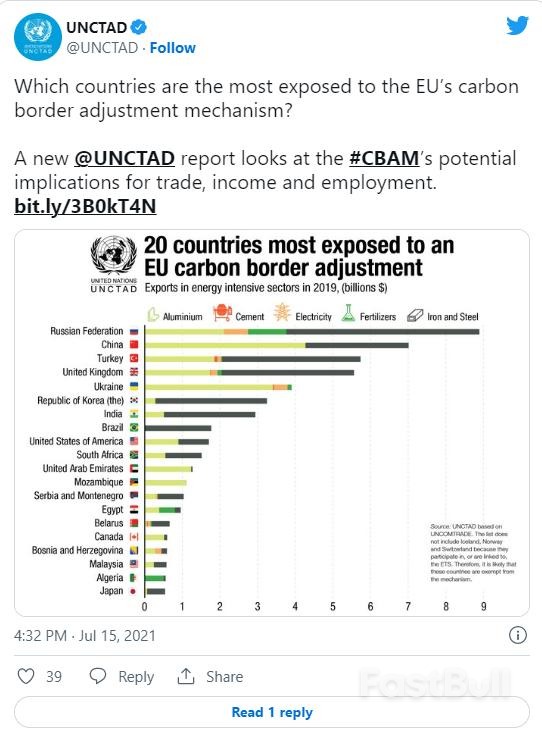
          The European Union is embarking on an experiment that will expand its climate policies to imports for the first time. It's called a carbon border adjustment, and it aims to level the playing field for the EU's domestic producers by taxing energy-intensive imports like steel and cement that are high in greenhouse gas emissions but aren't already covered by climate policies in their home countries.
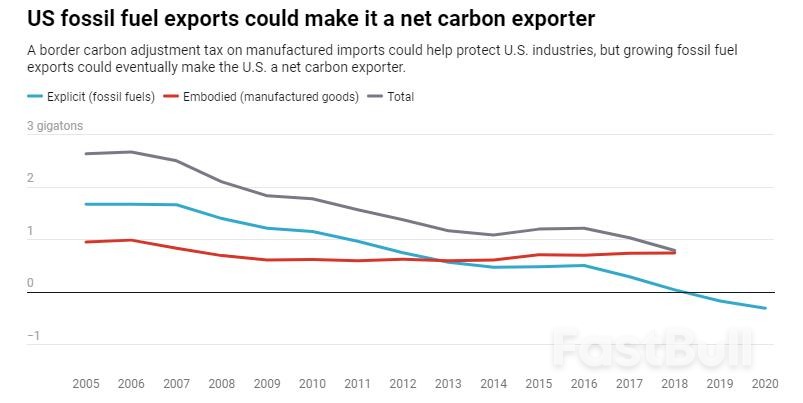
          If the border adjustment works as planned, it could encourage the spread of climate policies around the world. But the EU plan, as well as most attempts to evaluate the impact of such policies, is missing an important source of cross-border carbon flows: trade in fossil fuels themselves.
          As energy analysts, we decided to take a closer look at what including fossil fuels would mean.
          In a newly released paper, we analyzed the impact and found that including fossil fuels in carbon border adjustments would significantly alter the balance of cross-border carbon flows.
          For example, China is a major exporter of carbon-intensive manufactured goods, and its industries will face higher costs under the EU border adjustment if China doesn't set sufficient climate policies for those industries. But when fossil fuels are considered, China becomes a net carbon importer, so setting its own comprehensive border adjustment could be to its energy producers' benefit.
          The U.S., on the other hand, could see harm to its domestic fuel producers if other countries imposed carbon border adjustments on fossil fuels. But the U.S. would still be a net carbon importer, and adding a border adjustment could help its domestic manufacturers.

          What is a carbon border adjustment?

          Carbon border adjustments are trade policies designed to avoid "carbon leakage" – the phenomenon in which manufacturers relocate their production to other countries to get around environmental regulations.
          The idea is to impose a carbon "tax" on imports that is commensurate with the costs domestic companies face related to a country's climate policy. The carbon border adjustment is imposed on imports from countries that do not have similar climate policies. In addition, countries can give rebates to exports to ensure domestic manufacturers remain competitive in the global market.What if Carbon Border Taxes Applied to All Carbon – Fossil Fuels, too?_1
          This is all still in the future. The EU plan phases in starting in 2023 but currently isn't scheduled to fully go into effect until 2026. However, other countries are closely watching as they consider their own policies, including some members of the U.S. Congress who are considering carbon border adjustment legislation.

          Capturing all cross-border carbon flows

          One issue is that current discussions of carbon border taxes focus on "embodied" carbon – the carbon associated with the production of a good. For example, the EU proposal covers cement, aluminum, fertilizers, power generation, iron and steel.
          But a comprehensive border adjustment, in theory, should seek to address all cross-border carbon flows. All the major analyses to date, however, leave out the carbon content of fossil fuels trade, which we refer to as "explicit" carbon.
          In our analysis, we show that when only manufactured goods are considered, the U.S. and EU are portrayed as carbon importers because of their "embodied" carbon balance – they import a lot of high-carbon manufactured goods – while China is portrayed as a carbon exporter. That changes when fossil fuels are included.

          The impact of including fossil fuels

          By assessing the impact of a carbon border adjustment based only on embodied carbon flows, those involving manufactured goods, policymakers are missing a significant part of total carbon traded across their borders – in many cases, the largest part.
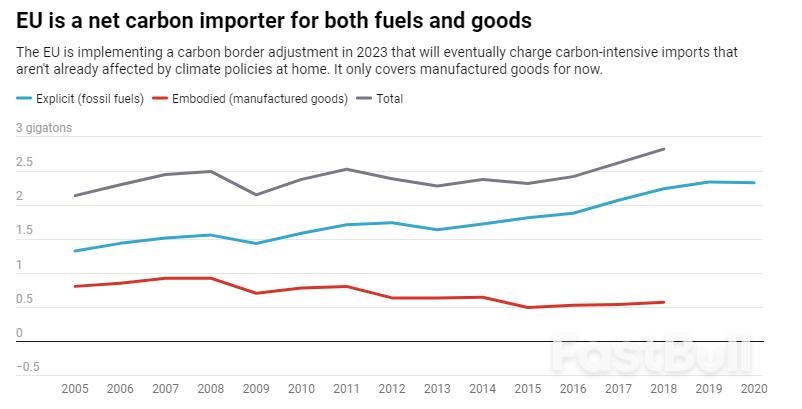
          In the EU, our findings largely reinforce the current motivation behind a carbon border adjustment, since the bloc is an importer of both explicit carbon and embodied carbon.What if Carbon Border Taxes Applied to All Carbon – Fossil Fuels, too?_2
          For the U.S., however, the results are mixed. A carbon border adjustment could protect domestic manufacturers but harm the international competitiveness of domestic fossil fuels, and at a time when Russia's invasion of Ukraine is placing renewed importance on the U.S. as a global energy supplier.What if Carbon Border Taxes Applied to All Carbon – Fossil Fuels, too?_3
          The Chinese economy, as an exporter of embodied carbon in manufactured goods, would suffer if its trading partners imposed a carbon border adjustment on China's products. On the other hand, a Chinese domestic border adjustment could benefit Chinese domestic energy producers at the expense of foreign competitors who fail to adopt similar policies.What if Carbon Border Taxes Applied to All Carbon – Fossil Fuels, too?_4
          Interestingly, our analysis suggests that, by including explicit carbon flows, the U.S., EU and China are all net importers of carbon. All three key players could be on the same side of the discussion, which could improve the prospects for future climate negotiations – if all parties recognize their common interests.

          Source: theconversation

          Risk Warnings and Disclaimers
          You understand and acknowledge that there is a high degree of risk involved in trading. Following any strategies or investment methods may lead to potential losses. The content on the site is provided by our contributors and analysts for information purposes only. You are solely responsible for determining whether any trading assets, securities, strategy, or any other product is suitable for investing based on your own investment objectives and financial situation.
          Comments
          Add to Favorites
          Share

          BoJ Maintains its Ultra-Low Rate Policy, Pushing Yen to 145 and Above

          Kevin Du
          The Bank of Japan, as expected, left monetary policy unchanged, which prompted USD/JPY to pass the 145 handle vs the USD. Top FX official, Mr. Kanda, reiterated his warnings about FX interventions when needed, while Governor Kuroda did not significantly change his rhetoric on the currency.

          The BoJ's decision to stay pat was unanimous and forward guidance is flagging the downside risk

          The Bank of Japan has made it clear that it will stick with its ultra low monetary policy until inflation stays at around 2% in a more sustained fashion. In addition, the BoJ decided to phase out its pandemic relief loan programme which were suppsed to terminate in September. Instead, part of the programme will extend until March next year. Taken together with today's results, the forward gudiance indicates downside risks for the economy and policy normalization is still far away. There are four policy meetings left until Governor Kuroda retires next April, and there is little possibility of policy change at these four meetings. Also, it is still too early to tell but it appears that it will take some time for the BoJ to make any policy changes even after Governor Kuroda steps down.

          Government efforts to curb inflation continue mainly through fiscal support, not through FX intervention

          With the weaker yen pushing import goods prices higher, the government is expected to mitigate negative shocks from the price increase through fiscal support. The industry ministry announced that the gasoline subsidy for oil distributors is set to rise to 36.7 yen (about USD0.25) per litre for the seven days from Thursday (vs 35.6 yen a week earlier). The temporary subsidy programme was introduced in January and has been extended several times since then. We expect the subsidy programmes for oil and food, and some cash transfer programmes targetting low-income households, to continue.
          Shortly after the BoJ's rate decision meeting Japan's top fx official, Mr. Kanda, said that the government could conduct stealth interveion in the fx market when needed. The government has not stepped into the fx market yet. We think that FX market intervention is possible, but that this only aims to smoothe out volatile currency movement, not to change the course of currency depreciation. Market intervention is not an effective way to stablize prices or bring the JPY down below 145. With Governor Kuroda's comments that BoJ future guidance won't need to change for the long-term, this will likely put more pressure on the currency.

          USD/JPY: Collision course for 150?

          In response to unchanged BoJ policy and increasing doubts about the political feasibility of FX intervention, USD/JPY has traded close to 146. As above, Japanese authorities will struggle to reverse a powerful dollar bull trend with intervention. We also assume that the bar is exceptionally high for the Japanese to receive approval for FX intervention from the US Treasury. Washington will argue that if Japan wants a stronger yen it should hike rates.
          This suggests that USD/JPY can continue to push towards 150 (our rates team sees US 10 year Treasury yields biased to 3.75%, if not 4.00%) and Japanese authorities increasingly hitting the wires with intervention threats. The next big event risk now may be the 12 October meeting of central bank governors and finance ministers in Washington. The Japanese will have to convince US authorities that the strong dollar is a problem, such that G20 FX language is altered. That is a tough task, with the Fed still seemingly welcoming dollar strength.

          Source: think.ing

          Risk Warnings and Disclaimers
          You understand and acknowledge that there is a high degree of risk involved in trading. Following any strategies or investment methods may lead to potential losses. The content on the site is provided by our contributors and analysts for information purposes only. You are solely responsible for determining whether any trading assets, securities, strategy, or any other product is suitable for investing based on your own investment objectives and financial situation.
          Comments
          Add to Favorites
          Share

          A perfect storm for UK gilts and FX

          Owen Li

          2022 mini-budget: blank cheques

          It was largely expected that the bill for the government’s energy price guarantee would run in the 12-digits (over £100bn) over its life and that most of this would be financed with extra issuance from the Debt Management Office (DMO). And yet, the mini-budget unveiled by the new chancellor added fuel to the fire already burning on the gilt market. The updated DMO remit for FY2022-23 includes an extra £72bn of borrowing, £10bn in T-bills and the balance in gilts. In our view, this is well within expectations but the current environment isn’t favourable to gilt sales.
          Alongside the confirmation of additional borrowing this year, the raft of tax cuts unveiled today clearly implies that it will not be contained to just this fiscal year. The cost of the newly-announced measures is reported to be £160bn over five years but, with the cost of the energy price guarantee highly dependent on wholesale energy prices, investors are worried the Treasury has effectively committed to open-ended borrowing.

          Markets are expecting a forceful BoE response to the new announced fiscal packageA perfect storm for UK gilts and FX_1

          (Monetary) context matters

          Of course, the additional borrowing comes at an inopportune time for gilts. Bond holders are already rattled by inflation and by the prospect of more Bank of England (BoE) hikes. Even if the central bank hiked only 50bp yesterday, compared to market pricing of 75bp, markets are betting that the pace of hikes will have to accelerate. The recent jump in yields implies that Bank Rate will peak next year well above 5%. That in itself is not a great backdrop for bonds but what has rattled investors is the prospect of the BoE hiking more in response to generous fiscal policy.
          Effectively, the BoE has reserved judgement on the inflationary implications of the energy price guarantee until its November monetary policy report but noted that the net effect will likely be to boost inflation over the medium term. Given the extra tax cuts announced, markets are jumping to the conclusion that the BoE will have to respond in kind with even higher rates. The prospect of the BoE and the Treasury competing with each other is a particularly unnerving one for bond investors.

          The already impaired gilt market is no longer able to accommodate more supply and quantitative tighteningA perfect storm for UK gilts and FX_2

          Financial stability in question

          To us, the magnitude of the jump in gilt yields has more to do with a market that has become dysfunctional. If a sell-off in gilts is rational in response to more fiscal spending, tax cuts, and higher inflation, the magnitude of the move should give policymakers pause for thought. This is particularly true of the BoE which is about to ramp up its quantitative tightening (QT) programme with outright gilt sales at £10bn per quarter.
          We have written at length before that trading conditions in the gilt market call for the BoE to tread very cautiously when it comes to adding to the selling pressure already evident in gilt markets. A number of indicators, from implied volatility to widening bid-offer spreads, suggest that liquidity is drying up and market functioning is impaired. A signal from the BoE that it is willing to suspend gilt sales would go a long way to restoring market confidence, especially if it wants to maximise its chances of fighting inflation with conventional tools like interest rate hikes. The QT battle, in short, is not one worth fighting for the BoE.

          The spread between UK gilt and German bund yields widest in over two decades

          A perfect storm for UK gilts and FX_3
          Barring a change of direction on QT, we expect 10Y gilt yields to cross 4% and for the spread to German bunds to widen 200bp. The fact that the DMO’s additional borrowing is skewed to the front end of the curve, the sector most affected by expected BoE hikes, has added to the curve flattening dynamics.

          GBP: The glass is half empty

          Sterling has had another wild ride on today’s fiscal event – initially rallying on the biggest tax cut since the 1980s, but subsequently falling hard as the UK gilt market reacted to the prospect of a heavy new supply slate.
          Sterling has been trading off fiscal concerns since early August. Expect this to remain the dominant theme as international investors again consider the right price, both in terms of sterling and gilt yields, to fund the UK’s widening budget deficit.
          We have to remember that FX is probably the easiest vehicle to trade UK country risk – given that there is not much liquidity in sovereign credit default swaps for the UK. On this subject, investors will take great interest in what the rating agencies have to say about UK fiscal plans. The UK's long-term sovereign outlook is currently stable at all three of the rating agencies, S&P (AA), Fitch (AA-) and Moody’s (Aa3). The risk of a possible shift to a negative outlook will come when the ratings are reviewed on 21 October (S&P and Moody’s) and 9 December (Fitch).
          Notably as well has been sterling’s disregard for interest rate differentials, where the very aggressive re-pricing of the BoE tightening cycle has provided no support to the pound. This leaves the BoE in a quandary but presumably would have to be even more hawkish if the weaker exchange rate were to damage the UK inflation profile still further.
          Unless something can be done to address these fiscal concerns, or the economy shows some surprisingly strong growth data, it looks like investors will continue to shun sterling. For reference, the FX options now prices the chances of GBP/USD hitting 1.00 by year-end at 17%. That is up from 6% in late June. Given our bias for the dollar rally going into over-drive as well, we think the market may be underpricing the chances of parity.

          Source:ING

          Risk Warnings and Disclaimers
          You understand and acknowledge that there is a high degree of risk involved in trading. Following any strategies or investment methods may lead to potential losses. The content on the site is provided by our contributors and analysts for information purposes only. You are solely responsible for determining whether any trading assets, securities, strategy, or any other product is suitable for investing based on your own investment objectives and financial situation.
          Comments
          Add to Favorites
          Share

          Ethereum Merge Vastly Increased Stakefish's Profile, but 25% of Its Employees Are Gone Anyway

          Owen Li
          On the very day that the Ethereum Merge dramatically elevated the importance of validators in the blockchain's ecosystem, one of the biggest ones – stakefish – was beset with chaos.
          More than 25% of its workforce, according to people familiar with the matter, was either laid off or resigned, including two senior departures: Head of Strategy and Operations Jun Soo Kim and Head of Protocols Daniel Hwang.
          CoinDesk spoke with four current and former employees for this story, all of whom took issue with how the layoffs were handled. One of the employees asked not to be identified because they signed a non-disclosure agreement. In total, right when stakefish was set to rake in big rewards for securing Ethereum's new miner-free network, eight employees were laid off and three more resigned from the company.
          According to these employees and internal messages reviewed by CoinDesk, workers were not informed they would be let go from stakefish until a few days before their termination date, Sept. 15. That was also the day of the Ethereum Merge – precisely the event for which stakefish had spent years laying crucial groundwork because that day was when Ethereum officially shifted from being run by miners to validator operators like stakefish.
          When asked for comment via the messaging service Telegram, Chun Wang, the CEO and founder of stakefish, wrote: "It is normal in a bear market to reduce team size and optimize costs." He added: "Only non-tech positions are laid off. We're still working hard to hire more developers and devops."
          Kim's resignation in particular marks a major blow to stakefish, which offers customers the ability to help secure proof-of-stake blockchains like the newly revamped Ethereum in exchange for rewards. According to former employees, Kim, whose resignation will take effect in October, was viewed as a potential replacement for Wang and served as a sort of interim CEO whenever the company's founder was absent.
          Kim told CoinDesk that he decided to leave in order to start his own venture.
          Hwang, the only member of stakefish's senior leadership to be included in the layoffs, opted to resign rather than accept a two-week severance package, which he told CoinDesk he considered "insulting." Another employee who spoke to CoinDesk reported having been offered the same deal. (For comparison, Coinbase, the cryptocurrency exchange that laid off 18% of its workforce earlier this year, offered its employees a minimum of 14 weeks severance pay).
          Hwang said he was tipped off that he would be let go by Andrea "Dimi" Di Michele, one of his direct reports. Dimi, who was appointed as Hwang's replacement and was one of stakefish's longest-serving employees, resigned from the company a few days later.
          "They gave, like, two days' notice," Dimi told CoinDesk. "I don't want to throw shade on stakefish – it's not my intention – but I think it's not fair what's going on," he said. "In general, stakefish had a great opportunity to do something great," he added. "I'm very disappointed."
          Ethereum's switch from a proof-of-work to a proof-of-stake system handed the reins of the second-largest blockchain from miners to validators that "stake" ether (ETH), Ethereum's native currency, by sending it to an address on the chain where it cannot be bought or sold. Stakefish, which sets up interest-earning validators on behalf of its customers, controlled around 2% of all staked ETH at press time. It is also a major validator in other ecosystems, including Cosmos, Polkadot, Polygon and Solana.
          Stakefish is based in the British Virgin Islands and has co-working spaces in Palo Alto, California, and Seoul. Most of its staff works remotely.
          Wang, stakefish's founder, co-founded F2Pool, the third-largest bitcoin (BTC) mining pool. Employees told CoinDesk the two companies frequently collaborate and share resources.
          As news of the layoffs spread across stakefish, several employees took to the company's Slack messaging platform to air their grievances around how information had been communicated to employees.
          "I have to express my opinion that this layoff is implemented in a horrible way," one employee wrote. "Keeping everything quiet makes the top management's words untrustworthy. It only makes low morale much lower, and the employees have no idea what to expect next. Lower morale, more people will decide to go. Maybe that's the goal?"
          "I understand the decision however the implementation of this decision by those in HR has been for want of a better word horrific," responded another employee. "Letting people know in a staggered fashion that they are to be fired with 2 days notice as if rumors and news like that does not travel sideways in a company is absolutely unbelievable."
          This employee reported hearing of the layoffs on a call with their team. "Upon further pushing we found out that people currently on this call were yet to hear that they are in fact fired, which as you can understand left us all dumbstruck," they wrote.
          "As of today 1 member of the marketing team has still not been contacted by anyone that they are to be fired tomorrow," responded a third employee.

          Source: cryptonews

          Risk Warnings and Disclaimers
          You understand and acknowledge that there is a high degree of risk involved in trading. Following any strategies or investment methods may lead to potential losses. The content on the site is provided by our contributors and analysts for information purposes only. You are solely responsible for determining whether any trading assets, securities, strategy, or any other product is suitable for investing based on your own investment objectives and financial situation.
          Comments
          Add to Favorites
          Share

          Turkey's Central Bank Delivers Another 100bp Rate Cut

          Kevin Du
          Citing evidence pointing to momentum loss in economic activity, the CBT cut the policy rate by 100bp İn September. Signs of a slowdown in activity, stability in FX reserves recently, and outperformance of the currency in comparison to peers are likely factors behind the CBT cut this month.
          In its September rate setting meeting, the CBT once again cut the policy rate by 100bp, to 12%. Most central banks around the world are moving in the opposite direction. Despite some calls for further easing the prevailing view in the market, including ours, was that the CBT would remain mute this month.
          The reasoning behind the extension of rate cut cycle is unchanged. The CBT cited the need for supportive financial conditions so as to preserve growth momentum in industrial production and the positive trend in employment. This, according to the bank, is particularly important given recent signs of momentum loss in economic activity. It was also influenced by decreasing foreign demand in an environment of higher uncertainties surrounding the global growth outlook as well as escalating geopolitical risks.
          In the rate-setting statement, the CBT has maintained (i) its signal of further macroprudential policy moves, with the objective of supporting the effectiveness of the monetary transmission mechanism, if needed, and (ii) its focus on the spread between policy rate and loan interest rates. The CBT guidance indicates potential additional measures to maintain selective credit growth policies, keep lending rates in check, support FX reserve growth, increase demand for TRY assets, and divert FX demand in the period ahead. Following the recent regulatory changes to increase security maintenance requirements for banks, the average commercial TRY loan rate stands below 21.5%, down by close to 600bp since mid-August. The average deposit rate is around 19.0% (for up to 3-month maturities), recording a slight decline in the same period. As a result, the spread between commercial loans and deposits has narrowed by about 350bp, reaching 5.0-5.5pp.
          Like the August statement, the latest note does not rule out further reduction in the policy rate as the bank reiterated that "the updated level of policy rate is adequate under the current outlook". Additional rate cuts, in our view, would be dependent on developments in the period ahead. A worsening global backdrop weighing on exports and higher FX volatility, coupled with ongoing momentum loss in credit growth, is expected to weigh on private consumption and investment. We have already seen a notable slowdown in July IP and have seen a weakening PMI index and deterioration in other sentiment indicators in recent months. Against this backdrop, the CBT would be able to come up with additional moves to ease financial conditions.
          Further signs of a slowdown in economic activity as well as recent stability in FX reserves along with outperformance of the currency vs peers are factors behind the CBT cut this month. However, ongoing widening pressures on the current account and subdued capital flows imply the possibility of further drawdowns in reserves. Today's move will do little to address Turkey's inflationary challenges. The current policy setting does not prioritise disinflation and inflation will likely remain elevated in the near term.

          Source: think.ing

          Risk Warnings and Disclaimers
          You understand and acknowledge that there is a high degree of risk involved in trading. Following any strategies or investment methods may lead to potential losses. The content on the site is provided by our contributors and analysts for information purposes only. You are solely responsible for determining whether any trading assets, securities, strategy, or any other product is suitable for investing based on your own investment objectives and financial situation.
          Comments
          Add to Favorites
          Share

          Germany's Zeitenwende Still Has a Long Way to Go

          Owen Li
          Chancellor Olaf Scholz's speech in the Bundestag on February 27, 2022, was a watershed event in German history.
          Mr. Scholz spoke of a "turning point" – Zeitenwende in German – triggered by Russia's invasion of Ukraine. "The world after that is no longer the same as the world before," the German leader said. The statement gave the impression that Germany had suddenly become aware of its responsibilities. From now on, the nation of 83 million people, with Europe's largest economy, would no longer entrust its security to the United States alone, its energy supply to Russia and its economic growth to exports to China.
          This turnaround is primarily about German-Russian relations, the need to strengthen defense capability and deterrence, and secure energy supplies. Mr. Scholz announced he would provide the Bundeswehr with a credit-financed special fund of 100 billion euros. That is a significant amount, but to meet the expectation that NATO members invest at least 2 percent of their gross domestic product (GDP) in defense, an additional 25 billion euros would have to be spent annually, adjusted for inflation.

          Major overhaul needed

          The change required is enormous. In 1989, Germany invested 2.7 percent of its gross domestic product in national security, and by 2014, it was only 1.1 percent. Only since 2017 has the share risen again – in 2021, it was 1.5 percent. However, 41 percent of this was spent on personnel and pension entitlements. In France, 26.5 percent of defense funds go to equipment; in Germany, only 16.87 percent do. On the day of the Russian invasion of Ukraine, Bundeswehr Inspector Lieutenant General Alfons Mais, the highest-ranking officer of the German Army, said that the army had been severely weakened after years of austerity and is no more up to the task.
          Under Mr. Scholz's predecessors, Gerhard Schroeder (1998-2005) and Angela Merkel (2005-2021), German foreign and security policy assumed that the nation was surrounded only by friends. This misjudgment led to a security policy recklessness that manifested itself in the neglect of the Bundeswehr. When the U.S., the United Kingdom, Poland and other NATO partners supplied Ukraine with heavy weapons, the Bundeswehr was already in such a deplorable state that it could not comply with the Ukrainian government's requests.
          However, national security is only one of the many ruins Ms. Merkel has left to the Scholz government. Russian President Vladimir Putin's threat to cut off gas supplies would not be nearly as effective if Germany had not done everything it could to make itself economically blackmailable. Udo Di Fabio, a former judge with the Constitutional Court, delivered a devastating verdict on German energy policy.
          No country with a keen sense of the mechanics of foreign power relations would have actively promoted or passively accepted such a massive energy dependence on Russia as Germany under chancellors Schroeder and Merkel. Criticism from the U.S. of projects such as Nord Stream 2 was politely forbidden, criticism from the Baltic states was not taken seriously. The Federal Republic pursued an almost romantic energy policy.Germany's Zeitenwende Still Has a Long Way to Go_1

          Self-inflicted wounds

          Reduced Russian oil and gas supplies are hitting Germany particularly hard today because rising global demand is accompanied by a politically engineered shortage that began long before the sanctions against Russia. Germany has been suffering from the consequences of self-inflicted economic wounds that have dominated energy policy since Ms. Merkel embraced the positions of the Greens.
          In 2011, she used the destruction of four reactor units in Fukushima, caused by an earthquake and a tidal wave, as a pretext to order Germany's withdrawal from the peaceful use of nuclear energy. The nuclear and coal-fired power plants were gradually shut down, and domestic gas extraction by fracking was dispensed with, citing possible environmental damage.
          Another concession with which the chancellor drew the left-wing opposition to her side was the opening of borders during the migration crisis of 2015-2016. Compared to the Greens, the party Die Linke and the left wing of the Social Democrats, she thus distinguished herself as an ally in the "fight against the right." The informal party coalition on which the chancellor relied ranged from the left-wing fringe to the Greens to deep into the CDU, which lost its conservative and Christian-democratic brand core.
          Today, German parties have to say goodbye to a series of apparent certainties that have been questioned for more than 20 years only on the fringes of the party spectrum branded as populist. To revise wrong decisions that have accumulated over five legislative periods would overwhelm any government, even if the parties supporting it had not been involved in setting those misguided policies.
          The three parties in the Scholz government had helped shape Germany during these two decades. The Social Democratic Party (SPD) and the Greens governed under Mr. Schroeder of the SPD from 1998 to 2005. Twice, from 2005 to 2009 and 2013 to 2021, the SPD belonged to a grand coalition with the Christian Democratic Union (CDU) under Ms. Merkel. The Free Democratic Party (FDP) had been Ms. Merkel's junior partner in the black-yellow coalition from 2009 to 2013. All three parties of the "traffic light" coalition and the CDU, as the largest opposition party, played a part in the drama that turned the economically strong and politically self-confident Germany of Helmut Kohl (who served from 1982-1998) into a less reliable and crisis-prone partner for the Western world.

          Rectifying misguided policies

          The responsibility for the mistakes and omissions of the Merkel era lies first and foremost with the CDU. Friedrich Merz, who emerged from the turmoil as Ms. Merkel's successor as the new CDU chairman, had been the chancellor's most prominent opponent within the party for years. So, it was not too difficult for him to support the turnaround that Mr. Scholz announced in the Bundestag. To prevent conflicts in the party, however, he has so far avoided criticizing the former chancellor, who had shaped the profile of the CDU and still enjoys significant support in it. To stand openly against them would be understood as a concession by the new CDU chairman to the Alternative for Germany (AfD), the only party in the Bundestag to have opposed them on almost all issues.
          Ms. Merkel's popularity was evident in a poll conducted three weeks before the federal election in September 2021. In it, 80 percent of those surveyed approved of her job. That judgment reflects the economic upswing experienced by Germany during her chancellorship.
          Robust German growth had been the result of an exceptionally favorable combination of several factors, led by cheap energy from Russia. But other factors contributed to the boom times: an upswing in the global economy, particularly from rising demand in China, the wage restraint of German workers and the weak external value of the euro. The higher tax revenues financed the expansion of the welfare state, the energy transition and a climate policy that was executed without regard for the industry's concerns.
          Meanwhile, the conditions supporting the German export industry have deteriorated significantly following the outbreak of the Covid-19 pandemic and the Ukraine war. The International Monetary Fund revised downward its growth forecasts for 2022 and 2023. In May 2022, it estimated Germany's 2022 growth at around 2 percent; by July, the projection was only 1.2 percent. Numerous small and medium-sized enterprises, especially in the tourism and gastronomy sectors, have had to close due to the Covid lockdowns. It is feared that many companies will not survive the increased energy prices and the reduction of gas supplies in autumn and winter.
          To relieve consumers, the government has thus far made 30 billion euros available. On September 4, the German chancellor announced an additional 65 billion-euro relief package, with Mr. Scholz finally acknowledging the obvious: "Russia is no longer a reliable supplier of energy." It represents a sharp departure from the failed strategy of "change through trade."
          The situation has kept changing dramatically. On September 5, the German government even agreed to continue operating until April 2023 two of the remaining three nuclear power plants that had been scheduled to close at the end of the year. Also on that day, the Kremlin said it is stopping gas supplies to Europe through Nord Stream until Western sanctions are lifted against Russia.

          Will support for sanctions hold?

          Nevertheless, the party Die Linke and the AfD are planning a "hot autumn" for the government. There were violent protests when Chancellor Scholz wanted to explain the federal government's plans at a citizens' meeting in Neuruppin on August 18. Unlike Ms. Merkel, who largely eluded debate, Mr. Scholz strives to establish contact with the citizens. However, he lacks charisma, and he keeps as many options open as possible in his statements. The chancellor is wary of the tense relations in the coalition with the Greens and the FDP and tries not to provoke the left in his own party, whose influence has increased after the Bundestag election.
          Meanwhile, the approval ratings of the traffic light coalition are falling. In a survey at the beginning of August 2022, only 14 percent of respondents said they were "very satisfied" with the government's work, while 37 percent said they were "very dissatisfied." Satisfaction with the chancellor has also slumped. Recent polls also show his SPD party losing popularity as the Greens gain.
          Opposition to supporting Ukraine is particularly strong in the SPD. Not only Mr. Schroeder but Federal President Frank-Walter Steinmeier and numerous other Social Democrats are known for their pro-Russian stance, which was not questioned in the party until after the full-scale Russian invasion of Ukraine. If the energy crisis in winter leads to mass social protests, the pressure on the government to lift or at least mitigate the sanctions against Russia is likely to increase, as demanded by Die Linke and the AfD.
          In the CDU, too, more voices want to force a change of course. The spokesman of this current movement is Saxon Prime Minister Michael Kretschmer, who is pushing for quick negotiations to "freeze" the war because sufficient Russian gas flows in the coming years are essential to keep social peace in Germany. There has been a debate even in the FDP since Wolfgang Kubicki, vice president of the Bundestag, proposed activating the Nord Stream 2 pipeline as soon as possible. The FDP chairman Christian Lindner and numerous other politicians of the party have spoken out vehemently against it.
          Only the Greens have thus far resisted the temptation to question the turnaround in Russia policy announced by Mr. Scholz in the Bundestag. Among the German parties, only they had spoken out against Nord Stream 2 from the outset. In the German Bundestag, the Greens campaigned even more than the CDU and FDP to support Ukraine against Russia with the supply of heavy weapons.

          Scenarios

          The future development of German policies will largely depend on how German society will react to the consequences of the failed energy policy and the resulting dependence on Russia. There is a high probability that fewer Germans will be willing to bear the costs of supporting Ukraine, although polls currently show still strong public backing for standing up to Moscow. Demonstrations against the government could bring even more people to the streets yet this year than the previous demonstrations against the tough measures to fight Covid. The pressure on the government to reverse the "turning point" announced by the German chancellor will increase. Whether the coalition will stand up to it depends above all on whether the left in the SPD is loyal to its chancellor or will join the protests.

          Source: gisreportsonline

          Risk Warnings and Disclaimers
          You understand and acknowledge that there is a high degree of risk involved in trading. Following any strategies or investment methods may lead to potential losses. The content on the site is provided by our contributors and analysts for information purposes only. You are solely responsible for determining whether any trading assets, securities, strategy, or any other product is suitable for investing based on your own investment objectives and financial situation.
          Comments
          Add to Favorites
          Share

          Tiers of joy: European central banks adjust their liquidity settings Authors

          Owen Li
          European central banks are gradually adjusting their policy setting to a world of positive interest rates but with still abundant liquidity. The common theme here is that hundreds of billions, or trillions in the ECB’s case, of bank reserves will be remunerated at positive interest rates, at a cost for their central banks, and ultimately their domestic government treasury.

          SNB: actively moving to absorb liquidity

          The Swiss National Bank (SNB) was the first one to actually implement a reserve tiering system at its September meeting. In a nutshell, banks’ sight deposits at the SNB up to a certain threshold will earn the SNB policy rate, currently 0.5%, and 0% on balances above that threshold. This, however, is only part of the story. In parallel, the SNB announced it will conduct liquidity-absorbing operations (Open Market Operations or OMOs). With a threshold set at an elevated 28 times banks required reserves, it won’t take much effort for the SNB to absorb enough liquidity so that all that remains is remunerated at the SNB. In effect, the SNB rate should remain the marginal rate in CHF money markets, and tiering should act as an incentive for banks to participate in liquidity-absorbing operations.
          The upshot is that the main feature of the new liquidity set-up at the SNB will be to remove liquidity from the system as it tightens policy in order to get inflation under control. There is likely to be only marginal interest rate savings for the central bank on its CHF640bn of sight deposits, if at all, but this doesn’t seem to be the point of the policy change. Rather the SNB's goal seems to be to make sure higher policy rates are transmitted to the economy.

          Bank reserves at the BoE will decline with QT, but not fast enough to save much interest cost to the BoETiers of joy: European central banks adjust their liquidity settings Authors_1

          BoE: saving money where it can

          There have been persistent press reports that the UK is looking to reduce the amount of interest it pays to banks. This is a more pressing issue in the UK because bank reserves now approach £945bn and the swap curve is implying that the Bank Rate could climb to 5% next year. This is something of a worst-case scenario, but this would result in an interest rate bill approaching £50bn per year. In practice, we think that rate hike expectations are exaggerated, and the BoE intends to reduce its bond holdings, and so the amount of reserves, by £80bn per year at least. At a time of large open-ended fiscal support to energy consumers, the Treasury could be forgiven for trying to save on this interest rate bill.
          Two options present themselves to the BoE. Designing a reserve tiering system akin to the SNB would allow it to gradually reduce the amount of liquidity in the system. Interest cost saving would probably be underwhelming at first, but it could attempt to gradually increase the amount of liquidity withdrawn from the system, thus also supporting its monetary tightening stance.
          Inversely, it could determine a fixed amount of reserves that is remunerated at 0%, with balances above that threshold earning the Bank Rate. If that threshold is set too high, this measure would incentivise banks to get rid of their liquidity and would push money market rates lower, thus contradicting the BoE’s monetary policy stance. Setting the threshold lower would mean a lower interest rate saving from the BoE but also probably less disruption in GBP money markets. We think this is the option that would likely deliver the best near-term compromise for public finances. Its market impact should be limited at first.

          The distribution of bank liquidity and TLTRO borrowing is uneven across the eurozoneTiers of joy: European central banks adjust their liquidity settings Authors_2

          ECB: peering into pandora’s box

          The European Central Bank’s motivation could be similar to the BoE's. As policy rates rise, the interest banks earn by placing liquidity at the ECB will gradually rise above the rate they are paying on their targeted longer-term refinancing operations (TLTRO) loans, presenting them with an interest rate gain. If this is the sole problem it is intending to solve, one option would be to retroactively change the TLTRO terms by raising its interest rate. This would be detrimental to the predictability, and so attractiveness of future TLTRO operations, however. With the brunt of TLTRO loans due to expire by the middle of next year, one could also question the need to come up with risky solutions to a problem that will disappear in nine months.
          If on the other hand, the goal is to reduce its interest bill over the longer term, it could borrow one of the two designs described above. A set-up similar to the SNB’s, where a fixed amount of reserves earns the policy rate and the amount in excess earns 0%, would imply that it intends to actively withdraw liquidity. This could be achieved if banks rush to repay TLTRO loans, but this is likely to result in at least a temporary drop in money market rates. To prevent this temporary disruption, the ECB could bridge the period until the next quarterly TLTRO repayment opportunity with ad hoc liquidity draining operations, or simply make the tiering apply on the same date as TLTRO repayment.
          If this is the option retained by the ECB, the reduction in excess liquidity resulting from early TLTRO repayments, and other liquidity draining operations, would push money market rates higher relative to the ECB deposit rate. Interbank lending rates would be the first area where we expect a reaction as banks move to replace TLTRO funding. In time, we'd also expect greater competition among banks to attract wholesale deposits. Both would push Euribor fixings higher relative to euro short-term rate (Estr) swaps. This should also contribute to pushing Estr fixings above the deposit rate, and closer to the refinancing rate.

          Draining liquidity would eventually push Estr above the ECB deposit rate

          Tiers of joy: European central banks adjust their liquidity settings Authors_3
          A design similar to the one described above for the BoE, where a fixed amount earns 0% and balances above that threshold earn the policy rate, would guarantee some interest rate saving but wouldn’t provide an incentive for banks to repay TLTRO funds if the threshold is set low enough. If the threshold is set high, then the risk is that 0% becomes the marginal interest rate for many banks and that some countries end up being net lenders, and others net borrowers. The result would be a drop in money market rates in some countries, and a rise in others.

          Source:ING

          Risk Warnings and Disclaimers
          You understand and acknowledge that there is a high degree of risk involved in trading. Following any strategies or investment methods may lead to potential losses. The content on the site is provided by our contributors and analysts for information purposes only. You are solely responsible for determining whether any trading assets, securities, strategy, or any other product is suitable for investing based on your own investment objectives and financial situation.
          Comments
          Add to Favorites
          Share
          FastBull
          Copyright © 2025 FastBull Ltd

          728 RM B 7/F GEE LOK IND BLDG NO 34 HUNG TO RD KWUN TONG KLN HONG KONG

          TelegramInstagramTwitterfacebooklinkedin
          App Store Google Play Google Play
          Products
          Charts

          Chats

          Q&A with Experts
          Screeners
          Economic Calendar
          Data
          Tools
          Membership
          Features
          Function
          Markets
          Copy Trading
          Latest Signals
          Contests
          News
          Analysis
          24/7
          Columns
          Education
          Company
          Careers
          About Us
          Contact Us
          Advertising
          Help Center
          Feedback
          User Agreement
          Privacy Policy
          Business

          White Label

          Data API

          Web Plug-ins

          Poster Maker

          Affiliate Program

          Risk Disclosure

          The risk of loss in trading financial instruments such as stocks, FX, commodities, futures, bonds, ETFs and crypto can be substantial. You may sustain a total loss of the funds that you deposit with your broker. Therefore, you should carefully consider whether such trading is suitable for you in light of your circumstances and financial resources.

          No decision to invest should be made without thoroughly conducting due diligence by yourself or consulting with your financial advisors. Our web content might not suit you since we don't know your financial conditions and investment needs. Our financial information might have latency or contain inaccuracy, so you should be fully responsible for any of your trading and investment decisions. The company will not be responsible for your capital loss.

          Without getting permission from the website, you are not allowed to copy the website's graphics, texts, or trademarks. Intellectual property rights in the content or data incorporated into this website belong to its providers and exchange merchants.

          Not Logged In

          Log in to access more features

          FastBull Membership

          Not yet

          Purchase

          Become a signal provider
          Help Center
          Customer Service
          Dark Mode
          Price Up/Down Colors

          Log In

          Sign Up

          Position
          Layout
          Fullscreen
          Default to Chart
          The chart page opens by default when you visit fastbull.com