Markets
News
Analysis
User
24/7
Economic Calendar
Education
Data
- Names
- Latest
- Prev


Signal Accounts for Members
All Signal Accounts
All Contests


U.K. Trade Balance Non-EU (SA) (Oct)A:--
F: --
P: --
U.K. Trade Balance (Oct)A:--
F: --
P: --
U.K. Services Index MoMA:--
F: --
P: --
U.K. Construction Output MoM (SA) (Oct)A:--
F: --
P: --
U.K. Industrial Output YoY (Oct)A:--
F: --
P: --
U.K. Trade Balance (SA) (Oct)A:--
F: --
P: --
U.K. Trade Balance EU (SA) (Oct)A:--
F: --
P: --
U.K. Manufacturing Output YoY (Oct)A:--
F: --
P: --
U.K. GDP MoM (Oct)A:--
F: --
P: --
U.K. GDP YoY (SA) (Oct)A:--
F: --
P: --
U.K. Industrial Output MoM (Oct)A:--
F: --
P: --
U.K. Construction Output YoY (Oct)A:--
F: --
P: --
France HICP Final MoM (Nov)A:--
F: --
P: --
China, Mainland Outstanding Loans Growth YoY (Nov)A:--
F: --
P: --
China, Mainland M2 Money Supply YoY (Nov)A:--
F: --
P: --
China, Mainland M0 Money Supply YoY (Nov)A:--
F: --
P: --
China, Mainland M1 Money Supply YoY (Nov)A:--
F: --
P: --
India CPI YoY (Nov)A:--
F: --
P: --
India Deposit Gowth YoYA:--
F: --
P: --
Brazil Services Growth YoY (Oct)A:--
F: --
P: --
Mexico Industrial Output YoY (Oct)A:--
F: --
P: --
Russia Trade Balance (Oct)A:--
F: --
P: --
Philadelphia Fed President Henry Paulson delivers a speech
Canada Building Permits MoM (SA) (Oct)A:--
F: --
P: --
Canada Wholesale Sales YoY (Oct)A:--
F: --
P: --
Canada Wholesale Inventory MoM (Oct)A:--
F: --
P: --
Canada Wholesale Inventory YoY (Oct)A:--
F: --
P: --
Canada Wholesale Sales MoM (SA) (Oct)A:--
F: --
P: --
Germany Current Account (Not SA) (Oct)A:--
F: --
P: --
U.S. Weekly Total Rig CountA:--
F: --
P: --
U.S. Weekly Total Oil Rig CountA:--
F: --
P: --
Japan Tankan Large Non-Manufacturing Diffusion Index (Q4)--
F: --
P: --
Japan Tankan Small Manufacturing Outlook Index (Q4)--
F: --
P: --
Japan Tankan Large Non-Manufacturing Outlook Index (Q4)--
F: --
P: --
Japan Tankan Large Manufacturing Outlook Index (Q4)--
F: --
P: --
Japan Tankan Small Manufacturing Diffusion Index (Q4)--
F: --
P: --
Japan Tankan Large Manufacturing Diffusion Index (Q4)--
F: --
P: --
Japan Tankan Large-Enterprise Capital Expenditure YoY (Q4)--
F: --
P: --
U.K. Rightmove House Price Index YoY (Dec)--
F: --
P: --
China, Mainland Industrial Output YoY (YTD) (Nov)--
F: --
P: --
China, Mainland Urban Area Unemployment Rate (Nov)--
F: --
P: --
Saudi Arabia CPI YoY (Nov)--
F: --
P: --
Euro Zone Industrial Output YoY (Oct)--
F: --
P: --
Euro Zone Industrial Output MoM (Oct)--
F: --
P: --
Canada Existing Home Sales MoM (Nov)--
F: --
P: --
Euro Zone Total Reserve Assets (Nov)--
F: --
P: --
U.K. Inflation Rate Expectations--
F: --
P: --
Canada National Economic Confidence Index--
F: --
P: --
Canada New Housing Starts (Nov)--
F: --
P: --
U.S. NY Fed Manufacturing Employment Index (Dec)--
F: --
P: --
U.S. NY Fed Manufacturing Index (Dec)--
F: --
P: --
Canada Core CPI YoY (Nov)--
F: --
P: --
Canada Manufacturing Unfilled Orders MoM (Oct)--
F: --
P: --
Canada Manufacturing New Orders MoM (Oct)--
F: --
P: --
Canada Core CPI MoM (Nov)--
F: --
P: --
Canada Manufacturing Inventory MoM (Oct)--
F: --
P: --
Canada CPI YoY (Nov)--
F: --
P: --
Canada CPI MoM (Nov)--
F: --
P: --
Canada CPI YoY (SA) (Nov)--
F: --
P: --
Canada Core CPI MoM (SA) (Nov)--
F: --
P: --


No matching data
Latest Views
Latest Views
Trending Topics
Top Columnists
Latest Update
White Label
Data API
Web Plug-ins
Affiliate Program
View All

No data
Wall Street ticked higher on hopes of US-China trade de-escalation ahead of the Fed's rate decision. Investors widely expect rates to remain unchanged.
U.S. stock index futures rose on Wednesday as hopes of a de-escalation in trade tensions with Beijing firmed, while investors awaited the Federal Reserve's decision on interest rates that is expected later in the day.
Washington announced late on Tuesday that representatives of the two countries would meet over the weekend in Switzerland for ice-breaker trade discussions.
The meetings will follow weeks of tit-for-tat tariffs that roiled financial markets and flagged concerns about global economic growth.
Mixed signals from the world's two biggest economies on the status of the negotiations left markets in a state of uncertainty, pushing many companies to shelve their forecasts. The U.S. central bank, meanwhile, adopted a wait-and-watch approach despite signs of slowing growth.
President Donald Trump's administration has said potential deals with major trading partners are underway, but markets are yet to see tangible results on that front.
At 07:05 a.m. ET, S&P 500 E-minis were up 37.25 points, or 0.66%, Nasdaq 100 E-minis were up 133.25 points, or 0.67%, Dow E-minis were up 299 points, or 0.73%.
The Federal Reserve is set to announce its policy decision on Wednesday afternoon and is widely expected to hold interest rates steady.Traders are now roughly pricing in a rate cut by July, according to data compiled by LSEG, after a mixed bag of economic data last week signaled a slowing economy and a resilient labor market.
Comments from policymakers will be scrutinized for clues on how they plan to approach monetary policy easing this year, amid Trump's repeated calls for lower interest rates and criticism of Fed Chair Jerome Powell, which had spooked investors in April.
"The Fed chair will need to balance guiding markets about the future of monetary policy and defending the Fed from pressure from the administration," said Kathleen Brooks, research director at trading platform XTB.
"A hawkish lean from the Fed could spook markets and remind us that the recent market rally was a correction in a downtrend," Brooks said, adding that markets were expecting just that from Powell.
Wall Street ended lower for the second straight session on Tuesday after the U.S. administration failed to provide clarity on the trade front.
The S&P 500 is more than 8% away from its record high notched in February, even though all indexes have recouped declines logged since Trump's "Liberation Day" reciprocal tariffs announcement on April 2.
Advanced Micro Devices (AMD.O), was up 1.7% in premarket trading after the chipmaker forecast revenue for the second quarter above Wall Street estimates.
Walt Disney's (DIS.N), quarterly results topped Street expectations, helped by increased visitor spending at its U.S. theme parks and a surge in streaming customers, sending its shares up 5%.
Uber Technologies (UBER.N), dropped 5.2% as the ride-hailing and food delivery company missed quarterly revenue expectations and said it anticipates a 1.5% currency-related drag on second-quarter gross bookings growth.
Arista Networks (ANET.N), fell 5% after its quarterly report, while Marvell Technology (MRVL.O), lost 7% after narrowing its forecast for the first quarter of 2026 and postponing its investor day.
Among the notable aspects of the April market shakeout was a sell‑off in longer‑term U.S. Treasuries. My concern is that this may be only the first leg of an inevitable violent bear steepening in the Treasury yield curve. Higher Treasury yields has been a foundational view of mine for a while now, as I expressed last December in “The calm before the storm: The outlook for Treasury yields.” Circumstances and factors driving the Treasury market are now all starting to align to likely bring this view to fruition.
At the heart of my thesis has been a worry about a tsunami of global debt issuance, which is a legacy of COVID‑generated fiscal largesse. To be clear, this is not just a U.S. issue. The U.S. is merely another participant in a hugely crowded, bare‑knuckle global debt‑sale fight—and I don’t expect issuers to fight fair.
Another very important factor supporting higher Treasury yields is that even after the early April sell‑off, the 10‑year U.S. Treasury note offered essentially the same yield as cash in late April.
The tariff news of the last few weeks has only exacerbated the ongoing tug‑of‑war between inflation and growth worries in the rates market. I generally try to avoid broad, clichéd labels that are sometimes used arbitrarily, such as stagflation or recession. Indeed, I don’t have a particularly differentiated or downbeat perspective on growth. I am certainly not ready to slip into the doom loop dominating prevailing consensus. However, it does seem very clear to me that inflation risks are skewed severely to the upside.
On growth, in any normal environment, it would be really hard to be bearish about global growth when you have Europe and China both fiscally stimulating and easing monetary policy. While it seems like a lifetime ago, it was only in March that we saw a once‑in‑a‑generation fiscal expansion from Germany.
I also try to keep reminding myself that the U.S. is largely a service‑based economy that relies mostly on domestic demand. In addition, further U.S. fiscal stimulus is also imminent as we head into the summer. Therefore, I think the most accurate way to think about growth is that the range of outcomes has simply widened. In short, I am not jumping into the recession camp without seeing further evidence.
Regarding inflation, I don’t think we can underestimate the game‑changing nature of 2022, which transformed both company and consumer attitudes and expectations around inflation. After being burned by inflation that proved far from transitory in 2022, it will be very easy for consumer inflation expectations to become unanchored.
What we hear from current meetings with CEOs and CFOs of companies across industries and around the globe is an almost universal willingness to proactively pass on tariffs and other frictional costs to their customers. As one of my T. Rowe Price colleagues said, we are in the midst of a supply shock with the potential for a demand shock on the horizon. With this backdrop, inflation may present another challenge to U.S. Treasuries.
There is one major factor that argues against inflation right now—the fall in energy prices. To be clear, this isn’t because U.S. domestic production has increased. Instead, it is due to the somewhat puzzling, opaque political decision from OPEC+ to increase oil production. One thing that is clear from our analysis is that at current oil prices around USD 66 per barrel for Brent crude,
“Regarding inflation, I don’t think we can underestimate the game‑changing nature of 2022....”
One campaign agenda item that the Trump administration has yet to fully engage with is tax cuts. The odds of a large fiscal package passing before the U.S. Congress leaves for its summer recess are growing. I anticipate that fiscal expansion will soon become the next overriding focus for markets.
Fiscal expansion may be growth supportive, but most importantly it would likely put even more pressure on the Treasury market. I am now even more convinced that the 10‑year U.S. Treasury yield will reach 6% in the next 12–18 months. Almost every piece of news this year has reenforced this view. In particular, higher inflation and further global fiscal expansion are a toxic combination for rates, particularly U.S. Treasuries. Higher yields and steeper curves are likely coming.
Inflation protection remains cheap. With five‑year inflation breakevens around 2.36% in late April,
I am also struck by two other observations. First, I am very happy that I am engaged in managing extremely liquid assets. The dislocations and opportunities being presented by the recent market volatility have been phenomenal. As I mentioned above, the range of potential outcomes has widened substantially. Not having the liquidity to react to those outcomes would be limiting.
Second, return correlations between different assets and asset classes have changed very quickly, in some cases flipping from positive to negative or vice versa. These correlations—whether between fixed income, currencies, and equities, or indeed between individual bonds, currencies, or stocks—are one of the most important factors in portfolio construction. Taking a view on future asset class correlations may prove to be far more important in portfolio outcomes than an outlook on individual assets.
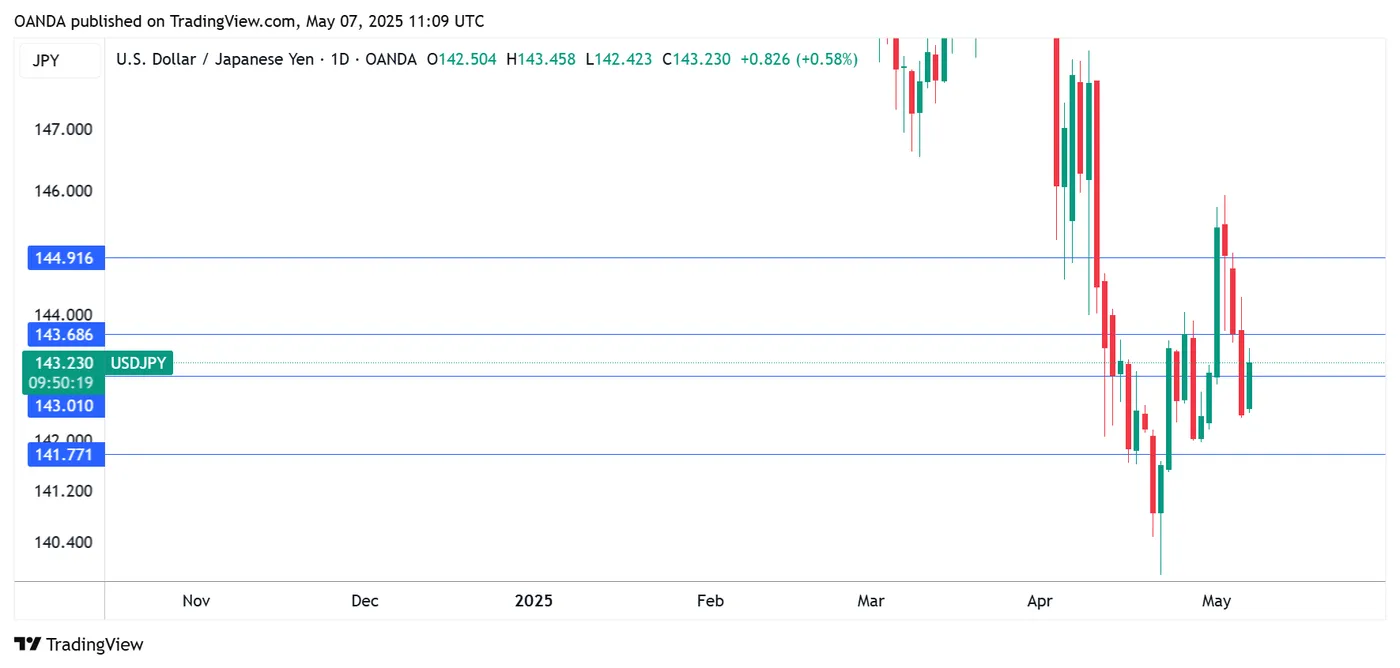
The Japanese yen is in negative territory on Wednesday, after a three-day rally which saw it gain 2% against the US dollar. In the European session, USD/JPY is trading at 143.29, up 0.61% on the day.
The Bank of Japan releases the minutes of its March meeting on Thursday. At the meeting, the BoJ held the key policy rate at 0.5% in a unanimous vote. Members cautioned that there was uncertainty over tariffs, which the US was expected to announce in April.
Since then, the financial markets have see-sawed in response to President Trump’s erratic tariff policy. Japan’s export-reliant economy could be hit hard, but Tokyo is already negotiating with the US and hopes to carve out an agreement to cancel or at least mitigate the impact of the tariffs.
The Bank of Japan is walking a tightrope, as it wants to continue to normalize policy and raise rates, but is worried about the uncertainty over the tariffs and the real possibility of a global trade war. Bank policymakers are taking a wait-and-see stance, hoping that US trade policy will become more clear.
The Federal Reserve is virtually certain to maintain rates at today’s FOMC meeting. There’s little doubt about the decision but investors will be all ears as to the amount of pushback from Fed Chair Jerome Powell, after President Trump has repeatedly pushed him to lower rates.
The markets have priced in a 30% chance of a cut in June, compared to a 63% likelihood just one week ago, according to CME’s Fedwatch Tool. We can expect the pricing of a June cut to continue to swing, as the tariff saga continues.
China and the US will hold their first trade talks since President Donald Trump took office and more than a month after the two sides imposed tariffs of more than 100% on each other.
US Treasury Secretary Scott Bessent and US Trade Representative Jamieson Greer will travel later this week to Switzerland for talks with Chinese Vice Premier He Lifeng, seeking to dial down a tariff standoff that has threatened to hammer both economies and other nations. The announcements early on Wednesday Beijing time boosted hopes that the two largest economies in the world might pull back from their actions which had threatened to effectively eliminate bilateral trade.
China said that it had to talk after approaches from US officials, but the Ministry of Commerce emphasized that “any dialogue and negotiation must be carried out under the premise of mutual respect, equal consultation, and mutual benefit,” adding that the US needed to “show sincerity in talks, correct wrong practices, meet China halfway, and resolve the concerns of both sides through equal consultation.”
The US is looking to “de-escalate” tensions, Bessent said on Fox News, calling the current level of tariffs “unsustainable” and saying the US doesn’t want to break completely with China. However, the US does “want to decouple over strategic industries,” he said, mention steel, semiconductors and pharmaceuticals as examples of sectors where the US wants to reshore manufacturing from China and elsewhere.
How damaging the tariffs have already to bilateral trade will become clearer this Friday when China released April trade figures, but high-frequency data is already showing that overall the effect has been muted so far, with Chinese ports processing more cargo in the final week of April than in any other week since the start of 2023. Shanghai port, one of the largest in the world, processed 4.5 million containers last month, according to data released on Wednesday, the most since August 2024.
—James Mayger in Beijing
Weekend meetings to de-escalate the punitive tariff war between the US and China can’t come soon enough for global trade. The latest sign of stress can be seen in freight rates as container liners begin to sever shipping routes that link the US and China across the Pacific. German container shipping group Hapag-Lloyd has canceled 30% of China-to-US bound shipments, according to a spokesperson. Swiss liner Kuehne + Nagel said some trades had stopped completely, while it expected a 25% to 30% drop in bookings from China to the US, CEO Stefan Paul said.
White Label
Data API
Web Plug-ins
Poster Maker
Affiliate Program
The risk of loss in trading financial instruments such as stocks, FX, commodities, futures, bonds, ETFs and crypto can be substantial. You may sustain a total loss of the funds that you deposit with your broker. Therefore, you should carefully consider whether such trading is suitable for you in light of your circumstances and financial resources.
No decision to invest should be made without thoroughly conducting due diligence by yourself or consulting with your financial advisors. Our web content might not suit you since we don't know your financial conditions and investment needs. Our financial information might have latency or contain inaccuracy, so you should be fully responsible for any of your trading and investment decisions. The company will not be responsible for your capital loss.
Without getting permission from the website, you are not allowed to copy the website's graphics, texts, or trademarks. Intellectual property rights in the content or data incorporated into this website belong to its providers and exchange merchants.
Not Logged In
Log in to access more features

FastBull Membership
Not yet
Purchase
Log In
Sign Up