• Trade
  • Markets
  • Copy
  • Contests
  • News
  • 24/7
  • Calendar
  • Q&A
  • Chats
Trending
Screeners
SYMBOL
LAST
BID
ASK
HIGH
LOW
NET CHG.
%CHG.
SPREAD
SPX
S&P 500 Index
6827.42
6827.42
6827.42
6899.86
6801.80
-73.58
-1.07%
--
DJI
Dow Jones Industrial Average
48458.04
48458.04
48458.04
48886.86
48334.10
-245.98
-0.51%
--
IXIC
NASDAQ Composite Index
23195.16
23195.16
23195.16
23554.89
23094.51
-398.69
-1.69%
--
USDX
US Dollar Index
97.950
98.030
97.950
98.500
97.950
-0.370
-0.38%
--
EURUSD
Euro / US Dollar
1.17394
1.17409
1.17394
1.17496
1.17192
+0.00011
+ 0.01%
--
GBPUSD
Pound Sterling / US Dollar
1.33707
1.33732
1.33707
1.33997
1.33419
-0.00148
-0.11%
--
XAUUSD
Gold / US Dollar
4299.39
4299.39
4299.39
4353.41
4257.10
+20.10
+ 0.47%
--
WTI
Light Sweet Crude Oil
57.233
57.485
57.233
58.011
56.969
-0.408
-0.71%
--

Community Accounts

Signal Accounts
--
Profit Accounts
--
Loss Accounts
--
View More

Become a signal provider

Sell trading signals to earn additional income

View More

Guide to Copy Trading

Get started with ease and confidence

View More

Signal Accounts for Members

All Signal Accounts

Best Return
  • Best Return
  • Best P/L
  • Best MDD
Past 1W
  • Past 1W
  • Past 1M
  • Past 1Y

All Contests

  • All
  • Trump Updates
  • Recommend
  • Stocks
  • Cryptocurrencies
  • Central Banks
  • Featured News
Top News Only
Share

Thai Leader Anutin: Landmine Blast That Killed Thai Soldiers 'Not A Roadside Accident'

Share

Thai Leader Anutin: Thailand To Continue Military Action Until 'We Feel No More Harm'

Share

Cambodian Prime Minister Hun Manet Says He Had Phone Calls With Trump And Malaysian Leader Anwar About Ceasefire

Share

Cambodia's Hun Manet Says USA, Malaysia Should Verify 'Which Side Fired First' In Latest Conflict

Share

Cambodia's Hun Manet: Cambodia Maintains Its Stance In Seeking Peaceful Resolution Of Disputes

Share

Nasdaq Companies: Allergan, Ferrovia, Insmed, Monolithic Power Systems, Seagate Technology, And Western Digital Will Be Added To The NASDAQ 100 Index. Biogen, CdW, GlobalFoundries, Lululemon, ON Semiconductor, And Tradedesk Will Be Removed From The NASDAQ 100 Index

Share

Witkoff Headed To Berlin This Weekend To Meet With Zelenskiy, European Leaders -Wsj Reporter On X

Share

Russia Attacks Two Ukrainian Ports, Damaging Three Turkish-Owned Vessels

Share

[Historic Flooding Occurs In At Least Four Rivers In Washington State Due To Days Of Torrential Rains] Multiple Areas In Washington State Have Been Hit By Severe Flooding Due To Days Of Torrential Rains, With At Least Four Rivers Experiencing Historic Flooding. Reporters Learned On The 12th That The Floods Caused By The Torrential Rains In Washington State Have Destroyed Homes And Closed Several Highways. Experts Warn That Even More Severe Flooding May Occur In The Future. A State Of Emergency Has Been Declared In Washington State

Share

Trump Says Proposed Free Economic Zone In Donbas Would Work

Share

Trump: I Think My Voice Should Be Heard

Share

Trump Says Will Be Choosing New Fed Chair In Near Future

Share

Trump Says Proposed Free Economic Zone In Donbas Complex But Would Work

Share

Trump Says Land Strikes In Venezuela Will Start Happening

Share

US President Trump: Thailand And Cambodia Are In A Good Situation

Share

State Media: North Korean Leader Kim Hails Troops Returning From Russia Mission

Share

The 10-year Treasury Yield Rose About 5 Basis Points During The "Fed Rate Cut Week," And The 2/10-year Yield Spread Widened By About 9 Basis Points. On Friday (December 12), In Late New York Trading, The Yield On The Benchmark 10-year US Treasury Note Rose 2.75 Basis Points To 4.1841%, A Cumulative Increase Of 4.90 Basis Points For The Week, Trading Within A Range Of 4.1002%-4.2074%. It Rose Steadily From Monday To Wednesday (before The Fed Announced Its Rate Cut And Treasury Bill Purchase Program), Subsequently Exhibiting A V-shaped Recovery. The 2-year Treasury Yield Fell 1.82 Basis Points To 3.5222%, A Cumulative Decrease Of 3.81 Basis Points For The Week, Trading Within A Range Of 3.6253%-3.4989%

Share

Trump: Lots Of Progress Being Made On Russia-Ukraine

Share

NOPA November US Soybean Crush Estimated At 220.285 Million Bushels

Share

SPDR Gold Trust Reports Holdings Up 0.22%, Or 2.28 Tonnes, To 1053.11 Tonnes By Dec 12

TIME
ACT
FCST
PREV
U.K. Trade Balance Non-EU (SA) (Oct)

A:--

F: --

P: --

U.K. Trade Balance (Oct)

A:--

F: --

P: --

U.K. Services Index MoM

A:--

F: --

P: --

U.K. Construction Output MoM (SA) (Oct)

A:--

F: --

P: --

U.K. Industrial Output YoY (Oct)

A:--

F: --

P: --

U.K. Trade Balance (SA) (Oct)

A:--

F: --

P: --

U.K. Trade Balance EU (SA) (Oct)

A:--

F: --

P: --

U.K. Manufacturing Output YoY (Oct)

A:--

F: --

P: --

U.K. GDP MoM (Oct)

A:--

F: --

P: --

U.K. GDP YoY (SA) (Oct)

A:--

F: --

P: --

U.K. Industrial Output MoM (Oct)

A:--

F: --

P: --

U.K. Construction Output YoY (Oct)

A:--

F: --

P: --

France HICP Final MoM (Nov)

A:--

F: --

P: --

China, Mainland Outstanding Loans Growth YoY (Nov)

A:--

F: --

P: --

China, Mainland M2 Money Supply YoY (Nov)

A:--

F: --

P: --

China, Mainland M0 Money Supply YoY (Nov)

A:--

F: --

P: --

China, Mainland M1 Money Supply YoY (Nov)

A:--

F: --

P: --

India CPI YoY (Nov)

A:--

F: --

P: --

India Deposit Gowth YoY

A:--

F: --

P: --

Brazil Services Growth YoY (Oct)

A:--

F: --

P: --

Mexico Industrial Output YoY (Oct)

A:--

F: --

P: --

Russia Trade Balance (Oct)

A:--

F: --

P: --

Philadelphia Fed President Henry Paulson delivers a speech
Canada Building Permits MoM (SA) (Oct)

A:--

F: --

P: --

Canada Wholesale Sales YoY (Oct)

A:--

F: --

P: --

Canada Wholesale Inventory MoM (Oct)

A:--

F: --

P: --

Canada Wholesale Inventory YoY (Oct)

A:--

F: --

P: --

Canada Wholesale Sales MoM (SA) (Oct)

A:--

F: --

P: --

Germany Current Account (Not SA) (Oct)

A:--

F: --

P: --

U.S. Weekly Total Rig Count

A:--

F: --

P: --

U.S. Weekly Total Oil Rig Count

A:--

F: --

P: --

Japan Tankan Large Non-Manufacturing Diffusion Index (Q4)

--

F: --

P: --

Japan Tankan Small Manufacturing Outlook Index (Q4)

--

F: --

P: --

Japan Tankan Large Non-Manufacturing Outlook Index (Q4)

--

F: --

P: --

Japan Tankan Large Manufacturing Outlook Index (Q4)

--

F: --

P: --

Japan Tankan Small Manufacturing Diffusion Index (Q4)

--

F: --

P: --

Japan Tankan Large Manufacturing Diffusion Index (Q4)

--

F: --

P: --

Japan Tankan Large-Enterprise Capital Expenditure YoY (Q4)

--

F: --

P: --

U.K. Rightmove House Price Index YoY (Dec)

--

F: --

P: --

China, Mainland Industrial Output YoY (YTD) (Nov)

--

F: --

P: --

China, Mainland Urban Area Unemployment Rate (Nov)

--

F: --

P: --

Saudi Arabia CPI YoY (Nov)

--

F: --

P: --

Euro Zone Industrial Output YoY (Oct)

--

F: --

P: --

Euro Zone Industrial Output MoM (Oct)

--

F: --

P: --

Canada Existing Home Sales MoM (Nov)

--

F: --

P: --

Euro Zone Total Reserve Assets (Nov)

--

F: --

P: --

U.K. Inflation Rate Expectations

--

F: --

P: --

Canada National Economic Confidence Index

--

F: --

P: --

Canada New Housing Starts (Nov)

--

F: --

P: --

U.S. NY Fed Manufacturing Employment Index (Dec)

--

F: --

P: --

U.S. NY Fed Manufacturing Index (Dec)

--

F: --

P: --

Canada Core CPI YoY (Nov)

--

F: --

P: --

Canada Manufacturing Unfilled Orders MoM (Oct)

--

F: --

P: --

Canada Manufacturing New Orders MoM (Oct)

--

F: --

P: --

Canada Core CPI MoM (Nov)

--

F: --

P: --

Canada Manufacturing Inventory MoM (Oct)

--

F: --

P: --

Canada CPI YoY (Nov)

--

F: --

P: --

Canada CPI MoM (Nov)

--

F: --

P: --

Canada CPI YoY (SA) (Nov)

--

F: --

P: --

Canada Core CPI MoM (SA) (Nov)

--

F: --

P: --

Q&A with Experts
    • All
    • Chatrooms
    • Groups
    • Friends
    Connecting
    .
    .
    .
    Type here...
    Add Symbol or Code

      No matching data

      All
      Trump Updates
      Recommend
      Stocks
      Cryptocurrencies
      Central Banks
      Featured News
      • All
      • Russia-Ukraine Conflict
      • Middle East Flashpoint
      • All
      • Russia-Ukraine Conflict
      • Middle East Flashpoint
      Search
      Products

      Charts Free Forever

      Chats Q&A with Experts
      Screeners Economic Calendar Data Tools
      Membership Features
      Data Warehouse Market Trends Institutional Data Policy Rates Macro

      Market Trends

      Market Sentiment Order Book Forex Correlations

      Top Indicators

      Charts Free Forever
      Markets

      News

      News Analysis 24/7 Columns Education
      From Institutions From Analysts
      Topics Columnists

      Latest Views

      Latest Views

      Trending Topics

      Top Columnists

      Latest Update

      Signals

      Copy Rankings Latest Signals Become a signal provider AI Rating
      Contests
      Brokers

      Overview Brokers Assessment Rankings Regulators News Claims
      Broker listing Forex Brokers Comparison Tool Live Spread Comparison Scam
      Q&A Complaint Scam Alert Videos Tips to Detect Scam
      More

      Business
      Events
      Careers About Us Advertising Help Center

      White Label

      Data API

      Web Plug-ins

      Affiliate Program

      Awards Institution Evaluation IB Seminar Salon Event Exhibition
      Vietnam Thailand Singapore Dubai
      Fans Party Investment Sharing Session
      FastBull Summit BrokersView Expo
      Recent Searches
        Top Searches
          Markets
          News
          Analysis
          User
          24/7
          Economic Calendar
          Education
          Data
          • Names
          • Latest
          • Prev

          View All

          No data

          Scan to Download

          Faster Charts, Chat Faster!

          Download App
          English
          • English
          • Español
          • العربية
          • Bahasa Indonesia
          • Bahasa Melayu
          • Tiếng Việt
          • ภาษาไทย
          • Français
          • Italiano
          • Türkçe
          • Русский язык
          • 简中
          • 繁中
          Open Account
          Search
          Products
          Charts Free Forever
          Markets
          News
          Signals

          Copy Rankings Latest Signals Become a signal provider AI Rating
          Contests
          Brokers

          Overview Brokers Assessment Rankings Regulators News Claims
          Broker listing Forex Brokers Comparison Tool Live Spread Comparison Scam
          Q&A Complaint Scam Alert Videos Tips to Detect Scam
          More

          Business
          Events
          Careers About Us Advertising Help Center

          White Label

          Data API

          Web Plug-ins

          Affiliate Program

          Awards Institution Evaluation IB Seminar Salon Event Exhibition
          Vietnam Thailand Singapore Dubai
          Fans Party Investment Sharing Session
          FastBull Summit BrokersView Expo

          Vietnam’s Tariff Deal With Trump Reflects Balancing Act Between US And China

          Michelle

          Economic

          Forex

          Summary:

          Vietnam has become the third country (after the UK and China) to reach an agreement with President Donald Trump over the ‘reciprocal tariffs’ he announced on 2 April. Trump had originally imposed a 46 per cent tariff on Vietnamese exports to the US – the fifth highest figure announced on his ‘Liberation Day’.

          Vietnam has become the third country (after the UK and China) to reach an agreement with President Donald Trump over the ‘reciprocal tariffs’ he announced on 2 April. Trump had originally imposed a 46 per cent tariff on Vietnamese exports to the US – the fifth highest figure announced on his ‘Liberation Day’. All those tariffs were suspended within hours but were due to be reimposed within 90 days (a deadline that has now been pushed to August 1).

          Announcing the deal with Vietnam last week, Trump said that the US will instead impose a 20 per cent tariff on Vietnamese goods. A higher rate of 40 per cent will apply on any goods from Vietnam it considers to have been ‘trans-shipped’ – i.e. simply moved through Vietnam rather than being manufactured or assembled there. The Trump administration has previously accused Vietnam of trans-shipping Chinese goods into the US market, in effect concealing part of China’s trade surplus with the US.

          The Vietnamese government has worked hard to reach an agreement with Washington. It has conducted well-publicized raids on sellers of counterfeit products to try to assuage Washington’s concerns over protecting intellectual property. Ministers have held multiple rounds of talks online, sent trade delegations to the US and pledged to buy billions of dollars’ worth of American products. Some reports even suggest Vietnam is considering buying American F-16 fighter jets, which would have been unthinkable even a few months ago in line with Hanoi’s long-held aversion to becoming dependent on Washington for strategic defence systems.

          That said, all these purchases add up to a tiny fraction of Vietnam’s overall trade surplus with the US, perhaps $10 billion compared to a surplus in 2024 of $123 billion. According to President Trump, Vietnam has also pledged to cut all tariffs on imports from the US. This prompted him to declare that American-made SUVs ‘will be a wonderful addition to the various product lines within Vietnam’. While this seems optimistic given that many Vietnamese streets are too small for American cars, it is quite possible that Vietnamese government ministries might be told to ‘buy American’ for their next vehicle purchase to reduce the trade surplus a little more.

          Vietnam’s economic incentives

          Vietnam has moved so fast to reach an agreement with Washington primarily because its economy depends on exports to the American market, and the country’s leadership knows it will be judged on its economic performance. The Communist Party of Vietnam (CPV) will hold its five-yearly Congress within a few months and its General-Secretary, To Lam, wants to be selected for another term in office. Keeping the country’s exports flowing to the US is a big win for him and his recently unveiled development strategy, which is firmly aimed at increasing economic growth.

          To Lam’s strategy involves the embrace of the private sector, which was endorsed by the new Politburo in May. He has also largely ended the anti-corruption campaign initiated by his hard-line predecessor, which had hobbled the economy. This approach is intended to help catapult Vietnam into the ranks of ‘high income countries’ by 2045, the centenary of the Vietnamese Declaration of Independence, and avoid falling into the ‘middle income trap’ like most of its Southeast Asian neighbours.

          To achieve this ambitious goal, Vietnam needs to sustain annual economic growth of at least eight per cent for the next 20 years. This will depend on maintaining very high levels of exports, particularly to the US and Europe.

          Between Chinese factories and Western markets

          At the same time, Vietnam is becoming more connected to Chinese-controlled supply chains. Vietnam’s economic growth has been driven in part by foreign firms building factories in the country to assemble products using components made in China. Historically, these assembly lines were owned by Japanese, Korean or Taiwanese firms. Increasingly, however, Chinese-owned companies are also setting up production in Vietnam.

          There are three reasons for this. Firstly, corporations are seeking to mitigate the risks of having all their production in one country; secondly, they need to reduce their exposure to US tariffs on China; and thirdly, because it is made possible by Vietnam and China both being part of the huge 15-country free trade area known as the Regional Comprehensive Economic Partnership (RCEP).

          For now, Vietnam’s major economic role globally is as an assembly line between Chinese producers and Western markets. This has rankled the Trump administration, which says China has trans-shipped products via Vietnam to avoid US tariffs. The higher tariff rate on trans-shipped products in the deal announced by Trump is intended to counter this. But exactly where the boundary lies between Vietnamese goods and trans-shipped goods will occupy trade negotiators, diplomats and customs officials for many months to come.

          Impact on Vietnam’s foreign relations

          While the deal will certainly contribute to improved US–Vietnam relations it is unlikely to signal a major change in Vietnam’s foreign policy orientation. Hanoi cannot afford to antagonize either of its major partners. It needs the US as a market, but also relies on trade with, and political support from, China.

          While Vietnam has developed close economic ties with the US, the CPV has remained wary of Washington’s political agenda. President Trump’s apparent lack of interest in promoting democracy abroad will help alleviate some of those fears, though some suspicion will inevitably remain.

          China has been damaging its relations with Vietnam recently with aggressive moves in the South China Sea and it is possible that Hanoi could reach out to Washington for some assistance in defending its position. This was certainly the case during the 2010s. However, Vietnam will not be part of any potential American military efforts that specifically target China.

          China will have mixed feelings about the US–Vietnam deal. Some of its companies and factories may benefit from continuing to route their production networks through Vietnam, but others may lose out from having their trans-shipment practices curtailed. Officials in Beijing may also be concerned about whether Hanoi has privately agreed other issues with Washington, such as greater security cooperation in the future. Hanoi will have to make full use of its communist party-to-party connections to reassure Beijing that it has not been flipped into the US camp.

          There is also a role here for third parties. Vietnam risks becoming a casualty of the power competition between China and the US. European countries and others with an interest in a multipolar world and a liberal trading order can offer stability to Vietnam. But perhaps they could also start to ask for things in exchange.

          Rather than reducing carbon emissions, Vietnam has been increasing the use of coal and gas-fired power stations and European manufacturers of, for example, clean energy generation technology have been blocked from the Vietnamese market by various non-tariff barriers. Vietnam is also failing to curb illegal migration to Europe. These issues are included in the EU and UK free trade agreements with Vietnam, and in other agreements on partnership and migration, but Vietnam is not upholding its side of the bargain. Perhaps it is time for Europeans to get tough too.

          Source: Chatham House

          To stay updated on all economic events of today, please check out our Economic calendar
          Risk Warnings and Disclaimers
          You understand and acknowledge that there is a high degree of risk involved in trading. Following any strategies or investment methods may lead to potential losses. The content on the site is provided by our contributors and analysts for information purposes only. You are solely responsible for determining whether any trading assets, securities, strategy, or any other product is suitable for investing based on your own investment objectives and financial situation.
          Add to Favorites
          Share

          Nvidia has the best product, but its real edge is having the best customers

          Adam

          Economic

          Why stop at $4 trillion? Nvidia (NVDA) bulls are looking to the next milestone: a market cap of $5 trillion.
          It's not particularly farfetched to imagine Nvidia becoming the first publicly traded company to grab both of those records. It was just over two years ago that Nvidia joined the $1 trillion club, riding the excitement over the breakout success of ChatGPT and reaping the rewards of building out an AI-focused data center business before AI became an earnings call buzzword.
          The stock is up 21% this year, the best performer in the Magnificent Seven behind only Meta (META), which has been busy building an ultra-niche Avengers team of highly-paid AI experts.
          "There is one company in the world that is the foundation for the AI Revolution and that is Nvidia with the Godfather of AI Jensen having the best perch and vantage point to discuss overall enterprise AI demand and the appetite for Nvidia's AI chips looking forward," wrote Wedbush analyst Dan Ives in a note on Wednesday.
          Nvidia's chips are at the forefront of the generative AI boom. The company has shed earlier concerns of being less well suited for use in AI models after they are trained and has benefited from countries vying to keep their AI data centers within their borders. Nvidia has also managed to shake off regulatory concerns at home.
          It pays to have a superior product. But Nvidia's empire was also built by having the best customers.
          As my colleague Dan Howley has reported, the biggest players in tech, each in command of vast fortunes and attempting to execute on grand ambitions, are spending hundreds of billions of dollars on the company's hardware.
          Tech behemoths, including Amazon (AMZN), Google (GOOG), Meta, Microsoft (MSFT), and Tesla (TSLA), rely on Nvidia's products to build out their data centers. The cloud-based AI offerings and internal AI models at the heart of the latest tech transformation have generated an industrywide line item paid out to Nvidia.
          The symbiotic relationship also favors Nvidia because the major tech platforms sit downstream of its chip supply. It's true that every player in the AI ecosystem is taking on huge risks. DeepSeek unleashing a brief investor panic was a painful reminder of that.
          But where the tech platforms have to eventually deliver on new, AI-centered services, fulfill promises and hype around building novel consumer habits, and usher in a new age of automated agents, all Nvidia has to do is keep selling chips.
          That's an oversimplification. And the fates of chipmakers and AI service providers are and will be intertwined.
          But the point stands: The onus of justifying enormous AI investments will fall more on the companies that have yet to profit from them. The tech giants still have to convince the rest of us to use and keep using their newfangled AI tools. All the while, Nvidia will be cashing checks from further up the hype chain.

          Source: finance.yahoo

          To stay updated on all economic events of today, please check out our Economic calendar
          Risk Warnings and Disclaimers
          You understand and acknowledge that there is a high degree of risk involved in trading. Following any strategies or investment methods may lead to potential losses. The content on the site is provided by our contributors and analysts for information purposes only. You are solely responsible for determining whether any trading assets, securities, strategy, or any other product is suitable for investing based on your own investment objectives and financial situation.
          Add to Favorites
          Share

          Israeli Strike Hits Near Gaza Medical Centre As Truce Talks Continue

          Glendon

          Political

          Middle East Situation

          An Israeli strike hit Palestinians near a medical centre in Gaza on Thursday, killing 16 including children and wounding more people, local health authorities said, as ceasefire talks dragged on with no result expected soon.

          The strike in Deir al-Balah in the central Gaza Strip came as Israeli and Hamas negotiators hold talks with mediators in Qatar over a proposed 60-day ceasefire and hostage release deal aimed at building agreement on a lasting truce.

          However, a senior Israeli official said on Wednesday that an agreement was not likely to be secured for another one or two weeks.

          Khalil al-Deqran, spokesperson for the health ministry in Gaza's Hamas-run government, said Israel had targeted a medical centre and that six of the dead were children. Many of those injured had suffered severe wounds to the head and chest, he said.

          Israel's military said it had struck a militant who took part in the Hamas-led October 7, 2023, attack that triggered the war. It said it was aware of reports regarding a number of injured individuals and that the incident was under review.

          Videos on Thursday verified by Reuters showed a scene of carnage, with the bodies of dead and injured, mainly women and children, lying in blood amid a cloud of dust as people screamed all around, and of motionless children lying in blood on a donkey cart.

          At Deir al-Balah's al-Aqsa Martyrs Hospital, where the dead and wounded were taken, Samah al-Nouri said her daughter had been killed in the morning's strike after attending the clinic to seek treatment for a throat ailment.

          "They hit her with a shell. Her brother went to check and he said they all died. What did they do? What's their fault? She was only getting treatment in a medical facility. Why did they kill them?" she said.

          Israeli attacks on Palestinian hospitals and health facilities, detentions of medics, and restrictions on the entry of medical supplies have drawn condemnation, opens new tab from the United Nations.

          The United Nations humanitarian agency OCHA said in May that the U.N. had documented at least 686 attacks impacting healthcare in Gaza since the war began.

          Dwindling fuel supplies risk further disruption in the remaining, semi-functioning hospitals, including to incubators at the neonatal unit of al-Shifa hospital in Gaza City, doctors there said.

          "We are forced to place four, five or sometimes three premature babies in one incubator," said Dr Mohammed Abu Selmia, the hospital director, adding that premature babies were now in a critical condition.

          TALKS

          U.S. President Donald Trump met Israeli Prime Minister Benjamin Netanyahu this week to discuss Gaza amid reports Israel and the Palestinian militant group Hamas were nearing agreement on a U.S.-brokered ceasefire proposal after 21 months of war.

          The Israeli official who was in Washington with Netanyahu said that if the two sides agree to the ceasefire proposal, Israel would use that time to offer a permanent truce requiring Hamas to disarm.

          If Hamas refuses, "we'll proceed" with military operations in Gaza, the official said on condition of anonymity.

          A Palestinian official said the talks in Qatar were in crisis and that issues under dispute, including whether Israel would continue to occupy parts of Gaza after a ceasefire, had yet to be resolved.

          The two sides previously agreed a ceasefire in January but it did not lead to a deal on a permanent truce and Israel resumed its military assault in March, stopping all aid supplies into Gaza and telling civilians to leave the north of the tiny territory.

          Israel's military campaign in Gaza has now killed more than 57,000 people, according to Palestinian health authorities. It has destroyed swathes of the territory and driven most Gazans from their homes.

          The Hamas attack on Israeli border communities that triggered the war killed around 1,200 people and the militant group seized around 250 hostages according to Israeli tallies.

          Source: Reuters

          Risk Warnings and Disclaimers
          You understand and acknowledge that there is a high degree of risk involved in trading. Following any strategies or investment methods may lead to potential losses. The content on the site is provided by our contributors and analysts for information purposes only. You are solely responsible for determining whether any trading assets, securities, strategy, or any other product is suitable for investing based on your own investment objectives and financial situation.
          Add to Favorites
          Share

          US bank profits to climb on stronger trading, investment banking

          Adam

          Economic

          Major U.S. banks are expected to report stronger profits next week, driven by buoyant trading and a modest rebound in investment banking.
          When JPMorgan Chase, Citigroup and Wells Fargo kick off second-quarter earnings on Tuesday, investors will focus on their outlooks at a time when economic uncertainty over U.S. tariff policies remains high.
          "Things are looking good and we expect that most banks will beat expectations," said Stephen Biggar, a banking analyst at Argus Research. "It is one of those quarters where no big surprises are expected and we are likely to see a continuation of trends."
          Investment banking activity has picked up in the second half of this quarter and dealmakers are more optimistic about the rest of the year. That marks a turnaround from April, when an escalating trade war and geopolitical tensions derailed confidence and drove mergers and acquisitions to a 20-year low that month.
          "We expect second-quarter investment banking revenues to be better than expected and management teams to point to pipelines building," Betsy Graseck, a banking analyst at Morgan Stanley, wrote in a report published last week.
          Amid the market turmoil, Bank of America and Citigroup executives said last month they expected market revenue to climb by mid-to-high single digit percentages in the second quarter.
          "We continue to expect the trading revenue to remain buoyant in the near future given the uncertain macroeconomic and geopolitical backdrop," analysts at Goldman Sachs said.
          Most of the major banks are expected to report a low-to-mid single digit percentage gain in net interest income (NII), or the difference between what they earn on loans and pay out for deposits.
          Lenders are also expected to set aside smaller amounts for potential souring loans, as the financial health of consumers and businesses remains resilient.
          Credit quality among consumer and commercial borrowers is still robust, and even though loan demand is muted, it is starting to improve, analysts say.
          "One of the biggest questions is: how sustainable is this loan growth," said Mike Mayo, an analyst at Wells Fargo. He sees industry loan growth rising to around 5%, higher than earlier estimates of 3%.
          Banks are also expected to benefit from the deregulatory regime under U.S. President Donald Trump. Lenders recently aced the Federal Reserve's stress test and showed enough capital to withstand possible adverse scenarios.
          Investors will likely scrutinize banks' plans to deploy excess capital after the lenders hiked dividends and some announced share buyback plans.
          Here is what is likely to come from the six biggest U.S. lenders:
          JPMorgan Chase
          The largest U.S. lender is predicted to report a 5% increase in earnings per share, according to estimates compiled by LSEG. Investors will take note of the bank's outlook on NII, loan growth and investment banking. Analysts are also watching for any developments in its work on stablecoins.
          Bank of America
          Bofa's EPS is likely to inch up nearly 4% when it reports earnings on July 16, LSEG estimates showed. NII is estimated to be higher by nearly 7%. However, its investment banking fees are forecast to slide to about $1.2 billion, according to management commentary.
          Citigroup
          Analysts see Citigroup's EPS improving by 5%, fueled by capital markets. Expenses and provisions may also exceed earlier estimates, Mayo said. Citi is his top pick.
          Wells Fargo
          Operating expenses will decrease slightly because of shrinking personnel costs, analysts at Raymond James said. Loan loss provisions are expected to remain flat versus the first quarter, while loan balances are expected to increase slightly, analysts said.
          The bank was recently released from a seven-year-long asset cap, and market participants are focused on its growth plans.
          Goldman Sachs
          The Wall Street giant is likely to see a nearly 11% increase in EPS, propelled by gains in investment banking and trading, analysts said.
          Morgan Stanley
          Morgan Stanley's EPS is estimated to increase over 7%, with all eyes on management commentary on the burgeoning rebound for investment banking.
          "After a relatively seamless CEO transition and a recalibration of strategic targets last January, CEO Ted Pick appears well-placed to flex franchise muscle and gain market share," Ebrahim Poonawala, an analyst at Bofa wrote in a report.

          Source: Reuters

          To stay updated on all economic events of today, please check out our Economic calendar
          Risk Warnings and Disclaimers
          You understand and acknowledge that there is a high degree of risk involved in trading. Following any strategies or investment methods may lead to potential losses. The content on the site is provided by our contributors and analysts for information purposes only. You are solely responsible for determining whether any trading assets, securities, strategy, or any other product is suitable for investing based on your own investment objectives and financial situation.
          Add to Favorites
          Share

          Spain Overtakes Japan in GDP per Capita – What Is Behind the Numbers?

          Warren Takunda

          Economic

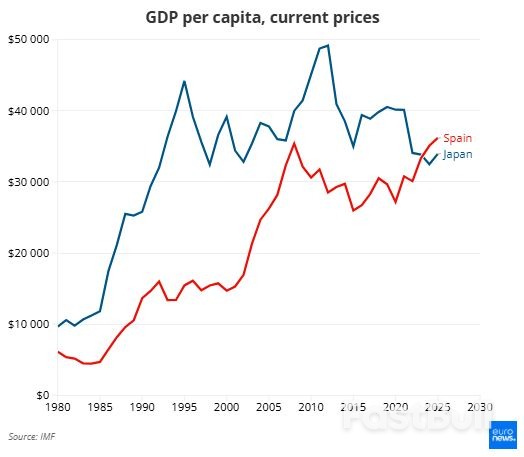
          What once seemed improbable became possible when the Spanish economy produced higher GDP per capita, a metric closely linked to living standards, than the G7 member Japan, according to IMF data.
          This, in itself, doesn’t mean that the Southern European economy is bigger than Japan’s when comparing its overall value of goods and services.
          But when Spain’s GDP is divided by the number of people living in the country and turned into US dollars, the GDP per capita in current prices turns out to be higher than that of Japan’s. In 2025, the GDP per capita denominated in US dollars was $33,960 in Japan, whereas in Spain it came to $36,190.Spain Overtakes Japan in GDP per Capita – What Is Behind the Numbers?_1
          This same figure was already slightly higher in the Southern European economy than in the Asian tech-oriented economy in 2024.
          “There is a real story behind this, but also a big caveat,” pointed out Ángel Talavera, Head of Europe Economics at Oxford Economics.
          While the Spanish economy has been one of the fastest-growing, “this figure is also driven by a statistical artifact,” he told Euronews Business.
          “The Japanese yen has depreciated 40% since 2021, which means that even if Japanese GDP per capita in local currency remains unchanged, it is 40% lower when measured in US dollars,” he said.
          This means that a large amount of Japanese economic data has deteriorated significantly in recent years when measured in US dollars needed for international comparisons.

          What drove Spanish growth over the past few years?

          Spain, which emerged from the financial crisis a little over ten years ago, expanded its economy by 3.2% in 2024, outperforming France, Germany and Italy, the three biggest economies in the eurozone. The German economy, Europe’s biggest, contracted by 0.2%.
          Spain’s GDP was driven up by strong domestic demand, robust tourism, and other services.
          The service sector provides a little over two-thirds of the country’s economic output, and improvement on this front is one of the key reasons behind Spain’s success.
          “Global tourism has benefited this economy more strongly than it has benefited Japan,” said Mathieu Savary, Chief European Strategist at BCA Research.
          In Spain, growth was also strengthened by strong government support and lower energy prices than in other European countries. Significant population growth also contributed to improved output.
          Savary added that Spain’s strong economic performance in the last decade has been supported by “brutal reforms and a major adjustment in labour costs in the wake of the European Sovereign Debt Crisis last decade, that have boosted its competitiveness”.
          During the financial crisis, unemployment in Spain was around 25%, one of the highest in the EU. There was a tendency for struggling businesses to favour temporary staff contracts, and in response, Spain approved reforms to soften employee protection in permanent contracts. Reducing firing costs and workers rights, among other reforms, improved labour mobility, helping to match positions with skilled workers, leading to improved productivity.

          What is constricting Japan's economy?

          Meanwhile, Japan's "ossified labour market means that its labour productivity remains poor,” Savary added.
          Japan, the fourth-largest economy in the world, has been struggling to maintain its leading role in the global economy, losing its spot as the third biggest economy to Germany last year. IMF data suggests that in 2025, Japan is expected to be overtaken by India as well, falling to fifth position in terms of GDP.
          The technology-driven Japanese economy has barely grown in the last three decades, and it was hit hard by the COVID-19 pandemic. Its GDP collapsed by 4.2% in 2020.
          Japanese research firm Nikko Research Center said in a recent report that the country has been struggling due to the lack of innovation.
          The report also noted that in the year 2000, Japan’s GDP per capita was ranked globally the second highest after Luxembourg. It is now the 38th.
          Japan’s current economic performance doesn’t point to a quick turnaround. The economy shrank in the first quarter, driven by weak exports. This is coupled with a sluggish domestic demand, rising inflation and slow production. US tariffs and tariff threats are damaging exports and industrial production, fuelling fears that Japan’s economy could go into recession in the second quarter.
          The Japanese economy is sustained by a lot of fiscal stimulus, focusing on energy subsidies, wage support, and digital infrastructure.
          The continuing lethargy in the Japanese economy is also fuelled by its ageing population, resulting in acute labour shortages and mounting social security costs.

          Is this a short-lived success for the Spanish economy?

          Service-driven economies such as Spain are projected to outperform in the future, too, as consumer trends are shifting across the globe.
          Overall, the contribution of services to economies worldwide has increased significantly. The service sector’s share of global GDP increased from 53% to 67% between 1970 and 2021, according to the World Trade Organisation (WTO).
          According to the IMF, Spain's GDP per capita is expected to remain ahead of Japan's until the end of its current forecast, in 2030. Spain's GDP per capita is expected to exceed $42,300 while Japan's will remain around $41,700, based on current trends.

          Source: Euronews

          To stay updated on all economic events of today, please check out our Economic calendar
          Risk Warnings and Disclaimers
          You understand and acknowledge that there is a high degree of risk involved in trading. Following any strategies or investment methods may lead to potential losses. The content on the site is provided by our contributors and analysts for information purposes only. You are solely responsible for determining whether any trading assets, securities, strategy, or any other product is suitable for investing based on your own investment objectives and financial situation.
          Add to Favorites
          Share

          Xi Signals China May Finally Move to End Deflationary Price Wars

          Michelle

          Economic

          Forex

          After years of mounting concern over deflation and the bruising price wars that have plagued much of China’s economy, President Xi Jinping’s government is showing signs of finally taking action.

          Beijing’s messaging has noticeably shifted in recent weeks, with Xi and other top officials offering their bluntest assessment yet of the cutthroat competition that’s been dragging down prices and profits across industries, from steel and solar panels to electric vehicles. This pivot comes after nearly three years of factory-gate deflation and growing pressure from US tariffs and trade tensions.

          Finding a solution would be welcome news for much of the world. A successful effort to rein in industrial overcapacity, long a source of friction with trading partners, stands to ease trade tensions and restore confidence in the globe’s second-biggest economy.

          But the path forward is far from clear. Xi’s government must curb excess supply without stalling growth or putting jobs at risk, especially as external demand slows and a lasting trade deal with the US remains elusive.

          “If executed right, it could be helpful to global trade, in terms of easing tensions coming from China’s overcapacity, output spilling into the global markets,” Wendy Liu, chief Asia and China equity strategist at JPMorgan Chase & Co., told Bloomberg Television on Wednesday. “But short term, it’s not GDP-friendly or employment-friendly, so it’s a balancing act.”

          China reported this week that factory deflation persisted into a 33rd month in June, with the producer price index falling 3.6% from a year earlier. The decline was the most since July 2023 and sharper than any economists had forecast, underscoring the urgency of the problem.

          While no formal plan has been announced, optimism is building that a more coordinated policy response is on the way. A meeting this month of the top Communist Party body in charge of economic policy acknowledged the underlying causes of the problem, ranging from local governments’ drive to promote investment to a tax system that favors output over efficiency.

          Though it doesn’t directly reference deflation, until recently a taboo topic in Beijing, the assessment “represents the strongest signal yet that Chinese policymakers are intending to tackle disorderly competition and the price wars in sectors like autos,” said Duncan Wrigley, chief China economist at Pantheon Macroeconomics.

          It omitted a mention of industry associations — whose efforts at self-regulation have largely failed at limiting production — in what Pantheon said could indicate a new approach “with greater top-down determination.”

          Industry groups and official media have echoed the shift in tone, calling for efforts to end the price wars. Some companies in sectors ranging from steel to glassmaking are reportedly planning to cut output. The cost of reinforcing bars, a key steel product used in construction, has fallen to the lowest since 2017, while glass prices are hovering near a nine-year low.

          The People’s Bank of China expressed similar concerns, naming “prices running at a low level continuously” as a key challenge of the economy for the first time in recent years. In May, the central bank offered another detailed analysis of downward pressure on prices, which highlighted the limits of relying on monetary easing to reflate the economy under a growth model that’s tilted toward investment and supply.

          China’s Ministry of Industry and Information Technology, or MIIT, met with solar companies, while a group of almost three dozen construction firms signed on to an “anti-involution” initiative, a term used in China to describe intense competition sparked by excess capacity. The government also launched a platform to handle supplier complaints over late payments, part of a broader push to clean up unfair business practices.

          For now, the lack of concrete policy measures is tempering expectations. If officials follow through, as they did after a similar meeting early 2024 that led to a consumer goods trade-in program — many economists expect them to reprise a playbook used between 2015 and 2017.

          That supply-side reform largely consisted of aggressive cuts of heavy industry capacity including steel and coal, as well as a shantytown redevelopment program that encouraged residents to buy new homes. The effort helped revive commodity prices and home sales. Eventually, it contributed to a recovery in industrial profits and stabilized economic growth.

          But the challenge now is more complex. Domestic demand remains weak, export prospects are deteriorating, and many of the sectors engaged in the most intense price wars — like EVs — are dominated by private firms, limiting the government’s ability to impose capacity cuts. Local officials, wary of unemployment, may resist moves that threaten jobs, even if it means keeping unprofitable firms alive.

          And while China is eager to defuse the pressure on prices, it’s equally determined to increase its manufacturing might in the face of President Donald Trump’s push to bring more factories back to the US. Beijing is considering a new version of its “Made in 2025” campaign to boost production of high-end technological goods, Bloomberg News previously reported.

          For Citigroup Inc., upcoming measures could include capacity cuts in sectors dominated by big state-owned enterprises, such as coal, steel and cement, as well as stricter enforcement of environmental, labor and quality standards in private-dominated industries.

          Authorities could also reduce subsidies for industries, including those motivated by local favoritism, or cut export tax rebate, according to a Citi report last week. The latter already happened for products including aluminum, copper and batteries in late 2024.

          Officials may also move to rein in bad business practices, such as exploiting suppliers to win lower prices or delaying payments. In March, new rules required firms to pay suppliers within 60 days, and several automakers have since pledged to comply.

          Analysts at HSBC Holdings Plc argue that demand-side measures will be equally important, with steps such as improving the social safety net as well as stabilizing employment and the property market.

          But longer-term change will require deeper reforms to the China’s growth model, one which relies on investment and production. That could mean adjusting how local officials are evaluated, shifting from pure economic expansion targets to metrics like consumption and income growth, according to Morgan Stanley.

          For now, the shift in tone is notable, but the follow-through remains uncertain. “The tone is sharper, the intent more coherent,” Morgan Stanley economists led by Robin Xing wrote in a report. “But no timeline has been laid out, and no mechanism for enforcement has been introduced,” they said, adding that “the gap between diagnosis and delivery remains wide.”

          Source: Bloomberg Europe

          To stay updated on all economic events of today, please check out our Economic calendar
          Risk Warnings and Disclaimers
          You understand and acknowledge that there is a high degree of risk involved in trading. Following any strategies or investment methods may lead to potential losses. The content on the site is provided by our contributors and analysts for information purposes only. You are solely responsible for determining whether any trading assets, securities, strategy, or any other product is suitable for investing based on your own investment objectives and financial situation.
          Add to Favorites
          Share

          German CPI confirmed at 2.0%, euro drifting, FOMC split over cuts

          Adam

          Economic

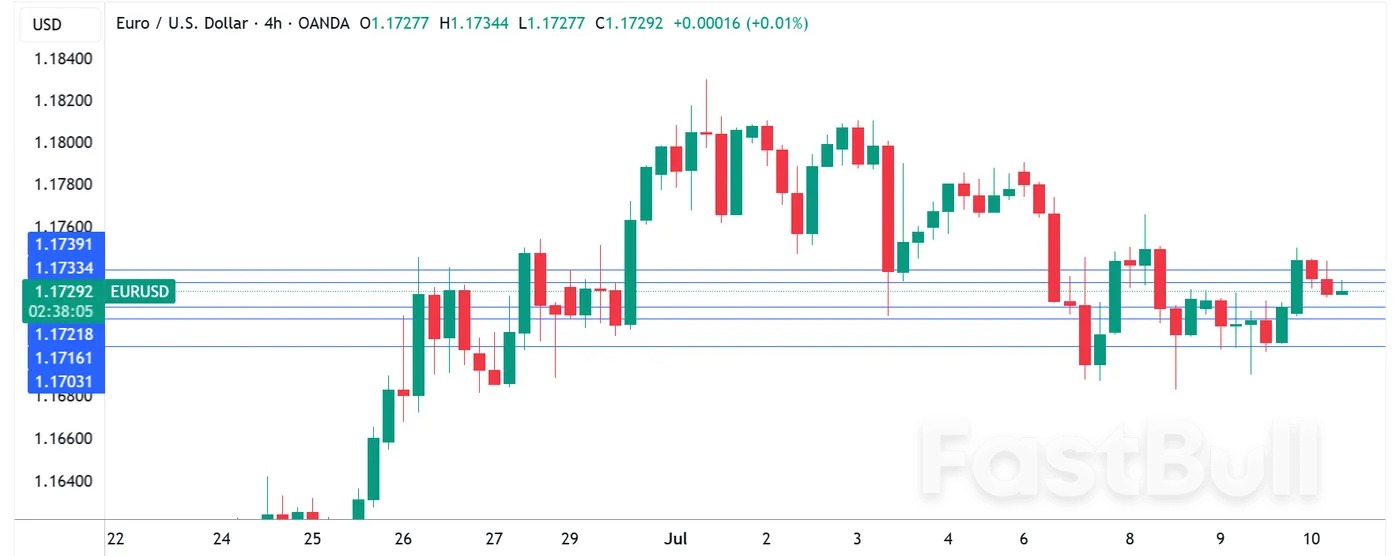
          The euro continues to have a quiet week and is drifting for a third consecutive day. In the European session, EUR/USD is trading at 1.1730, up 0.09% on the day.

          German inflation dips to 2% as food, energy prices fall

          German inflation rose 2.0% y/y in June, in line with the consensus and a drop lower than the 2.1% gain recorded in the past two months. The drop in CPI was driven by declines in energy and food prices. However, service prices remain high and continue to fuel inflation. Monthly, inflation was flat, in line with the consensus and a touch lower than the 0.1% gain in May.
          The annual inflation rate of 2.0% is the lowest level since October 2024. The inflation rate is right at the ECB's target but Bank policymakers know that the tough battle against inflation isn't over.
          Services inflation has been persistently above the 2% target and the newest headache for the ECB is the rapid appreciation of the euro, which has skyrocketed some 14% against the US dollar this year. The euro's rise has kept a lid on import prices and dampened inflation, but if the euro continues to rise, it will hurt the struggling export sector.
          The ECB lowered the deposit rate in June by a quarter-point to 2.0%, its lowest level since October 2022. If next week's eurozone inflation report indicates that inflation is heading lower, expectations will rise for a rate cut at the July 24 meeting.

          FOMC minutes: members split over much to cut

          The FOMC minutes from the June meeting were dovish in the sense that there is a broad consensus that the Fed will deliver additional rate cuts this year. The pace of those cuts, however, is up for debate. The minutes noted that some members favored cutting as soon as the July meeting, while others were more cautious and wanted to see where inflation and employment were headed. President Trump's tariffs have not boosted inflation so far, but the tariff effect on inflation could be felt in the following months.

          EURUSD Technical

          EUR/USD has pushed above resistance at 1.1721 and is testing resistance at 1.1733. Above, there is resistance at 1.1739
          1.1715 and 1.1703 are the next support levels
          German CPI confirmed at 2.0%, euro drifting, FOMC split over cuts_1

          EURUSD 4-Hour Chart, July 9, 2025

          Source: marketpulse

          To stay updated on all economic events of today, please check out our Economic calendar
          Risk Warnings and Disclaimers
          You understand and acknowledge that there is a high degree of risk involved in trading. Following any strategies or investment methods may lead to potential losses. The content on the site is provided by our contributors and analysts for information purposes only. You are solely responsible for determining whether any trading assets, securities, strategy, or any other product is suitable for investing based on your own investment objectives and financial situation.
          Add to Favorites
          Share
          FastBull
          Copyright © 2025 FastBull Ltd

          728 RM B 7/F GEE LOK IND BLDG NO 34 HUNG TO RD KWUN TONG KLN HONG KONG

          TelegramInstagramTwitterfacebooklinkedin
          App Store Google Play Google Play
          Products
          Charts

          Chats

          Q&A with Experts
          Screeners
          Economic Calendar
          Data
          Tools
          Membership
          Features
          Function
          Markets
          Copy Trading
          Latest Signals
          Contests
          News
          Analysis
          24/7
          Columns
          Education
          Company
          Careers
          About Us
          Contact Us
          Advertising
          Help Center
          Feedback
          User Agreement
          Privacy Policy
          Business

          White Label

          Data API

          Web Plug-ins

          Poster Maker

          Affiliate Program

          Risk Disclosure

          The risk of loss in trading financial instruments such as stocks, FX, commodities, futures, bonds, ETFs and crypto can be substantial. You may sustain a total loss of the funds that you deposit with your broker. Therefore, you should carefully consider whether such trading is suitable for you in light of your circumstances and financial resources.

          No decision to invest should be made without thoroughly conducting due diligence by yourself or consulting with your financial advisors. Our web content might not suit you since we don't know your financial conditions and investment needs. Our financial information might have latency or contain inaccuracy, so you should be fully responsible for any of your trading and investment decisions. The company will not be responsible for your capital loss.

          Without getting permission from the website, you are not allowed to copy the website's graphics, texts, or trademarks. Intellectual property rights in the content or data incorporated into this website belong to its providers and exchange merchants.

          Not Logged In

          Log in to access more features

          FastBull Membership

          Not yet

          Purchase

          Become a signal provider
          Help Center
          Customer Service
          Dark Mode
          Price Up/Down Colors

          Log In

          Sign Up

          Position
          Layout
          Fullscreen
          Default to Chart
          The chart page opens by default when you visit fastbull.com