• Trade
  • Markets
  • Copy
  • Contests
  • News
  • 24/7
  • Calendar
  • Q&A
  • Chats
Trending
Screeners
SYMBOL
LAST
BID
ASK
HIGH
LOW
NET CHG.
%CHG.
SPREAD
SPX
S&P 500 Index
6850.38
6850.38
6850.38
6878.28
6850.29
-20.02
-0.29%
--
DJI
Dow Jones Industrial Average
47804.51
47804.51
47804.51
47971.51
47771.72
-150.47
-0.31%
--
IXIC
NASDAQ Composite Index
23532.13
23532.13
23532.13
23698.93
23532.13
-45.98
-0.20%
--
USDX
US Dollar Index
99.070
99.150
99.070
99.110
98.730
+0.120
+ 0.12%
--
EURUSD
Euro / US Dollar
1.16291
1.16298
1.16291
1.16717
1.16245
-0.00135
-0.12%
--
GBPUSD
Pound Sterling / US Dollar
1.33178
1.33187
1.33178
1.33462
1.33087
-0.00134
-0.10%
--
XAUUSD
Gold / US Dollar
4190.45
4190.79
4190.45
4218.85
4175.92
-7.46
-0.18%
--
WTI
Light Sweet Crude Oil
58.990
59.020
58.990
60.084
58.892
-0.819
-1.37%
--

Community Accounts

Signal Accounts
--
Profit Accounts
--
Loss Accounts
--
View More

Become a signal provider

Sell trading signals to earn additional income

View More

Guide to Copy Trading

Get started with ease and confidence

View More

Signal Accounts for Members

All Signal Accounts

Best Return
  • Best Return
  • Best P/L
  • Best MDD
Past 1W
  • Past 1W
  • Past 1M
  • Past 1Y

All Contests

  • All
  • Trump Updates
  • Recommend
  • Stocks
  • Cryptocurrencies
  • Central Banks
  • Featured News
Top News Only
Share

The S&P 500 Opened 4.80 Points Higher, Or 0.07%, At 6875.20; The Dow Jones Industrial Average Opened 16.52 Points Higher, Or 0.03%, At 47971.51; And The Nasdaq Composite Opened 60.09 Points Higher, Or 0.25%, At 23638.22

Share

Reuters Poll - Swiss National Bank Policy Rate To Be 0.00% At End-2026, Said 21 Of 25 Economists, Four Said It Would Be Cut To -0.25%

Share

USGS - Magnitude 7.6 Earthquake Strikes Misawa, Japan

Share

Reuters Poll - Swiss National Bank To Hold Policy Rate At 0.00% On December 11, Said 38 Of 40 Economists, Two Said Cut To -0.25%

Share

Traders Believe There Is A 20% Chance That The European Central Bank Will Raise Interest Rates Before The End Of 2026

Share

Toronto Stock Index .GSPTSE Rises 11.99 Points, Or 0.04 Percent, To 31323.40 At Open

Share

Japan Meteorological Agency: A Tsunami With A Maximum Height Of Three Meters Is Expected Following The Earthquake In Japan

Share

Japan Meteorological Agency: A 7.2-magnitude Earthquake Struck Off The Coast Of Northern Japan, And A Tsunami Warning Has Been Issued

Share

Japan Finance Minister Katayama: G7 Expected To Hold Another Meeting By The End Of This Year

Share

The Japan Meteorological Agency Reported That An Earthquake Occurred In The Sea Near Aomori

Share

Japan Finance Minister Katayama: The G7 Finance Ministers' Meeting Discussed The Critical Mineral Supply Chain And Support For Ukraine

Share

Japan Finance Minister Katayama: Held Onlinemeeting With G7 Finance Ministers

Share

Fed Data - USA Effective Federal Funds Rate At 3.89 Percent On 05 December On $88 Billion In Trades Versus 3.89 Percent On $87 Billion On 04 December

Share

Chinese Foreign Minister Wang Yi: One-China Principle Is An Important Political Foundation For China-Germany Relations, And There Is No Room For Ambiguity

Share

Chinese Foreign Minister Wang Yi: Hopes Germany To Understand, Support China's Position Regarding Japan Prime Minister's Remark On Taiwan

Share

Chinese Foreign Minister Wang Yi: Hopes Germany Will View China More Objectively And Rationally, Adhere To The Positioning Of China-Germany Partnership

Share

China Foreign Ministry: China's Foreign Minister Wang Yi Meets German Counterpart

Share

Israeli Government Spokesperson: Netanyahu Will Meet Trump On December 29

Share

Stc Did Not Ask Internationally-Government To Leave Aden - Senior Stc Official To Reuters

Share

Members Of Internationally-Recognised Government, Opposed To Northern Houthis, Have Left Aden - Senior Stc Official To Reuters

TIME
ACT
FCST
PREV
France Trade Balance (SA) (Oct)

A:--

F: --

P: --
Euro Zone Employment YoY (SA) (Q3)

A:--

F: --

P: --
Canada Part-Time Employment (SA) (Nov)

A:--

F: --

P: --

Canada Unemployment Rate (SA) (Nov)

A:--

F: --

P: --

Canada Full-time Employment (SA) (Nov)

A:--

F: --

P: --

Canada Labor Force Participation Rate (SA) (Nov)

A:--

F: --

P: --

Canada Employment (SA) (Nov)

A:--

F: --

P: --

U.S. PCE Price Index MoM (Sept)

A:--

F: --

P: --

U.S. Personal Income MoM (Sept)

A:--

F: --

P: --

U.S. Core PCE Price Index MoM (Sept)

A:--

F: --

P: --

U.S. PCE Price Index YoY (SA) (Sept)

A:--

F: --

P: --

U.S. Core PCE Price Index YoY (Sept)

A:--

F: --

P: --

U.S. Personal Outlays MoM (SA) (Sept)

A:--

F: --

P: --
U.S. 5-10 Year-Ahead Inflation Expectations (Dec)

A:--

F: --

P: --

U.S. Real Personal Consumption Expenditures MoM (Sept)

A:--

F: --

P: --
U.S. Weekly Total Rig Count

A:--

F: --

P: --

U.S. Weekly Total Oil Rig Count

A:--

F: --

P: --

U.S. Consumer Credit (SA) (Oct)

A:--

F: --

P: --
China, Mainland Foreign Exchange Reserves (Nov)

A:--

F: --

P: --

Japan Trade Balance (Oct)

A:--

F: --

P: --

Japan Nominal GDP Revised QoQ (Q3)

A:--

F: --

P: --

China, Mainland Imports YoY (CNH) (Nov)

A:--

F: --

P: --

China, Mainland Exports (Nov)

A:--

F: --

P: --

China, Mainland Imports (CNH) (Nov)

A:--

F: --

P: --

China, Mainland Trade Balance (CNH) (Nov)

A:--

F: --

P: --

China, Mainland Exports YoY (USD) (Nov)

A:--

F: --

P: --

China, Mainland Imports YoY (USD) (Nov)

A:--

F: --

P: --

Germany Industrial Output MoM (SA) (Oct)

A:--

F: --

P: --
Euro Zone Sentix Investor Confidence Index (Dec)

A:--

F: --

P: --

Canada National Economic Confidence Index

A:--

F: --

P: --

U.K. BRC Like-For-Like Retail Sales YoY (Nov)

--

F: --

P: --

U.K. BRC Overall Retail Sales YoY (Nov)

--

F: --

P: --

Australia Overnight (Borrowing) Key Rate

--

F: --

P: --

RBA Rate Statement
RBA Press Conference
Germany Exports MoM (SA) (Oct)

--

F: --

P: --

U.S. NFIB Small Business Optimism Index (SA) (Nov)

--

F: --

P: --

Mexico 12-Month Inflation (CPI) (Nov)

--

F: --

P: --

Mexico Core CPI YoY (Nov)

--

F: --

P: --

Mexico PPI YoY (Nov)

--

F: --

P: --

U.S. Weekly Redbook Index YoY

--

F: --

P: --

U.S. JOLTS Job Openings (SA) (Oct)

--

F: --

P: --

China, Mainland M1 Money Supply YoY (Nov)

--

F: --

P: --

China, Mainland M0 Money Supply YoY (Nov)

--

F: --

P: --

China, Mainland M2 Money Supply YoY (Nov)

--

F: --

P: --

U.S. EIA Short-Term Crude Production Forecast For The Year (Dec)

--

F: --

P: --

U.S. EIA Natural Gas Production Forecast For The Next Year (Dec)

--

F: --

P: --

U.S. EIA Short-Term Crude Production Forecast For The Next Year (Dec)

--

F: --

P: --

EIA Monthly Short-Term Energy Outlook
U.S. API Weekly Gasoline Stocks

--

F: --

P: --

U.S. API Weekly Cushing Crude Oil Stocks

--

F: --

P: --

U.S. API Weekly Crude Oil Stocks

--

F: --

P: --

U.S. API Weekly Refined Oil Stocks

--

F: --

P: --

South Korea Unemployment Rate (SA) (Nov)

--

F: --

P: --

Japan Reuters Tankan Non-Manufacturers Index (Dec)

--

F: --

P: --

Japan Reuters Tankan Manufacturers Index (Dec)

--

F: --

P: --

Japan Domestic Enterprise Commodity Price Index MoM (Nov)

--

F: --

P: --

Japan Domestic Enterprise Commodity Price Index YoY (Nov)

--

F: --

P: --

China, Mainland PPI YoY (Nov)

--

F: --

P: --

China, Mainland CPI MoM (Nov)

--

F: --

P: --

Q&A with Experts
    • All
    • Chatrooms
    • Groups
    • Friends
    Connecting
    .
    .
    .
    Type here...
    Add Symbol or Code

      No matching data

      All
      Trump Updates
      Recommend
      Stocks
      Cryptocurrencies
      Central Banks
      Featured News
      • All
      • Russia-Ukraine Conflict
      • Middle East Flashpoint
      • All
      • Russia-Ukraine Conflict
      • Middle East Flashpoint
      Search
      Products

      Charts Free Forever

      Chats Q&A with Experts
      Screeners Economic Calendar Data Tools
      Membership Features
      Data Warehouse Market Trends Institutional Data Policy Rates Macro

      Market Trends

      Market Sentiment Order Book Forex Correlations

      Top Indicators

      Charts Free Forever
      Markets

      News

      News Analysis 24/7 Columns Education
      From Institutions From Analysts
      Topics Columnists

      Latest Views

      Latest Views

      Trending Topics

      Top Columnists

      Latest Update

      Signals

      Copy Rankings Latest Signals Become a signal provider AI Rating
      Contests
      Brokers

      Overview Brokers Assessment Rankings Regulators News Claims
      Broker listing Forex Brokers Comparison Tool Live Spread Comparison Scam
      Q&A Complaint Scam Alert Videos Tips to Detect Scam
      More

      Business
      Events
      Careers About Us Advertising Help Center

      White Label

      Data API

      Web Plug-ins

      Affiliate Program

      Awards Institution Evaluation IB Seminar Salon Event Exhibition
      Vietnam Thailand Singapore Dubai
      Fans Party Investment Sharing Session
      FastBull Summit BrokersView Expo
      Recent Searches
        Top Searches
          Markets
          News
          Analysis
          User
          24/7
          Economic Calendar
          Education
          Data
          • Names
          • Latest
          • Prev

          View All

          No data

          Scan to Download

          Faster Charts, Chat Faster!

          Download App
          English
          • English
          • Español
          • العربية
          • Bahasa Indonesia
          • Bahasa Melayu
          • Tiếng Việt
          • ภาษาไทย
          • Français
          • Italiano
          • Türkçe
          • Русский язык
          • 简中
          • 繁中
          Open Account
          Search
          Products
          Charts Free Forever
          Markets
          News
          Signals

          Copy Rankings Latest Signals Become a signal provider AI Rating
          Contests
          Brokers

          Overview Brokers Assessment Rankings Regulators News Claims
          Broker listing Forex Brokers Comparison Tool Live Spread Comparison Scam
          Q&A Complaint Scam Alert Videos Tips to Detect Scam
          More

          Business
          Events
          Careers About Us Advertising Help Center

          White Label

          Data API

          Web Plug-ins

          Affiliate Program

          Awards Institution Evaluation IB Seminar Salon Event Exhibition
          Vietnam Thailand Singapore Dubai
          Fans Party Investment Sharing Session
          FastBull Summit BrokersView Expo

          U.S. Tariffs Force Global Retailers to Rethink Strategy as Consumer Prices Rise

          Gerik

          Economic

          Summary:

          Facing a new wave of tariffs under President Donald Trump’s administration, global retailers are adjusting pricing, sourcing, and forecasting strategies to mitigate rising costs...

          Retailers Shift Tactics Amid Trade Policy Uncertainty

          As the Trump administration imposes fresh tariffs on imported goods, major global retailers are being forced to rapidly adapt. Companies like Pandora, Puma, Hugo Boss, Adidas, Shein, and Temu are reassessing product pricing, supply chain configurations, and consumer demand projections. These changes underscore a broader strategic recalibration, aimed at managing cost inflation and geopolitical volatility.
          Alexander Lacik, CEO of jewelry giant Pandora, warned that price increases are inevitable if tariffs remain in place. With much of the industry reliant on Asian manufacturing, companies across the board—particularly in fashion and consumer goods—are preparing to pass costs down the value chain.
          Sportswear brand Puma is considering price adjustments in the U.S. market and evaluating cost-cutting options, while CFO Markus Neubrand emphasized that the company is monitoring competitors before committing to increases. Meanwhile, Hugo Boss is looking to diversify sourcing beyond China, though it acknowledges that softening U.S. consumer demand and fears of recession are compounding trade-related pressures.

          E-Commerce Giants Face End of Tax-Free Loopholes

          Chinese online retailers Shein and Temu, both of which built their U.S. models around exploiting the “de minimis” exemption for small packages under $800, are particularly affected. The U.S. recently ended this exemption and replaced it with a reduced 54% tax (down from 120%), eliminating the tax-free model that previously gave these platforms a competitive edge.
          The loss of this loophole is prompting price hikes across their platforms, a move that risks alienating their core low-income and price-sensitive customer base in the U.S. market.

          Consumers Bear the Brunt

          The latest data and industry reactions confirm a clear trend: businesses are increasingly shifting tariff costs onto consumers. A survey by EY revealed that two-thirds of executives plan to raise prices to absorb the impact of tariffs. A separate poll in Texas found that 76% of manufacturers were preparing to do the same.
          David Loftus, President of the U.S. Electronic Components Association, noted that few companies have the margin space to absorb such high tariffs. "Manufacturers will push the cost to distributors, who will eventually pass it on to consumers," he said.
          Major firms like Stanley Black & Decker and Procter & Gamble have already raised prices this year. P&G, maker of brands like Tide and Old Spice, cited policy instability as a driver of unavoidable cost adjustments. Adidas also confirmed that persistent high tariffs would result in elevated product prices in the U.S.
          Despite April’s Consumer Price Index (CPI) easing to 2.3% year-over-year, down slightly from March’s 2.4%, core inflation risks are rising. Goldman Sachs forecasts that the PCE core inflation rate could rise to 3.8% by year-end, suggesting that consumer price pressures may intensify, especially in electronics and fashion—categories that heavily depend on Asian imports.
          The burden is expected to fall hardest on low- and middle-income households. A study by the Center for American Progress estimates tariffs could cost U.S. households an additional $5,200 annually—eroding purchasing power across essential and discretionary spending alike.

          A Fragile Truce: U.S.-China Agreement Offers Only Temporary Relief

          The recent Geneva summit between U.S. and Chinese negotiators yielded a temporary 90-day tariff reduction. Under the deal, U.S. tariffs on Chinese goods dropped from 145% to 30%, while Chinese tariffs on American imports fell from 125% to 10%. The agreement included the establishment of a bilateral economic dialogue mechanism, signaling a potential path forward.
          While this development helped stabilize financial markets and lifted investor sentiment, industry voices remain skeptical. The truce, though welcome, does not reverse the longer-term shift in U.S. trade posture, nor does it eliminate the risk of renewed escalation this autumn when the tariff reprieve expires.
          Retailers and manufacturers continue to treat the policy environment as volatile and are building long-term strategies accordingly. These include reshoring supply chains, diversifying suppliers, and adjusting pricing models in anticipation of prolonged uncertainty.
          The renewed tariff measures by the U.S. are reshaping retail strategies worldwide, compelling firms to raise prices, reconfigure supply chains, and brace for reduced consumer demand. The interim trade truce between Washington and Beijing has offered only temporary relief. As U.S. households confront higher prices and declining affordability, especially for low-cost imports, the political narrative that “other countries will pay” is increasingly contradicted by on-the-ground economic realities. Without lasting policy resolution, retail and consumer pain may deepen in the months ahead.

          Source: Reuters

          To stay updated on all economic events of today, please check out our Economic calendar
          Risk Warnings and Disclaimers
          You understand and acknowledge that there is a high degree of risk involved in trading. Following any strategies or investment methods may lead to potential losses. The content on the site is provided by our contributors and analysts for information purposes only. You are solely responsible for determining whether any trading assets, securities, strategy, or any other product is suitable for investing based on your own investment objectives and financial situation.
          Add to Favorites
          Share

          Euro Zone Growth Downgraded But Employment Holding Up

          Olivia Brooks

          Economic

          The euro zone economy grew slower in the first quarter than initially estimated but employment held up well, indicating that the bloc keeps creating jobs despite years of anaemic expansion, data from Eurostat showed on Thursday.

          Gross domestic product in the first three months grew by 0.3%, below an initial estimate for 0.4%, but that was still an improvement on previous quarter as industry finally expanded and employment growth also picked up.

          Compared with a year earlier, the bloc's economy expanded by 1.2%, the same as three months earlier, broadly in line with what the ECB considers the bloc's potential.

          While the euro zone has consistently underperformed the U.S. in recent years, the 0.3% quarterly growth rate is far better than the 0.3% contraction reported in the U.S., which in great part was a reflection of surging imports ahead of tariffs.

          Euro zone employment, meanwhile, expanded by 0.3% compared with the previous quarter, the highest figure in four quarters, likely easing fears that weak growth could finally prompt firms to start shedding workers.

          Unemployment has been holding at record lows all year, confounding some expectations that, with no prospect for a meaningful rebound in growth, firms could reassess their plans to keep hanging on to workers.

          Among the bloc's biggest economies, Germany grew by 0.2%, France by 0.1%, Italy by 0.3% and Spain by 0.6% compared to the previous quarter.

          Source: Yahoo Finance

          To stay updated on all economic events of today, please check out our Economic calendar
          Risk Warnings and Disclaimers
          You understand and acknowledge that there is a high degree of risk involved in trading. Following any strategies or investment methods may lead to potential losses. The content on the site is provided by our contributors and analysts for information purposes only. You are solely responsible for determining whether any trading assets, securities, strategy, or any other product is suitable for investing based on your own investment objectives and financial situation.
          Add to Favorites
          Share

          China Suspends Rare Earth Export Ban, Opening Door for Tariff Talks with U.S.

          Gerik

          China–U.S. Trade War

          Economic

          Rare Earths as Strategic Leverage in Trade Diplomacy

          On May 15, China’s Ministry of Commerce announced a 90-day suspension of export restrictions targeting products with both civilian and military applications, including critical rare earth elements. This decision applies to 28 American companies and follows a major breakthrough in Geneva where China and the U.S. agreed to temporarily lower import tariffs—marking a key de-escalation in their prolonged trade conflict.
          China has long dominated the global supply of rare earths and previously used these materials as a strategic tool in response to geopolitical tensions. The suspended restrictions are part of a wider maneuver aimed at reshaping negotiations without immediately disrupting global supply chains.

          Strategic Elements and Global Supply Chain Risks

          The paused restrictions likely include seven rare earths—samarium, gadolinium, terbium, dysprosium, lutetium, scandium, and yttrium—essential for the production of semiconductors, electric vehicles, aerospace technologies, and precision weapon systems. These materials were listed in Beijing’s April export control measures, which had sparked concern across Western industries.
          Under the new arrangement, companies can now apply for export licenses during the 90-day window. While this doesn’t guarantee continued access, it signals China’s willingness to use flexibility in strategic resource control to gain leverage in trade discussions.

          Markets React with Optimism

          Financial markets responded positively to the announcement. The U.S. dollar strengthened, and global stock indices rallied as investors welcomed signs of reduced U.S.-China tension. President Donald Trump described the agreement as “a brand-new beginning” for bilateral relations, emphasizing the potential for further cooperation.
          In addition, the Chinese Ministry of Commerce issued a separate notice temporarily lifting trade and investment restrictions on 17 additional U.S. companies—another gesture seen as conducive to constructive negotiations.

          A Pause, Not a Policy Shift

          While the suspension offers a diplomatic opening, it does not signal a fundamental change in China’s approach to trade or national security. The dual-use nature of the affected goods means Beijing retains the option to reintroduce controls should talks falter.
          At the same time, the U.S. has retained key pressure points—including high tariffs on sensitive imports and demands for Chinese action on fentanyl exports and market access. The current reprieve buys time, but the underlying strategic rivalry remains unresolved.
          China’s move to suspend rare earth export bans is a calculated gesture designed to restart talks without weakening its position. As trade negotiations resume, businesses and governments alike will be watching closely to see whether this shift leads to a durable reduction in tensions—or merely postpones the next round of economic confrontation.

          Source: AP

          To stay updated on all economic events of today, please check out our Economic calendar
          Risk Warnings and Disclaimers
          You understand and acknowledge that there is a high degree of risk involved in trading. Following any strategies or investment methods may lead to potential losses. The content on the site is provided by our contributors and analysts for information purposes only. You are solely responsible for determining whether any trading assets, securities, strategy, or any other product is suitable for investing based on your own investment objectives and financial situation.
          Add to Favorites
          Share

          IEA Sees Slightly Better Oil Demand Outlook

          Michelle

          Economic

          Commodity

          The IEA has nudged up its global oil demand growth forecasts for this year and 2026, citing better macroeconomic forecasts and the effects of lower oil prices.

          In its latest Oil Market Report (OMR), published today, the Paris-based watchdog raised its projected increase in oil consumption by 20,000 b/d to 740,000 b/d in 2025, bringing overall demand to 103.9mn b/d.

          It increased its oil demand growth forecast for 2026 by 70,000 b/d to 760,000 b/d.

          In its previous OMR the IEA cut its oil demand forecasts for 2025 by 310,000 b/d after the US' announcement of an array of import levies in April. But the IEA said today the tariff supply shock appeared less severe than initially implied, pointing to subsequent US trade arrangements with the UK and China. US talks with other countries continue.

          "Subsequent pauses, concessions, exemptions and negotiations are likely to attenuate the levies' permanence and economic impact," the IEA said.

          But it said policy uncertainty continued to weigh on consumer and business sentiment, and it sees oil consumption growth slowing to 650,000 b/d between now until the end of 2025, from 990,000 bd/ in the first quarter of the year.

          Its demand growth forecast for 2025 is 320,000 b/d lower than at the start of the year.

          The IEA increased its global oil supply growth forecast by 380,000 b/d to 1.61mn b/d in 2025, with almost all the rise accounted for by the Saudi-led unwinding of Opec+ cuts. It nudged its oil supply growth forecast for 2026 up by 10,000 b/d to 960,000 b/d.

          Eight Opec+ members earlier this month agreed to continue accelerating the pace of their planned unwinding of 2.2mn b/d of crude production cuts for June.

          The IEA again revised down its supply growth forecasts for the US, mainly because of the effects of lower oil prices on US shale producers. It downgraded US growth by 50,000 b/d to 440,000 b/d for 2025 and by 100,000 b/d to 180,000 b/d for 2026, and said US tight oil production in 2026 would contract on an annual basis for the first time since 2020.

          The IEA said sanctions on Russia, Iran and Venezuela are a key uncertainty in its forecasts. It noted that Russian crude supply grew by 170,000 b/d in April as crude prices fell below the G7 $60/bl price cap.

          The IEA's balances show supply exceeding demand by 730,000 b/d in 2025 and by 930,000 b/d in 2026. It said global observed stocks rose by 25.1mn bl in March, with preliminary data showing a further rise in April.

          Source: Argus Media

          To stay updated on all economic events of today, please check out our Economic calendar
          Risk Warnings and Disclaimers
          You understand and acknowledge that there is a high degree of risk involved in trading. Following any strategies or investment methods may lead to potential losses. The content on the site is provided by our contributors and analysts for information purposes only. You are solely responsible for determining whether any trading assets, securities, strategy, or any other product is suitable for investing based on your own investment objectives and financial situation.
          Add to Favorites
          Share

          Putin’s Peace Team: Who’s Representing Russia in Ukraine Talks?

          Gerik

          Russia-Ukraine Conflict

          A Strategic Blend of Authority: Russia’s Delegation Unpacked

          Late on May 14, the Kremlin named the officials set to represent Russia in proposed peace talks with Ukraine in Istanbul. Though President Vladimir Putin will not attend in person, the composition of his delegation sends a clear message: Moscow is approaching negotiations with a calculated mix of propaganda control, intelligence expertise, military influence, and diplomatic maneuvering. The appointment of key figures from past talks and strategic operations reflects both continuity and escalation in Russia’s approach to war diplomacy.
          Heading the delegation is Kremlin aide Vladimir Medinsky, a former culture minister and a central figure in the failed 2022 peace negotiations. Born in Soviet Ukraine and a graduate of MGIMO—Russia’s elite foreign affairs university—Medinsky is also the architect of Russia’s revamped history education agenda. He chairs the Russian Military Historical Society, known for promoting nationalist interpretations of Russian history. His role signals an ideological component to the talks, in which Russia may seek to justify its war aims through cultural and historical framing.
          Mikhail Galuzin – The Regional Diplomat
          Deputy Foreign Minister Mikhail Galuzin brings extensive experience in post-Soviet regional diplomacy, overseeing relations with the Commonwealth of Independent States (CIS). Fluent in Japanese and English, Galuzin adds diplomatic breadth to the delegation. His presence reflects Russia’s intent to position the war within a broader geopolitical struggle involving former Soviet republics.
          Igor Kostyukov – The Intelligence Operator
          The appointment of Igor Kostyukov, head of the GRU (now GU), underscores the intelligence dimension of the talks. As the first naval officer to lead the powerful agency, his inclusion suggests a strong emphasis on strategic and military intelligence. Kostyukov’s role also likely includes internal risk monitoring and coordination of security narratives presented during negotiations.
          Alexander Fomin – Military Liaison with Negotiating Experience
          Deputy Defence Minister Alexander Fomin previously participated in 2022 negotiations and will reprise his role. A seasoned intermediary between military operations and diplomatic channels, Fomin provides a bridge between battlefield developments and policy objectives. His familiarity with past negotiation dynamics may help ensure continuity in Russia’s tactical messaging.

          Expert Team: Tactical Minds and Humanitarian Covers

          Alongside the high-profile officials, Putin has approved a team of technical and advisory experts:
          Alexander Zorin, a military reconciliation specialist and deputy chief of information in the General Staff, brings expertise from Syria, indicating Russia's desire to position itself as a broker capable of managing both conflict and diplomacy.
          Yelena Podobreyevskaya, a key figure in the Kremlin’s humanitarian policy directorate, is likely included to present a softer façade—emphasizing non-military elements of Russia’s war narrative.
          Alexei Polishchuk, director of the Foreign Ministry’s CIS department, manages portfolios involving Ukraine, Belarus, and Moldova. His experience will be critical for managing post-conflict territorial and political arrangements.
          V. Shevtsov, deputy head of international military cooperation, represents Russia’s interest in framing the talks within a global military strategic context, likely aimed at countering NATO narratives.
          Though absent from the table himself, Putin’s delegation reflects a hybrid strategy: part ideological assertion, part military posturing, and part regional bargaining. The inclusion of intelligence chiefs and military officials suggests that the Kremlin does not view the Istanbul talks as merely symbolic. Instead, it seeks to shape the peace process with hard power and controlled messaging. The broader implication is that Russia’s tactical presence at the talks may serve less to compromise and more to reinforce its long-term positioning in Ukraine and beyond.

          Source: Reuters

          Risk Warnings and Disclaimers
          You understand and acknowledge that there is a high degree of risk involved in trading. Following any strategies or investment methods may lead to potential losses. The content on the site is provided by our contributors and analysts for information purposes only. You are solely responsible for determining whether any trading assets, securities, strategy, or any other product is suitable for investing based on your own investment objectives and financial situation.
          Add to Favorites
          Share

          Trump Says India Offered to Remove All Tariffs on US Goods

          Glendon

          Economic

          President Donald Trump said India has made an offer to drop tariffs on US goods, as the Asian nation seeks an agreement on import taxes.

          Speaking Thursday at an event with business leaders in Qatar, Trump said the Indian government has “offered us a deal where basically they are willing to literally charge us no tariff.”

          Trump did not offer further details of New Delhi’s apparent offer and the Indian government did not immediately respond to a request for comment.

          The US president also said he spoke with Apple Inc. Chief Executive Officer Tim Cook to discourage him from expanding production in India.

          “I said I don’t want you building in India,” Trump said about a conversation he said he had with Cook.

          As a result of their discussion, Trump said Apple will be “upping their production in the United States.”

          Source: Bloomberg Europe

          To stay updated on all economic events of today, please check out our Economic calendar
          Risk Warnings and Disclaimers
          You understand and acknowledge that there is a high degree of risk involved in trading. Following any strategies or investment methods may lead to potential losses. The content on the site is provided by our contributors and analysts for information purposes only. You are solely responsible for determining whether any trading assets, securities, strategy, or any other product is suitable for investing based on your own investment objectives and financial situation.
          Add to Favorites
          Share

          EURUSD In Balance: Investors Await New Drivers

          Blue River

          Economic

          Forex

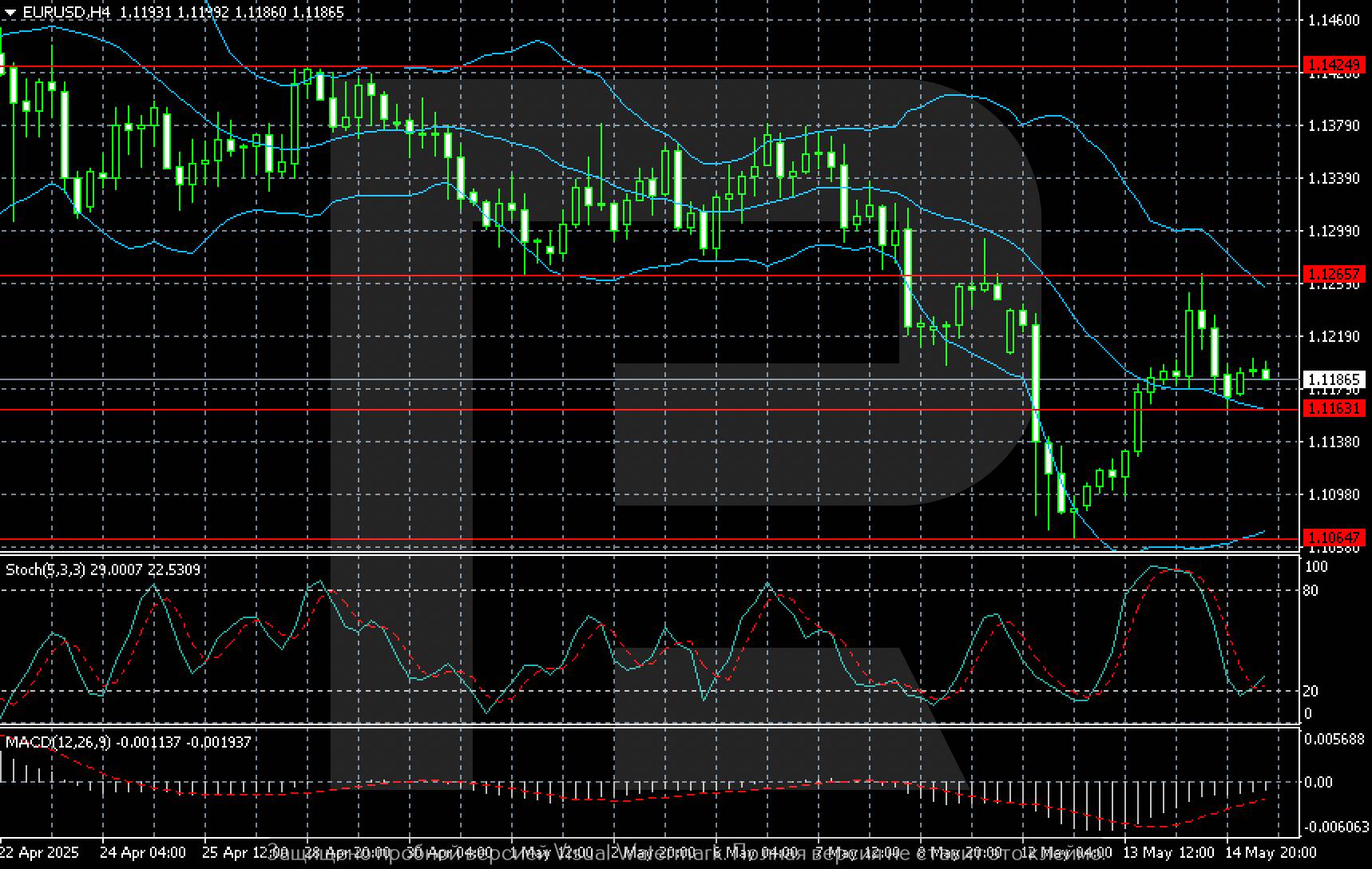
          The EURUSD pair enters another consolidation phase due to a mix of opposing factors. The market must weigh the White House’s intentions, US trade policy implications, and the upcoming data releases. The EURUSD outlook for today, 15 May 2025, anticipates a wave of selling towards 1.1163.

          The EURUSD pair remains stable around 1.1195. The market has a plethora of crucial statistics ahead. Find out more in our analysis for 15 May 2025.

          EURUSD forecast: key trading points

          ●The market believes the White House may be intentionally weakening the US dollar
          ●Focus shifts to a large batch of key data releases due tonight, including retail sales and industrial production
          ●EURUSD forecast for 15 May 2025: 1.1163

          Fundamental analysis

          The EURUSD pair is hovering around 1.1195 on Thursday. Trade uncertainty continues to pressure the market despite a recent easing in tensions.

          Investors actively debate whether Washington may be deliberately pursuing a weaker dollar as part of ongoing trade negotiations. The Trump administration previously argued that a strong dollar and weak regional currencies create unfavourable conditions for US exporters.

          The dollar’s recent strength, driven by optimism over tariff reductions in US-China talks, has started to fade. The market’s attention has now returned to the broader economic impact of Washington’s trade policy.

          Thursday brings a heavy load of crucial US dollar data, including retail sales, producer inflation figures, and the March industrial production report.

          The EURUSD forecast is moderately negative.

          Technical analysis

          On the H4 chart, the EURUSD pair has room for a local pullback towards 1.1163. If the market goes lower, the path to 1.1064 could open, although not immediately.

          On a larger timeframe, the main currency pair hovers in a sideways channel between 1.1163 and 1.1265.

          Source: RoboForex

          To stay updated on all economic events of today, please check out our Economic calendar
          Risk Warnings and Disclaimers
          You understand and acknowledge that there is a high degree of risk involved in trading. Following any strategies or investment methods may lead to potential losses. The content on the site is provided by our contributors and analysts for information purposes only. You are solely responsible for determining whether any trading assets, securities, strategy, or any other product is suitable for investing based on your own investment objectives and financial situation.
          Add to Favorites
          Share
          FastBull
          Copyright © 2025 FastBull Ltd

          728 RM B 7/F GEE LOK IND BLDG NO 34 HUNG TO RD KWUN TONG KLN HONG KONG

          TelegramInstagramTwitterfacebooklinkedin
          App Store Google Play Google Play
          Products
          Charts

          Chats

          Q&A with Experts
          Screeners
          Economic Calendar
          Data
          Tools
          Membership
          Features
          Function
          Markets
          Copy Trading
          Latest Signals
          Contests
          News
          Analysis
          24/7
          Columns
          Education
          Company
          Careers
          About Us
          Contact Us
          Advertising
          Help Center
          Feedback
          User Agreement
          Privacy Policy
          Business

          White Label

          Data API

          Web Plug-ins

          Poster Maker

          Affiliate Program

          Risk Disclosure

          The risk of loss in trading financial instruments such as stocks, FX, commodities, futures, bonds, ETFs and crypto can be substantial. You may sustain a total loss of the funds that you deposit with your broker. Therefore, you should carefully consider whether such trading is suitable for you in light of your circumstances and financial resources.

          No decision to invest should be made without thoroughly conducting due diligence by yourself or consulting with your financial advisors. Our web content might not suit you since we don't know your financial conditions and investment needs. Our financial information might have latency or contain inaccuracy, so you should be fully responsible for any of your trading and investment decisions. The company will not be responsible for your capital loss.

          Without getting permission from the website, you are not allowed to copy the website's graphics, texts, or trademarks. Intellectual property rights in the content or data incorporated into this website belong to its providers and exchange merchants.

          Not Logged In

          Log in to access more features

          FastBull Membership

          Not yet

          Purchase

          Become a signal provider
          Help Center
          Customer Service
          Dark Mode
          Price Up/Down Colors

          Log In

          Sign Up

          Position
          Layout
          Fullscreen
          Default to Chart
          The chart page opens by default when you visit fastbull.com