• Trade
  • Markets
  • Copy
  • Contests
  • News
  • 24/7
  • Calendar
  • Q&A
  • Chats
Trending
Screeners
SYMBOL
LAST
BID
ASK
HIGH
LOW
NET CHG.
%CHG.
SPREAD
SPX
S&P 500 Index
6827.42
6827.42
6827.42
6899.86
6801.80
-73.58
-1.07%
--
DJI
Dow Jones Industrial Average
48458.04
48458.04
48458.04
48886.86
48334.10
-245.98
-0.51%
--
IXIC
NASDAQ Composite Index
23195.16
23195.16
23195.16
23554.89
23094.51
-398.69
-1.69%
--
USDX
US Dollar Index
97.950
98.030
97.950
98.500
97.950
-0.370
-0.38%
--
EURUSD
Euro / US Dollar
1.17394
1.17409
1.17394
1.17496
1.17192
+0.00011
+ 0.01%
--
GBPUSD
Pound Sterling / US Dollar
1.33707
1.33732
1.33707
1.33997
1.33419
-0.00148
-0.11%
--
XAUUSD
Gold / US Dollar
4299.39
4299.39
4299.39
4353.41
4257.10
+20.10
+ 0.47%
--
WTI
Light Sweet Crude Oil
57.233
57.485
57.233
58.011
56.969
-0.408
-0.71%
--

Community Accounts

Signal Accounts
--
Profit Accounts
--
Loss Accounts
--
View More

Become a signal provider

Sell trading signals to earn additional income

View More

Guide to Copy Trading

Get started with ease and confidence

View More

Signal Accounts for Members

All Signal Accounts

Best Return
  • Best Return
  • Best P/L
  • Best MDD
Past 1W
  • Past 1W
  • Past 1M
  • Past 1Y

All Contests

  • All
  • Trump Updates
  • Recommend
  • Stocks
  • Cryptocurrencies
  • Central Banks
  • Featured News
Top News Only
Share

Iranian Media Says 18 Crew Members Of Foreign Tanker Seized In Gulf Of Oman Over Carrying 'Smuggled Fuel' Detained

Share

Regional Governor: Two Killed In Ukrainian Drone Strike On Russia's Saratov

Share

Chinese Foreign Ministry - China Foreign Minister Met With United Arab Emirates Counterpart On Dec 12

Share

China's Central Financial And Economic Affairs Commission Deputy Director: Will Expand Export And Increase Import In 2026

Share

Thai Leader Anutin: Landmine Blast That Killed Thai Soldiers 'Not A Roadside Accident'

Share

Thai Leader Anutin: Thailand To Continue Military Action Until 'We Feel No More Harm'

Share

Cambodian Prime Minister Hun Manet Says He Had Phone Calls With Trump And Malaysian Leader Anwar About Ceasefire

Share

Cambodia's Hun Manet Says USA, Malaysia Should Verify 'Which Side Fired First' In Latest Conflict

Share

Cambodia's Hun Manet: Cambodia Maintains Its Stance In Seeking Peaceful Resolution Of Disputes

Share

Nasdaq Companies: Allergan, Ferrovia, Insmed, Monolithic Power Systems, Seagate Technology, And Western Digital Will Be Added To The NASDAQ 100 Index. Biogen, CdW, GlobalFoundries, Lululemon, ON Semiconductor, And Tradedesk Will Be Removed From The NASDAQ 100 Index

Share

Witkoff Headed To Berlin This Weekend To Meet With Zelenskiy, European Leaders -Wsj Reporter On X

Share

Russia Attacks Two Ukrainian Ports, Damaging Three Turkish-Owned Vessels

Share

[Historic Flooding Occurs In At Least Four Rivers In Washington State Due To Days Of Torrential Rains] Multiple Areas In Washington State Have Been Hit By Severe Flooding Due To Days Of Torrential Rains, With At Least Four Rivers Experiencing Historic Flooding. Reporters Learned On The 12th That The Floods Caused By The Torrential Rains In Washington State Have Destroyed Homes And Closed Several Highways. Experts Warn That Even More Severe Flooding May Occur In The Future. A State Of Emergency Has Been Declared In Washington State

Share

Trump Says Proposed Free Economic Zone In Donbas Would Work

Share

Trump: I Think My Voice Should Be Heard

Share

Trump Says Will Be Choosing New Fed Chair In Near Future

Share

Trump Says Proposed Free Economic Zone In Donbas Complex But Would Work

Share

Trump Says Land Strikes In Venezuela Will Start Happening

Share

US President Trump: Thailand And Cambodia Are In A Good Situation

Share

State Media: North Korean Leader Kim Hails Troops Returning From Russia Mission

TIME
ACT
FCST
PREV
U.K. Trade Balance Non-EU (SA) (Oct)

A:--

F: --

P: --

U.K. Trade Balance (Oct)

A:--

F: --

P: --

U.K. Services Index MoM

A:--

F: --

P: --

U.K. Construction Output MoM (SA) (Oct)

A:--

F: --

P: --

U.K. Industrial Output YoY (Oct)

A:--

F: --

P: --

U.K. Trade Balance (SA) (Oct)

A:--

F: --

P: --

U.K. Trade Balance EU (SA) (Oct)

A:--

F: --

P: --

U.K. Manufacturing Output YoY (Oct)

A:--

F: --

P: --

U.K. GDP MoM (Oct)

A:--

F: --

P: --

U.K. GDP YoY (SA) (Oct)

A:--

F: --

P: --

U.K. Industrial Output MoM (Oct)

A:--

F: --

P: --

U.K. Construction Output YoY (Oct)

A:--

F: --

P: --

France HICP Final MoM (Nov)

A:--

F: --

P: --

China, Mainland Outstanding Loans Growth YoY (Nov)

A:--

F: --

P: --

China, Mainland M2 Money Supply YoY (Nov)

A:--

F: --

P: --

China, Mainland M0 Money Supply YoY (Nov)

A:--

F: --

P: --

China, Mainland M1 Money Supply YoY (Nov)

A:--

F: --

P: --

India CPI YoY (Nov)

A:--

F: --

P: --

India Deposit Gowth YoY

A:--

F: --

P: --

Brazil Services Growth YoY (Oct)

A:--

F: --

P: --

Mexico Industrial Output YoY (Oct)

A:--

F: --

P: --

Russia Trade Balance (Oct)

A:--

F: --

P: --

Philadelphia Fed President Henry Paulson delivers a speech
Canada Building Permits MoM (SA) (Oct)

A:--

F: --

P: --

Canada Wholesale Sales YoY (Oct)

A:--

F: --

P: --

Canada Wholesale Inventory MoM (Oct)

A:--

F: --

P: --

Canada Wholesale Inventory YoY (Oct)

A:--

F: --

P: --

Canada Wholesale Sales MoM (SA) (Oct)

A:--

F: --

P: --

Germany Current Account (Not SA) (Oct)

A:--

F: --

P: --

U.S. Weekly Total Rig Count

A:--

F: --

P: --

U.S. Weekly Total Oil Rig Count

A:--

F: --

P: --

Japan Tankan Large Non-Manufacturing Diffusion Index (Q4)

--

F: --

P: --

Japan Tankan Small Manufacturing Outlook Index (Q4)

--

F: --

P: --

Japan Tankan Large Non-Manufacturing Outlook Index (Q4)

--

F: --

P: --

Japan Tankan Large Manufacturing Outlook Index (Q4)

--

F: --

P: --

Japan Tankan Small Manufacturing Diffusion Index (Q4)

--

F: --

P: --

Japan Tankan Large Manufacturing Diffusion Index (Q4)

--

F: --

P: --

Japan Tankan Large-Enterprise Capital Expenditure YoY (Q4)

--

F: --

P: --

U.K. Rightmove House Price Index YoY (Dec)

--

F: --

P: --

China, Mainland Industrial Output YoY (YTD) (Nov)

--

F: --

P: --

China, Mainland Urban Area Unemployment Rate (Nov)

--

F: --

P: --

Saudi Arabia CPI YoY (Nov)

--

F: --

P: --

Euro Zone Industrial Output YoY (Oct)

--

F: --

P: --

Euro Zone Industrial Output MoM (Oct)

--

F: --

P: --

Canada Existing Home Sales MoM (Nov)

--

F: --

P: --

Euro Zone Total Reserve Assets (Nov)

--

F: --

P: --

U.K. Inflation Rate Expectations

--

F: --

P: --

Canada National Economic Confidence Index

--

F: --

P: --

Canada New Housing Starts (Nov)

--

F: --

P: --

U.S. NY Fed Manufacturing Employment Index (Dec)

--

F: --

P: --

U.S. NY Fed Manufacturing Index (Dec)

--

F: --

P: --

Canada Core CPI YoY (Nov)

--

F: --

P: --

Canada Manufacturing Unfilled Orders MoM (Oct)

--

F: --

P: --

Canada Manufacturing New Orders MoM (Oct)

--

F: --

P: --

Canada Core CPI MoM (Nov)

--

F: --

P: --

Canada Manufacturing Inventory MoM (Oct)

--

F: --

P: --

Canada CPI YoY (Nov)

--

F: --

P: --

Canada CPI MoM (Nov)

--

F: --

P: --

Canada CPI YoY (SA) (Nov)

--

F: --

P: --

Canada Core CPI MoM (SA) (Nov)

--

F: --

P: --

Q&A with Experts
    • All
    • Chatrooms
    • Groups
    • Friends
    Connecting
    .
    .
    .
    Type here...
    Add Symbol or Code

      No matching data

      All
      Trump Updates
      Recommend
      Stocks
      Cryptocurrencies
      Central Banks
      Featured News
      • All
      • Russia-Ukraine Conflict
      • Middle East Flashpoint
      • All
      • Russia-Ukraine Conflict
      • Middle East Flashpoint
      Search
      Products

      Charts Free Forever

      Chats Q&A with Experts
      Screeners Economic Calendar Data Tools
      Membership Features
      Data Warehouse Market Trends Institutional Data Policy Rates Macro

      Market Trends

      Market Sentiment Order Book Forex Correlations

      Top Indicators

      Charts Free Forever
      Markets

      News

      News Analysis 24/7 Columns Education
      From Institutions From Analysts
      Topics Columnists

      Latest Views

      Latest Views

      Trending Topics

      Top Columnists

      Latest Update

      Signals

      Copy Rankings Latest Signals Become a signal provider AI Rating
      Contests
      Brokers

      Overview Brokers Assessment Rankings Regulators News Claims
      Broker listing Forex Brokers Comparison Tool Live Spread Comparison Scam
      Q&A Complaint Scam Alert Videos Tips to Detect Scam
      More

      Business
      Events
      Careers About Us Advertising Help Center

      White Label

      Data API

      Web Plug-ins

      Affiliate Program

      Awards Institution Evaluation IB Seminar Salon Event Exhibition
      Vietnam Thailand Singapore Dubai
      Fans Party Investment Sharing Session
      FastBull Summit BrokersView Expo
      Recent Searches
        Top Searches
          Markets
          News
          Analysis
          User
          24/7
          Economic Calendar
          Education
          Data
          • Names
          • Latest
          • Prev

          View All

          No data

          Scan to Download

          Faster Charts, Chat Faster!

          Download App
          English
          • English
          • Español
          • العربية
          • Bahasa Indonesia
          • Bahasa Melayu
          • Tiếng Việt
          • ภาษาไทย
          • Français
          • Italiano
          • Türkçe
          • Русский язык
          • 简中
          • 繁中
          Open Account
          Search
          Products
          Charts Free Forever
          Markets
          News
          Signals

          Copy Rankings Latest Signals Become a signal provider AI Rating
          Contests
          Brokers

          Overview Brokers Assessment Rankings Regulators News Claims
          Broker listing Forex Brokers Comparison Tool Live Spread Comparison Scam
          Q&A Complaint Scam Alert Videos Tips to Detect Scam
          More

          Business
          Events
          Careers About Us Advertising Help Center

          White Label

          Data API

          Web Plug-ins

          Affiliate Program

          Awards Institution Evaluation IB Seminar Salon Event Exhibition
          Vietnam Thailand Singapore Dubai
          Fans Party Investment Sharing Session
          FastBull Summit BrokersView Expo

          US Stock Futures Up on China Trade De-Escalation Hopes; Fed Decision Awaited

          Glendon

          Economic

          Stocks

          China–U.S. Trade War

          Summary:

          U.S. stock index futures rose on Wednesday as hopes of a de-escalation in trade tensions with Beijing firmed, while investors awaited the Federal Reserve's decision on interest rates that is expected later in the day.

          U.S. stock index futures rose on Wednesday as hopes of a de-escalation in trade tensions with Beijing firmed, while investors awaited the Federal Reserve's decision on interest rates that is expected later in the day.

          Washington announced late on Tuesday that representatives of the two countries would meet over the weekend in Switzerland for ice-breaker trade discussions.

          The meetings will follow weeks of tit-for-tat tariffs that roiled financial markets and flagged concerns about global economic growth.

          Mixed signals from the world's two biggest economies on the status of the negotiations left markets in a state of uncertainty, pushing many companies to shelve their forecasts. The U.S. central bank, meanwhile, adopted a wait-and-watch approach despite signs of slowing growth.

          President Donald Trump's administration has said potential deals with major trading partners are underway, but markets are yet to see tangible results on that front.

          At 07:05 a.m. ET, S&P 500 E-minis were up 37.25 points, or 0.66%, Nasdaq 100 E-minis were up 133.25 points, or 0.67%, Dow E-minis were up 299 points, or 0.73%.

          The Federal Reserve is set to announce its policy decision on Wednesday afternoon and is widely expected to hold interest rates steady.Traders are now roughly pricing in a rate cut by July, according to data compiled by LSEG, after a mixed bag of economic data last week signaled a slowing economy and a resilient labor market.

          Comments from policymakers will be scrutinized for clues on how they plan to approach monetary policy easing this year, amid Trump's repeated calls for lower interest rates and criticism of Fed Chair Jerome Powell, which had spooked investors in April.

          "The Fed chair will need to balance guiding markets about the future of monetary policy and defending the Fed from pressure from the administration," said Kathleen Brooks, research director at trading platform XTB.

          "A hawkish lean from the Fed could spook markets and remind us that the recent market rally was a correction in a downtrend," Brooks said, adding that markets were expecting just that from Powell.

          Wall Street ended lower for the second straight session on Tuesday after the U.S. administration failed to provide clarity on the trade front.

          The S&P 500 is more than 8% away from its record high notched in February, even though all indexes have recouped declines logged since Trump's "Liberation Day" reciprocal tariffs announcement on April 2.

          Advanced Micro Devices (AMD.O), was up 1.7% in premarket trading after the chipmaker forecast revenue for the second quarter above Wall Street estimates.

          Walt Disney's (DIS.N), quarterly results topped Street expectations, helped by increased visitor spending at its U.S. theme parks and a surge in streaming customers, sending its shares up 5%.

          Uber Technologies (UBER.N), dropped 5.2% as the ride-hailing and food delivery company missed quarterly revenue expectations and said it anticipates a 1.5% currency-related drag on second-quarter gross bookings growth.

          Arista Networks (ANET.N), fell 5% after its quarterly report, while Marvell Technology (MRVL.O), lost 7% after narrowing its forecast for the first quarter of 2026 and postponing its investor day.

          Source: Kitco

          To stay updated on all economic events of today, please check out our Economic calendar
          Risk Warnings and Disclaimers
          You understand and acknowledge that there is a high degree of risk involved in trading. Following any strategies or investment methods may lead to potential losses. The content on the site is provided by our contributors and analysts for information purposes only. You are solely responsible for determining whether any trading assets, securities, strategy, or any other product is suitable for investing based on your own investment objectives and financial situation.
          Add to Favorites
          Share

          Tariffs Add To A Toxic Combination For U.S. Treasuries

          Michelle

          China–U.S. Trade War

          Among the notable aspects of the April market shakeout was a sell‑off in longer‑term U.S. Treasuries. My concern is that this may be only the first leg of an inevitable violent bear steepening in the Treasury yield curve. Higher Treasury yields has been a foundational view of mine for a while now, as I expressed last December in “The calm before the storm: The outlook for Treasury yields.” Circumstances and factors driving the Treasury market are now all starting to align to likely bring this view to fruition.

          At the heart of my thesis has been a worry about a tsunami of global debt issuance, which is a legacy of COVID‑generated fiscal largesse. To be clear, this is not just a U.S. issue. The U.S. is merely another participant in a hugely crowded, bare‑knuckle global debt‑sale fight—and I don’t expect issuers to fight fair.

          Another very important factor supporting higher Treasury yields is that even after the early April sell‑off, the 10‑year U.S. Treasury note offered essentially the same yield as cash in late April.

          Global growth should hold up amid fiscal stimulus from Europe and China

          The tariff news of the last few weeks has only exacerbated the ongoing tug‑of‑war between inflation and growth worries in the rates market. I generally try to avoid broad, clichéd labels that are sometimes used arbitrarily, such as stagflation or recession. Indeed, I don’t have a particularly differentiated or downbeat perspective on growth. I am certainly not ready to slip into the doom loop dominating prevailing consensus. However, it does seem very clear to me that inflation risks are skewed severely to the upside.

          On growth, in any normal environment, it would be really hard to be bearish about global growth when you have Europe and China both fiscally stimulating and easing monetary policy. While it seems like a lifetime ago, it was only in March that we saw a once‑in‑a‑generation fiscal expansion from Germany.

          I also try to keep reminding myself that the U.S. is largely a service‑based economy that relies mostly on domestic demand. In addition, further U.S. fiscal stimulus is also imminent as we head into the summer. Therefore, I think the most accurate way to think about growth is that the range of outcomes has simply widened. In short, I am not jumping into the recession camp without seeing further evidence.

          But inflation expectations could easily become unanchored

          Regarding inflation, I don’t think we can underestimate the game‑changing nature of 2022, which transformed both company and consumer attitudes and expectations around inflation. After being burned by inflation that proved far from transitory in 2022, it will be very easy for consumer inflation expectations to become unanchored.

          What we hear from current meetings with CEOs and CFOs of companies across industries and around the globe is an almost universal willingness to proactively pass on tariffs and other frictional costs to their customers. As one of my T. Rowe Price colleagues said, we are in the midst of a supply shock with the potential for a demand shock on the horizon. With this backdrop, inflation may present another challenge to U.S. Treasuries.

          There is one major factor that argues against inflation right now—the fall in energy prices. To be clear, this isn’t because U.S. domestic production has increased. Instead, it is due to the somewhat puzzling, opaque political decision from OPEC+ to increase oil production. One thing that is clear from our analysis is that at current oil prices around USD 66 per barrel for Brent crude,

          “Regarding inflation, I don’t think we can underestimate the game‑changing nature of 2022....”

          Watch for fiscal expansion to be the next overriding market theme

          One campaign agenda item that the Trump administration has yet to fully engage with is tax cuts. The odds of a large fiscal package passing before the U.S. Congress leaves for its summer recess are growing. I anticipate that fiscal expansion will soon become the next overriding focus for markets.

          Fiscal expansion may be growth supportive, but most importantly it would likely put even more pressure on the Treasury market. I am now even more convinced that the 10‑year U.S. Treasury yield will reach 6% in the next 12–18 months. Almost every piece of news this year has reenforced this view. In particular, higher inflation and further global fiscal expansion are a toxic combination for rates, particularly U.S. Treasuries. Higher yields and steeper curves are likely coming.

          How to respond: Inexpensive inflation protection

          Inflation protection remains cheap. With five‑year inflation breakevens around 2.36% in late April,

          I am also struck by two other observations. First, I am very happy that I am engaged in managing extremely liquid assets. The dislocations and opportunities being presented by the recent market volatility have been phenomenal. As I mentioned above, the range of potential outcomes has widened substantially. Not having the liquidity to react to those outcomes would be limiting.

          Second, return correlations between different assets and asset classes have changed very quickly, in some cases flipping from positive to negative or vice versa. These correlations—whether between fixed income, currencies, and equities, or indeed between individual bonds, currencies, or stocks—are one of the most important factors in portfolio construction. Taking a view on future asset class correlations may prove to be far more important in portfolio outcomes than an outlook on individual assets.

          Source: T.RowePrice

          Risk Warnings and Disclaimers
          You understand and acknowledge that there is a high degree of risk involved in trading. Following any strategies or investment methods may lead to potential losses. The content on the site is provided by our contributors and analysts for information purposes only. You are solely responsible for determining whether any trading assets, securities, strategy, or any other product is suitable for investing based on your own investment objectives and financial situation.
          Add to Favorites
          Share

          US Imports Hit Record High as Businesses Seek to Avoid Tariffs

          Warren Takunda

          Economic

          China–U.S. Trade War

          The US trade deficit soared to a record $140.5 billion (€123.6bn) in March as consumers and businesses alike tried to get ahead of President Donald Trump's latest and most sweeping tariffs — with federal data showing an enormous stockpiling of pharmaceutical products.
          The deficit — which measures the gap between the value of goods and services the US sells abroad against what it buys — has roughly doubled over the last year. In March 2024, that gap was just under $68.6bn (€60.3bn), according to the US Department of Commerce.
          According to federal data released on Tuesday, US exports for goods and services totalled about $278.5bn (€244.9bn) in March, while imports climbed to nearly $419bn (368.5bn). That’s up $500 million (€439.7m) and $17.8bn (€15.7bn), respectively, from February trade.

          Consumer goods boost US imports

          Consumer goods led the imports surge — increasing by $22.5bn (€19.8bn) in March. Pharma products in particular climbed $20.9bn (€18.4bn), the US Census Bureau and Bureau of Economic Analysis noted, signalling that drug makers sought to get ahead of Trump’s threats to slap tariffs on the sector.
          “While we had known consumer goods accounted for the bulk of March’s rise, we can now see pharmaceutical products were $20bn (€17.6bn) higher — almost all of which were imported from Ireland,” analysts at Oxford Economics wrote in a Tuesday research note. “Uncertainty remains high, and broader signs of front-loading may be visible in coming months.”
          Because pharma accounted for so much of this surge, the big rise in imports doesn’t necessarily mean other sectors used March to stockpile in the same way. Retailers, for example, may not have bought as many clothes, toys and furniture from abroad — perhaps because they were already feeling the effects of previously-implemented levies, some analysts say, or because they decided to hold off on rushing in new inventory due to uncertainty.
          Either way, this may signal supply challenges down the road — with shoppers potentially seeing barer shelves for products that run out of inventory in the coming months.
          Still, imports of “capital goods,” like computers, as well as automotive parts and cars, also increased in March. But industrial supplies and materials, such as metal and crude oil coming into the US, fell — notably as steel and aluminium tariffs and other levies impacting energy took effect. Service-based imports like travel also decreased.
          Overall, imports are flooding into the US for products that have — or rather, are feared to soon be — caught in the crosshairs of the ongoing trade war. Since taking office in January, Trump has threatened and imposed a series of steep tariffs.

          Tariffs contributed to increased US trade deficit, higher business costs

          Much of March, in particular, was filled with anticipation and uncertainty leading up to what the president called "Liberation Day" on 2 April, when he announced new import taxes on nearly all of America’s trading partners. With the exception of China, higher tariff rates for many countries have since been postponed — but other sweeping levies remain.
          The White House insists that new tariffs will help close long-standing trade deficits (the US hasn’t sold the rest of the world more than it’s bought since 1975), reinvigorate manufacturing in America and generate government revenue. But economists are warning of significant consequences for businesses, households and economies worldwide under the rates that Trump has proposed.
          These new tariffs are already increasing operating costs for businesses that rely on a global supply chain — which, in turn, will hike prices for a range of goods that consumers buy each day.
          The recent surge in imports reflects efforts by companies across the country to bring in foreign goods before more duties kicked in. New orders for manufactured durable goods, for example, jumped 9.2% to $315.7bn (€277.8bn) in March, Census Bureau data released last month shows.
          March’s trade deficit surpasses the last monthly record of $130.7bn (€115bn) reported in January — also due to tariff uncertainty after Trump took office, marking a more than $32bn (€28.2bn) jump from December.
          All of this contributed to shrinking economic growth in the first three months of the year. Last week, the Commerce Department reported that the US gross domestic product — or output of goods and services — fell 0.3% on an annual basis from January through March, marking the first drop in three years.
          Imports grew at a total 41% pace for that period, its fastest rate since 2020, shaving 5 percentage points off first-quarter growth. However, that surge is likely to reverse in the second quarter, removing some weight on GDP.

          Source: Euronews

          To stay updated on all economic events of today, please check out our Economic calendar
          Risk Warnings and Disclaimers
          You understand and acknowledge that there is a high degree of risk involved in trading. Following any strategies or investment methods may lead to potential losses. The content on the site is provided by our contributors and analysts for information purposes only. You are solely responsible for determining whether any trading assets, securities, strategy, or any other product is suitable for investing based on your own investment objectives and financial situation.
          Add to Favorites
          Share

          Yen Rally Ends, Markets Eyes Fed Rate Decision And BoJ Minutes

          Glendon

          Economic

          Forex

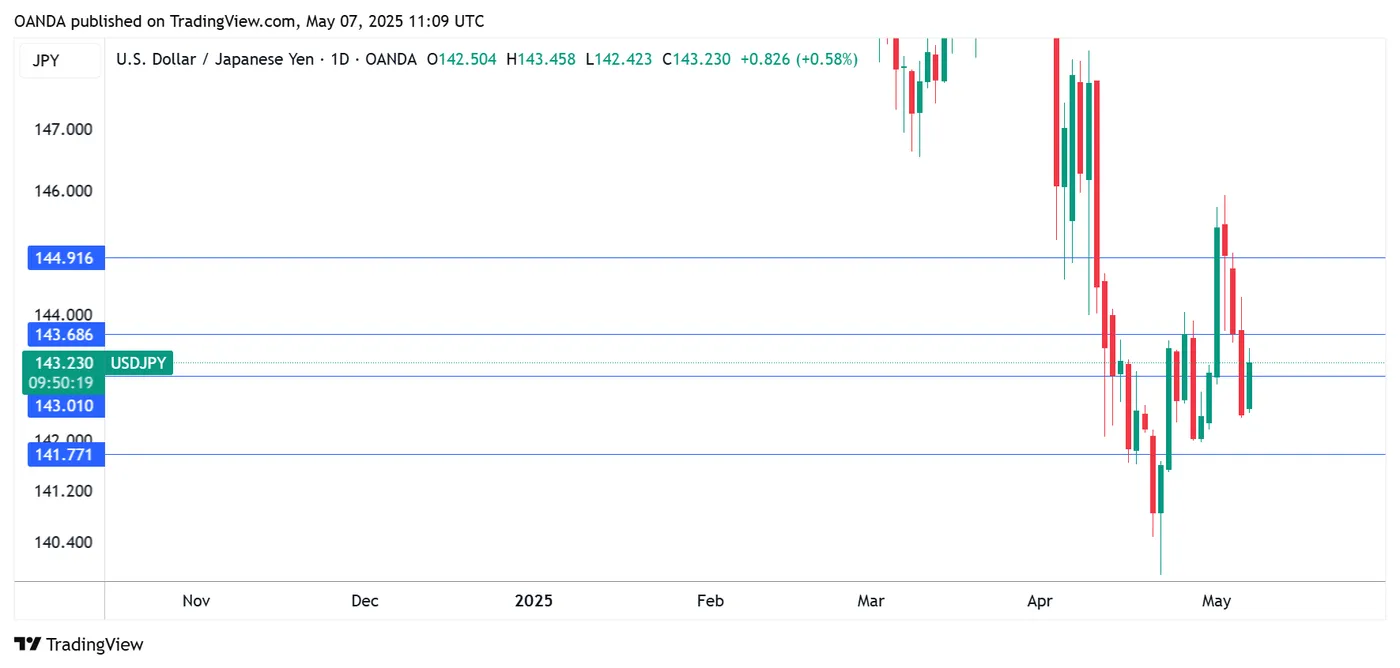
          The Japanese yen is in negative territory on Wednesday, after a three-day rally which saw it gain 2% against the US dollar. In the European session, USD/JPY is trading at 143.29, up 0.61% on the day.

          The Bank of Japan releases the minutes of its March meeting on Thursday. At the meeting, the BoJ held the key policy rate at 0.5% in a unanimous vote. Members cautioned that there was uncertainty over tariffs, which the US was expected to announce in April.

          Since then, the financial markets have see-sawed in response to President Trump’s erratic tariff policy. Japan’s export-reliant economy could be hit hard, but Tokyo is already negotiating with the US and hopes to carve out an agreement to cancel or at least mitigate the impact of the tariffs.

          The Bank of Japan is walking a tightrope, as it wants to continue to normalize policy and raise rates, but is worried about the uncertainty over the tariffs and the real possibility of a global trade war. Bank policymakers are taking a wait-and-see stance, hoping that US trade policy will become more clear.

          Fed likely to hold rates at today’s meeting

          The Federal Reserve is virtually certain to maintain rates at today’s FOMC meeting. There’s little doubt about the decision but investors will be all ears as to the amount of pushback from Fed Chair Jerome Powell, after President Trump has repeatedly pushed him to lower rates.

          The markets have priced in a 30% chance of a cut in June, compared to a 63% likelihood just one week ago, according to CME’s Fedwatch Tool. We can expect the pricing of a June cut to continue to swing, as the tariff saga continues.

          USD/JPY Technical

          • There is resistance at 143.67 and 144.92
          • 143.01 and 141.76 are the next support levels

          USDJPY 1-Day Chart, May 7, 2025

          Source: ACTIONFOREX

          To stay updated on all economic events of today, please check out our Economic calendar
          Risk Warnings and Disclaimers
          You understand and acknowledge that there is a high degree of risk involved in trading. Following any strategies or investment methods may lead to potential losses. The content on the site is provided by our contributors and analysts for information purposes only. You are solely responsible for determining whether any trading assets, securities, strategy, or any other product is suitable for investing based on your own investment objectives and financial situation.
          Add to Favorites
          Share

          Wall Street Points Higher Ahead of Federal Reserve Interest Rate Call

          Warren Takunda

          Stocks

          Wall Street is poised to open with gains as the Federal Reserve wraps up a two-day policy meeting where it will almost certainly leave interest rates unchanged despite pleas from President Donald Trump for a rate cut as he pursues a worldwide trade war.
          Futures for the S&P 500 and the Nasdaq composite rose 0.6% before the bell Wednesday. Futures for the Dow Jones Industrial Average rose 0.7%.
          Walt Disney Co. jumped more than 6% in premarket after the entertainment behemoth easily beat Wall Street’s profit targets for the second quarter. Disney’s revenue rose 7% from the same quarter a year ago as it added another 2.5 million Disney+ and Hulu subscribers.
          Disney’s results come just days after Trump accused other countries of “stealing the movie-making capabilities” of the U.S. and said that he had authorized government agencies to immediately begin the process of implementing this new import tax on all foreign-made films.
          Video game company Electronic Arts climbed more than 5% after it announced preliminary results for its most recent quarter, which also easily beat analysts’ sales and profit targets.
          Some companies say they’re already seeing impacts to their business from the uncertainty created by tariffs, causing them to revise or pull their guidance. Some have even offered two sets of forecasts — one contingent on tariffs and one without the additional costs factored in.
          Chair Jerome Powell and other Fed officials have signaled that they want to see how the duties — including 145% on all imports from China — impact consumer prices and the economy.
          Uncertainty around tariffs has also made U.S. households more pessimistic about the economy and could affect their long-term plans for purchases. That anxiety has helped fuel a surge in imports ahead of potentially more severe tariffs ahead.
          The U.S. trade deficit soared to a record $140.5 billion in March as consumers and businesses alike tried to get ahead of tariffs that went into effect in April and others that have been postponed until July. Last week, the government reported the U.S. economy shrank at a 0.3% annual pace during the first quarter of the year because of a surge in imports.
          At midday in Europe, Germany’s DAX was virtually unchanged, while the CAC 40 in Paris slipped 0.6% and Britain’s FTSE 100 shed 0.4%.
          In Asia, shares advanced after the U.S. and China said they plan to hold trade talks in Switzerland later this week.
          Hong Kong’s benchmark briefly jumped more than 2% after officials in Beijing rolled out interest rate cuts and other moves to help support the Chinese economy and markets as higher tariffs ordered by Trump hit the country’s exports.
          But the markets’ reaction to both developments was relatively restrained.
          Tokyo’s Nikkei 225 edged 0.1% lower to 36,779.66.
          The Hang Seng in Hong Kong gained only 0.1% by the end of trading, closing at 22,691.88. The Shanghai Composite index rose 0.8% to 3,342.67.
          The trade talks may account for the decision to announce the economic rescue package, Lynne Song of ING Economics said in a report.
          “This way, the easing won’t be seen as a knee-jerk reaction to tariffs. Policymakers are likely now privy to some of the early data on how the economy is being impacted by the tariff shock,” Song said.
          But analysts said the muted response to the policies announced Wednesday also may reflect disappointment over the lack of major government spending increases that many economists say may be needed to wrest the Chinese economy out of its doldrums.
          “These will help to shore up growth at the margin. But any boost to credit demand will be modest and today’s moves are no substitute for an expansion in fiscal support,” Julian Evans-Pritchard of Capital Economics said in a report.
          Australia’s S&P/ASX 200 picked up 0.3% to 8,178.30, while the Kospi in South Korea gained 0.6% to 2,573,80.
          U.S. benchmark crude oil gained 48 cents to $59.57 per barrel. Brent crude, the international standard, gained 40 cents to $62.55 per barrel.
          The dollar rose to 143.34 Japanese yen from 142.41 yen. The euro ticked down to $1.1365 from $1.1369.

          Source: AP

          Risk Warnings and Disclaimers
          You understand and acknowledge that there is a high degree of risk involved in trading. Following any strategies or investment methods may lead to potential losses. The content on the site is provided by our contributors and analysts for information purposes only. You are solely responsible for determining whether any trading assets, securities, strategy, or any other product is suitable for investing based on your own investment objectives and financial situation.
          Add to Favorites
          Share

          China And US to Hold Trade Talks As Tariffs Bite

          Michelle

          Economic

          Forex

          China and the US will hold their first trade talks since President Donald Trump took office and more than a month after the two sides imposed tariffs of more than 100% on each other.

          US Treasury Secretary Scott Bessent and US Trade Representative Jamieson Greer will travel later this week to Switzerland for talks with Chinese Vice Premier He Lifeng, seeking to dial down a tariff standoff that has threatened to hammer both economies and other nations. The announcements early on Wednesday Beijing time boosted hopes that the two largest economies in the world might pull back from their actions which had threatened to effectively eliminate bilateral trade.

          China said that it had to talk after approaches from US officials, but the Ministry of Commerce emphasized that “any dialogue and negotiation must be carried out under the premise of mutual respect, equal consultation, and mutual benefit,” adding that the US needed to “show sincerity in talks, correct wrong practices, meet China halfway, and resolve the concerns of both sides through equal consultation.”

          The US is looking to “de-escalate” tensions, Bessent said on Fox News, calling the current level of tariffs “unsustainable” and saying the US doesn’t want to break completely with China. However, the US does “want to decouple over strategic industries,” he said, mention steel, semiconductors and pharmaceuticals as examples of sectors where the US wants to reshore manufacturing from China and elsewhere.

          How damaging the tariffs have already to bilateral trade will become clearer this Friday when China released April trade figures, but high-frequency data is already showing that overall the effect has been muted so far, with Chinese ports processing more cargo in the final week of April than in any other week since the start of 2023. Shanghai port, one of the largest in the world, processed 4.5 million containers last month, according to data released on Wednesday, the most since August 2024.

          —James Mayger in Beijing

          Weekend meetings to de-escalate the punitive tariff war between the US and China can’t come soon enough for global trade. The latest sign of stress can be seen in freight rates as container liners begin to sever shipping routes that link the US and China across the Pacific. German container shipping group Hapag-Lloyd has canceled 30% of China-to-US bound shipments, according to a spokesperson. Swiss liner Kuehne + Nagel said some trades had stopped completely, while it expected a 25% to 30% drop in bookings from China to the US, CEO Stefan Paul said.

          Source: Bloomberg Europe

          To stay updated on all economic events of today, please check out our Economic calendar
          Risk Warnings and Disclaimers
          You understand and acknowledge that there is a high degree of risk involved in trading. Following any strategies or investment methods may lead to potential losses. The content on the site is provided by our contributors and analysts for information purposes only. You are solely responsible for determining whether any trading assets, securities, strategy, or any other product is suitable for investing based on your own investment objectives and financial situation.
          Add to Favorites
          Share

          China announces sweeping measures to ease policy in bid to shore up trade-war hit economy

          Adam

          Economic

          China’s central bank and financial regulators announced sweeping policy steps Wednesday, including interest rate cuts, as Beijing ramps up efforts to bolster growth amid mounting trade worries.
          China will cut the seven-day reverse repurchase rates by 10 basis points to 1.4% from 1.5%, the People’s Bank of China Governor Pan Gongsheng said at a press briefing. That will bring down the loan prime rate, the main policy rate, by around 10 basis points, the governor said.
          The central bank will also lower the reserve requirement ratio, which determines the amount of cash banks must hold in reserves, by 50 basis points, unleashing additional liquidity of 1 trillion yuan ($138.5 billion) to the market.
          The lower policy rates will come into effects Thursday, while the RRR relaxation will be effective May 15, according to state media Xinhua.
          The officials also announced measures to support financing for several key sectors, including technology and real estate, along with establishing of a 500-billion-yuan relending tool for consumption and elderly care.
          The PBOC will reduce the mortgage rates under the nation’s housing provident fund, a government-backed housing lender, by 25 basis points. Rates on five-year loans for first-time homebuyers will be trimmed to 2.6% from 2.85%, the governor said.
          It will also gradually lower the amount of cash that auto financing firms must hold in reserves to zero from the current 5%.
          These measures, however, may have limited impact on boosting domestic credit demand, said Tianchen Xu, senior economist at Economist Intelligence Unit, as “borrowing has been somewhat insensitive to interest rates.”
          China is also preparing more measures to support small and medium enterprises and the private sector, which will be announced soon, Li Yunze, the head of the financial regulatory administration, said at the briefing. The government has ramped up efforts in recent weeks to help businesses impacted by the tariffs and boost employment.
          The broad stimulus announcements Wednesday showed the officials were acting with greater urgency to bolster the economy and the easing depreciation pressure on Chinese yuan has created more desirable condition, analysts said.
          Chinese offshore yuan has regained some ground to hover near the key 7.20 threshold, after weakening to a record low of 7.4287 per U.S. dollar earlier this month. It depreciated modestly to trade at 7.2227 per U.S. dollar following the Wednesday briefing.
          “There is no longer pressure on the RMB to depreciate against the dollar. In this context, PBOC doesn’t need to worry about the risk of rate cut and RRR leading to capital outflows and RMB depreciation,” said Zhiwei Zhang, president and chief economist at Pinpoint Asset Management.
          New fiscal policy measures are, however, missing and may only be unleashed when policymakers see concrete signs of economic deterioration, Zhang said.
          Despite hinting repeatedly that it had sufficient policy firepower to deploy “when appropriate,” Beijing had largely opted for piecemeal stimulus measures this year. In a high-level economy policy setting meeting in April, Chinese top policymakers urged the country to prepare for “worst-case scenarios” with sufficient planning.
          “Policymakers are likely now privy to some of the early data on how the economy is being impacted by the tariff shock,” said Lynn Song, chief economist for Greater China at ING, flagging that “there is [still] room for further policy easing,” citing deflationary pressure and moderating growth.
          He expects further 20 basis points of cuts in the interest rates and 50-basis-point reduction in the RRR this year, while noting “the next move may not come until after the Fed resumes its rate cuts.”
          The yields on China’s benchmark 10-year government bond were little changed at 1.636% on Wednesday, according to LSEG data.
          The press conference took place hours after Beijing’s affirmation that Chinese Vice Premier He Lifeng will hold talks with U.S. Treasury Secretary Scott Bessent in Switzerland later this week to discuss tariff and trade matters, in the latest sign that negotiations could begin between the two sides.
          Those would be the first confirmed trade talks between the two countries since U.S. President Donald Trump ratcheted up tariffs on Chinese goods to an eye-watering 145%, prompting Beijing to retaliate with additional levies of 125% on imports from the U.S.
          The planned talks could mark a turning point in ongoing trade war that has rattled markets and crippled trade between the world’s two largest economies.

          source :cnbc

          To stay updated on all economic events of today, please check out our Economic calendar
          Risk Warnings and Disclaimers
          You understand and acknowledge that there is a high degree of risk involved in trading. Following any strategies or investment methods may lead to potential losses. The content on the site is provided by our contributors and analysts for information purposes only. You are solely responsible for determining whether any trading assets, securities, strategy, or any other product is suitable for investing based on your own investment objectives and financial situation.
          Add to Favorites
          Share
          FastBull
          Copyright © 2025 FastBull Ltd

          728 RM B 7/F GEE LOK IND BLDG NO 34 HUNG TO RD KWUN TONG KLN HONG KONG

          TelegramInstagramTwitterfacebooklinkedin
          App Store Google Play Google Play
          Products
          Charts

          Chats

          Q&A with Experts
          Screeners
          Economic Calendar
          Data
          Tools
          Membership
          Features
          Function
          Markets
          Copy Trading
          Latest Signals
          Contests
          News
          Analysis
          24/7
          Columns
          Education
          Company
          Careers
          About Us
          Contact Us
          Advertising
          Help Center
          Feedback
          User Agreement
          Privacy Policy
          Business

          White Label

          Data API

          Web Plug-ins

          Poster Maker

          Affiliate Program

          Risk Disclosure

          The risk of loss in trading financial instruments such as stocks, FX, commodities, futures, bonds, ETFs and crypto can be substantial. You may sustain a total loss of the funds that you deposit with your broker. Therefore, you should carefully consider whether such trading is suitable for you in light of your circumstances and financial resources.

          No decision to invest should be made without thoroughly conducting due diligence by yourself or consulting with your financial advisors. Our web content might not suit you since we don't know your financial conditions and investment needs. Our financial information might have latency or contain inaccuracy, so you should be fully responsible for any of your trading and investment decisions. The company will not be responsible for your capital loss.

          Without getting permission from the website, you are not allowed to copy the website's graphics, texts, or trademarks. Intellectual property rights in the content or data incorporated into this website belong to its providers and exchange merchants.

          Not Logged In

          Log in to access more features

          FastBull Membership

          Not yet

          Purchase

          Become a signal provider
          Help Center
          Customer Service
          Dark Mode
          Price Up/Down Colors

          Log In

          Sign Up

          Position
          Layout
          Fullscreen
          Default to Chart
          The chart page opens by default when you visit fastbull.com