Markets
News
Analysis
User
24/7
Economic Calendar
Education
Data
- Names
- Latest
- Prev


Signal Accounts for Members
All Signal Accounts
All Contests


U.S. Initial Jobless Claims 4-Week Avg. (SA)A:--
F: --
P: --
U.S. Weekly Continued Jobless Claims (SA)A:--
F: --
P: --
Canada Ivey PMI (SA) (Nov)A:--
F: --
P: --
Canada Ivey PMI (Not SA) (Nov)A:--
F: --
P: --
U.S. Non-Defense Capital Durable Goods Orders Revised MoM (Excl. Aircraft) (SA) (Sept)A:--
F: --
U.S. Factory Orders MoM (Excl. Transport) (Sept)A:--
F: --
P: --
U.S. Factory Orders MoM (Sept)A:--
F: --
P: --
U.S. Factory Orders MoM (Excl. Defense) (Sept)A:--
F: --
P: --
U.S. EIA Weekly Natural Gas Stocks ChangeA:--
F: --
P: --
Saudi Arabia Crude Oil ProductionA:--
F: --
P: --
U.S. Weekly Treasuries Held by Foreign Central BanksA:--
F: --
P: --
Japan Foreign Exchange Reserves (Nov)A:--
F: --
P: --
India Repo RateA:--
F: --
P: --
India Benchmark Interest RateA:--
F: --
P: --
India Reverse Repo RateA:--
F: --
P: --
India Cash Reserve RatioA:--
F: --
P: --
Japan Leading Indicators Prelim (Oct)A:--
F: --
P: --
U.K. Halifax House Price Index YoY (SA) (Nov)A:--
F: --
P: --
U.K. Halifax House Price Index MoM (SA) (Nov)A:--
F: --
P: --
France Current Account (Not SA) (Oct)A:--
F: --
P: --
France Trade Balance (SA) (Oct)A:--
F: --
P: --
France Industrial Output MoM (SA) (Oct)A:--
F: --
P: --
Italy Retail Sales MoM (SA) (Oct)A:--
F: --
P: --
Euro Zone Employment YoY (SA) (Q3)A:--
F: --
P: --
Euro Zone GDP Final YoY (Q3)A:--
F: --
P: --
Euro Zone GDP Final QoQ (Q3)A:--
F: --
P: --
Euro Zone Employment Final QoQ (SA) (Q3)A:--
F: --
P: --
Euro Zone Employment Final (SA) (Q3)A:--
F: --
Brazil PPI MoM (Oct)A:--
F: --
P: --
Mexico Consumer Confidence Index (Nov)A:--
F: --
P: --
Canada Unemployment Rate (SA) (Nov)--
F: --
P: --
Canada Labor Force Participation Rate (SA) (Nov)--
F: --
P: --
Canada Employment (SA) (Nov)--
F: --
P: --
Canada Part-Time Employment (SA) (Nov)--
F: --
P: --
Canada Full-time Employment (SA) (Nov)--
F: --
P: --
U.S. Personal Income MoM (Sept)--
F: --
P: --
U.S. Dallas Fed PCE Price Index YoY (Sept)--
F: --
P: --
U.S. PCE Price Index YoY (SA) (Sept)--
F: --
P: --
U.S. PCE Price Index MoM (Sept)--
F: --
P: --
U.S. Personal Outlays MoM (SA) (Sept)--
F: --
P: --
U.S. Core PCE Price Index MoM (Sept)--
F: --
P: --
U.S. UMich 5-Year-Ahead Inflation Expectations Prelim YoY (Dec)--
F: --
P: --
U.S. Core PCE Price Index YoY (Sept)--
F: --
P: --
U.S. Real Personal Consumption Expenditures MoM (Sept)--
F: --
P: --
U.S. 5-10 Year-Ahead Inflation Expectations (Dec)--
F: --
P: --
U.S. UMich Current Economic Conditions Index Prelim (Dec)--
F: --
P: --
U.S. UMich Consumer Sentiment Index Prelim (Dec)--
F: --
P: --
U.S. UMich 1-Year-Ahead Inflation Expectations Prelim (Dec)--
F: --
P: --
U.S. UMich Consumer Expectations Index Prelim (Dec)--
F: --
P: --
U.S. Weekly Total Rig Count--
F: --
P: --
U.S. Weekly Total Oil Rig Count--
F: --
P: --
U.S. Consumer Credit (SA) (Oct)--
F: --
P: --
China, Mainland Foreign Exchange Reserves (Nov)--
F: --
P: --
China, Mainland Exports YoY (USD) (Nov)--
F: --
P: --
China, Mainland Imports YoY (CNH) (Nov)--
F: --
P: --
China, Mainland Imports YoY (USD) (Nov)--
F: --
P: --
China, Mainland Imports (CNH) (Nov)--
F: --
P: --
China, Mainland Trade Balance (CNH) (Nov)--
F: --
P: --
China, Mainland Exports (Nov)--
F: --
P: --


No matching data
Latest Views
Latest Views
Trending Topics
Top Columnists
Latest Update
White Label
Data API
Web Plug-ins
Affiliate Program
View All

No data
For four months many economists have predicted that US inflation would reignite, in large part due to President Donald Trump’s trade war and the knock-on effects his tariffs would have on the economy.
For four months many economists have predicted that US inflation would reignite, in large part due to President Donald Trump’s trade war and the knock-on effects his tariffs would have on the economy. But for a fourth month in a row, data released by the Trump administration’s Bureau of Labor Statistics came in lower than expected. The consumer price index, excluding the often volatile food and energy categories, increased only 0.1% from April, according to government data.
The string of below-forecast inflation readings could be attributable to how many of the administration’s threatened levies are on hold. (In early April, Trump’s “reciprocal” tariffs managed to destabilize the bond market before he largely retreated.) Treasury Secretary Scott Bessent, who is being floated as a potential replacement for Jerome Powell at the Federal Reserve, credited Trump’s trade policies for slowing inflation, saying he challenged a “decades-old status quo.”
However, prices for groceries rose 0.3% after declining in April and retailers like Walmart and Target have warned of higher prices, as have carmakers including Ford and Subaru. A Fed survey of economic activity last week showed prices advanced at a “moderate” pace across the US in recent weeks, with some regions expecting future increases to be “strong, significant or substantial.”
America’s debt burden and interest expense have become “untenable,” a situation that may lead investors to move out of dollar-based assets, according to DoubleLine Capital’s Jeffrey Gundlach. “There’s an awareness now that the long-term Treasury bond is not a legitimate flight-to-quality asset,” the veteran bond manager said Wednesday in an interview at the Bloomberg Global Credit Forum in Los Angeles. A “reckoning is coming.”
In a wide-ranging discussion that also touched on gold’s attractiveness, stretched market valuations, the state of private credit, artificial intelligence and long-term investment opportunities in India, Gundlach said investors should be considering non-dollar-based holdings, adding that his firm was starting to introduce foreign currencies into its funds.
Calling Trump’s accelerating militarization of the government response to mostly peaceful protests in Los Angeles an “unmistakable step toward authoritarianism,” California Governor Gavin Newsom warned in a prime-time speech Tuesday that “democracy is under assault right before our eyes. This moment we have feared has arrived.”
Newsom, a leading potential Democratic candidate for president in 2028 who Trump has threatened with arrest, said the 78-year-old Republican will seek to bend other states to his will and threatens America’s wavering system of government. Protests against Trump have spread across the country, with more planned through the weekend.
Undeterred, Trump, who pardoned hundreds of his followers for their roles in the deadly Jan. 6, 2021, attack on the US Capitol, made a thinly veiled threat of violence against Americans who come out to protest his coming military parade in Washington (which coincides with his 79th birthday). Also, Trump’s attorney general and defense secretary threatened to federalize local prosecutions and increase domestic use of the military, respectively. And finally, members of the US military are not only assisting federal security agents on immigration raids in Los Angeles, but they are now themselves detaining Americans citizens.
Apollo Global Management told prospective investment-banking candidates that it won’t interview or extend offers to the class of 2027 this year, following a backlash from banks over young recruits accepting future-dated offers. In a letter sent to candidates on Wednesday, Apollo explained its decision by saying it believes graduates should take time early in their careers and deepen their understanding of business.
Apollo Chief Executive Officer Marc Rowan said he agreed with recent criticisms that the process for hiring young recruits had started too early. “Hiring decisions at Apollo are among the most significant to our business,” David Sambur, co-head of private equity and Nicole Bonsignore, head of human capital, wrote in the letter seen by Bloomberg. “With that in mind, we will not formally interview and extend offers this year for the class of 2027.”
Paul Tudor Jones sees the US dollar dropping over the next year as short-term interest rates fall sharply, he said. Jones, who founded the $16 billion macro hedge fund Tudor Investment Corp., said the dollar may be 10% lower a year from now as the yield curve steepens. “You know that we are going to cut short-term rates dramatically in the next year,” Jones said Wednesday in an interview with Bloomberg TV. “And you know that the dollar will probably be lower because of it. A lot lower because of it.”
Republican senators are considering placing a $30,000 cap on the state and local tax deduction as a compromise between current law and the more generous limit in the House’s version of the massive GOP tax bill. Senator Thom Tillis said his fellow Republican senators are trying to reduce the House-passed $40,000 SALT limit to at least $30,000.
Senators are also considering revising a levy on foreign investors, which has become known as the Section 899 “revenge tax.” That has sparked fears on Wall Street that it could make it difficult for foreign companies and individuals to invest in the US. Investors also fear the tax bill as a whole—specifically its projected multitrillion-cost to the US budget.
House Republicans just rewired Donald Trump’s One Big, Beautiful bill to keep it alive in the Senate, ripping out several key provisions that had been flagged as rule violations.
The changes went through on Wednesday afternoon after a 213 to 207 vote, locking in a procedural maneuver that updated the bill automatically without needing a second full House vote. The only Republican to vote no was Thomas Massie, a lawmaker from Kentucky.
The maneuver was needed to protect the bill’s reconciliation status — that is, the special privilege that allows it to bypass the filibuster and pass the Senate with a simple majority. Without these tweaks, the bill would’ve lost that shield and been exposed to a 60-vote threshold it had no chance of clearing.
According to reporting from Politico, the stripped-down version is meant to preserve the package’s viability ahead of the Senate’s review.
Republicans deleted many big-ticket items that were originally in their House version. These included $2 billion for Pentagon military intelligence, over $500 million for missile development, and a policy to crack down on the employee retention tax credit, which had turned into a scam magnet during and after the pandemic. That last item alone was expected to generate more than $6 billion in offsets that were supposed to balance the bill’s other spending and tax cuts.
But none of that could survive the Senate parliamentarian’s review. If those policies stayed, the parliamentarian would’ve ruled the bill out of order under reconciliation rules. That would have made it vulnerable to a filibuster and likely dead on arrival. So Republican leadership acted fast to rip out those items before the bill even reached the Senate.
They aren’t done yet. The Senate parliamentarian is still going through the rest of the package, and more sections could get cut for breaking budget rules. That means more adjustments are coming — and fast — because Republicans are still aiming to pass the full bill by July 4.
Trump’s party wants to rewrite and reintroduce some of the policies that got pulled. But they’ll try doing it through the Senate version instead, hoping they can get the language right this time without losing the fast-track privilege. Meanwhile, Senate Republicans are writing their version of the package now, and they’ve got less than a month to lock it in.
Mike Johnson, the Speaker of the House, told reporters, “We’ll see what they produce,” referring to the Senate’s work. “I just need them to come to their final decisions on everything. So we’ll see how it shapes up.”
Behind closed doors, aides in both chambers know the timeline is tight. Some say that even if the Senate moves quickly, it could still take weeks or even months to finalize if their version drifts too far from what the House passed. That’s a problem, because neither chamber wants to go through another pingpong fight — sending the bill back and forth for revisions.
The current plan is to settle all disputes during the Senate process. That way, once the Senate finishes, the House can vote again — once — to approve the final product and send it to Trump. But for that to work, they’ll need to agree ahead of time on some major sticking points: spending cuts, business tax extensions, and the SALT deduction cap.
“There’s just a lot of coordination to hopefully avoid some of the potential snafus that could happen with something that’s this complicated,” said John Thune, the Republican whip.
Work is already underway. Nick LaLota, a Republican from New York, met with Senate GOP staff on Wednesday to talk about raising the SALT cap. Over in a separate meeting Tuesday night, Chip Roy from Texas and Scott Perry from Pennsylvania sat down with budget hawks like Mike Lee, Ron Johnson, and Rick Scott to push for tighter spending limits and to keep the House’s cuts to clean energy tax credits in place.
U.S. President Donald Trump on Wednesday said U.S. personnel were being moved out of the Middle East because "it could be a dangerous place," adding that the United States would not allow Iran to have a nuclear weapon.
Reuters reported earlier on Wednesday that the U.S. is preparing a partial evacuation of its Iraqi embassy and will allow military dependents to leave locations around the Middle East due to heightened security risks in the region, according to U.S. and Iraqi sources.
The four U.S. and two Iraqi sources did not say what security risks had prompted the decision and reports of the potential evacuation pushed up oil prices by more than 4%.
A U.S. official said the State Department had authorized voluntary departures from Bahrain and Kuwait.
The decision by the U.S. to evacuate some personnel comes at a volatile moment in the region. Trump's efforts to reach a nuclear deal with Iran appear to be deadlocked and U.S. intelligence indicates that Israel has been making preparations for a strike against Iran's nuclear facilities.
"They are being moved out because it could be a dangerous place, and we'll see what happens," Trump told reporters. "We've given notice to move out."
Asked whether anything can be done to lower the temperature in the region, Trump said: "They can't have a nuclear weapon. Very simple, they can't have a nuclear weapon."
Trump has repeatedly threatened to strike Iran if stuttering talks over its nuclear programme fail and in an interview released earlier on Wednesday said he was growing less confident that Tehran would agree to stop enriching uranium, a key American demand.
Iranian Defence Minister Aziz Nasirzadeh also said on Wednesday that if Iran was subjected to strikes it would retaliate by hitting U.S. bases in the region.
The U.S. embassy in Kuwait said in a statement on Wednesday that it "has not changed its staffing posture and remains fully operational."
The United States has a military presence across the major oil-producing region, with bases in Iraq, Kuwait, Qatar, Bahrain and the United Arab Emirates.
U.S. Defense Secretary Pete Hegseth has authorized the voluntary departure of military dependents from locations across the Middle East, a U.S. official said. Another U.S. official said that was mostly relevant to family members located in Bahrain -- where the bulk of them are based.
"The State Department is set to have an ordered departure for (the) U.S. embassy in Baghdad. The intent is to do it through commercial means, but the U.S. military is standing by if help is requested," a third U.S. official said.
Iraq's state news agency cited a government source as saying Baghdad had not recorded any security indication that called for an evacuation.
Another U.S. official said that there was no change in operations at Al Udeid Air Base in Qatar, the largest U.S. military base in the Middle East and that no evacuation order had been issued for employees or families linked to the U.S. embassy in Qatar, which was operating as usual.
Oil futures climbed $3 on reports of the Baghdad evacuation with Brent crude futures at $69.18 a barrel.
Earlier on Wednesday Britain's maritime agency warned that increased tensions in the Middle East may lead to an escalation in military activity that could impact shipping in critical waterways. It advised vessels to use caution while travelling through the Gulf, the Gulf of Oman and the Straits of Hormuz, which all border Iran.
Britain's Foreign Office said it was monitoring the situation and will keep its embassy in Iraq under constant review following the U.S. moves.
Iraq, a rare regional partner of both the United States and its arch regional foe Iran, hosts 2,500 U.S. troops although Tehran-backed armed factions are linked to its security forces.
Tensions inside Iraq have heightened since the start of the war in Gaza in October 2023, with Iran-aligned armed groups in the country repeatedly attacking U.S. troops, though attacks have subsided since last year.
Israel and Iran also twice exchanged fire last year - the first ever such direct attacks between the region's most entrenched enemies - with missiles and war drones hurtling across Iraqi airspace.
Top U.S. regional ally Israel has also struck Iran-linked targets across the region, including Iraqi armed groups operating both inside Iraq and in neighbouring Syria.
In recent months the United States had deployed more military assets in the Middle East -- including B-2 bombers, which have since been replaced, and extending the deployment of a second aircraft carrier, which has since departed.
The next round of nuclear talks between Iran and the United States is due in the coming days with Iran expected to hand over a counter proposal after rejecting an offer by Washington.
A senior Iranian official told Reuters that a military threat has always been part of the United States’ negotiation tactics with Iran.
“Any military action against Iran, whether by the U.S. or Israel, will have serious consequences,” the official warned.
Iran's U.N. mission on Wednesday posted on X: "Threats of 'overwhelming force' won't change facts: Iran is not seeking a nuclear weapon and U.S. militarism only fuels instability."
The statement appeared to be a response to an earlier comment by U.S. Army General Michael "Erik" Kurilla, the head of U.S. Central Command, that he had provided the president with "a wide range of options" to prevent a nuclear-armed Iran.
Kurilla postponed testimony he was due to deliver before U.S. lawmakers on Thursday because of tensions in the Middle East, two other U.S. officials said.
Reporting by Daphne Psaledakis, Idrees Ali, Humeyra Pamuk and Steve Holland and Jeff Mason in Washington, Michelle Nichols in New York, Ahmed Rasheed and Timour Azhari in Baghdad and Parisa Hafezi in Dubai; Additional reporting by Sam Tabahriti in London; Writing by Jaidaa Taha, Yomna Ehab and Angus McDowall; Editing by Deepa Babington
U.S. troops in Los Angeles are authorized to detain people until police can arrest them, their commanding officer said on Wednesday, as hundreds of Marines prepared to move into a city rocked by protests over President Donald Trump's immigration raids.
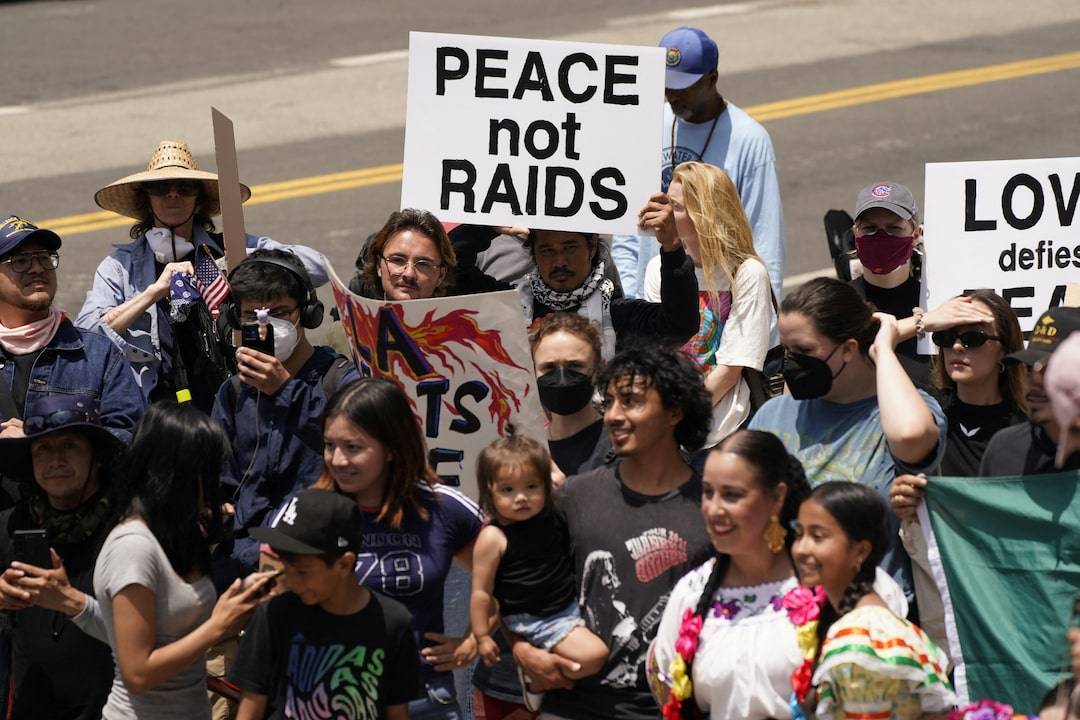
On Wednesday, Los Angeles endured a sixth day of protests that have been largely peaceful but occasionally punctuated by violence. The protests have spread to other U.S. cities and hundreds of nationwide demonstrations are planned for Saturday.
Trump's decision to dispatch troops to Los Angeles over the objections of California Governor Gavin Newsom has sparked a national debate about the use of the military on U.S. soil. Newsom's administration has sued the U.S. government to stop the deployment.
The Marines and National Guard could be deployed to protect federal personnel and property during immigration raids or related protests, officials have said.
Trump is carrying out a campaign promise to deport immigrants, employing forceful tactics consistent with the norm-breaking political style that got him elected twice. Democrats condemn these tactics as authoritarian, arguing they undermine democratic traditions.
"If I didn't act quickly on that, Los Angeles would be burning to the ground right now," said Trump at an event at the John F. Kennedy Center for the Performing Arts.
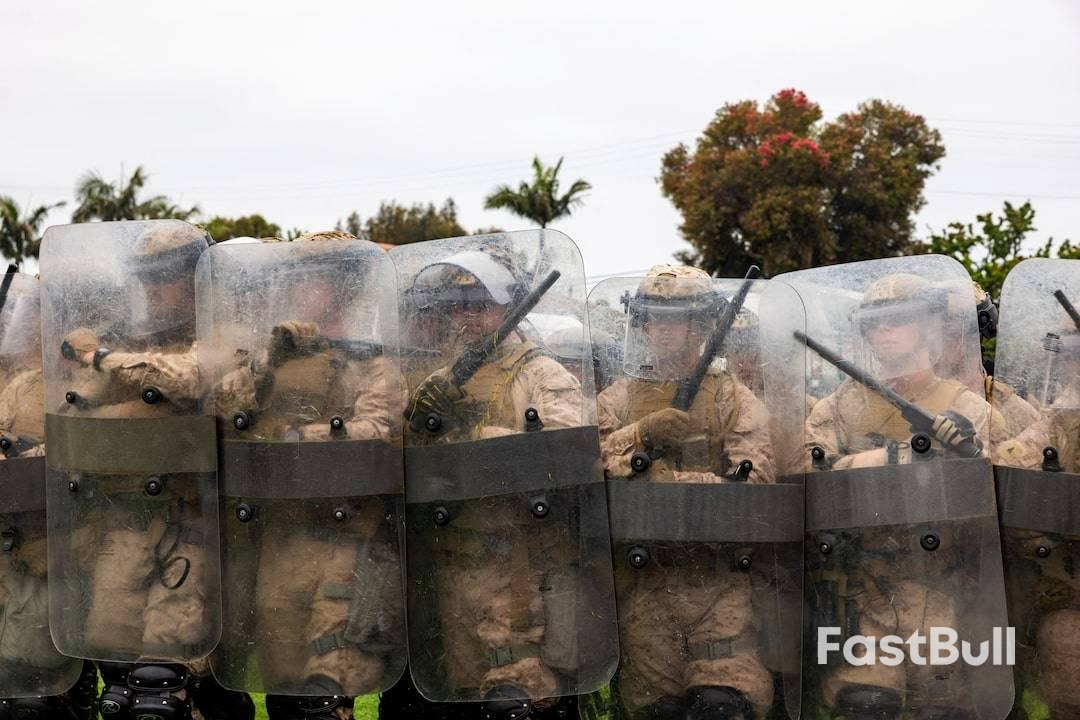
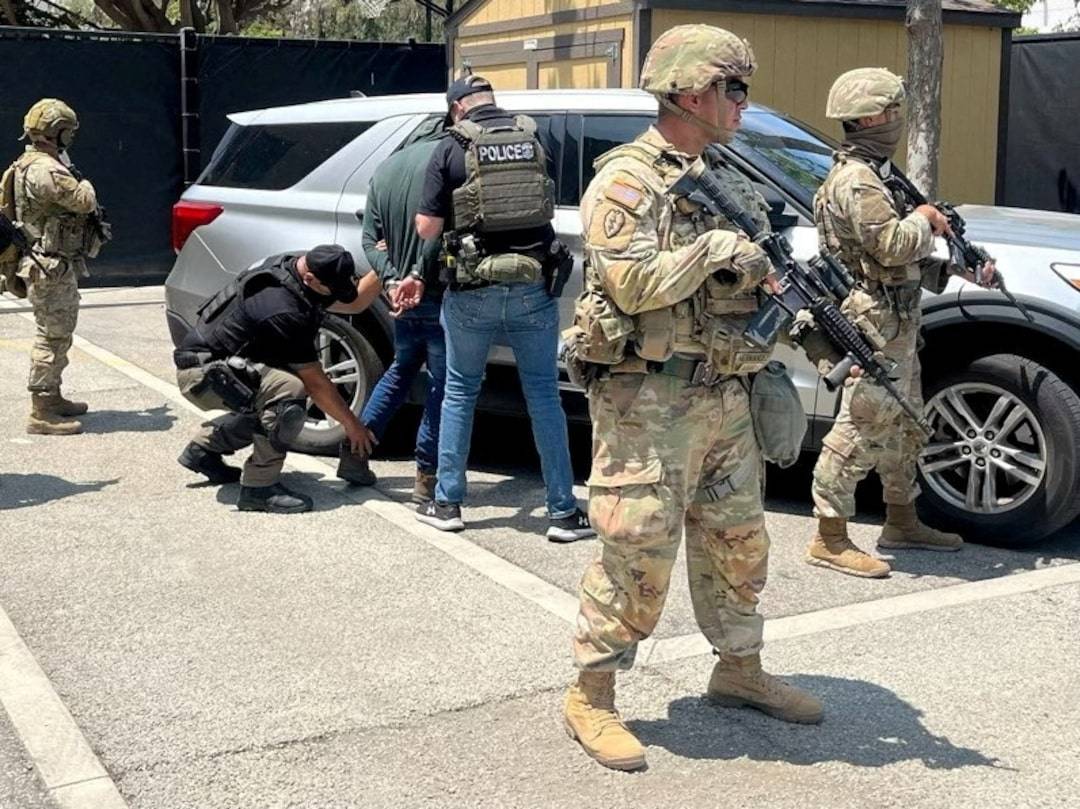
U.S. Army Major General Scott Sherman, who commands the deployed troops, told reporters that the 700 Marines and 4,000 National Guard troops cannot make arrests but could briefly detain people.
"They do not do any arrests. They're strictly there to detain to wait for law enforcement to come and handle those demonstrators," Sherman said.
Los Angeles County Sheriff Robert Luna said he was asking military leaders for clarification on the matter.
"My understanding at this point is that they do not have the powers to arrest or detain," Luna told a press conference.
The use of military forces is at the heart of California's lawsuit. The state maintains that none of the conditions were met to justify military deployment - such as a rebellion or danger thereof. It is also seeking a temporary restraining order to immediately stop the National Guard and Marines from participating in civilian law enforcement.
A hearing on that restraining order is scheduled for Thursday in San Francisco federal court.


Item 1 of 19 U.S. Marines with 2nd Battalion, 7th Marine Regiment, 1st Marine Division, who were placed in an alert status over the weekend, rehearse crowd control tactics at a base in the greater Los Angeles area, California, U.S. June 10, 2025. U.S. Marine Corps/Cpl. Juan Torres/Handout via REUTERS
[1/19]U.S. Marines with 2nd Battalion, 7th Marine Regiment, 1st Marine Division, who were placed in an alert status over the weekend, rehearse crowd control tactics at a base in the greater Los Angeles area, California, U.S. June 10, 2025. U.S. Marine Corps/Cpl. Juan Torres/Handout via REUTERS Purchase Licensing Rights, opens new tab
The Trump administration argued in a court filing ahead of the hearing that the president has the discretion to determine whether a "rebellion or danger of a rebellion" requires a military response.
The Marines, who have been training at Seal Beach just south of Los Angeles County, will move to the city soon, but not on Wednesday, Sherman said. They will not carry live ammunition in their rifles, he added.
Los Angeles Mayor Karen Bass, joined at a press conference by about 30 other California mayors, said the White House has overstepped its authority and has provoked the unrest.
The mayor of a neighboring city, Arturo Flores of Huntington Park, said that as a former Marine who served in Iraq and Afghanistan he wanted to remind military personnel that the people of Los Angeles were not foreign enemies."When we lifted our hands and we swore the oath to defend the Constitution and to defend this country, that oath was to the American people," Flores said. "It was not to a dictator, it was not to a tyrant, it was not to a president, it was to the American people and the people that are here in these communities ... are Americans, whether they have a document or they don't, you're dealing with Americans."
National Guard personnel have joined U.S. Immigration and Customs Enforcement officers in a support role on raids and have stood guard at a federal detention facility targeted by the protesters.
Bass blamed a few troublemakers for disrupting largely peaceful protests that have been limited to about five downtown streets.
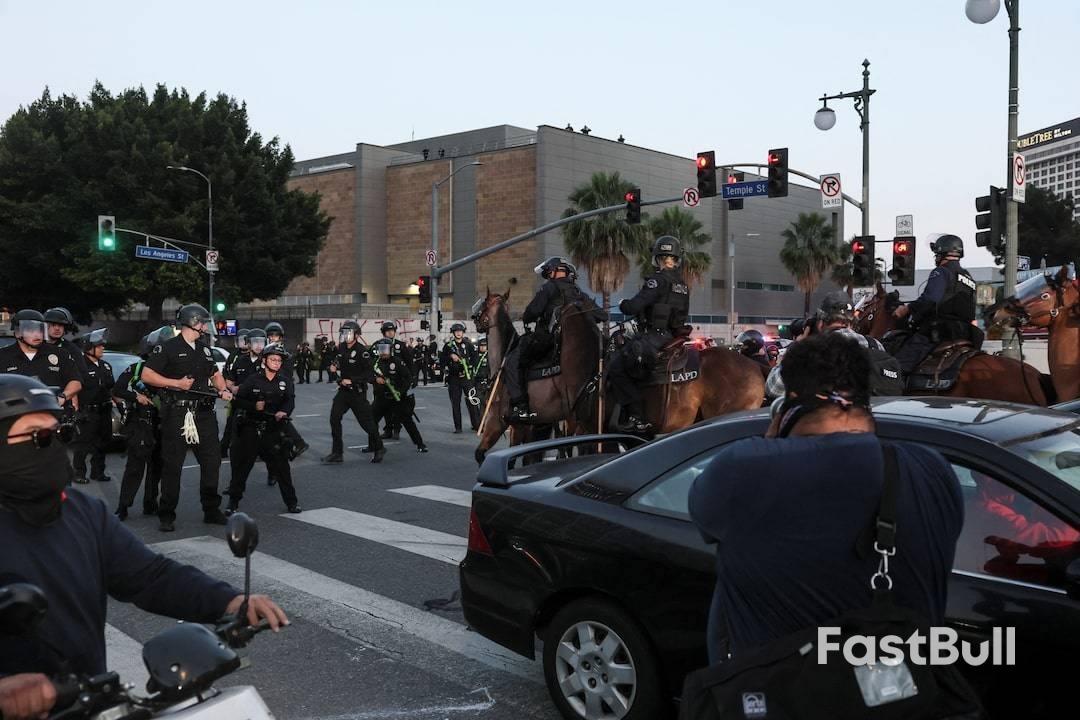
Even so, given the amount of looting, property damage and graffiti, Bass imposed a curfew over one square mile (2.5 square km) of the city's downtown starting on Tuesday night.
The Los Angeles Police Department said it arrested 225 people on Tuesday, including 203 for failing to disperse and 17 for violating the curfew. In all, police have arrested more than 400 people since Friday.
"President Trump promised to carry out the largest mass deportation campaign in American history and left-wing riots will not deter him in that effort," White House press secretary Karoline Leavitt said.
Elsewhere, protesters marched in New York, Atlanta and Chicago on Tuesday night, chanting anti-ICE slogans and at times clashing with law enforcement.
The protests are set to expand on Saturday, when several activist groups have planned more than 1,800 anti-Trump demonstrations across the country. That day, tanks and other armored vehicles will rumble down the streets of Washington, D.C., in a military parade marking the U.S. Army's 250th anniversary and coinciding with Trump's 79th birthday.
Reporting by Brad Brooks, Omar Younis, Jane Ross and Arafat Barbakh in Los Angeles, Dietrich Knauth in New York, and Idrees Ali and Tim Reid in Washington; Additional reporting by Costas Pitas, Christian Martinez, Ryan Jones, Ted Hesson and Jasper Ward; Writing by Joseph Ax and Daniel Trotta; Editing by Ross Colvin, Rod Nickel and Lisa Shumaker
Key Points:
Treasury Secretary Besent announced on June 12 that the U.S. may extend the 90-day tariff suspension for partners negotiating in good faith, stated in a hearing before the House Ways and Means Committee in Washington.
This potential extension aims to reduce trade uncertainty and stabilize markets. Market response has been calm, with no direct crypto impact reported.
U.S. Treasury Secretary Besent stated that the Trump administration might lengthen the tariff suspension, initially set for 90 days, beyond the July 9 deadline. The decision depends on whether major U.S. trade partners negotiate in good faith. The announcement came during a hearing at the House Ways and Means Committee, signaling an open stance amid complex global negotiations.
This development offers temporary market relief by reducing trade uncertainties. Analysts suggest such market-friendly gestures help stabilize trading conditions, supporting broader economic dynamics. The potential extension aims to facilitate continued dialogue with the 18 key trading partners mentioned by Besent, promoting ongoing negotiations without immediate financial disruption.
Market participants reacted cautiously. While stablecoin assets like USDT and USDC remain intricately tied to U.S. Treasury markets, the news did not trigger notable volatility. Analysts like Michaël van de Poppe view the broader economic climate positively, reflecting a bullish sentiment for digital assets given current stable macro conditions. As van de Poppe noted, “Bitcoin's recent breakout above the $106,500 resistance level triggered a swift move to $108,000, followed by a rapid retest that was aggressively bought up… confirming upward momentum in the current Bitcoin trend.”
Did you know? Previous tariff suspensions often led to interim periods of market calm, only to be followed by pronounced volatility upon deadline expiration or negotiation breakdowns, showing markets' sensitivity to policy timelines.
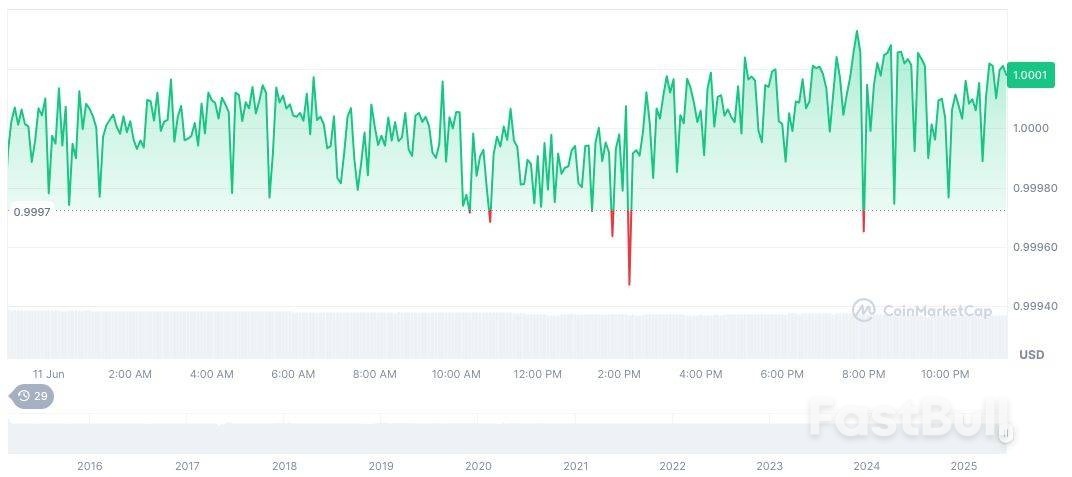
Tether USDt (USDT) holds a market cap of $155.20 billion and shows price stability with unchanged value at $1.00, reflecting a 0.00% price change over 24 hours (CoinMarketCap). The 24-hour trading volume decreased by 9.50%, aligning with maintained market stability amid current macroeconomic trends.
Tether USDt(USDT), daily chart, screenshot on CoinMarketCap at 00:26 UTC on June 12, 2025. Source: CoinMarketCapCoincu research indicates that while crypto markets remain stable, future regulatory or financial shifts linked to tariff policies could affect crypto liquidity.
U.S. President Donald Trump said on Wednesday that he will send letters to major economies setting his planned trade tariffs in the coming weeks, before a July 9 deadline to strike trade deals with his administration.
“At a certain point we’re just going to send letters out saying ‘this is the deal,’ you can take it or you can leave it,” Trump told reporters at the Kennedy Center.
“We’re going to be sending letters out in a week and a half to two weeks telling them what the deal is.”
Trump said talks were ongoing with Japan, South Korea, and about 15 countries.
It remained unclear whether Trump would make good on his tariff deadline, given that the president has set trade deadlines of two to three weeks in the past, only for them to pass either with no action or more extension.
When asked if he was willing to extend his July 9 deadline for trade talks, Trump said “I would, but I don’t think we’re going to have that necessity.”
Trump’s “liberation day” tariffs are set to take effect in early July, after the president initially unveiled them in April but announced a 90-day extension for trade talks. The president has threatened to impose steep tariffs on major U.S. trading partners unless they agree to a trade deal with the country.
So far, Trump’s administration has signed a trade deal only with the UK, and recently formed a trade framework with China.
Trump claimed on Wednesday that a trade deal with China was “done,” and that the U.S. had secured the supply of rare earths from the country. But more details on the deal were not provided.
White Label
Data API
Web Plug-ins
Poster Maker
Affiliate Program
The risk of loss in trading financial instruments such as stocks, FX, commodities, futures, bonds, ETFs and crypto can be substantial. You may sustain a total loss of the funds that you deposit with your broker. Therefore, you should carefully consider whether such trading is suitable for you in light of your circumstances and financial resources.
No decision to invest should be made without thoroughly conducting due diligence by yourself or consulting with your financial advisors. Our web content might not suit you since we don't know your financial conditions and investment needs. Our financial information might have latency or contain inaccuracy, so you should be fully responsible for any of your trading and investment decisions. The company will not be responsible for your capital loss.
Without getting permission from the website, you are not allowed to copy the website's graphics, texts, or trademarks. Intellectual property rights in the content or data incorporated into this website belong to its providers and exchange merchants.
Not Logged In
Log in to access more features

FastBull Membership
Not yet
Purchase
Log In
Sign Up