• Trade
  • Markets
  • Copy
  • Contests
  • News
  • 24/7
  • Calendar
  • Q&A
  • Chats
Trending
Screeners
SYMBOL
LAST
BID
ASK
HIGH
LOW
NET CHG.
%CHG.
SPREAD
SPX
S&P 500 Index
6827.42
6827.42
6827.42
6899.86
6801.80
-73.58
-1.07%
--
DJI
Dow Jones Industrial Average
48458.04
48458.04
48458.04
48886.86
48334.10
-245.98
-0.51%
--
IXIC
NASDAQ Composite Index
23195.16
23195.16
23195.16
23554.89
23094.51
-398.69
-1.69%
--
USDX
US Dollar Index
97.950
98.030
97.950
98.500
97.950
-0.370
-0.38%
--
EURUSD
Euro / US Dollar
1.17394
1.17409
1.17394
1.17496
1.17192
+0.00011
+ 0.01%
--
GBPUSD
Pound Sterling / US Dollar
1.33707
1.33732
1.33707
1.33997
1.33419
-0.00148
-0.11%
--
XAUUSD
Gold / US Dollar
4299.39
4299.39
4299.39
4353.41
4257.10
+20.10
+ 0.47%
--
WTI
Light Sweet Crude Oil
57.233
57.485
57.233
58.011
56.969
-0.408
-0.71%
--

Community Accounts

Signal Accounts
--
Profit Accounts
--
Loss Accounts
--
View More

Become a signal provider

Sell trading signals to earn additional income

View More

Guide to Copy Trading

Get started with ease and confidence

View More

Signal Accounts for Members

All Signal Accounts

Best Return
  • Best Return
  • Best P/L
  • Best MDD
Past 1W
  • Past 1W
  • Past 1M
  • Past 1Y

All Contests

  • All
  • Trump Updates
  • Recommend
  • Stocks
  • Cryptocurrencies
  • Central Banks
  • Featured News
Top News Only
Share

Iranian Media Says 18 Crew Members Of Foreign Tanker Seized In Gulf Of Oman Over Carrying 'Smuggled Fuel' Detained

Share

Regional Governor: Two Killed In Ukrainian Drone Strike On Russia's Saratov

Share

Chinese Foreign Ministry - China Foreign Minister Met With United Arab Emirates Counterpart On Dec 12

Share

China's Central Financial And Economic Affairs Commission Deputy Director: Will Expand Export And Increase Import In 2026

Share

Thai Leader Anutin: Landmine Blast That Killed Thai Soldiers 'Not A Roadside Accident'

Share

Thai Leader Anutin: Thailand To Continue Military Action Until 'We Feel No More Harm'

Share

Cambodian Prime Minister Hun Manet Says He Had Phone Calls With Trump And Malaysian Leader Anwar About Ceasefire

Share

Cambodia's Hun Manet Says USA, Malaysia Should Verify 'Which Side Fired First' In Latest Conflict

Share

Cambodia's Hun Manet: Cambodia Maintains Its Stance In Seeking Peaceful Resolution Of Disputes

Share

Nasdaq Companies: Allergan, Ferrovia, Insmed, Monolithic Power Systems, Seagate Technology, And Western Digital Will Be Added To The NASDAQ 100 Index. Biogen, CdW, GlobalFoundries, Lululemon, ON Semiconductor, And Tradedesk Will Be Removed From The NASDAQ 100 Index

Share

Witkoff Headed To Berlin This Weekend To Meet With Zelenskiy, European Leaders -Wsj Reporter On X

Share

Russia Attacks Two Ukrainian Ports, Damaging Three Turkish-Owned Vessels

Share

[Historic Flooding Occurs In At Least Four Rivers In Washington State Due To Days Of Torrential Rains] Multiple Areas In Washington State Have Been Hit By Severe Flooding Due To Days Of Torrential Rains, With At Least Four Rivers Experiencing Historic Flooding. Reporters Learned On The 12th That The Floods Caused By The Torrential Rains In Washington State Have Destroyed Homes And Closed Several Highways. Experts Warn That Even More Severe Flooding May Occur In The Future. A State Of Emergency Has Been Declared In Washington State

Share

Trump Says Proposed Free Economic Zone In Donbas Would Work

Share

Trump: I Think My Voice Should Be Heard

Share

Trump Says Will Be Choosing New Fed Chair In Near Future

Share

Trump Says Proposed Free Economic Zone In Donbas Complex But Would Work

Share

Trump Says Land Strikes In Venezuela Will Start Happening

Share

US President Trump: Thailand And Cambodia Are In A Good Situation

Share

State Media: North Korean Leader Kim Hails Troops Returning From Russia Mission

TIME
ACT
FCST
PREV
U.K. Trade Balance Non-EU (SA) (Oct)

A:--

F: --

P: --

U.K. Trade Balance (Oct)

A:--

F: --

P: --

U.K. Services Index MoM

A:--

F: --

P: --

U.K. Construction Output MoM (SA) (Oct)

A:--

F: --

P: --

U.K. Industrial Output YoY (Oct)

A:--

F: --

P: --

U.K. Trade Balance (SA) (Oct)

A:--

F: --

P: --

U.K. Trade Balance EU (SA) (Oct)

A:--

F: --

P: --

U.K. Manufacturing Output YoY (Oct)

A:--

F: --

P: --

U.K. GDP MoM (Oct)

A:--

F: --

P: --

U.K. GDP YoY (SA) (Oct)

A:--

F: --

P: --

U.K. Industrial Output MoM (Oct)

A:--

F: --

P: --

U.K. Construction Output YoY (Oct)

A:--

F: --

P: --

France HICP Final MoM (Nov)

A:--

F: --

P: --

China, Mainland Outstanding Loans Growth YoY (Nov)

A:--

F: --

P: --

China, Mainland M2 Money Supply YoY (Nov)

A:--

F: --

P: --

China, Mainland M0 Money Supply YoY (Nov)

A:--

F: --

P: --

China, Mainland M1 Money Supply YoY (Nov)

A:--

F: --

P: --

India CPI YoY (Nov)

A:--

F: --

P: --

India Deposit Gowth YoY

A:--

F: --

P: --

Brazil Services Growth YoY (Oct)

A:--

F: --

P: --

Mexico Industrial Output YoY (Oct)

A:--

F: --

P: --

Russia Trade Balance (Oct)

A:--

F: --

P: --

Philadelphia Fed President Henry Paulson delivers a speech
Canada Building Permits MoM (SA) (Oct)

A:--

F: --

P: --

Canada Wholesale Sales YoY (Oct)

A:--

F: --

P: --

Canada Wholesale Inventory MoM (Oct)

A:--

F: --

P: --

Canada Wholesale Inventory YoY (Oct)

A:--

F: --

P: --

Canada Wholesale Sales MoM (SA) (Oct)

A:--

F: --

P: --

Germany Current Account (Not SA) (Oct)

A:--

F: --

P: --

U.S. Weekly Total Rig Count

A:--

F: --

P: --

U.S. Weekly Total Oil Rig Count

A:--

F: --

P: --

Japan Tankan Large Non-Manufacturing Diffusion Index (Q4)

--

F: --

P: --

Japan Tankan Small Manufacturing Outlook Index (Q4)

--

F: --

P: --

Japan Tankan Large Non-Manufacturing Outlook Index (Q4)

--

F: --

P: --

Japan Tankan Large Manufacturing Outlook Index (Q4)

--

F: --

P: --

Japan Tankan Small Manufacturing Diffusion Index (Q4)

--

F: --

P: --

Japan Tankan Large Manufacturing Diffusion Index (Q4)

--

F: --

P: --

Japan Tankan Large-Enterprise Capital Expenditure YoY (Q4)

--

F: --

P: --

U.K. Rightmove House Price Index YoY (Dec)

--

F: --

P: --

China, Mainland Industrial Output YoY (YTD) (Nov)

--

F: --

P: --

China, Mainland Urban Area Unemployment Rate (Nov)

--

F: --

P: --

Saudi Arabia CPI YoY (Nov)

--

F: --

P: --

Euro Zone Industrial Output YoY (Oct)

--

F: --

P: --

Euro Zone Industrial Output MoM (Oct)

--

F: --

P: --

Canada Existing Home Sales MoM (Nov)

--

F: --

P: --

Euro Zone Total Reserve Assets (Nov)

--

F: --

P: --

U.K. Inflation Rate Expectations

--

F: --

P: --

Canada National Economic Confidence Index

--

F: --

P: --

Canada New Housing Starts (Nov)

--

F: --

P: --

U.S. NY Fed Manufacturing Employment Index (Dec)

--

F: --

P: --

U.S. NY Fed Manufacturing Index (Dec)

--

F: --

P: --

Canada Core CPI YoY (Nov)

--

F: --

P: --

Canada Manufacturing Unfilled Orders MoM (Oct)

--

F: --

P: --

Canada Manufacturing New Orders MoM (Oct)

--

F: --

P: --

Canada Core CPI MoM (Nov)

--

F: --

P: --

Canada Manufacturing Inventory MoM (Oct)

--

F: --

P: --

Canada CPI YoY (Nov)

--

F: --

P: --

Canada CPI MoM (Nov)

--

F: --

P: --

Canada CPI YoY (SA) (Nov)

--

F: --

P: --

Canada Core CPI MoM (SA) (Nov)

--

F: --

P: --

Q&A with Experts
    • All
    • Chatrooms
    • Groups
    • Friends
    Connecting
    .
    .
    .
    Type here...
    Add Symbol or Code

      No matching data

      All
      Trump Updates
      Recommend
      Stocks
      Cryptocurrencies
      Central Banks
      Featured News
      • All
      • Russia-Ukraine Conflict
      • Middle East Flashpoint
      • All
      • Russia-Ukraine Conflict
      • Middle East Flashpoint
      Search
      Products

      Charts Free Forever

      Chats Q&A with Experts
      Screeners Economic Calendar Data Tools
      Membership Features
      Data Warehouse Market Trends Institutional Data Policy Rates Macro

      Market Trends

      Market Sentiment Order Book Forex Correlations

      Top Indicators

      Charts Free Forever
      Markets

      News

      News Analysis 24/7 Columns Education
      From Institutions From Analysts
      Topics Columnists

      Latest Views

      Latest Views

      Trending Topics

      Top Columnists

      Latest Update

      Signals

      Copy Rankings Latest Signals Become a signal provider AI Rating
      Contests
      Brokers

      Overview Brokers Assessment Rankings Regulators News Claims
      Broker listing Forex Brokers Comparison Tool Live Spread Comparison Scam
      Q&A Complaint Scam Alert Videos Tips to Detect Scam
      More

      Business
      Events
      Careers About Us Advertising Help Center

      White Label

      Data API

      Web Plug-ins

      Affiliate Program

      Awards Institution Evaluation IB Seminar Salon Event Exhibition
      Vietnam Thailand Singapore Dubai
      Fans Party Investment Sharing Session
      FastBull Summit BrokersView Expo
      Recent Searches
        Top Searches
          Markets
          News
          Analysis
          User
          24/7
          Economic Calendar
          Education
          Data
          • Names
          • Latest
          • Prev

          View All

          No data

          Scan to Download

          Faster Charts, Chat Faster!

          Download App
          English
          • English
          • Español
          • العربية
          • Bahasa Indonesia
          • Bahasa Melayu
          • Tiếng Việt
          • ภาษาไทย
          • Français
          • Italiano
          • Türkçe
          • Русский язык
          • 简中
          • 繁中
          Open Account
          Search
          Products
          Charts Free Forever
          Markets
          News
          Signals

          Copy Rankings Latest Signals Become a signal provider AI Rating
          Contests
          Brokers

          Overview Brokers Assessment Rankings Regulators News Claims
          Broker listing Forex Brokers Comparison Tool Live Spread Comparison Scam
          Q&A Complaint Scam Alert Videos Tips to Detect Scam
          More

          Business
          Events
          Careers About Us Advertising Help Center

          White Label

          Data API

          Web Plug-ins

          Affiliate Program

          Awards Institution Evaluation IB Seminar Salon Event Exhibition
          Vietnam Thailand Singapore Dubai
          Fans Party Investment Sharing Session
          FastBull Summit BrokersView Expo

          US Futures and European Markets Rise on Temporary US-EU Trade Truce

          Warren Takunda

          Economic

          Summary:

          Markets rebound as US delays EU tariff threat; Tesla rises despite sales slump, and Japan hints at rate hikes. European and US futures surge, erasing Friday's losses amid renewed trade optimism.

          European markets and U.S. futures jumped early Tuesday following a weekend trade truce between the E.U. and U.S. after Trump’s threat late last week to tack on 50% imports from the trading bloc.
          Futures for the S&P 500 climbed 1.5% before the bell, while futures for the Nasdaq rose 1.6%. Futures for the Dow Jones Industrial Average gained 1.4%. Those premarket gains were enough to wipe out all the losses from Friday when Trump went on his E.U. trade tirade.
          Markets went into a tailspin early Friday after Trump posted on social media that trade talks with the European Union “were going nowhere” and that “straight 50%” tariffs could go into effect on June 1.
          Trump on Sunday said he would delay a threatened 50% tarif f on goods from the E.U. until July 9 to give the trading partners time to negotiate.
          The EU’s chief trade negotiator said Monday he had “good calls” with Trump administration officials and that the bloc was “fully committed” to reaching a trade deal by the July deadline.
          In Europe at midday, London’s FTSE 100 gained 0.8%, reopening after a British holiday on Monday.
          Germany’s DAX added 0.7% while the CAC 40 in Paris picked up 0.2%.
          Tesla’s sales in Europe plunged for the fourth consecutive month, even as growth in the electric car market picked up pace, according to data released by an industry trade group there.
          Sales of Tesla vehicles in 32 European countries tumbled 49% to 7,261 in April from 14,228 in the same month last year, according to the European Automobile Manufacturers’ Association. Sales of battery-electric vehicles by all manufacturers rose about 28%.
          The numbers are the latest indication of how the Tesla brand is suffering because of the backlash against billionaire CEO Elon Musk over his far-right views.
          Despite the grim sales figures, Tesla shares rose 2.1% before the bell Tuesday, perhaps propelled by optimism over an E.U.-U.S. trade deal.
          Southwest Airlines rose close to 3% in premarket trading as the carrier prepares to implement its new policy on Wednesday that will charge most travelers for checked bags. Southwest had built years of advertising campaigns around its policy of letting passengers check up to two bags for free, but the struggling airline has come under pressure from activist investors to boost profits and revenue.
          Data on U.S. consumer confidence and housing prices are due later Tuesday.
          In Asian trading, Japan’s Nikkei 225 reversed early losses to gain 0.5%, closing at 37,724.11 after the central bank’s said he anticipates raising interest rates in coming months due to inflationary pressures.
          Bank of Japan Gov. Kazuo Ueda cited rising food prices, with rice prices doubling in the past year, as one factor. Inflation in Japan is now higher than in the U.S. or Europe and above the BOJ’s target level of about 2%.
          But the central bank also has to take into account trade policies, he said without directly mentioning Trump’s tariff hikes. Risks from uncertainty for the global economy complicate the BOJ’s goal of raising its very low benchmark interest rate of 0.5%, Ueda said in a speech Tuesday.
          “We are now closer to the target than at any time during the last three decades, though we are not quite there. Our recent path has been affected in a unique way by supply shocks,” Ueda said.
          Hong Kong’s Hang Seng gained 0.4% to 23,381.99, while the Shanghai Composite index shed 0.2% to 3,340.69.
          In South Korea, the Kospi lost 0.3% to 2,637.22.
          Australia’s S&P/ASX 200 climbed 0.6% to 8,407.60 and Taiwan’s Taiex lost 0.9%. In India, the Sensex fell 1.2%.
          U.S. benchmark crude oil ticked down 7 cents to $61.46 per barrel. Brent crude, the international standard, lost 4 cents to $64.08 per barrel.
          The U.S. dollar rose to 144.08 Japanese yen from 142.85 yen. The euro fell to $1.1348 from $1.1388.

          Source: AP

          To stay updated on all economic events of today, please check out our Economic calendar
          Risk Warnings and Disclaimers
          You understand and acknowledge that there is a high degree of risk involved in trading. Following any strategies or investment methods may lead to potential losses. The content on the site is provided by our contributors and analysts for information purposes only. You are solely responsible for determining whether any trading assets, securities, strategy, or any other product is suitable for investing based on your own investment objectives and financial situation.
          Add to Favorites
          Share

          BofA Sees Room for USD Sell-Off to Continue, Bearish on JPY

          Glendon

          Economic

          Forex

          Bank of America (BofA) FX strategists took note a continuation of the trend with investors selling the USD, particularly against the Australian Dollar (AUD) and Asian emerging market currencies, following the recent U.S.-China talks.

          Over the past month, BofA noted that investors have been selling the USD, Japanese Yen (JPY), and Swedish Krona (SEK) in favor of Eastern Europe, Middle East, and Africa (EMEA) emerging market currencies, the Swiss Franc (CHF), and the Euro (EUR).

          Analysts at BofA highlighted the potential for the USD sell-off to persist, especially among Real Money investors. They pointed out that it will be crucial to observe if officials continue to rebalance into the USD at the current strong rate.

          In contrast to the USD, the JPY has faced downward pressure in recent weeks, attributed to Real Money investors. The shift in sentiment towards the JPY could be due to improved tariff sentiments, concerns over Japan’s fiscal health, and the Bank of Japan’s (BoJ) dovish stance, as outlined in the "Yen’s summer risk" report from May 14, 2025. BofA maintains a bearish outlook on the JPY, particularly against the EUR.

          Conversely, the British Pound (GBP) has seen relatively bearish sentiment throughout the year. However, last week marked a change, with both Hedge Funds and Real Money investors returning to the GBP. This shift may be linked to optimism surrounding the UK-EU reset summit, a sentiment that BofA analysts share.

          Source: Investing

          To stay updated on all economic events of today, please check out our Economic calendar
          Risk Warnings and Disclaimers
          You understand and acknowledge that there is a high degree of risk involved in trading. Following any strategies or investment methods may lead to potential losses. The content on the site is provided by our contributors and analysts for information purposes only. You are solely responsible for determining whether any trading assets, securities, strategy, or any other product is suitable for investing based on your own investment objectives and financial situation.
          Add to Favorites
          Share

          Pound Sterling Extends a Bullish Trend Against Euro and Dollar

          Warren Takunda

          Economic

          This as Pound Sterling extends gains against the Euro and Dollar with investors focusing on the UK's solid domestic fundamentals and simmering EU-U.S. trade war risks.
          The Pound to Euro exchange rate rose through the Friday session after U.S. President Donald Trump threatened the EU with a 50% trade tariff; however, he has since agreed to delay the tariffs by a month to allow talks to continue.
          "We had a very nice call and I agreed to move it,” Trump said following a call with EU Commission President Ursula von Der Leyen.
          “There’s now a new impetus for the negotiations,” Paula Pinho, a spokeswoman for the Commission, "They agreed both to fast track the trade negotiations and to stay in close contact.”
          The developments have shored up an under-fire Dollar, which remains the biggest loser when tariff tensions rise. However, analysts warn that the sudden 50% tariff announcement serves as a reminder that risks on trade linger and can arise at a moment's notice.
          "The renewed standoff between Trump and the EU is a reminder that tariff threats and delays can re-emerge quickly. If there’s a lesson from April, it’s that the dollar bears the brunt of tariff drama," says Francesco Pesole, FX Strategist at ING Bank.
          He adds that "the greenback still isn’t trading in line with the classic market drivers. In many respects, it’ behaving more like an emerging market currency, where investors are fixated on public finance sustainability, watching capital flows closely, and forced to factor in unpredictable policy moves."
          Pound Sterling Extends a Bullish Trend Against Euro and Dollar_1

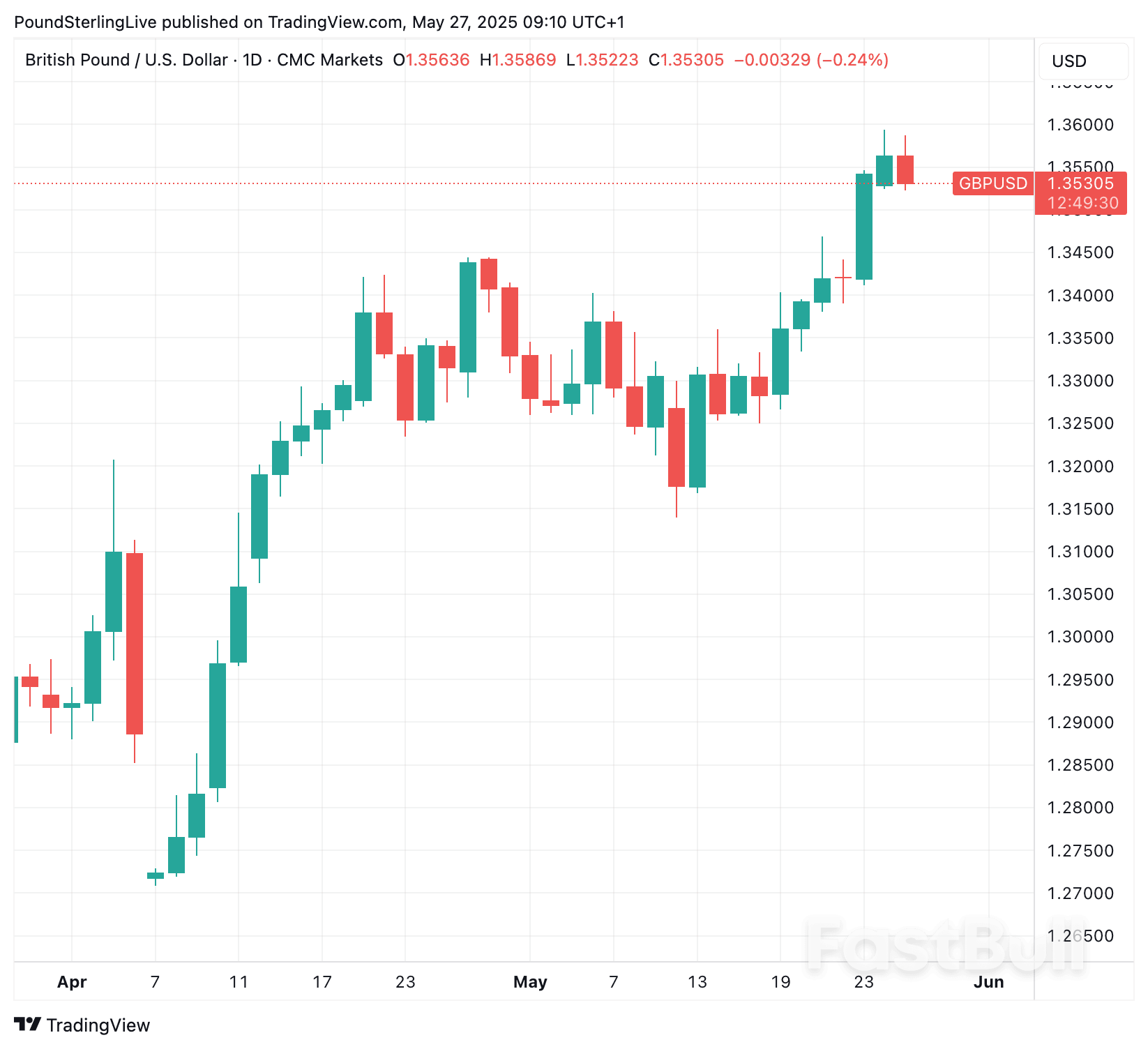
          Above: GBP/USD at daily intervals.

          This leaves the Pound to Dollar exchange rate (GBP/USD) trending upwards, with a new high at 1.3593 being reached on Monday.
          "The GBP/USD pair has continued its upward trajectory for the third consecutive session, recently trading near the 1.3570 level - just shy of its 39-month high at 1.3593. This strong performance of the pound reflects continued market confidence in the British currency, supported by a mix of political and economic factors that have contributed to the dollar's recent decline," says Rania Gule, Senior Market Analyst at XS.com.
          Gule says pullbacks should be shallow and that the bullish trend in GBP/USD remains intact, as long as the pair holds above the key support at 1.3550 and maintains the ascending channel it has respected in recent weeks.
          "A breakout above 1.3593 could pave the way toward 1.3700, especially in the absence of clear signals for monetary tightening from the U.S. side," he explains.
          Although the Euro advances against the Dollar during times of trade tensions, it is struggling against Pound Sterling.
          Pound Sterling Extends a Bullish Trend Against Euro and Dollar_2

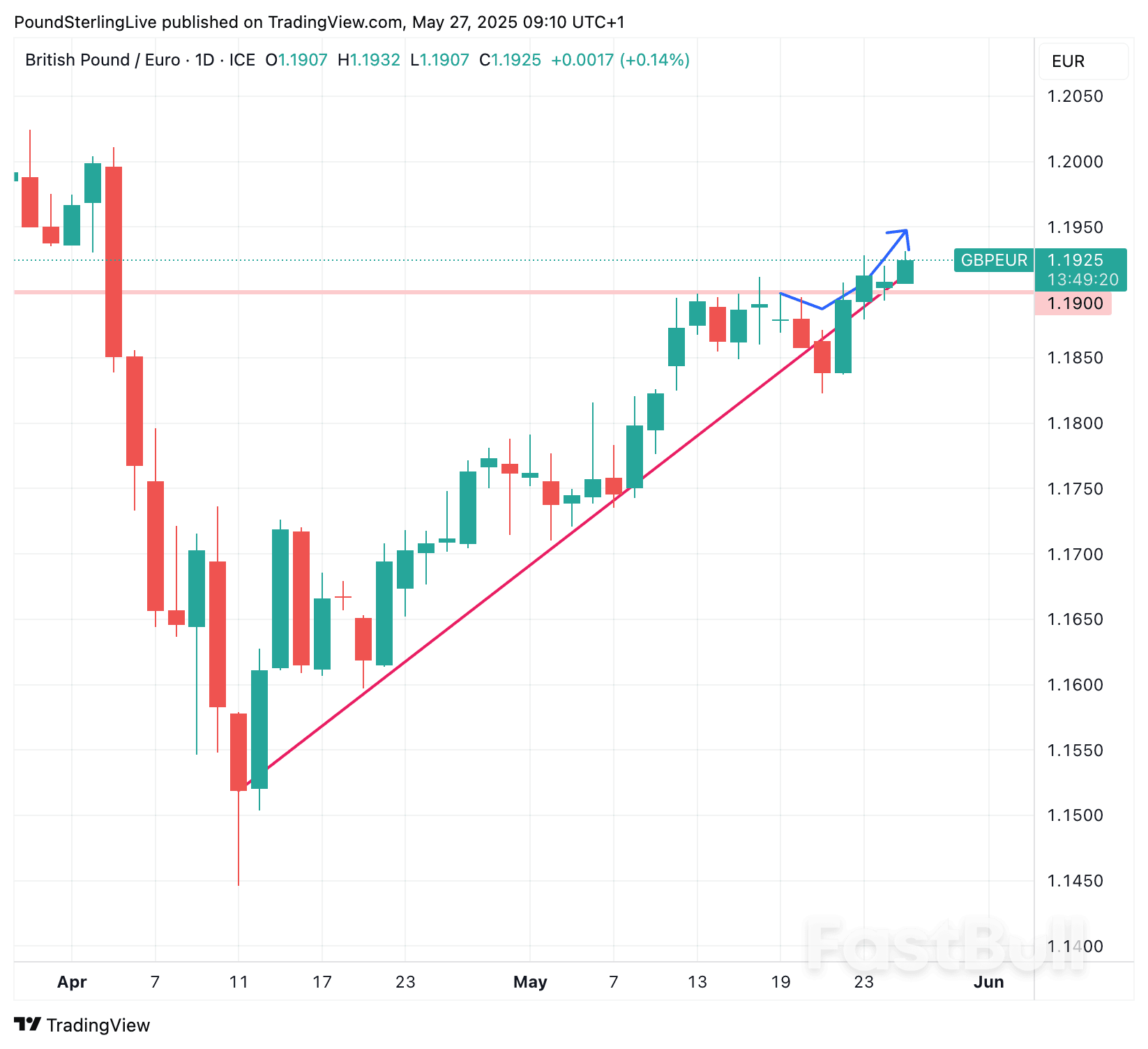
          Above: GBP/EUR at daily intervals.

          During the trade tensions of April, the Euro surged against the Pound. However, now that trade worries are focused on the EU, there is more at stake for the Euro as opposed to when trade fears were more generic.
          Indeed, the U.S. and UK have already struck a trade accord that eliminates associated uncertainty for the UK.
          Also, global stock markets are looking through the tariff noise and rising, meaning positive global sentiment supports GBP/EUR gains.
          Technical studies are all pointing higher, and we think a steady rise to 1.1950 is possible this week.
          "Support for the pound has also been reinforced by recent UK economic data. Retail sales rose by 1.2% in April — the fourth consecutive monthly increase — signaling resilient consumer spending despite economic headwinds. In my analysis, this reflects strong domestic demand and boosts investor confidence in the pound, as the consumer sector remains a key pillar of the UK economy," says Gule.

          Source: Poundsterlinglive

          To stay updated on all economic events of today, please check out our Economic calendar
          Risk Warnings and Disclaimers
          You understand and acknowledge that there is a high degree of risk involved in trading. Following any strategies or investment methods may lead to potential losses. The content on the site is provided by our contributors and analysts for information purposes only. You are solely responsible for determining whether any trading assets, securities, strategy, or any other product is suitable for investing based on your own investment objectives and financial situation.
          Add to Favorites
          Share

          US Dollar Warning: ING Sees More Downside Risks Amid Deficit Worries

          Michelle

          Economic

          Forex

          The financial world is keeping a close eye on the US Dollar. Recent reports indicate the greenback is softening, a move linked significantly to growing concerns over the nation’s budget deficit. This trend isn’t happening in a vacuum; it’s part of a complex interplay of global economic factors. Understanding this dynamic is crucial, especially for those navigating the volatile world of cryptocurrencies, which often reacts to shifts in major fiat currencies like the dollar.

          Why is the US Dollar Softening?

          Several factors contribute to the current state of the Currency Market, but the spotlight is increasingly on the fiscal health of the United States. A large and persistent budget deficit can weigh on a currency for fundamental economic reasons.

          • Increased Borrowing: To finance a deficit, the government issues more debt (Treasury bonds). A higher supply of debt can potentially reduce its appeal or require higher interest rates to attract buyers, impacting broader market sentiment.
          • Inflation Concerns: Large deficits can sometimes fuel concerns about future inflation, as they might imply increased money supply or future debt monetization. Inflation erodes purchasing power, which can weaken a currency’s value over time.
          • Reduced Foreign Investor Appetite: While US debt is generally considered safe, persistently large deficits can, in the long run, make some foreign investors hesitant, potentially decreasing demand for dollar-denominated assets.
          • Comparison to Other Economies: The relative fiscal position of the US compared to other major economies also plays a role. If other countries appear to have stronger fiscal management, their currencies might become relatively more attractive.

          Beyond the deficit, other elements influencing the US Dollar include the Federal Reserve’s monetary policy (interest rates, quantitative easing/tightening), global economic growth prospects, geopolitical stability, and market risk sentiment. When global risk appetite is high, investors might move away from safe-haven assets like the dollar towards riskier investments.

          What Downside Risks Does ING Identify?

          According to analysts at ING, the current softening of the dollar is not just a temporary blip. They point to specific factors suggesting that more downside risks remain for the currency.

          ING’s perspective often considers macro-financial trends and how they interact. While the precise details of their latest analysis would be in their specific reports, the general arguments for continued dollar weakness often revolve around:

          • Persistent Fiscal Challenges: The budget deficit is not a short-term issue. Ongoing government spending and revenue shortfalls create a structural headwind for the dollar. ING likely emphasizes that without concrete steps to address the deficit, the pressure will continue.
          • Relative Monetary Policy: Expectations about when and how much the Federal Reserve might cut interest rates compared to other central banks can weaken the dollar. If the Fed is expected to ease policy more aggressively or sooner than others, it makes dollar-denominated assets less attractive for yield-seeking investors.
          • Global Recovery or Stability: If other major economies show signs of strengthening or if global risks subside, the demand for the dollar as a safe haven decreases. ING might foresee scenarios where international economic conditions improve, reducing the dollar’s appeal.
          • Technical Factors: Currency markets are also driven by technical analysis and market positioning. ING’s view could be influenced by technical indicators suggesting further downward momentum for the dollar.

          These downside risks suggest that the path of least resistance for the dollar, in ING’s view, is downwards, at least in the near to medium term.

          How Does This Impact the Forex Market?

          The Forex market, or foreign exchange market, is where currencies are traded. It’s the largest and most liquid financial market globally. When the US Dollar softens, it has ripple effects across this massive market.

          • Major Currency Pairs: Pairs like EUR/USD, GBP/USD, and AUD/USD tend to rise when the dollar weakens, as it takes more dollars to buy one unit of the other currency.
          • Emerging Market Currencies: Many emerging market currencies are sensitive to dollar strength. A weaker dollar can provide relief to countries with dollar-denominated debt, making it cheaper to service. It can also potentially increase capital flows into these markets as the relative attractiveness of dollar assets diminishes.
          • Commodities: Commodities like oil and gold are often priced in dollars. A weaker dollar makes these commodities relatively cheaper for buyers using other currencies, potentially increasing demand and prices.
          • Global Trade: Exchange rates influence the cost of imports and exports, affecting trade balances between countries.

          Traders and investors in the Forex market constantly analyze these factors, including reports from institutions like ING, to anticipate currency movements.

          Actionable Insights for Navigating Currency Shifts

          Given the current outlook and the warnings from institutions like ING, what steps can market participants consider?

          Firstly, stay informed. Monitor economic data releases, particularly those related to the US budget, inflation, and employment. Pay attention to statements from the Federal Reserve and other major central banks. Follow analysis from reputable financial institutions like ING.

          Secondly, understand your exposure. If you hold assets denominated in dollars, recognize that a weakening dollar affects their value in terms of other currencies. If you are involved in international business or have foreign investments, currency fluctuations directly impact your bottom line.

          Thirdly, consider diversification. Holding assets across different currencies and asset classes can help mitigate the risks associated with the decline of a single currency.

          Finally, for those in the crypto space, remember that while cryptocurrencies operate independently of central banks, their prices are often influenced by global liquidity and risk sentiment, which are tied to major currency movements. A weaker dollar can sometimes correlate with increased risk appetite, potentially benefiting assets like Bitcoin, though this relationship is not always direct or consistent.

          Conclusion: The Path Ahead for the US Dollar

          The softening of the US Dollar, fueled by concerns over the Budget Deficit and other macro factors, is a significant development in the global financial landscape. Analysis from institutions like ING reinforces the view that the dollar faces continued downside risks. This situation impacts the vast Forex market, influencing everything from major currency pairs to commodity prices and global trade dynamics. While the future is never certain, understanding the pressures on the dollar and the potential implications is vital for investors, businesses, and anyone with exposure to the global economy. Keeping a close watch on economic indicators and expert analysis will be key to navigating the potential shifts in the Currency Market ahead.

          Source: CryptoSlate

          To stay updated on all economic events of today, please check out our Economic calendar
          Risk Warnings and Disclaimers
          You understand and acknowledge that there is a high degree of risk involved in trading. Following any strategies or investment methods may lead to potential losses. The content on the site is provided by our contributors and analysts for information purposes only. You are solely responsible for determining whether any trading assets, securities, strategy, or any other product is suitable for investing based on your own investment objectives and financial situation.
          Add to Favorites
          Share

          Citi Sees Up to 8% Downside for Stoxx 600 on Trump Tariff Risk

          Glendon

          Economic

          Stocks

          Citi analysts warned in a note Tuesday that European equities could face significant downside if President Trump’s tariff threats materialize.

          The bank outlined the potential implications of a 50% tariff on European goods, a scenario the firm is treating as hypothetical for now but one that has already rattled markets.

          While Trump said on Sunday that he has agreed to delay the 50% tariff on the European Union until July 9, Citi noted that the “surprise announcement on a possible 50% tariff on European goods” had triggered broad selling in European equities.

          The Stoxx 600 Index could drop “c7-8% from here” if the tariff threats are enacted and priced in, according to Citi’s projections.

          Earnings estimates for European companies have already started to reflect increased geopolitical risks.

          “Analyst consensus forecasts for 2025E European EPS growth have fallen from +7% pre-Liberation day to c2% now,” Citi noted. That decline is said to be consistent with their prior modeling of the earnings impact from a 20% tariff.

          However, should tariffs rise to 50%, Citi’s top-down models suggest EPS growth could deteriorate further.

          “EPS growth could fall another 5-6% to c-4%, if 50% broad tariffs are implemented,” they warned. “This comes against the backdrop of the market pricing in c4% EPS growth over the next 12m.”

          Citi emphasized that the uncertainty surrounding trade policy is already dragging down sentiment and could translate into more pronounced equity declines if the threats are realized.


          Source: Investing

          To stay updated on all economic events of today, please check out our Economic calendar
          Risk Warnings and Disclaimers
          You understand and acknowledge that there is a high degree of risk involved in trading. Following any strategies or investment methods may lead to potential losses. The content on the site is provided by our contributors and analysts for information purposes only. You are solely responsible for determining whether any trading assets, securities, strategy, or any other product is suitable for investing based on your own investment objectives and financial situation.
          Add to Favorites
          Share

          EU to Focus on Critical Sectors in Bid to Avoid Trump’s Tariffs, Bloomberg Reports

          Michelle

          Economic

          Forex

          The European Union (EU) is seeking to accelerate trade talks with the US just six weeks before President Donald Trump’s threatened 50% tariffs come into effect.

          The European Commission, which handles trade matters for the EU, will focus its new strategy on critical sectors as well as tariff and non-tariff barriers, according to people familiar with the plans. The commission will also link its approach to addressing regulatory barriers with its plans to simplify rules.

          The EU’s trade chief, Maros Sefcovic, will lead political negotiations on industries such as steel and aluminium, automobiles, pharmaceuticals, semiconductors and civilian aircraft, said the people, who spoke on the condition of anonymity. Those talks will happen in parallel with the technical discussions on tariffs and non-tariff barriers.

          Last week, Trump threatened to impose a 50% tariff on the EU starting June 1 after complaining the bloc was slow-walking negotiations and unfairly targeting US companies with lawsuits and regulations. But the US president extended the deadline back to July 9 after a Sunday call with Commission President Ursula von der Leyen when she agreed to fast-track talks.

          A spokesperson for the commission declined to comment.

          Member states were briefed on the discussions on Monday after Sefcovic held a call with his US counterparts, Commerce Secretary Howard Lutnick and US Trade Representative Jamieson Greer, according to the people.

          The industries that Sefcovic will focus on either have already been hit with US tariffs, or have been earmarked for future levies. The EU has proposed deepening cooperation with the US in those sectors as part of a previous proposal shared with the US last week, Bloomberg reported.

          The EU offer last week — which also proposed mutually lowering tariffs on many goods and working together on global challenges as well as mutual investments and strategic purchases — was rejected by the US and triggered Trump’s threat of higher tariffs.

          Any US unilateral demands that would impair the bloc’s autonomy in regulatory and tax matters are likely to remain red lines, the people said.

          Talks so far have been beset with multiple problems, with no clear path to finding a middle ground. The Europeans have complained that it’s not clear what the US wants or even who speaks for the American president, and the US has said the EU unfairly targets US companies with lawsuits and regulations.

          In parallel to ongoing talks with the Trump administration, the EU will continue to prepare countermeasures should negotiations fail to yield a satisfactory outcome, the people said.

          The EU has approved tariffs on €21 billion (US$23.8 billion or RM100.8 billion) of US goods in response to Trump’s metals levies that can be quickly implemented. They target politically sensitive American states and include products such as soybeans from Louisiana, home to House Speaker Mike Johnson, as well as agricultural products, poultry and motorcycles.

          The bloc is also preparing an additional list of tariffs on €95 billion of American products. Those measures, which are in response to Trump’s “reciprocal” levies and automotive duties would target industrial goods including Boeing Co aircraft, US-made cars and bourbon.

          The EU has been urged by some member states to additionally prepare countermeasures to any further action the US president has threatened, including on semiconductors and the pharmaceutical sector.

          Many EU officials and member states continue to believe that several of Trump’s tariffs will stay in place and the chances of a good deal remain slim, the people added.

          “We want a quick solution now,” German Finance Minister Lars Klingbeil told reporters in Berlin Monday. He added that he was “cautiously optimistic” that an agreement could be found, without elaborating. Klingbeil said the EU must respond to tariff threats from the US in a united, coordinated and consistent manner.

          Source: Theedgemarkets

          To stay updated on all economic events of today, please check out our Economic calendar
          Risk Warnings and Disclaimers
          You understand and acknowledge that there is a high degree of risk involved in trading. Following any strategies or investment methods may lead to potential losses. The content on the site is provided by our contributors and analysts for information purposes only. You are solely responsible for determining whether any trading assets, securities, strategy, or any other product is suitable for investing based on your own investment objectives and financial situation.
          Add to Favorites
          Share

          India Rises: From Fifth to Fourth Largest Economy, Eyeing the Global Top Three

          Gerik

          Economic

          India Overtakes Japan: A Shift in Global Economic Power

          For the first time in decades, Japan has exited the top four global economies, marking a symbolic shift in economic leadership from East Asia to South Asia. According to updated figures from the International Monetary Fund (IMF), India’s nominal GDP is estimated at $4.34 trillion by the end of 2024, marginally exceeding Japan’s $4.23 trillion. This milestone reaffirms India’s growing weight in the global economic order and underscores a long-term transition that reflects broader structural transformations in the global South.
          India’s population—a youthful, expanding, and increasingly urban demographic base—is at the core of this economic surge. With domestic consumption contributing nearly 70% of GDP, India leverages its internal market to fuel sustainable long-term growth. Unlike export-reliant economies, India’s structure allows for insulation against global trade volatility, granting it greater economic autonomy. This consumption-driven model reflects the increasing purchasing power of a burgeoning middle class and highlights the strength of internal demand as a stabilizing force.

          Policy Reform and Sectoral Momentum

          Beyond demographics, India’s ascent is reinforced by a proactive reform agenda and public investment. Strategic reforms in taxation, digital governance, and ease of doing business have attracted significant domestic and foreign investment. Infrastructure development and rapid technological adoption—particularly in fintech, digital services, and manufacturing—have enhanced productivity and competitiveness. These factors not only elevate GDP figures but also improve India's appeal as a business destination, reshaping its global economic identity.
          India’s rise contrasts starkly with economic stagnation in Japan, which faces a shrinking labor force, persistently low birth rates, and currency depreciation. These trends collectively weaken consumption and investment, leading to prolonged sluggish growth. Germany, meanwhile, is grappling with high energy costs, weakening industrial competitiveness, and rising global competition. Such structural impediments slow their respective economic momentum, creating space for emerging economies like India to climb the ranks.

          Forecasts and Strategic Imperatives

          According to the World Bank, India’s growth is projected to exceed 6.5% in the coming years—among the highest globally. This growth potential suggests a realistic trajectory toward overtaking Germany by 2027. If achieved, two of the world's top three economies would be in Asia, signifying a profound geopolitical and economic realignment often referred to as the “Asian Century.” However, experts caution that sustaining this trajectory will require deeper institutional and structural transformation.
          India’s momentum, while impressive, is not without vulnerabilities. Longstanding issues such as job creation for a vast young labor force, reducing income inequality, improving human development indicators, and reforming land, labor, and logistics sectors must be addressed. These are not merely developmental concerns but fundamental prerequisites for transforming demographic potential into tangible economic dividends. Without systemic change, growth may widen social disparities rather than bridge them.
          India’s leap to the fourth largest economy symbolizes more than statistical achievement—it reflects a rebalancing of global economic forces. With the right reforms and inclusive development strategies, India stands poised to challenge legacy economies and redefine leadership in the 21st-century global economy. However, the next phase of its ascent will hinge not just on growth rates but on the quality, equity, and sustainability of that growth.

          Source: Times of India

          To stay updated on all economic events of today, please check out our Economic calendar
          Risk Warnings and Disclaimers
          You understand and acknowledge that there is a high degree of risk involved in trading. Following any strategies or investment methods may lead to potential losses. The content on the site is provided by our contributors and analysts for information purposes only. You are solely responsible for determining whether any trading assets, securities, strategy, or any other product is suitable for investing based on your own investment objectives and financial situation.
          Add to Favorites
          Share
          FastBull
          Copyright © 2025 FastBull Ltd

          728 RM B 7/F GEE LOK IND BLDG NO 34 HUNG TO RD KWUN TONG KLN HONG KONG

          TelegramInstagramTwitterfacebooklinkedin
          App Store Google Play Google Play
          Products
          Charts

          Chats

          Q&A with Experts
          Screeners
          Economic Calendar
          Data
          Tools
          Membership
          Features
          Function
          Markets
          Copy Trading
          Latest Signals
          Contests
          News
          Analysis
          24/7
          Columns
          Education
          Company
          Careers
          About Us
          Contact Us
          Advertising
          Help Center
          Feedback
          User Agreement
          Privacy Policy
          Business

          White Label

          Data API

          Web Plug-ins

          Poster Maker

          Affiliate Program

          Risk Disclosure

          The risk of loss in trading financial instruments such as stocks, FX, commodities, futures, bonds, ETFs and crypto can be substantial. You may sustain a total loss of the funds that you deposit with your broker. Therefore, you should carefully consider whether such trading is suitable for you in light of your circumstances and financial resources.

          No decision to invest should be made without thoroughly conducting due diligence by yourself or consulting with your financial advisors. Our web content might not suit you since we don't know your financial conditions and investment needs. Our financial information might have latency or contain inaccuracy, so you should be fully responsible for any of your trading and investment decisions. The company will not be responsible for your capital loss.

          Without getting permission from the website, you are not allowed to copy the website's graphics, texts, or trademarks. Intellectual property rights in the content or data incorporated into this website belong to its providers and exchange merchants.

          Not Logged In

          Log in to access more features

          FastBull Membership

          Not yet

          Purchase

          Become a signal provider
          Help Center
          Customer Service
          Dark Mode
          Price Up/Down Colors

          Log In

          Sign Up

          Position
          Layout
          Fullscreen
          Default to Chart
          The chart page opens by default when you visit fastbull.com