• Trade
  • Markets
  • Copy
  • Contests
  • News
  • 24/7
  • Calendar
  • Q&A
  • Chats
Trending
Screeners
SYMBOL
LAST
BID
ASK
HIGH
LOW
NET CHG.
%CHG.
SPREAD
SPX
S&P 500 Index
6827.42
6827.42
6827.42
6899.86
6801.80
-73.58
-1.07%
--
DJI
Dow Jones Industrial Average
48458.04
48458.04
48458.04
48886.86
48334.10
-245.98
-0.51%
--
IXIC
NASDAQ Composite Index
23195.16
23195.16
23195.16
23554.89
23094.51
-398.69
-1.69%
--
USDX
US Dollar Index
97.950
98.030
97.950
98.500
97.950
-0.370
-0.38%
--
EURUSD
Euro / US Dollar
1.17394
1.17409
1.17394
1.17496
1.17192
+0.00011
+ 0.01%
--
GBPUSD
Pound Sterling / US Dollar
1.33707
1.33732
1.33707
1.33997
1.33419
-0.00148
-0.11%
--
XAUUSD
Gold / US Dollar
4299.39
4299.39
4299.39
4353.41
4257.10
+20.10
+ 0.47%
--
WTI
Light Sweet Crude Oil
57.233
57.485
57.233
58.011
56.969
-0.408
-0.71%
--

Community Accounts

Signal Accounts
--
Profit Accounts
--
Loss Accounts
--
View More

Become a signal provider

Sell trading signals to earn additional income

View More

Guide to Copy Trading

Get started with ease and confidence

View More

Signal Accounts for Members

All Signal Accounts

Best Return
  • Best Return
  • Best P/L
  • Best MDD
Past 1W
  • Past 1W
  • Past 1M
  • Past 1Y

All Contests

  • All
  • Trump Updates
  • Recommend
  • Stocks
  • Cryptocurrencies
  • Central Banks
  • Featured News
Top News Only
Share

Ukraine's Navy Says Russian Drone Attack Hit Civilian Turkish Vessel Carrying Sunflower Oil To Egypt On Saturday

Share

Israeli Military Says It Put Planned Strike On South Lebanon Site On Hold After Lebanese Army Requested Access

Share

Norwegian Nobel Committee: Calls On The Belarusian Authorities To Release All Political Prisoners

Share

Norwegian Nobel Committee: His Freedom Is A Deeply Welcome And Long-Awaited Moment

Share

Ukraine Says It Received 114 Prisoners From Belarus

Share

USA Embassy In Lithuania: Maria Kalesnikava Is Not Going To Vilnius

Share

USA Embassy In Lithuania: Other Prisoners Are Being Sent From Belarus To Ukraine

Share

Ukraine President Zelenskiy: Five Ukrainians Released By Belarus In US-Brokered Deal

Share

USA Vilnius Embassy: USA Stands Ready For "Additional Engagement With Belarus That Advances USA Interests"

Share

USA Vilnius Embassy: Belarus, USA, Other Citizens Among The Prisoners Released Into Lithuania

Share

USA Vilnius Embassy: USA Will Continue Diplomatic Efforts To Free The Remaining Political Prisoners In Belarus

Share

USA Vilnius Embassy: Belarus Releases 123 Prisoners Following Meeting Of President Trump's Envoy Coale And Belarus President Lukashenko

Share

USA Vilnius Embassy: Masatoshi Nakanishi, Aliaksandr Syrytsa Are Among The Prisoners Released By Belarus

Share

USA Vilnius Embassy: Maria Kalesnikava And Viktor Babaryka Are Among The Prisoners Released By Belarus

Share

USA Vilnius Embassy: Nobel Peace Prize Laureate Ales Bialiatski Is Among The Prisoners Released By Belarus

Share

Belarusian Presidential Administration Telegram Channel: Lukashenko Has Pardoned 123 Prisoners As Part Of Deal With US

Share

Two Local Syrian Officials: Joint US-Syrian Military Patrol In Central Syria Came Under Fire From Unknown Assailants

Share

Israeli Military Says It Targeted 'Key Hamas Terrorist' In Gaza City

Share

Rwanda's Actions In Eastern Drc Are A Clear Violation Of Washington Accords Signed By President Trump - Secretary Of State Rubio

Share

Israeli Military Issues Evacuation Warning In Southern Lebanon Village Ahead Of Strike - Spokesperson On X

TIME
ACT
FCST
PREV
U.K. Trade Balance Non-EU (SA) (Oct)

A:--

F: --

P: --

U.K. Trade Balance (Oct)

A:--

F: --

P: --

U.K. Services Index MoM

A:--

F: --

P: --

U.K. Construction Output MoM (SA) (Oct)

A:--

F: --

P: --

U.K. Industrial Output YoY (Oct)

A:--

F: --

P: --

U.K. Trade Balance (SA) (Oct)

A:--

F: --

P: --

U.K. Trade Balance EU (SA) (Oct)

A:--

F: --

P: --

U.K. Manufacturing Output YoY (Oct)

A:--

F: --

P: --

U.K. GDP MoM (Oct)

A:--

F: --

P: --

U.K. GDP YoY (SA) (Oct)

A:--

F: --

P: --

U.K. Industrial Output MoM (Oct)

A:--

F: --

P: --

U.K. Construction Output YoY (Oct)

A:--

F: --

P: --

France HICP Final MoM (Nov)

A:--

F: --

P: --

China, Mainland Outstanding Loans Growth YoY (Nov)

A:--

F: --

P: --

China, Mainland M2 Money Supply YoY (Nov)

A:--

F: --

P: --

China, Mainland M0 Money Supply YoY (Nov)

A:--

F: --

P: --

China, Mainland M1 Money Supply YoY (Nov)

A:--

F: --

P: --

India CPI YoY (Nov)

A:--

F: --

P: --

India Deposit Gowth YoY

A:--

F: --

P: --

Brazil Services Growth YoY (Oct)

A:--

F: --

P: --

Mexico Industrial Output YoY (Oct)

A:--

F: --

P: --

Russia Trade Balance (Oct)

A:--

F: --

P: --

Philadelphia Fed President Henry Paulson delivers a speech
Canada Building Permits MoM (SA) (Oct)

A:--

F: --

P: --

Canada Wholesale Sales YoY (Oct)

A:--

F: --

P: --

Canada Wholesale Inventory MoM (Oct)

A:--

F: --

P: --

Canada Wholesale Inventory YoY (Oct)

A:--

F: --

P: --

Canada Wholesale Sales MoM (SA) (Oct)

A:--

F: --

P: --

Germany Current Account (Not SA) (Oct)

A:--

F: --

P: --

U.S. Weekly Total Rig Count

A:--

F: --

P: --

U.S. Weekly Total Oil Rig Count

A:--

F: --

P: --

Japan Tankan Large Non-Manufacturing Diffusion Index (Q4)

--

F: --

P: --

Japan Tankan Small Manufacturing Outlook Index (Q4)

--

F: --

P: --

Japan Tankan Large Non-Manufacturing Outlook Index (Q4)

--

F: --

P: --

Japan Tankan Large Manufacturing Outlook Index (Q4)

--

F: --

P: --

Japan Tankan Small Manufacturing Diffusion Index (Q4)

--

F: --

P: --

Japan Tankan Large Manufacturing Diffusion Index (Q4)

--

F: --

P: --

Japan Tankan Large-Enterprise Capital Expenditure YoY (Q4)

--

F: --

P: --

U.K. Rightmove House Price Index YoY (Dec)

--

F: --

P: --

China, Mainland Industrial Output YoY (YTD) (Nov)

--

F: --

P: --

China, Mainland Urban Area Unemployment Rate (Nov)

--

F: --

P: --

Saudi Arabia CPI YoY (Nov)

--

F: --

P: --

Euro Zone Industrial Output YoY (Oct)

--

F: --

P: --

Euro Zone Industrial Output MoM (Oct)

--

F: --

P: --

Canada Existing Home Sales MoM (Nov)

--

F: --

P: --

Euro Zone Total Reserve Assets (Nov)

--

F: --

P: --

U.K. Inflation Rate Expectations

--

F: --

P: --

Canada National Economic Confidence Index

--

F: --

P: --

Canada New Housing Starts (Nov)

--

F: --

P: --

U.S. NY Fed Manufacturing Employment Index (Dec)

--

F: --

P: --

U.S. NY Fed Manufacturing Index (Dec)

--

F: --

P: --

Canada Core CPI YoY (Nov)

--

F: --

P: --

Canada Manufacturing Unfilled Orders MoM (Oct)

--

F: --

P: --

Canada Manufacturing New Orders MoM (Oct)

--

F: --

P: --

Canada Core CPI MoM (Nov)

--

F: --

P: --

Canada Manufacturing Inventory MoM (Oct)

--

F: --

P: --

Canada CPI YoY (Nov)

--

F: --

P: --

Canada CPI MoM (Nov)

--

F: --

P: --

Canada CPI YoY (SA) (Nov)

--

F: --

P: --

Canada Core CPI MoM (SA) (Nov)

--

F: --

P: --

Q&A with Experts
    • All
    • Chatrooms
    • Groups
    • Friends
    Connecting
    .
    .
    .
    Type here...
    Add Symbol or Code

      No matching data

      All
      Trump Updates
      Recommend
      Stocks
      Cryptocurrencies
      Central Banks
      Featured News
      • All
      • Russia-Ukraine Conflict
      • Middle East Flashpoint
      • All
      • Russia-Ukraine Conflict
      • Middle East Flashpoint
      Search
      Products

      Charts Free Forever

      Chats Q&A with Experts
      Screeners Economic Calendar Data Tools
      Membership Features
      Data Warehouse Market Trends Institutional Data Policy Rates Macro

      Market Trends

      Market Sentiment Order Book Forex Correlations

      Top Indicators

      Charts Free Forever
      Markets

      News

      News Analysis 24/7 Columns Education
      From Institutions From Analysts
      Topics Columnists

      Latest Views

      Latest Views

      Trending Topics

      Top Columnists

      Latest Update

      Signals

      Copy Rankings Latest Signals Become a signal provider AI Rating
      Contests
      Brokers

      Overview Brokers Assessment Rankings Regulators News Claims
      Broker listing Forex Brokers Comparison Tool Live Spread Comparison Scam
      Q&A Complaint Scam Alert Videos Tips to Detect Scam
      More

      Business
      Events
      Careers About Us Advertising Help Center

      White Label

      Data API

      Web Plug-ins

      Affiliate Program

      Awards Institution Evaluation IB Seminar Salon Event Exhibition
      Vietnam Thailand Singapore Dubai
      Fans Party Investment Sharing Session
      FastBull Summit BrokersView Expo
      Recent Searches
        Top Searches
          Markets
          News
          Analysis
          User
          24/7
          Economic Calendar
          Education
          Data
          • Names
          • Latest
          • Prev

          View All

          No data

          Scan to Download

          Faster Charts, Chat Faster!

          Download App
          English
          • English
          • Español
          • العربية
          • Bahasa Indonesia
          • Bahasa Melayu
          • Tiếng Việt
          • ภาษาไทย
          • Français
          • Italiano
          • Türkçe
          • Русский язык
          • 简中
          • 繁中
          Open Account
          Search
          Products
          Charts Free Forever
          Markets
          News
          Signals

          Copy Rankings Latest Signals Become a signal provider AI Rating
          Contests
          Brokers

          Overview Brokers Assessment Rankings Regulators News Claims
          Broker listing Forex Brokers Comparison Tool Live Spread Comparison Scam
          Q&A Complaint Scam Alert Videos Tips to Detect Scam
          More

          Business
          Events
          Careers About Us Advertising Help Center

          White Label

          Data API

          Web Plug-ins

          Affiliate Program

          Awards Institution Evaluation IB Seminar Salon Event Exhibition
          Vietnam Thailand Singapore Dubai
          Fans Party Investment Sharing Session
          FastBull Summit BrokersView Expo

          Uncertainty Surrounds First Ukraine Peace Talks in Years as Moscow Delays Delegation Announcement

          Gerik

          Economic

          Russia-Ukraine Conflict

          Summary:

          Uncertainty looms over the planned Ukraine peace talks in Istanbul, as Moscow delays announcing its delegation and Ukraine demands clarity on President Putin's attendance before committing...

          Uncertainty Over Russia’s Delegation as Peace Talks Approach

          As the first direct peace talks between Moscow and Kyiv in years are set for Thursday in Istanbul, uncertainty looms due to Russia's failure to disclose its delegation. While Russia has confirmed participation, the Kremlin has yet to reveal who will represent them. Ukrainian President Volodymyr Zelenskiy has stated that Ukraine will only attend if Russian President Vladimir Putin is present.
          U.S. President Donald Trump, who has expressed interest in attending if conditions allow, remarked that he was uncertain whether Putin would attend, despite the invitation. Trump emphasized that if Russia continues to block the peace process, secondary sanctions against Moscow, including financial penalties and sanctions on Russian oil buyers, could be imposed.

          Kremlin’s Silence on Delegation Members

          Russian President Putin proposed direct negotiations with Ukraine, setting the stage for the first such talks in three years. However, the Kremlin has yet to confirm the members of its delegation. A Kremlin spokesperson explained that they were still awaiting instructions from Putin regarding who would attend.
          The Ukrainian side, meanwhile, has demanded clarity on Putin’s participation before making a decision on the peace talks. A Ukrainian diplomatic source highlighted that Kyiv's next steps would depend on whether Putin agrees to attend, with discussions hinging on his decision.

          Zelenskiy’s Stance on Putin’s Participation

          Zelenskiy has made it clear that Ukraine will not attend the talks unless Putin is also present, marking a critical condition for Kyiv's involvement. If Putin agrees to join, it would be the first meeting between the two leaders since December 2019, and it would signal a significant development in the Ukraine-Russia conflict.
          While official confirmation is pending, unverified reports suggest that Russian Foreign Minister Sergei Lavrov and Yuri Ushakov, Putin’s foreign policy advisor, might be leading Russia’s delegation in Istanbul. However, the Kremlin has remained tight-lipped, stating that the delegation details will be disclosed once instructions are given by President Putin.

          Trump’s Role in the Talks

          Trump has indicated that he will send U.S. Secretary of State Marco Rubio, senior envoys Steve Witkoff and Keith Kellogg, and potentially himself to participate in the talks. Trump’s willingness to engage directly in the peace process highlights the U.S. government’s frustration with the ongoing conflict and its push for a resolution.
          As the situation develops, the world watches for clarity on Putin's involvement and whether the long-awaited peace talks will move forward.

          Source: Reuters

          To stay updated on all economic events of today, please check out our Economic calendar
          Risk Warnings and Disclaimers
          You understand and acknowledge that there is a high degree of risk involved in trading. Following any strategies or investment methods may lead to potential losses. The content on the site is provided by our contributors and analysts for information purposes only. You are solely responsible for determining whether any trading assets, securities, strategy, or any other product is suitable for investing based on your own investment objectives and financial situation.
          Add to Favorites
          Share

          House GOP Proposals in Focus As Lawmakers Debate Pieces of Trump Budget Bill

          Glendon

          Economic

          Forex

          Republican lawmakers in Congress have been debating and finalizing pieces of legislation related to tax cuts and spending reductions in U.S. President Donald Trump’s "big, beautiful" bill, as they race to pass the measure before May 26.

          The bill would then go to the Senate, with Trump aiming to sign it into law by July 4.

          Crucially, Republicans, who control both chambers of Congress, will be able to utilize a rule known as "reconciliation", which allows for a 60-vote filibuster threshold to be bypassed. This would mean that the GOP could pass Trump’s bill without support from Democrats.

          But media reports have suggested that there have been major disagreements within the Republican party, with some lawmakers uneasy about deep reductions to government healthcare programs like Medicare and others complaining that not enough is being done to rightsize the more than $36 trillion U.S. debt pile.

          According to the Wall Street Journal, Republicans have also been at odds over proposals to phase out tax credits for renewable energy producers, which was a major pillar of former President Joe Biden’s Inflation Reduction Act in 2022. Some Republicans want these credits to be immediately axed, while another group of GOP representatives are frustrated that these are being discontinued, the WSJ said.

          Meanwhile, Republicans from high-tax states like California and New York have registered their concerns about revised caps to state and local tax -- or SALT -- deductions.

          Taken together, reports say the major pillars of Trump’s budget legislation -- which would see the extension of tax cuts instituted during the president’s first term -- may add around $36.2 trillion to the country’s debt over the next decade. The tax cuts themselves would cost $3.72 trillion, Reuters reported.

          "The bill [...] makes good on many of Trump’s campaign promises (like no tax on tips or overtime, a deduction for seniors, and deductible interest on auto loans), deals with SALT, provides large capex incentives, curtails the renewable subsidies in the Inflation Reduction Act, and proposes an array of tax increases to offset the cost of new cuts," analysts at Piper Sandler said in a note to clients.

          The brokerage estimated that the legislation would expand the budget deficit "meaningfully" in the short-term -- by 0.2% of gross domestic product in the 2025 fiscal year and about 0.9% of GDP in the following year.

          Still, the bill could change a number of times prior to its final passage, the Piper Sandler analysts noted, adding that House committees will have the chance to "mark up" -- or debate, amend, or rewrite legislation -- over the coming days. The Senate will also have its own draft as well that will need to be reconciled with the House’s version.

          "We still believe this reconciliation package is on track to pass before August recess," the analysts predicted.

          Source: Investing

          To stay updated on all economic events of today, please check out our Economic calendar
          Risk Warnings and Disclaimers
          You understand and acknowledge that there is a high degree of risk involved in trading. Following any strategies or investment methods may lead to potential losses. The content on the site is provided by our contributors and analysts for information purposes only. You are solely responsible for determining whether any trading assets, securities, strategy, or any other product is suitable for investing based on your own investment objectives and financial situation.
          Add to Favorites
          Share

          Trump’s Saudi Victory Lap Belies AI Fears

          Warren Takunda

          Economic

          The United States does not hold a monopoly on technological breakthroughs. As it sought to contain China’s advances in artificial intelligence, President Joe Biden’s administration tried to use restrictions on cutting-edge chips from Nvidia as a cudgel, slowing progress elsewhere. His successor Donald Trump, who just kicked off a Middle East tour in Saudi Arabia, is now changing tack - by making use of U.S. silicon contingent on spurning Chinese alternatives.
          Trump on Tuesday announced a lump of investment deals with Saudi Arabia which the White House claimed tops $600 billion in value, encompassing cooperation between the nation’s firms and promised supplies of weaponry. Within the grab-bag came news from Nvidia that it will work with Humain, an AI firm backed by Saudi’s Public Investment Fund, to set up facilities with enough chips to consume up to 500 megawatts of power. That was swiftly followed by a Bureau of Industry and Security announcement that any use of Chinese rival Huawei's competing Ascend chips, anywhere in the world, now constitutes a violation of U.S. export controls.
          Under so-called AI diffusion rules implemented under Biden, Saudi and its neighbors saw their access to U.S. AI-powering microchips limited. Trump officials had blasted this as misguided, with AI czar David Sacks saying that there is no risk “with a friend like Saudi Arabia” and that the U.S. does not need to block the global spread of its technology. The Department of Commerce rescinded the Biden-era controls on Tuesday.
          The Biden agenda reflected an implicit assumption that U.S. tech was superior, and that the key priority was blocking Chinese access to it. DeepSeek, a breakthrough AI model, showed what firms in the People’s Republic could do when forced to design around restricted supplies. Now, chipmaker Huawei has launched updated systems using Ascend chips that, while less advanced than Nvidia’s state-of-the-art products, provide a lot of brute-force grunt.
          Trump and Nvidia’s Humain and export control gambits have a blunt logic. If buyers are forced to use Chinese silicon, the country’s firms have captive demand that can fund rapid development. Opening up U.S. supplies to allies helps to contain this dynamic – and so does making it harder for interested customers like Saudi and the United Arab Emirates to buy Chinese.
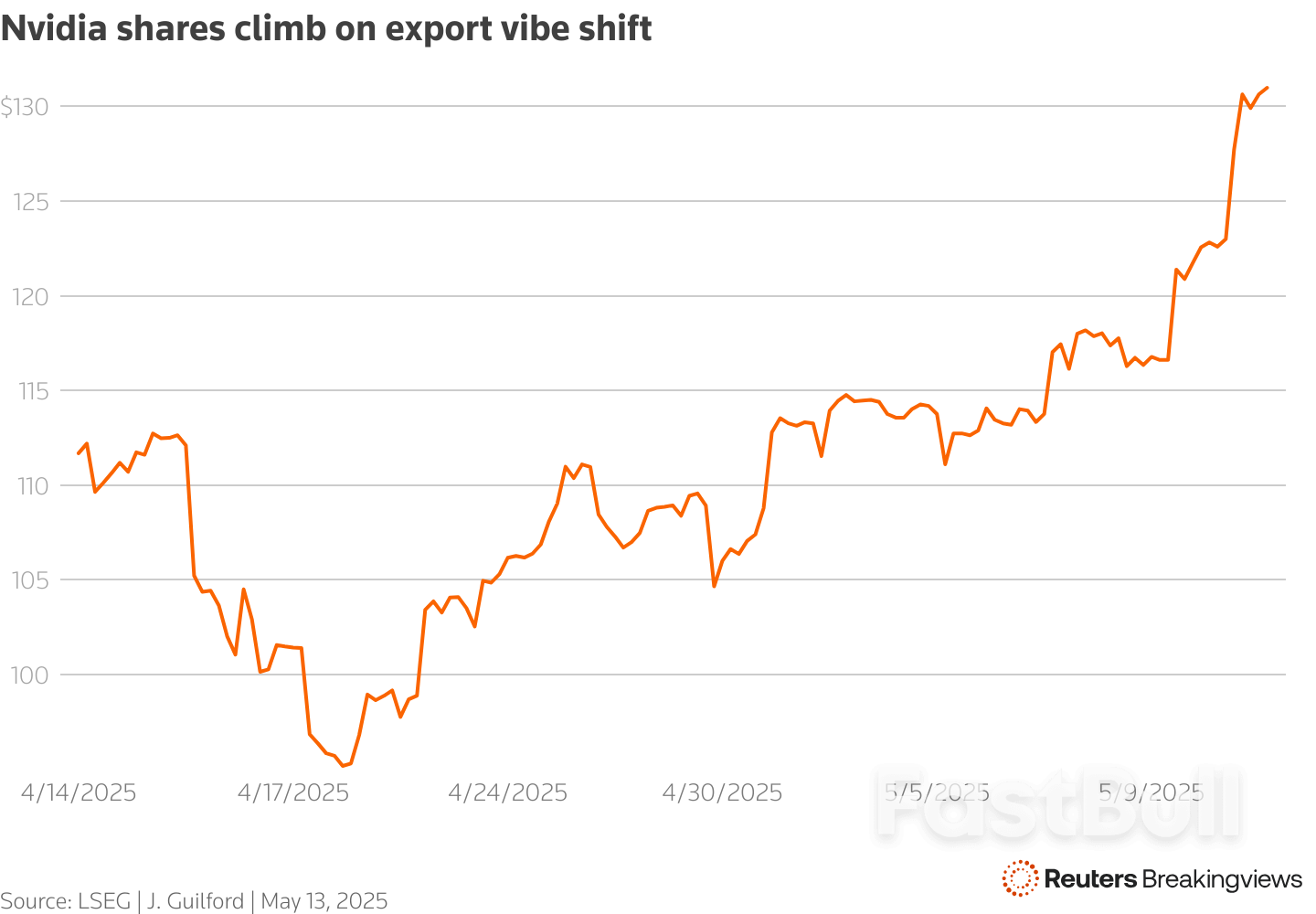
          How this can be practically enforced is unclear. Locking the world into American supply chains, though, would bolster Nvidia and its peers. After taking a $5.5 billion hit from tightened restrictions on even its cut-down products for the Chinese market, shares of the firm led by CEO Jensen Huang surged over 6% on Tuesday. If you can’t beat them, make others join you.
          Trump’s Saudi Victory Lap Belies AI Fears_1

          A chart showing Nvidia's share price

          The White House on May 13 announced a series of investment commitments between the U.S. and Saudi governments and firms from the respective countries. Nvidia said that it will work with Humain, an artificial intelligence startup backed by Saudi Arabia’s Public Investment Fund, to build new AI facilities in the country.
          The U.S. administration is working on deals to allow greater access to AI chips for Saudi Arabia and the United Arab Emirates, Bloomberg reported.
          Separately, the Department of Commerce rescinded a set of rules implemented under President Joe Biden that controlled the export of AI chips, announcing that it will impose a new set of guidelines. The Bureau of Industry and Security also issued guidance that using Ascend chips manufactured by Huawei “anywhere in the world” is now a violation of U.S. export controls.

          Source: Reuters

          To stay updated on all economic events of today, please check out our Economic calendar
          Risk Warnings and Disclaimers
          You understand and acknowledge that there is a high degree of risk involved in trading. Following any strategies or investment methods may lead to potential losses. The content on the site is provided by our contributors and analysts for information purposes only. You are solely responsible for determining whether any trading assets, securities, strategy, or any other product is suitable for investing based on your own investment objectives and financial situation.
          Add to Favorites
          Share

          The China Trade Deal Doesn’t Solve The Fed’s Problems

          Glendon

          Economic

          Forex

          The agreement between the US and China to roll back their respective tariffs for 90 days has led to renewed optimism that the worst of America’s trade wars is over. I’m not seeing the “breakthrough”: There’s still plenty of scope for economic damage that the Federal Reserve will struggle to contain.

          First, the rollback might not last and doesn’t change the broad contours of the story. Tariffs will still be high, fueling inflation and stunting growth. The Yale Budget Lab estimates that the average effective tariff rate will be 17.8%, up from about 2.5% when President Trump started his second term. That’s enough to increase the price level and the unemployment rate by about 1.7 and 0.35 percentage points, respectively.

          Second, the 90-day pause merely extends the corrosive uncertainty surrounding the US administration’s policies. This will lead businesses to delay purchase, investment and hiring decisions.

          Third, the Fed will still face the difficult choice between fighting inflation and supporting economic growth. In the near term, it’ll have to be patient, holding interest rates steady and watching inflation expectations — even as this raises the president’s ire. As a result, it will probably be slow in responding to weakening in the economy.

          The Fed has little choice. When it doesn’t know which way the risks skew, it must wait for more information. Right now any major move would have only a 50/50 chance of a positive outcome.

          The central bank’s predicament is particularly difficult given that inflation has overshot its 2% target since 2021. This makes any attempt to prioritize growth fraught, because it increases the probability that inflation expectations will become unanchored, triggering an upward price spiral that would be hard to contain. That’s an asymmetric risk the Fed can’t afford to take. When inflation expectations rose in the 1970s, it took punishingly high interest rates and a deep economic downturn to get them back under control.

          Being patient, though, also entails risks. As the economist Claudia Sahm has noted, weakness in the labor market can also be self-reinforcing, as layoffs hit spending and engender more layoffs. Historically, the unemployment rate has tended to rise sharply after crossing the threshold of a 0.5 percentage point increase, leading to recession. Last year proved to be an exception, because the rise in unemployment resulted from labor force growth outpacing strong hiring. This time will be different: Hiring will slow, while deportations and a border crackdown have depressed labor force growth.

          What, then, will the Fed do? It probably won’t get much clarity on inflation, growth and trade policy until September. If at that point it needs to reduce rates, it’ll have to move aggressively to arrest the deterioration in the labor market — especially given that the tariff-induced supply shock will undermine the effectiveness of monetary policy. If the US enters a recession, I’d expect rate cuts of 200 to 300 basis points.

          The Fed shouldn’t be faulted here. In contrast to the pandemic, when it was too slow in responding to inflationary pressures (thanks in part to a flawed monetary policy framework), this time around it’s grappling with the fallout of trade policies that are beyond its control. One can only sympathize and hope that clarity about the proper course emerges soon enough that the Fed can keep the economy afloat.

          Source: Bloomberg Europe

          To stay updated on all economic events of today, please check out our Economic calendar
          Risk Warnings and Disclaimers
          You understand and acknowledge that there is a high degree of risk involved in trading. Following any strategies or investment methods may lead to potential losses. The content on the site is provided by our contributors and analysts for information purposes only. You are solely responsible for determining whether any trading assets, securities, strategy, or any other product is suitable for investing based on your own investment objectives and financial situation.
          Add to Favorites
          Share

          Shifting Trade Dynamics: U.S.-China Tariff Truce and Emerging Business Impacts

          Gerik

          Economic

          China–U.S. Trade War

          The 90-Day Trade Truce and Its Business Implications

          In a notable shift in the U.S.-China trade relationship, both countries agreed to suspend most new tariffs for 90 days, while negotiating future trade policies. This pause in the trade war is seen as a breakthrough, offering temporary relief to businesses affected by the ongoing tariff uncertainty.
          The decision to reduce tariffs, however, does not erase the deep-rooted concerns that businesses face in navigating the complex global trade environment. For many companies, particularly those reliant on Chinese suppliers, the latest surge in tariffs was just another reason to diversify supply chains and mitigate risks.

          Business Adjustments in Response to Tariffs

          As the U.S. and China implement this tariff suspension, businesses are adjusting their strategies. While some, particularly large multinational corporations, are diversifying supply chains, others, such as small businesses, are finding it harder to cope with the volatility caused by shifting trade policies.
          Experts note that the uncertainty surrounding tariffs has fundamentally altered the post-WWII trade framework that once provided stable expectations. Even with this temporary relief, businesses remain cautious, with many looking for alternative sources outside of China to reduce their reliance on the country.

          China’s Long-Term Strategy: A Push for Self-Sufficiency

          Despite the temporary tariff relief, China continues to emphasize self-sufficiency in key industries, signaling that its trade strategy remains focused on reducing dependency on U.S. goods. The Chinese government has been taking measures to strengthen its position, such as tightening controls over the export of critical minerals and emphasizing national security in its policies.
          China's focus on economic self-reliance also comes with risks for foreign businesses. Some companies face increased scrutiny and market-entry barriers as China continues to prioritize domestic industries. Nevertheless, the Chinese market remains an essential player in global trade, with its influence continuing to grow across Southeast Asia, the EU, and Latin America.

          The Larger Picture: U.S.-China Relations and Global Trade Shifts

          As the U.S. and China move forward with the tariff pause, the broader geopolitical and economic implications remain unclear. For the U.S., the shift in trade policy with China could alter its global strategy, particularly as it seeks to navigate the challenges posed by China’s rise as a global economic power. This could lead to a future of more unpredictable trade dynamics, where tariff flexibility becomes a tool for managing relations with other major economies.
          For many companies, navigating this new environment requires adapting to changes in both trade regulations and market expectations. It remains to be seen whether this truce will evolve into a more stable relationship or if further disruptions will follow.
          In the short term, however, businesses are breathing a sigh of relief, hoping that the 90-day suspension will offer a chance to recalibrate and adapt to new trade policies as they continue to assess the long-term impacts of the evolving U.S.-China trade dynamics.

          Source: CNBC

          To stay updated on all economic events of today, please check out our Economic calendar
          Risk Warnings and Disclaimers
          You understand and acknowledge that there is a high degree of risk involved in trading. Following any strategies or investment methods may lead to potential losses. The content on the site is provided by our contributors and analysts for information purposes only. You are solely responsible for determining whether any trading assets, securities, strategy, or any other product is suitable for investing based on your own investment objectives and financial situation.
          Add to Favorites
          Share

          Trump Meets Syrian Leader al-Sharaa After Ending Sanctions, Urges Historic Reforms

          Gerik

          Economic

          Political

          Trump Ends Sanctions, Meets Syria’s Transitional Leader in Bid for Regional Reset

          U.S. President Donald Trump’s four-day Middle East tour took a historic turn Wednesday as he met with Ahmed al-Sharaa, the newly installed transitional president of Syria, in Riyadh—just 24 hours after announcing the end of all U.S. sanctions on Damascus. The meeting, overseen by Saudi Crown Prince Mohammed bin Salman and joined via phone by Turkish President Recep Tayyip Erdogan, signals the most direct U.S. diplomatic engagement with Syria in over a decade.
          Syria, a U.S.-designated state sponsor of terrorism since 1979, has been under layered U.S. sanctions since 2004, with additional severe restrictions imposed in 2011 following Bashar al-Assad’s brutal suppression of anti-government protests. The country's economic infrastructure has since been battered by civil war, foreign interventions, and terrorist insurgencies.
          Al-Sharaa, previously known as Abu Mohammed al-Jolani, once led the al-Qaeda-affiliated Hayat Tahrir al-Sham (HTS). After a lightning rebel offensive toppled Assad in December 2024, he re-emerged as the head of Syria’s transitional government, rebranding himself as a reformed nationalist leader.

          Trump’s Vision: Peace Through Pragmatism

          Speaking at the U.S.-Saudi Investment Forum on Tuesday, Trump said his decision to lift sanctions was based on giving Syria “a chance at greatness.” The U.S. president emphasized that with Assad gone, the time had come to back stability over isolation.
          “In Syria, which has seen so much misery and death, there is a new government that will hopefully succeed in stabilizing the country and keeping peace. That’s what we want to see,” Trump said, to applause.

          Terms for Reintegration: Trump’s Demands

          During his meeting with al-Sharaa, Trump urged the Syrian leader to take concrete steps to prove the legitimacy and direction of the new regime. The list includes:
          Signing the Abraham Accords and normalizing ties with Israel
          Expelling all foreign terrorist organizations from Syrian soil
          Deporting Palestinian militants designated as security threats
          Cooperating with the U.S. to prevent the return of ISIS
          Assuming control of and responsibility for ISIS detention facilities in northeastern Syria
          According to a White House readout, Trump described the moment as a “tremendous opportunity” for al-Sharaa and encouraged him to “do a great job for the Syrian people.”

          Middle Eastern Power Mediation

          The rapprochement would not have occurred without pressure from regional powers. Saudi Arabia and Turkey reportedly played instrumental roles in persuading Trump to meet al-Sharaa and consider Syria’s reentry into the international fold.
          For Riyadh and Ankara, Syria’s reintegration serves both geopolitical and ideological aims—weakening Iranian influence in the Levant and restoring Arab dominance over the conflict’s resolution.
          Cautious Optimism Amid Skepticism
          The visit marks the first official contact between a U.S. president and Syria’s new leadership. While the Trump administration insists the sanctions rollback is conditional on sustained reform, critics are raising alarms over the risks of legitimizing a former militant leader and potentially downplaying past human rights abuses by factions now in power.
          Nonetheless, the U.S. bet appears clear: that a politically useful al-Sharaa, backed by Saudi and Turkish guarantees, may offer a path to ending Syria’s spiral of conflict and curbing regional terrorism.
          The next steps will be closely watched. Trump is expected to meet again with regional leaders in Qatar before returning to Washington, where bipartisan responses to his Syria gambit are already beginning to take shape.

          Source: Reuters

          To stay updated on all economic events of today, please check out our Economic calendar
          Risk Warnings and Disclaimers
          You understand and acknowledge that there is a high degree of risk involved in trading. Following any strategies or investment methods may lead to potential losses. The content on the site is provided by our contributors and analysts for information purposes only. You are solely responsible for determining whether any trading assets, securities, strategy, or any other product is suitable for investing based on your own investment objectives and financial situation.
          Add to Favorites
          Share

          The China Tariff Pause Has Wall Street Scaling Back Recession Calls

          Warren Takunda

          Economic

          China–U.S. Trade War

          Trump's latest tariff pause has Wall Street reeling back its recession calls.
          Discussion of an economic downturn later in 2025 had surged as economists argued Trump's widespread tariffs would boost inflation and slow economic growth. Now, with the bulk of tariffs on goods from China paused for 90 days — and optimism around further trade deals building — economists argue that economic growth will still slow later this year, but the odds of a recession have diminished.
          "The administration's recent dialing down of some of the more draconian tariffs placed on China should reduce the risk that the US economy slips into recession this year," wrote JPMorgan chief US economist Michael Feroli, who had been the first Wall Street economist to call for a recession after Trump's large tariff increase.
          "We believe recession risks are still elevated, but now below 50%."
          Feroli's logic is simple: Tariffs are essentially a tax. With the latest tariff cuts, the estimated effective US tariff rate has fallen from roughly 24% to 14%. This creates a $300 billion "tax cut" for American consumers that likely would've been swallowing the brunt of the price increases caused by tariffs. Americans paying higher prices and eventually being unable to spend as much was a key part of why economists have been worried about tariffs leading to an economic slowdown.
          "The rolling back of this tax should provide some relief to consumer spending, and in our modeling is enough to tip the second-half growth outlook from one of modest contraction to one of modest growth," Feroli wrote.
          Feroli isn't alone in believing recession odds are diminishing as the US scales back its tariff escalation. Both Yardeni Research and Goldman Sachs have also lowered their recession odds in reaction to the US pausing the bulk of its tariffs on Chinese goods.
          Goldman Sachs' economics team moved its recession probability for the next 12 months down to 35% from a prior forecast of 45% while boosting its GDP forecast to 1% growth for the year, higher than a prior forecast of 0.5%.
          Yardeni, meanwhile, now sees 2025 GDP in a range of 1.5% to 2.5%, up from a prior projection in the 0.5% to 1.5% range. Barclays' economics team, which had previously called for a recession, removed its call for an economic downturn in a note to clients on Tuesday.
          "We think these lower tariff rates on China will be considerably less disruptive for domestic activity, labor markets, and less inflationary, than prior rates," Barclays chief US economist Marc Giannoni wrote.
          Giannoni pointed to how the tariffs on Chinese goods had already led to slower inbound cargo shipments into the US. Economists had cited this as one potential catalyst for the start of a recession, as slower shipments would eventually lead to lower inventory and higher prices for goods. That cycle would lead to consumers buying fewer goods and, eventually, companies being forced to cut employees as their sales slow. The increased likelihood of an eventual lower tariff rate on Chinese goods mitigates this risk.
          To be sure, economic forecasts are just that — forecasts. And while the likelihood of a downturn has shifted, risks remain for a US economy that already features a cooling labor market and is expected to see rising inflation later this year.
          Still, the more sanguine economic forecasts have provided a boost for stocks.
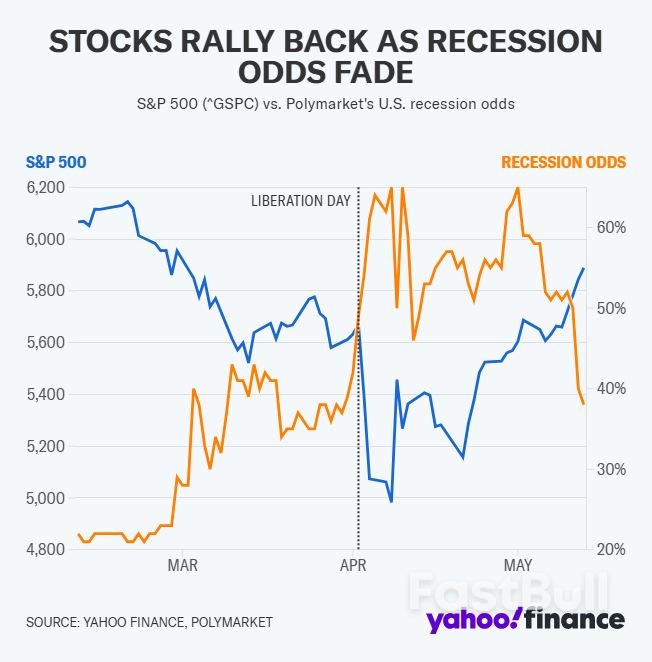
          In the initial reaction to Trump's "Liberation Day" tariffs on April 2, skyrocketing odds of a recession spooked more than 10 Wall Street strategists to slash their year-end target for the S&P 500 (^GSPC).
          Now the same trend has been happening in reverse. Yardeni Research President Ed Yardeni pointed out in a Monday night to clients that the odds of a recession on popular online betting platform Polymarket have tumbled from 51% last Friday to less than 40% after Trump's China tariff delay.
          In that same note to clients, Yardeni boosted his year-end target for the S&P 500 from 6,000 to 6,500. The Goldman Sachs equity strategy team made a similar move, now forecasting the benchmark index to end the year at 6,100, up from a prior call for 5,900.
          "We raise our S&P 500 return and earnings forecasts to incorporate lower tariff rates, better economic growth, and less recession risk than we previously expected," Goldman Sachs chief US equity strategist David Kostin wrote in a note to clients.The China Tariff Pause Has Wall Street Scaling Back Recession Calls_1

          Source: Yahoofinance

          To stay updated on all economic events of today, please check out our Economic calendar
          Risk Warnings and Disclaimers
          You understand and acknowledge that there is a high degree of risk involved in trading. Following any strategies or investment methods may lead to potential losses. The content on the site is provided by our contributors and analysts for information purposes only. You are solely responsible for determining whether any trading assets, securities, strategy, or any other product is suitable for investing based on your own investment objectives and financial situation.
          Add to Favorites
          Share
          FastBull
          Copyright © 2025 FastBull Ltd

          728 RM B 7/F GEE LOK IND BLDG NO 34 HUNG TO RD KWUN TONG KLN HONG KONG

          TelegramInstagramTwitterfacebooklinkedin
          App Store Google Play Google Play
          Products
          Charts

          Chats

          Q&A with Experts
          Screeners
          Economic Calendar
          Data
          Tools
          Membership
          Features
          Function
          Markets
          Copy Trading
          Latest Signals
          Contests
          News
          Analysis
          24/7
          Columns
          Education
          Company
          Careers
          About Us
          Contact Us
          Advertising
          Help Center
          Feedback
          User Agreement
          Privacy Policy
          Business

          White Label

          Data API

          Web Plug-ins

          Poster Maker

          Affiliate Program

          Risk Disclosure

          The risk of loss in trading financial instruments such as stocks, FX, commodities, futures, bonds, ETFs and crypto can be substantial. You may sustain a total loss of the funds that you deposit with your broker. Therefore, you should carefully consider whether such trading is suitable for you in light of your circumstances and financial resources.

          No decision to invest should be made without thoroughly conducting due diligence by yourself or consulting with your financial advisors. Our web content might not suit you since we don't know your financial conditions and investment needs. Our financial information might have latency or contain inaccuracy, so you should be fully responsible for any of your trading and investment decisions. The company will not be responsible for your capital loss.

          Without getting permission from the website, you are not allowed to copy the website's graphics, texts, or trademarks. Intellectual property rights in the content or data incorporated into this website belong to its providers and exchange merchants.

          Not Logged In

          Log in to access more features

          FastBull Membership

          Not yet

          Purchase

          Become a signal provider
          Help Center
          Customer Service
          Dark Mode
          Price Up/Down Colors

          Log In

          Sign Up

          Position
          Layout
          Fullscreen
          Default to Chart
          The chart page opens by default when you visit fastbull.com