• Trade
  • Markets
  • Copy
  • Contests
  • News
  • 24/7
  • Calendar
  • Q&A
  • Chats
Trending
Screeners
SYMBOL
LAST
BID
ASK
HIGH
LOW
NET CHG.
%CHG.
SPREAD
SPX
S&P 500 Index
6847.79
6847.79
6847.79
6861.30
6843.84
+20.38
+ 0.30%
--
DJI
Dow Jones Industrial Average
48616.74
48616.74
48616.74
48679.14
48557.21
+158.70
+ 0.33%
--
IXIC
NASDAQ Composite Index
23244.92
23244.92
23244.92
23345.56
23240.37
+49.77
+ 0.21%
--
USDX
US Dollar Index
97.820
97.900
97.820
98.070
97.810
-0.130
-0.13%
--
EURUSD
Euro / US Dollar
1.17571
1.17578
1.17571
1.17596
1.17262
+0.00177
+ 0.15%
--
GBPUSD
Pound Sterling / US Dollar
1.33956
1.33963
1.33956
1.33970
1.33546
+0.00249
+ 0.19%
--
XAUUSD
Gold / US Dollar
4331.21
4331.55
4331.21
4350.16
4294.68
+31.82
+ 0.74%
--
WTI
Light Sweet Crude Oil
56.876
56.906
56.876
57.601
56.789
-0.357
-0.62%
--

Community Accounts

Signal Accounts
--
Profit Accounts
--
Loss Accounts
--
View More

Become a signal provider

Sell trading signals to earn additional income

View More

Guide to Copy Trading

Get started with ease and confidence

View More

Signal Accounts for Members

All Signal Accounts

Best Return
  • Best Return
  • Best P/L
  • Best MDD
Past 1W
  • Past 1W
  • Past 1M
  • Past 1Y

All Contests

  • All
  • Trump Updates
  • Recommend
  • Stocks
  • Cryptocurrencies
  • Central Banks
  • Featured News
Top News Only
Share

The Nasdaq Golden Dragon China Index Fell 0.9% In Early Trading

Share

The S&P 500 Opened 32.78 Points Higher, Or 0.48%, At 6860.19; The Dow Jones Industrial Average Opened 136.31 Points Higher, Or 0.28%, At 48594.36; And The Nasdaq Composite Opened 134.87 Points Higher, Or 0.58%, At 23330.04

Share

Miran: Goods Inflation Could Be Settling In At A Higher Level Than Was Normal Before The Pandemic, But That Will Be More Than Offset By Housing Disinflation

Share

Miran, Who Dissented In Favor Of A Larger Cut At Last Fed Meeting, Repeats Keeping Policy Too Tight Will Lead To Job Losses

Share

Miran: Does Not Think Higher Goods Inflation Is Mostly From Tariffs, But Acknowledges Does Not Have A Full Explanation For It

Share

Toronto Stock Index .GSPTSE Rises 67.16 Points, Or 0.21 Percent, To 31594.55 At Open

Share

Miran: Excluding Housing And Non-Market Based Items, Core Pce Inflation May Be Below 2.3%, “Within Noise” Of The Fed's 2% Target

Share

Polish State Assets Minister Balczun Says Jsw Needs Over USD 830 Million Financing To Keep Liquidity For A Year

Share

Miran: Prices Are “Once Again Stable” And Monetary Policy Should Reflect That

Share

Fed's Miran: Current Excess Inflation Is Not Reflective Of Underlying Supply And Demand In The Economy

Share

Portugal Treasury Puts 2026 Net Financing Needs At 13 Billion Euros, Up From 10.8 Billion In 2025

Share

Portugal Treasury Expects 2026 Net Financing Needs At 29.4 Billion Euros, Up From 25.8 Billion In 2025

Share

Bank Of America Says With Indonesia's Smelter Now Ramping Up, It Expects Aluminium Supply Growth To Accelerate To 2.6% Year On Year In 2026

Share

Bank Of America Expects A Deficit In Aluminium Next Year And Sees Prices Pushing Above $3000/T

Share

Fed Data - USA Effective Federal Funds Rate At 3.64 Percent On 12 December On $102 Billion In Trades Versus 3.64 Percent On $99 Billion On 11 December

Share

Brazil's Petrobras Says No Impact Seen On Oil, Petroleum Products Output As Workers Start Planned Strike

Share

Statement: US Travel Group Warns New Proposed Trump Administration Requirements For Foreign Tourists To Provide Social Media Histories Could Mean Millions Of People Opting Not To Visit

Share

Blackrock: Kerry White Will Become Head Of Citi Investment Management At Citi Wealth

Share

Blackrock: Rob Jasminski, Head Of Citi Investment Management, Has Joined With Team

Share

Blackrock: Effective Dec 15, Citi Investment Management Employees Will Join Blackrock

TIME
ACT
FCST
PREV
Japan Tankan Small Manufacturing Outlook Index (Q4)

A:--

F: --

P: --

Japan Tankan Large Non-Manufacturing Outlook Index (Q4)

A:--

F: --

P: --

Japan Tankan Large Manufacturing Outlook Index (Q4)

A:--

F: --

P: --

Japan Tankan Small Manufacturing Diffusion Index (Q4)

A:--

F: --

P: --

Japan Tankan Large Manufacturing Diffusion Index (Q4)

A:--

F: --

P: --

Japan Tankan Large-Enterprise Capital Expenditure YoY (Q4)

A:--

F: --

P: --

U.K. Rightmove House Price Index YoY (Dec)

A:--

F: --

P: --

China, Mainland Industrial Output YoY (YTD) (Nov)

A:--

F: --

P: --

China, Mainland Urban Area Unemployment Rate (Nov)

A:--

F: --

P: --

Saudi Arabia CPI YoY (Nov)

A:--

F: --

P: --

Euro Zone Industrial Output YoY (Oct)

A:--

F: --

P: --

Euro Zone Industrial Output MoM (Oct)

A:--

F: --

P: --

Canada Existing Home Sales MoM (Nov)

A:--

F: --

P: --

Canada National Economic Confidence Index

A:--

F: --

P: --

Canada New Housing Starts (Nov)

A:--

F: --

P: --
U.S. NY Fed Manufacturing Employment Index (Dec)

A:--

F: --

P: --

U.S. NY Fed Manufacturing Index (Dec)

A:--

F: --

P: --

Canada Core CPI YoY (Nov)

A:--

F: --

P: --

Canada Manufacturing Unfilled Orders MoM (Oct)

A:--

F: --

P: --

U.S. NY Fed Manufacturing Prices Received Index (Dec)

A:--

F: --

P: --

U.S. NY Fed Manufacturing New Orders Index (Dec)

A:--

F: --

P: --

Canada Manufacturing New Orders MoM (Oct)

A:--

F: --

P: --

Canada Core CPI MoM (Nov)

A:--

F: --

P: --

Canada Trimmed CPI YoY (SA) (Nov)

A:--

F: --

P: --

Canada Manufacturing Inventory MoM (Oct)

A:--

F: --

P: --

Canada CPI YoY (Nov)

A:--

F: --

P: --

Canada CPI MoM (Nov)

A:--

F: --

P: --

Canada CPI YoY (SA) (Nov)

A:--

F: --

P: --

Canada Core CPI MoM (SA) (Nov)

A:--

F: --

P: --

Canada CPI MoM (SA) (Nov)

A:--

F: --

P: --

Federal Reserve Board Governor Milan delivered a speech
U.S. NAHB Housing Market Index (Dec)

--

F: --

P: --

Australia Composite PMI Prelim (Dec)

--

F: --

P: --

Australia Services PMI Prelim (Dec)

--

F: --

P: --

Australia Manufacturing PMI Prelim (Dec)

--

F: --

P: --

Japan Manufacturing PMI Prelim (SA) (Dec)

--

F: --

P: --

U.K. 3-Month ILO Employment Change (Oct)

--

F: --

P: --

U.K. Unemployment Claimant Count (Nov)

--

F: --

P: --

U.K. Unemployment Rate (Nov)

--

F: --

P: --

U.K. 3-Month ILO Unemployment Rate (Oct)

--

F: --

P: --

U.K. Average Weekly Earnings (3-Month Average, Including Bonuses) YoY (Oct)

--

F: --

P: --

U.K. Average Weekly Earnings (3-Month Average, Excluding Bonuses) YoY (Oct)

--

F: --

P: --

France Services PMI Prelim (Dec)

--

F: --

P: --

France Composite PMI Prelim (SA) (Dec)

--

F: --

P: --

France Manufacturing PMI Prelim (Dec)

--

F: --

P: --

Germany Services PMI Prelim (SA) (Dec)

--

F: --

P: --

Germany Manufacturing PMI Prelim (SA) (Dec)

--

F: --

P: --

Germany Composite PMI Prelim (SA) (Dec)

--

F: --

P: --

Euro Zone Composite PMI Prelim (SA) (Dec)

--

F: --

P: --

Euro Zone Services PMI Prelim (SA) (Dec)

--

F: --

P: --

Euro Zone Manufacturing PMI Prelim (SA) (Dec)

--

F: --

P: --

U.K. Services PMI Prelim (Dec)

--

F: --

P: --

U.K. Manufacturing PMI Prelim (Dec)

--

F: --

P: --

U.K. Composite PMI Prelim (Dec)

--

F: --

P: --

Euro Zone ZEW Economic Sentiment Index (Dec)

--

F: --

P: --

Germany ZEW Current Conditions Index (Dec)

--

F: --

P: --

Germany ZEW Economic Sentiment Index (Dec)

--

F: --

P: --

Euro Zone Trade Balance (Not SA) (Oct)

--

F: --

P: --

Euro Zone ZEW Current Conditions Index (Dec)

--

F: --

P: --

Euro Zone Trade Balance (SA) (Oct)

--

F: --

P: --

U.S. Retail Sales MoM (Excl. Automobile) (SA) (Oct)

--

F: --

P: --

Q&A with Experts
    • All
    • Chatrooms
    • Groups
    • Friends
    Connecting
    .
    .
    .
    Type here...
    Add Symbol or Code

      No matching data

      All
      Trump Updates
      Recommend
      Stocks
      Cryptocurrencies
      Central Banks
      Featured News
      • All
      • Russia-Ukraine Conflict
      • Middle East Flashpoint
      • All
      • Russia-Ukraine Conflict
      • Middle East Flashpoint
      Search
      Products

      Charts Free Forever

      Chats Q&A with Experts
      Screeners Economic Calendar Data Tools
      Membership Features
      Data Warehouse Market Trends Institutional Data Policy Rates Macro

      Market Trends

      Market Sentiment Order Book Forex Correlations

      Top Indicators

      Charts Free Forever
      Markets

      News

      News Analysis 24/7 Columns Education
      From Institutions From Analysts
      Topics Columnists

      Latest Views

      Latest Views

      Trending Topics

      Top Columnists

      Latest Update

      Signals

      Copy Rankings Latest Signals Become a signal provider AI Rating
      Contests
      Brokers

      Overview Brokers Assessment Rankings Regulators News Claims
      Broker listing Forex Brokers Comparison Tool Live Spread Comparison Scam
      Q&A Complaint Scam Alert Videos Tips to Detect Scam
      More

      Business
      Events
      Careers About Us Advertising Help Center

      White Label

      Data API

      Web Plug-ins

      Affiliate Program

      Awards Institution Evaluation IB Seminar Salon Event Exhibition
      Vietnam Thailand Singapore Dubai
      Fans Party Investment Sharing Session
      FastBull Summit BrokersView Expo
      Recent Searches
        Top Searches
          Markets
          News
          Analysis
          User
          24/7
          Economic Calendar
          Education
          Data
          • Names
          • Latest
          • Prev

          View All

          No data

          Scan to Download

          Faster Charts, Chat Faster!

          Download App
          English
          • English
          • Español
          • العربية
          • Bahasa Indonesia
          • Bahasa Melayu
          • Tiếng Việt
          • ภาษาไทย
          • Français
          • Italiano
          • Türkçe
          • Русский язык
          • 简中
          • 繁中
          Open Account
          Search
          Products
          Charts Free Forever
          Markets
          News
          Signals

          Copy Rankings Latest Signals Become a signal provider AI Rating
          Contests
          Brokers

          Overview Brokers Assessment Rankings Regulators News Claims
          Broker listing Forex Brokers Comparison Tool Live Spread Comparison Scam
          Q&A Complaint Scam Alert Videos Tips to Detect Scam
          More

          Business
          Events
          Careers About Us Advertising Help Center

          White Label

          Data API

          Web Plug-ins

          Affiliate Program

          Awards Institution Evaluation IB Seminar Salon Event Exhibition
          Vietnam Thailand Singapore Dubai
          Fans Party Investment Sharing Session
          FastBull Summit BrokersView Expo

          UK And India Seal Free Trade Agreement Slashing Tariffs, Barriers

          Glendon

          Economic

          Forex

          Summary:

          India and the UK sealed a free trade agreement eliminating tariffs on products ranging from cars to alcohol, finalizing a deal between two major economies at a time when US President Donald Trump’s tariff policies continue to disrupt global trade.

          India and the UK sealed a free trade agreement eliminating tariffs on products ranging from cars to alcohol, finalizing a deal between two major economies at a time when US President Donald Trump’s tariff policies continue to disrupt global trade.

          Broadcasters on Thursday aired footage showing UK Business and Trade Secretary Jonathan Reynolds and his Indian counterpart, Piyush Goyal, signing the agreement at a ceremony near London also attended by UK Chancellor of the Exchequer Rachel Reeves and Indian Minister of External Affairs Subrahmanyam Jaishankar. Indian prime minister Narendra Modi has also jetted in to mark the occasion with UK Prime Minister Keir Starmer.

          The pact comes after three years of intense negotiations touching on thorny topics such as visas, tariff reductions and tax breaks. The two nations concluded talks in May, completing Britain’s biggest trade deal since Brexit and India’s most significant such agreement to date.

          With Trump due to arrive in Scotland on Friday for a personal visit during which he’ll meet with Starmer, the signing comes as Britain works to flesh out the trade pact it agreed with the US. Meanwhile the New Delhi administration is racing to clinch a deal with Washington before Aug. 1, when higher tariffs are due to kick in.

          For Modi, the trade deal with Britain reinforces his push to position India as a viable alternative for global supply chains looking to diversify. The pact — India’s first major one in a decade — signals that the South Asian nation is willing to lower its barriers to attract investments as it negotiates a bilateral trade deal with the US. It will also act as a springboard for India’s ongoing talks with European Union.

          For Starmer, the deal will be a welcome step toward his goal of boosting economic growth in the UK. While it is expected to add £4.8 billion ($6.5 billion) to the UK’s annual economic output — a tiny increase to the size of the economy — Starmer’s Labour government hopes successive incremental wins will help encourage investment and turn around lackluster business sentiment.

          As a part of the deal, some 90% of tariff lines will be reduced for British exports to India, including 85% that will be fully tariff-free within a decade. India meanwhile will see duty reductions on about 99% of tariff lines for goods shipped to Britain.

          Levies on whisky and gin will be halved to 75% before reducing to 40% by the 10th year of the deal, while automotive industry tariffs will reduce to 10% — under a quota — from 110% over that period.

          Two-way trade between the two nations stood at $21.9 billion in 2024, and the deal is expected to boost bilateral by £25.5 billion a year over the long run.

          Source: Bloomberg Europe

          To stay updated on all economic events of today, please check out our Economic calendar
          Risk Warnings and Disclaimers
          You understand and acknowledge that there is a high degree of risk involved in trading. Following any strategies or investment methods may lead to potential losses. The content on the site is provided by our contributors and analysts for information purposes only. You are solely responsible for determining whether any trading assets, securities, strategy, or any other product is suitable for investing based on your own investment objectives and financial situation.
          Add to Favorites
          Share

          Euro Zone Business Activity Climbs to 11-Month High in July Amid Service Sector Strength

          Gerik

          Economic

          Gradual Recovery Gains Momentum in the Euro Zone

          Business activity across the euro zone accelerated in July, offering fresh signs that the region is emerging from an extended period of economic sluggishness. The HCOB flash composite Purchasing Managers’ Index (PMI), compiled by S&P Global, rose to 51.0 from 50.6 in June, marking the highest reading in 11 months. This figure exceeded both the 50.0 threshold that separates expansion from contraction and analysts’ forecast of 50.8.
          The data suggest that after months of faltering output and weak demand, the euro zone economy is regaining some footing driven largely by strength in the service sector and a softening downturn in manufacturing.

          Services Lead the Way While Manufacturing Inches Toward Growth

          The services PMI climbed to 51.2 in July, up from 50.5 in June, and surpassed economists’ expectations of 50.7. This uptick reflects modest but steady improvement in consumer-facing sectors like hospitality, retail, and professional services critical components of the euro zone’s economic engine.
          Manufacturing, while still below the growth threshold, posted its strongest reading in three years at 49.8, up from 49.5. While the index remains in contraction territory, the gain signals a possible end to the sector’s prolonged recession, according to Cyrus de la Rubia, Chief Economist at Hamburg Commercial Bank. He noted that although much of the current manufacturing activity stems from fulfilling backlogged orders rather than fresh demand, the rate at which backlogs are being cleared has slowed, indicating stabilization.

          Demand Conditions Improve, But Remain Fragile

          For the first time in over a year, the composite new business index did not decline, holding steady at 50.0 its highest level since May 2024. Though this indicates flat demand rather than expansion, it also marks a significant shift from persistent contractions seen throughout the past year.
          This steadiness in demand suggests that business confidence may be recovering in response to improved macroeconomic stability, fading inflation pressures, and expectations of supportive policy measures from the European Central Bank (ECB).

          Easing Inflation Supports Monetary Policy Outlook

          Signs of cooling price pressures added to the cautiously optimistic tone. The services input prices index dropped to a nine-month low of 56.7, down from 58.1 in June, suggesting input cost growth is slowing. This aligns with the broader inflation trend: euro zone consumer prices rose by just 2.0% year-on-year in June, matching the ECB’s target.
          With inflation appearing under control, markets widely expect the ECB to hold interest rates steady in its July meeting. According to a Reuters poll of 84 economists, the central bank is expected to cut rates once more before the end of the year, likely in September.

          Encouraging Signs Amid Persistent Uncertainty

          July’s PMI figures paint a cautiously encouraging picture of the euro zone economy. The service sector continues to do the heavy lifting, while manufacturing slowly emerges from its three-year downturn. With inflation falling into target range and business demand stabilizing, the ECB is positioned to maintain or cautiously ease policy, helping support the bloc’s recovery.
          Nevertheless, risks remain. Global trade tensions, including potential U.S. tariffs and geopolitical shocks, could derail momentum. Domestic structural weaknesses, such as uneven fiscal support across member states and tepid investment, may also limit the pace of recovery. Still, the July PMI offers evidence that the euro zone is turning a corner however slowly.

          Source: Reuters

          To stay updated on all economic events of today, please check out our Economic calendar
          Risk Warnings and Disclaimers
          You understand and acknowledge that there is a high degree of risk involved in trading. Following any strategies or investment methods may lead to potential losses. The content on the site is provided by our contributors and analysts for information purposes only. You are solely responsible for determining whether any trading assets, securities, strategy, or any other product is suitable for investing based on your own investment objectives and financial situation.
          Add to Favorites
          Share

          Top 3 Trade Ideas For 24 July 2025

          Samantha Luan

          Economic

          Forex

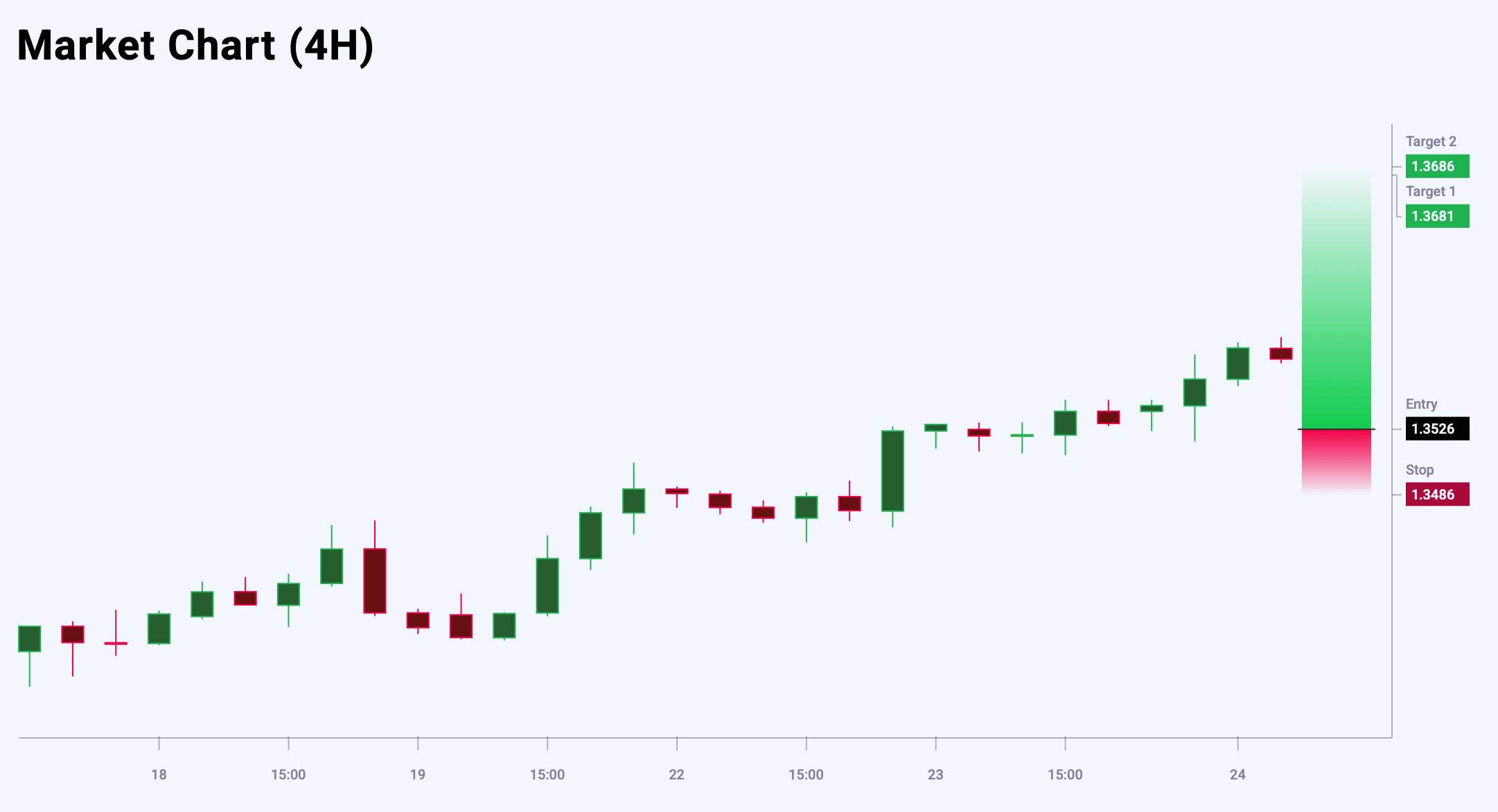
          GBPUSD trade idea

          The GBPUSD pair is undergoing a correction after seven consecutive sessions of growth. However, the current rally on intraday charts appears to be approaching exhaustion, increasing the likelihood of a local bearish correction. Under these conditions, the preferred strategy remains buying on pullbacks. The key support level stands at 1.3526. Today’s GBPUSD trade idea suggests placing a pending Buy Limit order.

          Market sentiment for GBPUSD points to a predominance of negative outlooks – 60% vs 40%. The risk-to-reward ratio is 1:4. Potential profit is 155 pips at the first take-profit level and 160 pips at the second, while potential losses are limited to 40 pips.

          GBPUSD trade idea for 24 July 2025

          Trading plan

          ● Entry point: 1.3526
          ● Target 1: 1.3681
          ● Target 2: 1.3686
          ● Stop-Loss: 1.3486

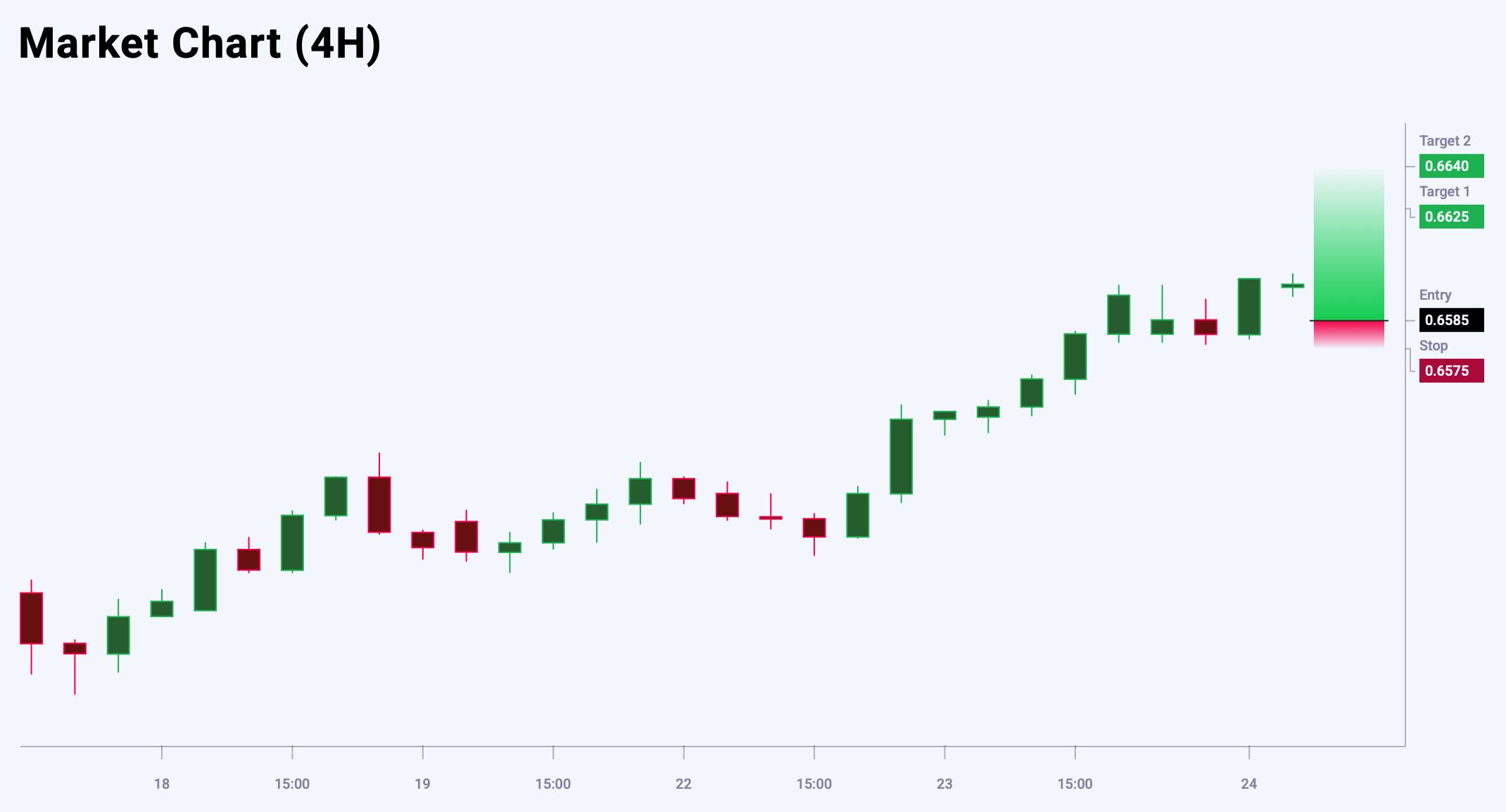
          AUDUSD trade idea

          The medium-term outlook for AUDUSD remains bullish, despite the pair trading in overbought territory. A bearish divergence is expected to form, which could limit further growth and trigger a moderate downside correction. To buy on dips remains the preferred strategy. The key support level is located at 0.6585. Today’s AUDUSD trade idea suggests placing a pending Buy Limit order.

          News sentiment for AUDUSD shows a strong tilt towards positive expectations – 64% vs 36%. The risk-to-reward ratio exceeds 1:5. Potential profit is 40 pips at the first take-profit level and 55 pips at the second, with potential losses limited to 10 pips.

          AUDUSD trade idea for 24 July 2025

          Trading plan

          ● Entry point: 0.6585
          ● Target 1: 0.6625
          ● Target 2: 0.6640
          ● Stop-Loss: 0.6575

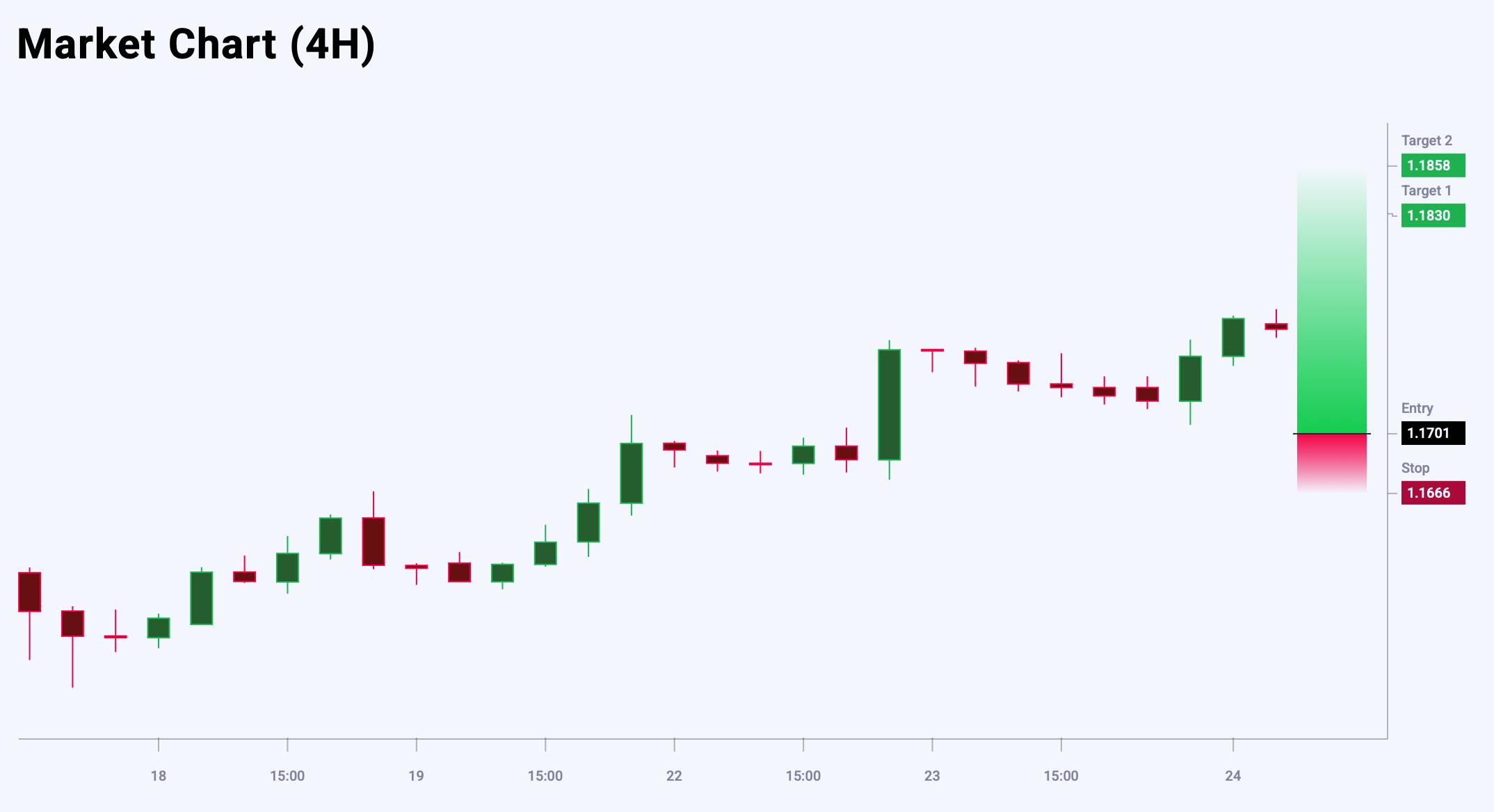
          EURUSD trade idea

          The EURUSD pair is posting a four-day rally after rebounding from key levels, although signs of a corrective phase have started to emerge. Despite the current decline, the preferred strategy remains buying on dips. The key support level lies at 1.1701. Today’s EURUSD trade idea suggests placing a pending Buy Limit order.

          News sentiment for EURUSD shows a notable predominance of positive expectations – 75% vs 25%. The risk-to-reward ratio exceeds 1:3. Potential profit is 120 pips at the first take-profit level and 148 pips at the second, with potential losses capped at 44 pips.

          EURUSD trade idea for 24 July 2025

          Trading plan

          ● Entry point: 1.1710
          ● Target 1: 1.1830
          ● Target 2: 1.1858
          ● Stop-Loss: 1.1666

          Source: RoboForex

          To stay updated on all economic events of today, please check out our Economic calendar
          Risk Warnings and Disclaimers
          You understand and acknowledge that there is a high degree of risk involved in trading. Following any strategies or investment methods may lead to potential losses. The content on the site is provided by our contributors and analysts for information purposes only. You are solely responsible for determining whether any trading assets, securities, strategy, or any other product is suitable for investing based on your own investment objectives and financial situation.
          Add to Favorites
          Share

          Germany’s Private Sector Inches Forward Amid Fragile Recovery Signs

          Gerik

          Economic

          Marginal Expansion as Economy Struggles for Momentum

          Germany’s private sector continued its tepid recovery in July, with the HCOB flash composite Purchasing Managers’ Index (PMI) slipping slightly to 50.3, down from 50.4 in June. Though still above the neutral 50.0 threshold, indicating expansion, the pace of growth remains weak and uneven across sectors. The result also missed economists’ expectations of 50.7, underscoring persistent headwinds for Europe’s largest economy.
          The PMI combines output data from the manufacturing and services sectors, which together form more than two-thirds of Germany’s GDP. The stagnation reflects a fragile and uncertain economic landscape shaped by geopolitical tensions, soft global demand, and domestic political instability following last year’s snap elections.

          Manufacturing Remains Subdued, but Shows Glimmers of Resilience

          Manufacturing PMI for July rose marginally to 49.2 from 49.0, remaining below the key growth threshold but suggesting a gradual improvement in momentum. According to Hamburg Commercial Bank’s chief economist Cyrus de la Rubia, the sector’s performance remains “fragile” yet not devoid of optimism, particularly given that output has increased for five consecutive months.
          This slow uptick in production is a potentially hopeful sign that industrial activity may be stabilizing. However, it continues to be weighed down by export weakness, elevated input costs, and lingering supply chain disruptions exacerbated by international trade disputes and U.S. tariff uncertainty.

          Services Sector Shows Signs of Revival

          On a more positive note, Germany’s services PMI rose to 50.1 in July from 49.7 in June, marking a four-month high and narrowly exceeding the consensus forecast of 50.0. After nearly a year of contraction, the sector registered its first rise in new business since mid-2024, suggesting that domestic demand could be slowly recovering.
          This service-sector stabilization aligns with predictions that rising real wages and supportive fiscal policies may gradually boost household consumption. Government stimulus and social transfers are beginning to filter through, giving consumers slightly more spending power amid falling inflationary pressures.

          Policy and Structural Challenges Persist

          Despite these small improvements, the overall economic picture remains clouded by both domestic and external risks. Germany’s industrial sector remains exposed to global trade uncertainties, particularly with the looming U.S. tariff deadline. Domestically, businesses face a structurally high tax burden and regulatory pressure to accelerate the green transition.
          Additionally, the impact of tighter monetary policy from the European Central Bank in previous quarters may still be weighing on credit availability and investment decisions, particularly for small and medium-sized enterprises.

          A Delicate Balance Between Recovery and Recession Risk

          Germany’s July PMI figures reflect a fragile yet ongoing recovery, with services stabilizing and manufacturing showing early signs of resilience despite staying in contraction territory. While the composite index remains just above breakeven, the trajectory is far from robust, and sentiment remains cautious across sectors.
          For now, the economy appears to be threading a narrow path between stagnation and growth, with momentum likely to hinge on broader developments such as the outcome of U.S. trade negotiations, further ECB rate decisions, and the implementation of fiscal stimulus at the national level. The coming months will be critical in determining whether this fragile recovery solidifies or slips back toward contraction.

          Source: Reuters

          To stay updated on all economic events of today, please check out our Economic calendar
          Risk Warnings and Disclaimers
          You understand and acknowledge that there is a high degree of risk involved in trading. Following any strategies or investment methods may lead to potential losses. The content on the site is provided by our contributors and analysts for information purposes only. You are solely responsible for determining whether any trading assets, securities, strategy, or any other product is suitable for investing based on your own investment objectives and financial situation.
          Add to Favorites
          Share

          Corporate Earnings Reveal Resilience in Tech Amid Global Tariff Turmoil

          Gerik

          Economic

          Tech leaders defy trade headwinds with strong results and forward guidance

          Some of the world’s top technology firms have emerged as clear outperformers amid the ongoing uncertainty surrounding US trade policy. Alphabet, SK Hynix, and Infosys all posted earnings that beat market expectations and issued forward guidance signaling confidence in future performance.
          SK Hynix, a critical supplier to Nvidia, reported record quarterly profit fueled by strong demand for AI chips and a strategic buildup of inventories by customers anticipating additional US tariffs. Meanwhile, Infosys, a key Indian IT services firm, raised the lower bound of its revenue growth forecast to 1%–3%, reflecting steady business demand despite regulatory and currency uncertainties.
          Alphabet also stood out, not only with better-than-expected earnings but by signaling increased investment plans, reinforcing long-term bullish sentiment in cloud infrastructure and AI development. These companies' proactive stance boosting capital expenditures and preparing for supply chain volatility suggests a degree of resilience rooted in innovation and forward-looking capacity management.

          Global tariff pressure weighs heavily on industrial sectors

          While tech firms shine, the broader Q2 earnings season has revealed significant pain among traditional manufacturers, particularly in automotive, aerospace, and pharmaceutical industries. Between July 16 and 22, companies collectively reported up to $7.8 billion in full-year losses, with US tariffs cited as a primary driver.
          Hyundai reported a 16% drop in Q2 operating profit, attributing 828 billion won (approximately $606.5 million) in losses to tariffs. General Motors echoed this narrative, with tariffs cutting $1.1 billion from its earnings. Tesla also highlighted pressure, with CEO Elon Musk warning of “rough quarters ahead” due to reduced government support for electric vehicles, following its worst sales performance in over a decade.
          These cases underscore the asymmetric impact of trade policy. Industries with high fixed costs, complex supply chains, and export exposure like automaking and aerospace are struggling to absorb the price distortion caused by sudden tariff changes.

          Consumer brands show resilience through strategic inventory and demand

          Swiss pharmaceutical giant Roche and global food and beverage leader Nestlé offered more positive signals. Roche beat H1 profit expectations and confirmed it had increased inventories in the US to hedge against the threat of incoming tariffs, a strategy that may reduce initial disruption. CEO Thomas Schinecker emphasized ongoing investment in local US production facilities, possibly to strengthen their case for exemption or leniency.
          Nestlé posted solid organic sales growth and maintained its 2025 outlook, a sign that consumer staples may be better positioned to weather the volatility. These firms have pricing power, diversified supply chains, and more flexible cost structures, enabling them to pass on some cost increases without significantly disrupting margins.

          High-stakes diplomacy ahead of August deadline

          The underlying cause of this market bifurcation global trade tension remains unresolved. The recent US-Japan trade agreement, which includes reduced tariffs on auto imports, briefly boosted market sentiment and raised hopes for similar deals with the European Union, South Korea, Brazil, and Canada before the revised August 1 deadline.
          However, uncertainty persists. South Korea’s finance ministry announced that its scheduled trade talks with US Treasury Secretary Scott Bessent were postponed, raising doubts over its ability to secure exemptions for key industries. Meanwhile, the EU is considering a 15% baseline tariff with conditional exemptions, and is entering a summit with China while bracing for pressure from both Beijing and Washington.
          The overlapping negotiations, shifting deadlines, and lack of coherent global coordination all add complexity to corporate forecasting and capital allocation, making long-term planning increasingly difficult for multinationals.

          Sectoral divergence widens as trade deadline nears

          Q2 2025 earnings illustrate a clear divergence between technology and industrial sectors. While innovative, asset-light firms such as Alphabet and SK Hynix continue to expand in spite of trade friction, capital-intensive manufacturers like Hyundai and GM are absorbing immediate and significant losses.
          Consumer staples and healthcare companies, aided by inventory hedging and diversified footprints, provide a degree of defensive stability. With major economies still rushing to conclude trade agreements before the looming August 1 deadline, the landscape remains fluid. For now, only the most adaptable companies those with foresight, capital strength, and geopolitical agility are positioned to thrive in this era of unpredictable policy and persistent macroeconomic tension.

          Source: Reuters

          To stay updated on all economic events of today, please check out our Economic calendar
          Risk Warnings and Disclaimers
          You understand and acknowledge that there is a high degree of risk involved in trading. Following any strategies or investment methods may lead to potential losses. The content on the site is provided by our contributors and analysts for information purposes only. You are solely responsible for determining whether any trading assets, securities, strategy, or any other product is suitable for investing based on your own investment objectives and financial situation.
          Add to Favorites
          Share

          European Car Sales Slide in June as Tariffs, Competition, and EV Transition Squeeze Automakers

          Gerik

          Economic

          Automakers face mounting structural headwinds

          The European auto market recorded a sharp decline in new vehicle registrations in June, down 5.1% year-on-year across the EU, UK, and EFTA regions, according to data from the European Automobile Manufacturers Association (ACEA). This downturn signals the growing burden faced by traditional automakers navigating a challenging landscape of elevated tariffs, regulatory pressure, and global competition.
          Volkswagen Group’s sales dropped 6.1%, while Renault and Hyundai saw even steeper declines of 12.3% and 8.7%, respectively. Stellantis reported a marginal dip of 0.6%. Tesla, meanwhile, recorded a 22.9% drop in deliveries, its sixth straight month of shrinking market share in Europe. The company’s share of the regional market contracted to 2.8%, from 3.4% a year earlier.
          This widespread contraction highlights a convergence of challenges affecting legacy and disruptive players alike. Most notably, the 25% US tariff on European vehicle imports announced earlier this year has eroded margins and demand for key export segments, particularly among German manufacturers. Simultaneously, rising competition from Chinese automakers like BYD has intensified pricing pressures, especially in the battery electric vehicle (BEV) segment.

          Electric vehicle adoption grows, but incumbents lag

          While overall auto sales in the EU fell 7.3% in June, electrified vehicle registrations surged. Battery electric vehicles rose 7.8%, hybrids jumped 41.6%, and plug-in hybrids increased 6.1%. Together, these vehicle types accounted for nearly 60% of EU passenger car sales up sharply from 50% a year ago.
          Despite this growth, traditional automakers appear slow to capture demand in this segment. Newer brands and Chinese entrants are aggressively expanding in the EV market, undercutting incumbents on both price and product offerings. According to Ben Nelmes of New AutoMotive, established carmakers have failed to respond quickly enough to consumer demand for cleaner, affordable vehicles, creating an opening for challengers.
          Notably, brands not included in ACEA data such as BYD and other Chinese manufacturers doubled their combined market share to 4.5%, reflecting growing traction among European consumers seeking lower-cost EV alternatives.

          Regional performance diverges amid economic pressures

          National-level sales trends revealed uneven performance across Europe. Germany, France, and Italy saw significant declines of 13.8%, 6.7%, and 17.4%, respectively. In contrast, Britain recorded a 6.7% rise in sales, and Spain posted an impressive 15.2% increase.
          These divergent outcomes are partly a function of domestic policy differences, including varying EV subsidies, consumer confidence levels, and industrial exposure to export markets. Germany’s sharp decline is particularly notable given its heavy reliance on automotive exports and vulnerability to US and Chinese trade actions.

          Industry disruption accelerates as incumbents struggle to adapt

          The June car sales slump across Europe underscores the growing mismatch between legacy automakers’ strategies and the rapidly evolving preferences of consumers. While EV adoption is clearly rising, incumbents are failing to lead this transition, losing share to faster, more agile entrants. At the same time, geopolitical frictions, especially the US tariff regime, are further distorting demand and squeezing profitability.
          Unless Europe’s major automakers accelerate innovation and adapt more decisively to structural shifts in global trade and vehicle technology, they risk ceding more ground to foreign competition both on the continent and abroad. The next six months, shaped by trade negotiations and EV market dynamics, will be critical in determining whether they can regain momentum or continue to lag behind.

          Source: Reuters

          To stay updated on all economic events of today, please check out our Economic calendar
          Risk Warnings and Disclaimers
          You understand and acknowledge that there is a high degree of risk involved in trading. Following any strategies or investment methods may lead to potential losses. The content on the site is provided by our contributors and analysts for information purposes only. You are solely responsible for determining whether any trading assets, securities, strategy, or any other product is suitable for investing based on your own investment objectives and financial situation.
          Add to Favorites
          Share

          UK Firms Cut Jobs And New Orders As Economy Struggles for Growth

          Glendon

          Economic

          Forex

          Britain’s private sector lost momentum in July as the fallout from the Labour government’s first budget and a febrile global backdrop prompted firms to cut jobs and new orders, according to a closely watched survey.

          S&P Global’s purchasing managers’ index slipped to 51 in July from the nine-month high of 52 the previous month. It was slightly worse than the 51.8 reading expected by economists surveyed by Bloomberg.

          While the index held above the 50 threshold separating growth and contraction, S&P said July’s survey implied a tepid quarterly growth rate of just 0.1%.

          It showed the UK economy struggling to shake off the twin hits of Labour’s tax-raising budget and a volatile geopolitical environment caused by Donald Trump’s US tariffs. The survey chimed with recent official data suggesting the economy slowed sharply from the bumper 0.7% growth seen in the first quarter.

          “The sluggish output growth reported in July reflected headwinds of deteriorating order books, subdued business confidence and rising costs,” said Chris Williamson, chief business economist at S&P Global Market Intelligence. He said these were “widely linked to the ongoing impact of the policy changes announced in last autumn’s budget and the broader destabilising effect of geopolitical uncertainty.”

          The manufacturing output index improved to a still-stagnant score of 50, suggesting an eight-month contraction in production ended. However, the UK’s powerhouse services sector suffered a slowdown to reading of 51.2, down from 52.8.

          Firms cut employment at the fastest pace in five months after being hit in April by a £26 billion ($35 billion) increase in payroll taxes and a hike in the minimum wage. S&P said this was being done through a mixture of hiring freezes and redundancies.

          New orders declined after picking up in June, while export sales fell for a ninth straight month as firms delay shipments and investment decisions amid the White House’s volatile tariff announcements. Input price inflation rose, fueled by April’s jump in employment costs.

          Source: Bloomberg Europe

          To stay updated on all economic events of today, please check out our Economic calendar
          Risk Warnings and Disclaimers
          You understand and acknowledge that there is a high degree of risk involved in trading. Following any strategies or investment methods may lead to potential losses. The content on the site is provided by our contributors and analysts for information purposes only. You are solely responsible for determining whether any trading assets, securities, strategy, or any other product is suitable for investing based on your own investment objectives and financial situation.
          Add to Favorites
          Share
          FastBull
          Copyright © 2025 FastBull Ltd

          728 RM B 7/F GEE LOK IND BLDG NO 34 HUNG TO RD KWUN TONG KLN HONG KONG

          TelegramInstagramTwitterfacebooklinkedin
          App Store Google Play Google Play
          Products
          Charts

          Chats

          Q&A with Experts
          Screeners
          Economic Calendar
          Data
          Tools
          Membership
          Features
          Function
          Markets
          Copy Trading
          Latest Signals
          Contests
          News
          Analysis
          24/7
          Columns
          Education
          Company
          Careers
          About Us
          Contact Us
          Advertising
          Help Center
          Feedback
          User Agreement
          Privacy Policy
          Business

          White Label

          Data API

          Web Plug-ins

          Poster Maker

          Affiliate Program

          Risk Disclosure

          The risk of loss in trading financial instruments such as stocks, FX, commodities, futures, bonds, ETFs and crypto can be substantial. You may sustain a total loss of the funds that you deposit with your broker. Therefore, you should carefully consider whether such trading is suitable for you in light of your circumstances and financial resources.

          No decision to invest should be made without thoroughly conducting due diligence by yourself or consulting with your financial advisors. Our web content might not suit you since we don't know your financial conditions and investment needs. Our financial information might have latency or contain inaccuracy, so you should be fully responsible for any of your trading and investment decisions. The company will not be responsible for your capital loss.

          Without getting permission from the website, you are not allowed to copy the website's graphics, texts, or trademarks. Intellectual property rights in the content or data incorporated into this website belong to its providers and exchange merchants.

          Not Logged In

          Log in to access more features

          FastBull Membership

          Not yet

          Purchase

          Become a signal provider
          Help Center
          Customer Service
          Dark Mode
          Price Up/Down Colors

          Log In

          Sign Up

          Position
          Layout
          Fullscreen
          Default to Chart
          The chart page opens by default when you visit fastbull.com