
Markets
News
Analysis
User
24/7
Economic Calendar
Education
Data
- Names
- Latest
- Prev


Signal Accounts for Members
All Signal Accounts
All Contests


U.K. Trade Balance Non-EU (SA) (Oct)A:--
F: --
P: --
U.K. Trade Balance (Oct)A:--
F: --
P: --
U.K. Services Index MoMA:--
F: --
P: --
U.K. Construction Output MoM (SA) (Oct)A:--
F: --
P: --
U.K. Industrial Output YoY (Oct)A:--
F: --
P: --
U.K. Trade Balance (SA) (Oct)A:--
F: --
P: --
U.K. Trade Balance EU (SA) (Oct)A:--
F: --
P: --
U.K. Manufacturing Output YoY (Oct)A:--
F: --
P: --
U.K. GDP MoM (Oct)A:--
F: --
P: --
U.K. GDP YoY (SA) (Oct)A:--
F: --
P: --
U.K. Industrial Output MoM (Oct)A:--
F: --
P: --
U.K. Construction Output YoY (Oct)A:--
F: --
P: --
France HICP Final MoM (Nov)A:--
F: --
P: --
China, Mainland Outstanding Loans Growth YoY (Nov)A:--
F: --
P: --
China, Mainland M2 Money Supply YoY (Nov)A:--
F: --
P: --
China, Mainland M0 Money Supply YoY (Nov)A:--
F: --
P: --
China, Mainland M1 Money Supply YoY (Nov)A:--
F: --
P: --
India CPI YoY (Nov)A:--
F: --
P: --
India Deposit Gowth YoYA:--
F: --
P: --
Brazil Services Growth YoY (Oct)A:--
F: --
P: --
Mexico Industrial Output YoY (Oct)A:--
F: --
P: --
Russia Trade Balance (Oct)A:--
F: --
P: --
Philadelphia Fed President Henry Paulson delivers a speech
Canada Building Permits MoM (SA) (Oct)A:--
F: --
P: --
Canada Wholesale Sales YoY (Oct)A:--
F: --
P: --
Canada Wholesale Inventory MoM (Oct)A:--
F: --
P: --
Canada Wholesale Inventory YoY (Oct)A:--
F: --
P: --
Canada Wholesale Sales MoM (SA) (Oct)A:--
F: --
P: --
Germany Current Account (Not SA) (Oct)A:--
F: --
P: --
U.S. Weekly Total Rig CountA:--
F: --
P: --
U.S. Weekly Total Oil Rig CountA:--
F: --
P: --
Japan Tankan Large Non-Manufacturing Diffusion Index (Q4)--
F: --
P: --
Japan Tankan Small Manufacturing Outlook Index (Q4)--
F: --
P: --
Japan Tankan Large Non-Manufacturing Outlook Index (Q4)--
F: --
P: --
Japan Tankan Large Manufacturing Outlook Index (Q4)--
F: --
P: --
Japan Tankan Small Manufacturing Diffusion Index (Q4)--
F: --
P: --
Japan Tankan Large Manufacturing Diffusion Index (Q4)--
F: --
P: --
Japan Tankan Large-Enterprise Capital Expenditure YoY (Q4)--
F: --
P: --
U.K. Rightmove House Price Index YoY (Dec)--
F: --
P: --
China, Mainland Industrial Output YoY (YTD) (Nov)--
F: --
P: --
China, Mainland Urban Area Unemployment Rate (Nov)--
F: --
P: --
Saudi Arabia CPI YoY (Nov)--
F: --
P: --
Euro Zone Industrial Output YoY (Oct)--
F: --
P: --
Euro Zone Industrial Output MoM (Oct)--
F: --
P: --
Canada Existing Home Sales MoM (Nov)--
F: --
P: --
Euro Zone Total Reserve Assets (Nov)--
F: --
P: --
U.K. Inflation Rate Expectations--
F: --
P: --
Canada National Economic Confidence Index--
F: --
P: --
Canada New Housing Starts (Nov)--
F: --
P: --
U.S. NY Fed Manufacturing Employment Index (Dec)--
F: --
P: --
U.S. NY Fed Manufacturing Index (Dec)--
F: --
P: --
Canada Core CPI YoY (Nov)--
F: --
P: --
Canada Manufacturing Unfilled Orders MoM (Oct)--
F: --
P: --
Canada Manufacturing New Orders MoM (Oct)--
F: --
P: --
Canada Core CPI MoM (Nov)--
F: --
P: --
Canada Manufacturing Inventory MoM (Oct)--
F: --
P: --
Canada CPI YoY (Nov)--
F: --
P: --
Canada CPI MoM (Nov)--
F: --
P: --
Canada CPI YoY (SA) (Nov)--
F: --
P: --
Canada Core CPI MoM (SA) (Nov)--
F: --
P: --


No matching data
Latest Views
Latest Views
Trending Topics
Top Columnists
Latest Update
White Label
Data API
Web Plug-ins
Affiliate Program
View All

No data
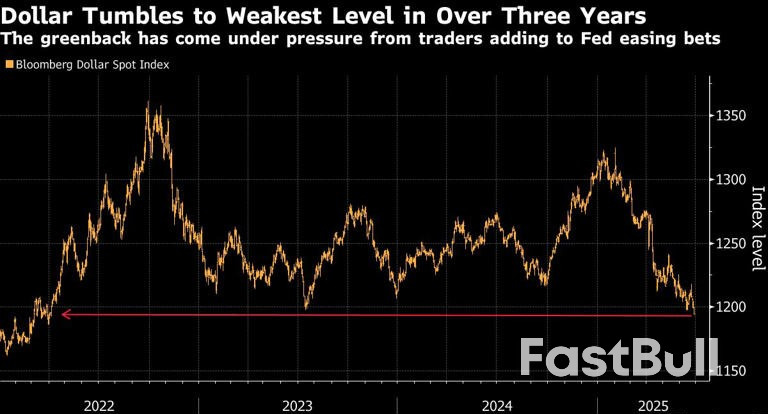
Treasuries rallied and the dollar slumped after reports that Trump may name a successor to Fed Chair Powell before his term ends. Markets expect a dovish shift, increasing bets on rate cuts.
The USDCHF is extending its declines for 2025, with the price now breaking to fresh 2025 lows below the key 0.8032 low from April. The move lower marks a significant technical development as it takes the price to the lowest level since 2011.
The USD is lower today as the market reacts to the news that the Pres. Trump will announce a successor to Fed's Powell over the next few months and the independence of the Fed would be compromised.
Going back in time on the weekly chart above, the bearish trend was set in motion after the January 2025 high stalled near multiple key technical zones:
The 2024 and October 2023 highs
The 50% retracement of the decline from the 2022 high
Since then, sellers have remained in control, pushing the pair below multiple support levels. In April the price fell below the floor between 0.8333 to 0.8373. However, after falling to the April 2025 low at 0.80325, the pair bounced - moving back above the old floor in May (above 0.8333 to 0.8373).
However, that bounce higher was short-lived, and the move lower was restarted in the very next week.
Since, then the price action has been decidedly more bearish with the break to new 2025 lows today at 0.80325. That level is now a close short-term risk level for sellers. Staying below it, and the door remains wide open for more downside probing. The current price is trading at 0.7993.
The International Monetary Fund has revised Saudi Arabia’s economic growth upwards amid the unwinding of production cuts by Opec+ members.
The Arab world’s largest economy is forecast to grow 3.5 per cent this year, up from a previous projection of 3 per cent in April, and 3.9 per cent in 2026, an upward revision of 0.2 percentage points from the last prediction.
“Saudi Arabia’s economy has demonstrated strong resilience to shocks, with non-oil economic activities expanding, inflation contained, and unemployment reaching record-low levels,” the IMF said on Thursday.
Saudi Arabia is focusing on diversifying its economy away from oil with an emphasis on the development of sectors such as technology, property, tourism and infrastructure as part of Vision 2030.
The kingdom is supporting the development of several industries spanning different sectors to generate employment and help its non-oil economy to grow.
The country's non-oil economy is expected to grow by 3.4 per cent in 2025, after recording a 4.2 per cent growth last year after “the continued implementation of Vision 2030 projects through public and private investment, as well as strong credit growth, which would help sustain domestic demand and mitigate the impact of lower oil prices”, the Washington-based lender said.
Oil prices have remained volatile amid a number of events including the introduction of tariffs by Donald Trump, US-Iran nuclear talks and the conflict between Iran and Israel that ended earlier this week.
Unwinding of production cuts by Opec+ members including Saudi Arabia and Russia have also been affecting oil prices. Last month, Opec+ agreed to increase its monthly oil output at 411,000 barrels per day for July, following similar levels for May and this month.
“Over the medium term, domestic demand – including momentum ahead of Saudi Arabia’s hosting of large-scale international events – is expected to push non-oil growth closer to 4 per cent in 2027 before stabilising at 3.5 per cent by 2030,” the IMF said.
Saudi Arabia is set to host two major global events, Expo 2030 and Fifa World Cup in 2034.
The direct impact of rising global trade tension amid Trump tariffs is also expected to be limited on Saudi Arabia as oil products – comprising 78 per cent of Saudi Arabia’s goods exports to the US in 2024 – are exempt from US tariffs, while non-oil exports account for only 3.4 per cent of the kingdom’s total non-oil exports, the lender said.
In April, US President Donald Trump levied an import tariff of 10 per cent on all Gulf countries.
Saudi Arabia’s inflation levels would remain lower at around 2 per cent, supported by a credible peg to the US dollar, domestic subsidies, and continued supply of expatriate labour and economic growth, according to the IMF.
The overall fiscal deficit is also expected to narrow in the medium term, driven by spending efficiency measures, it said.
Federal Reserve Bank of Richmond President Thomas Barkin said Thursday tariffs are very likely to push inflation up over coming months, in remarks that said central bank policy is where it needs to be to deal with what lies ahead.
“I do believe we will see pressure on prices,” Barkin said in the text of remarks prepared for delivery before a gathering of New York Association for Business Economics.
When it comes to tariffs and their impact on price pressures, “to date, these increases have had only modest effects on measured inflation, but I anticipate more pressure is coming,” amid comments from businesses that they expect to pass at least some of the rise in import taxes imposed by President Donald Trump.
“That said, I don’t expect the impact on inflation to be anywhere near as significant as what we just experienced” during the pandemic and there are signs that consumers will try to move away from tariffed goods, which could limit some of the upsides for higher inflation.
Last week, the Fed’s most recent gathering of the rate-setting Federal Open Market Committee saw officials leave their overnight target rate unchanged at between 4.25% and 4.5%. Uncertainty over the outlook is keeping the central bank on the sidelines amid expectations the tariffs will push up inflation this year while depressing growth and hiring.
In his remarks, Barkin noted the Fed is facing risks on both its job and inflation mandates. Citing the uncertainty of the outlook Barkin declined to say where monetary policy is heading.
But he said, “given the strength in today’s economy, we have time to track developments patiently and allow the visibility to improve,” adding, “when it does, we are well positioned to address whatever the economy will require.”
Barkin said that as the economy now stands things look pretty good and recent inflation data was “encouraging.” He said job growth has been “healthy.”
White Label
Data API
Web Plug-ins
Poster Maker
Affiliate Program
The risk of loss in trading financial instruments such as stocks, FX, commodities, futures, bonds, ETFs and crypto can be substantial. You may sustain a total loss of the funds that you deposit with your broker. Therefore, you should carefully consider whether such trading is suitable for you in light of your circumstances and financial resources.
No decision to invest should be made without thoroughly conducting due diligence by yourself or consulting with your financial advisors. Our web content might not suit you since we don't know your financial conditions and investment needs. Our financial information might have latency or contain inaccuracy, so you should be fully responsible for any of your trading and investment decisions. The company will not be responsible for your capital loss.
Without getting permission from the website, you are not allowed to copy the website's graphics, texts, or trademarks. Intellectual property rights in the content or data incorporated into this website belong to its providers and exchange merchants.
Not Logged In
Log in to access more features

FastBull Membership
Not yet
Purchase
Log In
Sign Up