• Trade
  • Markets
  • Copy
  • Contests
  • News
  • 24/7
  • Calendar
  • Q&A
  • Chats
Trending
Screeners
SYMBOL
LAST
BID
ASK
HIGH
LOW
NET CHG.
%CHG.
SPREAD
SPX
S&P 500 Index
6827.42
6827.42
6827.42
6899.86
6801.80
-73.58
-1.07%
--
DJI
Dow Jones Industrial Average
48458.04
48458.04
48458.04
48886.86
48334.10
-245.98
-0.51%
--
IXIC
NASDAQ Composite Index
23195.16
23195.16
23195.16
23554.89
23094.51
-398.69
-1.69%
--
USDX
US Dollar Index
97.950
98.030
97.950
98.500
97.950
-0.370
-0.38%
--
EURUSD
Euro / US Dollar
1.17394
1.17409
1.17394
1.17496
1.17192
+0.00011
+ 0.01%
--
GBPUSD
Pound Sterling / US Dollar
1.33707
1.33732
1.33707
1.33997
1.33419
-0.00148
-0.11%
--
XAUUSD
Gold / US Dollar
4299.39
4299.39
4299.39
4353.41
4257.10
+20.10
+ 0.47%
--
WTI
Light Sweet Crude Oil
57.233
57.485
57.233
58.011
56.969
-0.408
-0.71%
--

Community Accounts

Signal Accounts
--
Profit Accounts
--
Loss Accounts
--
View More

Become a signal provider

Sell trading signals to earn additional income

View More

Guide to Copy Trading

Get started with ease and confidence

View More

Signal Accounts for Members

All Signal Accounts

Best Return
  • Best Return
  • Best P/L
  • Best MDD
Past 1W
  • Past 1W
  • Past 1M
  • Past 1Y

All Contests

  • All
  • Trump Updates
  • Recommend
  • Stocks
  • Cryptocurrencies
  • Central Banks
  • Featured News
Top News Only
Share

China's Central Financial And Economic Affairs Commission Deputy Director: Will Expand Export And Increase Import In 2026

Share

Thai Leader Anutin: Landmine Blast That Killed Thai Soldiers 'Not A Roadside Accident'

Share

Thai Leader Anutin: Thailand To Continue Military Action Until 'We Feel No More Harm'

Share

Cambodian Prime Minister Hun Manet Says He Had Phone Calls With Trump And Malaysian Leader Anwar About Ceasefire

Share

Cambodia's Hun Manet Says USA, Malaysia Should Verify 'Which Side Fired First' In Latest Conflict

Share

Cambodia's Hun Manet: Cambodia Maintains Its Stance In Seeking Peaceful Resolution Of Disputes

Share

Nasdaq Companies: Allergan, Ferrovia, Insmed, Monolithic Power Systems, Seagate Technology, And Western Digital Will Be Added To The NASDAQ 100 Index. Biogen, CdW, GlobalFoundries, Lululemon, ON Semiconductor, And Tradedesk Will Be Removed From The NASDAQ 100 Index

Share

Witkoff Headed To Berlin This Weekend To Meet With Zelenskiy, European Leaders -Wsj Reporter On X

Share

Russia Attacks Two Ukrainian Ports, Damaging Three Turkish-Owned Vessels

Share

[Historic Flooding Occurs In At Least Four Rivers In Washington State Due To Days Of Torrential Rains] Multiple Areas In Washington State Have Been Hit By Severe Flooding Due To Days Of Torrential Rains, With At Least Four Rivers Experiencing Historic Flooding. Reporters Learned On The 12th That The Floods Caused By The Torrential Rains In Washington State Have Destroyed Homes And Closed Several Highways. Experts Warn That Even More Severe Flooding May Occur In The Future. A State Of Emergency Has Been Declared In Washington State

Share

Trump Says Proposed Free Economic Zone In Donbas Would Work

Share

Trump: I Think My Voice Should Be Heard

Share

Trump Says Will Be Choosing New Fed Chair In Near Future

Share

Trump Says Proposed Free Economic Zone In Donbas Complex But Would Work

Share

Trump Says Land Strikes In Venezuela Will Start Happening

Share

US President Trump: Thailand And Cambodia Are In A Good Situation

Share

State Media: North Korean Leader Kim Hails Troops Returning From Russia Mission

Share

The 10-year Treasury Yield Rose About 5 Basis Points During The "Fed Rate Cut Week," And The 2/10-year Yield Spread Widened By About 9 Basis Points. On Friday (December 12), In Late New York Trading, The Yield On The Benchmark 10-year US Treasury Note Rose 2.75 Basis Points To 4.1841%, A Cumulative Increase Of 4.90 Basis Points For The Week, Trading Within A Range Of 4.1002%-4.2074%. It Rose Steadily From Monday To Wednesday (before The Fed Announced Its Rate Cut And Treasury Bill Purchase Program), Subsequently Exhibiting A V-shaped Recovery. The 2-year Treasury Yield Fell 1.82 Basis Points To 3.5222%, A Cumulative Decrease Of 3.81 Basis Points For The Week, Trading Within A Range Of 3.6253%-3.4989%

Share

Trump: Lots Of Progress Being Made On Russia-Ukraine

Share

NOPA November US Soybean Crush Estimated At 220.285 Million Bushels

TIME
ACT
FCST
PREV
U.K. Trade Balance Non-EU (SA) (Oct)

A:--

F: --

P: --

U.K. Trade Balance (Oct)

A:--

F: --

P: --

U.K. Services Index MoM

A:--

F: --

P: --

U.K. Construction Output MoM (SA) (Oct)

A:--

F: --

P: --

U.K. Industrial Output YoY (Oct)

A:--

F: --

P: --

U.K. Trade Balance (SA) (Oct)

A:--

F: --

P: --

U.K. Trade Balance EU (SA) (Oct)

A:--

F: --

P: --

U.K. Manufacturing Output YoY (Oct)

A:--

F: --

P: --

U.K. GDP MoM (Oct)

A:--

F: --

P: --

U.K. GDP YoY (SA) (Oct)

A:--

F: --

P: --

U.K. Industrial Output MoM (Oct)

A:--

F: --

P: --

U.K. Construction Output YoY (Oct)

A:--

F: --

P: --

France HICP Final MoM (Nov)

A:--

F: --

P: --

China, Mainland Outstanding Loans Growth YoY (Nov)

A:--

F: --

P: --

China, Mainland M2 Money Supply YoY (Nov)

A:--

F: --

P: --

China, Mainland M0 Money Supply YoY (Nov)

A:--

F: --

P: --

China, Mainland M1 Money Supply YoY (Nov)

A:--

F: --

P: --

India CPI YoY (Nov)

A:--

F: --

P: --

India Deposit Gowth YoY

A:--

F: --

P: --

Brazil Services Growth YoY (Oct)

A:--

F: --

P: --

Mexico Industrial Output YoY (Oct)

A:--

F: --

P: --

Russia Trade Balance (Oct)

A:--

F: --

P: --

Philadelphia Fed President Henry Paulson delivers a speech
Canada Building Permits MoM (SA) (Oct)

A:--

F: --

P: --

Canada Wholesale Sales YoY (Oct)

A:--

F: --

P: --

Canada Wholesale Inventory MoM (Oct)

A:--

F: --

P: --

Canada Wholesale Inventory YoY (Oct)

A:--

F: --

P: --

Canada Wholesale Sales MoM (SA) (Oct)

A:--

F: --

P: --

Germany Current Account (Not SA) (Oct)

A:--

F: --

P: --

U.S. Weekly Total Rig Count

A:--

F: --

P: --

U.S. Weekly Total Oil Rig Count

A:--

F: --

P: --

Japan Tankan Large Non-Manufacturing Diffusion Index (Q4)

--

F: --

P: --

Japan Tankan Small Manufacturing Outlook Index (Q4)

--

F: --

P: --

Japan Tankan Large Non-Manufacturing Outlook Index (Q4)

--

F: --

P: --

Japan Tankan Large Manufacturing Outlook Index (Q4)

--

F: --

P: --

Japan Tankan Small Manufacturing Diffusion Index (Q4)

--

F: --

P: --

Japan Tankan Large Manufacturing Diffusion Index (Q4)

--

F: --

P: --

Japan Tankan Large-Enterprise Capital Expenditure YoY (Q4)

--

F: --

P: --

U.K. Rightmove House Price Index YoY (Dec)

--

F: --

P: --

China, Mainland Industrial Output YoY (YTD) (Nov)

--

F: --

P: --

China, Mainland Urban Area Unemployment Rate (Nov)

--

F: --

P: --

Saudi Arabia CPI YoY (Nov)

--

F: --

P: --

Euro Zone Industrial Output YoY (Oct)

--

F: --

P: --

Euro Zone Industrial Output MoM (Oct)

--

F: --

P: --

Canada Existing Home Sales MoM (Nov)

--

F: --

P: --

Euro Zone Total Reserve Assets (Nov)

--

F: --

P: --

U.K. Inflation Rate Expectations

--

F: --

P: --

Canada National Economic Confidence Index

--

F: --

P: --

Canada New Housing Starts (Nov)

--

F: --

P: --

U.S. NY Fed Manufacturing Employment Index (Dec)

--

F: --

P: --

U.S. NY Fed Manufacturing Index (Dec)

--

F: --

P: --

Canada Core CPI YoY (Nov)

--

F: --

P: --

Canada Manufacturing Unfilled Orders MoM (Oct)

--

F: --

P: --

Canada Manufacturing New Orders MoM (Oct)

--

F: --

P: --

Canada Core CPI MoM (Nov)

--

F: --

P: --

Canada Manufacturing Inventory MoM (Oct)

--

F: --

P: --

Canada CPI YoY (Nov)

--

F: --

P: --

Canada CPI MoM (Nov)

--

F: --

P: --

Canada CPI YoY (SA) (Nov)

--

F: --

P: --

Canada Core CPI MoM (SA) (Nov)

--

F: --

P: --

Q&A with Experts
    • All
    • Chatrooms
    • Groups
    • Friends
    Connecting
    .
    .
    .
    Type here...
    Add Symbol or Code

      No matching data

      All
      Trump Updates
      Recommend
      Stocks
      Cryptocurrencies
      Central Banks
      Featured News
      • All
      • Russia-Ukraine Conflict
      • Middle East Flashpoint
      • All
      • Russia-Ukraine Conflict
      • Middle East Flashpoint
      Search
      Products

      Charts Free Forever

      Chats Q&A with Experts
      Screeners Economic Calendar Data Tools
      Membership Features
      Data Warehouse Market Trends Institutional Data Policy Rates Macro

      Market Trends

      Market Sentiment Order Book Forex Correlations

      Top Indicators

      Charts Free Forever
      Markets

      News

      News Analysis 24/7 Columns Education
      From Institutions From Analysts
      Topics Columnists

      Latest Views

      Latest Views

      Trending Topics

      Top Columnists

      Latest Update

      Signals

      Copy Rankings Latest Signals Become a signal provider AI Rating
      Contests
      Brokers

      Overview Brokers Assessment Rankings Regulators News Claims
      Broker listing Forex Brokers Comparison Tool Live Spread Comparison Scam
      Q&A Complaint Scam Alert Videos Tips to Detect Scam
      More

      Business
      Events
      Careers About Us Advertising Help Center

      White Label

      Data API

      Web Plug-ins

      Affiliate Program

      Awards Institution Evaluation IB Seminar Salon Event Exhibition
      Vietnam Thailand Singapore Dubai
      Fans Party Investment Sharing Session
      FastBull Summit BrokersView Expo
      Recent Searches
        Top Searches
          Markets
          News
          Analysis
          User
          24/7
          Economic Calendar
          Education
          Data
          • Names
          • Latest
          • Prev

          View All

          No data

          Scan to Download

          Faster Charts, Chat Faster!

          Download App
          English
          • English
          • Español
          • العربية
          • Bahasa Indonesia
          • Bahasa Melayu
          • Tiếng Việt
          • ภาษาไทย
          • Français
          • Italiano
          • Türkçe
          • Русский язык
          • 简中
          • 繁中
          Open Account
          Search
          Products
          Charts Free Forever
          Markets
          News
          Signals

          Copy Rankings Latest Signals Become a signal provider AI Rating
          Contests
          Brokers

          Overview Brokers Assessment Rankings Regulators News Claims
          Broker listing Forex Brokers Comparison Tool Live Spread Comparison Scam
          Q&A Complaint Scam Alert Videos Tips to Detect Scam
          More

          Business
          Events
          Careers About Us Advertising Help Center

          White Label

          Data API

          Web Plug-ins

          Affiliate Program

          Awards Institution Evaluation IB Seminar Salon Event Exhibition
          Vietnam Thailand Singapore Dubai
          Fans Party Investment Sharing Session
          FastBull Summit BrokersView Expo

          Top 3 Crypto Stocks To Watch As Investors Eye Q3 Altcoin Season

          Samantha Luan

          Cryptocurrency

          Economic

          Summary:

          The current bull run in the market is further fueling investor interest in stocks associated with crypto-based firms. Cryptocurrency stocks allow investors to benefit from both the traditional stock and crypto prices

          Key Insights:

          ·Crypto stocks of Circle, Coinbase, and Robinhood are positioned for a positive rally in Q3 2025.
          ·CRCL, COIN, and HOOD are all up in Pre-market trading in readiness for a bullish week ahead.
          ·Investors eye a potential Q3 2025 altcoin season, fuelled by historical patterns with crypto stock ties.

          Over the years, crypto stock and associated currencies have solidified their position as a significant asset class. The market continues to attract interest from both individual and institutional investors.

          The current bull run in the market is further fueling investor interest in stocks associated with crypto-based firms. Cryptocurrency stocks allow investors to benefit from both the traditional stock and crypto prices.

          As market participants turn their attention to Q3, here are three top crypto stocks to look out for:

          Circle Internet Group

          Despite a mild correction, Circle CRCL remains a top performer among other crypto stocks. According to data from TradingView, the CRCL stock was priced at $187.33, up 0.92% in pre-market trading.

          Circle began trading on the New York Stock Exchange (NYSE) on June 5, 2025, following its Initial Public Offering (IPO). The stock opened at $69, surged to $103.75 intraday, and closed at $83.23.

          Circle stock jumped 800% in just 18 days to trade at $279. Circle CRCL has rallied approximately 550% since the initial public offering. This rapid increase indicated strong demand and effective positioning.

          As of July 14, 2025, the stock had a market capitalization of $42.64 Billion at the time of filing this story. Circle is the issuer of USDC, the second-largest stablecoin by market cap, $63 Billion (press time).

          Beyond stablecoin settlements, Circle has a partner network of over 500. Additionally, the US Senate passed the GENIUS Act with a 68–30 vote on June 17.

          This legislation creates the first federal framework for dollar‑pegged stablecoins, further boosting CRCL’s outlook.

          Using a 10-year discounted cash flow model, Bernstein analysts forecasted a $230 target for Circle stock.

          Coinbase Global Inc

          Coinbase is another promising stock to watch in the third quarter of 2025. COIN has rallied in pre-market trading on July 14, 2025, according to Google Finance data.

          The stock is currently traded at $387.06, reflecting a 55% increase year-to-date. As of writing, COIN was trading at $393 atop 5-day rally of 8.45%.
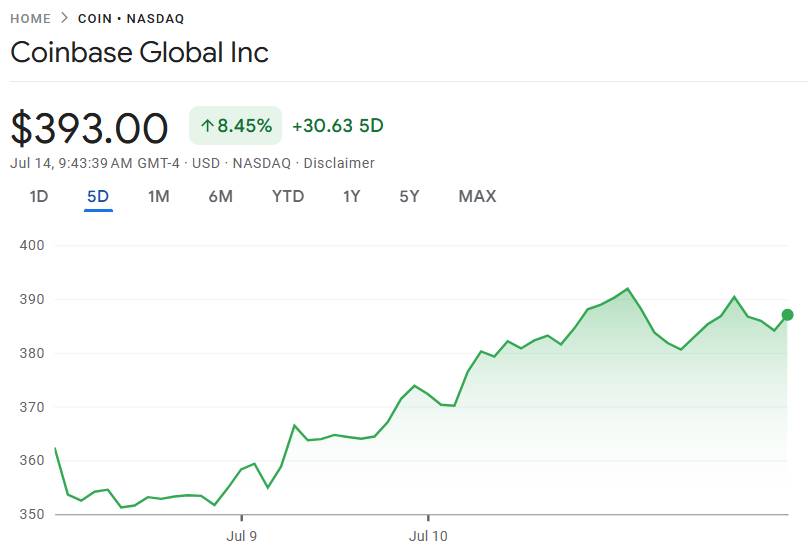
          Coinbase Price Chart | Source: Google Finance

          The Coinbase stock debuted at $381 on the Nasdaq Global Select Market on April 14, 2021. Price dropped below $50 in 2022, but it bounced back in 2023, 2024, and 2025.

          The rally is supported by the growing popularity of Bitcoin Exchange-Traded Funds (ETFs) and the fourth Bitcoin halving.

          Analysts are optimistic about the future outlook of COIN. Popular market analyst Ali Martinez recently predicted a $2,000 target for COIN, citing a rare bullish pattern on the COIN chart.

          Moreover, COIN recently rose as high as $388.96, despite Ark Invest selling 16,627 units of its Coinbase stock.

          Separately, the Czech National Bank has recently announced the acquisition of $18 Million worth of Coinbase shares during the second quarter of 2025.

          Robinhood Markets Inc

          Robinhood Markets, Inc. is the third crypto-related stock to consider in Q3 2025. HOOD opened at $98.34 on July 14, 2025, with a market capitalization of $86.78 Billion.

          As of writing, it was up 4.05% in the last 5 days to $99.36.
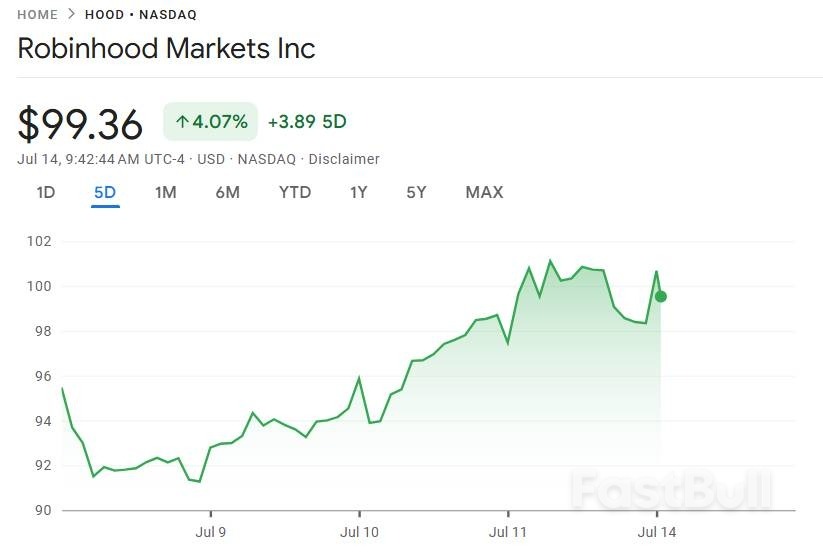
          Robinhood Price Chart | Source: Google Finance

          Robinhood Markets has a fifty-two-week low of $13.98 and a fifty-two-week high of $101.50. HOOD surged over 163% year-to-date and 310.7% within the past year.

          Analysts noted a strong rising trend, with some predicting a 117% rise in the next three months.

          In a research note on Tuesday, July 1, KeyCorp boosted its price objective on HOOD shares from $60 to $110. The bank-based financial services company gave the HOOD stock an “overweight” rating.

          In its last quarterly earnings released on April 30, Robinhood reported $0.37 earnings per share (EPS) for the quarter. This figure comes short of analysts’ consensus estimates of $0.41.

          However, the firm reported revenue of $927.00 Million for the quarter, higher than the consensus estimate of $917.12 Million.

          Beyond Crypto Stocks: Is an Altcoin Season in View in Q3?

          Historically, the altcoin season follows Bitcoin’s strong rallies and subsequent consolidation.According to CoinMarketCap data, Bitcoin has hit a new all-time high of $123,000, driven by positive market sentiments.

          This rally creates an opportunity for prices to consolidate, giving room for altcoins to shine.Ethereum often leads altcoin rallies, as its performance against Bitcoin signals broader altcoin market strength.

          In the past 24 hours, ETH has surged over 2.7% to $3,046. Blockchains like Solana and Avalanche have also benefited from the recent BTC rally.

          Additionally, altcoins like Aave and Toncoin are seeing renewed interest due to their scalability and DeFi innovations.

          Source: CryptoSlate

          To stay updated on all economic events of today, please check out our Economic calendar
          Risk Warnings and Disclaimers
          You understand and acknowledge that there is a high degree of risk involved in trading. Following any strategies or investment methods may lead to potential losses. The content on the site is provided by our contributors and analysts for information purposes only. You are solely responsible for determining whether any trading assets, securities, strategy, or any other product is suitable for investing based on your own investment objectives and financial situation.
          Add to Favorites
          Share

          China's Q2 GDP Beats Forecasts at 5.2%, but Headwinds Intensify Amid Tariff Threats and Property Slump

          Gerik

          Economic

          Economic Resilience, But Momentum Slips

          China’s second-quarter GDP growth of 5.2% year-on-year came in above the consensus estimate of 5.1%, though it marked a deceleration from 5.4% in Q1. On a quarterly basis, the economy grew 1.1%, beating the 0.9% forecast. The data point to modest resilience in the face of renewed external pressure from U.S. President Donald Trump’s escalating tariff threats and lingering domestic structural challenges.
          June’s industrial production growth, at 6.8%, far exceeded expectations, highlighting the strength of China’s manufacturing engine. However, this was offset by softening consumer activity, with retail sales up only 4.8% below the 5.4% forecast and significantly lower than May’s 6.4%. This divergence illustrates a widening imbalance between supply-side stability and weak domestic demand.
          Fixed-asset investment in the first half of the year grew just 2.8%, compared to the forecast of 3.6%, reflecting investor caution amid economic uncertainty. Meanwhile, property investment plunged 11.2%, extending its drag on the broader economy.

          Tariffs, Trade, and Waning Consumer Confidence

          President Trump’s announcement of a 30% tariff on EU and Mexican imports, alongside the threat of 100% secondary tariffs on countries purchasing Russian exports, has reignited concerns about global trade fragmentation. For China, the looming August 1 tariff deadline risks disrupting already fragile export-driven sectors.
          While June exports did climb to a record high suggesting a short-term boost from exporters front-loading shipments analysts warn this may be temporary. Dan Wang of Eurasia Group notes that small and medium-sized exporters are already facing bankruptcy risks, while consumers and businesses alike have grown more risk-averse.
          The yuan’s muted response to the data reflects Beijing’s ongoing strategy to maintain currency stability in the face of external shocks. However, policymakers are walking a tightrope: with fiscal and monetary levers already in use, their room to maneuver is narrowing.

          Policy Support May Need to Deepen

          Despite the upbeat GDP headline, China’s recovery lacks depth. The industrial sector particularly capital-intensive and automated remains a bright spot but contributes little to job creation or wage growth. Meanwhile, the disappointing performance of consumption and investment raises alarms about structural fragility.
          Beijing has responded with targeted measures: infrastructure spending, consumer subsidies, monetary easing, and housing-related support. Yet deflationary pressures continue to weigh, as shown by the steep fall in producer prices. Without more aggressive fiscal stimulus and demand-side reforms, analysts doubt whether the 2025 growth target of "around 5%" can be met.
          According to Reuters’ polling, China’s full-year GDP growth is now expected to slow to 4.6%, down from 5.0% in 2024, and could ease further to 4.2% in 2026 as trade tensions and domestic constraints persist.

          A Strong Quarter Masks Growing Risks

          China’s better-than-expected Q2 GDP figure may offer temporary relief to policymakers, but the underlying economic signals suggest growing stress beneath the surface. With retail consumption softening, property investment plunging, and external trade threats mounting, Q3 may prove significantly more challenging.
          Unless Beijing can effectively counteract these headwinds with deeper structural reforms and targeted fiscal policies, the path to sustained recovery and meeting its growth target remains precarious.

          Source: Reuters

          To stay updated on all economic events of today, please check out our Economic calendar
          Risk Warnings and Disclaimers
          You understand and acknowledge that there is a high degree of risk involved in trading. Following any strategies or investment methods may lead to potential losses. The content on the site is provided by our contributors and analysts for information purposes only. You are solely responsible for determining whether any trading assets, securities, strategy, or any other product is suitable for investing based on your own investment objectives and financial situation.
          Add to Favorites
          Share

          China’s Property Slump Deepens: June New Home Prices Fall at Sharpest Monthly Rate Since October

          Gerik

          Economic

          Home Prices Slide Further as Policy Support Falls Short

          China's real estate market continues to struggle despite a flurry of stimulus efforts, with new home prices in June dropping 0.3% from the previous month. This is the fastest decline since October 2024 and follows a 0.2% monthly drop in May, according to Reuters calculations based on data from the National Bureau of Statistics.
          On a year-over-year basis, the fall in prices moderated slightly to 3.2% in June, compared to a 3.5% annual decline in May. However, the persistent downward trend underscores the structural fragility of a sector that once accounted for roughly 25% of China's GDP.
          The prolonged correction, which began with the 2021 debt crisis engulfing developers like Evergrande and Country Garden, continues to weigh on consumer confidence, housing investment, and related supply chains. Even as the broader economy faces deflationary pressures and softening external demand, the real estate sector remains a core drag on the government's goal of achieving "around 5%" GDP growth in 2025.

          Policy Measures Yet to Revive Demand

          Beijing has rolled out several policy tools to stabilize the housing market, including:
          Allowing indebted developers to liquidate inventories and land to local governments
          Promoting urban village redevelopment to absorb excess supply
          Lowering mortgage rates and easing down-payment requirements
          Relaxing homebuying restrictions and tapping housing provident funds in many cities
          Despite these actions, consumer sentiment remains weak, especially among middle-class buyers who are skeptical about the long-term value of real estate as an investment. Developers remain constrained by liquidity issues, and local governments already fiscally stressed are cautious about aggressively purchasing assets.
          The State Council, in a meeting on June 13, pledged to improve policy targeting through a nationwide survey of land under development and unfinished housing projects. However, tangible outcomes from this initiative may take months to materialize.

          Broader Economic and Political Context Adds Pressure

          The housing downturn is not occurring in isolation. It is compounded by broader macroeconomic headwinds including weak domestic consumption, faltering private investment, and geopolitical uncertainty, especially amid rising trade tensions with the United States.
          This confluence of factors raises doubts about whether China can rely on housing-led stimulus to revive growth an approach that worked in the past but now appears structurally unsustainable. Analysts warn that without deeper reforms to stimulate income growth, boost labor mobility, and diversify investment channels, the housing market’s malaise may persist well into 2026.

          A Shifting Policy Dilemma

          China's June data paints a sobering picture for policymakers attempting to engineer a soft landing for the property sector. The 0.3% monthly price decline, while modest in absolute terms, reflects an entrenched confidence problem and diminishing returns from traditional stimulus tools.
          Unless Beijing can pivot toward more targeted, demand-side reforms such as household subsidies, rental housing schemes, or broader financial market liberalization the property sector may continue to underperform and act as a structural drag on China’s economic ambitions.

          Source: Reuters

          To stay updated on all economic events of today, please check out our Economic calendar
          Risk Warnings and Disclaimers
          You understand and acknowledge that there is a high degree of risk involved in trading. Following any strategies or investment methods may lead to potential losses. The content on the site is provided by our contributors and analysts for information purposes only. You are solely responsible for determining whether any trading assets, securities, strategy, or any other product is suitable for investing based on your own investment objectives and financial situation.
          Add to Favorites
          Share

          Markets Steady Amid Tariff Tensions as Asia Rises and Dollar Firms Ahead of US Earnings

          Gerik

          Economic

          Stocks

          Asia Climbs, but Caution Persists Amid Global Trade Volatility

          Asian equity markets started Tuesday on a cautiously positive note, with the MSCI Asia-Pacific Index outside Japan up 0.4% and Japan’s Nikkei edging 0.2% higher. This regional strength comes amid a backdrop of looming trade disruptions, a high-stakes U.S. earnings season, and elevated inflation uncertainty.
          The primary market concern stems from President Donald Trump’s recent announcement of 30% tariffs on European Union and Mexican imports, with implementation set for August 1. While the tone softened slightly this week as Trump signaled openness to further negotiations, the threat remains. Japan is scrambling to schedule high-level meetings with the U.S. ahead of the deadline, with Prime Minister Shigeru Ishiba expected to meet U.S. Treasury Secretary Scott Bessent this Friday in Tokyo.
          However, investors appear cautiously optimistic. Market strategist Rodrigo Catril from National Australia Bank noted that the muted reaction likely reflects a sense of “complacency or uncertainty over how far the tariff plans will actually go.”

          Yields Spike in Japan Ahead of Elections and Trade Talks

          Japan’s government bond market saw significant movement as political pressure mounts ahead of Sunday’s upper house election. The 10-year Japanese government bond yield soared to 1.595%, the highest since 2008, while the 30-year yield hit an unprecedented 3.195%. These moves reflect not only the trade risks but also fiscal uncertainty should the ruling coalition lose control to opposition parties advocating for aggressive spending.
          The U.S. dollar held firm against key currencies, trading at 147.71 yen and flat at $1.1672 against the euro. This strength comes ahead of pivotal inflation data and the kickoff of the second-quarter U.S. earnings season. Analysts expect S&P 500 profits to rise just 5.8% year-over-year a notable downgrade from the 10.2% forecast in April, prior to the escalation of Trump’s trade offensive.
          Energy markets remain under pressure. U.S. crude oil dropped another 0.3% to $66.80 per barrel as traders assessed the impact of Trump’s 50-day ultimatum to Russia and the potential ripple effects of energy sanctions. While the U.S. refrained from announcing immediate measures against Russian oil, the implied threat of secondary sanctions on its buyers especially China, India, and Turkey continues to weigh on sentiment.
          Precious metals were relatively stable, with gold inching up 0.1% to $3,348.35/oz and silver maintaining momentum at $38.15/oz, near its highest since 2011.

          Equity Futures Mixed as Earnings Season Takes the Stage

          Global futures offered mixed signals. Euro Stoxx 50, German DAX, and FTSE futures all ticked up by 0.1–0.2%, reflecting guarded optimism in European markets despite Brussels warning of potential countermeasures against U.S. tariffs. In contrast, S&P 500 e-mini futures slipped 0.1% in early trading, with investors eagerly awaiting results from major U.S. banks that could shape sentiment for the rest of the quarter.
          Investors are entering a pivotal stretch with macroeconomic, political, and earnings-related events converging. While markets in Asia and Europe showed resilience, the true test lies ahead especially with inflation data and corporate forward guidance poised to either confirm stability or highlight emerging cracks. Tariff headlines may dominate, but earnings commentary on margins and demand could determine whether current market calm holds or breaks in the coming weeks.

          Source: Reuters

          To stay updated on all economic events of today, please check out our Economic calendar
          Risk Warnings and Disclaimers
          You understand and acknowledge that there is a high degree of risk involved in trading. Following any strategies or investment methods may lead to potential losses. The content on the site is provided by our contributors and analysts for information purposes only. You are solely responsible for determining whether any trading assets, securities, strategy, or any other product is suitable for investing based on your own investment objectives and financial situation.
          Add to Favorites
          Share

          EU Mulls Retaliatory Tariffs, Iran-US Nuclear Talks Lack Timeline

          FastBull Featured

          Daily News

          [Quick Facts]

          1. Iranian Foreign Ministry: No clear timeline for Iran-US Nuclear Talks.
          2. EU prepares counter-tariffs on €72 billion worth of U.S. goods.
          3. Powell asks the U.S. Central Bank Inspector General to review the Fed Headquarters renovation.
          4. Trump pressures Russia for a ceasefire, threatens "Secondary Tariffs" on countries buying Russian oil.
          5. Trump vows to supply NATO with advanced weapons to support Ukraine.
          6. Erratic tariff policies drive soaring costs in U.S. construction sector.
          7. Japan's 10-Year Government Bond yield hits the highest level since 2008.
          8. Trump unsure whether Russia sanctions bill is necessary.

          [News Details]

          Iranian Foreign Ministry: No clear timeline for Iran-US Nuclear Talks
          Iranian Foreign Ministry spokesperson Ismail Baghaei said on the 14th local time that there is currently no clear timeline for negotiations between Iran and the United States regarding Iran's nuclear program. Regarding the arrangement for a meeting between Iranian Foreign Minister Abbas Araqchi and U.S. Special Envoy for Middle East Affairs Steven Wittkopf, Baghaei stated that so far, there is "no clear time or place" for such discussions.
          EU prepares counter-tariffs on €72 billion worth of U.S. goods
          According to Xinhua News Agency, European Commission Executive Vice President Maroš Šefčovič, responsible for trade and economic security, said on the 14th that if U.S.-EU trade negotiations fail, the EU is prepared to impose additional counter-tariffs on $84 billion (approximately €72 billion) worth of U.S. imports. This comes as the EU and the U.S. strive to reach a trade agreement, while U.S. President Donald Trump announced on the 12th that a 30% tariff on EU imports would take effect starting August 1st. EU member state ministers convened in Brussels on the 14th to discuss how to respond to Trump's latest remarks and prepare countermeasures. Danish Foreign Minister Anders Rasmussen, representing the EU rotating presidency, stated at a post-meeting press conference that EU member states consider the U.S. tariff threat "absolutely unacceptable." He emphasized, "We must be prepared for all outcomes, including, if necessary, well-considered proportionate measures to restore balance in our transatlantic relationship."
          Powell asks the U.S. Central Bank Inspector General to review the Fed Headquarters renovation
          On July 14th local time, as Trump administration officials escalated criticism of the Federal Reserve's operations, Fed Chair Jerome Powell requested the U.S. central bank's inspector general to review the costs associated with the renovation of the Federal Reserve headquarters. A source familiar with the matter revealed that the request was made over the weekend to Inspector General Michael Horowitz. This followed a letter last week from White House Office of Management and Budget Director Russell Vought to Powell, which stated that Trump was "deeply concerned" about cost overruns in the $2.5 billion project. Materials published on the Fed's website described the challenges of comprehensively renovating the Marriner S. Eccles Building and its adjacent properties.
          Trump pressures Russia for a ceasefire, threatens "Secondary Tariffs" on countries buying Russian oil
          Trump stated that the U.S. will send more weapons to Ukraine, signaling his growing impatience as Russia ignores his ceasefire demands and escalates military operations. Trump said the U.S. won't purchase weapons directly but will produce them, with the costs borne by them. The U.S. will deliver the most advanced weapons, without specifying the types, only noting they would serve as replacements. He added that if no agreement is reached within 50 days, the U.S. will impose 100% "secondary tariffs" on Russia. The details of this decision reflect Trump's priorities: the move would cost the U.S. nothing, and for now, no new American funds will be allocated to Ukraine. The White House has yet to explain how the proposed secondary tariffs would work, though Trump previously hinted they would target countries purchasing Russian oil.
          Trump vows to supply NATO with advanced weapons to support Ukraine
          On the 14th local time, U.S. President Trump, during a meeting with NATO Secretary General Rutte, announced that the U.S. and NATO had reached an agreement to deliver weapons to Ukraine. The U.S. will provide NATO with its most advanced military equipment, allocating top resources to NATO for coordinated support to Ukraine. Trump claimed billions in military assets would be rapidly deployed, with Patriot missiles arriving in Ukraine within days. He emphasized that the costs would be covered by NATO allies, not U.S. taxpayers. Rutte added that member states would expedite arms deliveries, including but not limited to Patriot missiles.
          Erratic tariff policies drive soaring costs in U.S. construction sector
          According to U.S. media reports on the 14th, data from the Bureau of Labor Statistics shows construction input costs rose 6% year-over-year as of May. Recent volatility in the Trump administration's tariff policies has sharply increased costs for the industry, disrupting procurement plans. A Massachusetts-based materials contractor said steel price swings forced it to lay off nearly half its staff, with tariff hikes delaying projects and severely impacting finances and orders. Experts note tariffs have inflated prices and threatened supplies of key materials like rebar, copper, and aluminum. A U.S. construction consultancy head predicted continued price fluctuations in the second half of the year, claiming that unless trade policy becomes clearer or stabilizes, significant cost reductions are unlikely.
          Japan's 10-Year Government Bond yield hits the highest level since 2008
          The yield on Japan's 10-year government bonds rose to its highest level since 2008 on Tuesday, as concerns over fiscal spending grew ahead of this month's upper house election. The 10-year yield climbed 2.5 basis points to 1.595%. Meanwhile, the 20-year Japanese government bond yield reached its highest level since 2000 on Monday, while the 2-year yield rose to 0.786%, the highest since early April this year. With the July 20th upper house election approaching, investors are focusing on budget-related risks in Japan. The ruling party has proposed cash handouts, while opposition parties are pushing for tax cuts. Polls by multiple local media outlets suggest that the ruling party may struggle to secure a majority. Globally, long-term government debt is also under pressure as concerns mount over excessive fiscal spending. The yield on 30-year German bonds is near its highest level in 14 years, while bond markets in the U.S., U.K., and France face similar selling pressure. U.S. Treasuries remained stable as investors awaited inflation data to assess the economic impact of new tariffs. The 10-year U.S. Treasury yield steadied at 4.43%.
          Trump unsure whether Russia sanctions bill is necessary
          During a meeting with NATO Secretary General Mark Rutte at the White House on the morning of July 14th, U.S. President Donald Trump expressed skepticism about a new Senate bill proposing harsh sanctions on Russia. Trump said he is not sure whether the sanctions bill on Russia is necessary, noting that some senior Republican senators are pushing the legislation. He added that he did not want them to "waste time," but conceded it might be useful. When asked about the bill's potential to impose tariffs exceeding 100% on Russia, Trump stated that if the Russia-Ukraine conflict continues, he plans to impose 100% tariffs on Russia "very soon."

          [Today's Focus]

          UTC+8 14:45 Boston Fed President Collins Speaks
          UTC+8 17:00 Germany July ZEW Economic Sentiment Index
          UTC+8 20:30 Canada June CPI
          UTC+8 20:30 US June CPI
          UTC+8 21:15 Fed Governor Bowman Speaks
          Pending OPEC Monthly Oil Market Report
          Pending BoE Governor Bailey & Chancellor Reeves Speak at Mansion House Dinner
          Risk Warnings and Disclaimers
          You understand and acknowledge that there is a high degree of risk involved in trading. Following any strategies or investment methods may lead to potential losses. The content on the site is provided by our contributors and analysts for information purposes only. You are solely responsible for determining whether any trading assets, securities, strategy, or any other product is suitable for investing based on your own investment objectives and financial situation.
          Add to Favorites
          Share

          China Reports 5.3% GDP Growth In 2025 First Half

          Nathaniel Wright

          Key Points:

          ● China's GDP grew 5.3% in early 2025, boosting market confidence.
          ● GDP growth aligns with State Council targets.
          ● No direct crypto market impact observed.

          The Chinese economy expanded by 5.3% year-on-year in the first half of 2025, as reported by Xinhua News Agency, indicating a robust economic performance amid global uncertainties.

          China's reported 5.3% GDP growth aligns with its State Council targets, reflecting a proactive approach amid challenges, although it holds limited immediate impact on cryptocurrency markets.

          China's Economic Resilience Amid Global Challenges

          China's GDP increase of 5.3%, reported by the National Bureau of Statistics, underscores the country's economic resilience. With aims to maintain stable growth, the proactive strategies are evident in the economic policy targets. Xinhua News Agency highlighted the role of the State Council in steering these economic outcomes.

          The broader implications include a boost in investor confidence, despite the stringent regulations on cryptocurrency within mainland China. Foreign capital flows could increase, although direct impacts on digital assets remain strictly regulated, affecting only offshore entities.

          "In the face of a challenging global environment, the proactive and resilient goal suggests that China is braving uncertainties with a clear, determined approach to growth." - Huang Qunhui, National Political Advisor, Institute of Economics, Chinese Academy of Social Sciences, via Xinhua.

          Crypto Market Reactions to Economic Developments

          Did you know? China's rigorous approach to macroeconomic management frequently stabilizes investor sentiment, historically minimizing disruptive impacts on global cryptocurrency flows despite its size and economic influence.

          As of July 15, 2025, Bitcoin's price reached $118,565.30 with a market cap of $2.36 trillion, maintaining a 63.56% dominance, per CoinMarketCap. While a 10.14% increase over the last seven days is noted, the 24-hour change stands at -0.44%.

          Bitcoin(BTC), daily chart, screenshot on CoinMarketCap at 02:10 UTC on July 15, 2025. Source: CoinMarketCap

          The Coincu research team emphasizes the GDP growth potentially supporting broader global financial confidence. However, the strict regulatory landscape in China means any associated benefits to cryptocurrency trading remain indirect and largely offshore, per historical trends. China's cautious economic integration strategy ensures balanced growth while limiting the crypto sector's direct involvement.

          Source: CryptoSlate

          Risk Warnings and Disclaimers
          You understand and acknowledge that there is a high degree of risk involved in trading. Following any strategies or investment methods may lead to potential losses. The content on the site is provided by our contributors and analysts for information purposes only. You are solely responsible for determining whether any trading assets, securities, strategy, or any other product is suitable for investing based on your own investment objectives and financial situation.
          Add to Favorites
          Share

          Tariffs for Peace? Trump's Secondary Tariff Threat Shakes Global Trade but Markets Stay Resilient

          Gerik

          China–U.S. Trade War

          Economic

          A New Chapter in Tariff Policy: Geopolitics Over Trade Deficits

          In a striking shift from traditional trade war rhetoric, U.S. President Donald Trump has announced that he will impose “secondary tariffs” set at 100% on countries and companies purchasing Russian exports if Moscow fails to end its war in Ukraine within 50 days. This policy marks a significant deviation from Trump’s previous tariff strategy, which focused on penalizing nations directly over trade imbalances. Instead, the new tactic applies economic pressure not only on Russia but also on its economic enablers.
          According to the International Trade Centre, Russia’s top exports especially crude oil are heavily bought by China, India, and Turkey. If these countries do not pivot their sourcing strategies, they could face tariffs that would effectively double the cost of doing business with the United States. The geopolitical ramifications are substantial, potentially destabilizing major trade corridors while testing global diplomatic alliances.
          Yet, despite the threat of economic disruption, markets responded with surprising calm. On Monday, all major U.S. stock indexes posted modest gains, suggesting investors either doubt the immediacy of implementation or believe U.S. firms will remain insulated from the fallout.

          Domestic Support: Patriotism as a Price Stabilizer?

          While critics warn of the inflationary effects of tariffs, the White House offers a different narrative. Kevin Hassett, Director of the National Economic Council, suggests that “patriotic” buying Americans favoring domestic goods over imports is muting inflation. This consumer shift, whether by design or economic necessity, may be helping to stabilize prices despite elevated duties on imports.
          But economists remain skeptical. Chris Hodge of Natixis CIB Americas highlights that inflationary pressure might simply be delayed, not absent. “Last month’s readings on apparel and autos were unexpectedly low, which runs counter to what you’d expect given the recent tariff escalation,” Hodge noted. The June inflation report due Tuesday is expected to clarify whether underlying prices are indeed reacting to these policy changes or if the worst is yet to come.

          Corporate Reactions and Industry Sensitivities

          Trump’s broadening use of tariffs coincides with uncertainty in sectors like retail and automotive, where import exposure is high. Walmart, for instance, continues to warn about rising prices linked to tariff volatility, even as it posts strong domestic sales. Meanwhile, auto manufacturers face a dual risk: higher input costs from global supply chains and reduced competitiveness in export markets.
          The fashion and auto sectors, historically among the most tariff-sensitive, have yet to show sustained inflation in consumer prices raising questions about whether firms are absorbing the costs or delaying price hikes to preserve demand.

          Technology and Trade: Tesla, xAI, and the Musk Factor

          In a separate development, Elon Musk rejected the idea of a full merger between Tesla and his artificial intelligence startup xAI. However, he indicated Tesla may invest in xAI, pending a shareholder vote. This comes as analysts see broader tech opportunities for Tesla’s battery supplier, CATL, suggesting potential growth beyond hardware into AI and software ecosystems a move that may help insulate tech players from future tariff volatility.
          Trump’s use of secondary tariffs as a geopolitical lever marks a fundamental shift in U.S. trade policy, blending foreign policy aims with economic sanctions. While markets appear unfazed for now the risk of retaliation from China, India, and Turkey looms large. If these tariffs are enforced, the ripple effects across supply chains, commodity prices, and inflation could be significant.
          The upcoming U.S. inflation report will be closely watched not only for signs of consumer price pressures but also as a litmus test for the White House’s claim that patriotism at the cash register is taming inflation. With 50 days on the clock, the global economy may be entering a countdown not just to peace talks, but to another potential trade realignment.

          Source: CNBC

          To stay updated on all economic events of today, please check out our Economic calendar
          Risk Warnings and Disclaimers
          You understand and acknowledge that there is a high degree of risk involved in trading. Following any strategies or investment methods may lead to potential losses. The content on the site is provided by our contributors and analysts for information purposes only. You are solely responsible for determining whether any trading assets, securities, strategy, or any other product is suitable for investing based on your own investment objectives and financial situation.
          Add to Favorites
          Share
          FastBull
          Copyright © 2025 FastBull Ltd

          728 RM B 7/F GEE LOK IND BLDG NO 34 HUNG TO RD KWUN TONG KLN HONG KONG

          TelegramInstagramTwitterfacebooklinkedin
          App Store Google Play Google Play
          Products
          Charts

          Chats

          Q&A with Experts
          Screeners
          Economic Calendar
          Data
          Tools
          Membership
          Features
          Function
          Markets
          Copy Trading
          Latest Signals
          Contests
          News
          Analysis
          24/7
          Columns
          Education
          Company
          Careers
          About Us
          Contact Us
          Advertising
          Help Center
          Feedback
          User Agreement
          Privacy Policy
          Business

          White Label

          Data API

          Web Plug-ins

          Poster Maker

          Affiliate Program

          Risk Disclosure

          The risk of loss in trading financial instruments such as stocks, FX, commodities, futures, bonds, ETFs and crypto can be substantial. You may sustain a total loss of the funds that you deposit with your broker. Therefore, you should carefully consider whether such trading is suitable for you in light of your circumstances and financial resources.

          No decision to invest should be made without thoroughly conducting due diligence by yourself or consulting with your financial advisors. Our web content might not suit you since we don't know your financial conditions and investment needs. Our financial information might have latency or contain inaccuracy, so you should be fully responsible for any of your trading and investment decisions. The company will not be responsible for your capital loss.

          Without getting permission from the website, you are not allowed to copy the website's graphics, texts, or trademarks. Intellectual property rights in the content or data incorporated into this website belong to its providers and exchange merchants.

          Not Logged In

          Log in to access more features

          FastBull Membership

          Not yet

          Purchase

          Become a signal provider
          Help Center
          Customer Service
          Dark Mode
          Price Up/Down Colors

          Log In

          Sign Up

          Position
          Layout
          Fullscreen
          Default to Chart
          The chart page opens by default when you visit fastbull.com